
MHT CET 2025 April 26 Shift 2 Question Paper with Solutions Pdf


Content Writer | Updated On - Jan 7, 2026
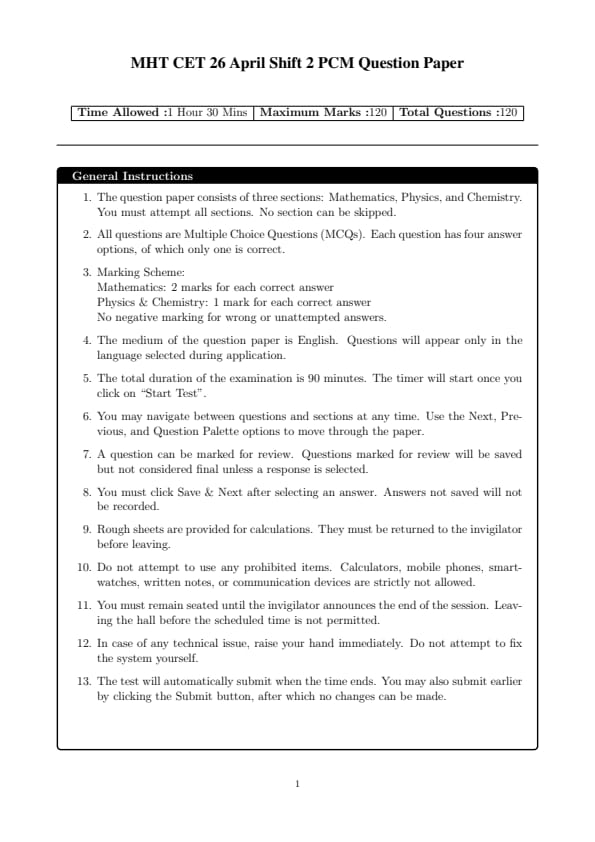
MHT CET 2025 April 26 Shift 2 Question Paper with Solution PDF is available for download here. MHT CET 2025 PCM Question Paper consists of 200 multiple-choice questions having 200 marks in total, divided into 3 sections: Physics, Chemistry, and Mathematics.
MHT CET 2025 April 26 Shift 2 Question Paper with Solutions PDF
| MHT CET 2025 April 26 Shift 2 Question Paper | Download PDF | Check Solutions |

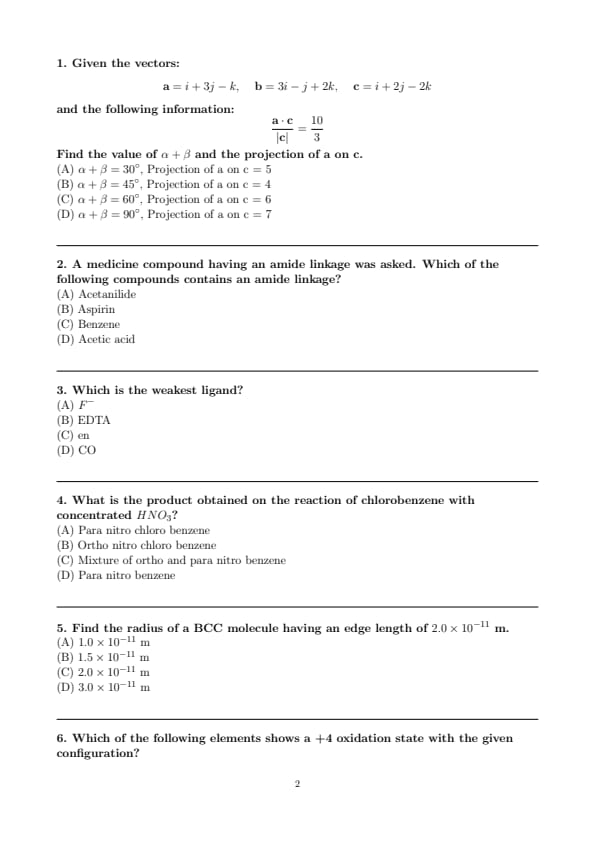
Given the vectors: \[ \mathbf{a} = i + 3j - k, \quad \mathbf{b} = 3i - j + 2k, \quad \mathbf{c} = i + 2j - 2k \]
and the following information: \[ \frac{\mathbf{a} \cdot \mathbf{c}}{|\mathbf{c}|} = \frac{10}{3} \]
Find the value of \(\alpha + \beta\) and the projection of \(\mathbf{a}\) on \(\mathbf{c}\).
View Solution
Step 1: Understanding the Concept:
The projection of a vector \(\mathbf{a}\) onto another vector \(\mathbf{c}\) is the scalar component of \(\mathbf{a}\) along the direction of \(\mathbf{c}\). The formula for scalar projection is: \[ Projection = \frac{\mathbf{a} \cdot \mathbf{c}}{|\mathbf{c}|} \]
Step 2: Calculating the Scalar Projection:
Given the vectors from the image: \[ \mathbf{a} = i + 3j - k \] \[ \mathbf{c} = i + 2j - 2k \]
First, calculate the dot product \(\mathbf{a} \cdot \mathbf{c}\): \[ \mathbf{a} \cdot \mathbf{c} = (1)(1) + (3)(2) + (-1)(-2) \] \[ \mathbf{a} \cdot \mathbf{c} = 1 + 6 + 2 = 9 \]
Next, calculate the magnitude of vector \(\mathbf{c}\) (\(|\mathbf{c}|\)): \[ |\mathbf{c}| = \sqrt{1^2 + 2^2 + (-2)^2} \] \[ |\mathbf{c}| = \sqrt{1 + 4 + 4} = \sqrt{9} = 3 \]
Now, substitute these values into the projection formula: \[ Projection = \frac{9}{3} = 3 \]
Step 3: Analyzing the Discrepancy:
The problem statement claims the projection is \(\frac{10}{3}\), but the calculation using the defined vectors yields \(3\). Additionally, the question asks for \(\alpha + \beta\), but the variables \(\alpha\) and \(\beta\) do not appear in the definition of vectors \(\mathbf{a}, \mathbf{b}, or \mathbf{c}\) provided in the image. This suggests that the question text in the image might be incomplete or contain typos (e.g., \(\mathbf{a}\) might have been intended as \(\alpha i + \beta j - k\)).
Since the calculated projection is 3 and no option corresponds to this value (Options are 5, 4, 6, 7), the question cannot be solved consistently with the provided text.
Final Answer: The calculated projection is 3. Quick Tip: In exams, if you encounter a clear data mismatch (like a calculated value not matching any option), re-read to ensure no variables (like \(\alpha\)) were missed. If the error persists, mark the option closest to your logic or leave it if negative marking applies, but conceptually, trust the formula: Projection = \(\frac{\mathbf{a} \cdot \mathbf{b}}{|\mathbf{b}|}\).
A medicine compound having an amide linkage was asked. Which of the following compounds contains an amide linkage?
View Solution
Step 1: Identifying the Amide Linkage:
An amide linkage is characterized by the functional group \(-CONH-\). This involves a carbonyl carbon (\(C=O\)) directly bonded to a nitrogen atom (\(N\)).
Step 2: Analyzing Each Option:
(A) Acetanilide (\(C_6H_5NHCOCH_3\)): This is an N-phenyl derivative of acetamide. The structure consists of a benzene ring attached to an \(NH\) group, which is attached to a carbonyl group (\(CO\)) and a methyl group (\(CH_3\)). The bond between the carbonyl carbon and the nitrogen is an **amide linkage**.
(B) Aspirin (Acetylsalicylic acid): The chemical structure contains a benzene ring with a carboxylic acid group (\(-COOH\)) and an ester group (\(-OCOCH_3\)). It does not contain an amide linkage.
(C) Benzene (\(C_6H_6\)): This is a simple aromatic hydrocarbon with no functional groups containing oxygen or nitrogen.
(D) Acetic acid (\(CH_3COOH\)): This contains a carboxylic acid group (\(-COOH\)), not an amide group.
Conclusion: Acetanilide is the only compound listed that possesses an amide linkage. Quick Tip: Pay attention to suffixes in chemical names: "-ide" in organic derivatives (like Acetanilide, Benzamide) often points to Amides. "-ate" often points to Esters or salts. "-ol" points to Alcohols or Phenols.
Which is the weakest ligand?
View Solution
Step 1: Understanding Ligand Strength:
The strength of a ligand refers to its ability to split the d-orbitals of the central metal ion (Crystal Field Splitting Energy, \(\Delta_o\)). This order is given by the **Spectrochemical Series**.
Step 2: Analyzing the Options using the Series:
The general increasing order of field strength is: \[ I^- < Br^- < SCN^- < Cl^- < S^{2-} < F^- < OH^- < H_2O < NCS^- < EDTA^{4-} < NH_3 < en < CN^- < CO \]
\(F^-\) (Fluoride): It is a halide donor and lies at the lower end of the series. It is a **weak field ligand**.
EDTA: It is a polydentate ligand and exerts a relatively strong field compared to halogens.
en (Ethylenediamine): It is a nitrogen donor and is a strong field ligand.
CO (Carbonyl): It is a \(\pi\)-acid ligand and has the strongest field strength due to synergic bonding.
Conclusion: Among the given choices, \(F^-\) causes the smallest splitting and is therefore the weakest ligand. Quick Tip: Remember the general grouping of ligands: \textbf{Weak Field:} Halogens (\(I^-, Cl^-, F^-\)), \(H_2O\), \(OH^-\). \textbf{Strong Field:} \(CN^-\), \(CO\), \(NO_2^-\), \(en\), \(NH_3\).
What is the product obtained on the reaction of chlorobenzene with concentrated \(HNO_3\)?
View Solution
Step 1: Reaction Identification:
The reaction of chlorobenzene with concentrated nitric acid (\(HNO_3\)) in the presence of concentrated sulfuric acid (\(H_2SO_4\)) is a **Nitration** reaction, which is an example of Electrophilic Aromatic Substitution.
Step 2: Directing Influence of Chlorine:
The substrate is Chlorobenzene. The chlorine atom has two opposing effects:
1. **-I Effect (Inductive):** It withdraws electrons, deactivating the ring.
2. **+M Effect (Mesomeric/Resonance):** It donates lone pair electrons into the ring, increasing electron density at the **ortho** and **para** positions.
Since resonance determines the orientation, the incoming electrophile (\(NO_2^+\)) is directed to the ortho and para positions.
Step 3: Products Formed:
Two isomers are formed:
1. **1-chloro-2-nitrobenzene (Ortho-nitrochlorobenzene):** Minor product due to steric hindrance between -Cl and -\(NO_2\).
2. **1-chloro-4-nitrobenzene (Para-nitrochlorobenzene):** Major product as it is more symmetric and has less steric repulsion.
Thus, the final product is a mixture of these two isomers. Option (C) best describes this outcome. Quick Tip: Key Rule for Electrophilic Substitution: Electron Donating Groups (e.g., \(-OH, -NH_2, -CH_3\)) \(\rightarrow\) ortho/para directing. Halogens (\(-Cl, -Br\)) \(\rightarrow\) Deactivating but ortho/para directing. Electron Withdrawing Groups (e.g., \(-NO_2, -COOH\)) \(\rightarrow\) meta directing.
Find the radius of a BCC molecule having an edge length of \(2.0 \times 10^{-11}\) m.
View Solution
Step 1: Formula for BCC Unit Cell:
In a Body-Centered Cubic (BCC) lattice, the atoms touch along the body diagonal of the cube. The body diagonal has a length of \(\sqrt{3}a\), where \(a\) is the edge length. This diagonal consists of one full atom in the center and two radii from the corner atoms. \[ Body Diagonal = 4r = \sqrt{3}a \]
Therefore, the radius \(r\) is: \[ r = \frac{\sqrt{3}}{4} a \]
Step 2: Calculation:
Given: \(a = 2.0 \times 10^{-11}\) m.
Substitute the value of \(a\): \[ r = \frac{1.732}{4} \times (2.0 \times 10^{-11}) \] \[ r = 1.732 \times \frac{2.0}{4} \times 10^{-11} \] \[ r = 1.732 \times 0.5 \times 10^{-11} \] \[ r = 0.866 \times 10^{-11} m \]
Step 3: Matching with Options:
The calculated value is \(0.866 \times 10^{-11}\) m.
Looking at the options:
(A) \(1.0 \times 10^{-11}\)
(B) \(1.5 \times 10^{-11}\)
(C) \(2.0 \times 10^{-11}\)
(D) \(3.0 \times 10^{-11}\)
The value \(0.866\) is closest to \(1.0\). Often in such problems, approximations like \(\sqrt{3} \approx 2\) might be erroneously implied by the question setter, or simply rounding to the nearest integer option is expected. Thus, (A) is the appropriate choice. Quick Tip: Geometric relations in cubic unit cells: **Simple Cubic:** Atoms touch along edge \(\rightarrow 2r = a\). **Face Centered (FCC):** Atoms touch along face diagonal \(\rightarrow 4r = \sqrt{2}a\). **Body Centered (BCC):** Atoms touch along body diagonal \(\rightarrow 4r = \sqrt{3}a\).
Which of the following elements shows a +4 oxidation state with the given configuration?
View Solution
Step 1: Analyzing Electronic Configurations:
Lanthanides generally show a +3 oxidation state. Stability of other states depends on attaining empty (\(f^0\)), half-filled (\(f^7\)), or fully-filled (\(f^{14}\)) subshells.
Step 2: Evaluating Each Option:
(A) Cerium (Ce, Z=58):
Ground State: \([Xe] 4f^1 5d^1 6s^2\).
Losing 4 electrons (\(Ce^{4+}\)) leads to \([Xe] 4f^0\).
This is a noble gas configuration, making the +4 state very stable.
(B) Terbium (Tb, Z=65):
Ground State: \([Xe] 4f^9 6s^2\).
It can exhibit +4 state (\(Tb^{4+}\) corresponds to \(4f^7\), half-filled stability), but Ce is the most characteristic element for the +4 state in basic chemistry curricula.
(C) Europium (Eu, Z=63):
Ground State: \([Xe] 4f^7 6s^2\).
It typically shows +2 oxidation state (\(Eu^{2+} \rightarrow 4f^7\)) because losing 2 s-electrons leaves a stable half-filled f-shell.
(D) Lutetium (Lu, Z=71):
Ground State: \([Xe] 4f^{14} 5d^1 6s^2\).
It shows +3 oxidation state (\(Lu^{3+} \rightarrow 4f^{14}\)) which is stable due to a fully filled f-shell.
Conclusion: Cerium (Ce) is the element most famously associated with a stable +4 oxidation state (\(Ce^{4+}\) is a strong oxidizing agent used in titrations). Quick Tip: Key Oxidation State Exceptions in Lanthanides: \textbf{Ce (+4):} attains noble gas config (\(f^0\)). \textbf{Eu (+2), Yb (+2):} attain half-filled (\(f^7\)) and full (\(f^{14}\)) shells respectively.
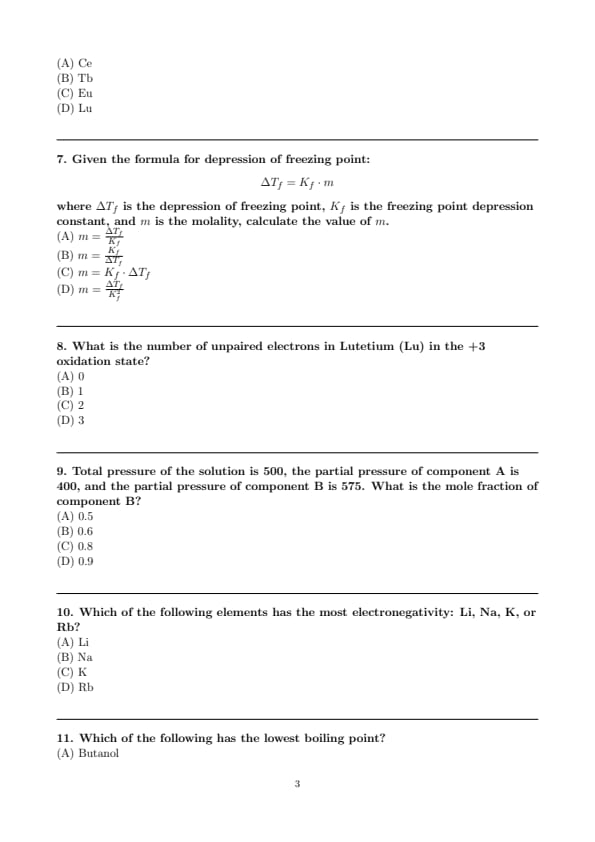
Given the formula for depression of freezing point: \[ \Delta T_f = K_f \cdot m \]
where \(\Delta T_f\) is the depression of freezing point, \(K_f\) is the freezing point depression constant, and \(m\) is the molality, calculate the value of \(m\).
View Solution
Step 1: Algebraic Manipulation:
The relationship is given by the linear equation: \[ \Delta T_f = K_f \times m \]
To isolate the variable \(m\) (molality), we must divide both sides of the equation by \(K_f\).
Step 2: Rearrangement: \[ \frac{\Delta T_f}{K_f} = \frac{K_f \times m}{K_f} \] \[ m = \frac{\Delta T_f}{K_f} \]
This matches Option (A). Quick Tip: This is a simple linear rearrangement (\(y = kx \implies x = y/k\)). Always check units: \(\Delta T_f\) (K), \(K_f\) (K kg mol\(^{-1}\)), \(m\) (mol kg\(^{-1}\)). Dividing K by (K kg mol\(^{-1}\)) gives (mol kg\(^{-1}\)), which is the correct unit for molality.
What is the number of unpaired electrons in Lutetium (Lu) in the +3 oxidation state?
View Solution
Step 1: Determine Atomic Number and Configuration:
Lutetium (Lu) is the last lanthanide element with atomic number \(Z = 71\).
The electronic configuration of neutral Lu is: \[ [Xe] 4f^{14} 5d^1 6s^2 \]
Step 2: Form the Ion \(Lu^{3+}\):
To form the +3 ion, the atom loses its 3 outermost electrons. The order of removal is:
1. Two electrons from \(6s\).
2. One electron from \(5d\).
So, \(Lu^{3+}\) configuration becomes: \[ [Xe] 4f^{14} \]
Step 3: Count Unpaired Electrons:
The \(4f\) subshell has 7 orbitals. According to Hund's rule and the Pauli exclusion principle, a capacity of 14 electrons means the subshell is completely filled (\(14\) electrons). \[ Number of electrons = 14 \]
Since all orbitals are doubly occupied, there are **zero** unpaired electrons. The ion is diamagnetic. Quick Tip: If an ion has a configuration of \(f^0\) (like \(La^{3+}, Ce^{4+}\)) or \(f^{14}\) (like \(Yb^{2+}, Lu^{3+}\)), it has 0 unpaired electrons and is diamagnetic (colorless).
Total pressure of the solution is 500, the partial pressure of component A is 400, and the partial pressure of component B is 575. What is the mole fraction of component B?
View Solution
Step 1: Interpreting the Data:
The phrasing "partial pressure of component A is 400" in this context refers to the **Vapor Pressure of Pure Component A** (\(P_A^\circ\)) because the total pressure lies between the two component pressures. If 400 and 575 were partial pressures in the mixture (\(p_A, p_B\)), their sum would be the total (\(400+575=975\)), which contradicts the given total of 500.
Thus: \[ P_A^\circ = 400 \] \[ P_B^\circ = 575 \] \[ P_{total} = 500 \]
Step 2: Applying Raoult's Law:
The total pressure is given by: \[ P_{total} = P_A^\circ x_A + P_B^\circ x_B \]
Since \(x_A + x_B = 1\), we can substitute \(x_A = 1 - x_B\): \[ P_{total} = P_A^\circ (1 - x_B) + P_B^\circ x_B \] \[ P_{total} = P_A^\circ - P_A^\circ x_B + P_B^\circ x_B \] \[ P_{total} = P_A^\circ + (P_B^\circ - P_A^\circ)x_B \]
Step 3: Calculating \(x_B\):
Substitute the values: \[ 500 = 400 + (575 - 400)x_B \] \[ 500 - 400 = 175 x_B \] \[ 100 = 175 x_B \] \[ x_B = \frac{100}{175} \]
Simplifying the fraction: \[ x_B = \frac{4}{7} \approx 0.571 \]
Step 4: Selecting the Correct Option:
The calculated value \(0.57\) is closest to Option (B) 0.6. Given the typical rounding in such exam questions, 0.6 is the intended answer. Quick Tip: Check logic: Since \(P_{total}\) (500) is closer to \(P_B^\circ\) (575) than to \(P_A^\circ\) (400), the mole fraction of B (\(x_B\)) should be greater than 0.5. Our result \(0.57 > 0.5\) confirms this.
Which of the following elements has the most electronegativity: Li, Na, K, or Rb?
View Solution
Step 1: Periodic Trend for Electronegativity:
Electronegativity is a measure of an atom's ability to attract shared electrons.
**Across a Period:** Electronegativity increases.
**Down a Group:** Electronegativity decreases because the atomic radius increases (valence electrons are further from the nucleus) and the shielding effect increases.
Step 2: Analyzing the Options:
The elements Li (Lithium), Na (Sodium), K (Potassium), and Rb (Rubidium) all belong to **Group 1 (Alkali Metals)**.
Their order down the group is: \[ Li \rightarrow Na \rightarrow K \rightarrow Rb \]
Since electronegativity decreases down the group, the element at the top (Lithium) has the highest electronegativity.
Values (Pauling scale): Li (0.98), Na (0.93), K (0.82), Rb (0.82).
Conclusion: Lithium (Li) is the most electronegative among the choices. Quick Tip: Smallest atom in a group \(\rightarrow\) Highest Electronegativity. Largest atom in a group \(\rightarrow\) Lowest Electronegativity (usually).
Which of the following has the lowest boiling point?
View Solution
Step 1: Relationship between Mass and Boiling Point:
For a homologous series of organic compounds (like alcohols), the boiling point typically **increases** as the molecular mass increases. This is because larger molecules have larger surface areas, leading to stronger **Van der Waals (dispersion) forces** between molecules.
Step 2: Comparing the Options:
All options are primary alcohols. Let's compare their carbon chain lengths:
(D) Methanol: \(CH_3OH\) (1 Carbon) \(\rightarrow\) Smallest Mass.
(C) Ethanol: \(C_2H_5OH\) (2 Carbons).
(B) Propanol: \(C_3H_7OH\) (3 Carbons).
(A) Butanol: \(C_4H_9OH\) (4 Carbons) \(\rightarrow\) Largest Mass.
Conclusion: Methanol has the shortest carbon chain and the lowest molecular weight, resulting in the weakest intermolecular forces among the group. Therefore, it has the lowest boiling point. Quick Tip: General Boiling Point Trend: Acid > Alcohol > Ketone > Aldehyde > Ether > Hydrocarbon (for comparable mass). Within alcohols: Methanol < Ethanol < Propanol < Butanol.
*The article might have information for the previous academic years, please refer the official website of the exam.