
MHT CET 2026 April 23 Shift 1 PCB Question Paper with Solution PDF


| Updated On - Apr 23, 2026
The State Common Entrance Test Cell, Maharashtra, conducted MHT CET 2026 PCB exam on April 23 in Shift 1 from 9 AM to 12 PM in CBT Mode. The MHT CET 2026 question paper includes three sections: Physics, Chemistry, and Biology (Botany & Zoology) with multiple-choice questions carrying a total of 200 marks. As per the MHT CET marking scheme, 1 mark is awarded for every correct answer and no marks are deducted for wrong answers.
MHT CET 2026 April 23 Shift 1 PCB Question Paper with Solution PDF is available here for download.
MHT CET 2026 April 23 Shift 1 PCB Question Paper with Solution PDF
| MHT CET 2026 April 23 Shift 1 Question Paper | Download PDF | Check Solutions |

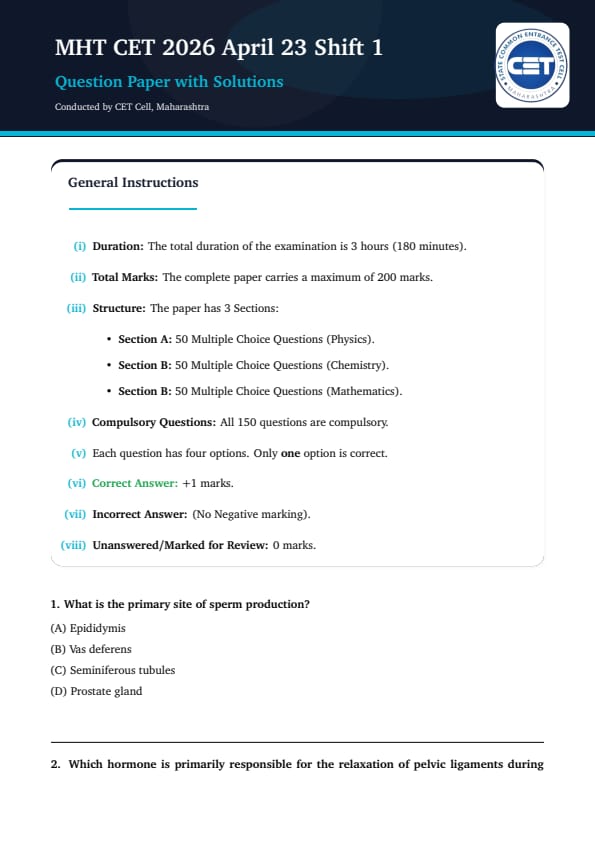
What is the primary site of sperm production?
View Solution
Concept:
The process of sperm production is known as spermatogenesis. It occurs in the male reproductive system and involves the formation of sperm cells from germ cells through a series of mitotic and meiotic divisions followed by differentiation. The testes are the primary reproductive organs in males, and within them are highly coiled structures called seminiferous tubules, which serve as the exact site of sperm formation.
Step 1: Understanding the structure of testes
The testes are composed of numerous lobules, and each lobule contains tightly coiled seminiferous tubules. These tubules are lined with germinal epithelium, which contains spermatogenic cells (precursors to sperm) and Sertoli cells that provide nourishment and structural support.
Step 2: Identifying the site of spermatogenesis
Spermatogenesis takes place inside the seminiferous tubules. Here, spermatogonia undergo mitosis and meiosis to eventually form haploid sperm cells (spermatozoa). This makes seminiferous tubules the primary and most crucial site for sperm production.
Step 3: Role of other structures (elimination of options)
Epididymis: It stores and allows maturation of sperm but does not produce them.
Vas deferens: It transports sperm from the epididymis to the urethra.
Prostate gland: It secretes fluid that forms part of semen but is not involved in sperm production.
Conclusion:
Since spermatogenesis occurs specifically in the seminiferous tubules, they are the primary site of sperm production. Quick Tip: Remember: \textit{“Seminiferous tubules = Sperm factory”.
Other parts like epididymis (storage), vas deferens (transport), and glands (secretion) support reproduction but do not produce sperm.
Which hormone is primarily responsible for the relaxation of pelvic ligaments during childbirth?
View Solution
Concept:
During pregnancy and childbirth, certain hormones prepare the female body for delivery. One crucial requirement is the relaxation and loosening of pelvic ligaments to allow the passage of the baby through the birth canal. This function is mainly carried out by the hormone relaxin, which is secreted by the ovaries and placenta.
Step 1: Understanding the role of hormones in childbirth
Different hormones perform specific roles:
Estrogen: Promotes growth of reproductive organs.
Progesterone: Maintains pregnancy by supporting the uterine lining.
Oxytocin: Stimulates uterine contractions during labor.
Step 2: Identifying the hormone responsible for ligament relaxation
Relaxin specifically acts on the pelvic ligaments and pubic symphysis, making them more flexible. This increases the diameter of the birth canal, facilitating childbirth.
Conclusion:
Thus, the hormone responsible for relaxation of pelvic ligaments during childbirth is relaxin. Quick Tip: \textit{Relaxin = Relaxation of ligaments.
It helps widen the pelvis for smooth delivery.
The interaction where one species is harmed and the other is unaffected is called?
View Solution
Concept:
In ecology, interactions between species can have positive, negative, or neutral effects. These interactions are classified based on how each organism is affected.
Step 1: Understanding types of interactions
Mutualism: Both species benefit (+, +)
Commensalism: One benefits, the other is unaffected (+, 0)
Parasitism: One benefits, the other is harmed (+, --)
Amensalism: One is harmed, the other is unaffected (0, --)
Step 2: Identifying the correct interaction
The question specifies that one species is harmed while the other is unaffected. This perfectly matches the definition of amensalism.
Conclusion:
Therefore, the correct term is amensalism. Quick Tip: \textit{Amensalism = "A" for affected (harmed), other is neutral.
Example: Antibiotics killing bacteria without affecting humans directly.
Which respiratory volume cannot be measured using a simple spirometer?
View Solution
Concept:
A spirometer is an instrument used to measure different respiratory volumes and capacities by recording the amount of air inhaled and exhaled by the lungs. However, it can only measure the volumes of air that move in and out of the lungs. Any volume of air that remains inside the lungs and cannot be expelled cannot be directly measured using a simple spirometer.
Step 1: Understanding respiratory volumes
The main respiratory volumes include:
Tidal Volume (TV): The volume of air inhaled or exhaled during normal breathing.
Inspiratory Reserve Volume (IRV): The extra amount of air that can be inhaled after a normal inspiration.
Expiratory Reserve Volume (ERV): The additional air that can be forcefully exhaled after normal expiration.
Residual Volume (RV): The air that remains in the lungs even after a forceful exhalation.
Step 2: Identifying the volume not measurable by spirometer
Residual Volume remains inside the lungs and prevents lung collapse by maintaining alveolar inflation. Since this air cannot be exhaled, a spirometer cannot measure it directly.
Conclusion:
Thus, the respiratory volume that cannot be measured using a simple spirometer is Residual Volume. Quick Tip: Remember: A spirometer measures only the air that moves in and out of the lungs.
Residual Volume always remains in the lungs and therefore cannot be measured by spirometry.
What is the vector responsible for transmitting Filariasis?
View Solution
Concept:
Filariasis is a parasitic disease caused by thread-like nematode worms such as \textit{Wuchereria bancrofti and \textit{Brugia malayi. These parasites affect the lymphatic system and can lead to a condition known as elephantiasis, characterized by swelling of body parts due to lymphatic blockage.
Step 1: Understanding disease transmission
Filariasis is not transmitted directly from person to person. Instead, it spreads through a vector organism that carries the parasite from an infected individual to a healthy one.
Step 2: Identifying the vector
The primary vector responsible for transmitting the filarial parasite is the female Culex mosquito. When this mosquito bites an infected person, it ingests microfilariae (larval forms of the parasite). These larvae develop inside the mosquito and are later transmitted to another human during subsequent bites.
Step 3: Eliminating other options
Female Anopheles mosquito: Vector for malaria.
Aedes mosquito: Vector for dengue, chikungunya, and yellow fever.
Sandfly: Vector for leishmaniasis.
Conclusion:
Therefore, the vector responsible for transmitting Filariasis is the female Culex mosquito. Quick Tip: Remember the vector–disease pairs:
Anopheles → Malaria
Aedes → Dengue
Culex → Filariasis
Which part of the brain acts as the primary regulator for body temperature and hunger?
View Solution
Concept:
The brain contains several regions responsible for maintaining internal body balance, known as homeostasis. One of the most important regulatory centers for maintaining this balance is the hypothalamus.
Step 1: Understanding the hypothalamus
The hypothalamus is a small but vital part of the forebrain located below the thalamus. It connects the nervous system with the endocrine system through the pituitary gland and regulates several physiological processes.
Step 2: Functions of the hypothalamus
The hypothalamus controls many essential functions including:
Regulation of body temperature
Control of hunger and thirst
Regulation of sleep and circadian rhythms
Control of hormone release through the pituitary gland
Step 3: Eliminating other options
Cerebellum: Coordinates balance and voluntary movements.
Medulla oblongata: Controls involuntary functions such as heartbeat and breathing.
Cerebrum: Responsible for thinking, memory, and voluntary actions.
Conclusion:
Thus, the part of the brain that primarily regulates body temperature and hunger is the hypothalamus. Quick Tip: Think of the hypothalamus as the body's “thermostat and hunger control center,” maintaining internal balance and homeostasis.
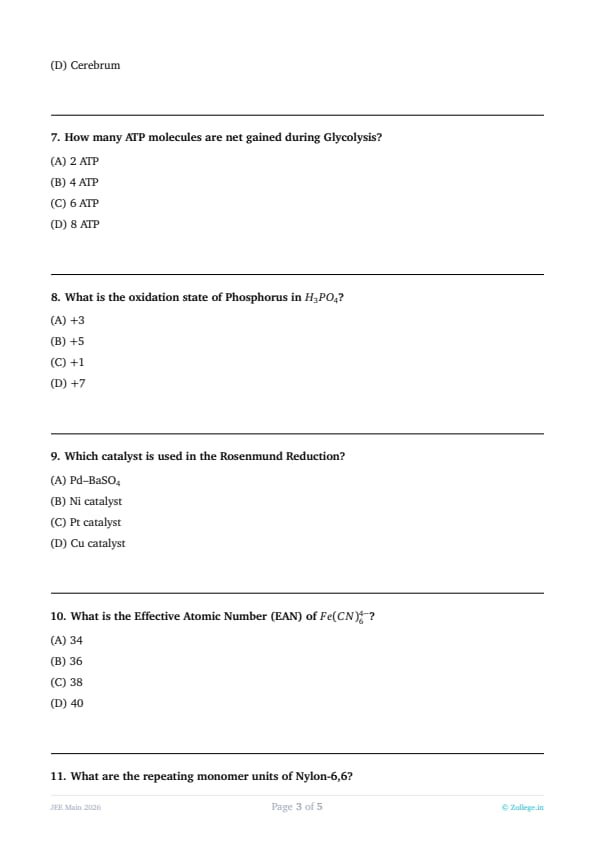
How many ATP molecules are net gained during Glycolysis?
View Solution
Concept:
Glycolysis is the first step of cellular respiration and occurs in the cytoplasm of the cell. In this process, one molecule of glucose (a six-carbon compound) is broken down into two molecules of pyruvate (three-carbon compounds). Glycolysis does not require oxygen and therefore occurs in both aerobic and anaerobic conditions.
During glycolysis, energy is released and captured in the form of ATP (adenosine triphosphate) and NADH molecules.
Step 1: ATP investment phase
At the beginning of glycolysis, the cell must invest energy to activate the glucose molecule. Two ATP molecules are used in the early steps of the pathway. These ATP molecules help phosphorylate glucose and its intermediates, preparing them for further breakdown.
Step 2: ATP generation phase
In the later steps of glycolysis, energy is released as the intermediates are converted into pyruvate. During this stage, four ATP molecules are produced through substrate-level phosphorylation.
Step 3: Calculating the net ATP gain
Although four ATP molecules are produced, two ATP molecules were already consumed in the earlier stage.
\[ Net ATP gain = ATP produced - ATP consumed \]
\[ = 4 - 2 = 2 ATP \]
Conclusion:
Therefore, the net gain of ATP molecules during glycolysis is 2 ATP per molecule of glucose. Quick Tip: In glycolysis:
ATP used = 2
ATP produced = 4
Net ATP gain = \textbf{2 ATP}.
What is the oxidation state of Phosphorus in \( H_3PO_4 \)?
View Solution
Concept:
The oxidation state (or oxidation number) of an element represents the hypothetical charge it would have if all bonds were completely ionic. In a compound, the sum of oxidation states of all atoms must equal the overall charge of the molecule.
For neutral molecules, the total oxidation state equals zero.
Step 1: Assign known oxidation states
In \(H_3PO_4\):
Hydrogen generally has an oxidation state of \(+1\).
Oxygen generally has an oxidation state of \(-2\).
Step 2: Let the oxidation state of phosphorus be \(x\)
\[ 3(+1) + x + 4(-2) = 0 \]
Step 3: Solve the equation
\[ 3 + x - 8 = 0 \]
\[ x - 5 = 0 \]
\[ x = +5 \]
Conclusion:
The oxidation state of phosphorus in \(H_3PO_4\) is \(\mathbf{+5}\). Quick Tip: To find oxidation states in neutral molecules, remember:
\textbf{Sum of oxidation numbers = 0}.
Which catalyst is used in the Rosenmund Reduction?
View Solution
Concept:
Rosenmund Reduction is an important organic reaction used to convert acid chlorides into aldehydes. The reaction involves hydrogenation of acid chlorides in the presence of a specially poisoned palladium catalyst.
Step 1: Understanding the reaction
\[ RCOCl + H_2 \rightarrow RCHO + HCl \]
In this reaction, the acid chloride is reduced to an aldehyde.
Step 2: Role of the catalyst
The catalyst used is palladium deposited on barium sulfate (\(Pd-BaSO_4\)). The catalyst is often ``poisoned'' with substances such as sulfur or quinoline to prevent further reduction of the aldehyde to alcohol.
Step 3: Importance of poisoning
Without poisoning, the aldehyde formed could be further reduced to a primary alcohol. The poisoned catalyst ensures the reaction stops at the aldehyde stage.
Conclusion:
Thus, the catalyst used in Rosenmund Reduction is Pd–BaSO\(_4\), commonly known as the Rosenmund catalyst. Quick Tip: \textbf{Rosenmund Reduction:}
Acid Chloride \(\rightarrow\) Aldehyde using \(Pd-BaSO_4\).
What is the Effective Atomic Number (EAN) of \(Fe(CN)_6^{4-}\)?
View Solution
Concept:
The Effective Atomic Number (EAN) rule states that a metal atom in a coordination compound tends to achieve the electronic configuration of the nearest noble gas after accepting electrons from ligands.
\[ EAN = Z - oxidation state + electrons donated by ligands \]
where \(Z\) is the atomic number of the metal.
Step 1: Determine the atomic number of iron
Iron (\(Fe\)) has atomic number:
\[ Z = 26 \]
Step 2: Determine oxidation state of iron
Each \(CN^-\) ligand carries a charge of \(-1\).
In \(Fe(CN)_6^{4-}\):
\[ x + 6(-1) = -4 \]
\[ x - 6 = -4 \]
\[ x = +2 \]
So iron is in the \(+2\) oxidation state.
Step 3: Calculate electron donation from ligands
Each \(CN^-\) ligand donates 2 electrons.
\[ 6 \times 2 = 12 electrons \]
Step 4: Apply the EAN formula
\[ EAN = 26 - 2 + 12 \]
\[ EAN = 36 \]
Conclusion:
The Effective Atomic Number of \(Fe(CN)_6^{4-}\) is \(\mathbf{36}\), which corresponds to the noble gas configuration of krypton. Quick Tip: For coordination compounds:
\textbf{EAN = Atomic number – Oxidation state + electrons donated by ligands}.
What are the repeating monomer units of Nylon-6,6?
View Solution
Concept:
Nylon-6,6 is a synthetic polyamide polymer produced by a condensation polymerization reaction between a dicarboxylic acid and a diamine. During the reaction, monomers join together with the elimination of small molecules such as water. The numbers in the name Nylon-6,6 indicate the number of carbon atoms present in each of the two monomers used to form the polymer.
Step 1: Identify the monomers involved
Nylon-6,6 is formed from the following two monomers:
Adipic acid \((HOOC-(CH_2)_4-COOH)\), which contains 6 carbon atoms.
Hexamethylenediamine \((H_2N-(CH_2)_6-NH_2)\), which also contains 6 carbon atoms.
Step 2: Understand the polymerization reaction
During condensation polymerization, the carboxyl group (\(-COOH\)) of adipic acid reacts with the amine group (\(-NH_2\)) of hexamethylenediamine. This reaction forms an amide linkage (\(-CONH-\)) while releasing a molecule of water.
\[ HOOC-(CH_2)_4-COOH + H_2N-(CH_2)_6-NH_2 \rightarrow Nylon-6,6 + H_2O \]
Step 3: Formation of repeating units
The repeating unit of Nylon-6,6 contains amide bonds that connect alternating segments derived from adipic acid and hexamethylenediamine. These repeating units give nylon its strong and durable polymer structure.
Conclusion:
Therefore, the repeating monomer units used to produce Nylon-6,6 are Adipic acid and Hexamethylenediamine. Quick Tip: The numbers in \textbf{Nylon-6,6} represent the number of carbon atoms in each monomer:
6 carbons from adipic acid and 6 carbons from hexamethylenediamine.
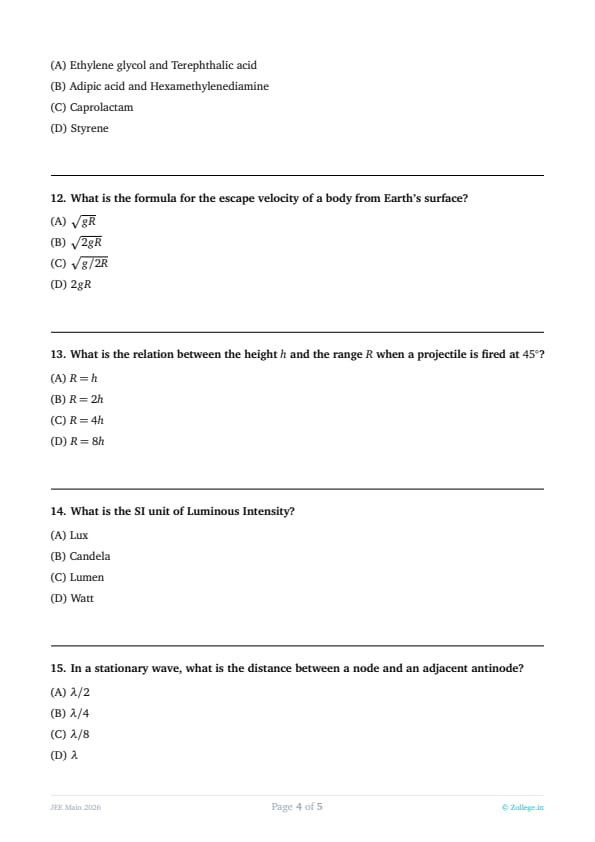
What is the formula for the escape velocity of a body from Earth's surface?
View Solution
Concept:
Escape velocity is the minimum velocity required for an object to escape completely from the gravitational field of a planet without any further propulsion. When an object is projected upward with this velocity, it can move infinitely far away from the planet with zero final velocity.
The escape velocity depends on the gravitational field strength and the radius of the planet.
Step 1: General formula for escape velocity
\[ v_e = \sqrt{\frac{2GM}{R}} \]
where:
\(G\) = gravitational constant
\(M\) = mass of the Earth
\(R\) = radius of the Earth
Step 2: Using the relation \(g = \frac{GM}{R^2}\)
Substituting into the formula gives:
\[ v_e = \sqrt{2gR} \]
Conclusion:
Thus, the escape velocity of a body from Earth's surface is \(\mathbf{\sqrt{2gR}}\). Quick Tip: Escape velocity depends only on the planet's gravity and radius. For Earth, its approximate value is \(11.2\,km/s\).
What is the relation between the height \(h\) and the range \(R\) when a projectile is fired at \(45^\circ\)?
View Solution
Concept:
In projectile motion, the maximum height and horizontal range depend on the initial velocity and the angle of projection. When the angle of projection is \(45^\circ\), the projectile achieves maximum horizontal range.
Step 1: Formula for maximum height
\[ h = \frac{u^2 \sin^2\theta}{2g} \]
For \(\theta = 45^\circ\):
\[ \sin^2 45^\circ = \frac{1}{2} \]
\[ h = \frac{u^2}{4g} \]
Step 2: Formula for horizontal range
\[ R = \frac{u^2 \sin 2\theta}{g} \]
For \(\theta = 45^\circ\):
\[ \sin 90^\circ = 1 \]
\[ R = \frac{u^2}{g} \]
Step 3: Find relation between \(R\) and \(h\)
\[ h = \frac{u^2}{4g} \]
\[ R = \frac{u^2}{g} \]
\[ R = 4h \]
Conclusion:
Thus, when a projectile is fired at \(45^\circ\), the relation between range and maximum height is \(\mathbf{R = 4h}\). Quick Tip: For a projectile at \(45^\circ\): Range = \(4 \times\) Maximum Height.
What is the SI unit of Luminous Intensity?
View Solution
Concept:
Luminous intensity is a photometric quantity that measures the amount of visible light emitted by a source in a particular direction. It represents how bright a light source appears in a given direction.
In the International System of Units (SI), luminous intensity is one of the seven fundamental physical quantities.
Step 1: Identify the SI base unit
The SI base unit for luminous intensity is the candela (cd).
Step 2: Understanding other related units
Lumen: Unit of luminous flux.
Lux: Unit of illumination.
Watt: Unit of power.
Conclusion:
Thus, the SI unit of luminous intensity is Candela. Quick Tip: Among the seven SI base units, \textbf{Candela} represents luminous intensity.
In a stationary wave, what is the distance between a node and an adjacent antinode?
View Solution
Concept:
A stationary wave (or standing wave) is formed by the superposition of two waves of the same frequency and amplitude traveling in opposite directions. This results in fixed points called nodes and antinodes.
Step 1: Understanding nodes and antinodes
Node: A point where the displacement is always zero.
Antinode: A point where the displacement is maximum.
Step 2: Distance relationships in stationary waves
In a stationary wave:
Distance between two consecutive nodes = \(\lambda/2\)
Distance between two consecutive antinodes = \(\lambda/2\)
Distance between a node and the nearest antinode = \(\lambda/4\)
Conclusion:
Therefore, the distance between a node and the adjacent antinode is \(\mathbf{\lambda/4}\). Quick Tip: Standing wave distances: Node to Node = \(\lambda/2\) Antinode to Antinode = \(\lambda/2\) Node to Antinode = \(\lambda/4\).


MHT CET 2026 Biology Most Important Questions
*The article might have information for the previous academic years, please refer the official website of the exam.