
MHT CET 2026 May 13 Shift 2 PCM Question Paper with Solution Pdf


| Updated On - May 30, 2026
The State Common Entrance Test Cell, Maharashtra conducted MHT CET 2026 May 13 Shift 2 PCM from 2 PM to 5 PM in CBT Mode. The MHT CET 2026 today’s question paper includes three sections: Physics, Chemistry, and Mathematics with multiple-choice questions carrying a total of 200 marks, as per the MHT CET marking scheme, where 1 mark is awarded for every correct answer and no marks are deducted for wrong answers.
MHT CET 2026 May 13 Shift 2 PCM Question Paper with Solution Pdf is available here for download.
MHT CET 2026 May 13 Shift 2 PCM Question Paper with Solution PDF
| MHT CET 2026 May 13 Shift 2 Question Paper | Download PDF | Check Solutions |
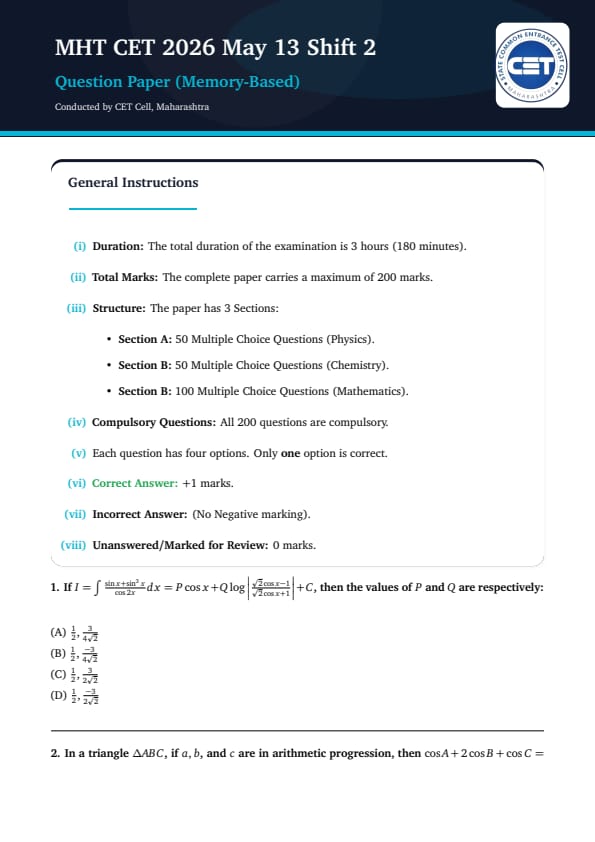
If \( I = \int \frac{\sin x+\sin^{3} x}{\cos 2x} d x = P \cos x+Q \log \left|\frac{\sqrt{2} \cos x-1}{\sqrt{2} \cos x+1}\right|+C \), then the values of \( P \) and \( Q \) are respectively:
In a triangle \( \Delta ABC \), if \( a, b \), and \( c \) are in arithmetic progression, then \( \cos A + 2 \cos B + \cos C = \)
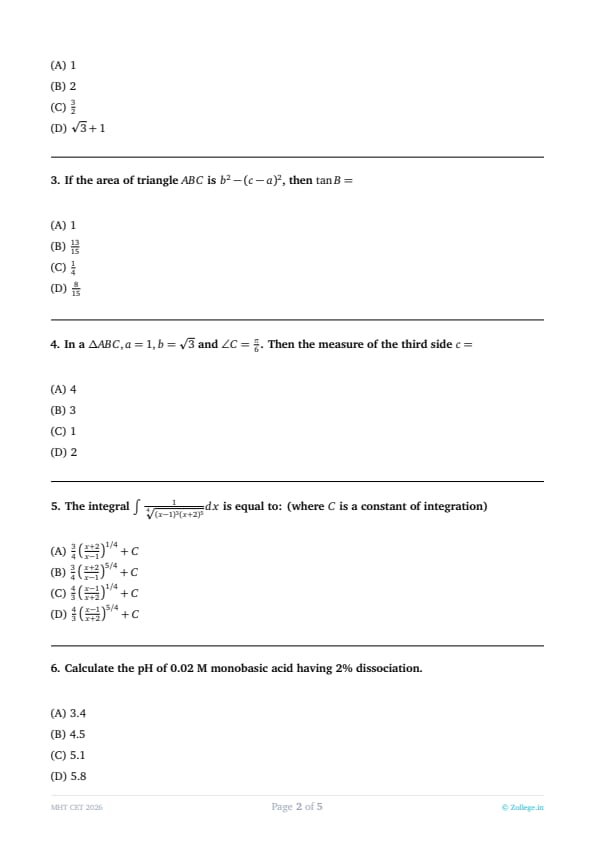
If the area of triangle \( ABC \) is \( b^2-(c-a)^2 \), then \( \tan B = \)
In a \( \Delta ABC, a=1, b=\sqrt{3} \) and \( \angle C = \frac{\pi}{6} \). Then the measure of the third side \( c = \)
The integral \( \int \frac{1}{\sqrt[4]{(x-1)^{3}(x+2)^{5}}} d x \) is equal to: (where \( C \) is a constant of integration)
Calculate the pH of 0.02 M monobasic acid having 2% dissociation.
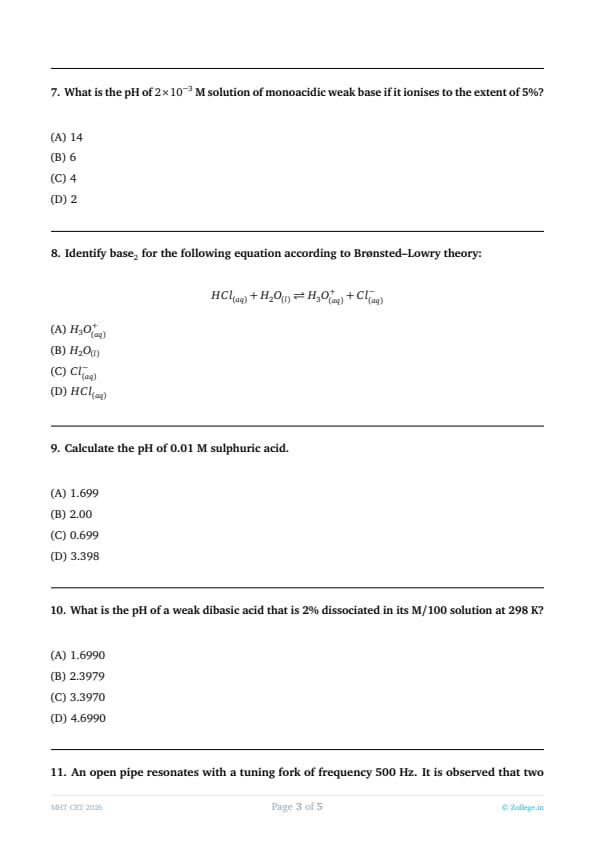
What is the pH of \( 2 \times 10^{-3} \) M solution of monoacidic weak base if it ionises to the extent of 5%?
Identify base\(_2\) for the following equation according to Brønsted–Lowry theory:
\[ HCl_{(aq)} + H_2O_{(l)} \rightleftharpoons H_3O^+_{(aq)} + Cl^-_{(aq)} \]
Calculate the pH of 0.01 M sulphuric acid.
What is the pH of a weak dibasic acid that is 2% dissociated in its M/100 solution at 298 K?
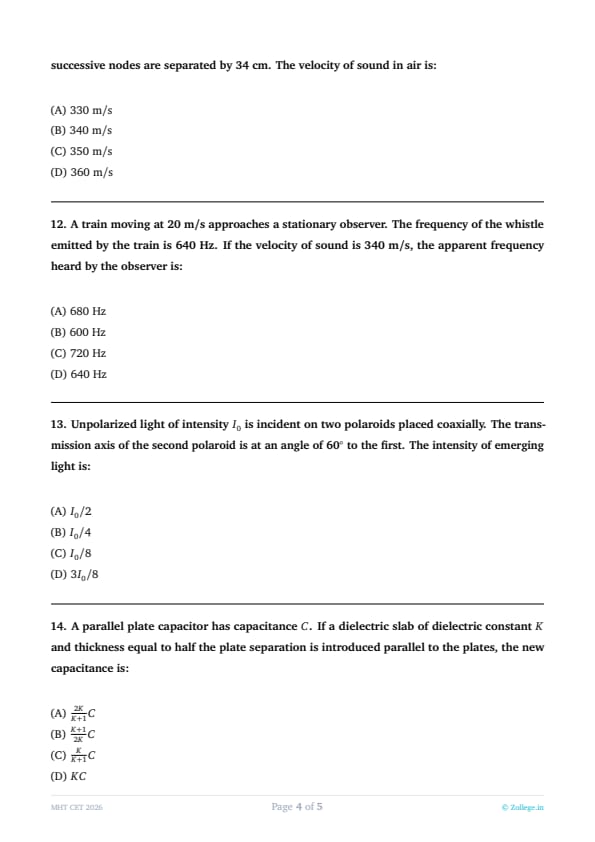
An open pipe resonates with a tuning fork of frequency 500 Hz. It is observed that two successive nodes are separated by 34 cm. The velocity of sound in air is:
A train moving at 20 m/s approaches a stationary observer. The frequency of the whistle emitted by the train is 640 Hz. If the velocity of sound is 340 m/s, the apparent frequency heard by the observer is:
Unpolarized light of intensity \( I_0 \) is incident on two polaroids placed coaxially. The transmission axis of the second polaroid is at an angle of 60\(^\circ\) to the first. The intensity of emerging light is:
A parallel plate capacitor has capacitance \( C \). If a dielectric slab of dielectric constant \( K \) and thickness equal to half the plate separation is introduced parallel to the plates, the new capacitance is:
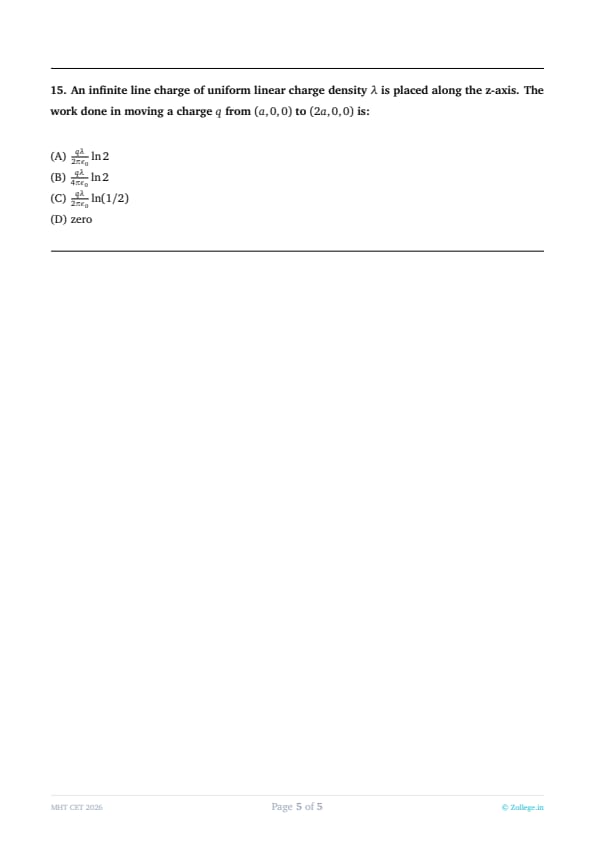
An infinite line charge of uniform linear charge density \( \lambda \) is placed along the z-axis. The work done in moving a charge \( q \) from \( (a, 0, 0) \) to \( (2 a, 0, 0) \) is:
MHT CET 2026 2nd Attempt Paper Analysis
*The article might have information for the previous academic years, please refer the official website of the exam.