
MHT CET 2026 May 15 Shift 1 PCM Question Paper with Solution Pdf


| Updated On - May 30, 2026
The State Common Entrance Test Cell, Maharashtra conducted MHT CET 2026 May 15 Shift 1 PCM from 9 AM to 12 PM in CBT Mode. The MHT CET 2026 today’s question paper includes three sections: Physics, Chemistry, and Mathematics with multiple-choice questions carrying a total of 200 marks, as per the MHT CET marking scheme, where 1 mark is awarded for every correct answer and no marks are deducted for wrong answers.
MHT CET 2026 May 15 Shift 1 PCM Question Paper with Solution Pdf is available here for download.
MHT CET 2026 May 15 Shift 1 PCM Question Paper with Solution PDF
| MHT CET 2026 May 15 Shift 1 Question Paper | Download PDF | Check Solutions |
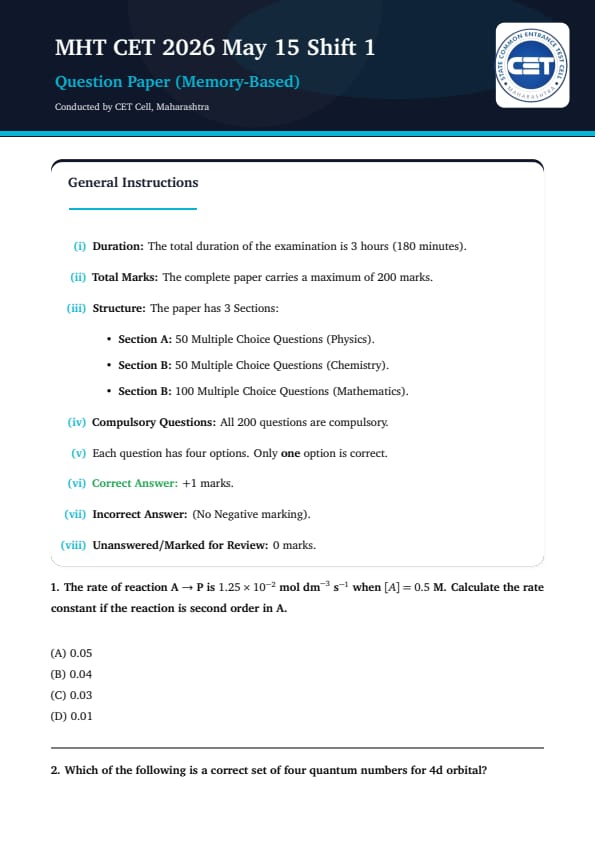
The rate of reaction A \(\to\) P is \(1.25 \times 10^{-2} mol dm^{-3} s^{-1}\) when \([A] = 0.5 M\). Calculate the rate constant if the reaction is second order in A.
Which of the following is a correct set of four quantum numbers for 4d orbital?
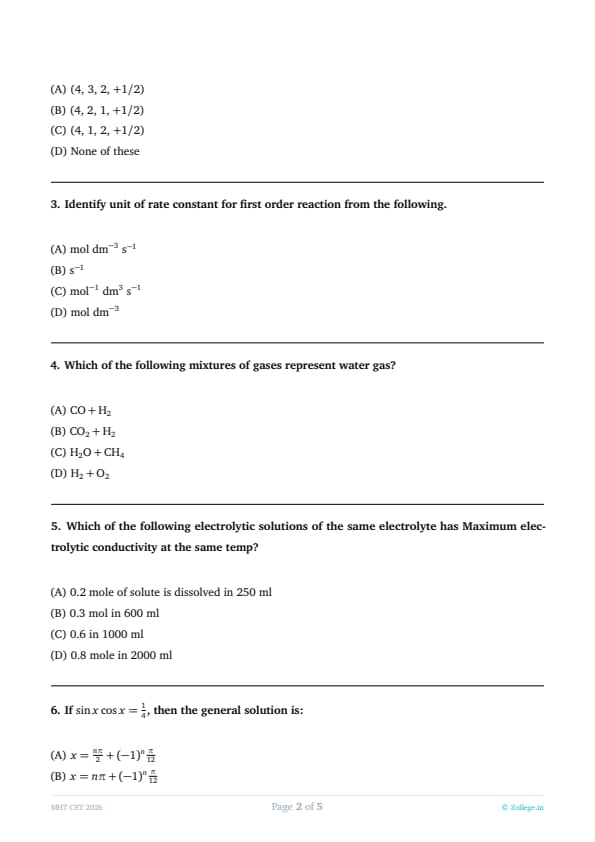
Identify unit of rate constant for first order reaction from the following.
Which of the following mixtures of gases represent water gas?
Which of the following electrolytic solutions of the same electrolyte has Maximum electrolytic conductivity at the same temp?
If \(\sin x \cos x = \frac{1}{4}\), then the general solution is:
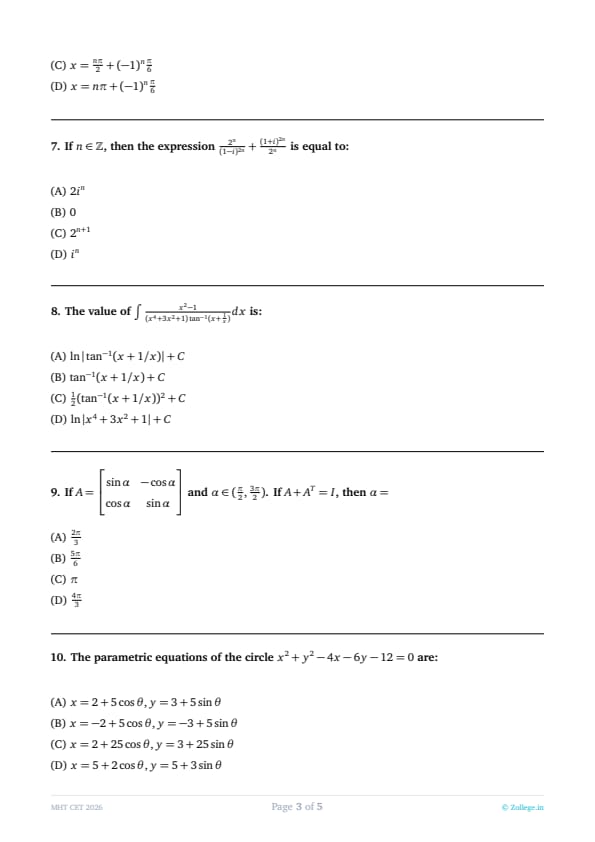
If \(n \in \mathbb{Z}\), then the expression \(\frac{2^n}{(1-i)^{2n}} + \frac{(1+i)^{2n}}{2^n}\) is equal to:
The value of \(\int \frac{x^2-1}{(x^4+3x^2+1)\tan^{-1}(x+\frac{1}{x})} dx\) is:
If \(A = \begin{bmatrix} \sin \alpha & -\cos \alpha
\cos \alpha & \sin \alpha \end{bmatrix}\) and \(\alpha \in (\frac{\pi}{2}, \frac{3\pi}{2})\). If \(A + A^T = I\), then \(\alpha = \)
The parametric equations of the circle \(x^2 + y^2 - 4x - 6y - 12 = 0\) are:
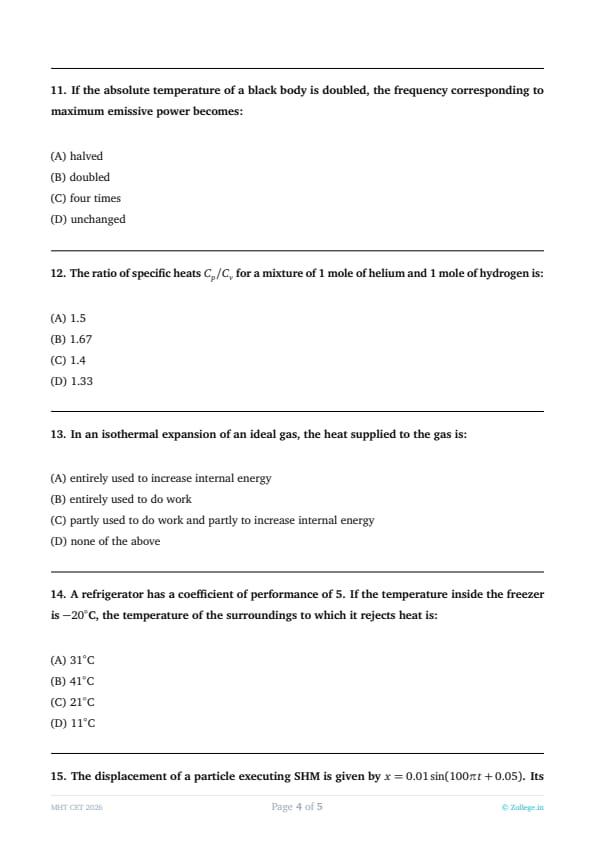
If the absolute temperature of a black body is doubled, the frequency corresponding to maximum emissive power becomes:
The ratio of specific heats \(C_p/C_v\) for a mixture of 1 mole of helium and 1 mole of hydrogen is:
In an isothermal expansion of an ideal gas, the heat supplied to the gas is:
A refrigerator has a coefficient of performance of 5. If the temperature inside the freezer is \(-20^\circC\), the temperature of the surroundings to which it rejects heat is:
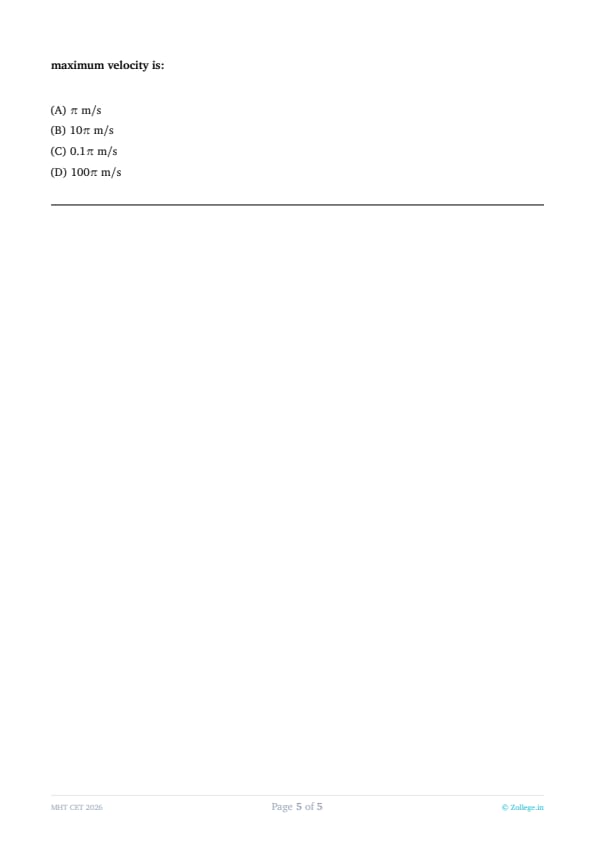
The displacement of a particle executing SHM is given by \(x = 0.01 \sin(100\pi t + 0.05)\). Its maximum velocity is:
MHT CET 2026 Maths | Top 50 MCQs
*The article might have information for the previous academic years, please refer the official website of the exam.