
MHT CET 2026 May 18 Shift 1 PCM Question Paper with Solutions Pdf


| Updated On - May 29, 2026
The State Common Entrance Test Cell, Maharashtra conducted MHT CET 2026 May 18 Shift 1 PCM from 9 AM to 12 PM in CBT Mode. The MHT CET 2026 today’s question paper includes three sections: Physics, Chemistry, and Mathematics with multiple-choice questions carrying a total of 200 marks, as per the MHT CET marking scheme, where 1 mark is awarded for every correct answer and no marks are deducted for wrong answers.
MHT CET 2026 May 18 Shift 1 PCM Question Paper with Solution Pdf is available here for download.
MHT CET 2026 May 18 Shift 1 PCM Question Paper with Solution PDF
| MHT CET 2026 May 18 Shift 1 Question Paper | Download PDF | Check Solutions |
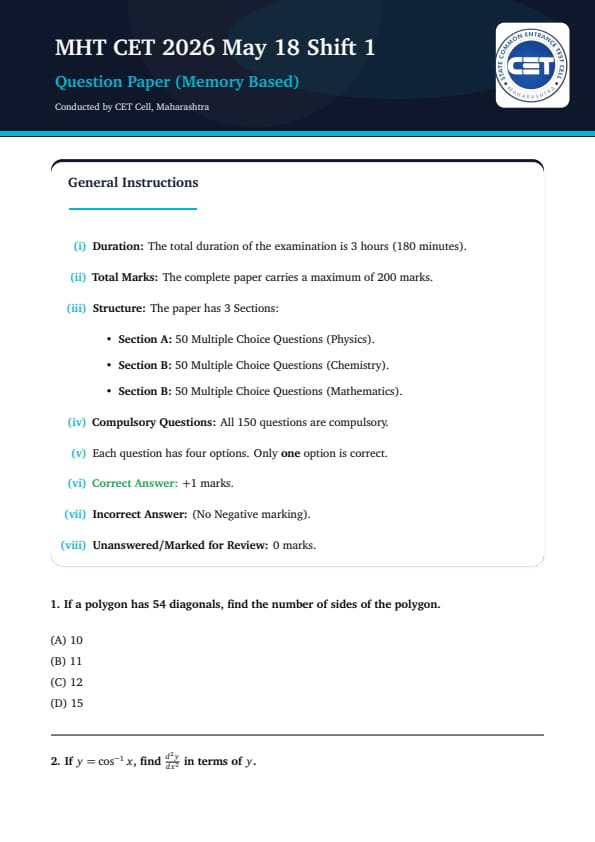
If a polygon has 54 diagonals, find the number of sides of the polygon.
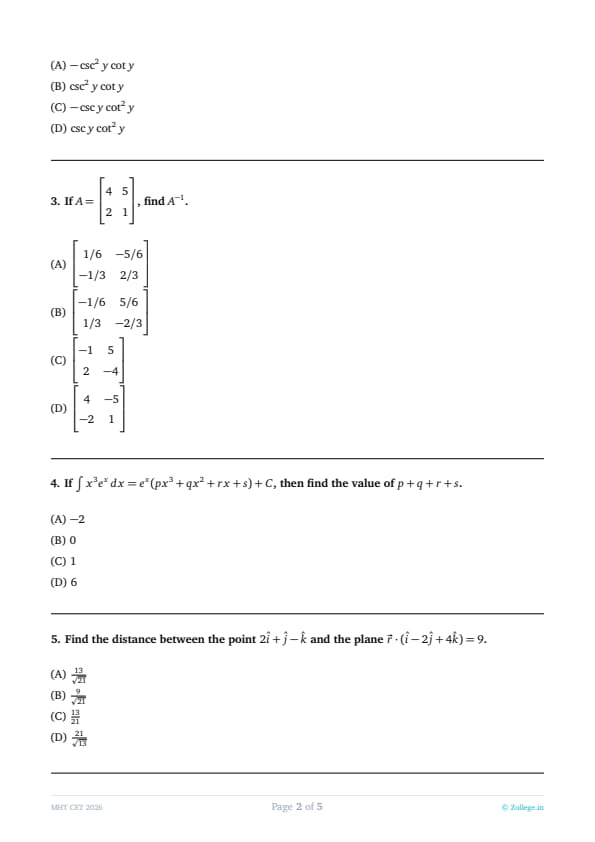
If \( y = \cos^{-1} x \), find \( \frac{d^2y}{dx^2} \) in terms of \( y \).


View Solution
Step 1 : Understanding the Question:
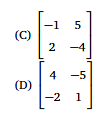
The problem requires us to find the inverse of a specific \(2 \times 2\) square matrix \(A\). In linear algebra, the inverse of a matrix \(A\) is denoted by \(A^{-1}\), and it possesses the property that when it is multiplied by the original matrix, the result is the identity matrix (\(I\)). The existence of an inverse is dependent on the matrix being non-singular, which means its determinant must be non-zero. Finding the inverse is a fundamental operation used in solving systems of linear equations and in various transformations.
Step 2 : Key Formulas and approach:
The general formula for the inverse of a \(2 \times 2\) matrix \(A = \begin{bmatrix} a & b \\
c & d \end{bmatrix}\) is given by:
\[ A^{-1} = \frac{1}{|A|} adj(A) \]
Where:
1. \(|A|\) is the determinant, calculated as \(ad - bc\).
2. \(adj(A)\) is the adjoint matrix, which for a \(2 \times 2\) matrix is found by swapping the principal diagonal elements (\(a\) and \(d\)) and changing the signs of the off-diagonal elements (\(b\) and \(c\)).
Our approach involves calculating the determinant first to ensure the inverse exists, then constructing the adjoint, and finally dividing the adjoint by the determinant.
Step 3 : Detailed Explanation:
First, we identify the elements of matrix \(A\): \(a=4, b=5, c=2, d=1\).
We calculate the determinant: \(|A| = (4 \times 1) - (5 \times 2) = 4 - 10 = -6\). Since \(-6 \neq 0\), the inverse is defined.
Next, we determine the adjoint of \(A\). We swap 4 and 1, and we change the signs of 5 and 2. Thus, \(adj(A) = \begin{bmatrix} 1 & -5 \\
-2 & 4 \end{bmatrix}\).
Now we apply the inverse formula: \(A^{-1} = \frac{1}{-6} \begin{bmatrix} 1 & -5 \\
-2 & 4 \end{bmatrix}\).
We distribute the scalar \(-1/6\) to every element inside the matrix: \(A^{-1} = \begin{bmatrix} -1/6 & 5/6 \\
2/6 & -4/6 \end{bmatrix}\).
Finally, we simplify the fractions where possible: \(2/6\) becomes \(1/3\), and \(-4/6\) becomes \(-2/3\).
The resulting matrix is \(A^{-1} = \begin{bmatrix} -1/6 & 5/6 \\
1/3 & -2/3 \end{bmatrix}\).
Step 4 : Final Answer:
The inverse matrix is \(\begin{bmatrix} -1/6 & 5/6 \\
1/3 & -2/3 \end{bmatrix}\), which matches option (B).
Quick Tip: To verify your result quickly, multiply the first row of your calculated \(A^{-1}\) by the first column of the original matrix \(A\). You should get exactly 1. For example: \((-1/6 \times 4) + (5/6 \times 2) = -4/6 + 10/6 = 6/6 = 1\). This is a reliable way to check for arithmetic errors.
If \(\int x^3 e^x \, dx = e^x(px^3 + qx^2 + rx + s) + C\),
then find the value of \(p + q + r + s\).
Find the distance between the point \(2\hat{i} + \hat{j} - \hat{k}\) and the plane \(\vec{r} \cdot (\hat{i} - 2\hat{j} + 4\hat{k}) = 9\).
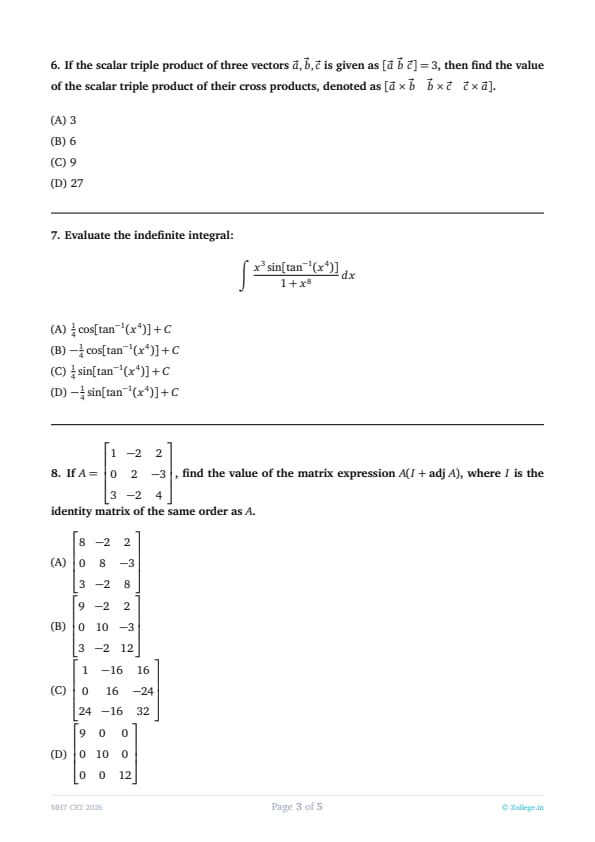
If the scalar triple product of three vectors \( \vec{a}, \vec{b}, \vec{c} \) is given as \([\vec{a}\ \vec{b}\ \vec{c}] = 3\), then find the value of the scalar triple product of their cross products, denoted as \([ \vec{a} \times \vec{b} \quad \vec{b} \times \vec{c} \quad \vec{c} \times \vec{a} ]\).
Evaluate the indefinite integral: \[ \int \frac{x^3 \sin [\tan^{-1}(x^4)]}{1 + x^8} \, dx \]
If 
find the value of the matrix expression \(A(I + adj A)\), where \(I\) is the identity matrix of the same order as \(A\).

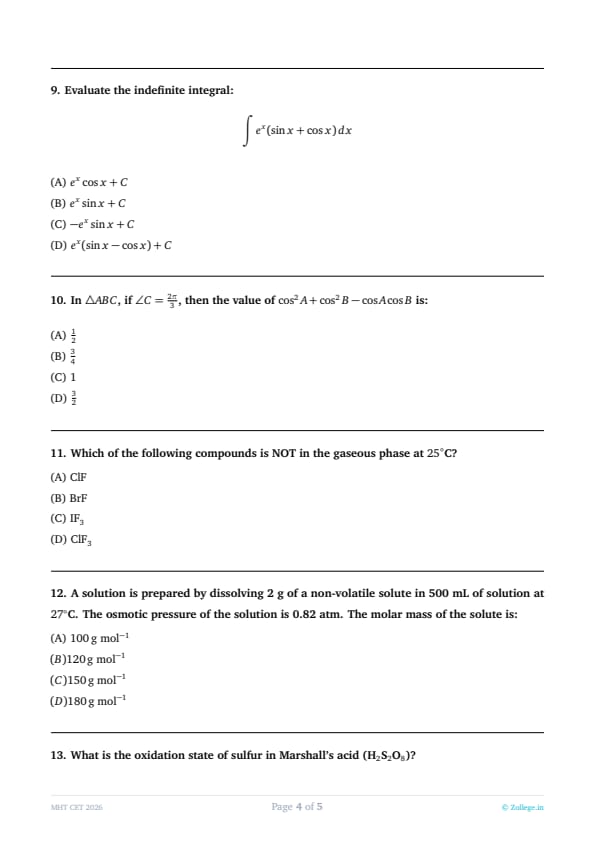
Evaluate the indefinite integral: \[ \int e^x (\sin x + \cos x)\, dx \]
In \(\triangle ABC\), if \(\angle C = \frac{2\pi}{3}\), then the value of \(\cos^2 A + \cos^2 B - \cos A \cos B\) is:
Which of the following compounds is NOT in the gaseous phase at \(25^{\circ}C\)?
A solution is prepared by dissolving 2 g of a non-volatile solute in 500 mL of solution at \(27^{\circ}C\). The osmotic pressure of the solution is 0.82 atm. The molar mass of the solute is:
What is the oxidation state of sulfur in Marshall's acid (H\(_2\)S\(_2\)O\(_8\))?
Oil of wintergreen is chemically known as:
Which of the following does not belong to Group 16 elements?
MHT CET 2026 Maths | Top 50 MCQs
*The article might have information for the previous academic years, please refer the official website of the exam.