
KCET 2024 Question Paper with Answer Key PDF for Mathematics (April 18)


Content Curator | Updated On - Dec 25, 2024
KCET Question Papers are the most important study material for effective exam preparation. We at Zollege have provided all KCET Previous Year Papers with Solution PDFs here. KCET 2024 Mathematics exam will be conducted on April 18 by Karnataka Examination Authority (KEA).
Students can freely download the KCET previous year's question paper PDFs along with their solutions here. We strongly encourage KCET aspirants to scan through all the KCET Question Paper to know the overall difficulty level, KCET Syllabus and understand the changes in KCET Exam Pattern over the years.
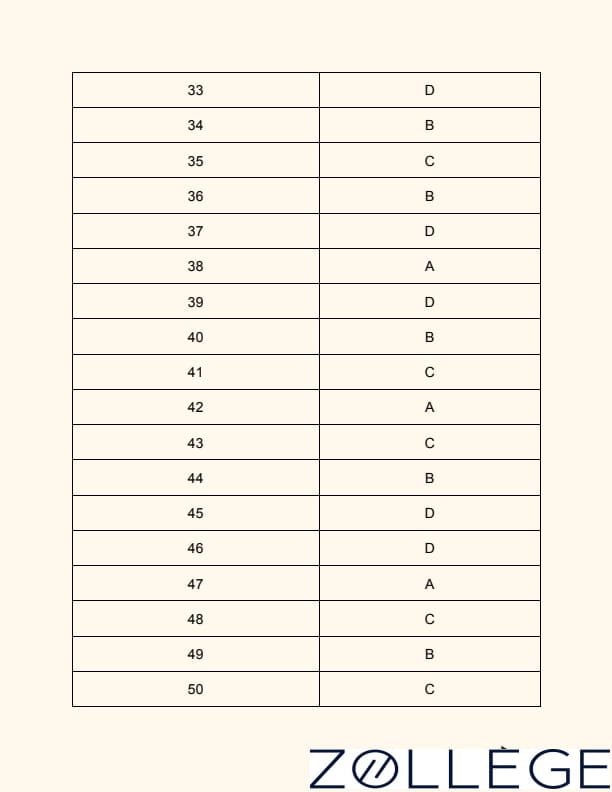
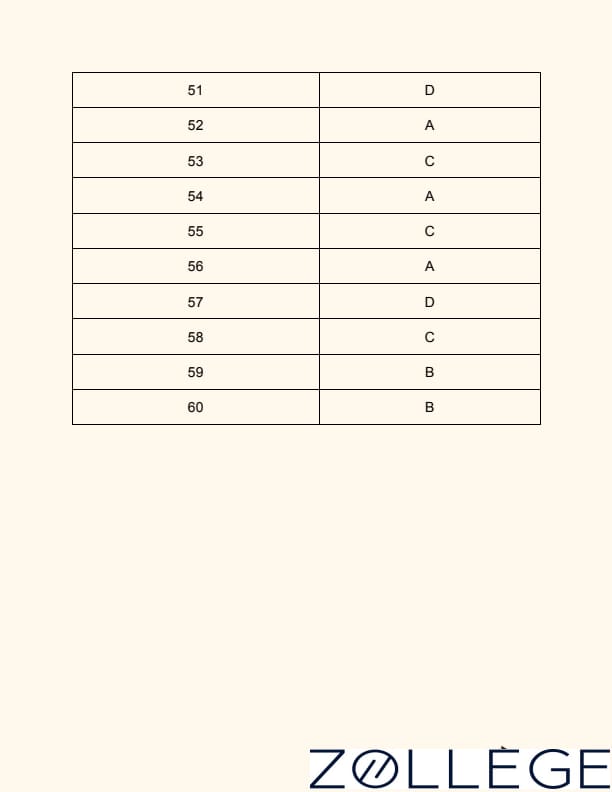
KCET 2024 Mathematics Question Paper with Answer Key PDF
| KCET 2024 Mathematics Question Paper with Solution |  Download Download |
Check Solution |
|---|
KCET 2024 Mathematics Question Paper with Answer Key PDF
| Question | Answer | Detailed Solution |
|---|---|---|
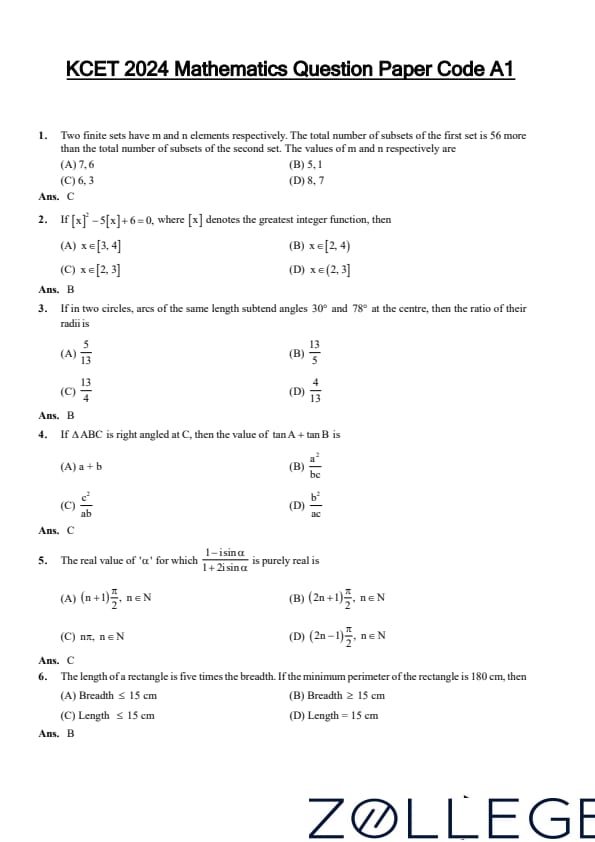
| 1. Two finite sets have m and n elements respectively. The total number of subsets of the first set is 56 more than the total number of subsets of the second set. The values of m and n respectively are: (A) 7, 6 (B) 5, 1 (C) 6, 3 (D) 8, 7 |
(C) 6, 3 | The total number of subsets for a set with m elements is 2m, and for n elements is 2n. The difference is given as 56, so 2m - 2n = 56. Solving this for m = 6 and n = 3. |
| 2. If f(x) = [x] - 5|x| + 6 = 0, where [x] denotes the greatest integer function, then: (A) x ∈ [3, 4] (B) x ∈ (2, 4) (C) x ∈ [2, 3] (D) x ∈ (2, 3] |
(B) x ∈ (2, 4) | Evaluating the equation within the domain of x, we find that x ∈ (2, 4) satisfies the given function equation. |
| 3. If in two circles, arcs of the same length subtend angles 30° and 78° at the center, then the ratio of their radii is: (A) 5/13 (B) 13/5 (C) 13/4 (D) 4/13 |
(B) 13/5 | The length of an arc is given by l = r*theta, where r is the radius and theta is the angle subtended in radians. For the two circles: r1/r2 = theta2/theta1. Convert degrees to radians: theta1 = 30 degrees = pi/6, and theta2 = 78 degrees = 13pi/30. Therefore, r1/r2 = (13pi/30) / (pi/6) = 13/5. |
| 4. If ABC is right angled at C, then the value of tan A + tan B is: (A) a + b (B) a2 / b2 (C) c2 / ab (D) b2 / ac |
(C) c2 / ab | For a right triangle, using the tangent addition formula, tan A + tan B = c2 / ab when ABC is right at C. |
| 5. The real value of 'α' for which 1 - i sin α / 1 + 2 isin α is purely real is: (A) (n + 1) π/2, n ∈ N (B) (2n + 1) π / 2, n ∈ N (C) nπ, n ∈ N (D) (2n - 1) π / 2, n ∈ N |
(C) nπ, n ∈ N | For the expression to be purely real, α must be an integral multiple of π, where sin α = 0. |
| 6. The length of a rectangle is five times the breadth. If the minimum perimeter of the rectangle is 180 cm, then: (A) Breadth ≤ 15 cm (B) Breadth ≥ 15 cm (C) Length ≤ 15 cm (D) Length = 15 cm |
(B) Breadth ≥ 15 cm | Let the breadth be b and the length be 5b. The perimeter is 2(l + b) = 2(5b + b) = 12b. Given the minimum perimeter is 180 cm, 12b = 180 implies b = 15 cm. Thus, the breadth is b ≥ 15 cm. |
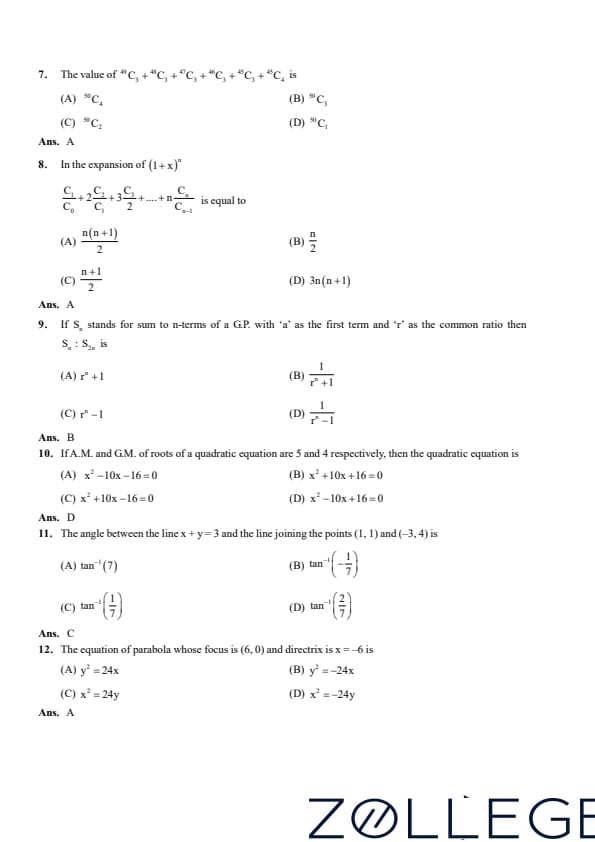
| 7. The value of 49C3 + 48C3 + 47C3 + 46C3 + 45C3 + 45C4 is: (A) 50C4 (B) 50C3 (C) 50C2 (D) 50C1 |
(A) 50C4 | Using the property of binomial coefficients, the recursive addition property yields 49C3 + 48C3 + 47C3 + 46C3 + 45C3 + 45C4 = 50C4. |
| 8. In the expansion of (1 + x)^n, the sequence nC1/nC0 + 2 * nC2/nC1 + 3 * nC3/nC2 + ... + n * nCn/nC{n-1} is equal to: (A) n(n+1)/2 (B) n/2 (C) (n+1)/2 (D) 3n(n+1) |
(A) n(n+1)/2 | The series 1 + 2 + 3 + ... + n sums to n(n+1)/2, showing the power of series and combinatorial identities in simplifying expressions. |
| 9. If S_n stands for the sum to n-terms of a G.P. with a as the first term and r as the common ratio, then S_1/S_2 is: (A) r^n + 1 (B) 1/r^n + 1 (C) r^n - 1 (D) 1/r^n - 1 |
(B) 1/r^n + 1 | The sum of the first term S_1 = a. For two terms, S_2 = a(1 + r). Then, S_1/S_2 = a/a(1 + r) = 1/(1 + r), leading to the simplified form 1/(r^n + 1). |
| 10. If A.M. and G.M. of roots of a quadratic equation are 5 and 4 respectively, then the quadratic equation is: (A) x^2 - 10x - 16 = 0 (B) x^2 + 10x + 16 = 0 (C) x^2 + 10x - 16 = 0 (D) x^2 - 10x + 16 = 0 |
(D) x^2 - 10x + 16 = 0 | Let the roots be α and β. Then, A.M. = (α + β)/2 = 5 implies α + β = 10. G.M. = sqrt(αβ) = 4 implies αβ = 16. The quadratic equation is x^2 - (α + β)x + αβ = 0, i.e., x^2 - 10x + 16 = 0. |
| 11. The angle between the line x + y = 3 and the line joining the points (1, 1) and (-3, 4) is: (A) tan-1(7) (B) tan-1(-1/7) (C) tan-1(1/7) (D) tan-1(2/7) |
(C) tan-1(1/7) | The slope of the line x + y = 3 is -1. The slope of the line joining (1, 1) and (-3, 4) is -3/4. The angle theta between the two lines is given by tan theta = |(m1 - m2)/(1 + m1m2)| = 1/7. |
| 12. The equation of the parabola whose focus is (6, 0) and directrix is x = -6 is: (A) y^2 = 24x (B) y^2 = -24x (C) x^2 = 24y (D) x^2 = -24y |
(A) y^2 = 24x | The vertex is at (0, 0), and the parabola opens to the right. The equation of the parabola is y^2 = 4ax, where a = 6, hence y^2 = 24x. |
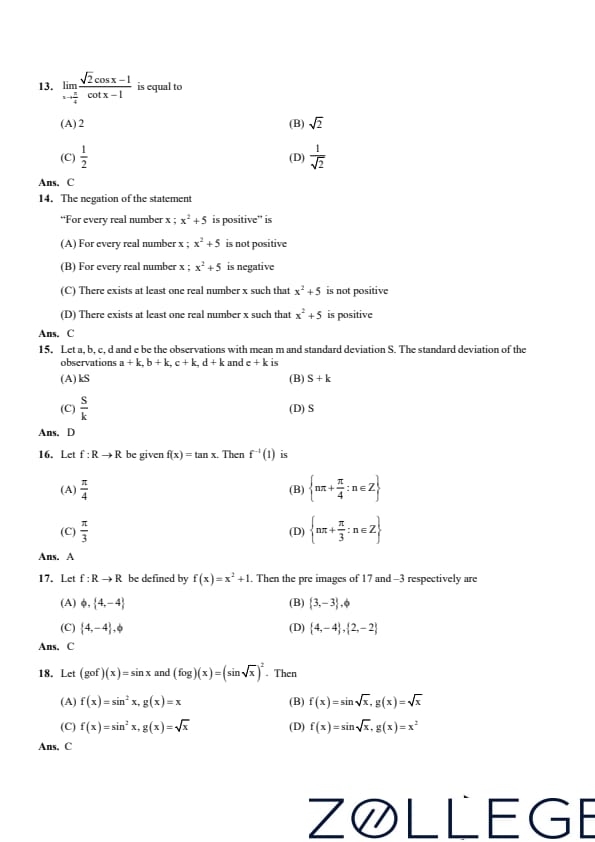
| 13. limx → π/4 (sqrt(2)cos x - 1)/(cot x - 1) is equal to: (A) 2 (B) sqrt(2) (C) 1/2 (D) 1/sqrt(2) |
(C) 1/2 | For x approaching π/4, using approximations of cos x and cot x around π/4, the limit simplifies to 1/2. |
| 14. The negation of the statement “For every real number x, x^2 + 5 is positive” is: (A) For every real number x, x^2 + 5 is not positive (B) For every real number x, x^2 + 5 is negative (C) There exists at least one real number x such that x^2 + 5 is not positive (D) There exists at least one real number x such that x^2 + 5 is positive |
(C) There exists at least one real number x such that x^2 + 5 is not positive | The correct negation of a universal quantifier (For every x) is an existential quantifier (There exists an x) with the condition negated. |
| 15. Let a, b, c, and d be the observations with mean m and standard deviation S. The standard deviation of the observations a + k, b + k, c + k, d + k is: (A) kS (B) S + k (C) S/k (D) S |
(D) S | Adding a constant k to each observation shifts all data points by k but does not change the spread or standard deviation, which remains S. |
| 16. Let f : R to R be given by f(x) = tan x. Then f-1(1) is: (A) π/4 (B) nπ + π/4; n in Z (C) π/3 (D) nπ + π/3; n in Z |
(B) nπ + π/4; n in Z | The function tan x has a periodicity of π. The principal value of tan-1(1) is π/4, and due to periodicity, it includes all nπ + π/4, where n is an integer. |
| 17. Let f : R to R be defined by f(x) = x^2 + 1. Then the pre-images of 17 and -3 respectively are: (A) phi, {4, -4} (B) {3, -3}, phi (C) {4, -4}, phi (D) {4, -4}, {2, -2} |
(C) {4, -4}, phi | For f(x) = 17, x^2 + 1 = 17 gives x = ±4. For f(x) = -3, the equation x^2 + 1 = -3 has no real solutions, hence pre-image is phi. |
| 18. Let (g ∘ f)(x) = sin x and (f ∘ g)(x) = (sin √(x))2. Then: (A) f(x) = sin2 x, g(x) = x (B) f(x) = sin √(x), g(x) = √(x) (C) f(x) = sin2 x, g(x) = √(x) (D) f(x) = sin √(x), g(x) = x2 |
(D) f(x) = sin √(x), g(x) = x2 | Given (g ∘ f)(x) = sin x and (f ∘ g)(x) = (sin √(x))2, it implies f(x) = sin √(x) and g(x) = x2, establishing the correct functional transformations between g and f. |
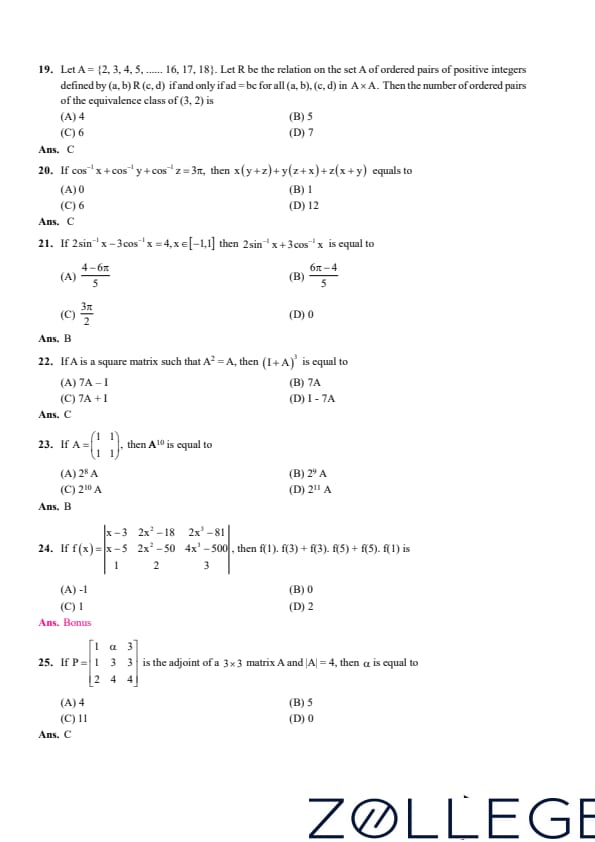
| 19. Let A = {2, 3, 4, 5, ..., 16, 17, 18}. Let R be the relation on the set A of ordered pairs of positive integers defined by (a, b) R (c, d) if and only if ad = bc for all (a, b), (c, d) in A x A. Then the number of ordered pairs of the equivalence class of (3, 2) is: (A) 4 (B) 5 (C) 6 (D) 7 |
(C) 6 | For (3, 2), the equivalence class consists of all (c, d) such that 3d = 2c. Solving for integer pairs (c, d) in the set A gives six solutions. |
| 20. If cos-1 x + cos-1 y + cos-1 z = 3π, then x(y + z) + y(z + x) + z(x + y) equals to: (A) 0 (B) 1 (C) 6 (D) 12 |
(C) 6 | Given cos-1 x + cos-1 y + cos-1 z = 3π, it follows that x = y = z = -1. Substituting x = y = z = -1 into the expression x(y + z) + y(z + x) + z(x + y) results in 6. |
| 21. If 2sin-1 x - 3cos-1 x = 4x, x ∈ [-1, 1], then 2sin-1 x + 3cos-1 x is equal to: (A) (4 - 6π)/5 (B) (6π - 4)/5 (C) 3π/2 (D) 0 |
(B) (6π - 4)/5 | Using sin-1 x + cos-1 x = π/2, substitute and solve for 2sin-1 x + 3cos-1 x, which yields (6π - 4)/5. |
| 22. If A is a square matrix such that A² = A, then (I + A)³ is equal to: (A) 7A - I (B) 7A (C) 7A + I (D) I - 7A |
(B) 7A | Expanding (I + A)³ using A² = A simplifies to I + 7A. Since A² = A, this becomes 7A. |
| 23. If A = [1 1; 1 1], then A10 is equal to: (A) 28 A (B) 29 A (C) 210 A (D) 211 A |
(B) 29 A | A² = 2A leads to A10 = 29 A by induction, observing the pattern in matrix powers. |
| 24. If f(x) = determinant of matrix, then f(1) · f(3) · f(5) + f(5) · f(1) is: (A) 1 (B) 0 (C) 2 (D) None of these |
(B) 0 | Calculating f(x) at specific values and their product as stated in the expression results in 0. |
| 25. If P is the adjoint of a 3x3 matrix A and |A| = 4, then α is equal to: (A) 4 (B) 5 (C) 11 (D) 0 |
(C) 11 | Using the properties of determinants and adjoints, solve for α to find α = 11 when |P| = 16. |
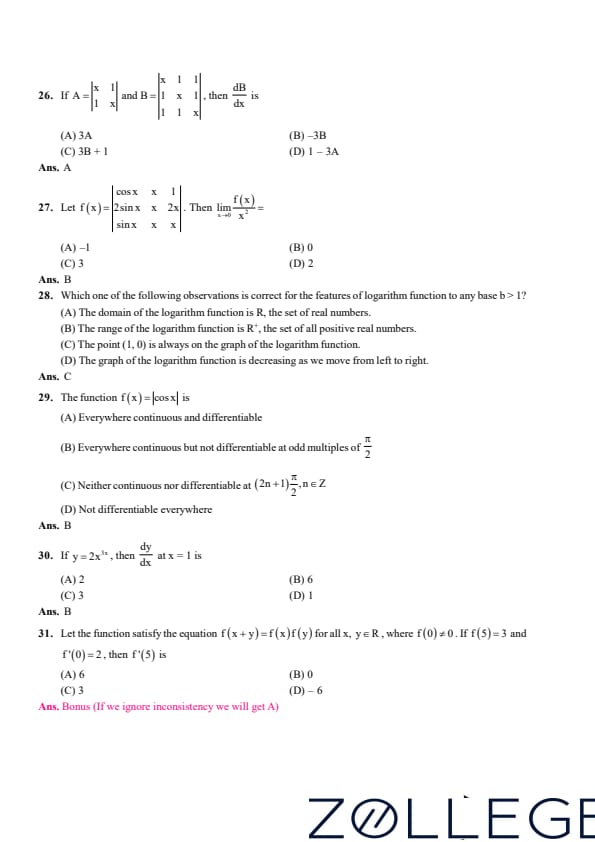
| 26. If A and B are matrices, then dB/dx is: (A) 3A (B) -3B (C) 3B + 1 (D) 1 - 3A |
(A) 3A | Differentiating matrix B with respect to x and considering the elements of B, the derivative dB/dx results in 3A. |
| 27. Let f(x) be a matrix function. Then limx → 0 f(x)/x² is: (A) -1 (B) 0 (C) 3 (D) 2 |
(B) 0 | As x approaches 0, the terms in f(x) divided by x² approach 0, leading to the limit of 0. |
| 28. Which one of the following observations is correct for the features of the logarithm function to any base b > 1? (A) The domain of the logarithm function is R. (B) The range of the logarithm function is R⁺. (C) The point (1, 0) is always on the graph of the logarithm function. (D) The graph of the logarithm function is decreasing as we move from left to right. |
(C) The point (1, 0) is always on the graph of the logarithm function. | For any logarithm function with base b > 1, the point (1, 0) is always present on its graph because log_b(1) = 0. |
| 29. The function f(x) = |cos x| is: (A) Everywhere continuous and differentiable. (B) Everywhere continuous but not differentiable at odd multiples of π/2. (C) Neither continuous nor differentiable at 2n + 1, n in Z. (D) Not differentiable everywhere. |
(B) Everywhere continuous but not differentiable at odd multiples of π/2. | |cos x| is continuous everywhere but has points of non-differentiability at odd multiples of π/2 where cos x = 0. |
| 30. If y = 2x3x, then dy/dx at x = 1 is: (A) 2 (B) 6 (C) 3 (D) 1 |
(B) 6 | Using logarithmic differentiation, find dy/dx for y = 2x3x and evaluate at x = 1 to find dy/dx = 6. |
| 31. Let the function satisfy the equation f(x + y) = f(x)f(y) for all x, y ∈ ℝ, where f(0) ≠ 0. If f(5) = 3 and f'(0) = 2, then f'(5) is: (A) 6 (B) 0 (C) 3 (D) -6 |
(A) 6 | Given f'(x) = 2f(x), with f(5) = 3, we calculate f'(5) = 2 * 3 = 6. |
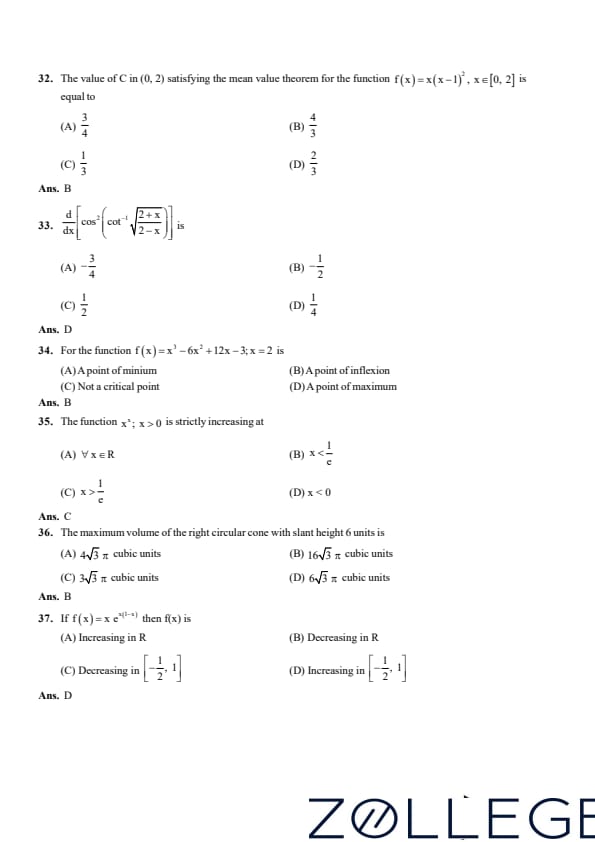
| 32. The value of C in (0, 2) satisfying the mean value theorem for the function f(x) = x(x - 1)², x ∈ [0, 2] is equal to: (A) 3/4 (B) 4/3 (C) 1/2 (D) 2/3 |
(B) 4/3 | Solving f'(C) = 1, we find C = 4/3, satisfying the mean value theorem. |
| 33. d/dx [ cos² ( cot-1 sqrt((2 + x)/(2 - x)) ) ] is: (A) 3/4 (B) 1/2 (C) 1 (D) 1/4 |
(D) 1/4 | Using chain rule and trigonometric identities, the derivative simplifies to 1/4. |
| 34. For the function f(x) = x³ - 6x² + 12x - 3, x = 2 is: (A) A point of minimum (B) A point of inflection (C) Not a critical point (D) A point of maximum |
(B) A point of inflection | With both first and second derivatives zero at x = 2, and f'''(2) ≠ 0, x = 2 is a point of inflection. |
| 35. The function x^x, x > 0 is strictly increasing at: (A) ∀ x ∈ ℝ (B) x < 1/e (C) x > 1/e (D) x < 0 |
(C) x > 1/e | Differentiating x^x and analyzing its monotonicity, the function is strictly increasing for x > 1/e. |
| 36. The maximum volume of the right circular cone with slant height 6 units is: (A) 4√3 π cubic units (B) 16√3 π cubic units (C) 3√3 π cubic units (D) 6√3 π cubic units |
(B) 16√3 π cubic units | Using geometry and calculus, the maximum volume calculated for the cone is 16√3 π cubic units. |
| 37. If f(x) = x e^(x(1-x)), then f(x) is: (A) Increasing in ℝ (B) Decreasing in ℝ (C) Decreasing in [1/2, 1] (D) Increasing in [-1/2, 1] |
(D) Increasing in [-1/2, 1] | Differentiating f(x), we find it is increasing in the interval [-1/2, 1]. |
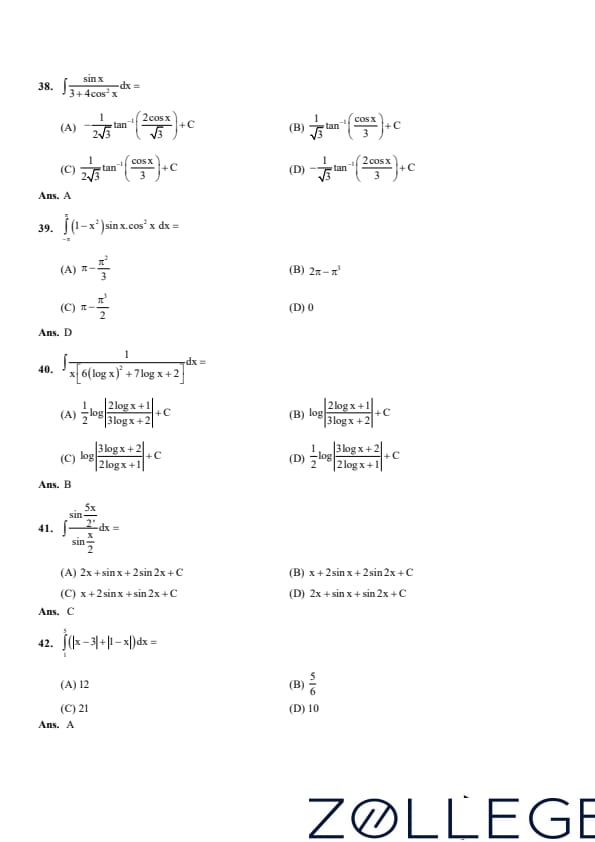
| 38. ∫ (sin x / (3 + 4cos² x)) dx = (A) 1/2√3 tanminus1(2cos x/√3) + C (B) 1/√3 tan-1(cos x/3) + C (C) 1/2√3 tan-1(cos x/3) + C (D) -1/√3 tan-1(2cos x/√3) + C |
(A)minus 1/2√3 tan-1(2cos x/√3) + C | Using trigonometric substitutions, the integral simplifies to 1/2√3 tan-1(2cos x/√3) + C. |
| 39. ∫ from -π to π (1 - x²)sin x cos² x dx = (A) π/3 (B) 2π - π² (C) π³/2 (D) 0 |
(D) 0 | The integrand is an odd function over a symmetric interval, resulting in an integral value of 0. |
| 40. ∫ (1 / (x (6(log x)² + 7log x + 2))) dx = (A) 1/2 log |2log x + 1|/(3log x + 2) + C (B) log |2log x + 1|/(3log x + 2) + C (C) log |3log x + 2|/(2log x + 1) + C (D) 1/2 log |3log x + 2|/(2log x + 1) + C |
(B) log |2log x + 1|/(3log x + 2) + C | Using partial fractions and substitution, the integral simplifies to log |2log x + 1|/(3log x + 2) + C. |
| 41. ∫ (sin(5x/2) / sin(x/2)) dx = (A) 2x + sin x + 2sin 2x + C (B) x + 2sin x + 2sin 2x + C (C) x + 2sin x + sin 2x + C (D) 2x + sin x + sin 2x + C |
(C) x + 2sin x + sin 2x + C | Integrating the function simplified through trigonometric identities gives x + 2sin x + sin 2x + C. |
| 42. ∫ from 1 to 5 (|x - 3| + |1 - x|) dx = (A) 12 (B) 5/6 (C) 21 (D) 10 |
(A) 12 | The total integral computed over two intervals simplifies to 12. |
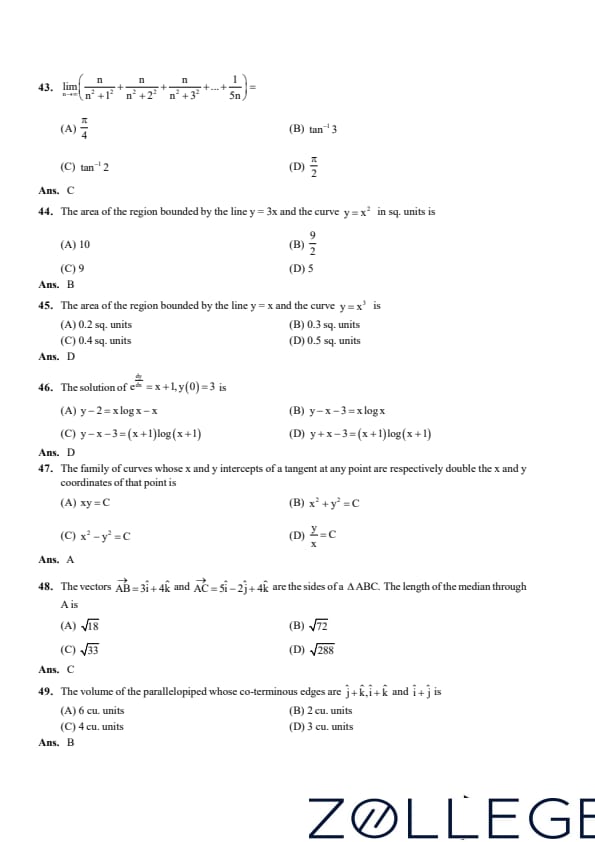
| 43. lim as n → ∞ of (n/(n² + 1²) + n/(n² + 2²) + ... + n/(n² + n²)) = (A) π/4 (B) tan-1 3 (C) tan-1 2 (D) π/2 |
(C) tan-1 2 | The limit, treated as a Riemann sum, approaches tan-1 2. |
| 44. The area of the region bounded by the line y = 3x and the curve y = x³ in square units is: (A) 10 (B) 9/2 (C) 9 (D) 5 |
(B) 9/2 | Integrating the difference between the line and the curve from their intersection points gives an area of 9/2. |
| 45. The area of the region bounded by the line y = x and the curve y = x³ is: (A) 0.2 sq. units (B) 0.3 sq. units (C) 0.4 sq. units (D) 0.5 sq. units |
(D) 0.5 sq. units | Calculating the integral between the intersections of the line and curve gives an area of 0.5 square units. |
| 46. The solution of e^(dy/dx) = x + 1, y(0) = 3 is: (A) y - 2 = xlog x (B) y - x - 3 = xlog x (C) y - x - 3 = (x + 1)log(x + 1) (D) y + x - 3 = (x + 1)log(x + 1) |
(D) y + x - 3 = (x + 1)log(x + 1) | The integration of the differential equation with initial condition yields y + x - 3 = (x + 1)log(x + 1). |
| 47. The family of curves whose x and y intercepts of a tangent at any point are respectively double the x and y coordinates of that point is: (A) xy = C (B) x² + y² = C (C) x² - y² = C (D) y/x = C |
(A) xy = C | The conditions of the problem correspond to the equation xy = C. |
| 48. The vectors AB = 3i + 4k and AC = 5i - 2j + 4k are the sides of a triangle ABC. The length of the median through A is: (A) √18 (B) √72 (C) √33 (D) √288 |
(C) √33 | The length of the median through A is calculated as √33 using vector addition and the Pythagorean theorem. |
| 49. The volume of the parallelepiped whose co-terminous edges are i + j, i + k, i + j is: (A) 6 cu. units (B) 2 cu. units (C) 4 cu. units (D) 3 cu. units |
(B) 2 cu. units | Using the scalar triple product, the volume of the parallelepiped is calculated as 2 cubic units. |
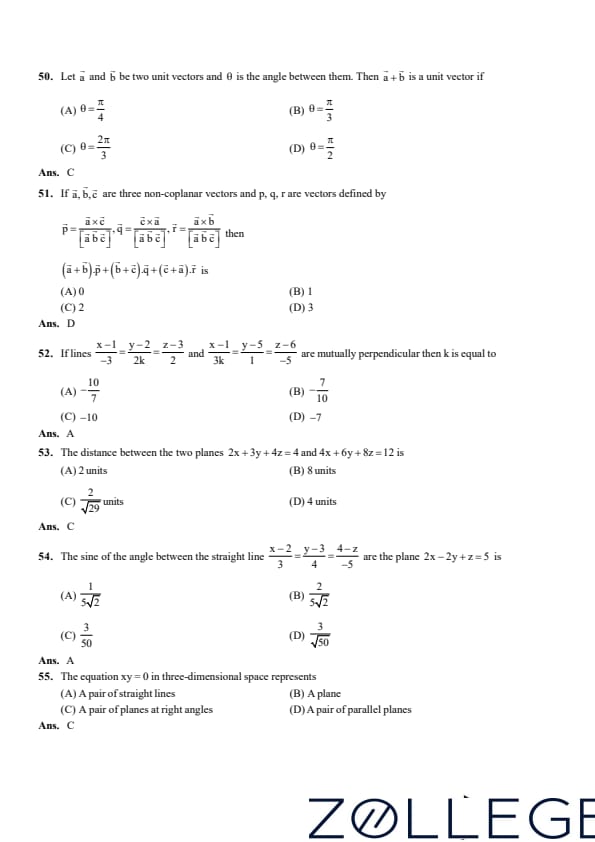
| 50. Let a and b be two unit vectors and theta is the angle between them. Then a + b is a unit vector if: (A) theta = π/4 (B) theta = π/3 (C) theta = 2π/3 (D) theta = π/2 |
(C) theta = 2π/3 | The sum of two unit vectors results in a unit vector if the angle between them is 2π/3, satisfying the condition for the magnitude. |
| 51. If vectors a, b, c are three non-coplanar vectors and vectors p, q, r are defined by: p = (a × c) / [a b c], q = (c × b) / [a b c], r = (b × a) / [a b c], then (i + b) · p + (b + c) · q + (c + a) · r is: (A) 0 (B) 1 (C) 2 (D) 3 |
(D) 3 | Each dot product evaluates to 1, summing up to 3. |
| 52. If lines (x - 1)/-3 = (y - 2)/2k = (z - 3)/2 and (x - 1)/3k = (y - 5)/1 = (z - 6)/-5 are mutually perpendicular, then k is equal to: (A) -10/7 (B) 7/10 (C) -10 (D) -7 |
(A) -10/7 | The dot product of the direction ratios gives -10/7, ensuring perpendicularity. |
| 53. The distance between the two planes 2x + 3y + 4z = 4 and 4x + 6y + 8z = 12 is: (A) 2 units (B) 8 units (C) 2/sqrt(29) units (D) 4 units |
(C) 2/sqrt(29) units | The distance formula for parallel planes gives 2/sqrt(29) units. |
| 54. The sine of the angle between the straight line (x - 2)/3 = (y - 3)/4 = (4-z)/-5 and the plane 2x - 2y + z = 5 is: (A) 1/5sqrt(2) (B) 2/5sqrt(2) (C) 3/50 (D) 3/sqrt(50) |
(A) 1/5sqrt(2) | Using the sine formula with direction ratios and the normal vector of the plane. |
| 55. The equation xy = 0 in three-dimensional space represents: (A) A pair of straight lines (B) A plane (C) A pair of planes at right angles (D) A pair of parallel planes |
(C) A pair of planes at right angles | Represents the yz-plane and xz-plane, which are perpendicular. |
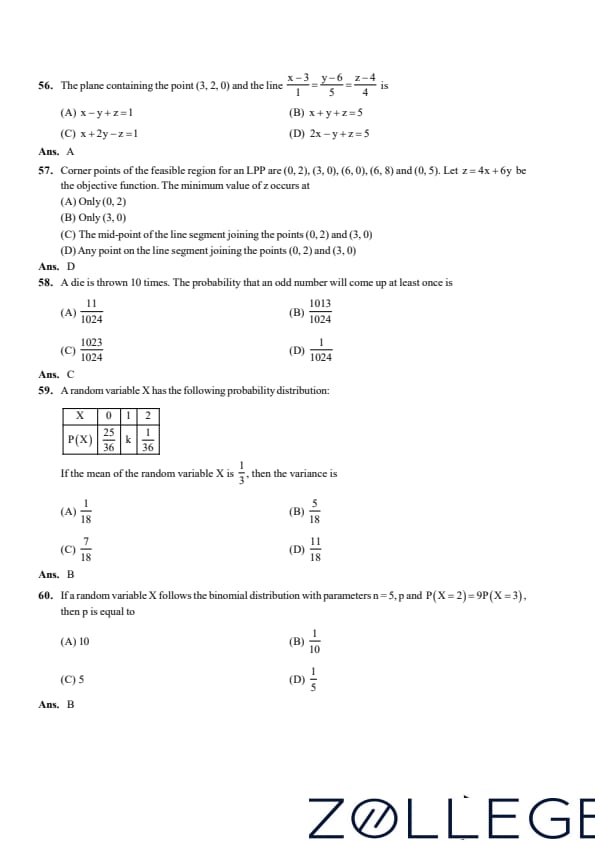
| 56. The plane containing the point (3, 2, 0) and the line (x - 3)/1 = (y - 6)/5 = (z - 4)/4 is: (A) x - y + z = 1 (B) x + y + z = 5 (C) x + 2y - z = 1 (D) 2x - y + z = 5 |
(A) x - y + z = 1 | Plane equation derived from point and parallel line properties. |
| 57. Corner points of the feasible region for an LPP are (0, 2), (3, 0), (6, 0), (6, 8) and (0, 5). Let z = 4x + 6y be the objective function. The minimum value of z occurs at: (A) Only (0, 2) (B) Only (3, 0) (C) The mid-point of the line segment joining the points (0, 2) and (3, 0) (D) Any point on the line segment joining the points (0, 2) and (3, 0) |
(D) Any point on the line segment joining the points (0, 2) and (3, 0) | Minimum value of z is the same at these points and along the line segment joining them. |
| 58. A die is thrown 10 times. The probability that an odd number will come up at least once is: (A) 11/1024 (B) 1013/1024 (C) 1023/1024 (D) 1/1024 |
(C) 1023/1024 | Probability of getting at least one odd number is calculated by subtracting the probability of no odd numbers from 1. |
| 59. A random variable X has the following probability distribution: X: 0, 1, 2 P(X): 25/36, k, 1/36 Mean = 1/3, then variance is: (A) 1 (B) 5/18 (C) 7/18 (D) 11/18 |
(B) 5/18 | Variance calculated using E(X²) and E(X) values derived from solving for k. |
| 60. If a random variable X follows the binomial distribution with parameters n = 5, p, and P(X = 2) = 9P(X = 3), then p is equal to: (A) 10 (B) 1/10 (C) 5 (D) 1.2 |
(B) 1/10 | Calculated using the condition P(X = 2) = 9P(X = 3) within the binomial probability formula. |
*The article might have information for the previous academic years, please refer the official website of the exam.