
UP Board Class 12 Biology 2026 Question Paper with Solution PDF


| Updated On - Feb 23, 2026
UP Board conducted the Class 12 Biology Board Exam 2026 on February 23, 2026. Class 12 Biology Question Paper with Solution PDF is available here for download.
The official question paper of UP Board Class 12 Biology Board Exam 2026 is provided below. Students can download the official paper in PDF format for reference.
UP Board Class 12 2026 Biology Question Paper with Solution PDF
| UP Board Class 12 Biology Question Paper 2026 | Download PDF | Check Solutions |
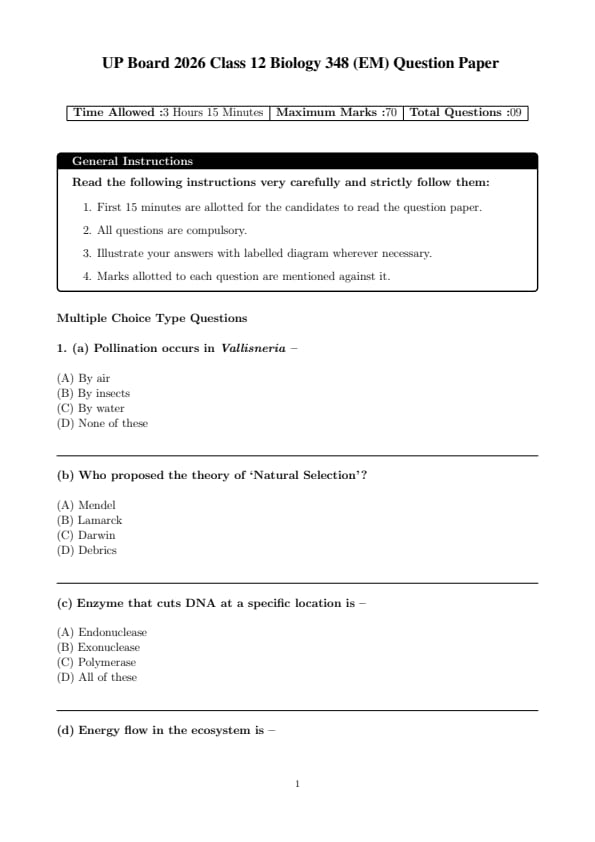
(a) Pollination occurs in Vallisneria –
View Solution
Step 1: Understanding the Concept:
Pollination in aquatic plants can occur in various ways. {Vallisneria is a submerged dioecious freshwater plant that uses water as a medium for the transfer of pollen grains (Hydrophily).
Step 2: Detailed Explanation:
In {Vallisneria, the female flower reaches the surface of the water by a long stalk. The male flowers or pollen grains are released onto the surface of the water. They are carried passively by water currents, eventually reaching the female flowers.
Step 3: Calculation:
Since the process is entirely dependent on water currents to bring the male and female gametes together, it is water pollination.
Step 4: Final Answer:
The correct option is (C) By water. Quick Tip: Plants pollinated by water are rare (only about 30 genera). Remember: Not all aquatic plants use water for pollination; many, like Water Lily, use insects or wind!
Who proposed the theory of ‘Natural Selection’?
View Solution
Step 1: Understanding the Concept:
Evolutionary theories explain how species change over time. Natural selection is the process whereby organisms better adapted to their environment tend to survive and produce more offspring.
Step 2: Detailed Explanation:
- Charles Darwin proposed Natural Selection in his 1859 book {On the Origin of Species.
- Mendel is the father of Genetics (laws of inheritance).
- Lamarck proposed the theory of "Inheritance of Acquired Characters."
- Hugo de Vries (often misspelled as Debrics) proposed the "Mutation Theory."
Step 3: Calculation:
The specific credit for the mechanism of Natural Selection goes to Darwin.
Step 4: Final Answer:
The correct option is (C) Darwin. Quick Tip: Darwin's theory is often summarized as "Survival of the Fittest," though the phrase was actually coined by Herbert Spencer after reading Darwin's work.
Enzyme that cuts DNA at a specific location is –
View Solution
Step 1: Understanding the Concept:
Molecular biology utilizes enzymes as "scissors" and "glue." Restriction enzymes are the scissors that cut DNA at specific nucleotide sequences.
Step 2: Detailed Explanation:
- Endonucleases make cuts at specific points {within the DNA strand.
- Exonucleases remove nucleotides from the {ends of the DNA.
- Polymerase is used to {synthesize DNA, not cut it.
Step 3: Calculation:
Since the question specifies cutting at a "location" (usually meaning an internal specific site), the answer is Endonuclease.
Step 4: Final Answer:
The correct option is (A) Endonuclease. Quick Tip: Restriction Endonucleases are often called "Molecular Scissors" because of their high precision in biotechnology.
Energy flow in the ecosystem is –
View Solution
Step 1: Understanding the Concept:
In an ecosystem, energy is transferred between trophic levels. This follows the laws of thermodynamics.
Step 2: Detailed Explanation:
Energy enters the ecosystem through the sun (captured by producers). It moves from producers to herbivores and then to carnivores. At each step, much of the energy is lost as heat. This energy {cannot flow back to the sun or back to the previous level.
Step 3: Calculation:
Because energy moves in only one direction (Sun \(\rightarrow\) Producer \(\rightarrow\) Consumer) and cannot be recycled, the flow is strictly unidirectional.
Step 4: Final Answer:
The correct option is (A) Unidirectional. Quick Tip: While energy is unidirectional, nutrients/minerals in an ecosystem move in a cyclic (biogeochemical) manner. Don't confuse the two!
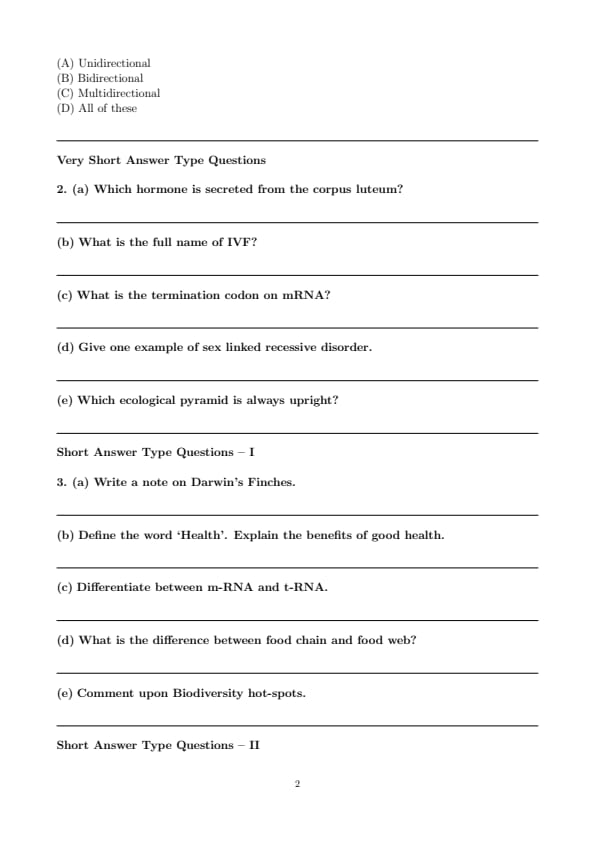
(a) Which hormone is secreted from the corpus luteum?
View Solution
Step 1: Understanding the Concept:
The corpus luteum is a temporary endocrine structure in female mammals that is involved in the production of relatively high levels of hormones following ovulation.
Step 2: Detailed Explanation:
After a follicle releases its egg during ovulation, the remaining follicle cells transform into the corpus luteum. Its primary role is to prepare the uterine lining for a potential pregnancy.
Step 3: Calculation:
The principal hormone secreted is Progesterone. It also secretes smaller amounts of estrogen and inhibin A.
Step 4: Final Answer:
The hormone secreted from the corpus luteum is Progesterone. Quick Tip: Think of Progesterone as the "Pro-Gestation" hormone—it maintains the pregnancy by keeping the uterine lining thick and stable.
What is the full name of IVF?
View Solution
Step 1: Understanding the Concept:
IVF is a major type of Assisted Reproductive Technology (ART) used to help with fertility or prevent genetic problems and assist with the conception of a child.
Step 2: Detailed Explanation:
In this process, mature eggs are collected (retrieved) from ovaries and fertilized by sperm in a laboratory setting (in a culture dish or "glass").
Step 3: Calculation:
The acronym stands for: In Vitro Fertilization. "In vitro" is Latin for "in glass."
Step 4: Final Answer:
The full name of IVF is In Vitro Fertilization. Quick Tip: Louise Joy Brown, born in 1978, was the world's first "test-tube baby" successfuly conceived through the IVF process.
What is the termination codon on mRNA?
View Solution
Step 1: Understanding the Concept:
During translation (protein synthesis), the ribosome reads the mRNA sequence in triplets called codons. Termination codons signal the end of the polypeptide chain.
Step 2: Detailed Explanation:
Unlike most codons, termination codons do not code for any amino acid. Instead, they bind release factors that cause the newly formed protein to be released.
Step 3: Calculation:
There are three standard termination (stop) codons:
UAA (Ochre)
UAG (Amber)
UGA (Opal)
Step 4: Final Answer:
The termination codons are UAA, UAG, and UGA. Quick Tip: A common mnemonic to remember them: U Are Away, U Are Gone, U Go Away.
Give one example of sex linked recessive disorder.
View Solution
Step 1: Understanding the Concept:
These are genetic disorders caused by an abnormal gene on the X chromosome. Since males have only one X chromosome, they are more frequently affected than females.
Step 2: Detailed Explanation:
In these disorders, a female must inherit two copies of the defective gene (one from each parent) to show the disease, whereas a male only needs one copy from his mother.
Step 3: Calculation:
Common examples include:
Haemophilia (Bleeder's disease)
Color Blindness (Red-Green)
Duchenne Muscular Dystrophy
Step 4: Final Answer:
An example of a sex-linked recessive disorder is Haemophilia (or Color Blindness). Quick Tip: Haemophilia is often called the "Royal Disease" because it was famously passed through the lineage of Queen Victoria of England.
Which ecological pyramid is always upright?
View Solution
Step 1: Understanding the Concept:
Ecological pyramids represent the relationship between different trophic levels in terms of number, biomass, or energy.
Step 2: Detailed Explanation:
While pyramids of numbers or biomass can sometimes be inverted (e.g., many insects on one big tree), the total energy available at a higher trophic level is always less than at the level below.
Step 3: Calculation:
According to the 10% Law, only 10% of the energy is transferred to the next level; 90% is lost as heat. Therefore, the base (producers) will always have the most energy.
Step 4: Final Answer:
The Pyramid of Energy is always upright. Quick Tip: If a question asks about the pyramid of numbers in a forest ecosystem, remember it can be spindle-shaped or inverted, but Energy never lies—it only goes down!
(a) Write a note on Darwin’s Finches.
View Solution
Step 1: Understanding the Concept:
Darwin's Finches are a classic example of adaptive radiation. They are a group of about 13-14 species of small birds found on the Galapagos Islands, which provided Charles Darwin with significant evidence for his theory of evolution.
Step 2: Detailed Explanation:
Darwin observed that although these birds were similar, they had developed distinct beak shapes and sizes. He reasoned that they all descended from a common ancestor from the South American mainland but evolved differently after reaching various islands with different ecological niches.
Step 3: Calculation:
The diversification happened as follows:
Seed-eaters: Developed thick, strong beaks.
Insect-eaters: Developed pointed, thin beaks.
Cactus-feeders: Developed long, sturdy beaks.
Step 4: Final Answer:
Darwin's Finches represent the process of evolution where a single ancestral species radiates into multiple descendant forms, each adapted to a specific environmental resource. Quick Tip: The key term here is Adaptive Radiation. It describes how organisms "radiate" out from a central point to fill different functional roles in an ecosystem.
Define the word ‘Health’. Explain the benefits of good health.
View Solution
Step 1: Understanding the Concept:
Health is not merely the absence of illness. According to the World Health Organization (WHO), it is a multidimensional state of being.
Step 2: Detailed Explanation:
Health is defined as a state of complete physical, mental, and social well-being and not merely the absence of disease or infirmity.
Step 3: Calculation:
Benefits of Good Health:
Increased Productivity: Healthy individuals can work more efficiently and for longer durations.
Longevity: Good health reduces the risk of chronic diseases, increasing life expectancy.
Economic Prosperity: It reduces the financial burden of medical expenses on families and the state.
Mental Peace: Physical health is closely linked to reduced stress and better emotional stability.
Step 4: Final Answer:
Health is a holistic state of well-being that ensures an individual is physically fit, mentally alert, and socially adjusted, leading to a more productive and fulfilling life. Quick Tip: Remember the three pillars of Health: Physical, Mental, and Social. Missing any one of these means a person is not fully "healthy" by definition.
Differentiate between m-RNA and t-RNA.
View Solution
Step 1: Understanding the Concept:
Messenger RNA (mRNA) and Transfer RNA (tRNA) are two different types of RNA molecules involved in the process of protein synthesis (translation).
Step 2: Detailed Explanation:
mRNA acts as the "template" or the message carrier from the DNA to the ribosome. tRNA acts as the "adapter" that brings the correct amino acids to the ribosome based on the mRNA's instructions.
Step 3: Calculation:
\begin{table[h]
\centering
\begin{tabular{|l|l|l|
\hline
Feature & m-RNA & t-RNA
\hline
Full Name & Messenger RNA & Transfer RNA
\hline
Structure & Linear/Single-stranded & Clover-leaf shaped (2D) / L-shaped (3D)
\hline
Function & Carries genetic code from DNA & Picks up and carries amino acids
\hline
Sequence & Contains Codons & Contains Anticodons
\hline
Lifespan & Short-lived & Relatively stable
\hline
\end{tabular
\end{table
Step 4: Final Answer:
The main difference is that mRNA provides the blueprint (codons) for the protein, while tRNA decodes that blueprint by bringing specific amino acids using its anticodons. Quick Tip: Think of mRNA as the Recipe and tRNA as the Delivery Guy who brings the specific ingredients (amino acids) to the kitchen (ribosome).
What is the difference between food chain and food web?
View Solution
Step 1: Understanding the Concept:
These are two ways of representing the feeding relationships and energy flow in an ecosystem.
Step 2: Detailed Explanation:
A food chain is a single, linear pathway through which food energy is transferred. A food web is a network of interconnected food chains, representing the complex reality of who eats whom in nature.
Step 3: Calculation:
\begin{table[h]
\centering
\begin{tabular{|l|l|
\hline
Food Chain & Food Web
\hline
Linear and simple & Complex and branched
\hline
Shows one energy path & Shows multiple energy paths
\hline
Less stable (one link break is fatal) & More stable (alternative food sources exist)
\hline
Does not show polyphagy & Shows that one organism can eat many types
\hline
\end{tabular
\end{table
Step 4: Final Answer:
A food chain is a single strand of feeding relationships, while a food web is the entire tapestry of multiple food chains linked together. Quick Tip: In nature, isolated food chains rarely exist. Most ecosystems function as food webs because most animals eat more than one type of food.
Comment upon Biodiversity hot-spots.
View Solution
Step 1: Understanding the Concept:
Biodiversity hotspots are specific regions that are both rich in unique biological species and under significant threat from human activities. The concept was introduced by Norman Myers in 1988.
Step 2: Detailed Explanation:
To qualify as a hotspot, a region must meet two strict criteria:
It must contain at least 1,500 species of vascular plants as endemics (found nowhere else).
It must have lost at least 70% of its original habitat.
Step 3: Calculation:
There are currently around 36 biodiversity hotspots globally. India is home to 4 significant hotspots:
The Himalayas
Indo-Burma
The Western Ghats and Sri Lanka
Sundaland (Nicobar Islands)
Step 4: Final Answer:
Biodiversity hotspots are "emergency rooms" for our planet's health; they cover only 2.3% of Earth's land surface but support more than half of the world’s plant species and nearly 43% of bird, mammal, reptile, and amphibian species as endemics. Quick Tip: Focusing conservation efforts on hotspots is the most efficient way to prevent mass extinction, as these areas have the highest concentration of unique species.
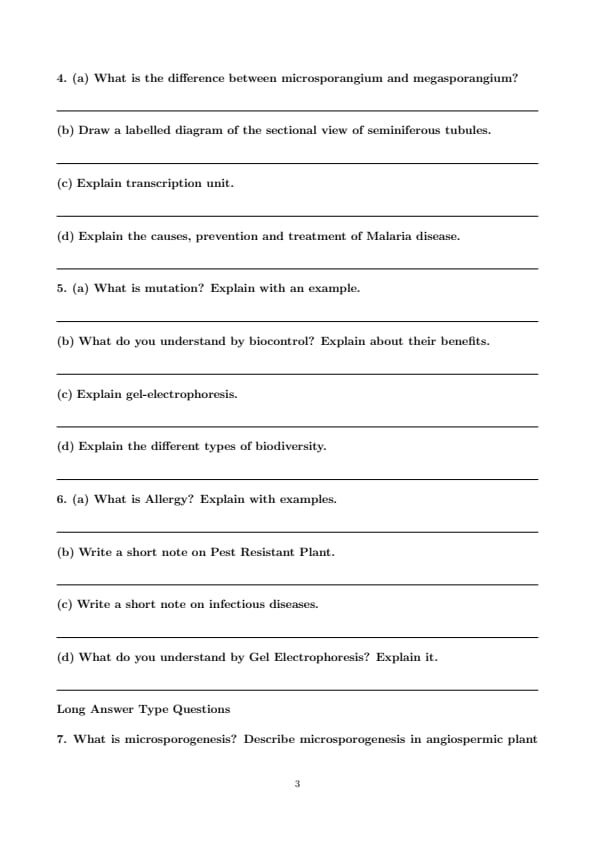
(a) What is the difference between microsporangium and megasporangium?
View Solution
Step 1: Understanding the Concept:
In flowering plants (angiosperms), the reproductive structures are specialized to produce either male or female gametophytes. Sporangia are the sacs where spores are formed through meiosis.
Step 2: Detailed Explanation:
The primary difference lies in the type of spores they produce and the reproductive organs they are associated with (Stamen for male, Carpel/Pistil for female).
Step 3: Calculation:
\begin{table[h]
\centering
\begin{tabular{|l|l|l|
\hline
Feature & Microsporangium & Megasporangium
\hline
Location & Found in the Anther (Stamen) & Found in the Ovary (Ovule)
\hline
Function & Produces microspores & Produces megaspores
\hline
Development & Develops into Pollen grains & Develops into Embryo sac
\hline
Quantity & Usually four per anther & Usually one per ovule
\hline
Product & Male Gametophyte & Female Gametophyte
\hline
\end{tabular
\end{table
Step 4: Final Answer:
Microsporangium is the pollen sac that produces male spores, whereas megasporangium is the ovule that produces the female spore. Quick Tip: Remember the prefixes: Micro- always refers to male structures (small pollen), and Mega- (or Macro-) always refers to female structures (large eggs).
Draw a labelled diagram of the sectional view of seminiferous tubules.
View Solution
Step 1: Understanding the Concept:
Seminiferous tubules are the site of germination, maturation, and transportation of sperm cells within the testes.
Step 2: Detailed Explanation:
A sectional view reveals the tubular structure lined by a complex stratified epithelium. It contains two types of cells: Germ cells (which become sperm) and Sertoli cells (which provide nourishment).
Step 3: Calculation:
Spermatogonia: Primary germ cells at the periphery.
Sertoli Cells: Large, elongated cells providing support.
Spermatocytes/Spermatids: Cells in various stages of meiosis.
Spermatozoa: Mature sperm cells in the lumen.
Leydig Cells: Located in the interstitial spaces between tubules.
Step 4: Final Answer:
The diagram above illustrates the arrangement of cells from the basement membrane to the lumen, showing the progression of spermatogenesis. Quick Tip: When labeling, always remember that Leydig cells are outside the tubules, while Sertoli cells are inside the tubules.
Explain transcription unit.
View Solution
Step 1: Understanding the Concept:
A transcription unit is a stretch of DNA that is transcribed into an RNA molecule. It is the basic functional unit of the transcription process.
Step 2: Detailed Explanation:
A transcription unit in DNA is defined primarily by three regions:
The Promoter: Located towards the \(5'\)-end (upstream) of the structural gene. It provides the binding site for RNA polymerase.
The Structural Gene: The actual area of DNA that serves as the template for RNA synthesis. It is flanked by the promoter and terminator.
The Terminator: Located towards the \(3'\)-end (downstream) of the coding strand. It defines the end of the transcription process.
Step 3: Calculation:
The transcription unit also features two strands:
Template Strand: The strand with \(3' \rightarrow 5'\) polarity used for RNA synthesis.
Coding Strand: The strand with \(5' \rightarrow 3'\) polarity (sequence matches the RNA, except T is replaced by U).
Step 4: Final Answer:
The transcription unit is the specific DNA segment comprising a promoter, a structural gene, and a terminator that works together to produce an RNA transcript. Quick Tip: All reference points in a transcription unit (like "upstream" or "downstream") are made with respect to the Coding Strand, not the template strand.
Explain the causes, prevention and treatment of Malaria disease.
View Solution
Step 1: Understanding the Concept:
Malaria is a life-threatening disease caused by parasites that are transmitted to people through the bites of infected female Anopheles mosquitoes.
Step 2: Detailed Explanation:
Causes:
It is caused by the protozoan parasite {Plasmodium.
Different species like {P. vivax, {P. malariae, and the most dangerous, {P. falciparum.
Vector: Female {Anopheles mosquito.
Step 3: Calculation:
Prevention:
Use of Insecticide-Treated Nets (ITNs).
Indoor Residual Spraying (IRS) to kill mosquitoes.
Eliminating standing water where mosquitoes breed.
Using mosquito repellents and wearing long-sleeved clothing.
Treatment:
Anti-malarial drugs such as Quinine and Chloroquine.
Artemisinin-based Combination Therapy (ACT) is currently the gold standard for {P. falciparum malaria.
Step 4: Final Answer:
Malaria is caused by {Plasmodium parasites, prevented primarily through vector control (mosquito management), and treated with specific anti-protozoal medications like ACT. Quick Tip: The characteristic high fever and chills in Malaria occur because of the release of a toxic substance called Haemozoin when red blood cells rupture.
(a) What is mutation? Explain with an example.
View Solution
Step 1: Understanding the Concept:
Mutation is a phenomenon which results in alteration of DNA sequences and consequently results in changes in the genotype and the phenotype of an organism. It is essentially a "mistake" or change in the genetic code.
Step 2: Detailed Explanation:
Mutations can occur due to various factors called mutagens (like UV radiation, chemicals, or errors during DNA replication). They can be as small as a single base pair change (point mutation) or as large as the deletion or insertion of a segment of a chromosome.
Step 3: Calculation:
Example: Sickle Cell Anemia.
This is a classic example of a point mutation. A single change in the gene for hemoglobin (substitution of Glutamic acid by Valine at the sixth position of the beta-globin chain) causes the red blood cells to change from a round shape to a sickle shape.
Step 4: Final Answer:
Mutation is a sudden, heritable change in the nucleotide sequence of the genome. A prominent example is Sickle Cell Anemia, caused by a point mutation in the hemoglobin gene. Quick Tip: Not all mutations are bad! Mutations are the primary source of genetic variation, which is the "raw material" for evolution and natural selection.
What do you understand by biocontrol? Explain about their benefits.
View Solution
Step 1: Understanding the Concept:
Biocontrol (Biological Control) refers to the use of biological methods for controlling plant diseases and pests. Instead of using toxic chemicals, it relies on natural predation or interference.
Step 2: Detailed Explanation:
Common examples include using Ladybirds to control aphids, or the bacteria {Bacillus thuringiensis (Bt) to control butterfly caterpillars. It involves creating an ecosystem where pests are kept at manageable levels by their natural enemies.
Step 3: Calculation:
Benefits of Biocontrol:
Eco-friendly: It does not pollute soil, water, or air unlike chemical pesticides.
Non-toxic: It is safe for human consumption and does not harm "non-target" beneficial insects like honeybees.
Sustainable: Pests are less likely to develop resistance to a predator than they are to a chemical.
Cost-effective: In the long run, it reduces the need for expensive synthetic sprays.
Step 4: Final Answer:
Biocontrol is a method of pest management using natural predators or biological agents. Its main benefits are environmental safety and the reduction of chemical residues in the food chain. Quick Tip: Organic farmers prefer biocontrol because their goal is not to eradicate "pests" completely, but to keep them at a level where the ecosystem remains balanced.
Explain gel-electrophoresis.
View Solution
Step 1: Understanding the Concept:
Gel electrophoresis is a technique used to separate macromolecules (like DNA, RNA, or proteins) based on their size and electrical charge.
Step 2: Detailed Explanation:
DNA fragments are negatively charged molecules. When placed in an electric field, they move toward the positive electrode (anode). They are forced to move through a matrix of agarose gel, which acts like a sieve.
Step 3: Calculation:
- The smaller the fragment size, the farther it moves through the gel pores.
- The larger fragments stay closer to the starting point (wells).
- After separation, the DNA bands are stained with Ethidium Bromide and viewed under UV light to appear as bright orange bands.
Step 4: Final Answer:
Gel electrophoresis is a laboratory method that separates DNA fragments by size using an electric current and an agarose gel matrix. It is essential for DNA fingerprinting and genetic engineering. Quick Tip: Remember: "Small travels fast." If you see a band at the very bottom of the gel, that's your smallest DNA fragment!
Explain the different types of biodiversity.
View Solution
Step 1: Understanding the Concept:
Biodiversity is the term popularized by sociobiologist Edward Wilson to describe the combined diversity at all levels of biological organization.
[Image illustrating Genetic, Species, and Ecological diversity]
Step 2: Detailed Explanation:
There are three main hierarchical levels of biodiversity:
Genetic Diversity: Variation of genes within a single species. (e.g., India has more than 50,000 genetically different strains of rice).
Species Diversity: The variety of species within a region. (e.g., The Western Ghats have a greater amphibian species diversity than the Eastern Ghats).
Ecological Diversity: The variety of ecosystems in a geographical area. (e.g., India has deserts, rain forests, mangroves, and alpine meadows).
Step 3: Calculation:
These levels are interconnected; genetic diversity allows species to adapt, while species diversity ensures ecosystem stability.
Step 4: Final Answer:
Biodiversity is categorized into three types: Genetic (within species), Species (between species), and Ecological (between ecosystems). Quick Tip: The "Species-Area Relationship" (proposed by Alexander von Humboldt) states that within a region, species richness increases with increasing explored area, but only up to a limit.
(a) What is Allergy? Explain with examples.
View Solution
Step 1: Understanding the Concept:
Allergy is the exaggerated or hypersensitive response of the immune system to certain antigens present in the environment. These substances, which are usually harmless to most people, are called allergens.
Step 2: Detailed Explanation:
When an allergen enters the body, the immune system produces a specific type of antibody called IgE. These antibodies attach to mast cells. Upon subsequent exposure, the allergen binds to the IgE, causing the mast cells to release chemicals like histamine and serotonin, which trigger inflammatory symptoms.
Step 3: Calculation:
Common symptoms include sneezing, watery eyes, running nose, and difficulty in breathing.
Examples:
Pollen grains from flowers.
Dust mites and animal dander.
Certain foods like peanuts, shellfish, or milk.
Molds and certain medicines like Penicillin.
Step 4: Final Answer:
Allergy is an overreaction of the immune system to allergens, mediated by IgE antibodies and histamine release. Common examples include reactions to pollen, dust, and certain food items. Quick Tip: Antihistamines, adrenaline, and steroids are the standard drugs used to quickly reduce the symptoms of an allergic reaction.
Write a short note on Pest Resistant Plant.
View Solution
Step 1: Understanding the Concept:
Pest-resistant plants are genetically modified organisms (GMOs) designed to resist attacks from insects and pests without the need for external chemical pesticides.
Step 2: Detailed Explanation:
The most common method involves using biotechnology to insert specific genes into the plant's DNA. A famous example is Bt Cotton. The gene is taken from the soil bacterium {Bacillus thuringiensis. This gene produces a pro-toxin protein that, when ingested by a specific insect (like the bollworm), becomes active in the alkaline pH of the insect's gut, creating pores and killing the pest.
Step 3: Calculation:
Another approach is RNA interference (RNAi), used to protect tobacco plants against the nematode {Meloidogyne incognita. It involves silencing the specific mRNA of the parasite using double-stranded RNA.
Step 4: Final Answer:
Pest-resistant plants, like Bt Cotton, use biotechnological tools (like Cry genes or RNAi) to provide built-in resistance against specific parasites, reducing the reliance on toxic chemical sprays. Quick Tip: Bt-toxin is biodegradable and only affects specific target insects, making it a much safer alternative for the environment than broad-spectrum chemical insecticides.
Write a short note on infectious diseases.
View Solution
Step 1: Understanding the Concept:
Infectious diseases (also known as communicable diseases) are illnesses caused by pathogenic microorganisms, such as bacteria, viruses, fungi, or parasites, that can be spread from one person to another.
Step 2: Detailed Explanation:
Transmission can occur through various routes:
Direct Contact: Touching, kissing, or sexual contact.
Indirect Contact: Contaminated water, food, or surfaces.
Airborne: Droplets from coughing or sneezing.
Vectors: Mosquitoes (Malaria), Ticks, or Fleas.
Step 3: Calculation:
Examples include:
Viral: Common Cold, Influenza, COVID-19, AIDS.
Bacterial: Typhoid, Tuberculosis, Pneumonia.
Protozoan: Malaria, Amoebiasis.
Step 4: Final Answer:
Infectious diseases are easily transmitted from an infected person to a healthy person. They are a major cause of mortality worldwide, but many can be prevented through vaccination and improved hygiene. Quick Tip: AIDS (Acquired Immuno Deficiency Syndrome) is an infectious disease that is particularly dangerous because it destroys the body's immune system, making the patient vulnerable to even minor infections.
What do you understand by Gel Electrophoresis? Explain it.
View Solution
Step 1: Understanding the Concept:
Gel Electrophoresis is a fundamental technique in molecular biology used to separate fragments of DNA, RNA, or proteins based on their physical properties—primarily size and electrical charge.
Step 2: Detailed Explanation:
Since DNA fragments are negatively charged, they move toward the positive electrode (anode) when an electric current is applied. The DNA is loaded into wells in an agarose gel matrix. This gel acts as a molecular sieve.
Step 3: Calculation:
The separation occurs as follows:
Size factor: Smaller fragments travel faster and further through the pores of the gel.
Staining: Since DNA is colorless, the gel is treated with Ethidium Bromide (EtBr).
Visualization: Under UV light, the DNA fragments appear as bright orange-colored bands.
Step 4: Final Answer:
Gel Electrophoresis is the process of forced migration of charged molecules through a gel medium under an electric field. It allows scientists to visualize and isolate specific DNA segments for further research or cloning. Quick Tip: The process of cutting out the separated DNA band from the agarose gel and extracting the DNA from the gel piece is known as Elution.
What is microsporogenesis? Describe microsporogenesis in angiospermic plant with diagram.
OR
Describe the process of spermatogenesis with a diagram.
View Solution

Step 1: Understanding the Concept:
Microsporogenesis is the biological process of the formation of microspores (pollen grains) from a microspore mother cell through the process of meiosis. This occurs within the microsporangium (pollen sac) of the anther.
Step 2: Detailed Explanation:
1. Microspore Mother Cell (MMC): As the anther develops, the sporogenous tissue undergoes meiotic divisions. Each cell of the sporogenous tissue is a potential pollen mother cell.
2. Meiosis: The diploid MMC (\(2n\)) undergoes meiosis to form a cluster of four haploid cells called the Microspore Tetrad.
3. Dissociation: As the anther matures and dehydrates, the microspores dissociate from each other.
4. Development: Each microspore develops into a Pollen Grain (the male gametophyte).
Step 3: Structure of Mature Pollen:
A mature pollen grain has two layers: the outer hard Exine (made of sporopollenin) and the inner Intine. It consists of a large Vegetative cell and a small Generative cell.
Step 4: Final Answer:
Microsporogenesis is the meiotic transformation of diploid mother cells into haploid microspores within the anther, ultimately producing the male gametophytes necessary for pollination.
Option 2: Spermatogenesis

Step 1: Understanding the Concept:
Spermatogenesis is the process of formation of haploid spermatozoa (sperm) from diploid spermatogonia in the seminiferous tubules of the testes. It begins at puberty due to the increase in secretion of GnRH.
Step 2: Detailed Explanation:
1. Multiplication Phase: Spermatogonia (\(2n\)) on the inside wall of seminiferous tubules multiply by mitosis.
2. Growth Phase: Some spermatogonia, called Primary Spermatocytes, undergo meiosis.
3. Maturation Phase (Meiosis I): The primary spermatocyte completes the first meiotic division to form two equal haploid Secondary Spermatocytes (\(n\)).
4. Maturation Phase (Meiosis II): These undergo the second meiotic division to produce four haploid Spermatids.
5. Spermiogenesis: The spermatids are transformed into mature Spermatozoa (sperm).
Step 3: Hormonal Regulation:
The process is stimulated by LH (acting on Leydig cells to secrete androgens) and FSH (acting on Sertoli cells to stimulate spermiogenesis).
Step 4: Final Answer:
Spermatogenesis is a continuous process in males where diploid germ cells undergo two meiotic divisions and a morphological transformation (spermiogenesis) to produce functional, motile sperm. Quick Tip: To remember the sequence in Spermatogenesis: Go Practice Some Sports—Gonium, Primary, Secondary, Spermatid, Spermatozoa.
What do you understand by DNA fingerprinting technique? Explain its process.
OR
Write short notes on the following –
(i) Translation
(ii) Hardy–Weinberg Principle.
View Solution
Step 1: Understanding the Concept:
DNA Fingerprinting is a forensic technique used to identify individuals by their unique DNA profiles, focusing on repeating sequences called VNTRs. Translation is the protein synthesis process, while the Hardy-Weinberg Principle is a mathematical model for genetic equilibrium in populations.
Step 2: Key Formula or Approach:
For DNA Fingerprinting, the approach is identifying Variable Number of Tandem Repeats (VNTRs). For Hardy-Weinberg, the formula used is: \[ p^2 + 2pq + q^2 = 1 \]
Step 3: Detailed Explanation:
Option 1: DNA Fingerprinting
DNA Fingerprinting involves identifying differences in specific regions of DNA sequence called as repetitive DNA.
1. Extraction: DNA is isolated from the sample (blood, hair, etc.).
2. Digestion: DNA is cut into fragments by restriction endonucleases.
3. Separation: Fragments are separated by size using gel electrophoresis.
4. Blotting: Separated DNA fragments are transferred to a synthetic membrane (nylon or nitrocellulose).
5. Hybridization: The membrane is treated with a labeled VNTR probe.
6. Detection: Hybridized DNA fragments are detected by autoradiography, appearing as dark bands on an X-ray film.
Option 2: Short Notes
(i) Translation: It is the process of polymerizing amino acids to form a polypeptide based on the sequence of codons in mRNA. It occurs in the ribosome and involves initiation, elongation, and termination.
(ii) Hardy–Weinberg Principle: It states that allele frequencies in a population are stable and constant from generation to generation in the absence of evolutionary factors like mutation, selection, and migration. It is expressed as \( p^2 + 2pq + q^2 = 1 \).
Step 4: Final Answer:
DNA Fingerprinting is a method for identification based on DNA patterns. Translation converts mRNA to protein, and Hardy-Weinberg defines genetic stability in non-evolving populations. Quick Tip: In DNA Fingerprinting, remember that \(99.9%\) of DNA is identical in all humans; the technique only analyzes the \(0.1%\) that is unique.
Describe the different types of ecological pyramids with a diagram.
OR
What is decomposition? Describe the decomposition cycle in a terrestrial ecosystem with a diagram.
View Solution

Step 1: Understanding the Concept:
Ecological pyramids are graphical representations of the relationship between different organisms in an ecosystem at various trophic levels. Decomposition is the biological process of breaking down complex organic matter into simpler inorganic substances.
Step 2: Key Formula or Approach:
Ecological pyramids are categorized by Number, Biomass, and Energy. In decomposition, we follow the sequence: Fragmentation \(\rightarrow\) Leaching \(\rightarrow\) Catabolism \(\rightarrow\) Humification \(\rightarrow\) Mineralization.
Step 3: Detailed Explanation:
Option 1: Ecological Pyramids
1. Pyramid of Number: Represents the number of individuals per unit area at various trophic levels. It is usually upright (e.g., Grassland), but can be inverted (e.g., many insects feeding on one big tree).
2. Pyramid of Biomass: Represents the total living material (dry weight) at each level. In terrestrial ecosystems, it is upright. In aquatic ecosystems, it is often inverted (e.g., biomass of fishes exceeds phytoplankton).
3. Pyramid of Energy: Represents the total energy at each level. It is always upright because energy is lost as heat at each transfer (10% law).
Option 2: Decomposition

Decomposition is the process where decomposers (bacteria, fungi) break down detritus (dead plant/animal remains).
1. Fragmentation: Detritivores (like earthworms) break detritus into smaller particles.
2. Leaching: Water-soluble inorganic nutrients go down into the soil horizon and get precipitated as unavailable salts.
3. Catabolism: Bacterial and fungal enzymes degrade detritus into simpler inorganic substances.
4. Humification: Leads to the accumulation of a dark-colored amorphous substance called humus, which is highly resistant to microbial action.
5. Mineralization: Humus is further degraded by some microbes and release of inorganic nutrients occur.
Step 4: Final Answer:
Ecological pyramids illustrate ecosystem structure through energy, mass, or population. Decomposition is the vital recycling process that converts dead organic matter back into usable soil minerals. Quick Tip: The Pyramid of Energy can NEVER be inverted because it follows the second law of thermodynamics, ensuring energy is lost as heat at every trophic level.
UP Board Class 12 Biology | Complete Biology Revision
*The article might have information for the previous academic years, please refer the official website of the exam.