
UP Board Class 12 Chemistry 2026 Set 347 EA Question Paper with Solution


Content Curator | Updated On - Jul 10, 2026
The UP Board Class 12 Chemistry 2026 question paper (Set 347-EA) is available with fully worked solutions for free download on Zollege. This Chemistry theory paper was conducted by the Uttar Pradesh Madhyamik Shiksha Parishad (UPMSP) on 25 February 2026, and it carried 26 questions for 70 marks in 3 hours 15 minutes.
| UP Board Class 12 Chemistry 2026 (Set 347-EA) Question Paper with Solution PDF | Download PDF | Check Solutions |
UP BOARD CLASS 12 CHEMISTRY 2026 SET 347 EA WITH SOLUTIONS Questions with Solutions
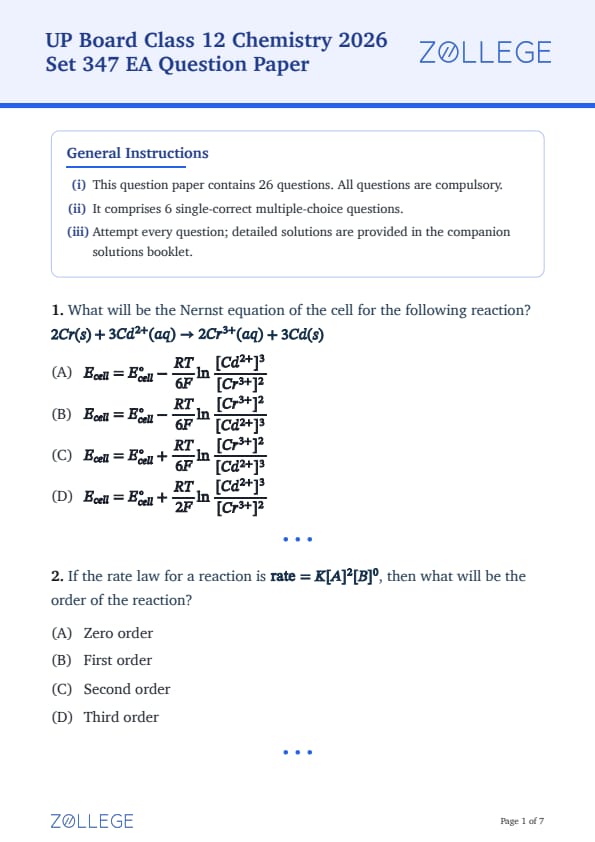
What will be the Nernst equation of the cell for the following reaction?
\( 2Cr(s) + 3Cd^{2+}(aq) \rightarrow 2Cr^{3+}(aq) + 3Cd(s) \)
If the rate law for a reaction is \( \text{rate} = K[A]^2[B]^0 \), then what will be the order of the reaction?
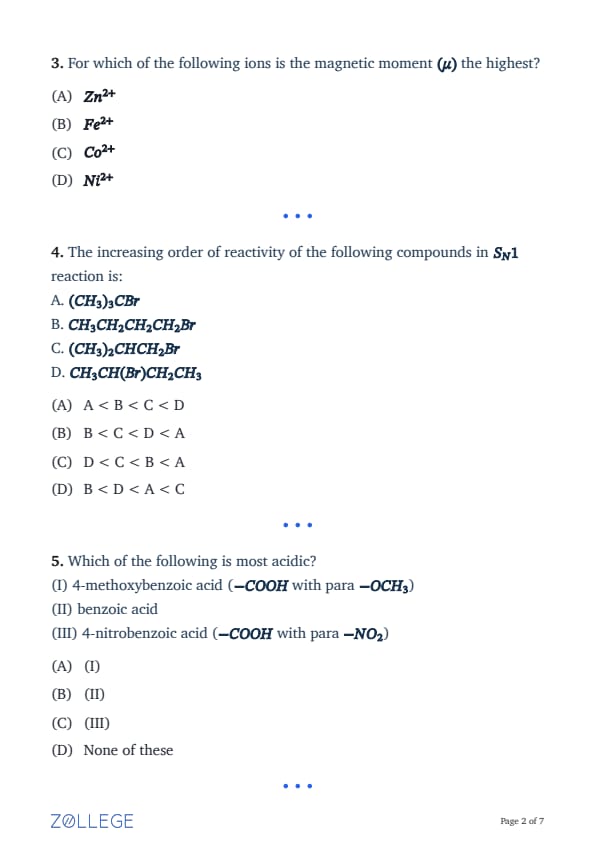
For which of the following ions is the magnetic moment \( (\mu) \) the highest?
The increasing order of reactivity of the following compounds in \( S_N1 \) reaction is:
A. \( (CH_3)_3CBr \)
B. \( CH_3CH_2CH_2CH_2Br \)
C. \( (CH_3)_2CHCH_2Br \)
D. \( CH_3CH(Br)CH_2CH_3 \)
Which of the following is most acidic?
(I) 4-methoxybenzoic acid (\( -COOH \) with para \( -OCH_3 \))
(II) benzoic acid
(III) 4-nitrobenzoic acid (\( -COOH \) with para \( -NO_2 \))
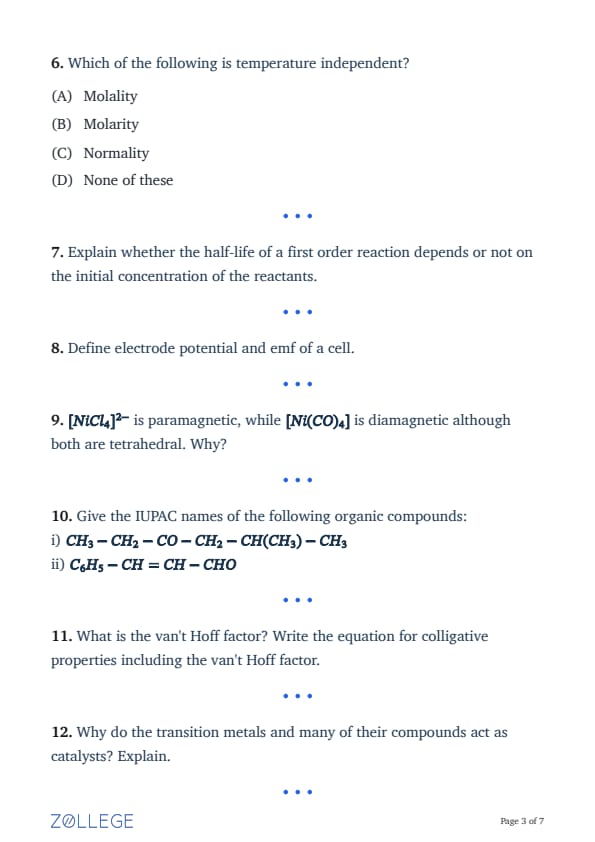
Which of the following is temperature independent?
Explain whether the half-life of a first order reaction depends or not on the initial concentration of the reactants.
Define electrode potential and emf of a cell.
\( [NiCl_4]^{2-} \) is paramagnetic, while \( [Ni(CO)_4] \) is diamagnetic although both are tetrahedral. Why?
Give the IUPAC names of the following organic compounds:
i) \( CH_3-CH_2-CO-CH_2-CH(CH_3)-CH_3 \)
ii) \( C_6H_5-CH=CH-CHO \)
What is the van't Hoff factor? Write the equation for colligative properties including the van't Hoff factor.
Why do the transition metals and many of their compounds act as catalysts? Explain.
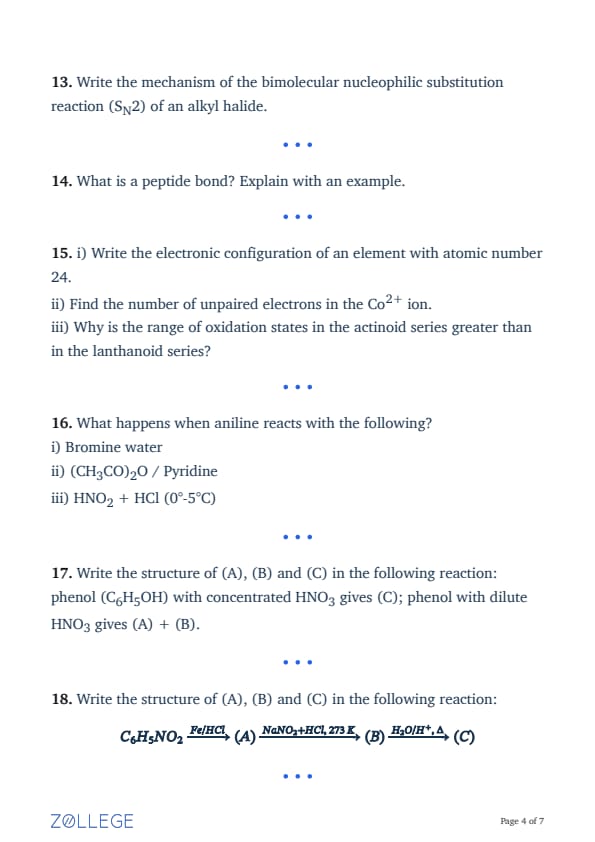
Write the mechanism of the bimolecular nucleophilic substitution reaction (SN2) of an alkyl halide.
What is a peptide bond? Explain with an example.
i) Write the electronic configuration of an element with atomic number 24.
ii) Find the number of unpaired electrons in the Co2+ ion.
iii) Why is the range of oxidation states in the actinoid series greater than in the lanthanoid series?
What happens when aniline reacts with the following?
i) Bromine water
ii) (CH3CO)2O / Pyridine
iii) HNO2 + HCl (0°-5°C)
Write the structure of (A), (B) and (C) in the following reaction: phenol (C6H5OH) with concentrated HNO3 gives (C); phenol with dilute HNO3 gives (A) + (B).
Write the structure of (A), (B) and (C) in the following reaction:
\[ C_6H_5NO_2 \xrightarrow{Fe/HCl} (A) \xrightarrow{NaNO_2 + HCl,\ 273\,K} (B) \xrightarrow{H_2O/H^+,\ \Delta} (C) \]
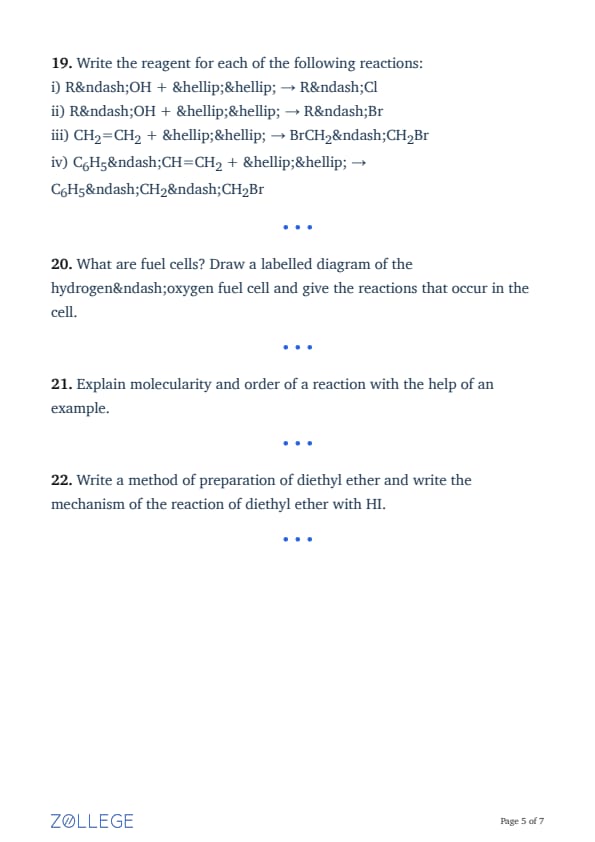
Write the reagent for each of the following reactions:
i) R–OH + …… → R–Cl
ii) R–OH + …… → R–Br
iii) CH2=CH2 + …… → BrCH2–CH2Br
iv) C6H5–CH=CH2 + …… → C6H5–CH2–CH2Br
What are fuel cells? Draw a labelled diagram of the hydrogen–oxygen fuel cell and give the reactions that occur in the cell.
Explain molecularity and order of a reaction with the help of an example.
Write a method of preparation of diethyl ether and write the mechanism of the reaction of diethyl ether with HI.
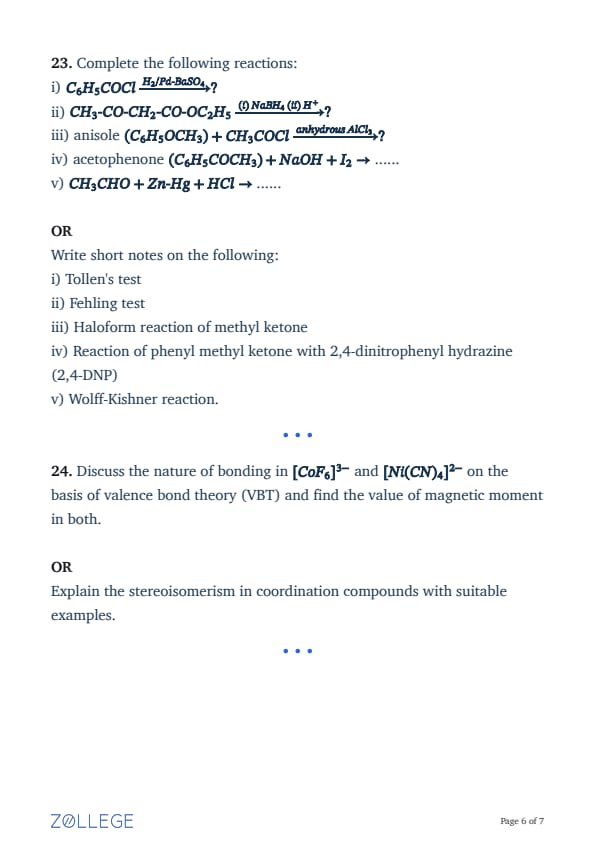
Complete the following reactions:
i) \( C_6H_5COCl \xrightarrow{H_2 / Pd\text{-}BaSO_4} ? \)
ii) \( CH_3\text{-}CO\text{-}CH_2\text{-}CO\text{-}OC_2H_5 \xrightarrow{(i)\ NaBH_4\ (ii)\ H^+} ? \)
iii) anisole \( (C_6H_5OCH_3) + CH_3COCl \xrightarrow{anhydrous\ AlCl_3} ? \)
iv) acetophenone \( (C_6H_5COCH_3) + NaOH + I_2 \rightarrow \) ......
v) \( CH_3CHO + Zn\text{-}Hg + HCl \rightarrow \) ......
OR
Write short notes on the following:
i) Tollen's test
ii) Fehling test
iii) Haloform reaction of methyl ketone
iv) Reaction of phenyl methyl ketone with 2,4-dinitrophenyl hydrazine (2,4-DNP)
v) Wolff-Kishner reaction.
Discuss the nature of bonding in \( [CoF_6]^{3-} \) and \( [Ni(CN)_4]^{2-} \) on the basis of valence bond theory (VBT) and find the value of magnetic moment in both.
OR
Explain the stereoisomerism in coordination compounds with suitable examples.
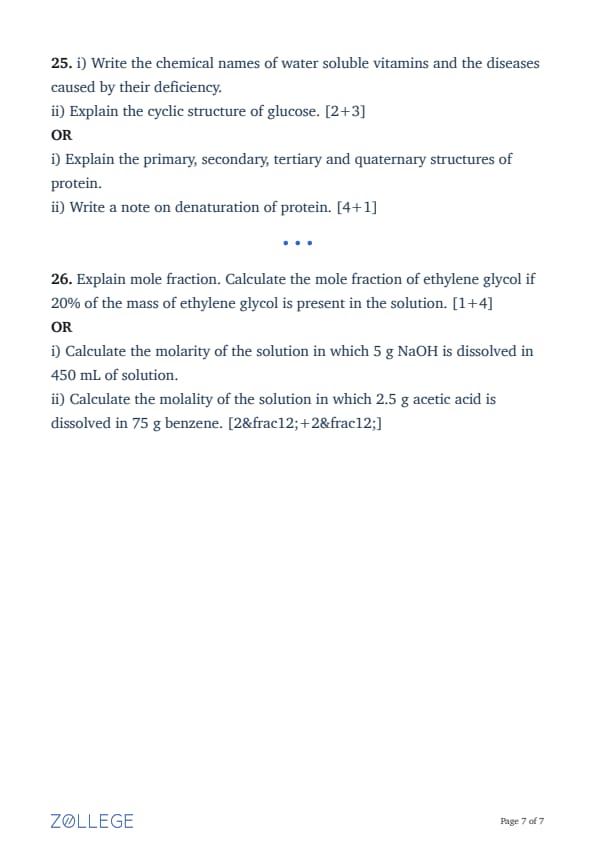
i) Write the chemical names of water soluble vitamins and the diseases caused by their deficiency.
ii) Explain the cyclic structure of glucose. [2+3]
OR
i) Explain the primary, secondary, tertiary and quaternary structures of protein.
ii) Write a note on denaturation of protein. [4+1]
Explain mole fraction. Calculate the mole fraction of ethylene glycol if 20% of the mass of ethylene glycol is present in the solution. [1+4]
OR
i) Calculate the molarity of the solution in which 5 g NaOH is dissolved in 450 mL of solution.
ii) Calculate the molality of the solution in which 2.5 g acetic acid is dissolved in 75 g benzene. [2½+2½]
UP Board Class 12 Chemistry 2026 Set 347-EA Paper Design and Mark Split
The Set 347-EA paper keeps the usual UPMSP Intermediate Chemistry layout, moving from one-mark objective questions up to five-mark long-answer questions with internal choice. Students who managed their time across the shorter answers first found the paper comfortable.
- Total questions: 26 questions, arranged in sections that rise in mark value
- Total marks: 70, to be answered in 3 hours 15 minutes
- Objective block: 6 single-answer MCQs, 1 mark each
- Short answer: very short and short questions worth 2 marks each
- Descriptive block: longer questions carrying 3 marks and 4 marks
- Long answer: the last two questions are 5 marks each and both come with an internal OR choice
UP Board Class 12 Chemistry 2026 Set 347-EA Full Solution Video
Source: Alpha Institute
Chapters That Carried the Most Marks in the Chemistry 2026 Set 347-EA Paper
Physical Chemistry and Organic Chemistry shared most of the paper, so students who were firm on kinetics, electrochemistry and reaction mechanisms scored quickly.
- Chemical Kinetics: order of a reaction from the rate law, temperature-independent quantities, half-life of a first-order reaction and the link between order and molecularity
- Electrochemistry: the Nernst equation for a Cr-Cd cell, electrode potential and emf, and the labelled hydrogen-oxygen fuel cell with its electrode reactions
- Coordination Compounds and d-block: magnetic moment comparison, why [NiCl4]2- is paramagnetic but [Ni(CO)4] is diamagnetic, transition metals as catalysts and valence bond treatment of [CoF6]3- and [Ni(CN)4]2-
- Haloalkanes and Haloarenes: the SN1 reactivity order, the full SN2 mechanism of an alkyl halide and reagents for converting alcohols to alkyl chlorides
- Oxygen and Nitrogen Organics: acidity comparison of substituted benzoic acids, IUPAC naming, aniline and diazonium reactions, phenol nitration and diethyl ether preparation
- Solutions and Biomolecules: the van't Hoff factor, mole fraction of ethylene glycol, peptide bonds, water-soluble vitamins and the cyclic structure of glucose
UP Board Class 12 Chemistry 2026 Set 347-EA Question Paper FAQs
Ques. When was the UP Board Class 12 Chemistry 2026 exam held?
Ans. The UP Board Class 12 Chemistry 2026 paper was conducted by UPMSP on 25 February 2026. The theory paper had 26 questions for a total of 70 marks, with 3 hours 15 minutes to finish.
Ques. How many marks is the UP Board Class 12 Chemistry theory paper?
Ans. The theory paper is 70 marks. The remaining 30 marks come from the practical exam, which takes the subject to 100 marks in total.
Ques. Which chapters were the most important in the Set 347-EA paper?
Ans. Chemical Kinetics, Electrochemistry and Coordination Compounds led the paper, while Haloalkanes, Aldehydes and Ketones, Amines and Solutions filled the rest. Physical and Organic Chemistry together carried most of the marks.
Ques. Does the UP Board Class 12 Chemistry paper have internal choices?
Ans. Yes. The two five-mark long-answer questions each give an internal OR option, so students pick one of the two parts in each case.
Ques. Where can I download the UP Board Class 12 Chemistry 2026 question paper with solutions PDF for free?
Ans. Use the download table above on Zollege to get the full Set 347-EA question paper with step-by-step solutions. For the official paper and results, visit the UPMSP website at upmsp.edu.in.
*The article might have information for the previous academic years, please refer the official website of the exam.