
UP Board Class 12 Chemistry 2026 Set 347 EC Question Paper with Solution


Content Curator | Updated On - Jul 10, 2026
The UP Board Class 12 Chemistry 2026 question paper (Set 347-EC) comes with fully worked solutions that students can download for free on Zollege. This theory paper was held by the Uttar Pradesh Madhyamik Shiksha Parishad (UPMSP) on 25 February 2026 in the afternoon 2:00 PM to 5:15 PM slot, and it set 26 questions for 70 marks across a duration of 3 hours 15 minutes.
| UP Board Class 12 Chemistry 2026 (Set 347-EC) Question Paper with Solution PDF | Download PDF | Check Solutions |
UP BOARD CLASS 12 CHEMISTRY 2026 SET 347 EC WITH SOLUTIONS Questions with Solutions
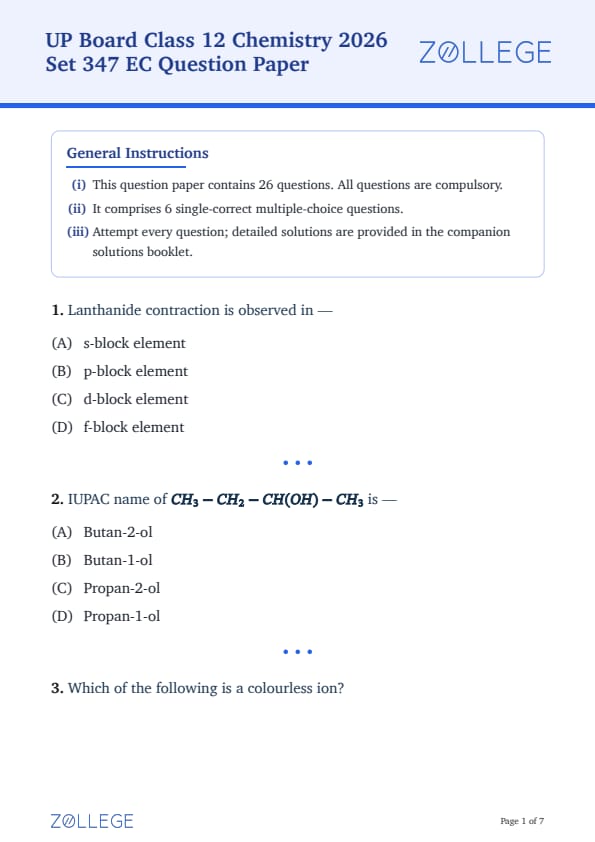
Lanthanide contraction is observed in —
IUPAC name of \( CH_3-CH_2-CH(OH)-CH_3 \) is —
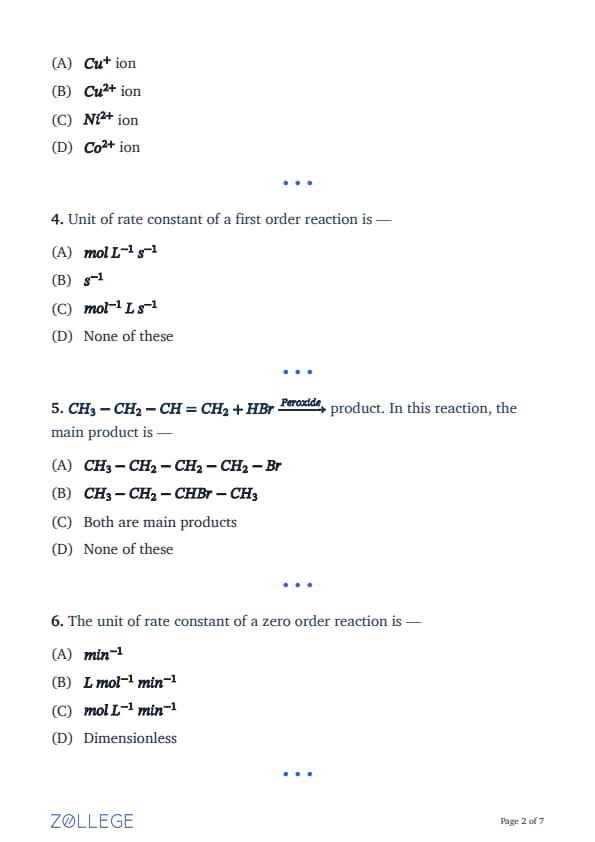
Which of the following is a colourless ion?
Unit of rate constant of a first order reaction is —
\( CH_3-CH_2-CH=CH_2 + HBr \xrightarrow{Peroxide} \) product. In this reaction, the main product is —
The unit of rate constant of a zero order reaction is —
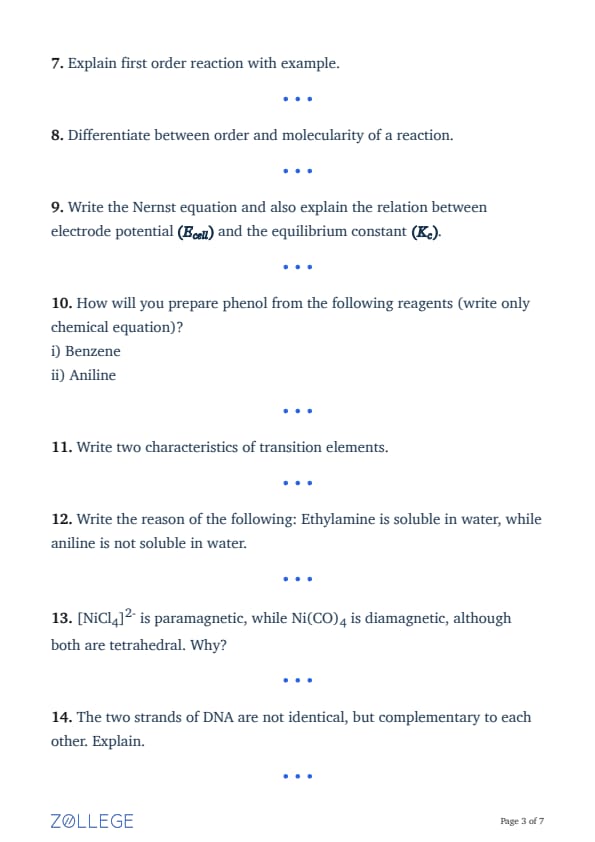
Explain first order reaction with example.
Differentiate between order and molecularity of a reaction.
Write the Nernst equation and also explain the relation between electrode potential \( (E_{cell}) \) and the equilibrium constant \( (K_c) \).
How will you prepare phenol from the following reagents (write only chemical equation)?
i) Benzene
ii) Aniline
Write two characteristics of transition elements.
Write the reason of the following: Ethylamine is soluble in water, while aniline is not soluble in water.
[NiCl4]2- is paramagnetic, while Ni(CO)4 is diamagnetic, although both are tetrahedral. Why?
The two strands of DNA are not identical, but complementary to each other. Explain.
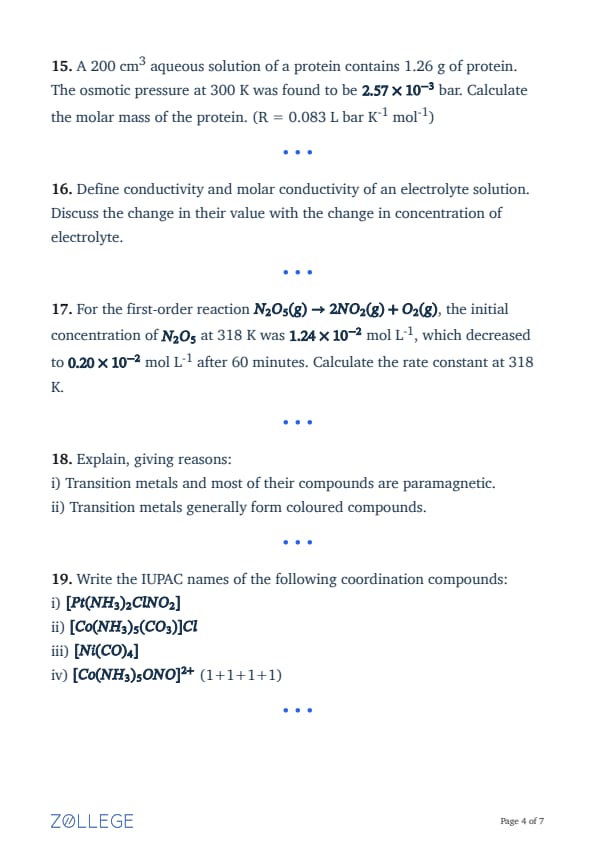
A 200 cm3 aqueous solution of a protein contains 1.26 g of protein. The osmotic pressure at 300 K was found to be \(2.57 \times 10^{-3}\) bar. Calculate the molar mass of the protein. (R = 0.083 L bar K-1 mol-1)
Define conductivity and molar conductivity of an electrolyte solution. Discuss the change in their value with the change in concentration of electrolyte.
For the first-order reaction \(N_2O_5(g) \rightarrow 2NO_2(g) + O_2(g)\), the initial concentration of \(N_2O_5\) at 318 K was \(1.24 \times 10^{-2}\) mol L-1, which decreased to \(0.20 \times 10^{-2}\) mol L-1 after 60 minutes. Calculate the rate constant at 318 K.
Explain, giving reasons:
i) Transition metals and most of their compounds are paramagnetic.
ii) Transition metals generally form coloured compounds.
Write the IUPAC names of the following coordination compounds:
i) \([Pt(NH_3)_2ClNO_2]\)
ii) \([Co(NH_3)_5(CO_3)]Cl\)
iii) \([Ni(CO)_4]\)
iv) \([Co(NH_3)_5ONO]^{2+}\) (1+1+1+1)
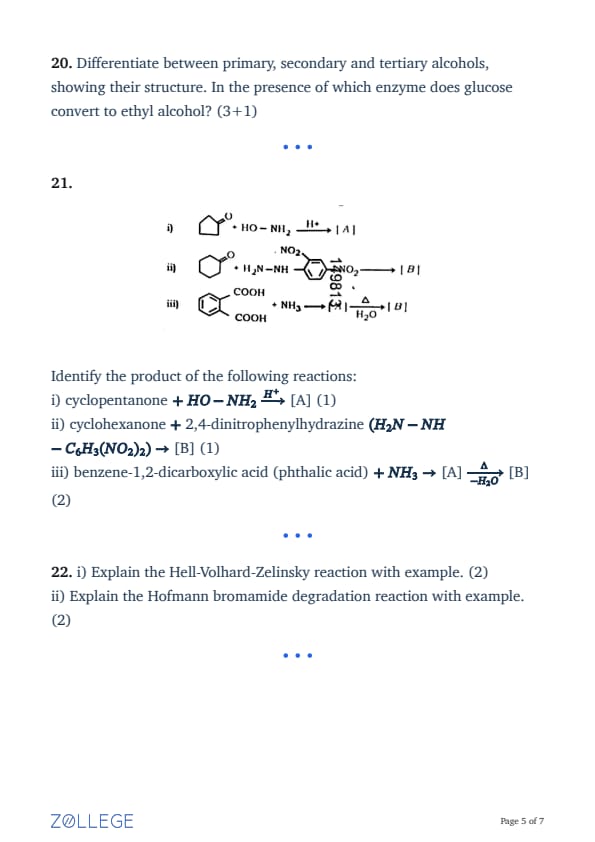
Differentiate between primary, secondary and tertiary alcohols, showing their structure. In the presence of which enzyme does glucose convert to ethyl alcohol? (3+1)

Identify the product of the following reactions:
i) cyclopentanone \(+\) \(HO-NH_2 \xrightarrow{H^+}\) [A] (1)
ii) cyclohexanone \(+\) 2,4-dinitrophenylhydrazine \((H_2N-NH-C_6H_3(NO_2)_2) \rightarrow\) [B] (1)
iii) benzene-1,2-dicarboxylic acid (phthalic acid) \(+\) \(NH_3 \rightarrow\) [A] \(\xrightarrow[-H_2O]{\Delta}\) [B] (2)
i) Explain the Hell-Volhard-Zelinsky reaction with example. (2)
ii) Explain the Hofmann bromamide degradation reaction with example. (2)
What are nucleic acids? Explain the difference between DNA and RNA and state their two important biological functions.
OR
How can vitamins be classified? Write the name of a fat soluble vitamin. Which vitamin is responsible for blood clotting?

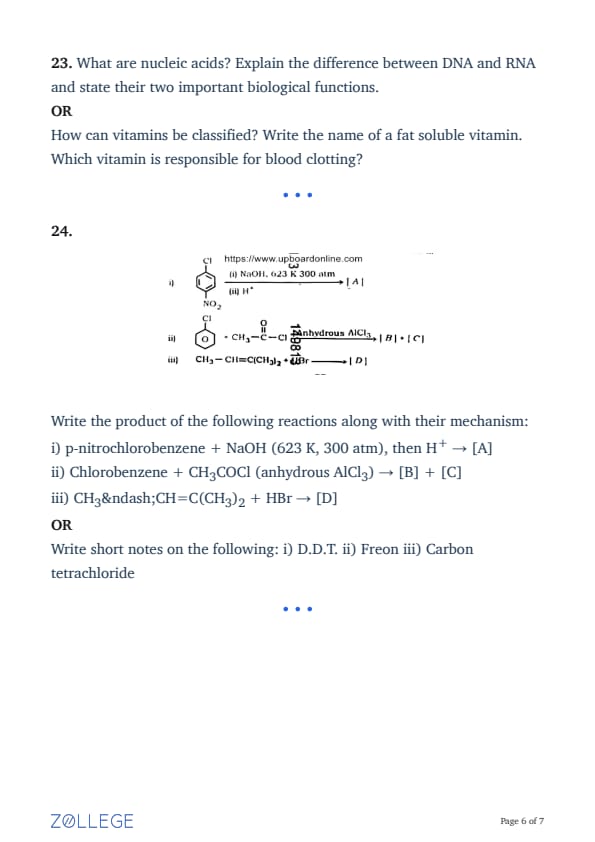
Write the product of the following reactions along with their mechanism:
i) p-nitrochlorobenzene + NaOH (623 K, 300 atm), then H+ → [A]
ii) Chlorobenzene + CH3COCl (anhydrous AlCl3) → [B] + [C]
iii) CH3–CH=C(CH3)2 + HBr → [D]
OR
Write short notes on the following: i) D.D.T. ii) Freon iii) Carbon tetrachloride
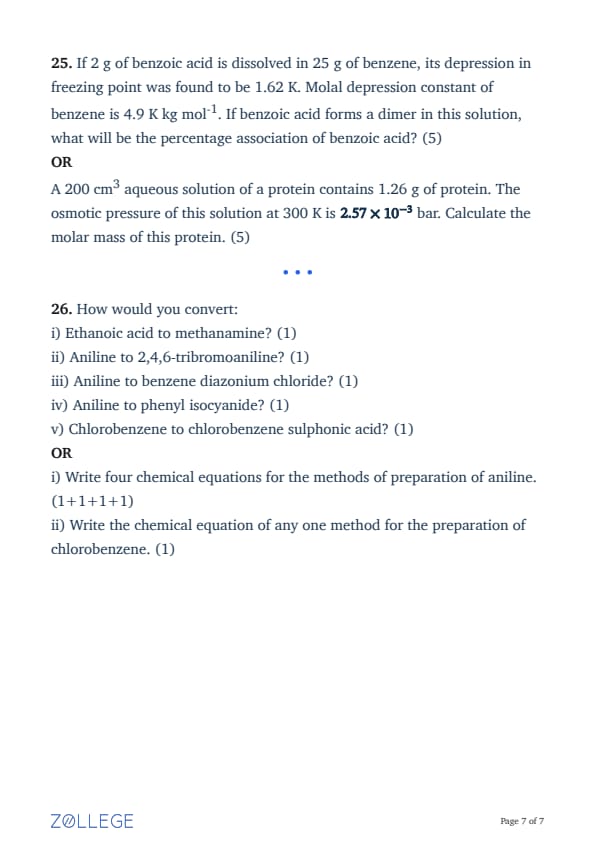
If 2 g of benzoic acid is dissolved in 25 g of benzene, its depression in freezing point was found to be 1.62 K. Molal depression constant of benzene is 4.9 K kg mol-1. If benzoic acid forms a dimer in this solution, what will be the percentage association of benzoic acid? (5)
OR
A 200 cm3 aqueous solution of a protein contains 1.26 g of protein. The osmotic pressure of this solution at 300 K is \(2.57\times10^{-3}\) bar. Calculate the molar mass of this protein. (5)
How would you convert:
i) Ethanoic acid to methanamine? (1)
ii) Aniline to 2,4,6-tribromoaniline? (1)
iii) Aniline to benzene diazonium chloride? (1)
iv) Aniline to phenyl isocyanide? (1)
v) Chlorobenzene to chlorobenzene sulphonic acid? (1)
OR
i) Write four chemical equations for the methods of preparation of aniline. (1+1+1+1)
ii) Write the chemical equation of any one method for the preparation of chlorobenzene. (1)
UP Board Class 12 Chemistry 2026 Paper Layout and Marks Split
The Set 347-EC paper keeps to the usual UPMSP Intermediate Chemistry blueprint, moving from one-mark objective questions to five-mark long-answer questions, with a few printed organic reaction schemes that students had to complete.
- Total questions: 26 questions spread across Sections A to E
- Total marks: 70, to be answered in 3 hours 15 minutes
- Section A: 6 single-answer MCQs, 1 mark each (Q1 parts a to f)
- Sections B and C: very short and short answer questions worth 2 marks each
- Section D: long answer questions of 3 marks and 4 marks
- Section E: 5-mark long answer questions, each carrying an internal OR choice
- Reaction schemes: printed organic conversions and mechanisms (such as the phenol preparation and nucleophilic aromatic substitution questions) needed complete equations, not one-word answers
UP Board Class 12 Chemistry 2026 Set 347-EC Solved Paper Video
Source: Alpha Institute
Chapters That Carried the Most Marks in the Chemistry 2026 Set 347-EC Paper
Physical Chemistry and Organic Chemistry shared the bulk of the paper, so students who had revised kinetics, electrochemistry and the named organic reactions cleared the easy marks quickly.
- Chemical Kinetics: rate constant units for first and zero order reactions (Q4, Q6), first order reaction with example (Q7), order versus molecularity (Q8) and the N2O5 decomposition numerical (Q17)
- Coordination Compounds: the colourless ion MCQ (Q3), why [NiCl4]2- is paramagnetic while Ni(CO)4 is diamagnetic (Q13) and IUPAC naming of complexes (Q19)
- d- and f-Block Elements: lanthanide contraction (Q1), characteristics of transition elements (Q11) and their paramagnetic, coloured nature (Q18)
- Amines: ethylamine versus aniline solubility (Q12), Hofmann bromamide degradation (Q22) and the aniline conversions to tribromoaniline and benzene diazonium chloride (Q26)
- Alcohols, Phenols and Ethers: IUPAC naming (Q2), phenol preparation from benzene and aniline (Q10) and the primary, secondary and tertiary alcohol comparison (Q20)
- Electrochemistry: the Nernst equation and its link to the equilibrium constant (Q9) and conductivity versus molar conductivity (Q16)
- Solutions: osmotic pressure of a protein solution (Q15) and the freezing point depression numerical (Q25)
- Biomolecules and Haloarenes: complementary DNA strands (Q14), nucleic acids with the vitamins OR choice (Q23) and nucleophilic aromatic substitution mechanisms (Q24)
UP Board Class 12 Chemistry 2026 Set 347-EC Question Paper FAQs
Ques. On which date was the UP Board Class 12 Chemistry 2026 exam held?
Ans. UPMSP conducted the UP Board Class 12 Chemistry 2026 paper on 25 February 2026 in the afternoon slot from 2:00 PM to 5:15 PM. The paper had 26 questions for a total of 70 marks.
Ques. What is the total mark for the UP Board Class 12 Chemistry theory paper?
Ans. The theory paper is worth 70 marks. The practical exam adds another 30 marks, so the full subject is scored out of 100 marks.
Ques. Which chapters had the highest weight in the Set 347-EC paper?
Ans. Chemical Kinetics led the paper, appearing in Sections A, B and D. Coordination Compounds, the d- and f-Block Elements, Amines and Electrochemistry were the next heaviest topics.
Ques. Does the UP Board Class 12 Chemistry paper give internal choices?
Ans. Yes. The 5-mark long answer questions in Section E carry an internal OR option, so students attempt one of the two given parts in each of those questions.
Ques. Where can students download the UP Board Class 12 Chemistry 2026 question paper with solutions PDF for free?
Ans. Use the download table above on Zollege to get the complete Set 347-EC question paper with step-by-step solutions. For the official paper and results, visit the UPMSP website at upmsp.edu.in.
*The article might have information for the previous academic years, please refer the official website of the exam.