
UP Board Class 12 Chemistry 2026 Set 347 EE Question Paper with Solution


Content Curator | Updated On - Jul 10, 2026
The UP Board Class 12 Chemistry 2026 exam was conducted by the Uttar Pradesh Madhyamik Shiksha Parishad (UPMSP) on 25 February 2026 in the afternoon shift. This page hosts the Set 347 EE Chemistry question paper together with a fully solved PDF that students can read online or download free from the table below on Zollege.
The Set 347 EE paper set 26 questions for a total of 70 marks, to be attempted in 3 hours 15 minutes. The solved PDF explains every objective answer, reaction and numerical step by step, so students can check their own attempt and correct weak areas well before the result.
| UP Board Class 12 Chemistry 2026 (Set 347 EE) Question Paper with Solution PDF | Download PDF | Check Solutions |
UP BOARD CLASS 12 CHEMISTRY 2026 SET 347 EE WITH SOLUTIONS Questions with Solutions
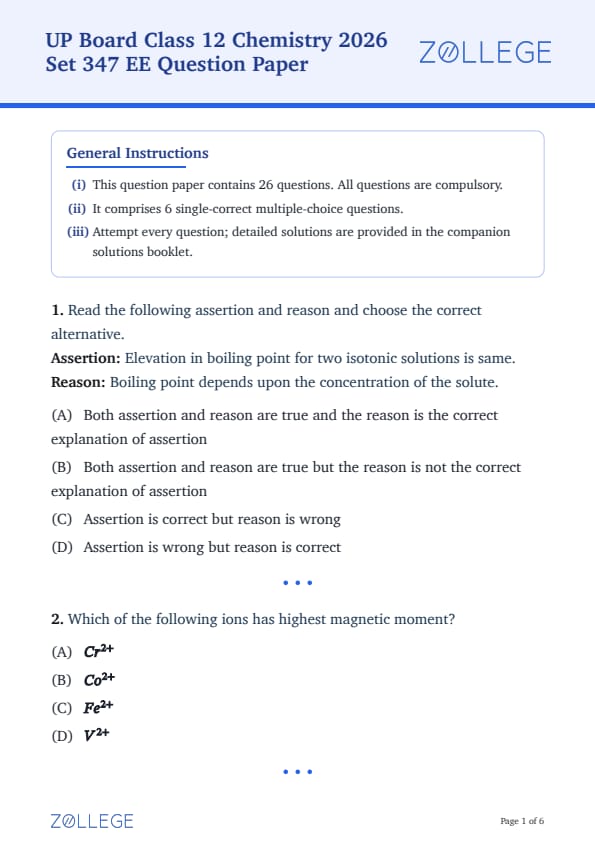
Read the following assertion and reason and choose the correct alternative.
Assertion: Elevation in boiling point for two isotonic solutions is same.
Reason: Boiling point depends upon the concentration of the solute.
Which of the following ions has highest magnetic moment?
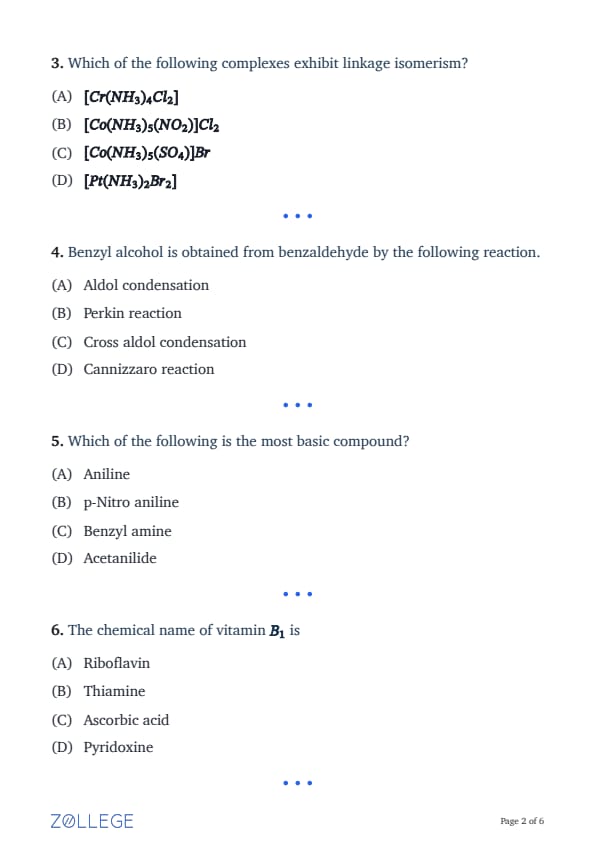
Which of the following complexes exhibit linkage isomerism?
Benzyl alcohol is obtained from benzaldehyde by the following reaction.
Which of the following is the most basic compound?
The chemical name of vitamin \( B_1 \) is
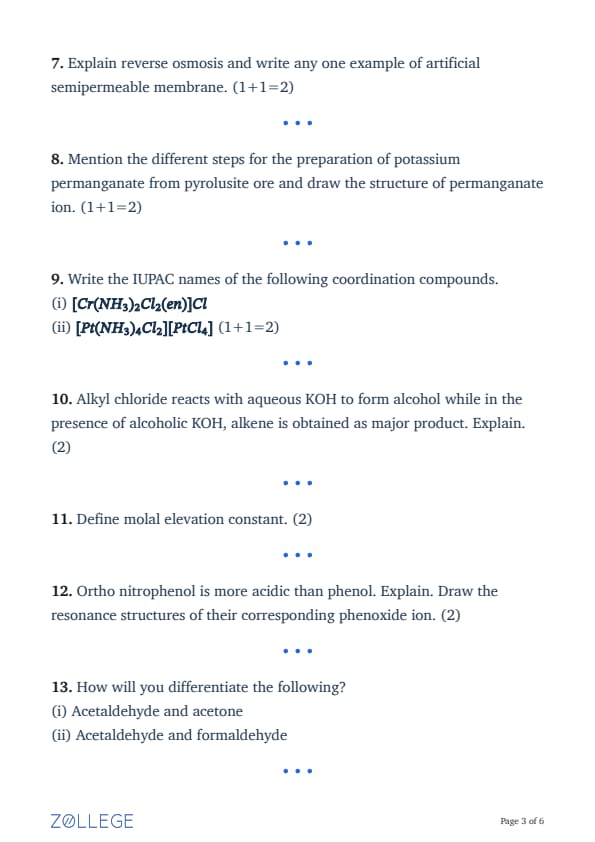
Explain reverse osmosis and write any one example of artificial semipermeable membrane. (1+1=2)
Mention the different steps for the preparation of potassium permanganate from pyrolusite ore and draw the structure of permanganate ion. (1+1=2)
Write the IUPAC names of the following coordination compounds.
(i) \( [Cr(NH_3)_2Cl_2(en)]Cl \)
(ii) \( [Pt(NH_3)_4Cl_2][PtCl_4] \) (1+1=2)
Alkyl chloride reacts with aqueous KOH to form alcohol while in the presence of alcoholic KOH, alkene is obtained as major product. Explain. (2)
Define molal elevation constant. (2)
Ortho nitrophenol is more acidic than phenol. Explain. Draw the resonance structures of their corresponding phenoxide ion. (2)
How will you differentiate the following?
(i) Acetaldehyde and acetone
(ii) Acetaldehyde and formaldehyde
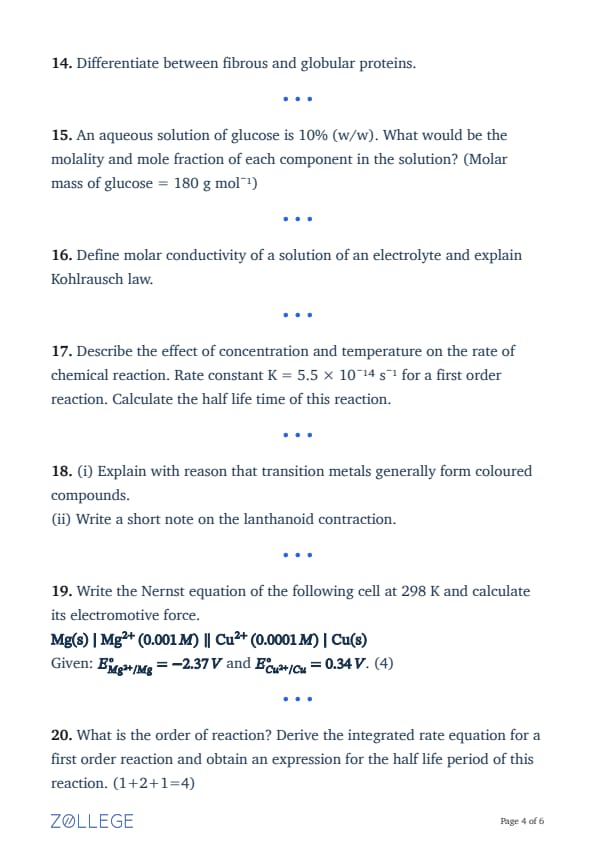
Differentiate between fibrous and globular proteins.
An aqueous solution of glucose is 10% (w/w). What would be the molality and mole fraction of each component in the solution? (Molar mass of glucose = 180 g mol⁻¹)
Define molar conductivity of a solution of an electrolyte and explain Kohlrausch law.
Describe the effect of concentration and temperature on the rate of chemical reaction. Rate constant K = 5.5 × 10⁻¹⁴ s⁻¹ for a first order reaction. Calculate the half life time of this reaction.
(i) Explain with reason that transition metals generally form coloured compounds.
(ii) Write a short note on the lanthanoid contraction.
Write the Nernst equation of the following cell at 298 K and calculate its electromotive force.
\( \text{Mg(s)} \mid \text{Mg}^{2+}\,(0.001\,M) \parallel \text{Cu}^{2+}\,(0.0001\,M) \mid \text{Cu(s)} \)
Given: \( E^\circ_{Mg^{2+}/Mg} = -2.37\,V \) and \( E^\circ_{Cu^{2+}/Cu} = 0.34\,V \). (4)
What is the order of reaction? Derive the integrated rate equation for a first order reaction and obtain an expression for the half life period of this reaction. (1+2+1=4)
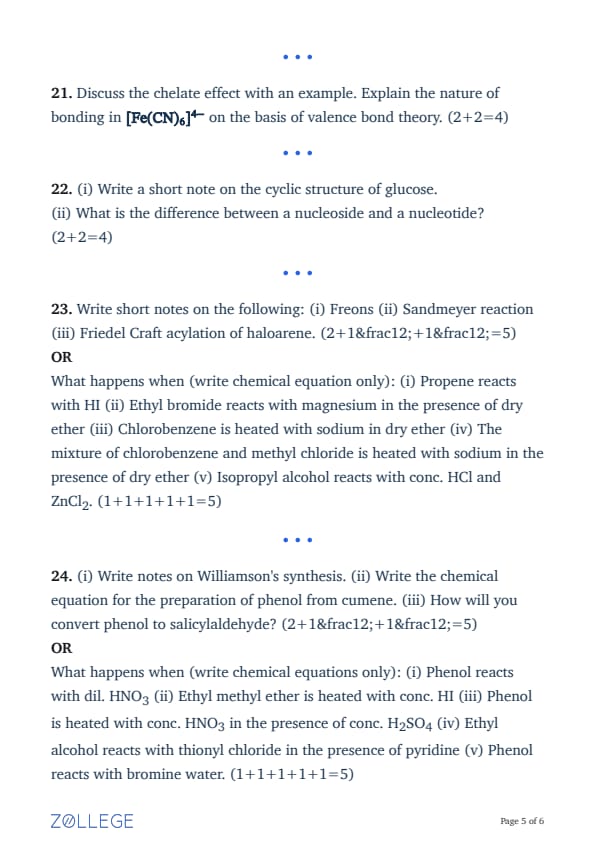
Discuss the chelate effect with an example. Explain the nature of bonding in \( [\text{Fe}(\text{CN})_6]^{4-} \) on the basis of valence bond theory. (2+2=4)
(i) Write a short note on the cyclic structure of glucose.
(ii) What is the difference between a nucleoside and a nucleotide? (2+2=4)
Write short notes on the following: (i) Freons (ii) Sandmeyer reaction (iii) Friedel Craft acylation of haloarene. (2+1½+1½=5)
OR
What happens when (write chemical equation only): (i) Propene reacts with HI (ii) Ethyl bromide reacts with magnesium in the presence of dry ether (iii) Chlorobenzene is heated with sodium in dry ether (iv) The mixture of chlorobenzene and methyl chloride is heated with sodium in the presence of dry ether (v) Isopropyl alcohol reacts with conc. HCl and ZnCl2. (1+1+1+1+1=5)
(i) Write notes on Williamson's synthesis. (ii) Write the chemical equation for the preparation of phenol from cumene. (iii) How will you convert phenol to salicylaldehyde? (2+1½+1½=5)
OR
What happens when (write chemical equations only): (i) Phenol reacts with dil. HNO3 (ii) Ethyl methyl ether is heated with conc. HI (iii) Phenol is heated with conc. HNO3 in the presence of conc. H2SO4 (iv) Ethyl alcohol reacts with thionyl chloride in the presence of pyridine (v) Phenol reacts with bromine water. (1+1+1+1+1=5)
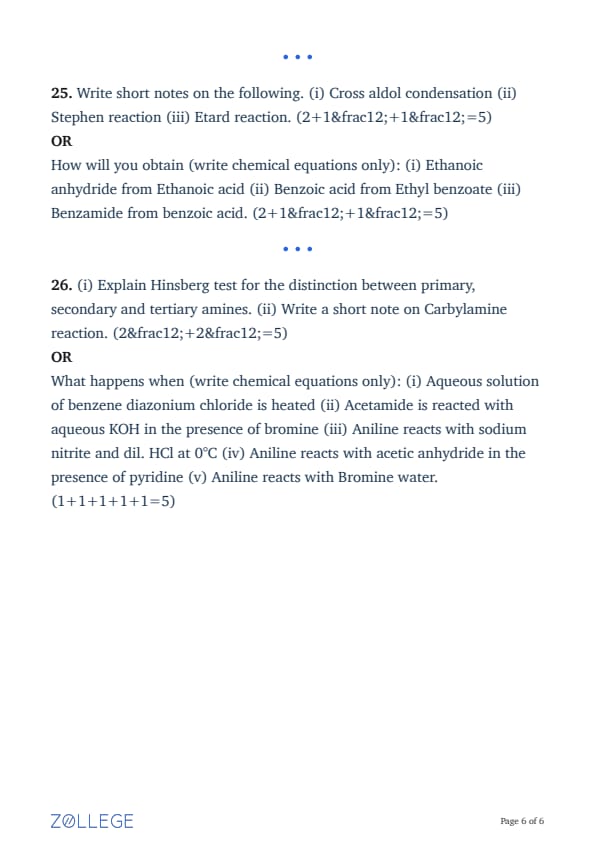
Write short notes on the following. (i) Cross aldol condensation (ii) Stephen reaction (iii) Etard reaction. (2+1½+1½=5)
OR
How will you obtain (write chemical equations only): (i) Ethanoic anhydride from Ethanoic acid (ii) Benzoic acid from Ethyl benzoate (iii) Benzamide from benzoic acid. (2+1½+1½=5)
(i) Explain Hinsberg test for the distinction between primary, secondary and tertiary amines. (ii) Write a short note on Carbylamine reaction. (2½+2½=5)
OR
What happens when (write chemical equations only): (i) Aqueous solution of benzene diazonium chloride is heated (ii) Acetamide is reacted with aqueous KOH in the presence of bromine (iii) Aniline reacts with sodium nitrite and dil. HCl at 0°C (iv) Aniline reacts with acetic anhydride in the presence of pyridine (v) Aniline reacts with Bromine water. (1+1+1+1+1=5)
UP Board Class 12 Chemistry 2026 Paper Pattern and Marks Distribution for Set 347 EE
The Chemistry theory paper carries 70 marks and runs for 3 hours 15 minutes. Set 347 EE follows the standard UPMSP layout, opening with one-mark objective questions and closing with five-mark long-answer questions that carry an internal choice. Understanding how the 26 questions are shared across the sections lets students budget their time before the exam.
How the 70 marks are split across the paper
- Objective block: Question 1, parts (a) to (f), gives six multiple choice questions of 1 mark each on coordination compounds, aldehydes, amines and biomolecules.
- Sections B and C: very short and short answer questions worth 2 marks each, mostly definitions, distinctions and single-step numericals.
- Section D: short answer questions worth 3 marks and 4 marks, covering solutions, electrochemistry, chemical kinetics and the d-block.
- Section E: five-mark long answer questions, each with an internal OR choice, that reward complete reasoning and balanced equations.
Using the Set 347 EE Solved Chemistry Paper the Smart Way
A solved previous year paper works best when students first attempt it under exam conditions and only then compare with the answer key. The Zollege solution PDF shows the working behind every answer, not just the final result, so gaps in reactions and formulas are easy to spot.
- Attempt the whole paper in one timed 3 hour 15 minute sitting to build real exam stamina.
- Match your answers line by line with the solved PDF and flag every step you missed.
- Note the repeated units, such as Coordination Compounds, Aldehydes and Ketones, and Solutions, and revise those first.
- Rewrite the named reactions and IUPAC names a second time, since organic chemistry carries a large share of the marks.
UP Board Class 12 Chemistry 2026 paper code 347(EE) full solution walkthrough
Source: Alpha Institute
UP Board Class 12 Chemistry 2026 Set 347 EE Question Paper FAQs
Ques. When was the UP Board Class 12 Chemistry 2026 exam held?
Ans. The UPMSP held the Class 12 Chemistry 2026 theory exam on 25 February 2026 in the afternoon shift, from 2:00 PM to 5:15 PM.
Ques. How many questions and marks are there in the Set 347 EE paper?
Ans. The Set 347 EE paper has 26 questions and carries a total of 70 marks, to be answered in 3 hours 15 minutes.
Ques. Is the UP Board Class 12 Chemistry 2026 solution PDF free on Zollege?
Ans. Yes. Students can read online or download the Set 347 EE question paper with its full solution PDF free from the table above on Zollege.
Ques. Which units carry the most weight in this Chemistry paper?
Ans. Organic units such as Aldehydes, Ketones and Amines, along with Coordination Compounds and Solutions, appear across the short and long answer sections, so students should practise these first.
Ques. Where can students verify the official UP Board Chemistry paper?
Ans. The official question paper and syllabus are released by the Uttar Pradesh Madhyamik Shiksha Parishad on its website upmsp.edu.in.
*The article might have information for the previous academic years, please refer the official website of the exam.