
UP Board Class 12 History Question Paper 2024 (Code 321 ED): Download Solution PDF with Answer Key

.jpg?tr=h-55,w-55,c-force)
Content Strategist|Tech-innovator|National Hackathon Winner | Updated On - Feb 28, 2025
UP Board Class 12 History Question Paper 2024 PDF (Code 321 ED) is available for download here. The History exam was conducted on March 6, 2024 in the Evening Shift from 2 PM to 5:15 PM. The total marks for the theory paper are 100. Students reported the paper to be moderate.
UP Board Class 12 History Question Paper 2024 (Code 321 ED) with Solutions
|
UP Board12 History Core Question Paper With Answer Key |
 Download Download |
Check Solution |

UP Board Class 12 History Question Paper With Solution
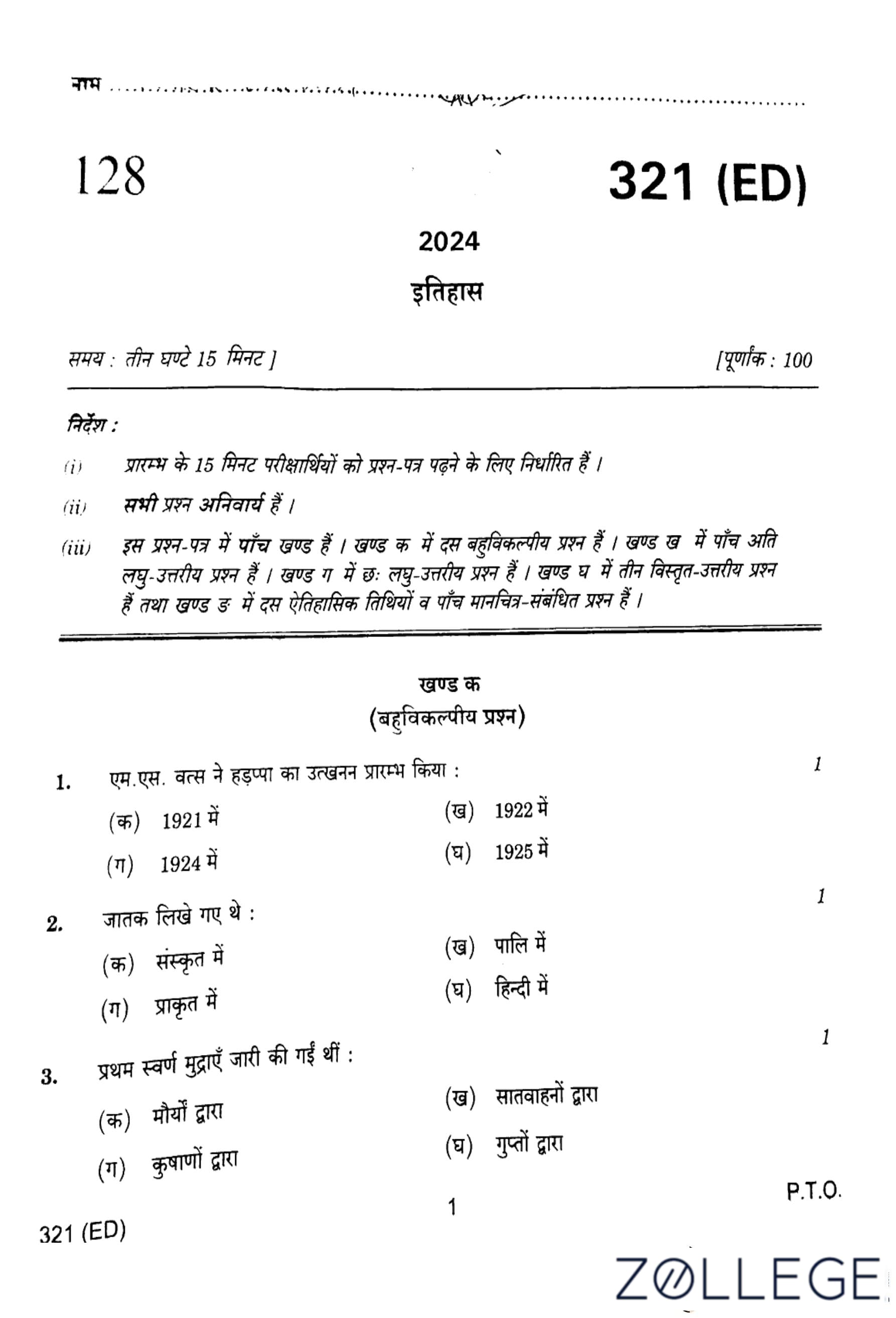
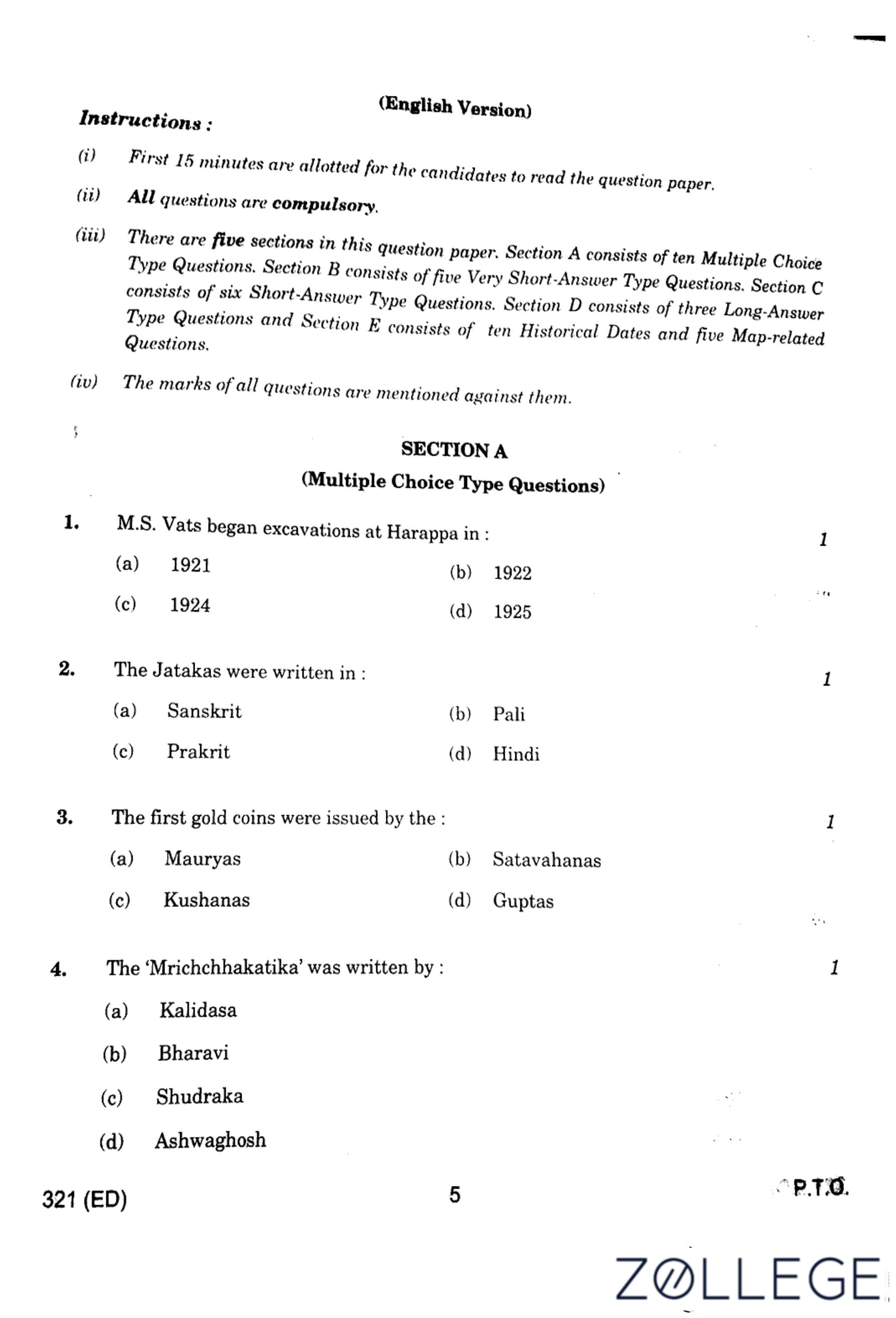
M.S. Vats began excavations at Harappa in:
View Solution
M.S. Vats, an archaeologist associated with the Archaeological Survey of India, began excavations at Harappa in 1921. Harappa is one of the major sites of the Indus Valley Civilization, located in present-day Pakistan. These excavations revealed significant insights into the urban planning, architecture, and lifestyle of one of the world's oldest civilizations. Quick Tip: Remember key dates and figures associated with archaeological discoveries for history-related questions.
The Jatakas were written in:
View Solution
The Jatakas are a collection of Buddhist literature written in the Pali language. These stories recount the previous lives of Gautama Buddha and convey moral and ethical lessons. The Jatakas are an important part of Theravāda Buddhism and serve as a rich source of cultural and historical information about ancient India. Quick Tip: Focus on the language and context of ancient texts to answer related questions effectively.
The first gold coins were issued by the:
View Solution
The Kushanas were the first rulers to issue gold coins in India, reflecting their economic prosperity and trade relations with the Roman Empire. These coins often depicted the rulers on one side and deities on the other, showcasing their political and cultural influences. Quick Tip: Study the contributions of different dynasties in fields like coinage, administration, and trade for comprehensive preparation.
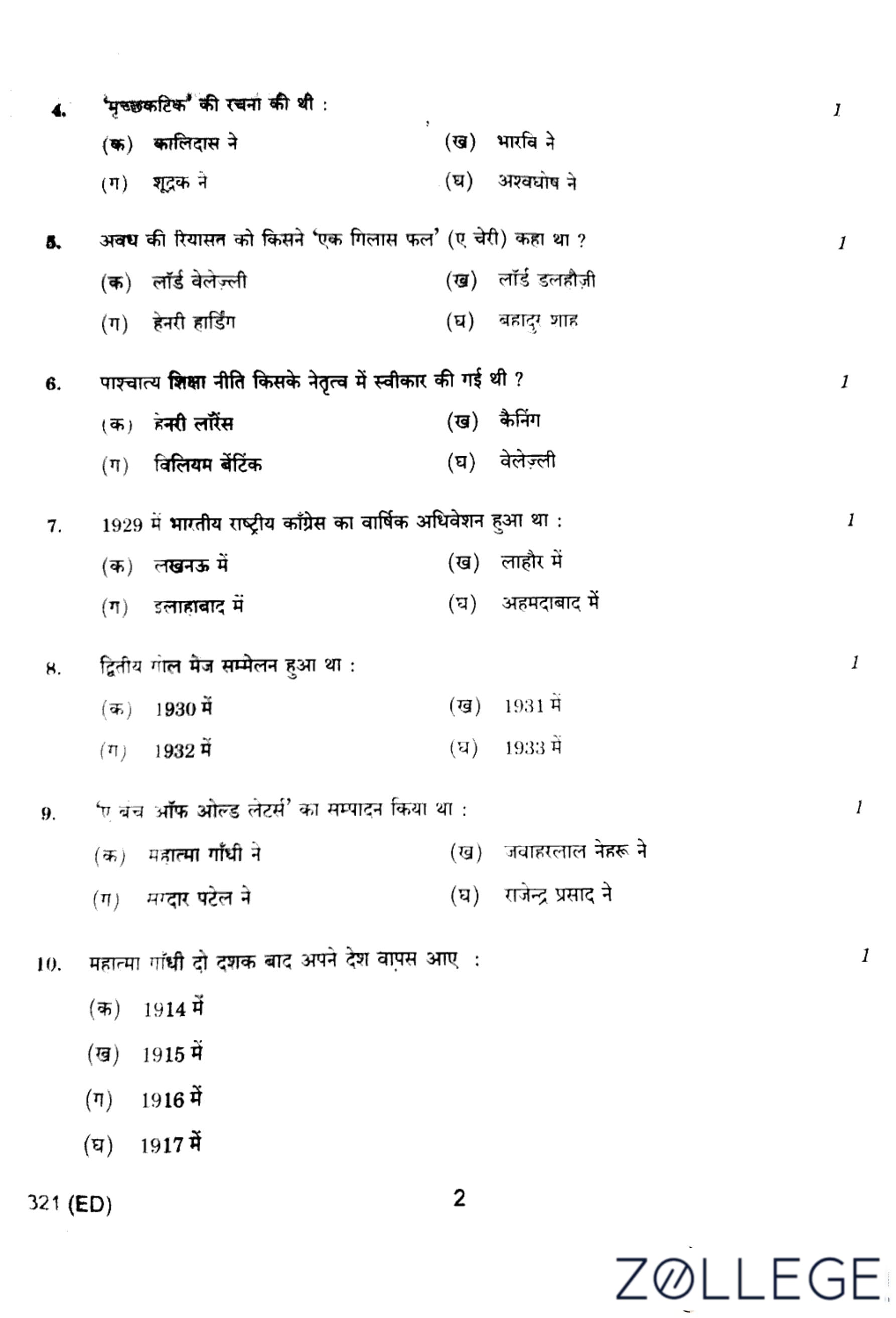
The ‘Mrichchhakatika’ was written by:
View Solution
The ‘Mrichchhakatika’ (The Little Clay Cart) is a Sanskrit play written by Shudraka. It is a ten-act drama that portrays the love story of Charudatta, a poor Brahmin merchant, and Vasantasena, a courtesan. The play is celebrated for its vivid characters, intricate plot, and social realism. Quick Tip: Familiarize yourself with major literary works and their authors to tackle questions in Indian literature.
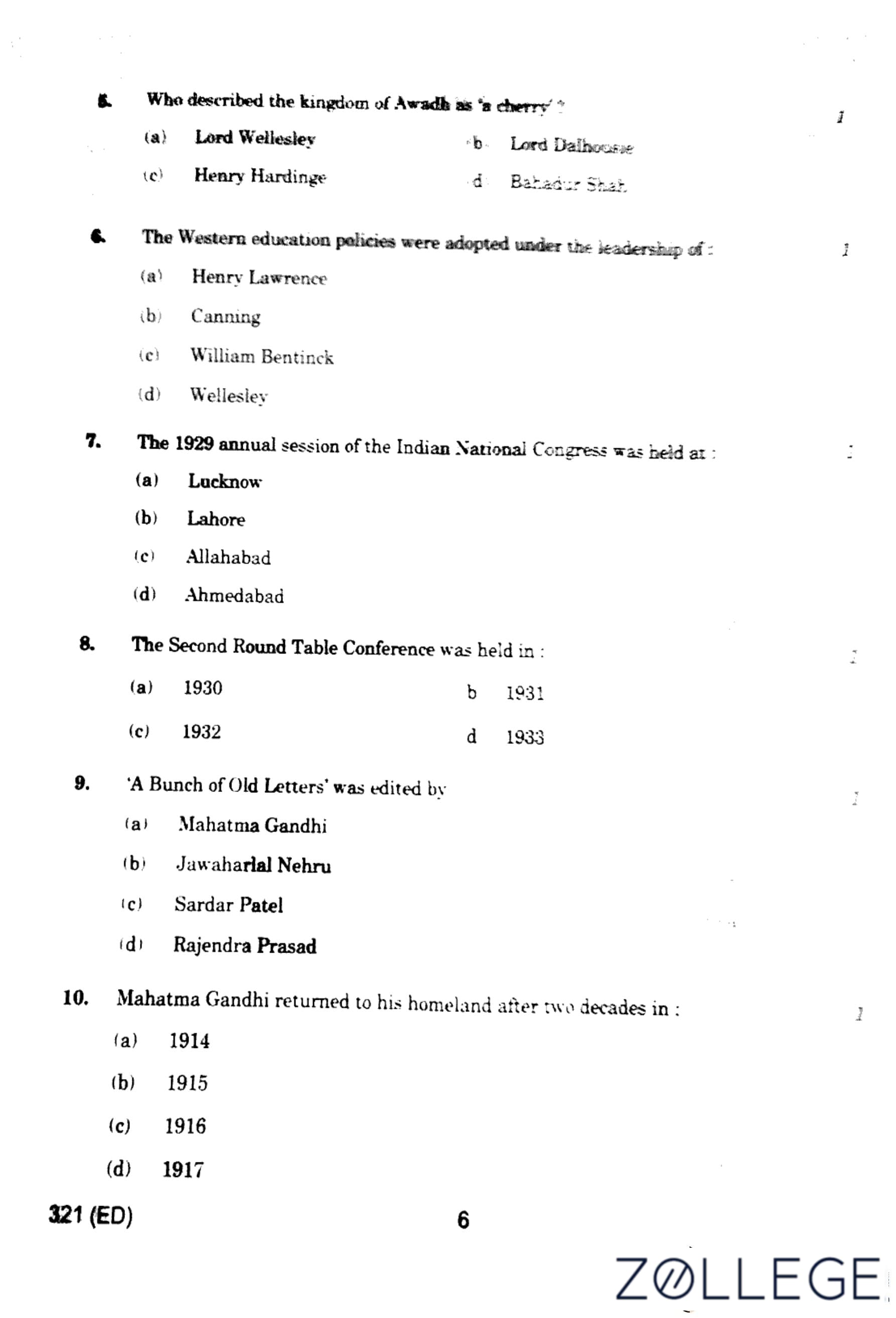
Who described the kingdom of Awadh as 'a cherry'?
View Solution
Lord Dalhousie described the kingdom of Awadh as 'a cherry' to signify its importance and rich resources, which made it desirable for annexation by the British East India Company. The Doctrine of Lapse and administrative inefficiencies were used as justifications for annexing Awadh in 1856. Quick Tip: Focus on important figures and their policies during British India to understand their administrative actions.
The Western education policies were adopted under the leadership of:
View Solution
William Bentinck, who served as the Governor-General of India from 1828 to 1835, was instrumental in introducing Western education policies in India. His administration saw the rise of educational reforms that aimed at modernizing the Indian education system, based on Western principles. One of the key steps taken by Bentinck was the promotion of English as the medium of instruction. This was a significant shift from the traditional education system, which was primarily based on vernacular languages and religious texts.
Bentinck’s policies were heavily influenced by Lord Macaulay’s Minutes on Education, which advocated for the education of the Indian population in Western subjects, particularly science, mathematics, and literature, through the English language. In 1835, Bentinck passed the resolution that English would be the medium of instruction in schools and colleges, replacing Persian, which had been the official language of education until then. This led to the establishment of schools that taught English and Western subjects, laying the foundation for the spread of Western education in India.
Bentinck’s education policies were not just about introducing a new language but were also part of a broader effort to modernize and reform Indian society. He believed that the knowledge of Western literature and sciences would enable Indians to take part in the global intellectual community and promote a new form of governance.
However, the shift towards English-medium education had both positive and negative impacts. On one hand, it led to the development of a class of educated Indians who could participate in administrative and intellectual discourses. On the other hand, it marginalized traditional forms of education and led to the decline of indigenous knowledge systems. Quick Tip: Pay attention to the reforms introduced by British administrators to understand their impact on Indian society, particularly in education and governance.
The 1929 annual session of the Indian National Congress was held at:
View Solution
The 1929 annual session of the Indian National Congress, held in Lahore, is historically significant as it declared complete independence (Purna Swaraj) as its goal. Jawaharlal Nehru was the President of the session, and the tricolor was hoisted for the first time on January 26, 1930. Quick Tip: Memorize key Congress sessions and their reSolutionss for Indian freedom struggle topics.
The Second Round Table Conference was held in:
View Solution
The Second Round Table Conference was held in 1931 in London. Mahatma Gandhi participated as the sole representative of the Indian National Congress. Discussions focused on constitutional reforms in India, but the conference failed to resolve differences between the Indian factions and the British government. Quick Tip: Review important conferences and agreements during the Indian independence movement to better understand political developments.
'A Bunch of Old Letters' was edited by:
View Solution
'A Bunch of Old Letters' is a collection of letters written by prominent leaders and personalities of the Indian freedom struggle. The book was edited by Jawaharlal Nehru and provides deep insight into the minds of the individuals who played key roles during the pre-independence period. It reflects the personal and political narratives of the time. Quick Tip: Remember the contributions of key leaders beyond politics, such as their writings and literary works.
Mahatma Gandhi returned to his homeland after two decades in:
View Solution
Mahatma Gandhi returned to India in January 1915 after spending two decades in South Africa, where he led various civil rights movements for the Indian community. His return marked the beginning of his active participation in the Indian freedom struggle, starting with smaller movements like the Champaran Satyagraha in 1917. Quick Tip: Understand the timeline of Mahatma Gandhi’s life to connect his South African experience with his Indian freedom struggle contributions.
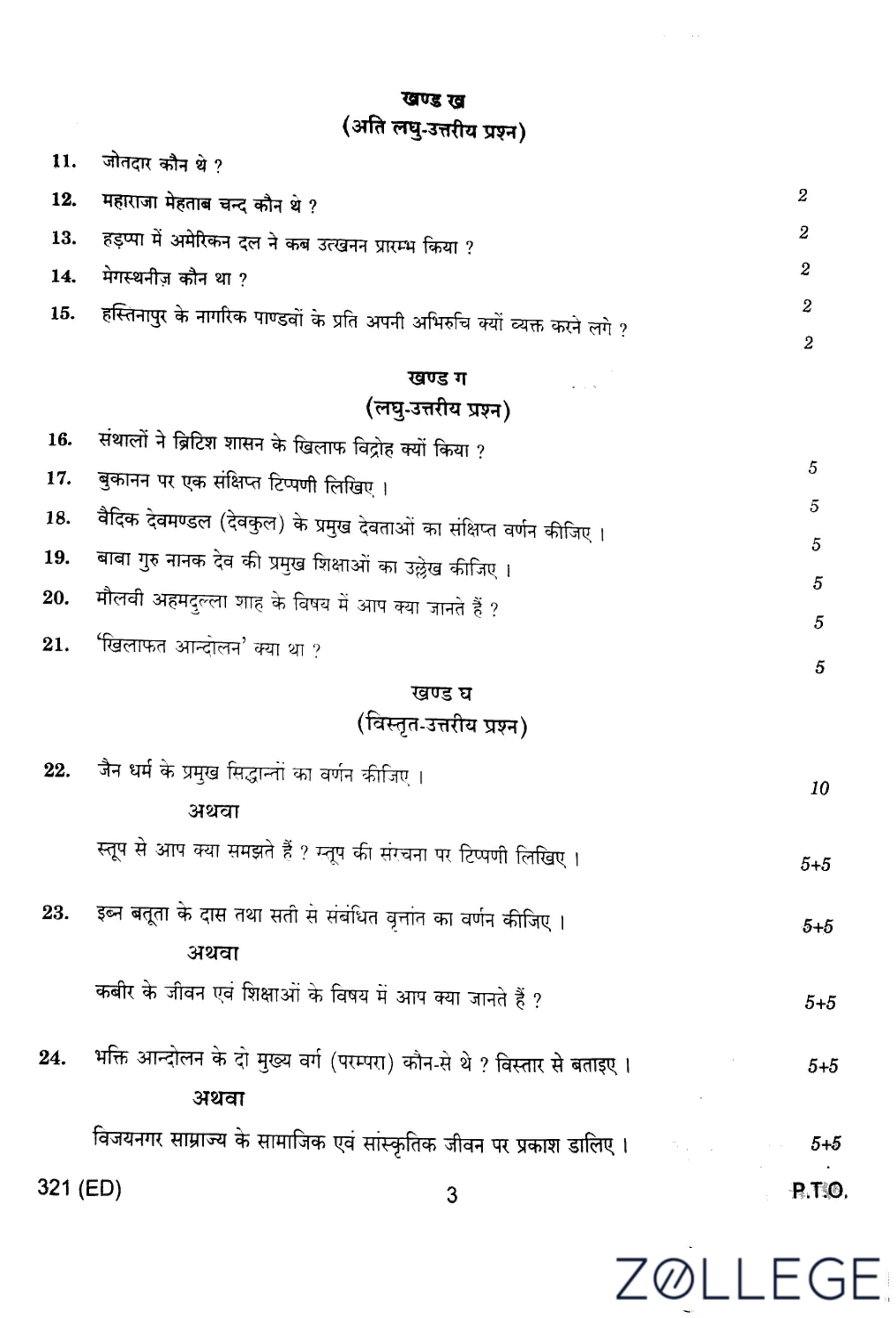
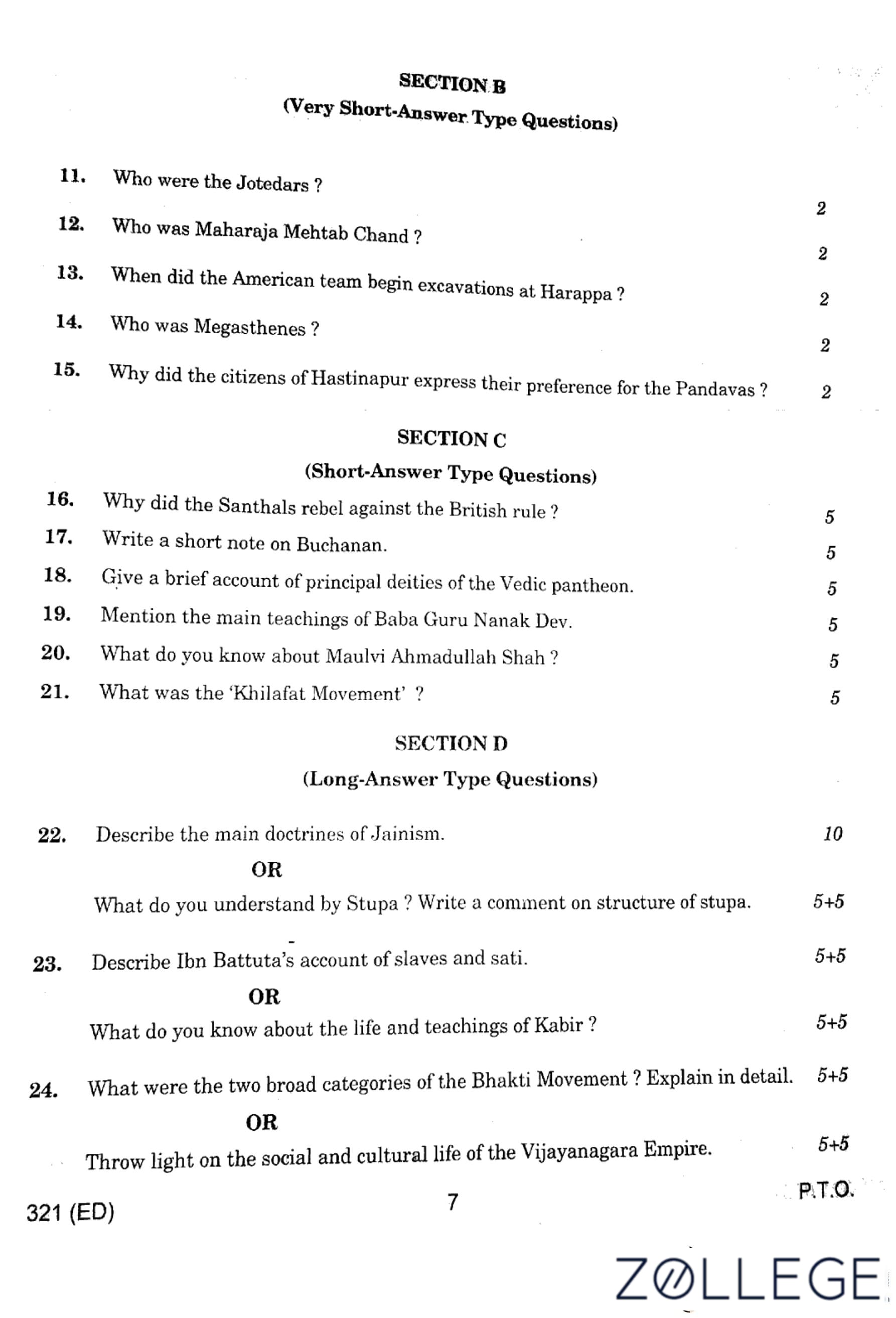
Who were the Jotedars?
View Solution
The Jotedars were rich peasants in Bengal during the colonial period who owned vast stretches of agricultural land. They played a dominant role in rural society by controlling land and resources and often acted as intermediaries between the British government and the rural masses. Jotedars challenged the authority of zamindars and were influential in shaping the agrarian structure in colonial Bengal. Quick Tip: Understand the rural social hierarchy in colonial India, including the roles of zamindars, Jotedars, and ryots.
Who was Maharaja Mehtab Chand?
View Solution
Maharaja Mehtab Chand was the ruler of Burdwan in the 19th century. He is remembered for his administrative reforms, contributions to education, and support for the British government. He worked to improve infrastructure in his state and was known for his philanthropy and progressive outlook. Quick Tip: Explore contributions of regional rulers to governance, education, and public welfare during colonial India.
When did the American team begin excavations at Harappa?
View Solution
The American team, led by archaeologist George F. Dales, began excavations at Harappa in the 1960s. Their work focused on uncovering the urban layout, trade networks, and cultural aspects of the Indus Valley Civilization. This marked a significant phase in understanding the advanced planning and social structure of the Harappan cities. Quick Tip: Keep track of major archaeological excavations and their contributions to historical knowledge.
Who was Megasthenes?
View Solution
Megasthenes was a Greek ambassador to the Mauryan court during the reign of Chandragupta Maurya. He authored the book 'Indica,' which provides valuable insights into the social, political, and economic conditions of ancient India. His observations are considered one of the earliest accounts of Indian civilization by a foreign traveler. Quick Tip: Study the works of foreign travelers like Megasthenes, Fa-Hien, and Ibn Battuta for early accounts of Indian history.
Why did the citizens of Hastinapur express their preference for the Pandavas?
View Solution
The citizens of Hastinapur expressed their preference for the Pandavas due to their just and righteous nature. Unlike the Kauravas, the Pandavas were known for their adherence to dharma, fairness in governance, and commitment to the welfare of the people. Their qualities made them ideal rulers in the eyes of the citizens. Quick Tip: Understand the ethical and moral values highlighted in Indian epics like the Mahabharata and Ramayana.
Why did the Santhals rebel against the British rule?
View Solution
The Santhal rebellion, or Santhal Hool of 1855-56, was a significant tribal uprising against British rule. The Santhals were exploited by zamindars, moneylenders, and British officials, losing their traditional lands to oppressive policies. They were subjected to unfair taxation, usurious lending practices, and social discrimination. The rebellion, led by tribal leaders like Sidhu and Kanhu Murmu, was a cry for justice and freedom. Despite their eventual defeat, the Santhal rebellion highlighted the injustices faced by tribal communities and led to some reforms in the governance of tribal regions. Quick Tip: Pay attention to tribal revolts in India, as they reveal the socio-economic impact of British policies on indigenous communities.
Write a short note on Buchanan.
View Solution
Francis Buchanan was a Scottish physician, naturalist, and surveyor known for his contributions to understanding Indian society under British rule. His surveys in Bengal and Bihar provided detailed insights into the socio-economic conditions of rural India, including agriculture, local industries, and social structures. His work documented the richness of Indian flora, fauna, and cultural practices. The Buchanan Report is considered a valuable historical source for understanding India's socio-economic conditions during colonial rule. His meticulous observations contributed to the colonial administration’s understanding of rural India. Quick Tip: Remember Buchanan’s role in documenting India’s natural and social environment under colonial rule, a key source for historians.
Give a brief account of principal deities of the Vedic pantheon.
View Solution
The Vedic pantheon was characterized by the worship of natural forces and cosmic principles. Key deities included Indra, the god of rain and thunder, revered for his strength and leadership; Agni, the fire god, who acted as a mediator between humans and gods during sacrifices; Varuna, the custodian of cosmic order and morality; and Surya, the sun god, symbolizing life and vitality. These deities were worshipped through elaborate rituals and hymns found in the Rigveda. The Vedic pantheon reflects the agrarian lifestyle and philosophical outlook of early Indian society. Quick Tip: Focus on how Vedic rituals and deities influenced Indian religious practices and social structures.
Mention the main teachings of Baba Guru Nanak Dev.
View Solution
Guru Nanak Dev, the founder of Sikhism, preached the unity of God and the equality of all people, rejecting caste discrimination and ritualistic practices. His teachings emphasized selfless service (seva), honest living (kirat karni), sharing with others (vand chhako), and spiritual devotion (naam japna). He advocated a life of humility, truth, and compassion. Guru Nanak’s philosophy inspired a reformist movement that emphasized social justice, harmony, and devotion. His teachings are immortalized in the Guru Granth Sahib, guiding millions of Sikhs worldwide. Quick Tip: Explore how Guru Nanak’s teachings addressed social inequality and laid the foundation of Sikhism.
What do you know about Maulvi Ahmadullah Shah?
View Solution
Maulvi Ahmadullah Shah, a prominent leader of the 1857 Revolt, was known for his fiery oratory and military leadership. Hailing from Faizabad, he inspired masses to join the rebellion against British rule. His deep knowledge of Islamic theology and his vision of an independent India made him a key figure in uniting various communities against the colonial administration. He organized uprisings in Awadh, leading forces in fierce battles. His leadership symbolized resistance and inspired others to fight for India’s freedom. Quick Tip: Study the roles of regional leaders in India’s first war of independence to understand the grassroots nature of the movement.
What was the ‘Khilafat Movement’?
View Solution
The Khilafat Movement (1919-1924) emerged to protest the British decision to dismantle the Ottoman Caliphate after World War I. Indian Muslims, led by Maulana Muhammad Ali and Shaukat Ali, sought to protect the Caliph, seen as the spiritual leader of Islam. The movement gained momentum when Mahatma Gandhi supported it as part of the Non-Cooperation Movement, fostering Hindu-Muslim unity. Though it eventually declined, the Khilafat Movement highlighted the Indian struggle against colonial rule and promoted communal harmony in the freedom movement. Quick Tip: Understand how the Khilafat Movement strengthened the freedom struggle and highlighted communal unity.
Describe the main doctrines of Jainism.
View Solution
Jainism is one of the oldest religions in the world, with its roots deeply embedded in the principles of non-violence, spiritual discipline, and self-realization. The primary doctrines of Jainism are as follows:
1. Ahimsa (Non-violence): The most central doctrine of Jainism is absolute non-violence (Ahimsa) in thought, word, and deed towards all living beings. Jains believe that all life forms, including plants and microorganisms, have a soul and must not be harmed. Ahimsa is not just physical non-violence but also extends to the mental and emotional realms, fostering compassion, love, and peace.
2. Anekantavada (Multiplicity of Truth): This doctrine emphasizes the multiplicity of perspectives and truth. Jainism asserts that truth is complex and cannot be fully grasped from just one point of view. The concept encourages intellectual humility, recognizing that one's understanding may be limited and that others' viewpoints are also valid.
3. Aparigraha (Non-possessiveness): Aparigraha advocates for non-attachment to material possessions. It teaches that excessive attachment to wealth and worldly desires leads to bondage and suffering. Jains believe in leading a simple, content life, focusing on spiritual progress rather than accumulating wealth or material goods.
4. Three Jewels (Ratnatraya): The Three Jewels—Right Faith (Samyak Darshan), Right Knowledge (Samyak Jnana), and Right Conduct (Samyak Charitra)—form the path to liberation (Moksha). These principles guide followers towards spiritual awakening, ethical behavior, and the development of wisdom.
5. Karma Theory: According to Jainism, every action, whether good or bad, leaves an imprint on the soul, contributing to the cycle of birth, death, and rebirth (Samsara). The doctrine of karma emphasizes that individuals are responsible for their actions and must work toward purifying their soul through ethical living and spiritual discipline.
6. Asceticism: Asceticism (Tapas) is highly valued in Jainism. It involves renouncing worldly pleasures and attachments in pursuit of spiritual purity and liberation (Moksha). Jain ascetics live a life of extreme discipline, practicing fasting, meditation, and self-restraint to shed accumulated karma and attain liberation.
These doctrines promote an ethical and disciplined life, focusing on compassion, non-violence, and self-realization. Jainism encourages spiritual progress, offering a path towards liberation from the cycle of life and death. The ultimate goal of Jainism is to achieve Moksha, where the soul is freed from the cycle of rebirth and attains eternal peace. Quick Tip: Focus on Jain doctrines like Ahimsa and Anekantavada, as they are fundamental to Jain philosophy and reflect the religion's emphasis on peace, compassion, and truth.
OR What do you understand by Stupa? Write a comment on the structure of Stupa.
View Solution
A Stupa is a significant architectural feature in Buddhist culture, symbolizing the teachings of Buddhism, the path to enlightenment, and the presence of Buddha’s relics. The Stupa is typically a hemispherical mound-like structure that was initially used to house sacred relics, such as the bones or personal items of Buddha and other revered figures. The Stupa’s structure is rich in symbolism, and each component has specific spiritual and cosmological meaning. The major parts of a Stupa include:
1. Anda (Dome): The central dome of the Stupa represents the universe. It is hemispherical and symbolizes the cosmic order, encompassing the entire universe. The dome is the main and largest part of the Stupa, signifying the earth and the containment of Buddha’s relics.
2. Harmika: This square platform is placed on top of the dome and represents heaven. It is often adorned with a railing, symbolizing the divine realm where deities reside. The Harmika is thought to hold the energy of enlightenment, bridging the physical world with the heavenly world.
3. Chhatri: The umbrella-like structure atop the Harmika symbolizes the presence of royalty and protection. It also signifies the supreme spiritual knowledge and Buddha’s protection over his followers. In some cases, multiple umbrellas are stacked on top of each other, reflecting the layers of divine protection.
4. Medhi: This circular base encircles the Stupa and provides a space for devotees to perform circumambulation (Pradakshina). It represents the physical realm, and by walking around the Stupa, worshippers symbolically align themselves with the spiritual path of the Buddha.
5. Toranas (Gateways): These ornamental gateways are situated at the cardinal points (North, South, East, and West) of the Stupa. They are richly decorated with carvings depicting various scenes from Buddha’s life, teachings, and Buddhist cosmology. Toranas serve as entryways, providing access to the sacred space within the Stupa.
The Stupa is a focal point for meditation and reflection. It embodies the teachings of Buddhism, such as the journey toward enlightenment, the impermanence of life, and the attainment of Nirvana. The circular structure signifies the cycle of birth, death, and rebirth, while the offerings and rituals performed at the Stupa symbolize the inner transformation of the individual. Quick Tip: Study the symbolism of Stupa components, as they reflect Buddhist cosmology and spirituality. Each part serves as a metaphysical representation of the journey towards enlightenment.
Describe Ibn Battuta's account of slaves and sati.
View Solution
Ibn Battuta, the famous Moroccan traveler, visited India in the 14th century and recorded his observations in his travelogue Rihla (The Journey). His writings provide an invaluable look into the customs and social structures of medieval India. Among the topics he covered were the practices of slavery and sati, both of which were deeply embedded in the social fabric of the time.
Slaves in India:
Ibn Battuta provides detailed accounts of slavery in India, highlighting its prevalence in various aspects of society. Slaves were used in different spheres of life, including domestic work, agriculture, and administration. He noted that slaves were both men and women, and they were considered an important part of the household workforce. He mentioned the practice of women slaves working in royal courts, often serving as concubines or attendants to queens and noblewomen. Battuta also observed that some slaves were trained in specific skills, such as music or dance, and were sometimes used in the courts as entertainers.
Ibn Battuta acknowledged the harsh realities faced by slaves but also noted their relatively better treatment in certain circumstances, especially within royal households, compared to the harsher conditions faced by slaves in other regions of the world. However, he also described the vulnerability of female slaves, who were often subjected to the whims of their masters, reflecting the gender-based inequalities in society.
Sati (the practice of widow immolation):
Ibn Battuta also encountered the practice of sati during his travels in India, which he described as a deeply rooted religious and social custom. Sati involved a widow either voluntarily or forcibly climbing onto her deceased husband's funeral pyre and immolating herself. Ibn Battuta observed that this practice was regarded as a noble and honorable act in some Hindu communities, often connected with the idea of marital devotion and a means to ensure the widow's liberation in the afterlife.
He made special note of the religious and social pressures surrounding the practice, pointing out how widows were often expected to perform this ritual. While he was not entirely sympathetic to the practice, his description provides a view of how deeply entrenched cultural norms governed the lives of women during that period. It is important to note that, while Battuta recognized the practice as widespread, it was not universally accepted, and its enforcement varied depending on the region and the local rulers.
Ibn Battuta’s accounts give us valuable insight into the socio-cultural practices of medieval India, shedding light on how slavery and sati, despite their inherent hardships and contradictions, were normalized in certain segments of society. His observations also highlight the complexity of Indian society, where local customs, religious beliefs, and political structures influenced social practices. Quick Tip: Refer to Ibn Battuta's travelogues for detailed descriptions of medieval Indian society and culture. His observations reflect the diversity of practices and their implications on social hierarchies.
OR What do you know about the life and teachings of Kabir?
View Solution
Kabir, a 15th-century poet and saint, is one of the most revered figures in the Bhakti movement. Born in Varanasi (Banaras), Kabir is believed to have been raised by a Muslim family but was deeply influenced by both Hindu and Muslim religious traditions. His life and teachings transcend religious boundaries, advocating a deep spiritual connection with the Divine and focusing on the internal devotion to God over outward rituals.
Kabir rejected the conventional religious practices of both Hinduism and Islam, particularly idol worship and the ritualistic aspect of religion. His teachings promoted a formless God (Nirguna), which resonated with the ideals of mysticism found in both Sufism and certain strands of Hinduism. Kabir’s verses are a profound critique of societal and religious norms, and they advocate for a simpler, more direct form of spirituality.
Key Teachings of Kabir:
1. Equality: Kabir's teachings emphasized the inherent equality of all human beings, irrespective of caste, religion, or social status. He vehemently rejected the caste system and social stratification. In his famous couplets, he states that a person’s worth is determined by their character and actions, not by their caste or birth. Kabir’s message was revolutionary at a time when caste discrimination was deeply entrenched in Indian society.
2. Devotion to God: According to Kabir, true worship is not through external rituals but through sincere love and devotion to God. He rejected the notion of formal worship and rituals that involved idol worship, and instead, he emphasized meditation and remembrance of the formless God (Nirguna). His idea of devotion was about purity of heart and love for the Divine rather than performing prescribed rites.
3. Moral Living: Kabir stressed the importance of leading a moral life, focusing on honesty, humility, and simplicity. He criticized hypocrisy and emphasized that a person’s behavior, character, and virtues are the true markers of spiritual growth. Kabir’s poetry encourages simplicity and purity in thought and action, suggesting that a simple, honest life is the most pious form of worship.
4. Unity of Religions: One of Kabir’s most remarkable contributions was his ability to bridge the gap between Hinduism and Islam. His teachings promoted unity and understanding between the two religions, urging his followers to look beyond religious labels and understand the shared message of love and devotion to God. He is often considered a syncretic figure, whose teachings synthesized elements from both Hindu and Muslim traditions.
Influence and Legacy:
Kabir’s verses, which were compiled in works like the Bijak, Sakhis, and Kabir Granthavali, have had a profound influence on the development of the Bhakti movement. His poetry was simple yet powerful, often written in a vernacular dialect accessible to the common people. His spiritual depth and critique of societal evils such as casteism, ritualism, and social inequality have inspired generations of people in India and beyond.
Kabir’s legacy continues to influence various spiritual and social reform movements, and his teachings are still widely studied and followed today, both in India and across the world. Quick Tip: Study Kabir’s couplets for their spiritual depth and critique of societal evils like casteism. His emphasis on devotion, equality, and simplicity makes his teachings relevant even today.
What were the two broad categories of the Bhakti Movement? Explain in detail.
View Solution
The Bhakti Movement, a spiritual reform movement that began in medieval India, aimed at fostering a personal connection with the divine, transcending the traditional rituals and caste divisions. The movement had two broad categories, each representing a distinct approach to devotion and worship. These categories are:
1. Nirguna Bhakti (Worship of the Formless God):
Nirguna Bhakti refers to the worship of a formless, abstract, and transcendent God. In this form of devotion, the divine is not represented by any idols or physical forms. The focus is on meditative and inner devotion to a God beyond human comprehension. Prominent saints like Kabir, Guru Nanak, and Dnyaneshwar advocated for this form of worship, emphasizing direct spiritual experience and realization of the formless (Nirguna) God. They rejected idol worship and elaborate rituals, instead promoting simplicity in devotion and emphasizing that God is formless and omnipresent.
This form of Bhakti encouraged individuals to seek a personal connection with the divine through meditation, inner purity, and self-reflection. It was a challenge to traditional religious orthodoxy, as it went beyond the physical representation of gods and called for the spiritual elevation of the individual. Nirguna Bhakti fostered equality, as it rejected caste distinctions and emphasized that all human beings, regardless of caste or religion, could access the divine through inner devotion.
2. Saguna Bhakti (Worship of the Formed God):
Saguna Bhakti refers to the worship of gods with forms, such as Vishnu, Krishna, Shiva, and Durga. This form of Bhakti involved the worship of deities that were often represented through idols and images, and devotion was expressed through rituals, prayers, songs, and bhajans. Saints like Tulsidas, Mirabai, Namdev, and Kabir (to some extent) followed this tradition, focusing on the personal relationship with the deity. Saguna Bhakti allowed for an emotional and personal connection with the divine, often through acts of devotion, singing hymns, and storytelling.
This form of Bhakti not only emphasized the love and devotion between the devotee and the deity but also played a significant role in the growth of devotional literature and poetry in medieval India. The worship of gods like Krishna and Shiva became central to the devotional practices in various regions, with the performance of rituals and festivals centered around these deities. Saguna Bhakti also contributed to the creation of a large body of devotional literature, including devotional hymns, songs, and epics.
Common Themes and Impact of Bhakti Movement:
Both Nirguna and Saguna Bhakti sought the ultimate goal of liberation (Moksha), freedom from the cycle of birth and rebirth, and union with the divine. The Bhakti Movement played a pivotal role in breaking down social barriers, especially the caste system. By emphasizing personal devotion and spiritual equality, the Bhakti saints fostered a sense of unity and equality among people, transcending traditional societal divisions.
Moreover, the Bhakti Movement had a profound influence on Indian literature, music, and culture. Devotional poetry and hymns in vernacular languages, as written by saints like Kabir, Mirabai, Tulsidas, and others, inspired millions and contributed to the development of regional languages and literature. The movement also paved the way for social reform, with its emphasis on love, equality, and devotion to God.
Both Nirguna and Saguna Bhakti represented different paths of devotion, but together they enriched the spiritual landscape of medieval India, offering diverse ways for individuals to connect with the divine. Quick Tip: Differentiate between Nirguna and Saguna Bhakti to understand the diversity of spiritual practices in medieval India. Both emphasize devotion but in different forms—formless vs. formed gods.
OR Throw light on the social and cultural life of the Vijayanagara Empire.
View Solution
The Vijayanagara Empire, which existed from the 14th to the 17th centuries, was one of the most powerful and prosperous empires in southern India. It was a hub of cultural and social life, promoting arts, literature, architecture, and social reforms that contributed to its long-lasting legacy. Some key aspects of its social and cultural life include:
1. Architecture:
The Vijayanagara Empire is renowned for its magnificent architectural feats, which exemplify Dravidian art and religious devotion. The empire's capital, Hampi, boasts grand structures like the Virupaksha Temple, Vithala Temple, and Hazara Rama Temple, which feature intricate carvings and majestic pillars. The city was also home to large fortifications, royal palaces, and public buildings. These architectural marvels symbolized the wealth, power, and cultural significance of the empire, which was deeply influenced by Hindu traditions but also incorporated elements from other cultures, such as Islamic and Persian styles.
The empire also supported the construction of step-wells, water tanks, and other civic infrastructure that improved the lives of its citizens, reflecting an advanced understanding of urban planning.
2. Literature:
The Vijayanagara Empire fostered a rich literary tradition in several languages, including Sanskrit, Kannada, Telugu, and Tamil, under royal patronage. The empire's rulers, particularly Krishnadevaraya, encouraged the development of literature and art, making the period a golden age for these languages. Sanskrit texts, including religious and philosophical treatises, were widely produced, while the regional languages saw the creation of works in poetry, history, and drama.
One of the most famous works from this period is Amuktamalyada, written by Krishnadevaraya himself in Telugu. The court of Vijayanagara was home to several famous poets, scholars, and intellectuals, known as the "Ashta Diggajas," who contributed significantly to the intellectual and cultural life of the empire.
3. Social Life:
The social structure in the Vijayanagara Empire was hierarchical but relatively flexible compared to other contemporary societies. Society was divided into various castes, and while the system of caste was firmly entrenched, there was also promotion of social mobility through education, patronage, and royal appointments. Women played an important role in the cultural and religious life of the empire. They participated in rituals, temple festivals, and even in the patronage of the arts. Some women were also involved in literature and the performing arts, though their roles were still largely constrained by traditional norms.
Festivals were a significant aspect of social life, and the royal court sponsored numerous events, including grand temple festivals, music performances, and dance. The Tirupati Venkateswara Temple and other such temples were major centers of social and religious activity. Music and dance were integral to cultural expressions and were often part of religious and courtly rituals.
4. Trade and Economy:
The Vijayanagara Empire had a flourishing economy, heavily reliant on agriculture, but also trade and commerce played a crucial role in its prosperity. Trade with Arabs, Europeans, and other Asian nations enriched the empire. The Hampi market was one of the largest markets in Asia, dealing in spices, textiles, precious stones, and more. The empire's trade relations helped create a wealthy elite class that could sponsor artists, scholars, and religious institutions. This economic prosperity allowed the empire to support its grand cultural initiatives, including the construction of temples, fortifications, and other infrastructure.
The empire also enjoyed a thriving textile industry, particularly cotton and silk, which were in demand both locally and abroad. Portuguese and Arab traders played an important role in the empire’s external trade relations, especially in the export of spices and textiles.
Conclusion:
The Vijayanagara Empire's social and cultural life was marked by a blend of tradition and innovation, with its emphasis on religious devotion, intellectual achievements, and artistic expression. The contributions to architecture, literature, and trade from this period have left a lasting legacy that continues to influence Indian culture today. Quick Tip: Focus on Vijayanagara’s contributions to art, architecture, and literature to appreciate its cultural legacy, especially in terms of its influence on subsequent Indian dynasties.
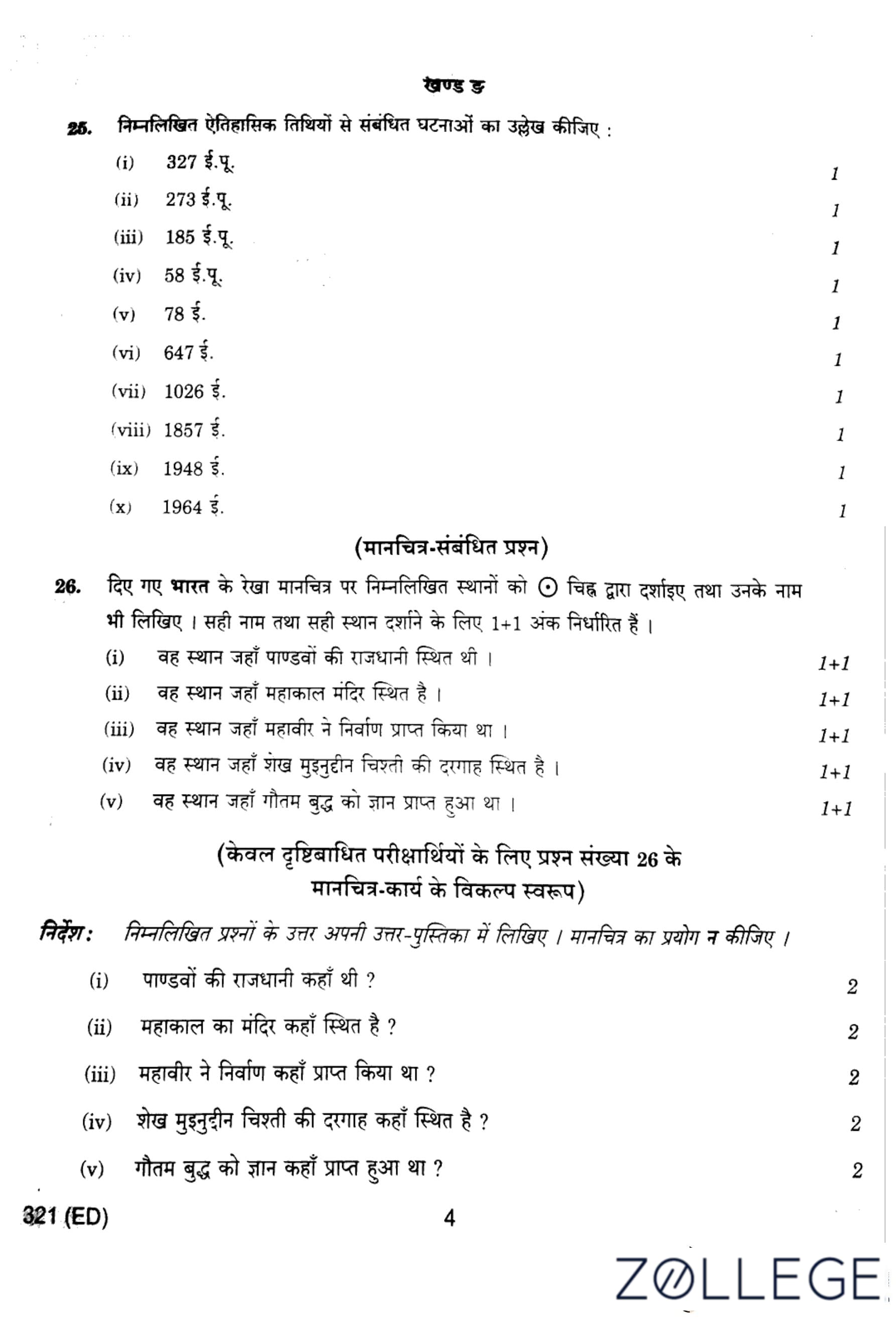
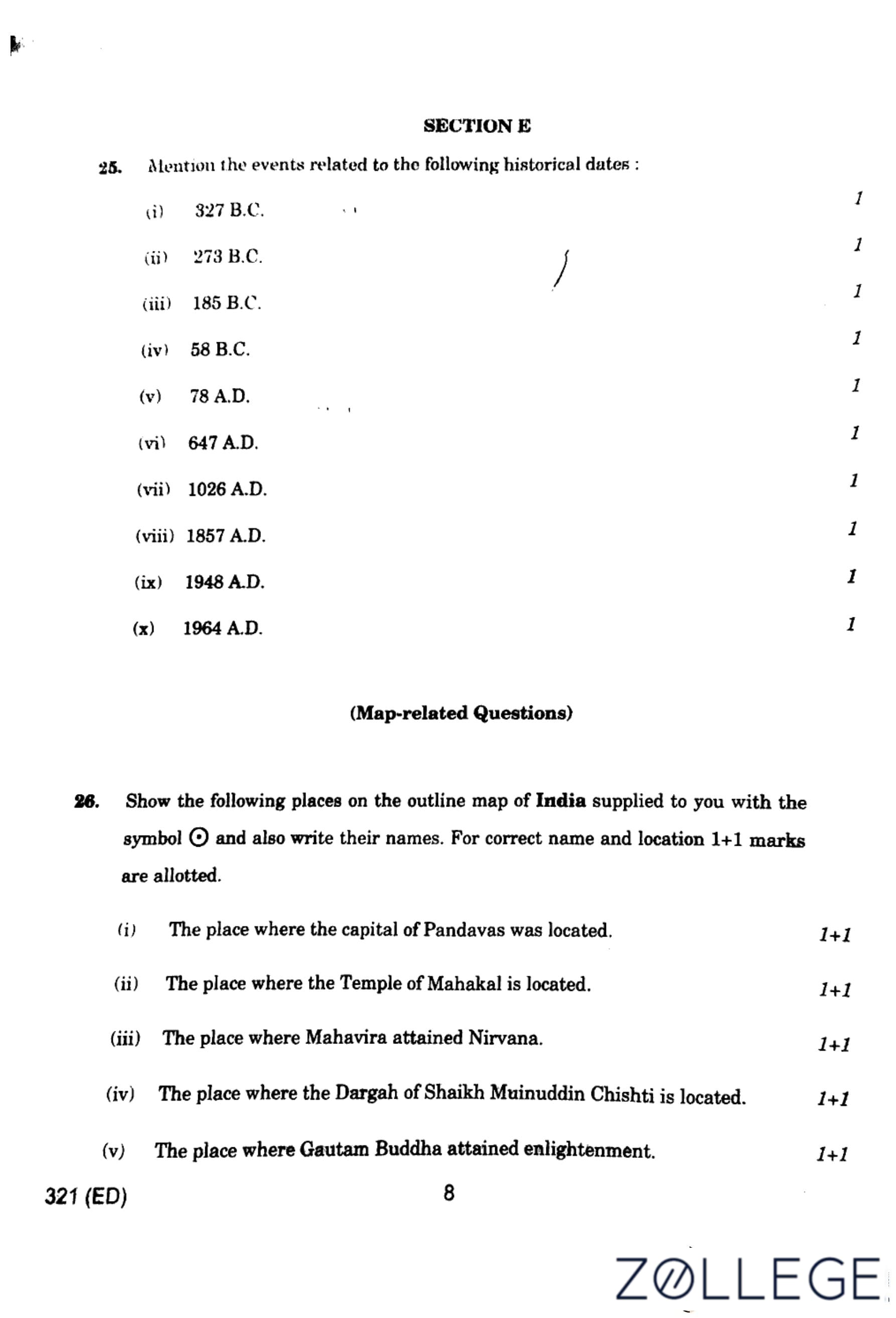
Mention the events related to the following historical dates:
(i) 327 B.C.
(ii) 273 B.C.
(iii) 185 B.C.
(iv) 58 B.C.
(v) 78 A.D.
(vi) 647 A.D.
(vii) 1026 A.D.
(viii) 1857 A.D.
(ix) 1948 A.D.
(x) 1964 A.D.
View Solution
(i) 327 B.C.: Alexander the Great invaded India and crossed the Indus River, marking the beginning of Greek influence in India.
(ii) 273 B.C.: Ashoka ascended the throne of the Mauryan Empire, becoming one of India's greatest rulers.
(iii) 185 B.C.: The fall of the Mauryan Empire occurred, leading to the rise of regional kingdoms.
(iv) 58 B.C.: The Vikram Samvat calendar was established by King Vikramaditya.
(v) 78 A.D.: The beginning of the Saka Era under the rule of King Kanishka.
(vi) 647 A.D.: The death of Harsha, marking the end of his reign and the subsequent decline of his empire.
(vii) 1026 A.D.: Mahmud of Ghazni invaded and plundered the Somnath Temple.
(viii) 1857 A.D.: The First War of Indian Independence, also known as the Sepoy Mutiny, took place.
(ix) 1948 A.D.: Mahatma Gandhi was assassinated, marking a pivotal moment in Indian history.
(x) 1964 A.D.: The death of Jawaharlal Nehru, India's first Prime Minister, occurred, leaving a significant impact on Indian politics. Quick Tip: Memorize key historical events and their associated dates to strengthen your understanding of Indian history and timelines.
Show the following places on the outline map of India supplied to you with the symbol \( \bigcirc \) and also write their names. For correct name and location, 1+1 marks are allotted.
(i) The place where the capital of Pandavas was located
(ii) The place where the Temple of Mahakal is located
(iii) The place where Mahavira attained Nirvana
(iv) The place where the Dargah of Sheikh Muinuddin Chishti is located
(v) The place where Gautam Buddha attained enlightenment
View Solution
(i) The place where the capital of Pandavas was located: Hastinapur (located in present-day Uttar Pradesh).
(ii) The place where the Temple of Mahakal is located: Ujjain (located in Madhya Pradesh).
(iii) The place where Mahavira attained Nirvana: Pavapuri (located in Bihar).
(iv) The place where the Dargah of Sheikh Muinuddin Chishti is located: Ajmer (located in Rajasthan).
(v) The place where Gautam Buddha attained enlightenment: Bodh Gaya (located in Bihar). Quick Tip: To excel in map-based questions, practice identifying historical and religious places on the map regularly. Remember their significance for better retention.
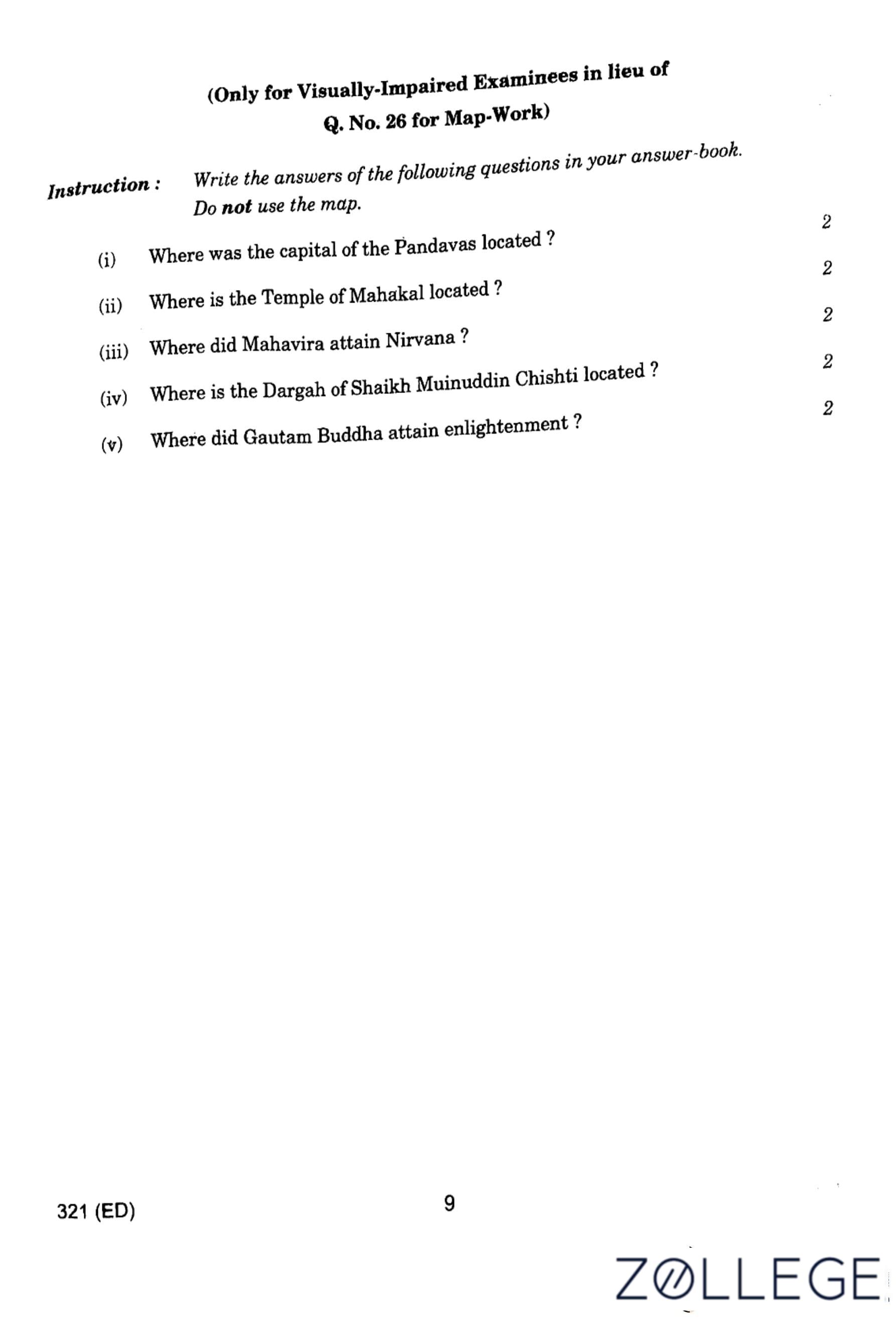
(for Visually-Impaired) Instruction : Write the answers of the following questions in your answer-book. Do not use the map.
(i) Where was the capital of the Pandavas located?
(ii) Where is the Temple of Mahakal located?
(iii) Where did Mahavira attain Nirvana?
(iv) Where is the Dargah of Sheikh Muinuddin Chishti located?
(v) Where did Gautam Buddha attain enlightenment?
View Solution
(i) The capital of the Pandavas was located in Hastinapur, which is in present-day Uttar Pradesh.
(ii) The Temple of Mahakal is located in Ujjain, Madhya Pradesh.
(iii) Mahavira attained Nirvana in Pavapuri, Bihar.
(iv) The Dargah of Sheikh Muinuddin Chishti is located in Ajmer, Rajasthan.
(v) Gautam Buddha attained enlightenment in Bodh Gaya, Bihar. Quick Tip: For such questions, focus on the historical and religious significance of the locations and their contributions to Indian heritage.
*The article might have information for the previous academic years, please refer the official website of the exam.