
UP Board Class 12 Home Science Question Paper 2024 (Code 328 GP) Available- Download Solution PDF with Answer Key

.jpg?tr=h-55,w-55,c-force)
Content Strategist|Tech-innovator|National Hackathon Winner | Updated On - Feb 28, 2025
UP Board Class 12 Home Science Question Paper 2024 PDF (Code 328 GP) is available for download here. The Home Science exam was conducted on February 27, 2024 in the Evening Shift from 2 PM to 5:15 PM. The total marks for the theory paper are 70. Students reported the paper to be easy to moderate.
UP Board Class 12 Home Science Question Paper 2024 (Code 328 GP) with Solutions
| UP Board Class 12 Home Science Question Paper with Answer Key |  Download Download |
UP Board Class 12 Home Science Questions with Solutions
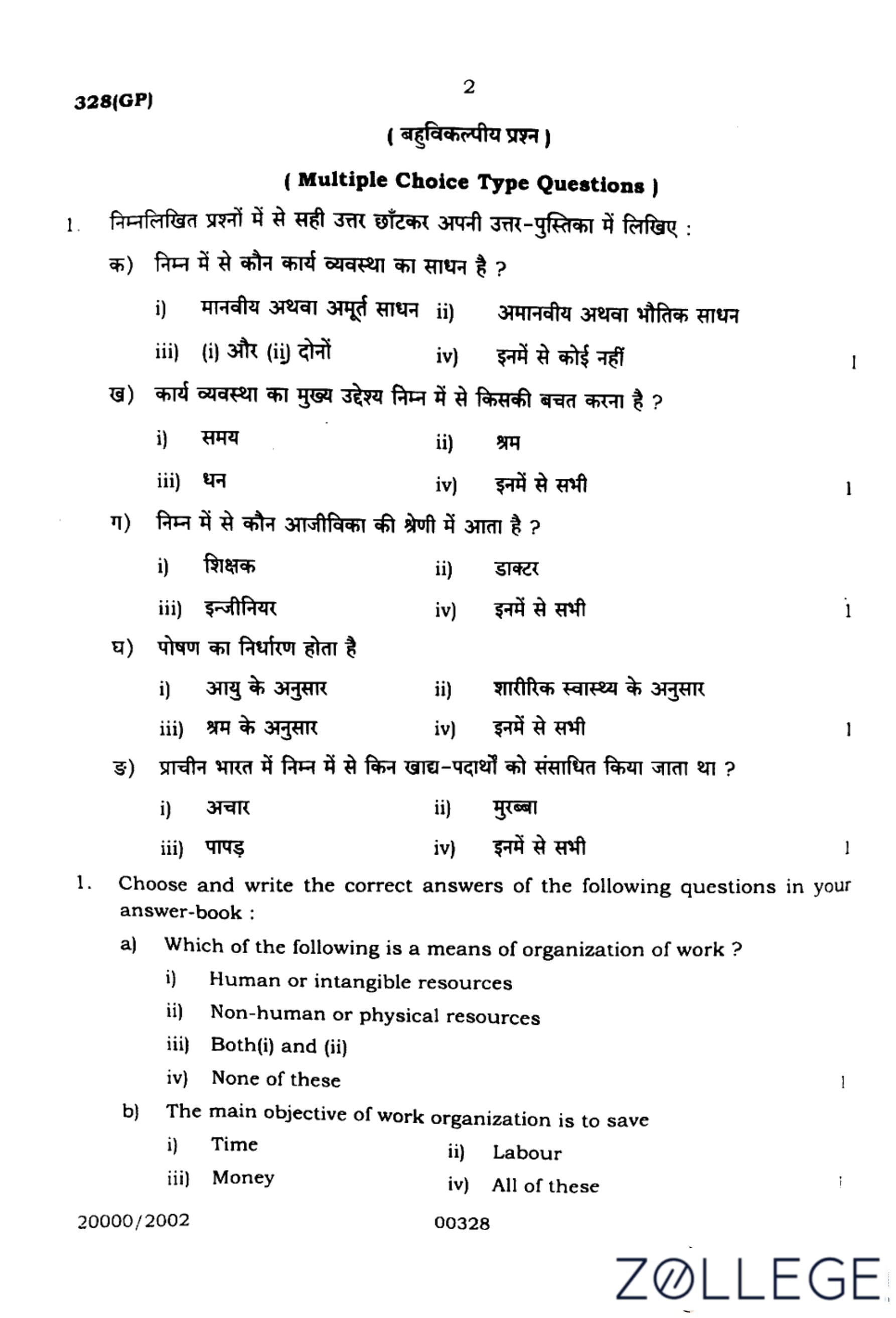
(a) Which of the following is a means of organization of work?
(A) Human or intangible resources
(B) Non-human or physical resources
(C) Both (A) and (B)
(D) None of these
View Solution
The organization of work involves both human or intangible resources (like skills and expertise) and non-human or physical resources (like equipment and materials). Thus, the correct choice is both (i) and (ii). Quick Tip: An effective organization of work always integrates human resources and physical resources to ensure productivity and efficiency.
(b) The main objective of work organization is to save:
(A) Time
(B) Labour
(C) Money
(D) All of these
View Solution
The primary goal of work organization is to optimize the use of resources by saving time, reducing unnecessary labour, and minimizing costs. Therefore, the correct answer is ”All of these.” Quick Tip: Work organization improves efficiency by systematically managing time, labour, and costs for effective outcomes.
(c) Which of the following comes under the category of livelihood?
(A) Teacher
(B) Doctor
(C) Engineer
(D) All of these
View Solution
Livelihood refers to activities or occupations that provide a means of earning income or resources necessary for living. Teacher, Doctor, and Engineer are all examples of livelihood occupations. Quick Tip: Livelihood includes professions and roles that directly contribute to economic activities or sustainable living.
(d) Nutrition is determined:
(A) By age
(B) According to physical health
(C) According to labour
(D) All of these
View Solution
Nutrition requirements depend on factors like age, physical health, and labour activities, as these determine the body’s energy needs and nutritional intake. Thus, all the options contribute to determining nutrition. Quick Tip: Nutrition planning must consider age, physical condition, and activity levels for balanced dietary choices.
(e) Which of the following food items was processed in ancient India?
(A) Pickle (Achaar)
(B) Murabba
(C) Papad
(D) All of these
View Solution
Pickle (Achaar), Murabba, and Papad are traditional food items that have been processed and preserved in India since ancient times. These methods helped in food storage and enhanced flavors. Quick Tip: Traditional Indian food processing techniques include fermentation, drying, and preserving food for longer shelf life.
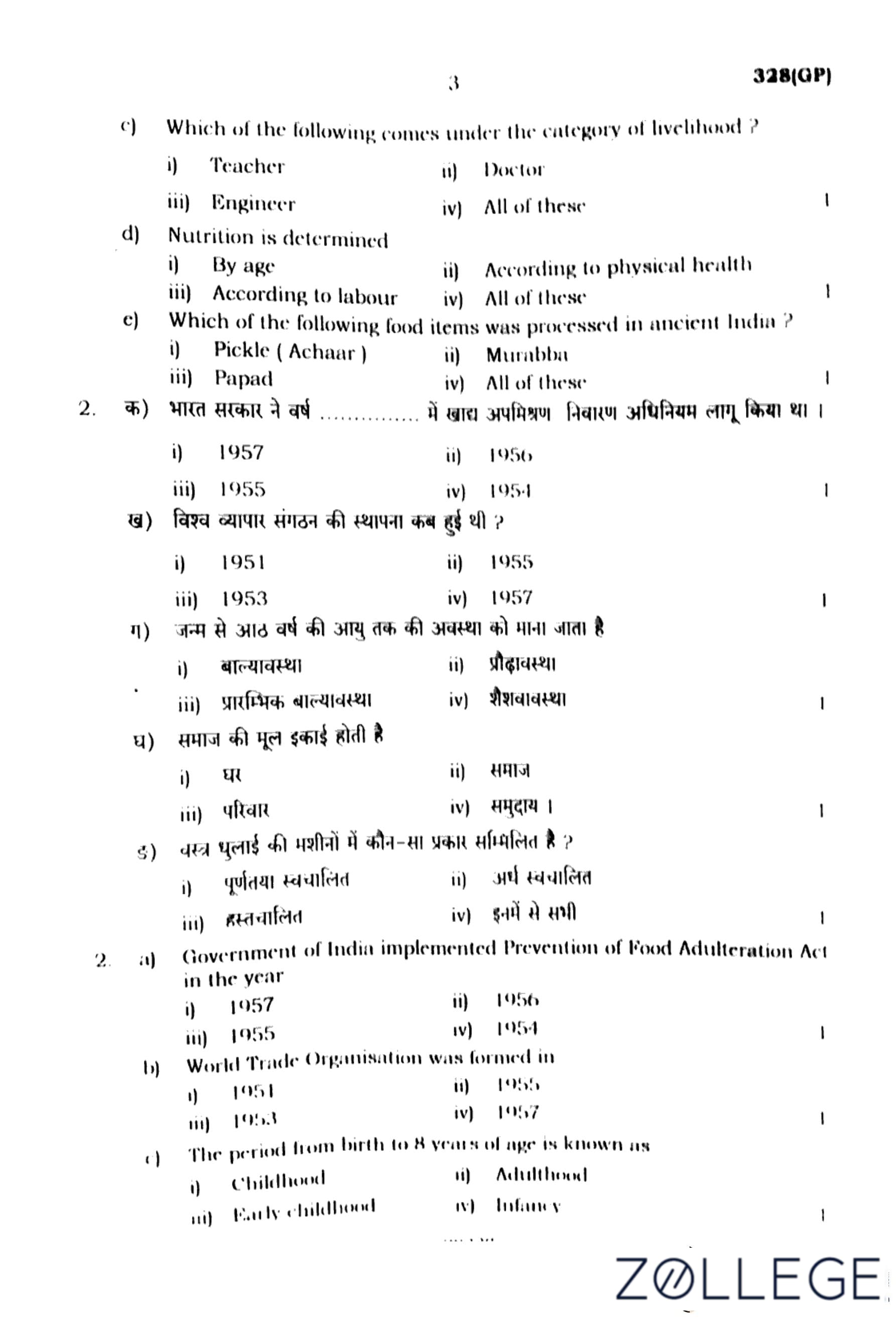
(a) Government of India implemented the Prevention of Food Adulteration Act in the year:
(A) 1957
(B) 1956
(C) 1955
(D) 1954
View Solution
The Government of India implemented the Prevention of Food Adulteration Act in 1954 to ensure the purity and safety of food products for consumption, addressing food adulteration issues. Quick Tip: The Prevention of Food Adulteration Act, 1954, was a significant step toward ensuring food safety and consumer health in India.
(b) World Trade Organisation was formed in:
(A) 1951
(B) 1955
(C) 1953
(D) 1995
View Solution
The World Trade Organization (WTO) was established on January 1, 1995, replacing the General Agreement on Tariffs and Trade (GATT). It aims to regulate international trade between nations. Quick Tip: The WTO promotes free trade and ensures compliance with trade agreements among member countries globally.
(c) The period from birth to 8 years of age is known as:
(A) Childhood
(B) Adulthood
(C) Early childhood
(D) Infancy
View Solution
The period from birth to 8 years of age is considered early childhood. This stage is crucial for the development of cognitive, emotional, social, and physical skills. Quick Tip: Early childhood is a foundational phase where brain development and learning capabilities are most active.
(d) The basic unit of society is:
(A) Home
(B) Society
(C) Family
(D) Community
View Solution
The family is considered the basic unit of society because it serves as the foundation for social relationships, nurturing, and the upbringing of individuals. Families contribute to the structure and functioning of society. Quick Tip: Strong family units are essential for creating a healthy, well-functioning society.
(e) Type(s) of washing machine is/are:
(A) Fully Automatic
(B) Semi-Automatic
(C) Manual
(D) All of these
View Solution
The types of washing machines include Fully Automatic, Semi-Automatic, and Manual. Each type serves different needs based on user convenience, affordability, and technology. Quick Tip: Fully automatic machines handle the entire wash process, semi-automatic machines require manual intervention, and manual washing involves no machines.
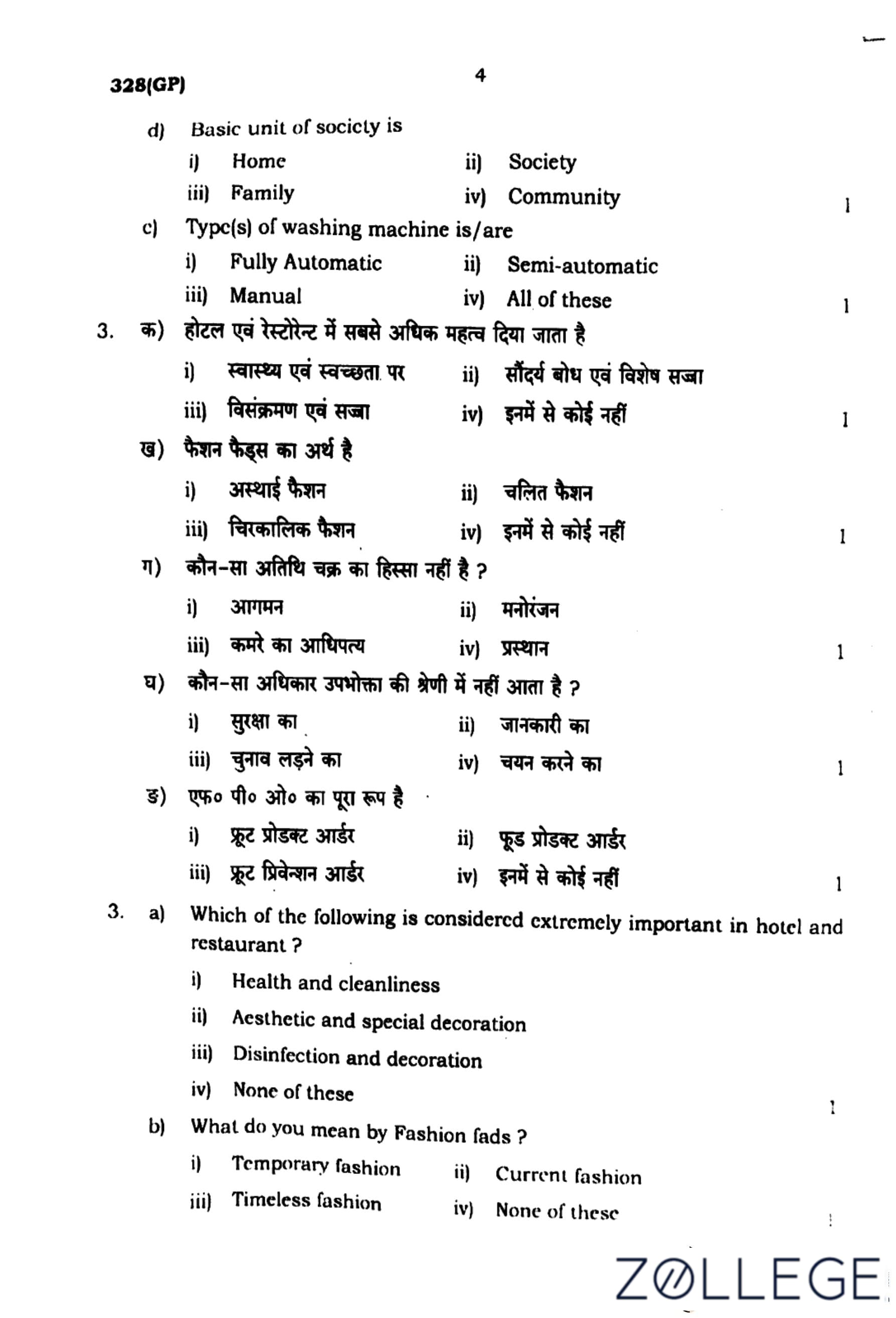
(a) Which of the following is considered extremely important in hotels and restaurants?
(A) Health and cleanliness
(B) Aesthetic and special decoration
(C) Disinfection and decoration
(D) None of these
View Solution
Health and cleanliness are critical in hotels and restaurants to ensure hygiene, safety, and customer satisfaction. Maintaining these standards is a priority in the hospitality industry. Quick Tip: Regular cleanliness and hygiene checks are essential for preventing contamination and ensuring customer health in food and hospitality businesses.
(b) What do you mean by fashion fads?
(A) Temporary fashion
(B) Current fashion
(C) Timeless fashion
(D) None of these
View Solution
Fashion fads refer to temporary trends that gain quick popularity and fade out just as quickly. These trends often appeal to a specific group for a short duration. Quick Tip: Fashion fads are typically short-lived compared to timeless or classic fashion, which remains relevant over time.
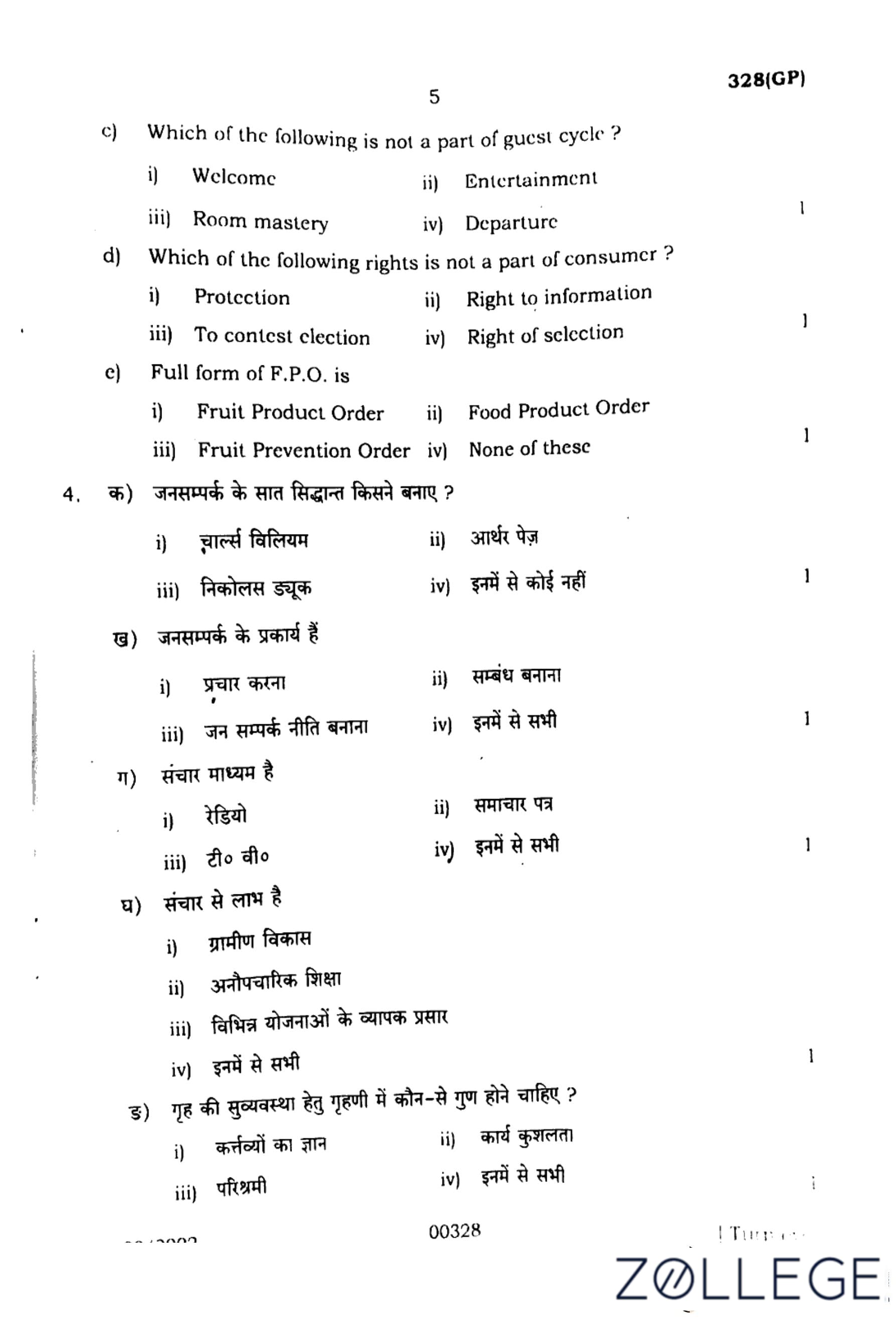
(c) Which of the following is not a part of the guest cycle?
(A) Welcome
(B) Entertainment
(C) Room mastery
(D) Departure
View Solution
The guest cycle refers to the sequence of stages in a hotel guest's experience, which typically includes welcome, entertainment, and departure. Room mastery is not a recognized part of this cycle. Quick Tip: The guest cycle stages include pre-arrival, arrival, occupancy, and departure, ensuring guest satisfaction throughout.
(d) Which of the following rights is not a part of consumer rights?
(A) Protection
(B) Right to information
(C) To contest election
(D) Right of selection
View Solution
Consumer rights include protection, access to information, and the right to make choices (selection). Contesting elections is unrelated to consumer rights and pertains to civic or political rights. Quick Tip: Consumer rights aim to safeguard buyers, ensuring fair treatment and access to information about goods and services.
(e) Full form of F.P.O. is:
(A) Fruit Product Order
(B) Food Product Order
(C) Fruit Prevention Order
(D) None of these
View Solution
F.P.O. stands for Fruit Product Order, a certification mark granted to processed fruit products in India to ensure their quality and standard. Quick Tip: The F.P.O. certification ensures that fruit-based products meet hygiene and quality standards.
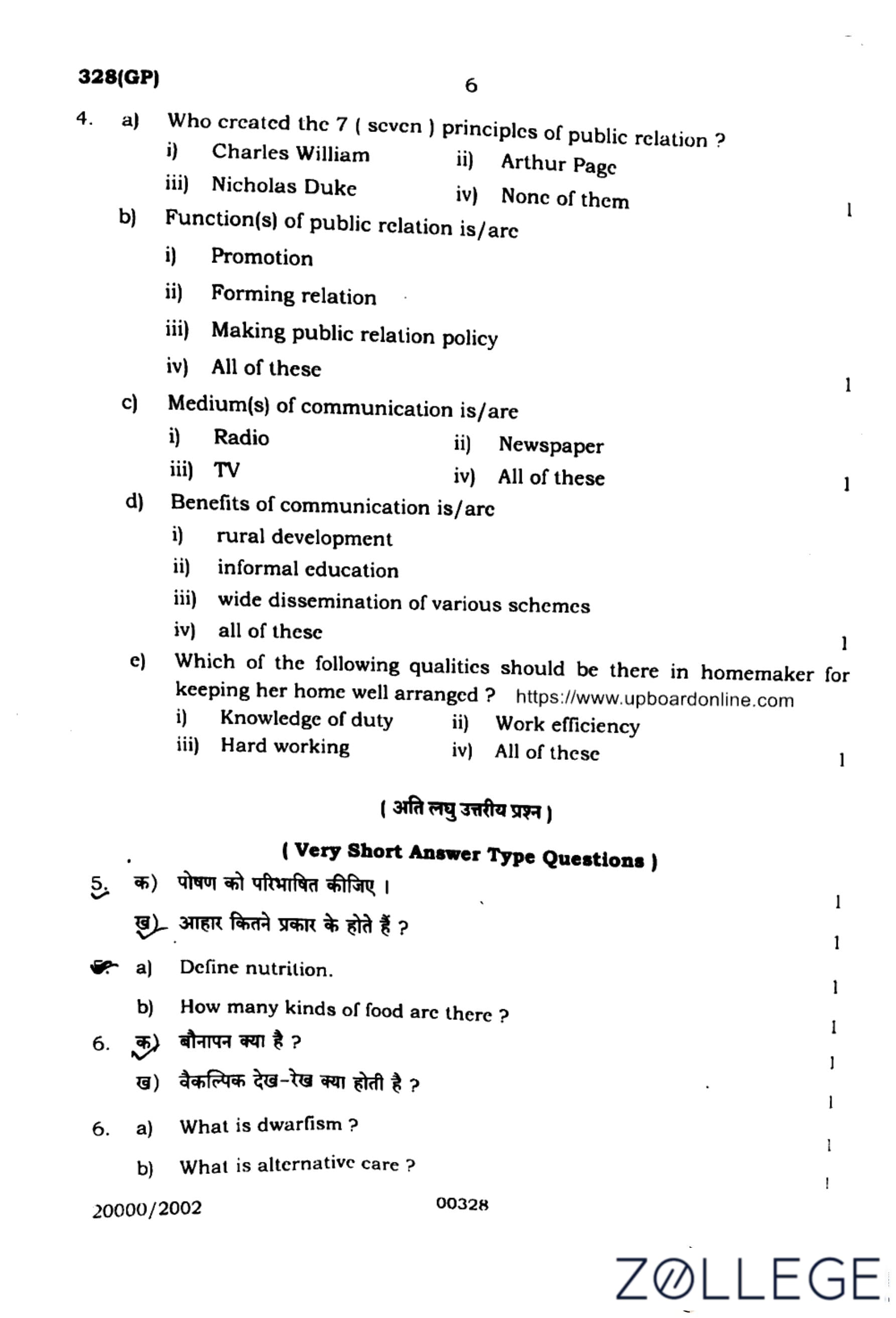
(a) Who created the 7 (seven) principles of public relation?
(A) Charles William
(B) Arthur Page
(C) Nicholas Duke
(D) None of them
View Solution
The seven principles of public relations were created by Arthur Page, who is considered a pioneer in the field of corporate communication. Quick Tip: Arthur Page's principles focus on authenticity, consistency, and communication strategies in public relations.
(b) Function(s) of public relation is/are:
(A) Promotion
(B) Forming relation
(C) Making public relation policy
(D) All of these
View Solution
Public relations encompass various functions, including promoting organizations, establishing relations with stakeholders, and creating strategic public relation policies. Quick Tip: Public relation efforts ensure an organization communicates effectively with its audience to maintain a positive reputation.
(c) Medium(s) of communication is/are:
(A) Radio
(B) Newspaper
(C) TV
(D) All of these
View Solution
Communication mediums include traditional media like radio, newspapers, and TV, which are crucial for reaching varied audiences. Quick Tip: Using multiple communication mediums enhances the dissemination of information effectively.
(d) Benefits of communication is/are:
(A) Rural development
(B) Informal education
(C) Wide dissemination of various schemes
(D) All of these
View Solution
Communication contributes significantly to rural development, informal education, and the wide dissemination of government and non-government schemes. Quick Tip: Effective communication helps in bridging gaps and ensuring the reach of important information to various sectors.
(e) Which of the following qualities should be there in a homemaker for keeping her home well arranged?
(A) Knowledge of duty
(B) Work efficiency
(C) Hardworking
(D) All of these
View Solution
A well-arranged home requires a homemaker to be knowledgeable about her duties, efficient in work, and hardworking to ensure all tasks are handled properly. Quick Tip: A combination of duty awareness, efficiency, and effort ensures a well-maintained and organized home.
Question 5:
(a) Define nutrition.
View Solution
Nutrition is the biological process by which living organisms obtain and utilize food for growth, energy, and maintenance of life functions. It involves the intake, digestion, absorption, and assimilation of nutrients essential for survival.
Quick Tip: Nutrition involves consuming foods that provide essential nutrients like carbohydrates, proteins, fats, vitamins, minerals, and water.
(b) How many kinds of food are there?
View Solution
Kinds of Food
Food is classified into three main types based on their function in the body:
Energy-giving foods
Provide energy for daily activities.
Examples: Rice, wheat, sugar, butter, oil.
Nutrients: Rich in carbohydrates and fats.
Body-building foods
Help in growth, muscle development, and repair of tissues.
Examples: Milk, eggs, meat, fish, pulses, nuts.
Nutrients: Rich in proteins.
Protective foods
Boost immunity and prevent diseases.
Examples: Fruits, vegetables, milk, yogurt.
Nutrients: Rich in vitamins and minerals.
Quick Tip: A balanced diet includes all six kinds of food in appropriate proportions for optimal health.
(a) What is dwarfism?
View Solution
Definition: Dwarfism
Dwarfism is a medical condition characterized by short stature, usually defined as an adult height of 4 feet 10 inches (147 cm) or shorter, caused by genetic, hormonal, or nutritional factors. Quick Tip: Dwarfism can result from conditions like achondroplasia or hormonal imbalances affecting growth.
(b) What is alternative care?
View Solution
Alternative care refers to a substitute or supportive form of care provided outside traditional family settings, such as foster care, residential care, or kinship care.
Quick Tip: Alternative care ensures the safety and wellbeing of individuals who cannot remain in their primary family environment.
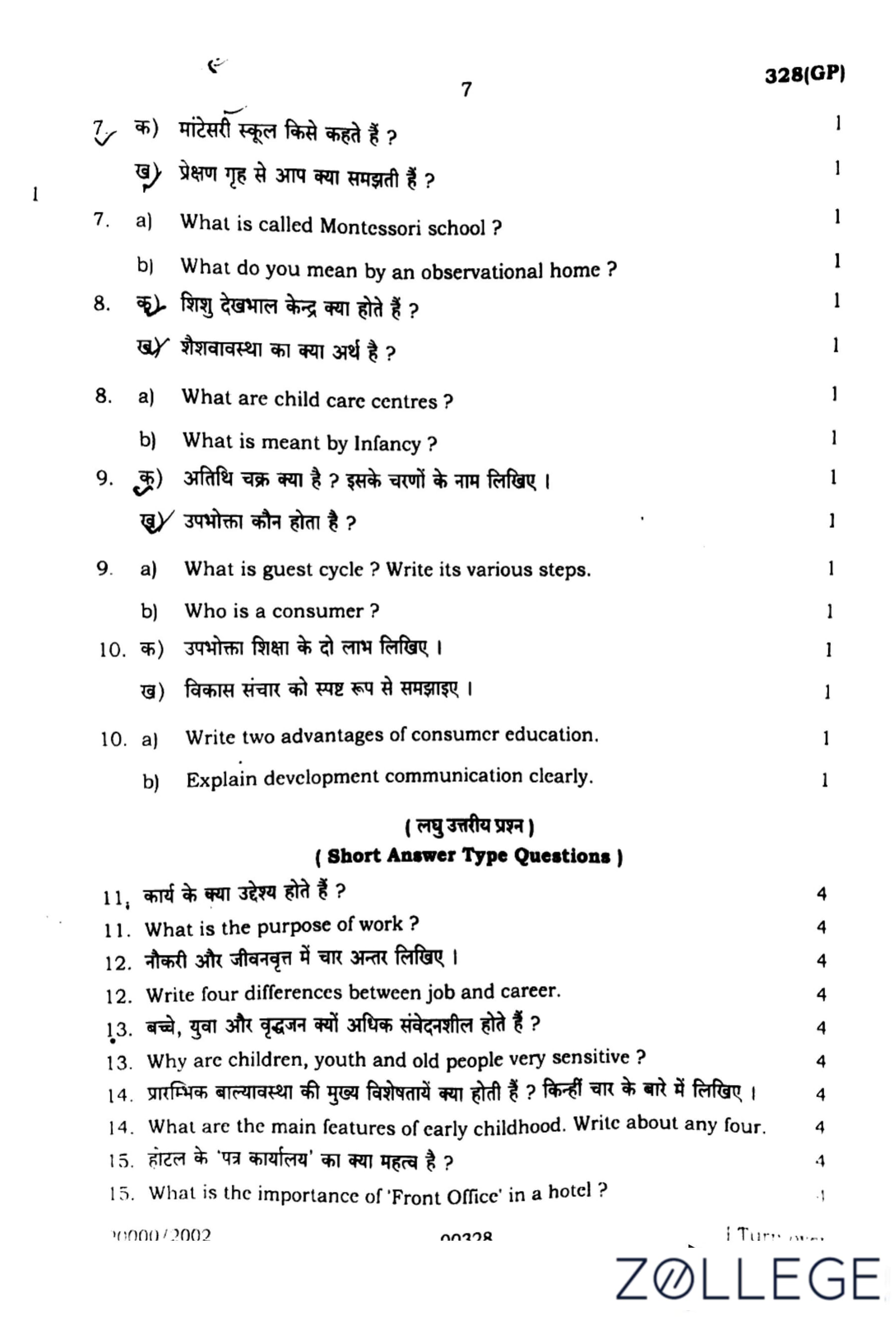
(a) What is called Montessori school?
View Solution
A Montessori school is an educational institution that follows the Montessori method, which focuses on self-directed activity, hands-on learning, and collaborative play.
Quick Tip: Montessori schools promote independence and practical life skills among children.
(b) What do you mean by an observational home?
View Solution
An observational home is a residential facility where children or individuals are observed for their behavior, health, and needs under supervised care.
Quick Tip: Observational homes are often used to assess the specific requirements of children in care.
(a) What are child care centres?
View Solution
Child care centres are facilities that provide care, supervision, and early education for young children while their parents are at work or unavailable.
Quick Tip: Child care centres support early development through activities and learning programs.
(b) What is meant by Infancy?
View Solution
Infancy refers to the early stage of a child's life, from birth to approximately two years of age, characterized by rapid physical and cognitive development.
Quick Tip: Infancy is crucial for forming strong parent-child bonds and learning fundamental skills.
(a) What is the guest cycle? Write its various steps.
View Solution
The guest cycle refers to the stages a guest goes through during a stay at a hotel, typically including:
1. Pre-arrival
2. Arrival
3. Occupancy
4. Departure
Quick Tip: The guest cycle helps hotels organize and ensure guest satisfaction at each stage of interaction.
(b) Who is a consumer?
View Solution
A consumer is any individual who purchases goods or services for personal use rather than for resale or production.
Quick Tip: Consumers drive the demand for goods and services, impacting the market economy.
(a) Write two advantages of consumer education.
View Solution
1. Empowers individuals to make informed purchasing decisions.
2. Protects consumers from fraud and exploitation.
Quick Tip: Consumer education promotes awareness of rights and responsibilities in the marketplace.
(b) Explain development communication clearly.
View Solution
Development communication is the use of communication to facilitate social, economic, and cultural development by sharing information and encouraging participation.
Quick Tip: Development communication plays a vital role in promoting progress in education, health, and governance.
What is the purpose of work?
View Solution
Purpose of Work: Work serves multiple purposes, including earning a livelihood, personal growth, social contribution, and fulfillment. It provides financial stability, enhances skills, and promotes self-discipline. Work also fosters social connections and gives a sense of purpose and achievement. Meaningful work improves mental well-being and helps in self-actualization, contributing to a productive and fulfilling life.
Quick Tip: Work provides financial stability, personal development, and a sense of purpose.
Write four differences between job and career.
View Solution
1. A job is a specific position of employment, whereas a career is a long-term professional journey.
2. A job often focuses on earning income, while a career focuses on personal growth.
3. Jobs are usually short-term, whereas careers are built over a lifetime.
4. Jobs require limited skillsets; careers demand skill enhancement and expertise over time.
Quick Tip: A career reflects your professional aspirations and growth, while a job is a stepping stone toward it.
Why are children, youth, and old people very sensitive?
View Solution
Children, youth, and elderly people are highly sensitive due to emotional, physical, and psychological factors.
Children have developing emotions, making them easily influenced.
Youth experience hormonal changes, stress, and peer pressure.
Old people face health issues, loneliness, and emotional dependence.
Proper care, understanding, and emotional support are essential for their well-being. Quick Tip: Sensitivity varies with age, demanding specific care and attention at each stage.
What are the main features of early childhood? Write about any four.
View Solution
1. Rapid physical growth and motor skill development.
2. Cognitive advancements, including language acquisition.
3. Emotional bonding and attachment with caregivers.
4. Socialization through interactions with peers and adults.
Quick Tip: Early childhood shapes foundational behaviors, abilities, and personality traits.
What is the importance of 'Front Office' in a hotel?
View Solution
Importance of Front Office in a Hotel
The Front Office is the face of a hotel, handling guest check-ins, reservations, billing, and customer service. It creates the first impression and ensures smooth communication between departments. The Front Office enhances guest experience, manages room allocation, and handles guest queries, ensuring satisfaction. It plays a crucial role in hotel reputation and revenue management. Quick Tip: A well-organized Front Office enhances customer satisfaction and brand loyalty.
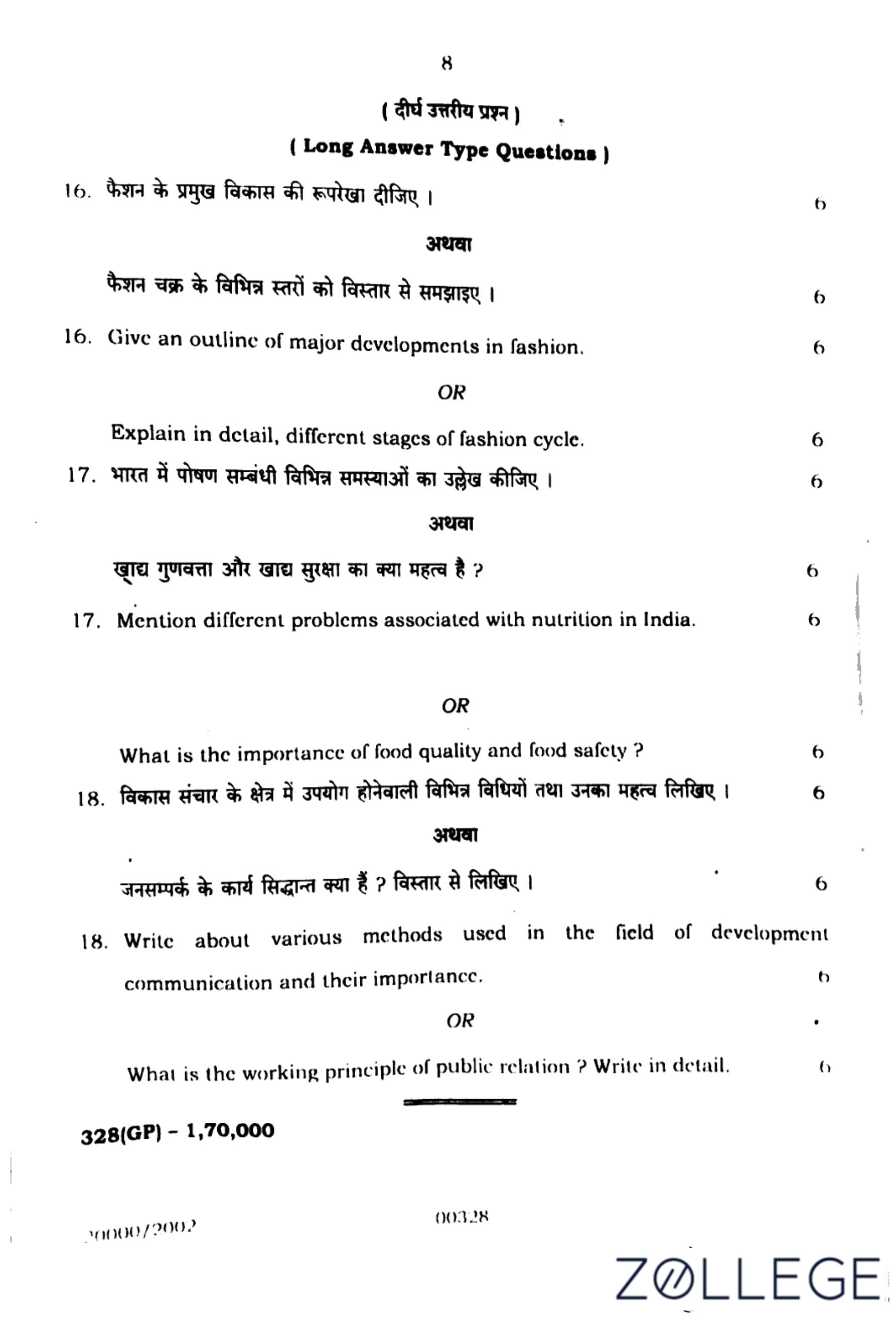
Give an outline of major developments in fashion.
View Solution
Fashion has evolved significantly over the centuries, influenced by cultural, economic, and technological changes. Major developments include:
1. Ancient Times: Clothing was primarily functional, with adornments reflecting social status and identity. For example, the Egyptian linen, Greek togas, and Indian cotton textiles were notable contributions.
2. The Renaissance Era: Fashion became a symbol of wealth and power, with intricate embroidery, tailored silhouettes, and luxurious fabrics like velvet and silk.
3. Industrial Revolution: The invention of sewing machines enabled mass production, making fashion accessible to the middle class. It also marked the rise of department stores.
4. 20th Century Fashion: This era introduced major designers like Coco Chanel and Christian Dior, emphasizing style, innovation, and individualism. Casual wear gained popularity, and ready-to-wear clothing became a staple.
5. Modern-Day Fashion: Sustainable practices, digital technologies like AI and 3D printing, and global influence have reshaped fashion. The industry focuses on inclusivity and environmental awareness.
Quick Tip: Fashion reflects cultural trends and evolves with technological advancements and societal needs.
(OR) Explain in detail, different stages of the fashion cycle.
View Solution
The fashion cycle represents the life span of a particular fashion trend. The stages are:
1. Introduction: Designers launch new trends during fashion shows or exclusive collections. These styles are high-cost and appeal to a niche audience.
2. Rise: The fashion trend gains popularity as influencers and celebrities adopt it, making it more visible in society. Retailers begin mass-producing similar styles.
3. Peak: The trend becomes widely accepted, and demand is at its highest. This stage often sees multiple variations and adaptations.
4. Decline: As the trend reaches saturation, interest begins to wane. Cheaper imitations flood the market.
5. Obsolescence: The trend fades as newer trends emerge, and its appeal declines sharply.
Quick Tip: Understanding the fashion cycle helps businesses predict market trends and plan inventory effectively.
Mention different problems associated with nutrition in India.
View Solution
India faces numerous nutritional challenges due to socio-economic disparities and lifestyle changes:
1. Undernutrition: Many children suffer from stunting and wasting due to inadequate food intake and poor dietary diversity.
2. Micronutrient Deficiencies: Common deficiencies include iron (anemia), vitamin A (vision problems), and iodine (goiter).
3. Overnutrition: Urbanization and sedentary lifestyles have led to an increase in obesity, diabetes, and other non-communicable diseases.
4. Food Insecurity: A large population still lacks access to sufficient and nutritious food, especially in rural and marginalized communities.
5. Malnutrition in Women: Women face nutritional challenges due to societal norms and inadequate healthcare, leading to anemia and complications during pregnancy.
Quick Tip: Addressing these issues requires integrated efforts in education, healthcare, and agriculture.
(OR) What is the importance of food quality and food safety?
View Solution
Food quality and safety are essential to ensure public health, prevent foodborne illnesses, and build consumer trust. Their importance includes:
1. Health Protection: Proper food safety standards reduce the risk of contamination and diseases like salmonella, listeria, and food poisoning.
2. Nutritional Value: Ensuring quality preserves the nutrients in food, vital for overall health and well-being.
3. Market Reliability: High standards enhance customer satisfaction, loyalty, and confidence in the food industry.
4. Economic Growth: Quality controls support exports, reduce waste, and foster international trade.
5. Regulation Compliance: Adhering to food laws ensures producers meet safety benchmarks, avoiding penalties or recalls.
Quick Tip: Maintaining food quality safeguards health and strengthens the global food supply chain.
Write about various methods used in the field of development communication and their importance.
View Solution
Development communication employs various tools to promote growth and social welfare:
1. Mass Media Campaigns: Television, radio, and social media are used to spread awareness on health, education, and social issues.
2. Participatory Communication: Involves engaging communities in problem-solving through workshops, group discussions, and feedback mechanisms.
3. Interpersonal Communication: One-on-one communication by healthcare workers, teachers, or trainers to foster change.
4. ICT (Information and Communication Technology): Tools like mobile apps, digital platforms, and e-learning programs facilitate efficient information dissemination.
Quick Tip: These methods help create awareness, empower individuals, and accelerate socio-economic progress.
(OR) What is the working principle of public relations? Write in detail.
View Solution
Public relations (PR) aims to build and maintain a favorable image of an organization through effective communication strategies:
1. Communication: PR focuses on crafting accurate, clear, and consistent messages to reach various stakeholders.
2. Relationship Management: Building trust with the media, employees, and the public through transparency and ethical practices.
3. Crisis Management: Handling emergencies effectively to protect the organization's reputation.
4. Feedback Mechanism: Collecting and analyzing feedback to align strategies with audience needs.
5. Event Organization: Hosting activities like press conferences, product launches, and campaigns to engage the public.
Quick Tip: A successful PR strategy ensures positive public perception, fostering trust and credibility.
*The article might have information for the previous academic years, please refer the official website of the exam.