
UP Board Class 12 Home Science Question Paper 2024 (Code 328 GQ) Available- Download Solution PDF with Answer Key

.jpg?tr=h-55,w-55,c-force)
Content Strategist|Tech-innovator|National Hackathon Winner | Updated On - Sep 24, 2025
UP Board Class 12 Home Science Question Paper 2024 PDF (Code 328 GQ) is available for download here. The Home Science exam was conducted on February 27, 2024 in the Evening Shift from 2 PM to 5:15 PM. The total marks for the theory paper are 70. Students reported the paper to be easy to moderate.
UP Board Class 12 Home Science Question Paper 2024 (Code 328 GQ) with Solutions
| UP Board Class 12 Home Science Question Paper with Answer Key |  Download Download |
UP Board Class 12 Home Science Questions with Solutions
Question 1:
(a) What specific qualities should a person have before doing any work?
(i) Education
(ii) Labour
(iii) Talent and skill
(iv) All of these
View Solution
A person should possess education to gain knowledge, labour to work hard, and talent and skill to excel. Each of these aspects contributes to efficiency and effectiveness in any work. Hence, the correct answer is All of these. Quick Tip: Always consider a combination of education, talent, and hard work as essential prerequisites for success.
(b) Work provides a person?
(i) Identity
(ii) Name
(iii) Satisfaction
(iv) All of these
View Solution
Work helps an individual gain identity and recognition, provides a name in society, and ensures personal satisfaction by meeting goals and aspirations. All these factors are interconnected and contribute to an individual's personal and professional fulfillment. Therefore, the correct answer is All of these. Quick Tip: Choose a career path that aligns with your passion to achieve identity, recognition, and satisfaction.
(c). Which of the following is a liquid diet?
(i) Lemonade
(ii) Blended pulses
(iii) Semolina Kheer
(iv) Banana
View Solution
(A) Lemonade is a liquid, but it is more of a beverage rather than a nutritional diet. (B)
Blended Pulses are a liquid diet as they provide essential nutrients in a liquid form, making
them suitable for people with digestion issues or those on a special diet. (C) Semolina Kheer
is semi-solid and cannot be classified as a purely liquid diet. (D) Banana is a solid fruit and
does not fit into the liquid diet category.
Quick Tip
A liquid diet is often recommended during recovery or for detoxification. Examples
include juices, soups, and smoothies
(d). Milk, meat, fish, eggs, fruits, and vegetables come under which food group?
(i) Healthy food group
(ii) Body warmer group
(iii) Harmful for body
(iv) None of these
View Solution
Milk, meat, fish, eggs, fruits, and vegetables are nutrient-rich and form part of a balanced diet. They provide essential vitamins, proteins, and minerals necessary for maintaining good health, hence classified as part of the Healthy food group. Quick Tip: Include items from all major food groups to ensure a balanced diet and optimal nutrition.
(e). Night blindness is caused by the deficiency of?
(i) Vitamin A
(ii) Vitamin C
(iii) Vitamin K
(iv) Vitamin B
View Solution
Night blindness, a condition where individuals face difficulty seeing in low light, is caused due to a deficiency of Vitamin A. This vitamin is crucial for maintaining eye health, especially for adapting vision in dim lighting. Quick Tip: Foods rich in Vitamin A, such as carrots, spinach, and sweet potatoes, can help prevent night blindness.
(a). High level of protein is obtained in:
(i) Potato
(ii) Milk
(iii) Pulses
(iv) Apple
View Solution
Pulses are an excellent source of protein, making them a vital part of a healthy diet. They contain essential amino acids, which are building blocks of protein. Quick Tip: To meet your protein needs, include foods like beans, lentils, and chickpeas in your diet.
(b). Property of silk cloth is:
(i) Thin
(ii) Soft
(iii) Shiny
(iv) All of these
View Solution
Silk fabric is known for its softness, shine, and lightweight properties, making it unique compared to other natural fibers. Quick Tip: Always handle silk garments delicately, as the fabric is soft and prone to damage.
(c). Which of the following is not a primary colour?
(i) Red
(ii) Green
(iii) Yellow
(iv) Blue
View Solution
The primary colors in light and pigments are Red, Blue, and Yellow. Green is considered a secondary color made by mixing blue and yellow. Quick Tip: Remember that Red, Blue, and Yellow form the primary colors, essential for mixing all other colors.
(d). Hotel is a business establishment which provides:
(i) Shelter
(ii) Food
(iii) Other facilities
(iv) All of these
View Solution
Hotels are multi-functional establishments that offer shelter, food, and additional amenities, such as room service, event spaces, and recreational facilities. Quick Tip: Different categories of hotels cater to specific needs, from luxury accommodations to budget stays.
(e). A consumer is:
(i) A person who buys goods and services
(ii) A person who sells goods and services
(iii) A person to provide information
(iv) None of these
View Solution
A consumer is defined as someone who purchases goods or services for personal use rather than for resale or business purposes. Quick Tip: Be aware of your rights as a consumer, such as the right to information, safety, and to be heard.
(a). Aim of advertisement is:
(i) To give information
(ii) To spend money
(iii) Saving
(iv) To do acting
View Solution
The primary goal of advertisement is to inform potential customers about a product, service, or event. It helps raise awareness and provides necessary details. Quick Tip: Always look for the key message in an advertisement—it’s designed to inform and attract attention!
(b). Function of public communication is:
(i) Advertisement
(ii) To make relation
(iii) Public relation policy
(iv) All of these
View Solution
Public communication serves various purposes, including advertising, building relationships, and managing public relations to engage the audience effectively. Quick Tip: Communication strategies vary, but they all work to convey messages effectively to the public.
(c). Campaigning, radio, television, print media, and information and communication technology are method of:
(i) Development communication
(ii) Development journalism
(iii) Development campaign
(iv) Development technology
View Solution
These methods are tools of development communication, focusing on using media and technology to inform and engage communities about development-related issues. Quick Tip: Media campaigns are essential for spreading awareness about social and development-related topics.
(d). On whom does a one-year-old child depend?
(i) On mother
(ii) On siblings
(iii) On teacher
(iv) On grandparents
View Solution
At the age of one year, a child is heavily dependent on their mother for nourishment, care, and emotional bonding, which is crucial for their development. Quick Tip: The bond between a mother and child in early years is foundational for the child’s growth and security.
(e). The scope of education in early childhood is:
(i) Child care centre
(ii) Nursery school
(iii) Sewing and stitching
(iv) Only (i) and (ii)
View Solution
Early childhood education focuses on learning through care centers and nursery schools to foster a child’s cognitive, social, and emotional development. Sewing and stitching are not part of this scope. Quick Tip: Early childhood education plays a vital role in preparing children for formal schooling.
(a). Basic unit of society is:
(i) Family
(ii) Society
(iii) Nation
(iv) Individual
View Solution
The family is considered the basic unit of society because it forms the primary group where individuals learn values, culture, and behavior, which collectively influence the larger society. Quick Tip: The strength of society lies in the unity and stability of its family systems.
(b). School is a/an:
(i) Institution
(ii) Society
(iii) Family
(iv) Scheme
View Solution
A school is defined as an institution where formal education is provided. It serves as a structured environment for learning and personal development. Quick Tip: Institutions like schools play a crucial role in shaping the future of individuals and society.
(c). Which of the following is not a child home?
(i) Observatory home
(ii) Child entertainment centre
(iii) Special home
(iv) Juvenile home
View Solution
Child homes are specifically designed to cater to the needs of children in distress, such as providing care and shelter. "Child entertainment centre" does not fall under this category. Quick Tip: Know the purpose of different homes—terms can be misleading in such questions.
(d). In how many stages does the fashion cycle move?
(i) four
(ii) five
(iii) six
(iv) seven
View Solution
The fashion cycle moves through five stages:
(A) Introduction – A new style is introduced by designers.
(B) Rise – The trend gains popularity among consumers.
(C) Peak – The fashion reaches its highest demand.
(D) Decline– Demand starts to decrease as new trends emerge.
(E) Obsolescence -The style becomes outdated and is no longer in demand. Quick Tip: Understanding the fashion cycle helps predict trends and changes in consumer preferences.
(e). Regular washing of clothes is beneficial because:
(i) Clothes remain clean and tidy
(ii) The bad smell of clothes goes off
(iii) Helps in personal health
(iv) All of these
View Solution
Regular washing keeps clothes clean, removes unpleasant odors, and contributes to personal hygiene, promoting overall health. Quick Tip: Maintaining cleanliness through regular washing enhances hygiene and prevents infections.
(a) What is meant by job?
View Solution
A job refers to a specific task or set of tasks that a person is employed to perform in exchange for compensation, such as wages or salary. It involves performing duties assigned by an employer, which are typically routine and require specific skills or qualifications. A job can be either full-time or part-time, and may or may not offer opportunities for career advancement.
A job often provides stability and a source of income.
It is typically defined by a role or position within an organization or industry. Quick Tip: Jobs can vary greatly in terms of responsibilities, pay, and growth opportunities. It is important to consider one's interests and qualifications when seeking a job.
(b) What is entrepreneurship?
View Solution
Entrepreneurship refers to the process of starting and managing a new business venture with the goal of making a profit. Entrepreneurs are individuals who identify opportunities in the market, develop innovative ideas, and take risks to launch and operate a business. Entrepreneurship is essential for economic development as it encourages innovation, job creation, and wealth generation.
It involves taking initiative and organizing resources to create a new product or service.
Entrepreneurs must demonstrate creativity, leadership, and risk-taking abilities to succeed. Quick Tip: Successful entrepreneurs are often problem-solvers who identify market needs and develop solutions that meet those needs in a profitable way.
(a) What is public health nutrition?
View Solution
Public health nutrition is a branch of nutrition science that focuses on improving the nutritional status of populations. It involves the development, implementation, and evaluation of strategies and programs to promote health and prevent nutrition-related diseases. Public health nutritionists work at the community, national, and global levels to address issues such as malnutrition, obesity, and chronic diseases related to diet.
The goal is to enhance public health by promoting good nutrition and preventing diet-related health problems.
Public health nutrition includes programs like food assistance, dietary guidelines, and health education campaigns. Quick Tip: Public health nutrition focuses on large-scale interventions to improve the health of populations, as opposed to individualized dietary counseling.
(b) What is meant by food fortification?
View Solution
Food fortification refers to the process of adding essential vitamins, minerals, or other nutrients to food products in order to enhance their nutritional value. This is typically done to address specific nutrient deficiencies within a population and improve public health outcomes. Fortified foods can help prevent nutritional deficiencies and associated health problems, especially in populations with limited access to diverse diets.
Common examples include adding vitamin D to milk, iodine to salt, and iron to flour.
Food fortification is an effective and cost-efficient way to combat malnutrition and promote overall health. Quick Tip: Food fortification is an important tool in public health nutrition, particularly in regions where certain nutrient deficiencies are widespread.
(a) What is shelf life (food life)?
View Solution
Shelf life, also known as food life, refers to the length of time a food product can be stored without deteriorating in quality, taste, texture, or safety. It is the period during which food remains safe to consume and retains its intended flavor, nutritional value, and appearance when stored under the recommended conditions. Shelf life can vary depending on the type of food, storage conditions (such as temperature, humidity, and packaging), and the presence of preservatives.
Perishable foods like fruits and vegetables have a short shelf life.
Canned and processed foods often have a longer shelf life due to preservatives and packaging. Quick Tip: Understanding shelf life is crucial for preventing food waste and ensuring the safety and quality of food products.
(b) Which three elements of art are used in apparel design?
View Solution
Apparel design incorporates three key elements of art:
(A) Line: Defines shape, structure, and movement in clothing.
(B) Color: Enhances aesthetic appeal and influences mood.
(C) Texture: Adds depth, feel, and visual interest to fabric. Quick Tip: The combination of these three elements—line, color, and texture—helps designers create a cohesive, fashionable, and functional piece of clothing.
(a) What special care is taken in washing clothes in hospitals?
View Solution
Hospital clothes require strict hygienic laundering to prevent infections. They are
washed at high temperatures, using disinfectants and antibacterial detergents. Segre-
gation of contaminated laundry, proper handling with gloves, and machine drying ensure
sanitation. Sterilization methods like autoclaving further eliminate harmful pathogens, main-
taining a safe hospital environment. Quick Tip: Proper laundering practices in hospitals help prevent healthcare-associated infections (HAIs) and maintain a safe environment for patients and staff.
(b) Which types of clothes have Woolmark sign?
View Solution
The Woolmark sign is a certification mark that is used to indicate that a garment is made from 100% pure wool or a wool blend that meets specific quality standards. It is commonly found on:
Woolen garments such as sweaters, coats, and scarves.
Wool-blend fabrics that meet certain criteria for quality and performance. Quick Tip: The Woolmark sign ensures the consumer that the garment is made from high-quality wool and has passed rigorous testing.
(a) What is a resort?
View Solution
A resort is a specialized place, typically located in scenic or natural surroundings, where people go to relax, enjoy leisure activities, and often stay for extended periods. Resorts offer a variety of amenities such as accommodation, food, and recreational activities such as swimming, skiing, or golfing. They are commonly located near beaches, mountains, or other tourist destinations.
Resorts often provide all-inclusive packages, where lodging, meals, and activities are included.
They cater to tourists seeking relaxation and recreation. Quick Tip: Resorts are popular vacation destinations that offer a full-service experience, including activities, dining, and accommodations.
(b) Define communication.
View Solution
Communication is the process of exchanging information, ideas, thoughts,
or emotions between individuals or groups using verbal, non-verbal, or written means.
It enables understanding, collaboration, and decision-making. Effective communication
is essential in personal, professional, and social interactions, fostering relationships and
knowledge sharing. Quick Tip: Good communication skills are essential for building relationships, solving problems, and ensuring understanding between people.
(a) Mention any four names of means of communication.
View Solution
Communication is facilitated through various means. Four common types include:
(A) Verbal Communication – Spoken words in face-to-face or telephonic conversations.
(B) Written Communication – Letters, emails, newspapers, and books.
(C) Electronic Communication – Internet, social media, and mobile messaging.
(D) Visual Communication – Signs, symbols, and presentations. Quick Tip: Effective communication often involves a combination of verbal and non-verbal methods to ensure clarity and understanding.
(b) Write two characteristics of development communication.
View Solution
Two Characteristics of Development Communication
(A) Goal-Oriented: Development communication aims to bring social, economic, and political change by addressing issues like education, health, and rural development.
(B) Participatory Approach: It encourages community involvement in decision-making, ensuring
that the communication process is inclusive, interactive, and people-centered.
Quick Tip: Development communication is essential for sustainable growth and empowering communities to actively participate in their development.
Give four examples of food preservation by ancient methods.
View Solution
Ancient civilizations used various natural techniques to preserve food and extend its
shelf life. Some of the most effective methods include:
(A) Sun Drying: Grains, spices, and fruits like mangoes and chilies were dried under the
sun to remove moisture and prevent spoilage. (B) Salting: Salt was used to preserve fish and
meat, as it inhibited bacterial growth and dehydration. (C) Fermentation: Foods like pickles,
yogurt, and idli batter were fermented to enhance flavor and extend shelf life. (D) Smoking:
Meat and fish were smoked over a fire, adding flavor and preventing microbial decay.Quick Tip: Ancient food preservation techniques laid the foundation for modern methods such as refrigeration and canning.
Differentiate between contamination and adulteration.
View Solution
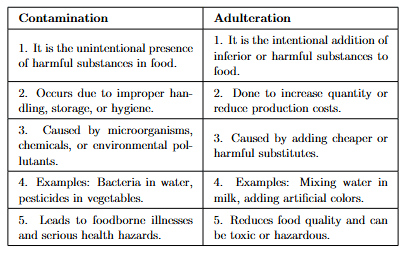
Quick Tip: While contamination can occur naturally or accidentally, adulteration is always intentional and illegal.
What is meant by child-centric approach?
View Solution
A child-centric approach focuses on the well-being and development of children in all aspects of their life. It is a strategy that puts the needs, rights, and interests of children at the center of planning, policies, and actions. This approach ensures that children's voices are heard, their needs are prioritized, and their development is supported in a healthy and safe environment. It is crucial in education, healthcare, and social policies, aiming to provide children with the best opportunities for growth and learning. Quick Tip: A child-centric approach not only prioritizes children’s needs but also focuses on their holistic development, including emotional, social, and cognitive growth.
Write briefly the various levels of fashion cycle.
View Solution
The fashion cycle refers to the predictable pattern in which fashion trends rise, peak, and eventually fall in popularity. The cycle can be divided into several levels:
Introduction: New fashion trends are introduced and are worn by a select group of people (typically high-end or celebrity-driven).
Rise: The trend gains more popularity as it is adopted by a wider audience, including middle-class consumers.
Peak: The trend is at its height and is widely accepted, becoming mainstream.
Decline: The trend starts losing popularity as people begin to tire of it, and it may be replaced by new trends.
Obsolescence: The fashion trend is no longer in style and is replaced by newer, more fashionable trends. Quick Tip: Fashion cycles help industry professionals predict trends and manage the production of clothing, ensuring they align with consumer preferences at various stages.
Write briefly the importance of development communication and journalism.
View Solution
Development communication and journalism play a significant role in driving social change and empowering communities:
Development Communication: It uses various forms of media to promote social development, public health, education, and other community welfare initiatives. It enables communities to express their needs and solutions and fosters collaboration between citizens, governments, and organizations.
Journalism: It plays a crucial role in informing the public, shaping opinions, and advocating for positive social changes. It highlights issues related to poverty, health, education, and justice, thus promoting transparency, accountability, and democracy.
Together, development communication and journalism help raise awareness, encourage civic participation, and bring about significant social and political changes. Quick Tip: Effective development communication and journalism empower communities by providing them with the knowledge and tools necessary for informed decision-making and social progress.
Mention the traditional occupations of India.
View Solution
Traditional occupations in India have historically revolved around the country's rural and agrarian economy. Agriculture has been the backbone of India’s economy, employing the majority of its population. Other significant occupations include weaving and handloom industries, which reflect the rich cultural heritage of India. Pottery and handicrafts, practiced across diverse regions, showcase the artistic skills of rural communities. Occupations such as fishing, animal husbandry, and forestry are vital in certain regions due to geographical and cultural factors. Traditional medicine systems like Ayurveda and Siddha have also been a cornerstone of India’s healthcare practices. These occupations have not only shaped the socio-economic framework of the country but also preserved its historical and cultural ethos. Quick Tip: Traditional occupations are often influenced by factors like geographical location, community skills, and cultural practices.
(OR) What things should be kept in mind before choosing any type of work, business, or career?
View Solution
Before choosing any work, business, or career, several factors should be considered to ensure success and satisfaction. One of the foremost considerations is the alignment of personal interests, skills, and strengths with the chosen field. A clear understanding of the market demand and future growth prospects of the industry is also essential. Financial implications, including initial investments and long-term stability, play a significant role, particularly in the case of starting a business. The work environment, location, and work-life balance must align with one’s lifestyle and personal values. Additionally, the availability of training or mentorship to improve knowledge and skills in the chosen domain can be a deciding factor. Finally, considering long-term goals and the potential for career progression ensures sustained satisfaction and development. Quick Tip: Evaluate your goals and consider long-term benefits over short-term advantages when choosing a career.
Briefly describe the rights and problems of a consumer.
View Solution
Consumers have specific rights that protect them from exploitation and unfair practices in the marketplace. These include the right to safety, ensuring that the products they purchase are free from harm; the right to information, which guarantees complete and accurate details about goods and services; the right to choice, allowing them to select products freely from a wide range of options; and the right to redressal, enabling them to seek compensation for defective products or inadequate services. However, consumers also face challenges. A significant problem is a lack of awareness about their rights and the legal mechanisms available for addressing grievances. Misleading advertisements and unethical business practices further exacerbate consumer vulnerabilities. Additionally, legal processes are often lengthy and complicated, deterring many from seeking justice. Promoting consumer education and simplifying complaint mechanisms are crucial to resolving these issues effectively. Quick Tip: Consumers can file complaints under the Consumer Protection Act if they face unfair trade practices.
(OR) What is the role of housekeeping section in guest management?
View Solution
The housekeeping section is a vital department in guest management within the hospitality industry. Its primary role is to ensure cleanliness, orderliness, and an overall pleasing environment within the establishment. Housekeeping services include maintaining guest rooms, public areas, and back-office spaces, ensuring a hygienic and welcoming atmosphere. A well-maintained environment significantly contributes to the comfort and satisfaction of guests, fostering positive reviews and repeat visits. Additionally, the housekeeping staff must be attentive to the specific needs and preferences of guests, such as providing extra amenities or fulfilling requests promptly. Their role extends to managing laundry services, maintaining room inventory, and ensuring that safety and sanitation protocols are strictly adhered to. The department's efficiency directly impacts the reputation and operational success of the establishment. Quick Tip: Maintaining effective communication between housekeeping and front office enhances guest satisfaction.
What is Integrated Child Development Service of Government of India? Write in brief.
View Solution
The Integrated Child Development Service (ICDS) is a flagship welfare scheme of the Government of India aimed at improving the nutritional and health standards of children under the age of six, as well as pregnant and lactating mothers. It provides a package of six essential services, including supplementary nutrition, preschool non-formal education, immunization, health check-ups, referral services, and nutrition and health education. The scheme operates through a network of Anganwadi centers across rural and urban areas. By focusing on the holistic development of children and addressing maternal health, the ICDS seeks to combat malnutrition, reduce infant mortality rates, and lay the foundation for a healthier and more productive population. Quick Tip: The ICDS program also promotes community involvement in addressing child and maternal nutrition needs.
(OR) What are the reasons for the deficit in associated and specific services and resources in India?
View Solution
The deficit in associated and specific services and resources in India stems from several systemic and socio-economic issues. One primary factor is the lack of adequate funding, which restricts the expansion and improvement of essential services like healthcare, education, and social welfare. Additionally, inefficient resource management and corruption exacerbate the problem, leading to underutilization and wastage of resources. Rural areas face a significant disparity in access to services compared to urban centers, further widening inequalities. Other contributing factors include a growing population, limited infrastructure, and inadequate training and deployment of skilled personnel. Addressing these challenges requires comprehensive planning, transparent governance, and equitable distribution of resources to ensure all sections of society benefit from development initiatives. Quick Tip: Improving access to services in rural areas is key to reducing the urban-rural divide in India.
*The article might have information for the previous academic years, please refer the official website of the exam.