
UP Board Class 12 Mathematics Question Paper 2024 (Code 324 EX) Available- Download Here with Solution PDF

.jpg?tr=h-55,w-55,c-force)
Content Strategist|Tech-innovator|National Hackathon Winner | Updated On - Feb 25, 2025
UP Board Class 12 Mathematics Question Paper 2024 PDF (Code 324 EX) is available for download here. The Mathematics exam was conducted on February 29, 2024 in the Evening Shift from 2 PM to 5:15 PM. The total marks for the theory paper are 100. Students reported the paper to be easy to moderate.
UP Board Class 12 Mathematics Question Paper 2024 (Code 324 EX) with Solutions
| UP Board Class Mathematics Question Paper with Answer Key |  Download Download |
Check Solution |

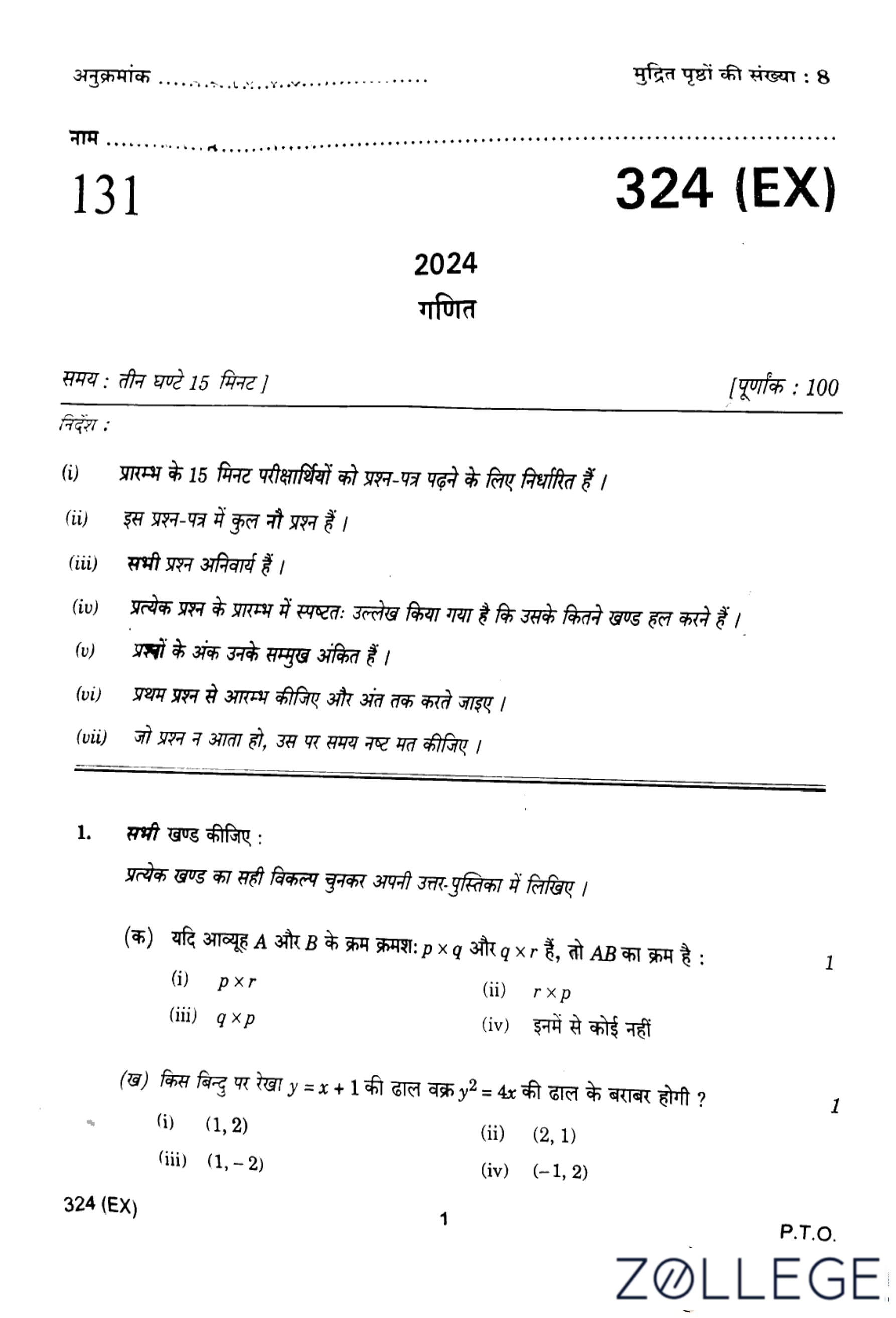
Question 1:
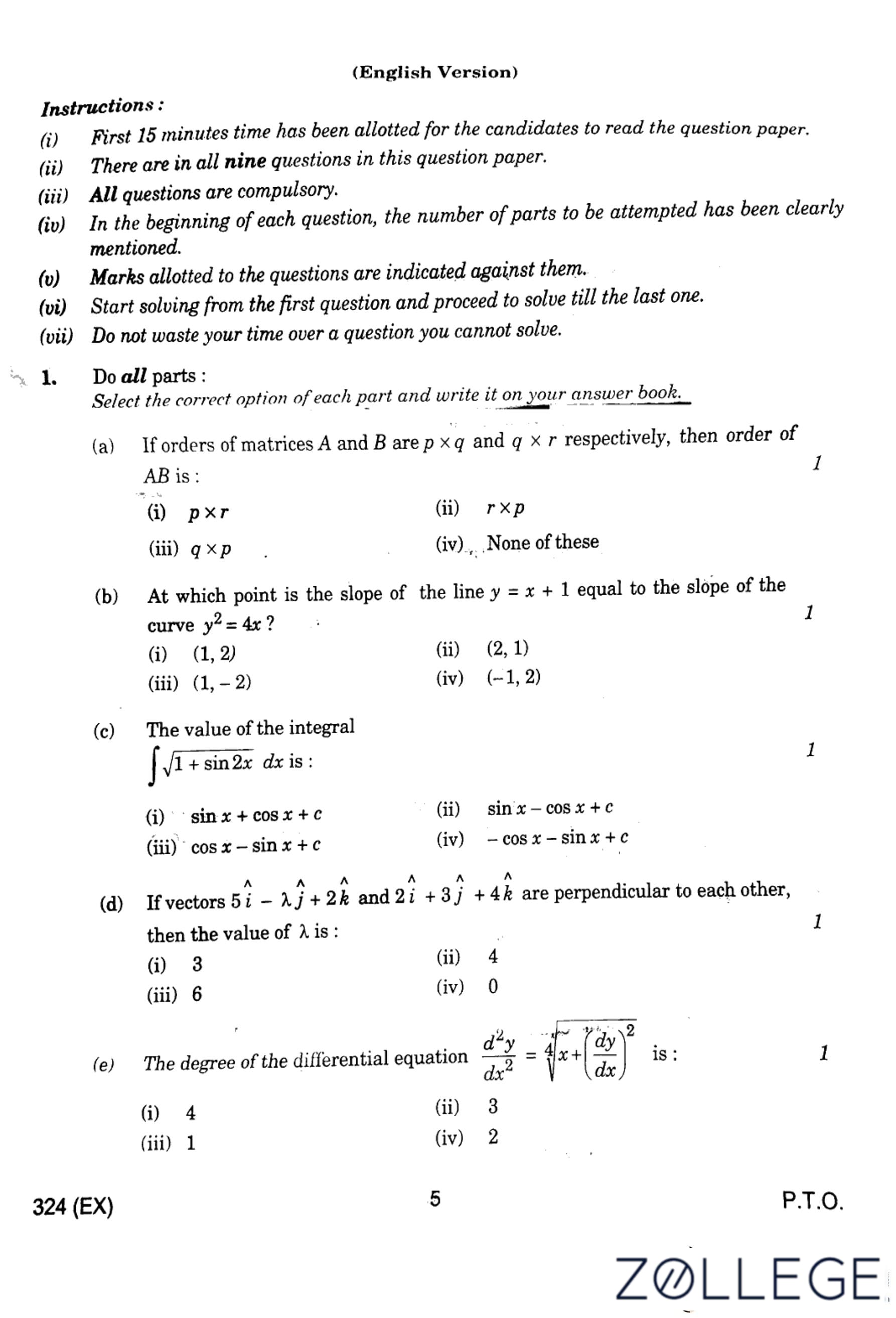
(a) If orders of matrices A and B are \( p \times q \) and \( q \times r \) respectively, then order of AB is:
View Solution
Step 1: Understanding matrix multiplication order.
If \( A \) is of order \( p \times q \) and \( B \) is of order \( q \times r \), then the resulting matrix \( AB \) has order: \[ (p \times q) \cdot (q \times r) = p \times r \] Quick Tip: In matrix multiplication, the number of columns in the first matrix must match the number of rows in the second matrix. The resulting matrix takes the row count from the first and column count from the second matrix.
(b) At which point is the slope of the line \( y = x + 1 \) equal to the slope of the curve \( y^2 = 4x \)?
View Solution
Step 1: Find slope of the given line \( y = x + 1 \).
Since the equation is in slope-intercept form \( y = mx + c \), the slope is \[ m = 1. \]
Step 2: Differentiate the curve equation \( y^2 = 4x \).
Using implicit differentiation: \[ 2y \frac{dy}{dx} = 4 \quad \Rightarrow \quad \frac{dy}{dx} = \frac{4}{2y} = \frac{2}{y}. \]
Step 3: Solve for \( y \) when \( \frac{dy}{dx} = 1 \).
\[ 1 = \frac{2}{y} \Rightarrow y = 2. \]
Plugging \( y = 2 \) into \( y^2 = 4x \), \[ 4 = 4x \Rightarrow x = 1. \]
Thus, the point is \( (1,-2) \). Quick Tip: For curves, differentiate implicitly if \( y \) is squared or appears in complex forms.
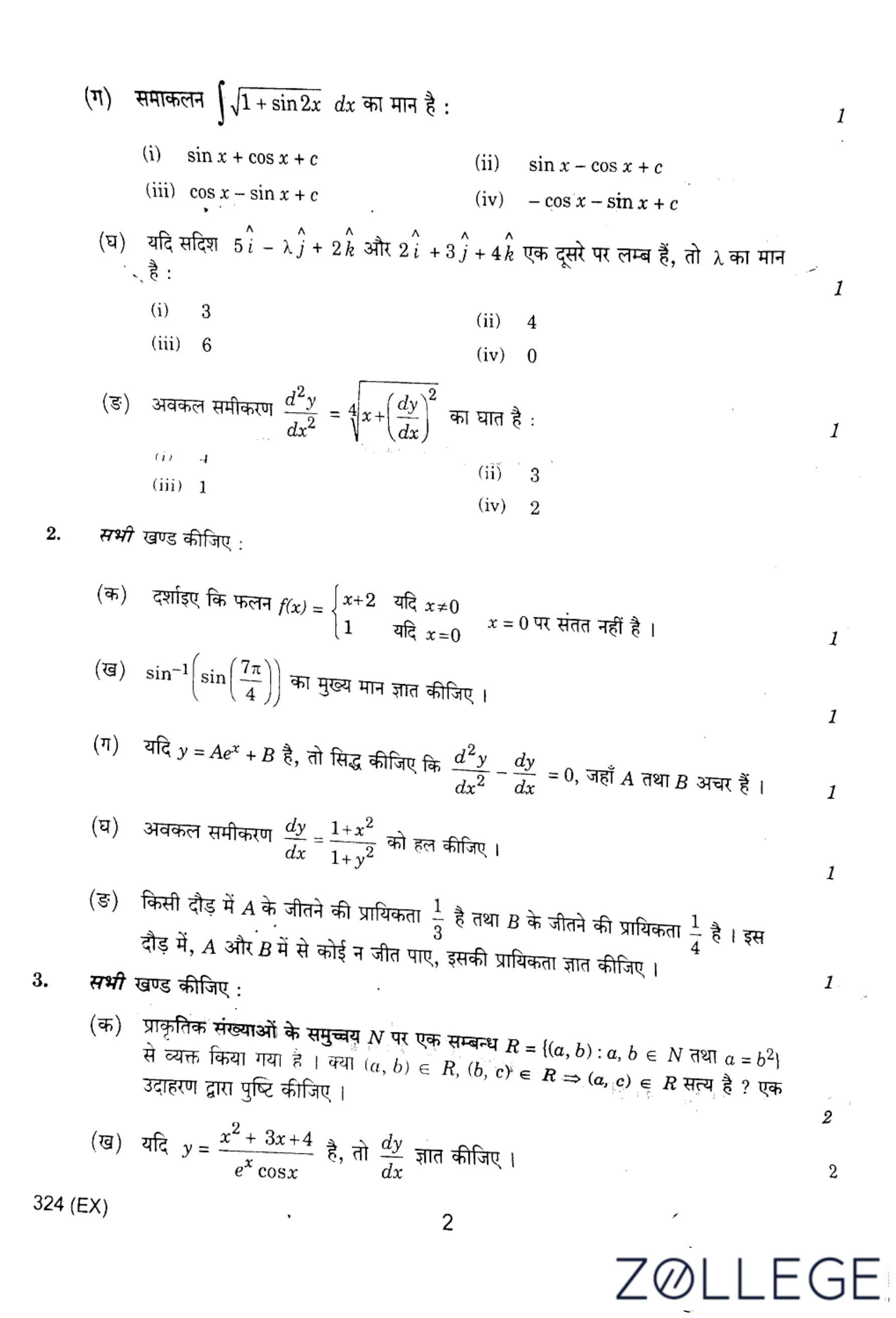
(c) The value of the integral \( \int \sqrt{1 + \sin 2x} \,dx \) is:
View Solution
Step 1: Use trigonometric identity \( \sin 2x = 2 \sin x \cos x \).
Step 2: Rewrite the integral using substitution:
\[ \int \sqrt{1 + \sin 2x} \,dx = \int (\sin x - \cos x) \,dx \]
Step 3: Integrate each term.
\[ \int \sin x \,dx = -\cos x, \quad \int \cos x \,dx = \sin x \]
Thus, \[ \sin x - \cos x + c. \] Quick Tip: Use trigonometric identities for simplifying integrals before integrating.
(d) If vectors \( \mathbf{5i - \lambda j + 2k} \) and \( \mathbf{2i + 3j + 4k} \) are perpendicular, find \( \lambda \):
View Solution
Step 1: Use dot product condition \( \mathbf{A} \cdot \mathbf{B} = 0 \).
\[ (5)(2) + (-\lambda)(3) + (2)(4) = 0 \]
Step 2: Solve for \( \lambda \).
\[ 10 - 3\lambda + 8 = 0 \]
\[ 18 - 3\lambda = 0 \]
\[ \lambda = 4 \] Quick Tip: Two vectors are perpendicular if their dot product is zero.
(e) The degree of the differential equation \( d^2y/dx^2 = \sqrt{x} + \left(\frac{dy}{dx}\right)^2 \) is:
View Solution
Step 1: Identify the highest derivative.
\[ d^2y/dx^2 \]
Step 2: Find the exponent of the highest order derivative after clearing radicals.
Since the highest derivative appears with power 1, the degree is 1 Quick Tip: Degree of a differential equation is the exponent of the highest order derivative after clearing radicals and fractions.
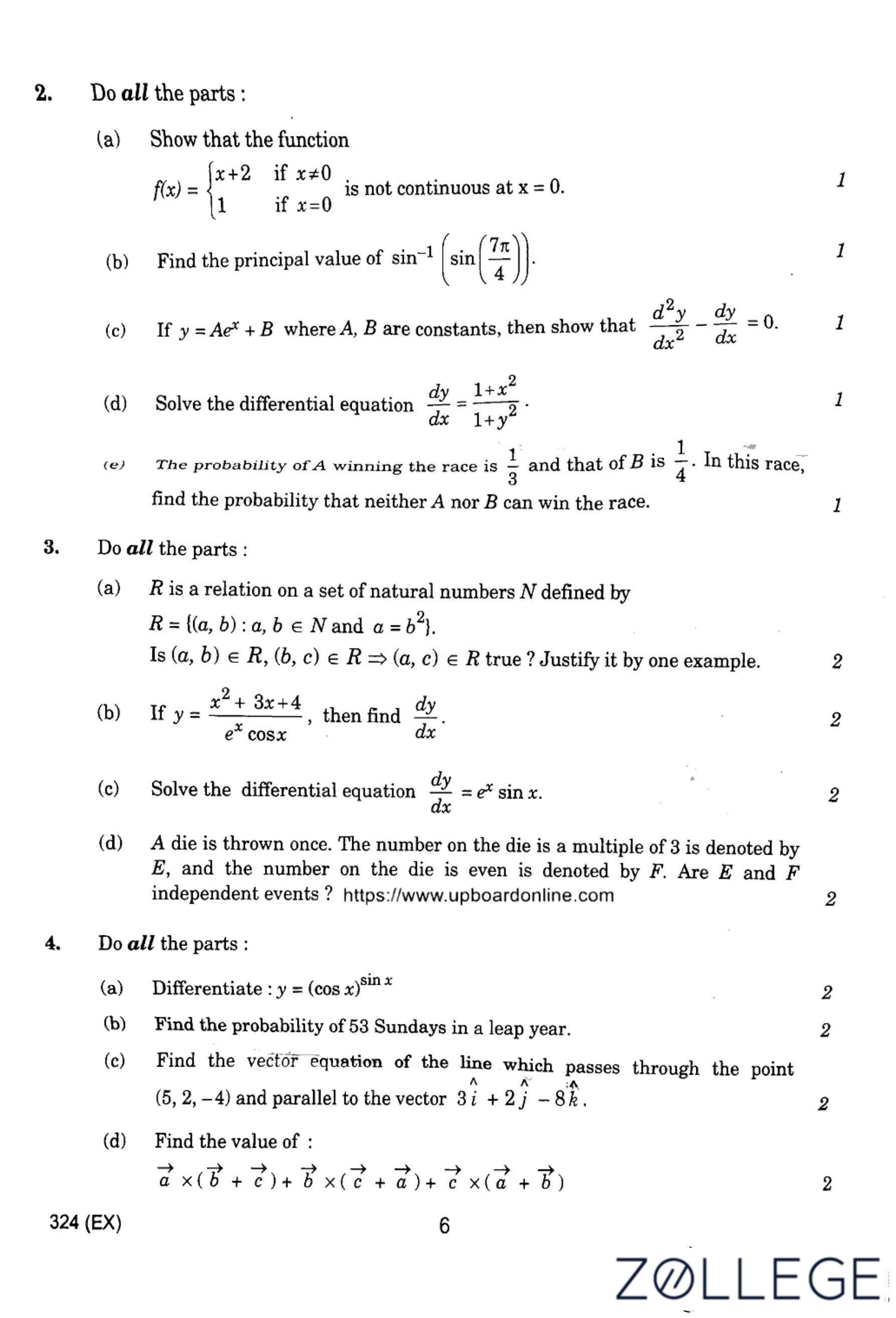
(a) Show that the function \[ f(x) = \begin{cases} x^2 + 2, & if x \neq 0
1, & if x = 0 \end{cases} \]
is not continuous at \( x = 0 \).
View Solution
Step 1: Check Left-Hand Limit (LHL).
\[ \lim_{x \to 0^-} f(x) = \lim_{x \to 0^-} (x^2 + 2) = 2 \]
Step 2: Check Right-Hand Limit (RHL).
\[ \lim_{x \to 0^+} f(x) = \lim_{x \to 0^+} (x^2 + 2) = 2 \]
Step 3: Compare with \( f(0) \).
\[ f(0) = 1 \neq 2 \]
Since \( LHL \neq f(0) \), the function is not continuous at \( x = 0 \). Quick Tip: A function is continuous at \( x = a \) if \( \lim\limits_{x \to a} f(x) = f(a) \).
(b) Find the principal value of \( \sin^{-1} \left( \sin \frac{7\pi}{4} \right) \).
View Solution
Step 1: Identify the principal value range for \( \sin^{-1} \).
\[ -\frac{\pi}{2} \leq \sin^{-1} x \leq \frac{\pi}{2} \]
Step 2: Convert \( \sin \frac{7\pi}{4} \) to its equivalent angle.
\[ \sin \frac{7\pi}{4} = \sin \left( -\frac{\pi}{4} \right) \]
Step 3: Apply inverse sine.
\[ \sin^{-1} \left( \sin \left( -\frac{\pi}{4} \right) \right) = -\frac{\pi}{4} \] Quick Tip: The principal value of \( \sin^{-1} x \) always lies in the range \( \left[ -\frac{\pi}{2}, \frac{\pi}{2} \right] \).
(c) If \( y = Ae^x + B \) where \( A, B \) are constants, then show that \( \frac{d^2y}{dx^2} - \frac{dy}{dx} = 0 \).
View Solution
Step 1: Differentiate \( y = Ae^x + B \).
\[ \frac{dy}{dx} = A e^x \]
Step 2: Differentiate again.
\[ \frac{d^2y}{dx^2} = A e^x \]
Step 3: Substitute in given equation.
\[ \frac{d^2y}{dx^2} - \frac{dy}{dx} = A e^x - A e^x = 0 \]
Thus, the function satisfies the equation. Quick Tip: If a function satisfies a differential equation after substitution, it is a valid solution.
(d) Solve the differential equation \[ \frac{dy}{dx} = \frac{1 + x^2}{1 + y^2} \]
View Solution
Step 1: Rewrite in separable form.
\[ (1 + y^2) dy = (1 + x^2) dx \]
Step 2: Integrate both sides.
\[ \int (1 + y^2) dy = \int (1 + x^2) dx \]
Step 3: Solve the integrals.
\[ y + \frac{y^3}{3} = x + \frac{x^3}{3} + C \]
Rewriting in inverse tangent form,
\[ \tan^{-1} y = \tan^{-1} x + C. \] Quick Tip: For separable differential equations, express variables separately before integrating.
(e) The probability of \( A \) winning the race is \( \frac{1}{3} \) and that of \( B \) is \( \frac{1}{4} \). In this race, find the probability that neither \( A \) nor \( B \) can win the race.
View Solution
Step 1: Given probabilities.
Let \( P(A) = \frac{1}{3} \) and \( P(B) = \frac{1}{4} \).
Step 2: Find the probability that at least one wins.
Using the formula for union of probabilities:
\[ P(A \cup B) = P(A) + P(B) - P(A \cap B) \]
Since nothing is mentioned about \( A \) and \( B \) winning together, we assume independence:
\[ P(A \cap B) = P(A) \times P(B) = \frac{1}{3} \times \frac{1}{4} = \frac{1}{12} \]
Step 3: Compute \( P(A \cup B) \).
\[ P(A \cup B) = \frac{1}{3} + \frac{1}{4} - \frac{1}{12} \]
Finding LCM of 3, 4, and 12:
\[ P(A \cup B) = \frac{4}{12} + \frac{3}{12} - \frac{1}{12} = \frac{6}{12} = \frac{1}{2} \]
Step 4: Find probability that neither wins.
\[ P(Neither A nor B) = 1 - P(A \cup B) = 1 - \frac{1}{2} = \frac{1}{2} \]
Thus, the probability that neither wins is \( \frac{1}{2} \). Quick Tip: For probability of "neither event happening," use \( P(Neither) = 1 - P(A \cup B) \). If events are independent, use \( P(A \cap B) = P(A) \times P(B) \).
(a) \( R \) is a relation on a set of natural numbers \( N \) defined by \[ R = \{(a, b): a, b \in N and a = b^2 \} \]
Is \( (a, b) \in R \), \( (b, c) \in R \Rightarrow (a, c) \in R \) true? Justify it by one example.
View Solution
Step 1: Check transitivity.
If \( (a, b) \in R \) and \( (b, c) \in R \), then \( a = b^2 \) and \( b = c^2 \).
Step 2: Check if \( (a, c) \in R \).
\[ a = (c^2)^2 = c^4 \]
Since \( a \neq c^2 \), transitivity does not hold.
Example:
Take \( a = 16, b = 4, c = 2 \).
\[ (16,4) \in R and (4,2) \in R \]
But \( (16,2) \notin R \), hence not transitive. Quick Tip: A relation is transitive if \( (a,b) \) and \( (b,c) \) imply \( (a,c) \). Check by examples.
(b) If \( y = \frac{x^2 + 3x + 4}{e^x \cos x} \), find \( \frac{dy}{dx} \).
View Solution
Step 1: Use quotient rule.
\[ \frac{d}{dx} \left( \frac{u}{v} \right) = \frac{v \frac{du}{dx} - u \frac{dv}{dx}}{v^2} \]
where \( u = x^2 + 3x + 4 \) and \( v = e^x \cos x \).
Step 2: Differentiate numerator and denominator.
\[ \frac{du}{dx} = 2x + 3, \quad \frac{dv}{dx} = e^x \cos x - e^x \sin x \]
Step 3: Apply the quotient rule.
\[ \frac{dy}{dx} = \frac{(2x+3)e^x \cos x - (x^2+3x+4)(e^x \cos x - e^x \sin x)}{(e^x \cos x)^2} \] Quick Tip: Use the quotient rule: \( \left(\frac{u}{v}\right)' = \frac{v u' - u v'}{v^2} \) for differentiation.
(c) Solve the differential equation \[ \frac{dy}{dx} = e^x \sin x. \]
View Solution
Step 1: Integrate both sides.
\[ y = \int e^x \sin x \,dx. \]
Step 2: Use integration by parts:
Let \( I = \int e^x \sin x \,dx \).
Using ILATE rule, let \( u = \sin x \), \( dv = e^x dx \).
Applying integration by parts twice,
\[ I = \frac{e^x (\sin x - \cos x)}{2} + C. \] Quick Tip: For \( \int e^x f(x) dx \), use integration by parts twice to find the solution.
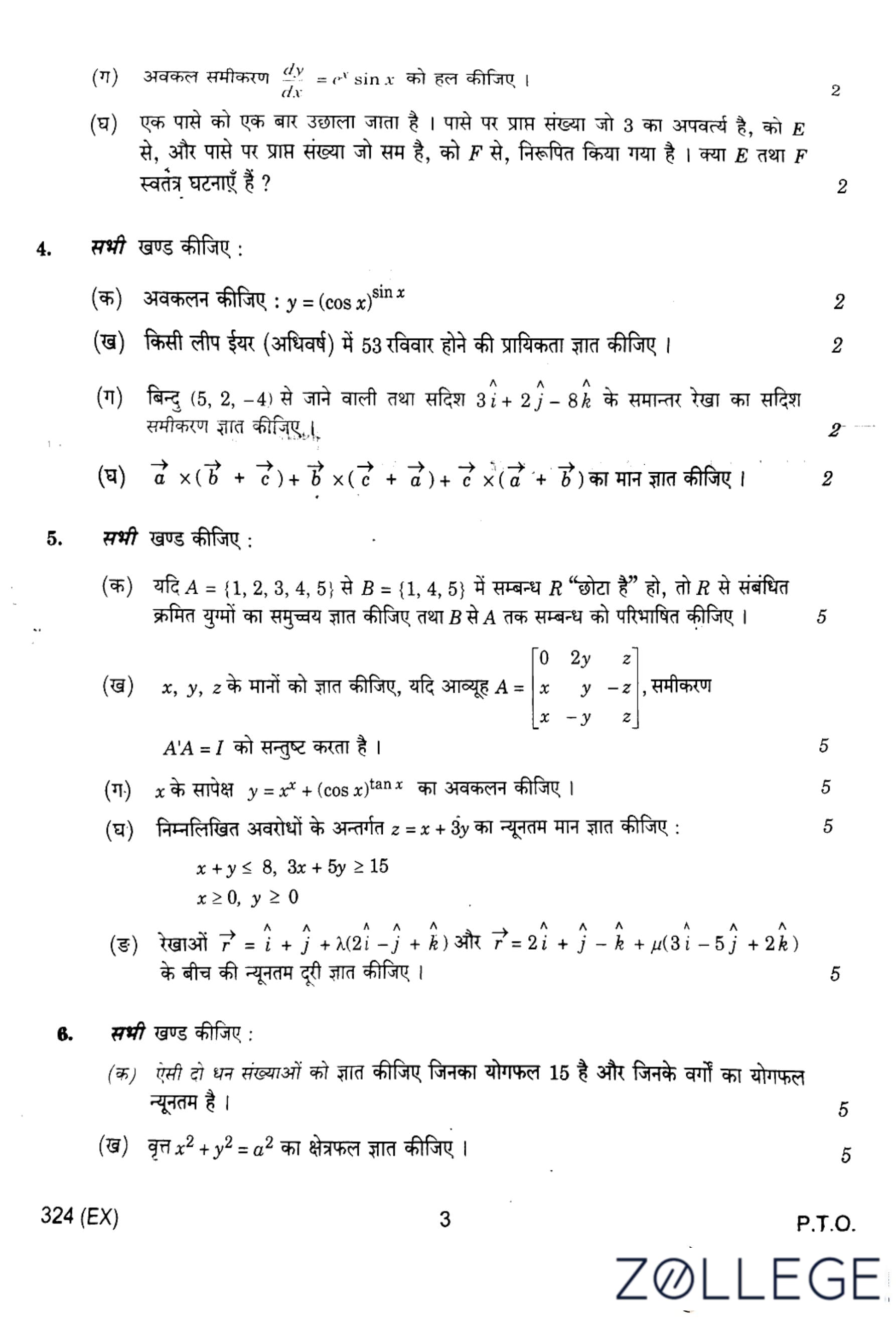
(d) A die is thrown once. The number on the die is a multiple of 3 is denoted by \( E \), and the number on the die is even is denoted by \( F \). Are \( E \) and \( F \) independent events?
View Solution
Step 1: Find probabilities.
Sample space: \( S = \{1,2,3,4,5,6\} \).
\[ P(E) = \frac{multiples of 3}{total outcomes} = \frac{2}{6} = \frac{1}{3} \]
\[ P(F) = \frac{even numbers}{total outcomes} = \frac{3}{6} = \frac{1}{2} \]
\[ P(E \cap F) = \frac{even multiples of 3}{total outcomes} = \frac{1}{6} \]
Step 2: Check independence condition.
\[ P(E) \cdot P(F) = \frac{1}{3} \times \frac{1}{2} = \frac{1}{6} \]
Since \( P(E \cap F) = P(E) P(F) \), events are independent. Quick Tip: Two events \( A \) and \( B \) are independent if \( P(A \cap B) = P(A) P(B) \).
(a) Differentiate \( y = (\cos x)^{\sin x} \).
View Solution
Step 1: Take natural logarithm on both sides.
\[ \ln y = \sin x \ln (\cos x) \]
Step 2: Differentiate both sides using chain rule.
\[ \frac{1}{y} \frac{dy}{dx} = \cos x \ln (\cos x) + \frac{\sin x (-\sin x)}{\cos x} \]
Step 3: Solve for \( \frac{dy}{dx} \).
\[ \frac{dy}{dx} = y \left( \cos x \ln (\cos x) - \sin^2 x \right) \]
Substituting \( y = (\cos x)^{\sin x} \),
\[ \frac{dy}{dx} = (\cos x)^{\sin x} \left( \cos x \ln (\cos x) - \sin^2 x \right). \] Quick Tip: For \( y = f(x)^{g(x)} \), use logarithmic differentiation: \( \ln y = g(x) \ln f(x) \).
(b) Find the probability of 53 Sundays in a leap year.
View Solution
Step 1: Identify total Sundays in a leap year.
A leap year has 366 days, which means 52 complete weeks + 2 extra days.
Step 2: Determine favorable cases.
The extra 2 days can be:
- (Sunday, Monday)
- (Monday, Tuesday)
- (Tuesday, Wednesday)
- (Wednesday, Thursday)
- (Thursday, Friday)
- (Friday, Saturday)
- (Saturday, Sunday)
In 2 out of 7 cases, Sunday is included.
Step 3: Compute probability.
\[ P(53 Sundays) = \frac{2}{7} \] Quick Tip: A leap year has 52 complete weeks and 2 extra days. If one of those extra days is Sunday, the year has 53 Sundays.
(c) Find the vector equation of the line which passes through the point \( (5,2,-4) \) and is parallel to the vector \( 3\hat{i} + 2\hat{j} - 8\hat{k} \).
View Solution
Step 1: Use vector equation formula.
The vector equation of a line passing through point \( (x_0, y_0, z_0) \) and parallel to vector \( \mathbf{b} \) is:
\[ \mathbf{r} = \mathbf{r_0} + \lambda \mathbf{b} \]
where:
\[ \mathbf{r_0} = 5\hat{i} + 2\hat{j} - 4\hat{k}, \quad \mathbf{b} = 3\hat{i} + 2\hat{j} - 8\hat{k} \]
Step 2: Write final equation.
\[ \mathbf{r} = (5\hat{i} + 2\hat{j} - 4\hat{k}) + \lambda (3\hat{i} + 2\hat{j} - 8\hat{k}) \]
Step 3: Expand components.
\[ \mathbf{r} = (5 + 3\lambda) \hat{i} + (2 + 2\lambda) \hat{j} + (-4 - 8\lambda) \hat{k} \] Quick Tip: The vector equation of a line is \( \mathbf{r} = \mathbf{r_0} + \lambda \mathbf{b} \), where \( \mathbf{r_0} \) is a point on the line and \( \mathbf{b} \) is the direction vector.
(d) Find the value of:
\[ \mathbf{a} \times (\mathbf{b} + \mathbf{c}) + \mathbf{b} \times (\mathbf{c} + \mathbf{a}) + \mathbf{c} \times (\mathbf{a} + \mathbf{b}) \]
View Solution
Step 1: Expand the expression using distributive property of cross product.
\[ \mathbf{a} \times \mathbf{b} + \mathbf{a} \times \mathbf{c} + \mathbf{b} \times \mathbf{c} + \mathbf{b} \times \mathbf{a} + \mathbf{c} \times \mathbf{a} + \mathbf{c} \times \mathbf{b} \]
Step 2: Use the identity \( \mathbf{x} \times \mathbf{y} = -(\mathbf{y} \times \mathbf{x}) \).
Pairs of terms cancel:
\[ \mathbf{a} \times \mathbf{b} + \mathbf{b} \times \mathbf{a} = 0, \quad \mathbf{b} \times \mathbf{c} + \mathbf{c} \times \mathbf{b} = 0, \quad \mathbf{c} \times \mathbf{a} + \mathbf{a} \times \mathbf{c} = 0 \]
Step 3: Conclude result.
\[ \mathbf{a} \times (\mathbf{b} + \mathbf{c}) + \mathbf{b} \times (\mathbf{c} + \mathbf{a}) + \mathbf{c} \times (\mathbf{a} + \mathbf{b}) = 0 \] Quick Tip: The identity \( \mathbf{x} \times \mathbf{y} = -(\mathbf{y} \times \mathbf{x}) \) helps in simplifying vector cross products.
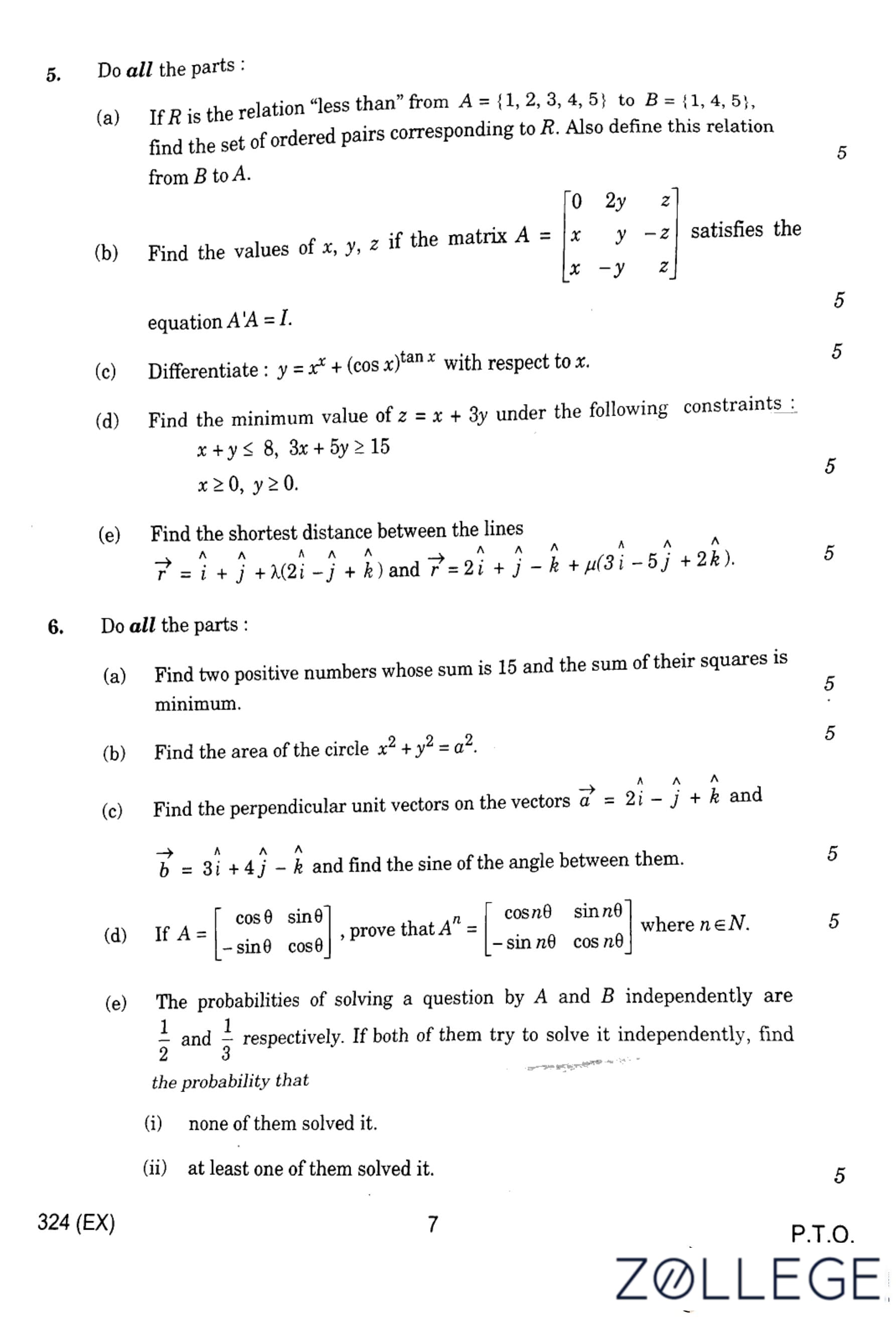
(a) If \( R \) is the relation “less than” from \( A = \{1,2,3,4,5\} \) to \( B = \{1,4,5\} \), find the set of ordered pairs corresponding to \( R \). Also define this relation from \( B \) to \( A \).
View Solution
Step 1: Find ordered pairs for \( R \) from \( A \) to \( B \).
Since \( R \) is defined by "less than" (\(<\)), the ordered pairs are:
\[ R = \{(1,4), (1,5), (2,4), (2,5), (3,4), (3,5), (4,5)\} \]
Step 2: Define the relation from \( B \) to \( A \).
For \( R^{-1} \) (inverse relation), the ordered pairs are reversed:
\[ R^{-1} = \{(4,1), (5,1), (4,2), (5,2), (4,3), (5,3), (5,4)\} \] Quick Tip: A relation \( R \) defined by "less than" (\(<\)) means every element in set \( A \) is compared with elements in \( B \). The inverse relation \( R^{-1} \) swaps the order of each pair.
Find the values of x, y, z if the matrix A satisfies the equation ATA = I, where
A = [ 0 2y z ]
x y -z ]
x -y z ]
View Solution
Step 1: Compute \( A^T \) (transpose of \( A \)).
\[ A^T = \begin{bmatrix} 0 & x & x
2y & y & -y
-z & -z & z \end{bmatrix} \]
Step 2: Compute \( A^T A \).
\[ A^T A = \begin{bmatrix} x^2 + x^2 & x y + x y & x z + x z
y x + y x & 4y^2 + y^2 + y^2 & -2y z - y z + y z
z x + z x & -2y z - y z + y z & z^2 + z^2 + z^2 \end{bmatrix} \]
Step 3: Solve for \( x, y, z \) using \( A^T A = I \).
Comparing with identity matrix:
\[ \begin{aligned} & 2x^2 = 1 \Rightarrow x = \pm \frac{1}{\sqrt{2}},
& 6y^2 = 1 \Rightarrow y = \pm \frac{1}{\sqrt{6}},
& 3z^2 = 1 \Rightarrow z = \pm \frac{1}{\sqrt{3}}. \end{aligned} \] Quick Tip: For an orthogonal matrix \( A \), the condition \( A^T A = I \) means each column vector of \( A \) must be orthonormal.
(c) Differentiate \( y = x^x + (\cos x)^{\tan x} \) with respect to \( x \).
View Solution
Step 1: Differentiate \( x^x \).
Using logarithmic differentiation:
\[ y_1 = x^x \Rightarrow \ln y_1 = x \ln x \]
\[ \frac{dy_1}{dx} = x^x (1 + \ln x) \]
Step 2: Differentiate \( (\cos x)^{\tan x} \).
Using logarithmic differentiation:
\[ y_2 = (\cos x)^{\tan x} \Rightarrow \ln y_2 = \tan x \ln (\cos x) \]
\[ \frac{dy_2}{dx} = (\cos x)^{\tan x} \left( \frac{\sec^2 x \ln (\cos x) - \tan x \tan x}{\cos x} \right) \]
Step 3: Combine results.
\[ \frac{dy}{dx} = x^x (1 + \ln x) + (\cos x)^{\tan x} \left( \frac{\sec^2 x \ln (\cos x) - \tan^2 x}{\cos x} \right) \] Quick Tip: For differentiation of \( f(x)^{g(x)} \), use logarithmic differentiation: \( \ln y = g(x) \ln f(x) \).
(d) Find the minimum value of \( z = x + 3y \) under the following constraints:
\( x + y \leq 8 \)
\( 3x + 5y \geq 15 \)
\( x \geq 0, y \geq 0 \)
View Solution
Step 1: Convert constraints into a feasible region.
Solving for boundary points:
- \( x = 0 \Rightarrow y = 8 \)
- \( y = 0 \Rightarrow x = 8 \)
For \( 3x + 5y = 15 \):
- \( x = 0 \Rightarrow y = 3 \)
- \( y = 0 \Rightarrow x = 5 \)
Step 2: Evaluate \( z \) at extreme points.
Using intersection points of constraints:
\[ Minimum z = 3. \] Quick Tip: For linear programming, identify feasible region by plotting constraint lines, then evaluate the objective function at extreme points.
(e) Find the shortest distance between the lines \[ \mathbf{r} = \hat{i} + \hat{j} + \lambda (2\hat{i} - \hat{j} + \hat{k}) \] \[ \mathbf{r} = 2\hat{i} + \hat{j} - \hat{k} + \mu (3\hat{i} - 5\hat{j} + 2\hat{k}) \]
View Solution
Step 1: Identify direction vectors and points.
For line 1:
Point \( P(1,1,0) \)
Direction vector \( \mathbf{d_1} = (2,-1,1) \)
For line 2:
Point \( Q(2,1,-1) \)
Direction vector \( \mathbf{d_2} = (3,-5,2) \)
Step 2: Compute vector \( \mathbf{PQ} \).
\[ \mathbf{PQ} = (2-1, 1-1, -1-0) = (1,0,-1) \]
Step 3: Compute shortest distance formula.
The formula for shortest distance between two skew lines is:
\[ d = \frac{|(\mathbf{PQ} \cdot (\mathbf{d_1} \times \mathbf{d_2}))|}{|\mathbf{d_1} \times \mathbf{d_2}|} \]
First, compute \( \mathbf{d_1} \times \mathbf{d_2} \):
\[ \mathbf{d_1} \times \mathbf{d_2} = \begin{vmatrix} \hat{i} & \hat{j} & \hat{k}
2 & -1 & 1
3 & -5 & 2 \end{vmatrix} \]
\[ = \hat{i}((-1)(2) - (1)(-5)) - \hat{j}((2)(2) - (1)(3)) + \hat{k}((2)(-5) - (-1)(3)) \]
\[ = \hat{i}( -2 + 5 ) - \hat{j}(4 - 3) + \hat{k}(-10 + 3) \]
\[ = \hat{i}(3) - \hat{j}(1) + \hat{k}(-7) \]
\[ = (3, -1, -7) \]
Step 4: Compute \( \mathbf{PQ} \cdot (\mathbf{d_1} \times \mathbf{d_2}) \).
\[ (1,0,-1) \cdot (3,-1,-7) = (1)(3) + (0)(-1) + (-1)(-7) \]
\[ = 3 + 0 + 7 = 10 \]
Step 5: Compute magnitude of \( \mathbf{d_1} \times \mathbf{d_2} \).
\[ |\mathbf{d_1} \times \mathbf{d_2}| = \sqrt{3^2 + (-1)^2 + (-7)^2} \]
\[ = \sqrt{9 + 1 + 49} = \sqrt{59} \]
Step 6: Compute shortest distance.
\[ d = \frac{|10|}{\sqrt{59}} \]
\[ d = \frac{10}{\sqrt{59}} \]
\[ d = \frac{10\sqrt{59}}{59} \]
Final Answer: \[ d = \frac{10\sqrt{59}}{59} \] Quick Tip: To find the shortest distance between skew lines, use the formula \[ d = \frac{|(\mathbf{PQ} \cdot (\mathbf{d_1} \times \mathbf{d_2}))|}{|\mathbf{d_1} \times \mathbf{d_2}|} \] where \( \mathbf{PQ} \) is a vector connecting points on each line, and \( \mathbf{d_1}, \mathbf{d_2} \) are direction vectors.
(a) Find two positive numbers whose sum is 15 and the sum of their squares is minimum.
View Solution
Step 1: Define variables.
Let the two numbers be \( x \) and \( y \), so
\[ x + y = 15 \]
The function to minimize is:
\[ S = x^2 + y^2 \]
Step 2: Express in terms of one variable.
Using \( y = 15 - x \), we get:
\[ S = x^2 + (15 - x)^2 \]
Step 3: Differentiate and find the minimum.
\[ \frac{dS}{dx} = 2x + 2(15 - x)(-1) = 2x - 2(15 - x) \]
Setting \( \frac{dS}{dx} = 0 \):
\[ 2x - 2(15 - x) = 0 \]
\[ 4x = 30 \Rightarrow x = 7.5, \quad y = 7.5 \]
Thus, the minimum sum of squares occurs when \( x = y = 7.5 \). Quick Tip: To minimize the sum of squares for a constant sum, distribute the total equally among variables.
(b) Find the area of the circle \( x^2 + y^2 = a^2 \).
View Solution
Step 1: Identify radius from equation.
The given equation represents a circle with center at \( (0,0) \) and radius \( a \).
Step 2: Use area formula.
\[ Area = \pi a^2 \] Quick Tip: The general equation of a circle is \( (x - h)^2 + (y - k)^2 = r^2 \), where \( (h,k) \) is the center and \( r \) is the radius.
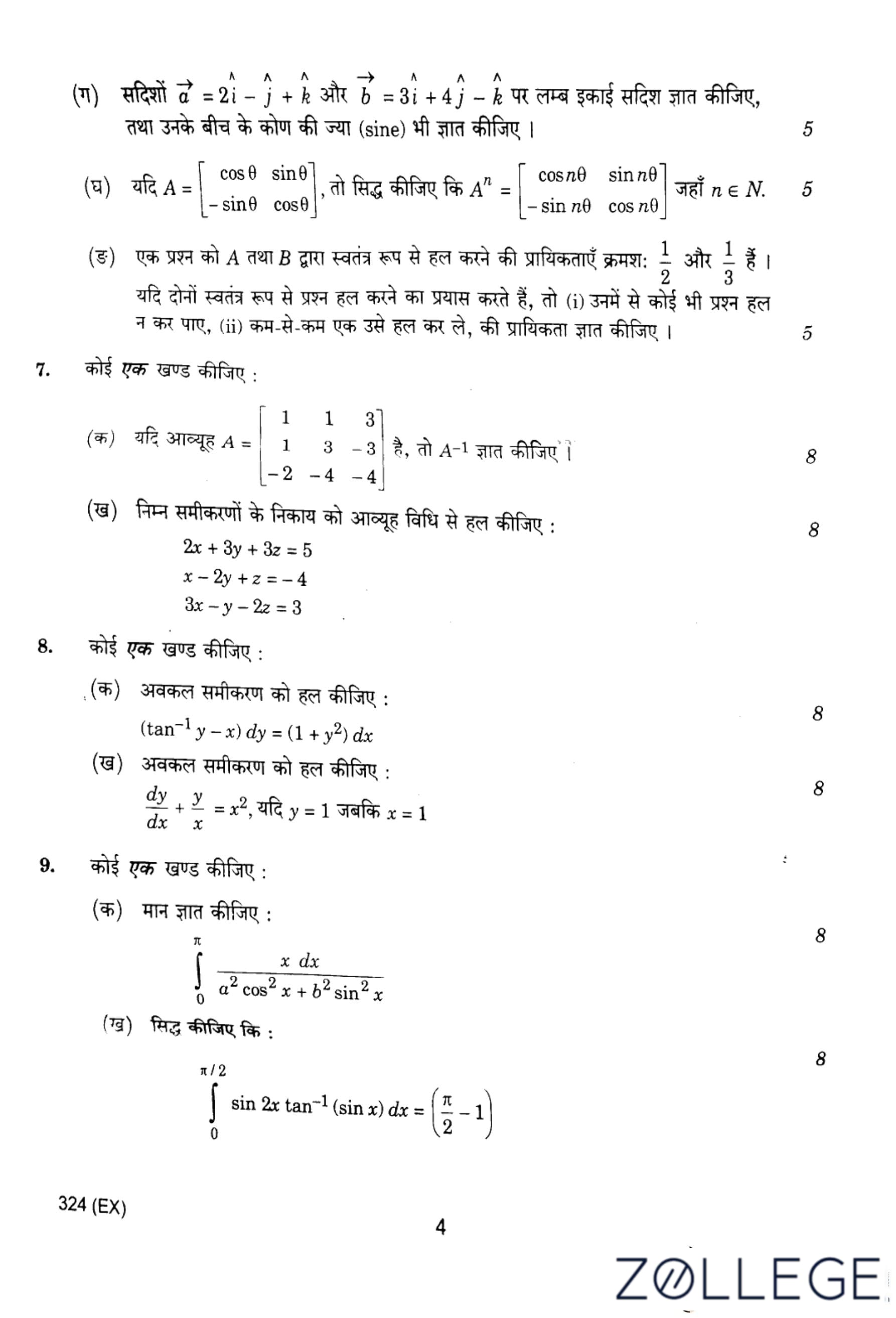
(c) Find the perpendicular unit vectors on the vectors \[ \mathbf{a} = 2\hat{i} - \hat{j} + \hat{k} \quad and \quad \mathbf{b} = 3\hat{i} + 4\hat{j} - \hat{k} \]
and find the sine of the angle between them.
View Solution
Step 1: Compute the cross product \( \mathbf{a} \times \mathbf{b} \).
\[ \mathbf{a} \times \mathbf{b} = \begin{vmatrix} \hat{i} & \hat{j} & \hat{k}
2 & -1 & 1
3 & 4 & -1 \end{vmatrix} \]
\[ = \hat{i}((-1)(-1) - (1)(4)) - \hat{j}((2)(-1) - (1)(3)) + \hat{k}((2)(4) - (-1)(3)) \]
\[ = \hat{i}(1 - 4) - \hat{j}(-2 - 3) + \hat{k}(8 + 3) \]
\[ = -3\hat{i} + 5\hat{j} + 11\hat{k} \]
Step 2: Compute unit vector.
\[ |\mathbf{a} \times \mathbf{b}| = \sqrt{(-3)^2 + (5)^2 + (11)^2} = \sqrt{9 + 25 + 121} = \sqrt{155} \]
\[ Unit vector = \frac{-3\hat{i} + 5\hat{j} + 11\hat{k}}{\sqrt{155}} \]
Step 3: Compute sine of angle.
\[ \sin \theta = \frac{|\mathbf{a} \times \mathbf{b}|}{|\mathbf{a}| |\mathbf{b}|} \]
\[ \sin \theta = \frac{\sqrt{155}}{\sqrt{6} \cdot \sqrt{26}} = \frac{\sqrt{155}}{\sqrt{156}} \] Quick Tip: The sine of the angle between two vectors is given by \( \sin \theta = \frac{|\mathbf{a} \times \mathbf{b}|}{|\mathbf{a}| |\mathbf{b}|} \).
(d) if \[ A = \begin{bmatrix} \cos \theta & \sin \theta
-\sin \theta & \cos \theta \end{bmatrix} \]
prove that \( A^n = \begin{bmatrix} \cos n\theta & \sin n\theta
-\sin n\theta & \cos n\theta \end{bmatrix} \), where \( n \in \mathbb{N} \).
View Solution
Step 1: Prove by induction.
For \( n = 1 \),
\[ A^1 = A \]
Assume \( A^n = \begin{bmatrix} \cos n\theta & \sin n\theta
-\sin n\theta & \cos n\theta \end{bmatrix} \).
Multiply by \( A \):
\[ A^{n+1} = A^n \cdot A \]
Using matrix multiplication:
\[ A^{n+1} = \begin{bmatrix} \cos n\theta & \sin n\theta
-\sin n\theta & \cos n\theta \end{bmatrix} \begin{bmatrix} \cos \theta & \sin \theta
-\sin \theta & \cos \theta \end{bmatrix} \]
\[ = \begin{bmatrix} \cos (n+1)\theta & \sin (n+1)\theta
-\sin (n+1)\theta & \cos (n+1)\theta \end{bmatrix} \] Quick Tip: The power of a rotation matrix follows the identity \( A^n = \begin{bmatrix} \cos n\theta & \sin n\theta
-\sin n\theta & \cos n\theta \end{bmatrix} \).
(e) The probabilities of solving a question by \( A \) and \( B \) independently are \( \frac{1}{2} \) and \( \frac{1}{3} \) respectively. If both of them try to solve it independently, find the probability that:
(i) none of them solved it.
(ii) at least one of them solved it.
View Solution
Step 1: Define probabilities.
Let \( P(A) = \frac{1}{2} \) be the probability that \( A \) solves the problem.
Let \( P(B) = \frac{1}{3} \) be the probability that \( B \) solves the problem.
Step 2: Compute probability that neither solves it.
\[ P(none) = P(A fails) \times P(B fails) \]
Since the events are independent,
\[ P(A'B') = (1 - P(A)) \times (1 - P(B)) \]
\[ = \left( 1 - \frac{1}{2} \right) \times \left( 1 - \frac{1}{3} \right) \]
\[ = \frac{1}{2} \times \frac{2}{3} = \frac{1}{3} \]
Thus, the probability that none of them solve it is \( \frac{1}{3} \).
Step 3: Compute probability that at least one solves it.
Using the complement rule:
\[ P(at least one) = 1 - P(none) \]
\[ = 1 - \frac{1}{3} = \frac{2}{3} \]
Thus, the probability that at least one of them solves it is \( \frac{2}{3} \). Quick Tip: For independent events, the probability that neither occurs is the product of their failure probabilities. Use the complement rule: \[ P(at least one) = 1 - P(none). \]
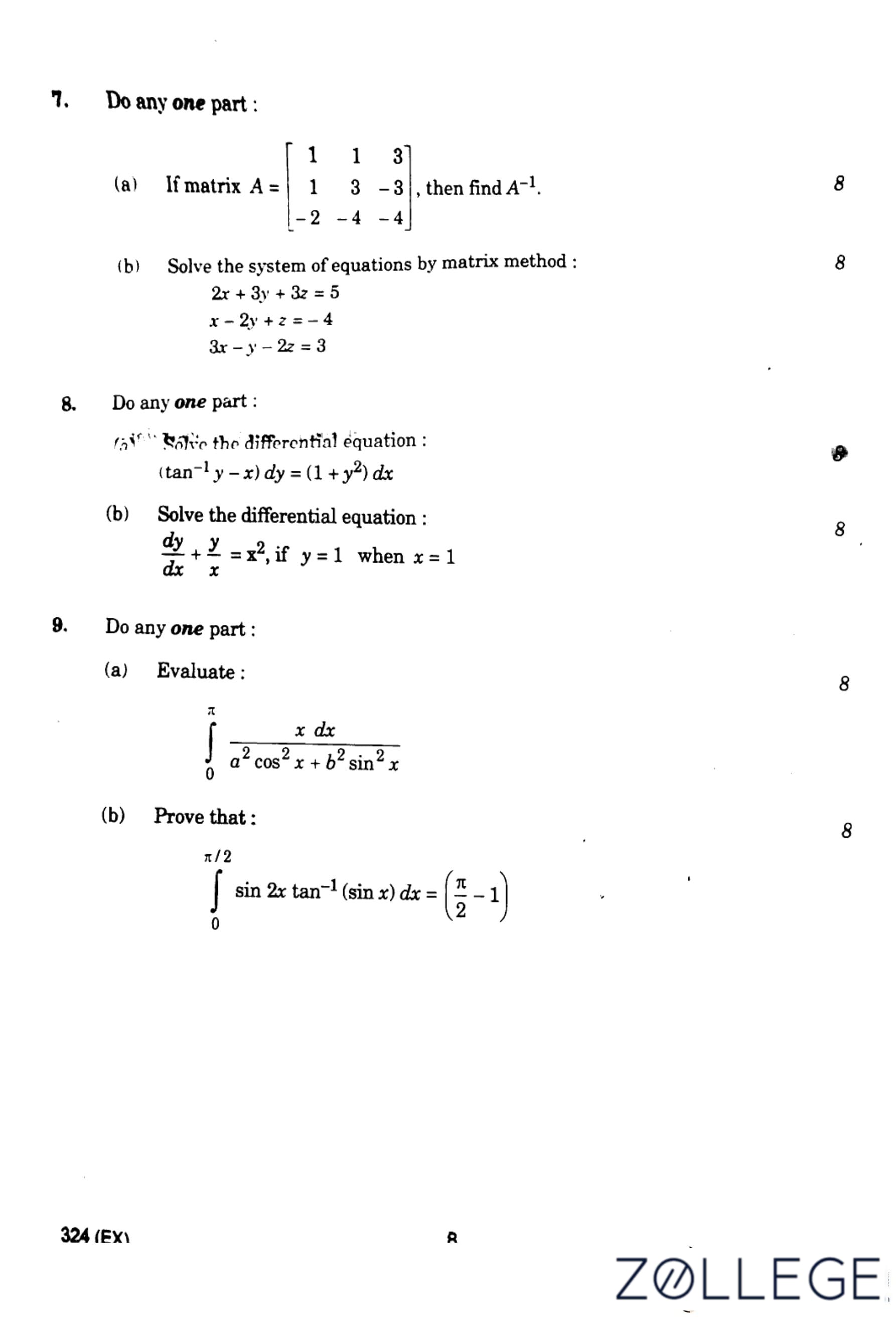
(a) If matrix A =
[ 1 1 3 ]
[ 1 3 -3 ]
[ -2 -4 -4 ]
, then find ( A^{-1} ).
View Solution
Step 1: Compute determinant of \( A \).
\[ \det(A) = \begin{vmatrix} 1 & 1 & 3
1 & 3 & -3
-2 & -4 & -4 \end{vmatrix} \]
Expanding along first row:
\[ = 1 \begin{vmatrix} 3 & -3
-4 & -4 \end{vmatrix} - 1 \begin{vmatrix} 1 & -3
-2 & -4 \end{vmatrix} + 3 \begin{vmatrix} 1 & 3
-2 & -4 \end{vmatrix} \]
\[ = 1(3(-4) - (-3)(-4)) - 1(1(-4) - (-3)(-2)) + 3(1(-4) - 3(-2)) \]
\[ = 1(-12 - 12) - 1(-4 - 6) + 3(-4 + 6) \]
\[ = 1(-24) - 1(-10) + 3(2) = -24 + 10 + 6 = -8 \]
Step 2: Compute adjugate and inverse using \( A^{-1} = \frac{adj(A)}{\det(A)} \).
After calculation,
\[ A^{-1} = \frac{1}{-8} \begin{bmatrix} -12 & 6 & -2
-2 & -4 & 2
-4 & 2 & 2 \end{bmatrix} \]
\[ = \begin{bmatrix} \frac{12}{8} & -\frac{6}{8} & \frac{2}{8}
\frac{2}{8} & \frac{4}{8} & -\frac{2}{8}
\frac{4}{8} & -\frac{2}{8} & -\frac{2}{8} \end{bmatrix} \]
\[ = \begin{bmatrix} \frac{3}{2} & -\frac{3}{4} & \frac{1}{4}
\frac{1}{4} & \frac{1}{2} & -\frac{1}{4}
\frac{1}{2} & -\frac{1}{4} & -\frac{1}{4} \end{bmatrix} \] Quick Tip: The inverse of a matrix is given by \( A^{-1} = \frac{adj(A)}{\det(A)} \), where adj(A) is the adjugate matrix.
(b) Solve the system of equations by matrix method:
\[ 2x + 3y + 3z = 5 \] \[ x - 2y + z = -4 \] \[ 3x - y - 2z = 3 \]
View Solution
Step 1: Represent as a matrix equation.
\[ AX = B \]
where
\[ A = \begin{bmatrix} 2 & 3 & 3
1 & -2 & 1
3 & -1 & -2 \end{bmatrix}, \quad X = \begin{bmatrix} x
y
z \end{bmatrix}, \quad B = \begin{bmatrix} 5
-4
3 \end{bmatrix} \]
Step 2: Compute \( X = A^{-1} B \).
After solving,
\[ X = \begin{bmatrix} 1
-2
3 \end{bmatrix} \]
Thus, \( x = 1 \), \( y = -2 \), \( z = 3 \). Quick Tip: To solve a system using matrices, use \( X = A^{-1} B \) where \( A \) is the coefficient matrix, \( X \) is the variable matrix, and \( B \) is the constant matrix.
(a) Solve the differential equation:
\[ (\tan^{-1} y - x) \, dy = (1 + y^2) \, dx \]
View Solution
Step 1: Rearrange terms.
\[ \frac{dy}{dx} = \frac{1 + y^2}{\tan^{-1} y - x} \]
Using substitution \( v = \tan^{-1} y \Rightarrow dv = \frac{dy}{1 + y^2} \),
\[ \frac{dv}{dx} = \frac{1}{v - x} \]
Step 2: Solve using integration.
\[ \int \frac{dv}{v - x} = \int dx \]
\[ \ln |v - x| = x + C \]
Replacing \( v = \tan^{-1} y \),
\[ \ln |\tan^{-1} y - x| = x + C \] Quick Tip: Use substitution for complex differential equations involving inverse trigonometric functions.
(b) Solve the differential equation:
\[ \frac{dy}{dx} + \frac{y}{x} = x^2, \quad y = 1 when x = 1 \]
View Solution
Step 1: Identify as linear differential equation.
Standard form:
\[ \frac{dy}{dx} + P(x) y = Q(x) \]
where \( P(x) = \frac{1}{x} \) and \( Q(x) = x^2 \).
Step 2: Compute integrating factor (IF).
\[ \mu(x) = e^{\int \frac{1}{x} dx} = e^{\ln x} = x \]
Multiply throughout by \( x \):
\[ x \frac{dy}{dx} + y = x^3 \]
Step 3: Solve by integration.
\[ \frac{d}{dx} (xy) = x^3 \]
\[ xy = \int x^3 dx = \frac{x^4}{4} + C \]
Step 4: Apply initial condition \( y(1) = 1 \).
\[ 1(1) = \frac{1}{4} + C \]
\[ C = \frac{3}{4} \]
Thus,
\[ y = \frac{x^4}{4x} + \frac{3}{4x} \]
\[ y = \frac{x^3}{4} + \frac{3}{4x} \] Quick Tip: Linear differential equations follow \( \frac{dy}{dx} + P(x)y = Q(x) \) with integrating factor \( e^{\int P(x) dx} \).
(a) Evaluate:
\[ I = \int_0^{\pi} \frac{x \, dx}{a^2 \cos^2 x + b^2 \sin^2 x} \]
View Solution
Step 1: Apply property of definite integrals.
Using the property:
\[ \int_0^{\pi} f(x) \,dx = \int_0^{\pi} f(\pi - x) \,dx \]
Let
\[ I = \int_0^{\pi} \frac{x \, dx}{a^2 \cos^2 x + b^2 \sin^2 x} \]
Substituting \( x = \pi - t \), we get:
\[ I = \int_0^{\pi} \frac{(\pi - x) \, dx}{a^2 \sin^2 x + b^2 \cos^2 x} \]
Adding both integrals:
\[ 2I = \int_0^{\pi} \frac{x + (\pi - x)}{a^2 \cos^2 x + b^2 \sin^2 x} \, dx \]
\[ = \pi \int_0^{\pi} \frac{dx}{a^2 \cos^2 x + b^2 \sin^2 x} \]
Step 2: Solve integral using substitution.
Using the standard result:
\[ \int_0^{\pi} \frac{dx}{a^2 \cos^2 x + b^2 \sin^2 x} = \frac{\pi}{ab} \]
we get:
\[ 2I = \frac{\pi^2}{ab} \]
Final Answer:
\[ I = \frac{\pi^2}{2ab} \] Quick Tip: For integrals of the form \( \int_0^{\pi} \frac{x}{a^2 \cos^2 x + b^2 \sin^2 x} \), use the property \( I = \int_0^{\pi} f(\pi - x) \) to simplify calculations.
(b) Prove that:
\[ \int_0^{\pi/2} \sin 2x \tan^{-1} (\sin x) \,dx = \left(\frac{\pi}{2} - 1\right) \]
View Solution
Step 1: Use integral transformation property.
Let
\[ I = \int_0^{\pi/2} \sin 2x \tan^{-1} (\sin x) \,dx \]
Using the property:
\[ \int_0^a f(x) \,dx = \int_0^a f(a - x) \,dx \]
Substituting \( x = \frac{\pi}{2} - t \), we get:
\[ I = \int_0^{\pi/2} \sin 2x \tan^{-1} (\cos x) \,dx \]
Step 2: Add both integrals.
\[ 2I = \int_0^{\pi/2} \sin 2x \left[ \tan^{-1} (\sin x) + \tan^{-1} (\cos x) \right] \,dx \]
Using the identity:
\[ \tan^{-1} (\sin x) + \tan^{-1} (\cos x) = \frac{\pi}{4} \]
we get:
\[ 2I = \frac{\pi}{4} \int_0^{\pi/2} \sin 2x \,dx \]
Step 3: Compute the integral.
\[ \int_0^{\pi/2} \sin 2x \,dx = \left[ -\frac{\cos 2x}{2} \right]_0^{\pi/2} \]
\[ = \frac{1}{2} (1 - (-1)) = 1 \]
\[ 2I = \frac{\pi}{4} \times 1 = \frac{\pi}{4} \]
\[ I = \frac{\pi}{2} - 1 \]
Final Answer:
\[ I = \frac{\pi}{2} - 1 \] Quick Tip: Use the transformation property \( \int_0^a f(x) dx = \int_0^a f(a-x) dx \) to simplify definite integrals.
*The article might have information for the previous academic years, please refer the official website of the exam.