
UP Board Class 12 Physics Question Paper 2026 (Set 346 DW) with Solution


Content Curator | Updated On - Jul 10, 2026
The UP Board Class 12 Physics 2026 question paper (Set 346-DW) is ready with fully worked solutions for free download on Zollege. This Physics theory paper was conducted by the Uttar Pradesh Madhyamik Shiksha Parishad (UPMSP) on 27 February 2026, in the 2:00 PM to 5:15 PM slot, and it carried 30 questions for 70 marks in 3 hours 15 minutes.
| UP Board Class 12 Physics 2026 (Set 346-DW) Question Paper with Solution PDF | Download PDF | Check Solutions |
UP BOARD CLASS 12 PHYSICS 2026 SET 346 DW WITH SOLUTIONS Questions with Solutions
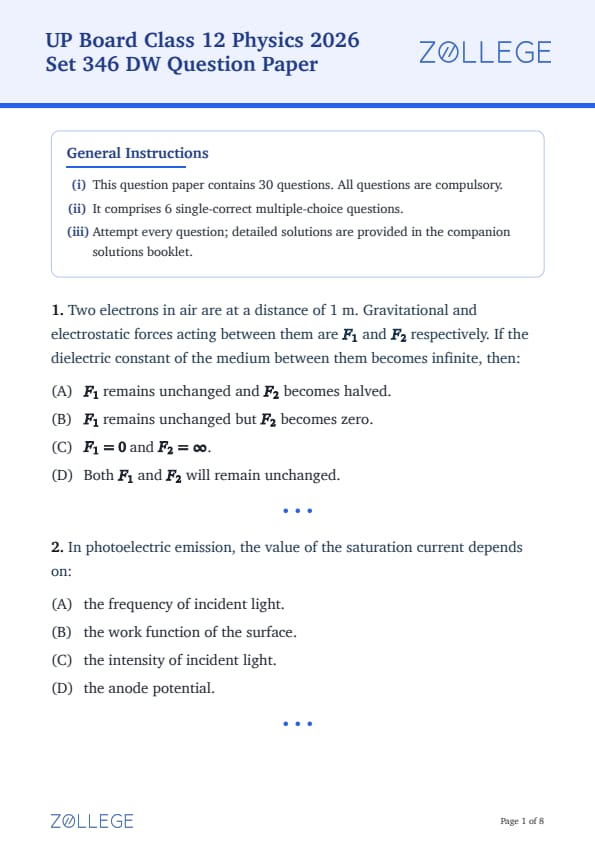
Two electrons in air are at a distance of 1 m. Gravitational and electrostatic forces acting between them are \( F_1 \) and \( F_2 \) respectively. If the dielectric constant of the medium between them becomes infinite, then:
In photoelectric emission, the value of the saturation current depends on:
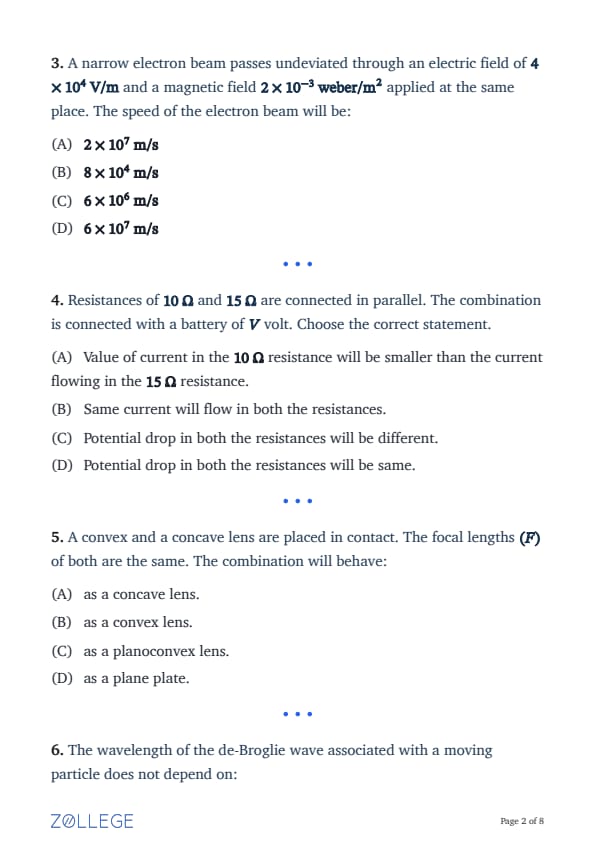
A narrow electron beam passes undeviated through an electric field of \( 4\times10^{4}\ \text{V/m} \) and a magnetic field \( 2\times10^{-3}\ \text{weber/m}^2 \) applied at the same place. The speed of the electron beam will be:
Resistances of \( 10\ \Omega \) and \( 15\ \Omega \) are connected in parallel. The combination is connected with a battery of \( V \) volt. Choose the correct statement.
A convex and a concave lens are placed in contact. The focal lengths \( (F) \) of both are the same. The combination will behave:
The wavelength of the de-Broglie wave associated with a moving particle does not depend on:
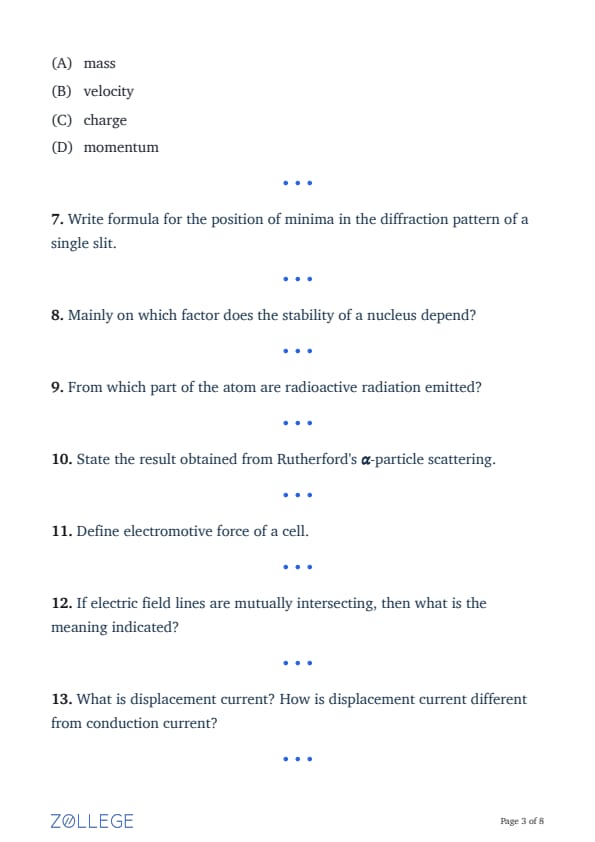
Write formula for the position of minima in the diffraction pattern of a single slit.
Mainly on which factor does the stability of a nucleus depend?
From which part of the atom are radioactive radiation emitted?
State the result obtained from Rutherford's \(\alpha\)-particle scattering.
Define electromotive force of a cell.
If electric field lines are mutually intersecting, then what is the meaning indicated?
What is displacement current? How is displacement current different from conduction current?
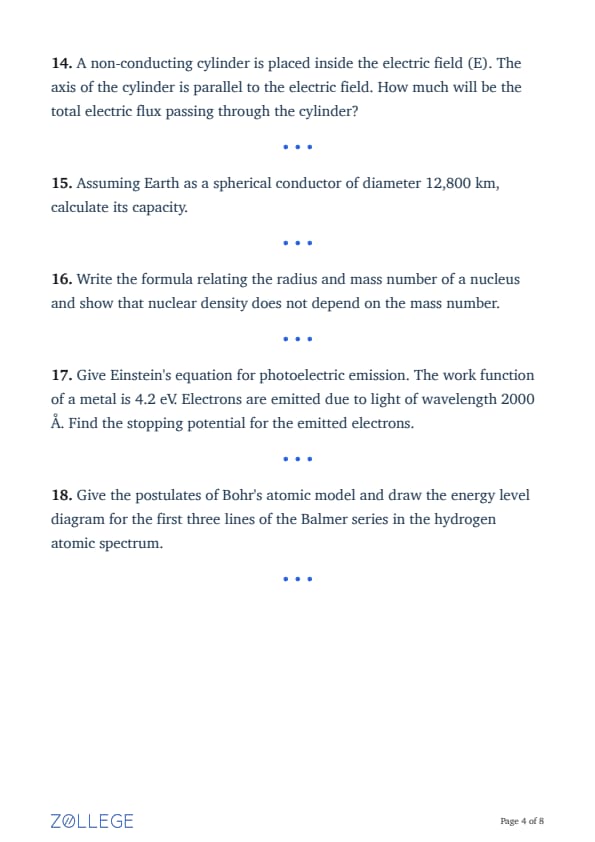
A non-conducting cylinder is placed inside the electric field (E). The axis of the cylinder is parallel to the electric field. How much will be the total electric flux passing through the cylinder?
Assuming Earth as a spherical conductor of diameter 12,800 km, calculate its capacity.
Write the formula relating the radius and mass number of a nucleus and show that nuclear density does not depend on the mass number.
Give Einstein's equation for photoelectric emission. The work function of a metal is 4.2 eV. Electrons are emitted due to light of wavelength 2000 Å. Find the stopping potential for the emitted electrons.
Give the postulates of Bohr's atomic model and draw the energy level diagram for the first three lines of the Balmer series in the hydrogen atomic spectrum.

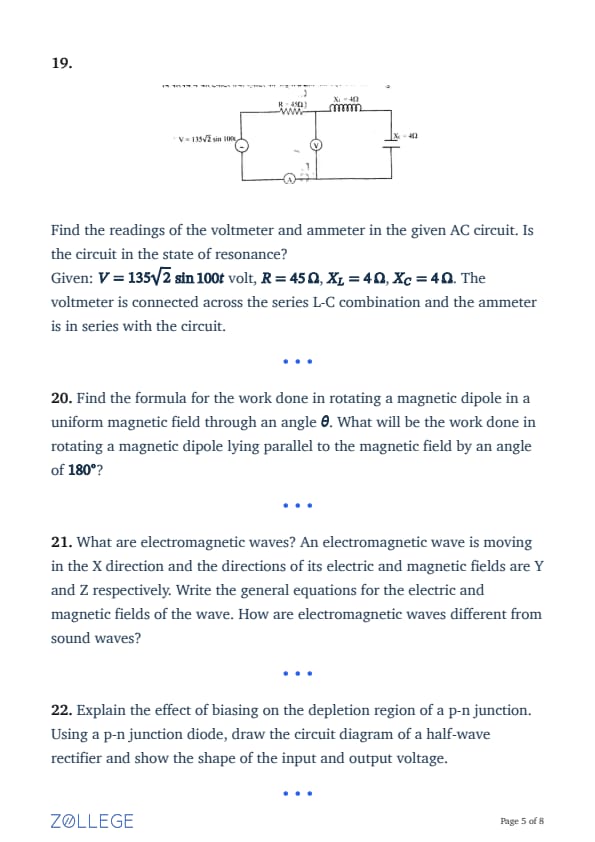
Find the readings of the voltmeter and ammeter in the given AC circuit. Is the circuit in the state of resonance?
Given: \( V = 135\sqrt{2}\,\sin 100t \) volt, \( R = 45\,\Omega \), \( X_L = 4\,\Omega \), \( X_C = 4\,\Omega \). The voltmeter is connected across the series L-C combination and the ammeter is in series with the circuit.
Find the formula for the work done in rotating a magnetic dipole in a uniform magnetic field through an angle \( \theta \). What will be the work done in rotating a magnetic dipole lying parallel to the magnetic field by an angle of \( 180^\circ \)?
What are electromagnetic waves? An electromagnetic wave is moving in the X direction and the directions of its electric and magnetic fields are Y and Z respectively. Write the general equations for the electric and magnetic fields of the wave. How are electromagnetic waves different from sound waves?
Explain the effect of biasing on the depletion region of a p-n junction. Using a p-n junction diode, draw the circuit diagram of a half-wave rectifier and show the shape of the input and output voltage.
For any particle, its particle nature and wave nature can be observed simultaneously. Comment. Radiation of wavelength \( \lambda \) is incident on a surface of negligible work function. Find the de-Broglie wavelength of the emitted electron.
Explain Kirchhoff's laws related to electrical circuits.
Reflecting telescopes are supposed to be better than refracting telescopes. Why? Draw the ray diagram for image formation by a refracting telescope. Final image is formed at infinity.
OR
What is the meaning of polarisation of light? Whether sound waves are also polarized? Explain polarization of light by refraction.
Potential difference at the ends of a conductor of length \(l\) is \(V\). Diameter of the conductor is \(d\). What will be the effect on the electric field inside the conductor and its resistance, if (i) \(V\) is halved? (ii) \(l\) is doubled? (iii) \(d\) is doubled?
Derive the formula for energy loss on connecting two charged conductors through a conducting wire.
OR
Explain the meaning of polarization of a dielectric material. What will be the effect on the capacity of an air filled parallel plate capacitor on putting a dielectric material in between its plates? Equivalent capacity of two condensers in series is 7.5 µF and in parallel is 30 µF. What will be the capacity of both the capacitors separately?
Write Huygen's principle of secondary wavelets and verify laws of refraction on its basis.
OR
Explain the meaning of coherent sources and sustained interference. Why central fringe in Young's double slit experiment is always bright? In Young's double slit experiment, fringe width is 0.04 cm for light of 6000 Å. Distance of screen from slits is 1 m. Find the distance of third bright and second dark fringe from central fringe and also the separation between the slits.
Derive the formula for magnetic field due to an infinitely long current carrying conducting wire using Biot-Savart law.
OR
Differentiate between self-induction and mutual induction. The current in primary coil becomes zero in \(10^{-3}\) s and an induced e.m.f. of 1500 volts is produced in secondary. Mutual inductance of coils is 0.5 H. Find the value of initial current in the primary.
Explain the difference between conductor, insulator and semiconductor on the basis of energy band in solids.
OR
Define diamagnetic, paramagnetic and ferromagnetic materials. Explain that a current carrying solenoid behaves as a bar magnet.
UP Board Class 12 Physics 2026 Paper Pattern and Marks Distribution
The Set 346-DW paper follows the standard UPMSP Intermediate Physics design, with five sections that move from one-mark objective questions to five-mark long-answer questions.
- Total questions: 30 questions spread across Sections A to E
- Total marks: 70, with 3 hours 15 minutes to attempt them
- Section A: 6 single-answer MCQs, 1 mark each (Q1 a to f)
- Section B: 6 very short answer questions, 1 mark each (Q2 a to f)
- Section C: 4 short answer-I questions, 2 marks each (Q3 a to d)
- Section D: 10 short answer-II questions, 3 marks each (Q4 and Q5), where Q5d gives an internal OR choice
- Section E: 4 long answer questions, 5 marks each (Q6 to Q9), every one with an internal OR option
UP Board Class 12 Physics 2026 Set 346-DW Full Solution Video
Source: Rastogi online coaching classes
High-Scoring Chapters in the UP Board Physics 2026 Set 346-DW Paper
Modern Physics dominated this paper, so the students who revised photoelectric effect, atoms and nuclei picked up easy marks first.
- Modern Physics: the single biggest block, covering the photoelectric equation and stopping potential (Q4a), Bohr model and Balmer series (Q4b), de-Broglie wavelength (Q1f, Q5b), nuclear density and stability (Q2b, Q3d) and Rutherford scattering (Q2d)
- Optics: single-slit diffraction (Q2a), lens combinations (Q1e), Young's double-slit numericals (Q7) and the refracting-telescope ray diagram (Q5d)
- Electrostatics: Coulomb force in a dielectric (Q1a), spherical-conductor capacitance (Q3c) and the energy-loss derivation on joining two charged conductors (Q6)
- Current Electricity: parallel resistances (Q1d), Kirchhoff's laws (Q5c) and the effect of length and diameter on field and resistance (Q5e)
- Electromagnetism and EM Waves: the velocity selector (Q1c), Biot-Savart derivation (Q8), magnetic dipole work (Q4d) and the nature of electromagnetic waves (Q4e)
- Semiconductors: p-n junction biasing with a half-wave rectifier (Q5a) and the conductor, insulator and semiconductor energy bands (Q9)
UP Board Class 12 Physics 2026 Set 346-DW Question Paper FAQs
Ques. When was the UP Board Class 12 Physics 2026 exam held?
Ans. The UP Board Class 12 Physics 2026 paper was conducted by UPMSP on 27 February 2026 in the afternoon slot from 2:00 PM to 5:15 PM. It carried 30 questions for a total of 70 marks.
Ques. How many marks is the UP Board Class 12 Physics theory paper?
Ans. The theory paper is 70 marks. The remaining 30 marks come from the practical exam, taking the subject to 100 marks in total.
Ques. Which chapters carried the most weight in the Set 346-DW paper?
Ans. Modern Physics led the paper, with the photoelectric effect, Bohr model, de-Broglie waves and nuclear physics appearing across Sections A, C, D and E. Optics and Electrostatics were the next heaviest blocks.
Ques. Are there internal choices in the UP Board Class 12 Physics paper?
Ans. Yes. All four long-answer questions in Section E (Q6 to Q9, 5 marks each) give an OR option, and Q5d in Section D also has an internal choice, so you pick one of the two parts.
Ques. Where can I download the UP Board Class 12 Physics 2026 question paper with solutions PDF for free?
Ans. Use the download table above on Zollege to get the full Set 346-DW question paper with step-by-step solutions. For the official paper and results, check the UPMSP website at upmsp.edu.in.
*The article might have information for the previous academic years, please refer the official website of the exam.