CUET PG 2024 Agricultural Science Question Paper Pdf- Check Solutions with Answer Key Pdf
- Question Paper 2025
- Question Paper 2024
- Question Paper 2023
- Mathematics Papers
- Statistics Question Paper
- English Question Paper
- Chemistry Question Paper
- Pol. Sci. Question Paper
- History Question Paper
- Commerce Question Papers
- Life Science Papers
- Geology Question Papers
- Journalism Question Paper
- B.Ed. HSS Question Paper
- Botany Question Paper
- B.Ed. Question Papers


Content Strategist | Updated On - Jan 15, 2025
CUET PG 2024 Agricultural Science 21st March 2024 Shift 3 Question Paper with Solution PDF is available for download here. Students found Crop Production and Horticulture sections easy, Plant Breeding and Genetics moderate, and Soil Science and Agronomy difficult. Soil Science and Agronomy carried the highest weightage, and the overall difficulty level was moderate to difficult.
CUET PG 2024 Agricultural Science Question Paper with Answer Key PDF
| CUET PG 2024 Agricultural Science Question Paper with Answer Key |  Download Download |
Check Solution |
Agricultural Science Questions with Solutions
Question 1:
Chromosomal aberration in which two breaks occur in a chromosome and the intercalary segment reunites in a reverse order is categorised as:
View Solution
An inversion is a chromosomal aberration where a segment of a chromosome is reversed end to end.
This occurs when a chromosome undergoes breakage and the resulting pieces rejoin in a reversed order. Inversions can disrupt gene function if they occur near or within important genetic sequences, potentially affecting phenotype.
Question 2:
Mutation was first discovered by:
View Solution
Hugo de Vries observed mutations as sudden changes in the evening primrose.
He noticed these changes led to new characteristics in subsequent generations. This discovery laid the foundation for understanding genetic variations and their role in evolution and natural selection.
Question 3:
In which ministry, the Genetic Engineering Appraisal Committee (GEAC) was set up?
View Solution
The GEAC is established under the Ministry of Environment, Forest and Climate Change to oversee the safe use of genetic engineering technology.
It also monitors the handling and usage of genetically modified organisms (GMOs) to ensure environmental and public health safety. This committee plays a critical role in regulating biotechnological advancements in India.
Question 4:
Which one of the following varieties is hybrid in rice crop?
View Solution
PRH-10 is recognized as a hybrid variety of rice developed to improve yield and adaptability.
This variety is designed to withstand environmental stressors, ensuring higher productivity and contributing significantly to sustainable agriculture in rice-growing regions.
Question 5:
Match List-I with List-II
| List-I (Scientist) | List-II (Contribution) |
|---|---|
| (A) T.H. Morgan | (I) Sex-linked inheritance |
| (B) Kornberg | (II) DNA polymerase |
| (C) Nathan and Smith | (III) Restriction endonucleases |
| (D) Paul Berg | (IV) Recombinant DNA |
Choose the correct answer from the options given below:
View Solution
This match highlights the fundamental contributions of each scientist to genetics and molecular biology.
T.H. Morgan's research on sex-linked inheritance provided important insights into the genetic basis of sex-linked disorders. Arthur Kornberg was awarded the Nobel Prize for his discovery of DNA polymerase, which is crucial for DNA replication. Nathan and Smith discovered the restriction endonucleases, essential for molecular cloning techniques, while Paul Berg developed the first methods of recombinant DNA technology, paving the way for genetic engineering.
Question 6:
Which of the following statements about seed are correct?
- (A) Progeny of nucleus seed is breeder seed.
- (B) TZ test is for evaluation of field performance of seed.
- (C) Seed rate of wheat is 100 kg/ha.
- (D) Tobacco is the example of smallest seed.
Choose the correct answer from the options given below:
View Solution
Correct statements include the progeny of nucleus seed being breeder seed and the typical seed rate for wheat being 100 kg/ha.
The TZ test evaluates seed viability, not field performance. Additionally, tobacco is not the smallest seed; this characteristic is more commonly associated with plants like orchids. Understanding these distinctions is critical for agricultural production and management.
Question 7:
Which of the following statements about Hammerling's experiment on Acetabularia is/are correct?
- (A) It demonstrates that Acetabularia is a unicellular organism.
- (B) It demonstrates the role of cytoplasm in heredity.
- (C) It demonstrates the role of nucleus in heredity.
- (D) It demonstrates the role of cytoplasm in determining rhizoid shape.
Choose the correct answer from the options given below:
View Solution
Hammerling's experiments demonstrated the role of the nucleus in heredity and its control over cellular development and regeneration.
His work with Acetabularia showed that the nucleus contains the genetic instructions necessary for growth and development. The experiment did not focus on the role of cytoplasm in heredity or rhizoid shape determination.
Question 8:
Linkage drag is the phenomenon in which-
View Solution
Linkage drag occurs when undesirable genes are linked to desirable genes on the same chromosome.
During breeding, this linkage causes the transfer of both desirable and undesirable traits, which can negatively impact the quality of the offspring. Strategies to minimize linkage drag involve breaking these linkages through advanced genetic techniques.
Question 9:
In a pea flower, five petals are arranged in a specialised manner with one posterior, two lateral and two anterior. These are named as:
View Solution
In a pea flower, the petals are arranged as Standard (posterior), Wings (lateral), and Keel (anterior).
This characteristic petal arrangement is typical of the Fabaceae family and plays a vital role in pollination. The keel encloses the reproductive structures, while the standard and wings attract pollinators, ensuring successful reproduction.
Question 10:
Linkage equilibrium can be achieved by:
View Solution
Linkage equilibrium is achieved through random mating, which increases genetic variation by redistributing alleles in a population.
Random mating ensures the breakage of linkage disequilibrium over generations. It is a critical factor in population genetics, promoting diversity and reducing the risks of inherited genetic disorders.
Question 11:
What is the term for the negative effect that a host plant has on the growth of an insect-pest that feeds on it?
View Solution
Antibiosis refers to the negative effect a host plant has on the growth and development of an insect-pest that feeds on it.
This phenomenon often involves the production of toxic compounds or metabolites by the plant, which deter pests and protect the plant's health and productivity.
Question 12:
Which of the following could be the valid value(s) of the correlation coefficient between two variables?
Choose the correct answer from the options given below:
View Solution
The correlation coefficient can only range from -1 to +1, representing the strength and direction of a linear relationship.
Values outside this range, such as -2 or +2, are mathematically invalid. A value of -1 indicates a perfect negative correlation, while +1 indicates a perfect positive correlation.
Question 13:
Conservation Agriculture includes adoption of -
Choose the correct answer from the options given below:
View Solution
Conservation Agriculture involves sustainable practices such as minimum tillage, crop rotations, and mulching.
Burning crop residues is not a part of conservation agriculture as it negatively impacts soil health and air quality. Conservation agriculture aims to improve soil fertility and reduce environmental impact through eco-friendly farming techniques.
Question 14:
Diammonium phosphate contains -
View Solution
Diammonium phosphate (DAP) is a commonly used fertilizer containing 18% nitrogen (N) and 46% phosphorus (P2O5).
DAP is especially beneficial for root development and plant growth due to its high phosphorus content. It is widely used in agriculture to boost crop yield and improve soil fertility.
Question 15:
What is the approximate composition of biogas, generated after decomposition of bio-degradable agricultural waste?
View Solution
Biogas is primarily composed of methane (55-65%) and carbon dioxide (35-44%).
Biogas is generated through anaerobic decomposition of biodegradable agricultural waste and may also contain traces of hydrogen sulfide and other gases. This renewable energy source is widely used for cooking, heating, and electricity generation.
Question 16:
The Food Corporation of India was established in which year?
View Solution
The Food Corporation of India (FCI) was established in 1965 to ensure the procurement, storage, and distribution of food grains.
FCI plays a vital role in India's food security system, managing public distribution systems and stabilizing food prices to protect both consumers and farmers.
Question 17:
Which one of the following is a good example of subsistence farming?
View Solution
Shifting cultivation is a subsistence farming practice where land is cultivated temporarily before being abandoned to allow soil recovery.
This method is commonly practiced in low-population-density regions by indigenous communities. It involves clearing forests by burning, cultivating for a few years, and then moving to a new location when soil fertility declines.
Question 18:
What was India's food grain production in 2021-22?
View Solution
India's food grain production in 2021-22 was recorded at 315.7 million tonnes, reflecting a year-on-year increase.
This record production was achieved due to improved agricultural techniques and favorable monsoon conditions, contributing to India's food security and agricultural growth.
Question 19:
Which of the following conditions characterizes disguised unemployment?
View Solution
Disguised unemployment occurs when additional workers are employed but do not contribute to increased output.
This phenomenon is often observed in the agricultural sector, where excessive labor is engaged, resulting in no marginal productivity, indicating inefficient resource utilization.
Question 20:
Sequence the principal stages of biological nitrogen fixation in their correct order of occurrence:
- (A) Formation of infection thread
- (B) Rhizobium multiply to colonize
- (C) Curling of root hair
- (D) Differentiation of cortical cells into nitrogen-fixing cells
Choose the correct answer from the options given below:
View Solution
The correct sequence for biological nitrogen fixation is:
1. Rhizobium multiply to colonize the root.
2. Curling of root hair occurs.
3. Formation of the infection thread follows.
4. Differentiation of cortical cells into nitrogen-fixing cells completes the process.
This sequence ensures that plants, especially legumes, receive the nitrogen needed for their growth.
Question 21:
Match List-I with List-II:
| List-I (Millet) | List-II (Botanical Name) |
|---|---|
| (A) Barnyard millet | (I) Paspalum scrobiculatum |
| (B) Kodo millet | (II) Setaria italica |
| (C) Foxtail millet | (III) Echinochloa frumantacea |
| (D) Finger millet | (IV) Eleusine coracana |
Options:
View Solution
The botanical names correctly matched with their millet types are as follows:
- Barnyard millet: Echinochloa frumantacea
- Kodo millet: Paspalum scrobiculatum
- Foxtail millet: Setaria italica
- Finger millet: Eleusine coracana
This classification is essential for agricultural science studies and competitive exams.
Question 22:
Which of the following statements is not true for NABARD?
View Solution
NABARD does not directly provide loans to individuals but finances projects through institutions.
NABARD plays a pivotal role in agricultural financing, research promotion, and supervising cooperative and rural banks to enhance rural development. The Cooperative Development Fund (CDF) was indeed established by NABARD in 1993.
Question 23:
Which of the following is a promising chemical for flower induction in mango?
View Solution
Ethylene promotes flowering in mango trees by influencing the plant's hormonal balance.
It works effectively in inducing flowering in various fruit trees, including mango. However, excessive use can lead to undesired effects, such as fruit drop, which must be managed carefully.
Question 24:
What is the name of the microbial spray, consisting of a blend of seven fungi, developed by ICAR-IARI, New Delhi, for the in-situ accelerated degradation of paddy straw or parali?
View Solution
Pusa Decomposer is a microbial spray designed to decompose paddy straw in the field effectively.
Developed by ICAR-IARI, this technology aids in managing crop residue sustainably and reduces the harmful environmental impact of burning paddy straw, significantly addressing air pollution in agricultural regions.
Question 25:
Match List-I with List-II:
| List-I (Classes of Seed) | List-II (Colour of Tag) |
|---|---|
| (A) Breeder Seed | (I) Golden Yellow |
| (B) Foundation Seed | (II) White |
| (C) Certified Seed | (III) Azure Blue |
| (D) T.L. Seed | (IV) Green Opal |
Options:
View Solution
The tag colors associated with the classes of seeds are:
- Breeder Seed: Golden Yellow
- Foundation Seed: White
- Certified Seed: Azure Blue
- T.L. Seed: Green Opal
These tag colors are standardized for seed certification and identification in agricultural practices.
Question 26:
The number of replications are equal to the number of treatments in the:
View Solution
In the Latin square design, the number of replications equals the number of treatments, ensuring a balanced experimental setup.
Each treatment is applied exactly once in each row and column of the design. This design is especially useful for controlling variability in two directions, such as rows and columns.
Question 27:
Match List-I with List-II:
| List-I (Disease) | List-II (Causal organism) |
|---|---|
| (A) Black rust | (I) Puccinia recondita |
| (B) Yellow rust | (II) Cercospora arachidicola |
| (C) Brown rust | (III) Puccinia graminis |
| (D) Tikka disease of groundnut | (IV) Puccinia striiformis |
Options:
View Solution
The causal organisms for the diseases are:
- Black rust: Puccinia graminis
- Yellow rust: Puccinia striiformis
- Brown rust: Puccinia recondita
- Tikka disease: Cercospora arachidicola
These associations are essential for identifying and managing crop diseases effectively.
Question 28:
Bacterial cells are more resistant to osmotic shock than eukaryotic cells due to the:
View Solution
The bacterial cell wall's peptidoglycan layer provides structural support, preventing osmotic shock.
This robust structure resists external pressure changes effectively, a feature lacking in eukaryotic cells, which rely on other mechanisms for osmoregulation.
Question 29:
Which of the following is the correct sequence of reagents given below used in the Gram staining process?
(A) Iodine
(B) Crystal violet
(C) Safranin
(D) Alcohol
Options:
View Solution
The Gram staining process starts with Crystal violet, followed by Iodine, Alcohol for decolorization, and Safranin as a counterstain.
This process differentiates Gram-positive bacteria, which retain the violet color, from Gram-negative bacteria, which take up the pink Safranin stain after decolorization with alcohol. This method is fundamental in microbiological diagnostics.
Question 30:
Which of the following terms specifically refers to the practice of rearing stingless bees?
View Solution
Meliponiculture is the specific practice of rearing and managing stingless bees.
Unlike apiculture, which refers to general beekeeping, meliponiculture focuses on stingless bee species. This practice is essential for sustainable pollination and conserving biodiversity in ecosystems where stingless bees thrive.
Question 31:
Consider the following statements regarding economic importance of fungi and choose the correct statements:
(A) Extract of the sclerotia of Claviceps purpurea is used to produce ergot drug
(B) Agaricus campestris is a fungus which is edible.
(C) Aflatoxin, a powerful toxin, is produced by Aspergillus.
(D) Saccharomyces cerevisiae is the source of enzyme invertase.
Options:
View Solution
All the statements are correct regarding fungi's economic importance.
- Claviceps purpurea is used in producing ergot drugs.
- Agaricus campestris is an edible mushroom.
- Aspergillus species produce aflatoxins, which are potent toxins.
- Saccharomyces cerevisiae is a source of invertase, widely used in food and pharmaceutical industries.
Question 32:
Match List-I with List-II:
| List-I (Microorganism) | List-II (Disease) |
|---|---|
| (A) Colletotrichum falcatum | (I) Late blight of potato |
| (B) Phytophthora infestans | (II) Green ear of bajra |
| (C) Sclerospora graminicola | (III) Red rot of sugarcane |
| (D) Ustilago nuda var. tritici | (IV) Loose smut of wheat |
Options:
View Solution
The microorganisms and their respective plant diseases are correctly matched.
- Colletotrichum falcatum: Red rot of sugarcane
- Phytophthora infestans: Late blight of potato
- Sclerospora graminicola: Green ear of bajra
- Ustilago nuda var. tritici: Loose smut of wheat
Question 33:
Who did work on the recurrence of wheat rusts in India?
View Solution
K.C. Mehta made significant contributions to the study and management of wheat rusts in India.
His research provided valuable insights into the recurrence patterns and strategies for controlling wheat rusts, a major agricultural problem affecting wheat production.
Question 34:
Match List-I with List-II:
| List-I (Disease) | List-II (Symptom) |
|---|---|
| (A) Downy mildew | (I) Dead areas on the stem bark of woody trees |
| (B) Blight | (II) Angular and elongated spots appearing on the veins on the lower surface of the leaf |
| (C) Canker | (III) Cottony growth on the host surface |
| (D) Anthracnose | (IV) Burnt appearance |
Options:
View Solution
The diseases and their symptoms are matched correctly.
- Downy mildew: Cottony growth on the host surface
- Blight: Burnt appearance
- Canker: Dead areas on the stem bark of woody trees
- Anthracnose: Angular and elongated spots appearing on the veins on the lower surface of the leaf
Accurate identification of symptoms is critical for effective disease management in plants.
Question 35:
Which of the following statements about extent of infection and perpetuation of pathogen are correct?
(A) Disease which is confined to a particular part or organ is known as systemic disease.
(B) Arhar wilt is a soil-borne disease.
(C) Smut diseases of cereals are seed-borne.
(D) Mildew and rusts are air-borne.
Options:
View Solution
The correct statements are that Arhar wilt is soil-borne, smut diseases of cereals are seed-borne, and mildew and rusts are air-borne.
The statement about systemic diseases is incorrect because they affect the entire organism rather than being confined to a specific part or organ.
Question 36:
Which of the following statements related to disease management is/are correct?
(A) Biological management of diseases makes use of hyperparasitism.
(B) Thiram is a contact fungicide.
(C) Bordeaux mixture consists of copper sulphate, ammonium carbonate, and water.
(D) Crop rotation is a prophylactic measure of disease management.
Options:
View Solution
Correct statements include that biological management utilizes hyperparasitism, Thiram is a contact fungicide, and crop rotation is a prophylactic measure.
The Bordeaux mixture contains copper sulphate, lime, and water, not ammonium carbonate, which makes statement (C) incorrect.
Question 37:
Match List-I with List-II:
| List-I (Hormone) | List-II (Physiological Effect) |
|---|---|
| (A) Cytokinin | (III) Promotes lateral shoot growth |
| (B) Auxin | (II) Prevent leaf and fruit drop at early stage |
| (C) Gibberellin | (I) Increase stem length |
| (D) Abscisic acid | (IV) Stimulates stomata closing |
Options:
View Solution
The correct matching is:
- Cytokinin: Promotes lateral shoot growth
- Auxin: Prevents leaf and fruit drop at the early stage
- Gibberellin: Increases stem length
- Abscisic acid: Stimulates stomata closing
These physiological effects are critical for plant growth regulation and adaptation to environmental changes.
Question 38:
Normal seedlings upon putting in dark, for a few days, get converted into white-like albinos. Which of the following terms will you use to describe them?
View Solution
Etiolated seedlings appear pale and elongated due to the lack of chlorophyll and insufficient light exposure.
This phenomenon occurs because the plant prioritizes stem elongation to reach light, resulting in pale, weak stems and unexpanded leaves. It highlights the importance of light in plant development.
Question 39:
Horizontal growth of seedling, swelling of axis, and apical hook formation of dicot seedlings are associated with:
View Solution
Ethylene regulates horizontal growth, stem swelling, and apical hook formation in dicot seedlings.
These effects allow the seedlings to push through the soil while protecting the shoot apex. Ethylene also plays a role in plant stress responses and other developmental processes, making it an essential hormone for plant biology.
Question 40:
Which of the following statements is/are correct about photosynthesis?
(A) Liberation of oxygen when green cells are exposed to sunlight in the presence of a suitable acceptor is known as the Emerson effect.
(B) Green light is not effective for photosynthesis.
(C) When CO2 is added to PEP, the first stable product is oxaloacetate.
(D) PEP is the primary CO2 acceptor in C4 plants.
Options:
View Solution
The correct statements about photosynthesis include:
- Green light is less effective for photosynthesis because it is mostly reflected by chlorophyll.
- When CO2 is added to PEP (phosphoenolpyruvate), the first stable product is oxaloacetate.
- PEP is the primary CO2 acceptor in C4 plants.
The Emerson effect, however, refers to the enhancement of photosynthesis under red and far-red light, not just oxygen liberation.
Question 41:
'Indian Farming' magazine is a publication of:
View Solution
'Indian Farming' magazine is published by the Indian Council of Agricultural Research (ICAR).
ICAR, headquartered in New Delhi, is the central body responsible for coordinating agricultural education, research, and extension across India. The magazine serves as a key resource for disseminating knowledge to farmers and researchers.
Question 42:
In which crop and year was the first All India Coordinated Research Project set up in India with the assistance of the Rockefeller Foundation of the USA?
View Solution
The first All India Coordinated Research Project was established for maize in 1957 with funding from the Rockefeller Foundation.
This project marked a significant milestone in Indian agricultural research, focusing on improving crop productivity through collaborative efforts and advanced breeding programs.
Question 43:
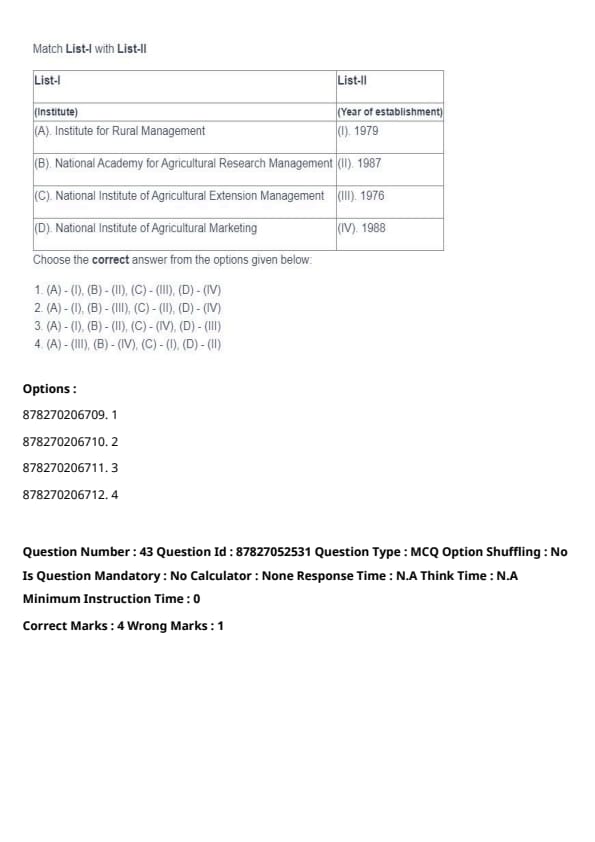
Match List-I with List-II:
| List-I (Institute) | List-II (Year of Establishment) |
|---|---|
| (A) Institute for Rural Management | (1) 1979 |
| (B) National Academy for Agricultural Research Management | (2) 1987 |
| (C) National Institute of Agricultural Extension Management | (3) 1976 |
| (D) National Institute of Agricultural Marketing | (4) 1988 |
Options:
View Solution
The correct matches for the institutes and their years of establishment are:
- Institute for Rural Management: 1979
- National Academy for Agricultural Research Management: 1976
- National Institute of Agricultural Extension Management: 1987
- National Institute of Agricultural Marketing: 1988
These institutions play a vital role in advancing agricultural education, research, and marketing in India.
Question 44:
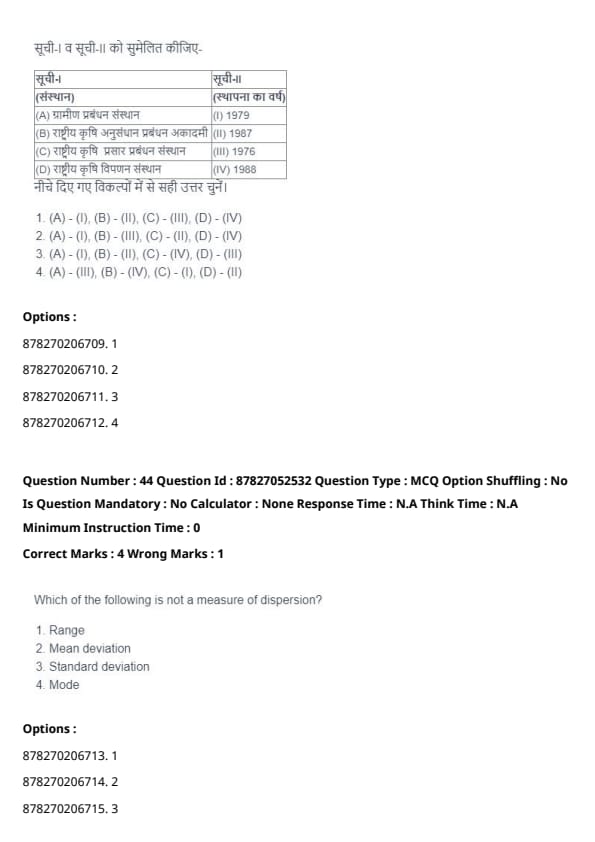
Which of the following is not a measure of dispersion?
View Solution
The mode, being a measure of central tendency, does not describe the dispersion of data.
Measures of dispersion, such as range, mean deviation, and standard deviation, describe the spread or variability of a dataset. The mode identifies the most frequently occurring value.
Question 45:
In a normally distributed population, the number of observations falling within the range Mean ± S.D. is approximately:
View Solution
In a normal distribution, about 68% of the observations lie within one standard deviation of the mean.
This is part of the Empirical Rule (68-95-99.7), which states:
- 68% of data lies within 1 standard deviation of the mean.
- 95% of data lies within 2 standard deviations.
- 99.7% of data lies within 3 standard deviations.
Understanding this rule is critical for analyzing normally distributed data.
Question 46:
While conducting a chi-square test to examine the independence of attributes in an \(m \times n\) contingency table, what formula determines the degree of freedom?
View Solution
The degrees of freedom for a chi-square test in an \(m \times n\) contingency table are calculated using the formula \((m-1)(n-1)\).
This formula accounts for the number of rows (\(m\)) and columns (\(n\)) in the table, excluding the constraints imposed by row and column totals. Degrees of freedom are critical for determining the critical value of chi-square.
Question 47:
Arrange the following steps in the correct sequence for implementing an agricultural extension programme:
(A) Developing extension materials
(B) Implementing the programme
(C) Evaluating the programme
(D) Conducting needs assessment
Options:
View Solution
The logical sequence starts with needs assessment, followed by developing materials, implementing the programme, and evaluating it.
- Needs assessment identifies the community's requirements.
- Extension materials are tailored to address these needs.
- Programme implementation applies these materials in real-world settings.
- Evaluation ensures the programme's effectiveness and identifies areas for improvement.
Question 48:
Diffusion of an innovation occurs through a step process. Arrange the following stages in the adoption process in sequential order:
(A) Decision
(B) Implementation and Confirmation
(C) Persuasion
(D) Knowledge
Options:
View Solution
The adoption process begins with Knowledge acquisition, followed by Persuasion, Decision making, and then Implementation and Confirmation.
- Knowledge: Individuals become aware of the innovation.
- Persuasion: They develop an attitude toward it based on available information.
- Decision: A choice is made to adopt or reject the innovation.
- Implementation and Confirmation: The innovation is put into use, and its effectiveness is evaluated.
Question 49:
Which of the following marketing concepts involves dividing a market into distinct groups of buyers based on their needs, characteristics, or behavior, who may require different products or marketing mixes?
View Solution
Market segmentation involves dividing the market into distinct groups based on varying needs and behaviors.
This allows businesses to create targeted marketing strategies and tailor products or services to meet specific consumer demands effectively. For instance, segmentation can be based on demographics, psychographics, or geographical location.
Question 50:
Match List-I with List-II:
| List-I (Scientist) | List-II (Scientific Contribution) |
|---|---|
| (A) Hans Krebs | (1) Citric acid cycle |
| (B) P. Mitchell | (2) Chemiosmotic hypothesis |
| (C) W. M. Stanley | (3) C3 cycle |
| (D) M. Calvin | (4) Crystallization of Tobacco Mosaic Virus |
Options:
View Solution
The correct matches are: Hans Krebs - Citric acid cycle, P. Mitchell - Chemiosmotic hypothesis, W. M. Stanley - Crystallization of Tobacco Mosaic Virus, and M. Calvin - C3 cycle.
These discoveries are foundational in biochemistry and molecular biology. Krebs elucidated the Citric acid cycle, pivotal in cellular respiration. Mitchell's Chemiosmotic hypothesis explained ATP synthesis in mitochondria. Stanley's work on TMV paved the way for virology, and Calvin mapped the C3 cycle in photosynthesis.
Question 51:
The following are the steps of chemiosmotic ATP synthesis in the light reaction. Arrange them in correct order of their occurrence:
(A) H+ diffuse through ATP synthetase and it makes ATP.
(B) Electrons from PS-II pass along the electron transport chain.
(C) H+ concentration gradient generates across the membrane.
(D) Light excites electrons in PS-I.
Options:
View Solution
The sequence is excitation in PS-I, electron transport from PS-II, proton gradient generation, and ATP synthesis.
- Light excites electrons in PS-I, initiating the process.
- Electrons from PS-II travel through the electron transport chain.
- Proton movement across the membrane creates a gradient.
- ATP synthase uses this gradient to produce ATP.
Question 52:
Consider the following statements and choose the correct statements:
(A) Sugarcane has kranz anatomy in their leaves
(B) Maize is a C4 plant
(C) Photolysis of water in photosynthesis require Mg2+ ions
(D) C4 pathway of photosynthetic CO2 fixation was discovered by Hatch and Slack
Options:
View Solution
Sugarcane has kranz anatomy, Maize is a C4 plant, and the C4 pathway was discovered by Hatch and Slack. The statement about Mg2+ ions is incorrect; Mn2+ ions are involved in water photolysis.
Kranz anatomy involves specialized leaf structure for C4 photosynthesis. Maize, like Sugarcane, utilizes the C4 pathway, improving efficiency in hot climates. Hatch and Slack discovered this pathway, revolutionizing our understanding of plant metabolism.
Question 53:
Match List-I with List-II:
| List-I (Element) | List-II (Biological Function) |
|---|---|
| (A) Iron | (1) Pollen germination |
| (B) Zinc | (2) Photolysis of water |
| (C) Boron | (3) Required in chlorophyll biosynthesis |
| (D) Manganese | (4) IAA biosynthesis |
Options:
View Solution
Iron is essential for chlorophyll biosynthesis, Zinc for IAA biosynthesis, Boron for pollen germination, and Manganese for photolysis of water in photosynthesis.
Iron's role in chlorophyll synthesis is crucial for photosynthesis. Zinc is involved in hormone synthesis, influencing plant growth. Boron supports reproduction by aiding pollen germination. Manganese catalyzes water-splitting reactions during photosynthesis.
Question 54:
The technique of growing plants in nutrient solution, in complete absence of soil, can be employed for:
(A) Identification of essentiality of mineral elements
(B) Commercial production of vegetables
(C) Studying the deficiency symptoms of a particular element
(D) Conservation of germplasm
Options:
View Solution
Hydroponics, the technique of growing plants in a nutrient solution without soil, is useful for studying essential mineral elements, commercial vegetable production, and identifying deficiency symptoms. It is not typically used for germplasm conservation.
Hydroponics allows plants to absorb nutrients directly from the solution, enabling researchers to identify the roles of specific elements and their deficiency symptoms. It is widely applied in experimental and commercial horticulture.
Question 55:
Certain bacteria living in the soil convert nitrates into nitrites and then to free nitrogen. Such bacteria are termed as:
Options:
View Solution
Denitrifying bacteria convert nitrates into nitrites and subsequently into nitrogen gas, releasing it back into the atmosphere.
These bacteria play a crucial role in the nitrogen cycle by reducing soil nitrates and maintaining a balance of nitrogen in ecosystems.
Question 56:
During seed germination, its stored food is mobilised by:
Options:
View Solution
Gibberellin stimulates the conversion of stored starch into glucose during germination, providing energy for growth.
This hormone activates the enzyme amylase, which breaks down starch into soluble sugars, fueling the growth of the seedling.
Question 57:
Match List-I with List-II:
| List-I (Fertilizer) | List-II (Component/Description) |
|---|---|
| (A) Urea | (1) Sulphur |
| (B) CAN | (2) KCl |
| (C) SSP | (3) Organic chemical fertilizer |
| (D) MoP | (4) Neutral fertilizer |
Options:
View Solution
Urea is an organic chemical fertilizer, CAN is a neutral fertilizer, SSP contains Sulphur, and MoP is KCl.
Fertilizers differ in composition and are used for specific soil and crop requirements. Correct application ensures optimal growth and yield.
Question 58:
Match List-I with List-II:
| List-I (Disorder) | List-II (Nutrient Deficiency) |
|---|---|
| (A) Black heart of Potato | (1) Calcium |
| (B) Interveinal chlorosis of younger leaves | (2) Boron |
| (C) Whip-tail in Cauliflower | (3) Iron |
| (D) Die-back of terminal buds | (4) Molybdenum |
Options:
View Solution
Black heart of Potato is caused by Boron deficiency, Interveinal chlorosis by Iron deficiency, Whip-tail in Cauliflower by Molybdenum deficiency, and Die-back of terminal buds by Calcium deficiency.
Identifying nutrient-related disorders in crops helps in addressing deficiencies and ensuring healthy plant development.
Question 59:
The formula of gypsum is:
View Solution
Gypsum is chemically known as calcium sulfate dihydrate, with the formula CaSO4.2H2O.
Gypsum is widely used in agriculture to improve soil structure, enhance water infiltration, and as a source of calcium and sulfur for plant nutrition.
Question 60:
What was the name of "the Commission for Agricultural Costs and Prices (CACP)" prior to 1980?
View Solution
Before being renamed as the Commission for Agricultural Costs and Prices in 1980, it was known as the Agricultural Prices Commission.
The Commission played a crucial role in determining minimum support prices (MSP) and other agricultural pricing policies to ensure fair returns for farmers.
Question 61:
Which of the following statements about correlation coefficient and regression coefficients are correct?
Options:
View Solution
The statements (A), (B), and (C) are correct. Statement (D) is incorrect because regression coefficients are not necessarily symmetric in their influence.
Correlation coefficient measures the strength and direction of the linear relationship between two variables, while regression coefficients indicate the slope of the relationship.
Question 62:
Which of the following exchangeable sodium percentage is characteristic of alkaline soils?
View Solution
Alkaline soils typically have an exchangeable sodium percentage (ESP) greater than 15%.
Soils with high ESP levels can experience structural issues such as poor water infiltration and aeration, necessitating reclamation practices like gypsum application.
Question 63:
Consider the following statements regarding chrysanthemum:
Options:
View Solution
Chrysanthemums do not propagate via corms; they are propagated through cuttings or division. Statements (B), (C), and (D) are correct.
Chrysanthemums are popular ornamental plants requiring specific light conditions for flowering, making them a classic example of photoperiodism.
Question 64:
The colour of beetroot is attributed to which of the following compound?
View Solution
The vibrant red-purple color of beetroot is primarily due to the presence of B-Cyanins and B-Xanthins.
Beetroot pigments, known as betalains, are categorized into two main types: betacyanins (red-purple) and betaxanthins (yellow), both of which contribute to its rich color and health benefits.
Question 65:
Place the following jelly making steps in the correct order:
Options:
View Solution
The correct sequence for making jelly is to first cut the fruits, then boil with water and add citric acid, followed by straining and testing for pectin, and finally adding sugar to boil and remove any scum.
Each step in jelly making is critical to ensure the correct consistency and flavor, particularly the pectin test, which determines the jelly's setting ability.
Question 66:
Match List-I with List-II:
| List-I (Plant) | List-II (Characteristic) |
|---|---|
| (A) Carrot | (1) Sporophytic self-incompatibility |
| (B) Radish | (2) Heteromorphic flower |
| (C) Brinjal | (3) Protoandry |
| (D) Papaya | (4) Dioecy |
Options:
View Solution
The correct associations are: Carrot with Protoandry, Radish with Sporophytic self-incompatibility, Brinjal with Heteromorphic flower, and Papaya with Dioecy.
These characteristics are crucial in understanding crop reproduction, enabling effective cultivation and hybridization strategies.
Question 67:
Amrapali is a cross of:
View Solution
The mango variety Amrapali is a hybrid cross between Dashehari and Neelum.
Amrapali is known for its excellent taste and high yield, showcasing the potential of hybridization in improving crop traits.
Question 68:
Thermal efficiency of diesel engine is:
View Solution
The typical thermal efficiency of diesel engines ranges from 32% to 38%.
Diesel engines are more efficient than gasoline engines due to higher compression ratios and lower fuel consumption for the same energy output.
Question 69:
Which of the following statements about tillage are correct?
- (A) Tillage operation in which nearly 30% crop residues are left on the soil surface is called conventional tillage
- (B) An open trench left in between two adjacent strips of land after finishing ploughing is called dead furrow.
- (C) Jethro Tull was known as father of tillage
- (D) Conservation tillage has mitigation effect on climate change
Options:
View Solution
Statement (A) is incorrect as conventional tillage usually involves complete soil overturning, leaving little or no residue. Statements (B), (C), and (D) are correct.
Adopting proper tillage practices is essential for soil health, water conservation, and mitigating climate change impacts.
Question 70:
Dropping of seeds in furrow lines in a continuous flow and covering them with soil is called as:
View Solution
Drilling is a method of seed planting where seeds are dropped into furrow lines in a continuous flow and covered with soil, ensuring uniform seed depth and spacing.
Drilling is widely used for large-scale farming due to its efficiency and ability to support mechanized planting techniques.
Question 71:
Consider the following statements regarding pest management in rice and choose correct options:
- (A) ETL for rice earhead bug in milky stage is 109 bugs/hill.
- (B) Use of synthetic pyrethroids may cause resurgence of sucking pest in rice.
- (C) Tip drying and orange discoloration of rice leaves is a typical symptom of Recilia dorsalis.
- (D) Alternate wetting and drying is a good management technique for controlling B.P.H. in rice.
Options:
View Solution
Using synthetic pyrethroids can lead to the resurgence of sucking pests, and alternate wetting and drying effectively controls B.P.H., making them part of effective integrated pest management strategies in rice.
Pest control in rice requires combining cultural, mechanical, and chemical methods for sustainable management.
Question 72:
Hand picking and killing of insects in the field is a:
View Solution
Hand picking is a simple mechanical method of pest control where pests are physically removed from plants, reducing pest populations without chemical use.
Mechanical methods like hand picking are especially useful in small-scale farming and environmentally sensitive areas.
Question 73:
National Bureau of Agricultural Insect Resources (NBAIR) is located at:
View Solution
NBAIR is located in Bengaluru, Karnataka, serving as a pivotal center for research in agricultural insect resources in India.
NBAIR focuses on promoting sustainable agricultural practices by utilizing beneficial insect resources for pest management.
Question 74:
Match List-I with List-II:
| List-I (Term) | List-II (Coined by) |
|---|---|
| (A) Ecology | (I) Ernst Haeckel |
| (B) Pheromone | (II) Raymond C. Bushland |
| (C) Integrated control | (III) Karlson and Luscher |
| (D) Pest management | (IV) V. Stern |
Choose the correct answer from the options given below:
View Solution
The correct matching pairs are A-1, B-III, C-IV, and D-II, reflecting the correct identification of each term with its originator in the field of ecological and pest management studies.
Matching scientific terms with their originators provides historical and conceptual clarity, helping in better comprehension of their applications.
Question 75:
Select the correct sequence of organs in the alimentary canal of insects, starting from mouth:
(A) Ileum
(B) Oesophagus
(C) Crop
(D) Pharynx
Choose the correct answer from the options given below:
View Solution
The correct sequence from the mouth in the insect alimentary canal is Pharynx, Oesophagus, Crop, and Ileum, describing the path food follows from intake to digestion.
This sequence is crucial for understanding insect physiology, especially for designing pest management strategies that disrupt their digestion.














































































































*The article might have information for the previous academic years, please refer the official website of the exam.