CUET PG Ancient Indian History, Culture & Arch Question Paper 2024: Download Question Paper with Solution PDF
- Question Paper 2025
- Question Paper 2024
- Question Paper 2023
- Mathematics Papers
- Statistics Question Paper
- English Question Paper
- Chemistry Question Paper
- Pol. Sci. Question Paper
- History Question Paper
- Commerce Question Papers
- Life Science Papers
- Geology Question Papers
- Journalism Question Paper
- B.Ed. HSS Question Paper
- Botany Question Paper
- B.Ed. Question Papers


Content Writer | Updated On - Mar 12, 2025
CUET PG Ancient Indian History, Culture & Arch Question Paper 2024 is available here for download. NTA conducted CUET PG Ancient Indian History, Culture & Arch paper 2024 on from March 21 in Shift 3. CUET PG Question Paper 2024 is based on objective-type questions (MCQs). According to latest exam pattern, candidates get 105 minutes to solve 75 MCQs in CUET PG 2024 Ancient Indian History, Culture & Arch question paper.
CUET PG Ancient Indian History, Culture & ArchQuestion Paper 2024 PDF Download
| CUET PG Ancient Indian History Question Paper 2024 with Answer Key |  Download Download |
Check Solutions |

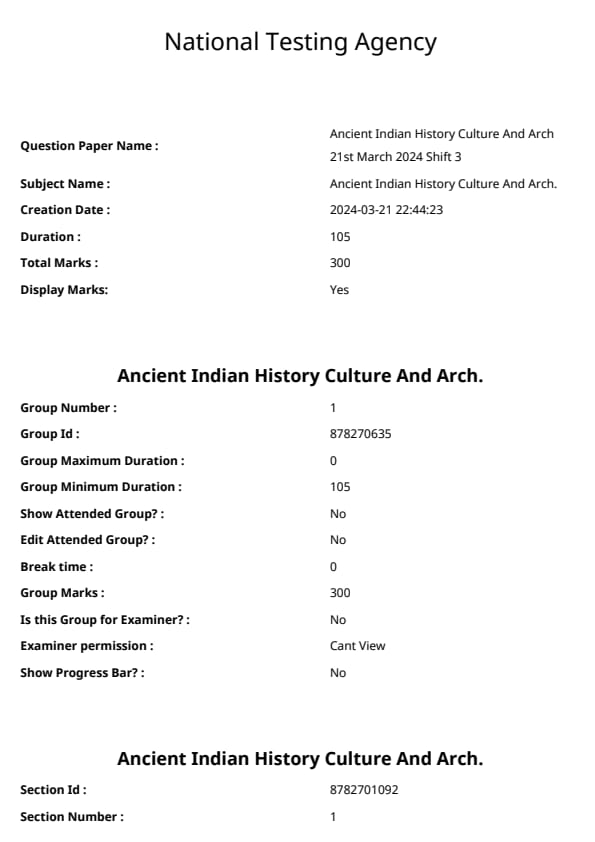
The 18th and 19th centuries were dominated by the writings of European scholars, usually referred to as the Orientalists or Indologists, although they often described themselves as:
View Solution
Orientalists and Indologists of the 18th and 19th centuries described themselves as antiquarians. These scholars studied ancient artifacts, manuscripts, and inscriptions to uncover cultural and historical insights. Their meticulous documentation contributed significantly to the understanding of ancient civilizations and laid the groundwork for modern historical studies. Quick Tip: Antiquarians preserved historical artifacts and manuscripts, providing future generations with access to cultural heritage.
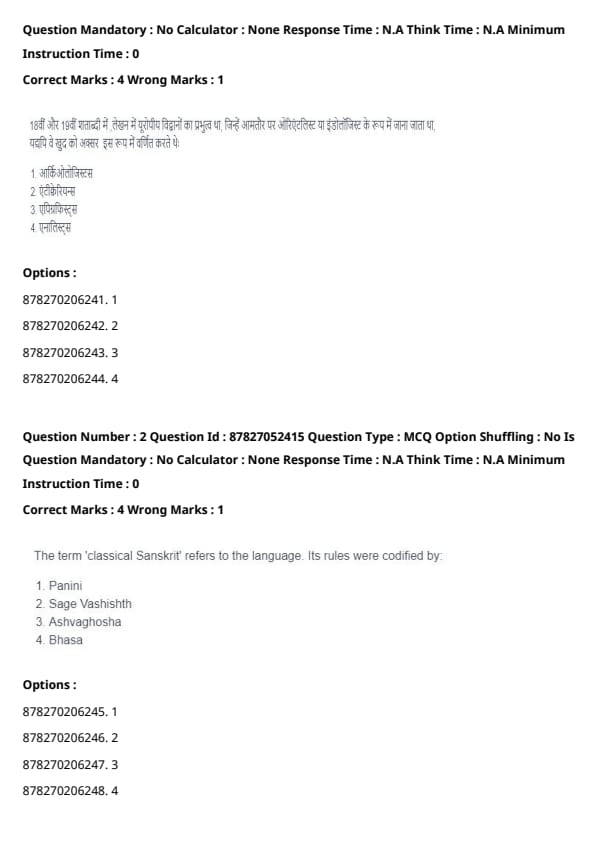
The term 'classical Sanskrit' refers to the language. Its rules were codified by:
View Solution
Classical Sanskrit is the refined and standardized form of Sanskrit codified by Panini in the Ashtadhyayi. This work consists of nearly 4,000 grammatical sutras, establishing the foundational rules of syntax, morphology, and phonetics. Panini's contribution ensured the language's uniformity and played a critical role in its application across literature, science, and philosophy. Quick Tip: Panini's Ashtadhyayi is regarded as one of the earliest works in formal grammar, influencing modern linguistic studies.
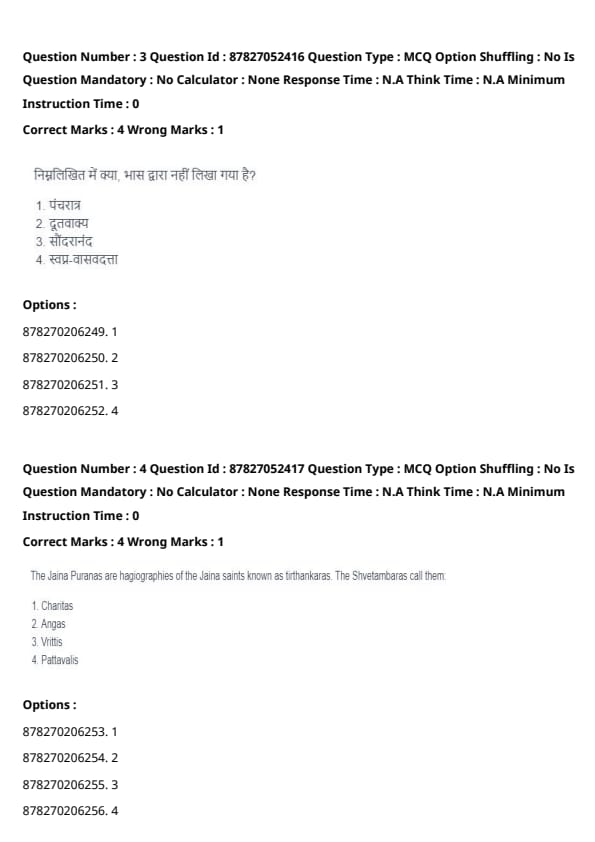
Which one of the following is not authored by Bhasa?
View Solution
Bhasa, a renowned Sanskrit playwright, authored works such as Pancharatra, Dutavakya, and Svapna-Vasavadatta. However, Saundarananda was written by Ashvaghosha, a Buddhist philosopher and poet. This text narrates the story of Nanda, a relative of the Buddha, emphasizing spiritual transformation and renunciation. Quick Tip: Understanding the contributions of key authors helps differentiate between literary and philosophical texts in ancient India.
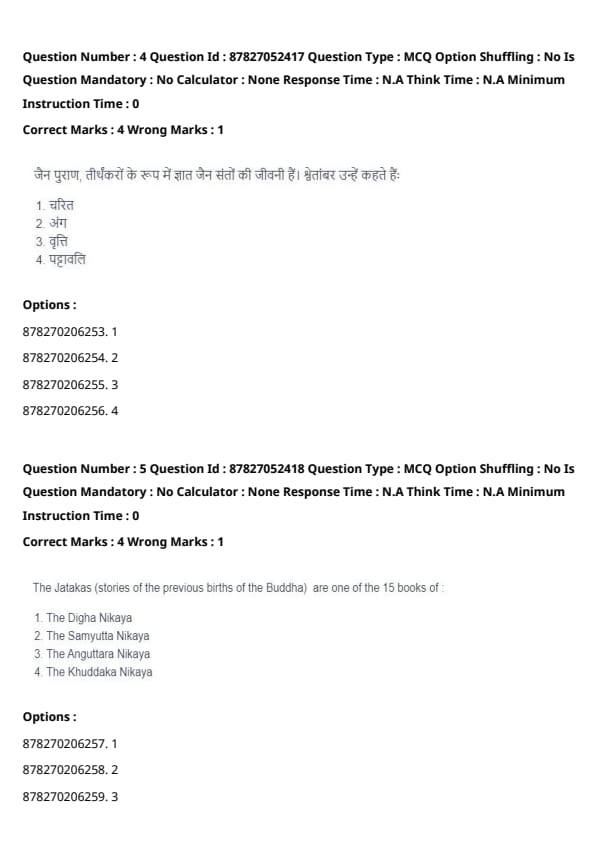
The Jaina Puranas are hagiographies of the Jaina saints known as tirthankaras. The Shvetambaras call them:
View Solution
The Jaina Puranas document the lives of tirthankaras, the spiritual leaders of Jainism. Among the Shvetambara sect, these hagiographies are referred to as Charitas. These texts focus on the deeds, teachings, and virtues of the tirthankaras, inspiring religious devotion and emulation. Quick Tip: Jain literature, including Charitas, reflects the community's religious values and philosophical teachings.
The Jatakas (stories of the previous births of the Buddha) are one of the 15 books of:
View Solution
The Jatakas are a collection of stories narrating the previous lives of the Buddha, illustrating his journey toward enlightenment. These stories are part of the Khuddaka Nikaya, a collection of diverse texts in the Sutta Pitaka of the Pali Canon. The Jatakas emphasize moral lessons and self-improvement through successive rebirths. Quick Tip: The Jatakas serve as a moral guide and provide insight into Buddhist concepts of karma and rebirth.
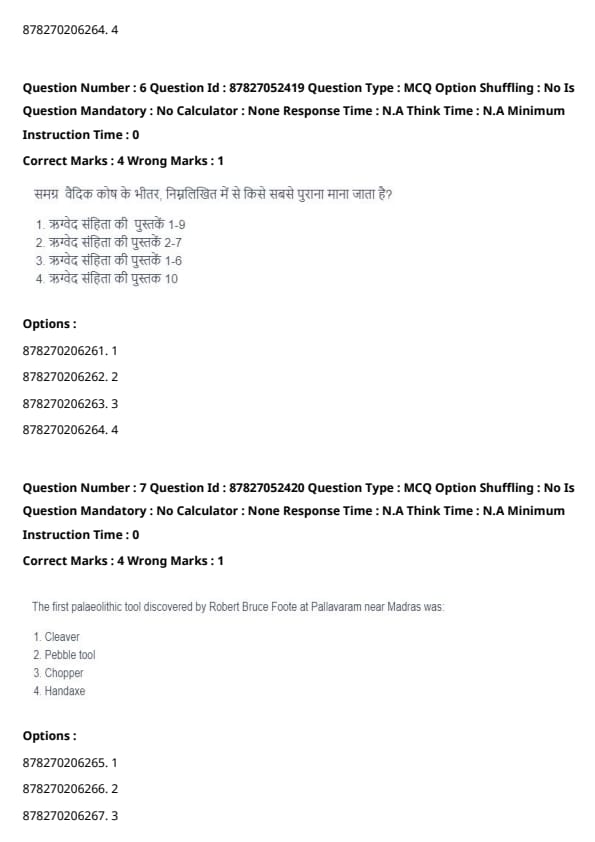
Within the Vedic corpus as a whole, which of the following are considered the oldest?
View Solution
Books 2–7 of the Rig Veda Samhita are referred to as the "family books" and are considered the oldest within the Vedic corpus. These books are arranged according to the priestly families who composed them and exhibit the most archaic language and cultural practices. They provide critical insights into the early Vedic civilization and its worldview. Quick Tip: The Rig Veda is the oldest of the four Vedas, and its "family books" (2–7) are key to understanding ancient Indo-Aryan society.
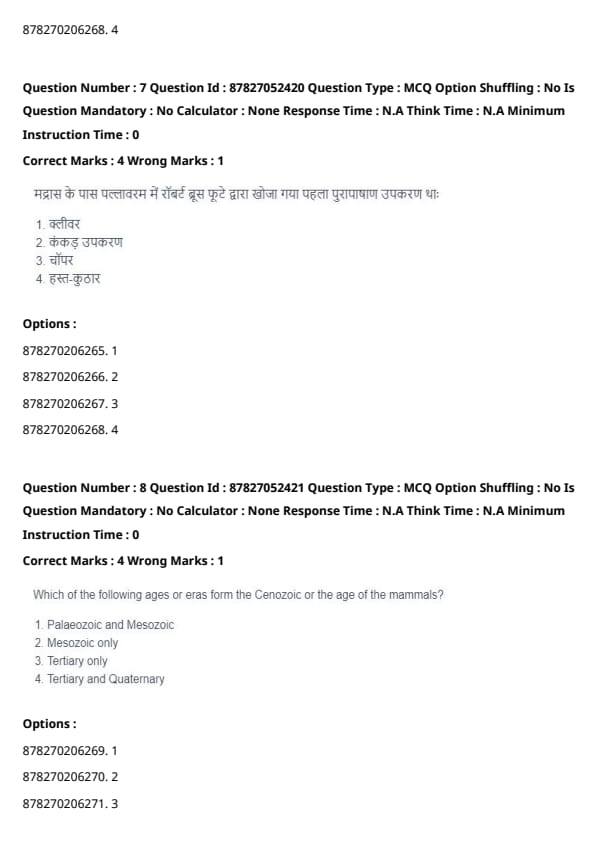
The first palaeolithic tool discovered by Robert Bruce Foote at Pallavaram near Madras was:
View Solution
Robert Bruce Foote, known as the "Father of Indian Prehistory," discovered the first palaeolithic tool, a handaxe, at Pallavaram near Madras in 186(C) This marked the beginning of systematic prehistoric studies in India. The handaxe, an iconic tool of the Lower Paleolithic period, was used for chopping and cutting by early humans. Quick Tip: The discovery of the handaxe in India linked the region's prehistory to global trends in early human evolution.
Which of the following ages or eras form the Cenozoic or the age of the mammals?
View Solution
The Cenozoic era, often called the "age of mammals," encompasses the Tertiary and Quaternary periods. These periods are characterized by the diversification of mammals and the rise of modern ecosystems. The Tertiary saw mammals becoming dominant, while the Quaternary included the development of humans and their environments. Quick Tip: The Cenozoic era highlights the evolutionary success of mammals and the eventual emergence of humans.
The three-age system – the idea that there was an age of stone tools, followed by one dominated by those of bronze and then of iron – was put forward by:
View Solution
Christian Thomsen and P.F. Suhm introduced the three-age system to classify prehistoric tools into Stone, Bronze, and Iron Ages. This framework became fundamental in archaeological studies, helping to establish a chronological understanding of technological evolution in human history. Quick Tip: The three-age system is pivotal for dating and understanding the progression of ancient human technologies.
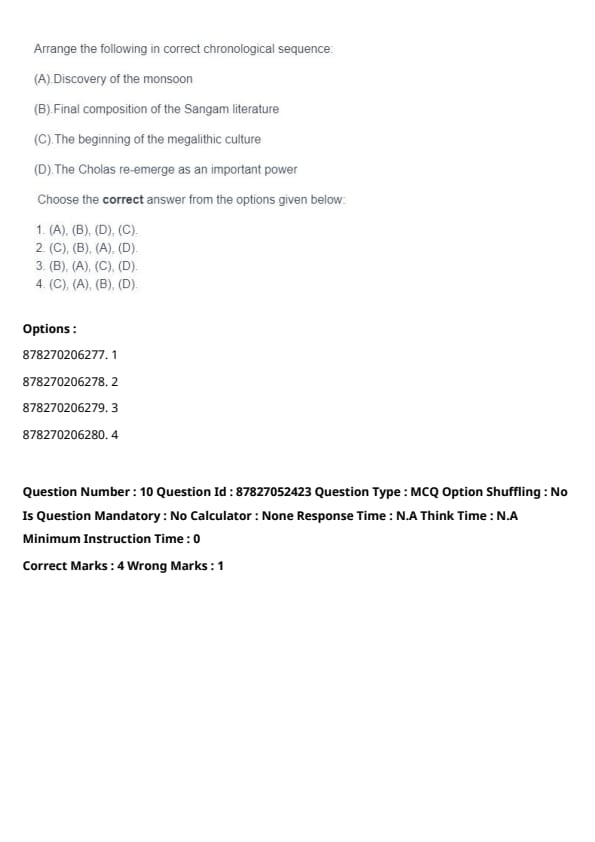
Arrange the following in correct chronological sequence:
(A) Discovery of the monsoon
(B) Final composition of the Sangam literature
(C) The beginning of the megalithic culture
(D) The Cholas re-emerge as an important power
Choose the correct answer from the options given below:
View Solution
The correct sequence is:
(C) The beginning of the megalithic culture
(A) Discovery of the monsoon
(B) Final composition of the Sangam literature
(D) The Cholas re-emerge as an important power. This order reflects the development of cultural and political milestones in South Indian history, starting from early burial practices to literary achievements and the rise of imperial powers. Quick Tip: Understanding chronological sequences helps in linking cultural, technological, and political changes in history.
Arrange the following in correct chronological sequence:
(A) Mature Harappan culture
(B) Use of rice in Lothal
(C) Earliest agricultural settlements in Baluchistan
(D) Pre-Harappan settlements in Cholistan (Pakistan)
View Solution
The correct chronological sequence is:
(C) Earliest agricultural settlements in Baluchistan
(D) Pre-Harappan settlements in Cholistan (Pakistan)
(A) Mature Harappan culture
(B) Use of rice in Lothal. This sequence reflects the gradual development of agricultural and urban settlements, beginning in Baluchistan, spreading to Cholistan, and culminating in the Harappan culture's maturity and agricultural practices like rice cultivation in Lothal. Quick Tip: Understanding the sequence of cultural and agricultural developments helps in tracing the evolution of ancient civilizations.
Arrange the following Pandya rulers of Madurai in correct chronological sequence:
(A) Rajasimha I
(B) Arikesari
(C) Kadungon
(D) Ranadhira
View Solution
The correct chronological order of Pandya rulers of Madurai is:
(A) Kadungon (C)
(B) Arikesari (B)
(C) Ranadhira (D)
(D) Rajasimha I (A).
This sequence aligns with historical records of their reigns. Quick Tip: When arranging rulers chronologically, cross-check historical timelines and major reign events.
Arrange the following in chronological order:
(A) The British succeeded in transferring many of Indian coins to private and public collections in Britain.
(B) The earliest coins contain a few symbols.
(C) The Indo-Greek coins were found around Afghanistan.
(D) The post-Gupta coins depict decline of trade and commerce.
View Solution
The correct sequence is (B) The earliest coins, (C) Indo-Greek coins, (D) Post-Gupta coins, (A) British transfer of coins. This reflects the historical development of coinage, starting with symbolic coins, Indo-Greek influences, decline in the post-Gupta period, and eventual British acquisitions. Quick Tip: Chronological understanding of numismatics provides insight into economic and cultural transitions in history.
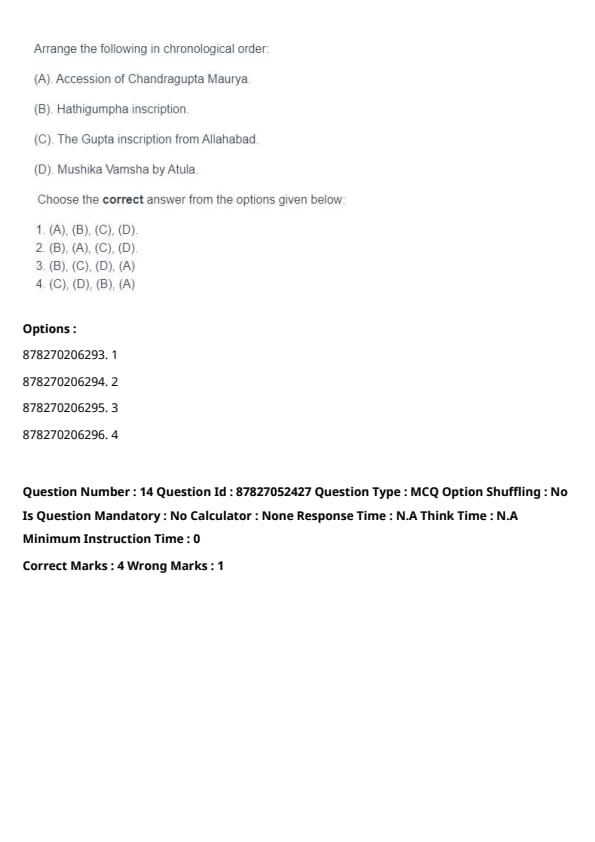
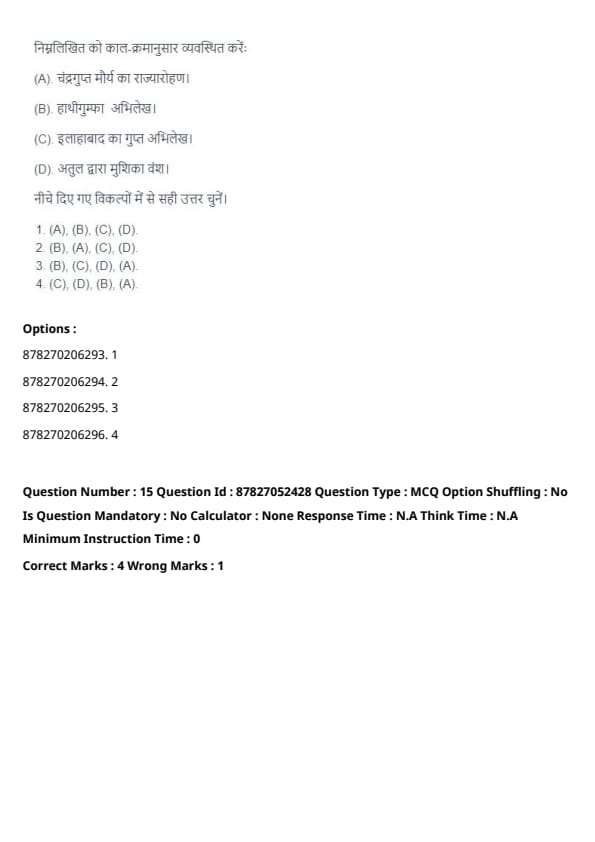
Arrange the following in chronological order:
(A) Accession of Chandragupta Maurya
(B) Hathigumpha inscription
(C) The Gupta inscription from Allahabad
(D) Mushika Vamsha by Atula
View Solution
The correct chronological order is:
(A) Accession of Chandragupta Maurya
(B) Hathigumpha inscription
(C) The Gupta inscription from Allahabad
(D) Mushika Vamsha by Atula.
This sequence highlights the significant historical and cultural developments starting with Chandragupta Maurya's accession and ending with the Mushika Vamsha composition. Quick Tip: For chronological questions, identify the events' historical contexts and order them based on their timelines.
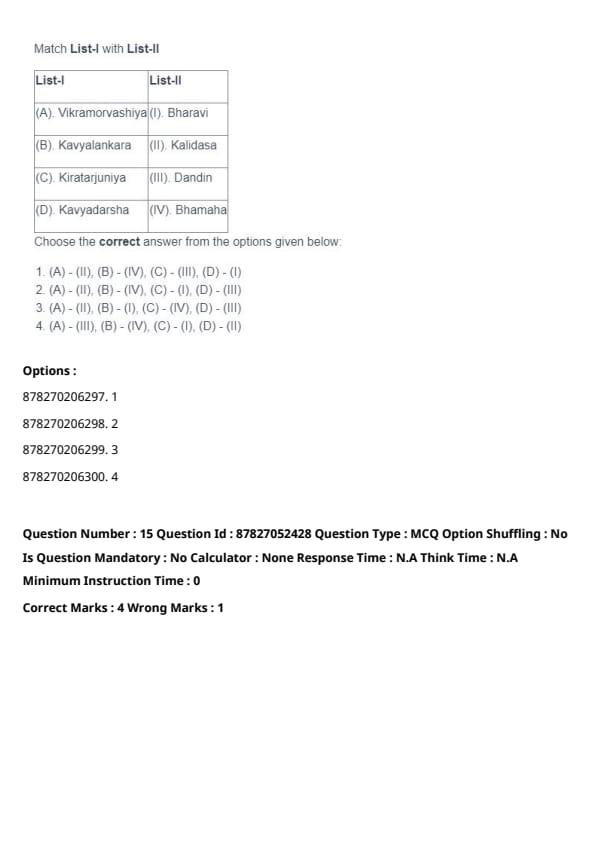
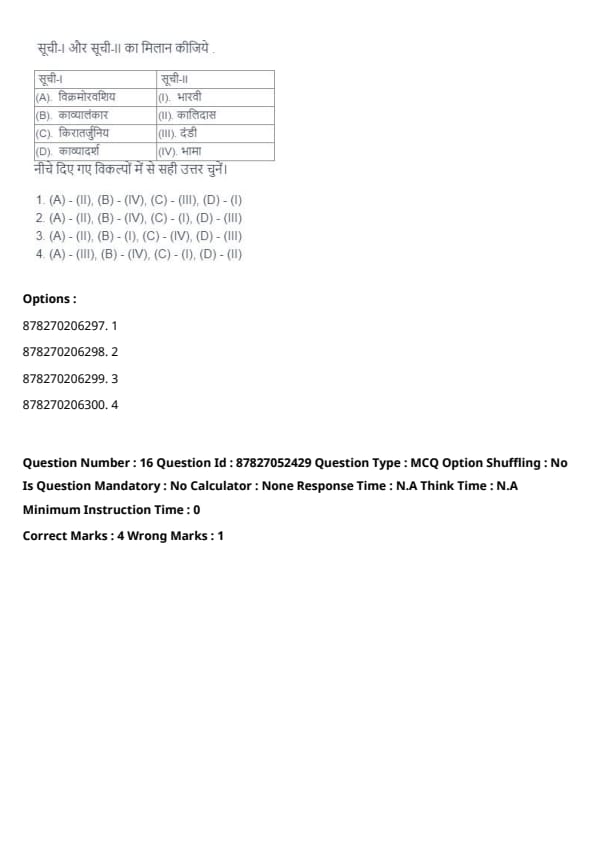
Match List-I with List-II:

View Solution
This question assesses knowledge of classical Sanskrit literature and its authors. The works listed in List-I are iconic contributions to Indian literary heritage, while List-II contains the corresponding authors. To determine the correct answer, you need to associate each work with the style and period of its respective author:
- Vikramorvashiya is a Sanskrit play authored by Kalidasa, renowned for his poetic elegance and dramatization of historical and mythological themes.
- Kavyalankara is a treatise on poetics written by Bhamaha, marking one of the earliest systematic expositions of Sanskrit literary theory.
- Kiratarjuniya, an epic poem, is authored by Bharavi and known for its complex style and profound philosophical depth.
- Kavyadarsha, another seminal text on poetics, is attributed to Dandin and focuses on literary aesthetics and rules of composition.
Recognizing the contributions of these literary figures provides a deeper understanding of India’s rich cultural and intellectual history. Quick Tip: When tackling matching questions, focus on the unique styles, themes, and historical periods associated with each author to make accurate associations.
What are true about Mesolithic rock paintings in India?
(A) The first rock paintings in India were discovered by A.C.L. Carlleyle.
(B) The Bhimbetka paintings have not been studied by V.S. Wakankar.
(C) At most Mesolithic rock art sites, animals dominate the scenes.
(D) No snakes are depicted in Indian Mesolithic rock paintings.
View Solution
The first rock paintings in India were discovered by A.C.L. Carlleyle, marking the beginning of the study of prehistoric art. Bhimbetka, extensively studied by V.S. Wakankar, is a UNESCO World Heritage Site showcasing Mesolithic art. Most Mesolithic rock art depicts animals as a central theme, and snakes are notably absent in the imagery. Quick Tip: Focus on the unique themes and historical studies of Mesolithic art to answer questions related to rock paintings.
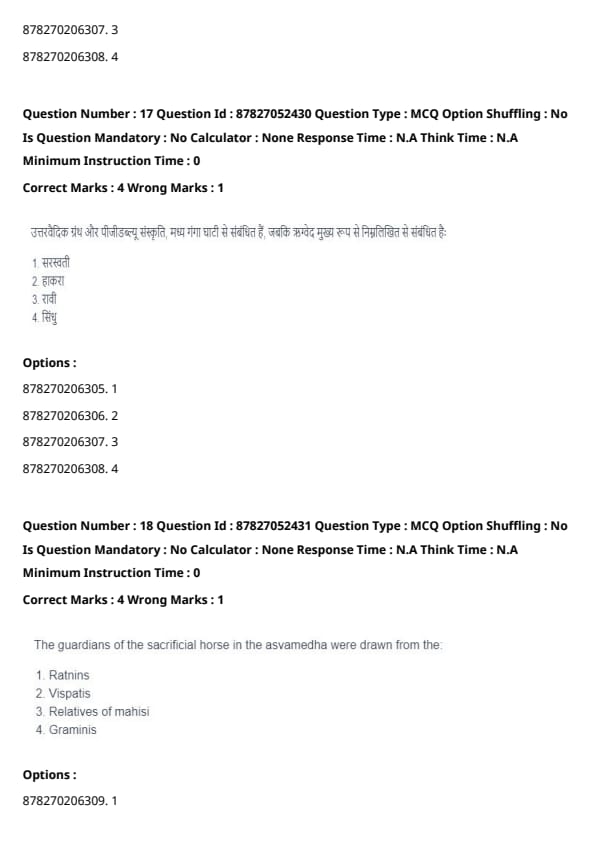
The later Vedic texts and the PGW Culture relate to the mid Ganga valley, whereas the Rigveda primarily pertains to:
View Solution
The Rigveda primarily refers to the Indus River and its associated regions. It also mentions the Saraswati and other rivers, but the cultural and geographical focus of the Rigvedic texts is predominantly the northwestern part of the Indian subcontinent. Quick Tip: Identify geographical references in ancient texts like the Rigveda to understand cultural and historical settings.
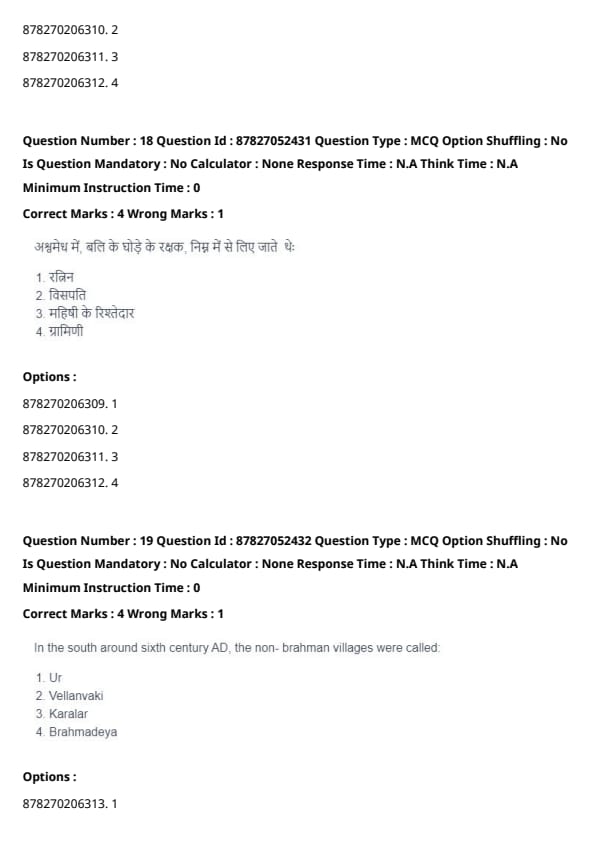
The guardians of the sacrificial horse in the Ashvamedha were drawn from the:
View Solution
The Ratnins, or "jewel-bearers," were important officials or dignitaries in Vedic rituals. They played a crucial role in protecting and guiding the sacrificial horse during the Ashvamedha, a grand ritual signifying imperial sovereignty. Quick Tip: Understanding the roles of officials in Vedic rituals is essential for answering questions on ancient Indian ceremonies.
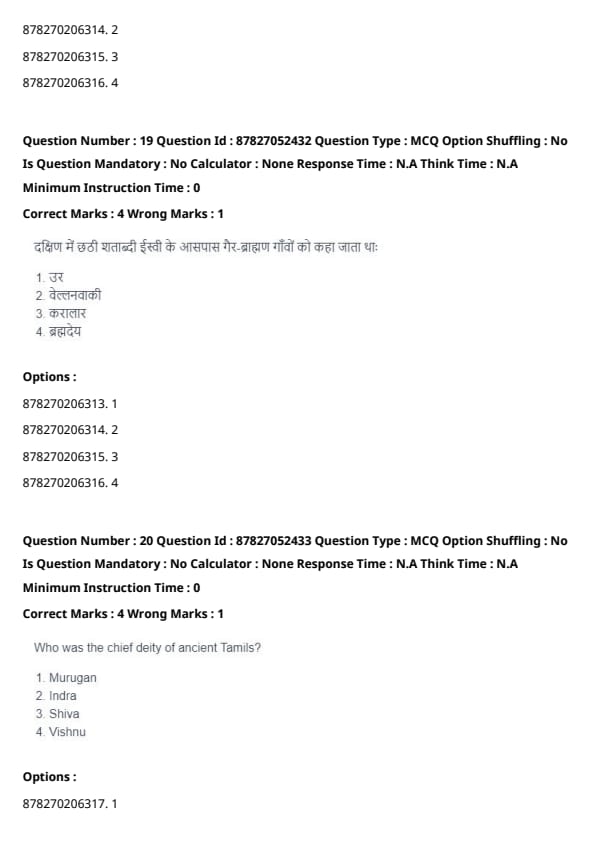
In the south around the sixth century AD, the non-Brahman villages were called:
View Solution
Non-Brahman villages in southern India were known as Vellanvaki. These settlements were primarily inhabited by agriculturists and other non-Brahman communities. The term distinguishes them from Brahmadeya villages, which were tax-free settlements granted to Brahmins. Quick Tip: Focus on terminology related to ancient village structures to distinguish between different community types.
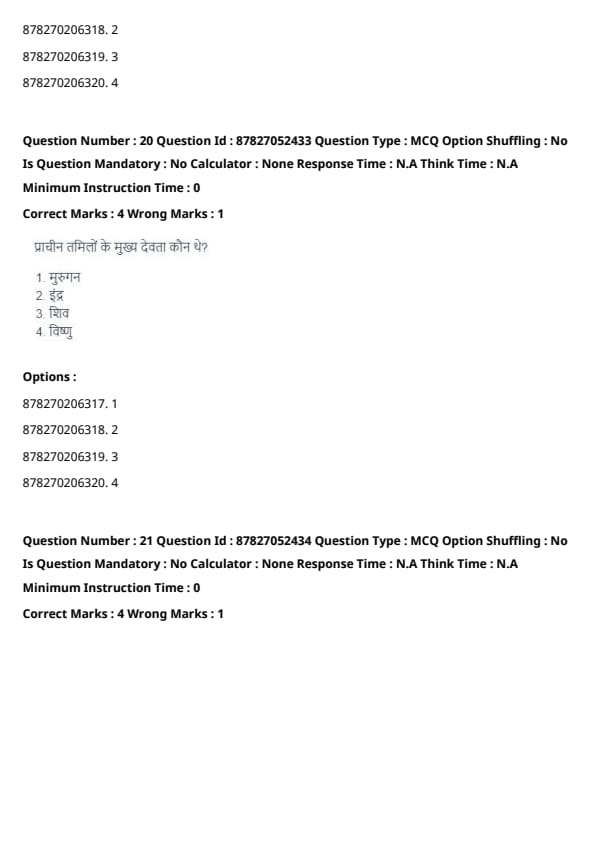
Who was the chief deity of ancient Tamils?
View Solution
Murugan was the primary deity worshipped by ancient Tamils. Associated with valor and youth, Murugan is still revered in Tamil Nadu and is considered a prominent deity in Tamil culture and tradition. Quick Tip: Understanding regional deities helps in grasping cultural and religious practices of specific communities.
Important aspects of Harappan trade were:
(A) Two-wheeled carts were an important mode of transport.
(B) Several routes of trade and commerce connected the various parts of the Harappan culture zone.
(C) The Khetri deposits of Rajasthan were not an important source of copper.
(D) The use of horses seems to have been very minimal.
View Solution
Harappan trade relied on two-wheeled carts for inland transport and a network of trade routes connecting key settlements. The Khetri mines in Rajasthan were significant sources of copper, contrary to (C). Horses played a minimal role in Harappan society, as evidenced by archaeological records. Quick Tip: Focus on economic and transport systems when studying Harappan culture.
(A) Gupta kings assumed imperial titles such as Maharajadhiraja.
(B) They also connected themselves with the gods through epithets such as Parama-daivata (the foremost worshipper of the gods).
(C) The Allahabad Prashasti describes Samudragupta as a common man.
(D) Some historians suggested that the Gupta kings claimed divine status.
View Solution
The Gupta kings adopted grand titles like Maharajadhiraja and connected themselves to divinity through epithets such as Parama-daivata. The Allahabad Prashasti by Harisena, however, portrays Samudragupta as an exceptional ruler rather than a common man. Quick Tip: Understand inscriptions and titles to analyze the political and religious ideologies of ancient dynasties.
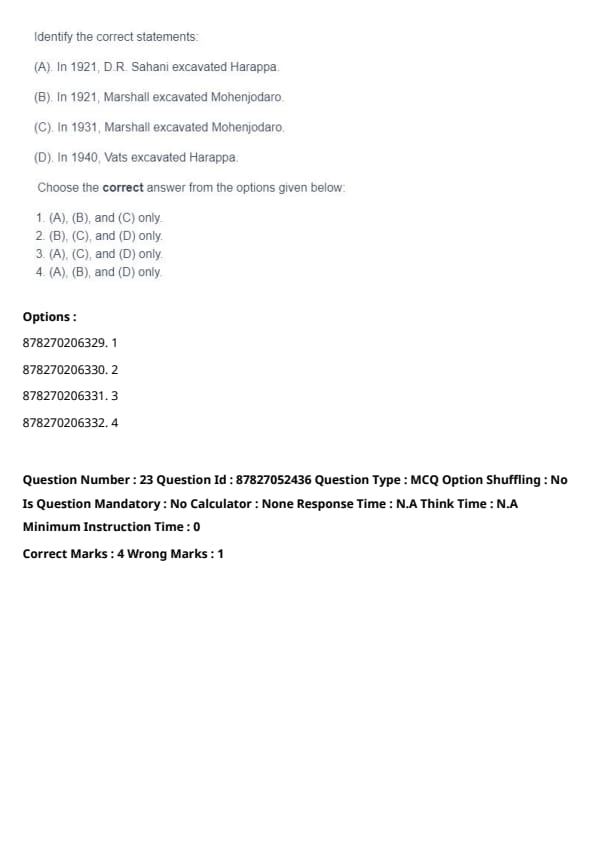
Identify the correct statements:
(A) In 1921, D.R. Sahani excavated Harappa.
(B) In 1921, Marshall excavated Mohenjodaro.
(C) In 1931, Marshall excavated Mohenjodaro.
(D) In 1940, Vats excavated Harappa.
View Solution
D.R. Sahani excavated Harappa in 1921, marking the discovery of the Indus Valley Civilization. Marshall, involved in Mohenjodaro excavations, worked in 193(A) Vats excavated further at Harappa in 1940. Quick Tip: Focus on key archaeologists and their contributions to identifying major sites in ancient history.
Identify the correctly paired structures and their locations:
(A) Ajivika Hall, Nagarjuni hills (Bihar).
(B) Ajivika Hall, Nagarjuni hill (Maharashtra).
(C) Karle Caves, Western Ghats.
(D) Rani Gumpha, Odisha.
View Solution
The correct pairings are:
- (A) Ajivika Hall, Nagarjuni hills (Bihar).
- (C) Karle Caves, Western Ghats.
- (D) Rani Gumpha, Odisha.
(B) is incorrect because the Nagarjuni hills are not located in Maharashtra.
Thus, the correct answer is (A), (C), and (D) only. Quick Tip: To correctly answer questions about historical sites, review their geographical and historical significance.
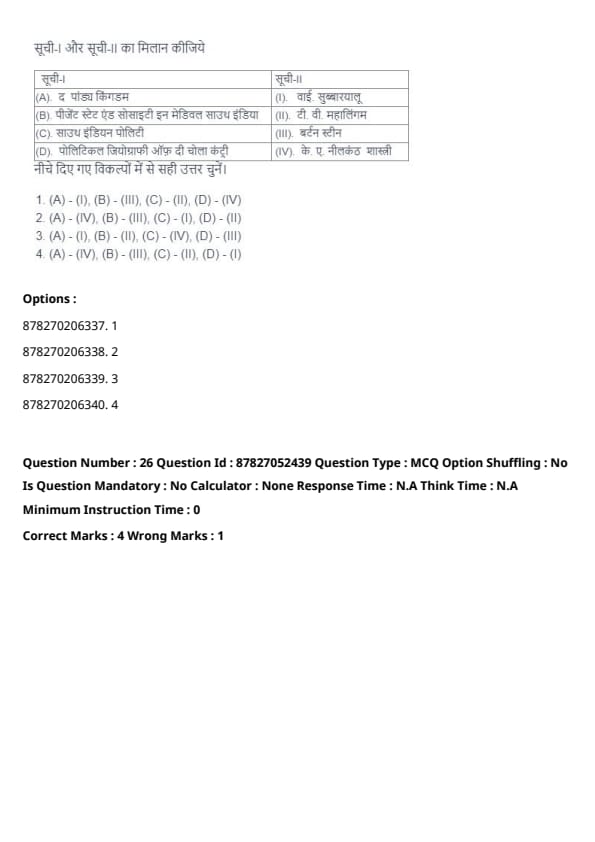
Match List-I with List-II:

View Solution
The correct matching is:
- (A) The Pandya Kingdom - (IV) K.A. Nilakanta Sastri
- (B) Peasant State and Society in Medieval South India - (III) Burton Stein
- (C) South Indian Polity - (II) T.V. Mahalingam
- (D) Political Geography of the Chola Country - (I) Y. Subbarayalu
Thus, the correct answer is Option (D) Quick Tip: When matching historical topics with authors, focus on their key works and contributions to Indian history.
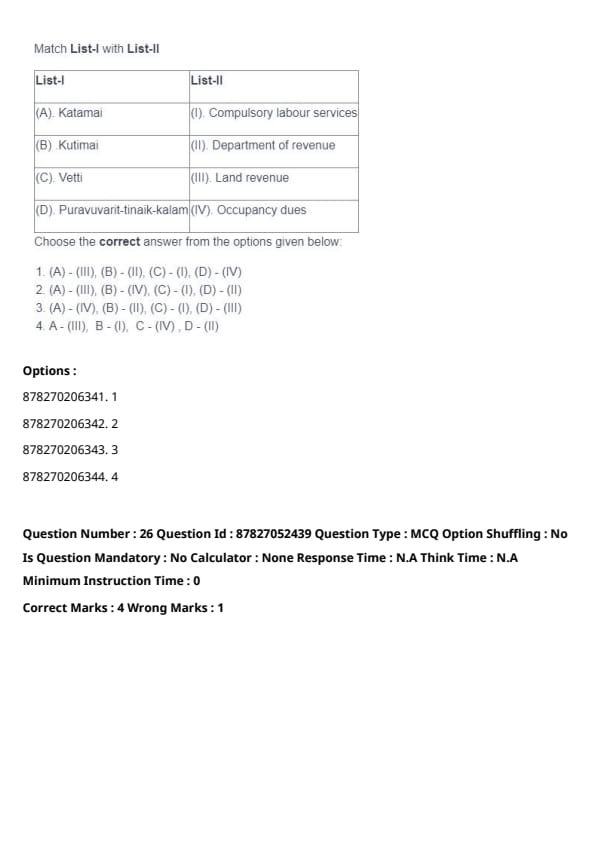
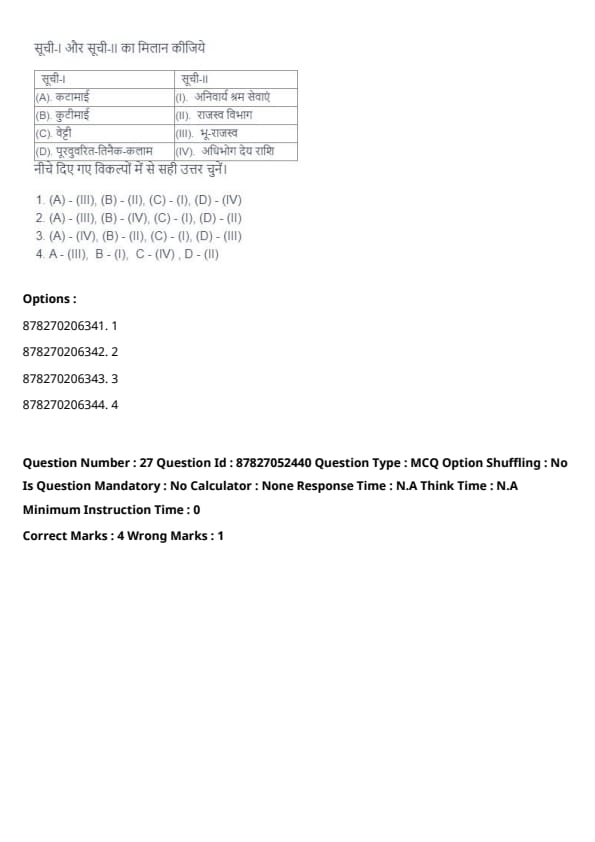
Match List-I with List-II:

View Solution
The correct matching is:
- (A) Katamai - (III) Land revenue
- (B) Kutimai - (IV) Occupancy dues
- (C) Vetti - (I) Compulsory labour services
- (D) Puravuvarit-tinaik-kalam - (II) Department of revenue
Thus, the correct answer is Option (B) Quick Tip: For matching historical terms with their meanings, focus on their administrative or societal contexts.
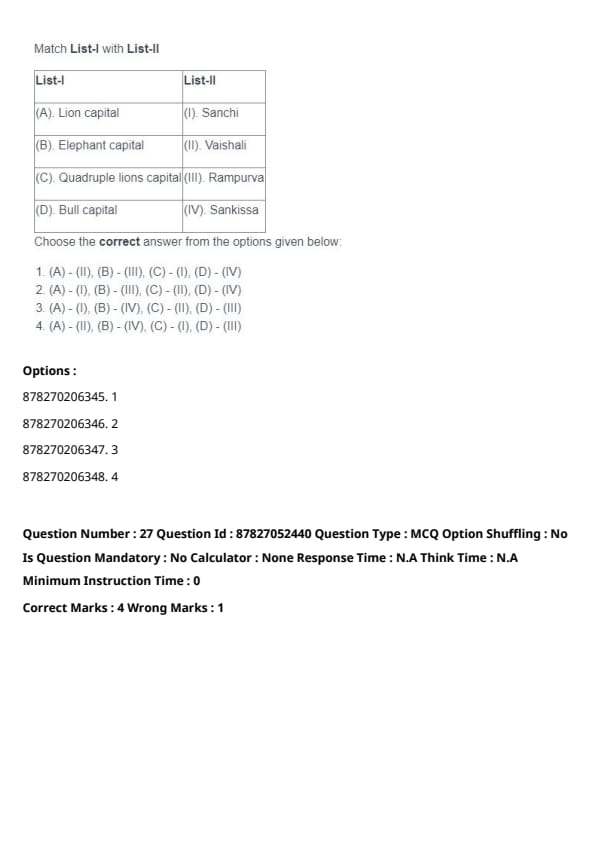
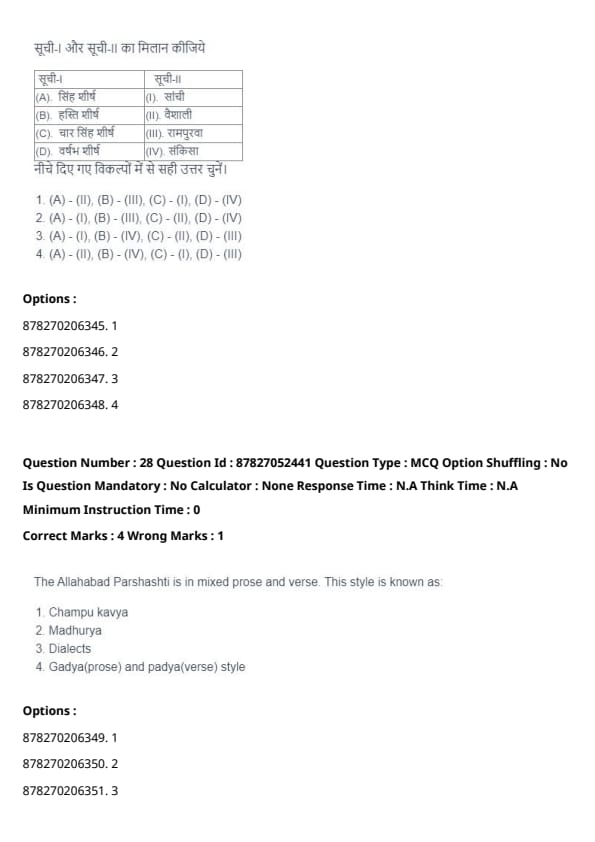
Match List-I with List-II:

View Solution
This question involves identifying Mauryan art and architecture by associating capitals with their locations. These capitals are significant symbols of Mauryan craftsmanship and reflect the cultural and artistic zenith of the period. Quick Tip: Familiarize yourself with Mauryan-era art and its symbolic significance to answer questions about historical landmarks.
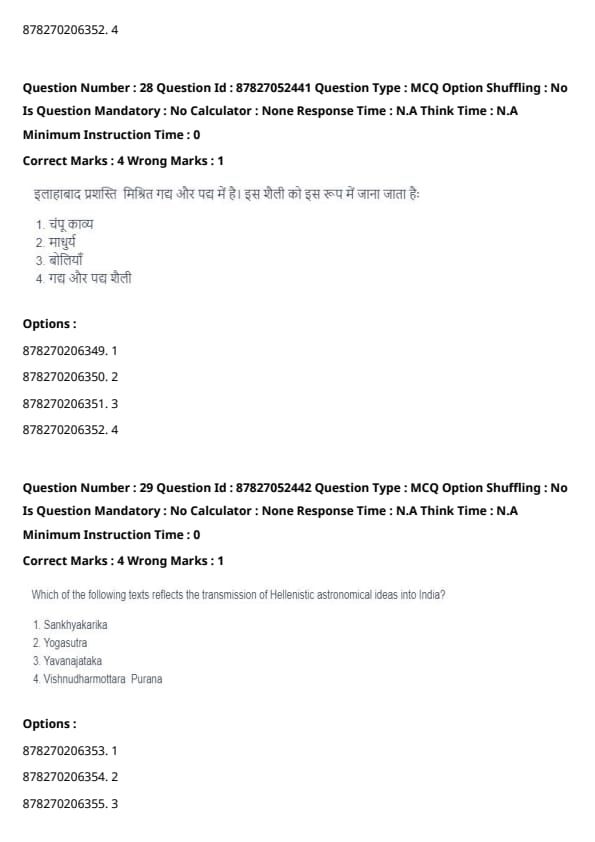
The Allahabad Parshasti is in mixed prose and verse. This style is known as:
View Solution
The Allahabad Prashasti, composed by Harisena, employs the Champu kavya style, which combines prose and poetry. This style was commonly used in classical Sanskrit literature to enhance the aesthetic and rhythmic quality of inscriptions. Quick Tip: Study literary styles like Champu kavya to understand how historical inscriptions convey both form and content.
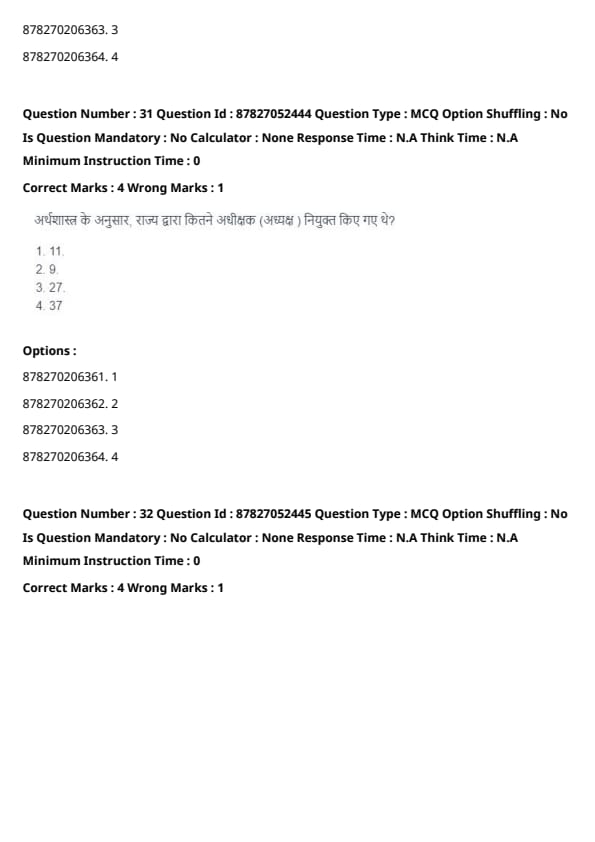
Which of the following texts reflects the transmission of Hellenistic astronomical ideas into India?
View Solution
The Yavanajataka is a Sanskrit text that integrates Hellenistic astronomical and astrological ideas into Indian tradition. It serves as an example of cultural exchange between Greece and India during the early centuries CE. Quick Tip: Focus on texts like the Yavanajataka to understand the transmission of scientific knowledge between civilizations.
The roots of Indian mathematics can be traced to:
View Solution
The Shulvasutras are ancient texts that focus on geometric principles related to altar construction. They contain early references to concepts like the Pythagorean theorem and proportionality, laying the foundation for Indian mathematics. Quick Tip: Study foundational texts like the Shulvasutras to trace the origins of mathematical thought in ancient India.
According to Arthashastra, how many superintendents (adhyakshas) were appointed by the state?
View Solution
The Arthashastra, an ancient Indian treatise on statecraft, economic policy, and military strategy by Kautilya (Chanakya), mentions the appointment of 27 superintendents (adhyakshas) to oversee various departments of the state, such as trade, agriculture, and taxation. These officials ensured the smooth functioning of the administration. Quick Tip: For questions on Arthashastra, focus on its administrative structure and economic strategies outlined by Chanakya.
Identify correct statements with reference to Sanauli Cemetery:
(A) M. S. Vats excavated Sanauli.
(B) Sanauli is located at Baghpat, Uttar Pradesh.
(C) The discoveries at Sanauli are tentatively dated c. 2200–1800 BCE.
(D) The goods of the cemetery comprise copper objects, gold ornaments, glass, etc.
View Solution
Sanauli, located in Baghpat, Uttar Pradesh, was excavated by the Archaeological Survey of India and is dated to 2200–1800 BCE. The cemetery revealed burial goods, including copper objects, pottery, and other artifacts, indicating a sophisticated material culture. Quick Tip: Focus on recent archaeological findings for their historical and cultural implications.
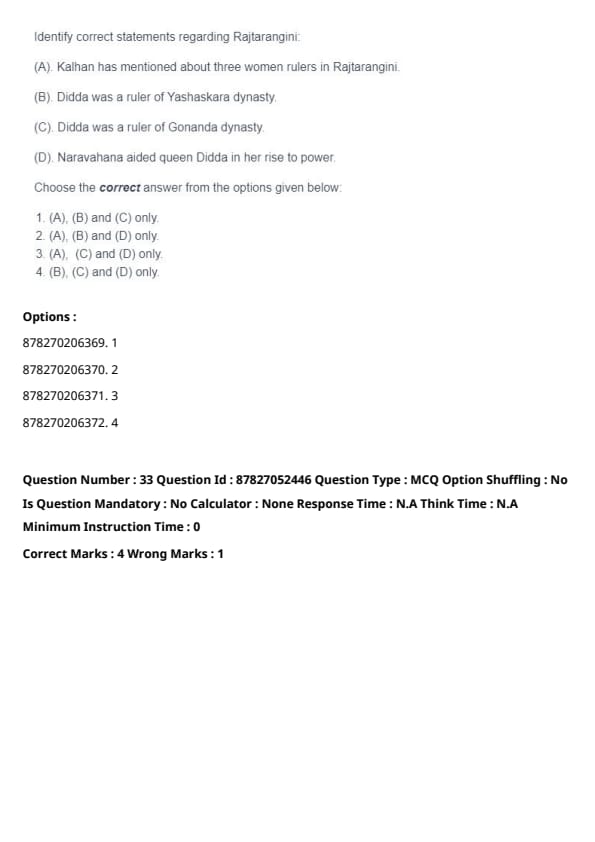
Identify correct statements regarding Rajtarangini:
(A) Kalhan has mentioned about three women rulers in Rajtarangini.
(B) Didda was a ruler of the Yashaskara dynasty.
(C) Didda was a ruler of the Gonanda dynasty.
(D) Naravahana aided queen Didda in her rise to power.
View Solution
Kalhana’s Rajtarangini records three women rulers, including Didda, who ruled the Yashaskara dynasty in Kashmir. Naravahana played a role in her rise to power. Didda was a prominent ruler known for her administrative acumen. Quick Tip: Study dynastic histories like Rajtarangini to understand the contributions of women rulers in ancient India.
Identify the correct statements regarding the Iron Pillar, Mehrauli:
(A) The pillar has a Sanskrit inscription.
(B) The pillar is made of pure wrought iron.
(C) It is surmounted by an inverted lotus emblem.
(D) The pillar is 7.85 meters tall.
View Solution
The Iron Pillar at Mehrauli is a marvel of metallurgy, made of wrought iron with minimal corrosion. It bears a Sanskrit inscription and is surmounted by an inverted lotus emblem. Its durability has fascinated metallurgists worldwide. Quick Tip: Focus on unique metallurgical achievements like the Iron Pillar to understand ancient Indian advancements in science and technology.
Identify correct statements regarding Ajanta Caves:
(A) Ajanta Caves are located in the Sahyadri Hills.
(B) 23 caves belong to the Vakataka Period.
(C) There are no chaityas at Ajanta.
(D) The Ajanta caves are situated near the Waghora River.
View Solution
Ajanta Caves are located in the Sahyadri Hills and near the Waghora River. They are renowned for their paintings and architecture, including 23 caves from the Vakataka Period. Contrary to the statement, Ajanta does have chaityas. Quick Tip: Focus on distinguishing features of major historical sites like Ajanta for architectural and artistic details.
By the middle of the tenth century, the landed magnates emerged in the Kaveri delta and outside in a big way. Which one of the following was NOT a title borne by them?
View Solution
Ajnapati is not recorded as a title of landed magnates in the Kaveri delta. Titles like Udaiyan, Velam, and Araiyan indicate the feudal structure that emerged in medieval South India. Quick Tip: Study the evolution of landholding patterns to understand regional administrative terminologies.
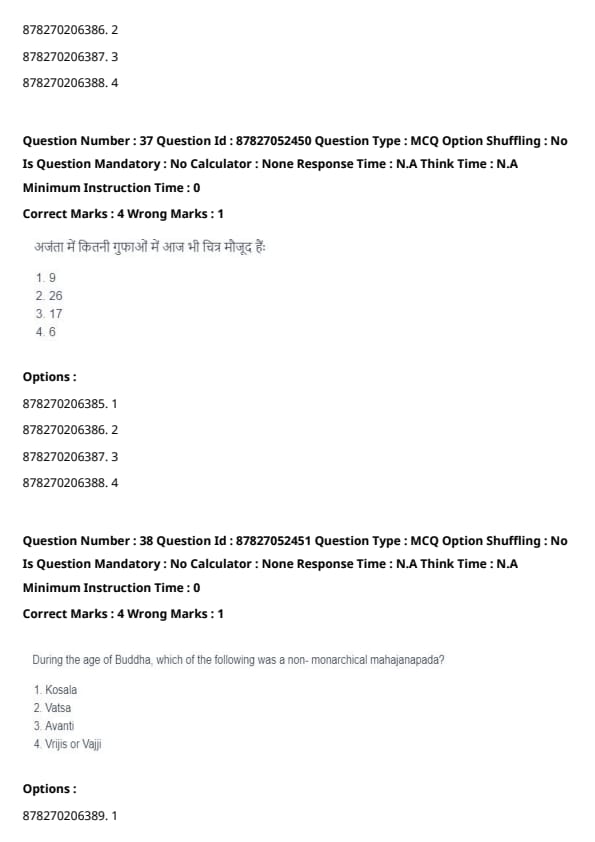
In how many caves at Ajanta do paintings survive today?
View Solution
Paintings have survived in 6 caves at Ajanta. These caves depict themes of Buddhist philosophy, Jataka tales, and royal life, highlighting the artistic and spiritual excellence of ancient India. Quick Tip: Study the specific caves at Ajanta to understand the diversity of themes and artistry that have withstood the test of time.
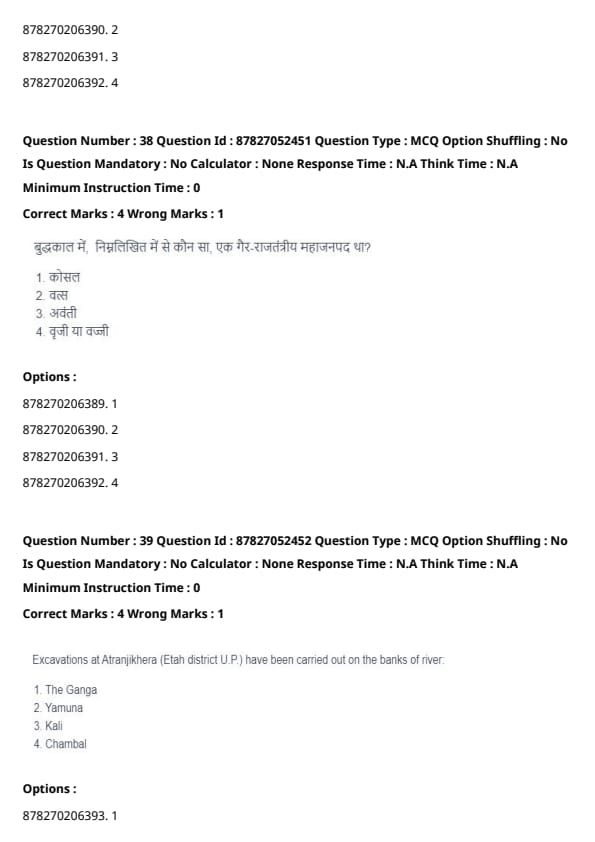
During the age of Buddha, which of the following was a non-monarchical mahajanapada?
View Solution
The Vrijis or Vajji were a confederacy of clans and a non-monarchical mahajanapada during Buddha's time. They followed a republican system of governance and were headquartered in Vaishali. Quick Tip: Distinguish between monarchical and non-monarchical mahajanapadas to understand ancient political systems.
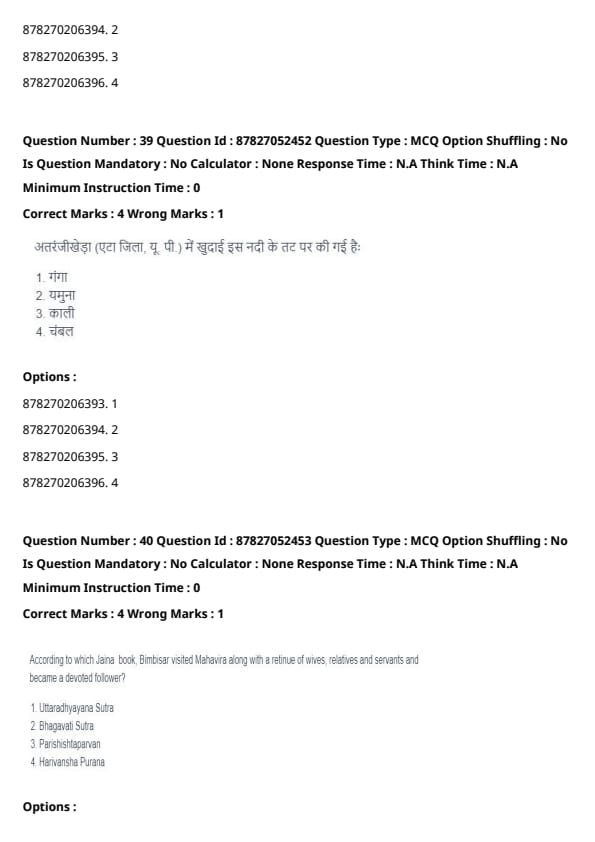
Excavations at Atranjikhera (Etah district, U.P.) have been carried out on the banks of which river?
View Solution
Atranjikhera, a site of Painted Grey Ware culture, is located on the banks of the Kali River. It provides crucial insights into the transition from the Chalcolithic to the Iron Age in northern India. Quick Tip: Associate archaeological sites with their geographical locations to answer questions accurately.
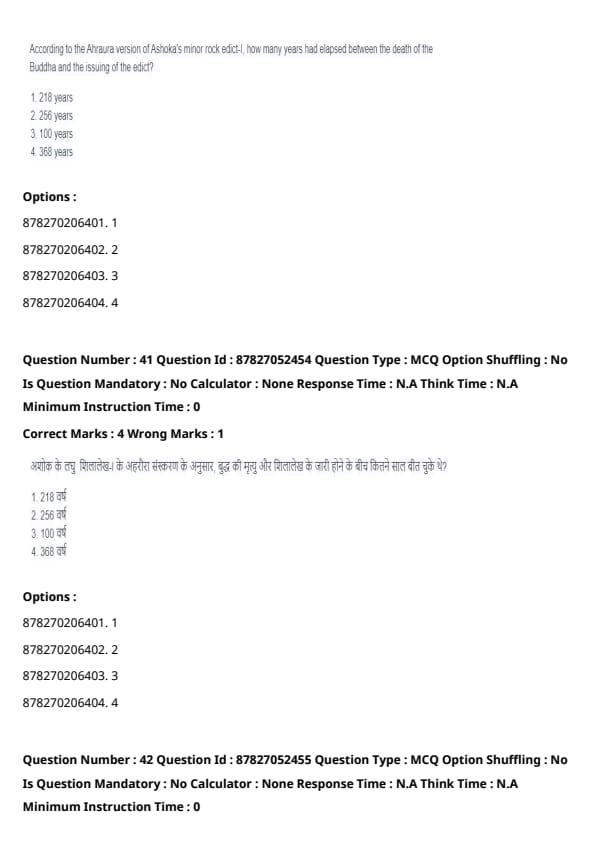
According to which Jaina book, Bimbisara visited Mahavira along with a retinue of wives, relatives, and servants and became a devoted follower?
View Solution
The Uttaradhyayana Sutra records King Bimbisara's visit to Mahavira, highlighting his journey to becoming a devoted follower. This scripture is crucial in Jain literature for detailing Mahavira's teachings and discipleship. Quick Tip: Study key Jain texts to understand the interactions between historical figures and religious leaders.
According to the Ahraura version of Ashoka's minor rock edict, how many years had elapsed between the death of the Buddha and the issuing of the edict?
View Solution
The Ahraura version of Ashoka's minor rock edict mentions that 256 years had passed since the Buddha's death. This inscription reflects Ashoka’s connection to Buddhism and his efforts to propagate its principles through edicts. Quick Tip: Focus on Ashoka’s inscriptions and their historical references for questions on his reign and contributions.
Which of the following Upanishads are among the earliest ones?
View Solution
The Brihadaranyaka and Chhandogya Upanishads are among the earliest Upanishads, forming the foundational texts of Indian philosophy. They discuss metaphysical concepts like Brahman, Atman, and the nature of reality. Quick Tip: Memorize the chronological order and key themes of the principal Upanishads for philosophy-related questions.
Most of the mature Harappan brick sizes have an identical ratio of thickness, width, and length. This ratio is:
View Solution
Mature Harappan bricks commonly followed the 1:2:4 ratio for thickness, width, and length. This standardization facilitated construction and reflects the advanced planning and architectural knowledge of the Harappans. Quick Tip: Focus on standardization practices in the Indus Valley Civilization to understand their architectural advancements.
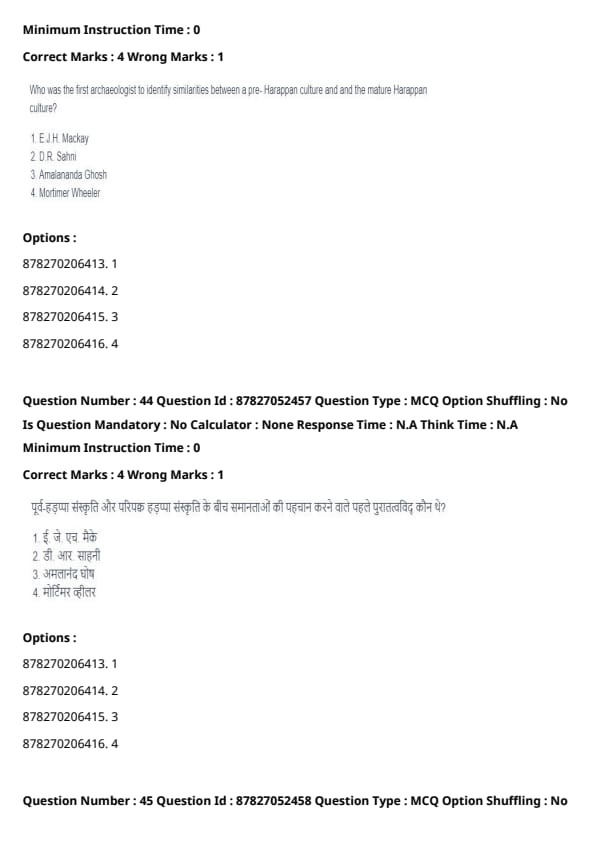
Who was the first archaeologist to identify similarities between a pre-Harappan culture and the mature Harappan culture?
View Solution
Amalananda Ghosh was the first archaeologist to identify continuities between pre-Harappan and mature Harappan cultures. His studies emphasized the evolution of cultural and urban practices in the Indus Valley Civilization. Quick Tip: Learn key contributions of archaeologists to understand the development of Indus Valley Civilization studies.
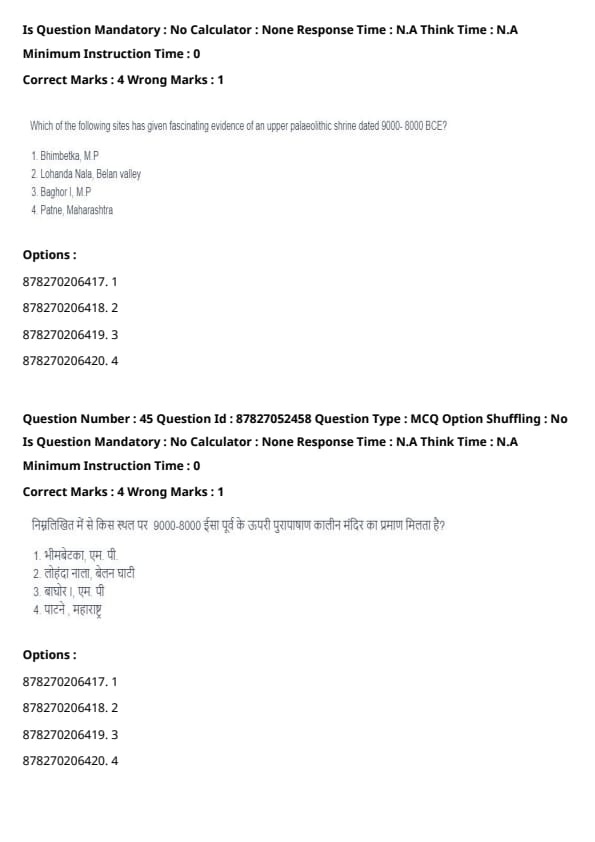
Which of the following sites has given fascinating evidence of an Upper Palaeolithic shrine dated 9000–8000 BCE?
View Solution
Baghor I in Madhya Pradesh revealed an Upper Palaeolithic shrine with artifacts dated to 9000–8000 BCE. The shrine is an important indication of symbolic and ritualistic behavior in prehistoric India. Quick Tip: Focus on archaeological evidence to understand cultural and ritualistic practices of prehistoric sites.
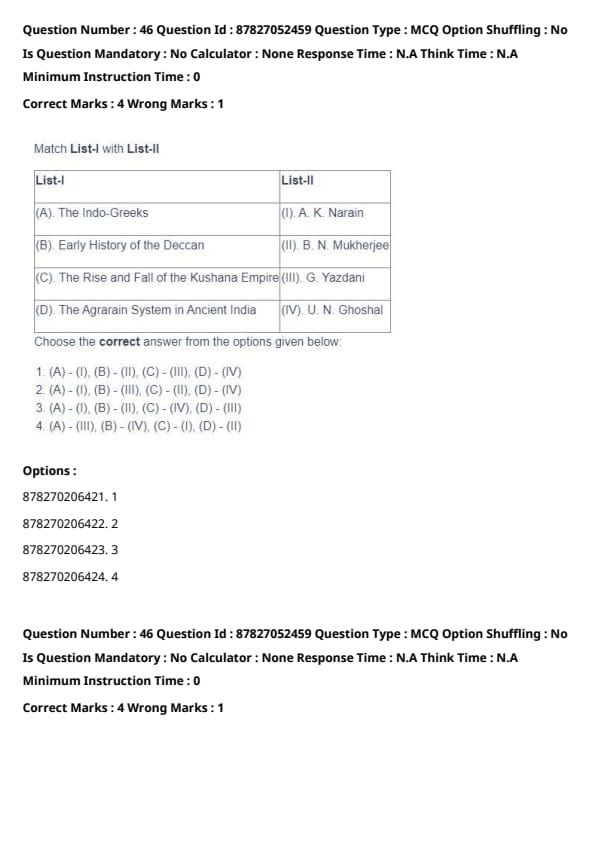
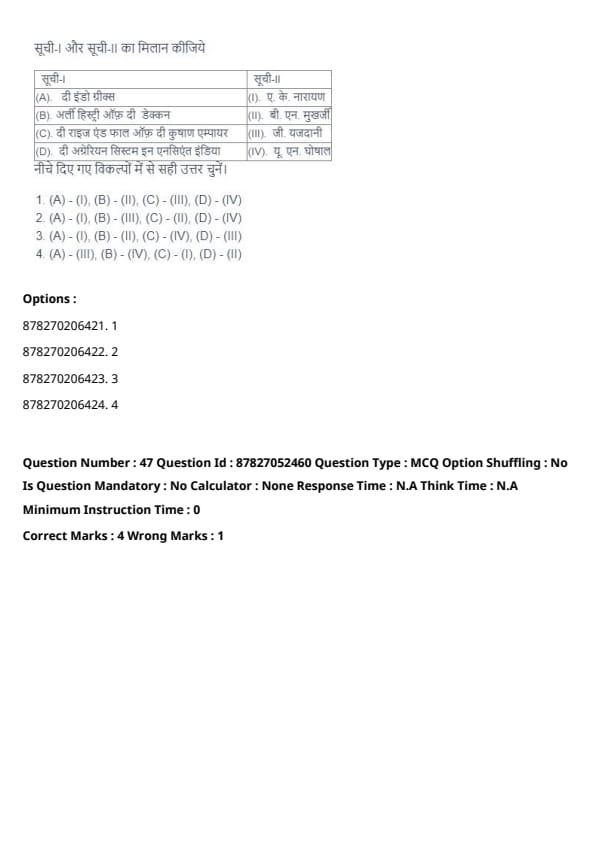
Match List-I with List-II:

View Solution
The correct matching is:
- (A) The Indo-Greeks - (I) A. K. Narain
- (B) Early History of the Deccan - (III) G. Yazdani
- (C) The Rise and Fall of the Kushana Empire - (IV) U. N. Ghoshal
- (D) The Agrarian System in Ancient India - (II) B. N. Mukherjee
Thus, the correct answer is Option (B) Quick Tip: For matching questions, identify the primary contributions of historians and their areas of research.
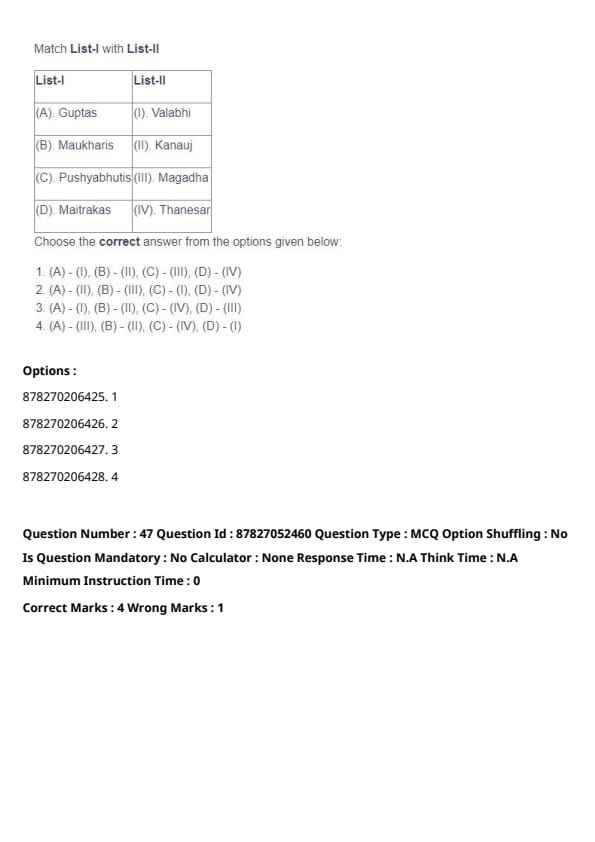
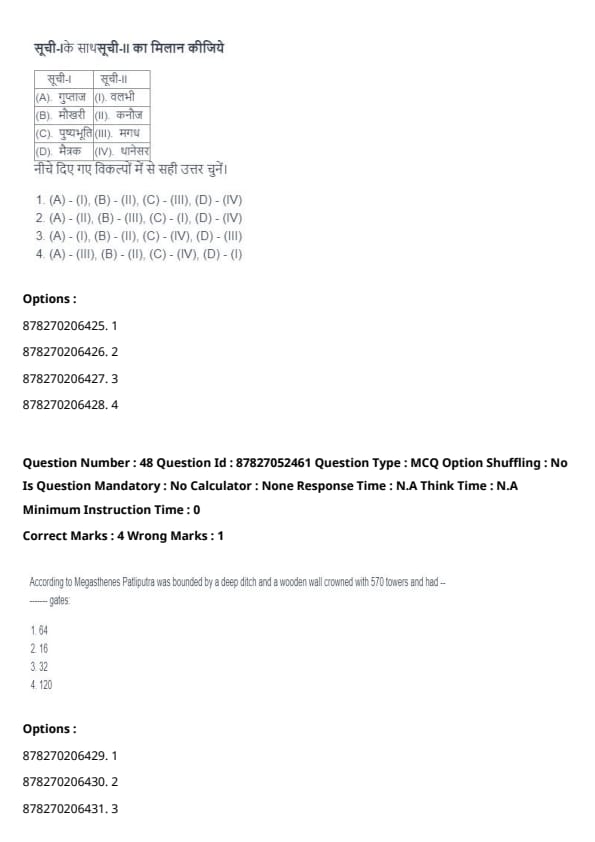
Match List-I with List-II:

View Solution
This question associates dynasties with their geographical centers. The Guptas were based in Magadha, the Maukhari dynasty in Kanauj, Pushyabhutis in Thanesar, and Maitrakas in Valabhi. Quick Tip: Focus on the geographical and political associations of Indian dynasties for matching-type questions.
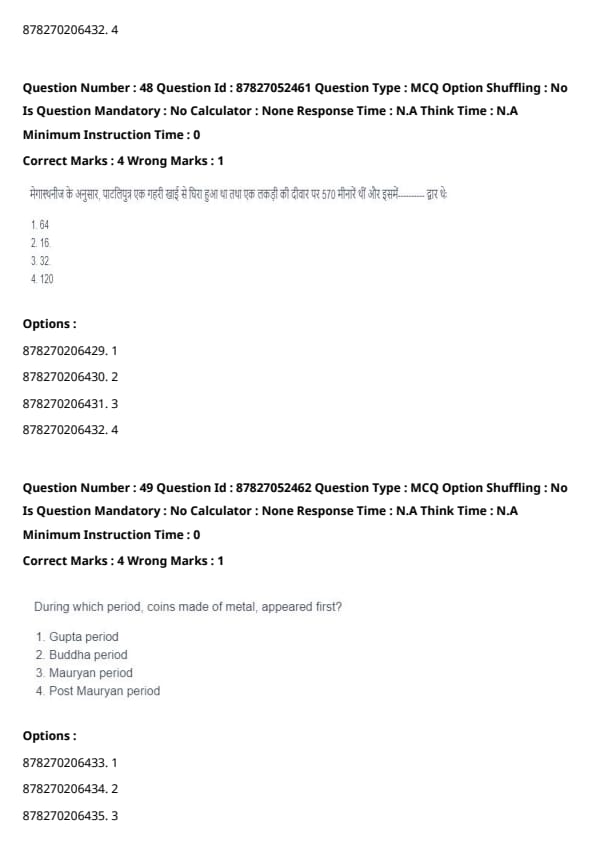
According to Megasthenes, Pataliputra was bounded by a deep ditch and a wooden wall crowned with 570 towers and had how many gates?
View Solution
Megasthenes described Pataliputra as a highly fortified city with 64 gates and 570 towers. This account provides valuable insights into the city's urban planning and defense mechanisms during the Mauryan period. Quick Tip: Pay attention to descriptions of ancient cities by foreign travelers to gain insights into their architecture and administration.
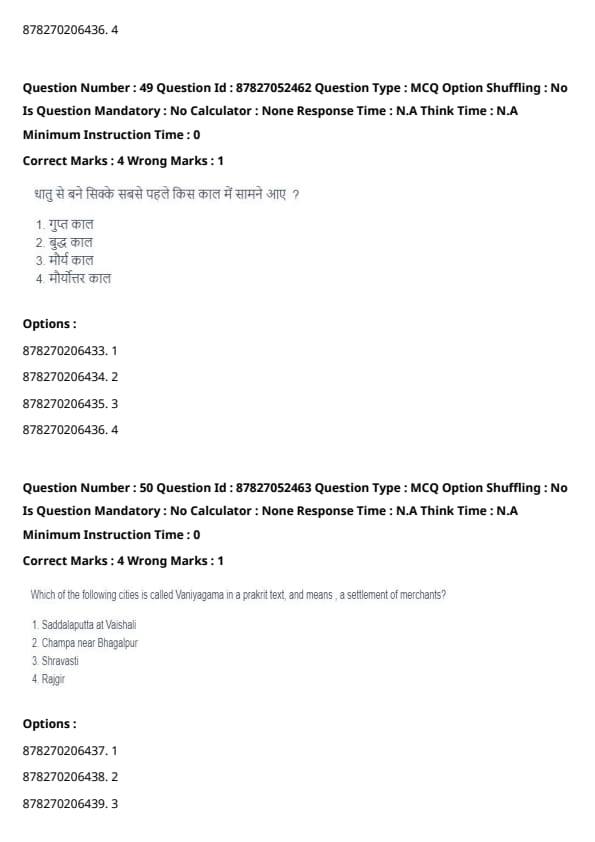
During which period did coins made of metal first appear?
View Solution
Metallic coins first appeared during the time of the Buddha in the 6th century BCE. These were punch-marked coins, often made of silver, and are among the earliest forms of currency in India. Quick Tip: Learn the evolution of coinage in India to understand the economic transitions across periods.
Which of the following cities is called Vaniyagama in a Prakrit text, meaning a settlement of merchants?
View Solution
Champa near Bhagalpur is referred to as Vaniyagama in a Prakrit text. The term indicates the city's prominence as a commercial hub for merchants and trade activities. Quick Tip: Study city names and their linguistic origins to understand their roles in trade and administration.
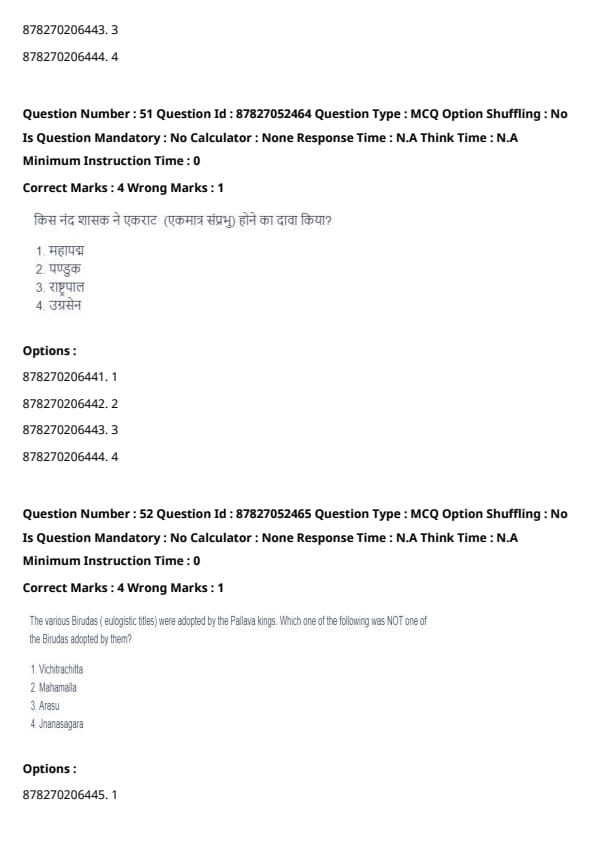
Which Nanda ruler claimed to be ekrat (the sole sovereign)?
View Solution
Mahapadma Nanda, the founder of the Nanda dynasty, claimed the title of ekrat (sole sovereign). He is credited with establishing a centralized and vast empire in northern India. Quick Tip: Focus on the titles and achievements of rulers to understand their political aspirations.
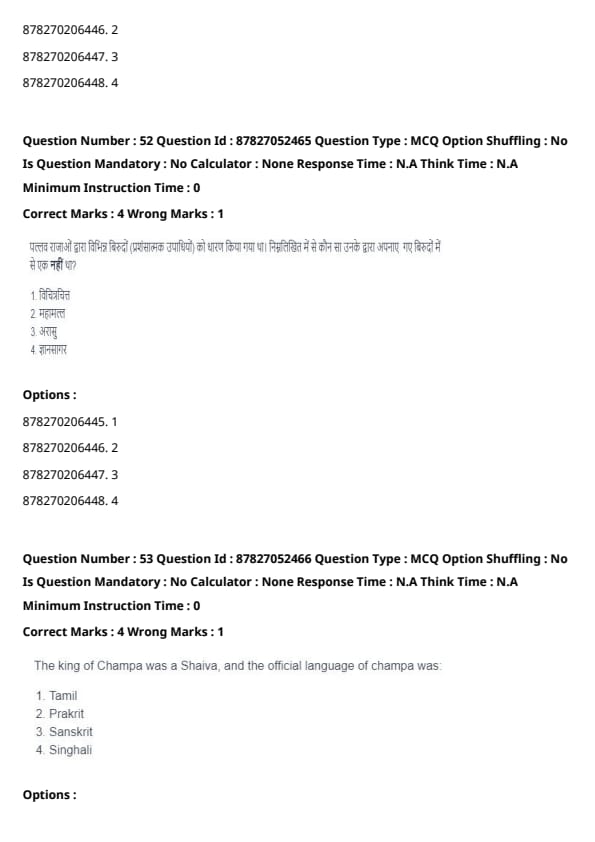
The various Birudas (eulogistic titles) were adopted by the Pallava kings. Which one of the following was NOT one of the Birudas adopted by them?
View Solution
The Pallava kings adopted titles such as Vichitrachitta, Mahamalla, and Jnanasagara to highlight their attributes and accomplishments. However, Arasu was not one of their titles. Quick Tip: Learn the titles used by rulers to connect them with their achievements and cultural significance.
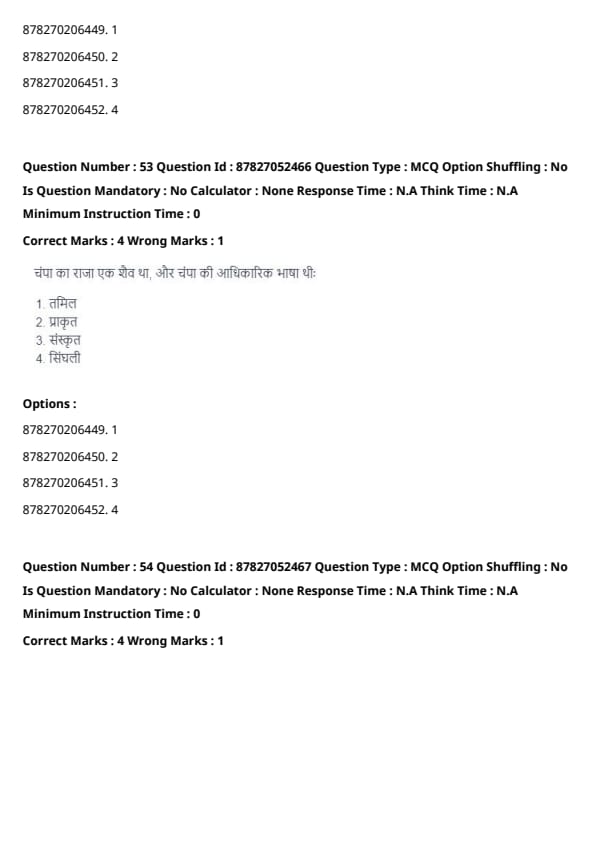
The king of Champa was a Shaiva, and the official language of Champa was:
View Solution
The kings of Champa were Shaivites, and Sanskrit was the official language of the kingdom. This reflects the influence of Indian culture and religion in Southeast Asia. Quick Tip: Study the spread of Indian culture to Southeast Asia to understand its linguistic and religious impact.
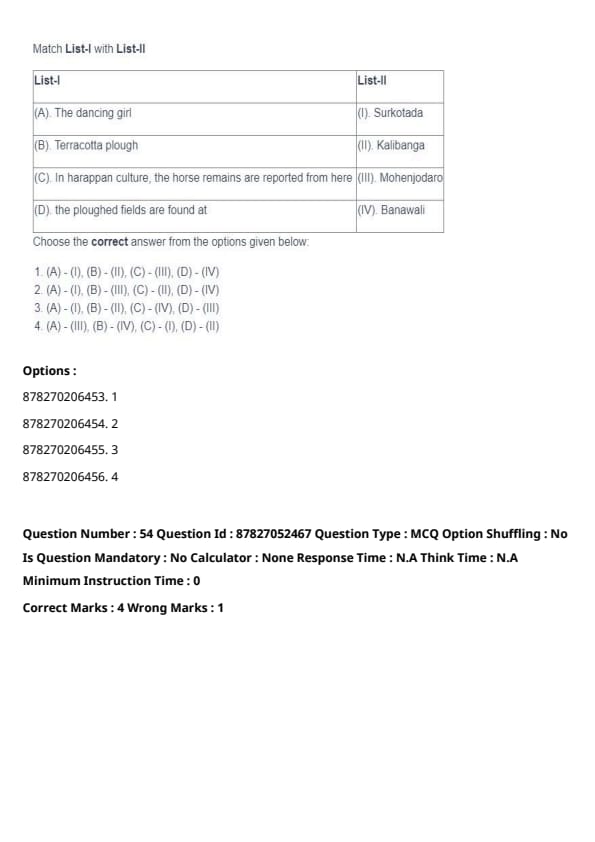
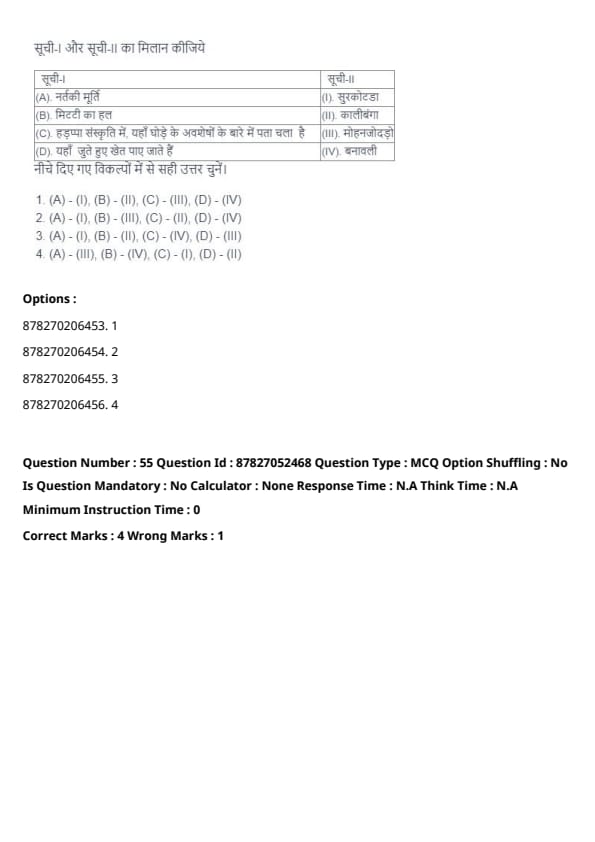
Match List-I with List-II:

View Solution
The correct matching is:
- (A) The dancing girl - (III) Mohenjodaro
- (B) Terracotta plough - (IV) Banawali
- (C) In Harappan culture, the horse remains are reported from here - (I) Surkotada
- (D) The ploughed fields are found at - (II) Kalibanga
Thus, the correct answer is Option (D) Quick Tip: Match artifacts and findings with their respective Harappan sites to understand their cultural and historical significance.
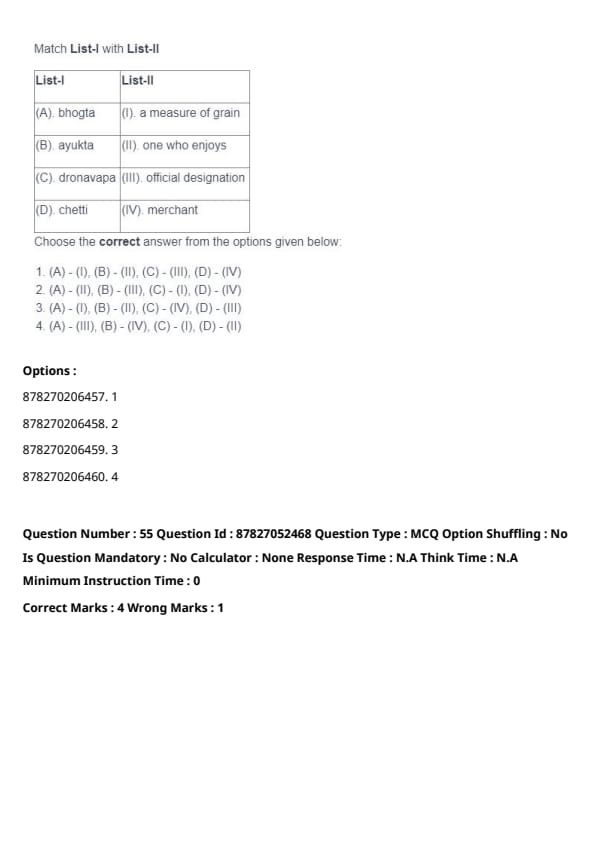
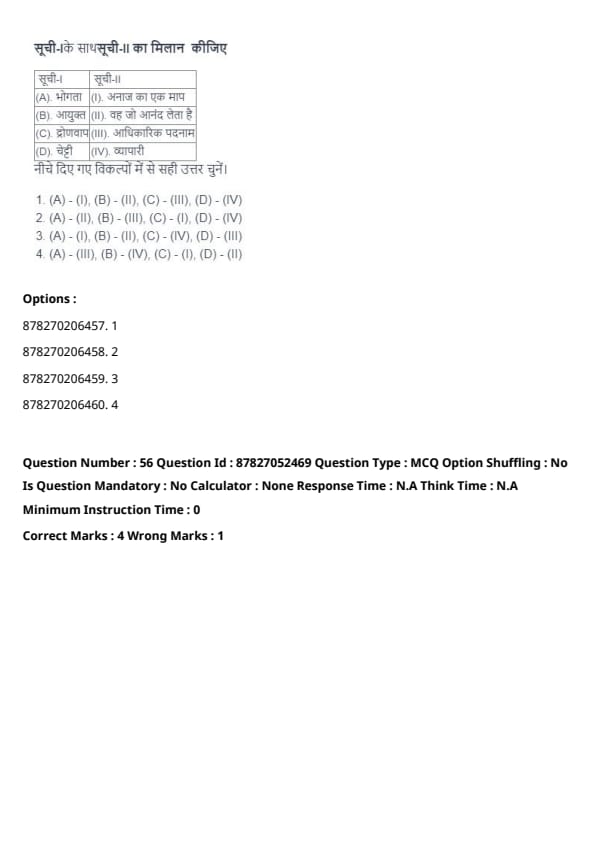
Match List-I with List-II:

View Solution
The correct matching is:
- (A) bhogta - (II) one who enjoys
- (B) ayukta - (III) official designation
- (C) dronavapa - (I) a measure of grain
- (D) chetti - (IV) merchant
Thus, the correct answer is Option (B) Quick Tip: Study the terminologies and their meanings in the context of ancient Indian administrative and economic systems.
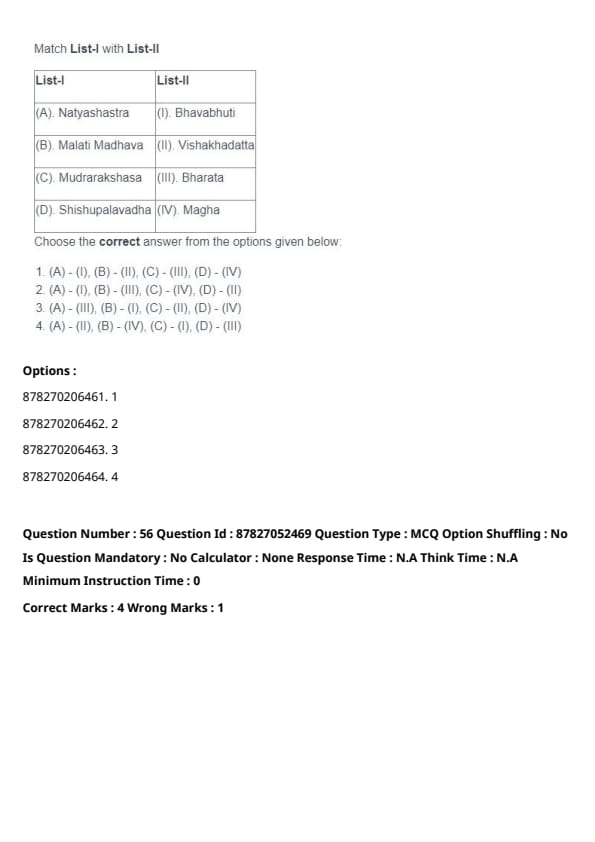
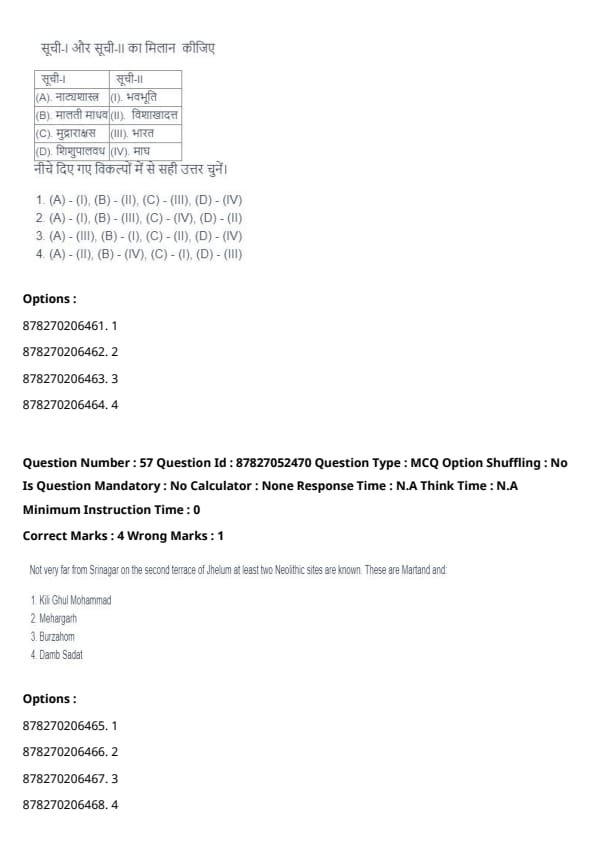
Match List-I with List-II:

View Solution
The Natyashastra, an ancient treatise on performing arts, is attributed to Bharata. Malati Madhava is authored by Bhavabhuti, Mudrarakshasa by Vishakhadatta, and Shishupalavadha by Magha. Quick Tip: Understanding authorship of classical texts helps in tracing literary and historical developments.
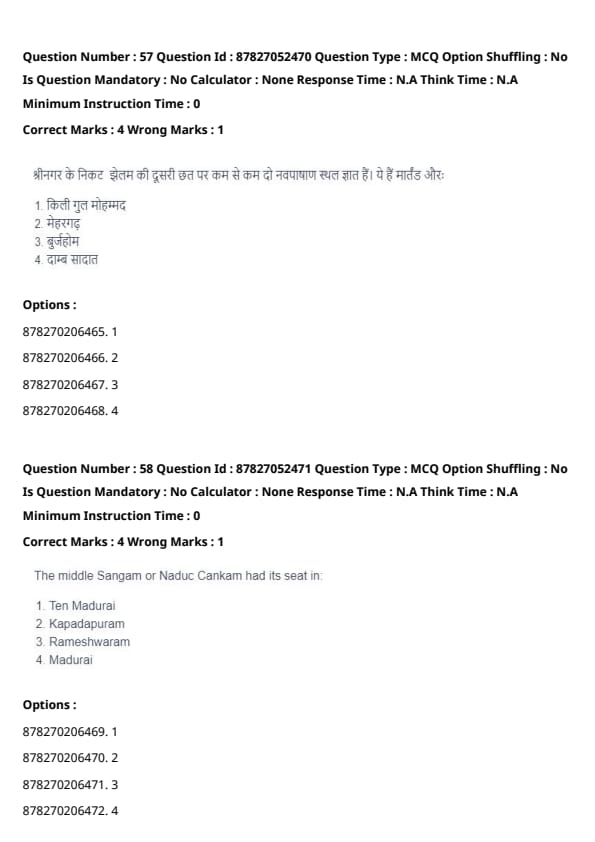
Not very far from Srinagar, on the second terrace of Jhelum, at least two Neolithic sites are known. These are Martand and:
View Solution
Burzahom, near Srinagar, is a prominent Neolithic site that features evidence of pit dwellings, tools, and early agriculture, highlighting the development of prehistoric settlements in Kashmir. Quick Tip: Focus on regional Neolithic cultures for insights into early human settlement and lifestyle.
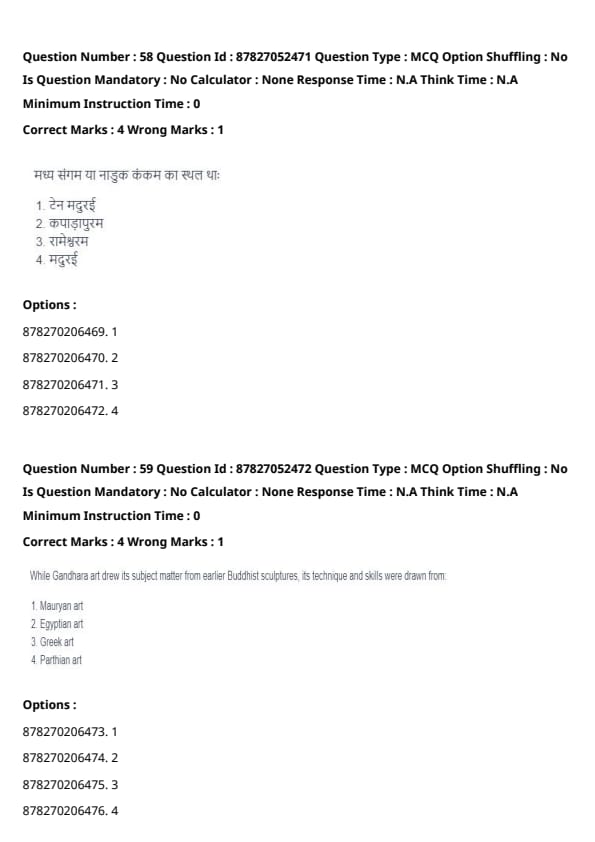
The middle Sangam or Naduc Cankam had its seat in:
View Solution
The seat of the middle Sangam was at Kapadapuram. The Sangam assemblies were centers of literary and cultural activities in ancient Tamilakam. Quick Tip: Learn the chronology and seats of Sangam assemblies to understand Tamil literary history.
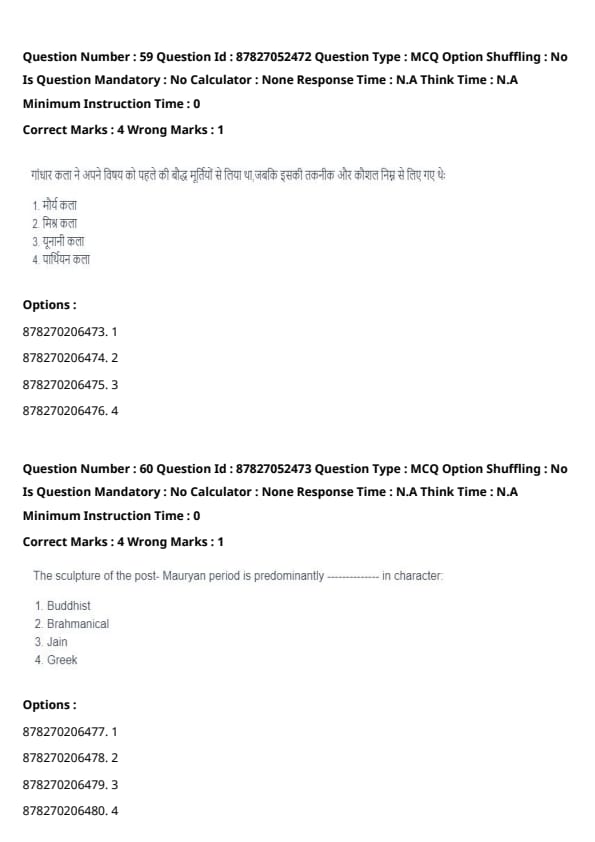
While Gandhara art drew its subject matter from earlier Buddhist sculptures, its technique and skills were drawn from:
View Solution
Gandhara art represents a fusion of Buddhist themes with Greco-Roman artistic techniques, evident in the naturalistic depiction of human figures and drapery. Quick Tip: Study the cross-cultural influences in art to understand regional stylistic developments.
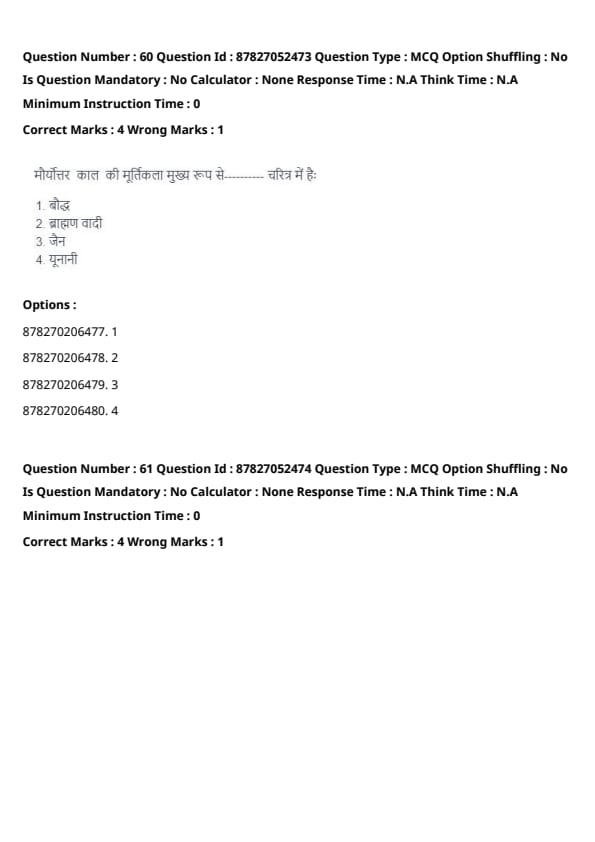
The sculpture of the post-Mauryan period is predominantly:
View Solution
Post-Mauryan sculpture predominantly reflects Buddhist themes, as seen in stupas, chaityas, and vihara decorations, exemplified by sites like Sanchi and Bharhut. Quick Tip: Explore regional variations in post-Mauryan art to understand its cultural contexts.
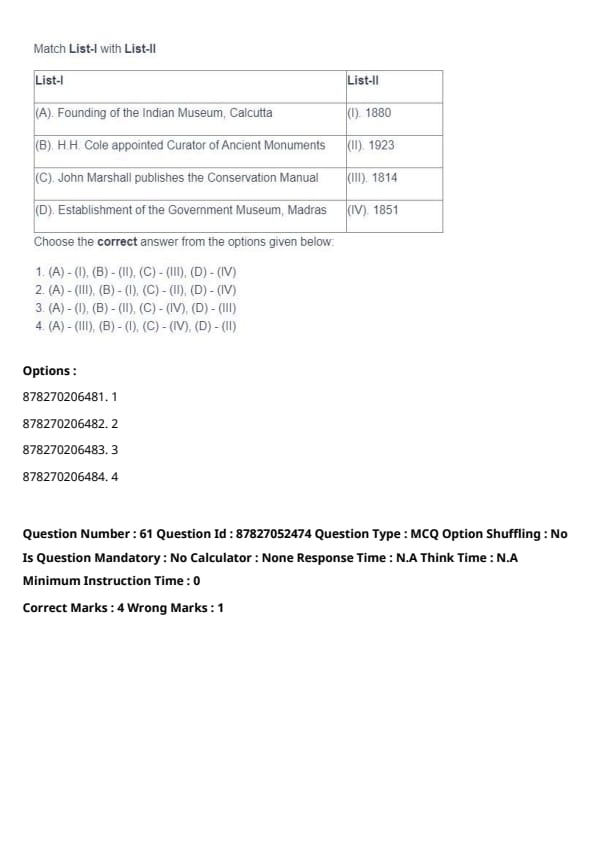
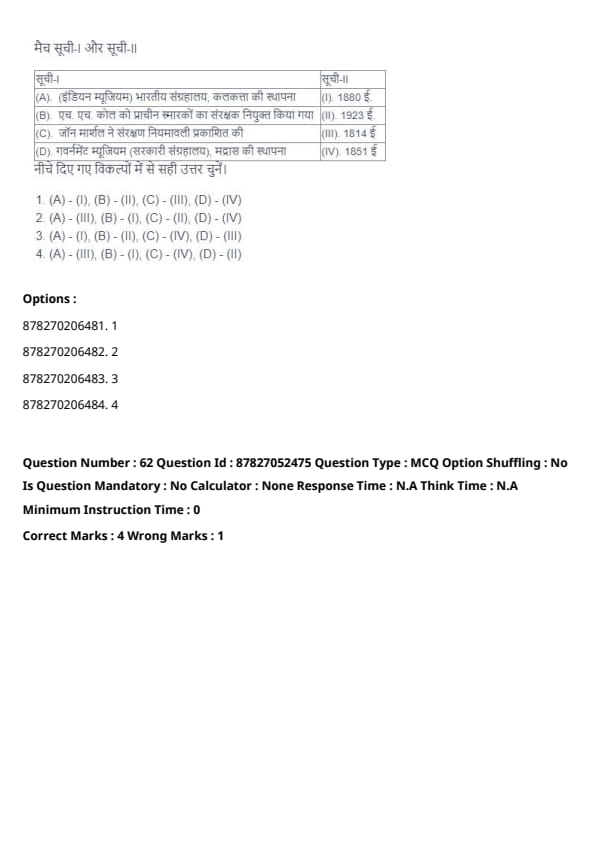
Match List-I with List-II:

View Solution
The Indian Museum in Calcutta was founded in 181(D) H.H. Cole was appointed curator in 1880, John Marshall published his Conservation Manual in 1923, and the Government Museum in Madras was established in 185(A) Quick Tip: Learn the chronology of museum establishments to trace heritage conservation in India.
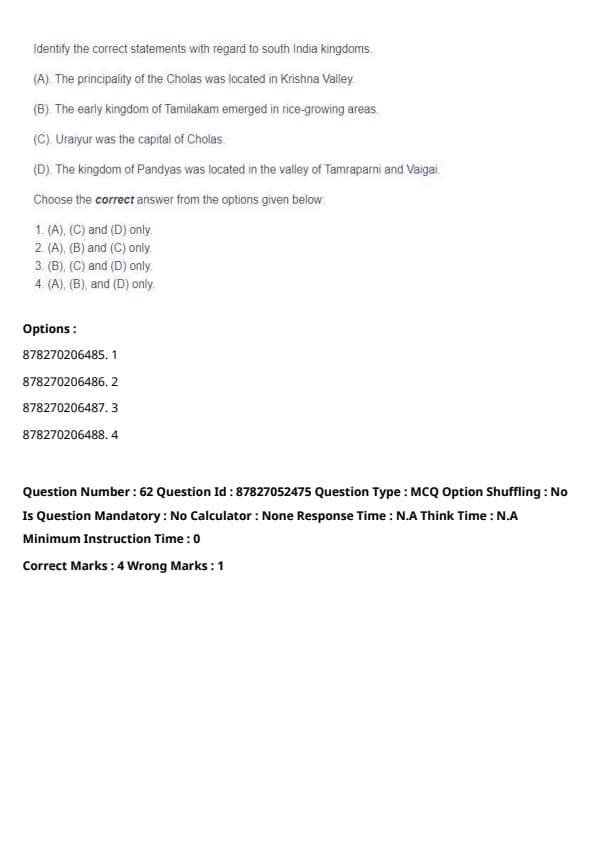
Identify the correct statements with regard to South Indian kingdoms:
(A) The principality of the Cholas was located in Krishna Valley.
(B) The early kingdom of Tamilakam emerged in rice-growing areas.
(C) Uraiyur was the capital of Cholas.
(D) The kingdom of Pandyas was located in the valley of Tamraparni and Vaigai.
View Solution
The Chola kingdom was not located in the Krishna Valley but centered in Tamil Nadu. Tamilakam primarily thrived in rice-growing regions. Uraiyur was indeed the Chola capital, and the Pandyas resided in the Tamraparni and Vaigai river valleys. Quick Tip: Focus on geographical and cultural specifics to accurately distinguish regional kingdoms.
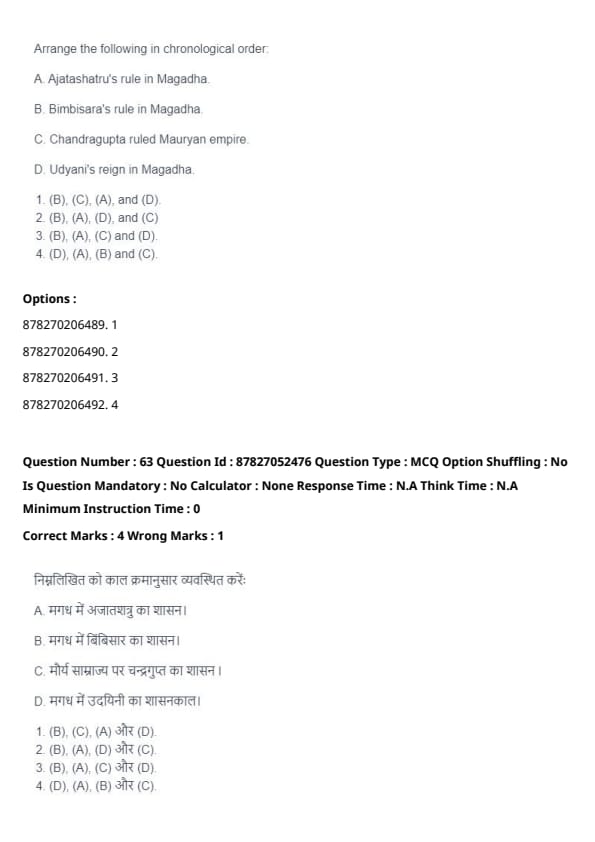
Arrange the following in chronological order:
(A) Ajatashatru's rule in Magadha
(B) Bimbisara's rule in Magadha
(C) Chandragupta ruled Mauryan Empire
(D) Udyani's reign in Magadha
View Solution
The correct chronology starts with Bimbisara's rule in Magadha, followed by his successor Ajatashatru. Udyani’s reign in Magadha comes after them, and Chandragupta Maurya's rule marks the beginning of the Mauryan Empire. This sequence reflects the evolution of political leadership in ancient Magadha. Quick Tip: For chronological questions, focus on the order of rulers and their contributions to understand the timeline of political developments.
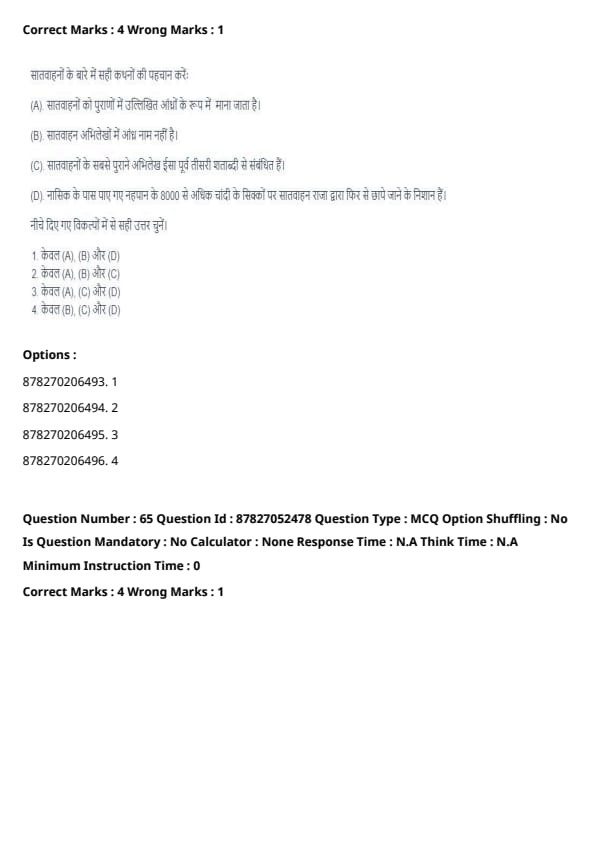
Identify the correct statements about the Satavahanas:
(A) The Satavahanas are considered to be the same as the Andhras mentioned in the Puranas.
(B) The name Andhra does not figure in Satavahana inscriptions.
(C) The earliest inscriptions of the Satavahanas relate to the third century BCE.
(D) Over 8,000 silver coins of Nahapana, found near Nasik, bear the marks of having been re-struck by the Satavahana king.
View Solution
The Satavahanas are identified with the Andhras mentioned in the Puranas. The name Andhra does not appear in their inscriptions, supporting this interpretation. Additionally, over 8,000 coins of Nahapana found near Nasik were re-struck by a Satavahana king, demonstrating their conquests and economic control. Statement (C) is incorrect, as their earliest inscriptions do not date back to the third century BCE. Quick Tip: Focus on the epigraphic evidence and archaeological findings to understand the Satavahanas’ political and economic strategies.
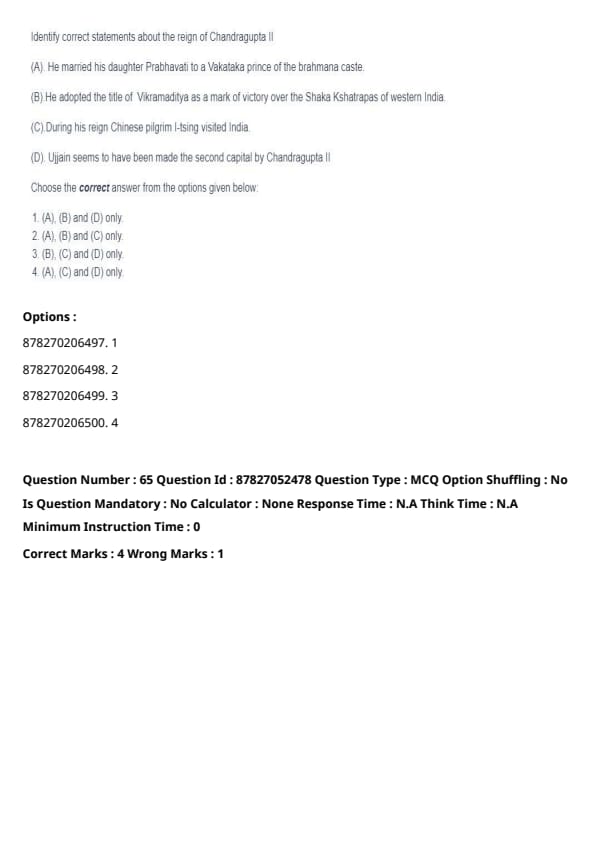
Identify correct statements about the reign of Chandragupta II:
(A) He married his daughter Prabhavati to a Vakataka prince of the Brahmana caste.
(B) He adopted the title of Vikramaditya as a mark of victory over the Shaka Kshatrapas of western India.
(C) During his reign, Chinese pilgrim I-tsing visited India.
(D) Ujjain seems to have been made the second capital by Chandragupta II.
View Solution
Chandragupta II strengthened alliances through marital connections, assumed the title Vikramaditya after defeating the Shakas, and likely established Ujjain as a second capital. However, I-tsing visited much later during Harsha’s reign. Quick Tip: Focus on key titles and policies of prominent rulers to identify their historical significance.
What is true about the Kushanas?
(A) The Kushanas used high-sounding titles such as devaputras.
(B) Religious donations by people for the well-being of the kings.
(C) Institution of devakulas, which involved the housing of statues of dead rulers.
(D) Only Buddhism and Jainism thrived under Kushanas in North India.
View Solution
- (A) is true: The Kushanas were known to use high-sounding titles such as devaputras (sons of gods).
- (B) is true: Religious donations were made by people for the well-being of the kings, a common practice under the Kushanas.
- (C) is true: The institution of devakulas involved housing statues of deceased rulers, a significant feature of Kushana rule.
- (D) is false: While Buddhism and Jainism thrived, other religions, including local cults and Vedic traditions, also coexisted under the Kushanas.
Hence, the correct answer is (A), (B), and (C) only. Quick Tip: Understand the socio-religious context of the Kushanas, including their titles, religious practices, and institutions like devakulas.
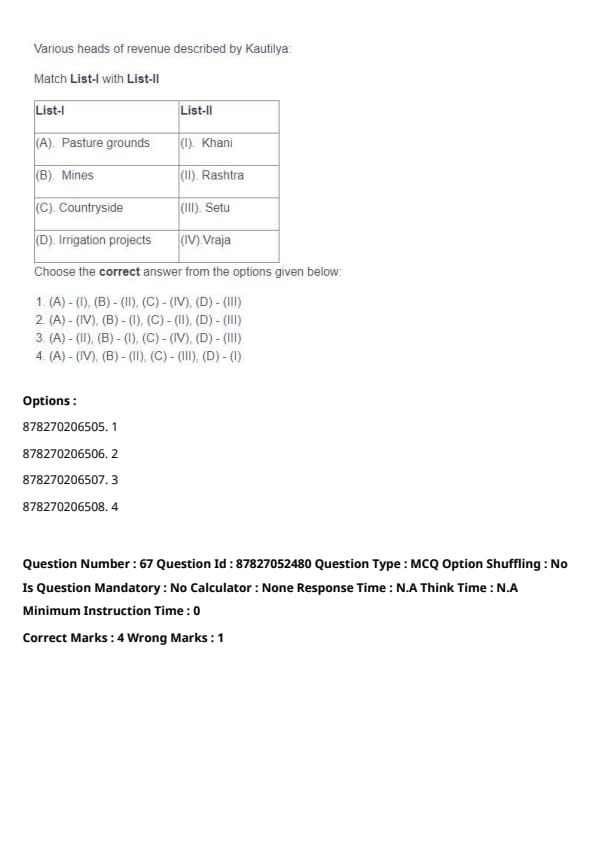
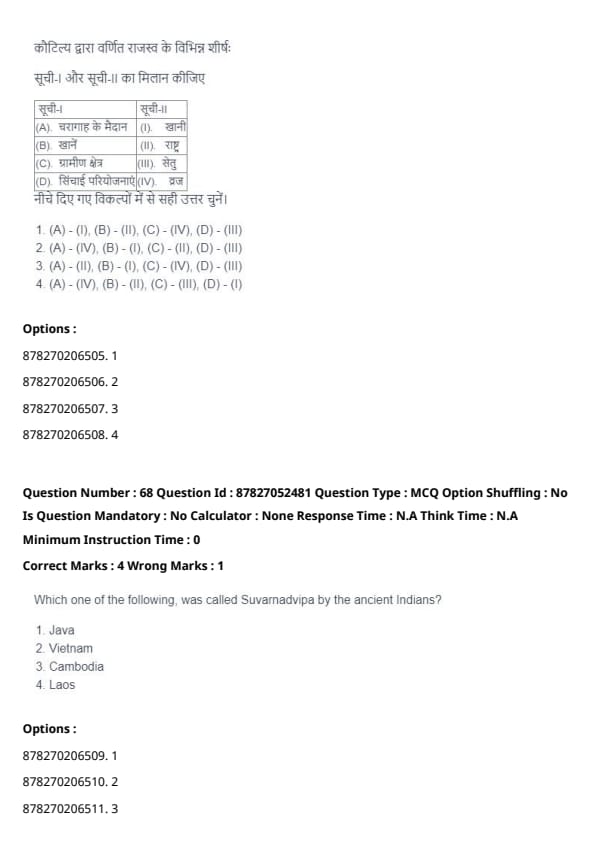
Match List-I with List-II:

View Solution
Kautilya’s Arthashastra categorizes revenues from pasture grounds (Vraja), mines (Khani), countryside (Rashtra), and irrigation projects (Setu). These terms represent critical aspects of Mauryan administration. Quick Tip: Understanding economic classifications in Arthashastra aids in comprehending ancient administrative systems.
Which one of the following was called Suvarnadvipa by the ancient Indians?
View Solution
Suvarnadvipa, meaning "island of gold," was a term used by ancient Indians to describe Java. This was due to Java's significant economic importance and trade connections with India, particularly in commodities like gold. Quick Tip: Study ancient trade routes and terminologies to understand regional interactions in history.
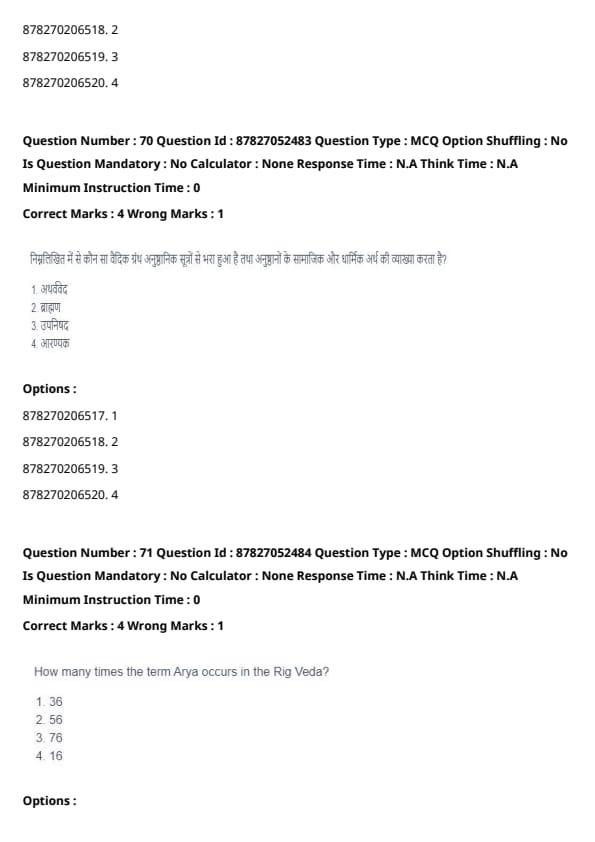
Which of the following speaks at length about the ploughing rituals in the later Vedic period?
View Solution
The Shatapatha Brahmana provides detailed accounts of ploughing rituals, emphasizing their significance in the agrarian economy of the later Vedic period. These rituals reflected the importance of agriculture as a cornerstone of Vedic society. Quick Tip: Brahmanas offer crucial insights into Vedic rituals and the socio-economic structure of ancient India.
Which of the following Vedic texts are replete with ritualistic formulae and explain the social and religious meaning of rituals?
View Solution
The Brahmanas are prose texts attached to the Vedas that elaborate on the details of Vedic rituals and their social and religious significance. These texts serve as a guide for performing rituals and understanding their meanings within the Vedic tradition. Quick Tip: Study the Brahmanas to gain insight into the practical aspects of Vedic rituals and their symbolism.
How many times does the term Arya occur in the Rig Veda?
View Solution
The term Arya occurs 36 times in the Rig Veda, primarily referring to the noble or civilized individuals in contrast to non-Aryan groups. The usage signifies socio-cultural distinctions of the time. Quick Tip: Review Vedic texts for sociolinguistic terms to understand ancient social hierarchies and identities.
The propagation of Buddhism promoted India's contact with Southeast Asian countries. Short inscriptions in Brahmi script related to the 2nd and 1st centuries BC have been found in:
View Solution
Brahmi inscriptions from the 2nd and 1st centuries BC have been discovered in Sri Lanka, reflecting the early spread of Buddhism and cultural exchanges facilitated by this religion. Quick Tip: Trace Buddhist propagation routes to understand India's cultural influence on Southeast Asia.
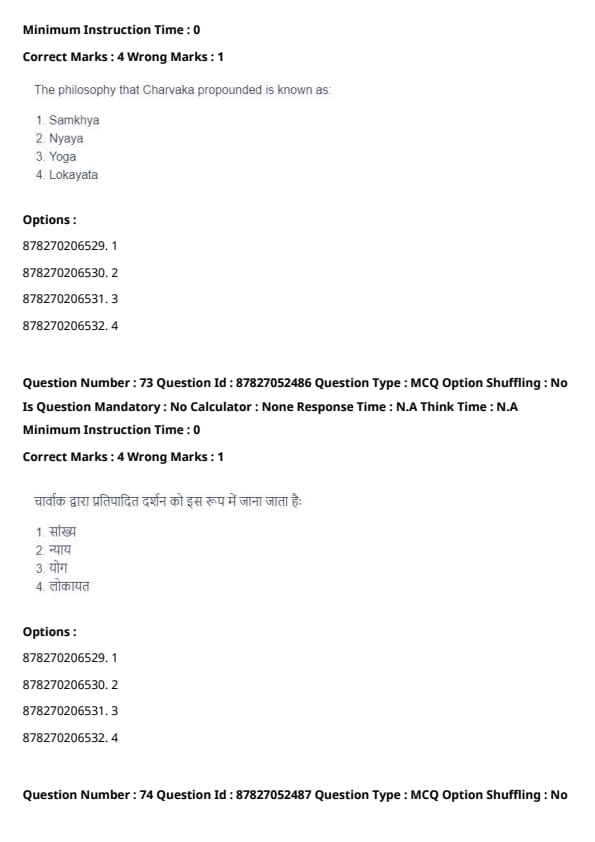
The philosophy that Charvaka propounded is known as:
View Solution
The Charvaka philosophy, also known as Lokayata, is a materialistic and skeptical school of thought in ancient India. It rejected rituals and the concept of the afterlife, focusing on material pleasures as the ultimate goal. Quick Tip: Explore Lokayata to study alternative viewpoints in Indian philosophy.
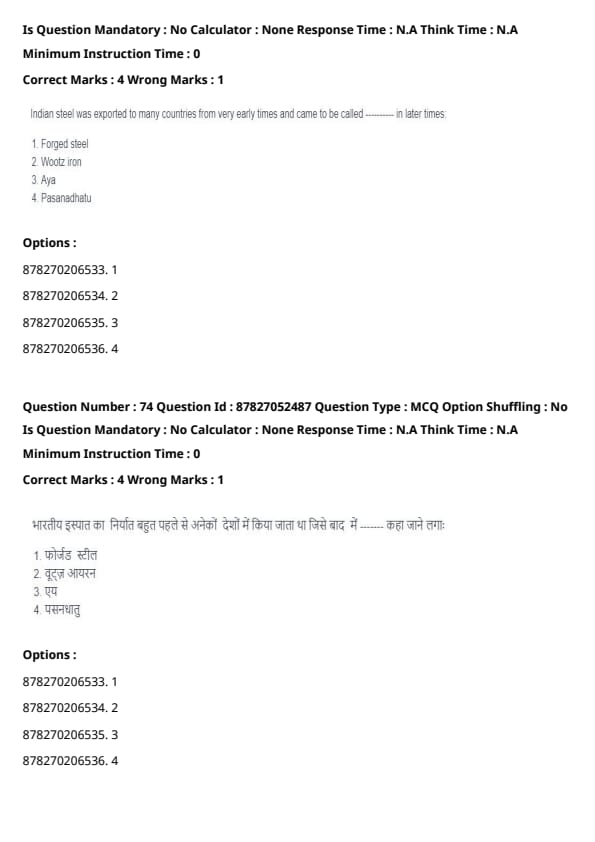
Indian steel was exported to many countries from very early times and came to be called in later times:
View Solution
Wootz iron, a high-quality steel with superior properties, was exported from India to various countries. Known for its remarkable strength and durability, it was highly sought after in ancient trade. Quick Tip: Research India's metallurgical contributions to understand its advanced technologies in ancient times.
The main body of the text (the Charaka Samhita) presents itself as containing knowledge received by Agnivesha from his teacher, named:
View Solution
Charaka Samhita, a foundational text in Ayurveda, attributes its teachings to Agnivesha, who received this knowledge from his teacher, Atreya. This highlights the teacher-disciple lineage in ancient Indian medical sciences. Quick Tip: Study the Charaka Samhita for foundational concepts in traditional Indian medicine.














































*The article might have information for the previous academic years, please refer the official website of the exam.