CUET PG 2024 Anthropology Question Paper Pdf- Check Solutions with Answer Key Pdf
- Question Paper 2025
- Question Paper 2024
- Question Paper 2023
- Mathematics Papers
- Statistics Question Paper
- English Question Paper
- Chemistry Question Paper
- Pol. Sci. Question Paper
- History Question Paper
- Commerce Question Papers
- Life Science Papers
- Geology Question Papers
- Journalism Question Paper
- B.Ed. HSS Question Paper
- Botany Question Paper
- B.Ed. Question Papers


Content Strategist | Updated On - Jan 15, 2025
CUET PG Anthropology 28th March 2024 Shift 3 Question Paper with Solution PDF is available for download here. Students found Physical Anthropology easy, Cultural Anthropology moderate, and Archaeological Anthropology difficult. Archaeological Anthropology carried the highest weightage, and the overall difficulty level was moderate to difficult.
CUET PG 2024 Anthropology Question Paper with Answer Key PDF
| CUET PG 2024 Anthropology Question Paper with Answer Key |  Download Download |
Check Solution |
CUET PG 2024 Anthropology Questions with Solutions
Question 1:
Who defined the past of human society in terms of technological and chronological stages marked by the successive use of tools made of stone, bronze, and iron (called Three-Age System)?
View Solution
Christian J. Thomsen introduced the concept of the Three-Age System, dividing prehistoric tools into the Stone, Bronze, and Iron Ages.
Question 2:
Which is the correct sequence of the following glacial/inter-glacial periods arranged from the first to the last?
- (A) Gunz
- (B) Wurm
- (C) Mindel
- (D) Riss
Options:
View Solution
The correct sequence of glacial/inter-glacial periods is: Gunz (A), Mindel (C), Riss (D), and Wurm (B).
Question 3:
Mesolithic period gained recognition as a separate cultural identity among European scholars only after the discovery of the type site:
View Solution
The Mesolithic period was recognized as distinct due to findings at Mas'd Az, highlighting its unique cultural traits.
Question 4:
Who developed the radioactive Carbon-14 (C14) method to determine the age of prehistoric artifacts?
View Solution
W.F. Libby developed the Carbon-14 dating method, revolutionizing archaeology by providing a means to determine the age of ancient organic materials.
Question 5:
Which of the following is/are the Chalcolithic culture(s) of India?
- (A) Kayatha
- (B) Meghula
- (C) Malwa
- (D) Jorwe
Options:
View Solution
The Kayatha, Malwa, and Jorwe cultures are notable Chalcolithic cultures of India, distinguished by their distinctive pottery and settlement patterns.
Question 6:
Match List-I with List-II:
| Main Urban Metropolis Sites of Indus Valley Civilization | State / Country |
|---|---|
| (A) Mohenjo-daro | (I) Gujarat |
| (B) Lothal | (II) Haryana |
| (C) Kalibangan | (III) Pakistan |
| (D) Banawali | (IV) Rajasthan |
Options:
View Solution
The matching is: Mohenjo-daro (Pakistan), Lothal (Gujarat), Kalibangan (Rajasthan), Banawali (Haryana).
Question 7:
Which technique is used for the manufacture of 'Upper Palaeolithic Blades'?
View Solution
The Punching technique was commonly used to manufacture blades during the Upper Palaeolithic period by striking flakes off a core.
Question 8:
Arrange the prehistoric cultural periods according to their appearance from first to last:
- (A) Solutrean
- (B) Azilian
- (C) Acheulean
- (D) Aurignacian
Options:
View Solution
The correct sequence of cultural periods is: Acheulean (C), Aurignacian (D), Solutrean (A), and Azilian (B), which represent a progression in tool-making and cultural complexity.
Question 9:
Match List-I with List-II:
| Tool Type | Cultural Period |
|---|---|
| (A) Backed point | (I) Chatelperronian |
| (B) Small pointed blade with one side blunted | (II) Aurignacian |
| (C) Eyed needles | (III) Gravettian |
| (D) "Steep" and "nosed" scrapers | (IV) Solutrean |
Options:
View Solution
The matching is: Backed point (Chatelperronian), Small pointed blade (Aurignacian), Eyed needles (Gravettian), "Steep" and "nosed" scrapers (Solutrean).
Question 10:
Who among the following are prehistorians?
- (A) Robert Bruce Foote
- (B) Patterson
- (C) H.H. Risley
- (D) H.D. Sankalia
Options:
View Solution
Robert Bruce Foote, Patterson, and H.D. Sankalia are prominent prehistorians known for their significant contributions to archaeology and the study of prehistoric cultures.
Question 11:
Moraines are used to study:
View Solution
Moraines are geological features formed by the accumulation of debris transported by glaciers. They help study past and present glacial movements and patterns.
Question 12:
Which of the following pottery-wares are found in India?
- (A) Rouletted Ware
- (B) Painted Grey Ware
- (C) Terracotta Chinese Painted Ware
- (D) Northern Black Polished Ware
Options:
View Solution
Rouletted Ware, Painted Grey Ware, and Northern Black Polished Ware are significant pottery types found in archaeological sites across India, reflecting diverse cultural practices.
Question 13:
Which of the following are correct?
- (A) Black-and-Red Ware: Red inside up to the rim and black on the outer surface
- (B) Ashmound: It is a characteristic feature of Northwest Mesolithic culture
- (C) BP: Before Present
- (D) Core: A piece of stone from which flakes are removed by striking it
Options:
View Solution
BP (Before Present) is a standard term for dating events, and a core is a fundamental tool in lithic industries for creating flakes.
Question 14:
The term Holocene means:
View Solution
The Holocene epoch is the current geological epoch, beginning approximately 11,700 years ago, characterized as "entirely recent."
Question 15:
Which of the following are megalithic types?
- (A) Menhir
- (B) Dolmen
- (C) Burin
- (D) Topi-kal
Options:
View Solution
Menhir and Dolmen are common megalithic types used as commemorative or burial markers. Burin is a tool, not a megalithic type.
Question 16:
Which of the following are true about Mesolithic rock art culture in India?
View Solution
A. Carlleyle first discovered rock paintings in India. Mesolithic rock art sites are mainly concentrated in the Vindhyas, especially in Mirzapur.
Question 17:
Which of the following tool is/are not Geometric Microlith(s)?
View Solution
Hand axes are not considered Geometric Microliths. Geometric Microliths are small, pointed tools like lunates, triangles, and trapezes.
Question 18:
Bhimbetka rock shelter is located in which state?
View Solution
Bhimbetka rock shelters are located in Madhya Pradesh and are UNESCO World Heritage Sites known for their ancient rock art.
Question 19:
Match List-I with List-II:
| Geological Epoch | Approximate Time (Before Present) |
|---|---|
| (A) Oligocene | (I) 55 million |
| (B) Pliocene | (II) 12 million |
| (C) Eocene | (III) 35 million |
| (D) Miocene | (IV) 25 million |
Options:
View Solution
The correct matches are: Oligocene (25 million), Pliocene (12 million), Eocene (35 million), and Miocene (55 million).
Question 20:
Choose the correct sequence of the following tool techniques from the earliest to latest:
View Solution
The sequence starts with the Block-on-anvil technique, followed by the Cylinder hammer technique, then Pressure flaking, and finally Grinding and polishing.
Question 21:
Why is the Venus of Willendorf believed to be used as fertility cult?
View Solution
The Venus of Willendorf is believed to symbolize fertility due to its exaggerated physical features representing childbearing and nourishment.
Question 22:
Match List-I with List-II:
| Books | Authors |
|---|---|
| (A) Prehistory and Protohistory in India and Pakistan | (I) Allchin Bridget and Raymond Allchin |
| (B) Archaeology from the Earth | (II) Mortimer Wheeler |
| (C) The Rise of Civilisation in India and Pakistan | (III) D.K. Bhattacharya |
| (D) An Outline of Indian Prehistory | (IV) H.D. Sankalia |
Options:
View Solution
The correct matches are:
- Prehistory and Protohistory in India and Pakistan: Allchin Bridget and Raymond Allchin
- Archaeology from the Earth: Mortimer Wheeler
- The Rise of Civilisation in India and Pakistan: D.K. Bhattacharya
- An Outline of Indian Prehistory: H.D. Sankalia
Question 23:
Which of the following is/are true about Kalibangan site?
- (A) It is located in Tamil Nadu
- (B) A ploughed field was discovered at Kalibangan
- (C) It is located in Rajasthan
- (D) Found in the Rift valley
Options:
View Solution
Kalibangan is an important Harappan site located in Rajasthan. It is notable for the discovery of a ploughed field, indicating advanced agricultural practices.
Question 24:
Which of the following Neolithic sites is located on the banks of River Ghaghra in Bihar?
View Solution
Chirand, located on the banks of the Ghaghra River in Bihar, is a significant Neolithic site known for its advanced stone tools and pottery.
Question 25:
Which of the following is NOT part of a cell?
View Solution
Germplasm refers to genetic material used in breeding and conservation, whereas the other options are integral parts of a cell.
Question 26:
Which of the following are correct about Lamarck's theory of evolution?
View Solution
Lamarck's theory emphasizes the inheritance of acquired characters and changes in organs due to use and disuse. Concepts like "survival of the fittest" are from Darwin's theory, not Lamarck's.
Question 27:
Who among the following inspired Charles Darwin's work on evolution?
View Solution
Thomas Malthus' essay on population growth influenced Darwin's concept of natural selection by highlighting the competition for limited resources.
Question 28:
What are the advantages of using blood as a genetic marker?
View Solution
Blood groups are effective genetic markers as they originated early, are easily identifiable, and exhibit stable frequencies in populations.
Question 29:
A father with O+ and a mother with B+ blood group can have children with the following blood groups:
View Solution
A father with genotype OO and a mother with genotype BO can produce children with either B (BO) or O (OO) blood types.
Question 30:
Inborn error of metabolism due to chromosomal aberration leading to Edward's Syndrome is caused by which condition?
View Solution
Edward's Syndrome is caused by Trisomy 18, where an individual has three copies of chromosome 18, resulting in severe developmental issues.
Question 31:
Which types of RNA are involved in protein synthesis?
View Solution
Protein synthesis involves mRNA, which carries the genetic code from DNA, and tRNA, which brings the appropriate amino acids for the growing polypeptide chain.
Question 32:
Match List-I with List-II:
| List-I | List-II |
|---|---|
| (A) Heterozygous | (I) An individual having two copies of different alleles |
| (B) Completely dominant | (II) The allele that masks the effect of the other allele |
| (C) Sex-linked | (III) Baldness |
| (D) Sex-limited | (IV) Beard, Moustache |
Options:
View Solution
Heterozygous describes an individual with two different alleles. A completely dominant allele masks another. Sex-linked traits include baldness, and sex-limited traits like beard growth are restricted by gender.
Question 33:
Which of the following is the correct sequence in Mitosis?
View Solution
Mitosis begins with prophase (chromosome condensation), followed by metaphase (alignment), anaphase (separation), and telophase (reformation of nuclei).
Question 34:
Which of the following is NOT a force of evolution?
View Solution
Overpopulation is not an evolutionary force. Mutation, natural selection, and genetic drift drive evolutionary changes in populations.
Question 35:
Match List-I with List-II:
| List-I | List-II |
|---|---|
| (A) Stereoscopic | (I) Eyes |
| (B) Pendulous | (II) Mammary glands |
| (C) Pectoral in position | (III) Limbs |
| (D) Prehensile | (IV) Penis |
Options:
View Solution
Stereoscopic vision pertains to depth perception (eyes), pendulous describes organs like the penis, pectoral positioning refers to mammary glands, and prehensility describes limb grasping.
Question 36:
Which of the following is NOT an anatomical change for bipedalism?
View Solution
The supra-orbital ridge becoming less prominent is associated with craniofacial changes, not specifically with bipedal locomotion.
Question 37:
What is the dental formula of the Old World monkeys?
View Solution
The dental formula 2:1:2:3 is characteristic of Catarrhine primates, including Old World monkeys and apes.
Question 38:
Match List-I with List-II:
| List-I (Hominids) | List-II (Discovery) |
|---|---|
| (A) Homo erectus javanensis | (I) Eugene Dubois |
| (B) Australopithecus africanus | (II) Raymond Dart |
| (C) Homo erectus narmadensis | (III) Arun Sonakia |
| (D) Australopithecus robustus | (IV) Robert Broom |
Options:
View Solution
Eugene Dubois discovered Homo erectus javanensis, Raymond Dart identified Australopithecus africanus, Arun Sonakia discovered Homo erectus narmadensis, and Robert Broom worked on Australopithecus robustus.
Question 39:
Culture is defined as an “instrumental reality, and apparatus for the satisfaction of the biological and derived need" by:
View Solution
Malinowski emphasized that culture functions as an apparatus to meet biological needs and the derived social needs of humans.
Question 40:
Who is known to possess 'Disharmonic Face-skull'?
View Solution
Grimaldi man exhibited disharmonic features like a broad face, short stature, and pronounced brow ridges, distinguishing them from other early Homo sapiens.
Question 41:
Which vertebral bone articulates with the base of the skull?
View Solution
The atlas (C1 vertebra) articulates with the occipital condyles at the base of the skull, enabling nodding movements.
Question 42:
How did the Neanderthal man possibly disappear?
- (A) Due to catastrophic meeting with more advanced Homo sapiens
- (B) Transformed into Homo sapiens due to environmental pressure
- (C) Due to severe cold during glaciation
- (D) Due to pluviation
Options:
View Solution
The Neanderthal disappearance is attributed to competition or conflict with Homo sapiens and the inability to adapt to the severe cold during the last glaciation period.
Question 43:
How is the human head uprightly well-balanced?
View Solution
The centrally placed foramen magnum aligns the skull directly over the vertebral column, aiding balance in an upright posture.
Question 44:
Which is/are the only movable bone of the skull?
View Solution
The mandible, or lower jawbone, is the only movable bone of the skull, facilitating chewing and speaking.
Question 45:
Which of the following statement is correct about the human skeleton?
View Solution
The human skull typically comprises 22 bones, including cranial and facial bones.
Question 46:
How does the human body attain genetic potentials completely after nutritional insult?
View Solution
Catch-up growth refers to the rapid growth seen in children who recover from a period of nutritional or environmental deprivation, allowing them to reach their genetic potential.
Question 47:
Which of the following is NOT a Mongoloid feature in terms of Racial Classification?
View Solution
Prognathism is typically associated with Negroid features and not Mongoloid racial characteristics.
Question 48:
Match List-I with List-II:
| List-I (Culture revealed at Kayatha) | List-II (Time Period) |
|---|---|
| (A) Kayatha culture | (I) Ca. 1950-1700 BC |
| (B) Ahar culture | (II) Ca. 2450-2000 BC |
| (C) Malwa culture | (III) Ca. 1700-1400 BC |
| (D) Early Historic | (IV) Ca. 600 BC-200 BC |
Options:
View Solution
The timeline for the respective cultures aligns as follows:
- (A) Kayatha culture - Ca. 2450-2000 BC
- (B) Ahar culture - Ca. 1950-1700 BC
- (C) Malwa culture - Ca. 1700-1400 BC
- (D) Early Historic - Ca. 600 BC-200 BC
Question 49:
Race formation is a complex process where several factors are involved. These may be:
View Solution
Race formation involves mutation introducing variability, natural selection favoring advantageous traits, and genetic drift causing allele frequency changes.
Question 50:
Why is BMI assessed?
View Solution
Body Mass Index (BMI) is primarily used to evaluate an individual's nutritional status, determining if they are underweight, normal weight, overweight, or obese.
Question 51:
Why is Man considered to be more evolved than Apes?
- (A) Larger brain size in relation to the body weight
- (B) Articulating speech
- (C) Bipedalism
- (D) Teeth adapted for mixed diet
Options:
View Solution
Humans are considered more evolved due to larger brain size enabling complex cognition, articulating speech for communication, and bipedal locomotion offering efficiency and tool usage.
Question 52:
Match List-I with List-II:
| List-I (Statistical Measure) | List-II (Statistical Test) |
|---|---|
| (A) Non-normal distribution | (I) Kolmogorov-Smirnov's Test |
| (B) Central Tendency | (II) Mean, Median, Mode |
| (C) Normal Distribution | (III) Chi-square test |
| (D) Dispersion | (IV) Standard Deviation |
Options:
View Solution
Non-normal distribution is tested by Kolmogorov-Smirnov's Test. Measures of central tendency include Mean, Median, Mode. Chi-square test applies to Normal Distribution, and dispersion is measured by Standard Deviation.
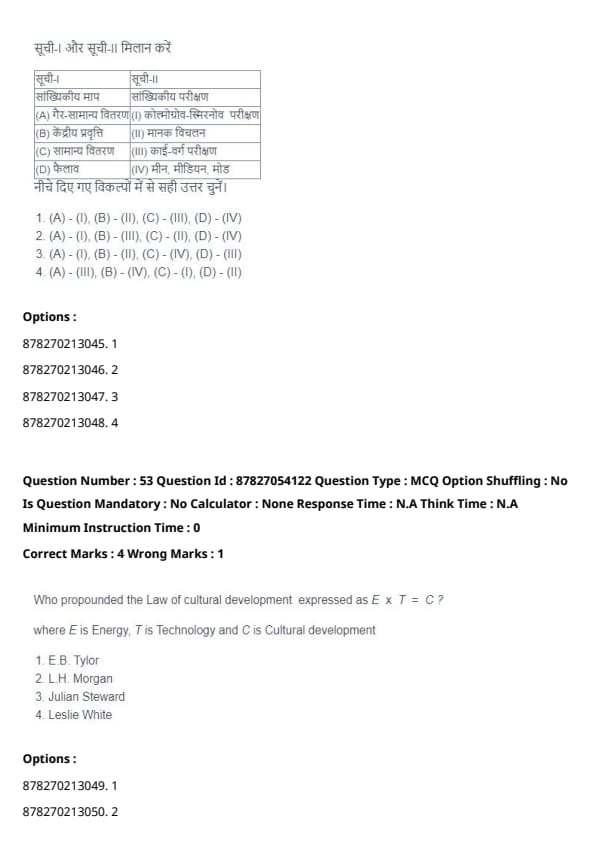
Question 53:
Who propounded the Law of cultural development expressed as \( E \times T = C \)?
where \( E \) is Energy, \( T \) is Technology, and \( C \) is Cultural Development.
View Solution
Leslie White proposed the equation \( E \times T = C \), emphasizing that cultural development is a function of energy harnessed and technological efficiency.
Question 54:
Match List-I with List-II:
| List-I (Basic Needs) | List-II (Cultural Response) |
|---|---|
| (A) Reproduction | (I) Kinship |
| (B) Safety | (II) Protection |
| (C) Body comforts | (III) Shelter |
| (D) Health | (IV) Hygiene |
Options:
View Solution
Reproduction aligns with kinship, safety with protection, body comforts with shelter, and health with hygiene as cultural responses to basic human needs.
Question 55:
Match List-I with List-II:
| List-I (School of Thought) | List-II (Name) |
|---|---|
| (A) British Evolutionary School | (I) E.B. Tylor |
| (B) American Evolutionary School | (II) L.H. Morgan |
| (C) American Neo-Evolutionist | (III) Julian H. Steward |
| (D) German Evolutionist | (IV) A. Bastian |
Options:
View Solution
E.B. Tylor is associated with the British Evolutionary School, L.H. Morgan with the American Evolutionary School, Julian H. Steward with American Neo-Evolutionism, and A. Bastian with German Evolutionism.
Question 56:
In Kinship, the person of reference is known as:
View Solution
In kinship studies, the "ego" is the central individual from whose perspective kinship relationships are mapped and analyzed.
Question 57:
In terms of degree of kinship, your sister's husband is your:
View Solution
Your sister's husband is not directly related to you by blood but through marriage (affinal kin). As he is not in the immediate circle, he is considered secondary kin.
Question 58:
Match List-I with List-II:
| List-I (Terms) | List-II (Definition) |
|---|---|
| (A) Avunculocal | (III) Couples live with or near the husband's mother's brother |
| (B) Levirate | (I) A widow marries deceased husband's brother |
| (C) Polyandry | (IV) One woman marries two or more men |
| (D) Exogamy | (II) Marriage out of one's own social group |
Options:
View Solution
Avunculocal refers to couples living near the husband's mother's brother. Levirate involves marrying the deceased husband's brother. Polyandry describes one woman marrying multiple men, while exogamy is marriage outside one’s group.
Question 59:
Which of the following is NOT the function of a family?
View Solution
Family primarily serves roles like sexual, reproductive, and economic functions, while transport and communication are societal infrastructural functions.
Question 60:
Which of the following are correct?
- (A) Edmund Leach was an American social anthropologist.
- (B) Rousseau described the Indians as ‘noble savage’ of the golden age of natural man.
- (C) Montesquieu published his Esprit des Lois, based on reading and not on travel.
- (D) Some people call Herodotus ‘the father of Anthropology’.
Options:
View Solution
Edmund Leach was a British social anthropologist, making statement (A) incorrect. Statements (B), (C), and (D) correctly describe Rousseau, Montesquieu, and Herodotus respectively.
Question 61:
Which of the following statements are NOT correct?
Options:
View Solution
This question is dropped as per the answer key provided, and no evaluation is necessary. Please move to the next question.
Question 62:
According to Max Weber, which of the following are 'Categories of power'?
Options:
View Solution
Weber categorized power into legal, traditional, and charismatic authorities. Religious authority is not considered a distinct category in Weber's classification.
Question 63:
Arrange the following scheme of development of human societies based on the socio-economic and political-religion parameters in correct sequence:
Options:
View Solution
Human societies evolved socio-economically and politically in the order: Band (simplest, egalitarian), Tribe (larger, kin-based), Chiefdom (centralized leadership), and State (complex and institutionalized governance).
Question 64:
According to Dalton (1971), the three important characteristics of the primitive economy are:
Options:
View Solution
Primitive economies, as outlined by Dalton, are characterized by reciprocity, simple technologies, and comparative geographical or cultural isolation.
Question 65:
Regarding the evolution of culture, science, and religion, which of the following sequences are correct?
Options:
View Solution
The correct sequences reflect the anthropological understanding of cultural evolution: Magic-Religion-Science represents intellectual progression, and Savagery-Barbarism-Civilization represents societal evolution.
Question 66:
Match List-I with List-II:
| List-I (Anthropologist) | List-II (Fieldwork among) |
|---|---|
| (A) Radcliffe Brown | (III) Andaman Islanders |
| (B) Franz Boas | (IV) Baffin Land and British Columbia |
| (C) Malinowski | (I) Trobiand Islanders of Malanesia |
| (D) Edmund Leach | (II) High Land Burma among the Kachins |
Options:
View Solution
Radcliffe Brown conducted fieldwork among the Andaman Islanders, Franz Boas in Baffin Land and British Columbia, Malinowski among the Trobiand Islanders, and Edmund Leach in High Land Burma.
Question 67:
Why is Ruth Benedict's work "The Chrysanthemum and the Sword: Patterns of Japanese Culture" considered as "Applied Anthropology"?
View Solution
Ruth Benedict's work was commissioned by the U.S. government to understand Japanese culture during World War II, marking it as a significant applied anthropology effort.
Question 68:
The ethnographic account based on fieldwork in "Argonauts of the Western Pacific" is a landmark publication in Anthropology.
View Solution
Bronislaw Malinowski's "Argonauts of the Western Pacific" is a foundational text in anthropology, introducing participant observation as a key fieldwork methodology.
Question 69:
The characteristics of culture are paradoxical because:
View Solution
Culture exists universally across human societies, yet its manifestations vary locally, creating a paradox of universality and diversity.
Question 70:
Which of the following is true about the "Slash and Burn" method of agriculture?
View Solution
The "Slash and Burn" method is a traditional agricultural practice involving clearing forests and burning vegetation, commonly referred to as Jhum or shifting cultivation.
Question 71:
Who is associated with the concept of "Sanskritization"?
View Solution
M.N. Srinivas coined the term "Sanskritization" to describe the process by which lower castes adopt rituals, practices, and ideologies of the upper castes to improve their status.
Question 72:
The tribal studies acronym "ITDP" stands for:
View Solution
Integrated Tribal Development Project (ITDP) is an initiative aimed at improving the socio-economic conditions of tribal communities by addressing their developmental needs.
Question 73:
Which of the following statements is correct about Questionnaire and Interview Schedule?
View Solution
In an Interview Schedule, the investigator actively records responses during a face-to-face interaction, whereas in a Questionnaire, the informant independently provides written responses.
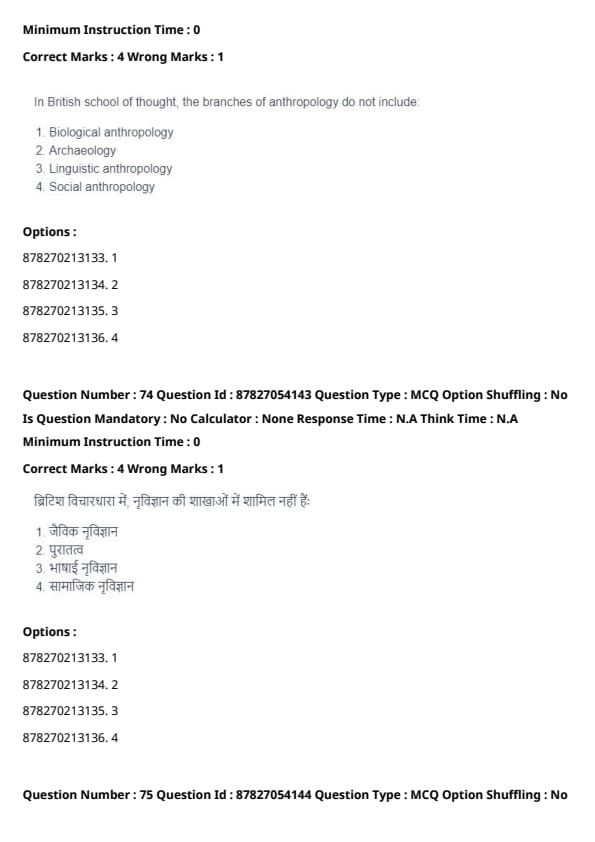
Question 74:
In the British school of thought, the branches of anthropology do not include:
View Solution
The British school traditionally emphasized Biological, Archaeological, and Social Anthropology but did not prioritize Linguistic Anthropology as a distinct branch.
Question 75:
Arrange the following authors and their books sequentially, starting from the earliest to the most recent:
- (A) Henry S Maine - Ancient Law
- (B) Charles Darwin - Origin of Species
- (C) Lewis Henry Morgan - Ancient Society
- (D) E.B. Tylor - Primitive Culture
Options:
View Solution
The chronological order is:
- Charles Darwin (1859) - "Origin of Species"
- Henry S Maine (1861) - "Ancient Law"
- E.B. Tylor (1871) - "Primitive Culture"
- Lewis Henry Morgan (1877) - "Ancient Society"












































































































*The article might have information for the previous academic years, please refer the official website of the exam.