CUET PG 2024 Atmospheric Science Question Paper Pdf- Check Solutions with Answer Key Pdf
- Question Paper 2025
- Question Paper 2024
- Question Paper 2023
- Mathematics Papers
- Statistics Question Paper
- English Question Paper
- Chemistry Question Paper
- Pol. Sci. Question Paper
- History Question Paper
- Commerce Question Papers
- Life Science Papers
- Geology Question Papers
- Journalism Question Paper
- B.Ed. HSS Question Paper
- Botany Question Paper
- B.Ed. Question Papers


Content Strategist | Updated On - Jan 15, 2025
CUET PG 2024 Atmospheric Science 22nd March 2024 Shift 1 Question Paper with Solution PDF is available for download here. Students found the Descriptive Meteorology section easy, the Climatology and Atmospheric Dynamics sections moderate, and the Advanced Atmospheric Physics section difficult. The Advanced Atmospheric Physics section carried the highest weightage, and the overall difficulty level was moderate to difficult
CUET PG 2024 Atmospheric Science Question Paper with Answer Key PDF
| CUET PG 2024 Atmospheric Science Question Paper with Answer Key |  Download Download |
Check Solution |
Atmospheric Science Questions with Solutions
Question 1:
On a hot summer day while travelling in a bus you notice a distant patch of road which appears to be wet. This phenomenon of mirage is due to:
View Solution
The phenomenon of mirage occurs due to total internal reflection. Light rays bend due to temperature gradients in the air, making distant objects appear displaced, especially on hot days.
Mirages occur because of the refraction and total internal reflection of light, especially in hot environments where temperature differences create layers of air with different densities.
Question 2:
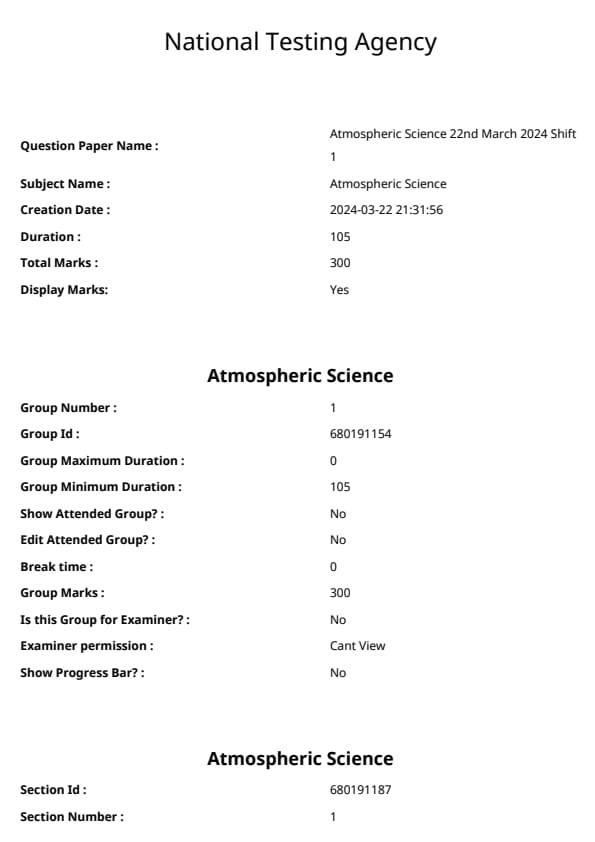
Arrange the principal gases of dry air in the decreasing order of their abundance in the atmosphere of the Earth:
Choose the correct answer from the options given below:
View Solution
The order of gases in Earth's atmosphere based on their abundance is: Argon, Carbon dioxide, Methane, and Krypton. Carbon dioxide is a trace gas but significant in climate dynamics.
The most abundant gases in the atmosphere are nitrogen and oxygen, with trace gases like carbon dioxide and methane influencing climate.
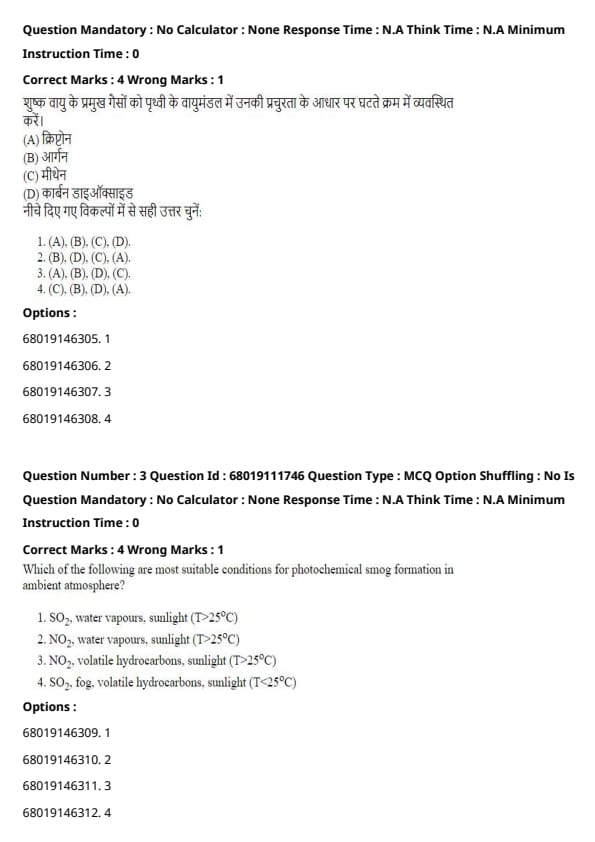
Question 3:
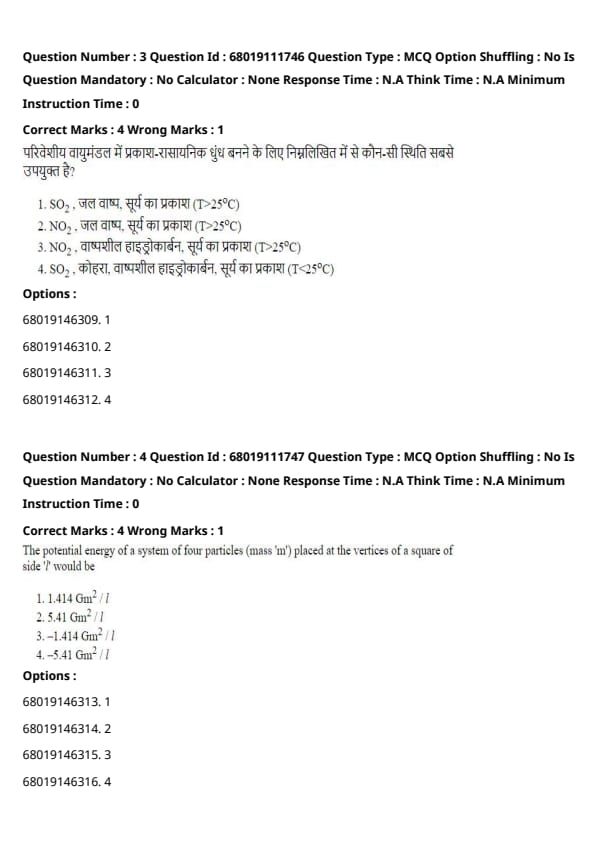
Which of the following are most suitable conditions for photochemical smog formation in ambient atmosphere?
View Solution
Photochemical smog forms when nitrogen oxides (NO2) and volatile organic compounds (VOCs) react with sunlight at high temperatures (above 25°C), producing harmful secondary pollutants.
Photochemical smog is common in urban areas with high vehicle emissions, especially under sunny, warm conditions.
Question 4:
The potential energy of a system of four particles (mass 'm') placed at the vertices of a square of side "l" would be:
View Solution
The potential energy of the system can be calculated by considering the gravitational potential energy between each pair of particles at the vertices of the square. The result is negative due to the attractive nature of the gravitational force.
Gravitational potential energy between particles depends on their distance and the masses involved. A negative potential energy indicates attraction.
Question 5:
Which of the following is NOT a criteria pollutant under National Ambient Air Quality Standards in India?
View Solution
Carbon dioxide is not a criteria pollutant under the National Ambient Air Quality Standards (NAAQS) in India, although it contributes to climate change. Criteria pollutants include substances like CO, Ozone, and PM10.
Carbon dioxide is a greenhouse gas, but it is not considered a local air quality issue like the criteria pollutants.
Question 6:
Average ocean salinity of 35 ppt can also be expressed as:
View Solution
The average ocean salinity is 35 parts per thousand (ppt), which is equivalent to 3.5% by mass.
Salinity is often expressed in ppt or percentage, with seawater averaging 3.5% salt content.
Question 7:
Consider the following list of processes. L = {P1, P2, P3, P4} having CPU bursts. T = {6, 8, 7, 4} in milliseconds. Applying shortest job first CPU scheduling, compute the average waiting time:
View Solution
By applying the Shortest Job First (SJF) scheduling algorithm, the processes are executed in the order of their burst times: P4 (4 ms), P1 (6 ms), P3 (7 ms), P2 (8 ms). The average waiting time is calculated by determining the waiting times for each process and averaging them.
Read More
SJF scheduling minimizes waiting time by processing the shortest tasks first, ensuring optimal scheduling when burst times are known in advance.
Question 8:
The hotter objects radiate more total energy per unit area than do colder objects. This concept is referred to as:
View Solution
The Stefan-Boltzmann law states that the total energy radiated by a blackbody is proportional to the fourth power of its temperature.
Read More
Hotter objects emit more energy at all wavelengths, and this is quantified by the Stefan-Boltzmann law.
Question 9:
Match List I with List II:
| List I | List II |
|---|---|
| (A) UV-Visible | (I) Vibrational motion |
| (B) Infrared | (II) Ejection of internal electron |
| (C) Microwave | (III) Ejection of outer electron |
| (D) X-rays | (IV) Rotational motion |
Choose the correct answer from the options given below:
View Solution
UV-Visible radiation causes electronic transitions, Infrared radiation excites vibrations, Microwaves induce rotational motion, and X-rays cause ionization of atoms.
Different types of electromagnetic radiation interact with matter in unique ways, depending on their energy and wavelength.
Question 10:
A cyclonic circulation denotes:
Choose the correct answer from the options given below:
View Solution
Cyclonic circulation refers to the rotation of air masses in a cyclone. In the Northern Hemisphere, cyclonic circulation is counterclockwise (A), while in the Southern Hemisphere, it is clockwise (C) due to the Coriolis effect.
The Coriolis effect causes moving air to turn left in the Southern Hemisphere and right in the Northern Hemisphere, influencing cyclonic systems.
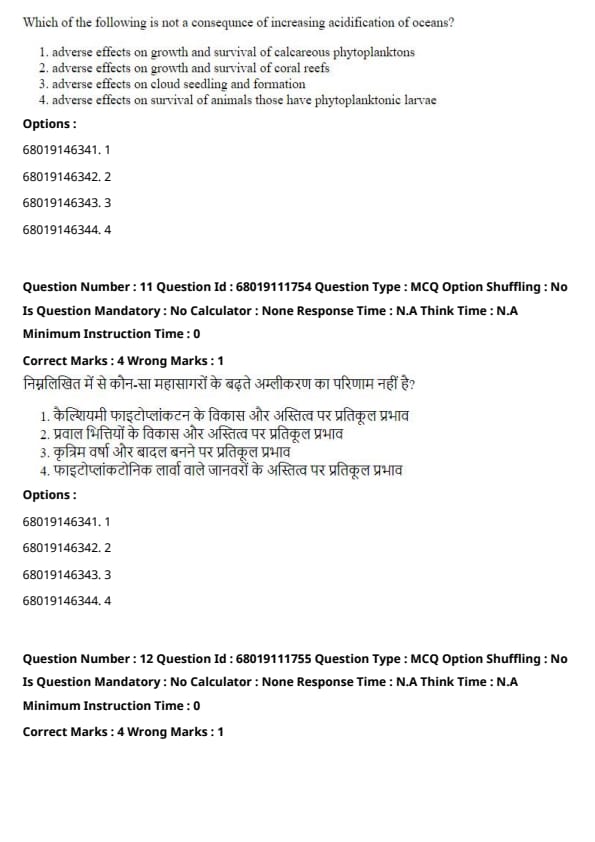
Question 11:
Which of the following is not a consequence of increasing acidification of oceans?
View Solution
Ocean acidification primarily impacts marine life, especially organisms that rely on calcium carbonate, such as phytoplanktons and coral reefs. It does not directly affect cloud seeding and formation.
Ocean acidification is caused by increased atmospheric CO2, leading to lower pH in seawater, which affects marine ecosystems.
Question 12:
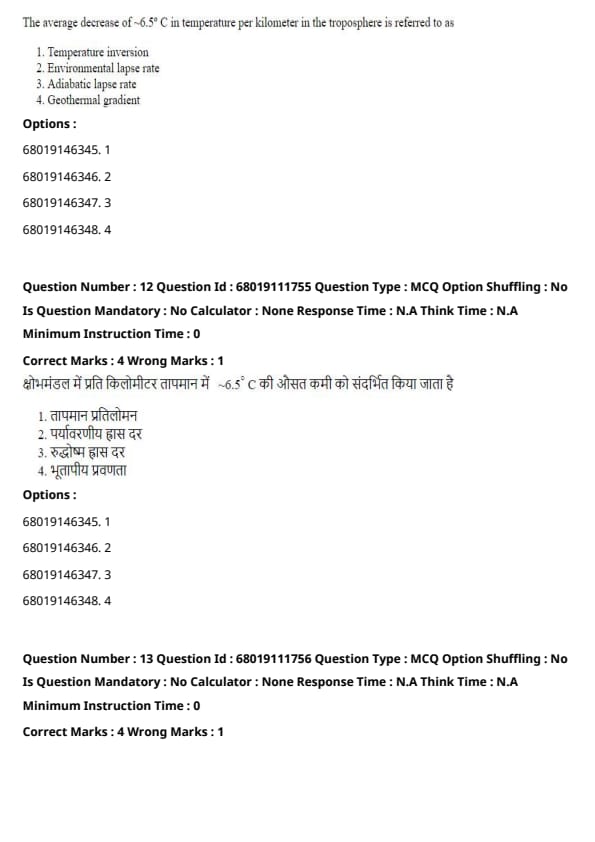
The average decrease of ~6.5°C in temperature per kilometer in the troposphere is referred to as:
View Solution
The environmental lapse rate refers to the rate at which temperature decreases with altitude in the troposphere. Typically, this rate is around 6.5°C per kilometer.
The environmental lapse rate is important for understanding atmospheric stability and weather patterns.
Question 13:
In rate-monotonic scheduling, the worst-case CPU utilization achieved for execution of N processes can be expressed as:
View Solution
In rate-monotonic scheduling, the worst-case CPU utilization for execution of N processes can be expressed as N(21/N - 1). This formula provides the worst-case utilization when tasks have different execution times and periods.
In rate-monotonic scheduling, higher priority is given to tasks with shorter periods, and the formula above calculates the worst-case CPU utilization.
Question 14:
The occurrence of aurora borealis and aurora australis takes place in the:
View Solution
Auroras occur in the thermosphere due to the interaction of charged particles from the solar wind with Earth's magnetic field. These particles excite atoms, causing them to emit light.
Read More
Auroras are visible near the poles and are caused by interactions between solar wind particles and Earth's magnetic field.
Question 15:
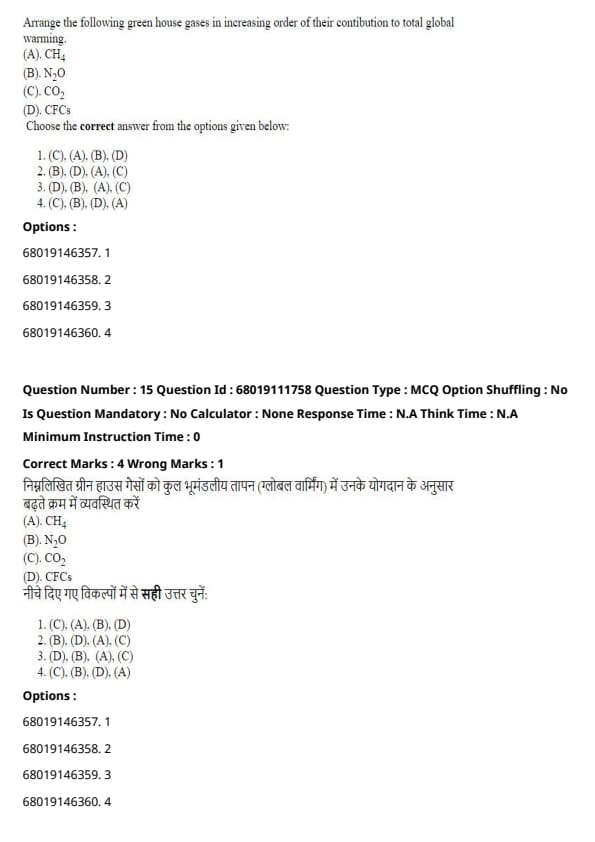
Arrange the following greenhouse gases in increasing order of their contribution to total global warming:
Choose the correct answer from the options given below:
View Solution
The contribution of greenhouse gases to global warming varies greatly due to differences in their global warming potential (GWP). CFCs have a much higher GWP compared to CO2 and methane. Nitrous oxide (N2O) has a higher GWP than CO2 but lower than CFCs. The order of increasing contribution to global warming is: N2O (B), CFCs (D), methane (CH4) (A), and CO2 (C).
Read More
Greenhouse gases like CFCs and methane have much higher global warming potentials than CO2, which is more abundant but less potent in warming.
Question 16:
Absolute humidity in ambient air at a given temperature T is 3 g/m³. Maximum absolute humidity at the same temperature T is 10 g/m³. What will the relative humidity at the same temperature T?
View Solution
Relative humidity is calculated as the ratio of the actual absolute humidity to the maximum absolute humidity at the same temperature. Here, (3/10) × 100 = 30%.
Relative humidity indicates how much moisture is in the air relative to the maximum amount it can hold at a given temperature.
Question 17:
The zone of atmospheric window falls in the wavelength range of:
View Solution
The atmospheric window is the range of wavelengths in the infrared region (8 to 12 µm) through which Earth's radiation escapes into space.
The atmospheric window allows for the escape of infrared radiation, which is important for Earth's energy balance.
Question 18:
Match List I with List II:
| Types of Scattering | Example |
|---|---|
| (A) Rayleigh scattering | (II) Blue Sky |
| (B) Mie scattering | (I) Haze |
| (C) Non-selective scattering | (IV) Cloud appears white |
| (D) Thomson scattering | (III) Scattering of low intensity light by electron |
Choose the correct answer from the options given below:
View Solution
Rayleigh scattering causes the blue sky, Mie scattering causes haze, Non-selective scattering causes white clouds, and Thomson scattering involves light scattered by electrons.
Scattering is classified based on the particle size relative to the wavelength of light.
Question 19:
Match List I with List II:
| Soil Type | Characteristics |
|---|---|
| (A) Oxisol | (IV) Highly weathered tropical and sub-tropical soils |
| (B) Spodosol | (I) Acid soil with leached upper horizon |
| (C) Entisol | (II) Young soils with no horizon |
| (D) Vertisol | (III) Clay rich soils |
Choose the correct answer from the options given below:
View Solution
Oxisols are highly weathered tropical soils (A - IV), Spodosols are characterized by acidic leaching (B - I), Entisols are young soils without well-developed horizons (C - II), and Vertisols are rich in clay (D - III).
Soil types are classified based on their formation processes and characteristics such as acidity, horizon development, and clay content.
Question 20:
PM10 stands for particulate matter having particles smaller than or equal to 10 µm. With respect to the particle characteristics, 10 µm represents:
View Solution
PM10 refers to particulate matter with an aerodynamic diameter of 10 micrometers or less. This means the particle's size is defined by its ability to be suspended in the air and be inhaled.
The aerodynamic diameter is used to describe how particles behave when suspended in air, influencing their ability to enter the respiratory system.
Question 21:
Choose the incorrect statement:
View Solution
Moist air actually rises higher compared to dry air because it has a lower density due to the latent heat released during condensation.
The presence of water vapor in air makes moist air less dense, allowing it to rise more easily than dry air under adiabatic conditions.
Question 22:
Which of the following zones in a lake will have maximum nutrient and minimum dissolved oxygen?
View Solution
The benthic zone, being the bottom layer of the lake, has higher nutrient levels due to the accumulation of organic matter, but it also has the lowest dissolved oxygen levels due to limited water circulation and decaying matter.
The benthic zone is characterized by a high concentration of nutrients from decomposed organic matter, but also lower dissolved oxygen due to limited mixing and high organic decay.
Question 23:
Mission LiFE was proposed by India in:
View Solution
Mission LiFE (Lifestyle for Environment) was proposed by India at COP-26 in Glasgow in 2021, with the aim of promoting sustainable lifestyles to mitigate climate change.
Mission LiFE focuses on encouraging people to adopt sustainable living practices that contribute to global environmental goals, launched at COP-26.
Question 24:
A narrow whitish ring with a large diameter centered on the sun is referred to as:
View Solution
A halo is a ring of light that forms around the sun (or moon) due to the refraction of light by ice crystals in the atmosphere.
Halos are caused by the interaction of light with ice crystals in high-altitude clouds, creating a ring of light around the sun or moon.
Question 25:
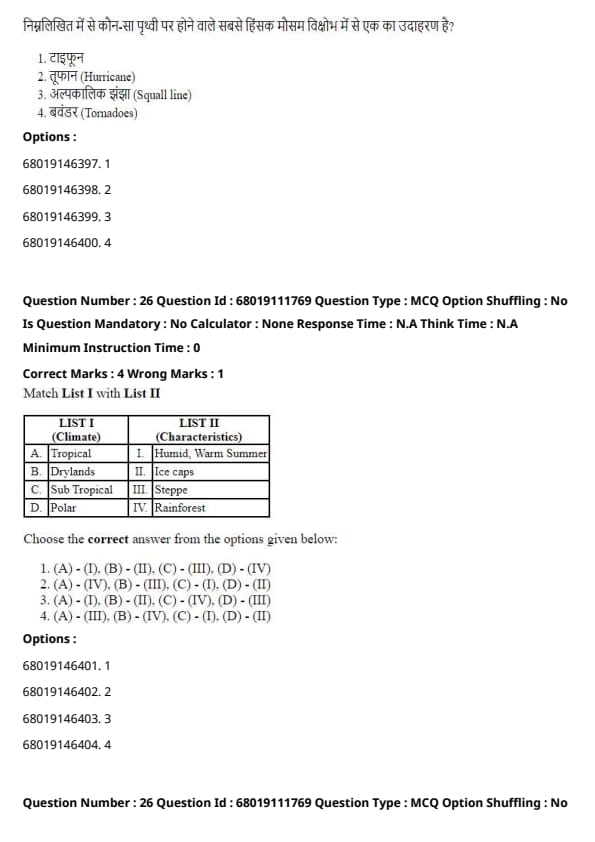
Which of the following is an example of one of the most violent weather disturbances that occurs on the earth?
View Solution
Tornadoes are the most violent weather disturbances, with wind speeds that can exceed 300 mph, making them much more destructive than typhoons or hurricanes.
Tornadoes are characterized by their extreme wind speeds and localized destruction, often causing more damage than other storms in a concentrated area.
Question 26:
Match List I with List II
| Climate | Characteristics |
|---|---|
| (A) Tropical | (I) Humid, Warm Summer |
| (B) Drylands | (II) Ice caps |
| (C) Sub Tropical | (III) Steppe |
| (D) Polar | (IV) Rainforest |
Choose the correct answer from the options given below:
View Solution
Tropical climates are typically associated with rainforests, drylands are steppe climates, subtropical climates have warm summers, and polar climates are ice-capped.
Climate classification helps to categorize regions based on temperature and precipitation patterns, with specific examples of flora and fauna adapted to each type.
Question 27:
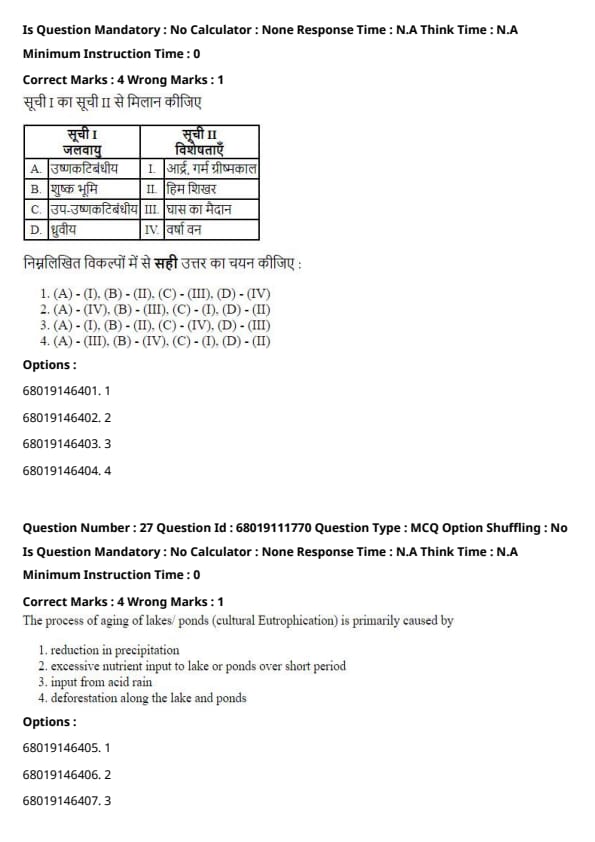
The process of aging of lakes/ponds (cultural Eutrophication) is primarily caused by:
View Solution
Eutrophication occurs due to excessive nutrient loading, especially nitrogen and phosphorus, which leads to algal blooms and depletion of oxygen in the water.
Excessive fertilizer use and wastewater discharge can accelerate eutrophication, which disrupts the aquatic ecosystem and leads to hypoxia.
Question 28:
The Képpen classification is based on:
Choose the correct answer from the options given below:
View Solution
The Képpen classification uses temperature and precipitation data to categorize climates, focusing on how they affect vegetation patterns.
The Képpen system is one of the most widely used methods for climate classification, helping to understand regional climate patterns and their impact on ecosystems.
Question 29:
Choose the correct statements:
(A) Earth undergoes three basic motions: yearly revolution around Sun, daily rotation on its axis, and a slow wobble of its axis.
(B) Precession is a slow wobbling of the axis as Earth spins.
(C) Apparent solar day is twenty-four hours as determined from mean solar time.
(D) The event of time, noon, is the instant the Sun appears to move across the celestial meridian.
Choose the correct answer from the options given below:
View Solution
Earth's three basic motions include its yearly revolution around the Sun, daily rotation on its axis, and the slow wobble of its axis (precession). The event of time "noon" refers to when the Sun crosses the celestial meridian. The apparent solar day is not fixed to 24 hours due to the Earth's elliptical orbit and axial tilt.
The Earth's axial tilt and precession affect long-term variations in climate and the length of days and nights, which influence seasonal patterns.
Question 30:
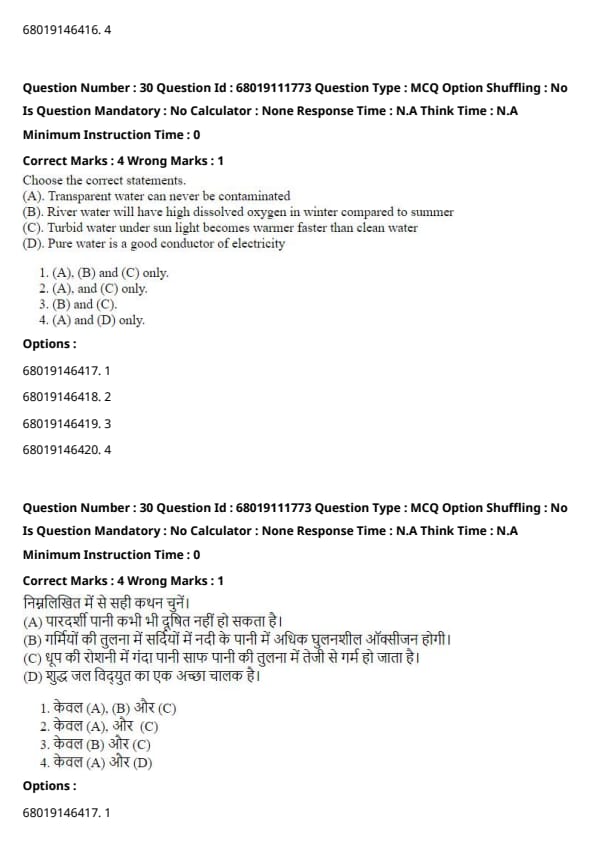
Choose the correct statements:
(A) Transparent water can never be contaminated.
(B) River water will have high dissolved oxygen in winter compared to summer.
(C) Turbid water under sunlight becomes warmer faster than clean water.
(D) Pure water is a good conductor of electricity.
Choose the correct answer from the options given below:
View Solution
River water has higher oxygen levels in winter due to lower temperatures and less biological activity. Turbid water heats faster in sunlight due to its higher absorbance of light.
Turbid water absorbs more solar radiation, causing it to warm faster, while clear water reflects more light, remaining cooler.
Question 31:
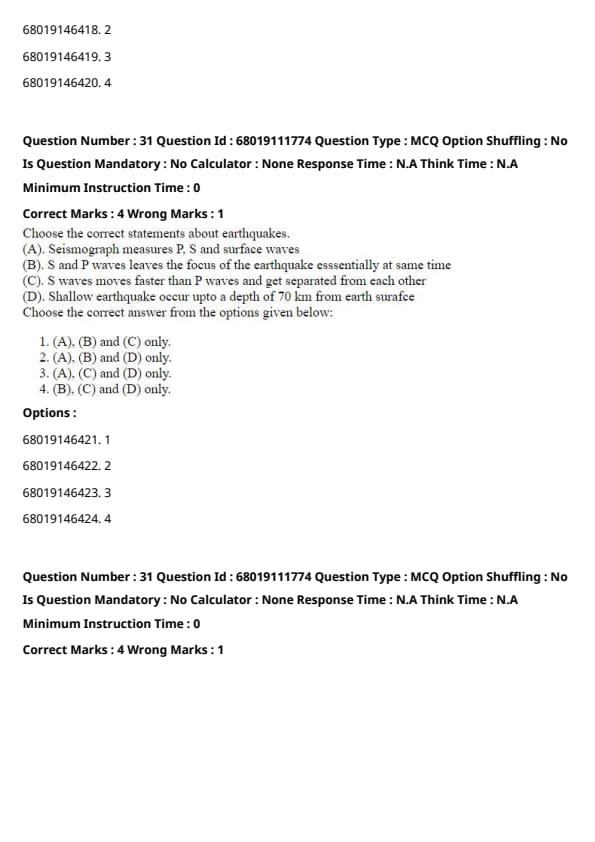
Choose the correct statements about earthquakes:
Choose the correct answer from the options given below:
View Solution
Seismographs measure P, S, and surface waves. S waves move slower than P waves, not faster, and do not separate in the way described. Shallow earthquakes typically occur at depths up to 70 km.
Seismic waves are classified into body waves (P and S) and surface waves, and they travel at different speeds through various layers of the Earth.
Question 32:
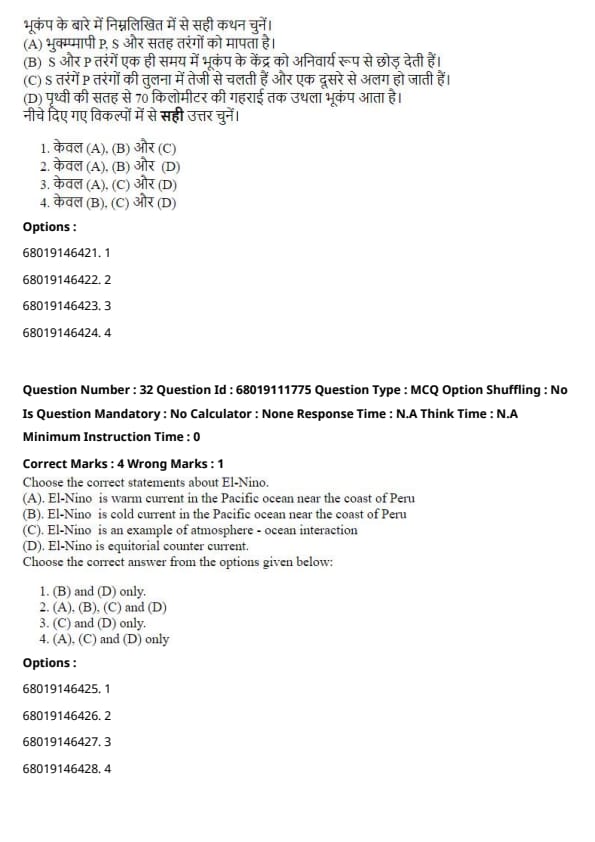
Choose the correct statements about El-Nino:
Choose the correct answer from the options given below:
View Solution
El-Nino refers to the warm ocean current in the Pacific near Peru, which is an example of atmosphere-ocean interaction and is a significant equatorial countercurrent.
El-Nino impacts global weather patterns by disrupting normal ocean currents and atmospheric conditions in the tropical Pacific region.
Question 33:
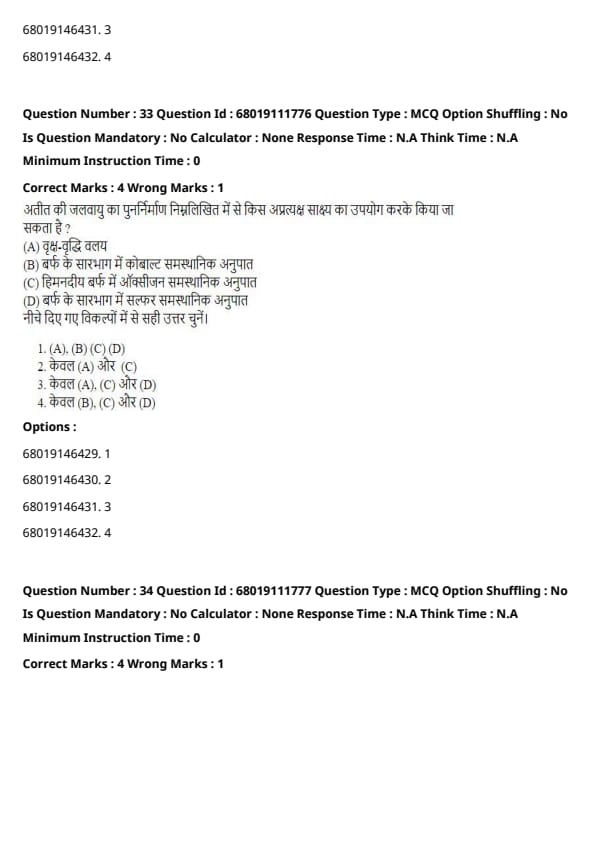
Reconstruction of past climates can be done using indirect evidence from:
Choose the correct answer from the options given below:
View Solution
Past climates can be reconstructed using tree rings and oxygen isotope ratios in ice cores, which provide valuable data on historical temperature and precipitation patterns.
Tree rings, oxygen isotope ratios in ice, and other proxies provide insights into past climate conditions, helping scientists understand historical climate changes.
Question 34:
Match List-I with List-II
| Natural Causes of Climate Change | Associated Activity |
|---|---|
| (A) Plate tectonics | (III) Rearrangement of the continents |
| (B) Solar variability | (IV) Sunspots activity |
| (C) Variation in Earth's orbit | (I) Change in reflectivity of the atmosphere |
| (D) Volcanic activity | (II) Change in reflectivity of the atmosphere |
Choose the correct answer from the options given below:
View Solution
Plate tectonics influences Earth's climate by rearranging continents and oceans. Solar variability, such as sunspot activity, affects Earth's climate by changing the amount of sunlight. The Earth's orbit variation and volcanic activity contribute to long-term climate changes.
Natural climate change is influenced by factors such as plate tectonics, solar activity, volcanic eruptions, and variations in Earth's orbit.
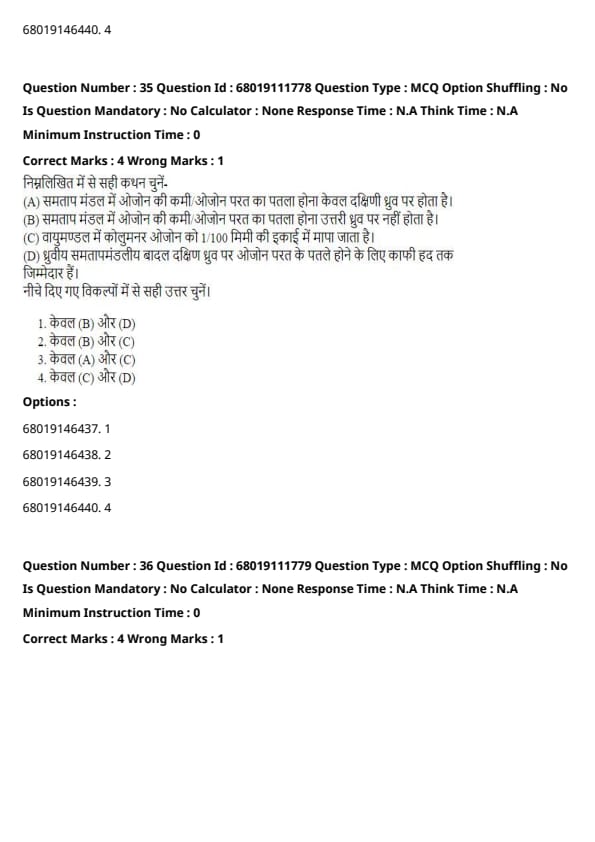
Question 35:
Choose the correct statements:
Choose the correct answer from the options given below:
View Solution
Ozone layer thinning occurs over both poles, but it is more pronounced over the south pole. Polar stratospheric clouds contribute to ozone depletion. Columnar ozone is measured in Dobson units.
Ozone depletion is a significant environmental issue, mainly caused by CFCs and other chemicals that break down ozone molecules in the stratosphere.
Question 36:
Match List I with List II
| Radiation Law | Equation |
|---|---|
| (A) Beer Lambert's Law | (III) I = I0 e-μ(x) |
| (B) Wien's displacement law | (I) λmax = bT |
| (C) Planck's formula of low frequencies | (IV) Iλ = 2C λ-4 KT |
| (D) Kirchof's law | (II) αλ = ελ |
Choose the correct answer from the options given below:
View Solution
Beer Lambert's law is associated with the equation for light absorption: I = I0 e-μ(x). Wien's displacement law relates the maximum wavelength of emitted radiation to temperature: λmax = bT. Planck's formula describes the spectral distribution of blackbody radiation at low frequencies. Kirchof's law relates the emission of radiation to the temperature of an object: Iλ = 2C λ-4 KT.
Radiation laws govern how energy is emitted or absorbed by bodies, especially in the context of temperature and wavelength.
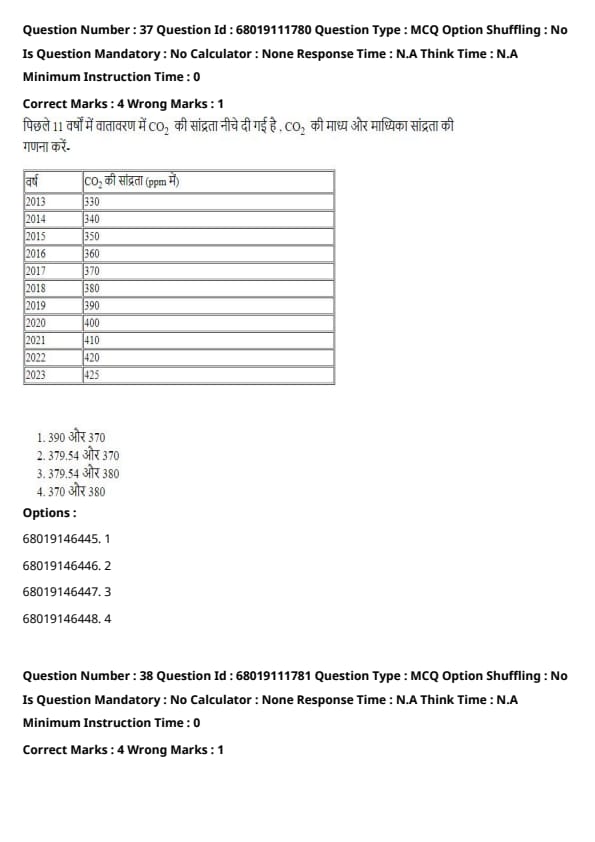
Question 37:
Given below is the concentration of CO₂ in the atmosphere in the last 11 years. Calculate the mean and median concentration of CO₂.
| Year | Concentration of CO₂ (in ppm) |
|---|---|
| 2013 | 330 |
| 2014 | 340 |
| 2015 | 350 |
| 2016 | 360 |
| 2017 | 370 |
| 2018 | 380 |
| 2019 | 390 |
| 2020 | 400 |
| 2021 | 410 |
| 2022 | 420 |
| 2023 | 425 |
Choose the correct answer from the options given below:
View Solution
The mean concentration is calculated as \( \frac{\text{sum of all concentrations}}{\text{number of years}} \). The median is the middle value when the data is ordered, which is 380.
To calculate the mean, sum all values and divide by the number of values. For the median, order the values and find the middle value.
Question 38:
Arrange the following periods of the Paleozoic era in the correct order starting from older to younger.
(A) Cambrian
(B) Devonian
(C) Carboniferous
(D) Permian
(E) Silurian
Choose the correct answer from the options given below:
View Solution
The Paleozoic era is divided into five periods in the following order: Cambrian, Silurian, Devonian, Carboniferous, and Permian.
The Paleozoic era spans from approximately 541 to 252 million years ago and saw the emergence of complex life forms.
Question 39:
The two coherent sources of intensity ratio β interfere. The value of (Imax - Imin) / (Imax + Imin) is:
View Solution
The intensity ratio (Imax - Imin) / (Imax + Imin) in interference patterns is related to the amplitude ratio β using the formula (2 √β) / (1 + β).
In wave interference, the intensity difference depends on the amplitude ratio between the sources, influencing the constructive and destructive interference patterns.
Question 40:
A radio station which can tune in to 7.5 MHz to 12 MHz corresponds to the wavelength band:
View Solution
The wavelength (λ) is related to frequency (f) by the formula λ = c / f, where c is the speed of light. For frequencies of 7.5 MHz to 12 MHz, the corresponding wavelengths are in the range of 40m to 25m.
To calculate the wavelength from the frequency, use the formula λ = c / f, where c is approximately 3 × 10⁸ m/s.
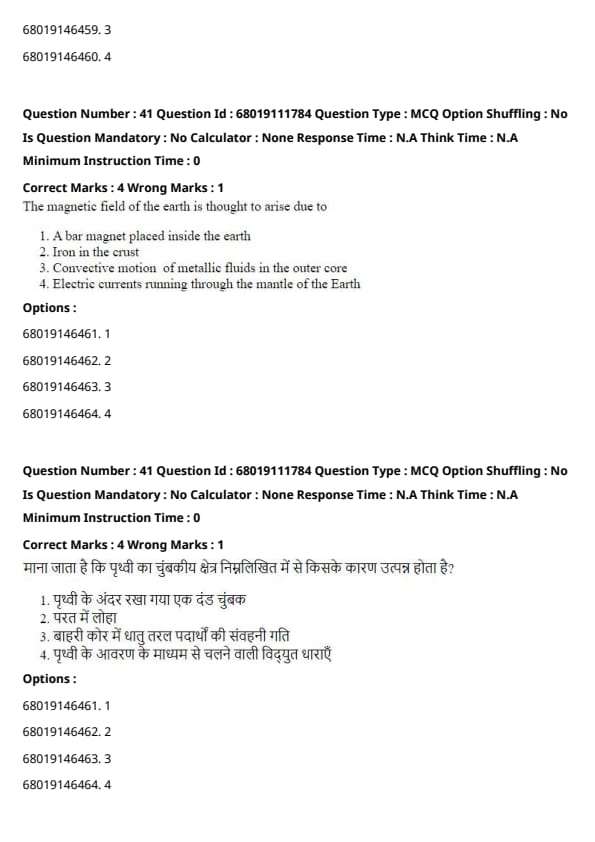
Question 41:
The magnetic field of the Earth is thought to arise due to:
View Solution
The Earth's magnetic field is generated by the movement of molten iron and other metals in the outer core, creating convection currents that generate the magnetic field.
Earth's magnetic field is mainly caused by the movement of conductive molten materials in its outer core.
Question 42:
Standard deviation for the first 10 even natural numbers is:
View Solution
The standard deviation for the first 10 even natural numbers can be calculated by finding the square root of the average of the squared deviations from the mean.
The standard deviation measures how spread out the numbers are in a dataset, and can be calculated using the deviations from the mean.
Question 43:
Mean square deviation of a distribution is least when deviations are taken about:
View Solution
The mean square deviation (or variance) is minimized when the deviations are taken about the mean, because the mean is the point that minimizes the sum of squared deviations.
The mean minimizes the sum of squared deviations, making it the best measure for minimizing variance.
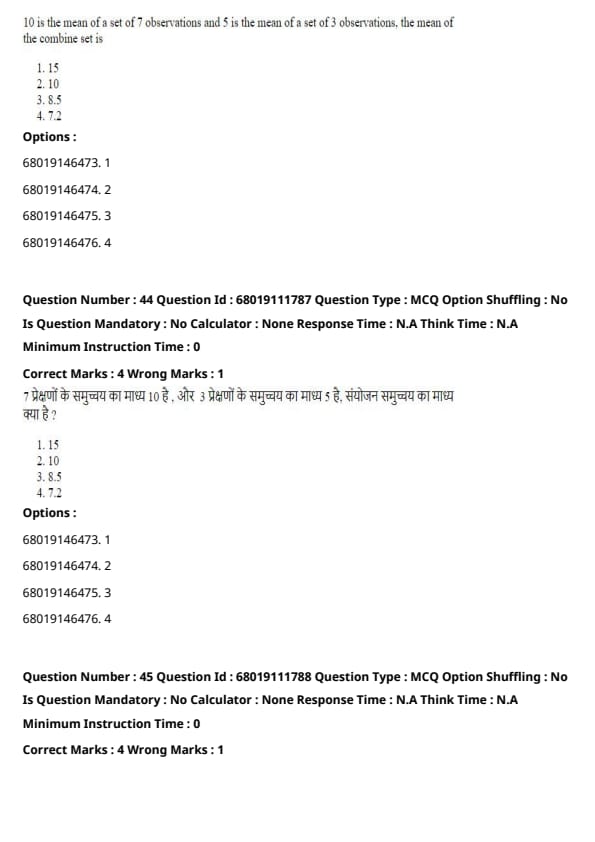
Question 44:
10 is the mean of a set of 7 observations and 5 is the mean of a set of 3 observations, the mean of the combined set is:
View Solution
To find the mean of the combined set, use the formula for the combined mean: (7 * 10 + 3 * 5) / (7 + 3) = (70 + 15) / 10 = 8.5.
The combined mean is calculated by taking the weighted average of the individual means based on the number of observations in each set.
Question 45:
A statistical measure which cannot be determined graphically is:
View Solution
The harmonic mean is a specific type of average that cannot be determined directly from graphical methods, as it involves reciprocals of the data points.
The harmonic mean is best calculated algebraically, particularly when dealing with rates or ratios.
Question 46:
An ogive is used to determine:
View Solution
An ogive is a cumulative frequency curve that is used to determine the median and other percentiles of a dataset.
Ogives are useful for determining the median, quartiles, and percentiles in a dataset.
Question 47:
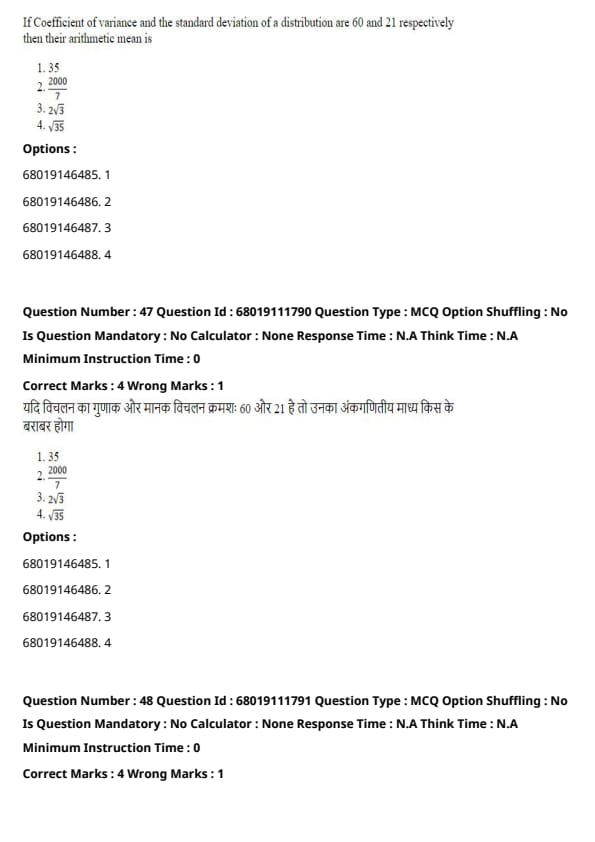
If the coefficient of variance and the standard deviation of a distribution are 60 and 21 respectively, then their arithmetic mean is:
View Solution
The coefficient of variation is the ratio of the standard deviation to the mean, and with the given values, we can use algebraic manipulation to find the mean.
The coefficient of variation provides a measure of relative variability, and can be used to compute the mean when combined with the standard deviation.
Question 48:
For dealing with qualitative data the best average is:
View Solution
For qualitative data, the median is the best measure of central tendency, as it is not affected by extreme values and better represents the middle value.
The median is often preferred for ordinal data or data with outliers, as it represents the middle point without being skewed by extreme values.
Question 49:
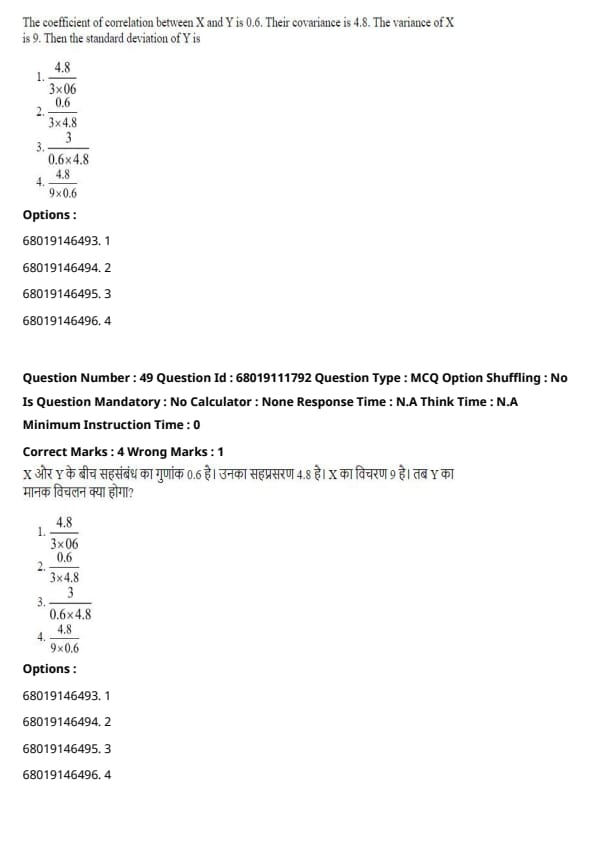
The coefficient of correlation between X and Y is 0.6. Their covariance is 4.8. The variance of X is 9. Then the standard deviation of Y is:
View Solution
The formula for the correlation coefficient is r = cov(X, Y) / (σ_X * σ_Y), and using this, we can solve for the standard deviation of Y.
The correlation coefficient helps us relate the standard deviations of two variables with their covariance. This allows us to compute the unknown standard deviation (σ_Y) when the covariance, the correlation coefficient, and the standard deviation of X (σ_X) are known. The formula derived from the correlation coefficient can be rearranged as σ_Y = cov(X, Y) / (r * σ_X), and by plugging in the values provided, we can easily calculate the standard deviation of Y.
Question 50:
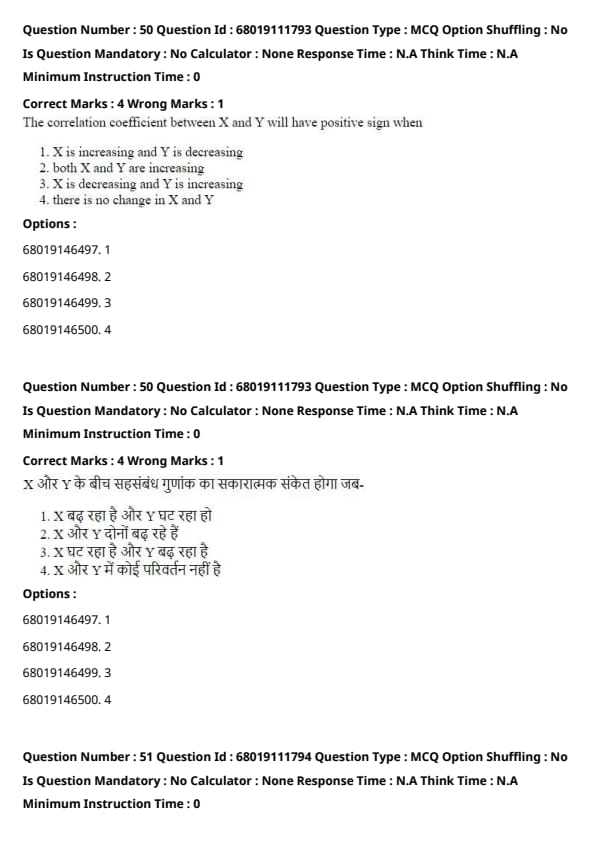
The correlation coefficient between X and Y will have a positive sign when:
View Solution
The correlation coefficient will be positive when both variables are moving in opposite directions, such as when X decreases and Y increases, indicating an inverse relationship.
A positive correlation occurs when two variables move in the same direction, meaning as one increases, the other also increases. However, when both variables are changing in opposite directions (one increasing while the other decreases), this can result in a positive correlation depending on how they are proportionally related. In this case, a negative correlation would typically be expected, but if the data shows a positive correlation, the variables may be interrelated in complex ways. Always remember, the sign of the correlation coefficient depends on the direction of the relationship between the variables.
Question 51:
The coefficient of correlation is independent of:
View Solution
The coefficient of correlation is independent of changes in scale and origin, meaning that multiplying or adding a constant to the data does not affect the correlation coefficient.
The coefficient of correlation, or Pearson’s r, is a normalized measure of the linear relationship between two variables. It quantifies how well the data points fit a straight line, irrespective of the scale (units of measurement) or the origin (starting point) of the data. This property makes the correlation coefficient an ideal statistic for comparing the strength and direction of relationships between variables across different units or origins. In contrast to other statistical measures like mean or variance, correlation remains unchanged when the data is transformed by scaling (multiplying by a constant) or shifting (adding a constant). This makes it a useful tool for assessing the relationship between variables with different units or scales.
Question 52:
Kepler's laws deal with:
Choose the correct answer from the options given below:
View Solution
Kepler's laws describe planetary motion, including the shape of orbits (A), the relationship between the orbital period and distance (B), and the conservation of angular momentum (D). The law of gravitation (C) is not part of Kepler's laws but is Newton's law.
Kepler’s laws provide a mathematical model for understanding planetary motion. The first law (Law of Orbits) states that planets move in elliptical orbits with the sun at one focus. The second law (Law of Areas) describes how a line segment joining a planet and the sun sweeps out equal areas during equal intervals of time, reflecting the conservation of angular momentum. The third law (Law of Periods) relates the time a planet takes to complete an orbit to its distance from the sun. Kepler's laws are foundational in celestial mechanics, providing critical insight into the motion of planets and other celestial bodies. Kepler’s laws differ from Newton's law of gravitation, which is a fundamental force law describing the attractive interaction between masses.
Question 53:
In order to increase the resolving power of a telescope it is necessary to:
View Solution
The resolving power of a telescope increases with the diameter of the objective lens or mirror, which gathers more light and resolves finer details.
The resolving power of a telescope is determined by its ability to distinguish between two close objects. The larger the objective lens or mirror, the more light it can collect, improving the telescope’s ability to resolve finer details. This is why telescopes with larger apertures are better suited for observing distant and faint celestial objects. The eyepiece diameter does not affect the resolving power, but it plays a role in magnifying the image. By increasing the objective lens size, telescopes can achieve better clarity and resolution, allowing astronomers to view more distant or finer structures.
Question 54:
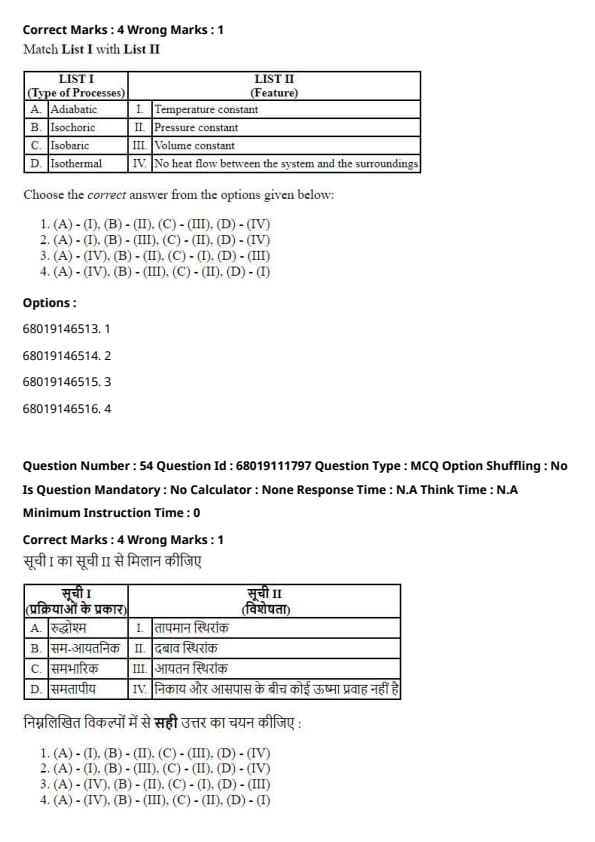
Match List I with List II:
| Type of Processes | Feature |
|---|---|
| (A) Adiabatic | (IV) No heat flow between the system and surroundings |
| (B) Isochoric | (III) Volume constant |
| (C) Isobaric | (II) Pressure constant |
| (D) Isothermal | (I) Temperature constant |
Choose the correct answer from the options given below:
View Solution
Adiabatic processes have no heat exchange, so no heat flow occurs between the system and surroundings (A - IV). Isochoric processes occur at constant volume (B - III). Isobaric processes happen at constant pressure (C - II). Isothermal processes occur at constant temperature (D - I).
In thermodynamics, different types of processes describe how the system exchanges energy in the form of heat or work. An adiabatic process involves no heat transfer between the system and the surroundings, making the process adiabatic. An isochoric process happens at constant volume, where the volume does not change regardless of pressure or temperature changes. An isobaric process occurs at constant pressure, and in an isothermal process, the temperature remains constant. These processes play a fundamental role in thermodynamic cycles and understanding energy conservation in systems.
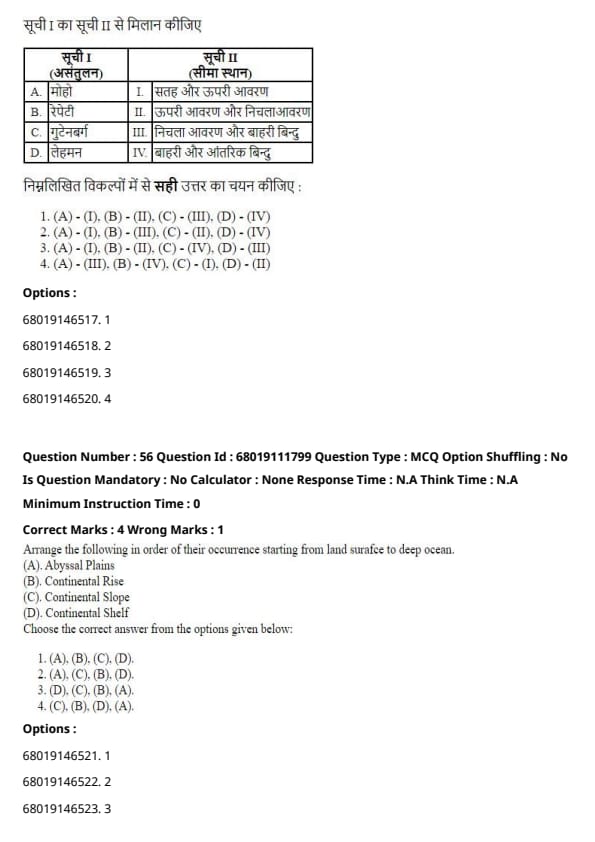
Question 55:
Match List I with List II:
| Discontinuity | Boundary Location |
|---|---|
| (A) Moho | (I) Crust and Upper mantle |
| (B) Repetti | (II) Upper mantle and Lower mantle |
| (C) Gutenberg | (III) Lower mantle and Outer core |
| (D) Lehmann | (IV) Outer and Inner core |
Choose the correct answer from the options given below:
View Solution
The Mohorovičić discontinuity (Moho) is the boundary between the Earth's crust and the upper mantle (A - I). The Repetti discontinuity is between the upper and lower mantle (B - II). The Gutenberg discontinuity is between the lower mantle and outer core (C - III). The Lehmann discontinuity is between the outer and inner core (D - IV).
Understanding Earth's internal structure involves studying various discontinuities. Each discontinuity represents a significant change in the physical properties of Earth's layers, helping scientists understand seismic activity and the internal processes of the Earth. These discontinuities are identified by changes in seismic wave velocities, which reflect differing material compositions and states. For example, the Moho discontinuity reflects a change from brittle crustal materials to more ductile mantle materials, which is crucial for the tectonic activity and the dynamic nature of Earth's crust.
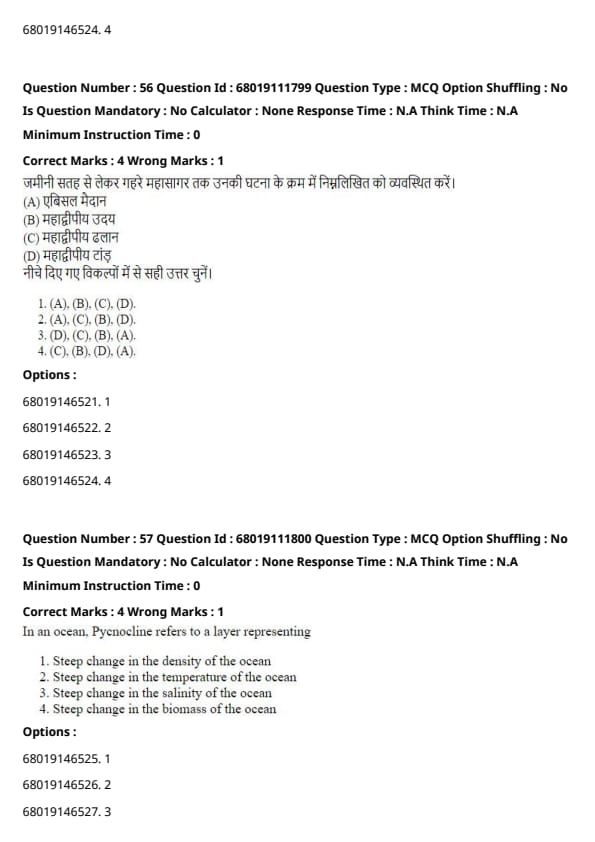
Question 56:
Arrange the following in order of their occurrence starting from land surface to deep ocean:
Choose the correct answer from the options given below:
View Solution
The continental shelf is the shallow area closest to the land, followed by the slope, rise, and finally the abyssal plains which are the deepest areas of the ocean floor.
Marine geography features distinct zones each playing a crucial role in the ocean's ecosystem. The continental shelf often harbors a diverse array of marine life due to its proximity to sunlight and nutrients. Deeper, the continental slope marks the boundary to deeper ocean basins and is often the site of significant geological activity, including submarine landslides and turbidity currents that shape the seafloor. The continental rise collects sediments that spill over the slope, creating a transition to the abyssal plains. These plains are among the flattest and most remote parts of the Earth’s surface, composed of sediments that cover the oceanic crust.
Question 57:
In an ocean, Pycnocline refers to a layer representing:
View Solution
Pycnocline is a layer in the ocean where the density changes rapidly with depth, primarily due to changes in temperature and salinity. This layer is found between the surface and deep ocean layers.
The pycnocline plays a critical role in oceanic circulation and can act as a barrier to the mixing of surface waters and deeper ocean waters. This affects thermal and nutrient exchanges and can influence climate patterns by affecting ocean currents. The density differences in the pycnocline are primarily driven by temperature (thermocline) and salinity (halocline), both of which contribute to the overall density of seawater.
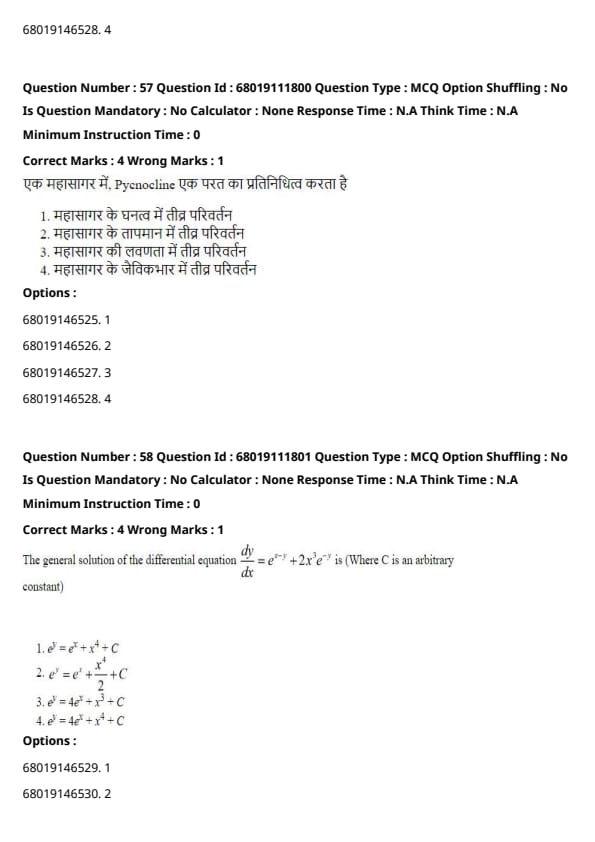
Question 58:
The general solution of the differential equation dy/dx = e^(x-y) + 2x^3e^(-y) is (Where C is an arbitrary constant):
View Solution
This is a differential equation that involves both exponential and polynomial terms. The solution can be found by solving the equation for y in terms of x and integrating both sides.
When solving such differential equations, integrating factors or separation of variables may be used, depending on how the variables can be arranged. The separation of variables in this equation allows integration on both sides, leading to the general solution provided. The integration process involves handling the exponential terms, which requires special attention to ensure the integration is performed correctly and the constants are adjusted appropriately.
Question 59:
If the order of the differential equation x3 dy/dx (dx2)/2 + 4 + y = 0 is a, then 2a + 3 is:
View Solution
The order of the differential equation is determined by the highest derivative with respect to x. In this case, we need to calculate the derivatives and identify the order.
The expression provided needs to be clarified and simplified to properly identify the derivatives involved. The term x^3 dy/dx (dx^2)/2 suggests a higher-order derivative, possibly misleading. It's essential to understand and possibly reorganize the terms to properly define the differential equation's order and solve for a. Once a is determined, 2a + 3 is calculated to get the final answer.
Question 60:
2x * [4, 7] + 3y * [1, 2] = [3, 12], then:
View Solution
We can solve for x and y by solving the system of equations derived from the matrix multiplication and the given equation. By performing matrix multiplication and solving for x and y, we find the solution x = -3, y = 9.
This problem involves basic matrix operations where each vector is multiplied by a scalar and the results are added to form a system of equations. Solving this system involves basic algebraic techniques. Each equation represents a linear combination of x and y that must satisfy the given matrix equation. The solution involves isolating x and y and solving for their values that satisfy both equations simultaneously.
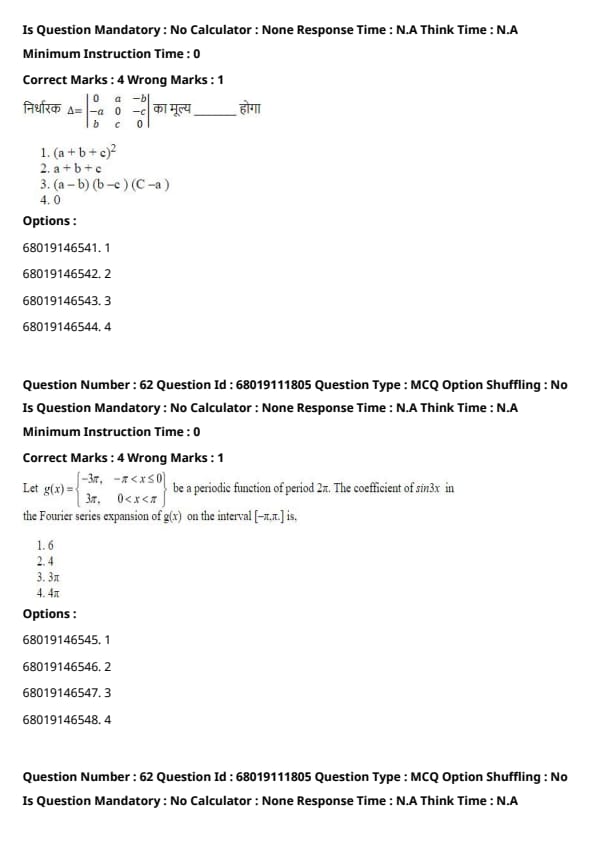
Question 61:
The value of the determinant:
Δ = | 0 a -b |
-a 0 -c |
b c 0 |
View Solution
The determinant of this 3x3 matrix is calculated by expanding it. In this case, the result simplifies to 0 due to the structure of the matrix.
Read More
For determinants of 3x3 matrices with specific symmetries, such as this one, the result can often simplify to 0.
Question 62:
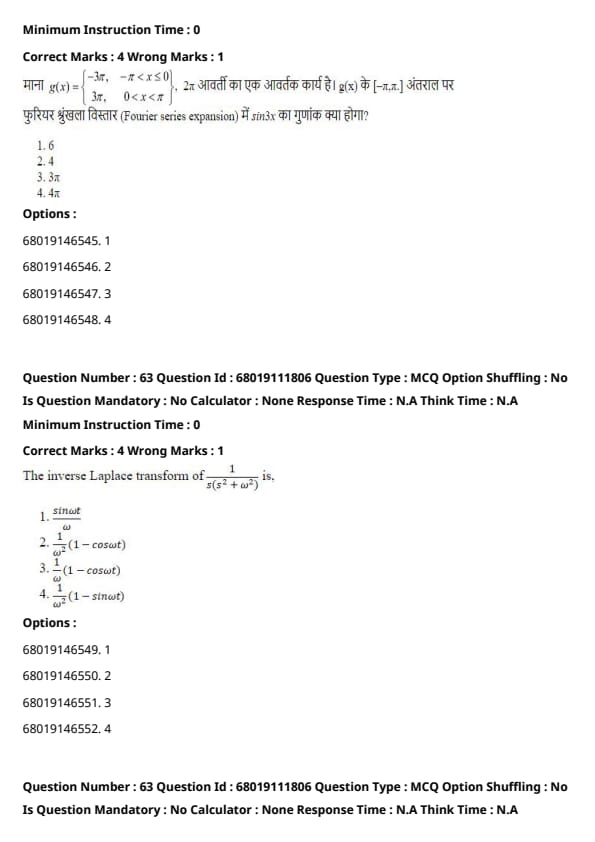
Let g(x) be a periodic function of period 2π defined as:
g(x) = {
-3π, -π < x ≤ 0
3π, 0 < x < π
}
The coefficient of sin(3x) in the Fourier series expansion of g(x) on the interval [-π, π] is:
View Solution
The Fourier coefficient of a sine term can be calculated using the Fourier series formula. For this piecewise function, the coefficient of sin(3x) is found to be 4.
The Fourier series can be used to represent periodic functions in terms of sine and cosine terms. The coefficient is determined by integrating over the period of the function.
Question 63:
The inverse Laplace transform of 1/(s(s² + ω²)) is:
View Solution
The inverse Laplace transform can be calculated using standard Laplace transform tables and finding the appropriate expression corresponding to the given function. The correct result is 1/ω² (1 - cos(ωt)).
The inverse Laplace transform is useful for solving differential equations and analyzing systems in the time domain.
Question 64:
If the centre of the circle x² + y² - 4x - 8y - 45 = 0 is (a, b), then the value of 3a + 2b is:
View Solution
The center of a circle (x - h)² + (y - k)² = r² is (h, k). Completing the square on the equation x² + y² - 4x - 8y - 45 = 0 gives the center (2, 4), and 3a + 2b = 3(2) + 2(4) = 14.
Completing the square is a standard method for finding the center of a circle from its general equation.
Question 65:
The real numbers a and b if (a - ib)(3 + 5i) is the conjugate of -6 - 24i, are:
View Solution
The conjugate of a complex number a + ib is a - ib. By setting up the equation, we can solve for a and b. The correct values are a = 3 and b = -3.
The conjugate of a complex number is found by changing the sign of its imaginary part.
Question 66:
If A and B are two sets such that |A ∪ B| = 20, |A| = 10 and |B| = 17, then the number of elements in A ∩ B is:
View Solution
Using the formula for the union of two sets |A ∪ B| = |A| + |B| - |A ∩ B|, we can solve for |A ∩ B|. Substituting the given values gives |A ∩ B| = 7.
The number of elements in the intersection of two sets can be found using the formula for the union of sets.
Question 67:
If y'' + y' + 5y = 6, y(0) = 0, y'(0) = 0, then the Laplace Transformation Y(s) of the solution y(t) of the differential equation is equal to:
View Solution
To solve this using Laplace Transforms, we take the Laplace of each term of the differential equation and solve for Y(s). After applying the initial conditions, the result is 6/s(s2 + s + 5).
Laplace Transforms are useful for converting differential equations into algebraic equations, which are easier to solve.
Question 68:
Which of the following are statistical techniques for data pre-processing?
(A) Measures of variability
(B) Structured querying
(C) Substring pattern matching
(D) Central tendency
View Solution
Data pre-processing typically involves statistical techniques such as measures of central tendency (mean, median, mode) and measures of variability (standard deviation, range). Structured querying and substring pattern matching are not commonly used for pre-processing.
Statistical techniques like central tendency and variability are essential for summarizing and understanding data before further analysis.
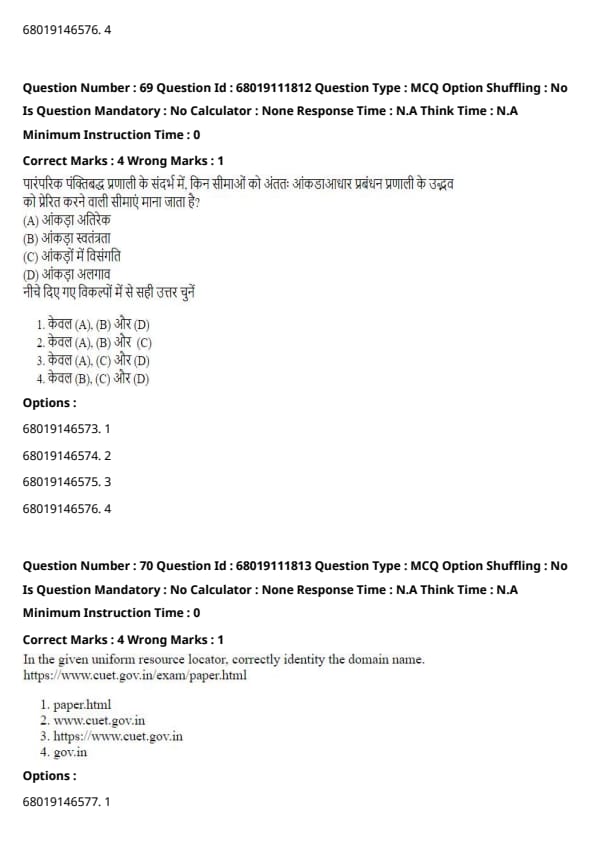
Question 69:
In the context of traditional file systems, which are considered to be the limitations that eventually motivated the emergence of database management systems?
(A) Data redundancy
(B) Data independence
(C) Data inconsistency
(D) Data isolation
View Solution
Traditional file systems suffer from issues like data redundancy, data inconsistency, and data isolation, which motivated the development of database management systems to provide more efficient and reliable data handling.
Database management systems address the limitations of traditional file systems by offering better organization, consistency, and reduced redundancy.
Question 70:
In the given uniform resource locator, correctly identify the domain name.
https://www.cuet.gov.in/exam/paper.html
View Solution
The domain name in the URL is the part that represents the website's address, which is www.cuet.gov.in. This is the server that hosts the page.
The domain name is part of the URL that specifies the address of the server where the website or resource is hosted.
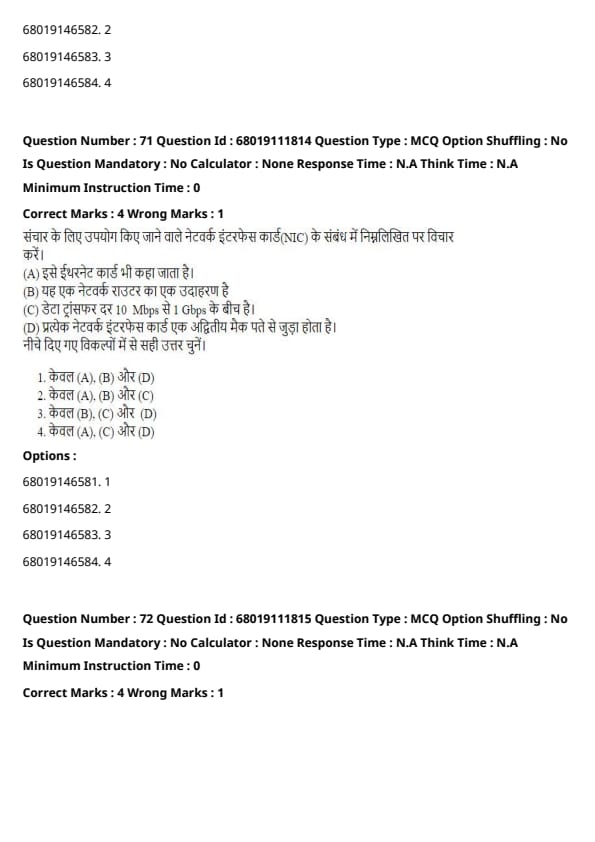
Question 71:
Consider the following with respect to a network interface card used for communication:
View Solution
A network interface card (NIC) is also known as an ethernet card, has data transfer rates between 10 Mbps to 1 Gbps, and is associated with a unique MAC address. It is not an instance of a network router.
The MAC address is unique to each network interface card and serves as an identifier in local network communication.
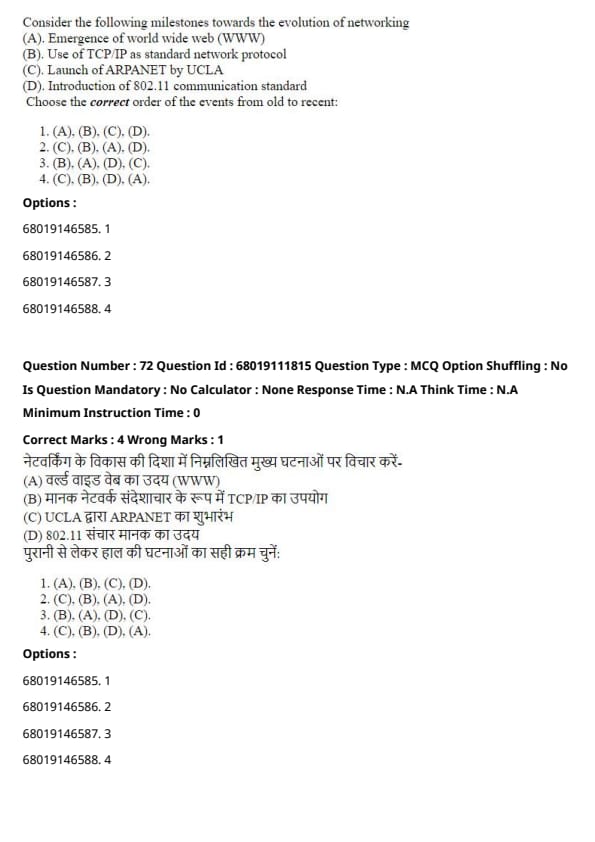
Question 72:
Consider the following milestones towards the evolution of networking:
View Solution
The correct chronological order of these milestones is: Launch of ARPANET (C), Use of TCP/IP (B), Emergence of WWW (A), Introduction of 802.11 standard (D).
The development of networking protocols and standards has been crucial for the growth of the internet and wireless communication technologies.
Question 73:
Which of the following is a valid malware identification method used by antivirus software?
View Solution
Signature-based detection is a method used by antivirus software to identify malware by comparing files to known malware signatures or patterns. Other methods like iris-based detection are not related to malware identification.
Signature-based detection is one of the most commonly used techniques in antivirus software for identifying malicious files or programs.
Question 74:
Identify the appropriate file type employed for storing and managing fully structured data in workstations:
View Solution
Comma-separated values (CSV) files are widely used for storing and managing structured data, as they store data in tabular form with commas separating the values. Other formats like RTF and GIF are used for text and graphics, respectively.
CSV files are ideal for representing structured data and are easily readable by various software programs like spreadsheet tools.
Question 75:
Following are the major stages in the software development life cycle:
Choose the correct order of the stages from the options given below:
View Solution
The correct order of stages in the software development life cycle is: Data Analysis and Design (C), Development and Testing (B), Implementation Phase (D), Performance Evaluation (A).
In the software development life cycle, the stages are generally followed in this order to ensure that the system is designed, developed, tested, and evaluated efficiently.























































*The article might have information for the previous academic years, please refer the official website of the exam.