CUET PG 2024 Question Paper with Answer Key PDF for Dance (March 22 - Shift 1)
- Question Paper 2025
- Question Paper 2024
- Question Paper 2023
- Mathematics Papers
- Statistics Question Paper
- English Question Paper
- Chemistry Question Paper
- Pol. Sci. Question Paper
- History Question Paper
- Commerce Question Papers
- Life Science Papers
- Geology Question Papers
- Journalism Question Paper
- B.Ed. HSS Question Paper
- Botany Question Paper
- B.Ed. Question Papers


Content Writer | Updated On - Mar 12, 2025
CUET PG Question Papers are the most important study material for effective exam preparation. We at Zollege have provided all CUET PG Previous Year Papers with Solution PDFs here. CUET PG 2024 Dance exam was conducted successfully on March 22 by NTA.
Students can freely download the CUET PG previous year's question paper PDFs along with their solutions here. We strongly encourage CUET PG aspirants to scan through all the CUET PG Question Paper to know the overall difficulty level, CUET PG Syllabus and understand the changes in CUET PG Exam Pattern over the years.
CUET PG 2024 Dance Question Paper with Answer Key PDF
| CUET PG 2024 Dance Question Paper with Answer Key |  Download Download |
Check Solution |
Dance 2024 Questions with Solutions
Question 1:
In Advaita Vedānta, in case of a tree, svagata bheda refers to:
View Solution
Solution: In Advaita Vedānta, svagata bheda refers to the internal difference within a single entity, like the parts of a tree (branches, flowers, fruits) being different from the whole tree. This concept is used to explain distinctions within the same substance.
Quick Tip: Svagata bheda represents internal differences within one entity, a key idea in the philosophy of Advaita Vedānta.
Question 2:
Human eardrum can hear the sound which is:
View Solution
Solution: The human eardrum can detect sounds in the frequency range of 20Hz to 20,000Hz, which is the audible range of sound for humans. Sounds outside this range, like infrasound or ultrasound, are not detectable by the human ear.
Quick Tip: Humans can hear sounds in the frequency range of 20Hz to 20000Hz, which defines our auditory perception.
Question 3:
The roof of the mouth is:
View Solution
Solution: The roof of the mouth, specifically the hard palate, is considered a contrastive articulator. It does not move during speech, but plays a role in the articulation of certain sounds when the active articulators, such as the tongue, come into contact with it.
Quick Tip: Contrastive articulators are the fixed parts of the vocal tract that interact with active articulators to produce speech sounds.
Question 4:
Human sound is:
View Solution
Solution: Human sound is produced when air passes through the vocal cords and is shaped by the articulatory organs into audible sound waves, which can be perceived by the human ear.
Quick Tip: Sound is created by the vibration of air molecules, which the human ear detects as audible sound.
Question 5:
The science of dictionary making is called:
View Solution
Solution: Lexicography is the practice of compiling dictionaries. Morphology is the branch of linguistics concerned with the structure and form of words in a language, including how they are created and how they relate to one another. It examines the smallest units of meaning in a language, called morphemes, and their roles in word formation. Graphology is the analysis of handwriting with attempt to determine someone's personality traits. Graphics refers to visual presentations or images on some surface, such as a wall, canvas, screen, paper, or stone to brand, inform, illustrate, or entertain
Quick Tip: Lexicography involves the systematic study and compilation of words, a critical tool for language documentation and education.
Question 6:
Which Raas is performed in the precincts of Govindji Temple on Kartik Purnima?
View Solution
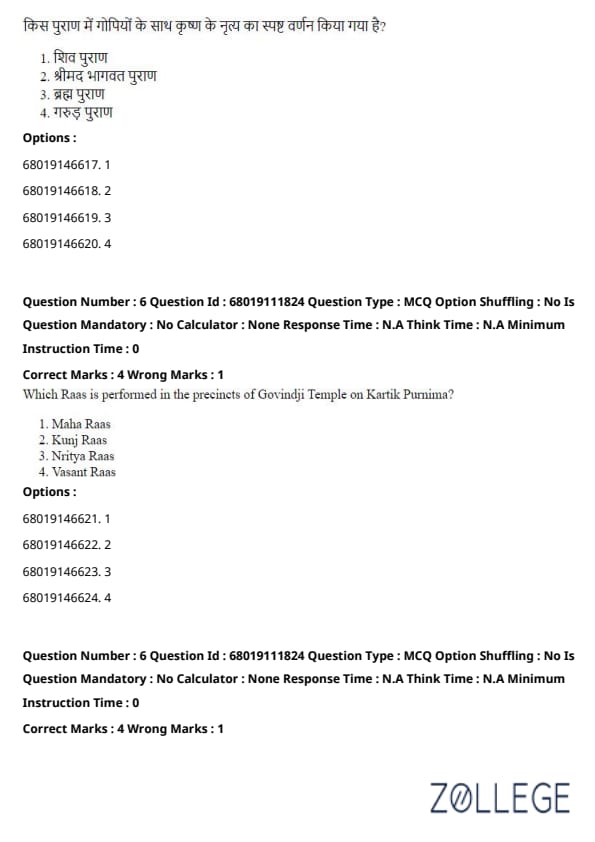
Solution: Maha Raas is traditionally performed in the precincts of Govindji Temple during Kartik Purnima. It is a significant event in the Vaishnavism tradition, often depicting the divine dance of Lord Krishna with the gopis.
Quick Tip: Maha Raas is a divine dance form, symbolizing divine love and devotion to Lord Krishna, performed during Kartik Purnima.
Question 7:
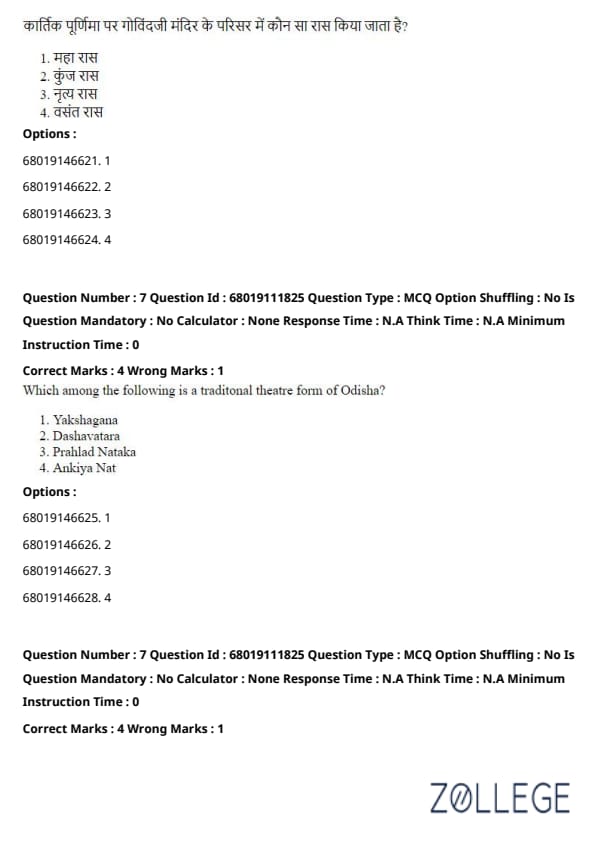
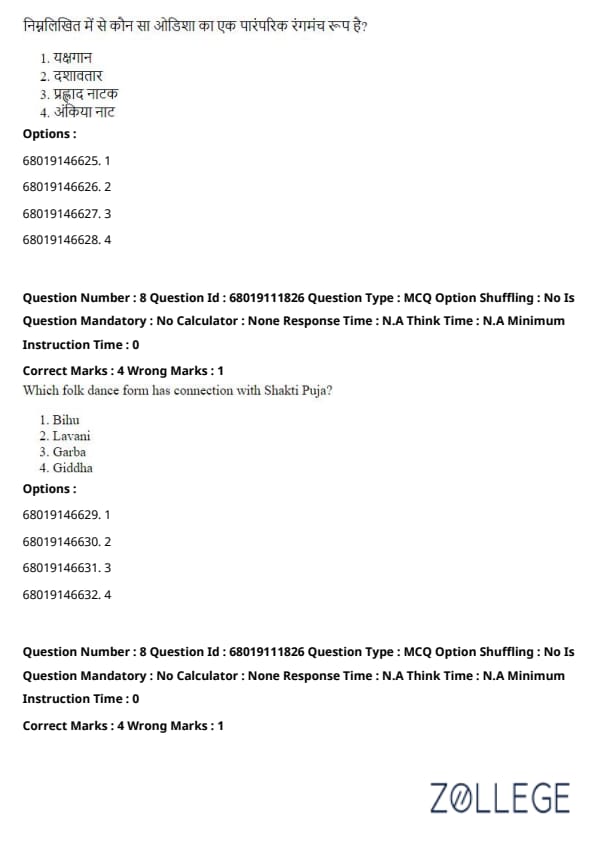
Which among the following is a traditional theatre form of Odisha?
View Solution
Solution: Prahlad Nataka is a traditional theatre form of Odisha. Yakshagana is a traditional theatre form of Karnataka. Dashavatara is a traditional theatre form of Maharashtra and parts of Goa. Ankiya Nat is a traditional theatre form of Assam.
Quick Tip: Prahlad Nat is a devotional and dramatic tradition of Odisha, combining acting, music, and dance for storytelling.
Question 8:
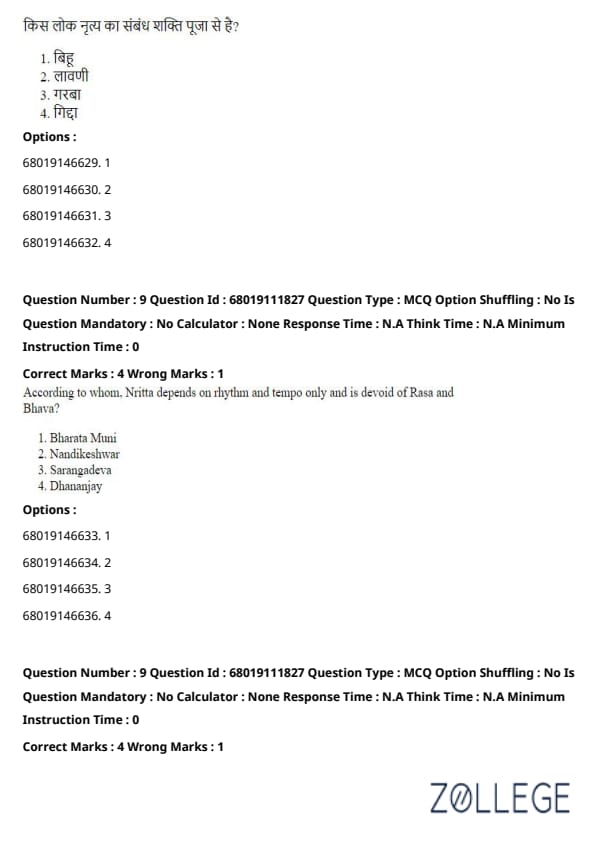
Which folk dance form has connection with Shakti Puja?
View Solution
Solution: Garba is a traditional folk dance from Gujarat, primarily performed during the Navratri festival, which is associated with the worship of Goddess Durga, symbolizing Shakti Puja. Bihu is a folk dance from Assam, Lavani is a folk dance from Maharashtra, and Giddha is a folk dance from Punjab.
Quick Tip: Garba is an energetic and rhythmic dance form performed during Navratri, celebrating the divine feminine energy, Shakti.
Question 9:
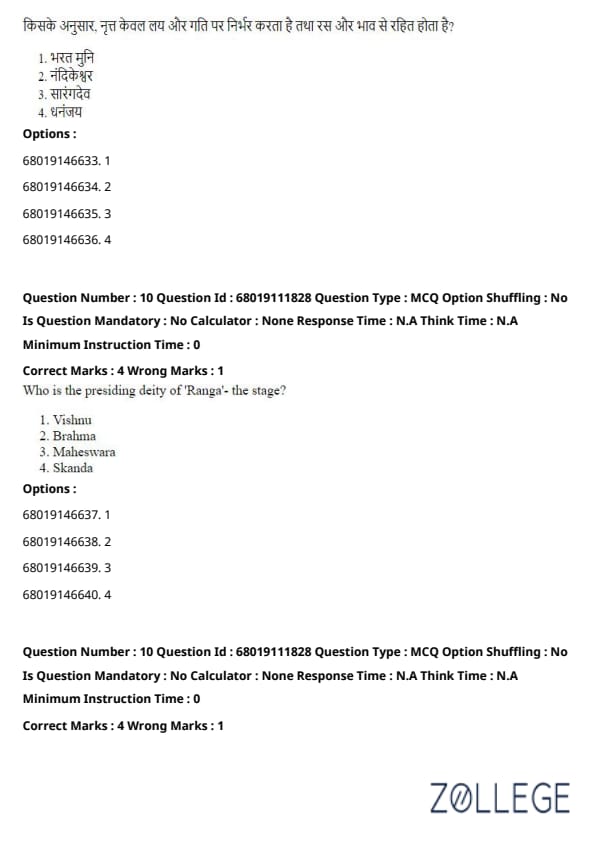
According to whom, Nritta depends on rhythm and tempo only and is devoid of Rasa and Bhava?
View Solution
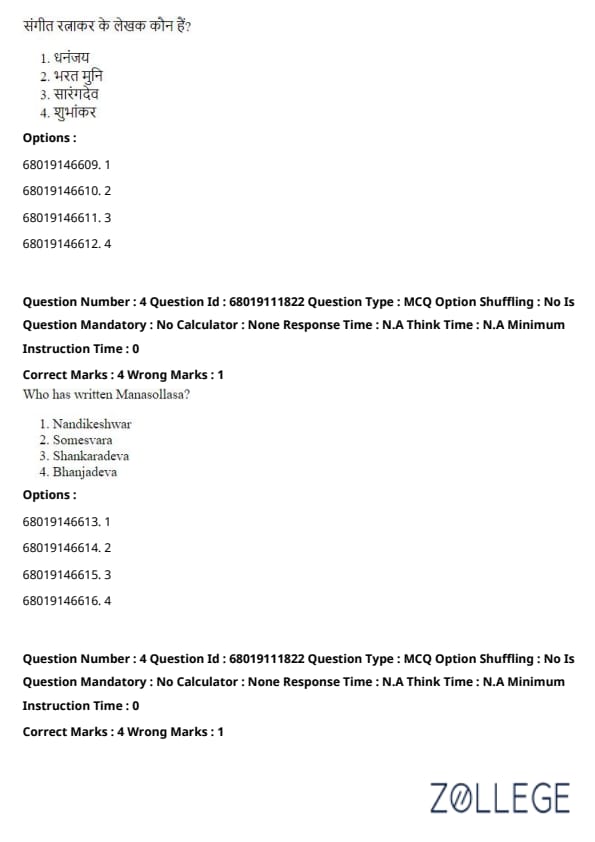
Solution: According to Dhananjaya, Nritta depends on rhythm and tempo only and is devoid of Rasa and Bhava. Bharata Muni, Nandikeshwar, and Sarangadeva are other important figures in Indian classical dance and music, but they do not hold this specific view about Nritta.
Quick Tip: This view focuses purely on rhythmic movements, without any emotional expressions.
Question 10:
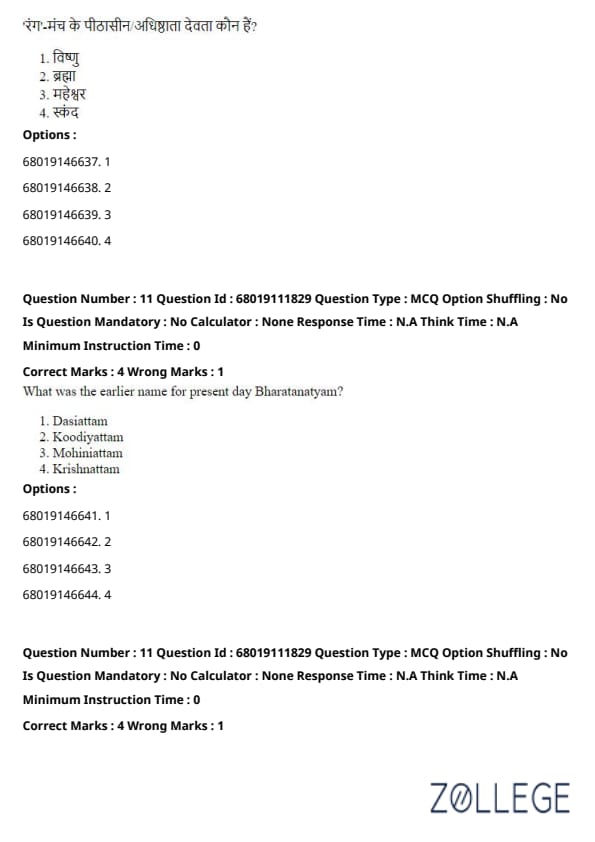
Who is the presiding deity of 'Ranga' - the stage?
View Solution
Solution: In classical Indian theatre, Brahma is regarded as the presiding deity of the stage or 'Ranga', as he is the creator of all artistic forms, including dance and drama. Vishnu is the preserver, Maheswara (Shiva) is the destroyer, and Skanda (Kartikeya) is the god of war.
Quick Tip: Brahma is associated with creation, and hence is revered as the presiding deity of the stage in Indian classical arts.
Question 11:
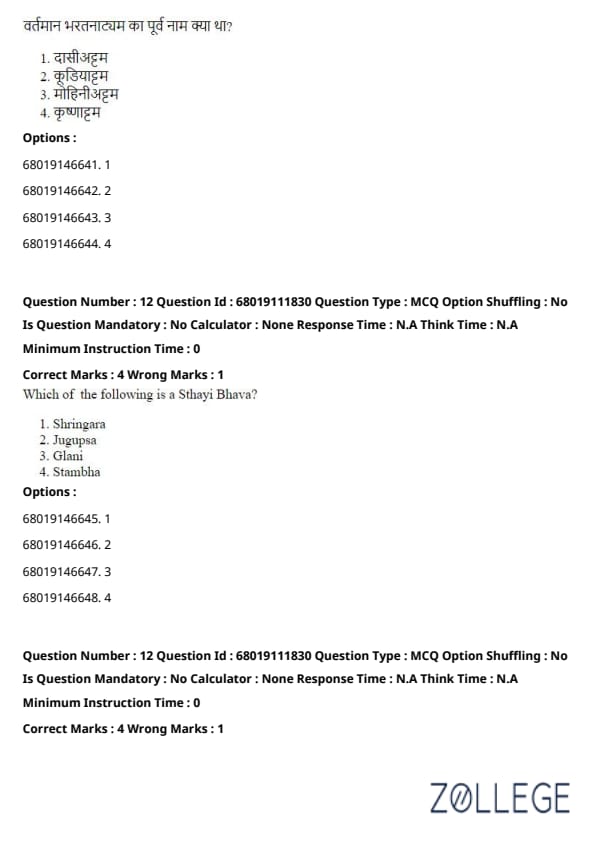
What was the earlier name for present day Bharatanatyam?
View Solution
Solution: Bharatanatyam was earlier known as Dasiattam, a classical Indian dance form that was performed by Devadasis in temples as a devotional offering.
Quick Tip: Dasiattam is the traditional name for Bharatanatyam, a dance form with deep roots in temple rituals and Devadasi culture.
Question 12:
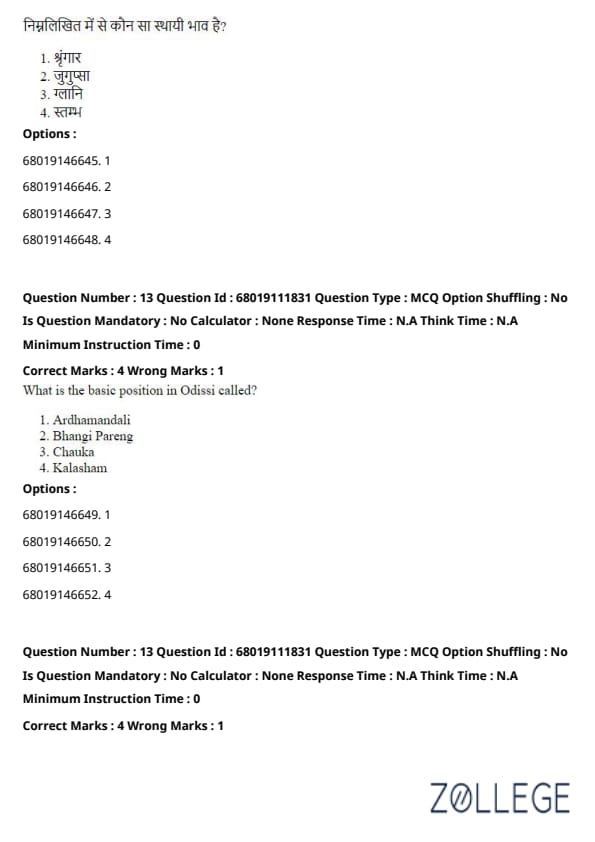
Which of the following is a Sthayi Bhava?
View Solution
Solution: Jugupsa (disgust) is a Sthayi Bhava, a permanent or dominant emotion in Indian classical dance. Shringara (love), Glani (weakness), and Stambha (paralysis) are not classified as Sthayi Bhavas.
Quick Tip: Jugupsa represents disgust and is one of the Sthayi Bhavas used to convey emotions in classical Indian dance and drama.
Question 13:
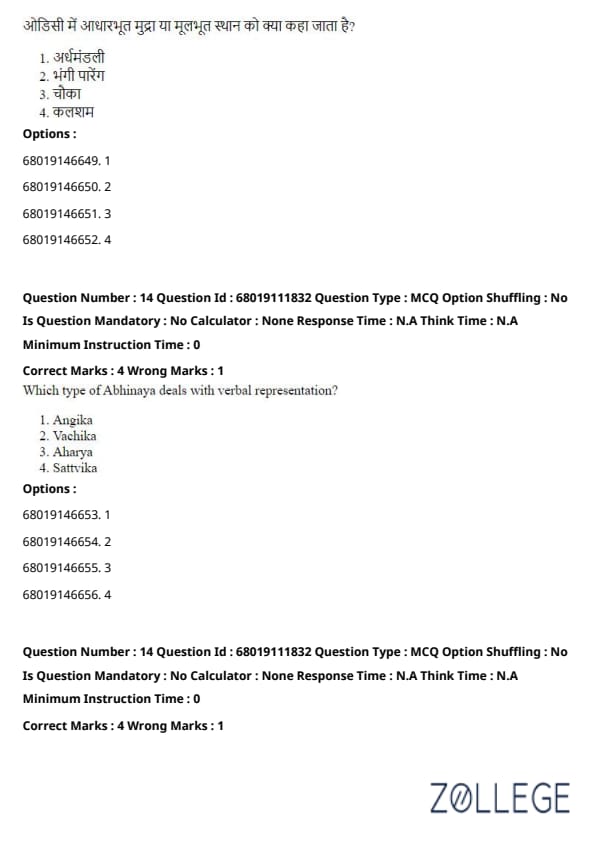
What is the basic position in Odissi called?
View Solution
Solution: In Odissi, the basic position is called Chauka, which is a square-shaped posture that symbolizes Lord Jagannath's idol and involves intricate footwork and balance. Ardhamandali is a half-circular movement, Bhangi Pareng is a specific stance in Odissi, and Kalasham represents a pot or pitcher.
Quick Tip: The Chauka position in Odissi is a key stance that signifies strength and is one of the fundamental postures in the dance.
Question 14:
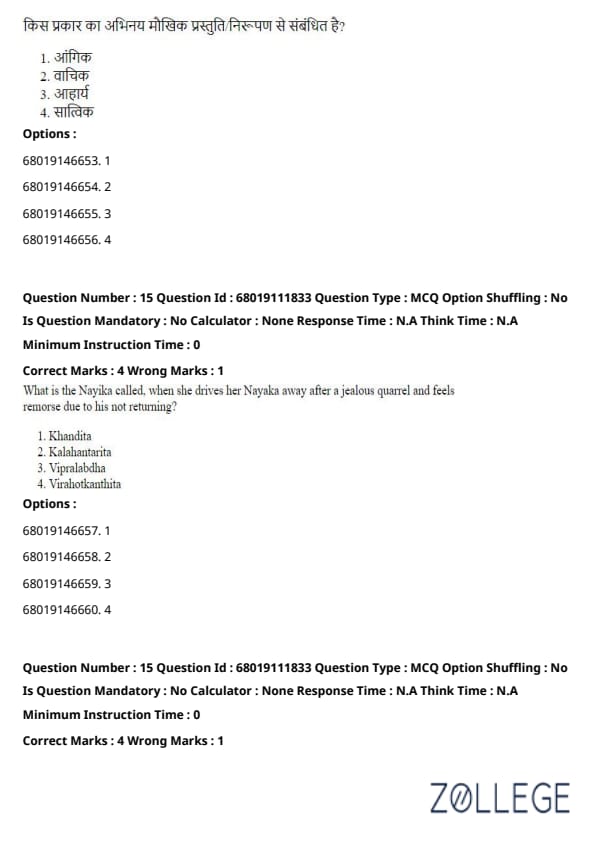
Which type of Abhinaya deals with verbal representation?
View Solution
Solution: Vachika Abhinaya refers to verbal expression, including the use of speech, song, and vocalization to communicate the emotions and themes in a performance. Angika is related to body movements, Aharya to costumes and makeup, and Sattvika to involuntary expressions.
Quick Tip: Vachika Abhinaya is the verbal expression used to convey the narrative in classical dance and drama.
Question 15:
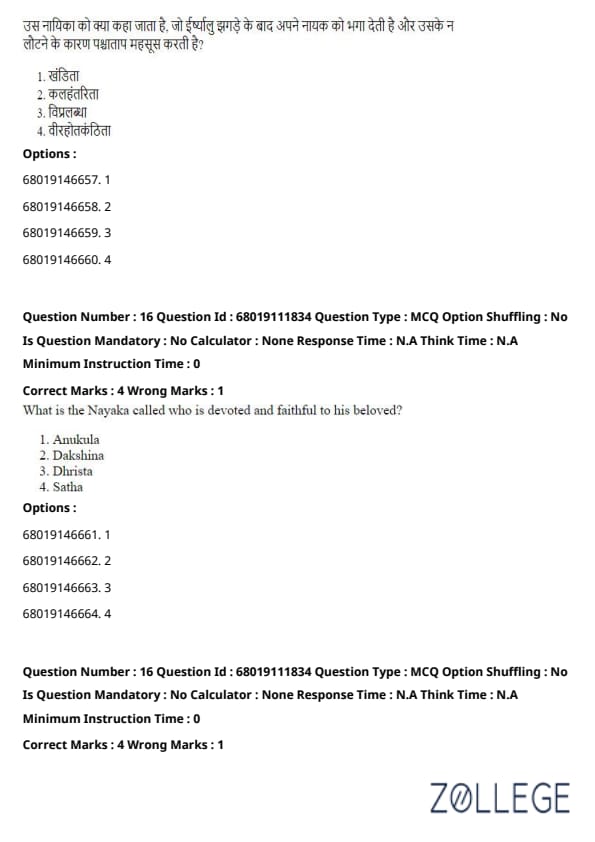
What is the Nayika called, when she drives her Nayaka away after a jealous quarrel and feels remorse due to his not returning?
View Solution
Solution: Kalahantarita is the Nayika who drives her lover (Nayaka) away after a quarrel, feeling remorseful later when he doesn't return. Khandita is a rejected Nayika, Vipralabdha is one separated from her lover, and Virahotkanthita is one suffering the pangs of separation.
Quick Tip: Kalahantarita represents the emotion of a jealous lover who feels regret when the conflict leads to separation.
Question 16:
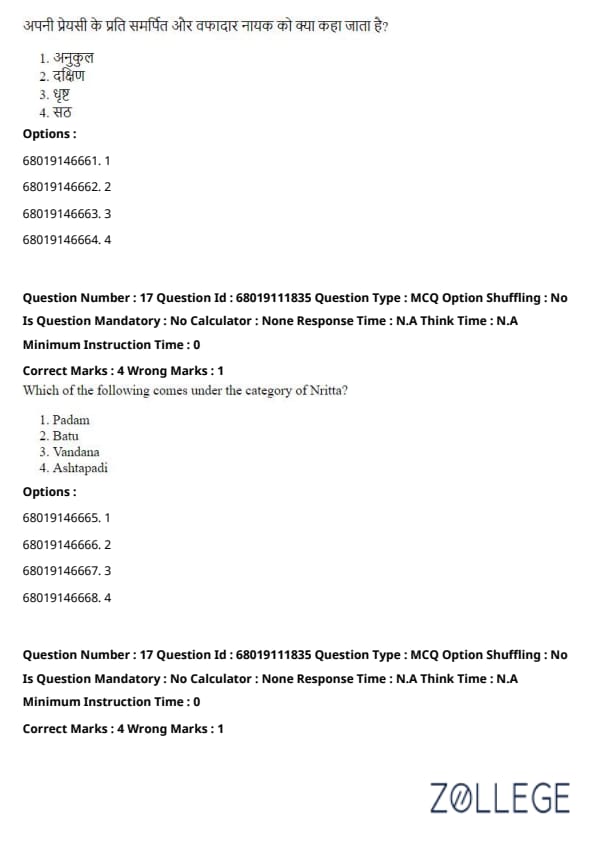
What is the Nayaka called who is devoted and faithful to his beloved?
View Solution
Solution: Anukula is the Nayaka who is devoted, faithful, and loyal to his beloved. Dakshina is a skillful and generous lover, Dhrista is audacious and arrogant, and Satha is deceitful and cunning.
Quick Tip: Anukula refers to a lover who is faithful and devoted, commonly used in classical Indian art and literature.
Question 17:
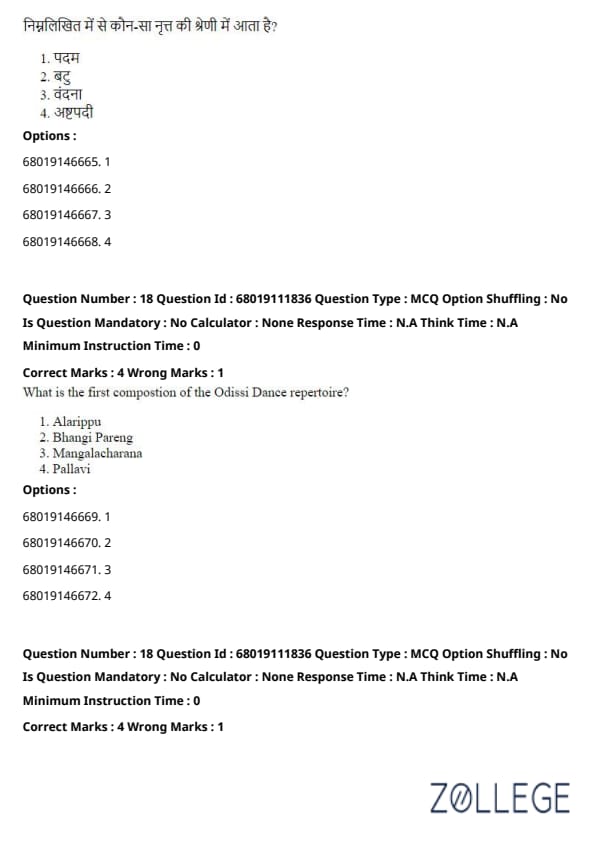
Which of the following comes under the category of Nritta?
View Solution
Solution: Nritta refers to pure dance movements that are abstract and not associated with any specific meaning or emotion. Batu, being a rhythmic and pure dance, falls under Nritta. Padam, Vandana and Ashtapadi involve expression of emotions and storytelling (Nritya).
Quick Tip: Nritta is the abstract, rhythmic movement in classical dance, and Batu is an example of such a dance form.
Question 18:
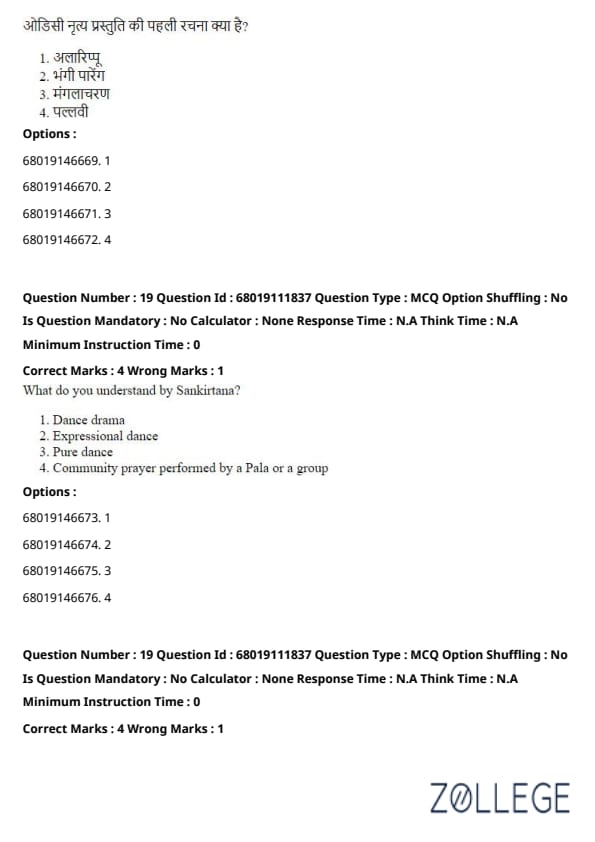
What is the first composition of the Odissi Dance repertoire?
View Solution
Solution: The first composition in the Odissi dance repertoire is Mangalacharana, which is a traditional invocation to the deities, seeking blessings for a successful performance. Alarippu is the first item in Bharatanatyam, Bhangi Pareng is a basic stance in Odissi, and Pallavi is a later composition in Odissi.
Quick Tip: Mangalacharana is an invocation piece, performed at the beginning of an Odissi dance recital.
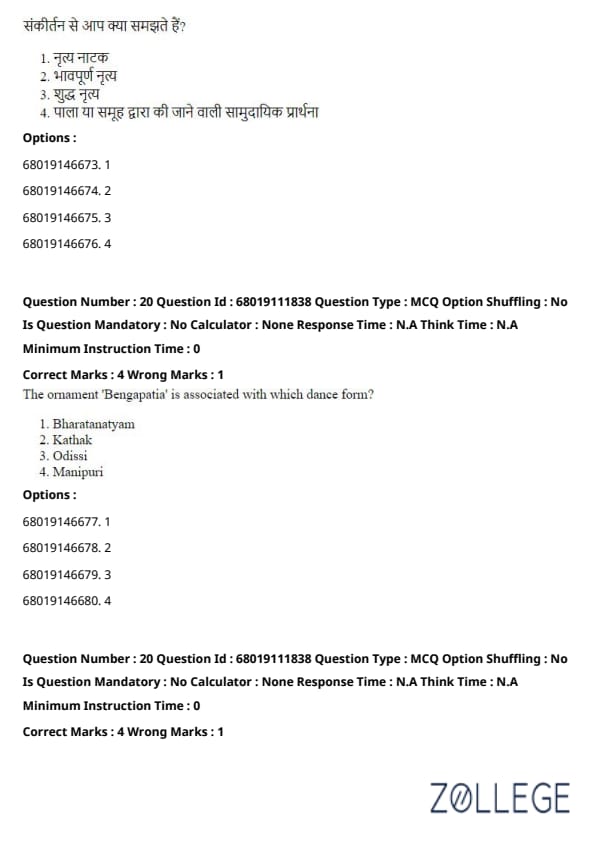
Question 19:
What do you understand by Sankirtana?
View Solution
Solution: Sankirtana is a form of community prayer where a group, often led by a Pala, sings hymns, praises deities, and may involve dance, commonly seen in Odissi and other classical Indian dance forms.
Quick Tip: Sankirtana is a devotional group prayer or hymn that may include both singing and dancing.
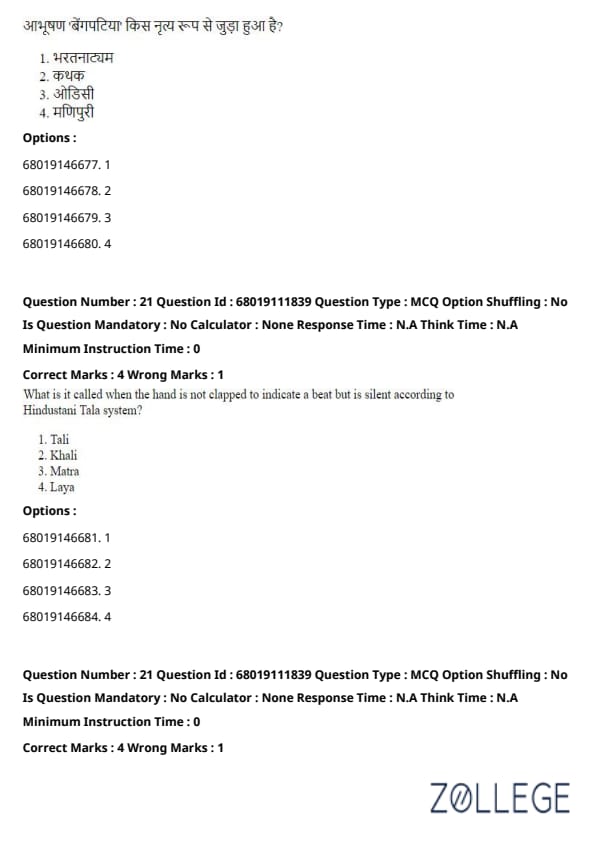
Question 20:
The ornament 'Bengapatia' is associated with which dance form?
View Solution
Solution: The 'Bengapatia' ornament is specifically associated with the Odissi dance form, representing a traditional aesthetic style in the dance. It's a type of necklace.
Quick Tip: Bengapatia is a traditional ornament used in Odissi dance, reflecting its cultural aesthetics.
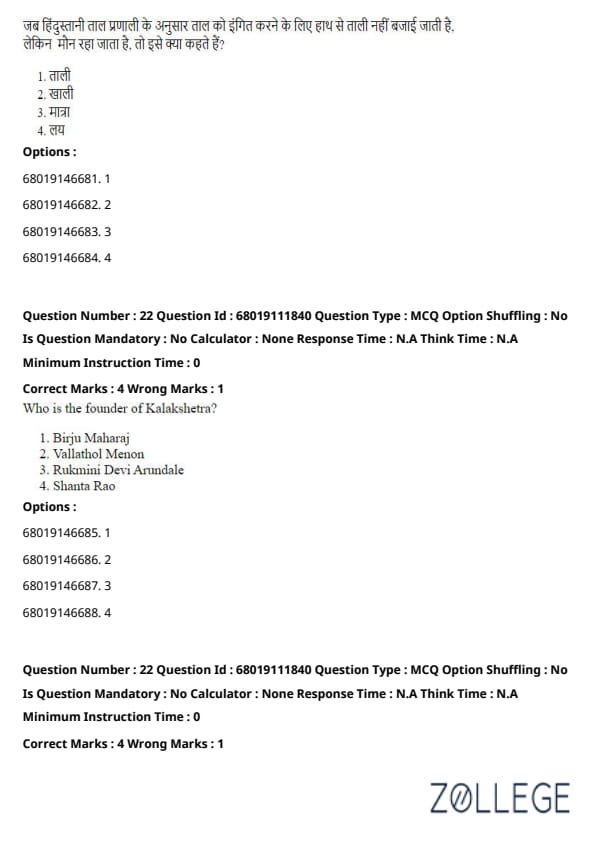
Question 21:
What is it called when the hand is not clapped to indicate a beat but is silent according to Hindustani Tala system?
View Solution
Solution: In the Hindustani Tala system, 'Khali' refers to the silent beat where the hand is not clapped, indicating a pause in the cycle of the rhythm. Tali is a clap, Matra is a beat or time unit, and Laya is tempo.
Quick Tip: Khali refers to a silent beat or a gap in the rhythm cycle where no clap occurs.
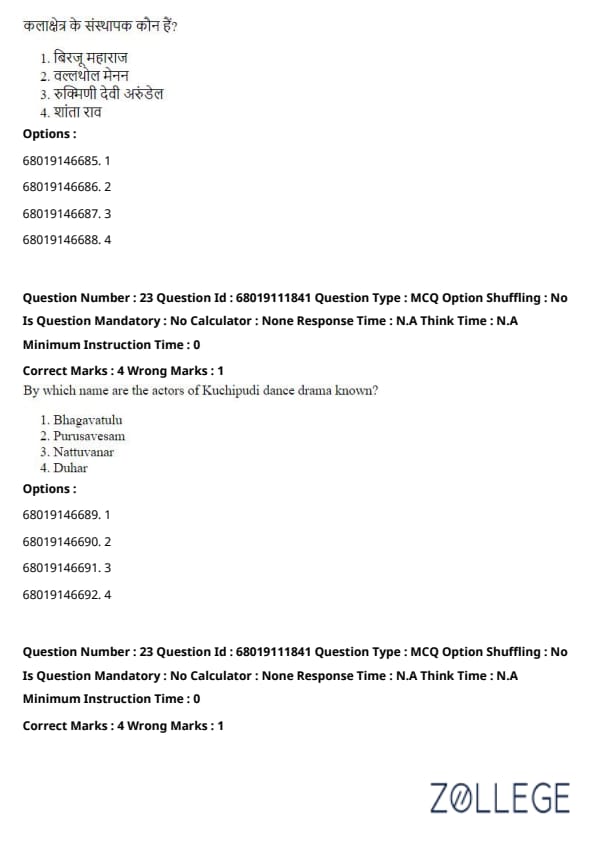
Question 22:
Who is the founder of Kalakshetra?
View Solution
Solution: Rukmini Devi Arundale is the founder of Kalakshetra, a renowned institution for the study and performance of classical dance, particularly Bharatanatyam. Birju Maharaj is a Kathak dancer, Vallathol Menon is associated with Kathakali, and Shanta Rao is a Bharatnatyam dancer.
Quick Tip: Kalakshetra, founded by Rukmini Devi Arundale, is one of the leading institutions for classical dance in India.
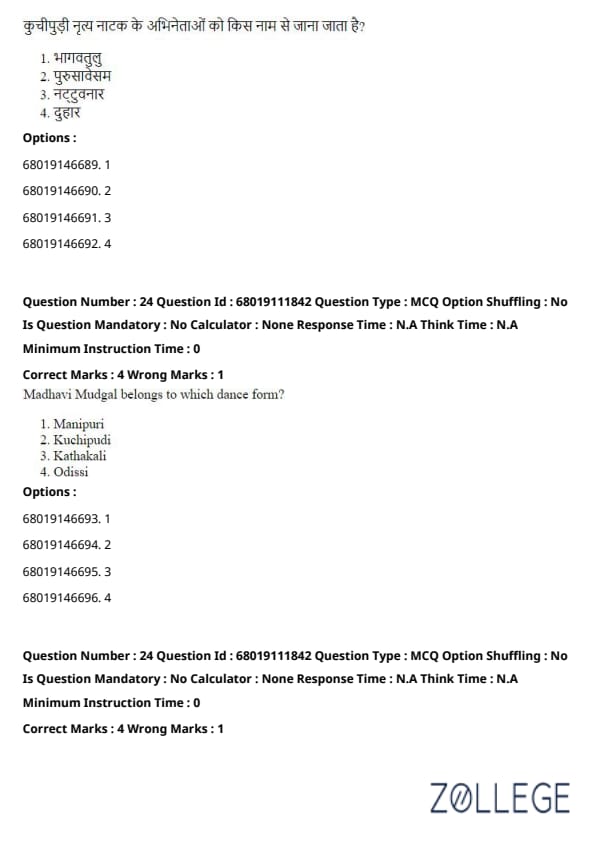
Question 23:
By which name are the actors of Kuchipudi dance drama known?
View Solution
Solution: In Kuchipudi dance drama, the actors are known as Bhagavatulu. They play a key role in performing the traditional dance-dramas. Purusavesam isn't related to actors, Nattuvanar are dance teachers in Bharatanatyam, and Duhar isn't a term associated with Kuchipudi.
Quick Tip: In Kuchipudi, Bhagavatulu are the performers who enact the traditional dance-drama with narration.
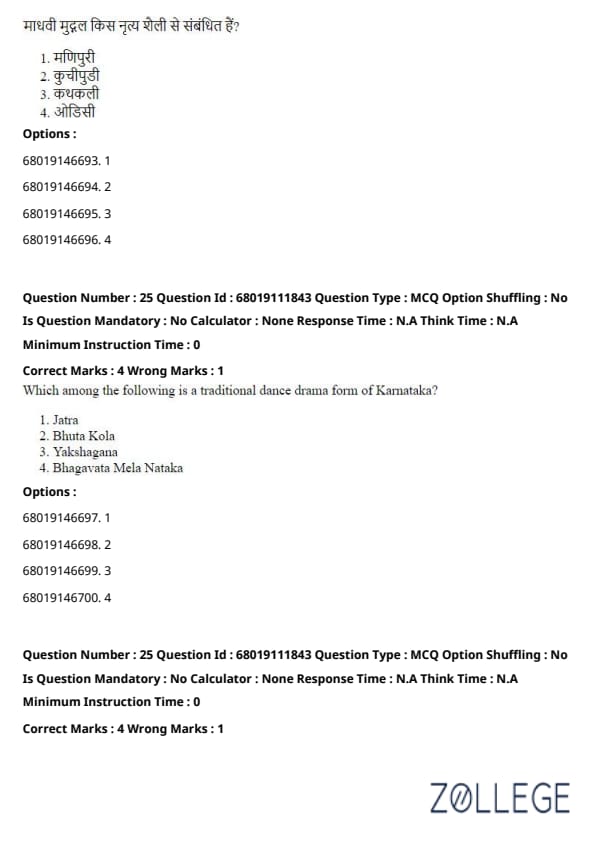
Question 24:
Madhavi Mudgal belongs to which dance form?
View Solution
Solution: Madhavi Mudgal is a prominent exponent of Odissi, one of the classical dance forms of India, known for its graceful movements and devotional themes.
Quick Tip: Madhavi Mudgal is renowned for her contributions to Odissi dance and is one of its leading exponents.
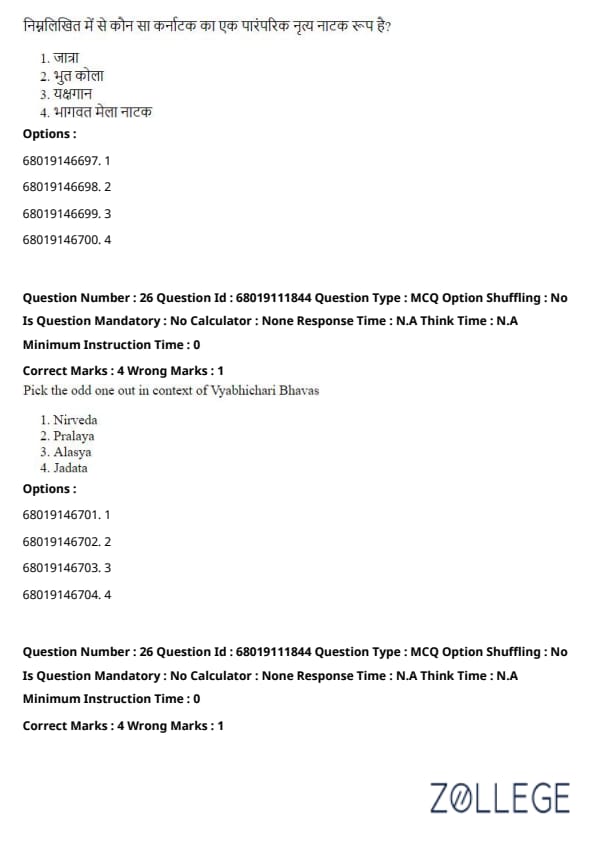
Question 25:
Which among the following is a traditional dance drama form of Karnataka?
View Solution
Solution: Yakshagana is a traditional dance-drama form of Karnataka that combines dance, music, and dialogue to depict stories from Hindu mythology. Jatra is from West Bengal, Bhuta Kola is a spirit worship ritual dance from Karnataka (not a dance drama), and Bhagavata Mela Nataka is a dance-drama form from Tamil Nadu.
Quick Tip: Yakshagana is a unique dance-drama tradition from Karnataka, known for its vibrant costumes and energetic performances.
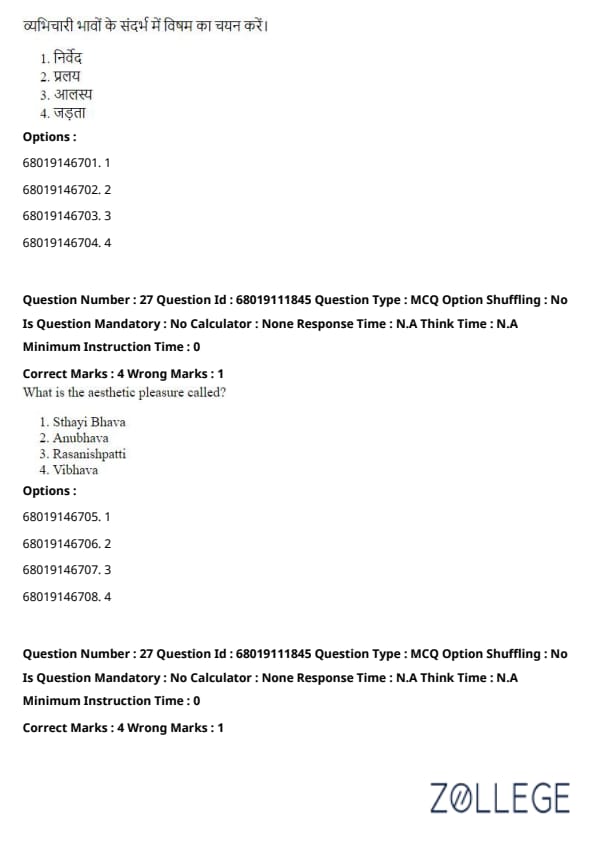
Question 26:
Pick the odd one out in context of Vyabhichari Bhavas
View Solution
Solution: Vyabhichari Bhavas refer to the transient emotions that are seen in the characters while performing a dramatic expression. While Nirveda (detachment/disgust), Alasya (laziness), and Jadata (stupidity/dullness) are all examples of such transient states, Pralaya (dissolution/destruction) refers to a complete destruction, which is different in essence.
Quick Tip: Vyabhichari Bhavas are temporary emotions; Pralaya is more extreme, indicating destruction.
Question 27:
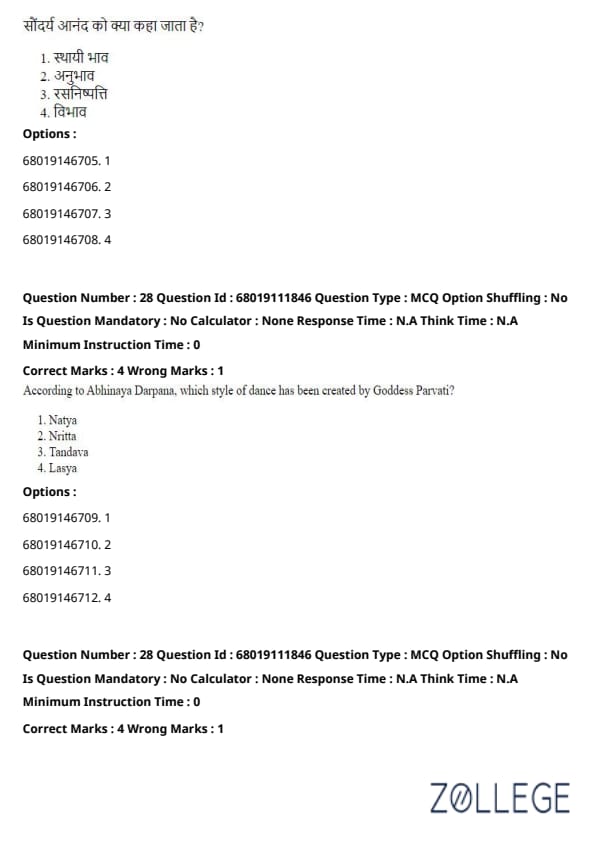
What is the aesthetic pleasure called?
View Solution
Solution: Rasanishpatti refers to the ultimate aesthetic pleasure derived from the interaction of emotions and artistic performance in the context of Rasa theory. Sthayi Bhava is a permanent mood, Anubhava is a consequential feeling, and Vibhava is the determinant of an emotion.
Quick Tip: Rasanishpatti is the culmination of emotional and artistic harmony in performance, leading to aesthetic pleasure.
Question 28:
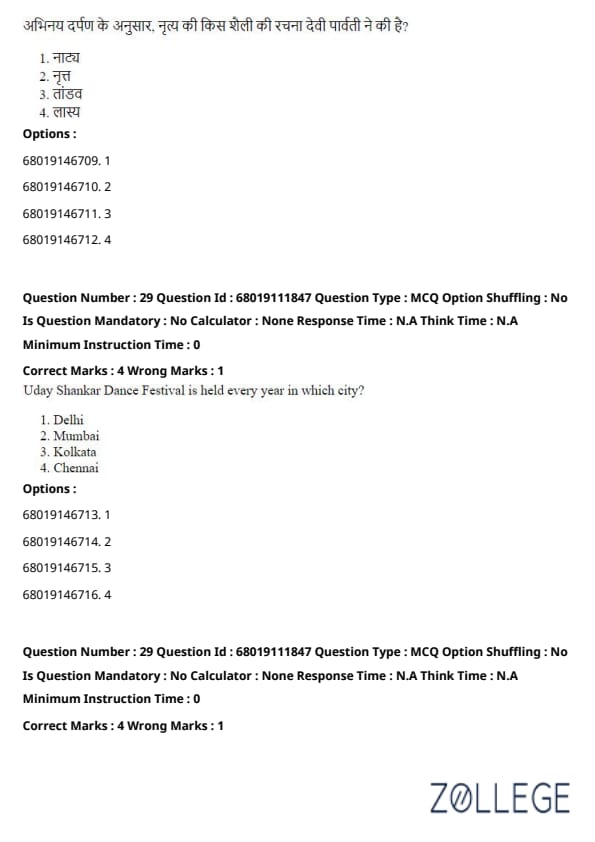
According to Abhinaya Darpana, which style of dance has been created by Goddess Parvati?
View Solution
Solution: According to the Abhinaya Darpana, Lasya is the style of dance created by Goddess Parvati, characterized by graceful and delicate movements, contrasting with the more vigorous Tandava style created by Lord Shiva. Natya encompasses both Nritta and Nritya, and Nritta is pure dance.
Quick Tip: Lasya, created by Goddess Parvati, is the graceful counterpart to Shiva's energetic Tandava.
Question 29:
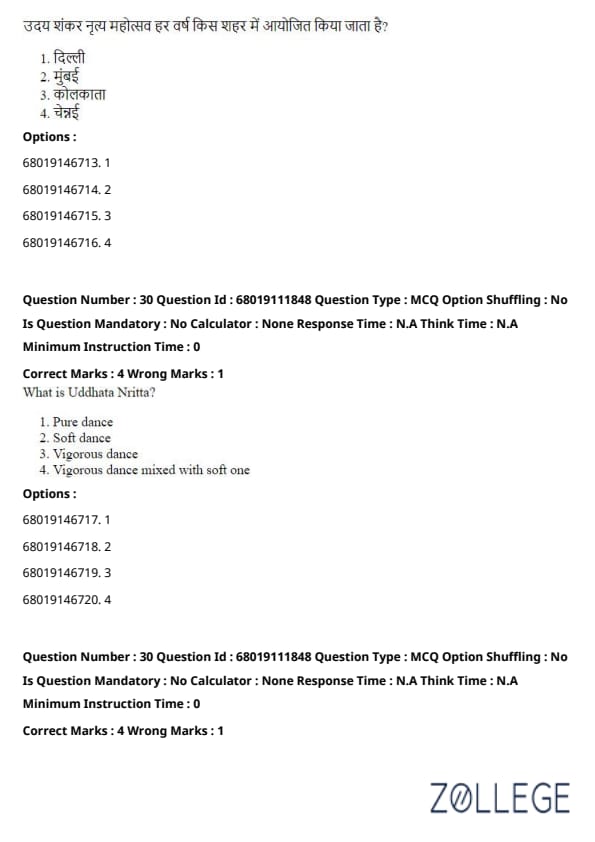
Uday Shankar Dance Festival is held every year in which city?
View Solution
Solution: The Uday Shankar Dance Festival, named after the legendary dancer and choreographer Uday Shankar, is celebrated annually in Kolkata, paying tribute to his contributions to the Indian classical dance forms.
Quick Tip: The Uday Shankar Dance Festival is an annual event held in Kolkata to honor Uday Shankar's legacy.
Question 30:
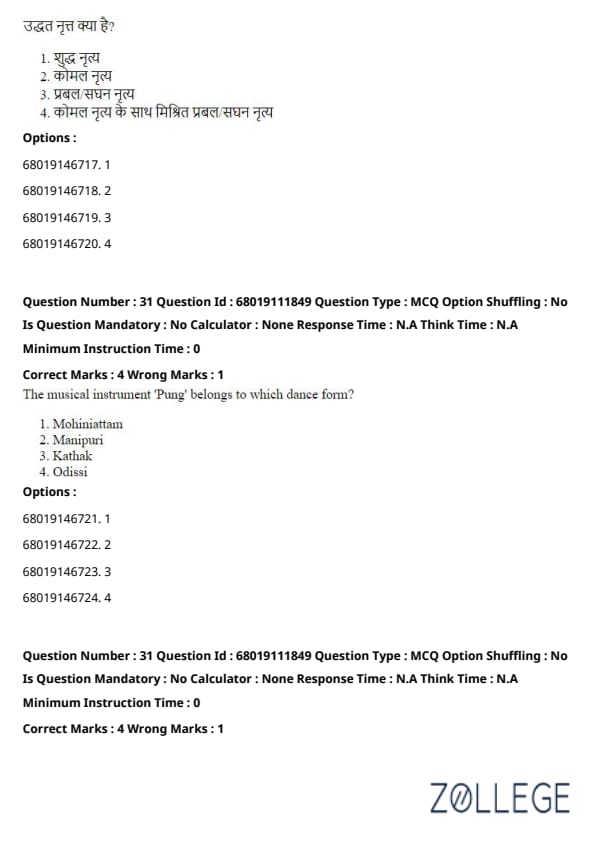
What is Uddhata Nritta?
View Solution
Solution: Uddhata Nritta refers to a vigorous and energetic style of dance characterized by dynamic movements and intense physical exertion. It doesn't necessarily have to be mixed with soft movements.
Quick Tip: Uddhata Nritta is known for its vigorous, energetic movements, and intense expressions in dance.
Question 31:
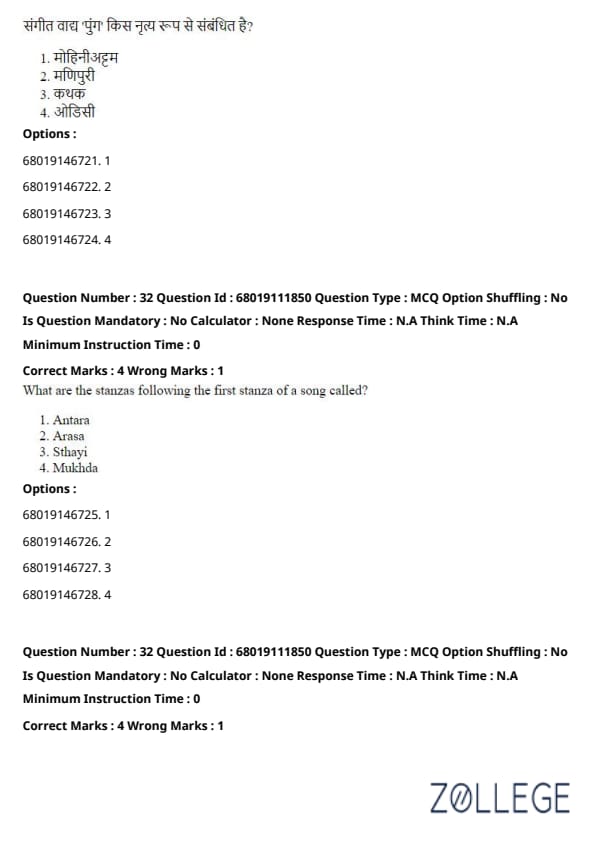
The musical instrument "Pung” belongs to which dance form?
View Solution
Solution: The "Pung" is a traditional drum used in Manipuri dance, a classical dance form from the state of Manipur, India. It is an essential part of the dance's musical accompaniment.
Quick Tip: The Pung is intrinsic to Manipuri dance, known for its rhythmic beats that accompany the movements.
Question 32:
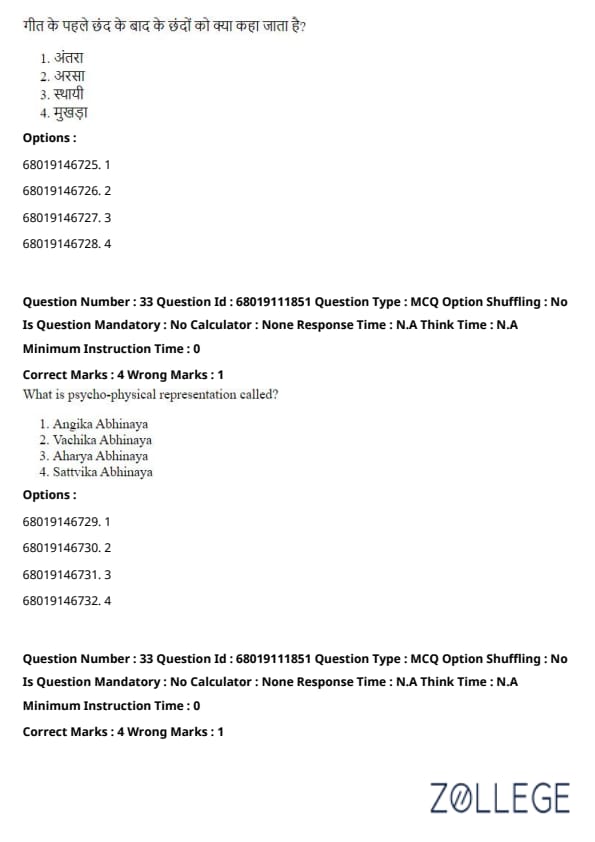
What are the stanzas following the first stanza of a song called?
View Solution
Solution: In music, the stanzas following the first one, usually presenting a contrasting or additional melody, are referred to as "Antara". "Sthayi" is the refrain, and "Mukhda" refers to the first stanza. Arasa isn't the term used for subsequent stanzas.
Quick Tip: Antara is the part of the song that follows the first stanza and adds variety to the melody.
Question 33:
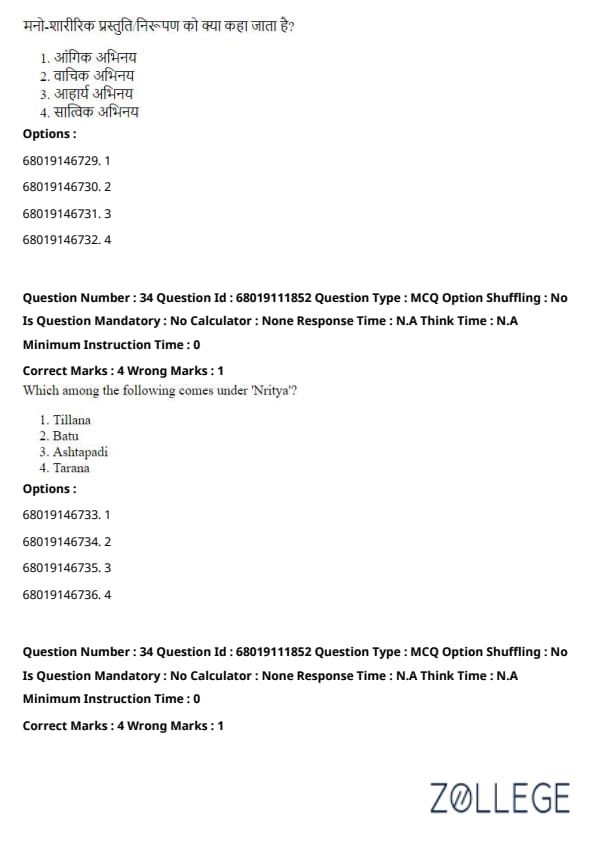
What is psycho-physical representation called?
View Solution
Solution: Sattvika Abhinaya is the psycho-physical representation of emotions through involuntary expressions like trembling, tears, changes in complexion, etc. Angika relates to body movements, Vachika to speech, and Aharya to costumes and makeup.
Quick Tip: Sattvika Abhinaya involves subtle expressions that convey the inner emotions of the character.
Question 34:
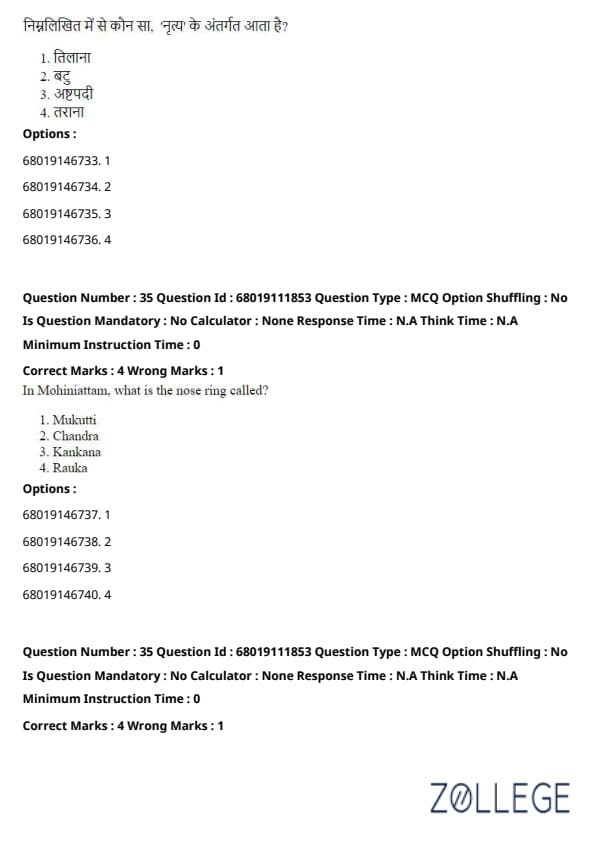
Which among the following comes under 'Nritya'?
View Solution
Solution: Nritya involves expressive dance and abhinaya (expression). Ashtapadi, with its focus on storytelling and emotional portrayal (often from Gita Govinda), falls under Nritya. Tillana and Tarana are closer to pure dance (Nritta), and Batu is specifically rhythmic pure dance.
Quick Tip: Ashtapadi is expressive dance that tells a story through both gestures and movement.
Question 35:
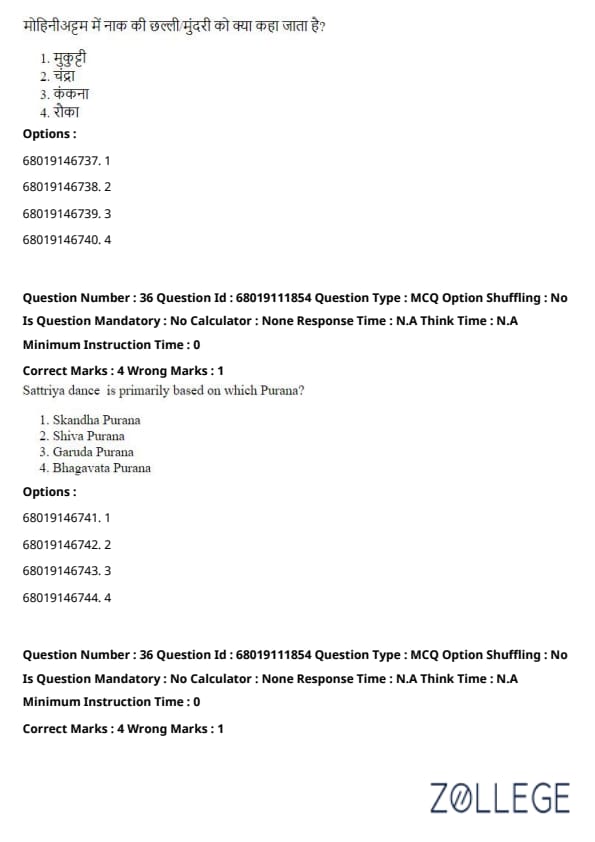
In Mohiniattam, what is the nose ring called?
View Solution
Solution: In Mohiniattam, the traditional dance form of Kerala, the nose ring is called 'Mukutti'. It is an important part of the costume and adds to the classical aesthetic of the dancer. Chandra, Kankana, and Rauka are not terms associated with nose rings in Mohiniattam.
Quick Tip: Mukutti is the distinctive nose ring worn in Mohiniattam to complement the traditional attire of the dancer.
Question 36:
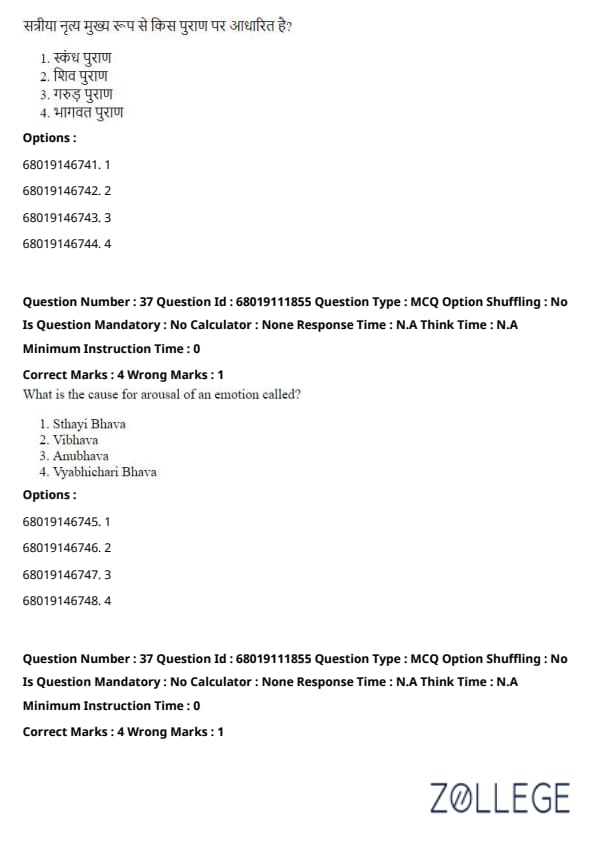
Sattriya dance is primarily based on which Purana?
View Solution
Solution: Sattriya, a classical dance form of Assam, is primarily based on the teachings and narratives found in the Bhagavata Purana, particularly those related to the devotional service of Lord Krishna. It draws inspiration from the Krishna legends within this Purana.
Quick Tip: Sattriya dance originates from the devotional stories of Lord Krishna found in the Bhagavata Purana.
Question 37:
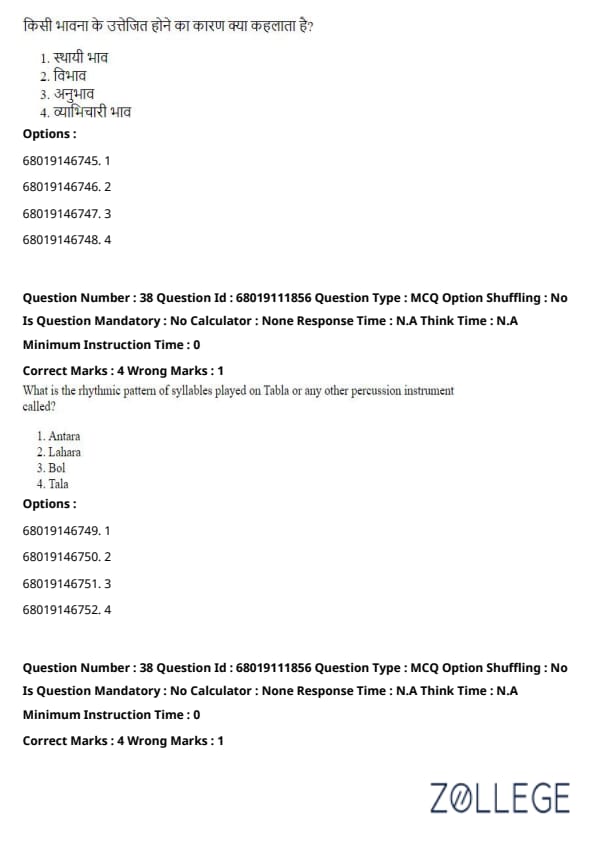
What is the cause for arousal of an emotion called?
View Solution
Solution: In the context of Bharatanatyam and other classical Indian dances, Vibhava is the cause or stimulus for the arousal of a particular emotion, whereas Sthayi Bhava refers to the enduring emotional state. Anubhava is the consequential feeling, and Vyabhichari Bhava is a transient emotion.
Quick Tip: Vibhava is the cause or stimulus that triggers the arousal of emotion in Indian classical dance.
Question 38:
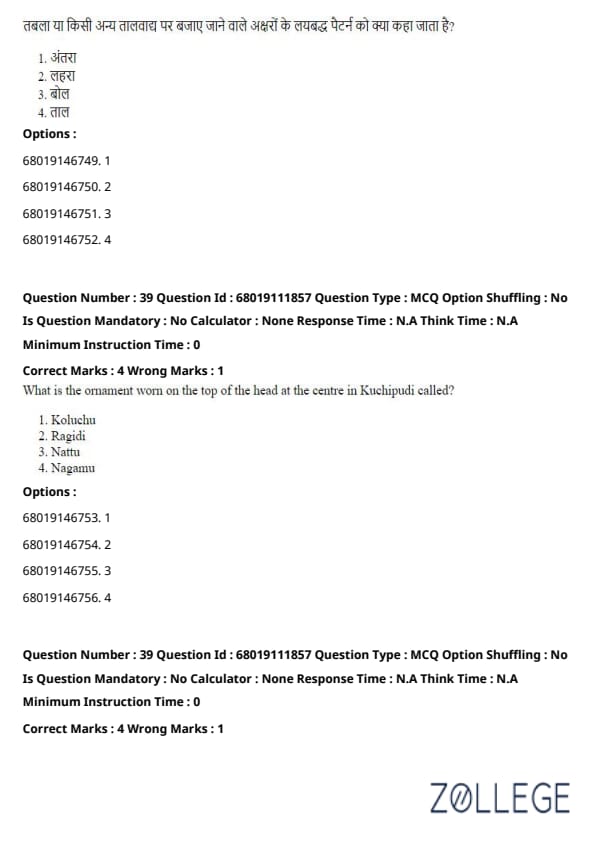
What is the rhythmic pattern of syllables played on Tabla or any other percussion instrument called?
View Solution
Solution: Bol refers to the rhythmic syllables played on the Tabla or any other percussion instrument. It's the language of rhythmic expression. Antara is a melodic phrase in music, Lahara is a melodic embellishment, and Tala is the rhythmic cycle.
Quick Tip: Bol is the fundamental rhythmic element in Indian classical music, particularly for percussion.
Question 39:
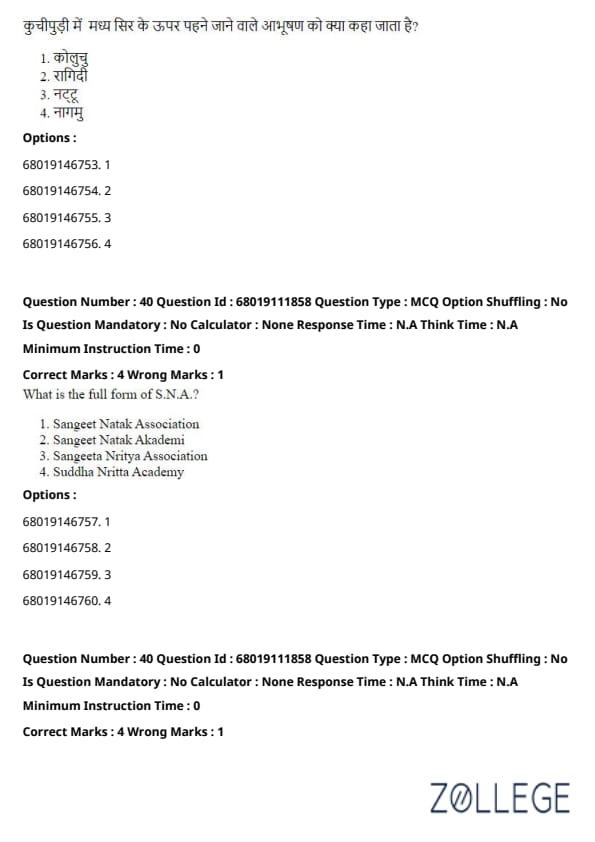
What is the ornament worn on the top of the head at the centre in Kuchipudi called?
View Solution
Solution: Ragidi is a head ornament worn in Kuchipudi, placed at the center of the dancer's forehead. While not a widely known term outside Kuchipudi circles, it is part of the traditional aesthetic. The other options aren't relevant head ornaments in this context.
Quick Tip: Ragidi is the central head ornament in Kuchipudi, positioned on the forehead.
Question 40:
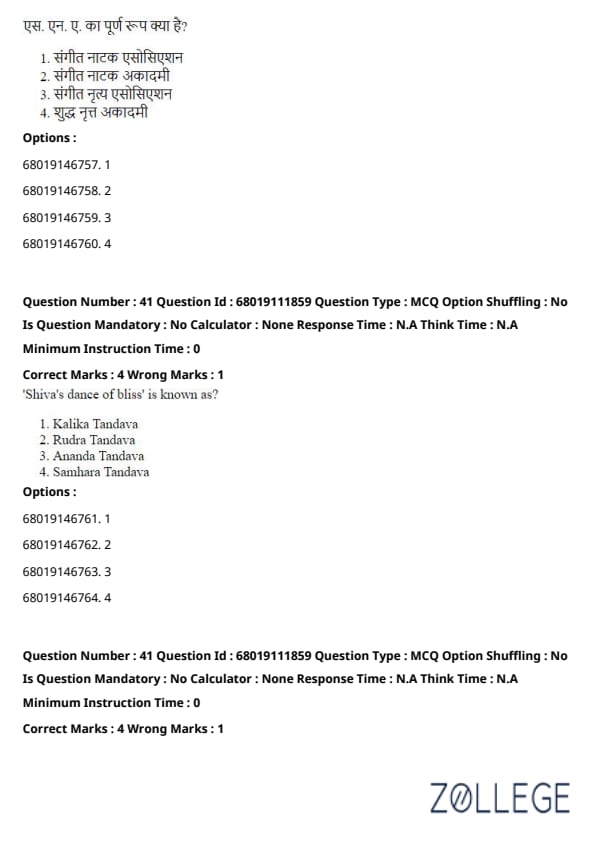
What is the full form of S.N.A.?
View Solution
Solution: The full form of S.N.A. is Sangeet Natak Akademi, which is India's national academy for music, dance, and drama. It is the primary institution for promoting these performing arts.
Quick Tip: Sangeet Natak Akademi is the national academy of music, dance, and drama in India, promoting performing arts.
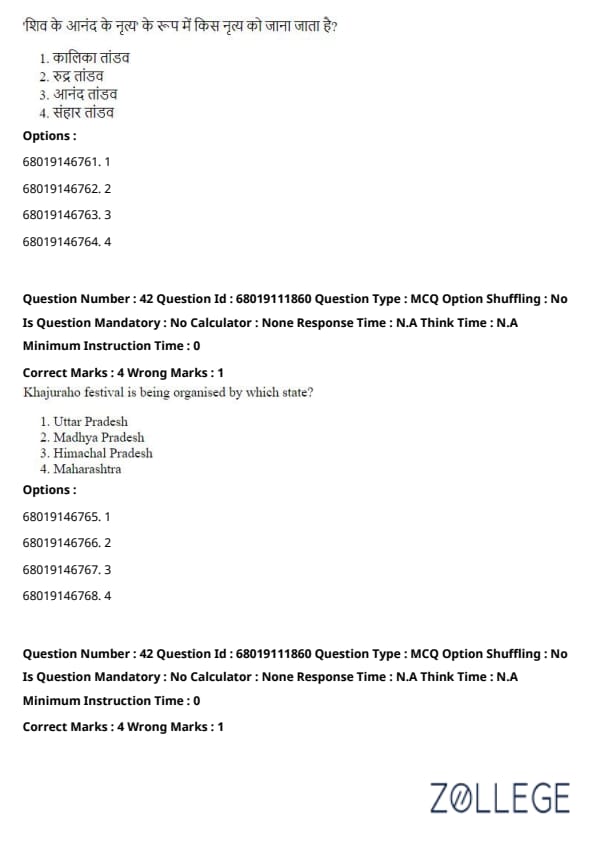
Question 41:
'Shiva's dance of bliss' is known as?
View Solution
Solution: 'Ananda Tandava' refers to the dance of bliss performed by Lord Shiva. It symbolizes the cosmic cycle of creation, preservation, and destruction and is the most celebrated dance of Shiva in Hindu mythology. Kalika Tandava is associated with destruction, Rudra Tandava is a fierce dance, and Samhara Tandava is the dance of destruction.
Quick Tip: Ananda Tandava represents Shiva's cosmic dance of bliss, signifying creation and cosmic order.
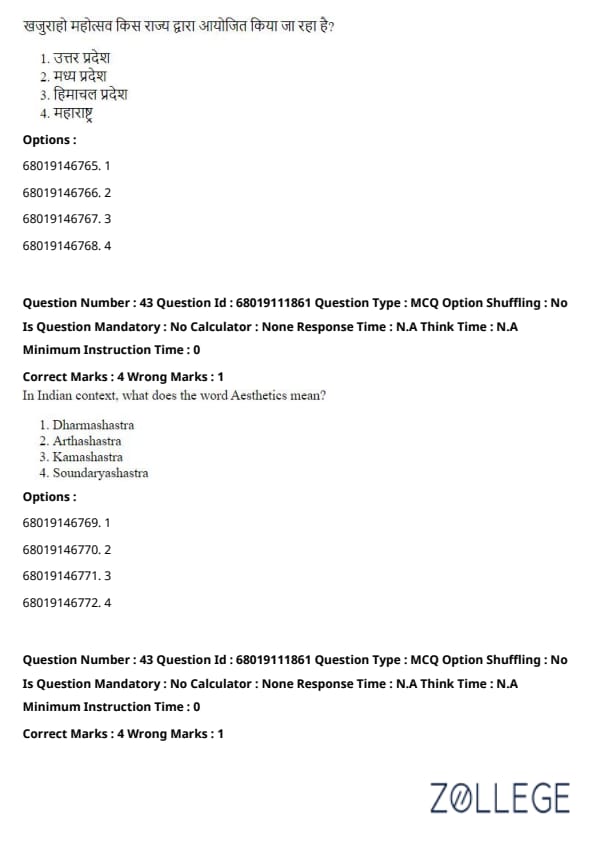
Question 42:
Khajuraho festival is being organised by which state?
View Solution
Solution: The Khajuraho festival, an important cultural festival showcasing classical dance and music, is organized by the Madhya Pradesh Government. It takes place annually at the UNESCO World Heritage site, Khajuraho.
Quick Tip: The Khajuraho Festival is organized by the Madhya Pradesh Government to celebrate Indian classical dance and music.
Question 43:
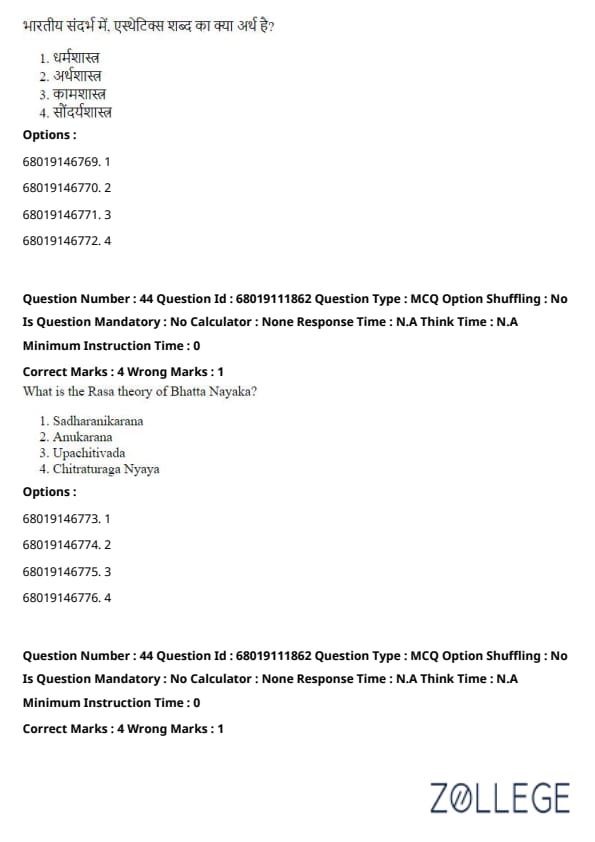
In Indian context, what does the word Aesthetics mean?
View Solution
Solution: In the Indian context, Aesthetics is known as 'Soundaryashastra', which is the science or philosophy of beauty, art, and taste, encompassing various art forms, including dance, music, and visual arts. Dharmashastra deals with law and morality, Arthashastra with economics and politics, and Kamashastra with the art of love.
Quick Tip: Soundaryashastra refers to the philosophy and study of beauty and artistic expressions in Indian tradition.
Question 44:
What is the Rasa theory of Bhatta Nayaka?
View Solution
Solution: Bhatta Nayaka's Rasa theory is based on 'Sadharanikarana', which means the process of making the emotions of a performer universally accessible to the audience, allowing them to experience the rasa, or essence, of the emotions conveyed in a performance. Anukarana is imitation, Upachitivada is the theory of enhancement, and Chitraturaga Nyaya isn't directly related to Bhatta Nayaka's theory.
Quick Tip: Sadharanikarana is the process by which emotions are generalized or universalized so that the audience can relate to them, a key concept in Rasa theory.
Question 45:
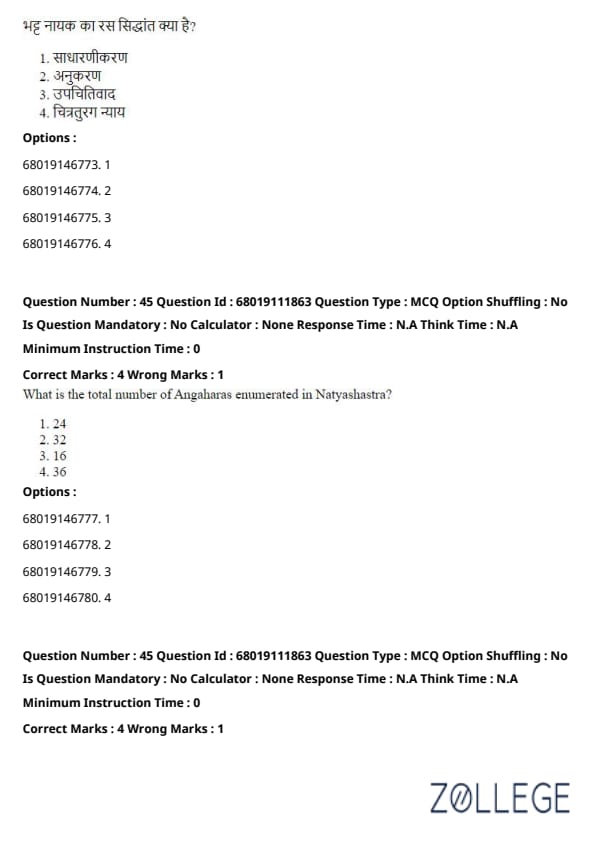
What is the total number of Angaharas enumerated in Natyashastra?
View Solution
Solution: According to the Natyashastra, 32 Angaharas are enumerated. These Angaharas are specific combinations of hand gestures and body movements used in classical dance forms.
Quick Tip: Angaharas are combinations of hand gestures and body movements, and the Natyashastra identifies 32 of them.
Question 46:
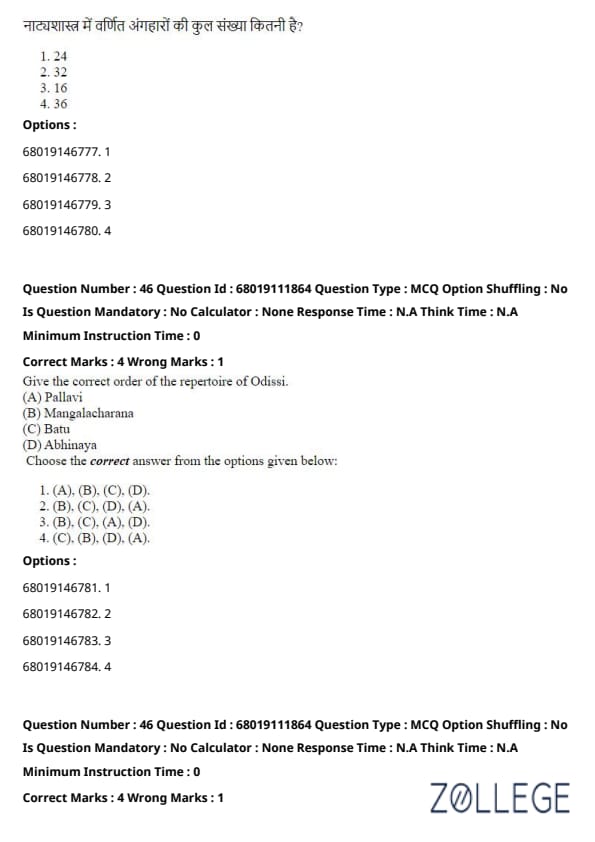
Give the correct order of the repertoire of Odissi.
Choose the correct answer from the options given below:
View Solution
Solution: In Odissi dance, the repertoire typically follows this order: Batu (pure dance), Mangalacharana (invocation), Abhinaya (expressive dance), and Pallavi (rhythmic piece).
Quick Tip: The Odissi repertoire progresses from pure dance (Batu) to invocation (Mangalacharana), then to expressive storytelling (Abhinaya), and finally to a rhythmic and melodic piece (Pallavi).
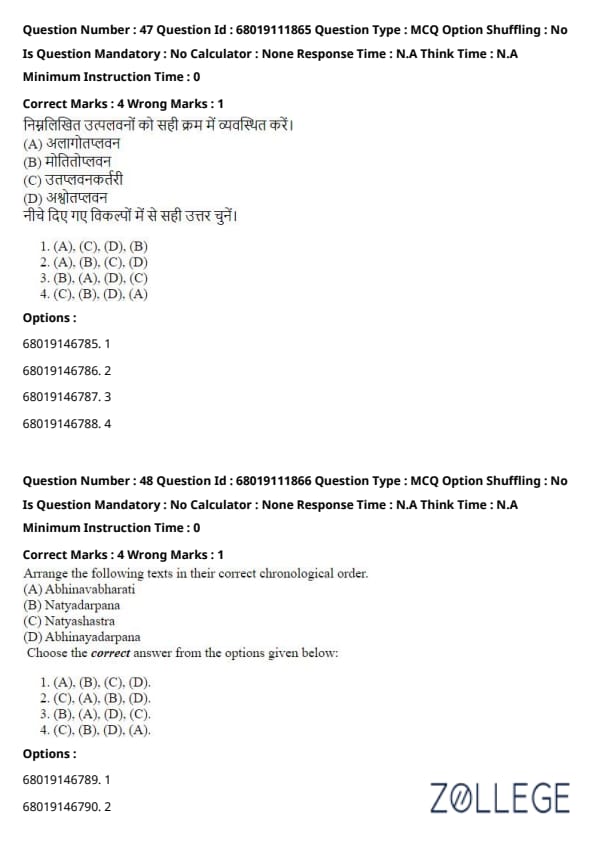
Question 47:
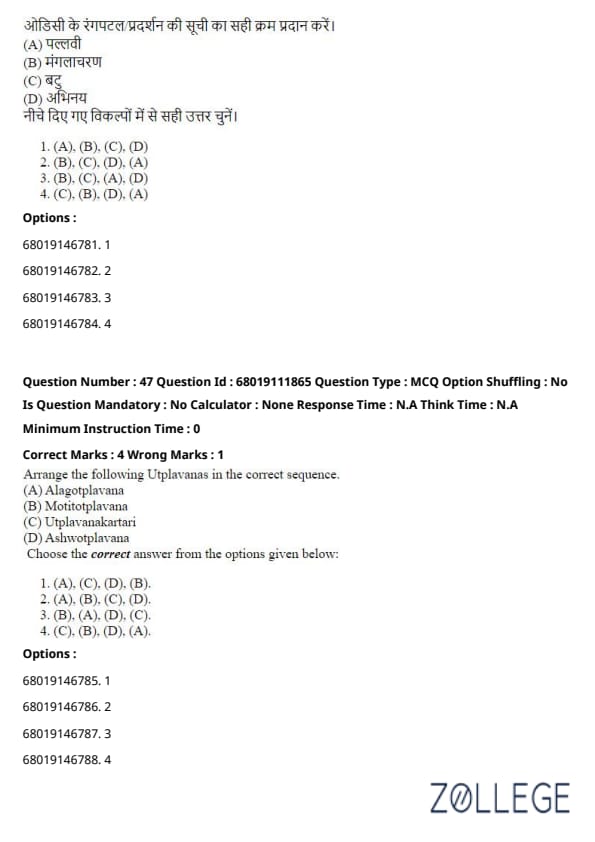
Arrange the following Utplavanas in the correct sequence.
Choose the correct answer from the options given below:
View Solution
Solution: The correct sequence of Utplavanas (jumps or leaps in Odissi) is: Alagotplavana (single-foot jump), Utplavanakartari (scissors jump), Ashwotplavana (horse-like jump), and Motitotplavana (double-foot jump).
Quick Tip: Remember the sequence of Utplavanas as Alagotplavana, Utplavanakartari, Ashwotplavana, and Motitotplavana.
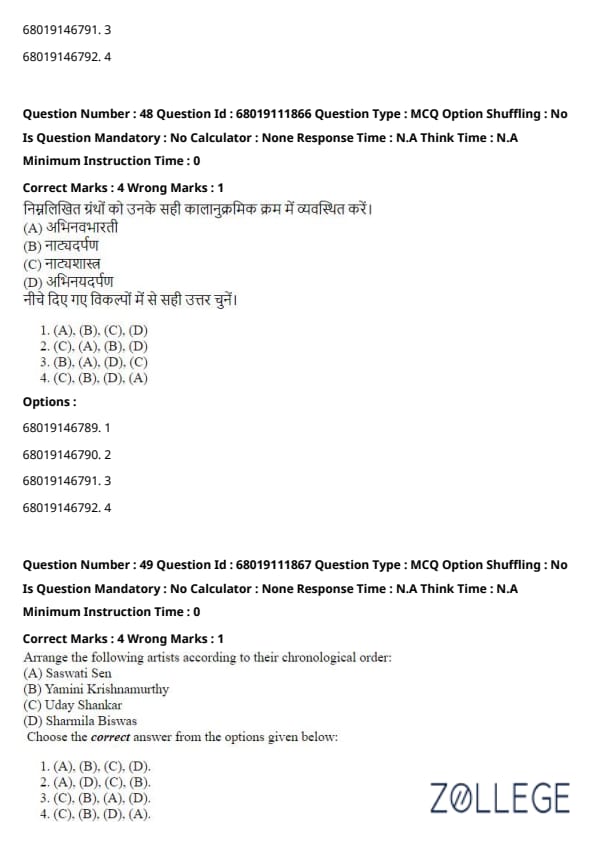
Question 48:
Arrange the following texts in their correct chronological order.
Choose the correct answer from the options given below:
View Solution
Solution: The correct chronological order is: Natyashastra (ancient treatise on performing arts), Abhinavabharati (commentary on Natyashastra), Natyadarpana (later work on dramaturgy), Abhinayadarpana (text on expression in dance and drama).
Quick Tip: Natyashastra is the foundational text, followed by its commentary (Abhinavabharati), then later works (Natyadarpana and Abhinayadarpana).
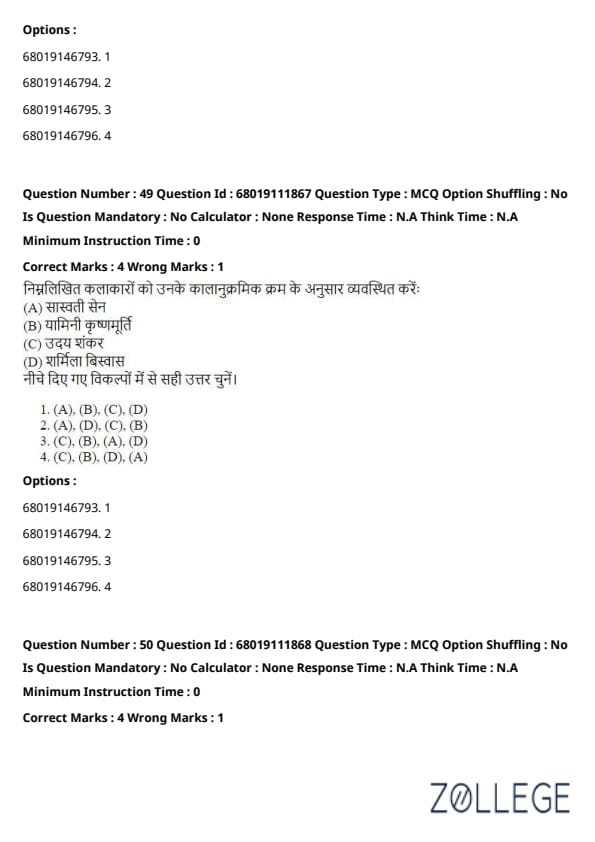
Question 49:
Arrange the following artists according to their chronological order.
Choose the correct answer from the options given below:
View Solution
Solution: The correct chronological order of these artists is: Uday Shankar (pioneer of modern Indian dance), Yamini Krishnamurthy (Bharatanatyam and Kuchipudi dancer), Saswati Sen (Kathak dancer), Sharmila Biswas (Odissi dancer).
Quick Tip: Uday Shankar was a pioneer, followed by Yamini Krishnamurthy, then Saswati Sen and Sharmila Biswas.
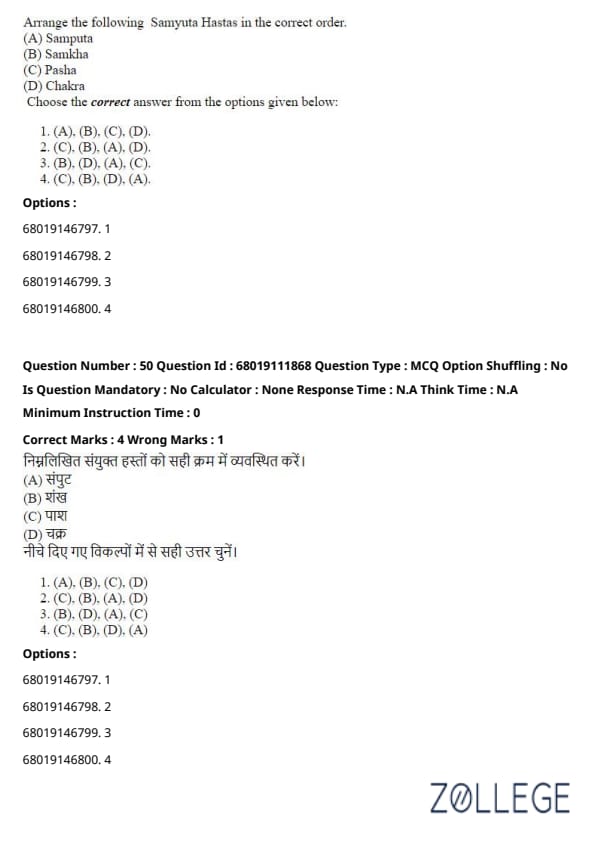
Question 50:
Arrange the following Samyuta Hastas in the correct order.
Choose the correct answer from the options given below:
View Solution
Solution: The correct order of these Samyuta Hastas (combined hand gestures) is: Samkha (conch), Chakra (wheel), Samputa (closed hollow), Pasha (noose).
Quick Tip: The order of these Hastas can be remembered by associating them with their symbolic meanings: sound (Samkha), movement (Chakra), enclosure (Samputa), and control (Pasha).
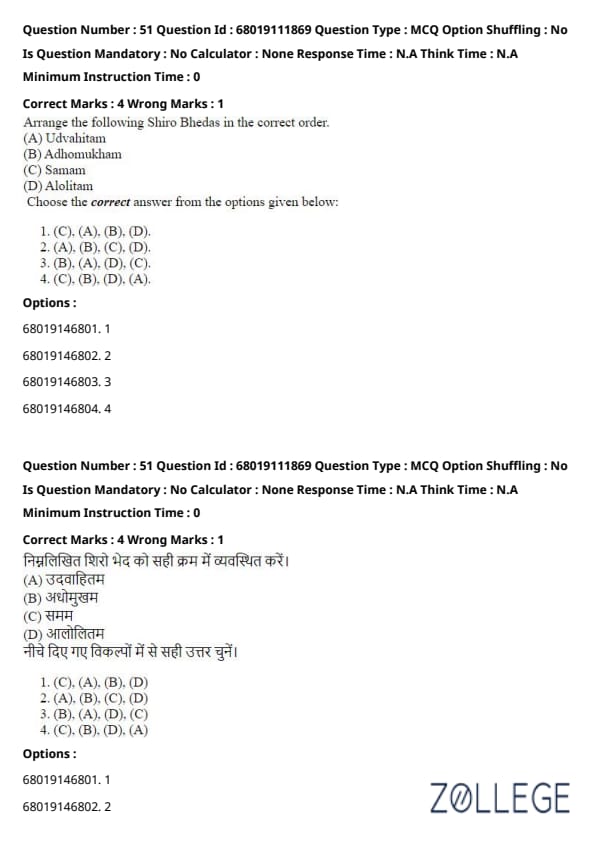
Question 51:
Arrange the following Shiro Bhedas in the correct order:
Choose the correct answer from the options given below:
View Solution
Solution: The correct sequence of Shiro Bhedas (head movements) is: Samam (neutral), Udvahitam (raised), Adhomukham (lowered), Alolitam (circular).
Quick Tip: The Shiro Bhedas represent a progression of head movements from neutral to upward, downward, and finally circular.
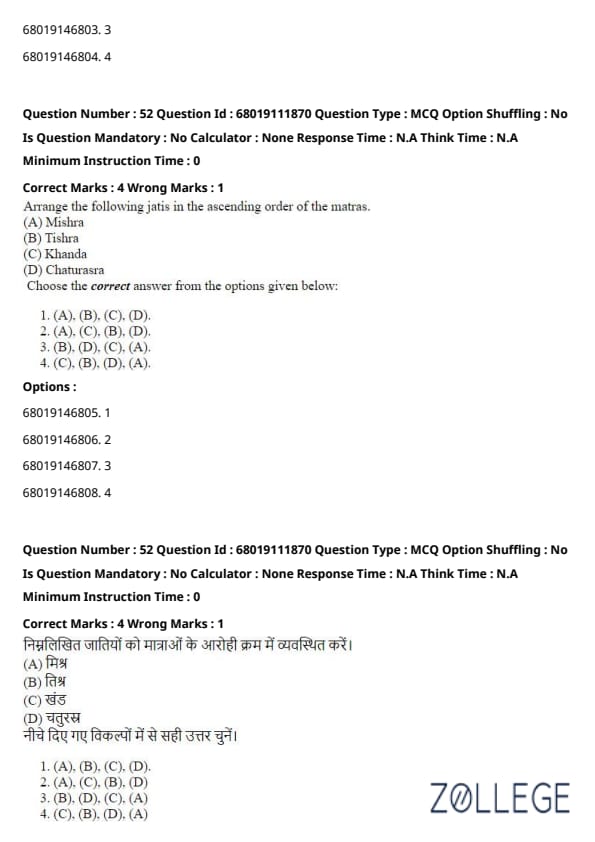
Question 52:
Arrange the following Jatis in the ascending order of the Matras:
Choose the correct answer from the options given below:
View Solution
Solution: Jatis are rhythmic patterns. Ascending order of Matras (beats): Tishra (3 beats), Chaturasra (4 beats), Khanda (5 beats), Mishra (7 beats).
Quick Tip: Jatis are arranged based on the increasing number of beats (matras) in their rhythmic cycle.
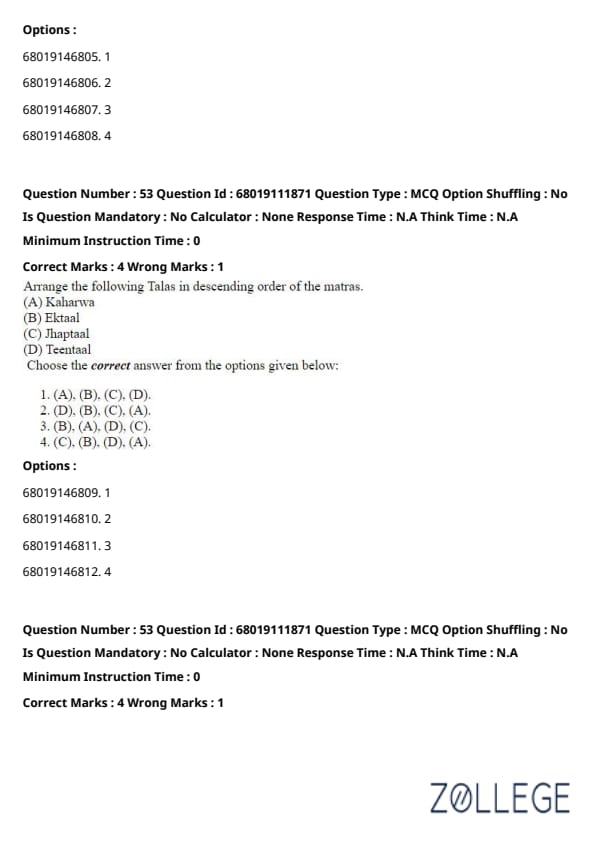
Question 53:
Arrange the following Talas in descending order of the Matras:
Choose the correct answer from the options given below:
View Solution
Solution: Talas are rhythmic cycles. Descending order of Matras: Teentaal (16 beats), Ektaal (12 beats), Jhaptaal (10 beats), Kaharwa (8 beats).
Quick Tip: Talas are ordered based on the decreasing number of beats (matras) they contain.
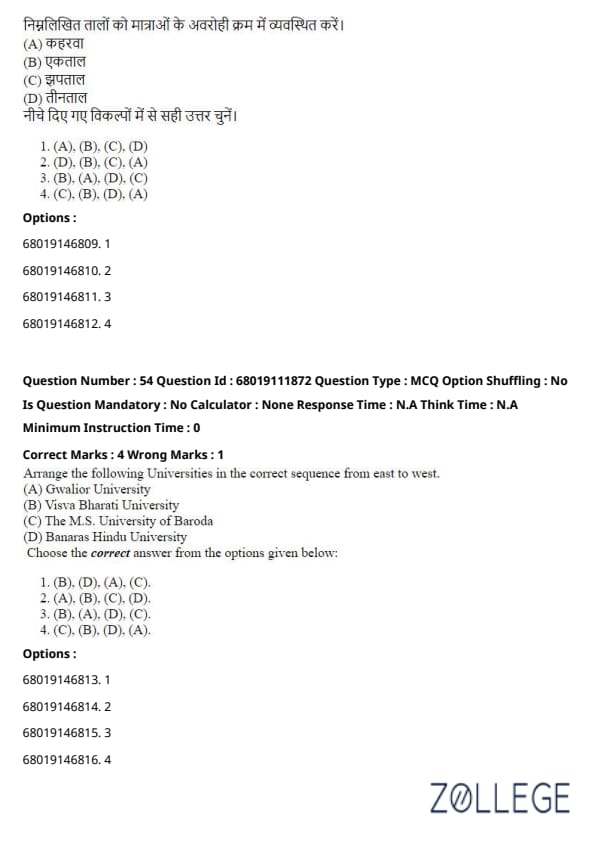
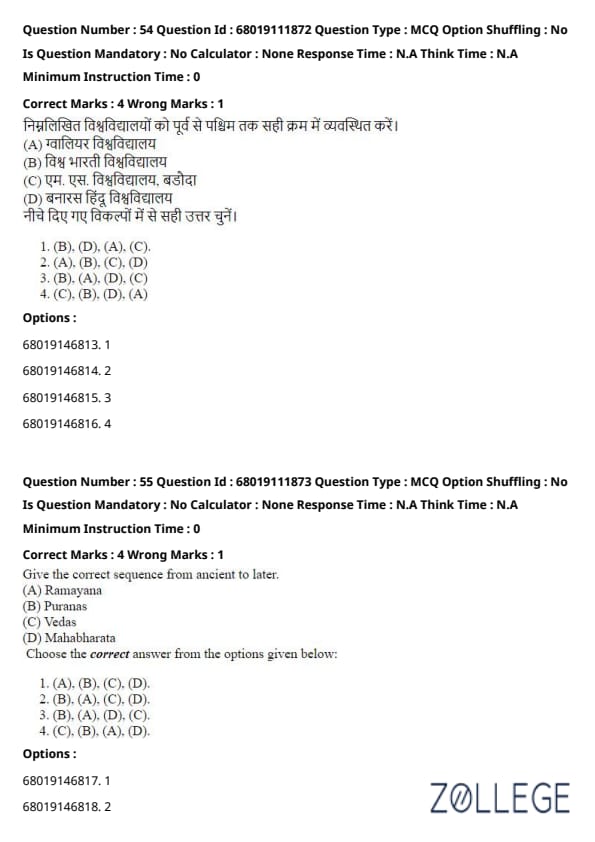
Question 54:
Arrange the following Universities in the correct sequence from east to west:
Choose the correct answer from the options given below:
View Solution
Solution: East to West: Visva Bharati University (West Bengal), Banaras Hindu University (Uttar Pradesh), Gwalior University (Madhya Pradesh), The M.S. University of Baroda (Gujarat).
Quick Tip: Use a map of India to visualize the locations of these universities and determine their east-to-west order.
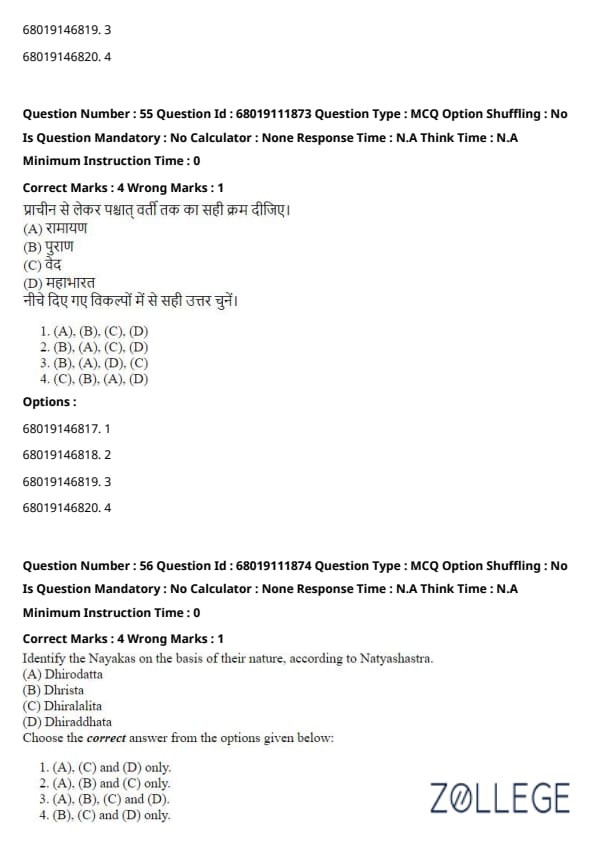
Question 55:
Give the correct sequence from ancient to later:
Choose the correct answer from the options given below:
View Solution
Solution: Ancient to Later: Vedas, Puranas, Ramayana, Mahabharata.
Quick Tip: The Vedas are the oldest scriptures, followed by the Puranas, then the epics Ramayana and Mahabharata.
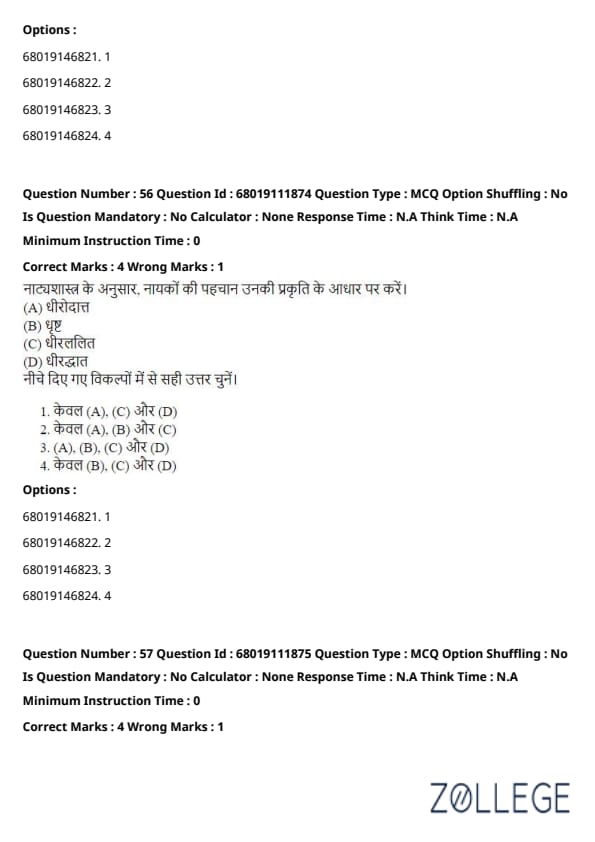
Question 56:
Identify the Nayakas on the basis of their nature, according to Natyashastra:
Choose the correct answer from the options given below:
View Solution
Solution: According to Natyashastra, Dhirodatta (calm and composed), Dhiralalita (playful and witty), and Dhiraddhata (determined and strong) are Nayakas (hero types) based on their nature. Dhrista (audacious/arrogant) is a type of Nayaka, but not categorized solely by nature, rather by his behavior in love.
Quick Tip: The Natyashastra classifies Nayakas based on different criteria, including their nature and behavior in love. Dhrista falls under a classification based on behavior, not inherent nature.
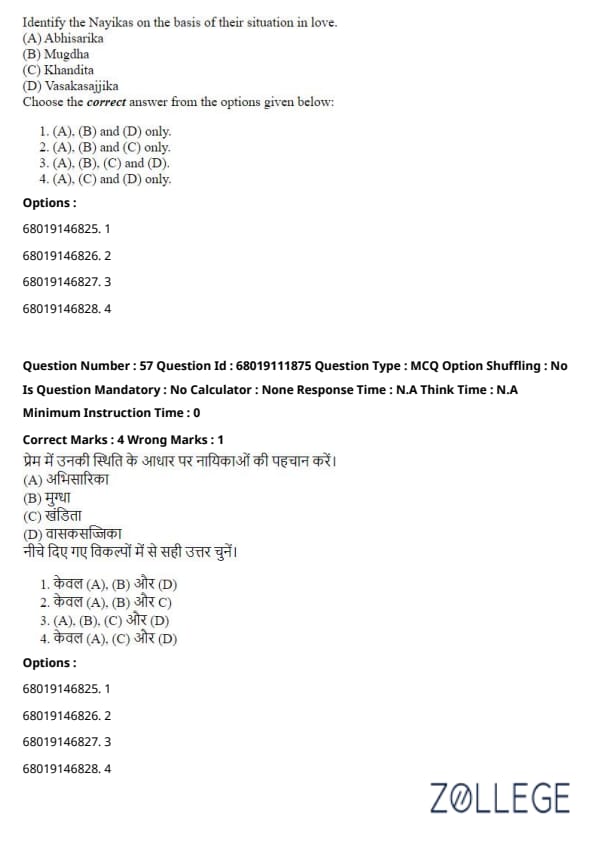
Question 57:
Identify the Nayikas on the basis of their situation in love:
Choose the correct answer from the options given below:
View Solution
Solution: Abhisarika (one who goes to meet her lover), Khandita (one angry with her lover), and Vasakasajjika (one dressed and waiting for her lover) are Nayikas (heroine types) based on their situation in love. Mugdha (innocent/naive) describes a Nayika's temperament, not her situation in a love affair.
Quick Tip: Focus on the specific situation in love each Nayika finds herself in. Mugdha describes a personality trait, not a situation.
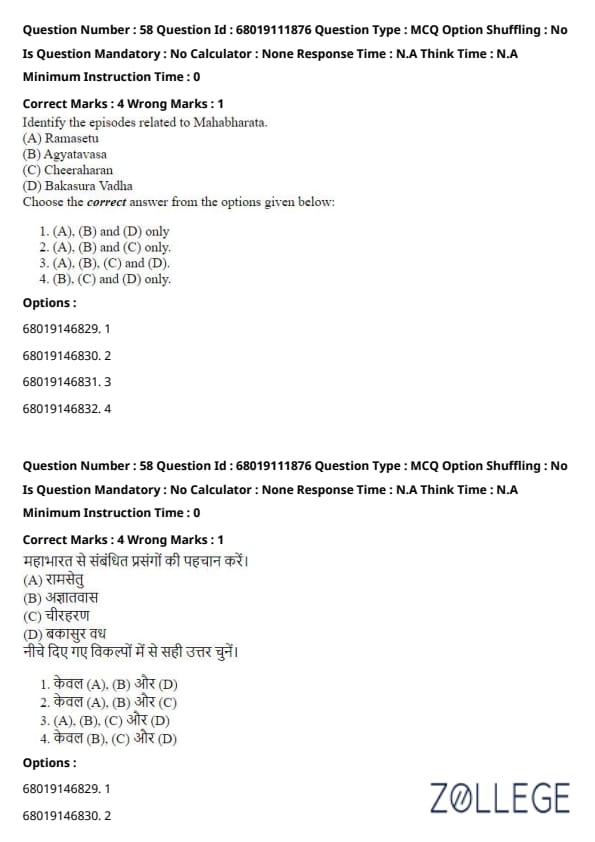
Question 58:
Identify the episodes related to Mahabharata:
Choose the correct answer from the options given below:
View Solution
Solution: Agyatavasa (living incognito), Cheeraharan (disrobing of Draupadi), and Bakasura Vadha (killing of Bakasura) are episodes from the Mahabharata. Ramasetu (building the bridge to Lanka) is from the Ramayana.
Quick Tip: To identify Mahabharata episodes, focus on events and characters related to the Pandavas and Kauravas.
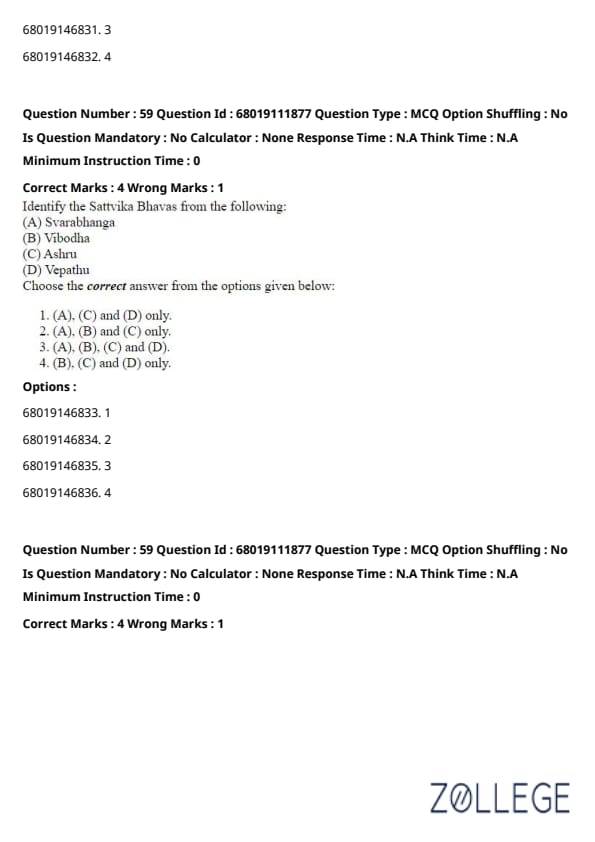
Question 59:
Identify the Sattvika Bhavas from the following:
Choose the correct answer from the options given below:
View Solution
Solution: Sattvika Bhavas are involuntary expressions of emotion. Ashru (tears), and Vepathu (trembling) are Sattvika Bhavas. Svarabhanga is change in voice tone (not a Sattvika Bhava), and Vibodha is awakening or understanding which is a state of mind, not a displayed emotion.
Quick Tip: Sattvika Bhavas are physical manifestations of inner emotions, often involuntary reactions like tears or trembling.
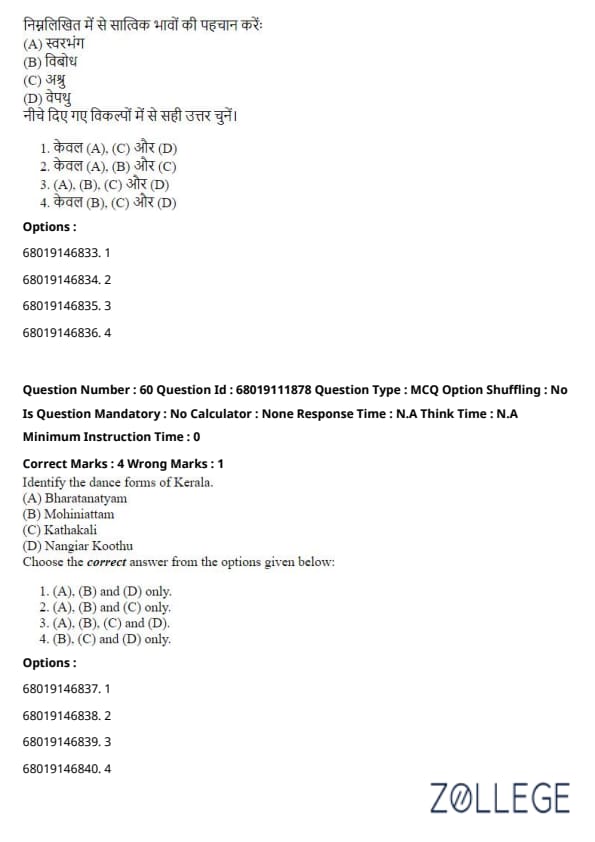
Question 60:
Identify the dance forms of Kerala:
Choose the correct answer from the options given below:
View Solution
Solution: Mohiniattam, Kathakali, and Nangiar Koothu are classical dance forms of Kerala. Bharatanatyam is a classical dance form of Tamil Nadu.
Quick Tip: Kerala's classical dance forms are Mohiniattam, Kathakali, and Nangiar Koothu. Bharatanatyam is associated with Tamil Nadu.
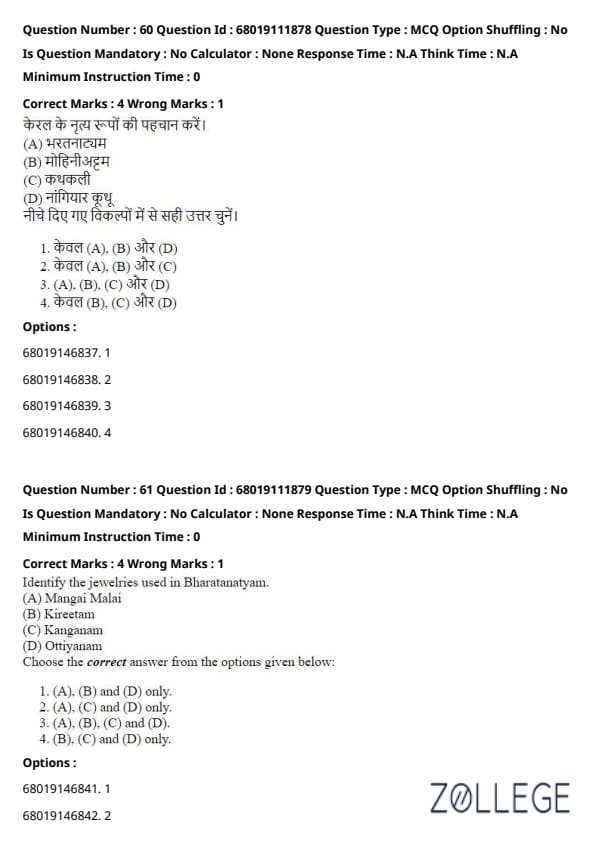
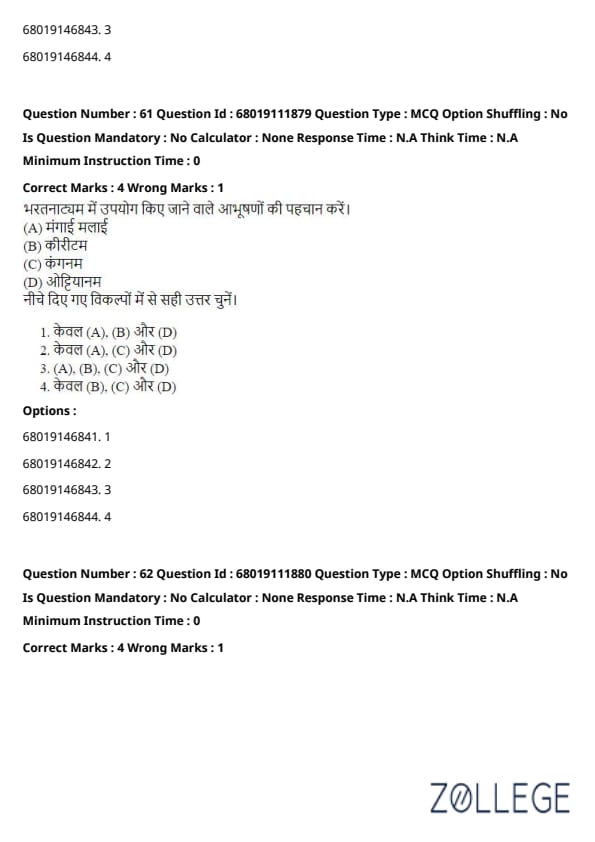
Question 61:
Identify the jewelries used in Bharatanatyam:
Choose the correct answer from the options given below:
View Solution
Solution: Mangai Malai (long necklace), Kireetam (crown), Kanganam (bangles), and Ottiyanam (waist belt) are all jewelry used in Bharatanatyam.
Quick Tip: Bharatanatyam dancers adorn various ornaments, including necklaces, crowns, bangles, and waist belts, as part of their traditional costume.
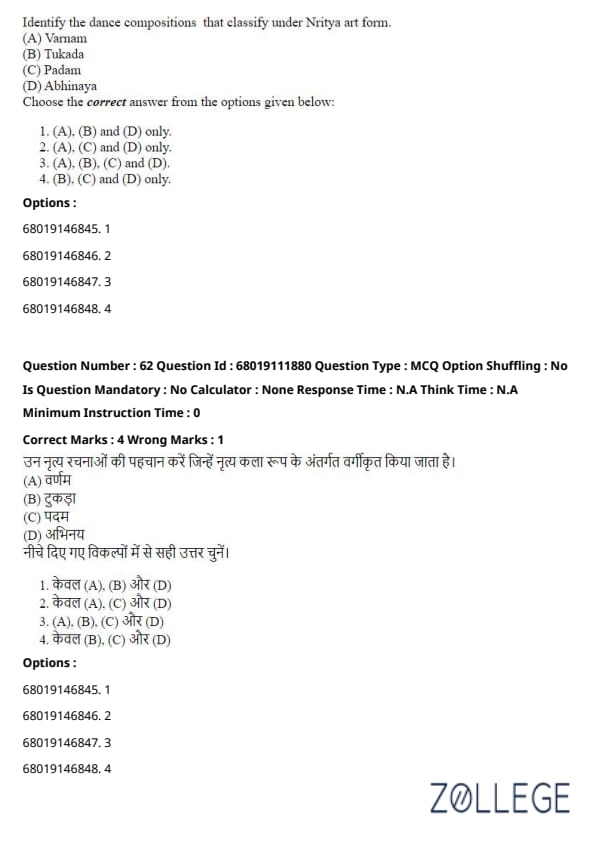
Question 62:
Identify the dance compositions that classify under Nritya art form:
Choose the correct answer from the options given below:
View Solution
Solution: Nritya emphasizes expressive elements. Varnam (combines nritta and nritya), Padam (expressive piece), and Abhinaya (expression itself) belong to Nritya. Tukada (a short, fast-paced piece) belongs to Nritta.
Quick Tip: Nritya focuses on expression and storytelling, using abhinaya to convey emotions and narratives.
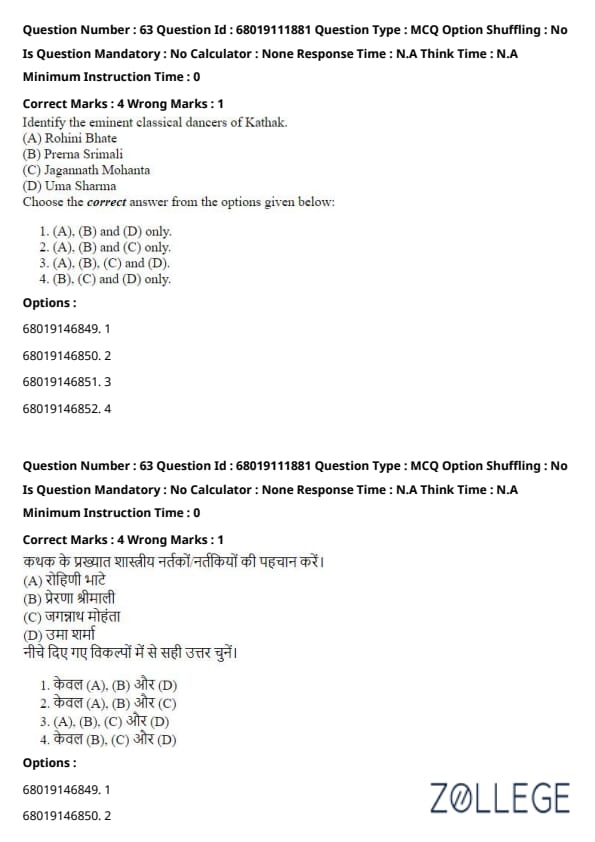
Question 63:
Identify the eminent classical dancers of Kathak:
Choose the correct answer from the options given below:
View Solution
Solution: Rohini Bhate, Prerna Srimali, and Uma Sharma are renowned Kathak dancers. Jagannath Mohanta is an Odissi dancer.
Quick Tip: Remember these prominent Kathak artists and their contributions to the dance form. Jagannath Mohanta is associated with Odissi.
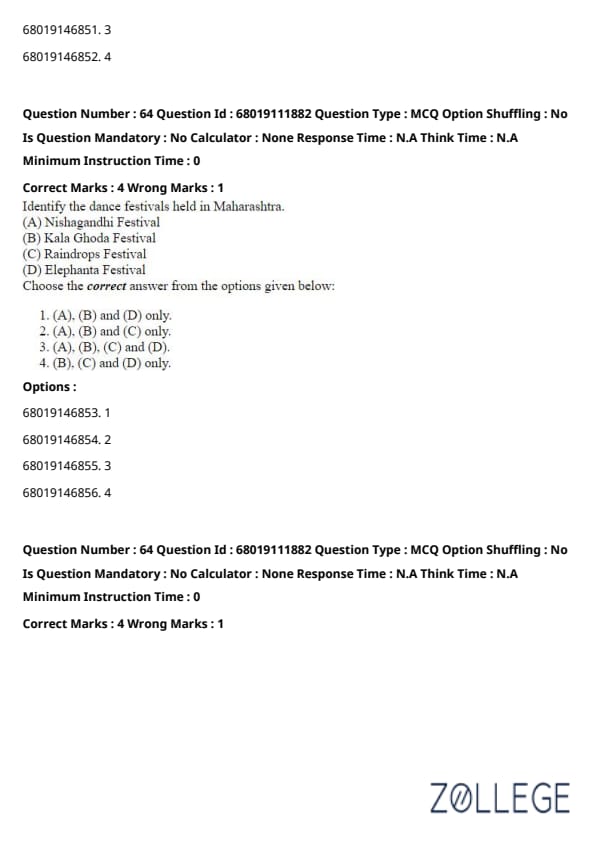
Question 64:
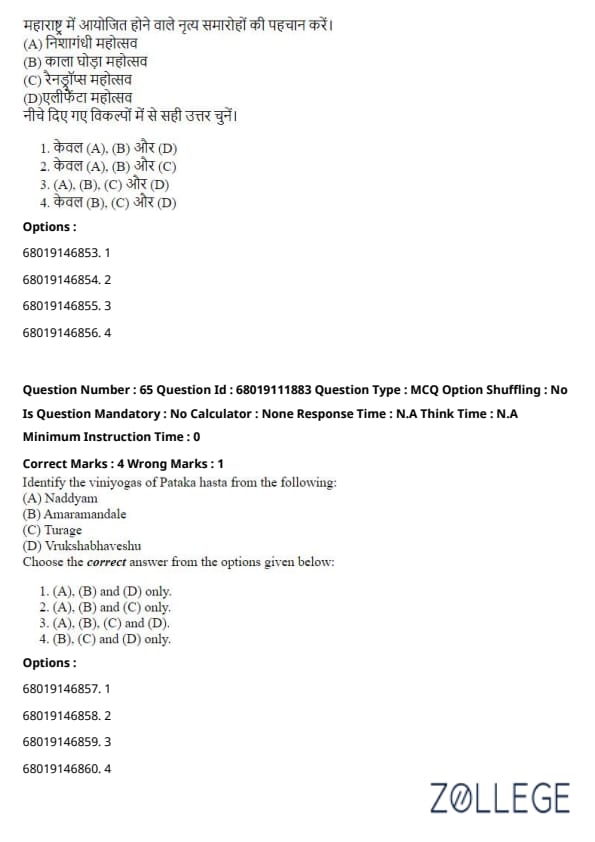
Identify the dance festivals held in Maharashtra:
Choose the correct answer from the options given below:
View Solution
Solution: Kala Ghoda Festival, Raindrops Festival, and Elephanta Festival are held in Maharashtra. Nishagandhi Festival is held in Kerala.
Quick Tip: Maharashtra hosts several dance festivals, including Kala Ghoda, Raindrops, and Elephanta. Nishagandhi is associated with Kerala.
Question 65:
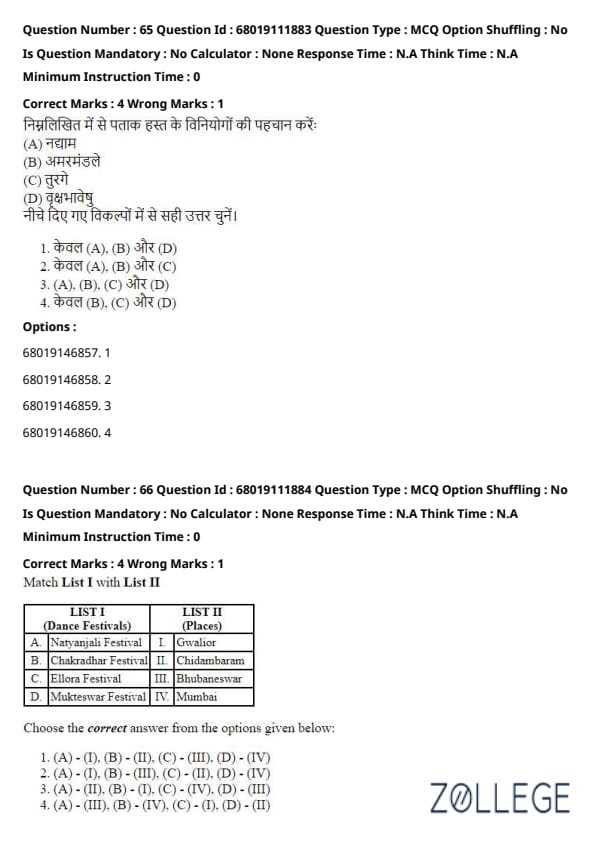
Identify the viniyogas of Pataka hasta from the following:
Choose the correct answer from the options given below:
View Solution
Solution: Viniyogas are specific usages of hand gestures. For Pataka hasta (flag hand gesture): Naddyam (river), Amaramandale (sky/heaven), and Turage (horse) are valid viniyogas. Vrukshabhaveshu (trees) is not a traditional viniyoga for Pataka hasta.
Quick Tip: Pataka hasta is a versatile hand gesture with multiple symbolic meanings, enhancing storytelling in dance.
Question 66:
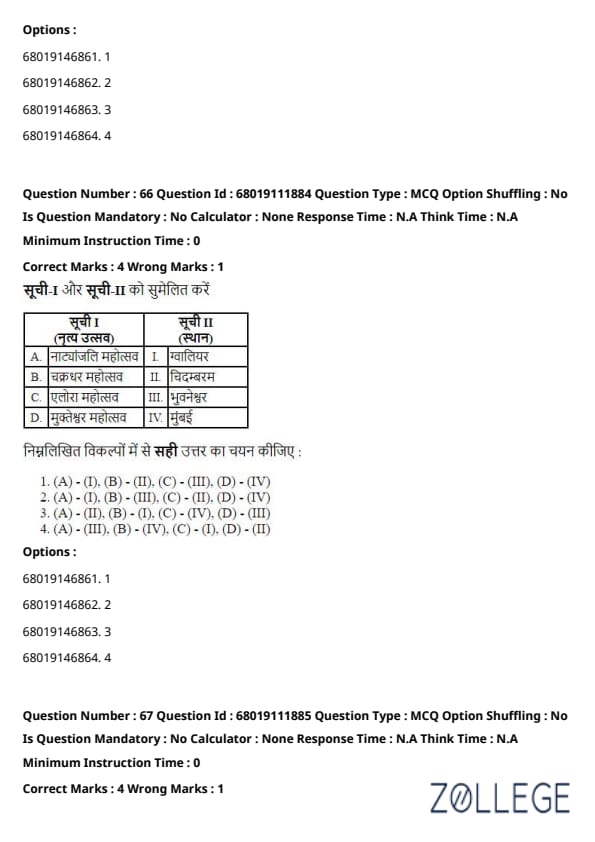
Match List I with List II:
| List I (Dance Festivals) | List II (Places) |
|---|---|
| (A) Natyanjali Festival | (I) Gwalior |
| (B) Chakradhar Festival | (II) Chidambaram |
| (C) Ellora Festival | (III) Bhubaneswar |
| (D) Mukteswar Festival | (IV) Mumbai |
Choose the correct answer from the options given below:
View Solution
Solution:
- Natyanjali Festival - Chidambaram, Tamil Nadu
- Chakradhar Festival - Gwalior, Madhya Pradesh
- Ellora Festival - Aurangabad, Maharashtra (near Ellora Caves)
- Mukteswar Festival - Bhubaneswar, Odisha
Quick Tip: Associate the festivals with their respective states and prominent temples or locations within those states.
Question 67:
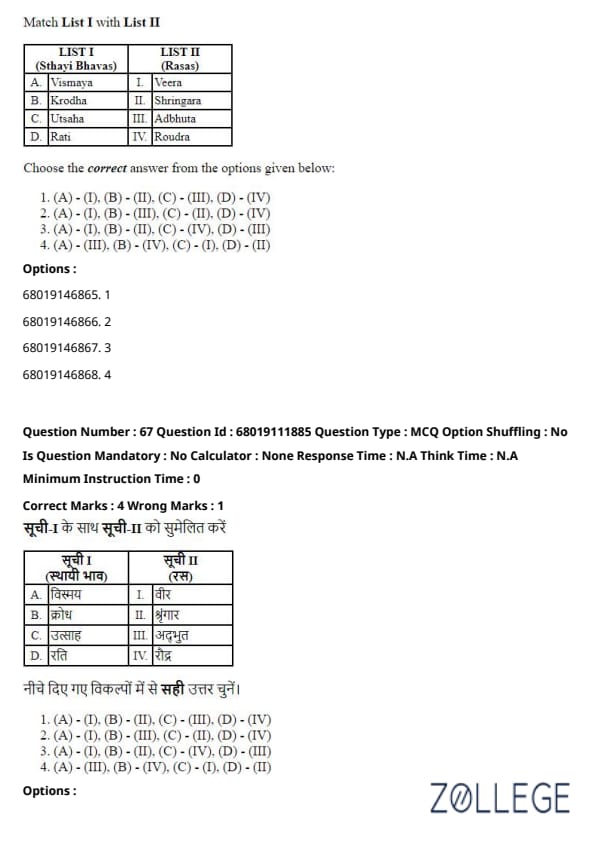
Match List I with List II:
| List I (Sthayi Bhavas) | List II (Rasas) |
|---|---|
| (A) Vismaya | (I) Veera |
| (B) Krodha | (II) Shringara |
| (C) Utsaha | (III) Adbhuta |
| (D) Rati | (IV) Roudra |
Choose the correct answer from the options given below:
View Solution
Solution:
- Vismaya (wonder) - Adbhuta (wonder)
- Krodha (anger) - Raudra (fury)
- Utsaha (enthusiasm/energy) - Shringara (love/beauty)
- Rati (love/passion) - Veera (heroism)
Quick Tip: Sthayi Bhavas are the dominant emotions that give rise to Rasas (aesthetic flavors). Remember the pairings of these emotions and their corresponding Rasas.
Question 68:
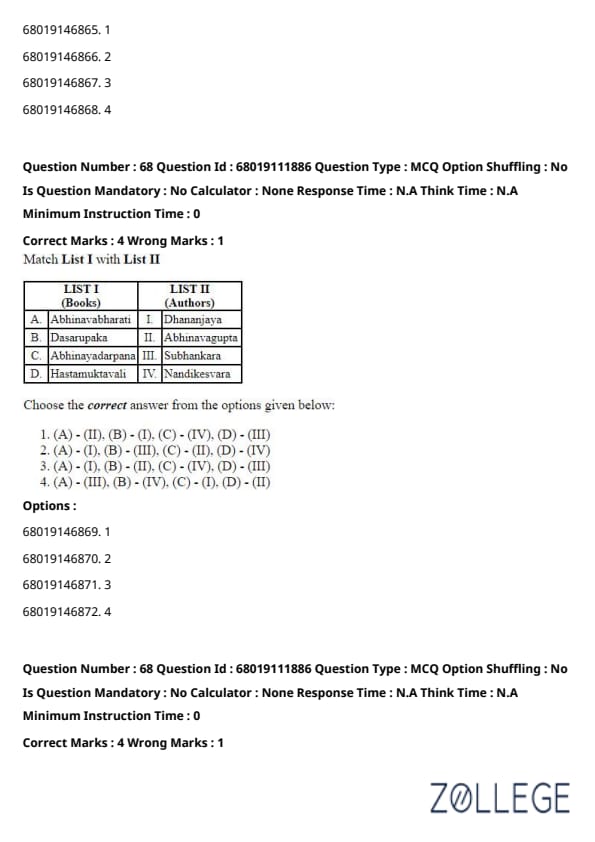
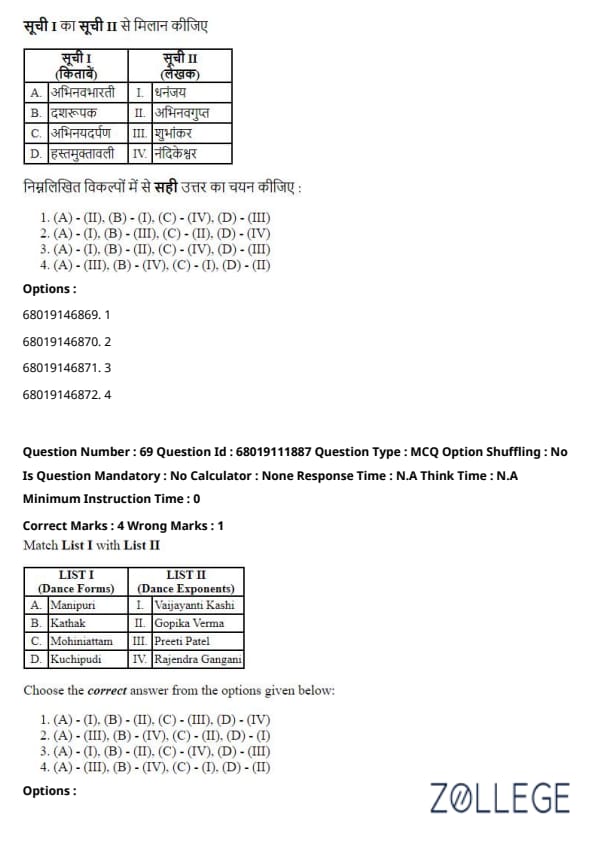
Match List I with List II:
| List I (Books) | List II (Authors) |
|---|---|
| (A) Abhinavabharati | (I) Dhananjaya |
| (B) Dasarupaka | (II) Abhinavagupta |
| (C) Abhinayadarpana | (III) Subhankara |
| (D) Hastamuktavali | (IV) Nandikesvara |
Choose the correct answer from the options given below:
View Solution
Solution:
- Abhinavabharati - Abhinavagupta
- Dasarupaka - Dhananjaya
- Abhinayadarpana - Nandikesvara
- Hastamuktavali - Subhankara
Quick Tip: These are key texts in Indian dramaturgy and aesthetics. Knowing the authors of these works is essential for such matching questions.
Question 69:
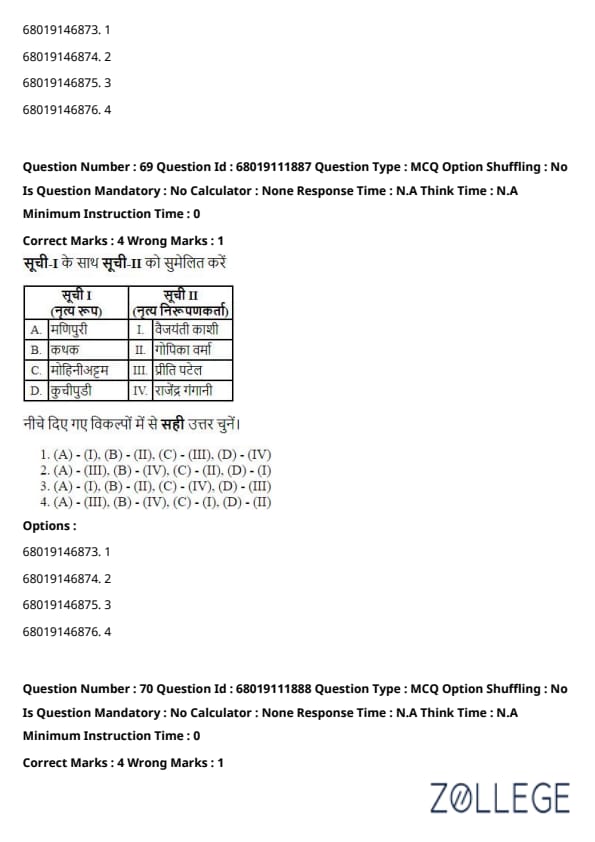
Match List I with List II:
| List I (Dance Forms) | List II (Dance Exponents) |
|---|---|
| (A) Manipuri | (I) Vaijayanti Kashi |
| (B) Kathak | (II) Gopika Verma |
| (C) Mohiniattam | (III) Preeti Patel |
| (D) Kuchipudi | (IV) Rajendra Gangani |
Choose the correct answer from the options given below:
View Solution
Solution:
- Manipuri - Preeti Patel
- Kathak - Rajendra Gangani
- Mohiniattam - Gopika Verma
- Kuchipudi - Vaijayanti Kashi
Quick Tip: Remember the prominent dancers associated with each classical dance form for accurate matching.
Question 70:
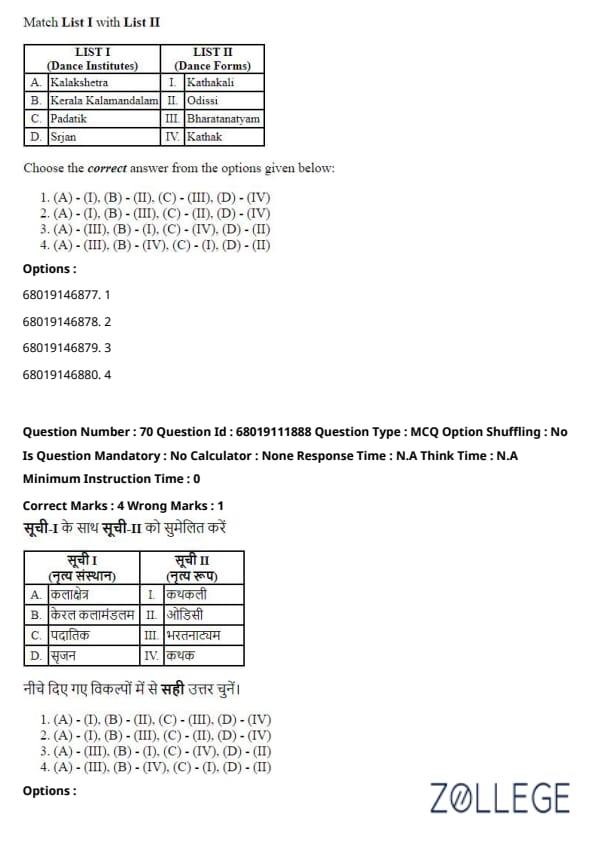
Match List I with List II:
| List I (Dance Institutes) | List II (Dance Forms) |
|---|---|
| (A) Kalakshetra | (I) Kathakali |
| (B) Kerala Kalamandalam | (II) Odissi |
| (C) Padatik | (III) Bharatanatyam |
| (D) Srijan | (IV) Kathak |
Choose the correct answer from the options given below:
View Solution
Solution:
- Kalakshetra - Bharatanatyam
- Kerala Kalamandalam - Kathakali
- Padatik - Kathak
- Srijan - Odissi
Quick Tip: Match the dance institutes with their regionally and stylistically associated dance forms.
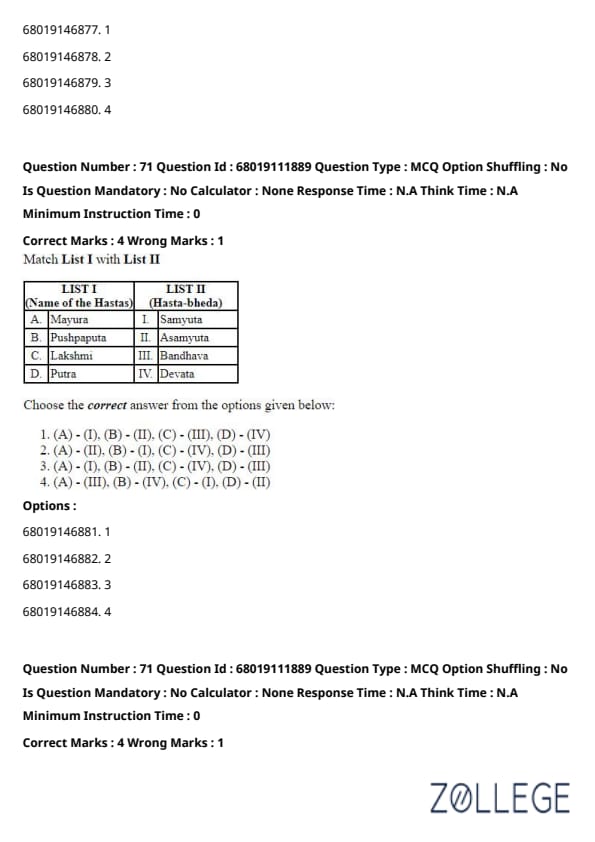
Question 71:
Match List I with List II:
| List I (Name of the Hastas) | List II (Hasta-bheda) |
|---|---|
| (A) Mayura | (I) Samyuta |
| (B) Pushpaputa | (II) Asamyuta |
| (C) Lakshmi | (III) Bandhava |
| (D) Putra | (IV) Devata |
Choose the correct answer from the options given below:
View Solution
Solution: Hasta-bhedas categorize hand gestures.
- Mayura (peacock) - Asamyuta (single-hand)
- Pushpaputa (flower basket) - Samyuta (double-hand)
- Lakshmi (goddess Lakshmi) - Devata (representing deities)
- Putra (son) - Bandhava (indicating relationships)
Quick Tip: Hasta-bhedas classify hand gestures based on whether they are single-handed, double-handed, represent deities, or indicate relationships.
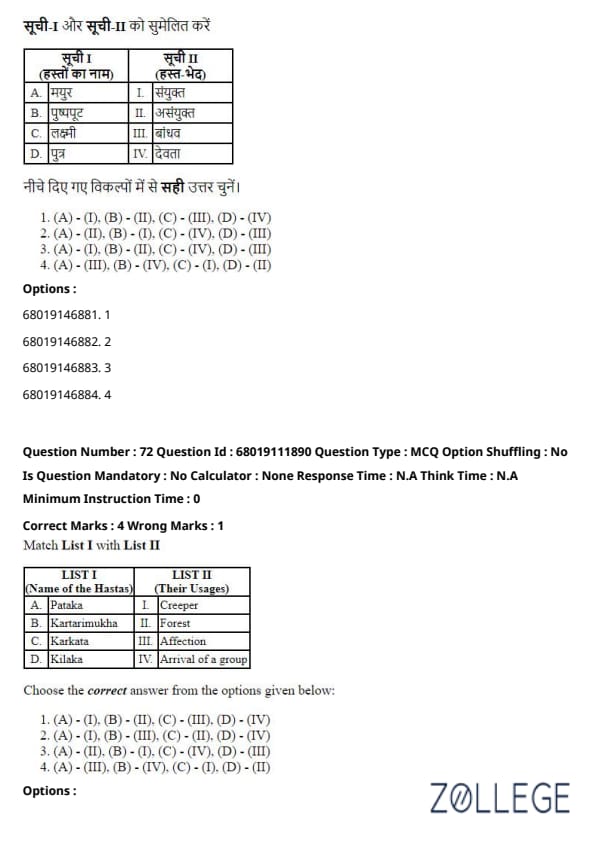
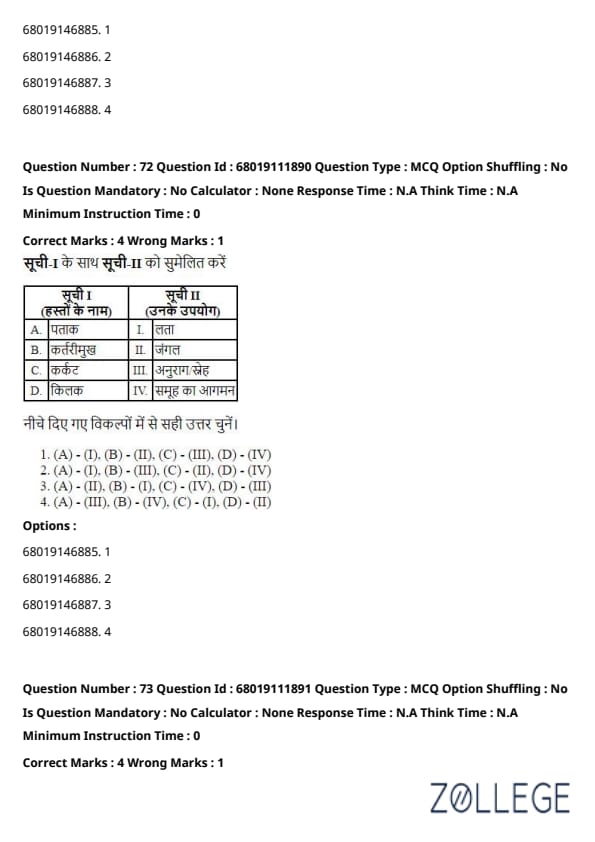
Question 72:
Match List I with List II:
| List I (Name of the Hastas) | List II (Their Usages) |
|---|---|
| (A) Pataka | (I) Creeper |
| (B) Kartarimukha | (II) Forest |
| (C) Karkata | (III) Affection |
| (D) Kilaka | (IV) Arrival of a group |
Choose the correct answer from the options given below:
View Solution
Solution:
- Pataka - Forest
- Kartarimukha - Creeper
- Karkata - Arrival of a group
- Kilaka - Affection
Quick Tip: Each Hasta has specific usages that enhance the expressive quality of dance. Familiarize yourself with these associations.
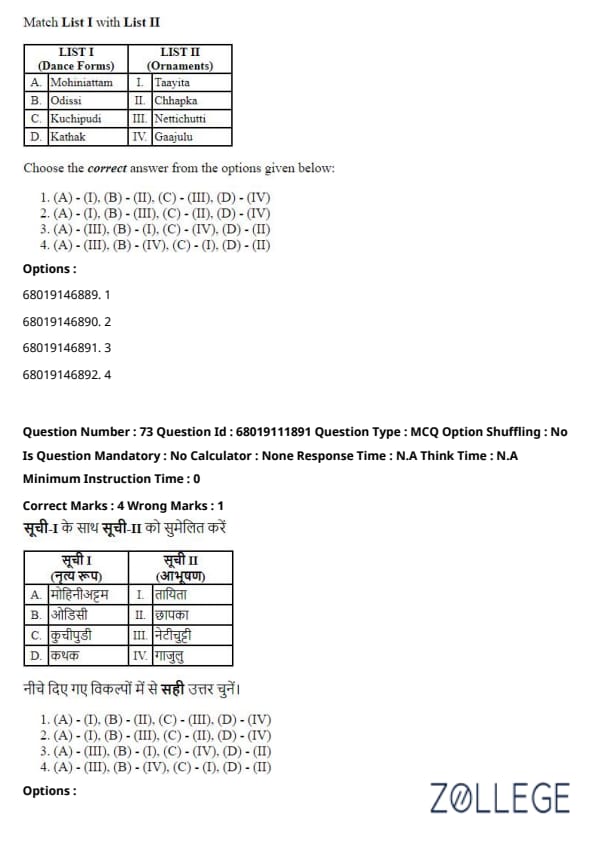
Question 73:
Match List I with List II:
| List I (Dance Forms) | List II (Ornaments) |
|---|---|
| (A) Mohiniattam | (I) Taayita |
| (B) Odissi | (II) Chhapka |
| (C) Kuchipudi | (III) Nettichutti |
| (D) Kathak | (IV) Gaajulu |
Choose the correct answer from the options given below:
View Solution
Solution:
- Mohiniattam - Nettichutti (forehead ornament)
- Odissi - Gaajulu (anklets)
- Kuchipudi - Taayita (head ornament)
- Kathak - Chhapka (head ornament)
Quick Tip: Different dance forms have distinct jewelry and costume traditions. Pay attention to the specific ornaments mentioned.
Question 74:
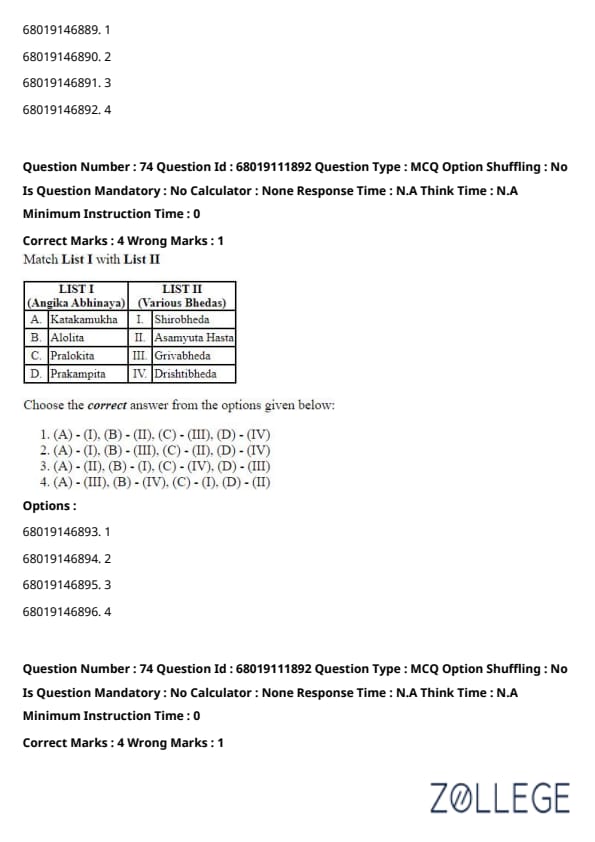
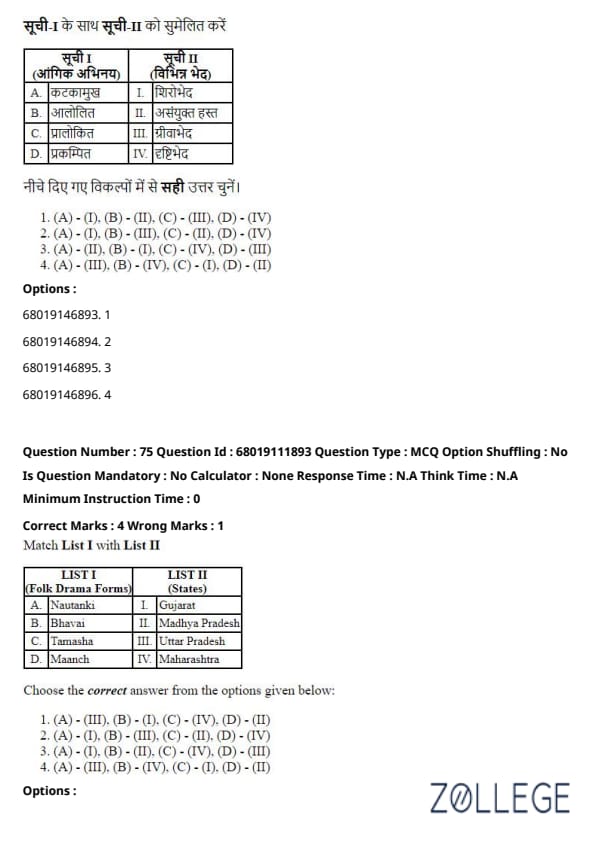
Match List I with List II:
| List I (Angika Abhinaya) | List II (Various Bhedas) |
|---|---|
| (A) Katakamukha | (I) Shirobheda |
| (B) Alolita | (II) Asamyuta Hasta |
| (C) Pralokita | (III) Grivabheda |
| (D) Prakampita | (IV) Dristhibheda |
Choose the correct answer from the options given below:
View Solution
Solution: Angika Abhinaya refers to expression through body movement.
- Katakamukha (sideways glance) - Asamyuta Hasta (single-hand gestures)
- Alolita (circular movement of the head) - Shirobheda (head movements)
- Pralokita (looking around) - Dristhibheda (eye movements)
- Prakampita (trembling) - Grivabheda (neck movements)
Quick Tip: Angika Abhinaya is categorized into movements of different body parts. Pay attention to the specific bheda (category) each movement belongs to.
Question 75:
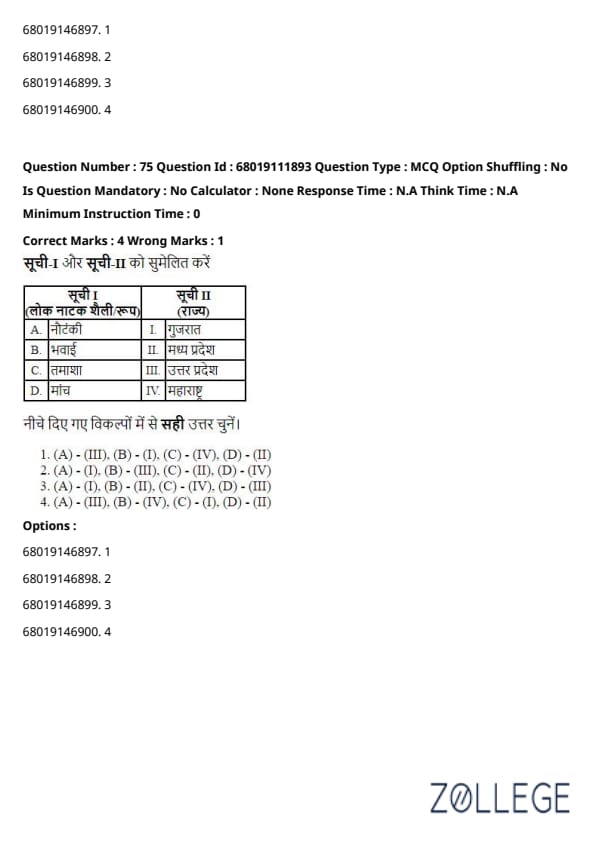
Match List I with List II:
| List I (Folk Drama Forms) | List II (States) |
|---|---|
| (A) Nautanki | (I) Gujarat |
| (B) Bhavai | (II) Madhya Pradesh |
| (C) Tamasha | (III) Uttar Pradesh |
| (D) Maanch | (IV) Maharashtra |
Choose the correct answer from the options given below:
View Solution
Solution:
- Nautanki - Uttar Pradesh
- Bhavai - Gujarat
- Tamasha - Maharashtra
- Maanch - Madhya Pradesh
Quick Tip: Folk drama forms are often regionally specific. Remember the state of origin for each of these forms.
*The article might have information for the previous academic years, please refer the official website of the exam.