CUET PG 2024 Question Paper with Answer Key PDF for Fine Arts (March 27 - Shift 3)
- Question Paper 2025
- Question Paper 2024
- Question Paper 2023
- Mathematics Papers
- Statistics Question Paper
- English Question Paper
- Chemistry Question Paper
- Pol. Sci. Question Paper
- History Question Paper
- Commerce Question Papers
- Life Science Papers
- Geology Question Papers
- Journalism Question Paper
- B.Ed. HSS Question Paper
- Botany Question Paper
- B.Ed. Question Papers


Content Strategist | Updated On - Jan 13, 2025
The CUET PG 2024 Fine Arts 27th March 2024 Shift 3 Question Paper with Solution PDF is available for download here. Students found the Art History and Aesthetics section easy, Practical Knowledge of Fine Arts moderate, and Contemporary Art Practices difficult. The Contemporary Art Practices section carried the highest weightage, and the overall difficulty level was moderate to difficult.
CUET PG 2024 Fine Arts Question Paper with Answer Key PDF
| CUET PG 2024 Fine Arts Question Paper with Answer Key |  Download Download |
Check Solution |
CUET PG 2024 Fine Arts Questions with Solutions
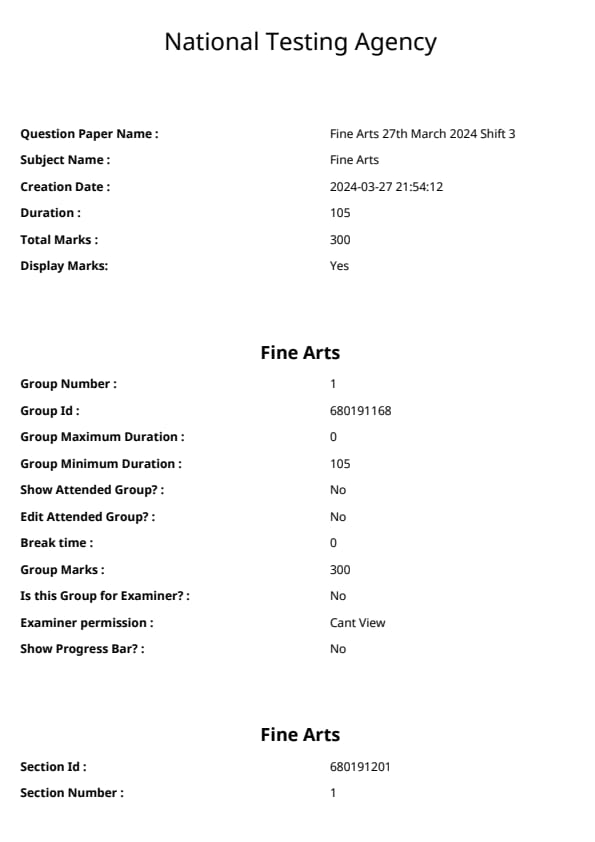
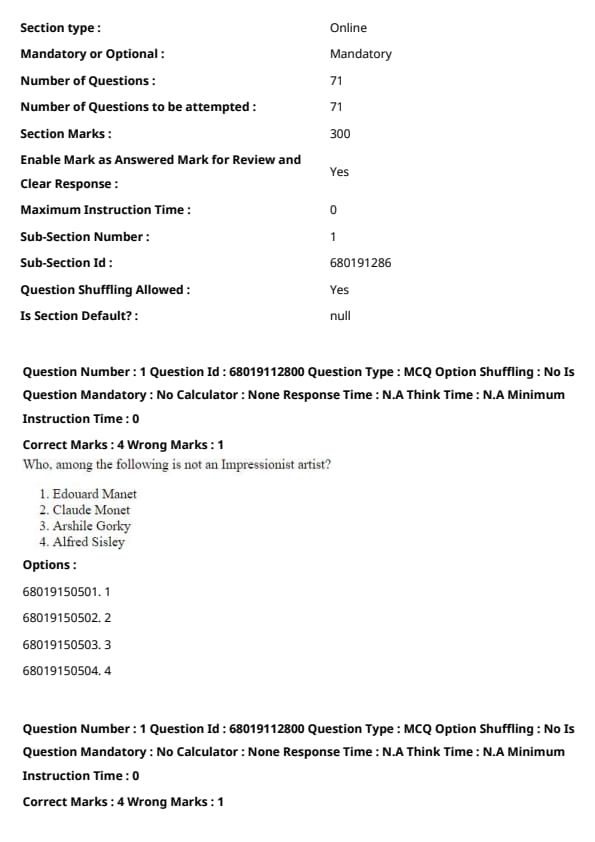
Question 1:
Who among the following is not an Impressionist artist?
View Solution
Arshile Gorky is considered a Surrealist artist, not an Impressionist. Artists like Claude Monet, Alfred Sisley, and Edouard Manet are key figures of the Impressionist movement.
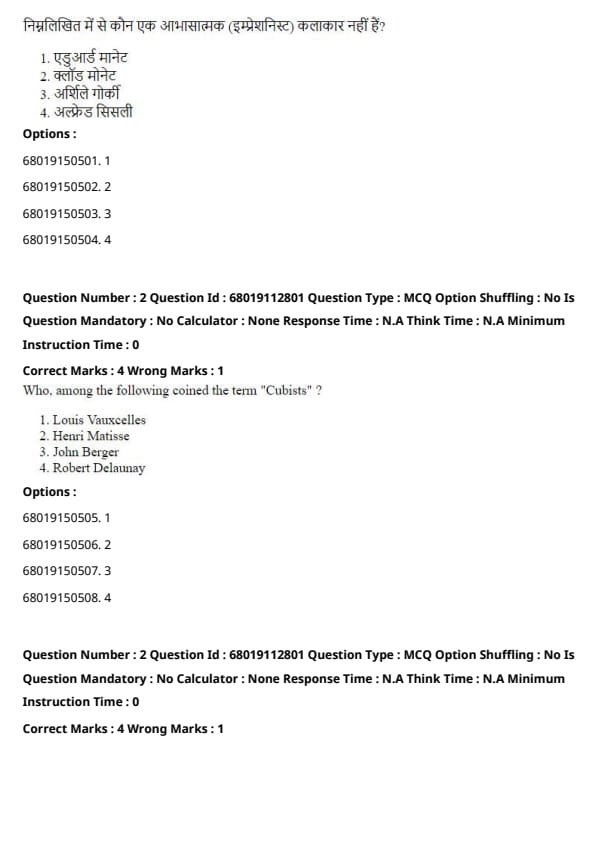
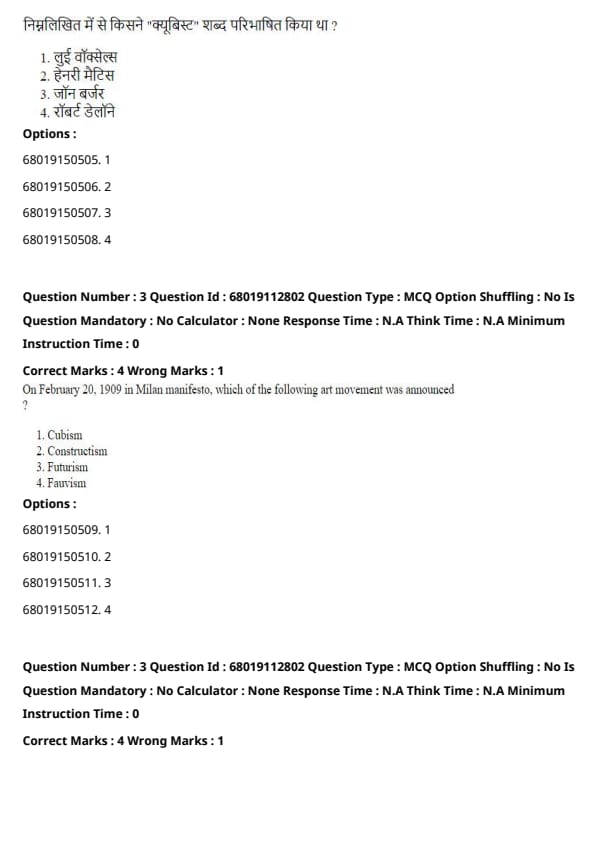
Question 2:
Who among the following coined the term "Cubists"?
View Solution
Louis Vauxcelles, an art critic, first used the term "Cubists" to describe the style of artists like Picasso and Braque, who focused on geometric abstraction.
Question 3:
On February 20, 1909, in the Milan Manifesto, which of the following art movements was announced?
View Solution
Futurism, an avant-garde movement, was launched with the Milan Manifesto by Filippo Tommaso Marinetti in 1909, emphasizing speed, technology, and modernity.
Question 4:
Which of the followings is related to Bagh caves?
View Solution
Bagh caves are known for their Buddhist rock-cut architecture, and Rangamahal is one of the prominent features of this site.
Question 5:
Which among the following Christian themes was also painted in the royal atelier of Jahangir?
View Solution
The Mughal Emperor Jahangir showed interest in European art and often commissioned works inspired by Christian themes like "Madonna and Child."
Question 6:
Who among the following Dutch artists mostly painted group and single portraits?
View Solution
Frans Hals is renowned for his lively group portraits, such as "The Banquet of the Officers of the St George Militia Company."
Question 7:
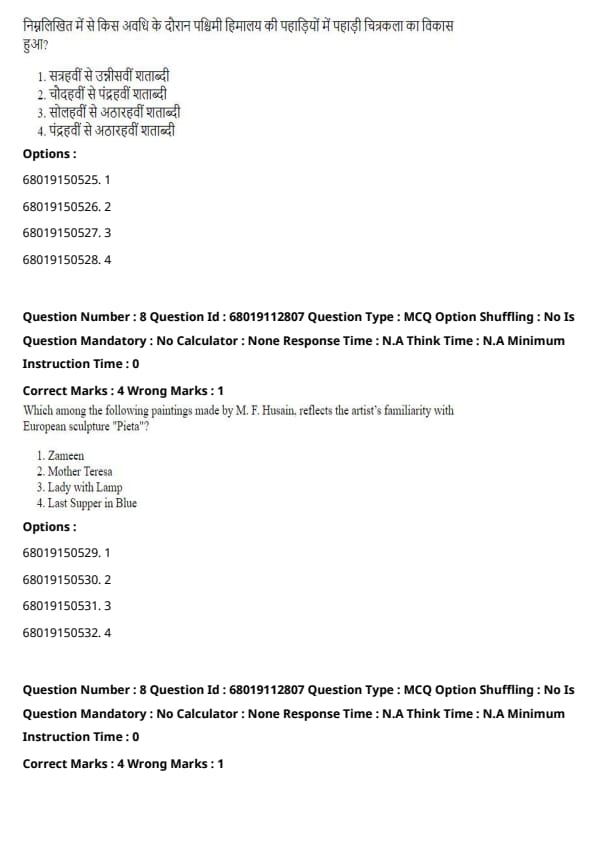
In the hills of Western Himalayas, Pahari paintings developed during which of the following time periods?
View Solution
Pahari paintings flourished between the 17th and 19th centuries, characterized by their romantic themes and vibrant colors.
Question 8:
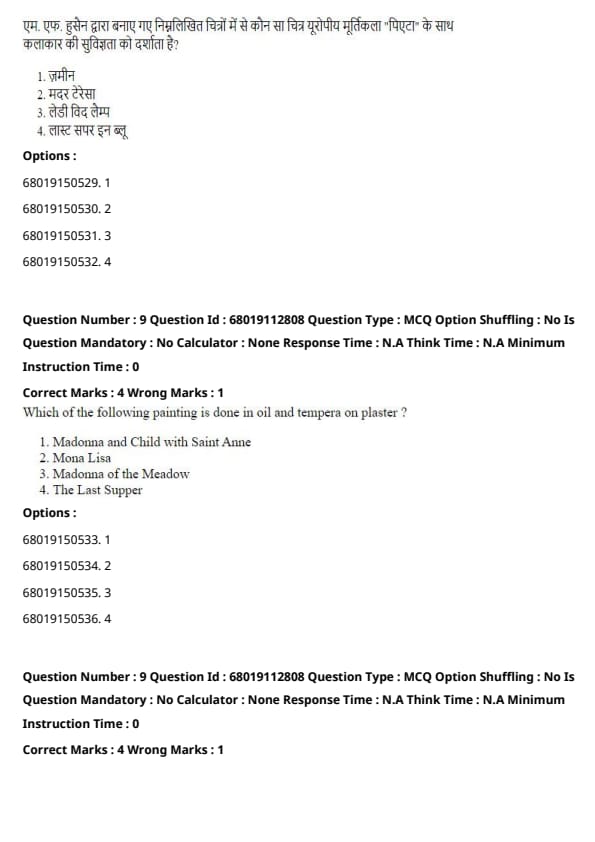
Which among the following paintings made by M. F. Husain reflects the artist’s familiarity with European sculpture "Pieta"?
View Solution
M. F. Husain’s "Mother Teresa" series echoes the compassion and form of Michelangelo's "Pieta."
Question 9:
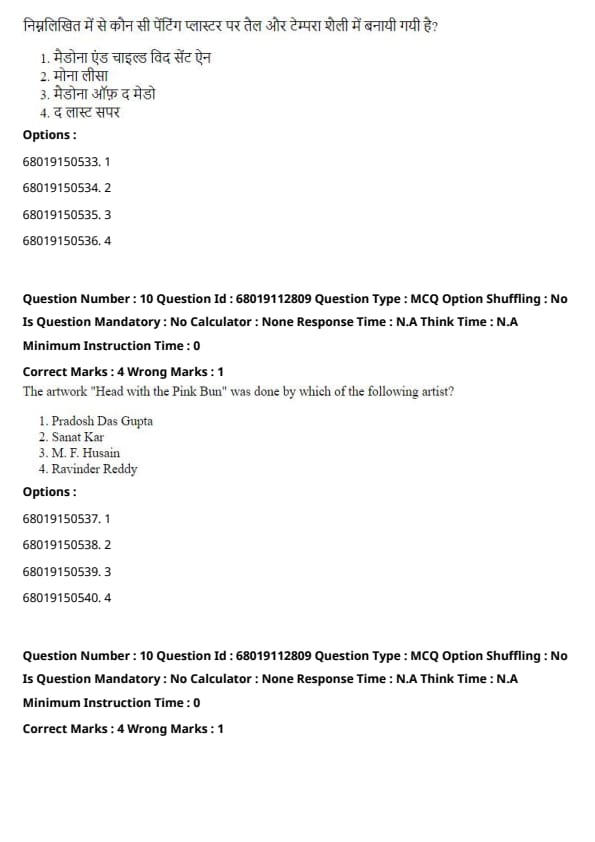
Which of the following paintings is done in oil and tempera on plaster?
View Solution
Leonardo da Vinci’s "The Last Supper" was created using a combination of oil and tempera on plaster, which caused it to deteriorate quickly.
Question 10:
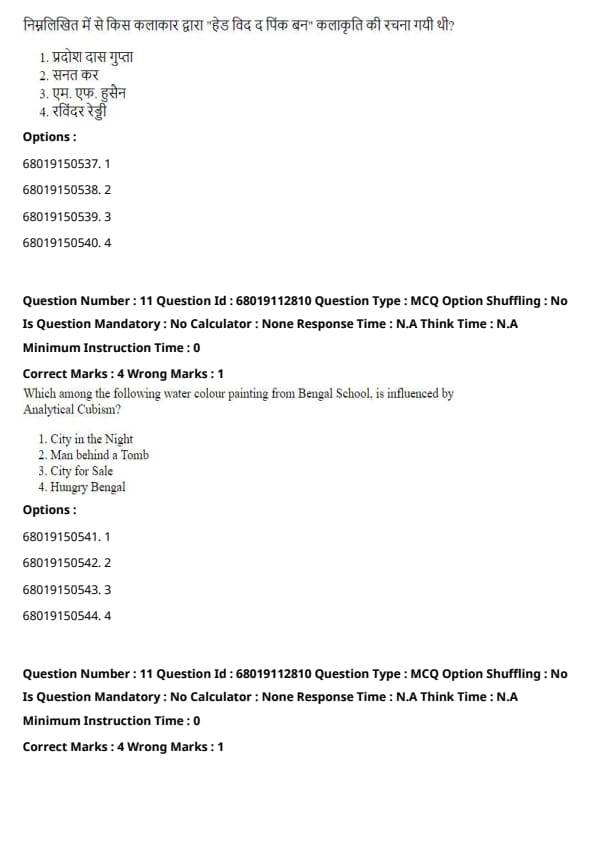
The artwork "Head with the Pink Bun" was done by which of the following artists?
View Solution
Ravinder Reddy is known for his bold, colorful sculptures, including "Head with the Pink Bun," which celebrates Indian culture and aesthetics.
Question 11:
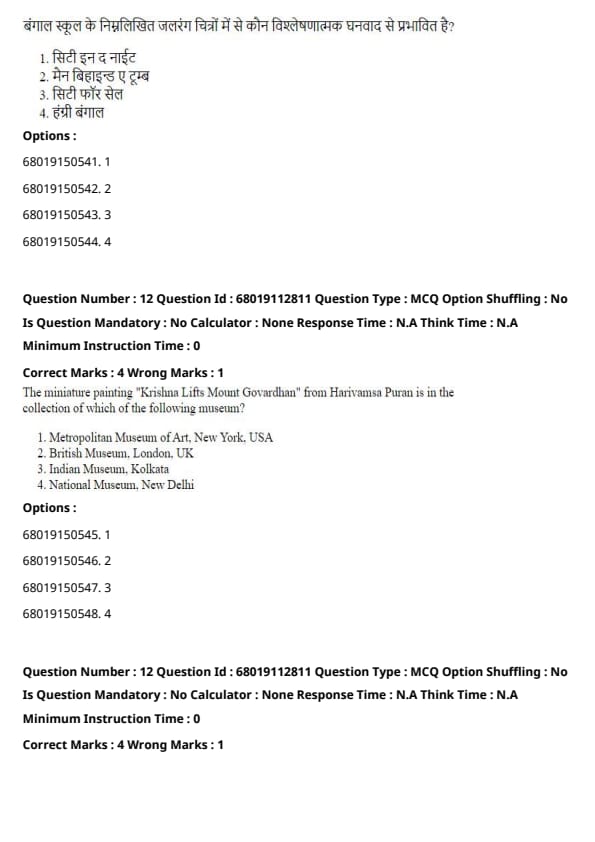
Which among the following watercolour painting from Bengal School, is influenced by Analytical Cubism?
View Solution
"City in the Night" is a Bengal School watercolour painting that shows clear influences of Analytical Cubism, marked by fragmented geometric shapes and multiple perspectives.
Question 12:
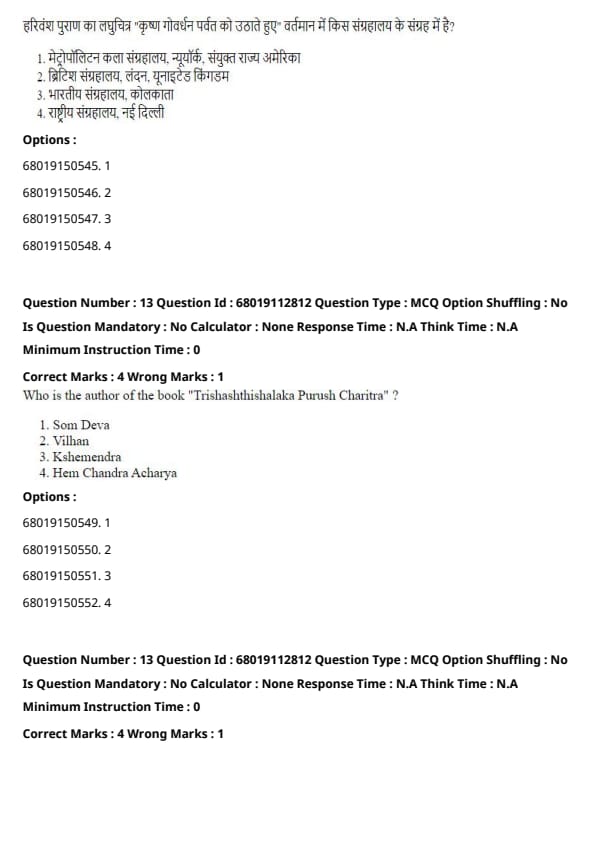
The miniature painting "Krishna Lifts Mount Govardhan" from Harivamsa Puran is in the collection of which of the following museums?
View Solution
The National Museum in New Delhi houses the miniature painting "Krishna Lifts Mount Govardhan," which is an exquisite example of Pahari art.
Question 13:
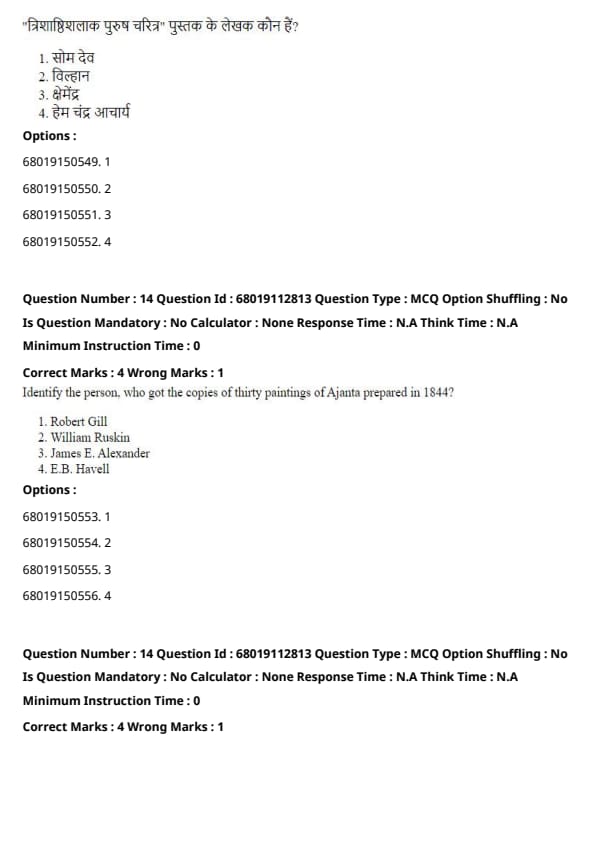
Who is the author of the book "Trishashthishalaka Purush Charitra"?
View Solution
"Hem Chandra Acharya," a Jain scholar, authored "Trishashthishalaka Purush Charitra," detailing the lives of 63 great figures in Jainism.
Question 14:
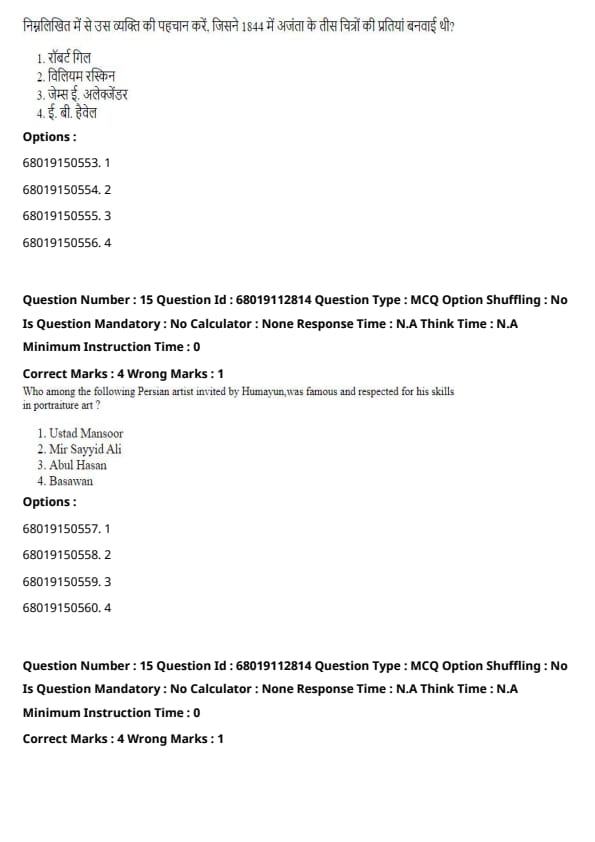
Identify the person who got the copies of thirty paintings of Ajanta prepared in 1844?
View Solution
Robert Gill, a British officer, prepared copies of Ajanta paintings in 1844, preserving their intricate details for global audiences.
Question 15:
Who among the following Persian artists invited by Humayun was famous and respected for his skills in portraiture art?
View Solution
Mir Sayyid Ali was invited by Humayun and is celebrated for his portraiture and contributions to the Mughal art tradition.
Question 16:
"Chauri Bearer" Yakshi from Didarganj, Patliputra is classified to which of the following periods?
View Solution
The "Chauri Bearer" Yakshi from Didarganj belongs to the Maurya Period, showcasing advanced stone carving techniques and polished finishes.
Question 17:
The majority of seals found from Harappan sites are made of which of the following materials?
View Solution
Most Harappan seals are made of steatite, a soft stone that was easily carved and often coated with an alkali glaze for durability.
Question 18:
The Vedika pillar with Yakshini "Chandra" from Bharhut, Madhya Pradesh is now in the collection of which museum?
View Solution
The Yakshini "Chandra" Vedika pillar from Bharhut is preserved in the Indian Museum, Kolkata, highlighting early Buddhist art.
Question 19:
Who painted "Last Supper in Blue"?
View Solution
M. F. Husain’s "Last Supper in Blue" reflects his modernist approach, blending traditional themes with contemporary aesthetics.
Question 20:
Which among the following is not the theme or subject of "Kishangarh School" of painting?
View Solution
The Kishangarh School of painting is renowned for its romantic and devotional themes, focusing on Radha-Krishna tales and lyrical compositions, not battle scenes.
Question 21:
Medieval Saints were the main focus in the painting of which of the following artists?
View Solution
Benode Behari Mukherjee often depicted themes of medieval saints and Indian traditions in his murals and paintings, reflecting his deep engagement with Indian history and spirituality.
Question 22:
Who among the following expressed that the Indian Museum, Calcutta must serve as an educational institution and Calcutta University should conduct classes in its galleries?
View Solution
Ashutosh Mukherjee, a prominent educationist, advocated for utilizing the Indian Museum, Calcutta, as a center for education and research, emphasizing its potential for academic engagement.
Question 23:
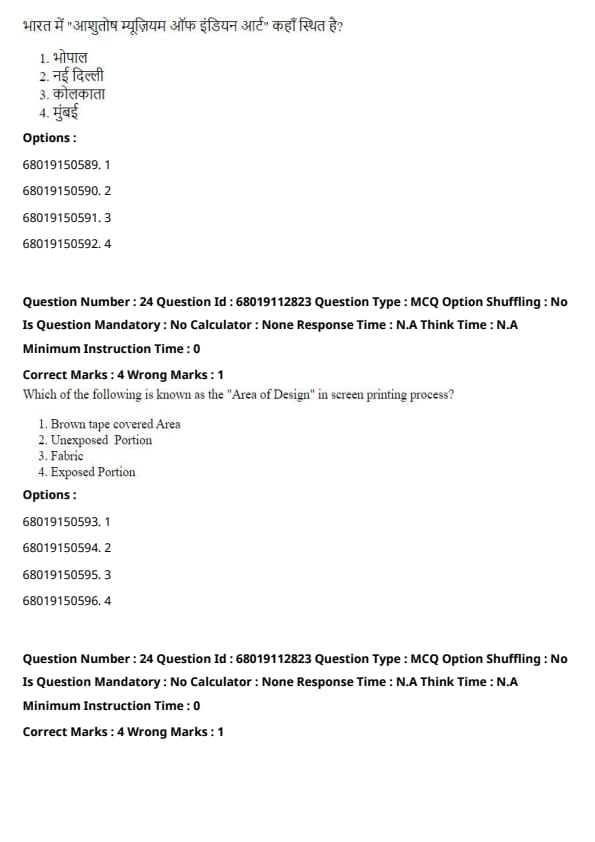
Where is "Ashutosh Museum of Indian Art" situated in India?
View Solution
The Ashutosh Museum of Indian Art is located in Kolkata, named after Ashutosh Mukherjee, and is renowned for its collection of Indian artifacts and art.
Question 24:
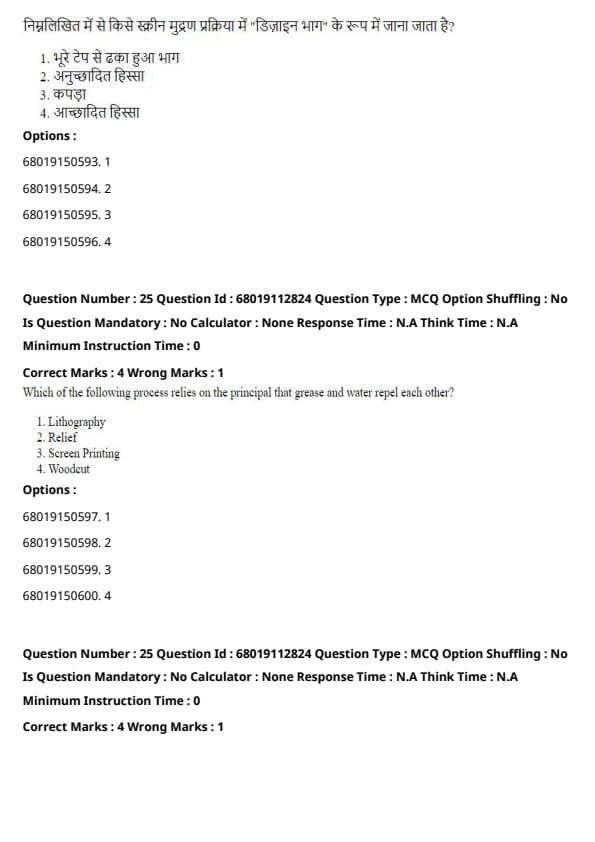
Which of the following is known as the "Area of Design" in the screen printing process?
View Solution
In screen printing, the "Area of Design" refers to the unexposed portion of the stencil through which ink passes to create the design.
Question 25:
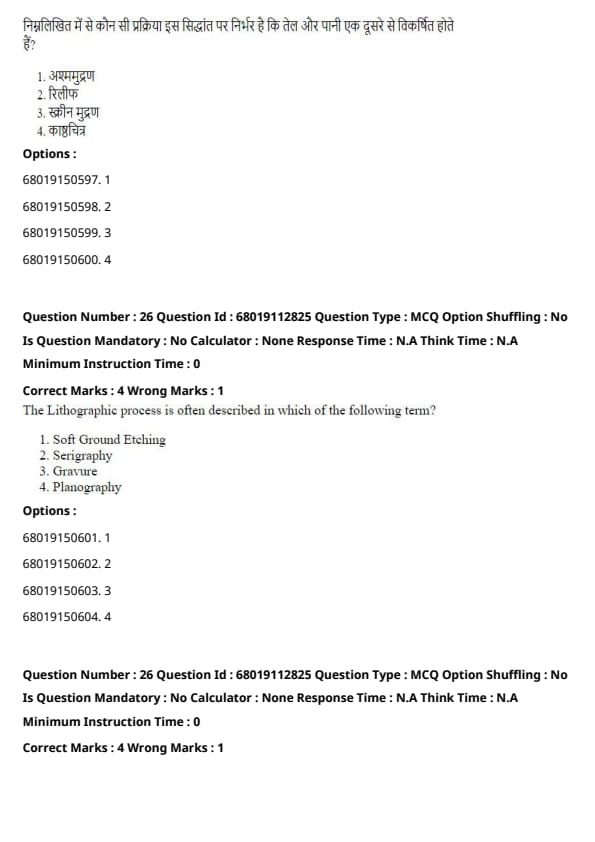
Which of the following processes relies on the principle that grease and water repel each other?
View Solution
Lithography works on the principle that grease and water repel each other, allowing ink to adhere only to the greasy areas of the design.
Question 26:
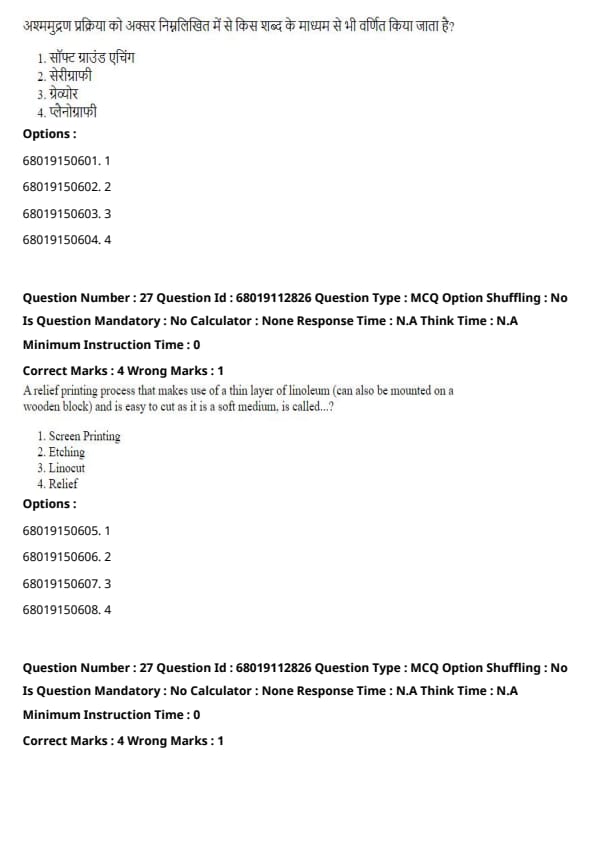
The Lithographic process is often described in which of the following terms?
View Solution
Lithography is referred to as planography since it involves a flat printing surface without raised or indented areas.
Question 27:
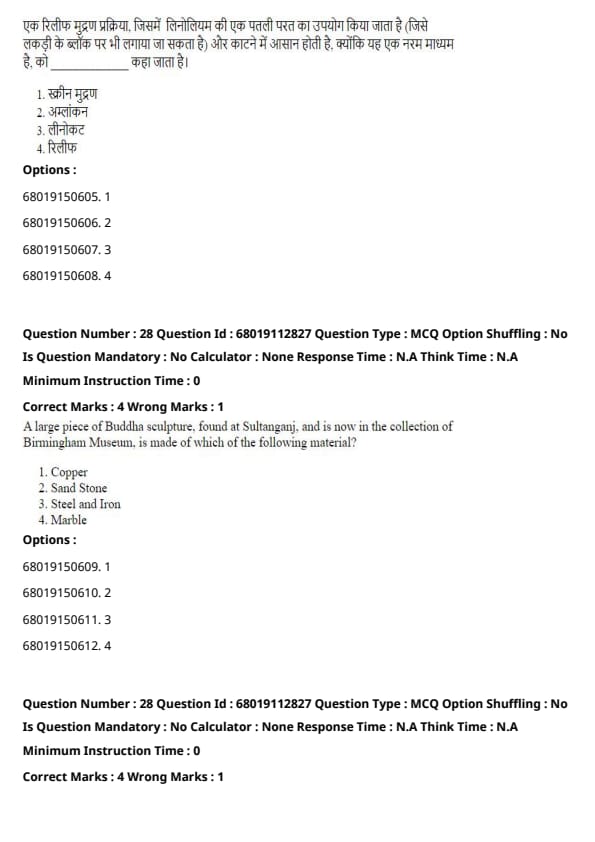
A relief printing process that makes use of a thin layer of linoleum (can also be mounted on a wooden block) and is easy to cut as it is a soft medium, is called...?
View Solution
Linocut is a relief printing technique that uses a soft linoleum sheet, making it easy to carve intricate designs.
Question 28:
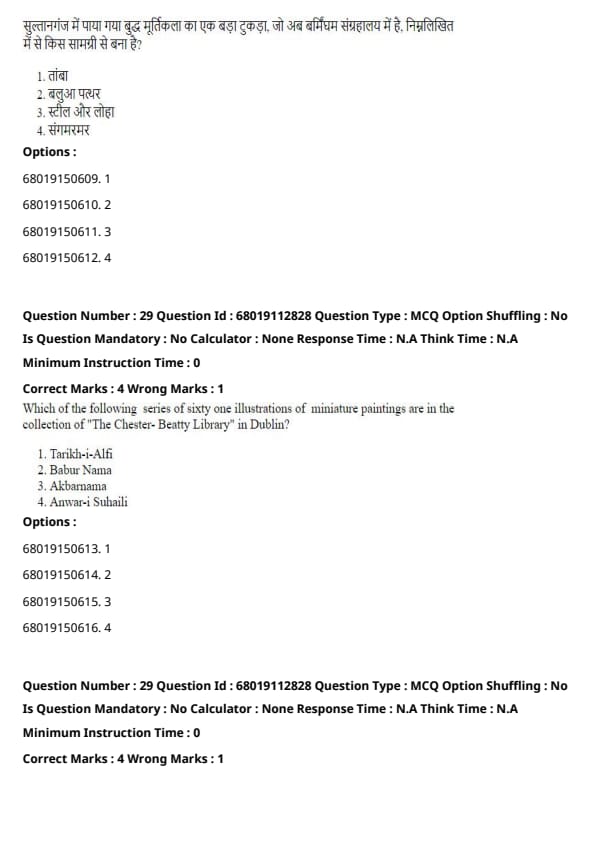
A large piece of Buddha sculpture, found at Sultanganj and now in the collection of Birmingham Museum, is made of which of the following materials?
View Solution
The Buddha sculpture from Sultanganj, made of copper, is one of the largest surviving sculptures from ancient India.
Question 29:
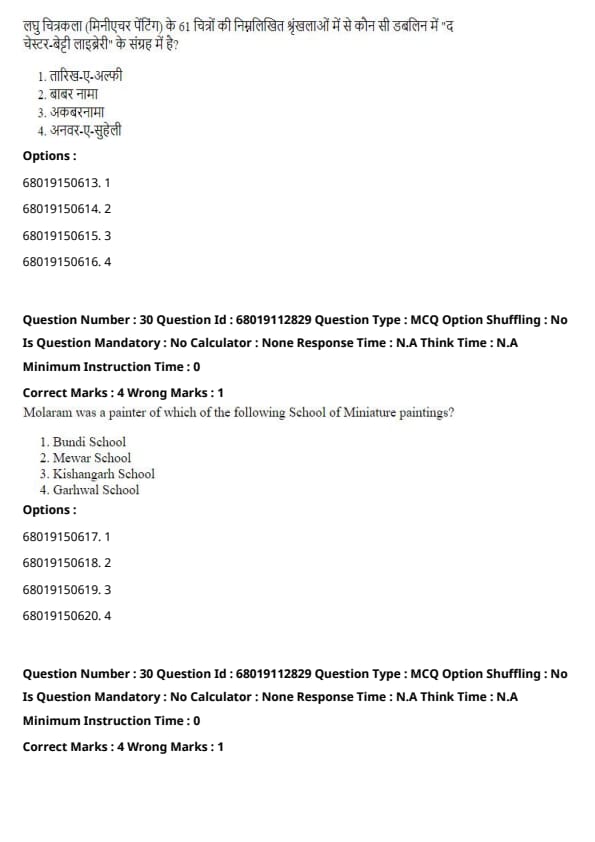
Which of the following series of sixty-one illustrations of miniature paintings are in the collection of "The Chester Beatty Library" in Dublin?
View Solution
The Akbarnama series of miniature paintings, depicting the reign of Emperor Akbar, is housed in "The Chester Beatty Library" in Dublin.
Question 30:
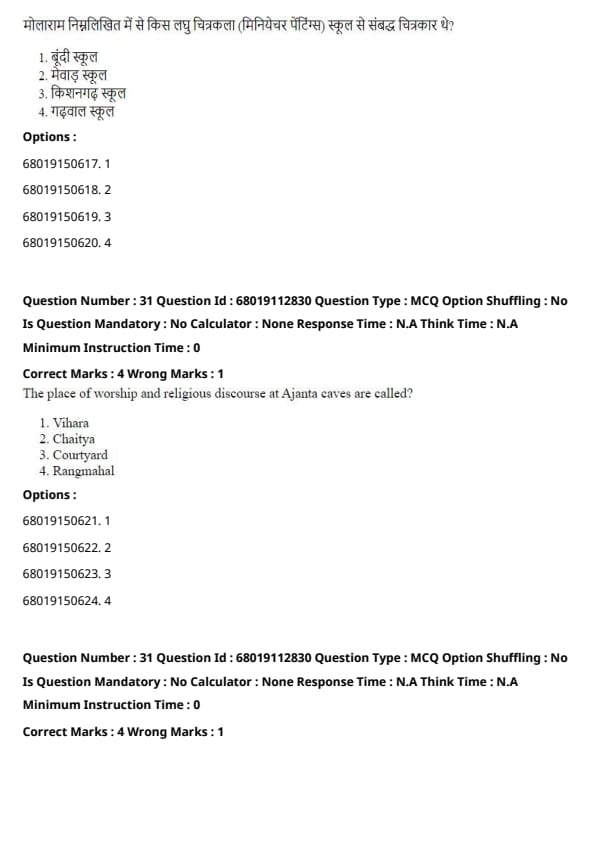
Molaram was a painter of which of the following schools of miniature paintings?
View Solution
Molaram was a prominent artist of the Garhwal School of miniature paintings, known for its vivid depictions of local landscapes and religious themes.
Question 31:
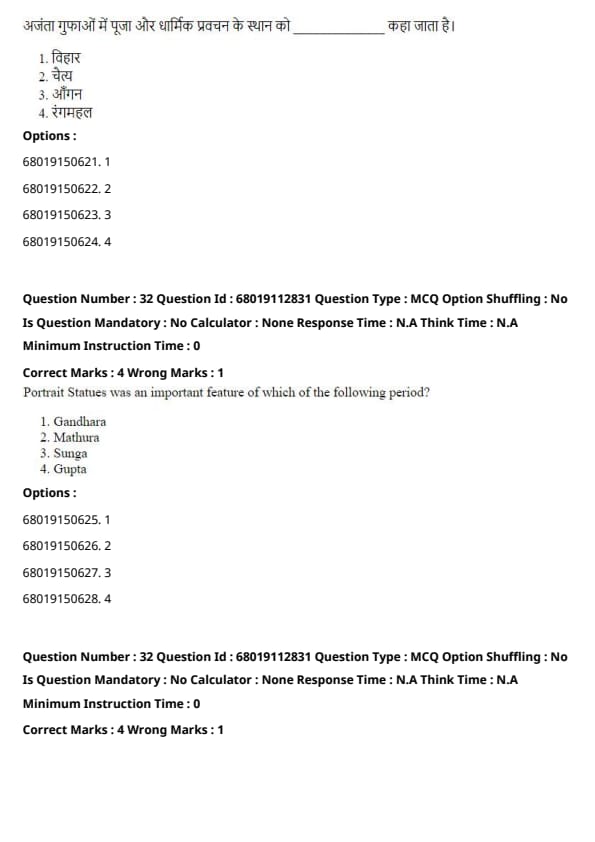
The place of worship and religious discourse at Ajanta caves are called?
View Solution
The Ajanta caves include Chaityas, which are halls of worship used for religious discourse and meditation in Buddhist tradition.
Question 32:
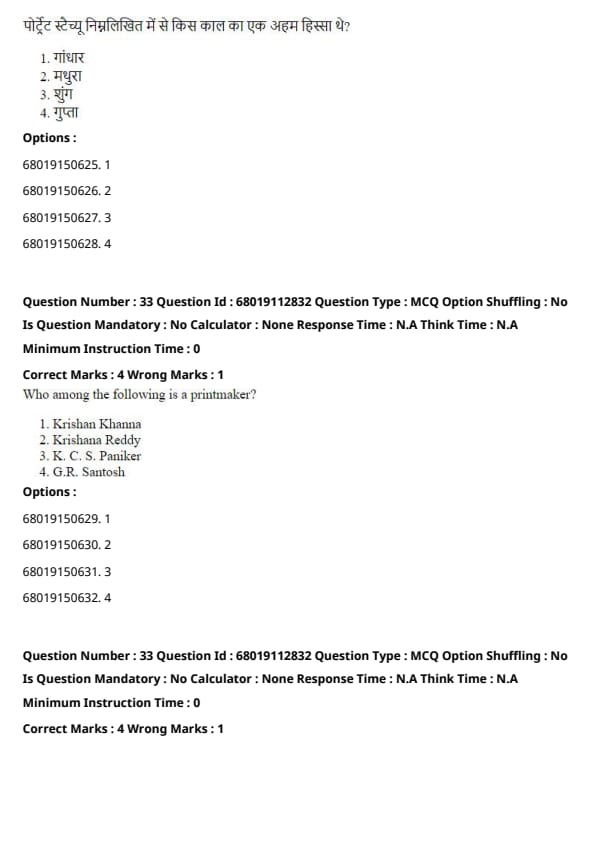
Portrait statues were an important feature of which of the following periods?
View Solution
The Mathura period is renowned for its portrait statues, which depicted realistic representations of individuals and deities.
Question 33:
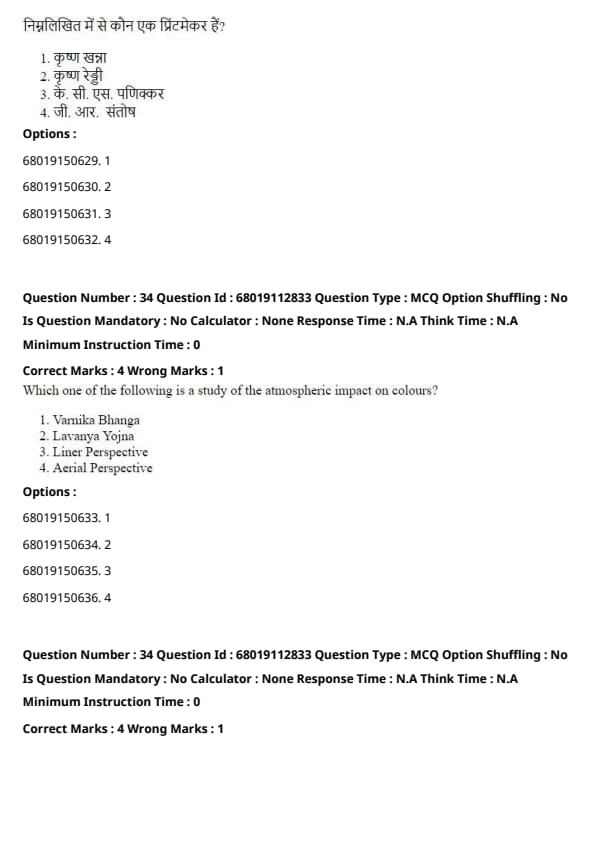
Who among the following is a printmaker?
View Solution
Krishna Reddy was a renowned printmaker, best known for his innovative techniques in intaglio printmaking.
Question 34:
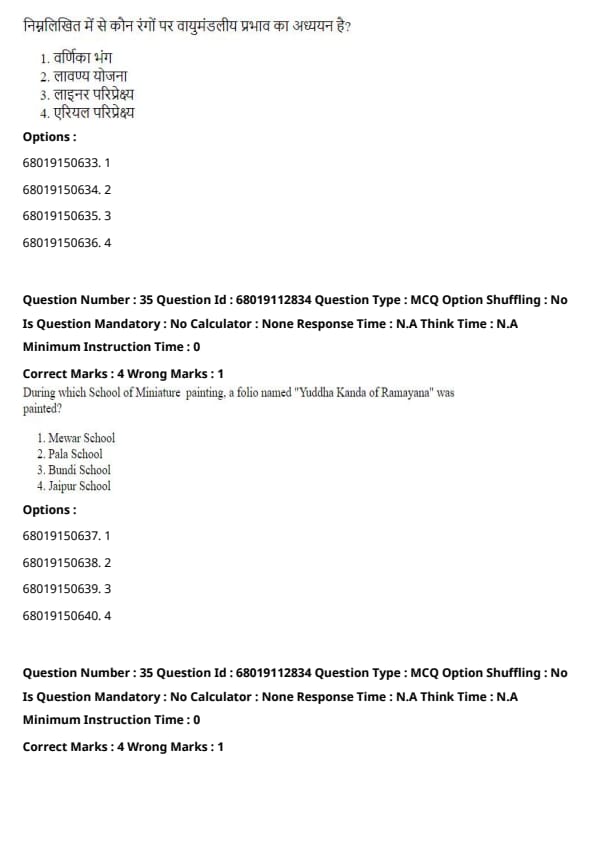
Which one of the following is a study of the atmospheric impact on colors?
View Solution
Aerial perspective refers to the method of depicting the effect of the atmosphere on objects as they recede into the distance, making them appear lighter and less detailed.
Question 35:
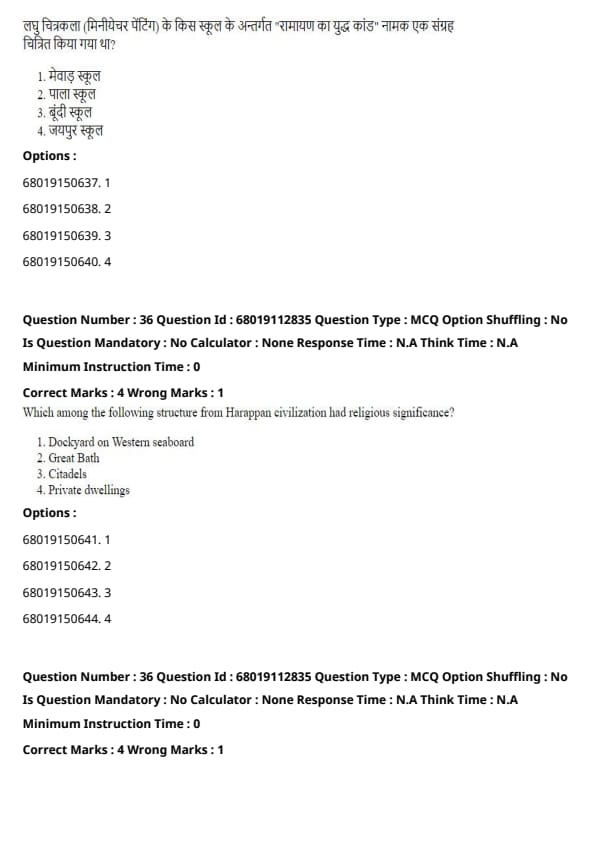
During which school of miniature painting was a folio named "Yuddha Kanda of Ramayana" painted?
View Solution
The Mewar School of miniature painting is known for its vibrant depictions of epics such as the Ramayana, including the "Yuddha Kanda" folio.
Question 36:
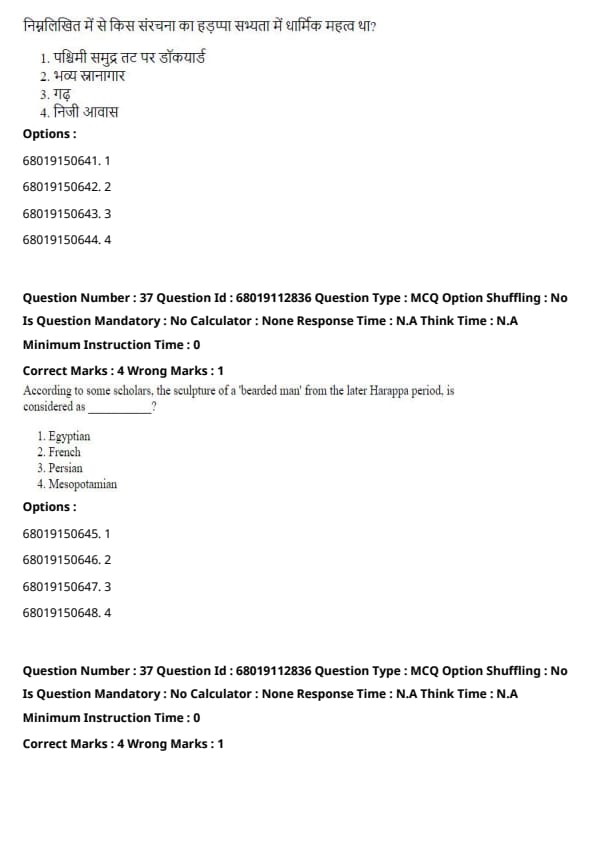
Which among the following structures from the Harappan civilization had religious significance?
View Solution
The Great Bath at Mohenjo-Daro is believed to have had religious significance, likely used for ritual purification.
Question 37:
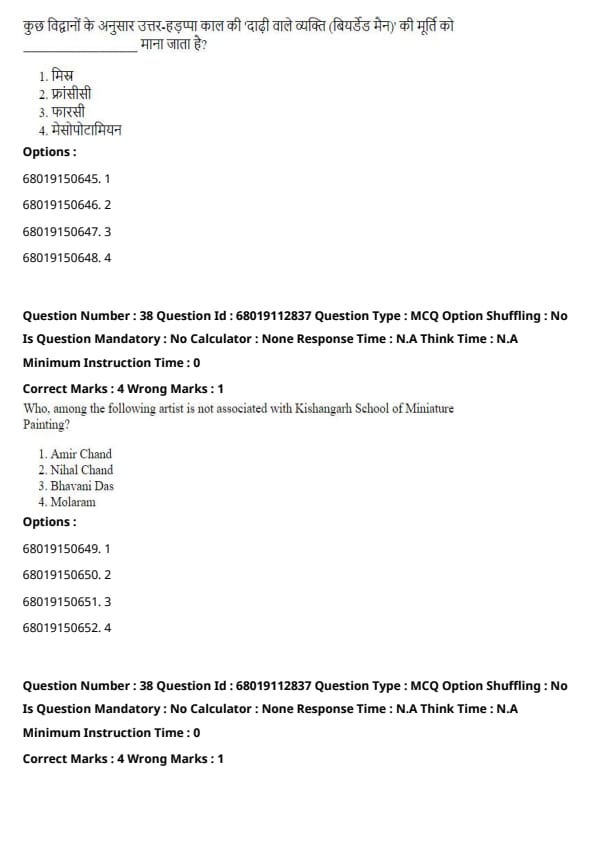
According to some scholars, the sculpture of a 'bearded man' from the later Harappa period is considered as?
View Solution
The 'Bearded Man' sculpture from Harappa displays stylistic similarities with Persian art, suggesting possible cultural connections.
Question 38:
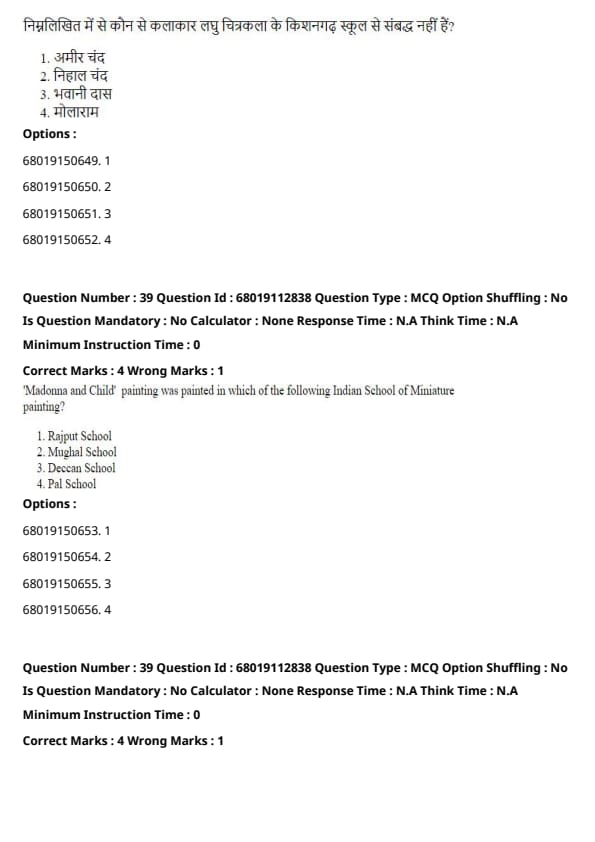
Who among the following artists is not associated with the Kishangarh School of Miniature Painting?
View Solution
Molaram was associated with the Garhwal School of miniature painting, not Kishangarh.
Question 39:
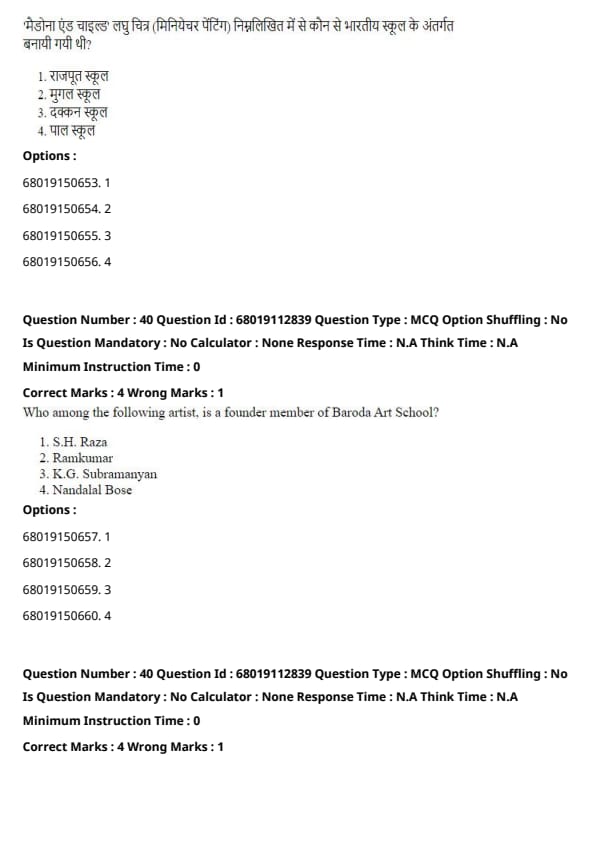
"Madonna and Child" painting was painted in which of the following Indian School of Miniature Painting?
View Solution
The "Madonna and Child" painting reflects the Mughal School's exposure to European art during the reign of Emperor Akbar.
Question 40:
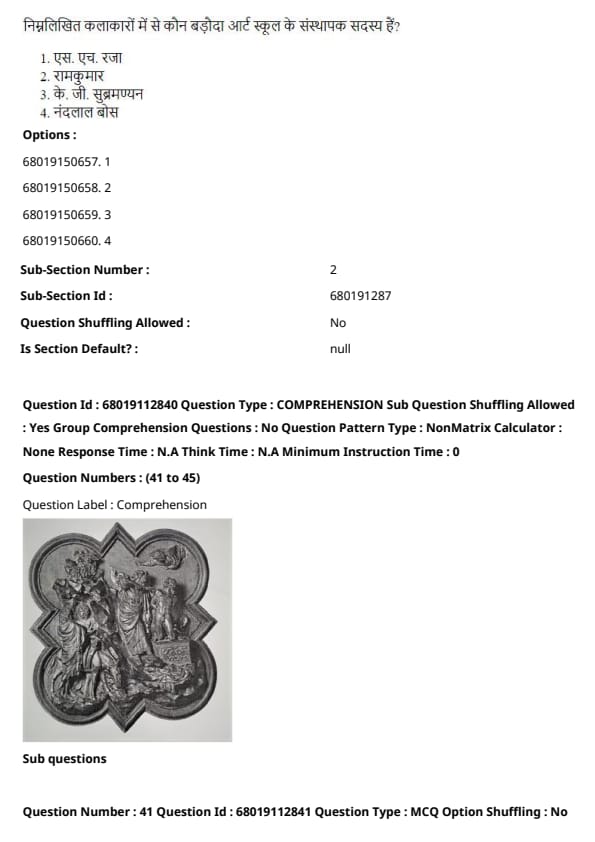
Who among the following artists is a founder member of Baroda Art School?
View Solution
K. G. Subramanyan was a prominent artist and educator, playing a crucial role in establishing the Baroda Art School as a center for modern art education.
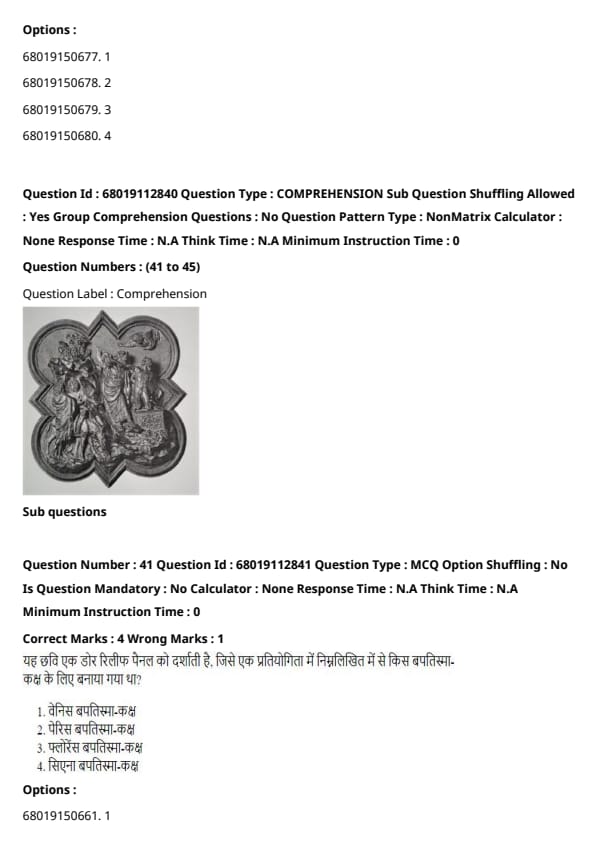
Question 41:
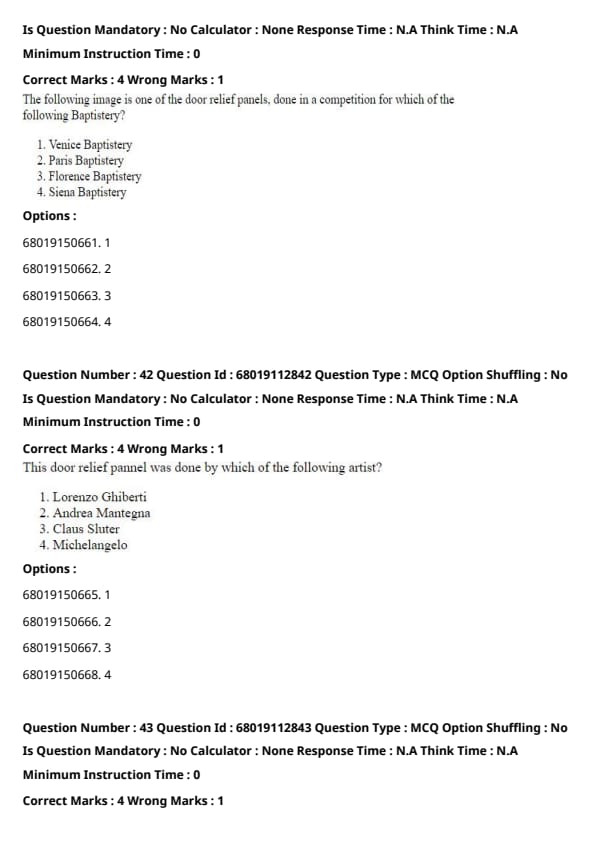
The following image is one of the door relief panels, done in a competition for which of the following Baptistery?
View Solution
The Florence Baptistery, known as the Baptistery of St. John, is famous for its exquisite door panels created through competitive artistic commissions.
Question 42:
This door relief panel was done by which of the following artist?
View Solution
Lorenzo Ghiberti won the competition to create the doors for the Florence Baptistery, showcasing his mastery in relief sculpture.
Question 43:
What was the subject for this competition?
View Solution
The theme of the competition was the "Sacrifice of Isaac," requiring artists to showcase their skill in composition and emotional depth.
Question 44:
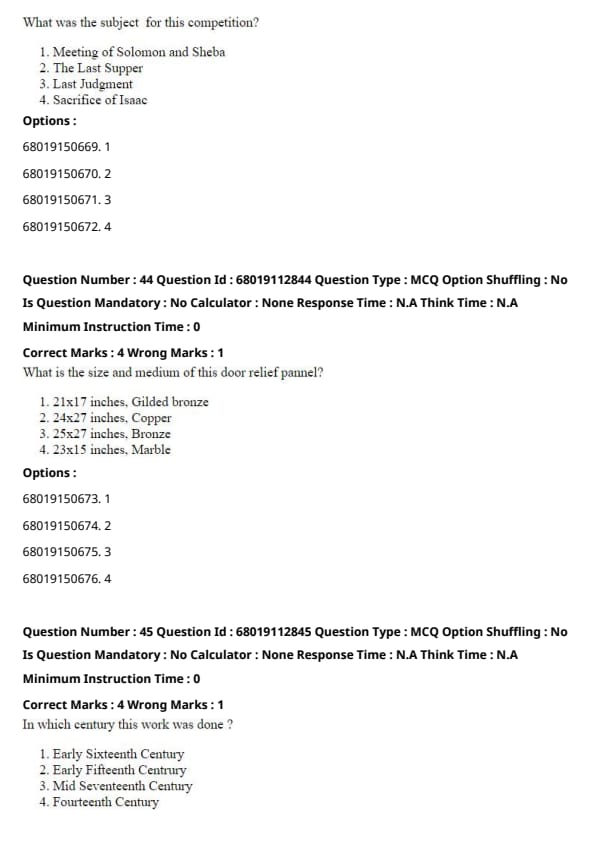
What is the size and medium of this door relief panel?
View Solution
The door relief panels were crafted in gilded bronze, measuring 21x17 inches, reflecting the technical and artistic innovations of the Renaissance period.
Question 45:
In which century was this work done?
View Solution
The competition for the Florence Baptistery doors was held in the early fifteenth century, marking a significant moment in the early Renaissance.
Question 46:
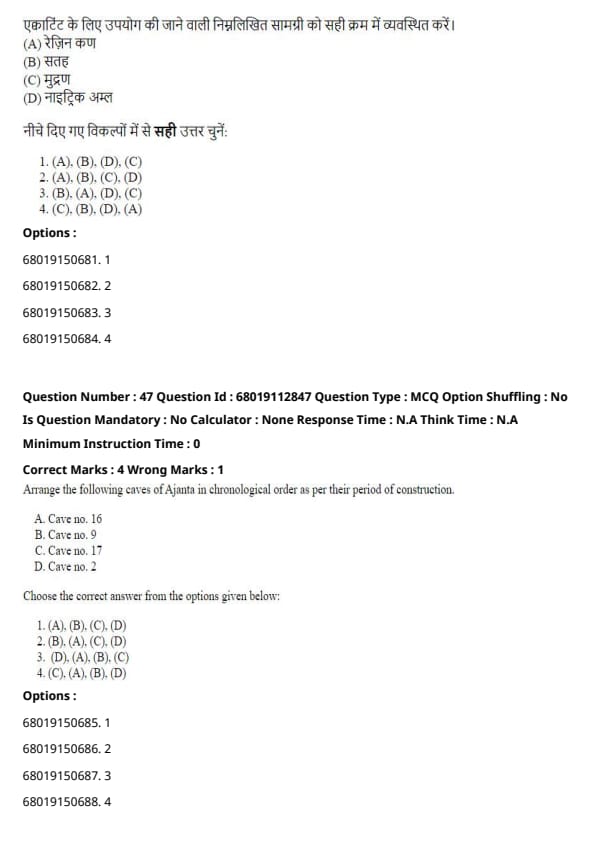
Arrange the following material used for aquatint in correct sequence:
(A) Resin dust
(B) Ground
(C) Printing
(D) Nitric acid
View Solution
The correct sequence for the aquatint process is starting with grounding (B), applying resin dust (A), using nitric acid (D) for etching, and finally proceeding with printing (C).
Question 47:
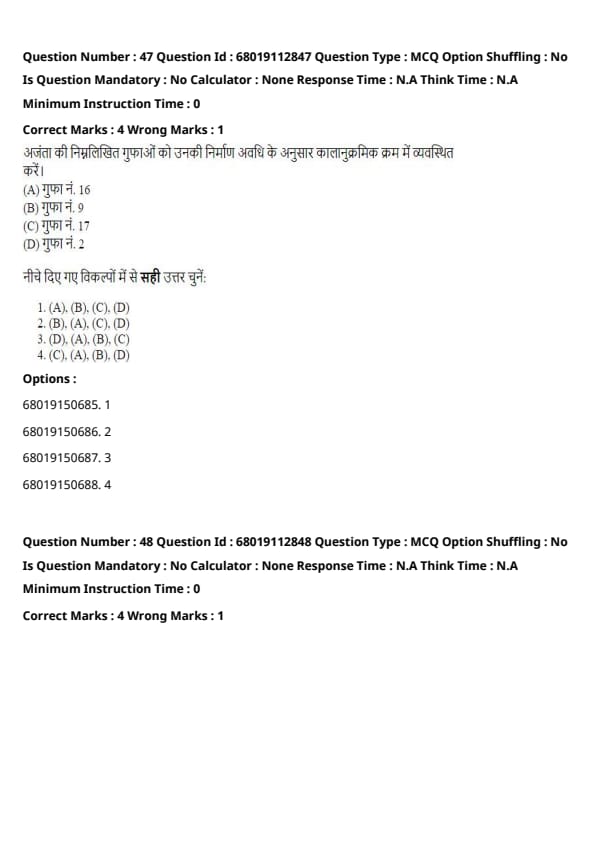
Arrange the following caves of Ajanta in chronological order as per their period of construction:
(A) Cave no. 16
(B) Cave no. 9
(C) Cave no. 17
(D) Cave no. 2
View Solution
The Ajanta caves were constructed in stages, with Cave no. 9 from the Hinayana phase being the earliest, followed by Cave no. 16, then Cave no. 17, and finally Cave no. 2.
Question 48:
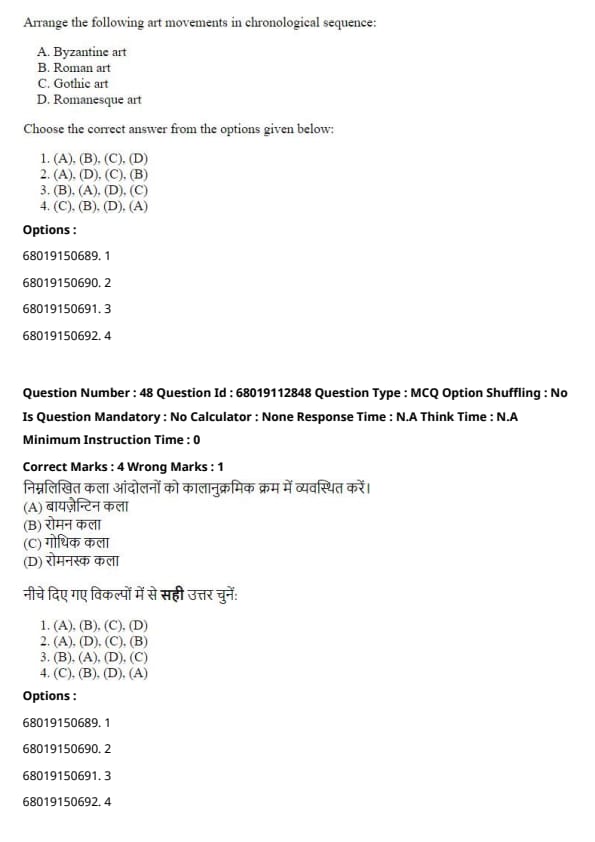
Arrange the following art movements in chronological sequence:
(A) Byzantine art
(B) Roman art
(C) Gothic art
(D) Romanesque art
View Solution
The chronological order begins with Roman art (B), followed by Byzantine art (A), Romanesque art (D), and Gothic art (C).
Question 49:
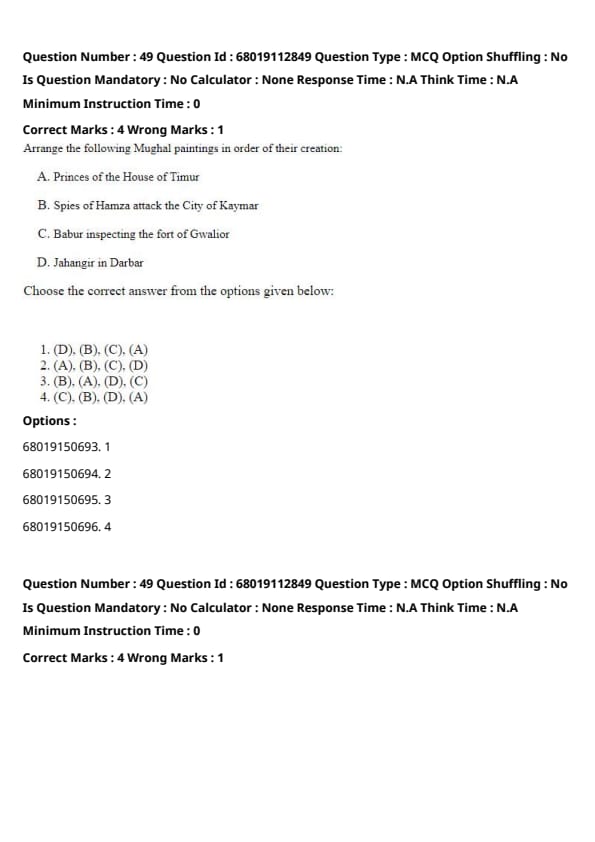
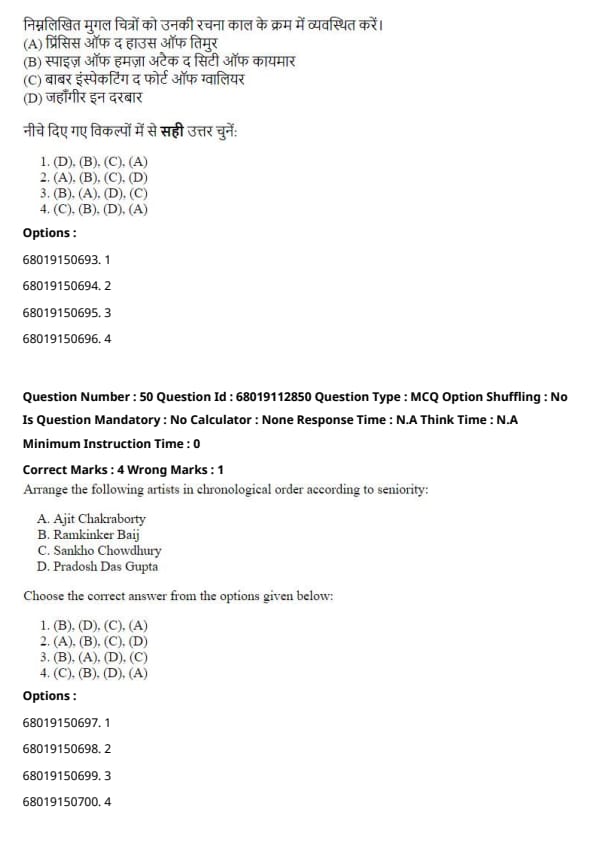
Arrange the following Mughal paintings in order of their creation:
(A) Princes of the House of Timur
(B) Spies of Hamza attack the City of Kaymar
(C) Babur inspecting the fort of Gwalior
(D) Jahangir in Darbar
View Solution
The sequence starts with "Princes of the House of Timur" (A), followed by "Spies of Hamza attack the City of Kaymar" (B), then "Babur inspecting the fort of Gwalior" (C), and finally "Jahangir in Darbar" (D).
Question 50:
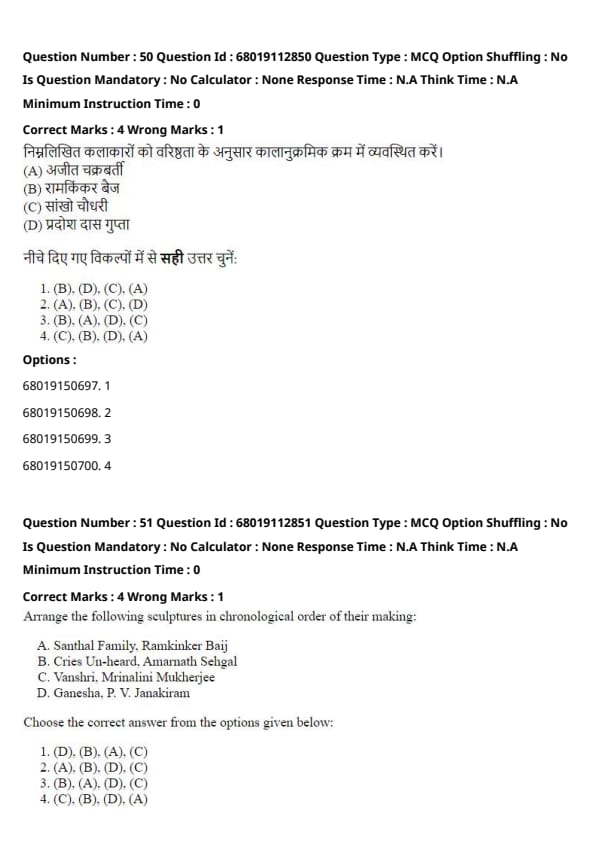
Arrange the following artists in chronological order according to seniority:
(A) Ajit Chakraborty
(B) Ramkinker Baij
(C) Sankho Chowdhury
(D) Pradosh Das Gupta
View Solution
The chronological order of the artists based on seniority is Ramkinker Baij (B), Pradosh Das Gupta (D), Sankho Chowdhury (C), and Ajit Chakraborty (A).
Question 51:
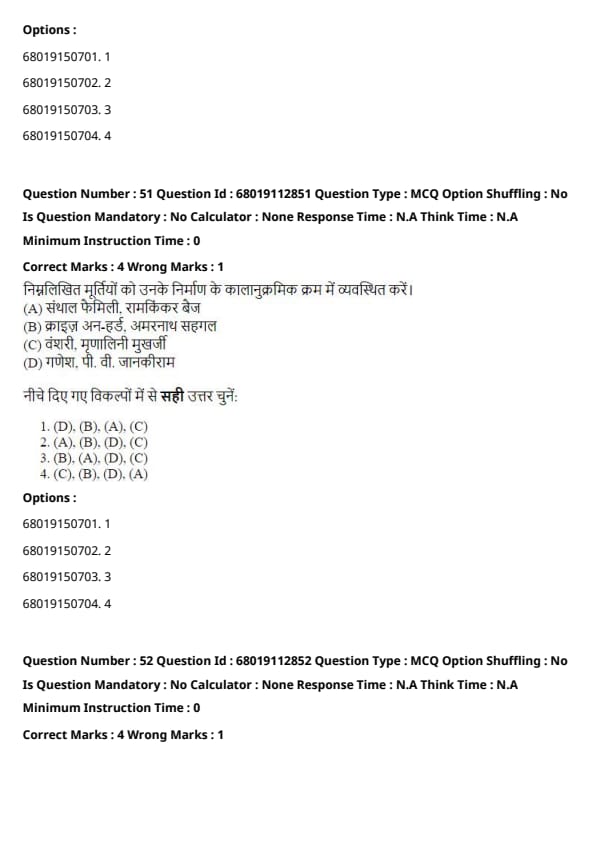
Arrange the following sculptures in chronological order of their making:
(A) Santhal Family, Ramkinker Baij
(B) Cries Un-heard, Amarnath Sehgal
(C) Vanshri, Mrinalini Mukherjee
(D) Ganesha, P. V. Janakiram
View Solution
The chronological order is based on the creation of these sculptures: Ramkinker Baij's "Santhal Family" was one of the earliest, followed by Amarnath Sehgal's "Cries Un-heard," then P. V. Janakiram's "Ganesha," and finally Mrinalini Mukherjee's "Vanshri."
Question 52:
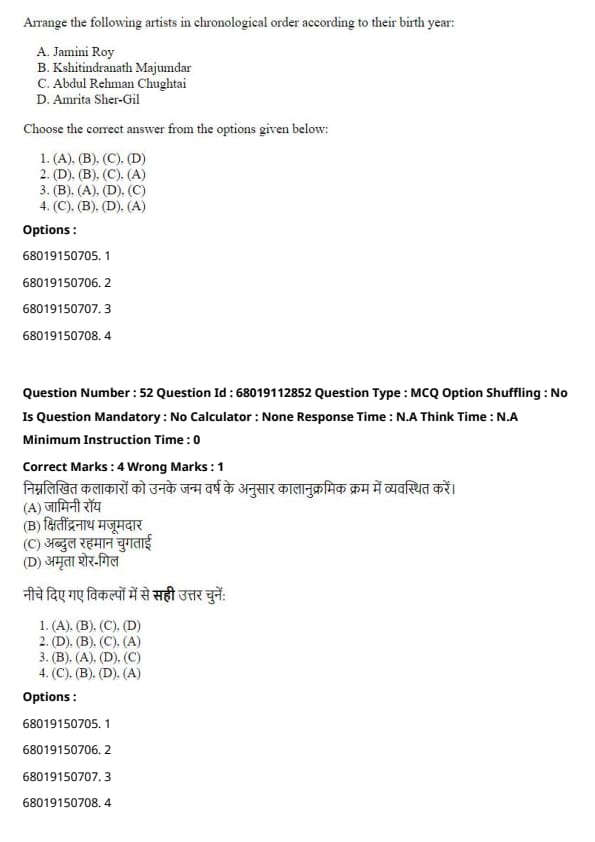
Arrange the following artists in chronological order according to their birth year:
(A) Jamini Roy
(B) Kshitindranath Majumdar
(C) Abdul Rehman Chughtai
(D) Amrita Sher-Gil
View Solution
Jamini Roy was born earlier than Kshitindranath Majumdar, followed by Abdul Rehman Chughtai, and finally Amrita Sher-Gil, making the correct chronological order: (A), (B), (C), (D).
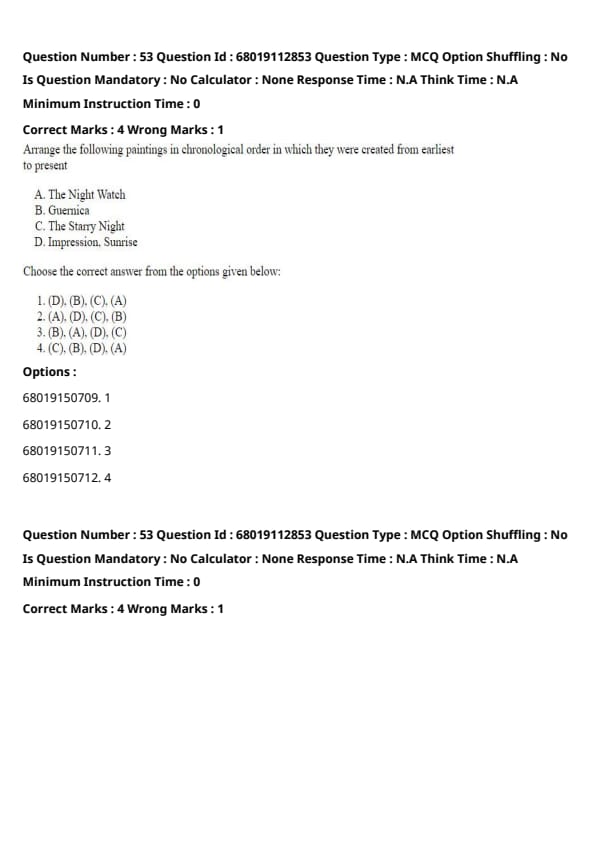
Question 53:
Arrange the following paintings in chronological order in which they were created:
(A) The Night Watch
(B) Guernica
(C) The Starry Night
(D) Impression, Sunrise
View Solution
"The Night Watch" was created in 1642, followed by "Impression, Sunrise" in 1872, "The Starry Night" in 1889, and finally "Guernica" in 1937.
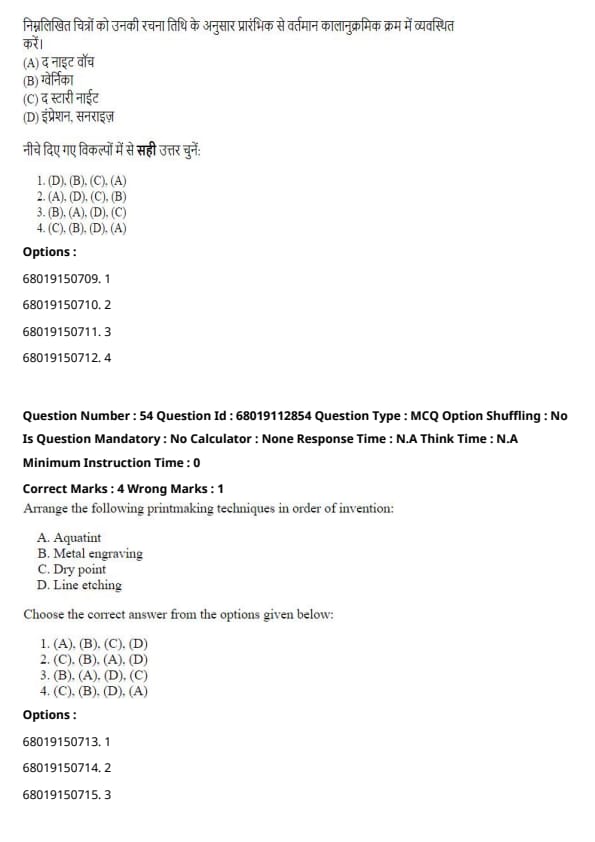
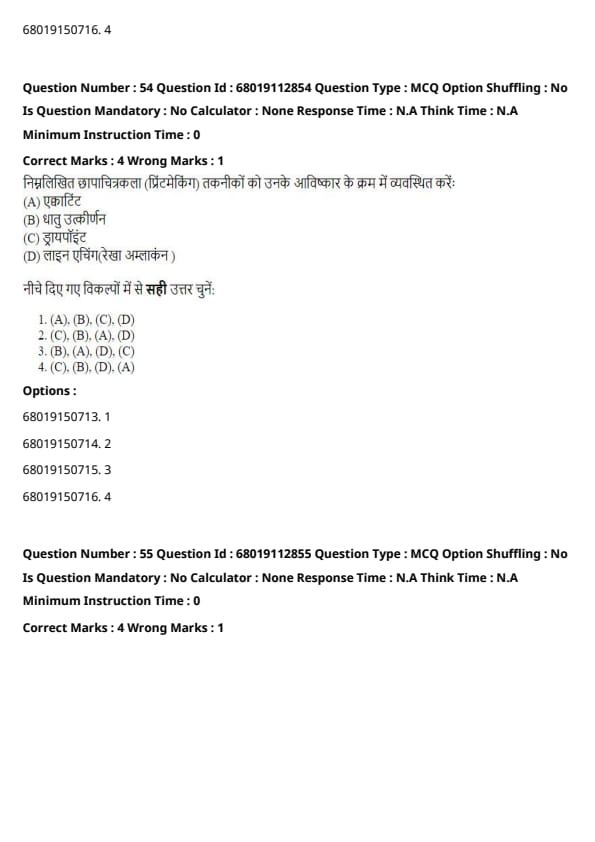
Question 54:
Arrange the following printmaking techniques in order of invention:
(A) Aquatint
(B) Metal engraving
(C) Dry point
(D) Line etching
View Solution
Metal engraving was invented first, followed by aquatint, then line etching, and finally dry point.
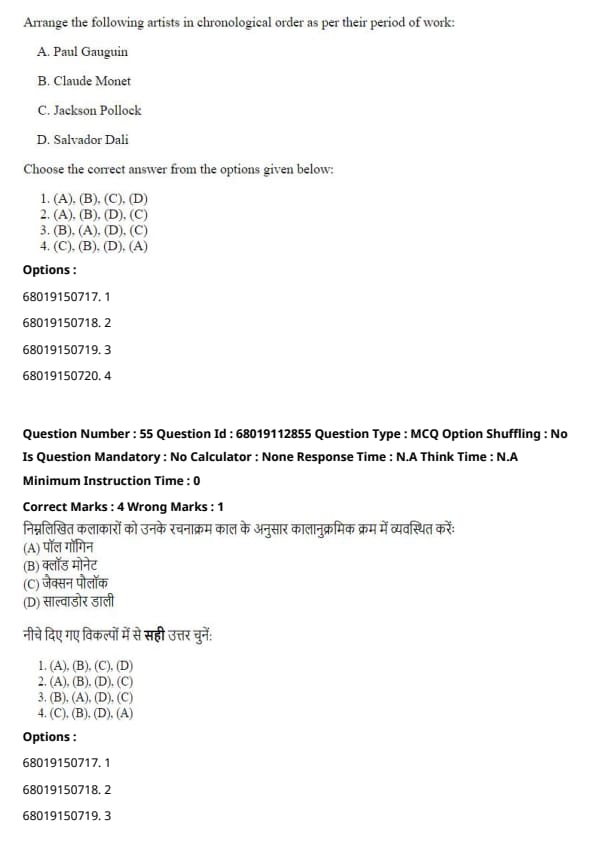
Question 55:
Arrange the following artists in chronological order as per their period of work:
(A) Paul Gauguin
(B) Claude Monet
(C) Jackson Pollock
(D) Salvador Dali
View Solution
Claude Monet, known for Impressionism, worked earlier than Paul Gauguin, followed by Surrealist Salvador Dali, and finally Abstract Expressionist Jackson Pollock.
Question 56:
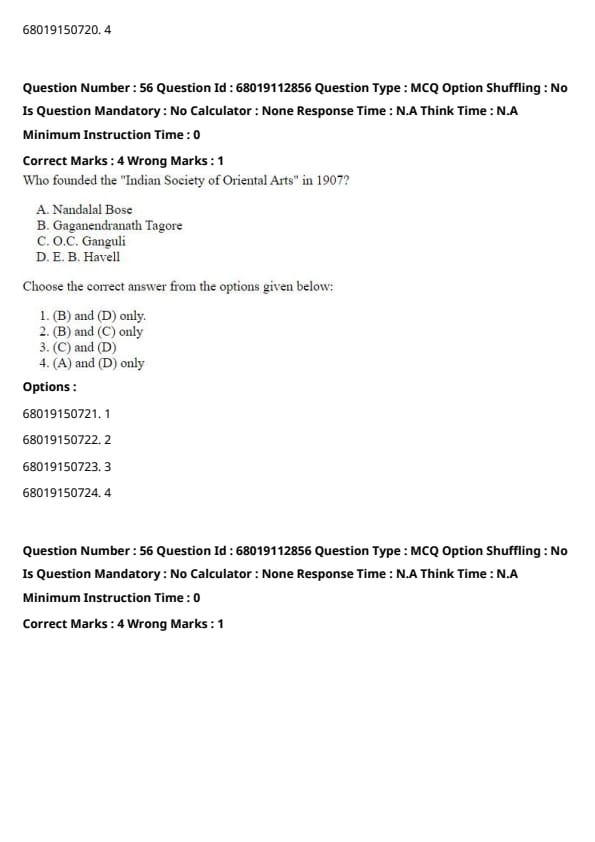
Who founded the "Indian Society of Oriental Arts" in 1907?
(A) Nandalal Bose
(B) Gaganendranath Tagore
(C) O.C. Ganguli
(D) E.B. Havell
View Solution
The Indian Society of Oriental Arts was founded by Gaganendranath Tagore and O.C. Ganguli in 1907 to revive and promote Indian art forms.
Question 57:
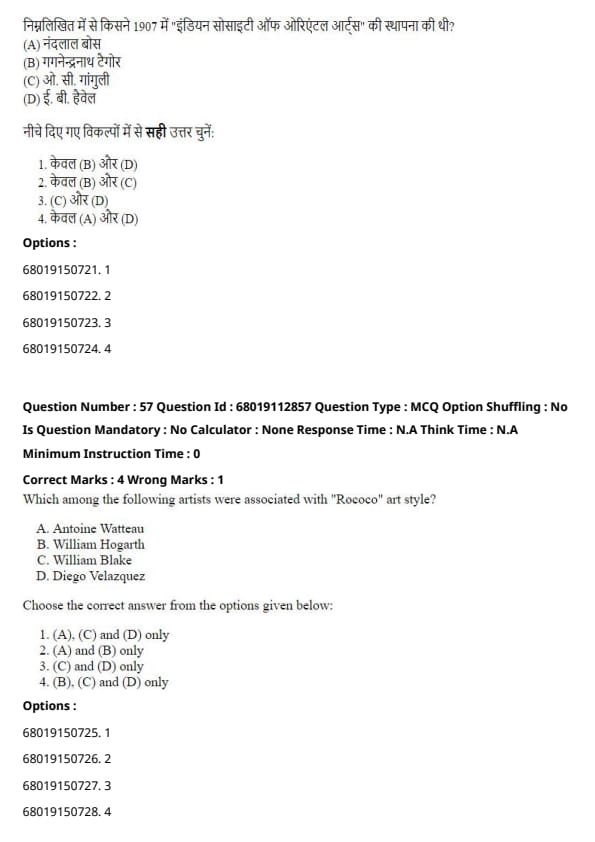
Which among the following artists were associated with "Rococo" art style?
(A) Antoine Watteau
(B) William Hogarth
(C) William Blake
(D) Diego Velazquez
View Solution
Antoine Watteau and William Hogarth were associated with the Rococo art style, characterized by ornate and elaborate design elements.
Question 58:
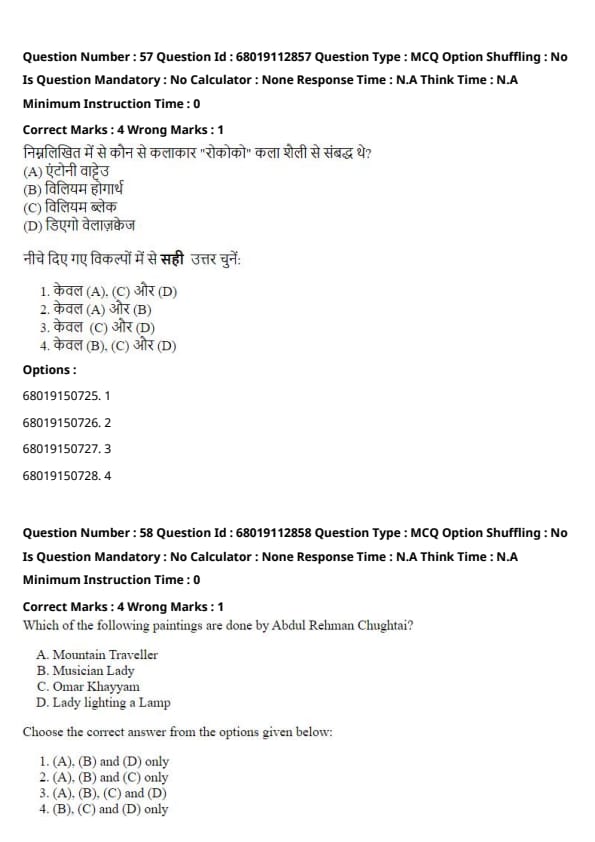
Which of the following paintings are done by Abdul Rehman Chughtai?
(A) Mountain Traveller
(B) Musician Lady
(C) Omar Khayyam
(D) Lady Lighting a Lamp
View Solution
Abdul Rehman Chughtai's artistic repertoire includes all four works: "Mountain Traveller," "Musician Lady," "Omar Khayyam," and "Lady Lighting a Lamp."
Question 59:
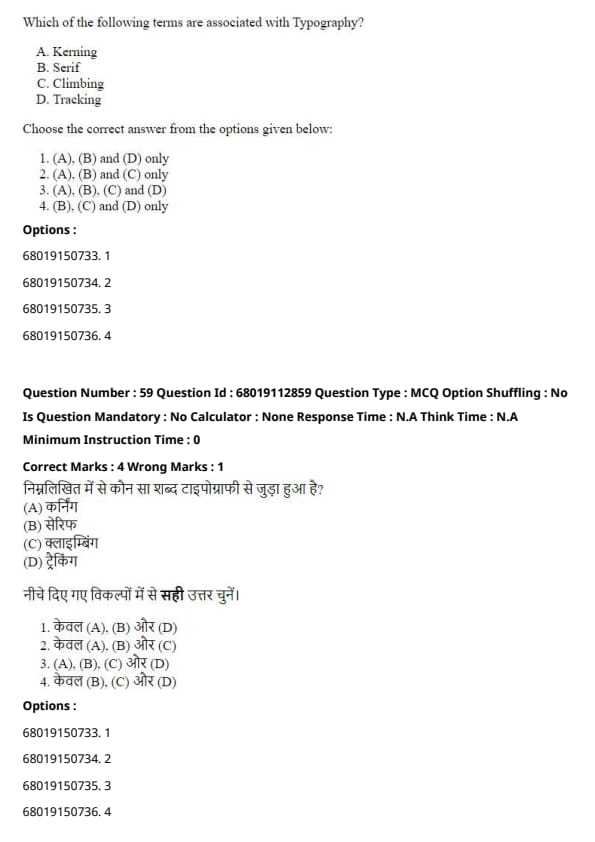
Which of the following terms are associated with Typography?
(A) Kerning
(B) Serif
(C) Climbing
(D) Tracking
View Solution
Kerning, Serif, and Tracking are fundamental concepts in typography, whereas "Climbing" is not related to typography.
Question 60:
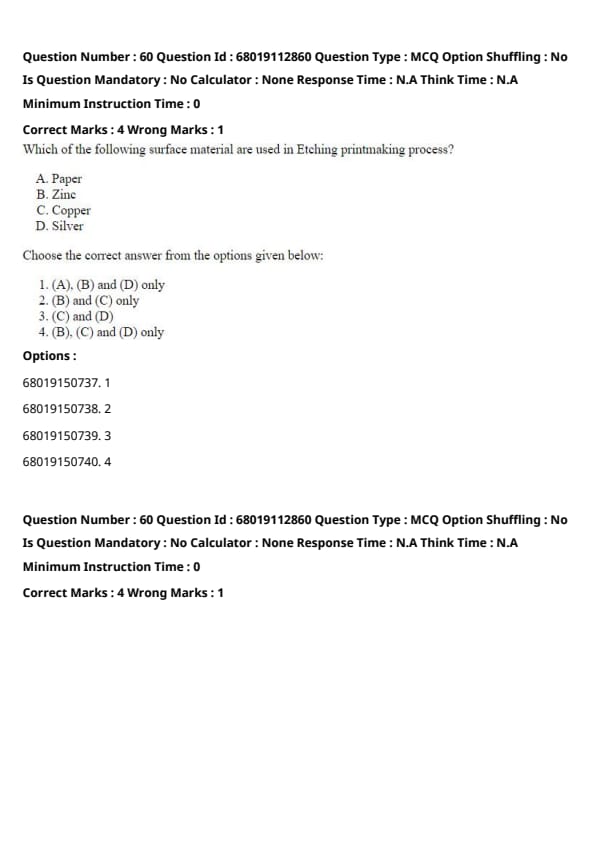
Which of the following surface materials are used in Etching printmaking process?
(A) Paper
(B) Zinc
(C) Copper
(D) Silver
View Solution
Zinc and copper are commonly used in etching for creating fine details in printmaking, whereas paper is used for transferring the print, not as the surface material.
Question 61:
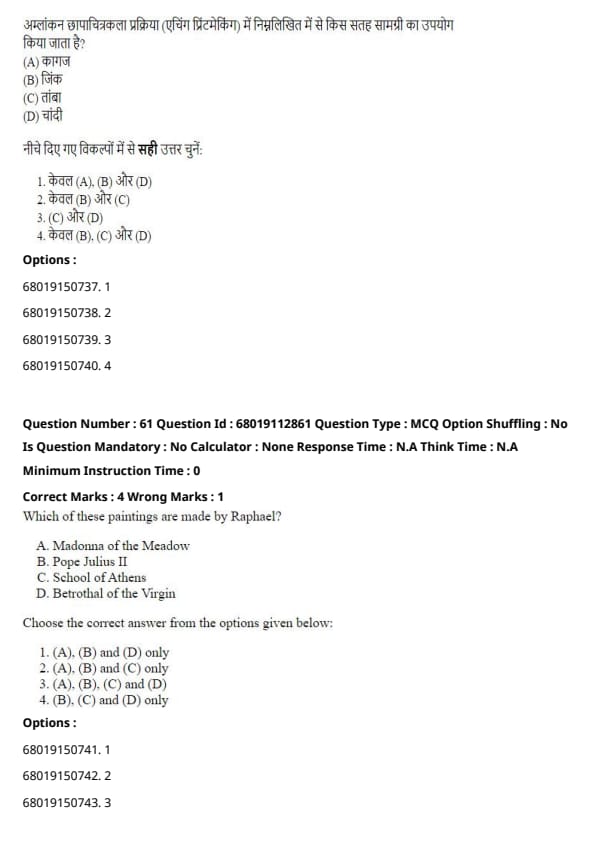
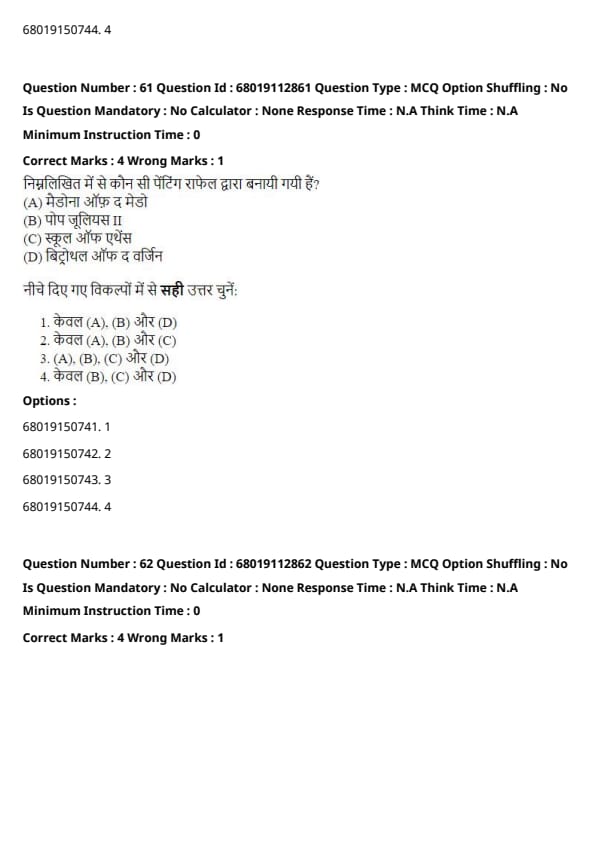
Which of these paintings are made by Raphael?
(A) Madonna of the Meadow
(B) Pope Julius II
(C) School of Athens
(D) Betrothal of the Virgin
View Solution
All the listed paintings—"Madonna of the Meadow," "Pope Julius II," "School of Athens," and "Betrothal of the Virgin"—are masterpieces by Raphael, showcasing his expertise in Renaissance art.
Question 62:
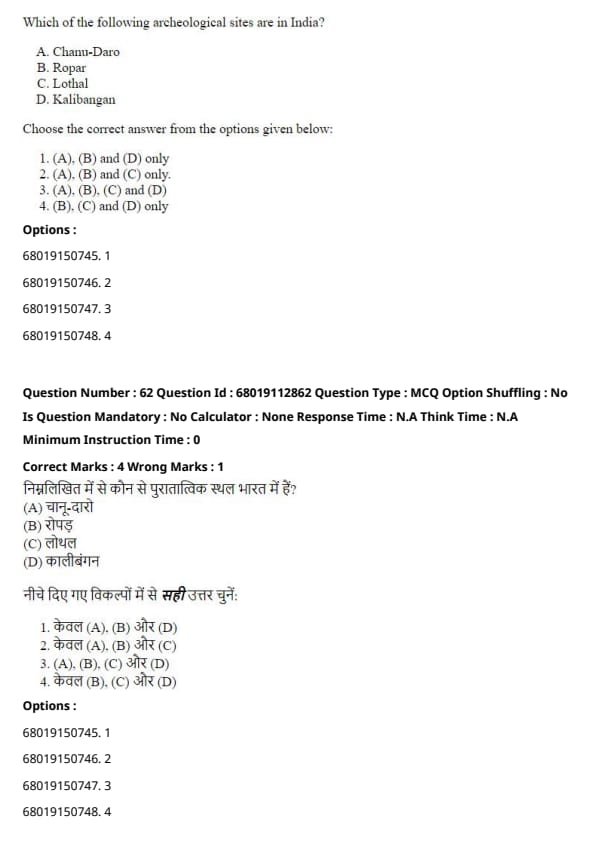
Which of the following archaeological sites are in India?
(A) Chanu-Daro
(B) Ropar
(C) Lothal
(D) Kalibangan
View Solution
Ropar, Lothal, and Kalibangan are in India, while Chanu-Daro is located in present-day Pakistan.
Question 63:
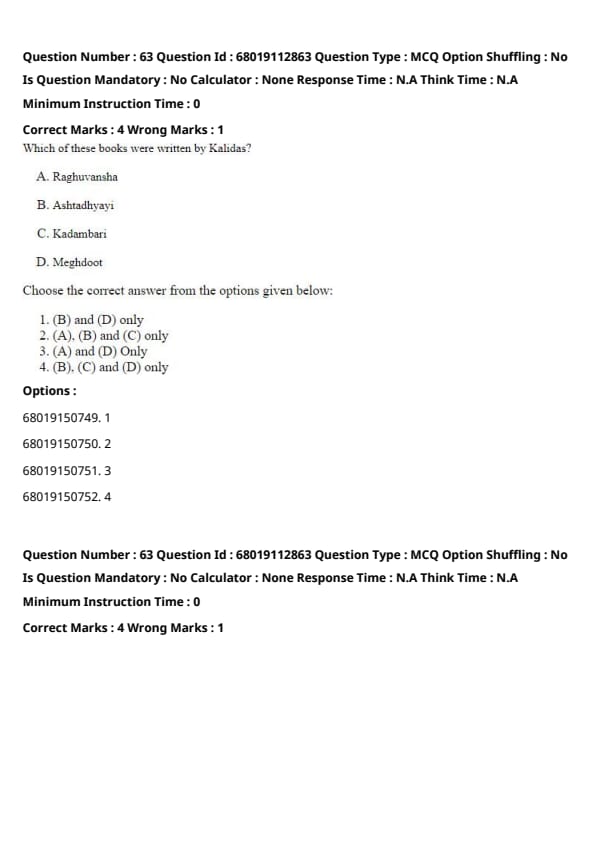
Which of these books were written by Kalidas?
(A) Raghuvansha
(B) Ashtadhyayi
(C) Kadambari
(D) Meghdoot
View Solution
Kalidas wrote "Raghuvansha" and "Meghdoot." "Ashtadhyayi" was written by Panini, and "Kadambari" by Banabhatta.
Question 64:
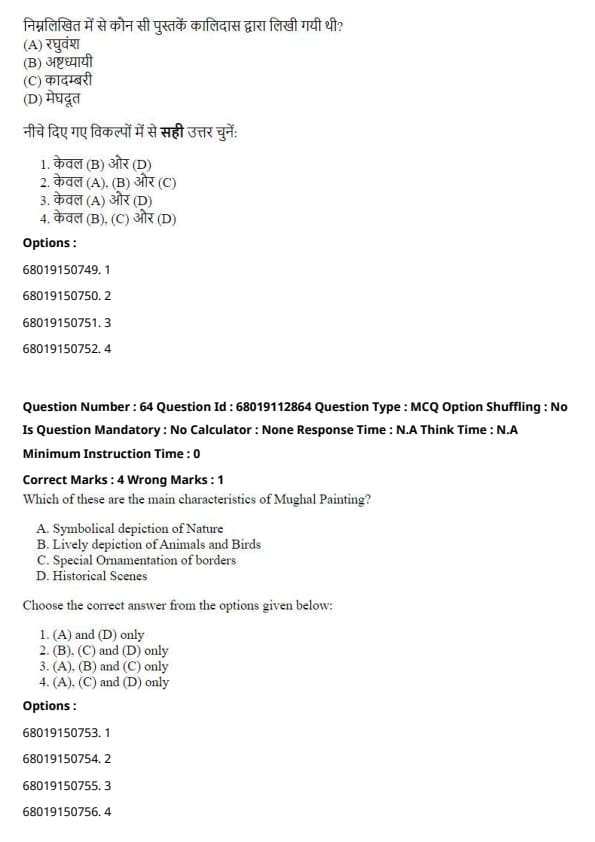
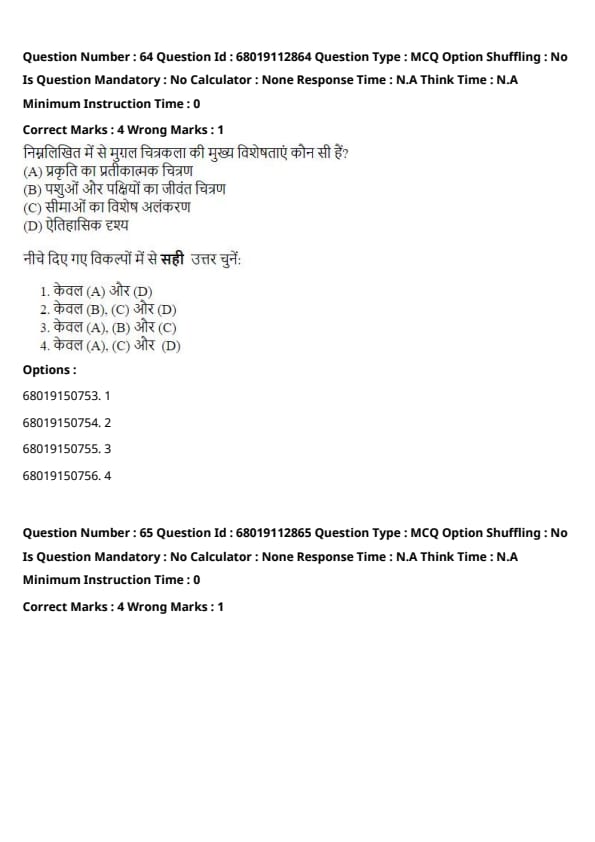
Which of these are the main characteristics of Mughal Painting?
(A) Symbolical depiction of Nature
(B) Lively depiction of Animals and Birds
(C) Special Ornamentation of borders
(D) Historical Scenes
View Solution
Mughal paintings are known for their symbolic depiction of nature, lively portrayal of animals and birds, and elaborate border ornamentation. Historical scenes are less emphasized.
Question 65:
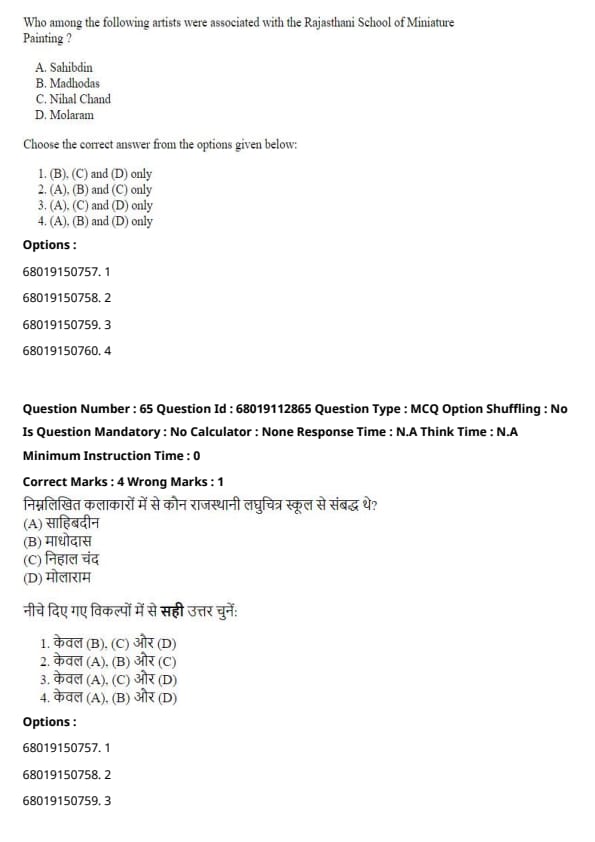
Who among the following artists were associated with the Rajasthani School of Miniature Painting?
(A) Sahibdin
(B) Madhodas
(C) Nihal Chand
(D) Molaram
View Solution
Sahibdin, Madhodas, and Nihal Chand were significant contributors to the Rajasthani School of Miniature Painting. Molaram was associated with the Garhwal School.
Question 66:
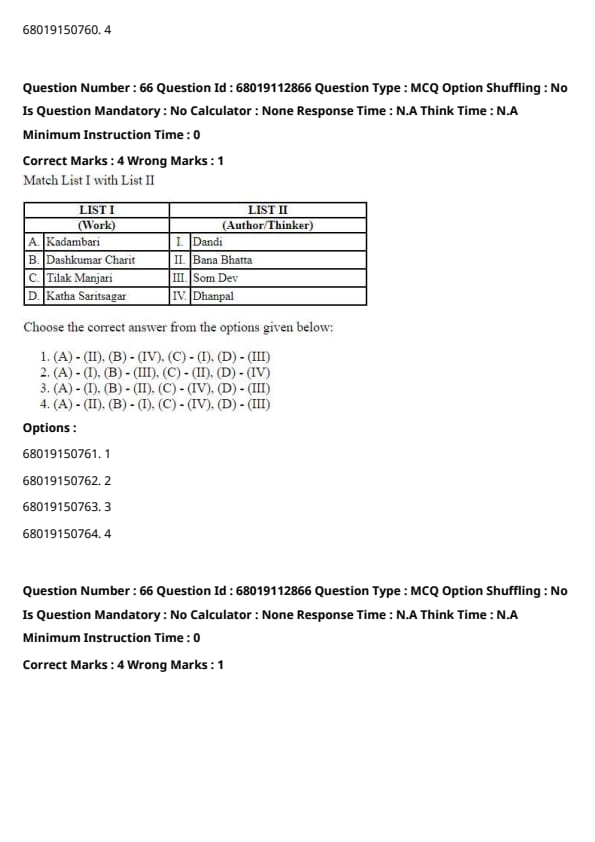
Match List I with List II:
| List I (Work) | List II (Author/Thinker) |
|---|---|
| A. Kadambari | I. Dandi |
| B. Dashkumar Charit | II. Bana Bhatta |
| C. Tilak Manjari | III. Som Dev |
| D. Katha Saritsagar | IV. Dhanpal |
View Solution
The correct matches between the works and their respective authors are:
- Kadambari – Written by Bana Bhatta, a masterpiece of Sanskrit prose.
- Dashkumar Charit – Authored by Dandi, an important work in Sanskrit literature.
- Tilak Manjari – Written by Som Dev, showcasing classical storytelling.
- Katha Saritsagar – Composed by Dhanpal, an extensive collection of stories.
Question 67:
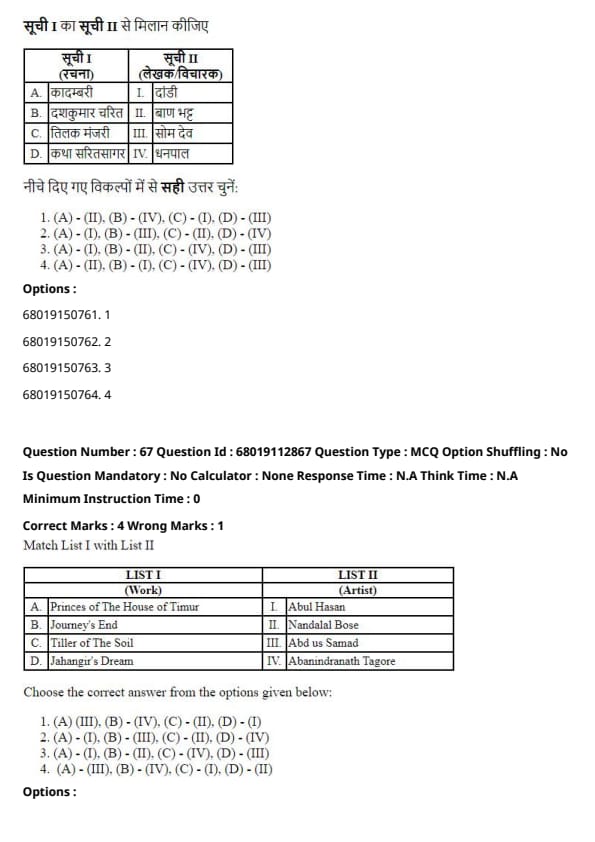
Match List I with List II:
| List I (Work) | List II (Artist) |
|---|---|
| A. Princes of The House of Timur | I. Abul Hasan |
| B. Journey's End | II. Nandalal Bose |
| C. Tiller of The Soil | III. Abd us Samad |
| D. Jahangir's Dream | IV. Abanindranath Tagore |
View Solution
The correct matches between the works and their respective artists are:
- Princes of The House of Timur – Created by Abd us Samad, a key figure in Mughal miniature art.
- Journey's End – A significant work by Nandalal Bose, showcasing his mastery in modern Indian art.
- Tiller of The Soil – Painted by Abanindranath Tagore, a pioneer of the Bengal School of Art.
- Jahangir's Dream – A masterpiece by Abul Hasan, exemplifying Mughal artistry.
Question 68:
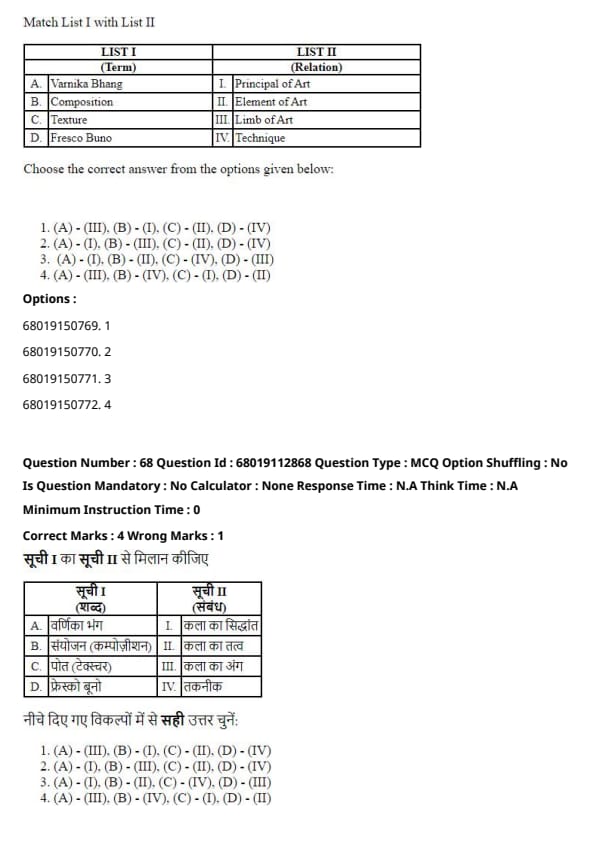
Match List I with List II:
| List I (Term) | List II (Relation) |
|---|---|
| A. Varnika Bhang | I. Principle of Art |
| B. Composition | II. Element of Art |
| C. Texture | III. Limb of Art |
| D. Fresco Buno | IV. Technique |
View Solution
The correct matches between the terms and their relations are:
- Varnika Bhang – Associated with the Limb of Art, a term linked to the structure and essence of painting.
- Composition – Refers to the Principle of Art, organizing elements within a work.
- Texture – An Element of Art, denoting surface quality in art and design.
- Fresco Buno – A Technique, specific to painting on wet plaster.
Question 69:
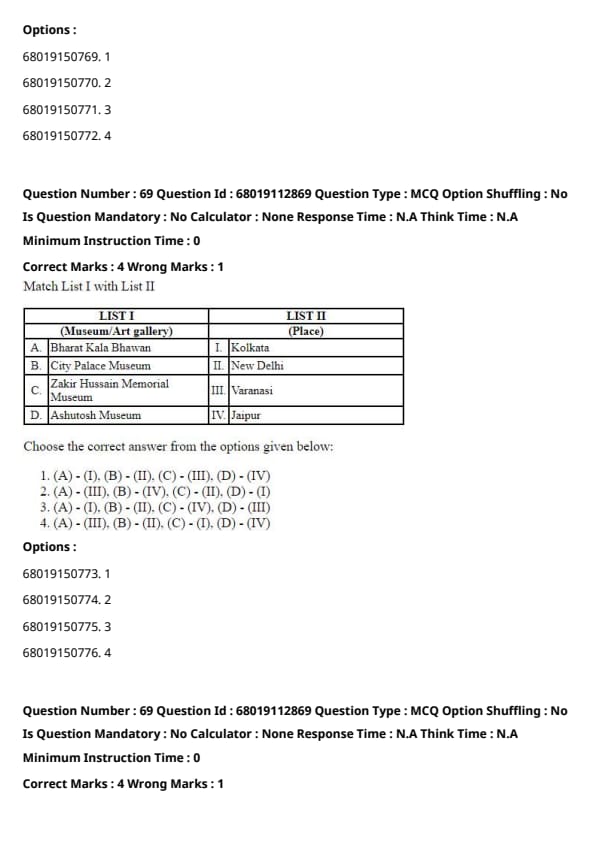
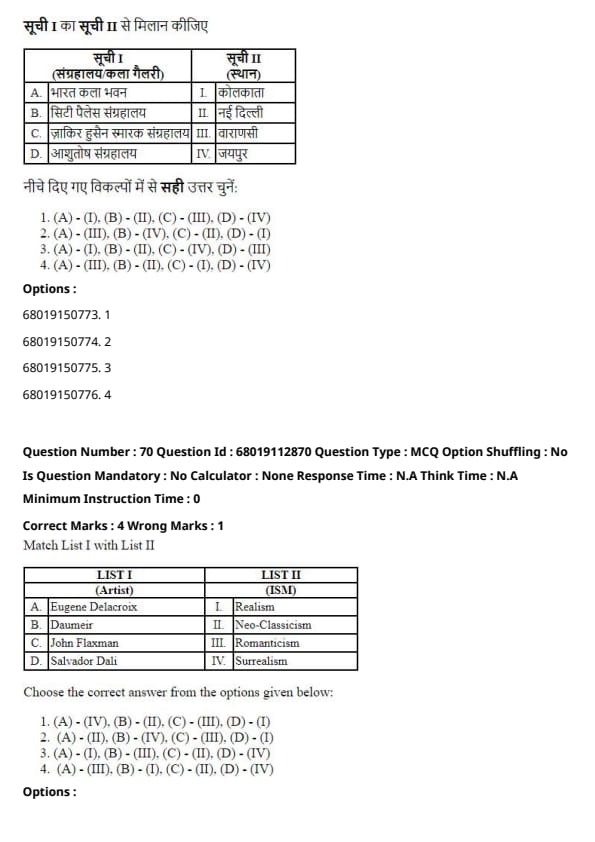
Match List I with List II:
| List I (Museum/Art Gallery) | List II (Place) |
|---|---|
| A. Bharat Kala Bhawan | I. Kolkata |
| B. City Palace Museum | II. New Delhi |
| C. Zakir Hussain Memorial Museum | III. Varanasi |
| D. Ashutosh Museum | IV. Jaipur |
View Solution
The correct matches between the museums and their respective locations are:
- Bharat Kala Bhawan – Located in Varanasi, renowned for its art and cultural artifacts.
- City Palace Museum – Situated in Jaipur, showcasing the royal heritage of Rajasthan.
- Zakir Hussain Memorial Museum – Based in New Delhi, commemorating the life of Zakir Hussain.
- Ashutosh Museum – Located in Kolkata, highlighting Bengal’s art and culture.
Question 70:
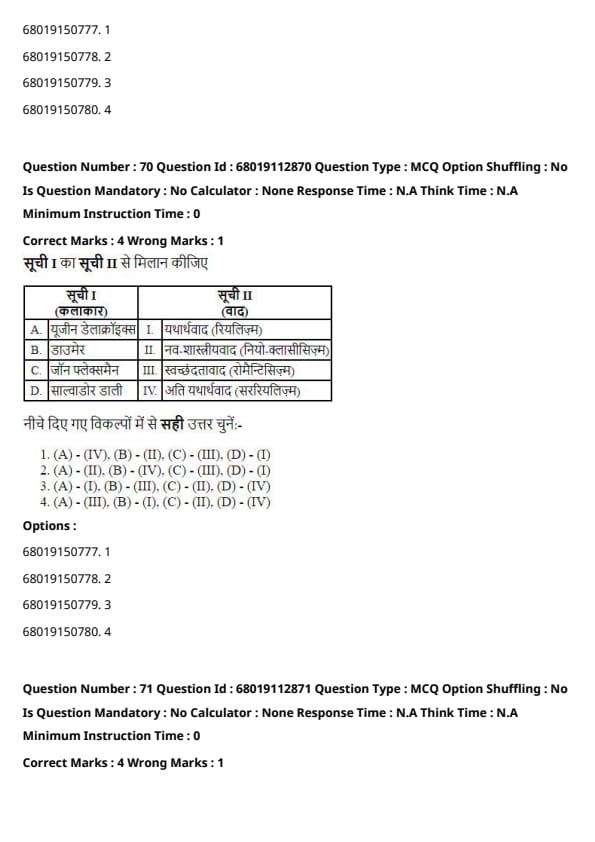
Match List I with List II:
| List I (Artist) | List II (ISM) |
|---|---|
| A. Eugene Delacroix | I. Realism |
| B. Daumier | II. Neo-Classicism |
| C. John Flaxman | III. Romanticism |
| D. Salvador Dali | IV. Surrealism |
View Solution
The correct matches between the artists and their respective art movements are:
- Eugene Delacroix – A central figure in Romanticism, emphasizing emotion and vivid imagery.
- Daumier – Associated with Realism, depicting the social and political life of his era.
- John Flaxman – Known for his contribution to Neo-Classicism, focusing on classical ideals and linear design.
- Salvador Dali – A pioneer in Surrealism, creating dreamlike, imaginative works.
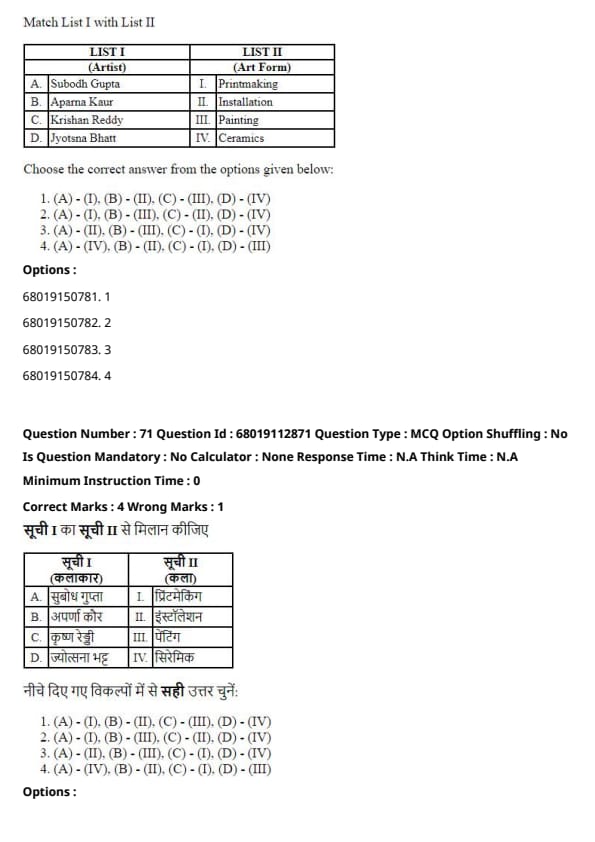
Question 71:
Match List I with List II:
| List I (Artist) | List II (Art Form) |
|---|---|
| A. Subodh Gupta | I. Printmaking |
| B. Aparna Kaur | II. Installation |
| C. Krishan Reddy | III. Painting |
| D. Jyotsna Bhatt | IV. Ceramics |
View Solution
The correct matches between the artists and their respective art forms are:
- Subodh Gupta – Associated with Printmaking, showcasing innovation in this medium.
- Aparna Kaur – Renowned for her Installations, blending diverse themes into creative works.
- Krishan Reddy – Known for his Paintings, expressing mastery and versatility.
- Jyotsna Bhatt – Celebrated for her work in Ceramics, pushing artistic boundaries.
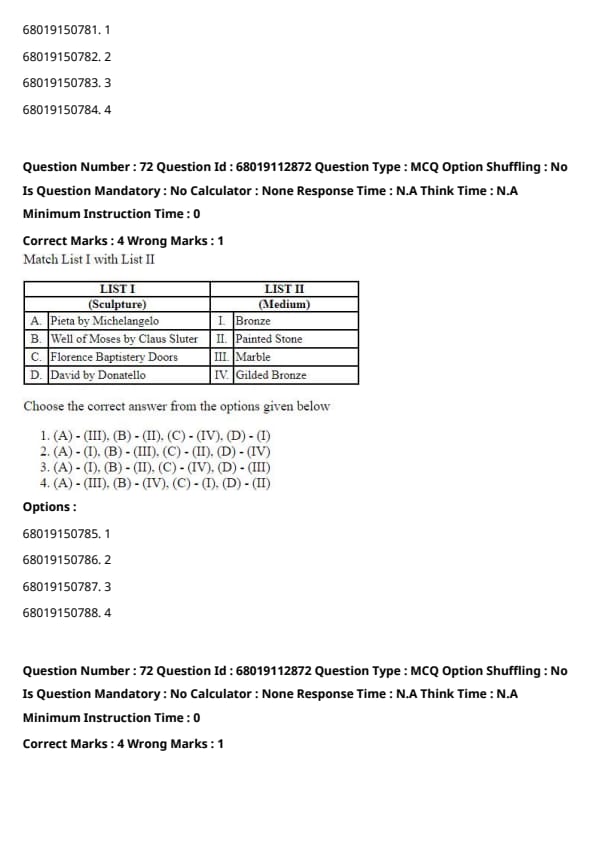
Question 72:
Match List I with List II:
| List I (Sculpture) | List II (Medium) |
|---|---|
| A. Pieta by Michelangelo | I. Bronze |
| B. Well of Moses by Claus Sluter | II. Painted Stone |
| C. Florence Baptistery Doors | IV. Gilded Bronze |
| D. David by Donatello | III. Marble |
View Solution
The correct matches between the sculptures and their mediums are:
- Pieta by Michelangelo – Crafted from Bronze, reflecting Michelangelo’s detailed craftsmanship.
- Well of Moses by Claus Sluter – Made from Painted Stone, an exemplar of Gothic art.
- Florence Baptistery Doors – Known as the "Gates of Paradise," crafted from Gilded Bronze.
- David by Donatello – Made from Marble, showcasing Renaissance mastery in sculpture.
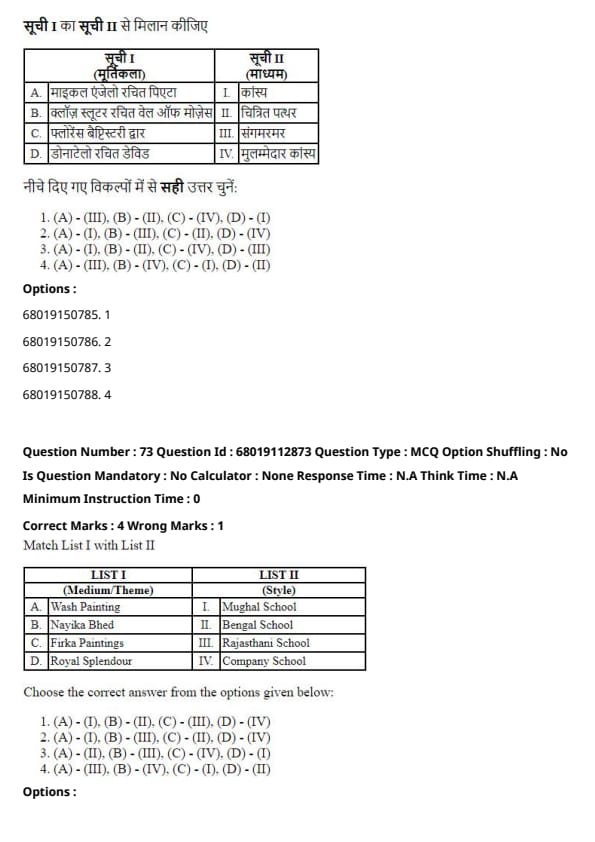
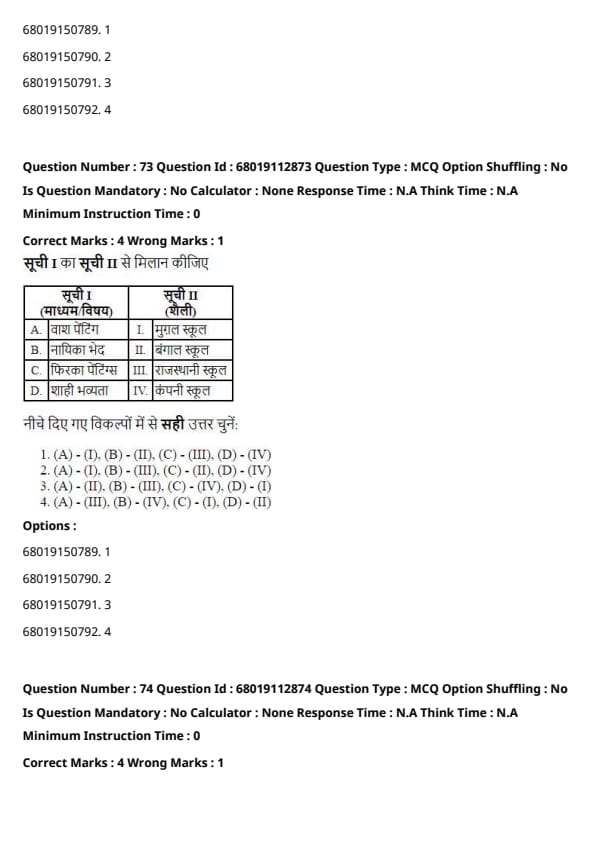
Question 73:
Match List I with List II:
| List I (Medium/Theme) | List II (Style) |
|---|---|
| A. Wash Painting | I. Mughal School |
| B. Nayika Bhed | II. Bengal School |
| C. Firka Paintings | III. Rajasthani School |
| D. Royal Splendour | IV. Company School |
View Solution
The correct matches between the themes and styles are as follows:
- Wash Painting – Associated with the Mughal School, renowned for its attention to detail and refinement.
- Nayika Bhed – A characteristic of the Bengal School, focusing on emotional themes and cultural contexts.
- Firka Paintings – Connected to the Rajasthani School, known for its vibrant colors and depictions of courtly themes.
- Royal Splendour – Reflective of the Company School, blending traditional Indian and European artistic techniques.
Question 74:
Match List I with List II:
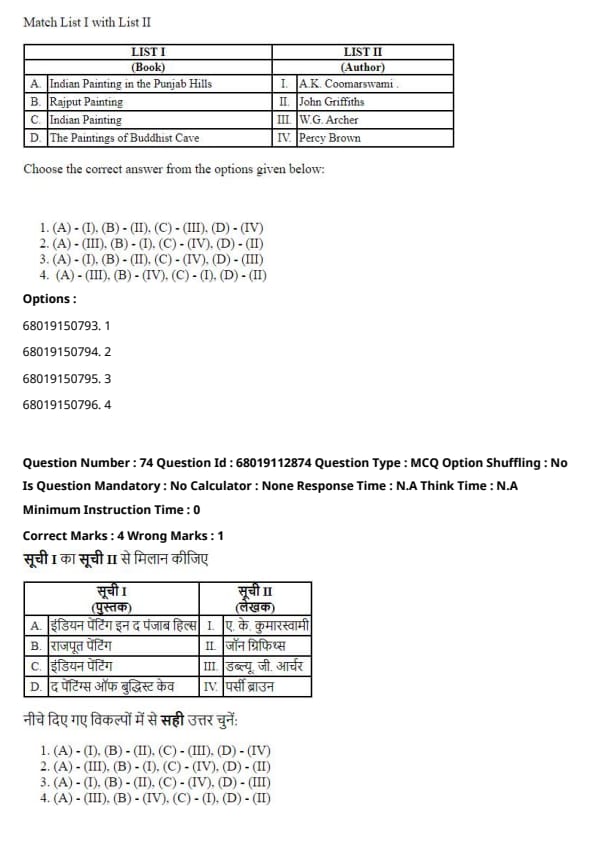
| List I (Book) | List II (Author) |
|---|---|
| A. Indian Painting in the Punjab Hills | I. A.K. Coomaraswamy |
| B. Rajput Painting | II. John Griffiths |
| C. Indian Painting | III. W.G. Archer |
| D. The Paintings of Buddhist Cave | IV. Percy Brown |
View Solution
The correct matches between the books and their authors are as follows:
- Indian Painting in the Punjab Hills – Written by W.G. Archer.
- Rajput Painting – Authored by A.K. Coomaraswamy.
- Indian Painting – Written by Percy Brown.
- The Paintings of Buddhist Cave – Authored by John Griffiths.
Question 75:
Match List I with List II:
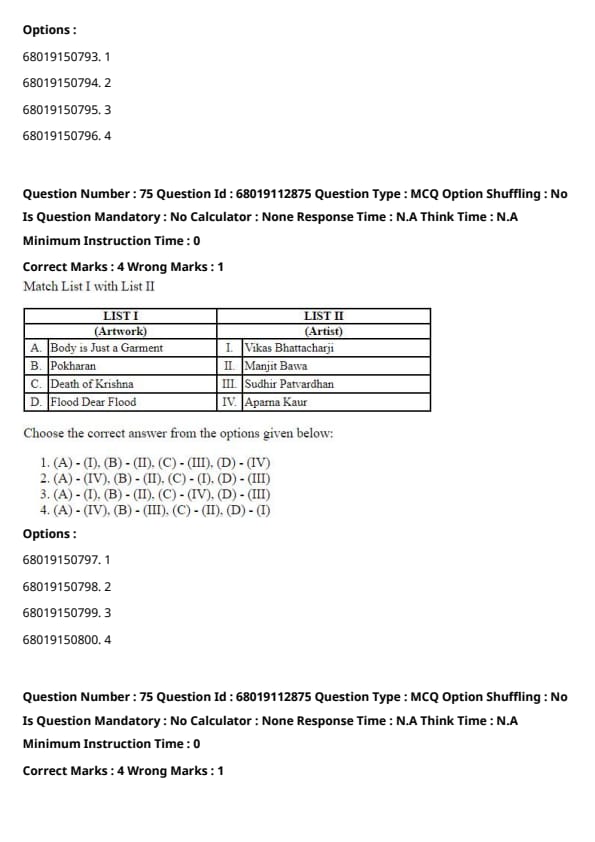
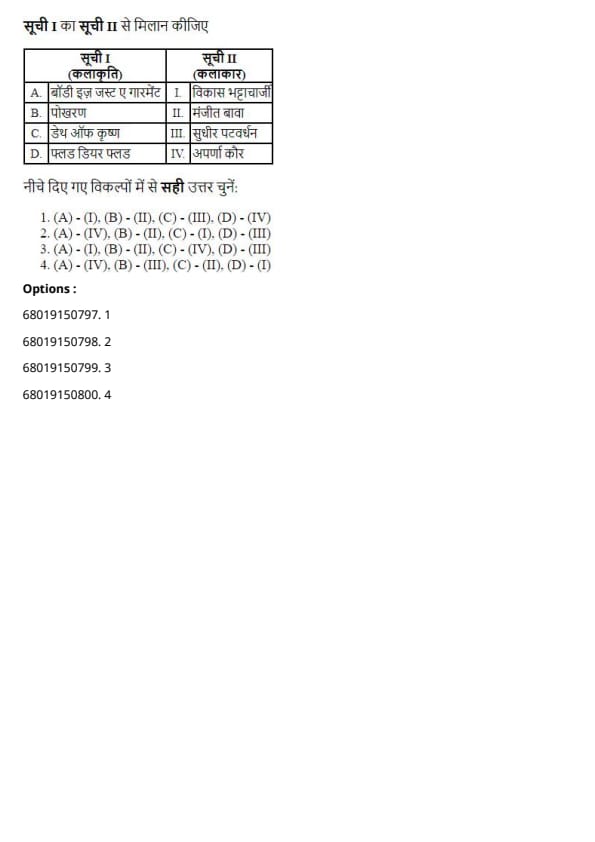
| List I (Artwork) | List II (Artist) |
|---|---|
| A. Body is Just a Garment | I. Vikas Bhattacharji |
| B. Pokharan | II. Manjit Bawa |
| C. Death of Krishna | III. Sudhir Patvardhan |
| D. Flood Dear Flood | IV. Aparna Kaur |
View Solution
The correct matches between the artworks and their respective artists are as follows:
- Body is Just a Garment – Created by Vikas Bhattacharji.
- Pokharan – Created by Manjit Bawa.
- Death of Krishna – Created by Sudhir Patvardhan.
- Flood Dear Flood – Created by Aparna Kaur.
*The article might have information for the previous academic years, please refer the official website of the exam.