CUET PG 2024 Library & Information Science March 16 - Shift 2 Question Paper Pdf- Check Solutions with Answer Key
- Question Paper 2025
- Question Paper 2024
- Question Paper 2023
- Mathematics Papers
- Statistics Question Paper
- English Question Paper
- Chemistry Question Paper
- Pol. Sci. Question Paper
- History Question Paper
- Commerce Question Papers
- Life Science Papers
- Geology Question Papers
- Journalism Question Paper
- B.Ed. HSS Question Paper
- Botany Question Paper
- B.Ed. Question Papers


Content Strategist | Updated On - Jan 15, 2025
CUET PG 2024 Library and Information Science 16st March 2024 Shift 2 Question Paper with Solution PDF is available for download here.CUET PG 2024 Library and Information Science exam is Moderate. The candidates find the Subject not challenging.
CUET PG 2024 Library and Information Science Question Paper with Answer Key PDF
| CUET PG 2024 Library and Information Science Question Paper with Answer Key |  Download Download |
Check Solution |
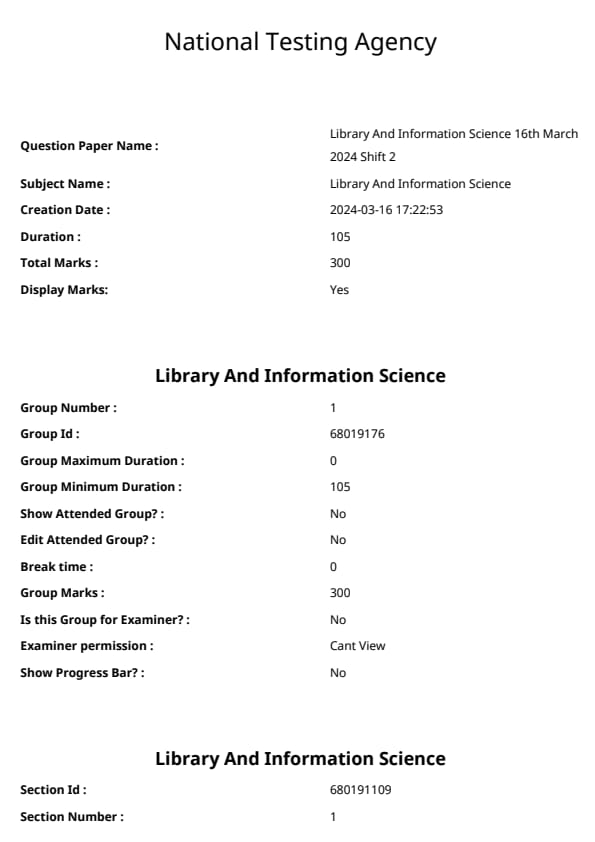
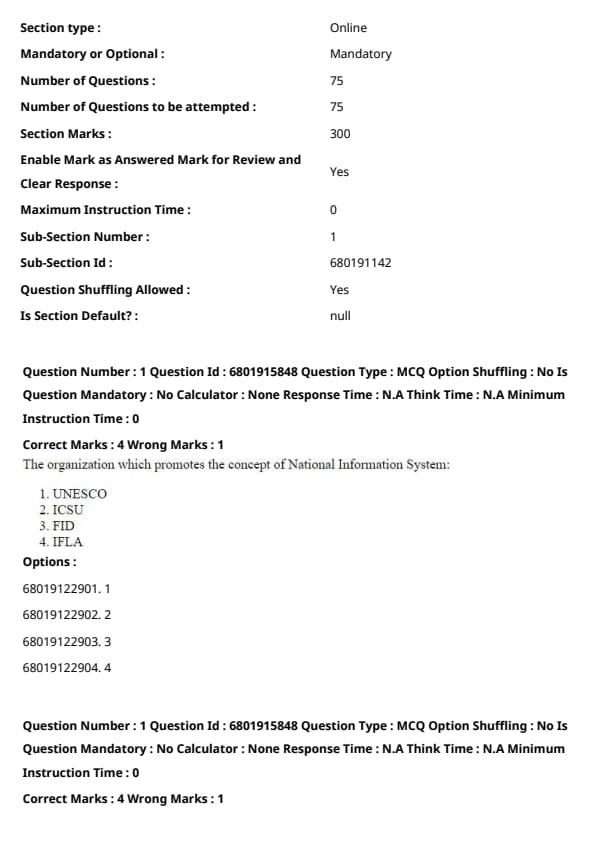
Question 1:
The organization that advocates for the concept of the National Information System is:
View Solution
UNESCO, the United Nations Educational, Scientific, and Cultural Organization, plays a pivotal role in enhancing library services globally. It promotes the integration of library resources into cohesive National Information Systems, improving accessibility, resource sharing, and international cooperation in information exchange and library technology advancements.
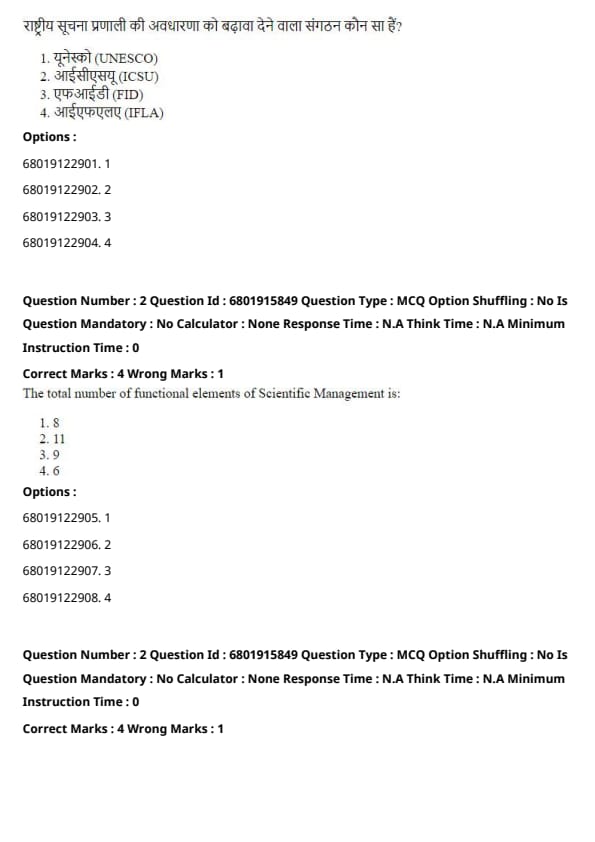
Question 2:
The total number of functional elements in Scientific Management is:
View Solution
Frederick Taylor, the pioneer of Scientific Management, outlined eight critical functional elements designed to boost productivity and efficiency. These principles include the standardization of tools, the division of labor, time studies, and worker training, all contributing to modern management practices.
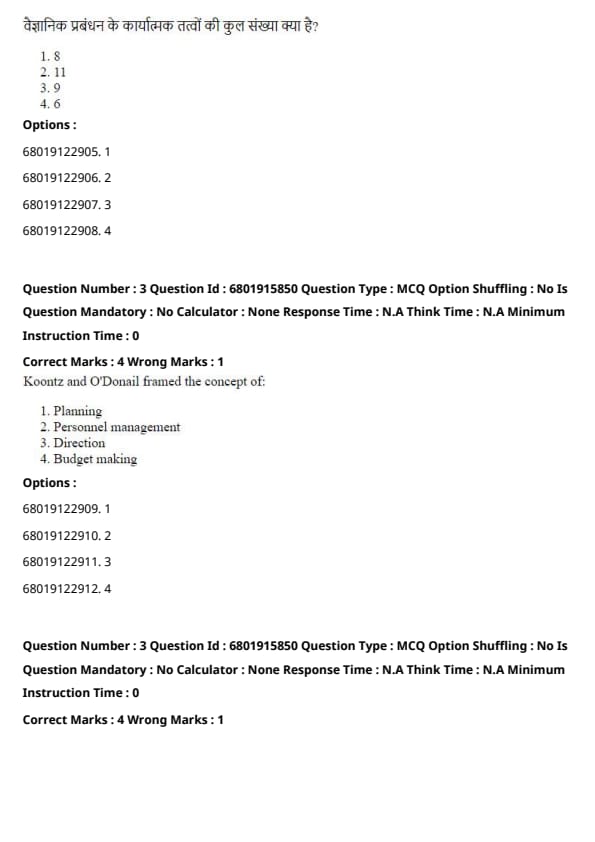
Question 3:
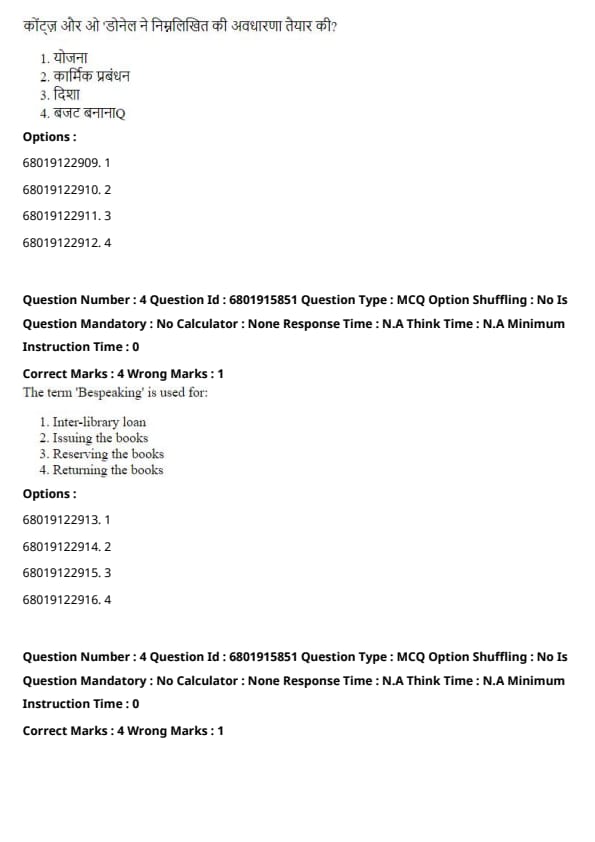
Koontz and O'Donnell framed the concept of:
View Solution
Harold Koontz and Cyril O'Donnell highlighted planning as the cornerstone of management. It involves setting objectives, formulating strategies, and devising specific steps to meet organizational goals. Planning ensures direction and benchmarks success.
Question 4:
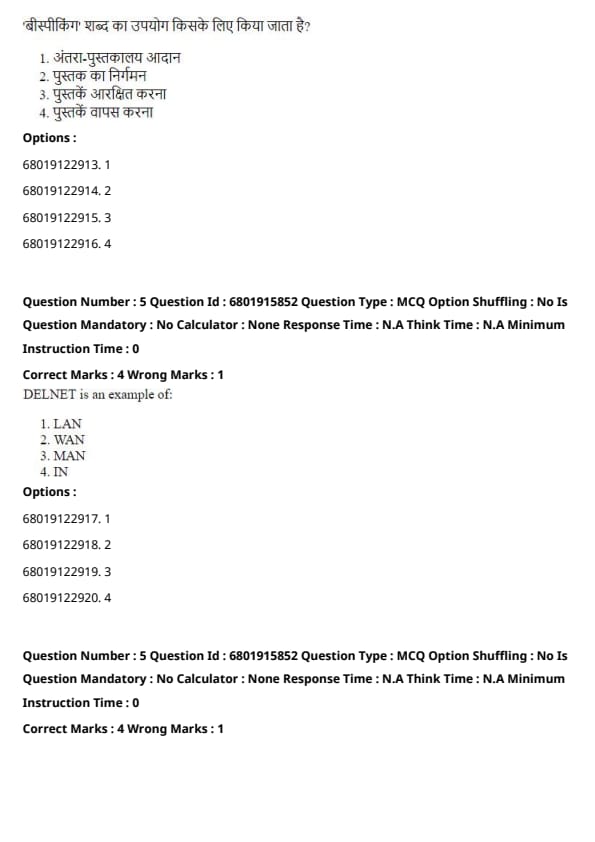
The term 'Bespeaking' is used for:
View Solution
In library terminology, 'bespeaking' refers to the act of reserving a book for future borrowing. This is especially useful for managing high-demand materials in libraries and ensuring they are available for patrons.
Question 5:
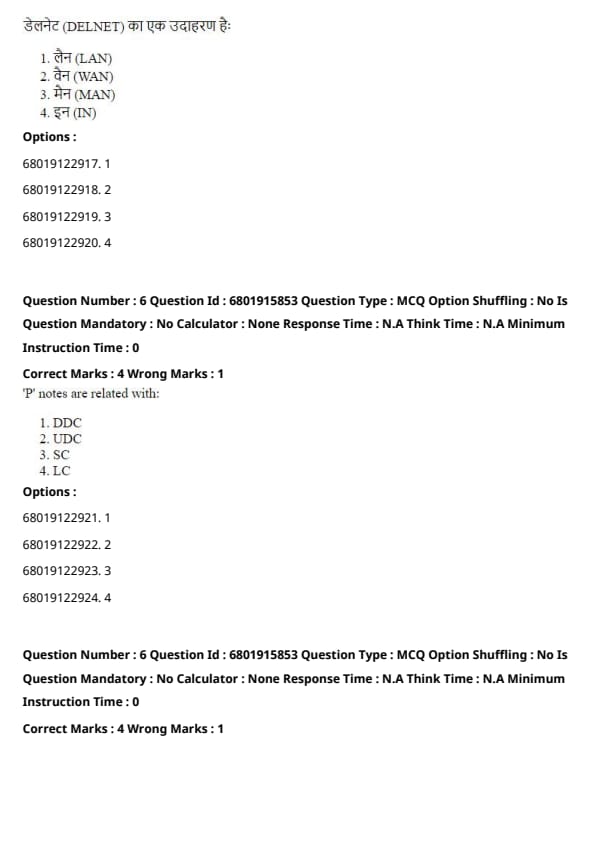
DELNET is an example of:
View Solution
DELNET (Developing Library Network) is a Metropolitan Area Network (MAN) that connects libraries across India and internationally. It facilitates resource sharing, inter-library loans, and access to an extensive range of information databases.
Question 6:
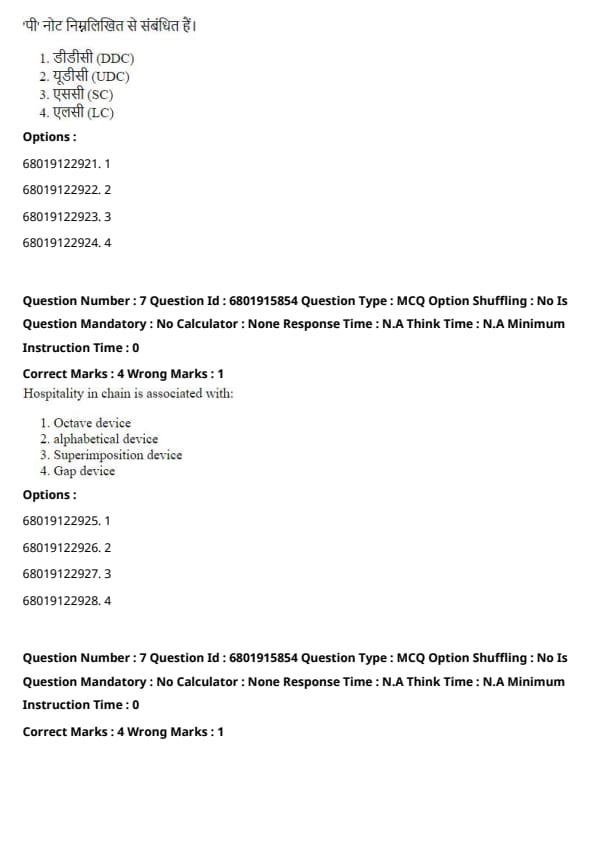
'P' notes are related with:
View Solution
'P' notes are supplementary annotations used in the Universal Decimal Classification (UDC) system. These notes enhance the granularity of classification by offering additional details on complex subjects, aiding in more precise categorization.
Question 7:
Hospitality in chain is associated with:
View Solution
In chain indexing, hospitality refers to the method of incorporating extra elements via a superimposition device. This device helps to efficiently represent overlapping or related terms, ensuring accurate indexing.
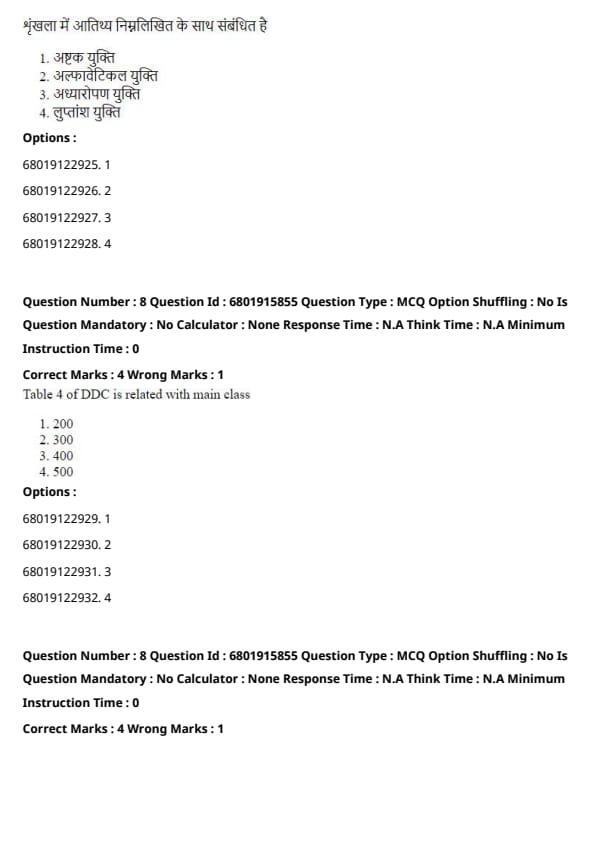
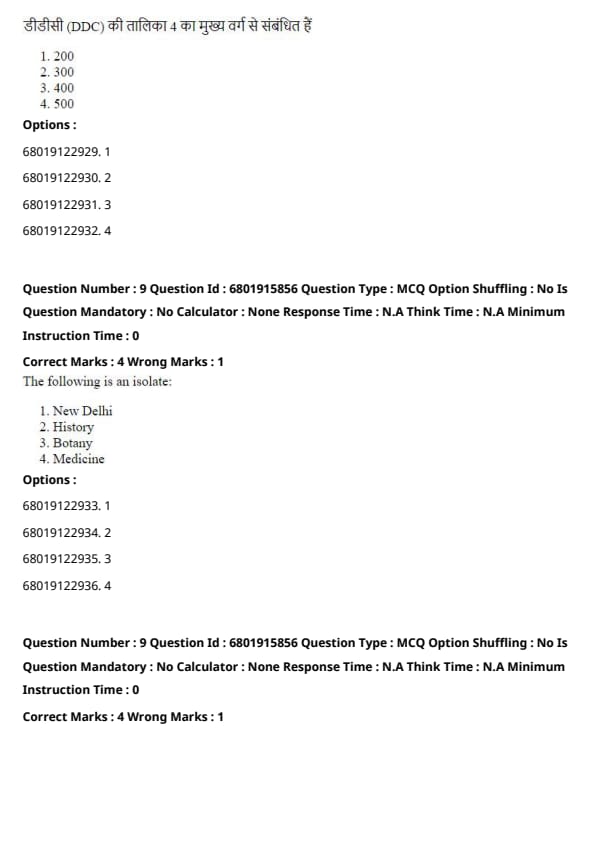
Question 8:
Table 4 of DDC is related with main class:
View Solution
Table 4 in the Dewey Decimal Classification (DDC) system corresponds to the 400 class, which focuses on language and linguistics. It provides further divisions for specific languages, including grammar, dictionaries, and phonology.
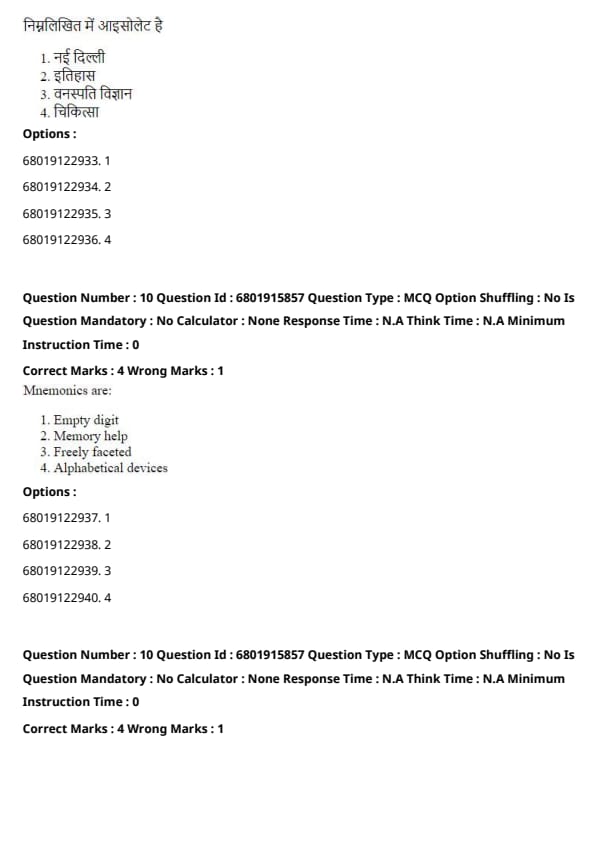
Question 9:
The following is an isolate:
View Solution
In library classification systems, an isolate represents a unique entity that stands independently from others. 'New Delhi' is a geographical isolate used to categorize materials specifically related to the region, such as its history, culture, and government.
Question 10:
Mnemonics are:
View Solution
Mnemonics are techniques used to enhance memory recall by organizing information into easily remembered patterns or associations. In classification systems, mnemonics help recall complex codes for specific topics or subjects.
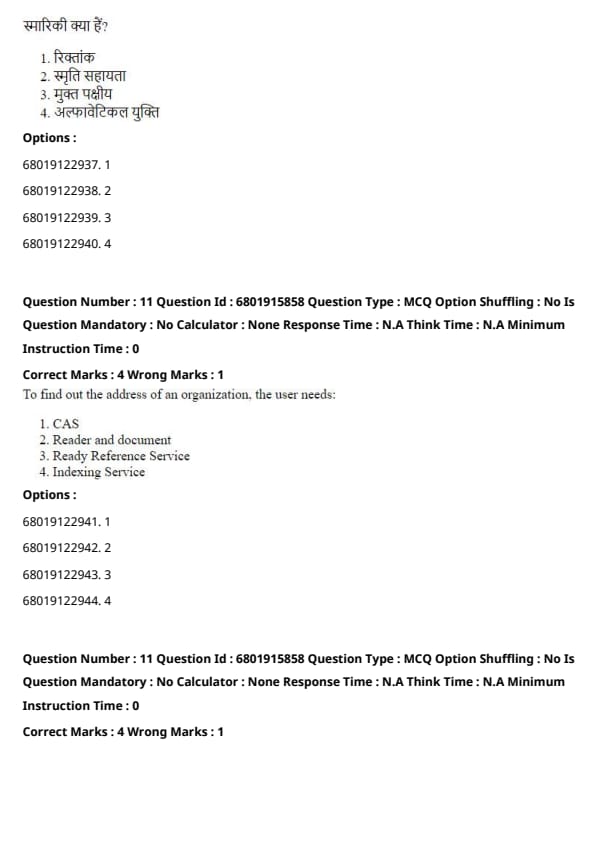
Question 11:
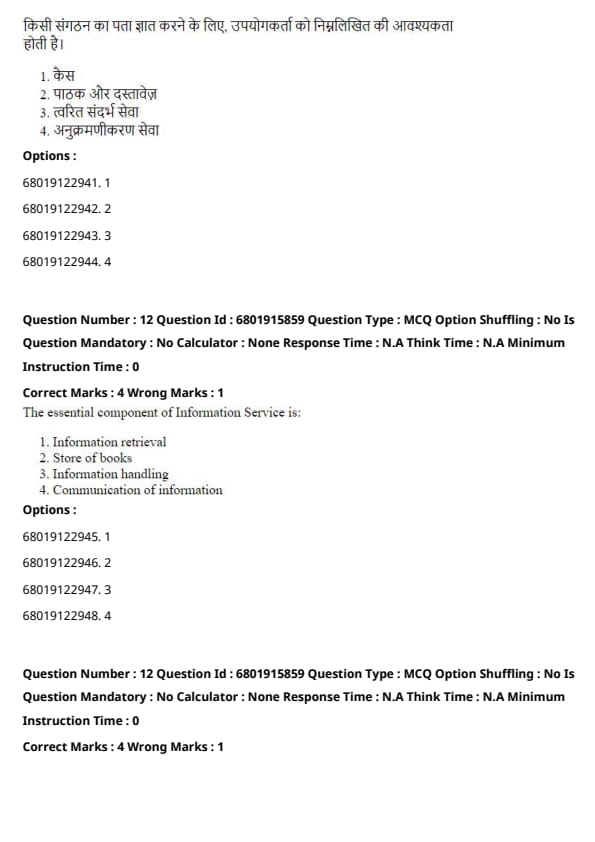
To find out the address of an organization, the user needs:
View Solution
The Ready Reference Service is specifically designed to provide quick, factual answers to straightforward questions, such as finding the address of an organization. It relies on resources like directories, almanacs, and online databases for accurate, timely responses.
Question 12:
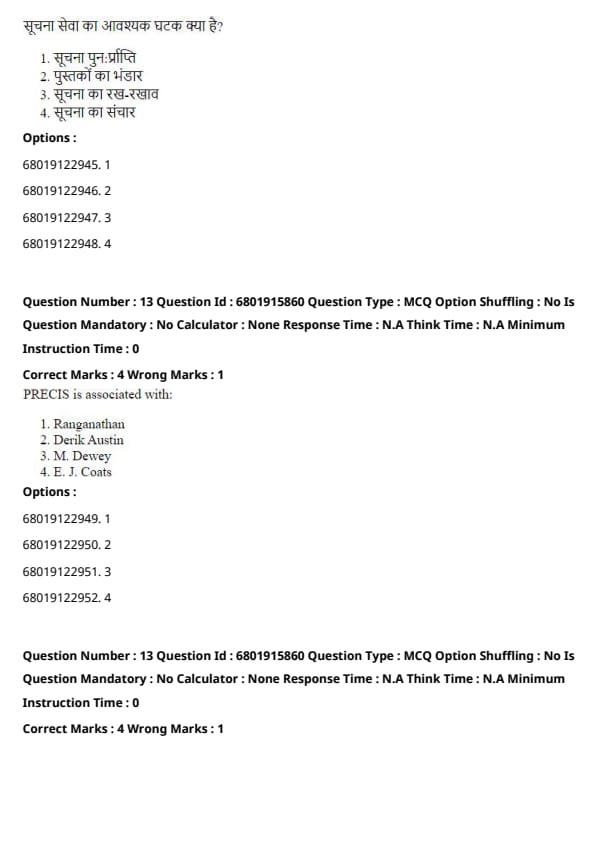
The essential component of Information Service is:
View Solution
The communication of information is the core function of an Information Service. It ensures that processed data is shared with users in an accessible and relevant manner, using effective channels like digital media, publications, or personal consultations.
Question 13:
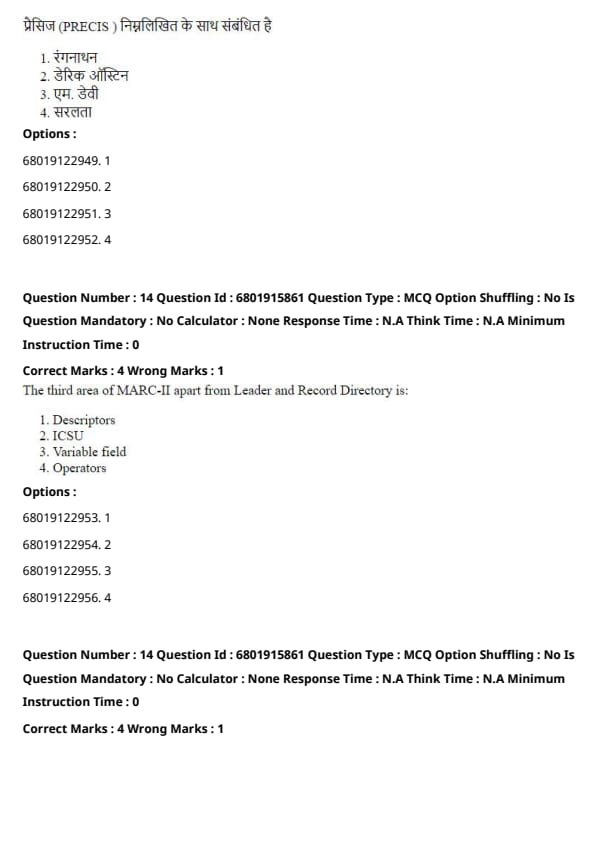
PRECIS is associated with:
View Solution
The PRECIS (Preserved Context Indexing System) was developed by Derik Austin. It focuses on maintaining the context of terms within indexes, allowing for precise and meaningful document retrieval, especially in complex subject areas.
Question 14:
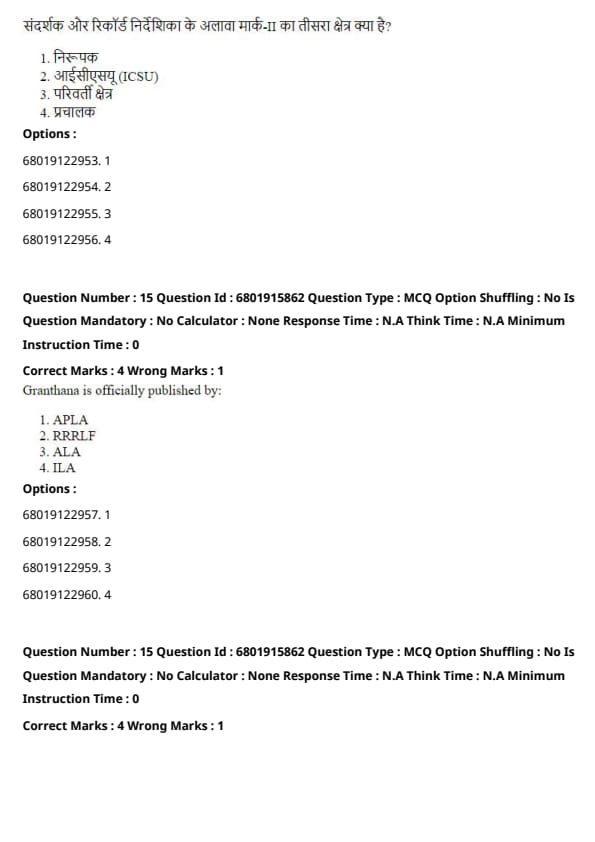
The third area of MARC-II, apart from Leader and Record Directory, is:
View Solution
In the MARC-II (Machine-Readable Cataloging) format, the Variable Field contains essential bibliographic data, such as titles, authors, and subject information. This field allows libraries to organize and share detailed metadata efficiently.
Question 15:
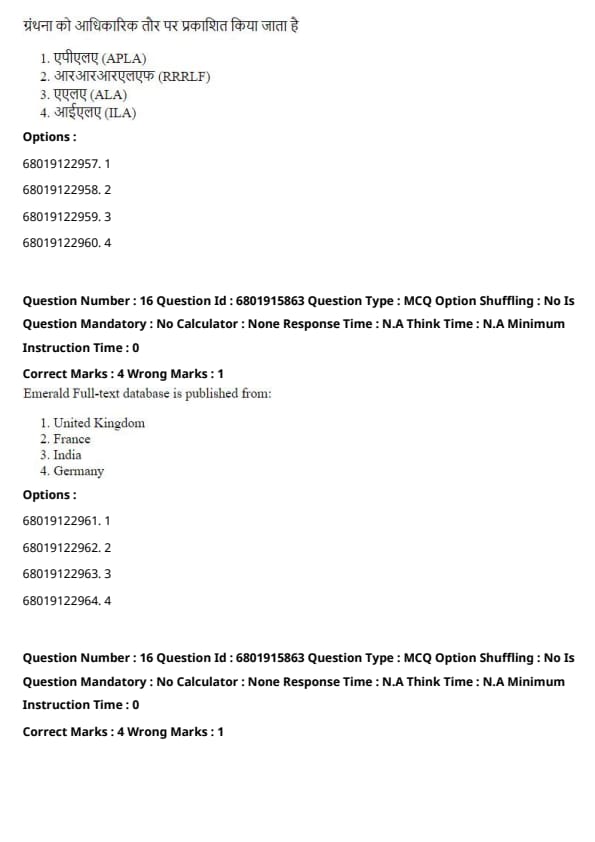
Granthana is officially published by:
View Solution
Granthana is a professional journal published by the Raja Rammohun Roy Library Foundation (RRRLF). It focuses on advancing library science, sharing innovative practices, and offering insights into information services and professional development.
Question 16:
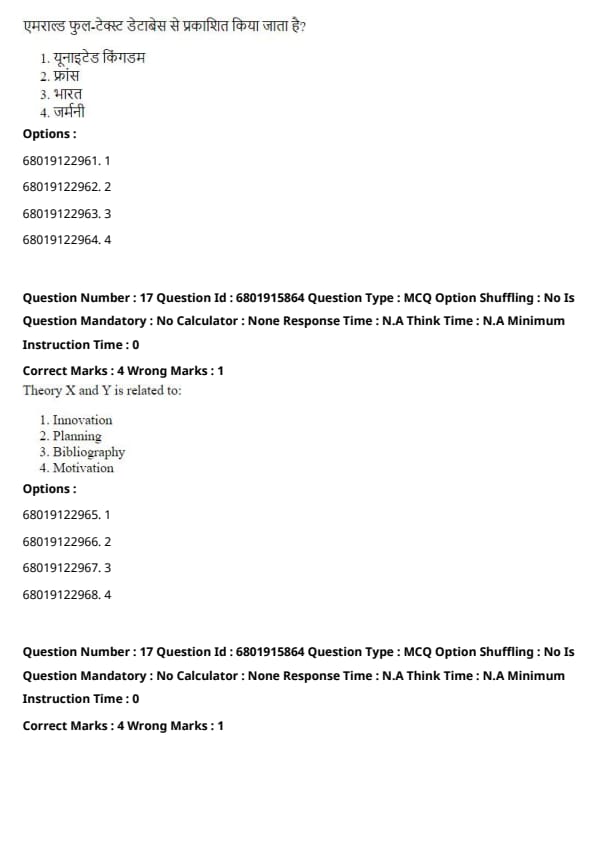
Emerald Full-text database is published from:
View Solution
Emerald Group Publishing, based in the United Kingdom, is a leading provider of peer-reviewed journals, case studies, and books in areas like business, education, and social sciences. Its full-text database is widely respected by academics and researchers globally.
Question 17:
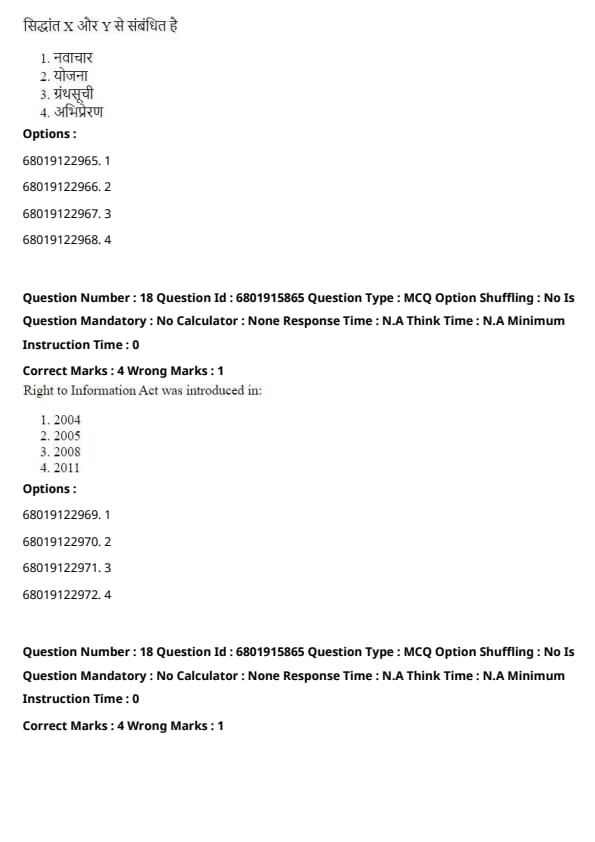
Theory X and Y is related to:
View Solution
Douglas McGregor proposed two theories—Theory X and Theory Y—to explain differing assumptions about employee motivation:
- Theory X: Assumes that employees inherently dislike work and need constant supervision to be productive.
- Theory Y: Assumes that employees find satisfaction in work, are self-motivated, and seek opportunities for responsibility.
These theories help managers adopt the right approach to managing teams based on their beliefs about employee behavior.
Question 18:
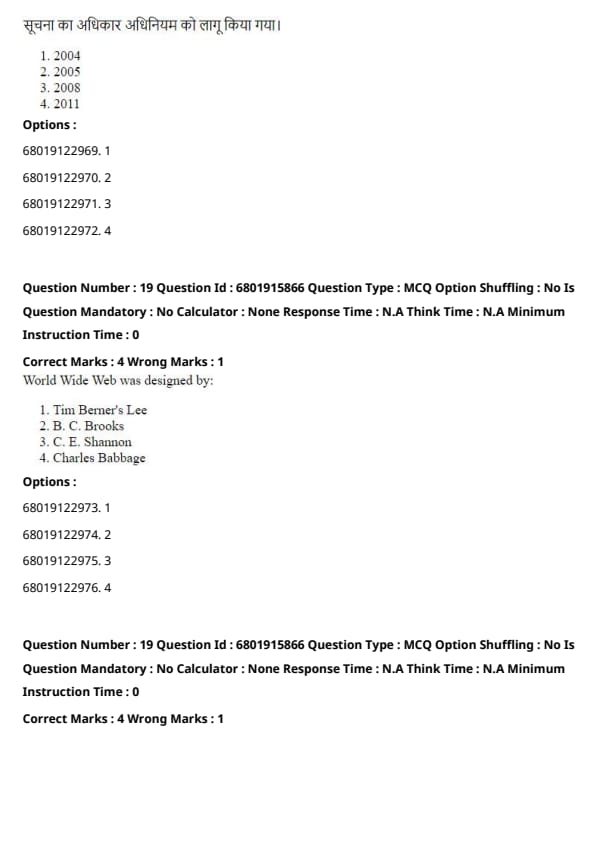
Right to Information Act was introduced in:
View Solution
The Right to Information (RTI) Act, enacted in 2005, empowers Indian citizens to request information from public authorities. This legislation promotes transparency, accountability, and public participation in governance.
Question 19:
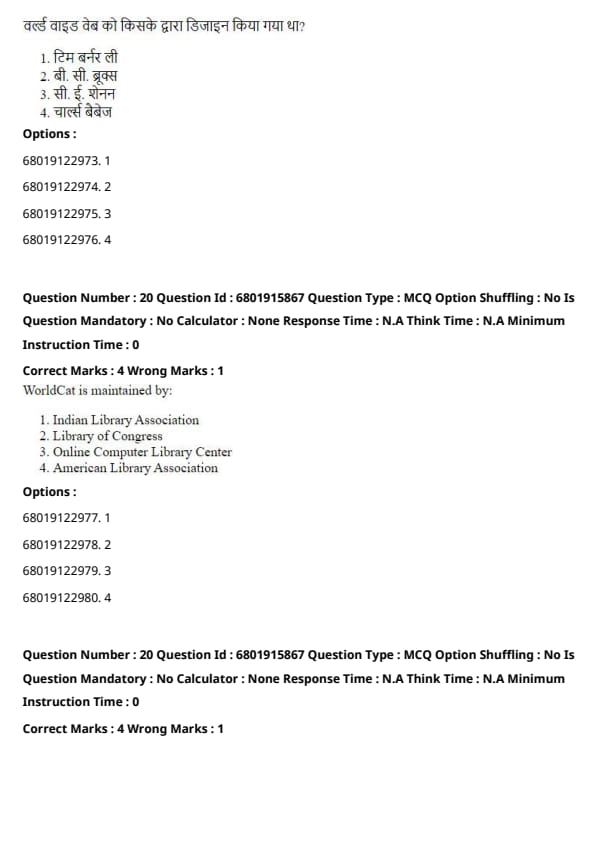
World Wide Web was designed by:
View Solution
Tim Berners-Lee developed the World Wide Web in 1989 while working at CERN. The invention of the WWW revolutionized the internet by introducing hyperlinks, multimedia, and a system for sharing information across the globe.
Question 20:
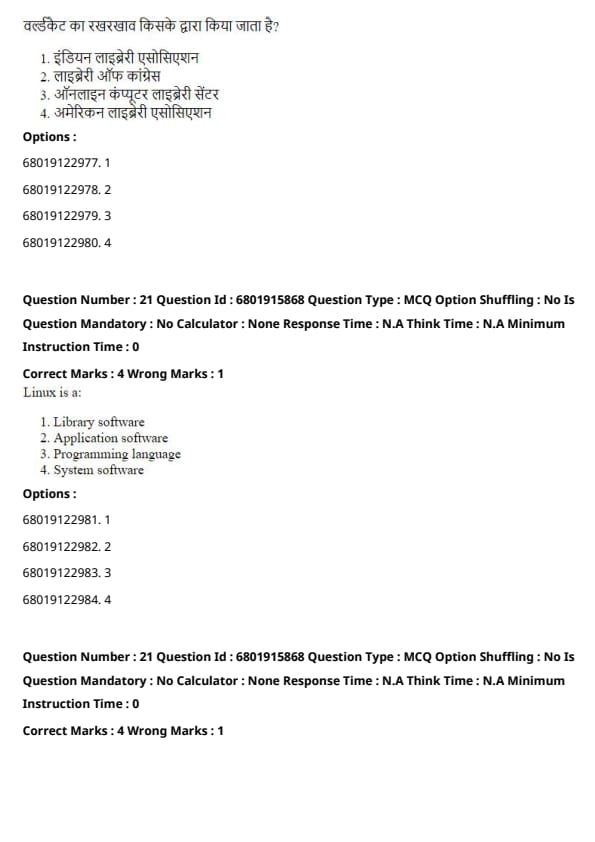
WorldCat is maintained by:
View Solution
WorldCat, a global library catalog, is managed by the Online Computer Library Center (OCLC). It connects libraries worldwide, allowing users to search a vast network of bibliographic records and facilitating interlibrary loans and resource sharing.
Question 21:
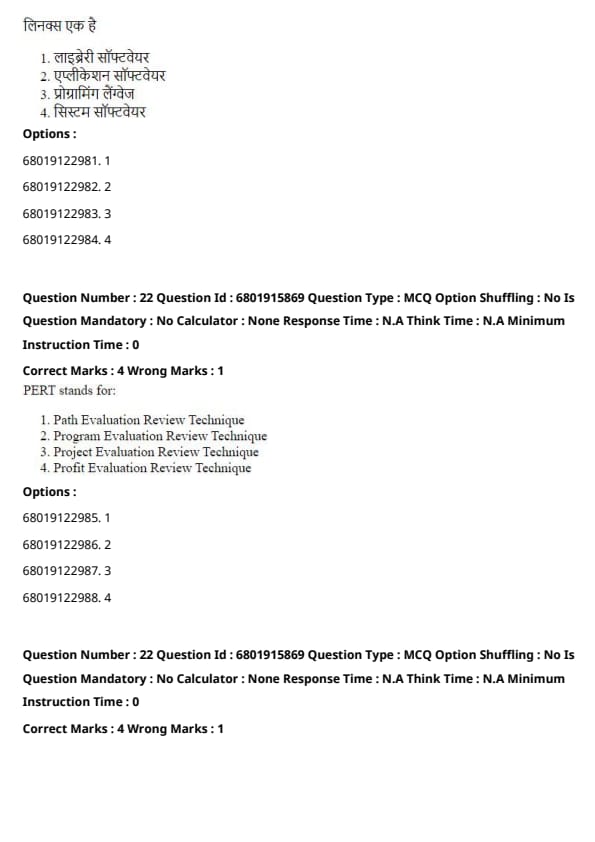
Linux is a:
View Solution
Linux is an operating system that falls under the category of system software. It manages hardware resources and provides services for application software. As an open-source system, Linux is known for its stability, security, and flexibility, making it widely used in server environments and personal computing.
Question 22:
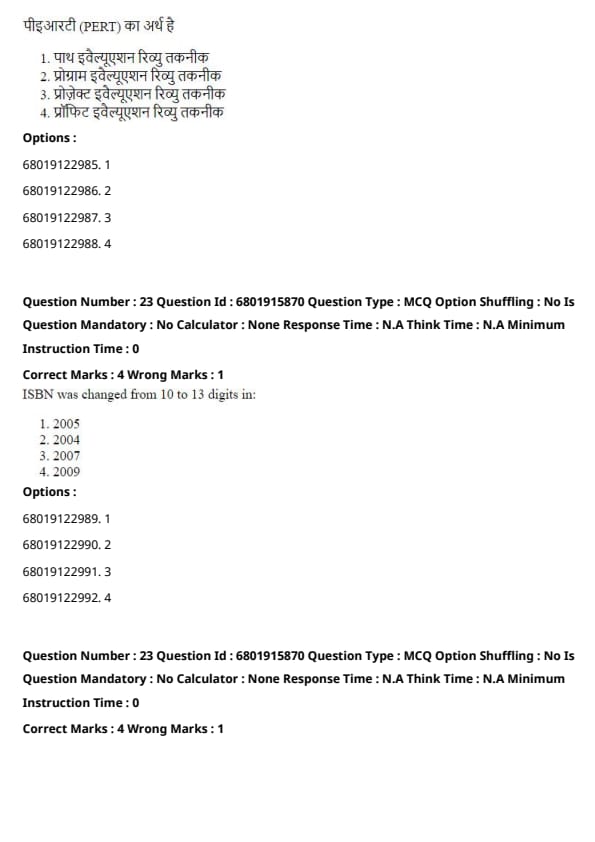
PERT stands for:
View Solution
The Program Evaluation Review Technique (PERT) is a project management tool that helps plan and manage large projects by analyzing the tasks involved. PERT is particularly useful for estimating the time needed for project completion, managing resources, and identifying the critical path that determines the project's overall timeline.
Question 23:
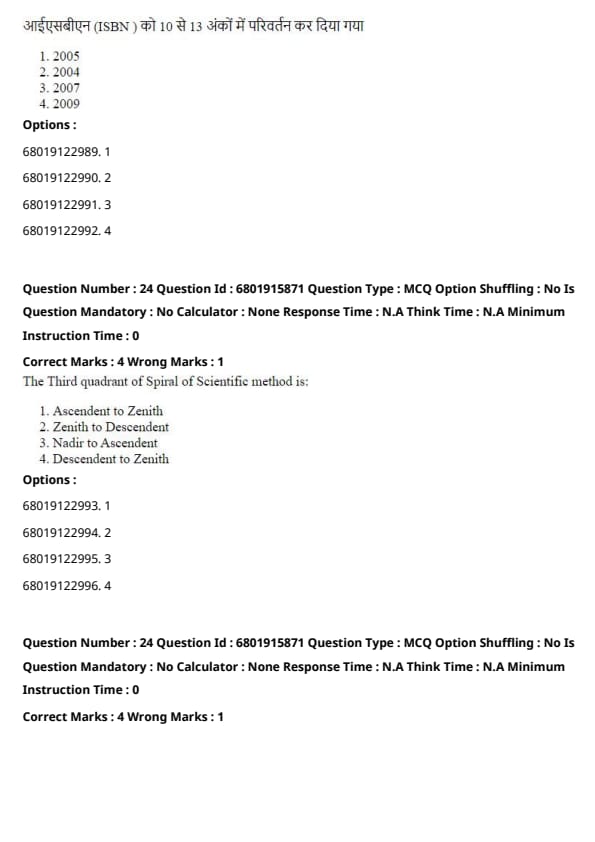
ISBN was changed from 10 to 13 digits in:
View Solution
The transition from a 10-digit to a 13-digit ISBN format occurred in 2007. This change was made to align with the global standards for product identification, particularly the GTIN system. The 13-digit ISBN allows for better integration with barcode technology, making book tracking and sales easier worldwide.
Question 24:
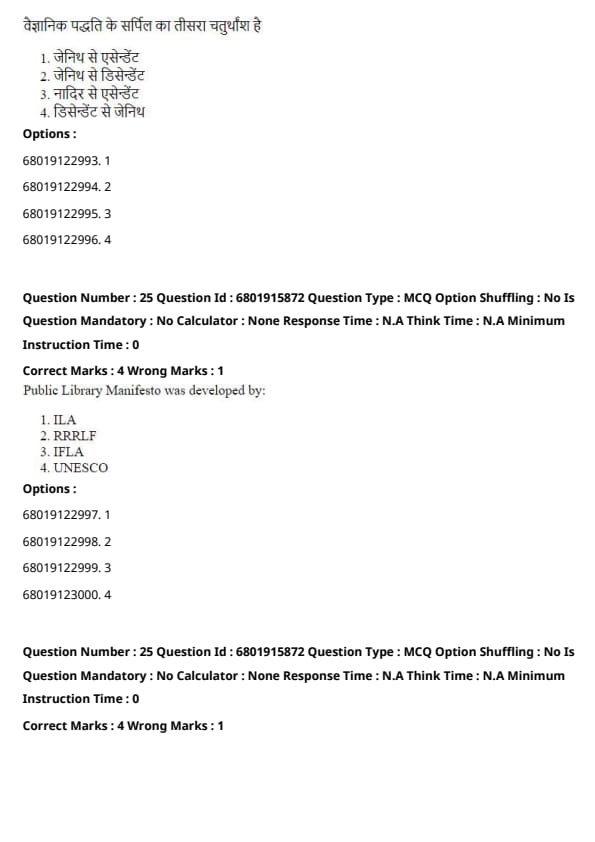
The Third quadrant of Spiral of Scientific method is:
View Solution
The "Zenith to Descendent" phase of the Spiral of Scientific Method focuses on refining and validating hypotheses. During this phase, scientists test their theories under controlled conditions, analyze results, and adjust their methods based on empirical evidence. This iterative process leads to a more accurate understanding of the phenomena being studied.
Question 25:
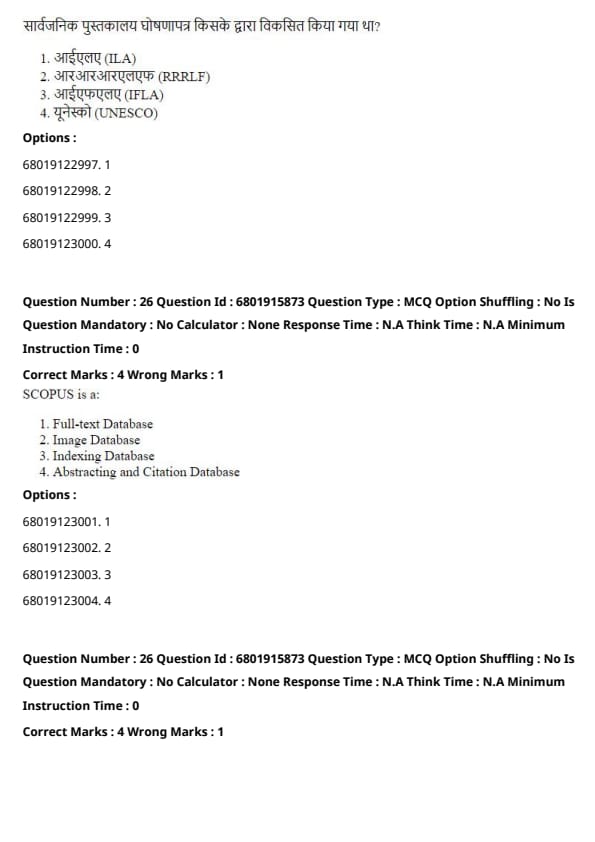
Public Library Manifesto was developed by:
View Solution
UNESCO developed the Public Library Manifesto to highlight the essential role that public libraries play in advancing access to knowledge, education, and culture. The manifesto serves as a foundational document that guides library practices, ensuring libraries remain centers of learning, democratic participation, and social inclusion.
Question 26:
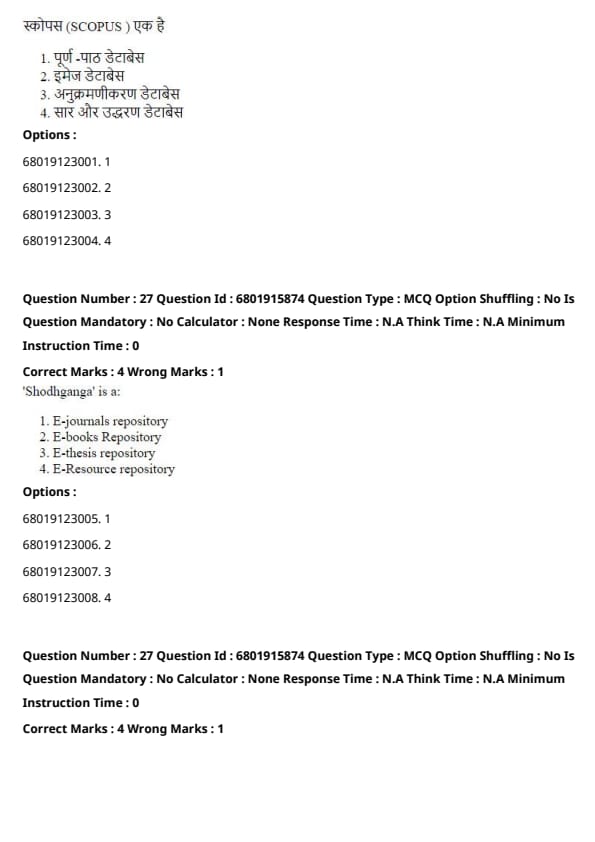
SCOPUS is a:
View Solution
SCOPUS is a comprehensive database offering abstracting and citation information for research articles, journals, and conference papers. It helps researchers track academic impact, monitor citation patterns, and evaluate scholarly trends across a variety of fields.
Question 27:
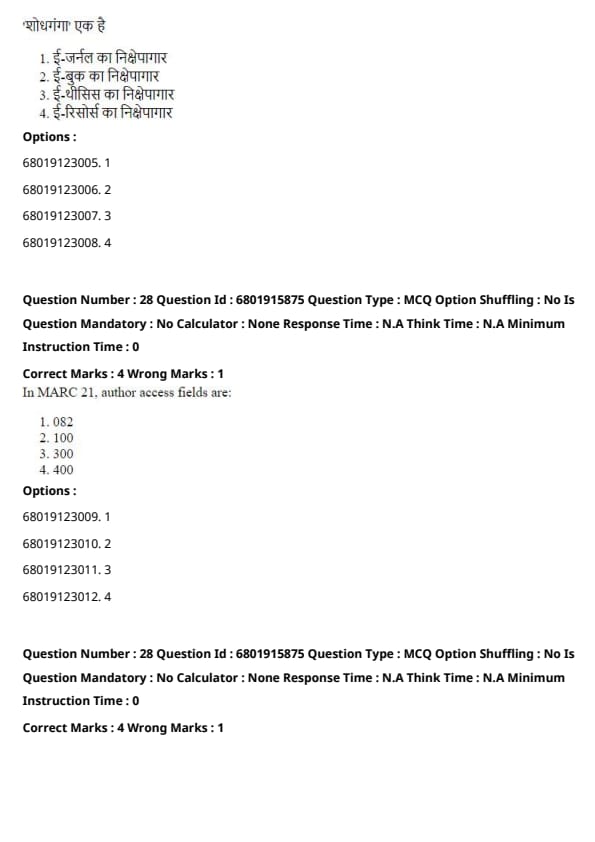
'Shodhganga' is a:
View Solution
Shodhganga is a national repository that archives electronic theses and dissertations submitted by students of Indian universities. It provides a platform for researchers to access original academic work and encourages scholarly communication within India.
Question 28:
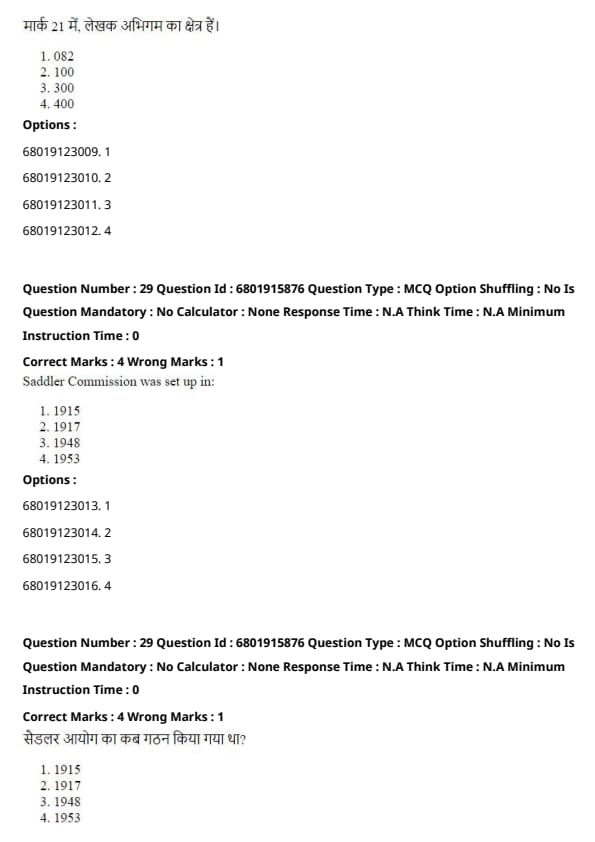
In MARC 21, author access fields are:
View Solution
The "100" field in MARC 21 is used to record the primary author of a work, offering a standardized method to catalog and retrieve books and other resources based on the author's name. It plays a key role in author-based indexing in library catalogs.
Question 29:
Saddler Commission was set up in:
View Solution
The Saddler Commission was established in 1917 to assess and provide recommendations for higher education in India. The commission's key focus was on the structure of universities and the need for reforms to improve academic standards and align education with modern needs.
Question 30:
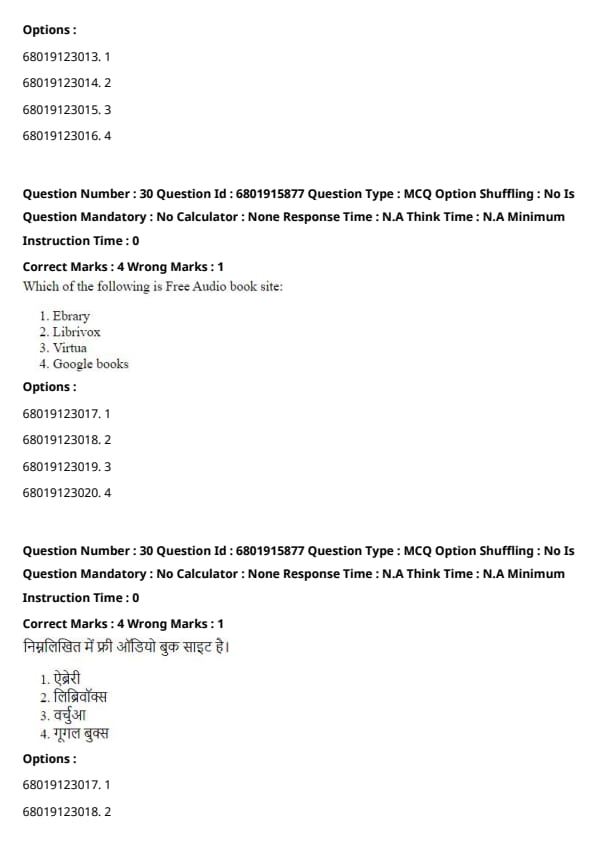
Which of the following is a Free Audio Book site:
View Solution
Librivox is a free resource offering audiobooks of works in the public domain. It is run by volunteers who record classic literature and make it available for free download, providing a valuable resource for audiobooks, especially for classic texts.
Question 31:
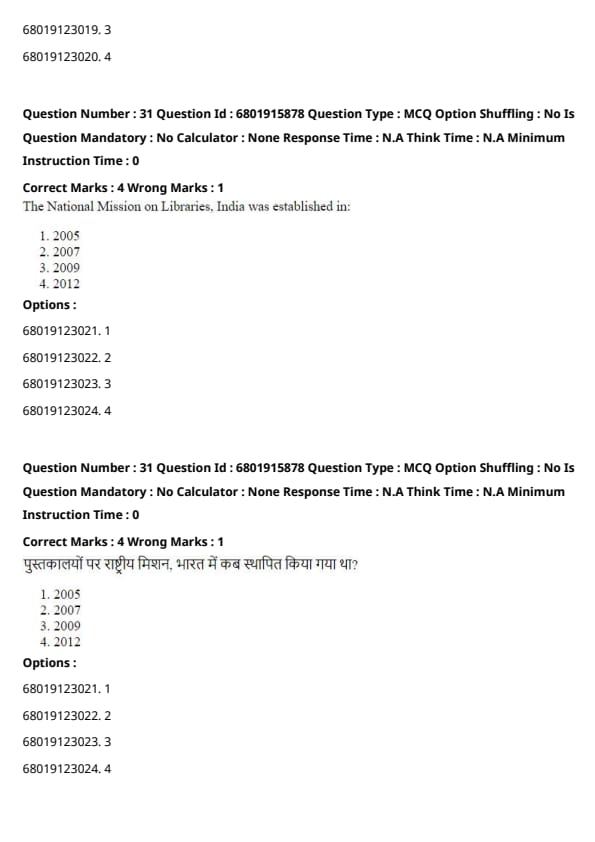
The National Mission on Libraries, India, was established in:
View Solution
The National Mission on Libraries (NML) was established in 2012 to revitalize library services in India. The mission's goal is to enhance library facilities, promote digital literacy, and expand access to knowledge through improved library infrastructure, making it a vital tool for social and educational development.
Question 32:
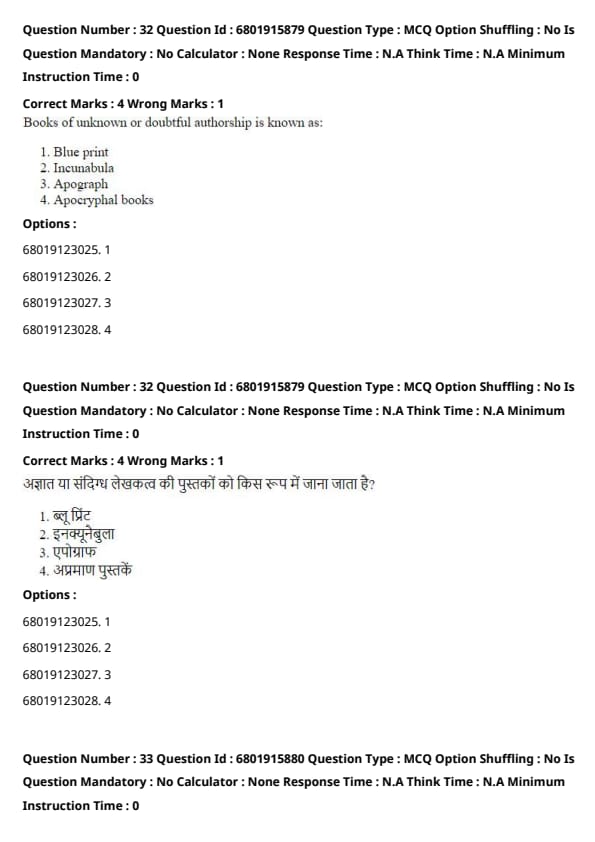
Books of unknown or doubtful authorship are known as:
View Solution
Apocryphal books refer to literary works whose authenticity or authorship is uncertain or disputed. These texts often exist in religious or historical contexts, where their validity as canonical or authoritative is debated.
Question 33:
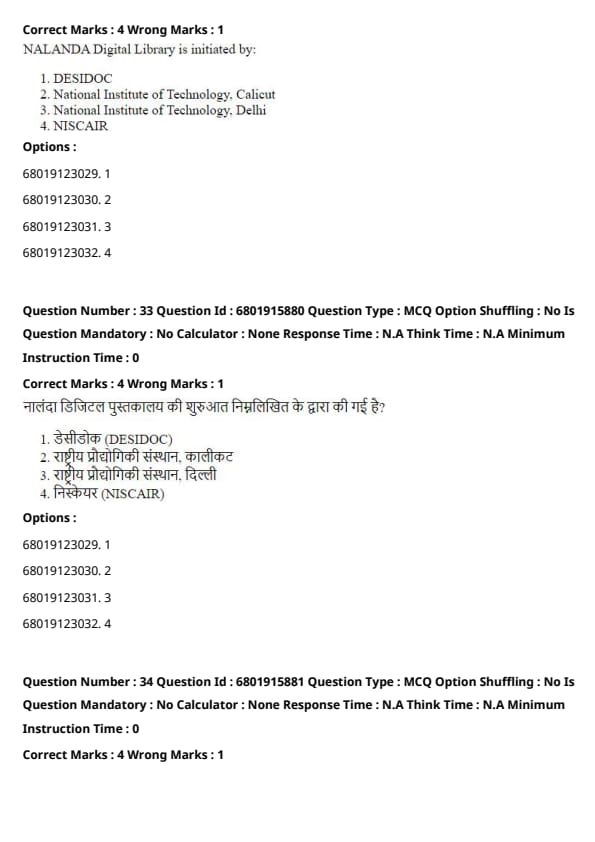
NALANDA Digital Library is initiated by:
View Solution
The NALANDA Digital Library was launched by the National Institute of Technology, Calicut, to provide a platform for the digitalization of academic resources. The library offers access to academic papers, research articles, and other digital resources to support research and learning.
Question 34:
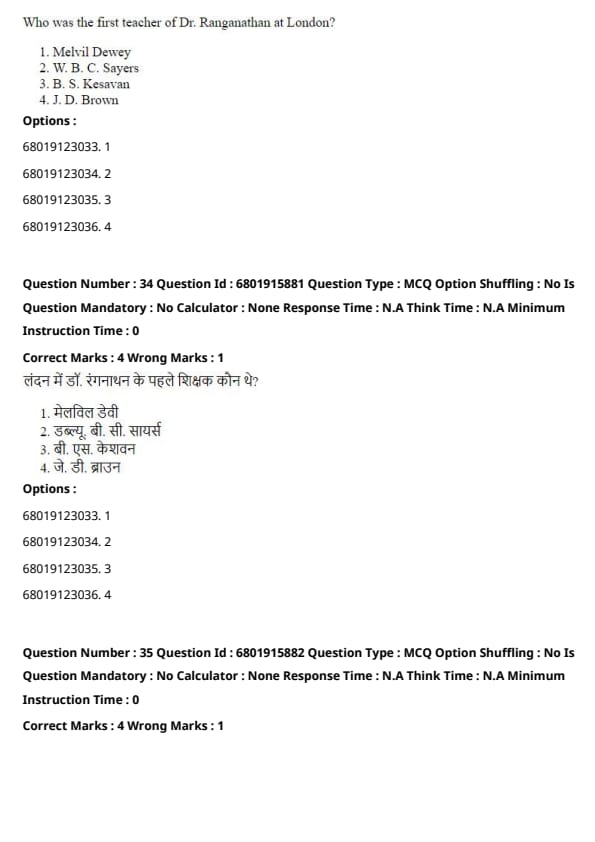
Who was the first teacher of Dr. Ranganathan at London?
View Solution
W. B. C. Sayers, an eminent British librarian, was Dr. Ranganathan's first teacher at London. Sayers greatly influenced Ranganathan's development of the Colon Classification system and his understanding of library science, particularly in the areas of classification and library organization.
Question 35:
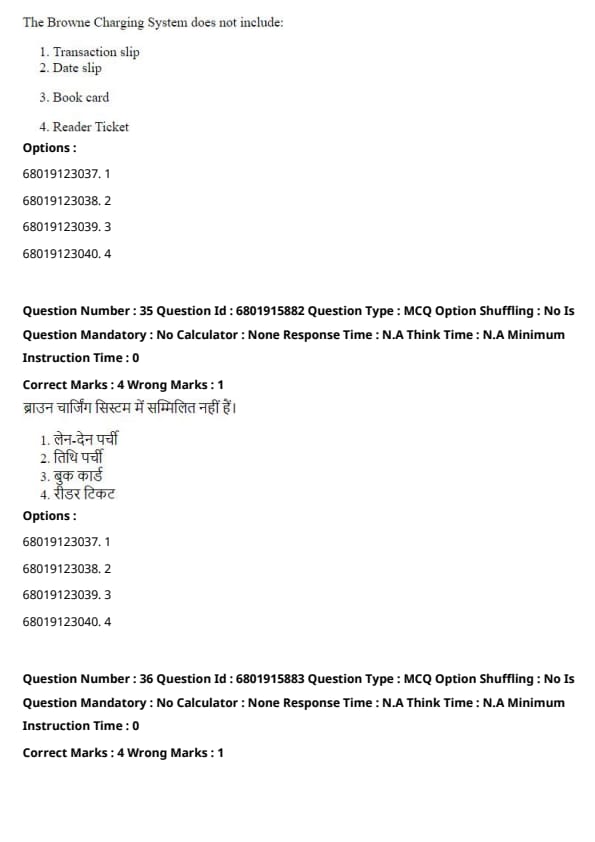
The Browne Charging System does not include:
View Solution
The Browne Charging System is a manual library circulation system that relies on a set of components such as book cards, reader tickets, and date slips to track borrowed books. Transaction slips, however, are not part of this system.
Question 36:
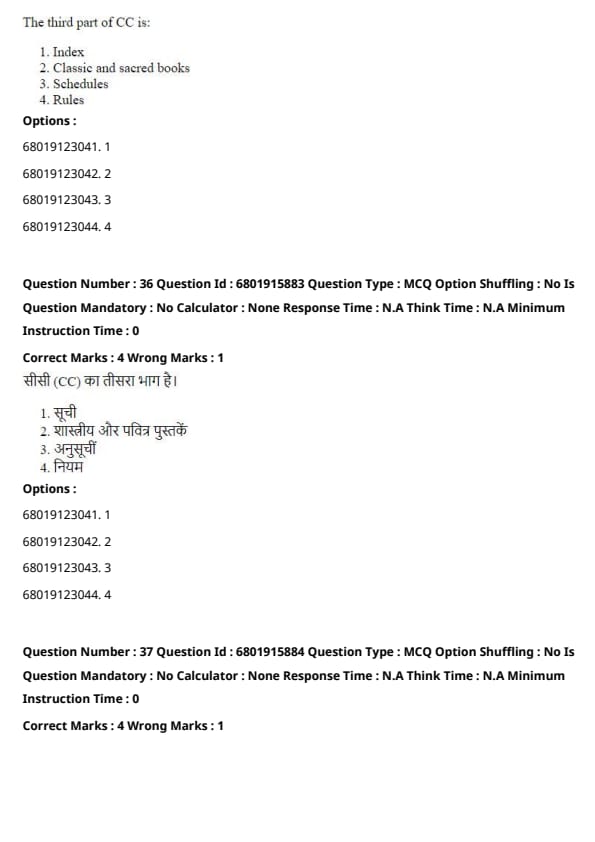
The third part of CC (Colon Classification) is:
View Solution
The third part of Dr. Ranganathan's Colon Classification system deals with "Classic and Sacred Books." This section emphasizes the importance of categorizing and preserving culturally and historically significant texts, especially those of religious and literary value.
Question 37:
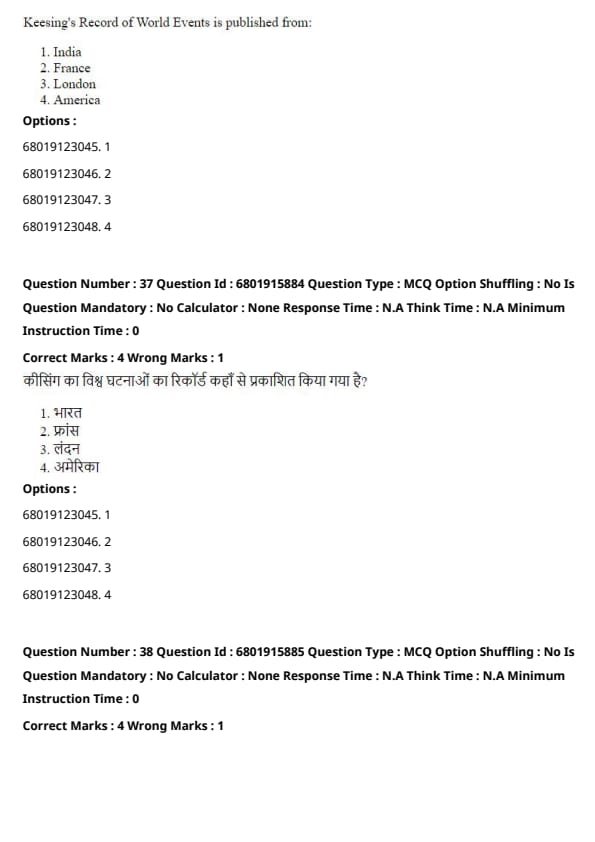
Keesing's Record of World Events is published from:
View Solution
Keesing's Record of World Events is a respected global publication based in London. It offers a comprehensive and reliable record of significant global events, including political, social, and economic developments.
Question 38:
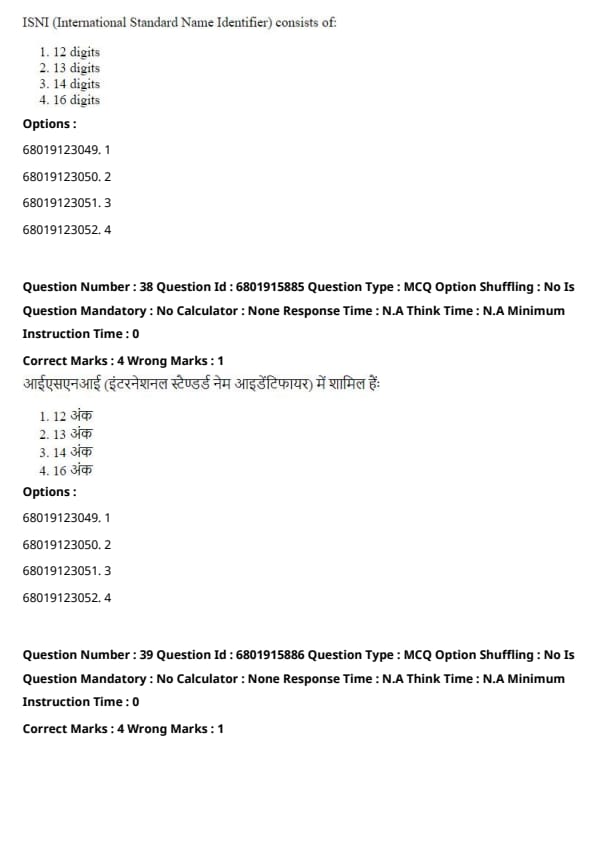
ISNI (International Standard Name Identifier) consists of:
View Solution
The International Standard Name Identifier (ISNI) is a unique 16-digit code used to identify individuals and organizations involved in the creation or distribution of intellectual works. It helps resolve ambiguity in author names, especially when similar names exist.
Question 39:
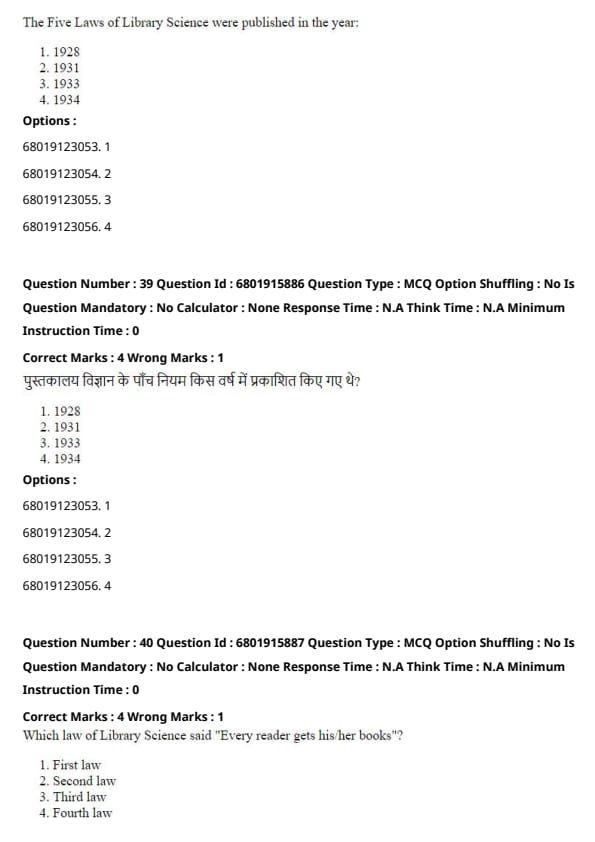
The Five Laws of Library Science were published in the year:
View Solution
Dr. S. R. Ranganathan introduced the Five Laws of Library Science in 1931. These laws are fundamental principles that advocate for user-centered library services and highlight the dynamic nature of libraries as evolving institutions.
Question 40:
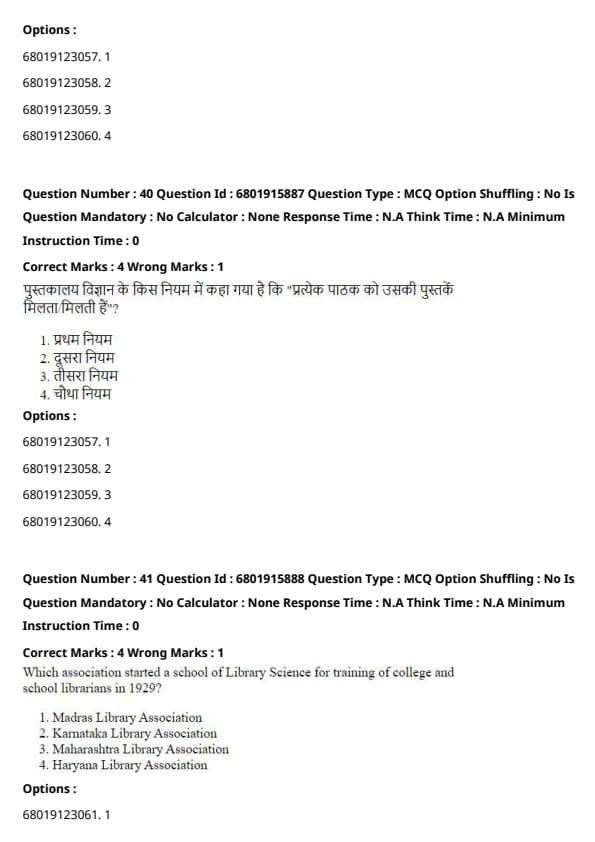
Which law of Library Science says "Every reader gets his/her books"?
View Solution
The Second Law of Library Science, "Every reader his/her book," highlights the need to ensure that library collections meet the diverse needs of all users. It advocates for a personalized approach to library services and collection development.
Question 41:
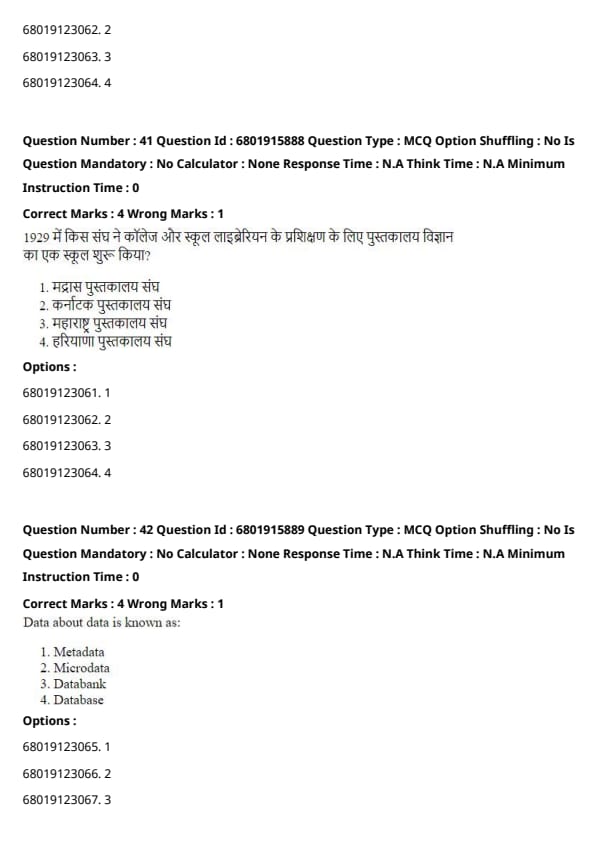
Which association started a school of Library Science for training of college and school librarians in 1929?
View Solution
The Madras Library Association established a library science school in 1929 with the goal of formalizing librarian training in India. It was a significant step toward professionalizing library services in educational institutions and laid the groundwork for subsequent library education programs across the country.
Question 42:
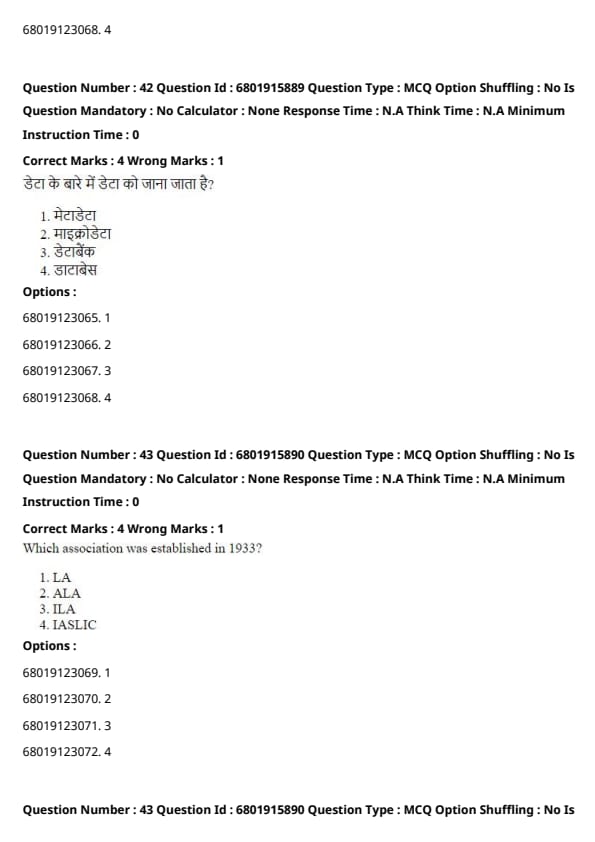
Data about data is known as:
View Solution
Metadata is data that provides information about other data. It helps describe, categorize, and organize data, making it easier to locate, use, and manage. In digital libraries and databases, metadata enables efficient information retrieval by adding context and structure to the raw data.
Question 43:
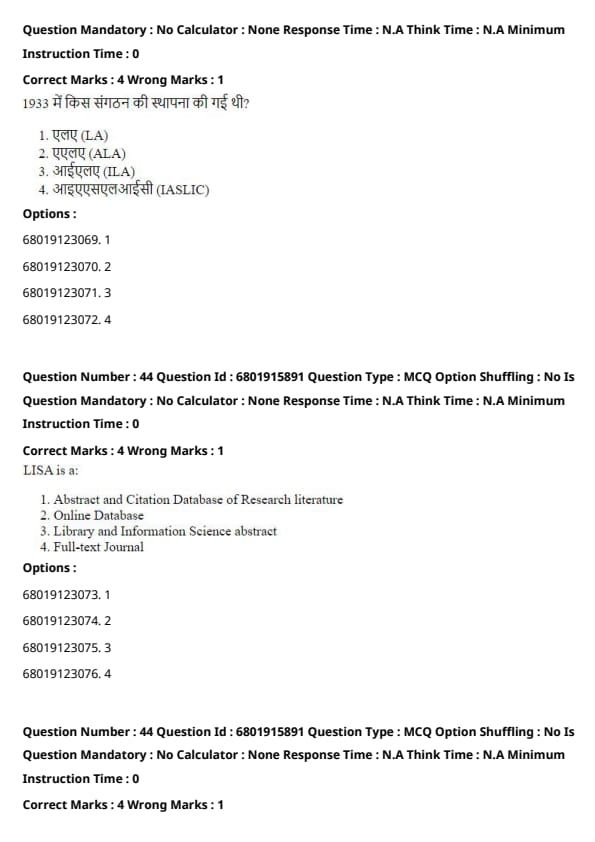
Which association was established in 1933?
View Solution
The Indian Library Association (ILA) was founded in 1933 with the aim of promoting library services and advancing the field of library science in India. It serves as a national body for librarians, advocating for the improvement of library services and the professional development of library staff.
Question 44:
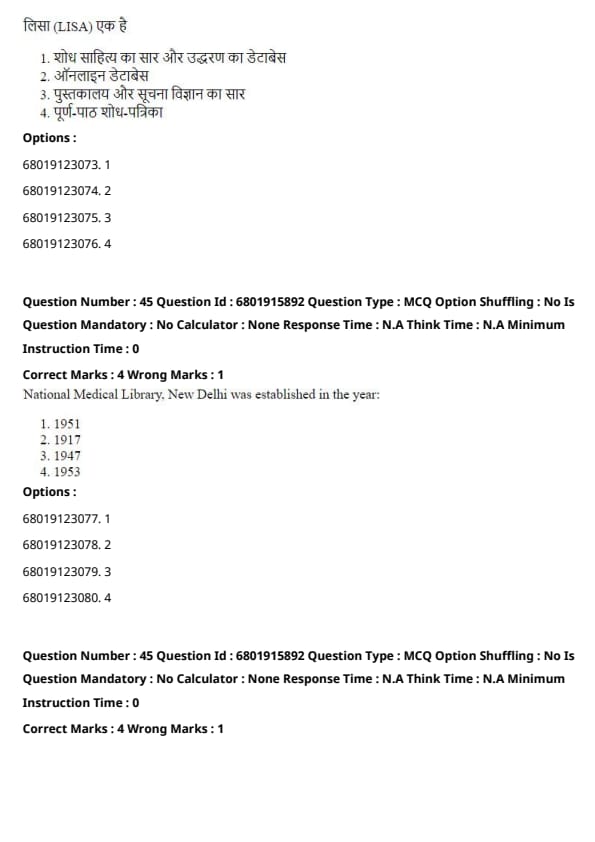
LISA is a:
View Solution
LISA (Library and Information Science Abstracts) is a comprehensive indexing service for library and information science literature. It provides abstracts and references from global sources, helping researchers identify and access key research articles in the field of library science.
Question 45:
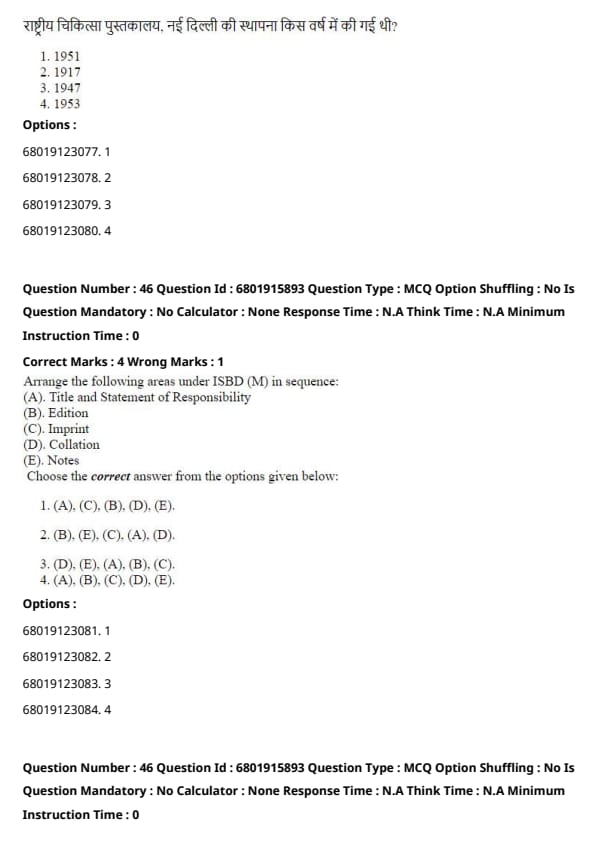
National Medical Library, New Delhi was established in the year:
View Solution
The National Medical Library (NML) in New Delhi was established in 1953 to serve as the central hub for medical and health-related information in India. It plays a key role in supporting medical education, research, and policy by providing access to medical literature and information resources.
Question 46:
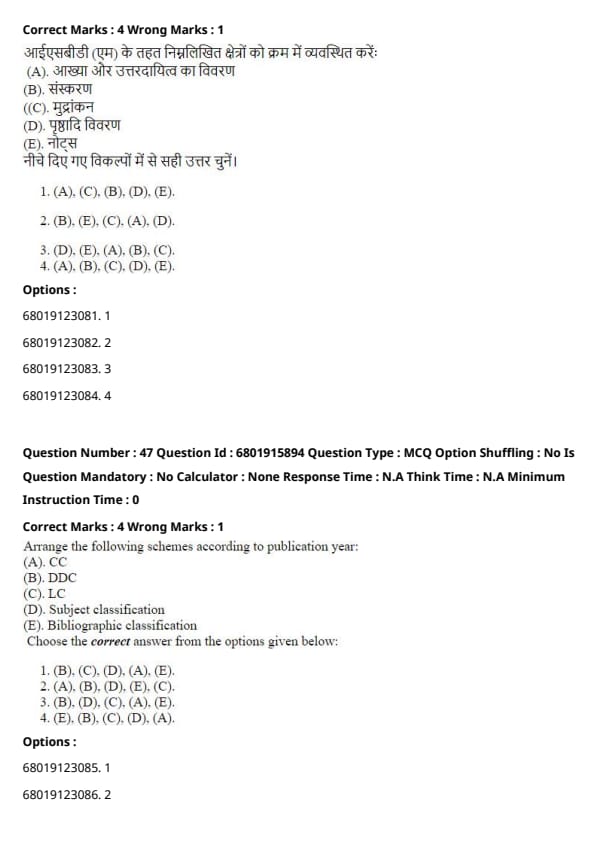
Arrange the following areas under ISBD (M) in sequence:
A. Title and Statement of Responsibility
B. Edition
C. Imprint
D. Collation
E. Notes
View Solution
The ISBD (M) standardizes the order of bibliographic description elements for monographs. The sequence (A), (B), (C), (D), (E) follows the logical flow for cataloging, from the title and statement of responsibility to the notes section, ensuring a structured and consistent approach to bibliographic data.
Question 47:
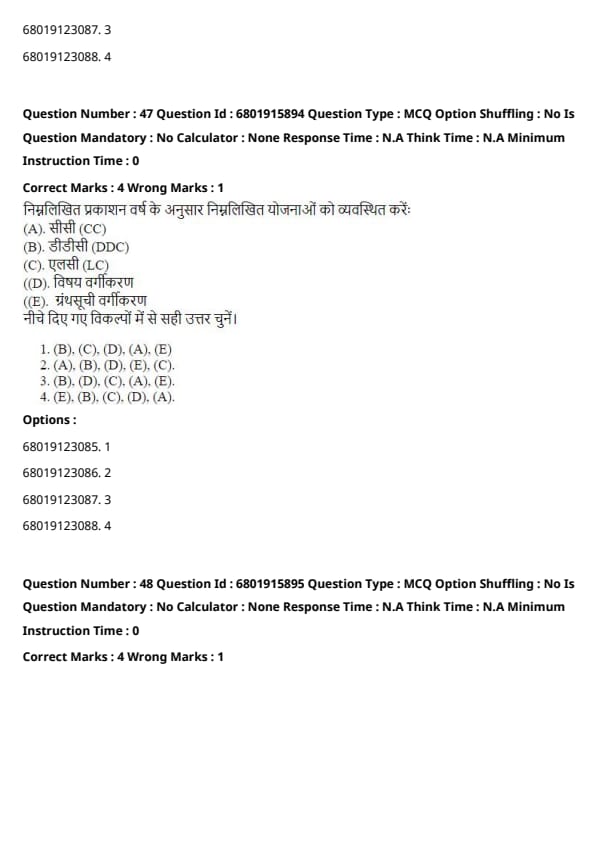
Arrange the following schemes according to publication year:
A. CC
B. DDC
C. LC
D. Subject Classification
E. Bibliographic Classification
View Solution
The classification schemes evolved as follows: DDC (1876) set the stage, followed by LC (1897) for large-scale libraries, Subject Classification, CC (Colon Classification, 1933) focusing on a more scientific approach, and Bibliographic Classification emerging later as a complementary tool for cataloging.
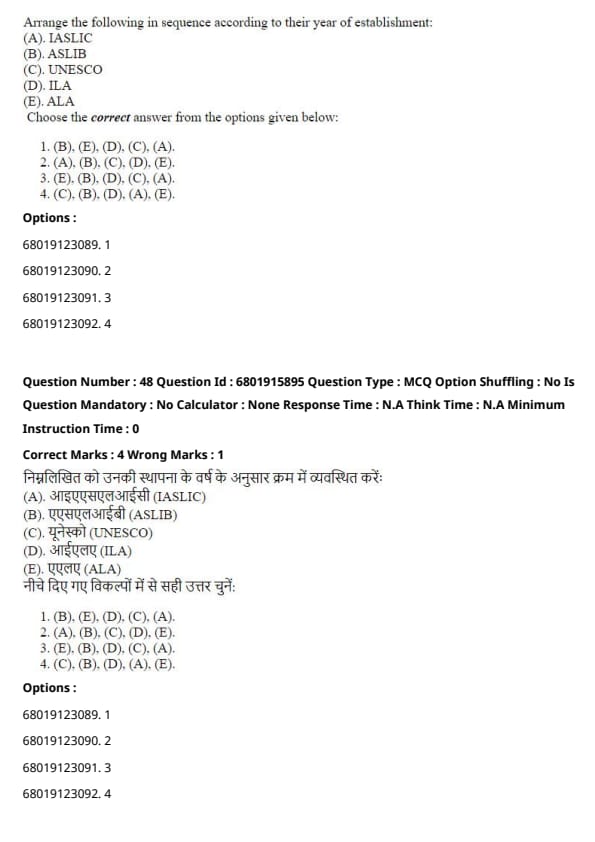
Question 48:
Arrange the following in sequence according to their year of establishment:
A. IASLIC
B. ASLIB
C. UNESCO
D. ILA
E. ALA
View Solution
The correct sequence based on the establishment years is: ALA (1876), ASLIB (1924), ILA (1933), UNESCO (1945), and IASLIC (1955). This progression highlights the global development of library organizations to address increasing library and information needs.
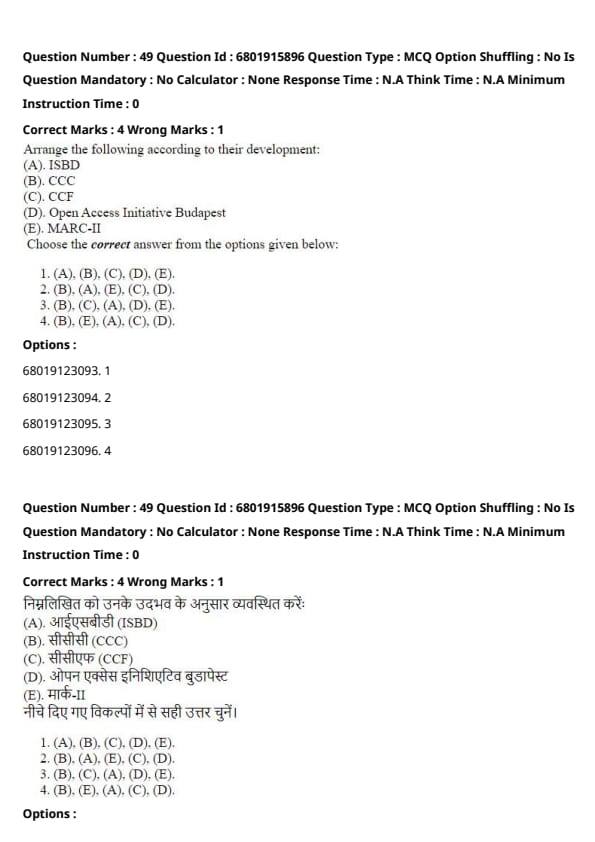
Question 49:
Arrange the following according to their development:
A. ISBD
B. CCC
C. CCF
D. Open Access Initiative Budapest
E. MARC-IT
View Solution
The development timeline is: CCC (Colon Classification), followed by ISBD for bibliographic descriptions, MARC-IT for machine-readable records, CCF for bibliographic data exchange, and the Open Access Initiative Budapest revolutionizing the availability of scholarly content.
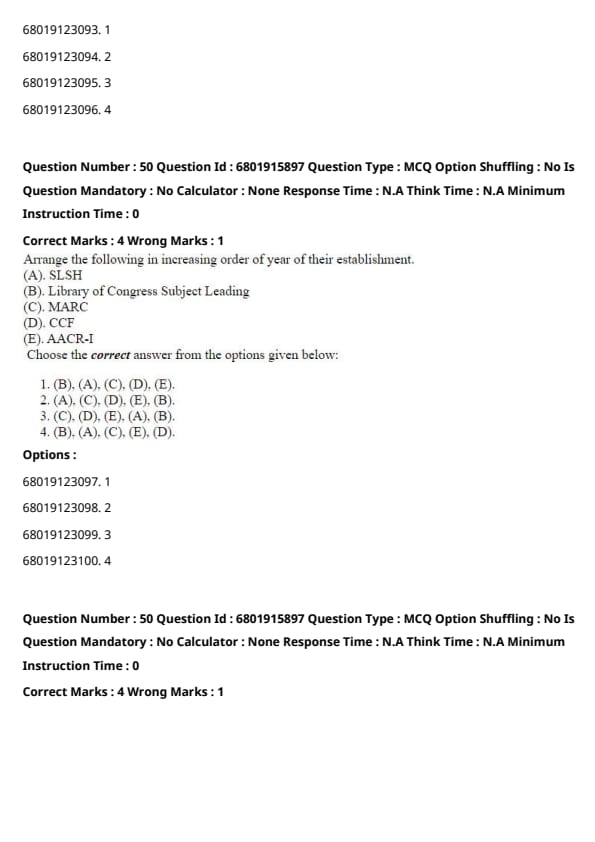
Question 50:
Arrange the following in increasing order of year of their establishment:
A. SLSH
B. Library of Congress Subject Heading (LCSH)
C. MARC
D. CCF
E. AACR-I
View Solution
The correct chronological order is: LCSH (1897), SLSH, MARC (1960s), AACR-I (1967), and CCF (1970s). This sequence reflects the development of cataloging standards and bibliographic tools that shaped modern library systems.
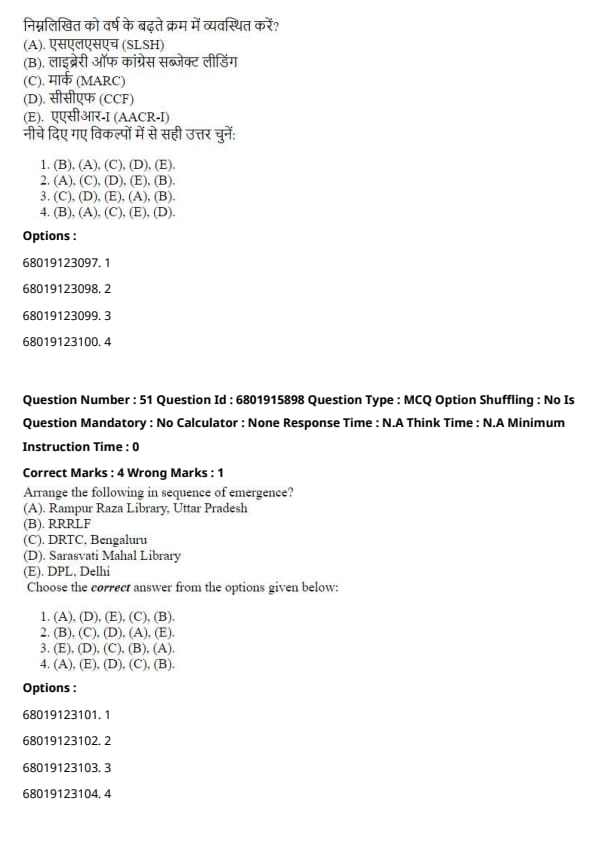
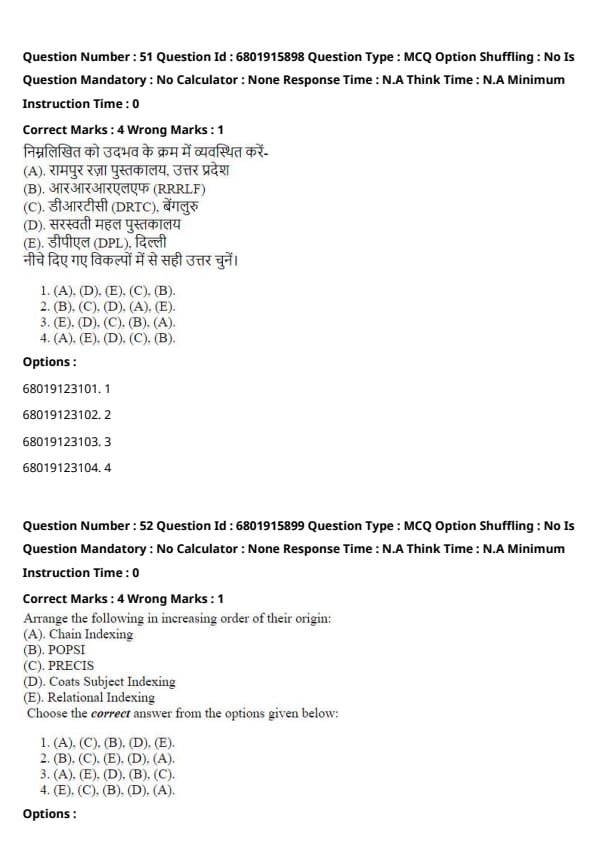
Question 51:
Arrange the following in sequence of emergence:
A. Rampur Raza Library, Uttar Pradesh
B. RRRLF
C. DRTC, Bengaluru
D. Sarasvati Mahal Library
E. DPL, Delhi
View Solution
The sequence of emergence is as follows: Rampur Raza Library, known for its rare manuscript collections, followed by Sarasvati Mahal Library as one of India's oldest libraries. Delhi Public Library (DPL) emerged as an important public resource, followed by DRTC and then RRRLF to improve rural library infrastructure.
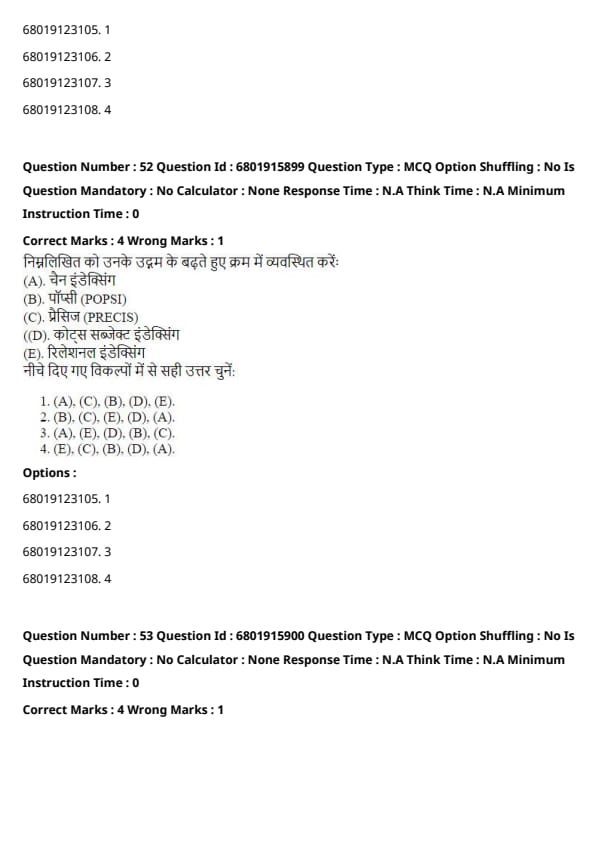
Question 52:
Arrange the following in increasing order of their origin:
A. Chain Indexing
B. POPSI
C. PRECIS
D. Coats Subject Indexing
E. Relational Indexing
View Solution
Chain Indexing, developed by Ranganathan, was the first to be introduced. Relational Indexing followed, along with Coats Subject Indexing. POPSI and PRECIS came later as advanced techniques for subject indexing and organization.
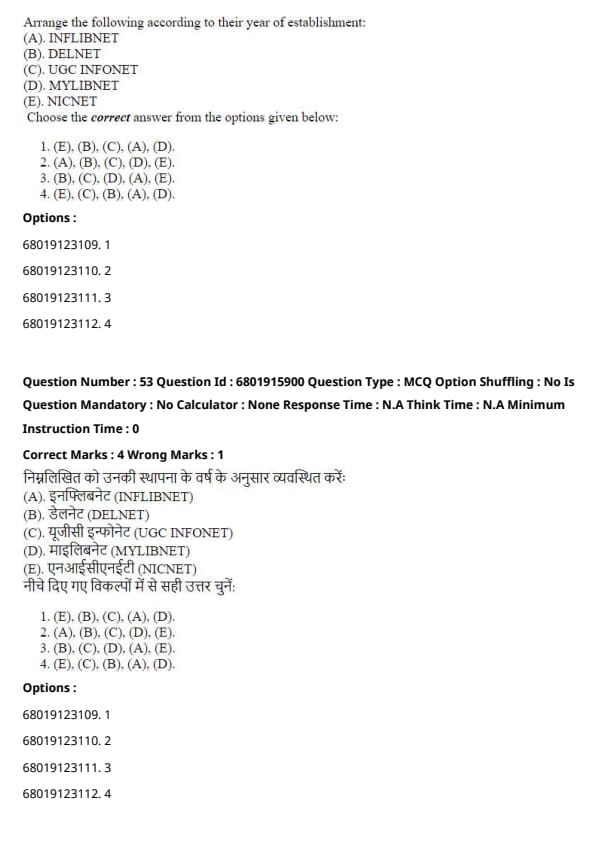
Question 53:
Arrange the following according to their year of establishment:
A. INFLIBNET
B. DELNET
C. UGC INFONET
D. MYLIBNET
E. NICNET
View Solution
NICNET was the first networking initiative in India, followed by DELNET. UGC INFONET was introduced to connect academic institutions, and INFLIBNET further advanced the digital library network. MYLIBNET is a more recent initiative for networking libraries in India.
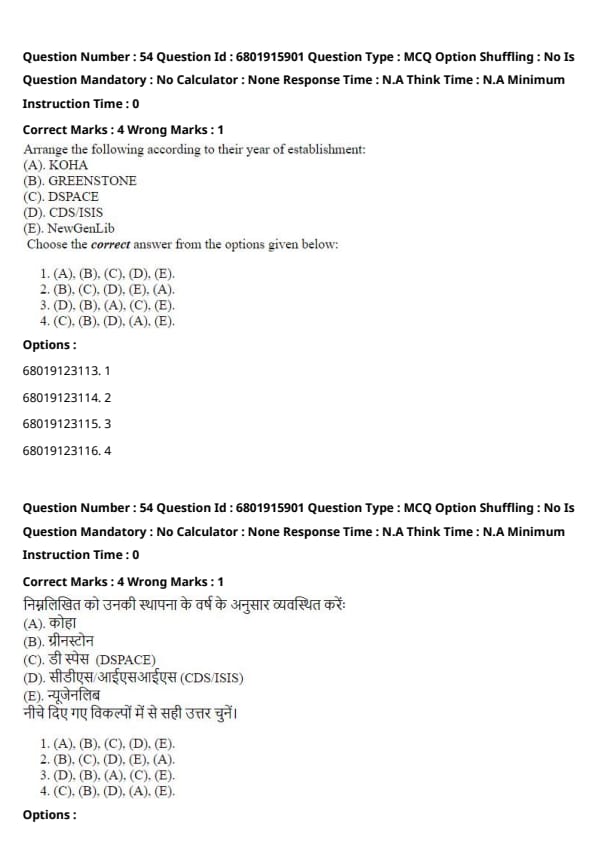
Question 54:
Arrange the following according to their year of establishment:
A. KOHA
B. GREENSTONE
C. DSPACE
D. CDS/ISIS
E. NewGenLib
View Solution
CDS/ISIS, developed in the 1980s, was the first library management software. Greenstone followed for digital libraries, then KOHA emerged as an open-source ILS. DSPACE and NewGenLib were developed later to provide solutions for institutional repositories and integrated library systems.
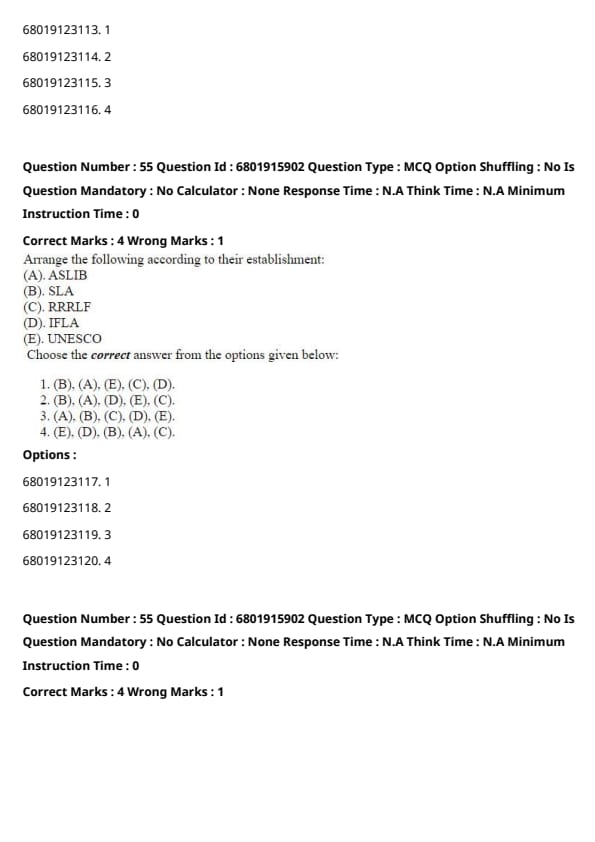
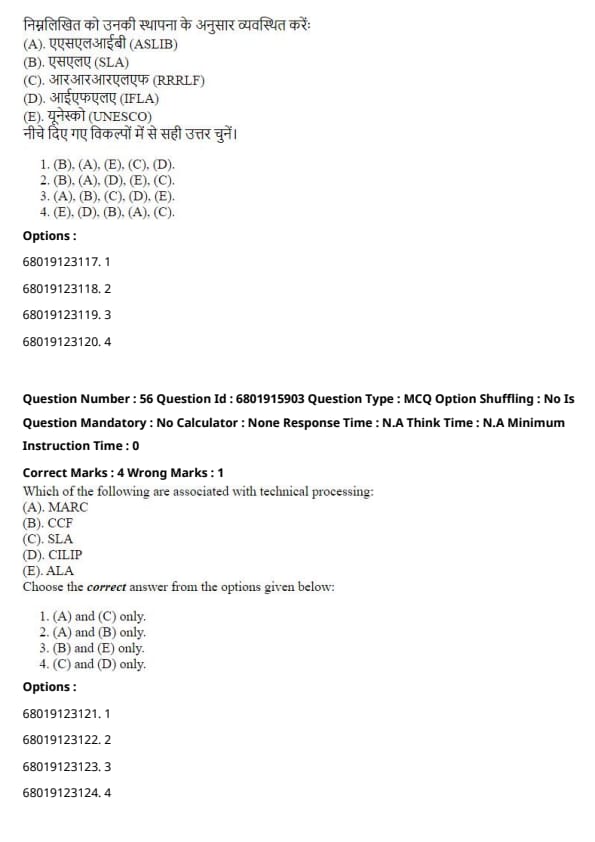
Question 55:
Arrange the following according to their establishment:
A. ASLIB
B. SLA
C. RRRLF
D. IFLA
E. UNESCO
View Solution
SLA (Special Libraries Association) and ASLIB (Association of Special Libraries) were established early, followed by IFLA (International Federation of Library Associations) and UNESCO. RRRLF (Raja Rammohun Roy Library Foundation) was set up later to improve library services in rural India.
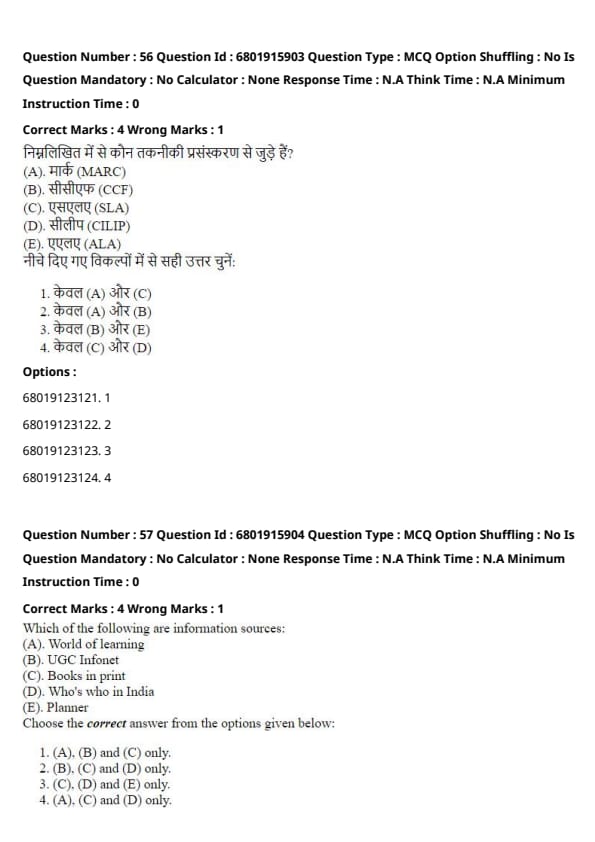
Question 56:
Which of the following are associated with technical processing?
A. MARC
B. CCF
C. SLA
D. CILIP
E. ALA
View Solution
MARC (Machine-Readable Cataloging) and CCF (Common Communication Format) are directly related to technical processing in libraries, aiding in cataloging and the standardization of bibliographic data.
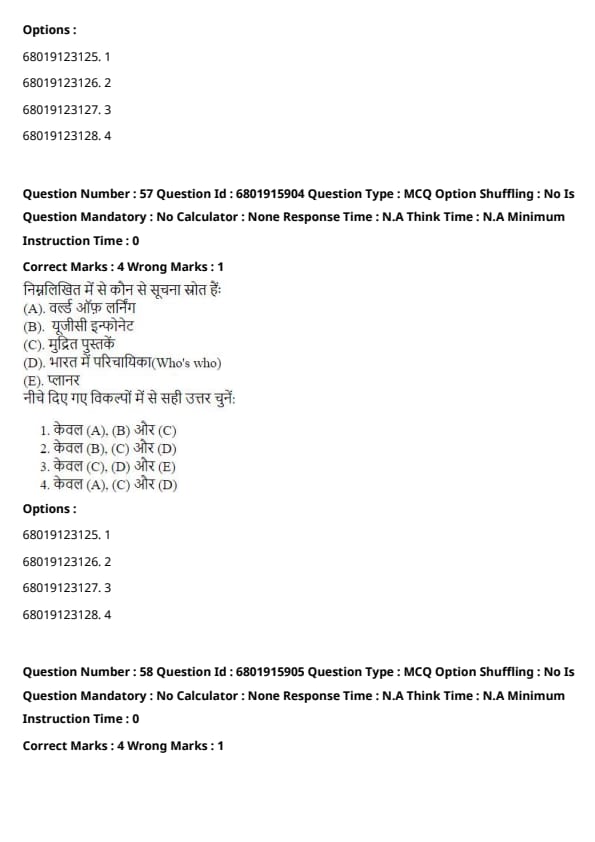
Question 57:
Which of the following are information sources?
A. World of Learning
B. UGC Infonet
C. Books in Print
D. Who’s Who in India
E. Planner
View Solution
"World of Learning" provides academic information, "Books in Print" lists available books, and "Who's Who in India" offers biographical details. UGC Infonet is a digital library resource, and "Planner" pertains to event management.
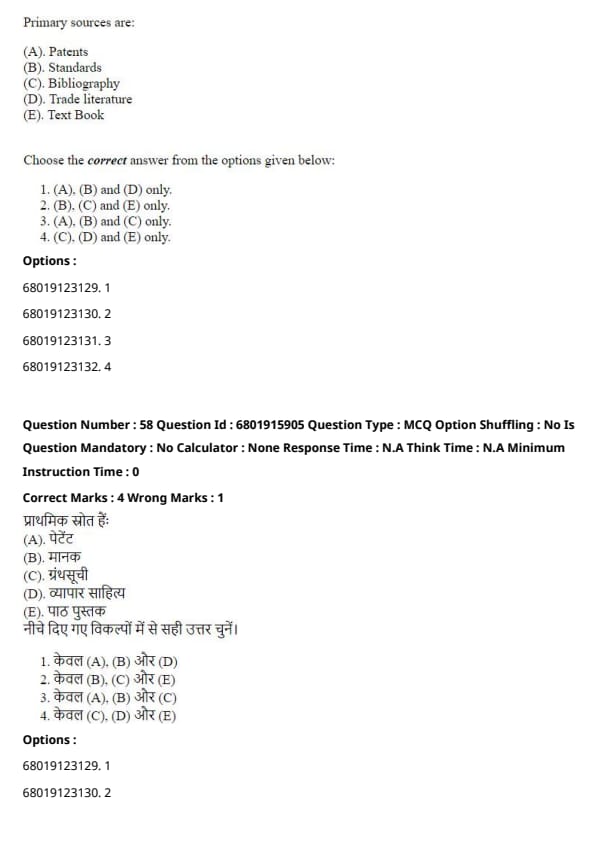
Question 58:
Primary sources are:
A. Patents
B. Standards
C. Bibliography
D. Trade Literature
E. Textbooks
View Solution
Primary sources provide original data, such as patents, standards, and trade literature. Bibliographies and textbooks are secondary or tertiary sources that summarize or interpret primary information.
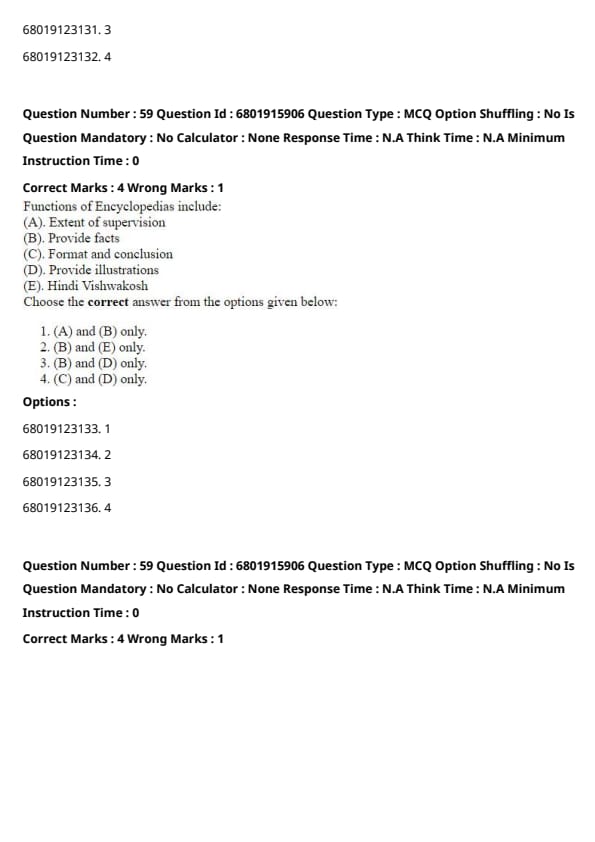
Question 59:
Functions of Encyclopedias include:
A. Extent of supervision
B. Provide facts
C. Format and conclusion
D. Provide illustrations
E. Hindi Vishwakosh
View Solution
Encyclopedias are designed to provide factual information and illustrations to help readers understand concepts. They do not focus on supervision or the creation of region-specific resources like Hindi Vishwakosh.
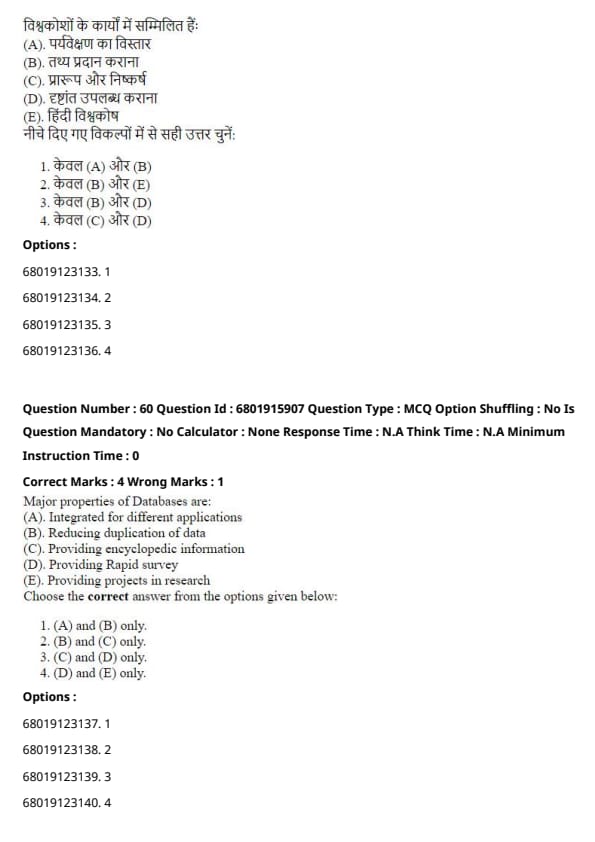
Question 60:
Major properties of Databases are:
A. Integrated for different applications
B. Reducing duplication of data
C. Providing encyclopedic information
D. Providing rapid survey
E. Providing projects in research
View Solution
Databases are designed to integrate data for various applications while minimizing redundancy. They provide organized, accessible data across multiple platforms.
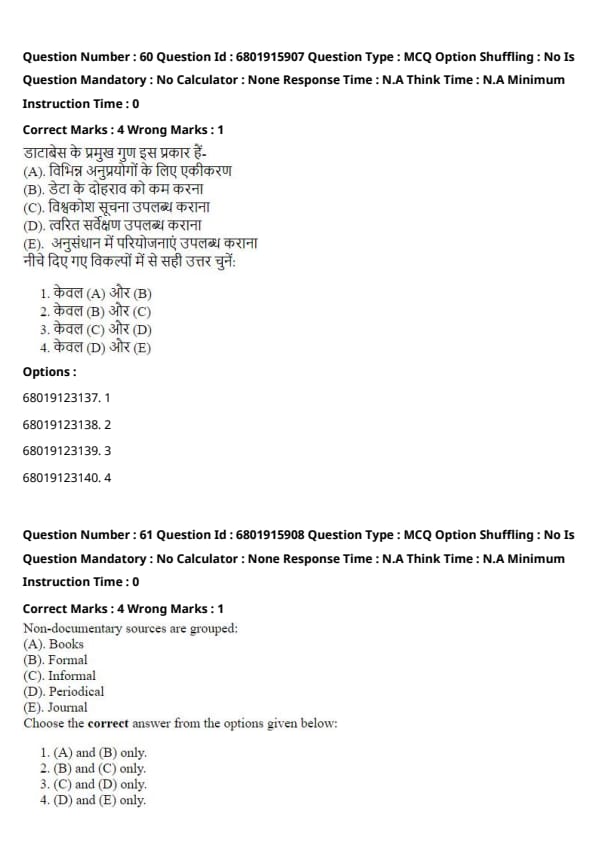
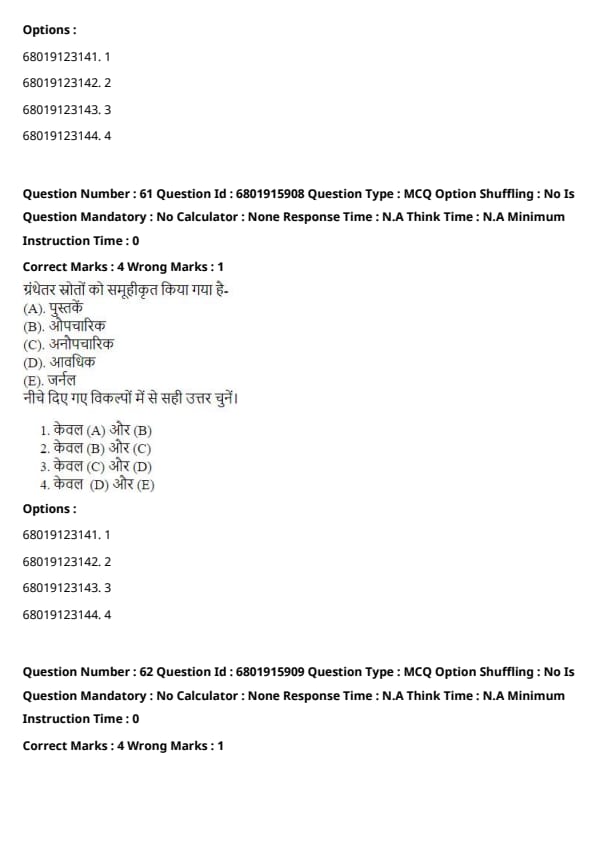
Question 61:
Non-documentary sources are grouped:
A. Books
B. Formal
C. Informal
D. Periodical
E. Journal
View Solution
Non-documentary sources include both formal (e.g., meetings, conferences) and informal (e.g., personal interviews) communication methods. These sources provide valuable information not contained in traditional documents like books, journals, and periodicals.
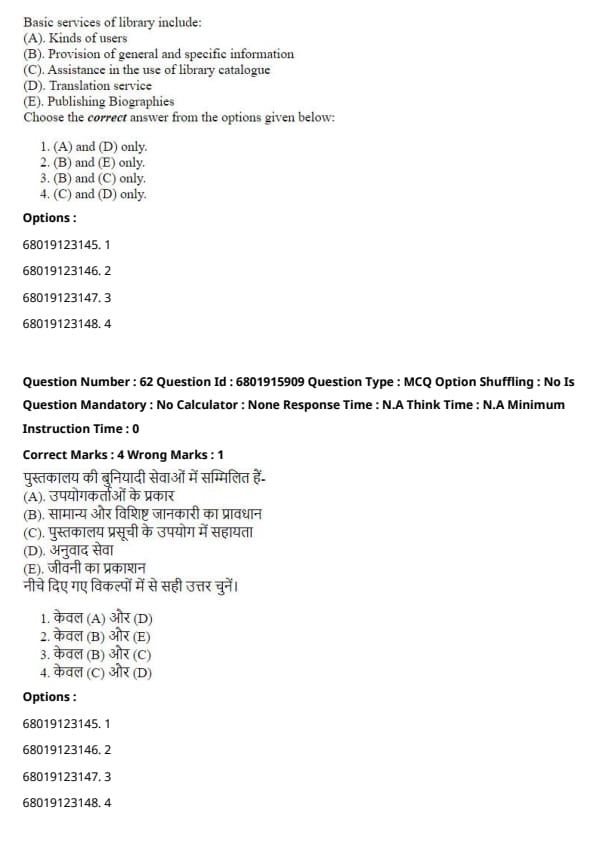
Question 62:
Basic services of library include:
A. Kinds of users
B. Provision of general and specific information
C. Assistance in the use of library catalogue
D. Translation service
E. Publishing Biographies
View Solution
Basic library services focus on providing both general and specific information to users, as well as assisting with library catalog usage. Specialized services like translation and biography publishing fall under advanced or supplementary offerings.
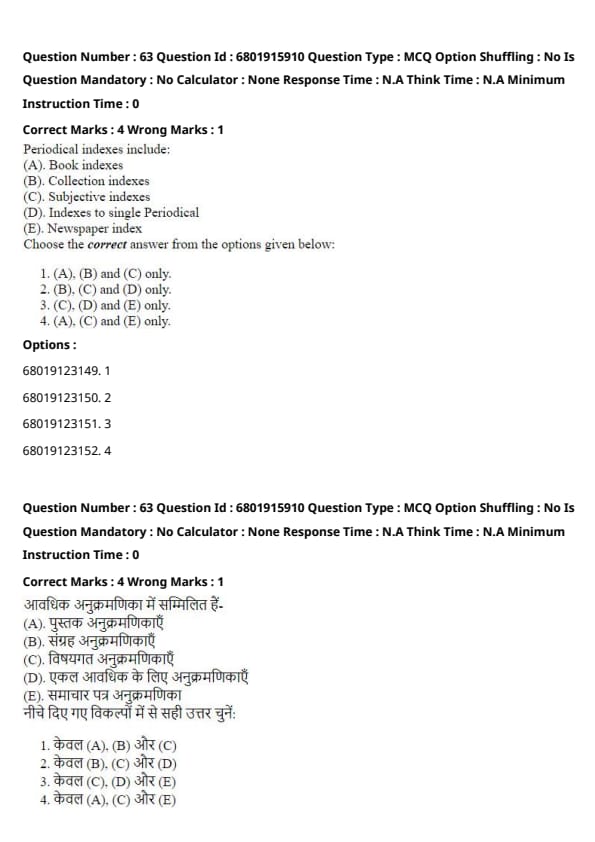
Question 63:
Periodical indexes include:
A. Book indexes
B. Collection indexes
C. Subjective indexes
D. Indexes to single Periodical
E. Newspaper index
View Solution
Periodical indexes focus on organizing content from specific types of periodicals. This includes subject indexes (categorizing articles by topic), indexes to single periodicals, and newspaper indexes. Book and collection indexes are not typically part of periodical indexing.
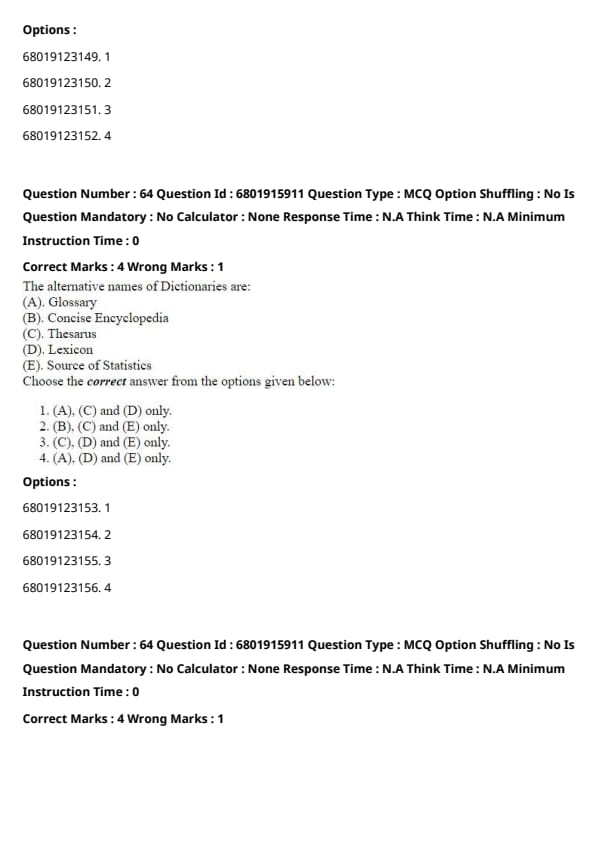
Question 64:
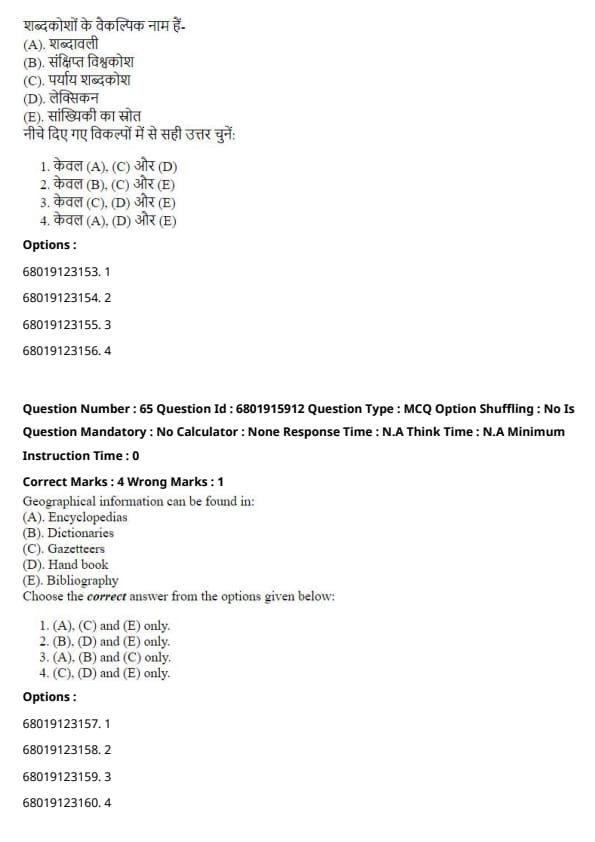
The alternative names of Dictionaries are:
A. Glossary
B. Concise Encyclopedia
C. Thesaurus
D. Lexicon
E. Source of Statistics
View Solution
Dictionaries are often referred to as glossaries, thesauruses, or lexicons, each offering word meanings, definitions, and sometimes synonyms. A concise encyclopedia provides brief overviews of topics but is not a synonym for a dictionary, and statistics sources are unrelated to dictionary definitions.
Question 65:
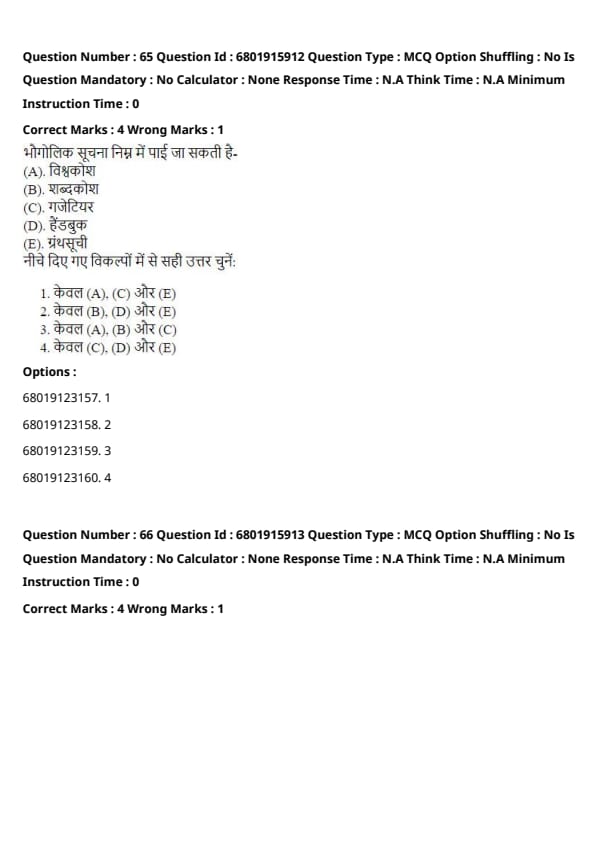
Geographical information can be found in:
A. Encyclopedias
B. Dictionaries
C. Gazetteers
D. Handbooks
E. Bibliographies
View Solution
Geographical data is often found in encyclopedias, dictionaries (for place names), and gazetteers (which focus specifically on geographical locations). Handbooks and bibliographies tend not to specialize in geographical information.
Question 66:
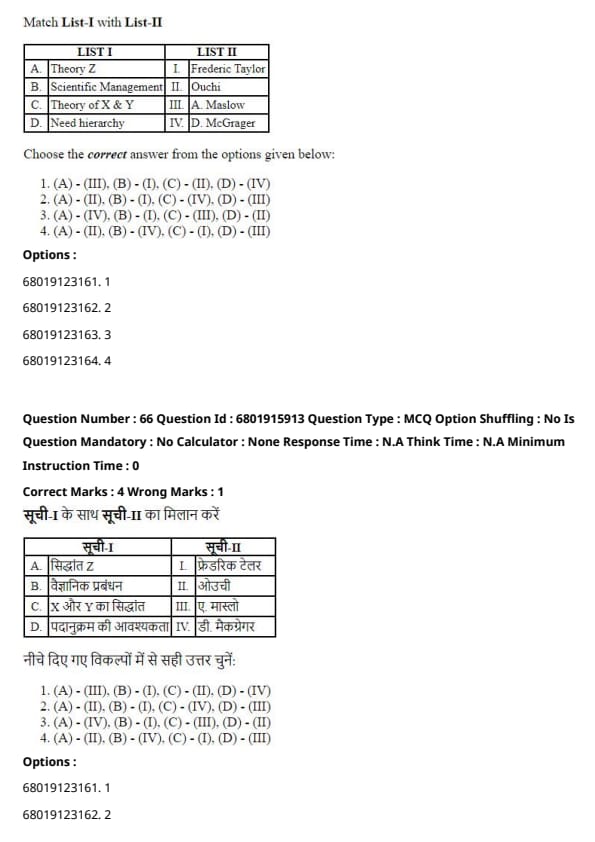
Match List-I with List-II:
| List-I | List-II |
|---|---|
| (A) Theory Z | (I) Frederic Taylor |
| (B) Scientific Management | (II) Ouchi |
| (C) Theory of X & Y | (III) A. Maslow |
| (D) Need Hierarchy | (IV) D. McGregor |
View Solution
Theory Z emphasizes participative management (Ouchi), Scientific Management focuses on efficiency (Taylor), Theory X & Y are McGregor's approaches to management, and Need Hierarchy is Maslow's model of human needs.
Question 67:
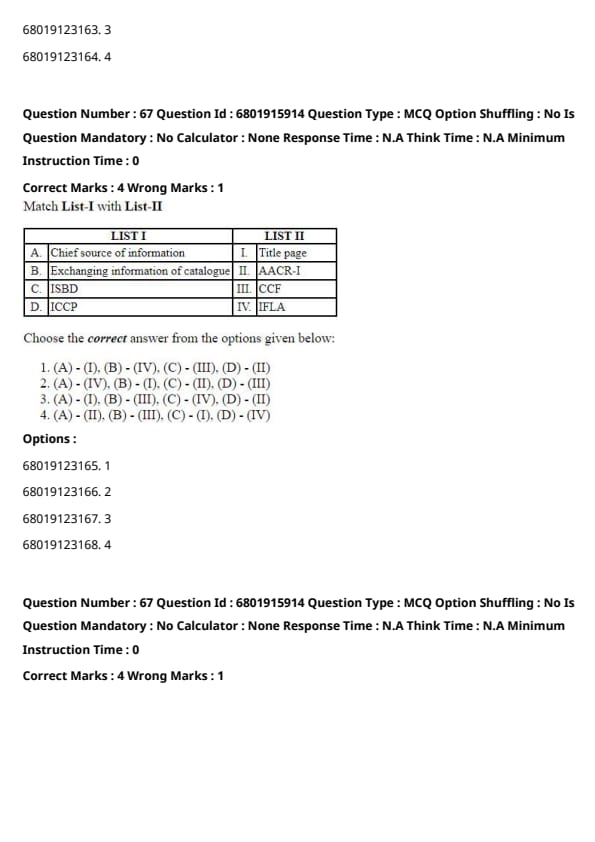
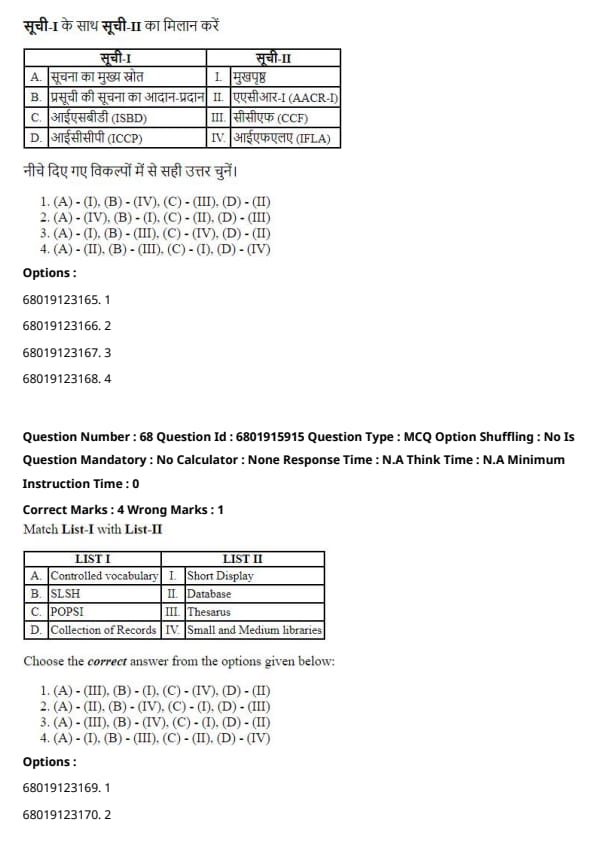
Match List-I with List-II:
| List-I | List-II |
|---|---|
| (A) Chief source of information | (I) Title page |
| (B) Exchanging information of catalogues | (III) CCF |
| (C) ISBD | (IV) IFLA |
| (D) ICCP | (II) AACR-I |
View Solution
The title page serves as the chief source of bibliographic data. AACR-I standardizes catalog information, ISBD (from IFLA) ensures bibliographic consistency, and CCF facilitates bibliographic data exchange.
Question 68:
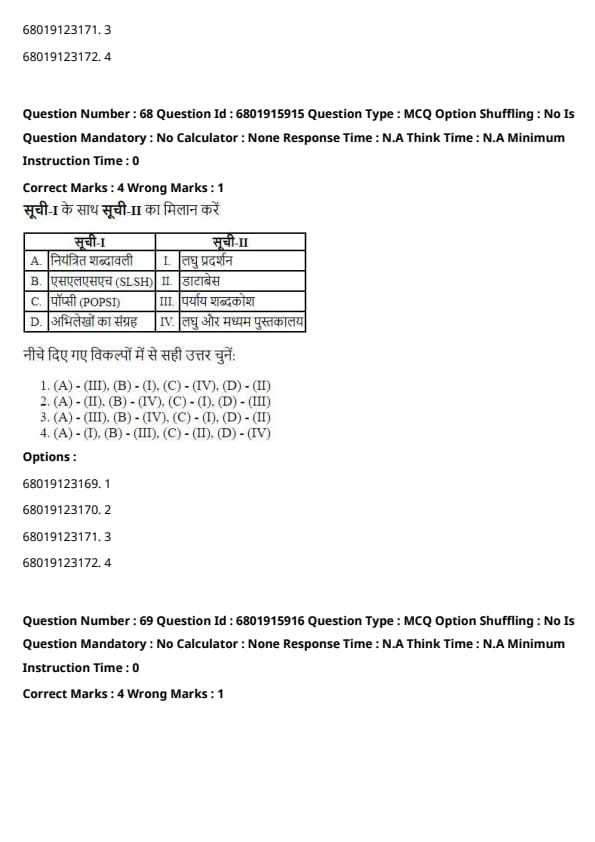
Match List-I with List-II:
| List-I | List-II |
|---|---|
| (A) Controlled vocabulary | (III) Thesaurus |
| (B) SLSH | (IV) Small and Medium Libraries |
| (C) POPSI | (I) Short Display |
| (D) Collection of Records | (II) Database |
View Solution
Controlled vocabulary is represented by a thesaurus, SLSH serves small and medium libraries, POPSI enables short indexing displays, and a database stores collections of records systematically.
Question 69:
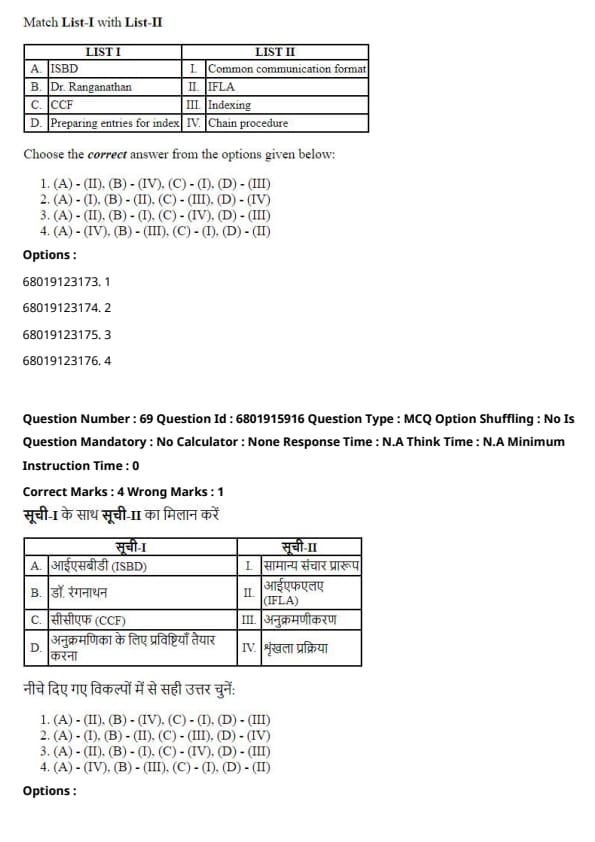
Match List-I with List-II:
| List-I | List-II |
|---|---|
| (A) ISBD | (II) IFLA |
| (B) Dr. Ranganathan | (IV) Chain Procedure |
| (C) CCF | (I) Common Communication Format |
| (D) Preparing entries for index | (III) Indexing |
View Solution
ISBD was developed by IFLA for bibliographic descriptions. Dr. Ranganathan introduced the Chain Procedure for subject indexing. CCF enables bibliographic data exchange, and preparing entries is a part of indexing.
Question 70:
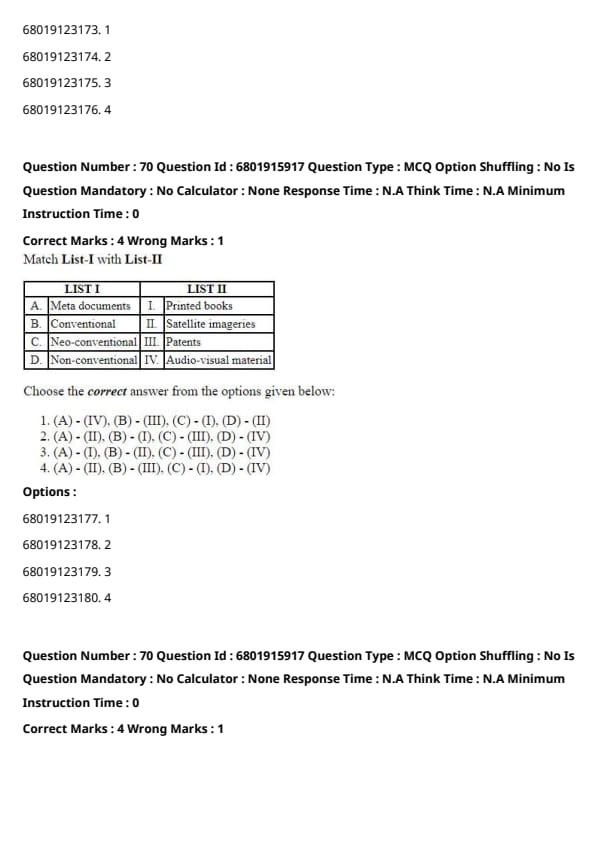
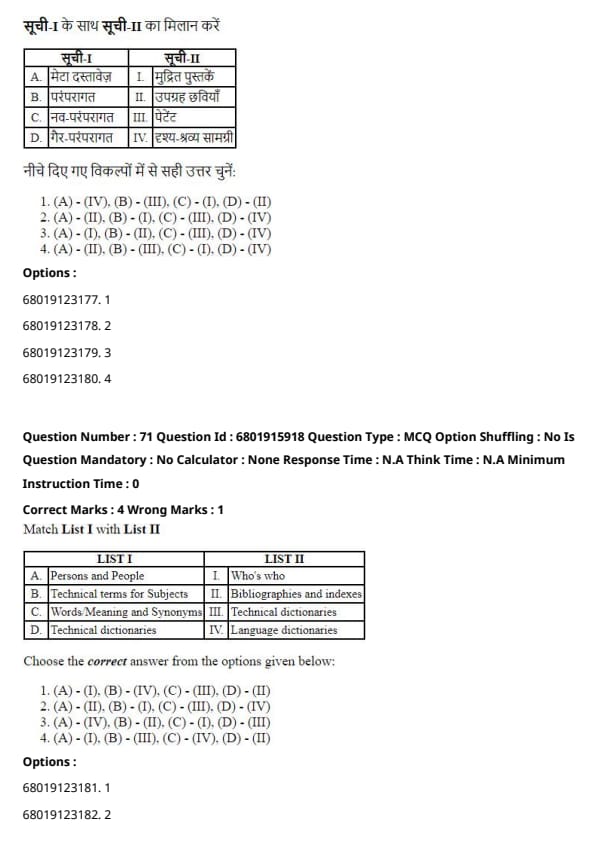
Match List-I with List-II:
| List-I | List-II |
|---|---|
| (A) Meta documents | (II) Satellite imageries |
| (B) Conventional | (I) Printed books |
| (C) Neo-conventional | (III) Patents |
| (D) Non-conventional | (IV) Audio-visual material |
View Solution
Meta documents include satellite imageries, conventional documents are printed books, neo-conventional documents encompass patents, and non-conventional documents refer to audio-visual materials.
Question 71:
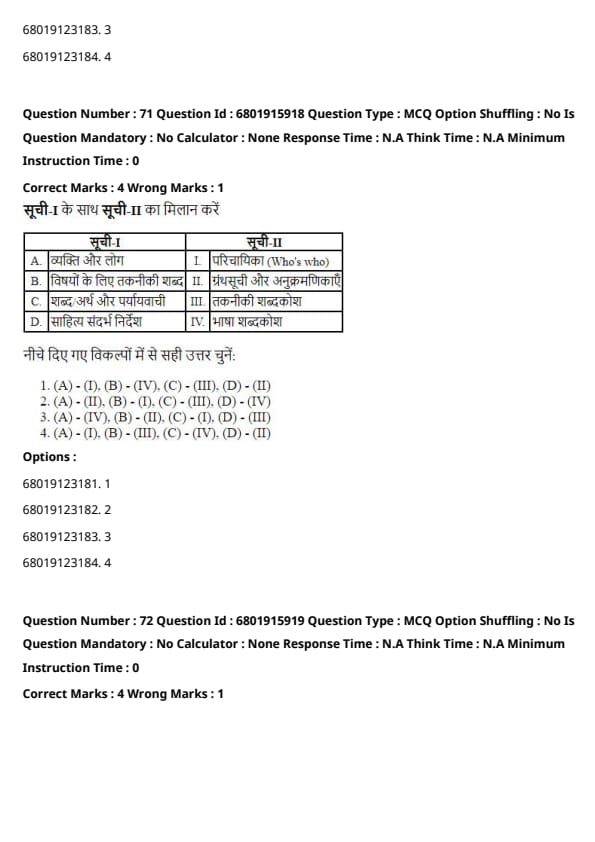
Match List-I with List-II:
| List-I | List-II |
|---|---|
| (A) Persons and People | (I) Who’s Who |
| (B) Technical terms for Subjects | (II) Bibliographies and Indexes |
| (C) Words/Meaning and Synonyms | (III) Technical dictionaries |
| (D) Bibliographies and Indexes | (IV) Language dictionaries |
View Solution
- "Who’s Who" is a reference work for finding detailed information about notable individuals.
- "Technical dictionaries" explain specialized terms in specific fields.
- "Language dictionaries" provide definitions and synonyms for words.
- Bibliographies and indexes are used for organizing and referencing a wide range of literature.
Question 72:
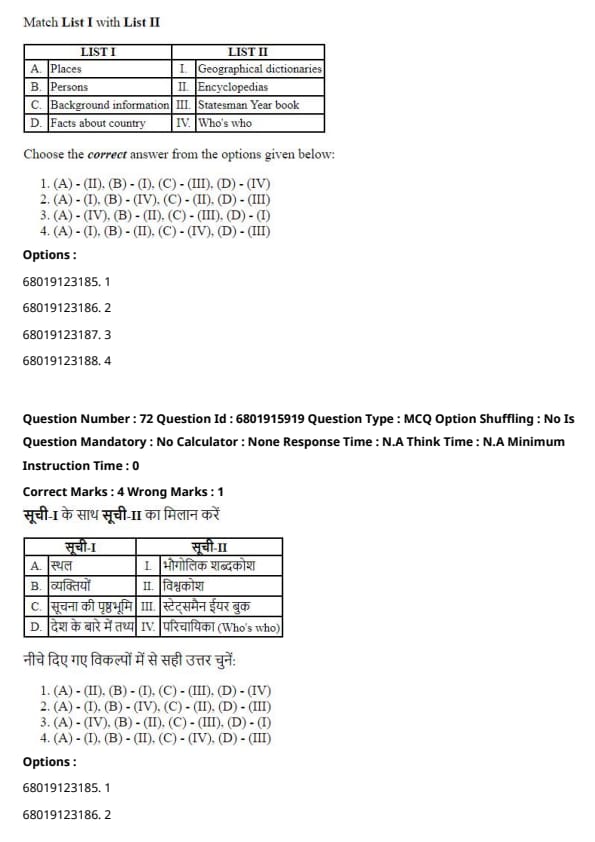
Match List-I with List-II:
| List-I | List-II |
|---|---|
| (A) Places | (I) Geographical dictionaries |
| (B) Persons | (II) Encyclopedias |
| (C) Background Information | (III) Statesman Year Book |
| (D) Facts about Country | (IV) Who's Who |
View Solution
- Geographical dictionaries provide information about places.
- "Who's Who" lists information about people.
- Encyclopedias provide comprehensive background information.
- The Statesman Year Book contains facts about countries, including statistical data.
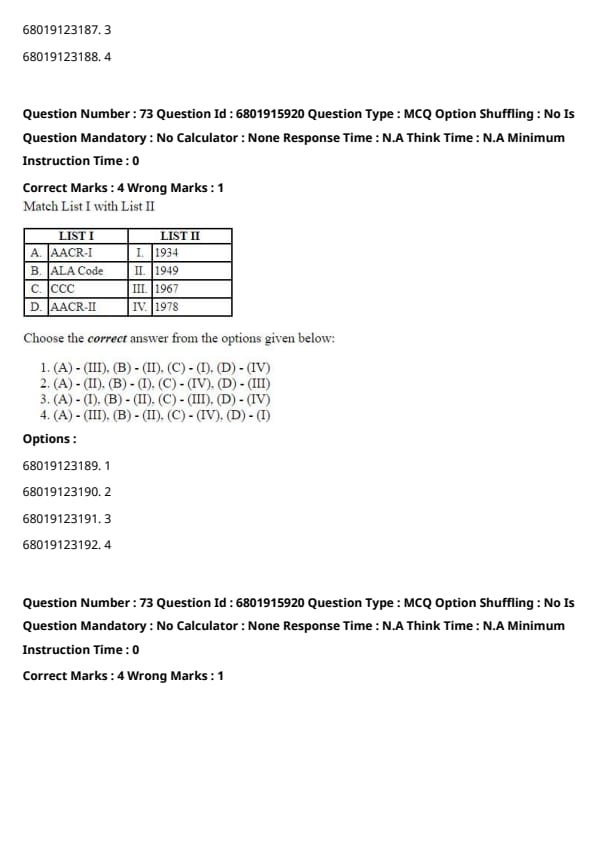
Question 73:
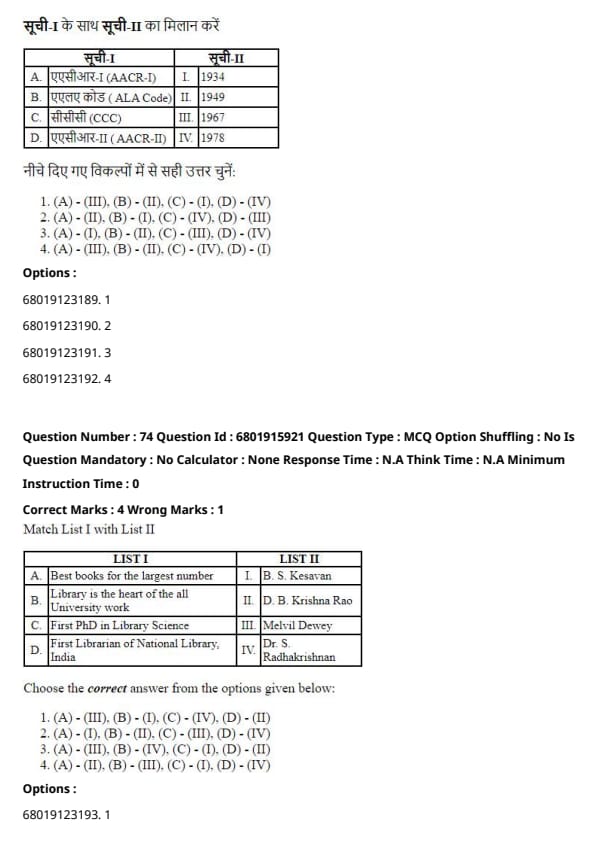
Match List-I with List-II:
| List-I | List-II |
|---|---|
| (A) AACR-I | (I) 1934 |
| (B) ALA Code | (II) 1949 |
| (C) CCC | (III) 1967 |
| (D) AACR-II | (IV) 1978 |
View Solution
AACR-I (1967) introduced modern cataloging rules.
ALA Code (1934) provided cataloging guidelines.
CCC (1949) was developed by Dr. Ranganathan.
AACR-II (1978) updated AACR-I for newer formats.
Question 74:
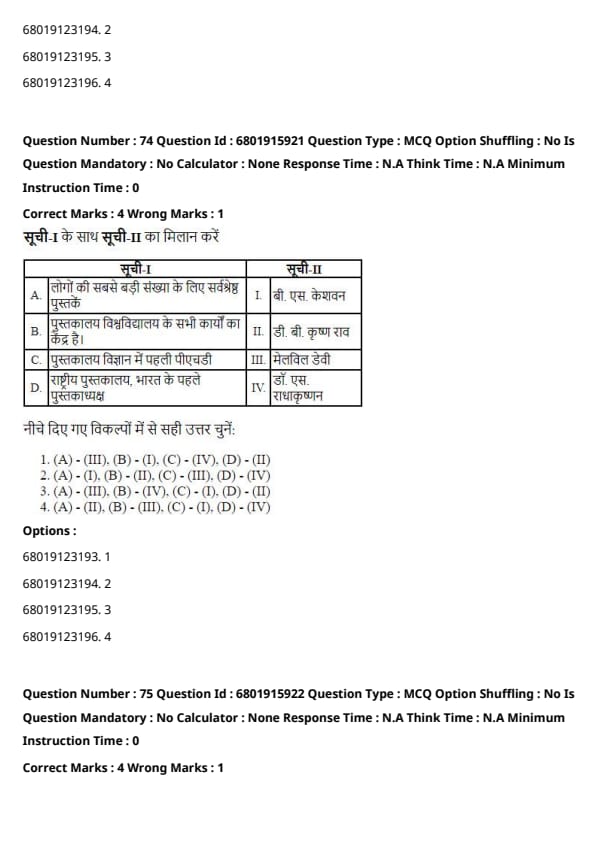
Match List-I with List-II:
| List-I | List-II |
|---|---|
| (A) Best books for the largest number | (I) D. B. Krishna Rao |
| (B) Library is the heart of all university work | (II) B. S. Kesavan |
| (C) First Ph.D. in Library Science | (III) Melvil Dewey |
| (D) First Librarian of National Library, India | (IV) Dr. S. Radhakrishnan |
View Solution
Melvil Dewey emphasized providing the best books to the largest number.
Dr. Radhakrishnan valued libraries as university hubs.
D. B. Krishna Rao earned the first Ph.D. in Library Science.
B. S. Kesavan was the first Librarian of the National Library of India.
Question 75:
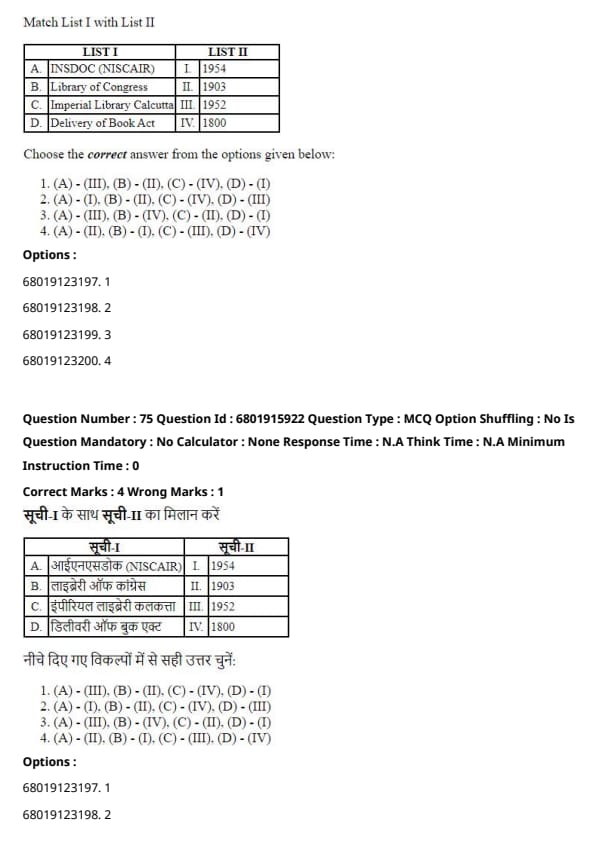
Match List-I with List-II:
| List-I | List-II |
|---|---|
| (A) INSDOC (NISCAIR) | (I) 1954 |
| (B) Library of Congress | (II) 1800 |
| (C) Imperial Library Calcutta | (III) 1903 |
| (D) Delivery of Book Act | (IV) 1952 |
View Solution
- INSDOC (NISCAIR) was established in 1954.
The Library of Congress was founded in 1800.
The Imperial Library Calcutta was founded in 1903.
The Delivery of Books Act was enacted in 1952.

*The article might have information for the previous academic years, please refer the official website of the exam.