CUET PG 2024 Question Paper with Answer Key PDF for Theatre (March 18 - Shift 1)
- Question Paper 2025
- Question Paper 2024
- Question Paper 2023
- Mathematics Papers
- Statistics Question Paper
- English Question Paper
- Chemistry Question Paper
- Pol. Sci. Question Paper
- History Question Paper
- Commerce Question Papers
- Life Science Papers
- Geology Question Papers
- Journalism Question Paper
- B.Ed. HSS Question Paper
- Botany Question Paper
- B.Ed. Question Papers


Content Writer | Updated On - Mar 13, 2025
CUET PG Question Papers are the most important study material for effective exam preparation. We at Zollege have provided all CUET PG Previous Year Papers with Solution PDFs here. CUET PG 2024 Theatre exam was conducted successfully on March 18 by NTA.
Students can freely download the CUET PG previous year's question paper PDFs along with their solutions here. We strongly encourage CUET PG aspirants to scan through all the CUET PG Question Paper to know the overall difficulty level, CUET PG Syllabus and understand the changes in CUET PG Exam Pattern over the years.
CUET PG 2024 Theatre Question Paper with Answer Key PDF
| CUET PG 2024 Theatre Question Paper with Answer Key |  Download Download |
Check Solution |
Theatre 2024 Questions with Solutions
Question 1:
In which of the following Dasarupakas, the story deals with gods and asuras: the hero is well known and estimable: in its three acts, there are three kinds of deceit, three calamities, and three types of Shringara?
View Solution
Solution: Nataka is a type of drama that deals with gods and asuras, features a well-known and estimable hero, and follows a structured progression with deceit, calamities, and types of Shringara in its three acts.
Quick Tip: Nataka is the most comprehensive form of drama in ancient Indian literature, embodying elements of moral conflict and divine intervention.
Question 2:
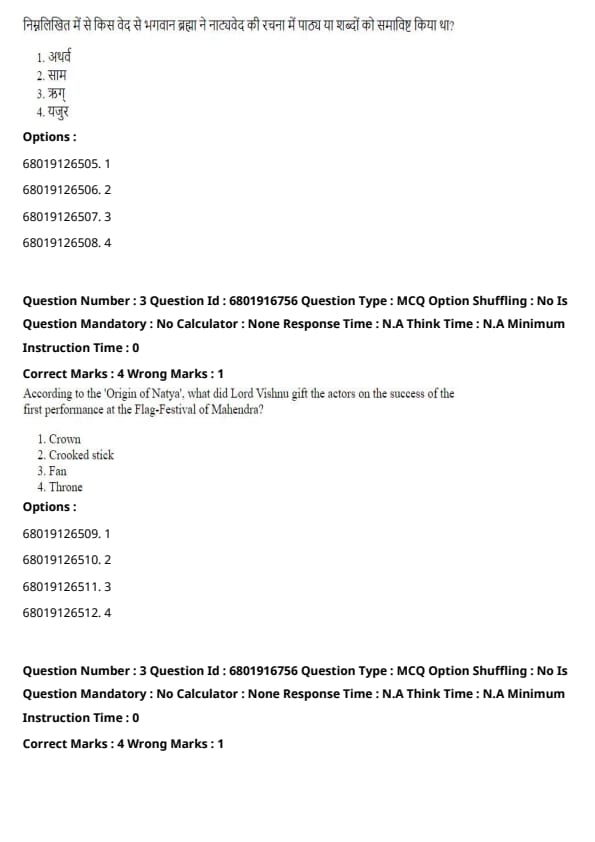
From which of the following Vedas, Lord Brahma incorporated pathya or words in the composition of the Natyaveda?
View Solution
Solution: Lord Brahma is said to have incorporated pathya or words from the Sama Veda into the composition of the Natyaveda, which is the foundation for classical Indian dance and drama.
Quick Tip: The Sama Veda's musical and rhythmic aspects deeply influenced the composition of Natyaveda, which integrates dance, music, and drama.
Question 3:
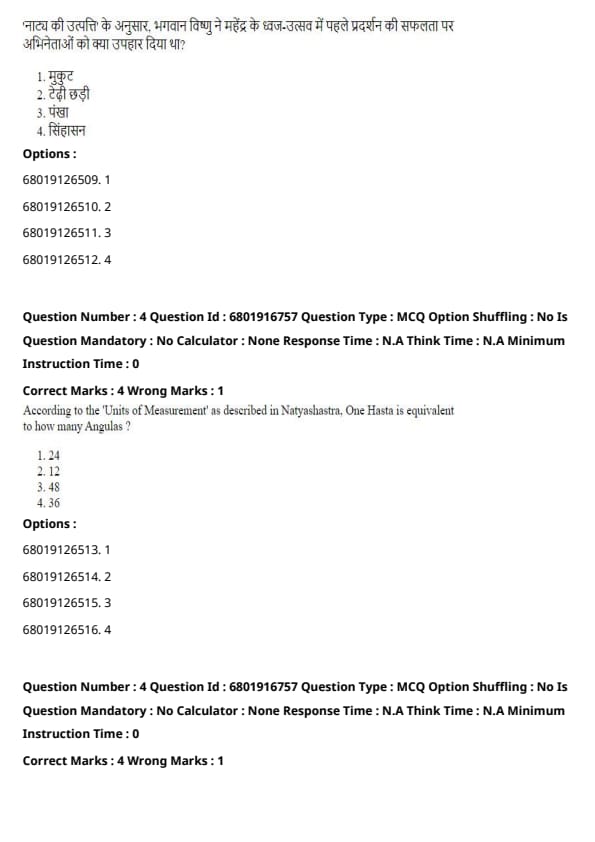
According to the 'Origin of Natya', what did Lord Vishnu gift the actors on the success of the first performance at the Flag-Festival of Mahendra?
View Solution
Solution: According to the 'Origin of Natya', Lord Vishnu gifted the actors a crooked stick after their successful performance at the Flag-Festival of Mahendra, symbolizing their role in drama and performing arts.
Quick Tip: The crooked stick is symbolic of the performing arts, representing the role of the actor in bringing the story to life.
Question 4:
According to the 'Units of Measurement' as described in Natyashastra, One Hasta is equivalent to how many Angulas?
View Solution
Solution: In the Natyashastra, the unit of measurement for physical gestures and hand movements is the Hasta, which is equivalent to 12 Angulas.
Quick Tip: The precise measurement of hand movements and gestures in classical dance forms is a fundamental aspect of Natyashastra.
Question 5:
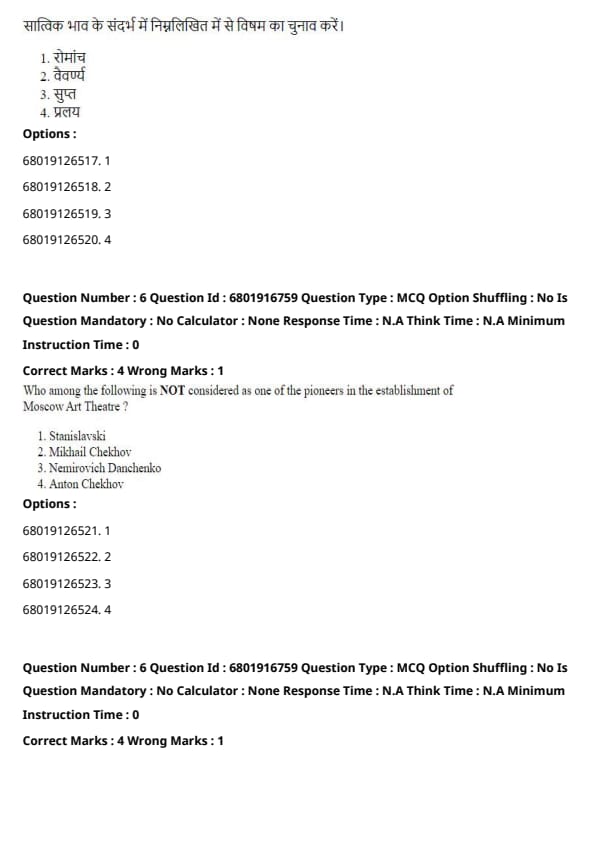
Pick the odd one out in the context of Sattvika Bhava:
View Solution
Solution: Sattvika Bhava refers to the mental and emotional states in performance art. Among the listed options, Supta (sleep) is the odd one out, as it is not typically associated with the emotional expressions of the actor, unlike Romancha, Vaivarnya, and Pralaya.
Quick Tip: Sattvika Bhava represents emotional expressions that are crucial in classical performance arts to convey a wide range of human experiences.
Question 6:
Who among the following is NOT considered as one of the pioneers in the establishment of Moscow Art Theatre?
View Solution
Solution: Although Anton Chekhov was a key playwright whose works were performed at the Moscow Art Theatre, he was not one of its founders. The pioneers of the theatre were Stanislavski, Nemirovich-Danchenko, and Mikhail Chekhov.
Quick Tip: The Moscow Art Theatre is known for its innovative acting techniques, notably developed by Stanislavski, which transformed modern theatre.
Question 7:
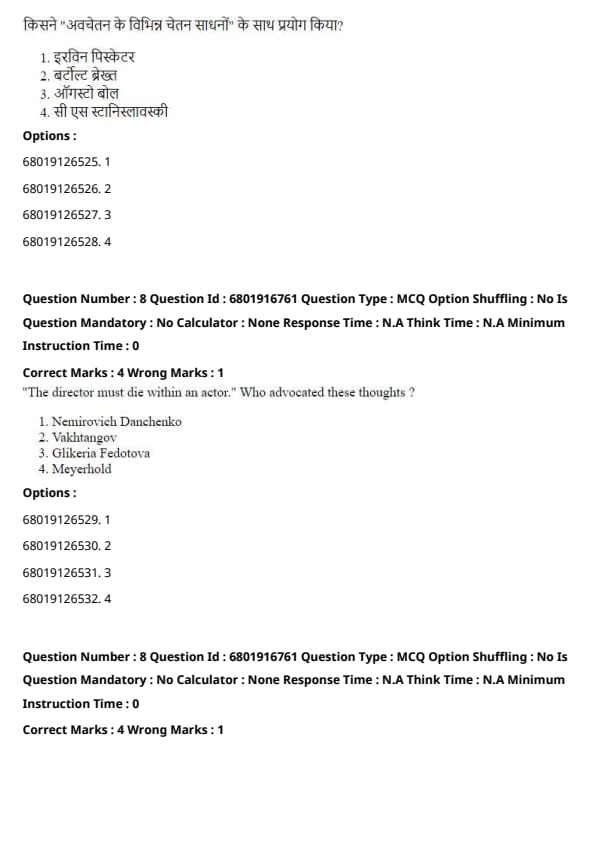
Who experimented with various ”Conscious means to the Subconscious"?
View Solution
Solution: Stanislavski developed a method that explored the conscious control of subconscious emotions in acting, which became known as the "Stanislavski System," aiming to create more natural and psychologically complex performances.
Quick Tip: Stanislavski's work focused on the actor's psychological and emotional processes to bring authenticity to the performance.
Question 8:
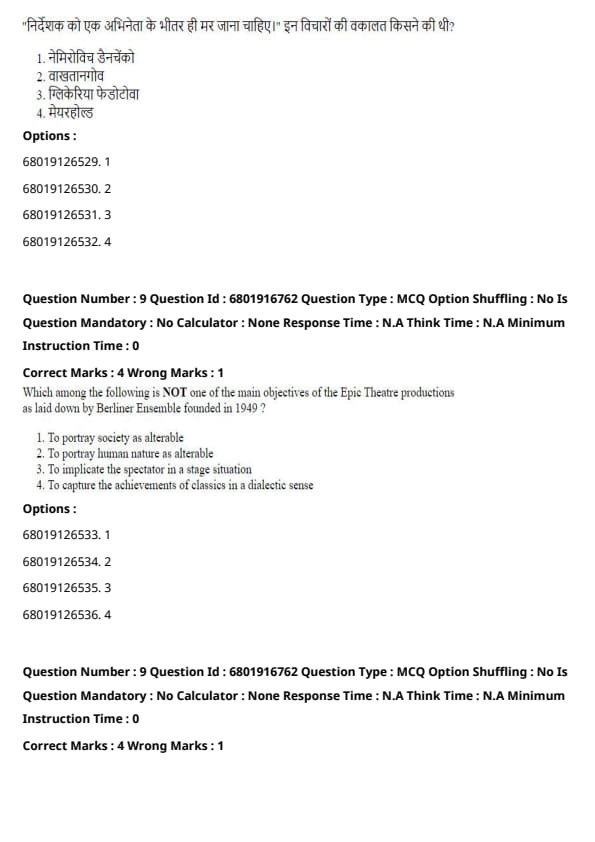
"The director must die within an actor.” Who advocated these thoughts?
View Solution
Solution: Vakhtangov emphasized the necessity of a deep, intimate relationship between the actor and director. His belief was that the director must become one with the actor in order to inspire and guide their performance authentically.
Quick Tip: Vakhtangov's work was a precursor to the more experimental approaches to theatre, focusing on the fusion of actor and director.
Question 9:
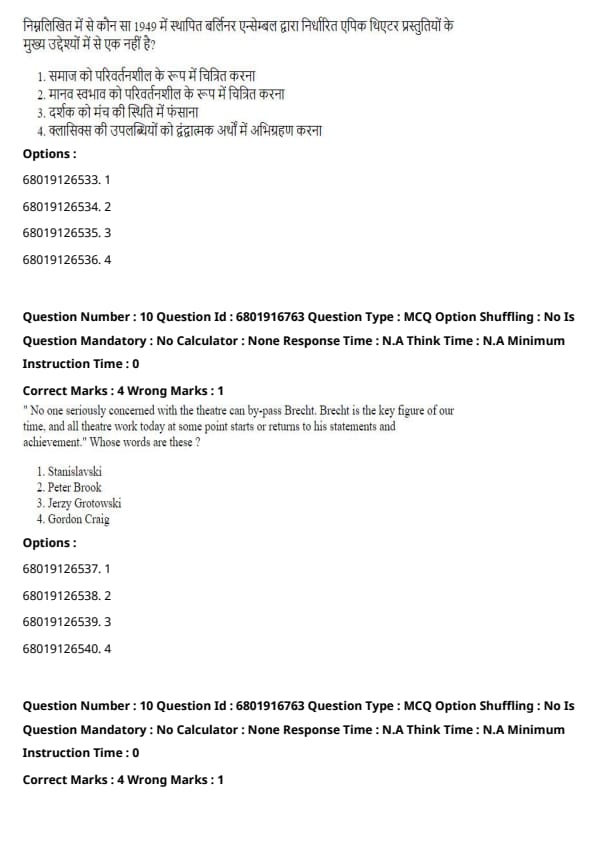
Which among the following is NOT one of the main objectives of the Epic Theatre productions as laid down by Berliner Ensemble founded in 1949?
View Solution
Solution: Epic Theatre, founded by Brecht and the Berliner Ensemble, aimed to provoke thought and social change by presenting society and human nature as changeable, rather than focusing on capturing traditional classics or idealized versions of the past.
Quick Tip: Epic Theatre aims to engage the audience's critical thinking, encouraging them to reflect on societal and human issues.
Question 10:
"No one seriously concerned with the theatre can bypass Brecht. Brecht is the key figure of our time, and all theatre work today at some point starts or returns to his statements and achievements." Whose words are these?
View Solution
Solution: Peter Brook, a renowned theatre director, acknowledged Bertolt Brecht's profound influence on modern theatre, recognizing Brecht's role as a key figure in shaping contemporary performance art.
Quick Tip: Brecht's ideas revolutionized theatre, emphasizing social engagement and critical reflection, influencing generations of theatre practitioners.
Question 11:
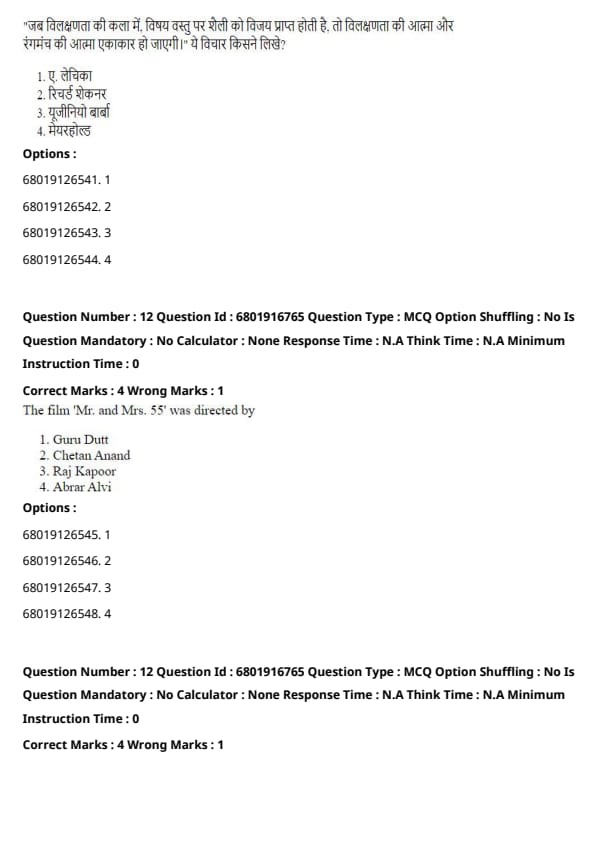
"When in the art of the grotesque, form triumphs over content, then the soul of the grotesque and the soul of the theatre will be one.” Who wrote these thoughts?
View Solution
Solution: The thoughts are attributed to Vsevolod Meyerhold, a Russian theatre director and innovator, known for his work on the grotesque in theatre and his emphasis on form over content in performance.
Quick Tip: Meyerhold's approach to theatre often focused on physical expression and form, particularly in his work with biomechanics.
Question 12:
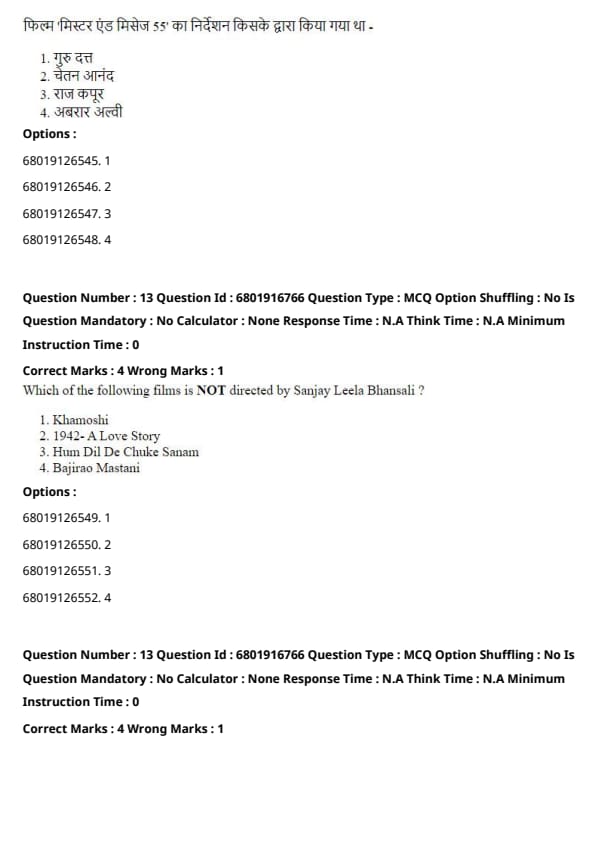
The film 'Mr. and Mrs. 55' was directed by
View Solution
Solution: 'Mr. and Mrs. 55' (1955) was directed by Guru Dutt, a legendary figure in Indian cinema known for his innovative contributions to Bollywood films.
Quick Tip: Guru Dutt's films often explored themes of melancholy and human emotions, making him a prominent figure in Indian cinema.
Question 13:
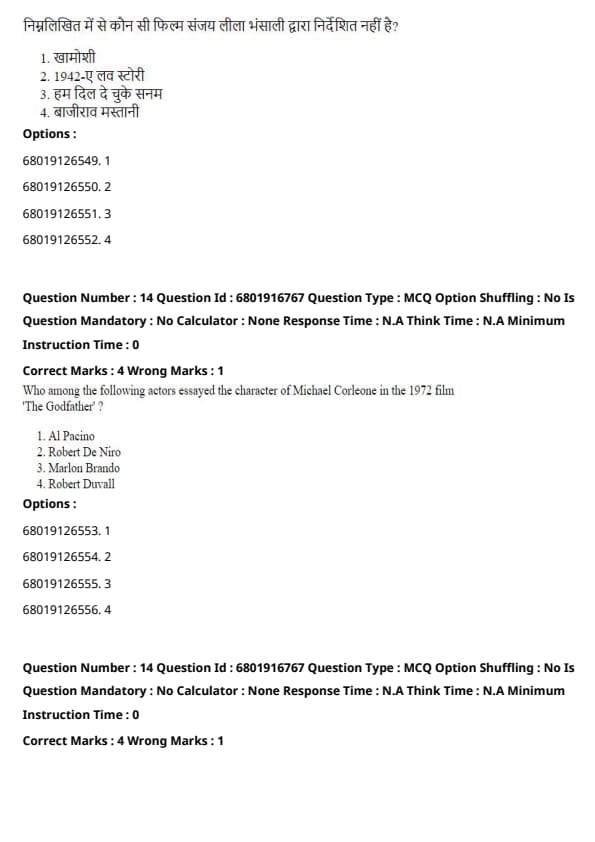
Which of the following films is NOT directed by Sanjay Leela Bhansali?
View Solution
Solution: '1942- A Love Story' (1994) was directed by Vidhu Vinod Chopra, not Sanjay Leela Bhansali. Bhansali is known for films like 'Hum Dil De Chuke Sanam' and 'Bajirao Mastani'.
Quick Tip: Sanjay Leela Bhansali is famous for his grandiose storytelling, especially in historical films like 'Bajirao Mastani'.
Question 14:
Who among the following actors essayed the character of Michael Corleone in the 1972 film 'The Godfather'?
View Solution
Solution: Al Pacino played the iconic role of Michael Corleone in the 1972 film 'The Godfather', directed by Francis Ford Coppola. This role made him an international star.
Quick Tip: Al Pacino's portrayal of Michael Corleone remains one of the most iconic and critically acclaimed performances in film history.
Question 15:
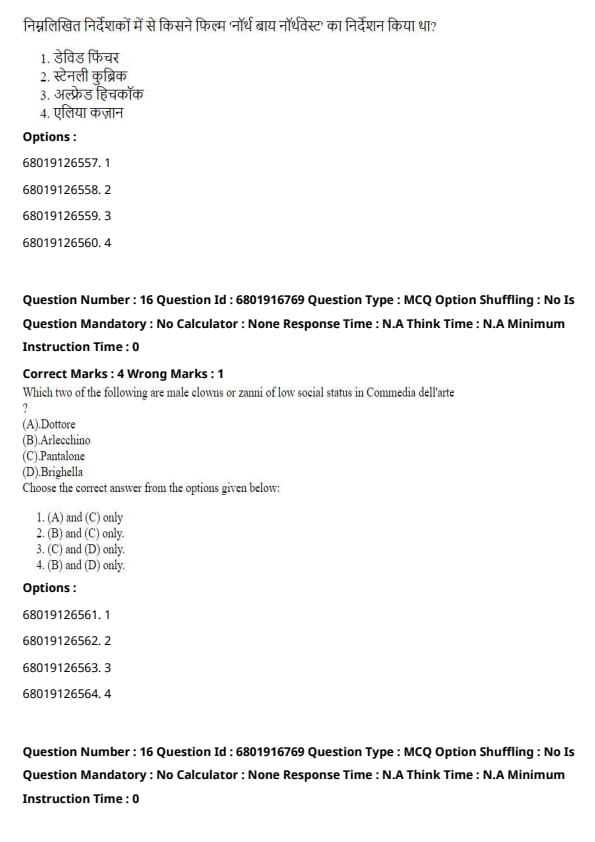
Who among the following directors directed the film 'North by Northwest'?
View Solution
Solution: 'North by Northwest' (1959) was directed by Alfred Hitchcock, known for his mastery of suspense and psychological thrillers.
Quick Tip: Alfred Hitchcock is a legendary filmmaker, recognized for creating some of the most influential suspense and thriller films in cinematic history.
Question 16:
Which two of the following are male clowns or zanni of low social status in Commedia dell'arte?
View Solution
Solution: In Commedia dell'arte, Arlecchino (B) and Brighella (D) are the male clowns, or zanni, of low social status. Dottore (A) and Pantalone (C) are not classified as zanni, as they represent different character types, such as the learned man and the wealthy Venetian merchant, respectively.
Quick Tip: Zanni characters like Arlecchino and Brighella often represent lower-class figures with comedic roles in Commedia dell'arte performances.
Question 17:
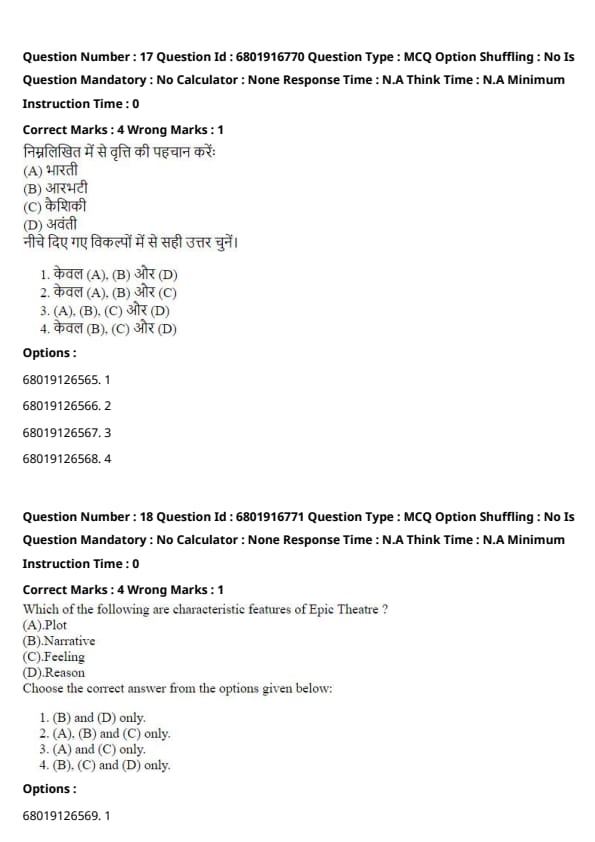
Identify Vrittis from among the following:
View Solution
Solution: Vrittis are classified in Natya Shastra, and all the given options Bharati, Arabhati, Kaishiki, and Avanti are considered Vrittis, which represent various types of hand gestures or movements used in classical Indian dance and drama.
Quick Tip: Vrittis represent different types of hand gestures in classical Indian performance arts and are vital for expressing emotions and narratives.
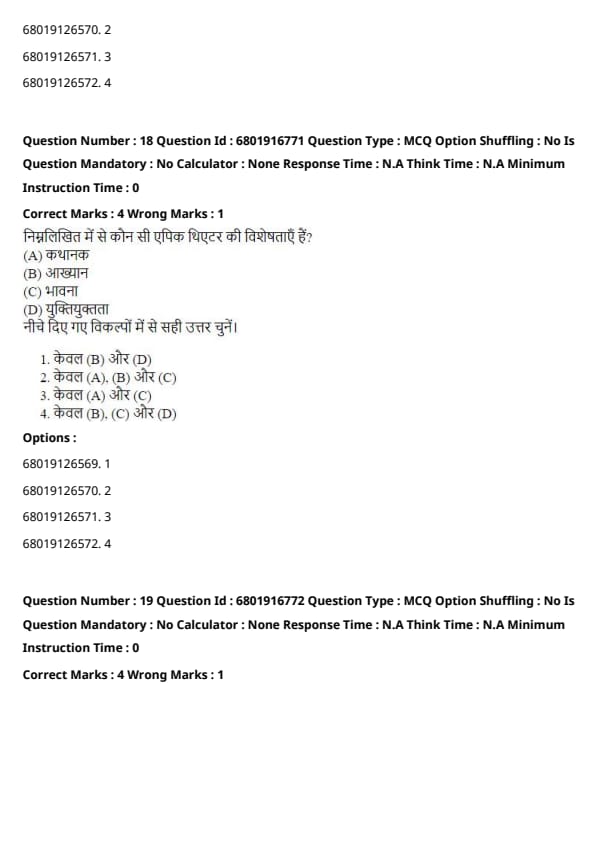
Question 18:
Which of the following are characteristic features of Epic Theatre?
View Solution
Solution: Epic Theatre, as developed by Bertolt Brecht, focuses on narrative and reason rather than feeling and traditional plot development. The goal is to engage the audience's critical thinking through a narrative and logical structure, distancing them from emotional involvement.
Quick Tip: Epic Theatre challenges traditional notions of theatre by prioritizing intellectual engagement over emotional involvement.
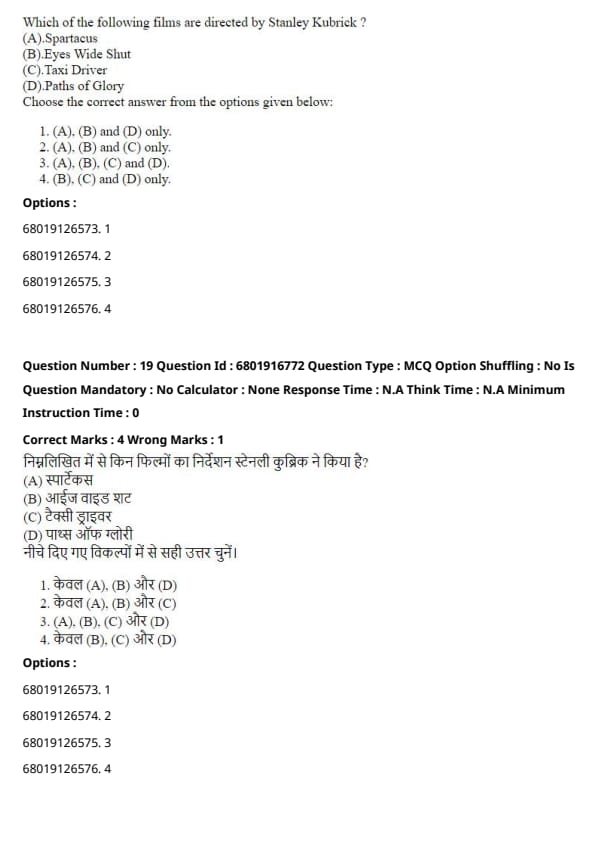
Question 19:
Which of the following films are directed by Stanley Kubrick?
View Solution
Solution: Stanley Kubrick directed 'Spartacus', 'Eyes Wide Shut', and 'Paths of Glory'. However, 'Taxi Driver' was directed by Martin Scorsese, not Kubrick.
Quick Tip: Stanley Kubrick is known for his iconic and thought-provoking films, including 'Eyes Wide Shut' and 'Paths of Glory'.
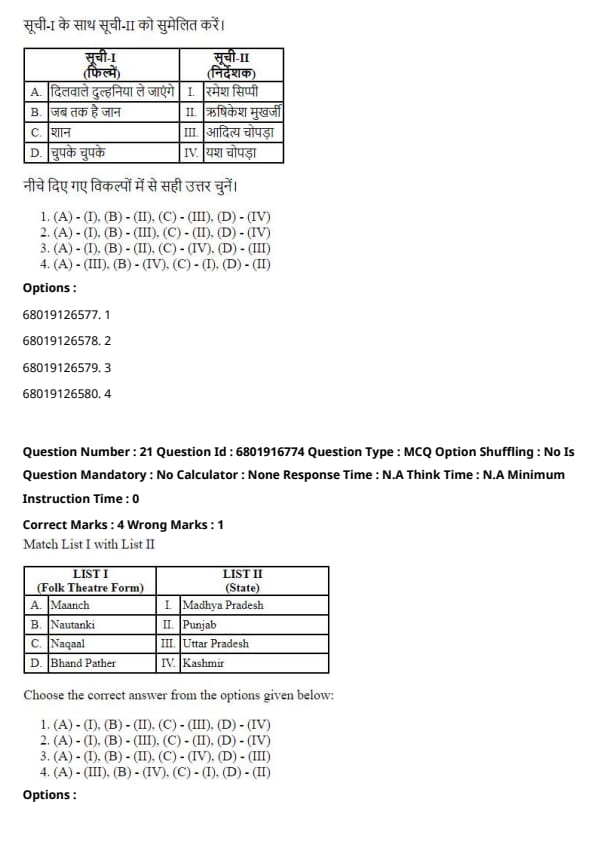
Question 20:
Match List I with List II:
List I Films
List II Directors
View Solution
Solution:
- Dilwale Dulhaniya Le Jayenge (A) was directed by Aditya Chopra (III).
- Jab Tak Hai Jaan (B) was directed by Yash Chopra (IV).
- Shaan (C) was directed by Ramesh Sippy (I).
- Chupke Chupke (D) was directed by Hrishikesh Mukherjee (II).
Quick Tip: The films listed here are iconic Bollywood movies, each directed by legendary filmmakers who have shaped the Indian cinema landscape.
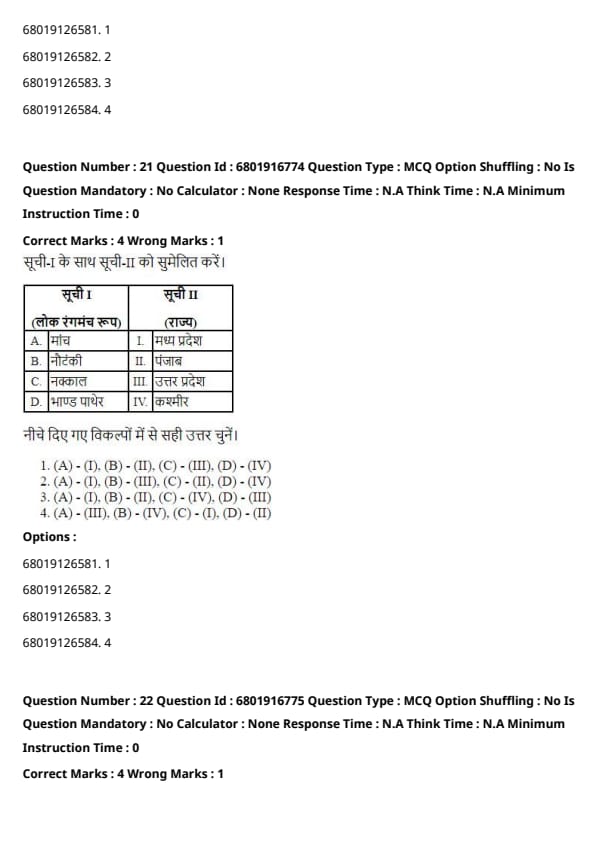
Question 21:
Match List I with List II:
List I Folk Theatre Form
List II State
View Solution
Solution:
- Maanch (A) is from Madhya Pradesh (I).
- Nautanki (B) is from Punjab (II).
- Naqqaal (C) is from Uttar Pradesh (III).
- Bhand Pather (D) is from Kashmir (IV).
Quick Tip: Folk theatre forms are an integral part of cultural heritage, with each state contributing unique traditions and performances.
Question 22:
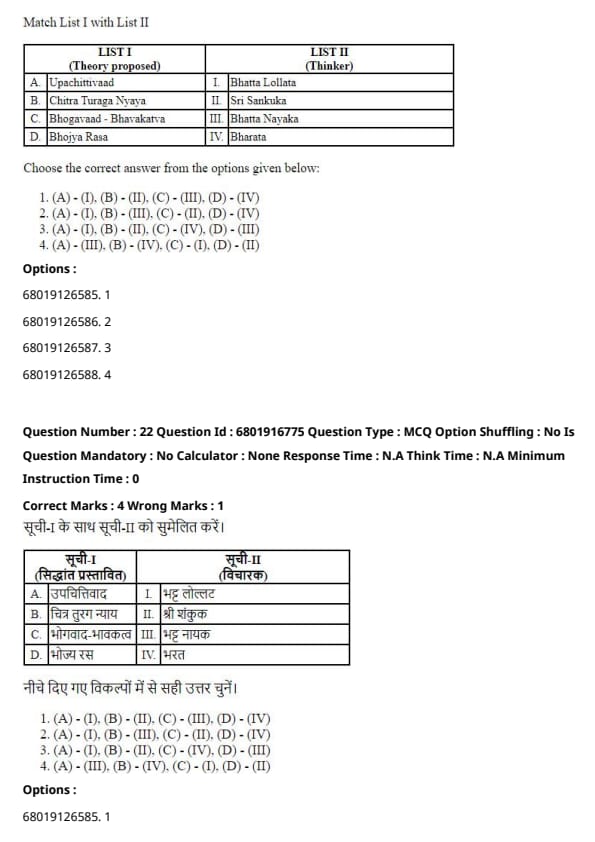
Match List I with List II:
List I Theory proposed
List II Thinker
View Solution
Solution:
- Upachittivaad (A) is associated with Bhatta Lollata (I).
- Chitra Turaga Nyaya (B) is associated with Sri Sankuka (II).
- Bhogaavad - Bhavatkva (C) is associated with Bhatta Nayaka (III).
- Bhojya Rasa (D) is associated with Bharata (IV).
Quick Tip: Theoretical concepts like Upachittivaad and Bhogaavad are crucial in understanding ancient Indian aesthetics, particularly in relation to performance and drama.
Question 23:
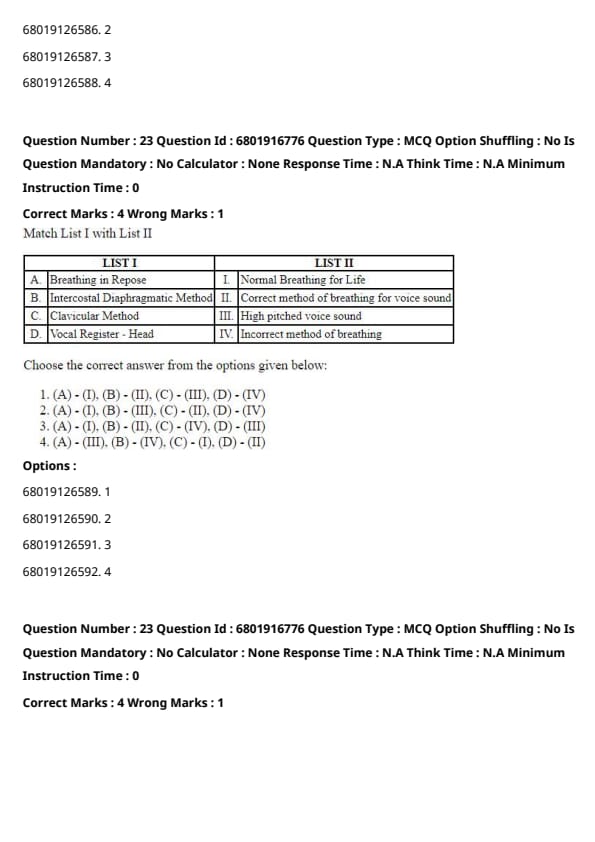
Match List I with List II:
List I Breathing Method
List II Breathing Description
View Solution
Solution:
- Breathing in repose (A) refers to normal breathing for life (I).
- Intercostal Diaphragmatic Method (B) is the correct method of breathing for voice sound (II).
- Clavicular Method (C) results in high pitched voice sound (III).
- Vocal Register - Head (D) is an incorrect method of breathing (IV).
Quick Tip: Proper breathing methods, especially in vocal performance, are essential for controlling sound and maintaining health.
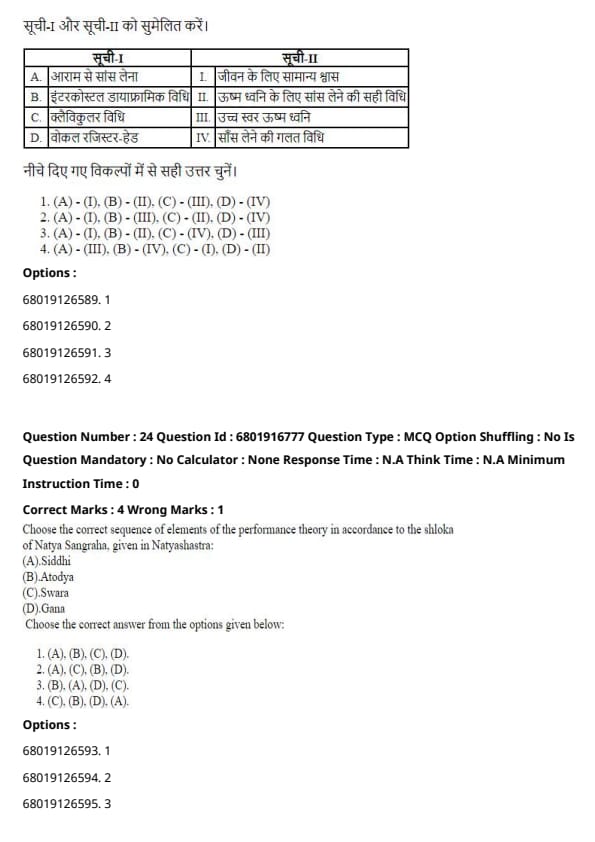
Question 24:
Choose the correct sequence of elements of the performance theory in accordance to the shloka of Natya Sangraha, given in Natyashastra:
View Solution
Solution: According to the shloka from Natya Sangraha in Natyashastra, the correct sequence of performance elements is Siddhi (A), followed by Swara (C), Atodya (B), and Gana (D).
Quick Tip: Understanding the sequence of elements in performance theory is essential for creating harmonious and impactful theatre performances.
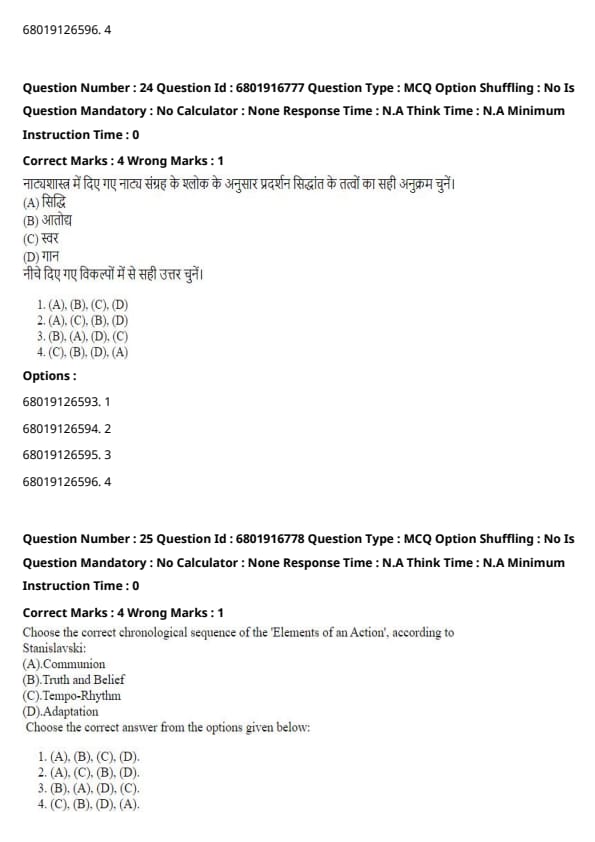
Question 25:
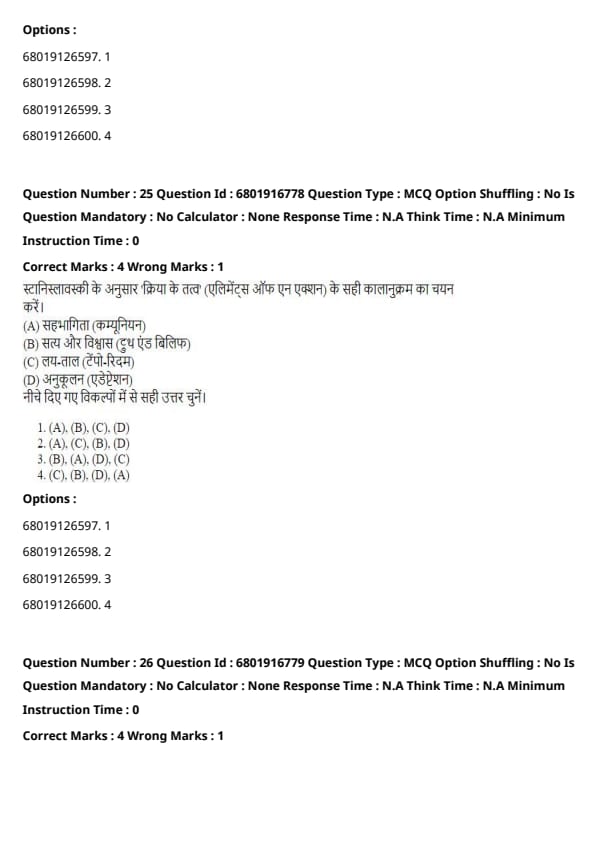
Choose the correct chronological sequence of the 'Elements of an Action', according to Stanislavski:
View Solution
Solution: According to Stanislavski, the correct chronological sequence of the elements of an action is Communion (A), Truth and Belief (B), Tempo-Rhythm (C), and Adaptation (D), which guides the actor's approach to creating a believable and authentic performance.
Quick Tip: Stanislavski's method emphasizes the importance of creating a connection with the audience, truth in performance, rhythm in delivery, and the ability to adapt to the situation.
Question 26:
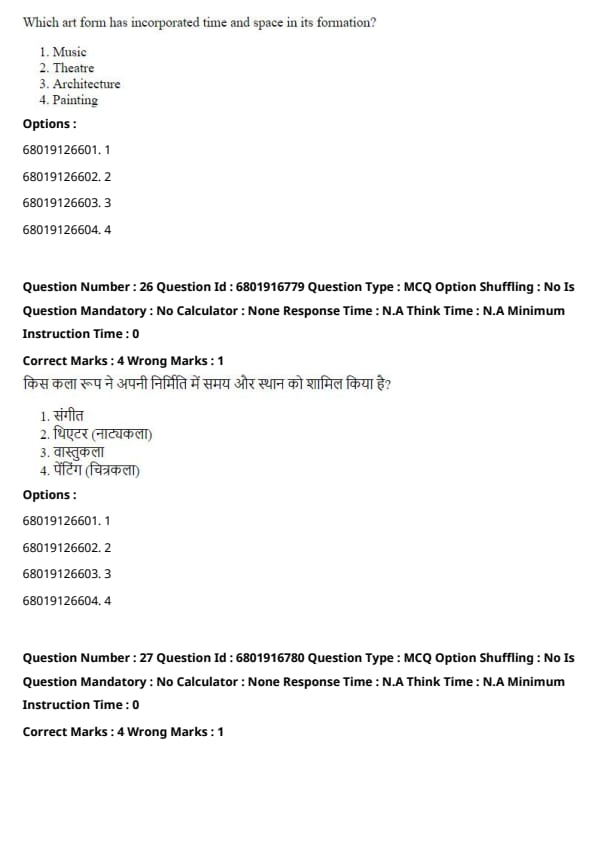
Which art form has incorporated time and space in its formation?
View Solution
Solution: Theatre is the art form that inherently incorporates time and space in its formation, as the performance takes place in real-time and occupies a defined physical space, blending movement, dialogue, and visual composition.
Quick Tip: In theatre, the use of time (through performance) and space (the stage) is crucial in creating an immersive experience for the audience.
Question 27:
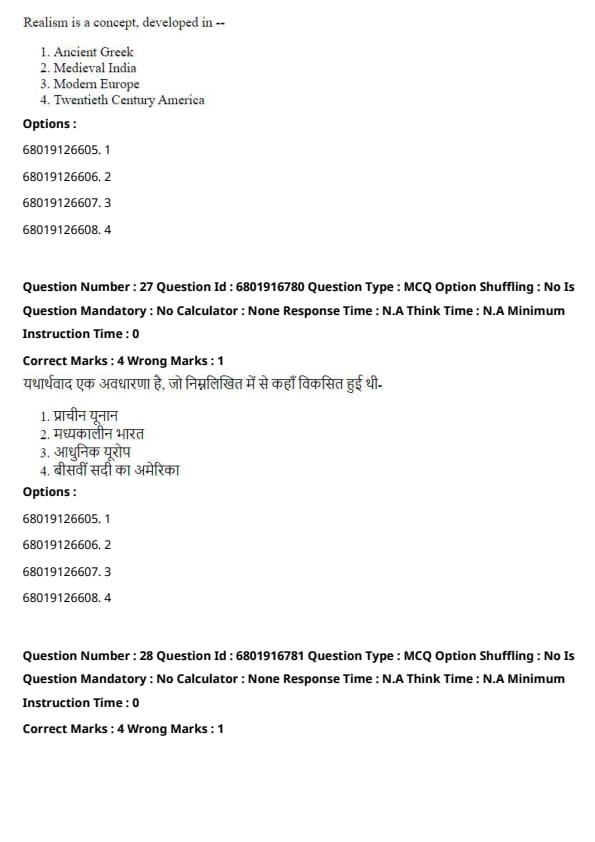
Realism is a concept, developed in
View Solution
Solution: Realism as an artistic and philosophical concept originated in Modern Europe, particularly in the 19th century, as a response to Romanticism and idealized representations, focusing on portraying life in its true, unembellished form.
Quick Tip: Realism emerged in European art and theatre as an attempt to depict everyday life and ordinary people in a truthful manner, challenging exaggerated or idealized portrayals.
Question 28:
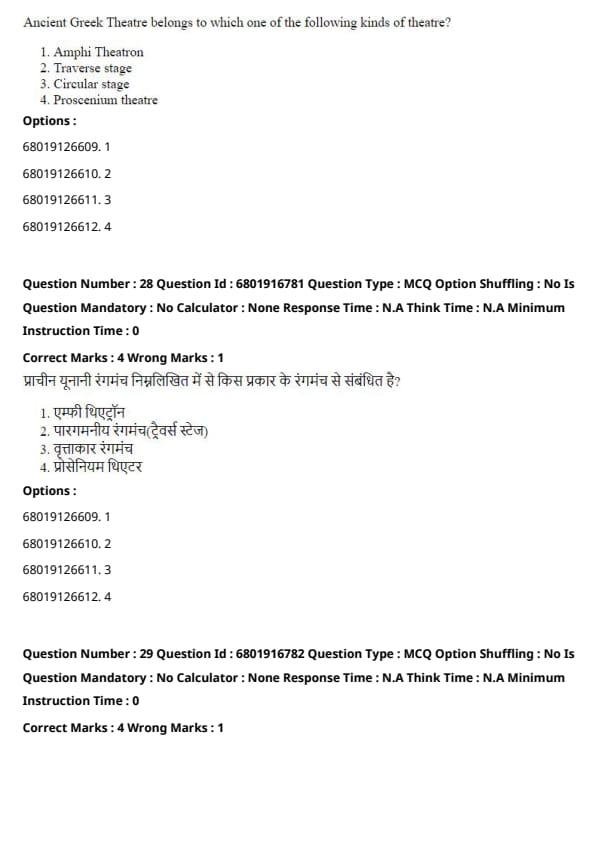
Ancient Greek Theatre belongs to which one of the following kinds of theatre?
View Solution
Solution: Ancient Greek Theatre typically used an "Amphi Theatron" stage, which was a semi-circular or circular open-air theatre, designed to allow for optimal acoustics and sightlines for the audience.
Quick Tip: The Amphi Theatron in Ancient Greek Theatre allowed for large audiences and was instrumental in the development of dramatic performance and theatre architecture.
Question 29:
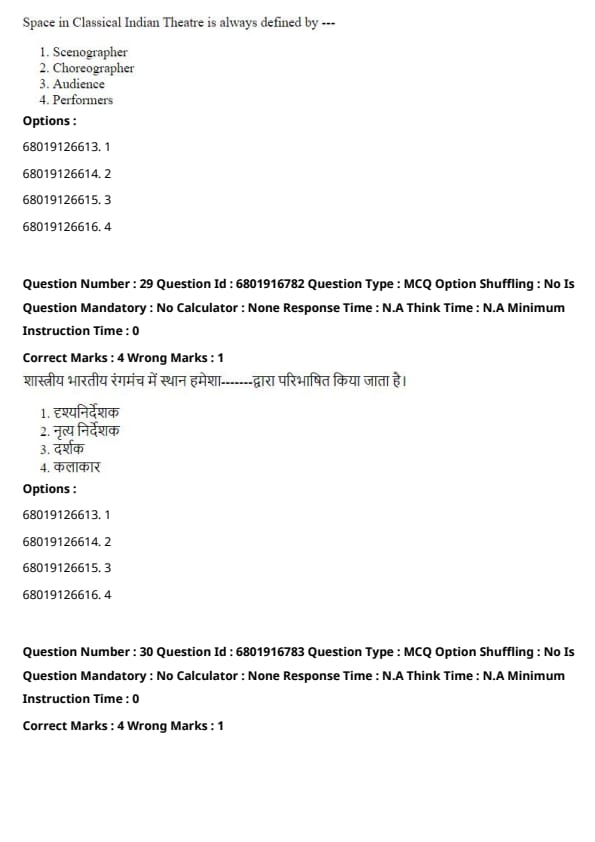
Space in Classical Indian Theatre is always defined by
View Solution
Solution: In Classical Indian Theatre, the space is traditionally defined by the audience. The interaction between the performers and the audience shapes the spatial experience, and the performers often use the entire stage area to engage with the audience.
Quick Tip: The audience plays a crucial role in Indian theatre, often influencing the performance through their interaction with the performers and the space.
Question 30:
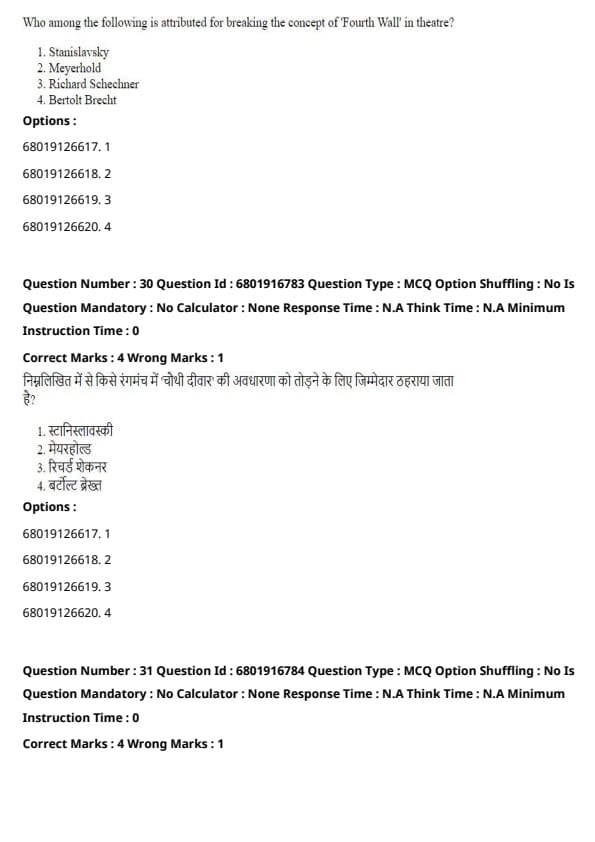
Who among the following is attributed for breaking the concept of 'Fourth Wall' in theatre?
View Solution
Solution: Bertolt Brecht is known for his concept of breaking the "Fourth Wall" in theatre, encouraging actors to address the audience directly and making them aware of the performance as a form of social commentary, rather than a mere illusion.
Quick Tip: Brecht's "Verfremdungseffekt" (alienation effect) sought to make the audience critically reflect on the action by breaking the immersive experience typical in traditional theatre.
Question 31:
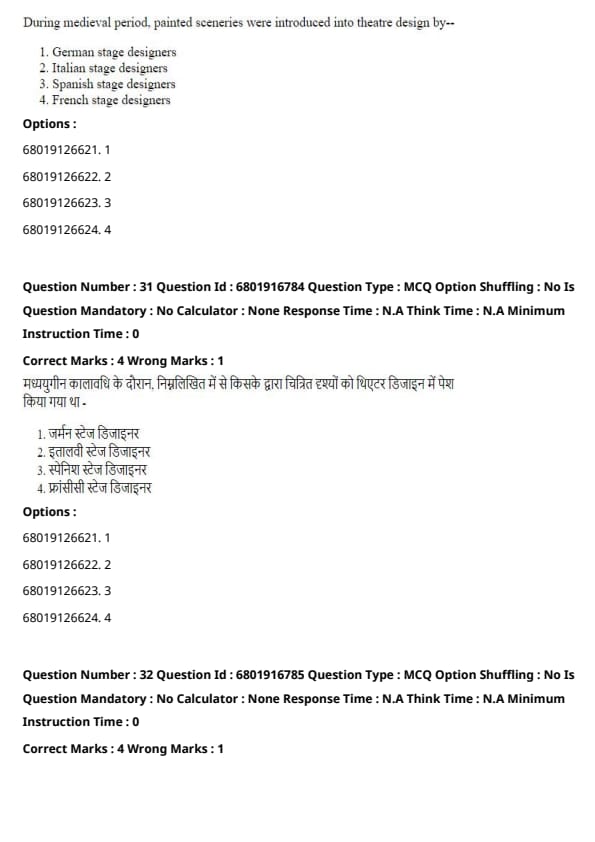
During the medieval period, painted sceneries were introduced into theatre design by-
View Solution
Solution: It was the Italian stage designers who introduced painted sceneries into theatre design during the medieval period, notably in their development of perspective scenery and the use of painted backdrops.
Quick Tip: Italian theatre designers revolutionized stage design with their focus on perspective, influencing the development of modern scenic design.
Question 32:
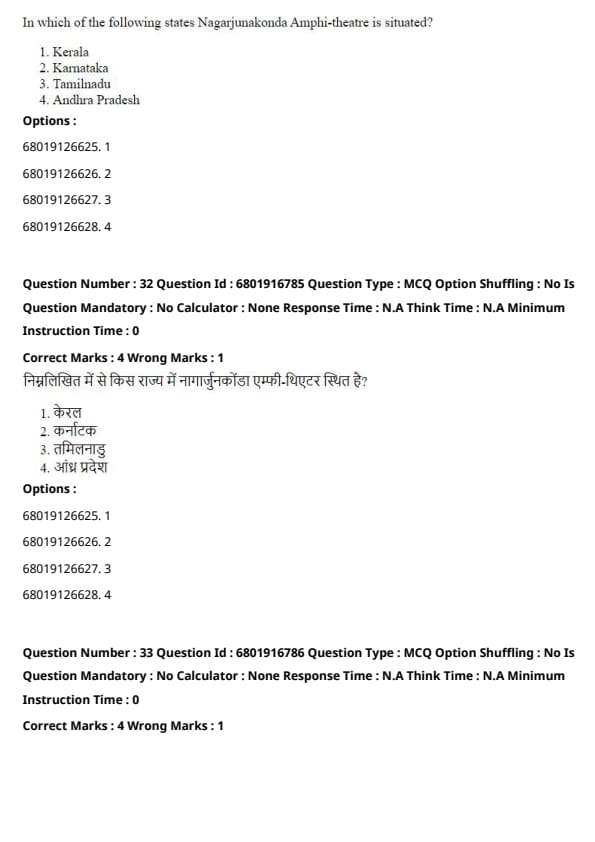
In which of the following states Nagarjunakonda Amphi-theatre is situated?
View Solution
Solution: Nagarjunakonda Amphi-theatre is situated in the state of Andhra Pradesh, India, and is an important archaeological and architectural site from the ancient period.
Quick Tip: The Nagarjunakonda site is an ancient Buddhist complex, and its amphitheatre is a notable example of ancient Indian theatre architecture.
Question 33:
Which of the following painters is known for creating "Abstract Expressionism" in his works?
View Solution
Solution: Jackson Pollock is known for pioneering Abstract Expressionism, characterized by his unique "drip painting” technique, which emphasized spontaneous, automatic, or subconscious creation.
Quick Tip: Pollock's work in Abstract Expressionism was instrumental in the shift from representational art to more abstract, emotionally intense works.
Question 34:
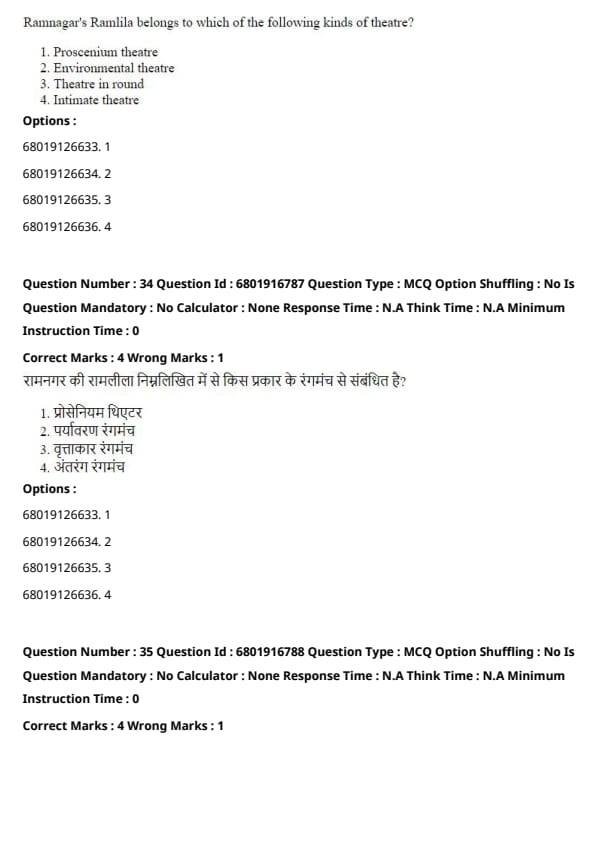
Ramnagar's Ramlila belongs to which of the following kinds of theatre?
View Solution
Solution: Ramnagar's Ramlila, a traditional performance of the Ramayana, is an example of environmental theatre, where the performance takes place in the natural environment, engaging the audience directly within the surroundings.
Quick Tip: Environmental theatre integrates the performance space with the natural environment, creating a dynamic and immersive experience for the audience.
Question 35:
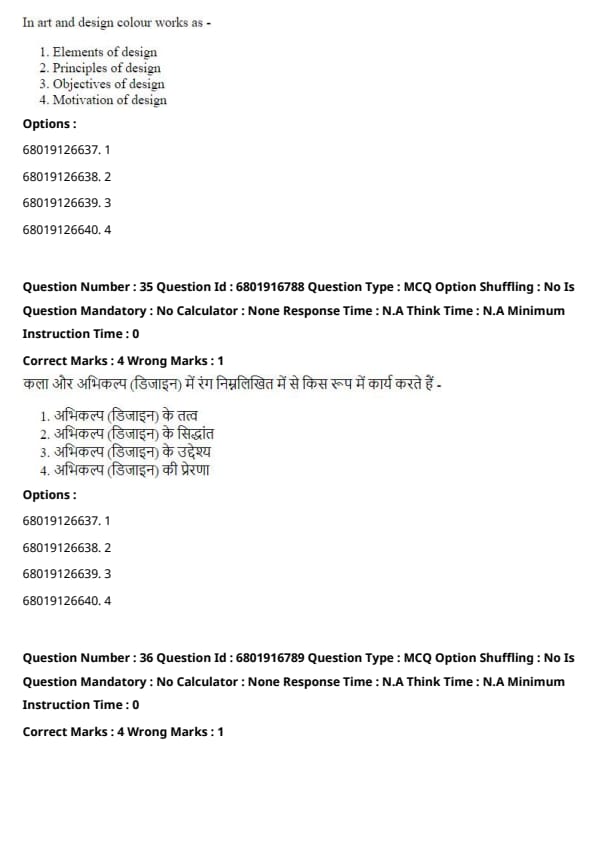
In art and design, colour works as
View Solution
Solution: Colour is considered one of the key elements of design, as it plays a crucial role in visual composition and affects the emotional and aesthetic impact of the artwork.
Quick Tip: In design, elements like colour, line, shape, and texture work together to form a cohesive composition that communicates the artist's intent.
Question 36:
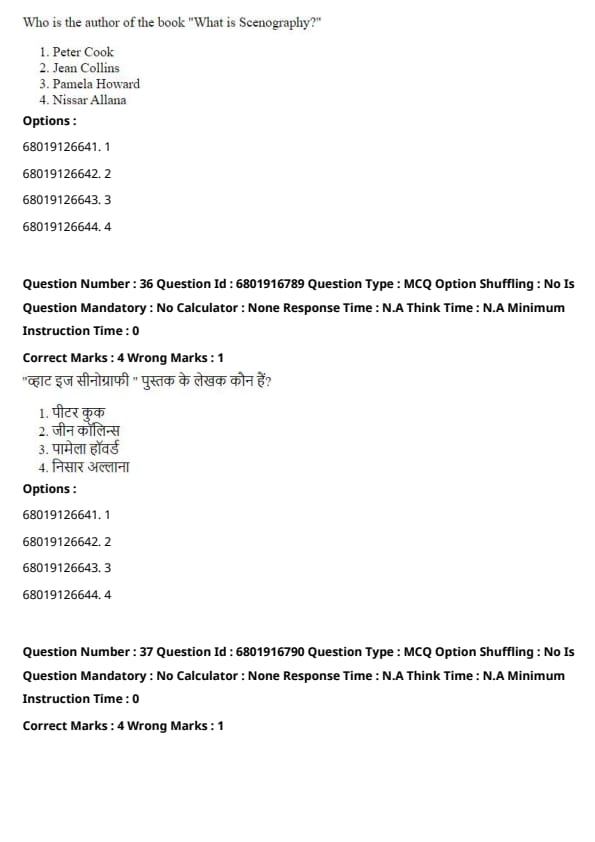
Who is the author of the book "What is Scenography?"
View Solution
Solution: The book "What is Scenography?" is authored by Pamela Howard. The book explores the art and practice of scenography in theatre design, making it an important text in the field.
Quick Tip: Scenography is a vital aspect of theatre design, involving the creation of stage settings, lighting, and props to enhance the overall performance.
Question 37:
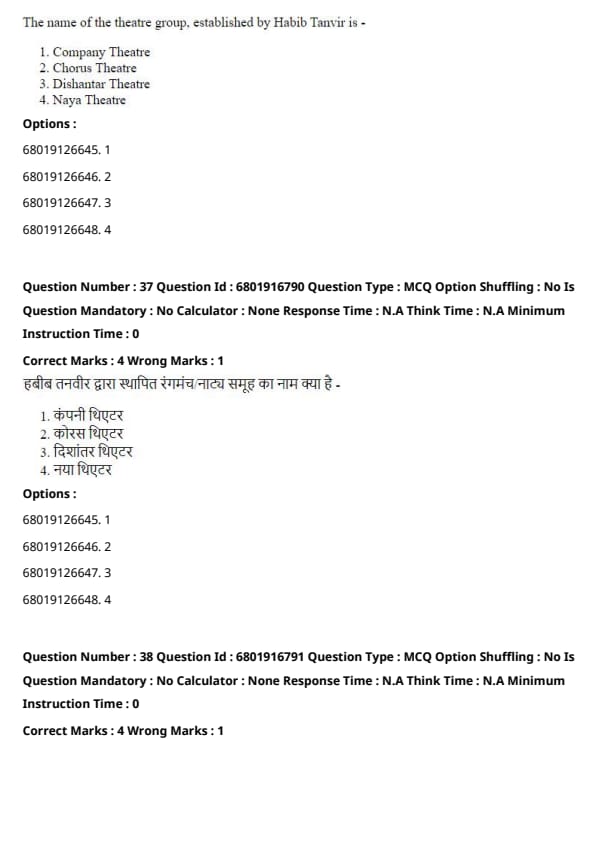
The name of the theatre group, established by Habib Tanvir is -
View Solution
Solution: Habib Tanvir founded Naya Theatre, a prominent Indian theatre company known for its innovative and socially relevant productions that often included folk elements.
Quick Tip: Naya Theatre is well-known for its contributions to Indian theatre, particularly through the blending of traditional folk theatre with modern forms.
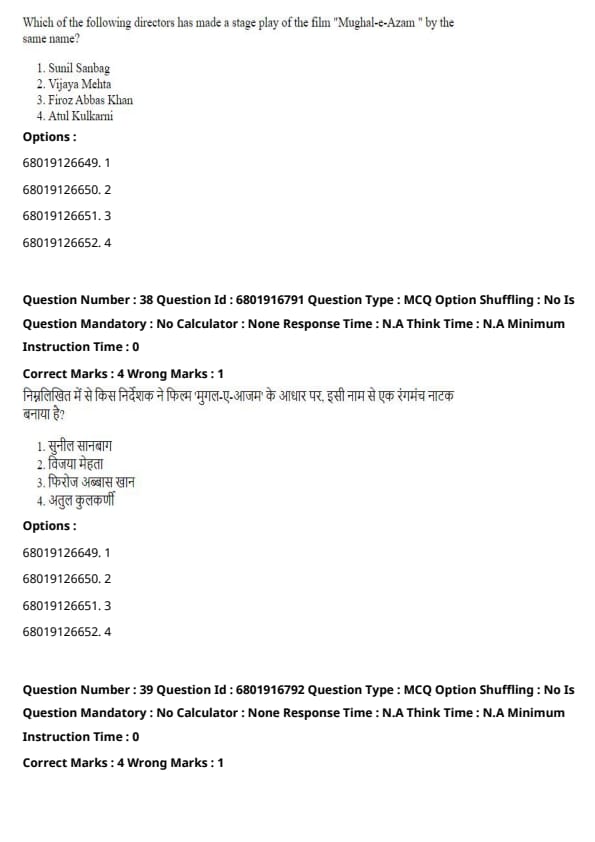
Question 38:
Which of the following directors has made a stage play of the film "Mughal-e-Azam" by the same name?
View Solution
Solution: Firoz Abbas Khan directed the stage play adaptation of the classic film "Mughal-e-Azam,” bringing the iconic story to the stage with grand production values and strong performances.
Quick Tip: The stage adaptation of "Mughal-e-Azam" was highly successful, keeping the essence of the original film while introducing new theatrical elements.
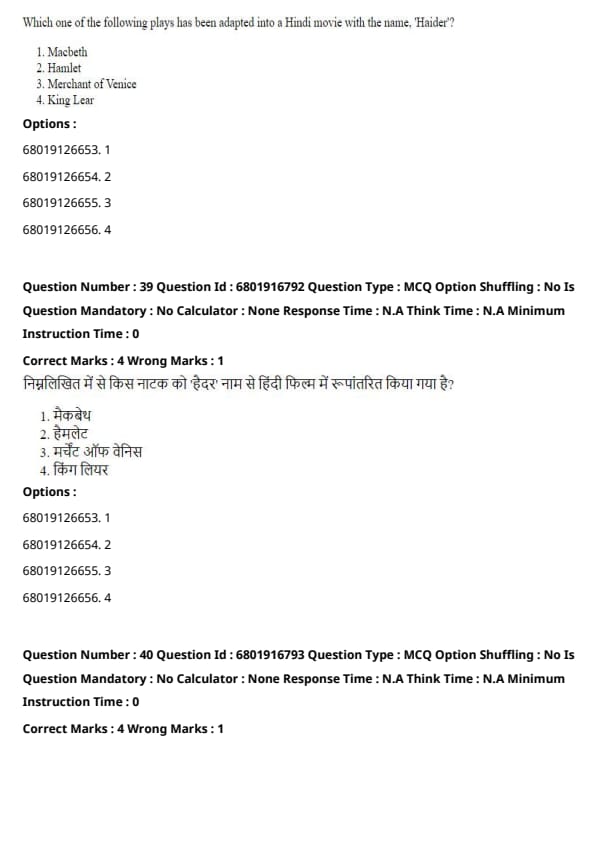
Question 39:
Which one of the following plays has been adapted into a Hindi movie with the name, Haider'?
View Solution
Solution: The Hindi film "Haider”(2014), directed by Vishal Bhardwaj, is an adaptation of William Shakespeare's play "Hamlet," set against the backdrop of Kashmir.
Quick Tip: "Haider” is a modern adaptation of Shakespeare's "Hamlet,” exploring themes of political unrest and personal tragedy in a contemporary Indian context.
Question 40:
In stage lighting, intensity is controlled through
View Solution
Solution: In stage lighting, the intensity of the light is controlled through a device called a dimmer, which adjusts the power supply to the light source, allowing for variations in brightness.
Quick Tip: Dimmer controls are essential for creating different moods and effects on stage by manipulating the light intensity.
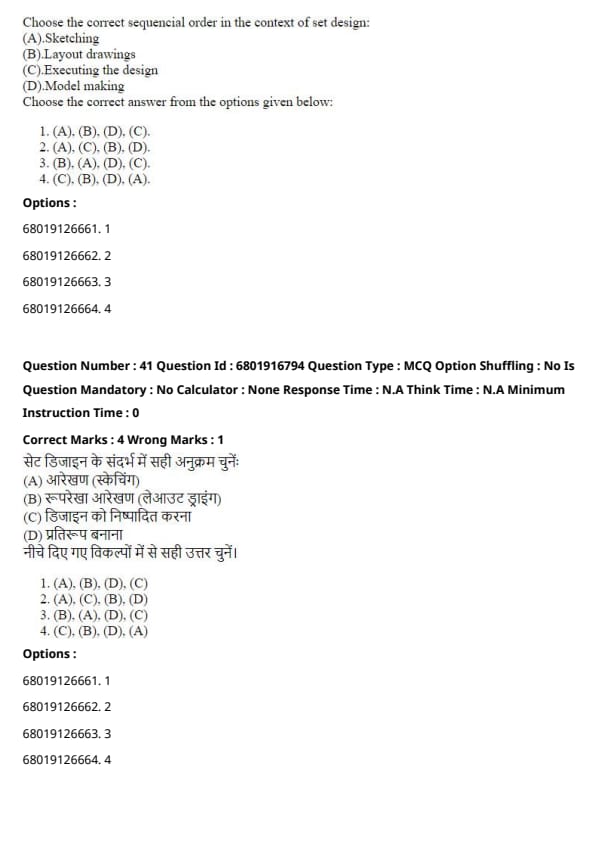
Question 41:
Choose the correct sequential order in the context of set design:
View Solution
Solution: In the context of set design, the sequence is:
- Sketching (A): Initial idea and visual representation of the design.
- Layout drawings (B): Detailed drawings outlining the dimensions and positioning of elements.
- Model making (D): Creating a small-scale model of the set to visualize the design.
- Executing the design (C): Constructing and installing the set for the performance.
Quick Tip: The process of set design involves conceptualizing the design through sketching, refining the idea with detailed drawings, creating a model, and finally executing the design for performance.
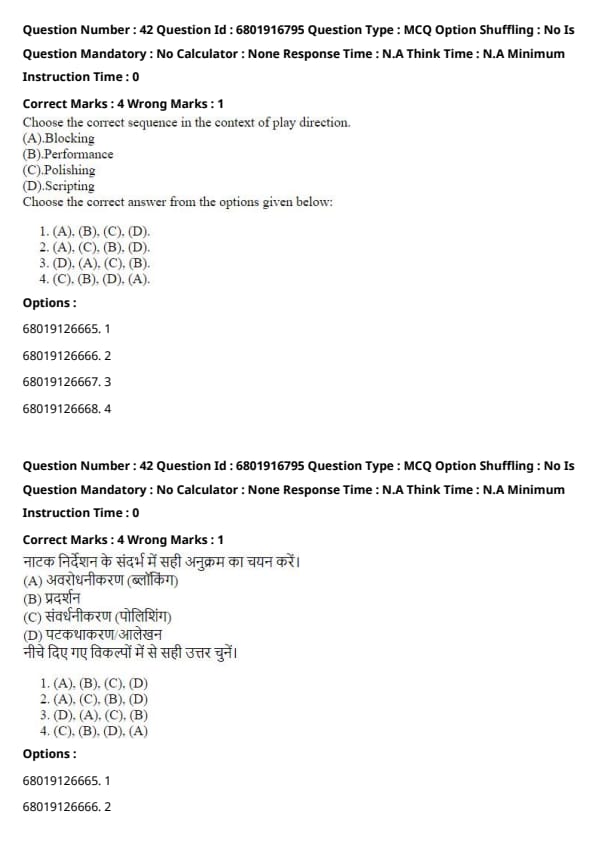
Question 42:
Choose the correct sequence in the context of play direction:
View Solution
Solution: The correct order of play direction is:
- Scripting (D): Writing the play script.
- Blocking (A): Determining the movement of actors on stage.
- Polishing (C): Refining the actors' performance and movements.
- Performance (B): The actual presentation of the play to the audience.
Quick Tip: In play direction, the process begins with scripting, followed by blocking the movements, polishing the performance, and finally presenting the performance.
Question 43:
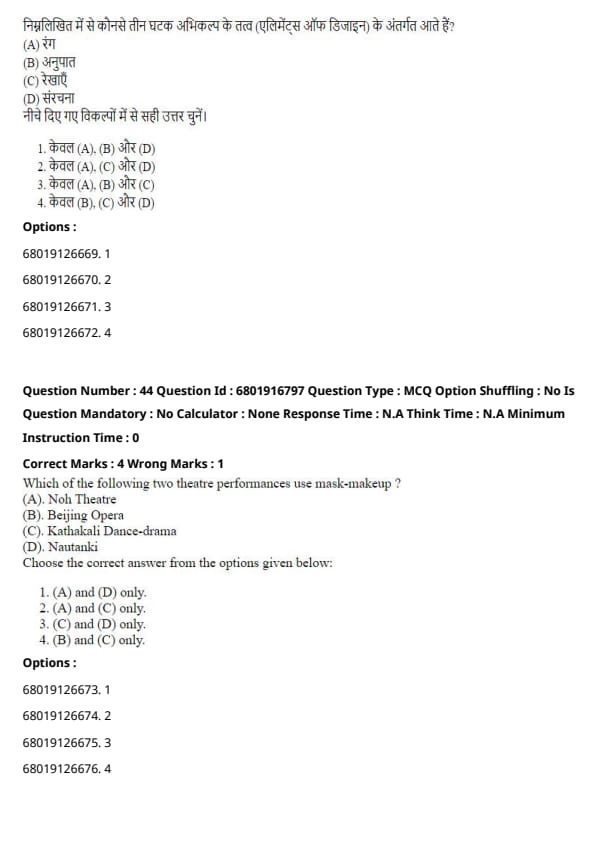
Which of the following three components fall under Elements of Design?
View Solution
Solution: The key elements of design in various art forms are:
- Colour (A): Used to create mood and emphasize particular features.
- Proportion (B): Relates to the size and scale relationships between components of the design.
- Texture (D): Adds depth and visual interest to the design.
Lines (C) are not specifically classified as an element of design but are used in various art forms to guide visual flow.
Quick Tip: Elements of design are key components such as colour, proportion, and texture that influence the visual appearance of art forms.
Question 44:
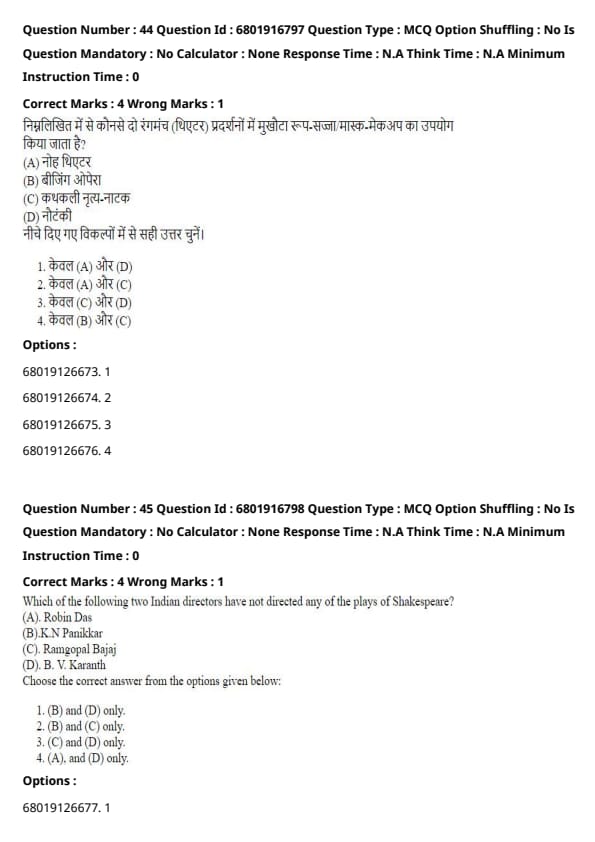
Which of the following two theatre performances use mask-makeup?
View Solution
Solution:
- Noh Theatre (A): A traditional Japanese theatre form that uses masks to represent characters.
- Kathakali Dance-drama (C): A classical Indian dance-drama in which performers wear elaborate masks and makeup.
Beijing Opera (B) and Nautanki (D) typically do not use masks in the same way.
Quick Tip: In traditional theatre forms, mask and makeup are used to convey different characters and emotions, such as in Noh Theatre and Kathakali.
Question 45:
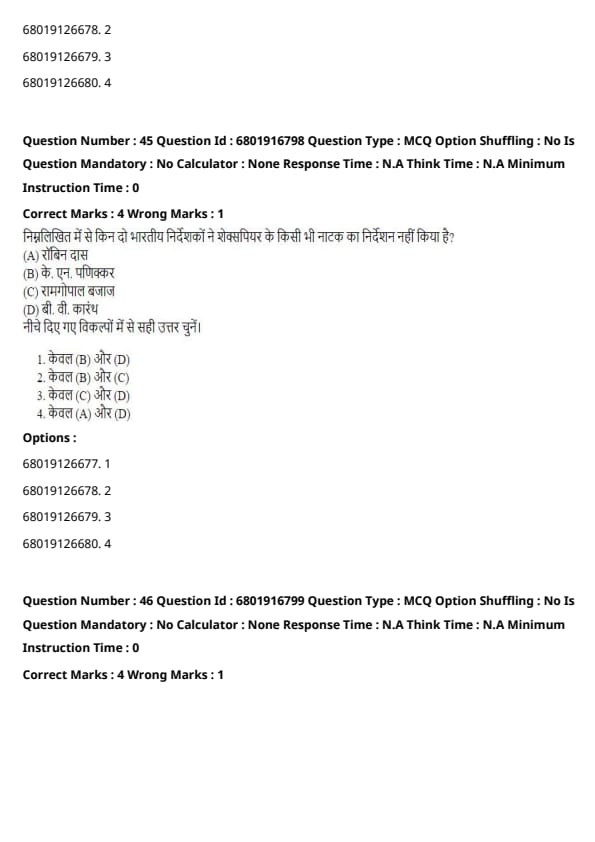
Which of the following two Indian directors have not directed any of the plays of Shakespeare?
View Solution
Solution: K.N Panikkar (B) and B. V. Karanth (D) are two prominent Indian directors who have not directed any of Shakespeare's plays. Robin Das (A) and Ramgopal Bajaj (C) have directed works of Shakespeare in their careers.
Quick Tip: Shakespeare's plays have been adapted and directed by many theatre personalities worldwide, though some renowned directors have focused on other playwrights.
Question 46:
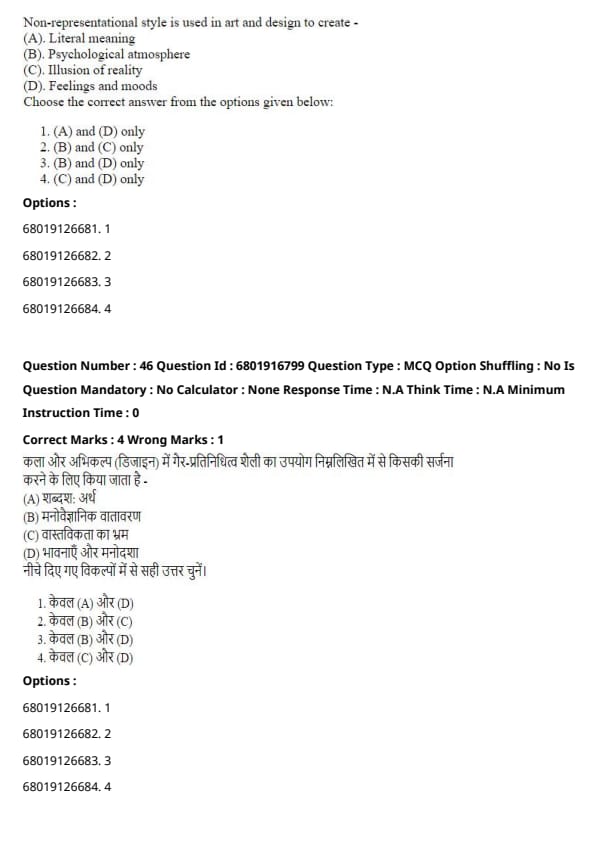
Non-representational style is used in art and design to create –
View Solution
Solution: Non-representational art focuses on conveying psychological atmosphere (B) and evoking feelings and moods (D). It does not emphasize literal meaning or the illusion of reality, which are typically found in representational art.
Quick Tip: Non-representational art aims to evoke emotional responses and create a psychological atmosphere without representing the physical world literally.
Question 47:
Match List I with List II
List I
List II
View Solution
Solution: The correct match for the individuals and their associated works is:
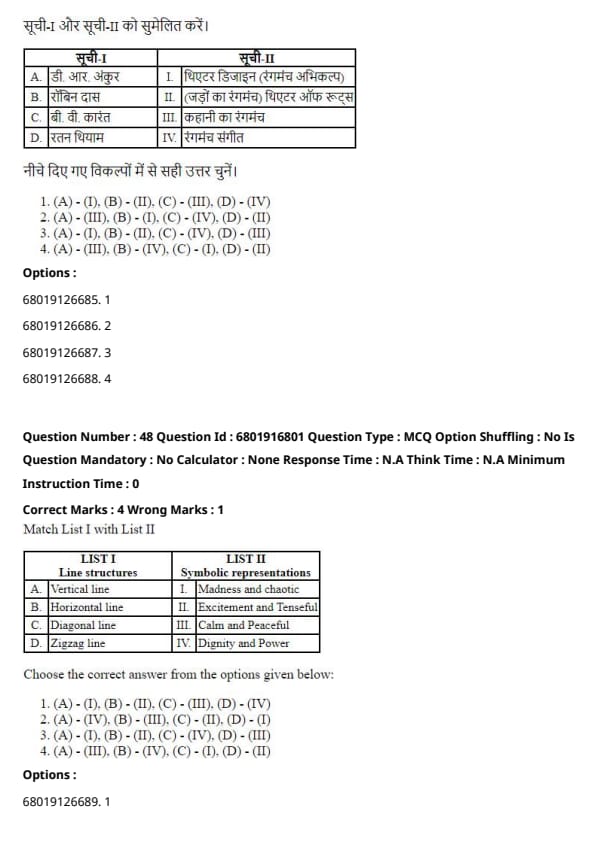
- D. R Ankur is associated with Theatre Design (I)
- Robin Das is associated with Theatre of Roots (II)
- B. V Karanth is associated with Kahani ka Rangmanch (III)
- Ratan Thiyam is associated with Theatre Music (IV)
Quick Tip: Theatre practitioners are often associated with their respective contributions to various aspects of theatre, including design, music, and storytelling.
Question 48:
Match List I with List II
List I
List II
View Solution
Solution: The correct match between the line structures and their symbolic representations is:
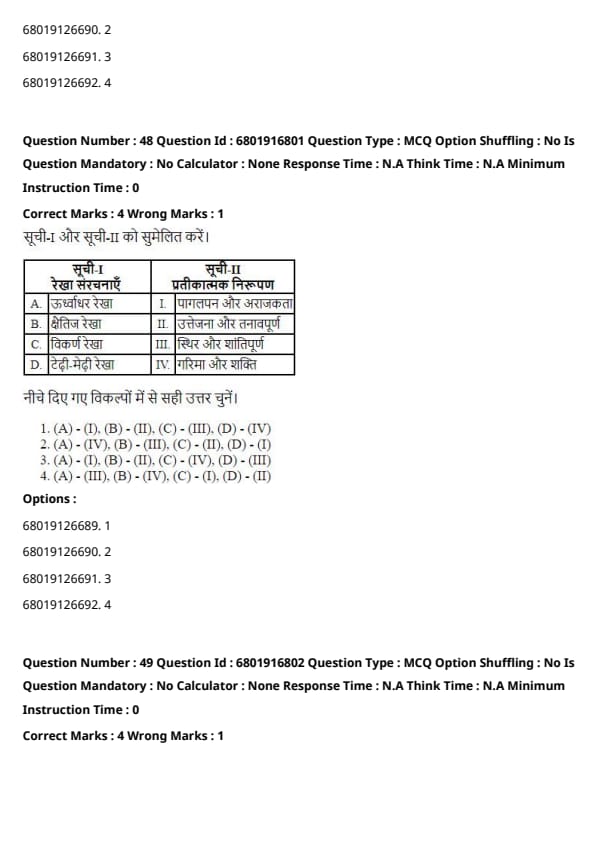
- Vertical line symbolizes Dignity and Power (IV)
- Horizontal line symbolizes Calm and Peaceful (III)
- Diagonal line symbolizes Excitement and Tenseful (II)
- Zigzag line symbolizes Madness and chaotic (I)
Quick Tip: In design, different types of lines carry specific symbolic meanings. Understanding these associations can enhance the aesthetic appeal and emotional impact of a design.
Question 49:
Match List I with List II
List I
List II
View Solution
Solution: The correct match between the items and their corresponding theatrical forms is:
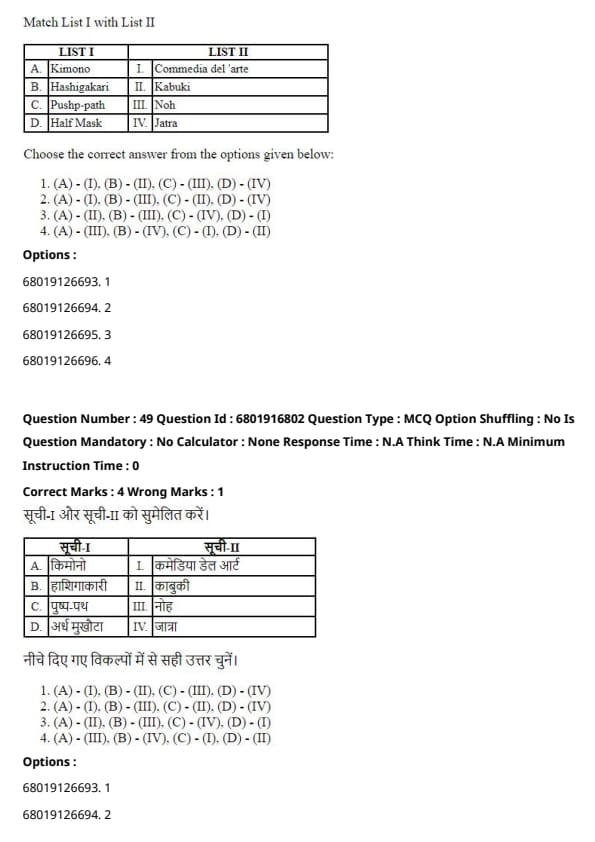
- Kimono is associated with Kabuki (II)
- Hashigakari is associated with Noh (III)
- Pushp-path is associated with Jatra (IV)
- Half Mask is associated with Commedia dell'arte (I)
Quick Tip: Each item in a performance is often symbolic of the particular theatrical tradition. Understanding the connections between cultural items and their performances can help one appreciate traditional art forms more deeply.
Question 50:
Match List I with List II
List I
List II
View Solution
Solution: The correct match between the items and their corresponding characteristics is:
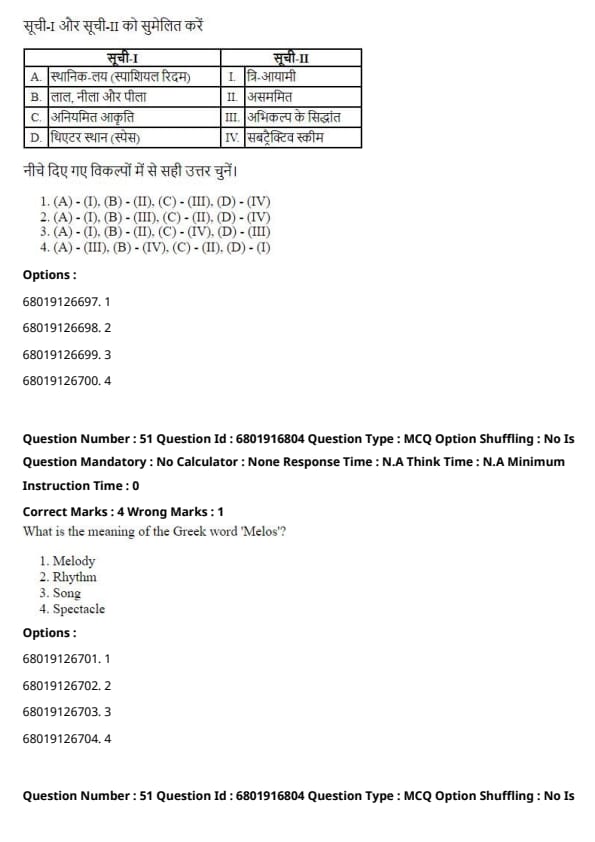
- Spatial-rhythm is associated with Spatial-rhythm (I)
- Red, Blue, and Yellow are associated with Subtractive scheme (II)
- Irregular shape is associated with Asymmetric (III)
- Theatre Space is associated with Principles of design (IV)
Quick Tip: Understanding the relationship between elements in design, such as shapes, colors, and space, helps in creating balanced and effective artistic compositions.
Question 51:
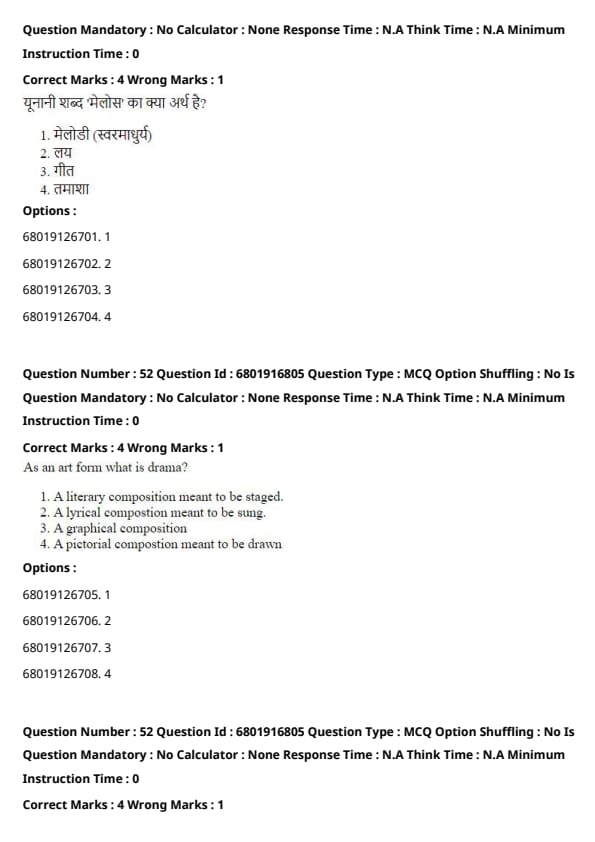
What is the meaning of the Greek word 'Melos'?
View Solution
Solution: The Greek word 'Melos' refers to melody, which is the arrangement of musical notes that is most recognized in songs and musical compositions.
Quick Tip: 'Melos' is closely associated with melody in the context of Greek art, highlighting the importance of music and song in dramatic performances.
Question 52:
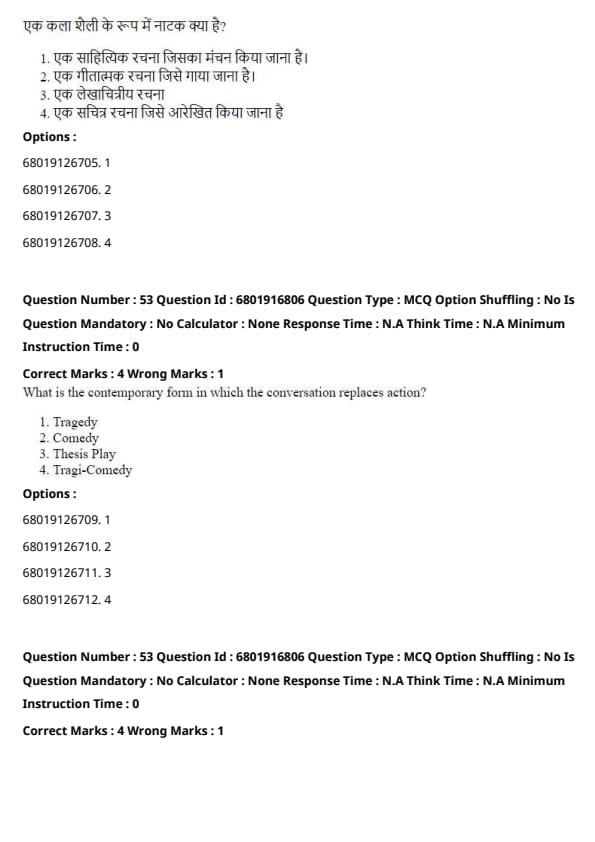
As an art form what is drama?
View Solution
Solution: Drama, as an art form, refers to a literary composition that is intended to be performed or staged, often involving dialogues, actions, and characters.
Quick Tip: Drama is an art form where storytelling is brought to life through performance on stage.
Question 53:
What is the contemporary form in which the conversation replaces action?
View Solution
Solution: In a Thesis Play, the conversation typically replaces action. The play focuses on dialogue to explore ideas or arguments, often with minimal physical action.
Quick Tip: Thesis plays are driven by dialogue and intellectual discourse, replacing physical action with conversation.
Question 54:
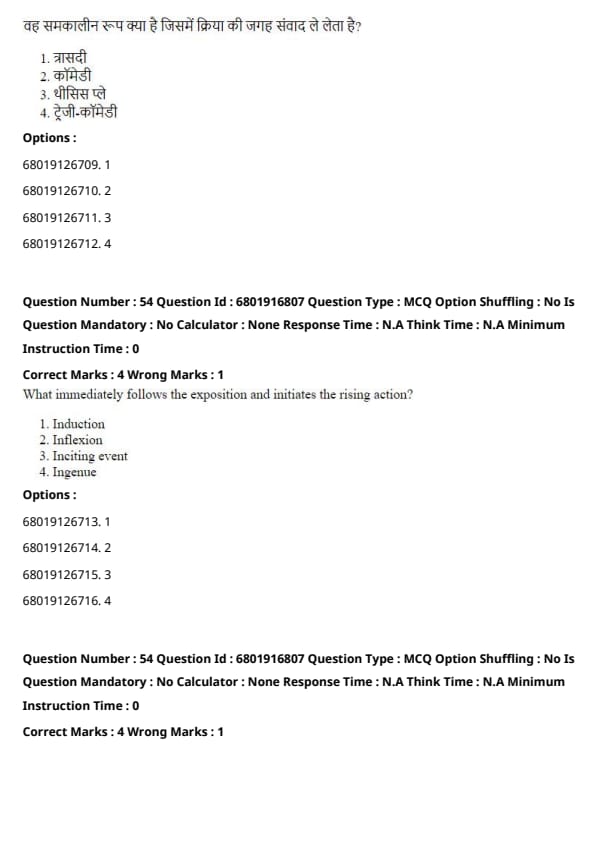
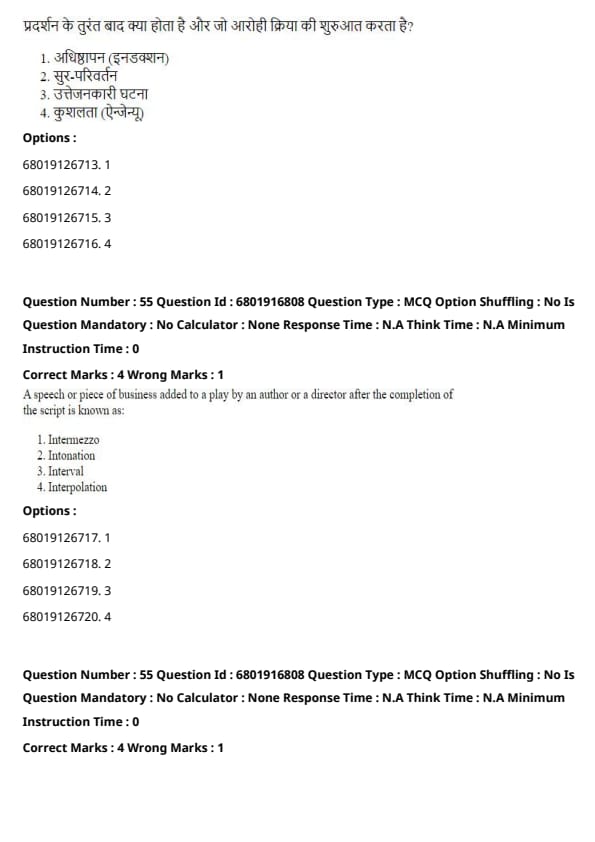
What immediately follows the exposition and initiates the rising action?
View Solution
Solution: The inciting event is the moment that triggers the rising action in a play, following the exposition and setting the story into motion.
Quick Tip: The inciting event marks a turning point that propels the plot toward the rising action.
Question 55:
A speech or piece of business added to a play by an author or a director after the completion of the script is known as:
View Solution
Solution: Interpolation refers to any addition or modification made to the script of a play after its original writing, often by the director or author.
Quick Tip: Interpolation involves inserting new elements or adjusting existing content in a script after its initial creation.
Question 56:
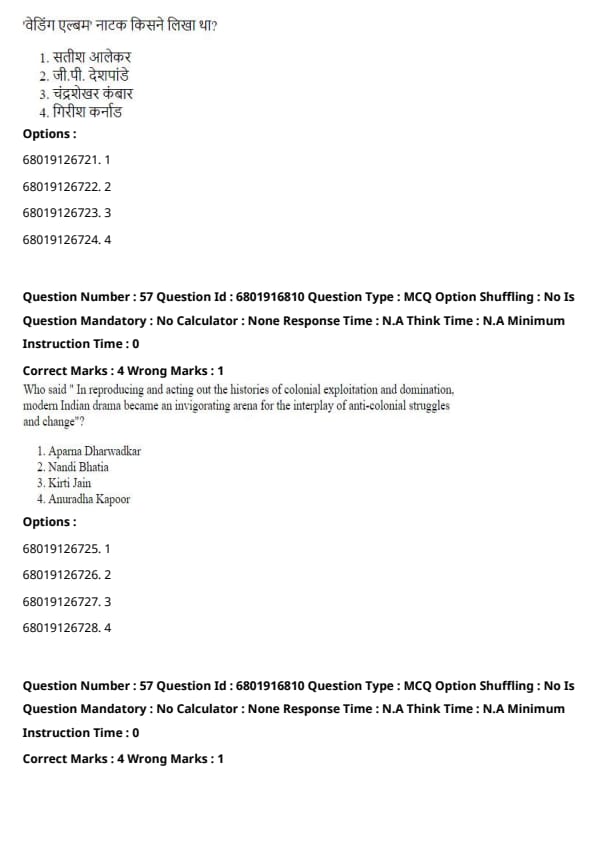
Who wrote the play 'Wedding Album'?
View Solution
Solution: The play 'Wedding Album' was written by G.P. Deshpande. It is a contemporary Indian play that touches upon themes of family, tradition, and societal norms.
Quick Tip: G.P. Deshpande is a prominent figure in modern Indian theatre, and 'Wedding Album' reflects his exploration of family dynamics.
Question 57:
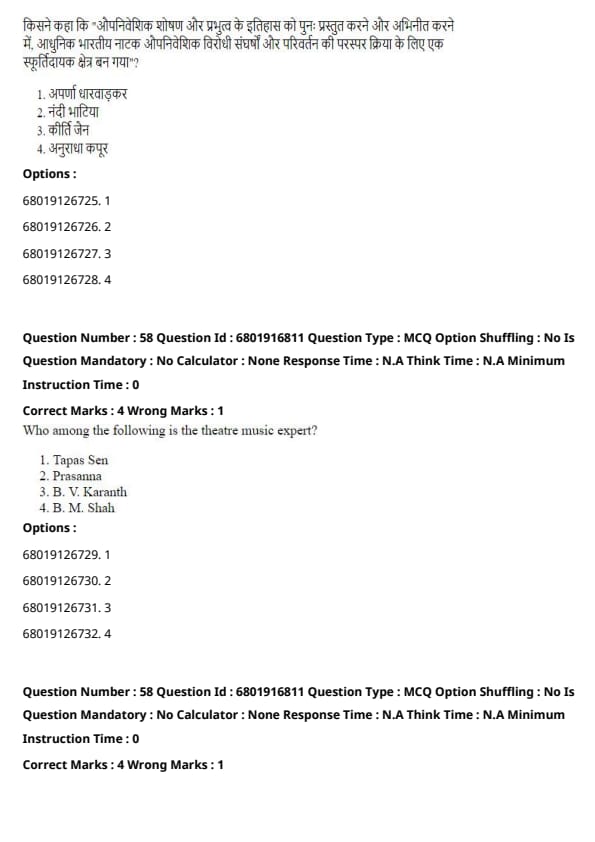
Who said "In reproducing and acting out the histories of colonial exploitation and domination, modern Indian drama became an invigorating arena for the interplay of anti-colonial struggles and change"?
View Solution
Solution: Nandi Bhatia is a scholar who examined the impact of colonialism on Indian theatre and its role in the anti-colonial struggle. She emphasized the power of modern Indian drama in depicting these struggles.
Quick Tip: Nandi Bhatia's work highlights how theatre became a powerful medium for expressing resistance during colonial times.
Question 58:
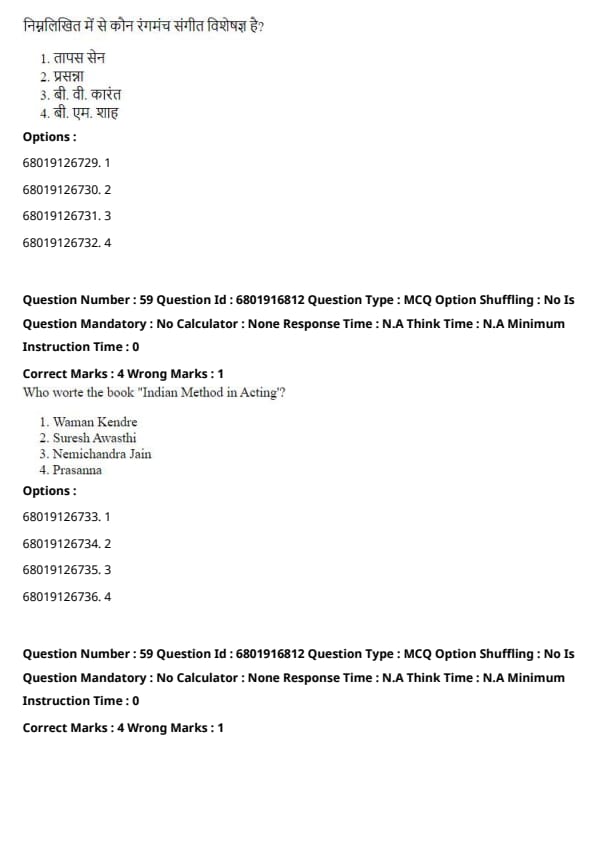
Who among the following is the theatre music expert?
View Solution
Solution: B. V. Karanth was a renowned theatre artist and music expert known for his work in both theatre and traditional music. He made significant contributions to the integration of music into Indian theatre.
Quick Tip: B. V. Karanth is well-known for his work in theatre music, particularly for blending traditional and contemporary styles.
Question 59:
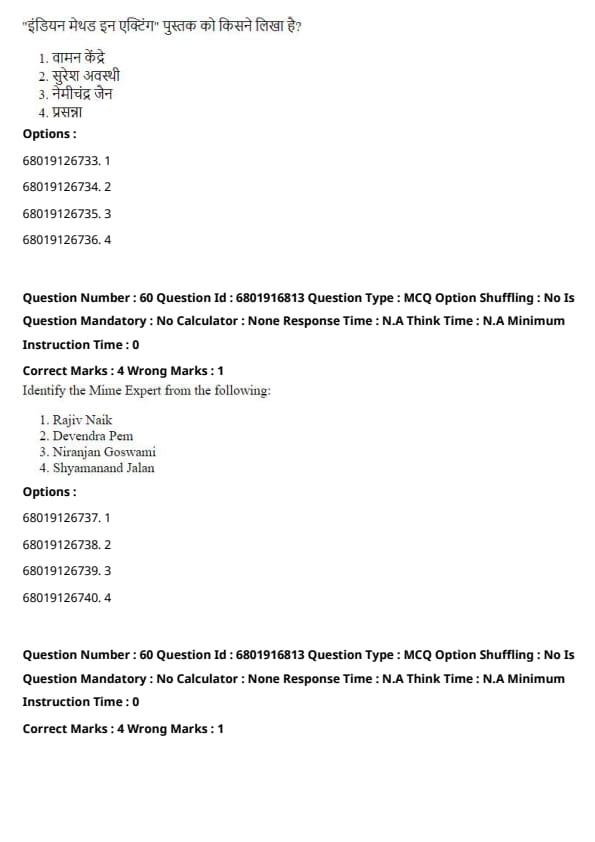
Who wrote the book "Indian Method in Acting”?
View Solution
Solution: Waman Kendre's book "Indian Method in Acting" provides a comprehensive understanding of the traditional techniques of acting in Indian theatre and their relevance in contemporary performances.
Quick Tip: Waman Kendre's contribution is crucial to understanding the fusion of traditional and modern acting techniques in Indian theatre.
Question 60:
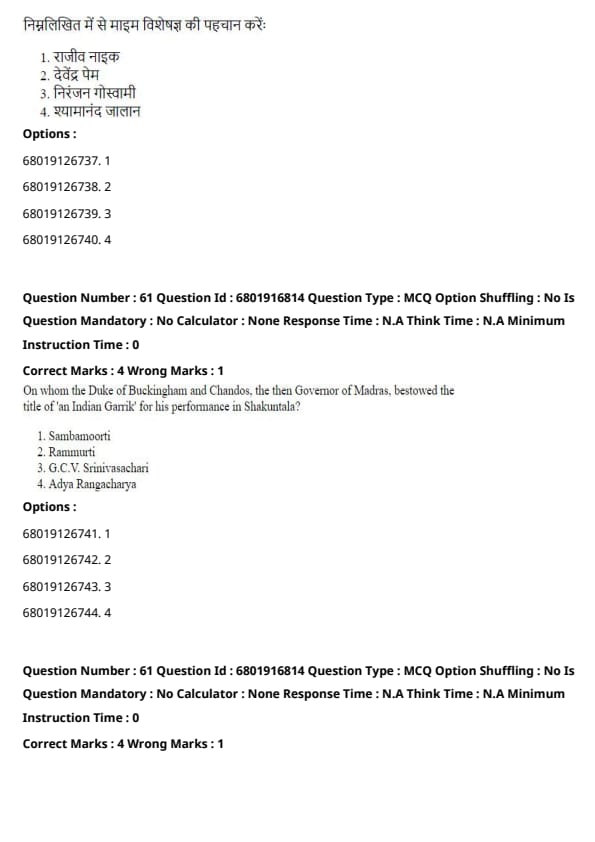
Identify the Mime Expert from the following:
View Solution
Solution: Niranjan Goswami is known for his expertise in the field of mime and has contributed significantly to the development and promotion of mime as a form of theatre in India.
Quick Tip: Mime, as an expressive form, plays a significant role in the theatrical arts, with experts like Niranjan Goswami shaping its practice.
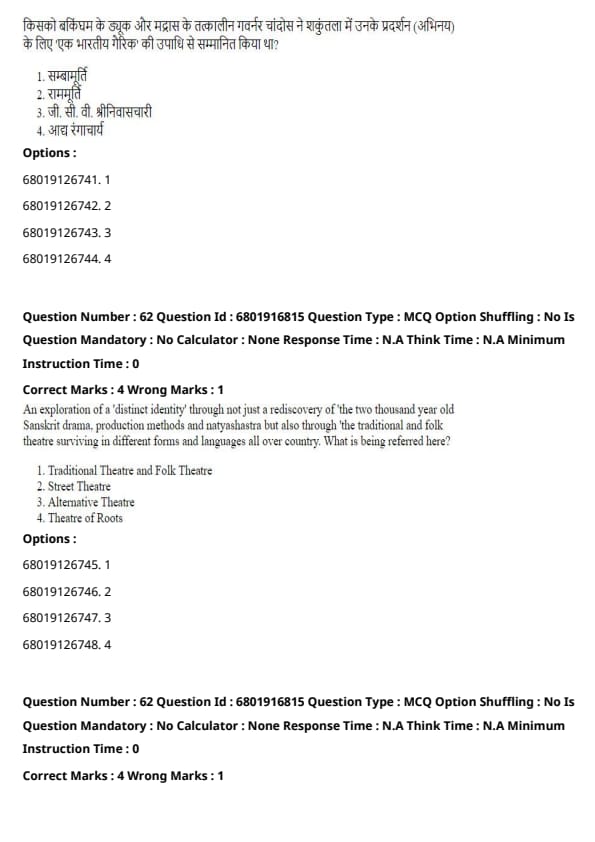
Question 61:
On whom did the Duke of Buckingham and Chandos, the then Governor of Madras, bestow the title of 'an Indian Garrik' for his performance in Shakuntala?
View Solution
Solution: The Duke of Buckingham and Chandos, the then Governor of Madras, conferred the title of 'an Indian Garrik' upon Adya Rangacharya for his remarkable performance in the Sanskrit play Shakuntala. Rangacharya's contribution to theatre earned him this recognition.
Quick Tip: Adya Rangacharya is celebrated for his exceptional work in traditional theatre, especially his performances in Sanskrit dramas.
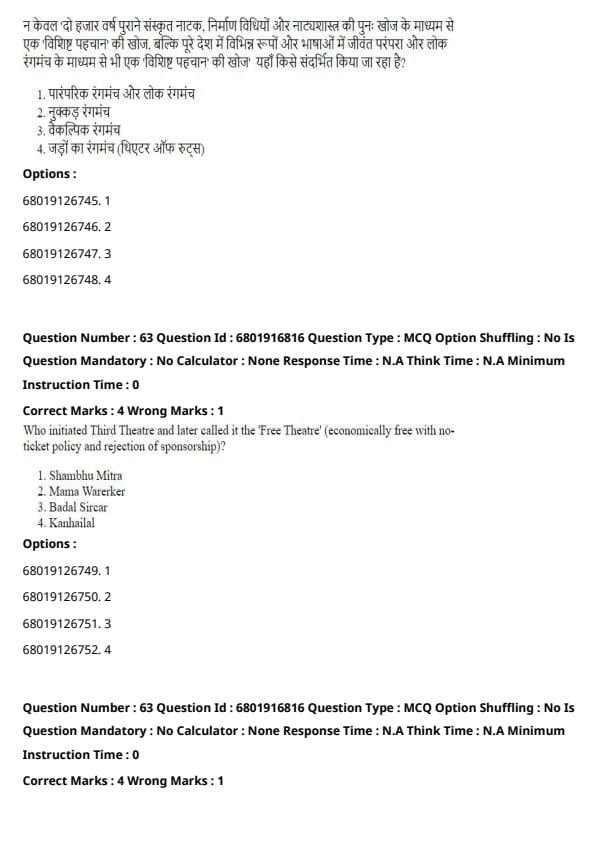
Question 62:
An exploration of a 'distinct identity' through not just a rediscovery of 'the two thousand year old Sanskrit drama, production methods and natyashastra but also through 'the traditional and folk theatre surviving in different forms and languages all over the country. What is being referred here?
View Solution
Solution: The phrase refers to 'Theatre of Roots', which explores the rediscovery of ancient Sanskrit drama and the rich diversity of traditional and folk theatre forms in India. This form of theatre seeks to reconnect with indigenous traditions and cultural expressions.
Quick Tip: Theatre of Roots is a movement that emphasizes the importance of traditional and folk theatre in expressing cultural identity.
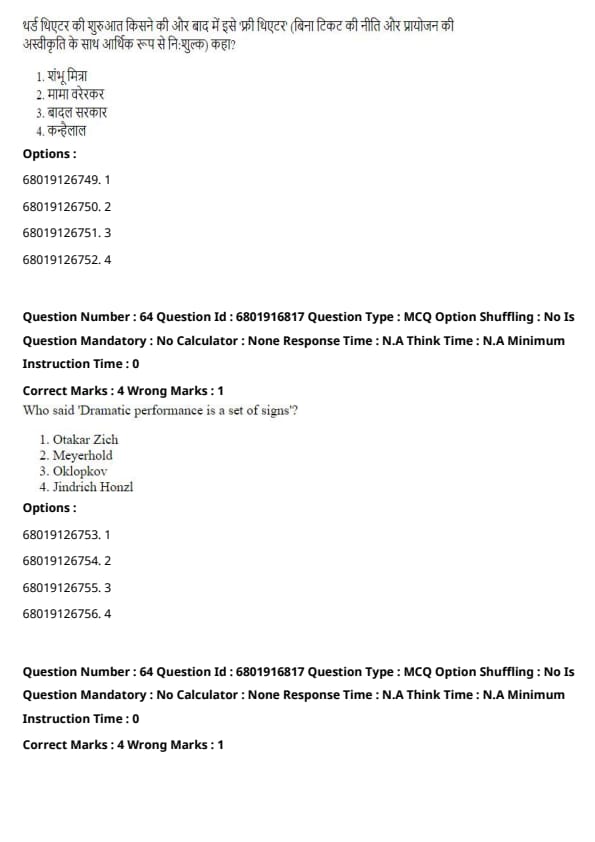
Question 63:
Who initiated Third Theatre and later called it the Free Theatre' (economically free with no ticket policy and rejection of sponsorship)?
View Solution
Solution: Badal Sircar, a pioneering figure in Indian theatre, initiated the concept of Third Theatre, which later became known as Free Theatre. This movement was characterized by its economic independence, with no ticket sales or sponsorships, and an emphasis on social relevance.
Quick Tip: Badal Sircar's Free Theatre movement challenged conventional theatre practices by rejecting commercial constraints and focusing on social issues.
Question 64:
Who said 'Dramatic performance is a set of signs'?
View Solution
Solution: Otakar Zich, a Czech philosopher and theatre theorist, famously stated that "Dramatic performance is a set of signs," emphasizing the semiotic nature of theatre, where each movement, gesture, or expression conveys meaning.
Quick Tip: Otakar Zich's theory on the semiotic aspects of theatre highlights the importance of interpreting performance as a system of signs and symbols.
Question 65:
What is the text which employs the written text only as one element in a multicoded, multidimensional, and pluralistic new textual system?
View Solution
Solution: Intertext refers to a text that is a multi-coded, multi-dimensional system, where the written text is just one element within a larger framework of meaning. This concept highlights the relationships between various texts and their influence on each other.
Quick Tip: Intertextuality explores how texts influence and relate to each other, forming a complex system of meanings and connections.
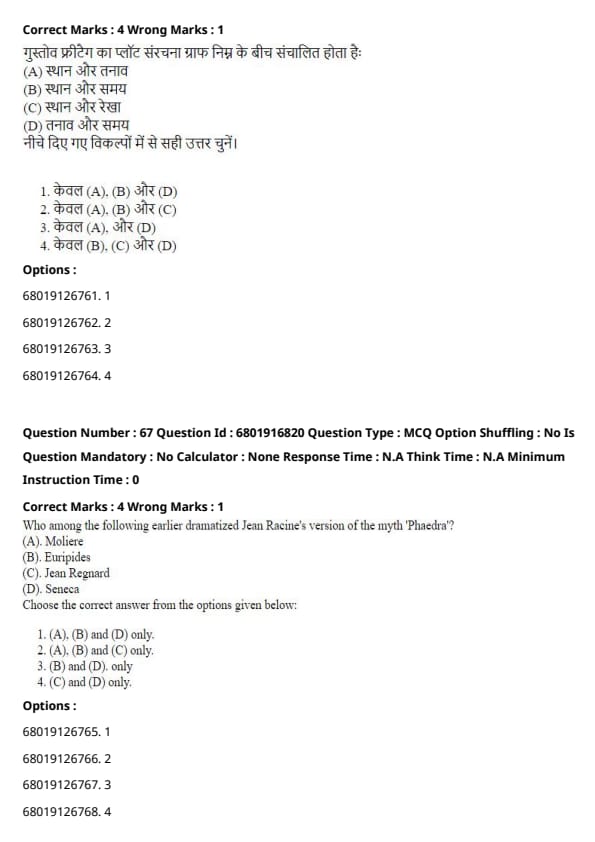
Question 66:
The Plot structure graph of Gustov Freytag operates between:
View Solution
Solution: Freytag's Pyramid operates between the axes of tension and time. It represents the way in which tension rises and falls over the course of a narrative. The tension peaks during the climax and then resolves towards the end.
Quick Tip: The Freytag Pyramid is a tool used in narrative structure to map out the progression of tension and time, helping to visualize the flow of the story.
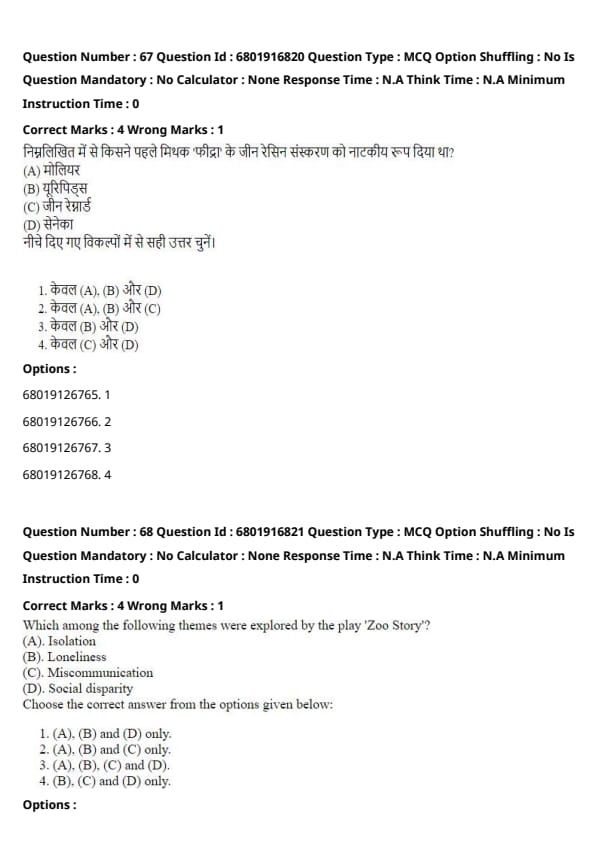
Question 67:
Who among the following earlier dramatized Jean Racine's version of the myth 'Phaedra'?
View Solution
Solution: Euripides' Hippolytus and Seneca's Phaedra are early adaptations of the myth of Phaedra. Jean Racine later dramatized the myth, but Euripides and Seneca were the first to bring the myth to the stage.
Quick Tip: Both Euripides and Seneca had a significant impact on the early dramatic portrayals of the Phaedra myth, influencing future adaptations such as Racine's version.
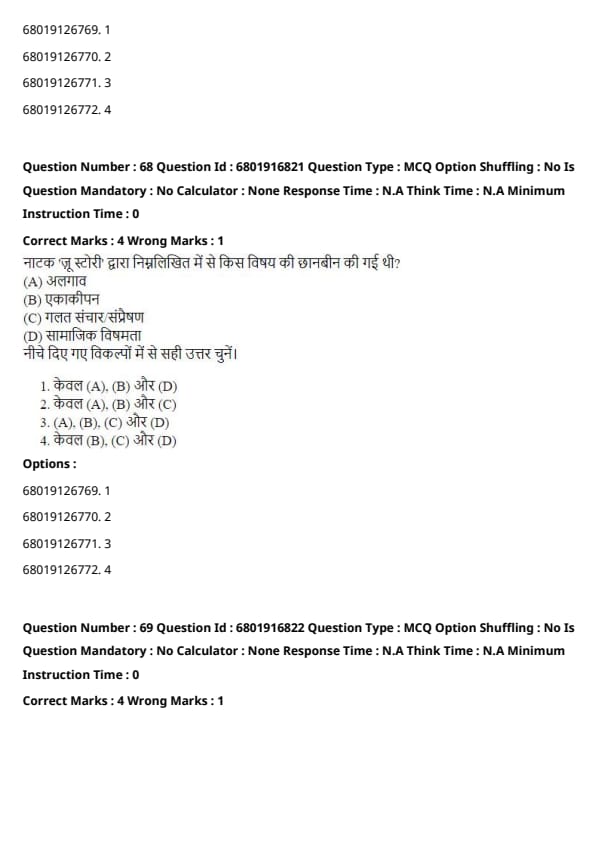
Question 68:
Which among the following themes were explored by the play 'Zoo Story'?
View Solution
Solution: In Edward Albee's Zoo Story, the play explores themes of isolation, loneliness, and miscommunication, which are central to the interaction between the two characters. Social disparity is not as directly addressed in the play as the other themes.
Quick Tip: Zoo Story deeply examines human isolation and the failure of communication between individuals.
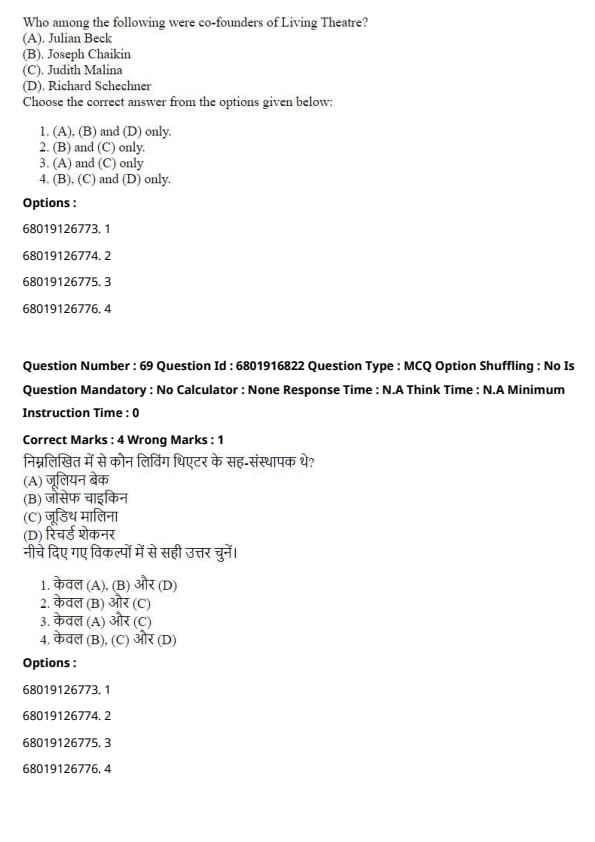
Question 69:
Who among the following were co-founders of Living Theatre?
View Solution
Solution: The Living Theatre was co-founded by Julian Beck and Judith Malina. While Richard Schechner is an influential figure in experimental theatre, he was not a co-founder of the Living Theatre. Joseph Chaikin was involved with the experimental theatre movement but was not a co-founder of this particular group.
Quick Tip: The Living Theatre, known for its avant-garde approach to theatre, was co-founded by Julian Beck and Judith Malina.
Question 70:
Match List I with List II
List I
List II
View Solution
Solution:
- Well-made play is associated with Eugine Scribe (IV).
- Realistic Expressionism is associated with Garcia Lorca (I).
- Social Realism is associated with Tennessee Williams (II).
- Poetic Realism is associated with Synge (III).
Quick Tip: Each dramatic genre has a distinct thinker or dramatist who pioneered or significantly contributed to it. This match links the genres with their prominent thinkers.
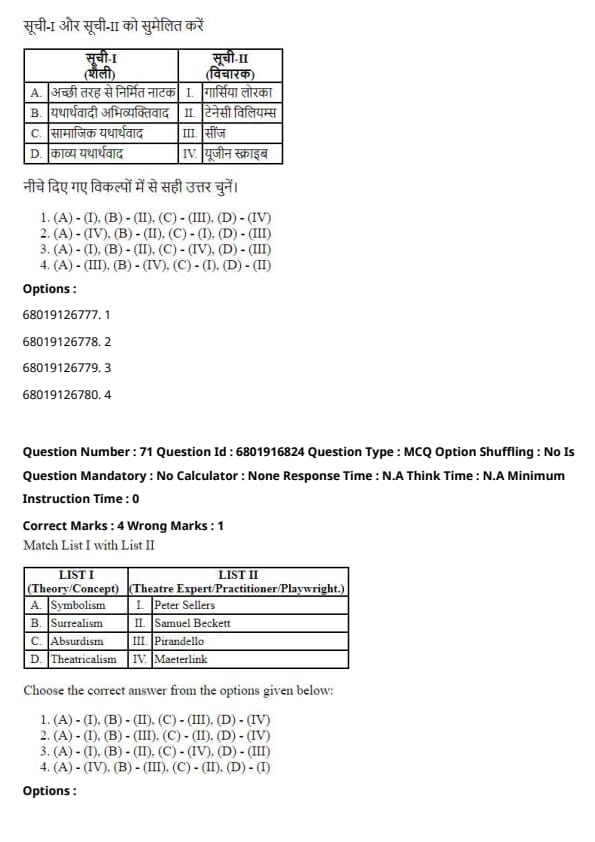
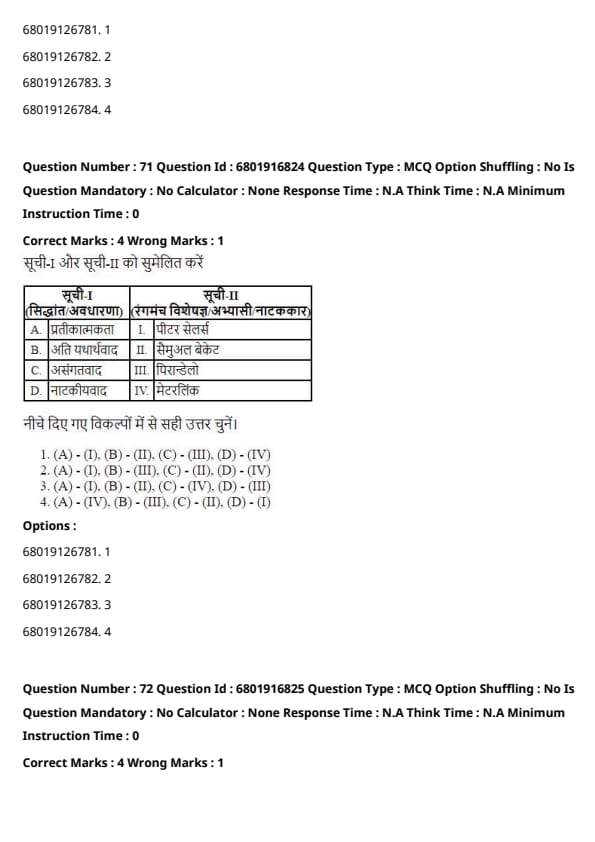
Question 71:
Match List I with List II
List I
List II
View Solution
Solution:
- Symbolism is associated with Maeterlink (IV)
- Surrealism is associated with Samuel Beckett (II)
- Absurdism is associated with Pirandello (III)
- Theatricalism is associated with Peter Sellers (I)
Quick Tip: Each theatrical theory or concept has a significant playwright or practitioner who has contributed to its development. This match helps identify the key contributors to these movements.
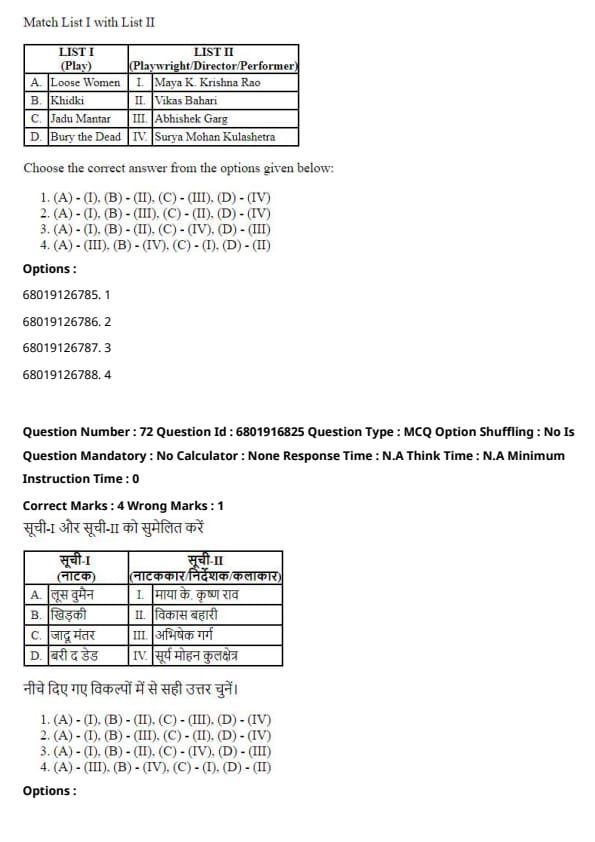
Question 72:
Match List I with List II
List I
List II
View Solution
Solution:
- Loose Women was written by Maya K. Krishna Rao (I).
- Khidki was written by Vikas Bahari (II).
- Jadu Mantar was written by Abhishek Garg (III).
- Bury the Dead was written by Surya Mohan Kulashestra (IV).
Quick Tip: This matching exercise helps familiarize you with the playwrights/directors/performers associated with important Indian plays. Understanding these connections is important for analyzing theatre history and movements.
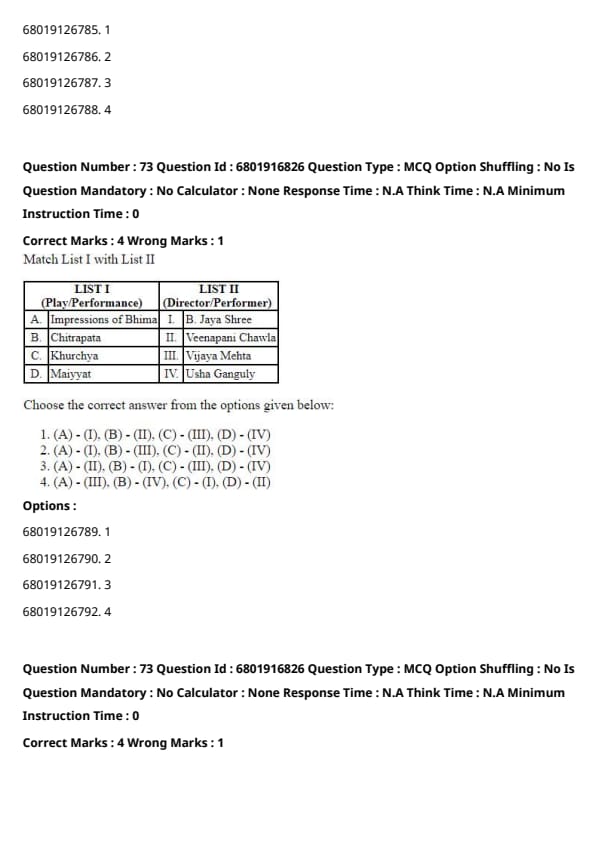
Question 73:
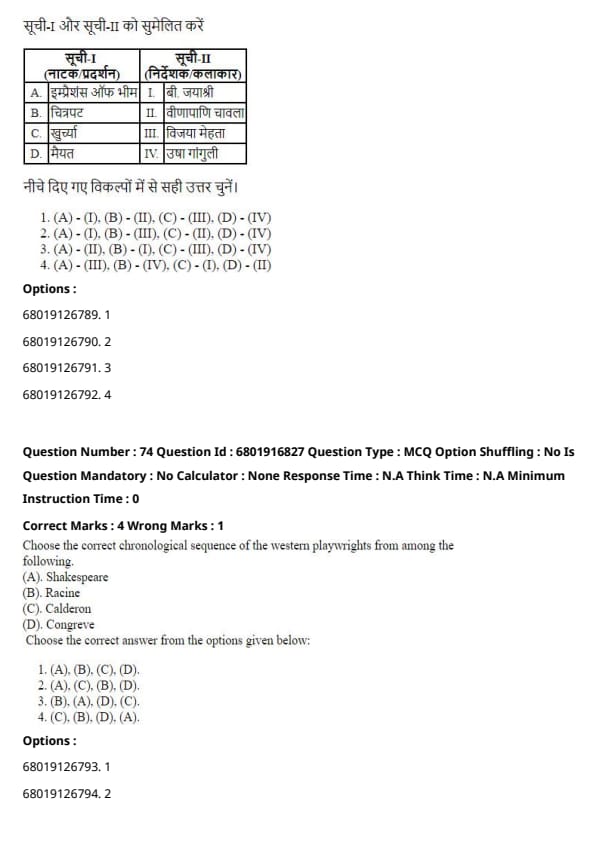
Match List I with List II
List I
List II
View Solution
Solution:
- Impressions of Bhima was directed by B. Jaya Shree (IV).
- Chitrapata was directed by Veenapani Chawla (I).
- Khurchya was directed by Vijaya Mehta (III).
- Maiyyat was directed by Usha Ganguly (II).
Quick Tip: Understanding the directors associated with Indian plays helps in grasping the distinctive approaches and styles in the evolution of modern theatre in India.
Question 74:
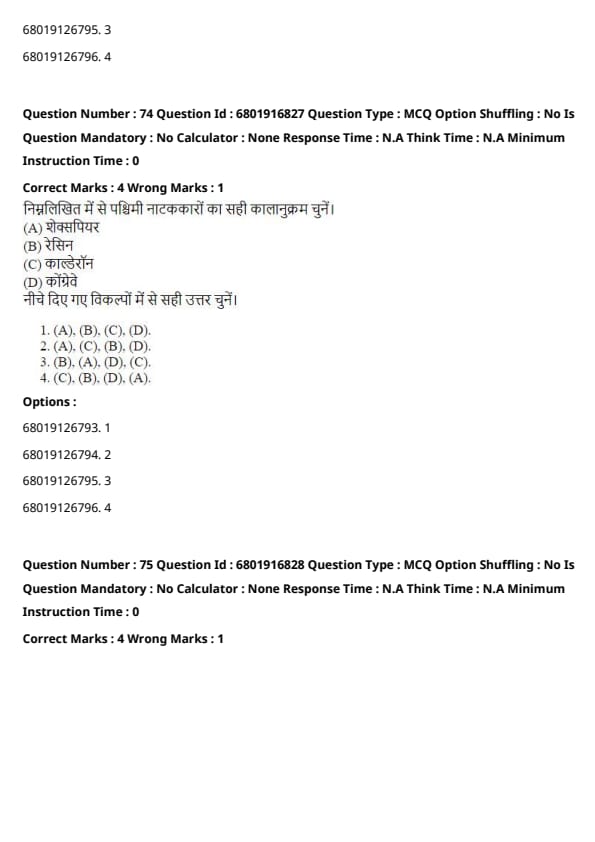
Choose the correct chronological sequence of the western playwrights from among the following.
View Solution
Solution: The chronological order of the playwrights is:
- Shakespeare (1564-1616)
- Calderon (1600-1681)
- Racine (1639-1699)
- Congreve (1670-1729)
Quick Tip: Shakespeare is the earliest among the listed playwrights, followed by Calderon, Racine, and finally Congreve in the 17th century.
Question 75:
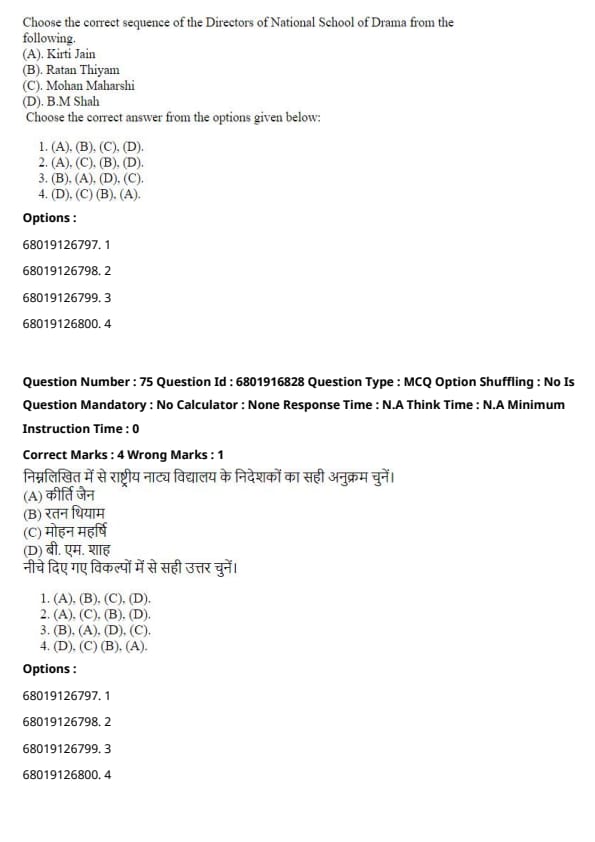
Choose the correct sequence of the Directors of National School of Drama from the following.
View Solution
Solution: The sequence of Directors of the National School of Drama is:
- Kirti Jain (First)
- Ratan Thiyam (Second)
- Mohan Maharshi (Third)
- B.M Shah (Fourth)
Quick Tip: The National School of Drama's directors played an instrumental role in shaping the institution's identity and contributions to Indian theatre.

















*The article might have information for the previous academic years, please refer the official website of the exam.