CUET PG 2026 Botany Question Paper with Solution Pdf (Available Soon)
- Question Paper 2025
- Question Paper 2024
- Question Paper 2023
- Mathematics Papers
- Statistics Question Paper
- English Question Paper
- Chemistry Question Paper
- Pol. Sci. Question Paper
- History Question Paper
- Commerce Question Papers
- Life Science Papers
- Geology Question Papers
- Journalism Question Paper
- B.Ed. HSS Question Paper
- Botany Question Paper
- B.Ed. Question Papers


| Updated On - Mar 18, 2026
The National Testing Agency (NTA) conducted the CUET PG Botany Exam 2026 on March 18, 2026 in third shift from 4:00 PM to 5:30 PM. The CUET PG Botany Question Paper with Solution PDF is available here for download.
The CUET PG Botany Exam was conducted in CBT mode, consisting of 75 MCQs that candidates had to complete within 90 minutes. Each correct answer carried 4 marks, while 1 mark was deducted for every incorrect answer.The CUET PG Botany paper features a variety of topics including scientific study of plants, algae, and fungi, encompassing their structure, function, evolution, classification, and ecological relationships.
CUET PG 2026 Botany Question Paper with Solution Pdf
| CUET PG Botany Question Paper 2026 | Download PDF | Check Solutions |

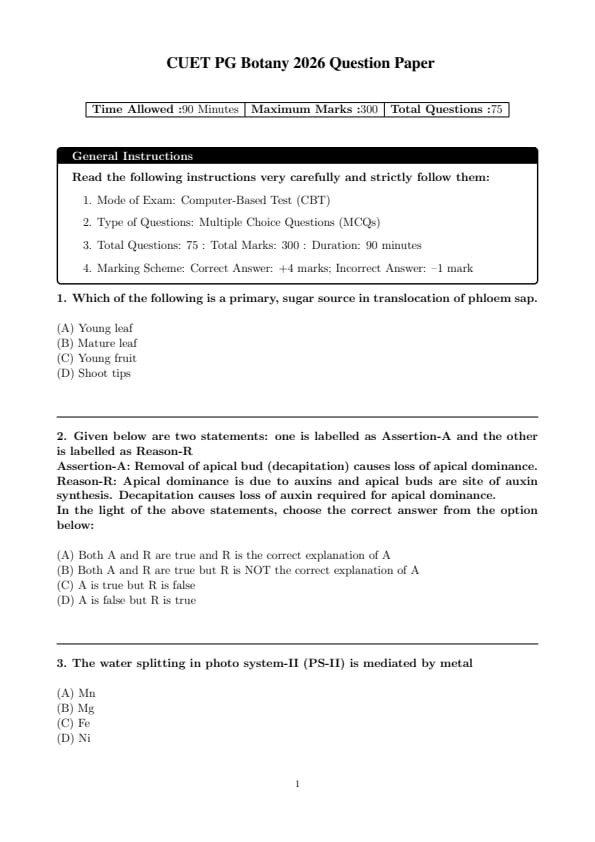
Which of the following is a primary, sugar source in translocation of phloem sap.
View Solution
Step 1: Understanding the Question:
The question asks to identify the primary "source" for sugar in the process of phloem translocation. In plant physiology, a 'source' is an organ that produces more sugars (through photosynthesis) than it requires for its own metabolic needs. A 'sink' is an organ that consumes sugars for growth or storage.
Step 2: Detailed Explanation:
Mature leaf (B): Mature leaves are the primary sites of photosynthesis. They produce sugars, mainly sucrose, in excess of their own needs. This excess sugar is then exported via the phloem to other parts of the plant. Therefore, a mature leaf acts as a primary source.
Young leaf (A): Young leaves are still growing and developing their photosynthetic machinery. They consume more sugar than they produce and are thus considered sinks, importing sugar from mature leaves.
Young fruit (C): Fruits are non-photosynthetic organs that require a large amount of energy for development and sugar storage. They are strong sinks.
Shoot tips (D): Shoot tips are areas of active cell division and growth (apical meristems). They have high metabolic activity and are dependent on imported sugars, making them sinks.
Step 3: Final Answer:
Based on the analysis, the mature leaf is the primary organ for producing and exporting sugar, making it the primary source for phloem translocation.
Quick Tip: Remember the Source-Sink relationship: Sources (like mature leaves) produce sugars, and Sinks (like roots, fruits, and young leaves) consume them. The direction of phloem transport is always from a source to a sink.
Given below are two statements: one is labelled as Assertion-A and the other is labelled as Reason-R
Assertion-A: Removal of apical bud (decapitation) causes loss of apical dominance.
Reason-R: Apical dominance is due to auxins and apical buds are site of auxin synthesis. Decapitation causes loss of auxin required for apical dominance.
In the light of the above statements, choose the correct answer from the option below:
View Solution
Step 1: Understanding the Question:
This question evaluates the understanding of apical dominance, the role of the apical bud, and the hormone auxin. It requires assessing the truthfulness of both the Assertion and the Reason, and whether the Reason correctly explains the Assertion.
Step 2: Detailed Explanation:
Analyzing Assertion-A: Apical dominance is the phenomenon where the central, main stem of a plant grows more strongly than the lateral stems. The apical bud at the tip of the main stem is responsible for this. Removing the apical bud (a process called decapitation or pruning) removes this dominance and allows the lateral (axillary) buds to grow, making the plant bushier. Therefore, Assertion-A is true.
Analyzing Reason-R: The apical bud is the primary site of synthesis for the plant hormone auxin. Auxin flows downwards from the apical bud and inhibits the growth of the axillary buds located below it. This hormonal inhibition is the mechanism behind apical dominance. When the apical bud is removed (decapitation), the source of this inhibitory auxin is eliminated. The lack of auxin allows the lateral buds to sprout and grow. Therefore, Reason-R is a true statement.
Connecting Assertion and Reason: The Reason correctly explains why removing the apical bud (Assertion) leads to the loss of apical dominance. The removal of the auxin source (as explained in the Reason) is the direct cause of the effect described in the Assertion.
Step 3: Final Answer:
Both Assertion-A and Reason-R are true, and Reason-R provides the correct scientific explanation for Assertion-A.
Quick Tip: For Assertion-Reason questions, first check if each statement is true independently. If both are true, then check if the Reason logically explains the Assertion by asking "Why?" or "Because".
The water splitting in photo system-II (PS-II) is mediated by metal
View Solution
Step 1: Understanding the Question:
The question asks to identify the specific metal ion that is essential for the process of water splitting (photolysis) which occurs in Photosystem-II (PS-II) during photosynthesis.
Step 2: Detailed Explanation:
The splitting of water molecules during the light-dependent reactions of photosynthesis is catalyzed by a protein complex known as the Oxygen-Evolving Complex (OEC), which is associated with Photosystem-II.
The reaction is: \(2H_2O \rightarrow 4H^+ + 4e^- + O_2\).
The core of the OEC contains a cluster of four Manganese (Mn) ions and one Calcium (Ca) ion, often denoted as a \(Mn_4CaO_5\) cluster.
These Manganese ions cycle through different oxidation states, which is crucial for accumulating the four oxidizing equivalents needed to split two water molecules and release one molecule of oxygen (\(O_2\)).
Mg (Magnesium) is a component of the chlorophyll molecule's porphyrin ring, but it is not directly involved in water splitting.
Fe (Iron) is a component of cytochromes and ferredoxin in the electron transport chain, but not in the OEC.
Ni (Nickel) is a cofactor for some enzymes, like urease, but is not involved in photosynthesis.
Step 3: Final Answer:
Manganese (Mn) is the essential metal cofactor in the Oxygen-Evolving Complex of PS-II that mediates water splitting.
Quick Tip: Remember the key metals in photosynthesis: Mg in chlorophyll, Mn in the water-splitting complex (OEC of PS-II), and Fe in cytochromes and ferredoxin.
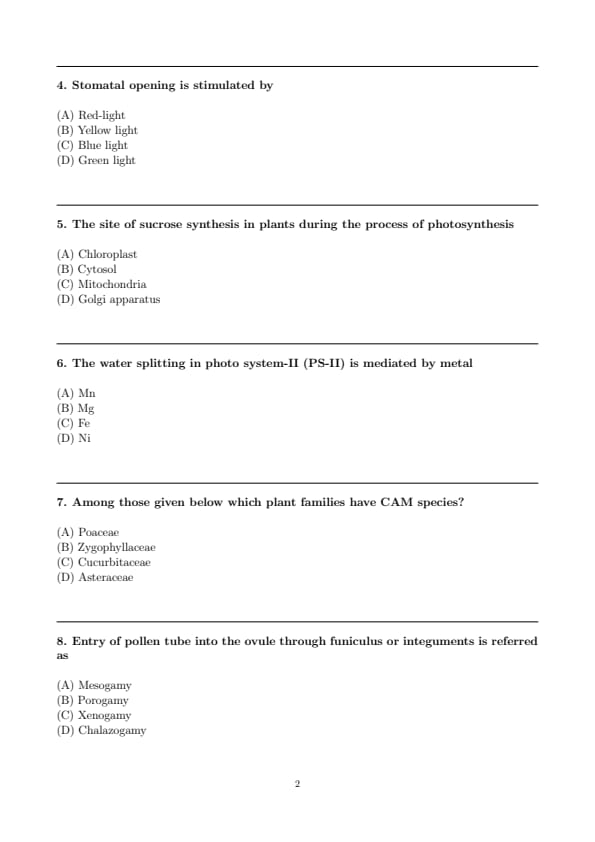
Stomatal opening is stimulated by
View Solution
Step 1: Understanding the Question:
The question asks which wavelength (color) of light is a primary stimulus for the opening of stomata.
Step 2: Detailed Explanation:
Stomatal opening is regulated by several factors, including light, CO\(_2\) concentration, and water status. Light is a major signal.
Blue light: Blue light acts as a direct and potent signal for stomatal opening. It activates specific blue-light photoreceptors (phototropins) in the guard cells. This activation triggers a signal transduction pathway that leads to the activation of proton pumps (\(H^+\)-ATPase) on the guard cell membrane. The pumping of protons out of the cell creates an electrochemical gradient that drives the influx of potassium ions (\(K^+\)) and other solutes, lowering the water potential inside the guard cells. Water then enters via osmosis, increasing turgor pressure and causing the stomata to open.
Red light: Red light also promotes stomatal opening, but it does so indirectly by stimulating photosynthesis in the guard cell chloroplasts. Photosynthesis reduces the internal CO\(_2\) concentration and produces ATP, which can fuel the proton pumps. However, the direct blue-light response is generally considered faster and more specific for stomatal opening.
Yellow light: This has a minor effect compared to red and blue light.
Green light: Green light is largely reflected by chlorophyll and is the least effective wavelength for stimulating photosynthesis and stomatal opening.
Step 3: Final Answer:
While both red and blue light cause stomatal opening, blue light is the most direct and effective stimulus. Therefore, blue light is the correct answer.
Quick Tip: Remember that stomata have a specific blue-light response mediated by phototropins, which is independent of photosynthesis and highly effective at triggering opening.
The site of sucrose synthesis in plants during the process of photosynthesis
View Solution
Step 1: Understanding the Question:
The question asks for the specific cellular location where sucrose is synthesized in a plant cell as a product of photosynthesis.
Step 2: Detailed Explanation:
Photosynthesis and the Calvin Cycle: The Calvin cycle, which fixes CO\(_2\) into organic molecules, occurs in the stroma of the chloroplast (A). The primary products of the Calvin cycle are three-carbon sugars, specifically triose phosphates (Glyceraldehyde-3-phosphate).
Fate of Triose Phosphates: These triose phosphates have two main fates:
Some are used within the chloroplast to regenerate RuBP (the initial CO\(_2\) acceptor) and to synthesize starch for temporary storage inside the chloroplast.
The rest are exported from the chloroplast into the cytosol (B).
Sucrose Synthesis: In the cytosol, two molecules of triose phosphate are combined to form fructose-1,6-bisphosphate, which is then converted to fructose-6-phosphate and glucose-6-phosphate. These are then used to synthesize sucrose (a disaccharide made of glucose and fructose). This newly synthesized sucrose is the primary form of sugar transported throughout the plant via the phloem.
Other Organelles: Mitochondria (C) are involved in cellular respiration, and the Golgi apparatus (D) is involved in modifying, sorting, and packaging proteins and lipids. Neither is the site of sucrose synthesis from photosynthesis.
Step 3: Final Answer:
The synthesis of sucrose from the immediate products of photosynthesis occurs in the cytosol.
Quick Tip: Remember the division of labor: Starch synthesis (for temporary storage) happens in the chloroplast, while sucrose synthesis (for transport) happens in the cytosol.
The water splitting in photo system-II (PS-II) is mediated by metal
View Solution
Step 1: Understanding the Question:
The question asks to identify the specific metal ion that is essential for the process of water splitting (photolysis) which occurs in Photosystem-II (PS-II) during photosynthesis.
Step 2: Detailed Explanation:
The splitting of water molecules during the light-dependent reactions of photosynthesis is catalyzed by a protein complex known as the Oxygen-Evolving Complex (OEC), which is associated with Photosystem-II.
The reaction is: \(2H_2O \rightarrow 4H^+ + 4e^- + O_2\).
The core of the OEC contains a cluster of four Manganese (Mn) ions and one Calcium (Ca) ion, often denoted as a \(Mn_4CaO_5\) cluster.
These Manganese ions cycle through different oxidation states, which is crucial for accumulating the four oxidizing equivalents needed to split two water molecules and release one molecule of oxygen (\(O_2\)).
Mg (Magnesium) is a component of the chlorophyll molecule's porphyrin ring, but it is not directly involved in water splitting.
Fe (Iron) is a component of cytochromes and ferredoxin in the electron transport chain, but not in the OEC.
Ni (Nickel) is a cofactor for some enzymes, like urease, but is not involved in photosynthesis.
Step 3: Final Answer:
Manganese (Mn) is the essential metal cofactor in the Oxygen-Evolving Complex of PS-II that mediates water splitting.
Quick Tip: Remember the key metals in photosynthesis: Mg in chlorophyll, Mn in the water-splitting complex (OEC of PS-II), and Fe in cytochromes and ferredoxin.
Among those given below which plant families have CAM species?
View Solution
Step 1: Understanding the Question:
The question asks to identify which of the given plant families includes species that exhibit Crassulacean Acid Metabolism (CAM) photosynthesis. CAM is a photosynthetic adaptation to arid conditions.
Step 2: Detailed Explanation:
CAM Photosynthesis: In CAM plants, stomata open at night to fix atmospheric CO\(_2\) into organic acids, which are stored in vacuoles. During the day, stomata close to conserve water, and the stored acids are broken down to release CO\(_2\) for the Calvin cycle. This pathway is common in succulents and epiphytes.
Analyzing the Options:
Poaceae (A): The grass family. It contains many important C4 plants (like maize, sugarcane) and C3 plants (like rice, wheat), but CAM is not a characteristic feature.
Zygophyllaceae (B): The caltrop family. While many are adapted to arid conditions, they are typically C3 or C4 plants.
Cucurbitaceae (C): The gourd family (cucumber, melon). These are typically C3 plants.
Asteraceae (D): The sunflower or composite family. This is one of the largest families of flowering plants and exhibits great diversity. It includes numerous succulent species that perform CAM photosynthesis, such as some members of the genus *Senecio*. Other famous CAM families include Cactaceae, Crassulaceae, and Euphorbiaceae.
Step 3: Final Answer:
Among the choices provided, Asteraceae is a well-known family that contains species utilizing the CAM pathway.
Quick Tip: Associate CAM photosynthesis with succulent plants and arid environments. Key families to remember are Crassulaceae, Cactaceae, Euphorbiaceae, and Asteraceae.
Entry of pollen tube into the ovule through funiculus or integuments is referred as
View Solution
Step 1: Understanding the Question:
The question asks for the specific term used to describe the entry of the pollen tube into the ovule through the funiculus or the integuments, rather than the more common paths.
Step 2: Detailed Explanation:
There are three main ways a pollen tube can enter an ovule to deliver the male gametes:
Porogamy (B): The pollen tube enters the ovule through the micropyle. This is the most common mode of entry in angiosperms.
Chalazogamy (D): The pollen tube enters the ovule through the chalazal end (the base of the ovule, opposite the micropyle).
Mesogamy (A): The pollen tube penetrates the ovule through its "middle" parts, which are the funiculus (the stalk connecting the ovule to the placenta) or the integuments (the outer layers of the ovule).
Xenogamy (C): This term refers to cross-pollination, the transfer of pollen between flowers of two different plants. It is a type of pollination, not a mode of pollen tube entry into the ovule.
Step 3: Final Answer:
The entry of the pollen tube through the funiculus or integuments is correctly termed mesogamy.
Quick Tip: Remember the entry points: \textbf{Poro}gamy = via \textbf{Pore} (micropyle); \textbf{Chala}zogamy = via \textbf{Chala}za; \textbf{Meso}gamy = via the \textbf{Meso} (middle) part like integuments.
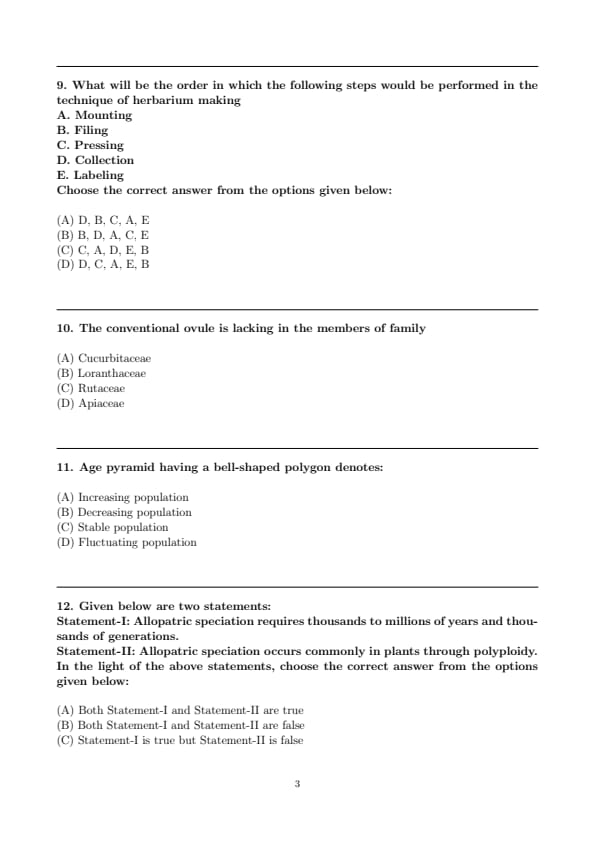
What will be the order in which the following steps would be performed in the technique of herbarium making
A. Mounting
B. Filing
C. Pressing
D. Collection
E. Labeling
Choose the correct answer from the options given below:
View Solution
Step 1: Understanding the Question:
The question asks for the correct chronological sequence of steps involved in preparing a herbarium specimen.
Step 2: Detailed Explanation:
Let's analyze the logical flow of creating a herbarium sheet:
D. Collection: The first step is to go to the field and collect the plant specimen. This involves selecting a representative plant part with flowers or fruits if possible.
C. Pressing: Immediately after collection, the specimen must be pressed flat between sheets of blotting paper or newspaper in a plant press. This removes moisture and preserves the plant's form. This step is followed by drying.
A. Mounting: Once the specimen is completely dry and pressed, it is carefully mounted (glued or stitched) onto a standard-sized, stiff herbarium sheet.
E. Labeling: A label containing all the essential data (scientific name, common name, family, location of collection, date of collection, collector's name, etc.) is affixed to the bottom right corner of the sheet. This step is crucial for the scientific value of the specimen and is done concurrently with or immediately after mounting.
B. Filing: Finally, the completed herbarium sheet is deposited and stored (filed) in a herbarium cabinet according to a recognized system of classification (e.g., Bentham and Hooker system) for future reference and study.
Step 3: Final Answer:
The correct sequence of steps is Collection \(\rightarrow\) Pressing \(\rightarrow\) Mounting \(\rightarrow\) Labeling \(\rightarrow\) Filing. This corresponds to the order D, C, A, E, B.
Quick Tip: Think of it like creating a photo album: First you \textbf{collect} memories (plants), then you \textbf{press} them (in a book/press), then you \textbf{mount} them in the album, \textbf{label} them with details, and finally \textbf{file} the album on a shelf.
The conventional ovule is lacking in the members of family
View Solution
Step 1: Understanding the Question:
The question asks to identify the plant family where a "conventional ovule" is absent. A conventional ovule is a distinct structure with integuments, a nucellus, and a funiculus. A lack of this structure implies a highly reduced or modified reproductive setup.
Step 2: Detailed Explanation:
Loranthaceae: This is a family of parasitic plants, commonly known as mistletoes. Due to their parasitic nature, many members of this family show extreme reduction in their floral parts. In many species of Loranthaceae, the ovules are not differentiated into the typical structures (integuments and nucellus). Instead, the embryo sac develops directly within the placental tissue (a condition known as a placental ovule or undifferentiated ovule). Therefore, they lack a conventional ovule.
Cucurbitaceae (A), Rutaceae (C), and Apiaceae (D): These are all large and well-known families of angiosperms that possess standard, well-differentiated (conventional) ovules with integuments, nucellus, and other typical parts.
Step 3: Final Answer:
The family Loranthaceae is characterized by members that often lack a conventional, distinct ovule, a feature linked to their parasitic lifestyle.
Quick Tip: Parasitic plants like those in Loranthaceae often exhibit significant reduction and modification in their vegetative and reproductive structures. This is a key point to remember for unusual botanical questions.
Age pyramid having a bell-shaped polygon denotes:
View Solution
Step 1: Understanding the Question:
The question asks what a bell-shaped age pyramid represents in terms of population dynamics. An age pyramid is a graphical representation of the age and sex distribution of a population.
Step 2: Detailed Explanation:
The shape of an age pyramid indicates the growth status of a population:
Expanding or Increasing Population (A): This is represented by a classic pyramid shape with a very broad base and a narrow top. The broad base indicates a large number of young individuals (high birth rate). As each age cohort is smaller than the one before it, the population is growing rapidly.
Stable Population (C): This is represented by a bell-shaped or columnar polygon. In this case, the number of individuals in the pre-reproductive (young) and reproductive (adult) age groups are more or less equal. The post-reproductive group is smaller. This indicates that the birth rate is roughly equal to the death rate, leading to zero or slow population growth.
Declining or Decreasing Population (B): This is represented by an urn-shaped pyramid, which is narrow at the base and bulges in the middle or top. This indicates that there are fewer individuals in the pre-reproductive age group than in the reproductive age group, meaning the birth rate is lower than the death rate, and the population is shrinking.
Fluctuating Population (D): This is not a standard category represented by a specific pyramid shape; fluctuations are temporal changes rather than a stable age structure.
Step 3: Final Answer:
A bell-shaped age pyramid, where the pre-reproductive and reproductive cohorts are of similar size, denotes a stable population.
Quick Tip: Memorize the shapes: Broad-base Pyramid = Expanding; Bell/Column = Stable; Narrow-base Urn = Declining.
Given below are two statements:
Statement-I: Allopatric speciation requires thousands to millions of years and thousands of generations.
Statement-II: Allopatric speciation occurs commonly in plants through polyploidy.
In the light of the above statements, choose the correct answer from the options given below:
View Solution
Step 1: Understanding the Question:
The question presents two statements about speciation and asks to evaluate their correctness. Statement-I deals with the timescale of allopatric speciation, and Statement-II links allopatric speciation with polyploidy.
Step 2: Detailed Explanation:
Analyzing Statement-I: Allopatric speciation is evolution of new species that occurs when populations of the same species become geographically isolated from one another. This isolation prevents gene flow. Over time, the isolated populations accumulate genetic differences due to mutation, natural selection, and genetic drift, eventually leading to reproductive isolation. This is typically a very slow, gradual process, often taking thousands or millions of years and spanning many generations. Therefore, Statement-I is true.
Analyzing Statement-II: Polyploidy is the condition where an organism has more than two complete sets of chromosomes. It can lead to the formation of a new species in a single generation. A polyploid individual is often instantly reproductively isolated from its diploid ancestors. This mechanism of rapid speciation occurs within the same geographical area, without any physical barrier. Speciation that occurs without geographic isolation is known as sympatric speciation. Therefore, speciation via polyploidy is a classic example of sympatric speciation, not allopatric speciation. It is particularly common in plants. Thus, Statement-II is false.
Step 3: Final Answer:
Statement-I is a correct description of the timescale for allopatric speciation, but Statement-II incorrectly links polyploidy with allopatric speciation instead of sympatric speciation. Hence, Statement-I is true and Statement-II is false.
Quick Tip: Associate \textbf{Allo}patric speciation with \textbf{A}part (geographical isolation) and slow, gradual change. Associate \textbf{Sym}patric speciation with \textbf{S}ame place and rapid events like \textbf{polyploidy}.
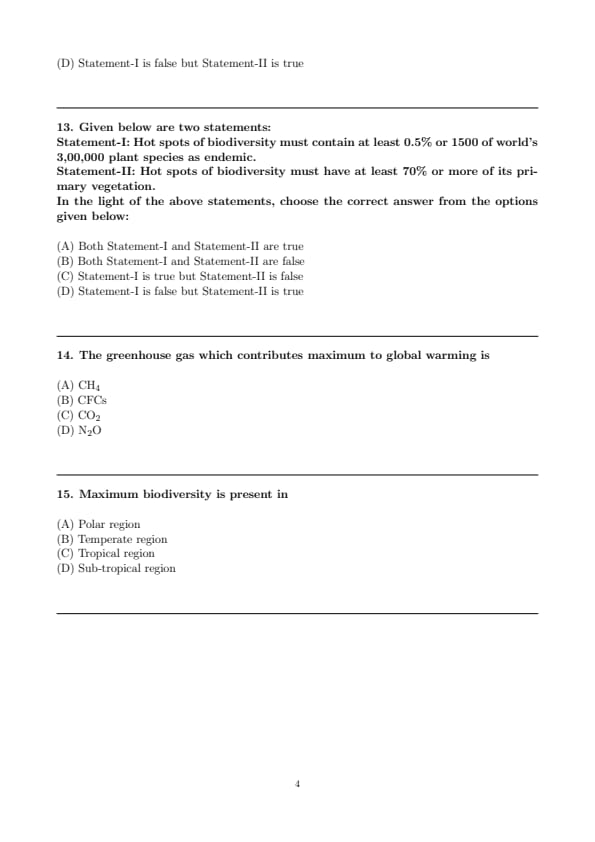
Given below are two statements:
Statement-I: Hot spots of biodiversity must contain at least 0.5% or 1500 of world's 3,00,000 plant species as endemic.
Statement-II: Hot spots of biodiversity must have at least 70% or more of its primary vegetation.
In the light of the above statements, choose the correct answer from the options given below:
View Solution
Step 1: Understanding the Question:
The question asks to evaluate two statements that define the criteria for a region to be classified as a biodiversity hotspot. We need to determine if each statement is true or false.
Step 2: Detailed Explanation:
According to Conservation International, an organization that introduced the concept, a region must meet two strict criteria to qualify as a biodiversity hotspot:
High Endemism: It must contain at least 1,500 species of vascular plants (\(>\) 0.5% of the world's total) as endemics, meaning these species are found nowhere else on Earth.
High Threat Level: It must have lost at least 70% of its original primary vegetation. In other words, it must have 30% or less of its original habitat remaining.
Step 3: Evaluating the Statements:
Statement-I: "Hot spots of biodiversity must contain at least 0.5% or 1500 of world's 3,00,000 plant species as endemic." This statement accurately reflects the first criterion. (Note: 0.5% of 300,000 is 1500). Thus, Statement-I is true.
Statement-II: "Hot spots of biodiversity must have at least 70% or more of its primary vegetation." This statement is incorrect. It describes the opposite of the second criterion. A hotspot must have lost at least 70% of its primary vegetation, meaning it has 30% or less remaining. Thus, Statement-II is false.
Step 4: Final Answer:
Based on the analysis, Statement-I is true, and Statement-II is false.
Quick Tip: To be a hotspot, a region must be both \textbf{irreplaceable} (high endemism) and \textbf{threatened} (high habitat loss). Remember it must have LOST at least 70% of its habitat.
The greenhouse gas which contributes maximum to global warming is
View Solution
Step 1: Understanding the Question:
The question asks to identify the greenhouse gas with the largest overall contribution to global warming. This contribution depends not just on the warming potential per molecule but also on the gas's atmospheric concentration.
Step 2: Detailed Explanation:
The relative contribution of different greenhouse gases to global warming is as follows:
CO\(_2\) (Carbon Dioxide): While other gases have a higher Global Warming Potential (GWP) per molecule, CO\(_2\) is by far the most abundant greenhouse gas emitted by human activities. Its sheer volume in the atmosphere means it is responsible for the largest portion of the enhanced greenhouse effect. Its contribution is estimated to be around 60-70%.
CH\(_4\) (Methane): Methane has a much higher GWP than CO\(_2\) but is present in much lower concentrations. It is the second-largest contributor, accounting for about 16-20% of global warming.
CFCs (Chlorofluorocarbons): These have extremely high GWPs but are present in very low concentrations. Their contribution is around 14%. (The option "CFC5" is likely a typo for CFCs).
N\(_2\)O (Nitrous Oxide): This gas also has a high GWP but low concentration, contributing about 6% to global warming.
Step 3: Final Answer:
Due to its overwhelmingly high concentration in the atmosphere compared to other greenhouse gases, carbon dioxide (CO\(_2\)) has the maximum overall contribution to global warming.
Quick Tip: Don't confuse "most potent" (highest GWP, like CFCs) with "largest contribution." The largest contribution comes from CO\(_2\) because there is so much more of it in the atmosphere.
Maximum biodiversity is present in
View Solution
Step 1: Understanding the Question:
The question asks to identify the geographical region on Earth that exhibits the highest level of biodiversity (species richness).
Step 2: Detailed Explanation:
There is a well-known ecological pattern called the latitudinal diversity gradient. This pattern shows that species richness increases as one moves from the poles towards the equator.
Tropical region (C): These regions, located around the equator, harbor the greatest biodiversity on the planet. Several hypotheses explain this:
They receive more solar energy, leading to high productivity.
They have had a more stable climate over long evolutionary timescales, with less disruption from events like ice ages.
The warm temperatures and high humidity provide favorable conditions for a vast array of life forms. Tropical rainforests, in particular, are centers of biodiversity.
Sub-tropical region (D): These regions have high biodiversity but generally less than the tropics.
Temperate region (B): These regions experience distinct seasons with colder winters, which limits the diversity of species compared to the tropics.
Polar region (A): These regions have the lowest biodiversity due to extreme cold, long periods of darkness, and very short growing seasons, which create harsh living conditions.
Step 3: Final Answer:
The tropical region has the most favorable and stable conditions for life, leading to the evolution and sustenance of the maximum number of species, hence the highest biodiversity.
Quick Tip: Remember the simple rule: Biodiversity is greatest at the equator (tropics) and decreases as you move towards the poles.
CUET PG 2026 Preparation Tips
*The article might have information for the previous academic years, please refer the official website of the exam.