CUET PG 2026 Chemistry Question Paper with Solutions PDF
- Question Paper 2025
- Question Paper 2024
- Question Paper 2023
- Mathematics Papers
- Statistics Question Paper
- English Question Paper
- Chemistry Question Paper
- Pol. Sci. Question Paper
- History Question Paper
- Commerce Question Papers
- Life Science Papers
- Geology Question Papers
- Journalism Question Paper
- B.Ed. HSS Question Paper
- Botany Question Paper
- B.Ed. Question Papers


| Updated On - Mar 16, 2026
CUET PG 2026 Chemistry Question Paper is available for download here. The National Testing Agency (NTA) conducted the CUET PG 2026 Chemistry (SCQP08) examination on March 11, 2026, during Shift 3 from 04:00 PM to 05:30 PM.
CUET PG 2026 Chemistry Question Paper with Solutions PDF(Memory-Based)
| CUET PG 2026 Chemistry Question Paper with Answer Key | Download PDF | Check Solutions |
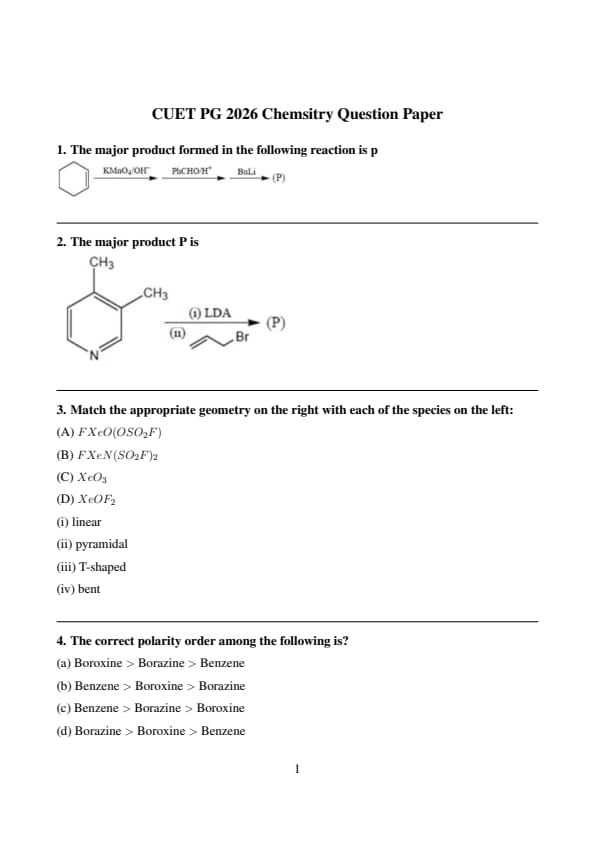
The major product formed in the following reaction is p

The major product P is

Match the appropriate geometry on the right with each of the species on the left:
The correct polarity order among the following is?
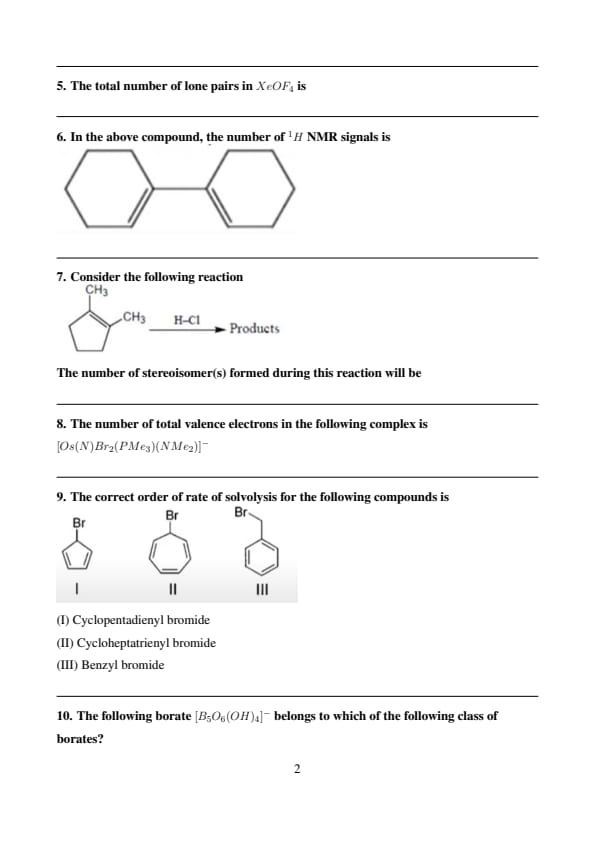
The total number of lone pairs in \(XeOF_4\) is
In the above compound, the number of \(^1H\) NMR signals is

Consider the following reaction

The number of stereoisomer(s) formed during this reaction will be
The number of total valence electrons in the following complex is \([Os(N)Br_2(PMe_3)(NMe_2)]^-\)
The correct order of rate of solvolysis for the following compounds is

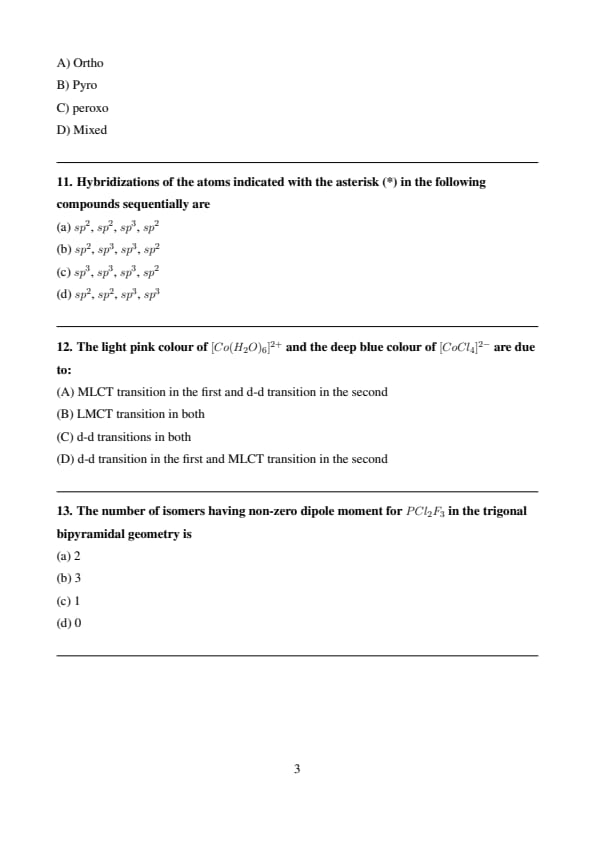
The following borate \([B_5O_6(OH)_4]^-\) belongs to which of the following class of borates?
Hybridizations of the atoms indicated with the asterisk (*) in the following compounds sequentially are
The light pink colour of \([Co(H_2O)_6]^{2+}\) and the deep blue colour of \([CoCl_4]^{2-}\) are due to:
The number of isomers having non-zero dipole moment for \(PCl_2F_3\) in the trigonal bipyramidal geometry is
CUET PG 2026 Chemistry Preparation
*The article might have information for the previous academic years, please refer the official website of the exam.