CUET PG 2024 Agroforestry Question Paper Pdf- Check Solutions with Answer Key Pdf
- Question Paper 2025
- Question Paper 2024
- Question Paper 2023
- Mathematics Papers
- Statistics Question Paper
- English Question Paper
- Chemistry Question Paper
- Pol. Sci. Question Paper
- History Question Paper
- Commerce Question Papers
- Life Science Papers
- Geology Question Papers
- Journalism Question Paper
- B.Ed. HSS Question Paper
- Botany Question Paper
- B.Ed. Question Papers


Content Strategist | Updated On - Jan 15, 2025
CUET PG 2024 Agroforestry 14th March 2024 Shift 3 Question Paper with Solution PDF is available for download here. Students found Silviculture easy, Forest Ecology moderate, and Agroforestry Systems difficult. Agroforestry Systems carried the highest weightage, and the overall difficulty level was moderate to difficult.
CUET PG 2024 Agroforestry Question Paper with Answer Key PDF
| CUET PG 2024 Agroforestry Question Paper with Answer Key |  Download Download |
Check Solution |
Agroforestry 2024 Questions with Solutions
Question 1:
Basic principles of ecology are:
Choose the correct answer from the options given below:
View Solution
All organisms are interdependent, nature strives for diversity, and the environment is holocentric.
The basic principles of ecology emphasize the complex interdependence between organisms and their physical surroundings. The claim that organisms have no limit of tolerance is incorrect, as every species has specific environmental thresholds. These principles are foundational for understanding biodiversity and sustainability.
Question 2:
Arrange anatomical features of stem from surface to inner layers:
Choose the correct answer from the options given below:
View Solution
The outermost layer is the thick cuticle, followed by epidermis, hypodermis, and vascular bundles.
The thick cuticle acts as a protective outer layer, preventing water loss and mechanical damage. The epidermis, located beneath the cuticle, serves as a barrier against pathogens. The hypodermis, composed of supportive tissue, provides structural integrity. Finally, vascular bundles transport water, nutrients, and sugars throughout the plant.
Question 3:
Arrange growth stages of wheat from beginning to end of life cycle:
Choose the correct answer from the options given below:
View Solution
The sequence is CRI, Boot, Flowering, and Dough stages.
Wheat begins its growth with the CRI (Crown Root Initiation) stage, where roots establish. The boot stage marks the emergence of the inflorescence within the sheath. Flowering occurs as the reproductive phase, leading to pollination and grain formation. The dough stage signifies grain maturation, where the seeds develop their final size and weight.
Question 4:
Arrange the following activities in the chronological order of their starting year in India:
Choose the correct answer from the options given below:
View Solution
PMFBY (2016) → PMMSY (2020) → PMGKAY (2020) → PLISFPI (2021).
The Pradhan Mantri Fasal Bima Yojana (PMFBY), launched in 2016, focuses on providing crop insurance to farmers. The Pradhan Mantri Matsya Sampada Yojana (PMMSY), launched in 2020, aims to enhance fisheries' productivity. In 2020, the Pradhan Mantri Garib Kalyan Anna Yojana (PMGKAY) was introduced to ensure food security during the pandemic. The Production Linked Incentive Scheme for Food Processing Industry (PLISFPI) followed in 2021 to support food processing businesses.
Question 5:
Planning Commission divided India into how many agroclimatic zones?
View Solution
India is divided into 15 agroclimatic zones.
The Planning Commission's classification into 15 agroclimatic zones considers factors such as soil type, rainfall, temperature, and water availability. These zones facilitate the development of region-specific agricultural practices and strategies, optimizing resource use and improving productivity across diverse climatic conditions.
Question 6:
Plant physiological and biochemical response to elevated CO₂ is known as:
View Solution
CO₂-fertilization enhances plant growth.
CO₂-fertilization is a process where elevated atmospheric CO₂ levels increase photosynthesis in plants, leading to higher biomass production. This phenomenon is most evident in C3 plants, such as wheat and rice, as they benefit significantly from enhanced photosynthetic efficiency. However, the impact of CO₂-fertilization is limited by other factors such as nutrient and water availability.
Question 7:
Which cropping system occupies the maximum area in India?
View Solution
The rice-wheat cropping system is the most widely practiced in India.
This cropping system is predominant in the Indo-Gangetic plains, contributing significantly to the country's food grain production. It ensures year-round agricultural activity and supports food security, though it faces challenges like soil degradation and water scarcity due to intensive farming practices.
Question 8:
Match List I with List II:
| LIST I (Potential Cropping System) | LIST II (Rainfall in mm) |
|---|---|
| A. Double cropping | I. <300 |
| B. No Crop | II. 301-700 |
| C. Single cropping | III. 701-1100 |
| D. Inter cropping | IV. >1100 |
Choose the correct answer from the options given below:
View Solution
The correct matches are based on the rainfall requirements for each cropping system.
Double cropping requires rainfall greater than 1100 mm to sustain multiple harvests annually. In arid regions with less than 300 mm rainfall, no cropping is possible. Single cropping is suited for moderate rainfall between 301-700 mm, while intercropping is feasible in areas receiving 701-1100 mm rainfall.
Question 9:
Which among the following is a positional average?
View Solution
Median represents the middle value in a sorted dataset.
The median divides a dataset into two equal halves and is unaffected by extreme values, making it a reliable measure of central tendency for skewed distributions. It is distinct from the mean, which averages all values, and mode, which identifies the most frequent value.
Question 10:
Which one is not the benefit of agroforestry?
View Solution
Agroforestry provides multiple environmental and economic benefits, but green water uptake is not one of them.
Benefits of agroforestry include nutrient recycling, improving microclimates, reducing deforestation, and enhancing biodiversity. It also contributes to carbon sequestration and soil conservation, making it an effective tool for sustainable land management.
Question 11:
Which programme has been launched as a part of the Golden Jubilee celebration of ICAR?
View Solution
The Lab to Land Programme was launched to transfer agricultural research findings to farmers directly.
Launched during ICAR's Golden Jubilee celebrations, the Lab to Land Programme aims to boost agricultural productivity and farmer incomes by bridging the gap between scientific research and field-level implementation. It focuses on empowering farmers with modern agricultural technologies.
Question 12:
Conversion of 'central leaf into shiny tubular structure' is associated with which of the following pest of rice crop?
View Solution
Gall midge infestation in rice crops results in the conversion of the central leaf into a tubular structure.
The rice gall midge is a major pest in Asia, causing characteristic 'silver shoots' or shiny tubular leaves. These pests significantly affect tillering and yield. Integrated pest management practices, including resistant varieties and cultural controls, are key to managing infestations effectively.
Question 13:
Which of the following facts are associated with khaira disease of rice?
Choose the correct answer from the options given below:
View Solution
Khaira disease is identified by the white midrib appearance, stunted growth, and symptoms occurring between two to four weeks post-transplanting.
Khaira disease is primarily caused by zinc deficiency in rice plants. It leads to significant yield reduction if left unchecked. The condition can be effectively managed by applying zinc sulfate to the soil or through foliar sprays of zinc solutions.
Question 14:
Identify the facts associated with wilt in chickpea crop:
Choose the correct answer from the options given below:
View Solution
Wilt disease in chickpeas is marked by plant wilting 3 weeks after sowing, weakening, and dark-colored affected portions.
The disease is caused by Fusarium oxysporum. Preventive measures include using resistant cultivars, seed treatment with bio-fertilizers such as Azotobacter, and adopting crop rotation to break the pathogen lifecycle.
Question 15:
Match List I with List II:
| LIST I (Disease) | LIST II (Organism) |
|---|---|
| (A) Loose smut | (IV) Ustilago |
| (B) Karnal bunt | (I) Nevossia |
| (C) Rust | (II) Puccinia |
| (D) Powdery mildew | (III) Erysiphe |
Choose the correct answer from the options given below:
View Solution
The correct matches are: Loose smut (Ustilago), Karnal bunt (Nevossia), Rust (Puccinia), and Powdery mildew (Erysiphe).
Each pathogen has specific traits and control methods. Loose smut is controlled by seed treatment, Karnal bunt is a quarantine pest, rust diseases spread via spores, and powdery mildew thrives in high humidity.
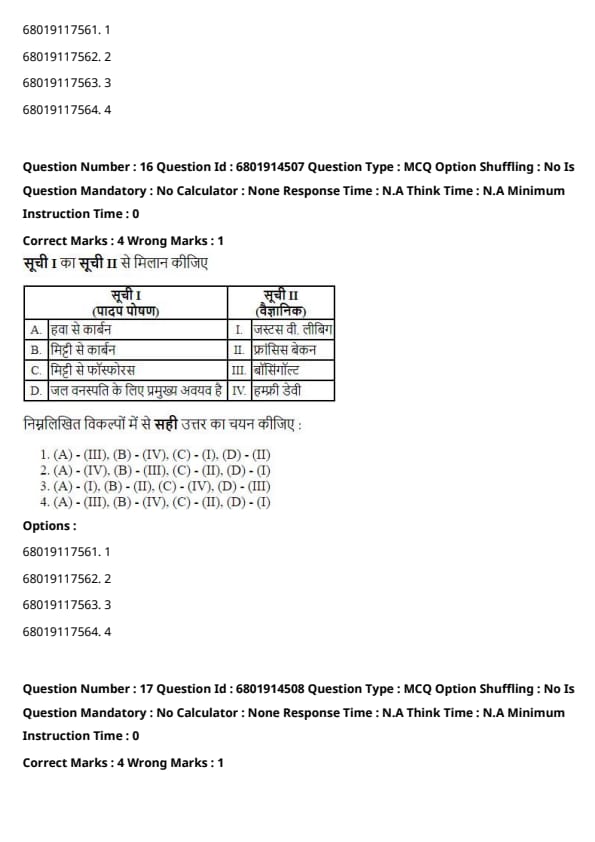
Question 16:
Match List I with List II:
| LIST I (Plant nutrient) | LIST II (Scientist associated) |
|---|---|
| (A) Carbon from air | (III) Bossingault |
| (B) Carbon from soil | (IV) Humphrey Davy |
| (C) Phosphorus from soil | (I) Justus V Liebig |
| (D) Water is the principal element of vegetation | (II) Francis Bacon |
Choose the correct answer from the options given below:
View Solution
Bossingault identified carbon uptake from air, Humphrey Davy highlighted carbon from soil, Liebig emphasized phosphorus absorption, and Bacon proposed water as a principal vegetation element.
The foundational understanding of plant nutrition was built through contributions by these scientists. Their discoveries emphasized the roles of air, soil, and water in plant growth and have influenced modern agricultural practices.
Question 17:
How many essential nutrients are required for plant growth and development?
View Solution
Plants require 18 essential nutrients, including macronutrients and micronutrients, for physiological and metabolic activities.
The 18 essential nutrients include macronutrients like nitrogen, phosphorus, and potassium, as well as micronutrients like zinc and iron. These nutrients are absorbed from air, water, and soil, and their balance is crucial for optimal plant growth and yield.
Question 18:
Deficiency symptoms of phosphorus are:
Choose the correct answer from the options given below:
View Solution
Phosphorus deficiency causes purple or orange discoloration in older leaves and stunted root development, hindering nutrient uptake.
Phosphorus deficiency severely impacts plant energy metabolism, photosynthesis, and root system development. This can lead to poor crop performance and reduced yield. Timely phosphorus application via fertilizers is essential for addressing this deficiency.
Question 19:
What is true in relation to soil fertility and productivity?
Choose the correct answer from the options given below:
View Solution
Soil fertility is the inherent ability of soil to supply nutrients, while productivity involves external factors like management practices and environmental conditions.
Soil fertility refers to the soil's natural ability to provide nutrients essential for plant growth. Soil productivity, on the other hand, encompasses soil fertility along with management practices, environmental conditions, and crop type, making it a broader concept. While fertile soils are usually productive, productivity can be influenced by external interventions.
Question 20:
Who proposed the essentiality criteria of nutrients for plants?
View Solution
Arnon and Stout established criteria for determining nutrient essentiality, forming the basis for modern plant nutrition studies.
Arnon and Stout proposed three criteria: the element must be necessary for the plant to complete its life cycle, no other element can replace it, and it must be directly involved in plant metabolism. This framework remains a cornerstone in plant nutrition science.
Question 21:
Match List I with List II:
| LIST I (Biochemical and physiological function) | LIST II (Associated nutrients) |
|---|---|
| (A) Major constituent of plants | (I) N and S |
| (B) Involved in biochemical reactions | (II) Zn and Mo |
| (C) Free ionic state | (III) P and B |
| (D) Present as chelates | (IV) Ca and Mg |
Choose the correct answer from the options given below:
View Solution
Each nutrient is uniquely associated with specific plant functions, contributing to growth and development.
Nitrogen (N) and Sulfur (S) are key components of amino acids and proteins. Zinc (Zn) and Molybdenum (Mo) are vital for enzymatic reactions. Phosphorus (P) and Boron (B) contribute to energy transfer and structural integrity, while Calcium (Ca) and Magnesium (Mg) act as chelates, stabilizing structures.
Question 22:
Sequential steps involved in mineralization of nitrogen:
Choose the correct sequence from the options given below:
View Solution
The mineralization process starts with proteins being converted to ammonium (NH4), which is oxidized to nitrite (NO2) and finally to nitrate (NO3).
Nitrogen mineralization involves several steps: protein decomposition releases ammonium ions (NH4+), which are then converted to nitrite (NO2-) through nitrification. This nitrite is further oxidized to nitrate (NO3-), a form readily absorbed by plants for growth.
Question 23:
Forest sustainability deals with:
Choose the correct answer from the options given below:
View Solution
Forest sustainability emphasizes balancing environmental conservation with meeting the social and economic needs of current and future generations.
Forest sustainability integrates the principles of ecology, economy, and society to preserve biodiversity and ensure the forest resources remain productive for future generations. It involves conservation efforts that reduce deforestation and promote regeneration while fulfilling the present demands for forest-based resources responsibly.
Question 24:
Conservation tillage helps in:
Choose the correct answer from the options given below:
View Solution
Conservation tillage improves soil water retention, reduces erosion, and lowers energy use by minimizing the need for heavy machinery.
By reducing soil disturbance, conservation tillage maintains organic matter levels and prevents soil erosion. The improved water infiltration and retention contribute to better crop growth. Additionally, it lowers fuel and equipment costs, promoting sustainable and cost-effective farming practices. Excessive tillage can compact the soil, which is avoided in this method.
Question 25:
Which cropping system is more sustainable in nature?
View Solution
The Maize - chickpea system is sustainable due to chickpea's nitrogen-fixing ability, reducing the need for synthetic fertilizers.
Integrating legumes like chickpeas in crop rotation improves soil health and enhances productivity by fixing atmospheric nitrogen. This practice reduces dependence on chemical fertilizers, lowers production costs, and supports sustainable farming. Chickpeas also provide a balanced nutrient cycle when paired with cereal crops like maize.
Question 26:
Match List I with List II:
| List I (Agroforestry definition) | List II (Associated with) |
|---|---|
| (A) Sustainable management system for land | (I) Bartle, 1977 |
| (B) Range land management with trees | (II) Thomas, 1977 |
| (C) Integration of trees, crops, and animals | (III) Bene et al, 1977 |
| (D) Combination of agriculture and forestry | (IV) Nair, 1979 |
Choose the correct answer from the options given below:
View Solution
Agroforestry definitions align with the authors as follows: Bene et al (1977) emphasized sustainability, Bartle (1977) addressed range management, Nair (1979) focused on integration, and Thomas (1977) highlighted agriculture and forestry combinations.
Agroforestry integrates agriculture and forestry practices to improve land productivity and sustainability. Combining trees, crops, and animals in managed systems enhances biodiversity, prevents soil erosion, and ensures long-term ecological balance. These approaches are foundational for sustainable land-use planning.
Question 27:
Agricultural waste management involves the sequence of events as:
Choose the correct answer from the options given below:
View Solution
The correct sequence is crop and animal waste decomposition, followed by nutrient mineralization and uptake by plants.
Agricultural waste is initially processed into compost or manure through decomposition. Nutrients in the manure are mineralized into forms that plants can absorb, completing the nutrient cycle. Effective waste management reduces environmental impacts and improves crop productivity by enhancing soil fertility.
Question 28:
Match List I with List II:
| List I (Agricultural waste) | List II (Nitrogen %) |
|---|---|
| (A) Cattle dung | (I) 1.0-1.8 |
| (B) Poultry manure | (II) 0.6 |
| (C) Sheep dung | (III) 0.95 |
| (D) Horse dung | (IV) 0.70 |
Choose the correct answer from the options given below:
View Solution
The correct matching of agricultural waste with their nitrogen percentages is based on research data, ensuring proper nutrient management in agriculture.
Nitrogen content in agricultural waste varies based on the source. Poultry manure is the richest in nitrogen (1.0-1.8%), followed by sheep dung (0.95%), horse dung (0.70%), and cattle dung (0.6%). Understanding these values helps in the effective utilization of organic waste for soil fertility improvement.
Question 29:
The correct order of steps in resource conservation is:
Choose the correct answer from the options given below:
View Solution
Start with soil and water conservation measures, then maximize precipitation retention, store run-off water, and manage silt for long-term resource sustainability.
Resource conservation involves implementing measures like contour farming and terracing to prevent erosion, maximizing water retention through vegetative cover, managing silt accumulation in water bodies, and effectively storing water for agricultural use. This systematic approach ensures resource optimization and sustainability.
Question 30:
Benefits of conservation agriculture include:
Choose the correct answer from the options given below:
View Solution
Conservation agriculture enhances soil structure and organic carbon but does not require additional energy or reduce water infiltration.
Practices like no-till farming and crop rotation in conservation agriculture promote soil health by increasing organic matter and improving soil aeration. These practices also minimize energy inputs, making them more sustainable while enhancing water infiltration and retention.
Question 31:
Which of the following statements about mango are correct?
Choose the correct answer from the options given below:
View Solution
Mankurad is a mid-season variety of Goa, Niranjan is an off-season variety, and India leads in global mango production. However, Chausa is not a late-maturing variety specific to South India.
India dominates global mango production due to diverse climatic conditions and the cultivation of multiple varieties like Alphonso, Dasheri, and Banganapalli. Niranjan, being an off-season variety, is crucial for market stability during non-peak seasons.
Question 32:
Match List I with List II:
| List I (Fruit crop) | List II (Variety) |
|---|---|
| (A) Pear | (I) Mariposa |
| (B) Peach | (II) Amritha |
| (C) Plum | (III) Laxton's Superb |
| (D) Pineapple | (IV) Quetta |
Choose the correct answer from the options given below:
View Solution
The correct matching reflects geographical and characteristic associations:
Pear - Laxton's Superb, Peach - Quetta, Plum - Mariposa, Pineapple - Amritha.
These fruit varieties have been cultivated for their adaptability to specific regions and their unique taste profiles, making them popular in both domestic and international markets.
Question 33:
Which of the following statements about grapes are correct?
Choose the correct answer from the options given below:
View Solution
All the pruning times mentioned for the grape varieties Anab-e-Shahi, Thompson Seedless, Bhokri, and Bangalore Blue are correct.
Pruning schedules are critical in grape cultivation to ensure proper growth and yield. Anab-e-Shahi and Thompson Seedless require precise timing for summer and winter pruning to maximize productivity. Bangalore Blue and Bhokri schedules optimize their fruiting cycles.
Question 34:
Arrange fruit crops as per its importance in the Indian economy (Top to bottom):
Choose the correct answer from the options given below:
View Solution
In terms of economic importance, Banana ranks first, followed by Mango, Citrus, and Guava in India.
Banana and Mango are cultivated extensively in India, contributing significantly to the agricultural GDP. Citrus fruits and Guava follow, offering nutritional and economic benefits, especially in regional markets.
Question 35:
De-navelling in banana refers to which of the following practice?
View Solution
De-navelling refers to removing the male bud in banana cultivation, improving fruit development and quality.
This practice prevents nutrient diversion to the male bud, ensuring better growth and maturity of the banana fruit, which enhances market value.
Question 36:
Anacardium occidentale is native to which country?
View Solution
Anacardium occidentale, commonly known as cashew, is native to Brazil and was later introduced to India and other tropical countries.
Cashew is a vital export commodity, particularly for India, where it is processed and sold globally. Brazil remains a significant player in the raw cashew nut market.
Question 37:
Which of the following statements about coconut are correct?
Choose the correct answer from the options given below:
View Solution
Coconut holds a significant share in oilseed production, thrives in a pH range of 7.0 to 9.5, and requires a temperature range of 27°C to 32°C for optimal growth. Kera Sree is not specifically a hybrid variety.
Coconut is a vital crop in tropical regions, contributing to the economy through oil production and by-products. Maintaining the right pH and temperature ensures high yield and quality.
Question 38:
Match List I with List II:
| List I (Important feature) | List II (Variety of Turmeric) |
|---|---|
| (A) Resistant to shoot borer | (I) Suranjana |
| (B) Resistant to leaf spot | (II) BSR-1 |
| (C) High oleoresin content | (III) Prathibha |
| (D) Resistant to drought | (IV) Sudarshana |
Choose the correct answer from the options given below:
View Solution
The correct matching is:
- Suranjana: Resistant to shoot borer
- BSR-1: Resistant to leaf spot
- Prathibha: High oleoresin content
- Sudarshana: Resistant to drought
Understanding the unique traits of turmeric varieties helps in choosing the best option for specific growing conditions and pest resistance.
Question 39:
The correct difference between Lianas and Epiphytes is:
View Solution
Lianas are woody climbing plants rooted in the ground, requiring other plants for support. Epiphytes grow on plants without extracting nutrients from them.
Lianas are common in tropical rainforests and use other trees to reach sunlight. Epiphytes, including orchids and ferns, are independent plants utilizing host plants for support and access to better light.
Question 40:
In which association where one species is benefited and the other one is not affected?
View Solution
Commensalism is a symbiotic relationship where one species benefits, and the other remains unaffected. This differs from mutualism, where both species gain benefits.
Examples of commensalism include birds nesting in trees or remoras hitching rides on sharks. These interactions do not harm the host species while providing benefits like shelter or transport to the commensal species.
Question 41:
Components from bottom to top in an ecological pyramid are:
View Solution
An ecological pyramid starts with producers (plants) at the base, followed by herbivores (primary consumers), and carnivores (secondary consumers) at higher levels.
The ecological pyramid visually represents energy or biomass distribution across trophic levels. Producers form the foundation as they convert solar energy into chemical energy, which is transferred through the food chain.
Question 42:
Interlocked food chains are called:
View Solution
A food web consists of interlinked food chains, showing the complex feeding relationships and energy flow in an ecosystem.
Food webs provide a more realistic representation of ecosystem dynamics than simple food chains, highlighting multiple predator-prey relationships and the interconnectedness of species.
Question 43:
Ecological succession happening on sand is known as:
View Solution
Psammosere refers to ecological succession occurring on sandy substrates, starting with pioneer species and progressing to more complex ecosystems.
This process involves colonizing plants like grasses and shrubs that stabilize the sandy soil, allowing other species to establish. Psammosere is common in coastal dunes and sandy deserts.
Question 44:
Identify the correct aspects regarding multipurpose tree species:
View Solution
Multipurpose tree species are valued for their resistance to environmental stress, their ability to enrich soil through leaf litter, and their tolerance to management practices like coppicing and pruning.
These trees provide multiple benefits, including fuelwood, fodder, and ecological services. They play a crucial role in agroforestry systems and help in soil conservation and improving soil fertility.
Question 45:
Basic objective of farm forestry is:
View Solution
Farm forestry primarily aims to generate maximum profit by growing trees on farmland, while also offering ecological and social benefits.
By integrating tree plantations into agriculture, farm forestry improves biodiversity, reduces environmental degradation, and provides income from timber, fruits, and other tree products.
Question 46:
Mean Annual Increment of tree growth can be computed by using the formula:
View Solution
The Mean Annual Increment (MAI) of tree growth is calculated as the total volume of the tree divided by its age, providing an average growth rate per year.
MAI is a key metric in forestry, used to evaluate the growth efficiency of forest stands and guide sustainable harvesting practices.
Question 47:
Huber's formula is useful to measure which part of the tree?
View Solution
Huber's formula is commonly used to estimate the stem volume of trees, which is crucial for determining the timber volume for forestry operations.
Read More
The formula considers the cross-sectional area and height of the stem to calculate its volume, aiding in accurate resource assessment in forestry.
Question 48:
Evergreen shola forests are found in which area of India?
View Solution
Evergreen shola forests are primarily found in the Nilgiris, Annamalai hills, and Palni hills in the Western Ghats of India, not in the Himalayas.
Read More
Shola forests are a unique type of tropical montane forest found in the valleys of the Western Ghats, supporting a rich biodiversity and acting as vital water catchment areas.
Question 49:
IUCN stands for:
View Solution
IUCN is the International Union for Conservation of Nature, an organization involved in global conservation efforts and sustainable use of natural resources.
The IUCN is particularly known for its Red List of Threatened Species, which serves as a critical indicator of the health of the world's biodiversity.
Question 50:
Match List I with List II:
| List I (Organization/Act) | List II (Year of establishment) |
|---|---|
| (A) Bombay Natural History Society | (I) 1958 |
| (B) Wild life Preservation Society of India | (II) 1883 |
| (C) World Wildlife Fund | (III) 1972 |
| (D) Wild Life Protection Act | (IV) 1969 |
Choose the correct answer from the options given below:
View Solution
This correct matching aligns each organization and act with its establishment year, providing insight into the historical context of conservation efforts in India.
These organizations and acts have played pivotal roles in the development of wildlife and environmental conservation in India.
Question 51:
Match List I with List II:
| List I (Book) | List II (Author) |
|---|---|
| (A) Forest Policy | (I) AK Patra |
| (B) Forest Mensuration | (II) BS Chundawat and SK Gautam |
| (C) Agroforestry Principles and Practice | (III) SS Negi |
| (D) Text book of Agroforestry | (IV) Chapman |
Choose the correct answer from the options given below:
View Solution
Each book is correctly matched with its author, helping to identify key resources in forestry and agroforestry literature.
These books are essential references for students and professionals in the field of forestry, providing theoretical and practical knowledge.
Question 52:
Who is the father of Agroforestry in India?
View Solution
PKR Nair is widely recognized as the father of Agroforestry in India due to his significant contributions to the field.
PKR Nair’s work laid the foundation for agroforestry research and development in India, bridging the gap between traditional practices and modern scientific approaches.
Question 53:
What are the important practices in canopy management of Agroforestry tree species?
- (A) Pruning
- (B) Pollarding
- (C) Coppicing
- (D) Uprooting
Choose the correct answer from the options given below:
View Solution
Pruning, pollarding, and coppicing are key canopy management practices in agroforestry, enhancing tree health and productivity, while uprooting is not typically a management practice.
Canopy management helps maintain balance between light availability, air circulation, and tree growth, promoting sustainable agroforestry systems.
Question 54:
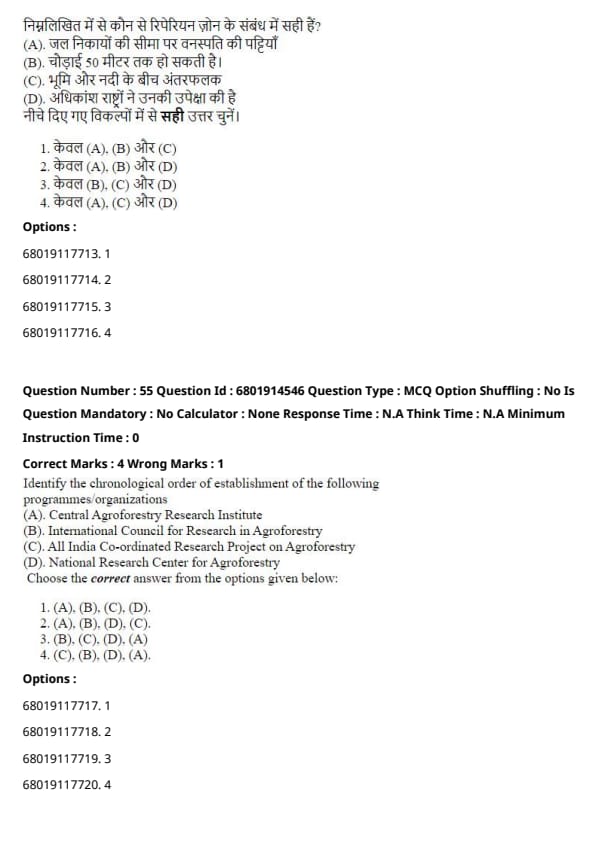
Which of the followings are correct regarding Riparian zones?
- (A) Strips of vegetation bordering water bodies
- (B) Width may be up to 50 m
- (C) Interface between land and river
- (D) Most nations have neglected them
Choose the correct answer from the options given below:
View Solution
Riparian zones are vegetative areas next to water bodies, acting as a buffer and interface between land and water, commonly up to 50 m in width.
These zones are critical for maintaining water quality, reducing erosion, and supporting biodiversity in aquatic and terrestrial ecosystems.
Question 55:
Identify the chronological order of establishment of the following programmes/organizations:
Choose the correct answer from the options given below:
View Solution
The correct chronological order is: International Council for Research in Agroforestry, All India Co-ordinated Research Project on Agroforestry, National Research Center for Agroforestry, and then the Central Agroforestry Research Institute.
The development of agroforestry programs reflects the growing importance of integrating agriculture and forestry to address sustainability challenges and improve livelihoods.
Question 56:
Match List I with List II:
| List I (System) | List II (Components) |
|---|---|
| (A) Horti-pastoral | (I) Fodder crops+tree |
| (B) Silvi-olericulture | (II) Perennial hedges+crops |
| (C) Alley cropping | (III) Fruit tree-fodder |
| (D) Forage forestry | (IV) Tree+vegetables |
Choose the correct answer from the options given below:
View Solution
Each agroforestry system is matched with its typical components, reflecting the integration of various agricultural practices with forestry.
Matching systems and components helps identify suitable agroforestry techniques for different ecological and economic goals.
Question 57:
Which are the popular tree species under wood lot category?
Choose the correct answer from the options given below:
View Solution
Bamboo, Casuarina, and Poplar are all commonly used in wood lots due to their fast growth rates and suitability for timber and pulp production.
Wood lot species like Bamboo, Casuarina, and Poplar provide sustainable options for timber, fuel, and environmental benefits.
Question 58:
Match List I with List II:
| List I (Agroforestry Classification) | List II (Practices) |
|---|---|
| (A) Agrisilviculture | (I) Cut and carry fodder production |
| (B) Silvipasture | (II) Multipurpose wood lots |
| (C) Agrisilvipastural | (III) Alley cropping |
| (D) Other systems | (IV) Home gardens |
Choose the correct answer from the options given below:
View Solution
This matching aligns each agroforestry classification with its corresponding practice, illustrating the diversity of approaches in agroforestry.
Agrisilviculture involves alley cropping, highlighting the integration of crop cultivation with tree farming for optimal land use.
Question 59:
What is the decreasing order of approximate area in different states in India under Taungya cultivation?
Choose the correct answer from the options given below:
View Solution
West Bengal, Uttar Pradesh, Tripura, and Maharashtra follow this order in terms of area under Taungya cultivation, a practice that integrates forestry and agriculture.
Understanding regional cultivation practices helps in planning and policy-making for sustainable agricultural and forestry development.
Question 60:
Arrange the correct time of seed collection in different forest tree species starting from January to December:
Choose the correct answer from the options given below:
View Solution
The sequence for collecting seeds from these species through the year starts with Acacia catechu, followed by Ailanthus grandis, Acrocarpus fraxinifolius, and lastly Casuarina equisetifolia, reflecting their flowering and seed maturation periods.
Timing seed collection correctly is crucial for maximizing germination rates and ensuring healthy sapling growth.
Question 61:
Identify the tree with fleshy fruits:
Choose the correct answer from the options given below:
View Solution
Gmelina and Azadirachta are known for having fleshy fruits, while Teak, Walnut, Oak, and Almond have hard or dry fruits.
Fleshy fruits are typically found in species that have soft, edible parts surrounding the seeds.
Question 62:
Which of the following trees are not meant for pulpwood extraction?
Choose the correct answer from the options given below:
View Solution
Pithecellobium is not used for pulpwood extraction. Trees like Eucalyptus, Populus, and Anthocephalus are commonly used for pulpwood.
Pulpwood trees are specifically chosen for their soft wood, which is ideal for paper production.
Question 63:
Arrange the states in the decreasing order of approximate area under forests in India:
Choose the correct answer from the options given below:
View Solution
The correct decreasing order of forest area in India is as follows: Madhya Pradesh, Maharashtra, Orissa, and Arunachal Pradesh.
Madhya Pradesh and Maharashtra have the largest forest areas in India, contributing significantly to the nation's biodiversity.
Question 64:
What is the size of the drawing sheet generally used in survey work?
View Solution
The standard drawing sheet size used in survey work is 76 x 56 cm, commonly used for detailed survey and mapping.
Surveying sheets are selected based on the level of detail required for mapping and documentation in field surveys.
Question 65:
Which of the following statements about survey are correct?
Choose the correct answer from the options given below:
View Solution
In survey work, the follower holds the rear end of the chain, and a polygon is formed in close traverse, while open traverse does not form a polygon.
Understanding the roles in survey work and the types of surveys helps in conducting accurate and efficient field measurements.
Question 66:
Which of the following statements about forest classification are correct?
Choose the correct answer from the options given below:
View Solution
Government-owned forests in Union Territories are under central government control, and the Chief Conservator of Forests is the head of the state's forest department. National forest was indeed one component of the classification per the National Forest Policy 1952.
Understanding forest governance and classification aids in the management and protection of national and state forests.
Question 67:
In India, how much percent of land holdings are less than two ha?
View Solution
In India, about 90% of land holdings are less than two hectares, indicating the prevalence of small-scale farming.
Small landholdings dominate Indian agriculture, leading to challenges in scaling farming practices for increased productivity.
Question 68:
Which of the following statements are correct?
Choose the correct answer from the options given below:
View Solution
Shifting cultivation generally occurs in areas where land is abundant, but labor can be scarce. The Taungya system, which integrates forestry with agriculture, involves intensive land use.
The Taungya system is a practice that balances forestry and farming by integrating crops with the establishment of tree plantations.
Question 69:
Arrange gases in sequence (Higher to lower) as per their content in environment at or near to sea:
Choose the correct answer from the options given below:
View Solution
The most abundant gases in the atmosphere near sea level are Nitrogen, Oxygen, Argon, and then CO2, in that order.
Nitrogen makes up about 78% of the Earth's atmosphere, followed by oxygen at 21%. CO2 and argon have much smaller concentrations.
Question 70:
The chief source of carbon monoxide in the environment is:
View Solution
Automobiles, particularly those that run on gasoline or diesel, are one of the primary sources of carbon monoxide in the environment due to incomplete combustion.
Carbon monoxide is a toxic gas primarily produced by vehicles and can have serious health effects if inhaled in large quantities.
Question 71:
International Agreement on Convention on Biological Diversity was enacted in which year?
View Solution
The Convention on Biological Diversity (CBD) was enacted in 1992 during the Earth Summit held in Rio de Janeiro, Brazil, aiming to conserve biodiversity, sustainably use its components, and ensure fair and equitable sharing of benefits.
The CBD is a landmark agreement for global conservation efforts and sustainable development goals.
Question 72:
Which of the following statements regarding pests of forest are correct?
Choose the correct answer from the options given below:
View Solution
Sap feeders like Cicadas and Psyllids belong to the Hemiptera order, but they rarely lead to tree death. Bacillus thuringiensis is a widely used biological agent to control defoliators.
Biological agents like Bacillus thuringiensis provide sustainable pest control without harming the environment.
Question 73:
Which of the following statements are correct?
Choose the correct answer from the options given below:
View Solution
All the given statements are correct, as parasitoids are known to lay their eggs inside their hosts, and Carabid beetles and spiders are well-known predators.
Parasitoids and predators play a crucial role in regulating pest populations in agroforestry ecosystems.
Question 74:
Which of the following statements about Insect Associated Diseases are correct?
Choose the correct answer from the options given below:
View Solution
Bark beetles are responsible for introducing blue stain fungi like Ophiostoma and Ceratocystis into trees, causing discoloration and timber damage. Ips typographus is pathogenic to trees.
Understanding insect-associated diseases helps in managing pest infestations effectively to protect forest health.
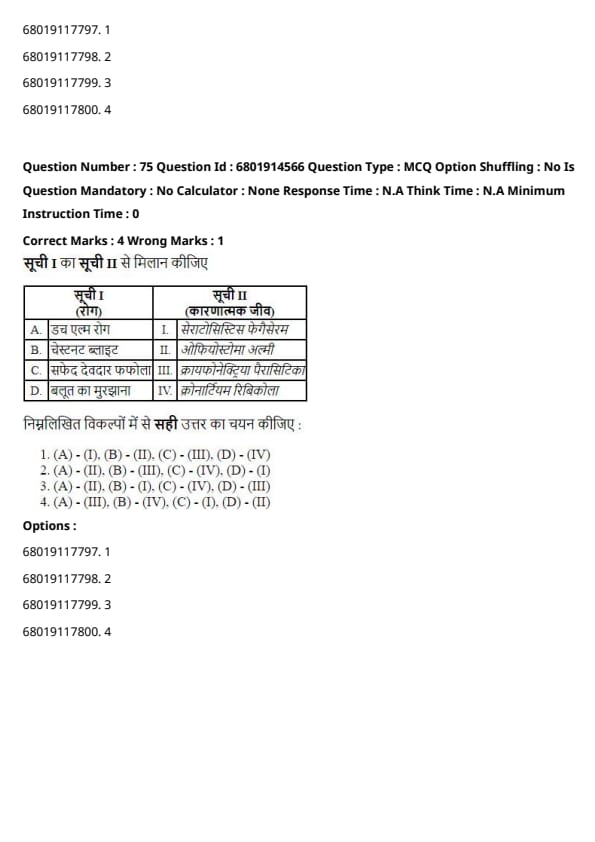
Question 75:
Match List I with List II:
| List I (Disease) | List II (Causal organism) |
|---|---|
| (A) Dutch elm disease | (II) Ophiostoma ulmi |
| (B) Chestnut blight | (III) Cryphonectria parasitica |
| (C) White pine blister | (IV) Cronartium ribicola |
| (D) Oak wilt | (I) Ceratocystis fagacearum |
Choose the correct answer from the options given below:
View Solution
Each disease is correctly matched with its causal organism, providing an understanding of the biological causes behind major tree diseases.
Effective management of forest diseases requires identifying their causal organisms and understanding their life cycles.



















































































*The article might have information for the previous academic years, please refer the official website of the exam.