CUET PG 2024 Question Paper with Answer Key PDF for Commerce (March 19 - Shift 2)
- Question Paper 2025
- Question Paper 2024
- Question Paper 2023
- Mathematics Papers
- Statistics Question Paper
- English Question Paper
- Chemistry Question Paper
- Pol. Sci. Question Paper
- History Question Paper
- Commerce Question Papers
- Life Science Papers
- Geology Question Papers
- Journalism Question Paper
- B.Ed. HSS Question Paper
- Botany Question Paper
- B.Ed. Question Papers


Content Writer | Updated On - Mar 9, 2025
CUET PG Question Papers are the most important study material for effective exam preparation. We at Zollege have provided all CUET PG Previous Year Papers with Solution PDFs here. CUET PG 2024 Commerce exam was conducted successfully on March 19 by NTA.
Students can freely download the CUET PG previous year's question paper PDFs along with their solutions here. We strongly encourage CUET PG aspirants to scan through all the CUET PG Question Paper to know the overall difficulty level, CUET PG Syllabus and understand the changes in CUET PG Exam Pattern over the years.
CUET PG 2024 Commerce Question Paper with Answer Key PDF
| CUET PG 2024 Commerce Question Paper with Answer Key |  Download Download |
Check Solution |
Commerce 2024 Questions with Solutions
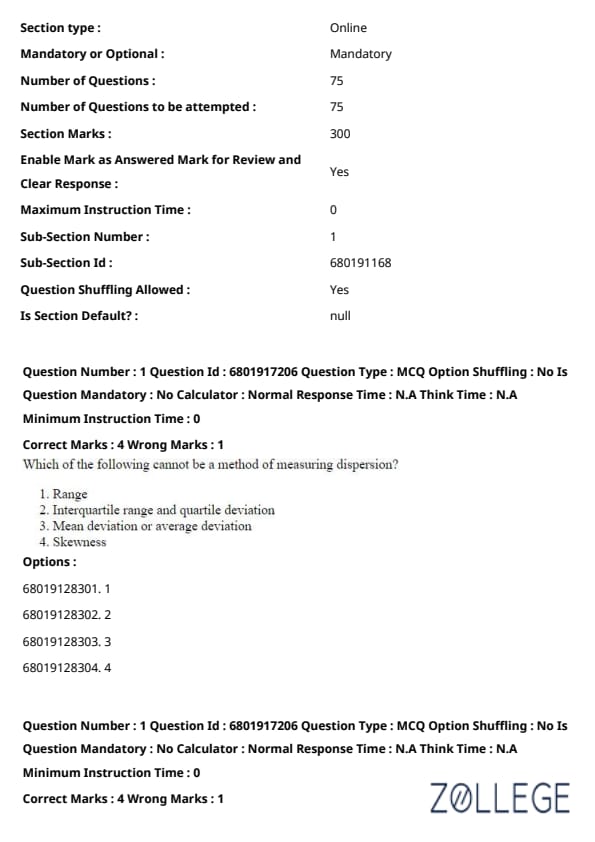
Question 1:
Which of the following cannot be a method of measuring dispersion?
View Solution
Solution: Dispersion measures the spread of a dataset and is typically calculated using methods like range, interquartile range, quartile deviation, and mean deviation. Skewness, on the other hand, measures the asymmetry of the distribution, not dispersion.
Quick Tip: Dispersion focuses on the spread of values, while skewness measures asymmetry.
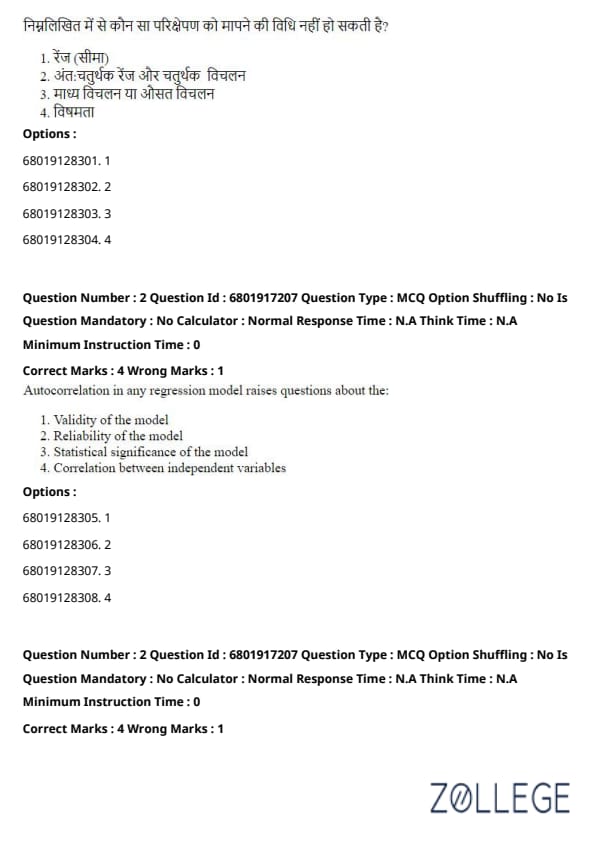
Question 2:
Autocorrelation in any regression model raises questions about the:
View Solution
Solution: Autocorrelation implies that residuals are not independent of each other, raising concerns about the reliability of the model's predictions and parameter estimates. This violates the assumption of independence in regression analysis.
Quick Tip: Address autocorrelation by using methods like Durbin-Watson statistics to ensure reliable regression results.
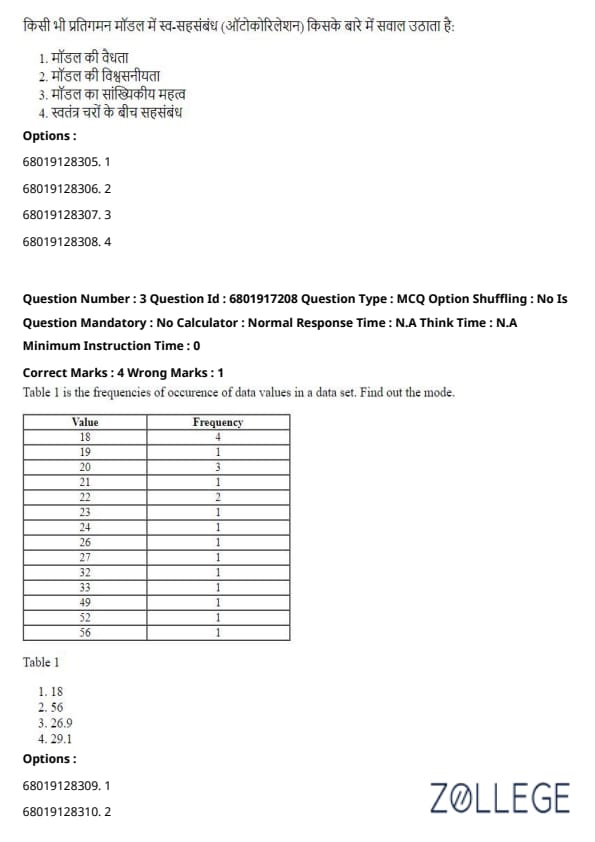
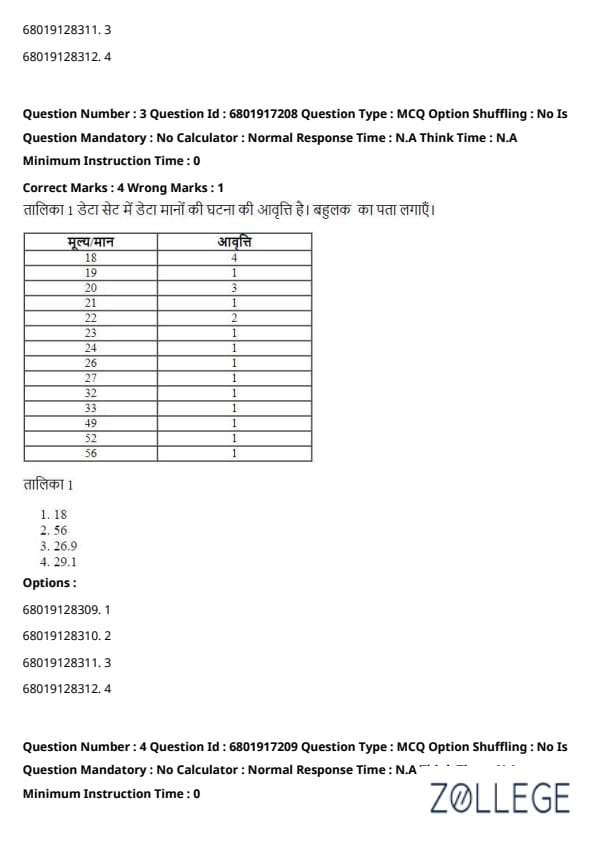
Question 3:
Table 1 is the frequencies of occurrence of data values in a dataset. Find out the mode.
| Value | Frequency |
|---|---|
| 18 | 4 |
| 19 | 1 |
| 20 | 3 |
| 21 | 1 |
| 22 | 2 |
| 23 | 1 |
| 24 | 1 |
| 26 | 1 |
| 27 | 1 |
| 32 | 1 |
| 33 | 1 |
| 49 | 1 |
| 52 | 1 |
| 56 | 1 |
View Solution
Solution: The mode of a dataset is the value that appears most frequently. Here, the value 18 has the highest frequency (4), making it the mode.
Quick Tip: The mode is the most frequent value in a dataset. Focus on the highest frequency to determine it.
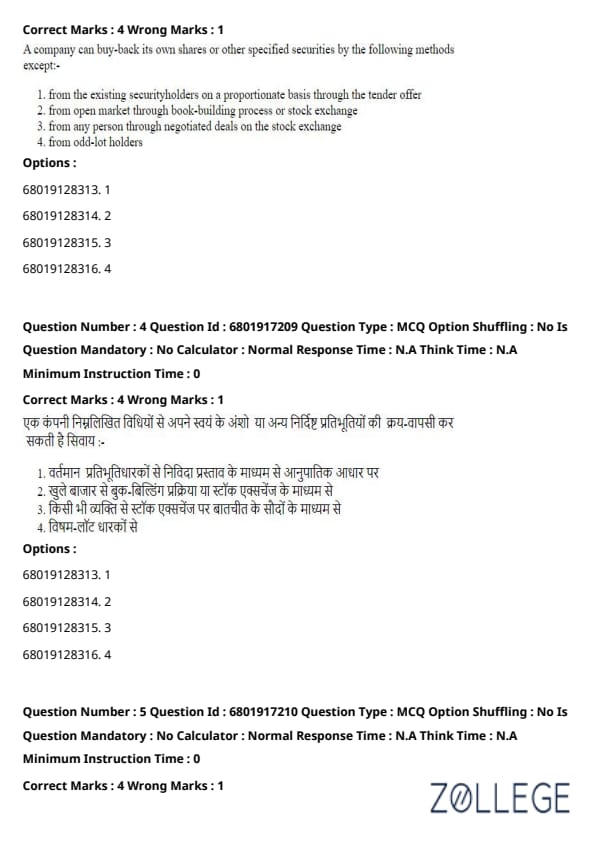
Question 4:
A company can buy-back its own shares or other specified securities by the following methods except:
View Solution
Solution: Buy-back methods include tender offers, open market purchases, or purchases from odd-lot holders. Negotiated deals are not a permitted method under the company law regulations for buy-backs.
Quick Tip: Understand the permissible methods for share buy-back as per company law to avoid errors.
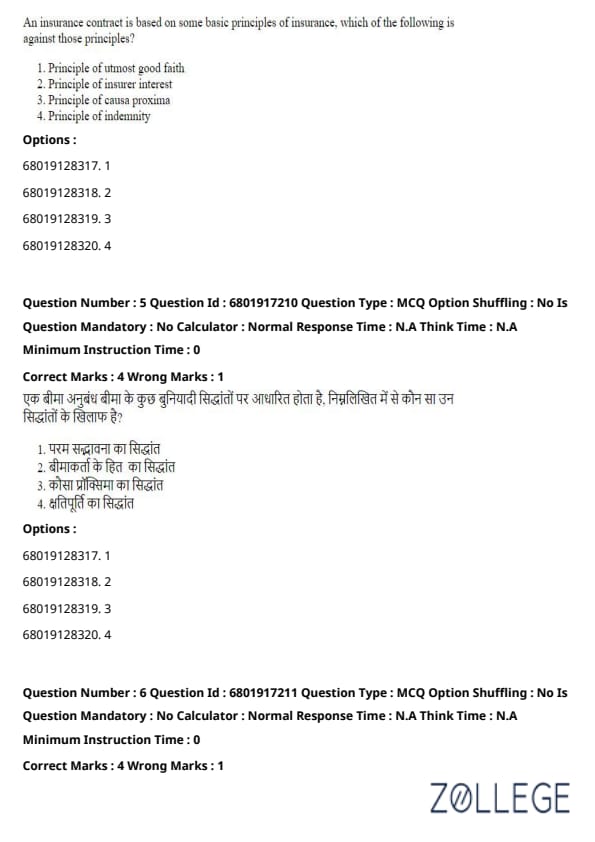
Question 5:
An insurance contract is based on some basic principles of insurance. Which of the following is against those principles?
View Solution
Solution: Insurance principles include utmost good faith, causa proxima, and indemnity. The concept of "insurer interest" is not a valid principle and does not align with the fundamental doctrines of insurance.
Quick Tip: Focus on the core principles of insurance: utmost good faith, indemnity, and causa proxima.
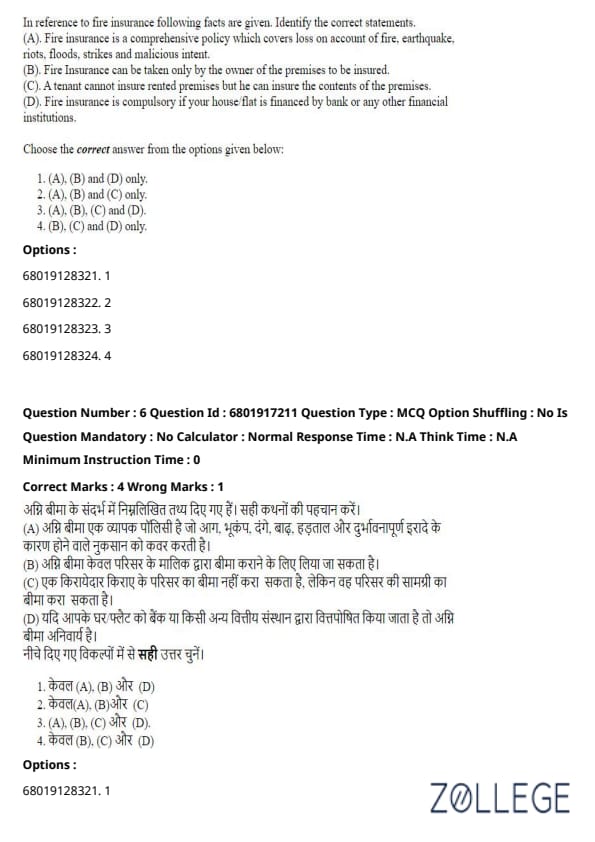
Question 6:
Identify the correct statements in reference to fire insurance:
Choose the correct answer from the options given below:
View Solution
Solution:
- Statement (A) is incorrect because fire insurance is not always comprehensive; its coverage depends on the terms of the policy.
- Statement (B) is correct as fire insurance is typically taken by the owner of the property.
- Statement (C) is correct because tenants can insure the contents of rented premises.
- Statement (D) is correct because financial institutions often require fire insurance as a prerequisite for loans on houses/flats.
Quick Tip: Fire insurance policies vary in coverage; always review the terms to ensure they meet your requirements.
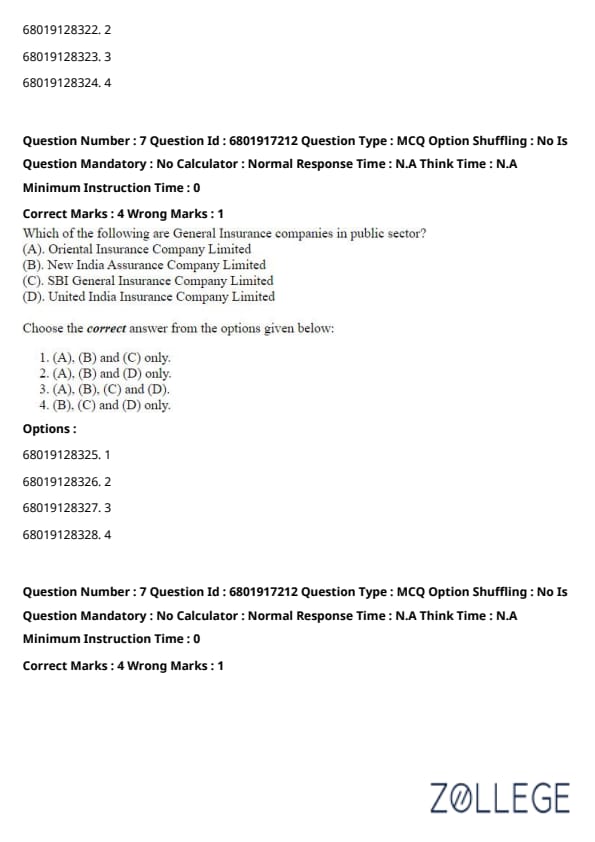
Question 7:
Which of the following are General Insurance companies in public sector?
Choose the correct answer from the options given below:
View Solution
Solution: The correct public sector general insurance companies are Oriental Insurance Company Limited, New India Assurance Company Limited, and United India Insurance Company Limited. SBI General Insurance Company Limited is a joint venture between State Bank of India and Insurance Australia Group, making it a private sector entity.
Quick Tip: Understanding the sector (public or private) of insurance companies is essential for various financial and insurance-related decisions.
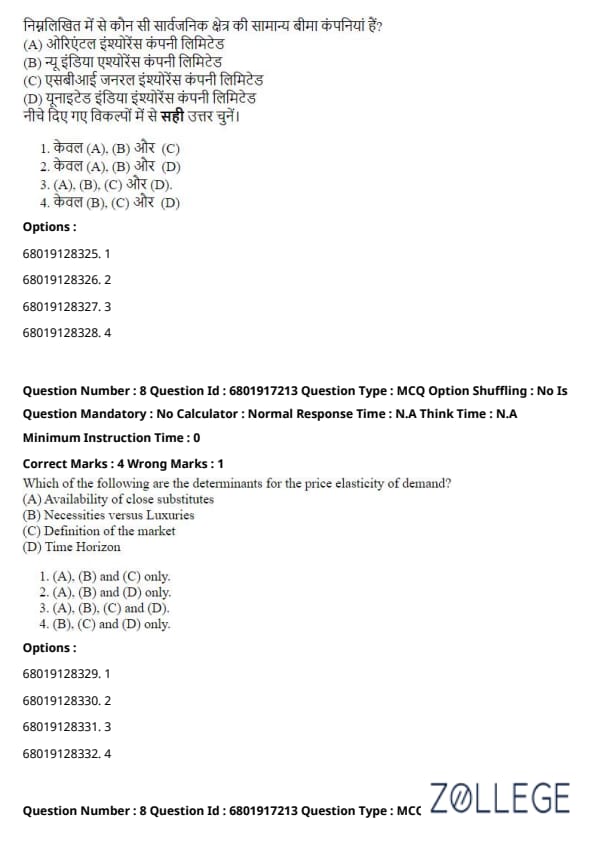
Question 8:
Which of the following are the determinants for the price elasticity of demand?
Choose the correct answer from the options given below:
View Solution
Solution: All listed factors influence the price elasticity of demand. Availability of substitutes, whether goods are necessities or luxuries, how narrowly or broadly the market is defined, and the time frame considered, all affect how responsive consumers are to changes in price.
Quick Tip: Understanding the factors that affect price elasticity can help businesses and policy-makers predict and influence consumer responses to price changes.
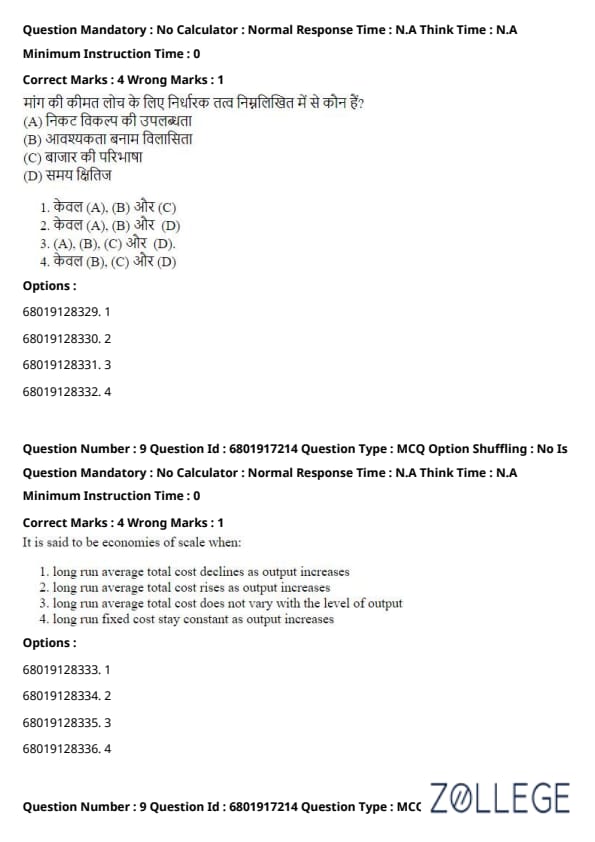
Question 9:
It is said to be economies of scale when:
Choose the correct answer from the options given below:
View Solution
Solution: Economies of scale occur when the long-run average total cost declines as the level of output increases. This often results due to spreading the fixed costs over a larger quantity of output and achieving greater efficiency and specialization in production processes.
Quick Tip: Economies of scale can provide a competitive advantage to companies by allowing them to produce goods at a lower per-unit cost as production scales up.
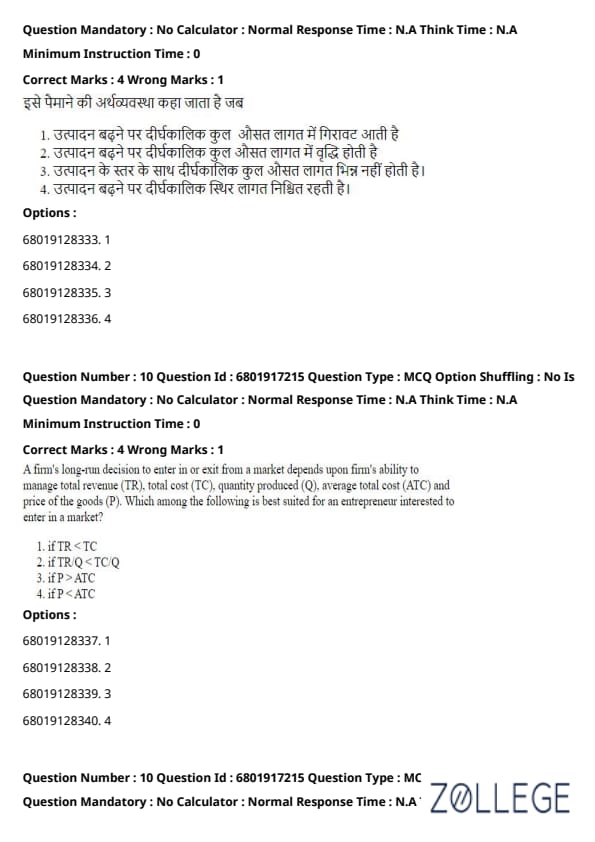
Question 10:
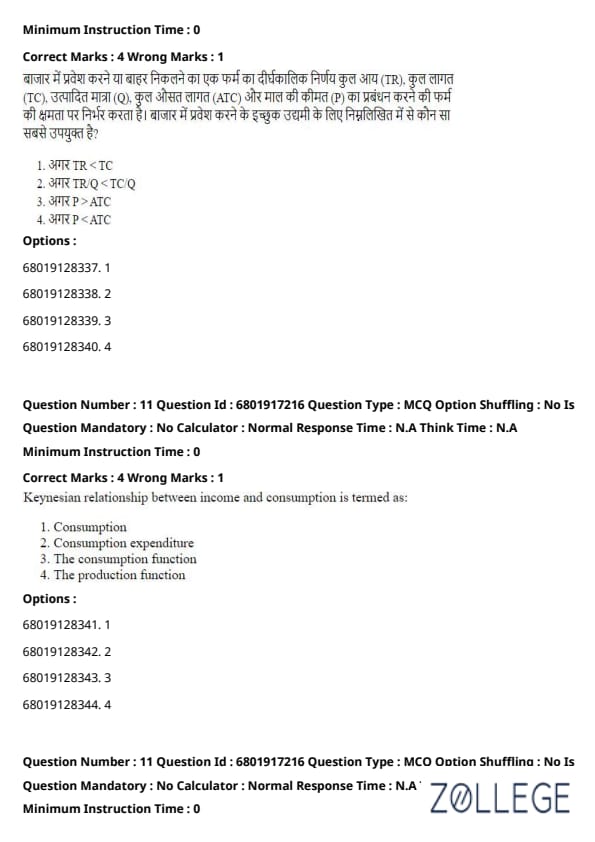
A firm's long-run decision to enter in or exit from a market depends upon firm's ability to manage total revenue (TR), total cost (TC), quantity produced (Q), average total cost (ATC), and price of the goods (P). Which among the following is best suited for an entrepreneur interested to enter in a market?
Choose the correct answer from the options given below:
View Solution
Solution: An entrepreneur would be interested in entering a market if the price (P) of the goods exceeds the average total cost (ATC) of producing those goods. This indicates that the firm can cover all its costs and generate a profit, making entry into the market potentially profitable.
Quick Tip: Before entering a market, it is crucial to ensure that expected prices can cover all variable and fixed costs, providing a basis for sustainable business operations and profitability.
Question 11:
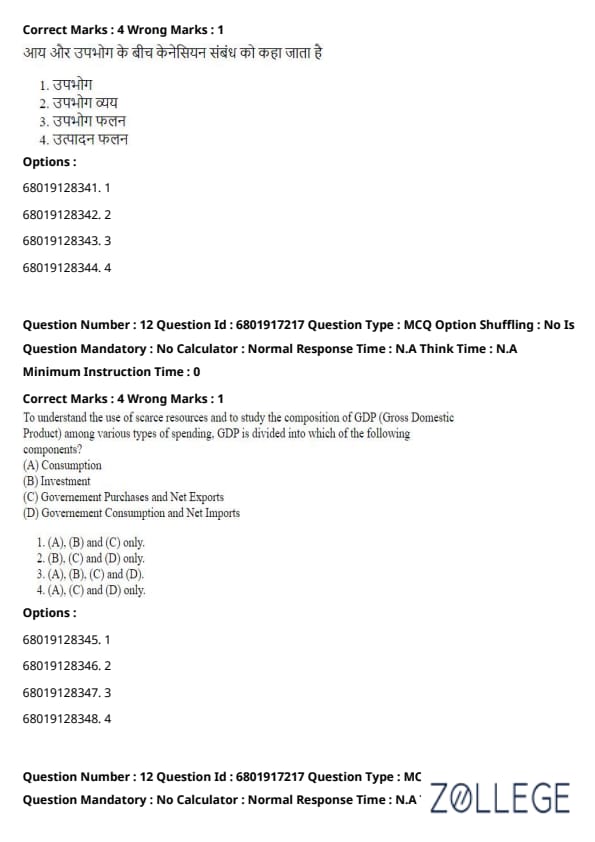
Keynesian relationship between income and consumption is termed as:
Choose the correct answer from the options given below:
View Solution
Solution: The Keynesian relationship between income and consumption is formally expressed as the "consumption function". This economic model indicates that consumption expenditure increases as disposable income increases, albeit at a decreasing rate.
Quick Tip: Understanding the consumption function is crucial for macroeconomic analysis as it helps predict how changes in income affect consumer spending.
Question 12:
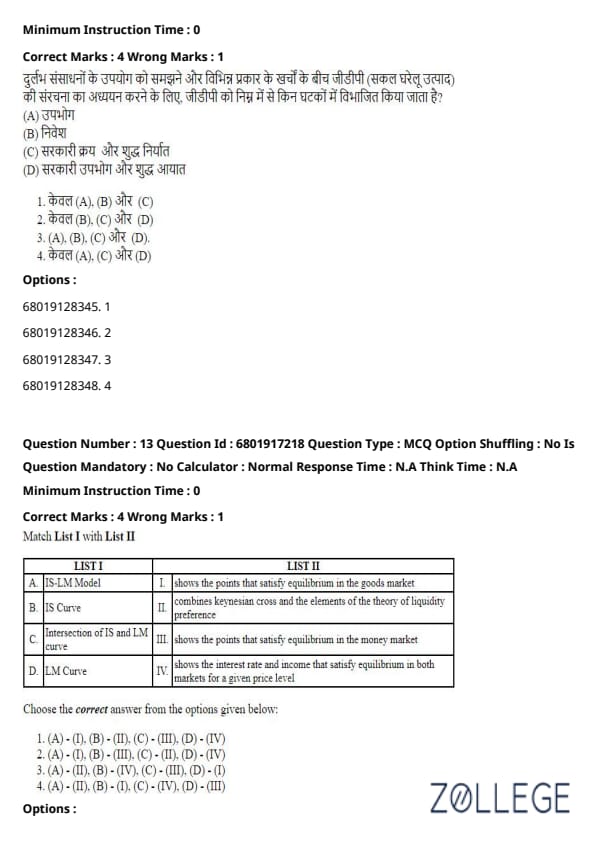
To understand the use of scarce resources and to study the composition of GDP (Gross Domestic Product) among various types of spending, GDP is divided into which of the following components?
Choose the correct answer from the options given below:
View Solution
Solution: GDP is typically divided into four main components: Consumption (C), Investment (I), Government Purchases (G), and Net Exports (X - M), where Net Exports equal exports minus imports. The listed components (A), (B), and (C) correctly reflect these categories. (D) mislabels 'Government Consumption' and incorrectly states 'Net Imports' instead of 'Net Exports'.
Quick Tip: Understanding the components of GDP is essential for analyzing economic health and the effectiveness of fiscal and monetary policies.
Question 13:
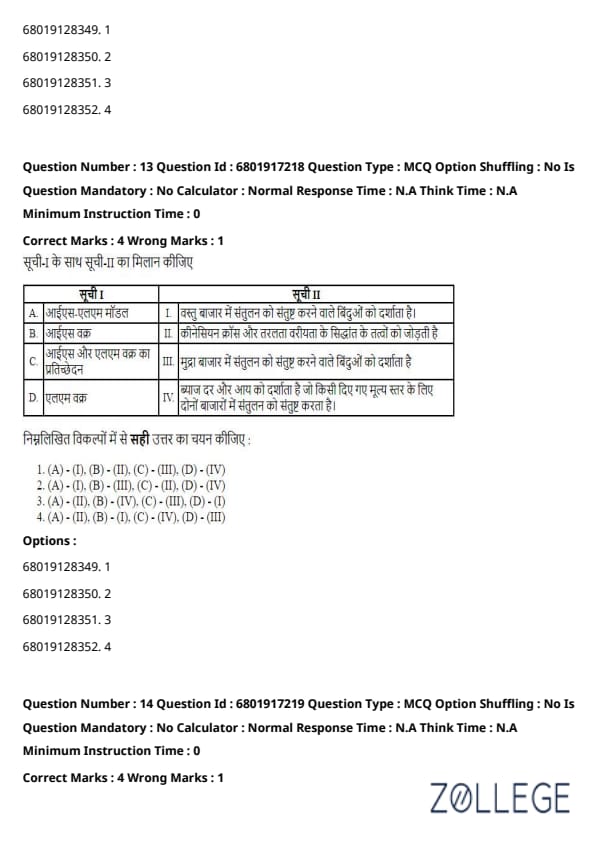
Match the concepts in LIST I with their definitions in LIST II.
| LIST I | LIST II |
|---|---|
| A. IS-LM Model | I. Shows the points that satisfy equilibrium in the goods market |
| B. IS Curve | II. Combines Keynesian cross and the elements of the theory of liquidity preference |
| C. Intersection of IS and LM curve | III. Shows the points that satisfy equilibrium in the money market |
| D. LM Curve | IV. Shows the interest rate and income that satisfy equilibrium in both markets for a given price level |
Choose the correct answer from the options given below:
View Solution
Solution: The IS-LM Model (A) is a fundamental macroeconomic tool to analyze the interdependencies between the 'real' economy (the IS curve) and the money market (the LM curve), fitting with description II. The IS Curve (B) reflects equilibrium in the goods market, matching with description I. The intersection of the IS and LM curve (C) indicates the overall economic equilibrium, corresponding to description IV, where both the goods and money markets are in balance. Lastly, the LM Curve (D) represents equilibrium in the money market, aligning with description III.
Quick Tip: Understanding the IS-LM model helps in comprehending how policies affect different sectors of the economy, such as fiscal policy affecting the IS curve and monetary policy affecting the LM curve.
Question 14:
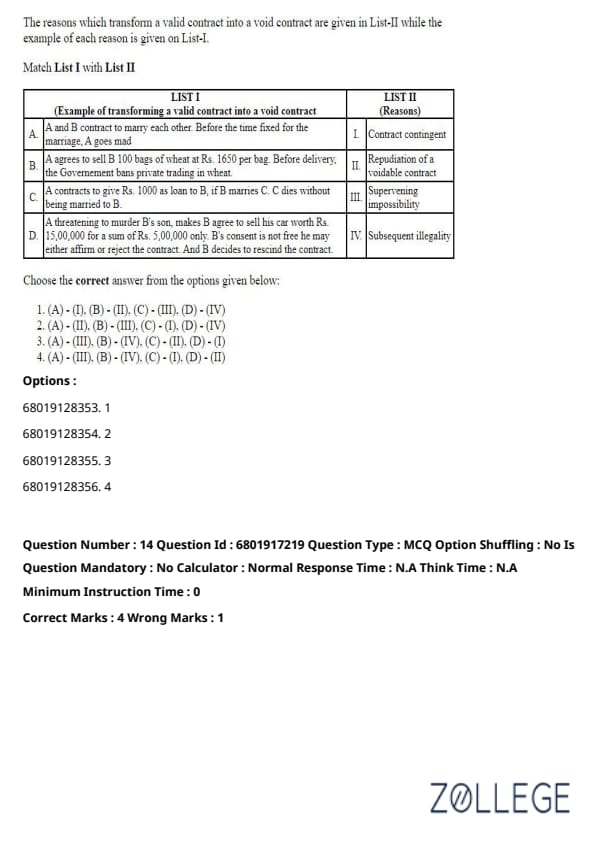
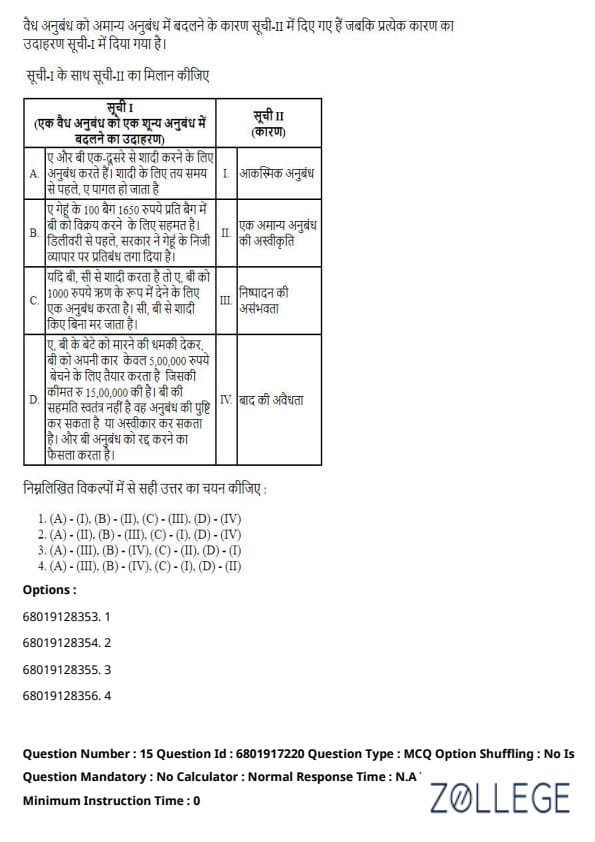
The reasons which transform a valid contract into a void contract are given in List-II while the example of each reason is given in List-I.
Choose the correct answer from the options given below:
| LIST I (Example of transforming a valid contract into a void contract) | LIST II (Reasons) |
|---|---|
| A. A and B contract to marry each other. Before the time fixed for the marriage, A goes mad. | I. Contract contingent |
| B. A agrees to sell B 100 bags of wheat at Rs. 1650 per bag. Before delivery, the Government bans private trading in wheat. | II. Repudiation of a voidable contract |
| C. A contracts to give Rs. 1000 as a loan to B, if B marries C. C dies without being married to B. | III. Supervening impossibility |
| D. A threatening to murder B's son makes B agree to sell his car worth Rs. 15,00,000 for a sum of Rs. 5,00,000 only. B's consent is not free; he may either affirm or reject the contract. B decides to rescind the contract. | IV. Subsequent illegality |
View Solution
Solution:
- A: The contract to marry is contingent upon mental stability. If A goes mad, the contingency fails, making the contract void due to supervening impossibility.
- B: When the Government bans private trading of wheat, the sale becomes illegal, leading to subsequent illegality.
- C: A contract contingent upon marriage cannot be fulfilled if C dies. This is a case of contract contingent.
- D: The threat to B's son makes the contract voidable. B rescinds it due to repudiation of a voidable contract.
Quick Tip: When matching examples with reasons, focus on key terms like "contingency," "impossibility," "illegality," and "voidable contracts" to identify the correct transformation reason.
Question 15:
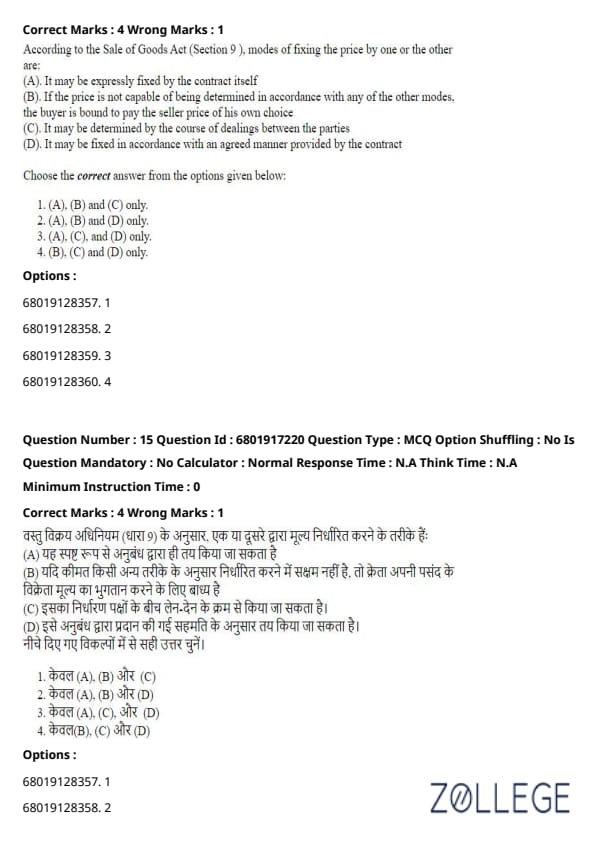
According to the Sale of Goods Act (Section 9), modes of fixing the price by one or the other are:
Choose the correct answer from the options given below:
View Solution
Solution: Under the Sale of Goods Act, the price of goods can be determined through explicit agreement in the contract, by reference to an agreed method, or through the established course of dealings between the parties. Option (B) is incorrect as it misrepresents the legal framework which specifies that the buyer should pay a reasonable price when the price is not determined through other stipulated means.
Quick Tip: Understanding the contractual terms and the legal framework for determining prices is crucial for both parties in a sales contract to ensure compliance and avoid disputes.
Question 16:
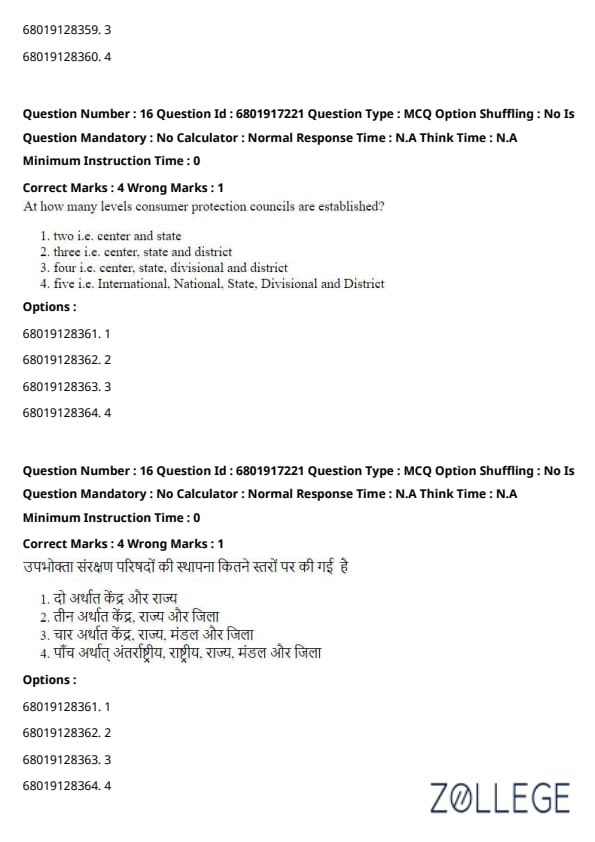
At how many levels consumer protection councils are established?
View Solution
Solution: Under the Consumer Protection Act, 2019, consumer protection councils are established at three levels:
• Central Level: Governed by the Central Consumer Protection Council.
• State Level: State Consumer Protection Councils operate within individual states.
• District Level: District Consumer Protection Councils serve at the local district level.
These councils work to promote consumer rights and address grievances across these levels. Divisional or international councils are not part of the structure.
Quick Tip: Consumer protection councils are established at central, state, and district levels to safeguard consumer rights.
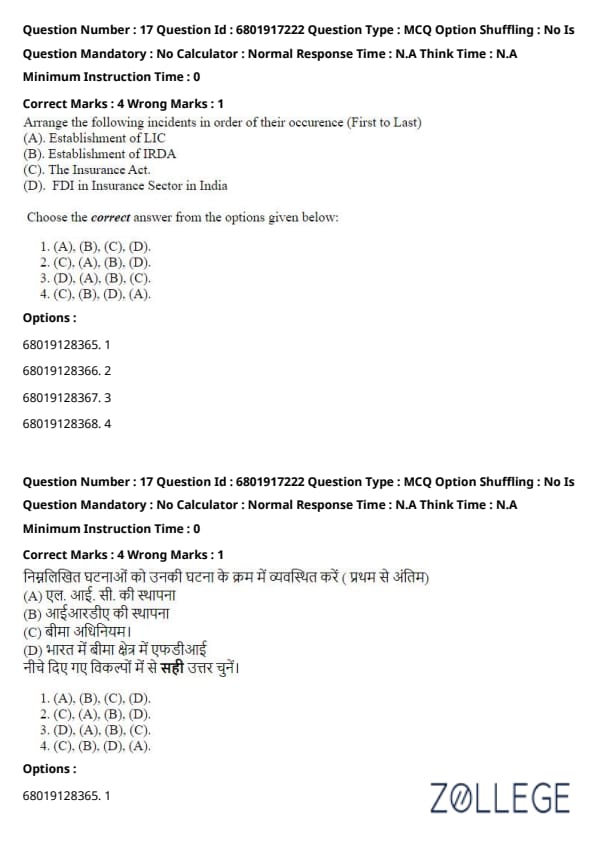
Question 17:
Arrange the following incidents in order of their occurrence (First to Last):
Choose the correct answer from the options given below:
View Solution
Solution: The correct chronological order is as follows:
- The Insurance Act was enacted first, providing the legal framework for insurance regulation in India.
- LIC (Life Insurance Corporation) was established in 1956, consolidating the insurance business in India.
- IRDA (Insurance Regulatory and Development Authority) was established in 1999 to regulate and develop the insurance sector.
- FDI in the Insurance Sector was introduced later to boost foreign investment.
Quick Tip: Understanding the timeline of reforms and events in the insurance sector is crucial for regulatory and historical clarity.
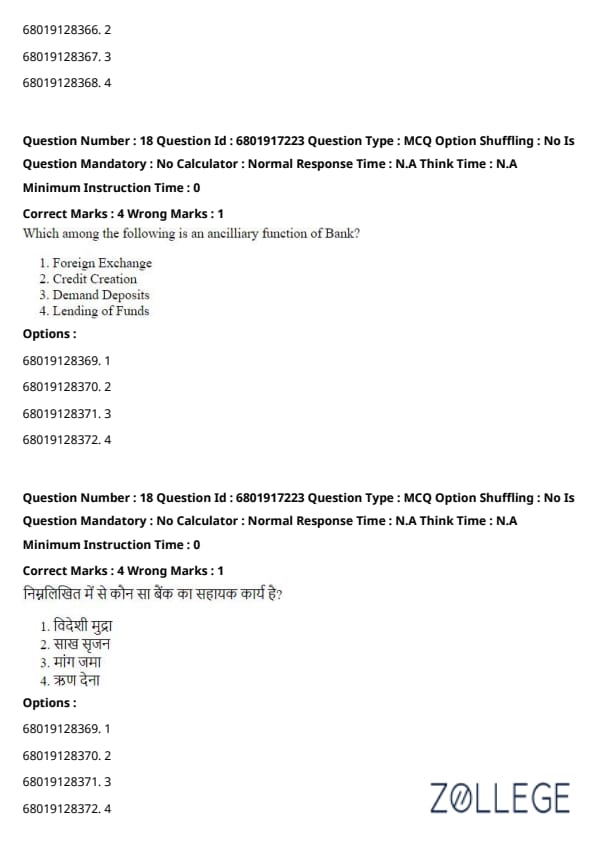
Question 18:
Which among the following is an ancillary function of a bank?
View Solution
Solution: Ancillary functions of banks include foreign exchange services, which involve facilitating currency conversion, international trade transactions, and foreign remittances. Functions like credit creation and demand deposits are core functions, not ancillary.
Quick Tip: Foreign exchange services are key ancillary functions of banks to support international trade and travel.
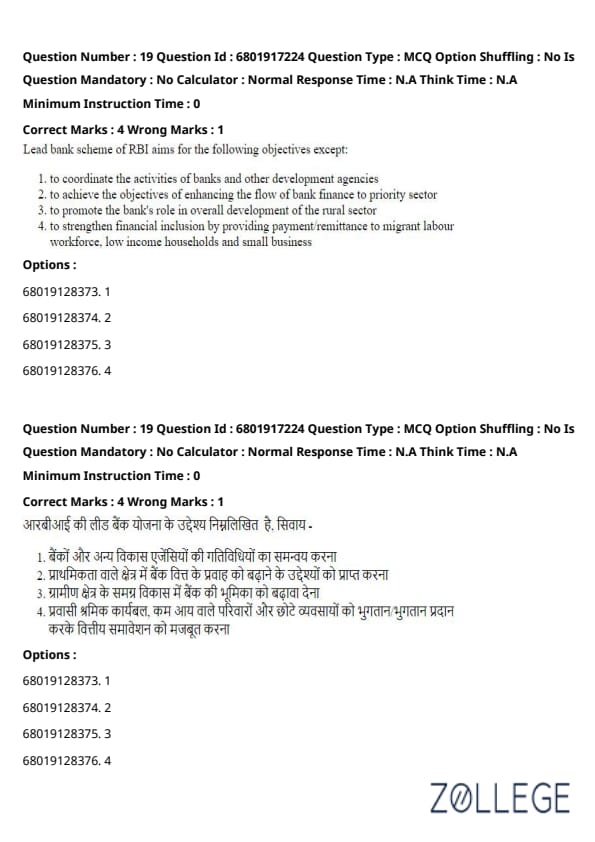
Question 19:
Lead bank scheme of RBI aims for the following objectives except:
View Solution
Solution: The Lead Bank Scheme was introduced to coordinate the activities of banks and development agencies in rural areas and enhance credit flow to priority sectors like agriculture and MSMEs. Strengthening financial inclusion through remittance services is not a direct objective of this scheme.
Quick Tip: Focus on the primary objectives of the Lead Bank Scheme, such as rural development and credit coordination.
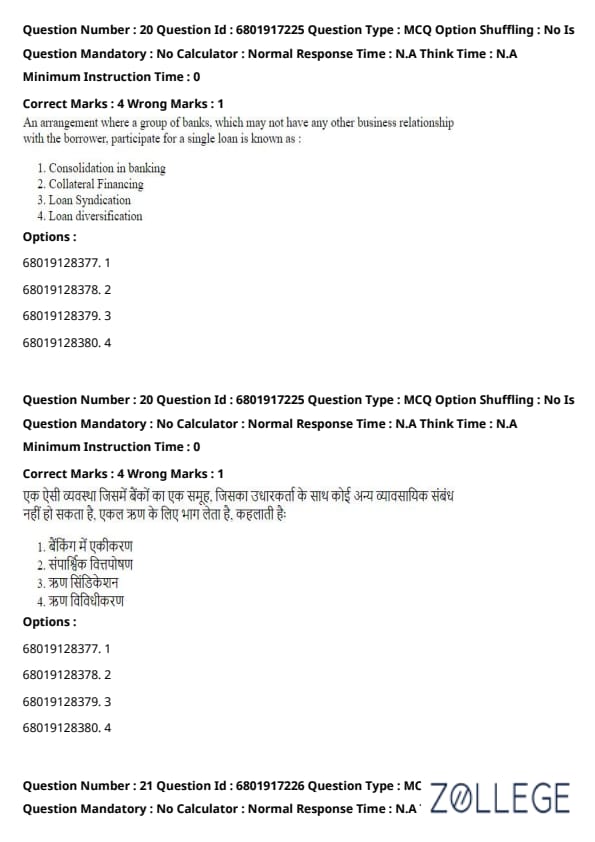
Question 20:
An arrangement where a group of banks, which may not have any other business relationship with the borrower, participate for a single loan is known as:
View Solution
Solution: Loan syndication is a financing arrangement where multiple banks jointly provide a single loan to a borrower. This is common for large-scale projects requiring substantial funding, distributing the risk among participating banks.
Quick Tip: Loan syndication is commonly used for large projects to share risks and resources among banks.
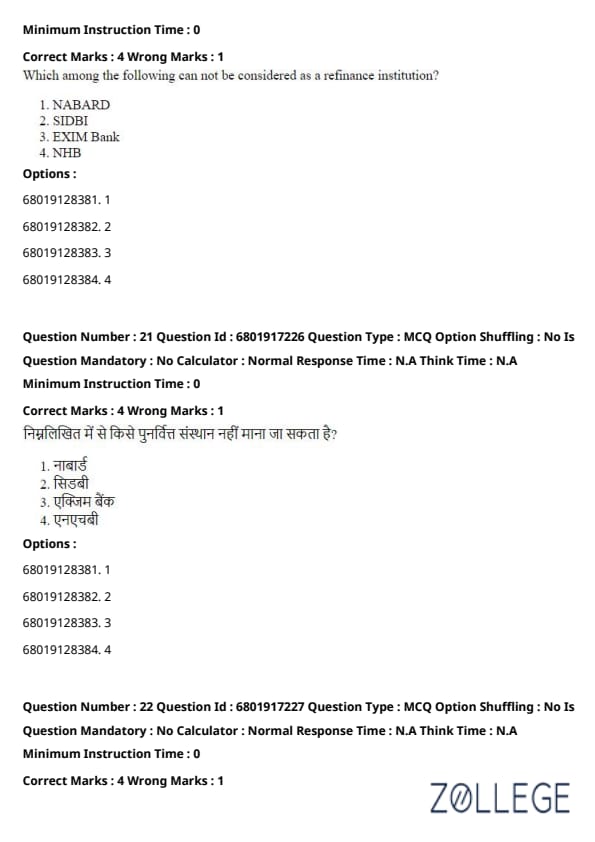
Question 21:
Which among the following cannot be considered as a refinance institution?
View Solution
Solution: Refinance institutions provide funding to other financial institutions to promote credit flow in specific sectors. NABARD, SIDBI, and NHB are prominent refinance institutions in India. However, EXIM Bank focuses on financing and promoting international trade and does not function as a refinance institution.
Quick Tip: Refinance institutions indirectly support economic sectors by refinancing loans provided by other institutions.
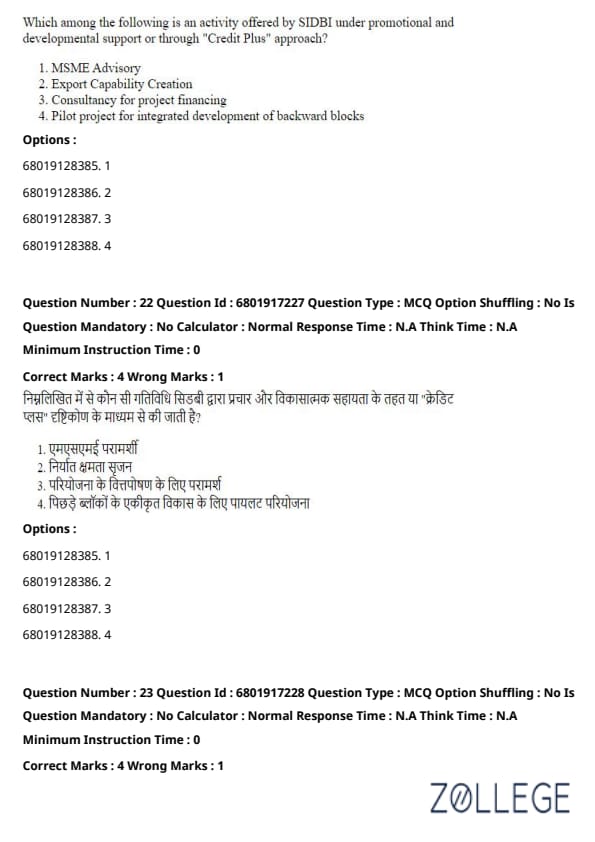
Question 22:
Which among the following is an activity offered by SIDBI under promotional and developmental support or through "Credit Plus” approach?
View Solution
Solution: SIDBI's "Credit Plus" approach focuses on providing holistic support to Micro, Small, and Medium Enterprises (MSMEs). This includes offering advisory services, capacity building, and skill development for MSMEs. The other options, while development-oriented, do not directly fall under the scope of SIDBI's Credit Plus initiatives.
Quick Tip: SIDBI plays a vital role in MSME development by offering financial and non-financial services.
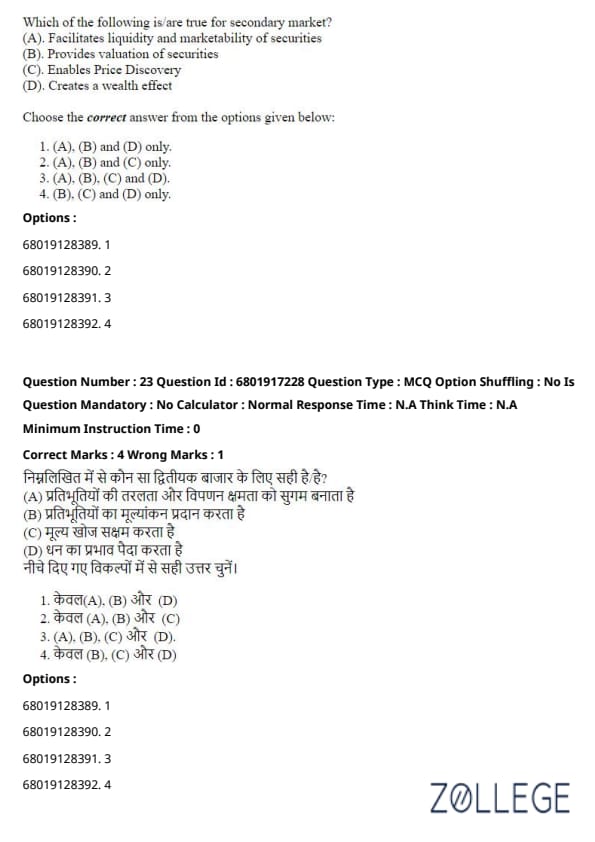
Question 23:
Which of the following is/are true for the secondary market?
Choose the correct answer from the options given below:
View Solution
Solution: The secondary market plays a pivotal role in the financial system by providing liquidity and marketability for securities, ensuring price discovery, and enabling the valuation of securities. Additionally, the creation of a wealth effect stems from the price appreciation of securities, which boosts investor confidence.
Quick Tip: The secondary market ensures investors can buy and sell securities efficiently while influencing overall market stability and investor trust.
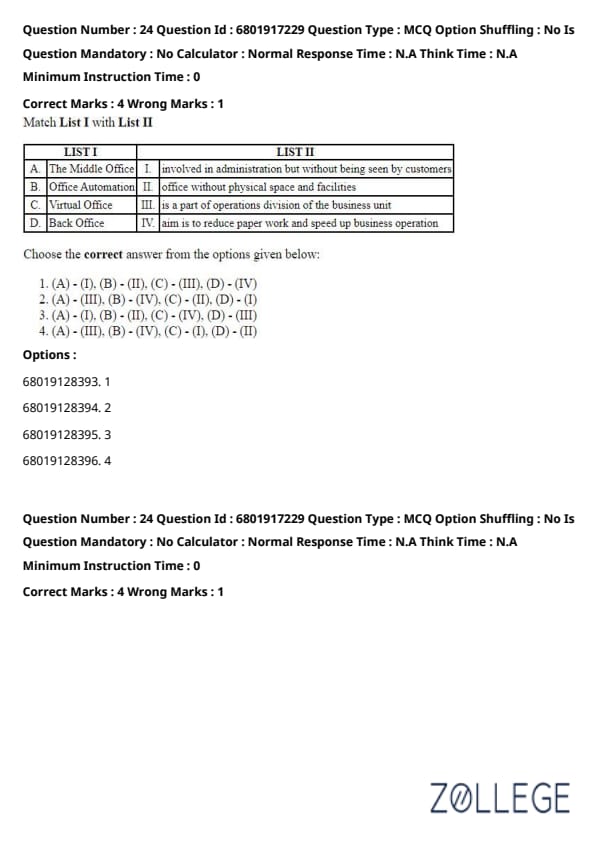
Question 24:
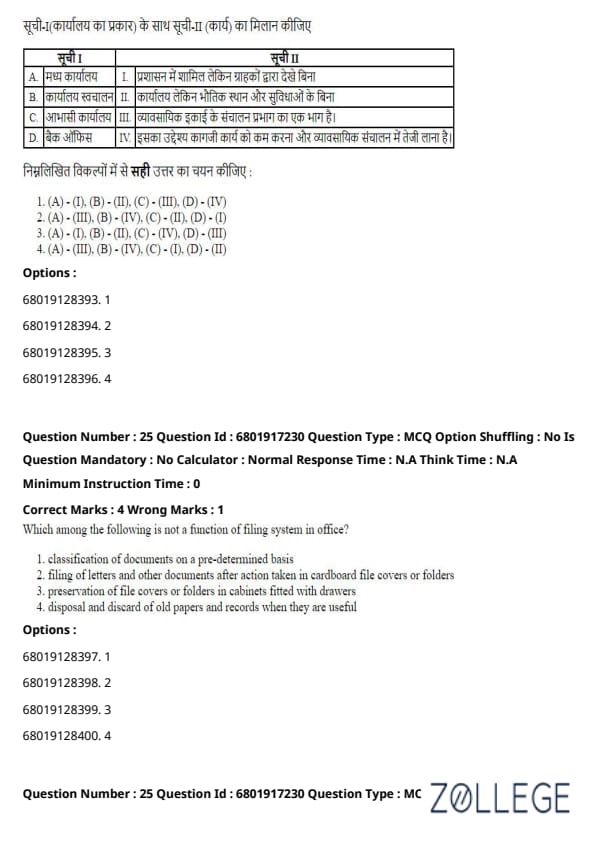
Match List I with List II:
| LIST I | LIST II |
|---|---|
| A. The Middle Office | I. Involved in administration but without being seen by customers |
| B. Office Automation | II. Office without physical space and facilities |
| C. Virtual Office | III. A part of the operations division of the business unit |
| D. Back Office | IV. Aim is to reduce paperwork and speed up business operations |
Choose the correct answer from the options given below:
View Solution
Solution:
- The Middle Office is responsible for administrative tasks without customer visibility.
- Office Automation focuses on reducing paperwork and increasing efficiency in business operations.
- A Virtual Office provides office functionalities without requiring physical space.
- The Back Office supports the operations division, handling core processes.
Quick Tip: Understand the functional roles of different offices to streamline business operations effectively.
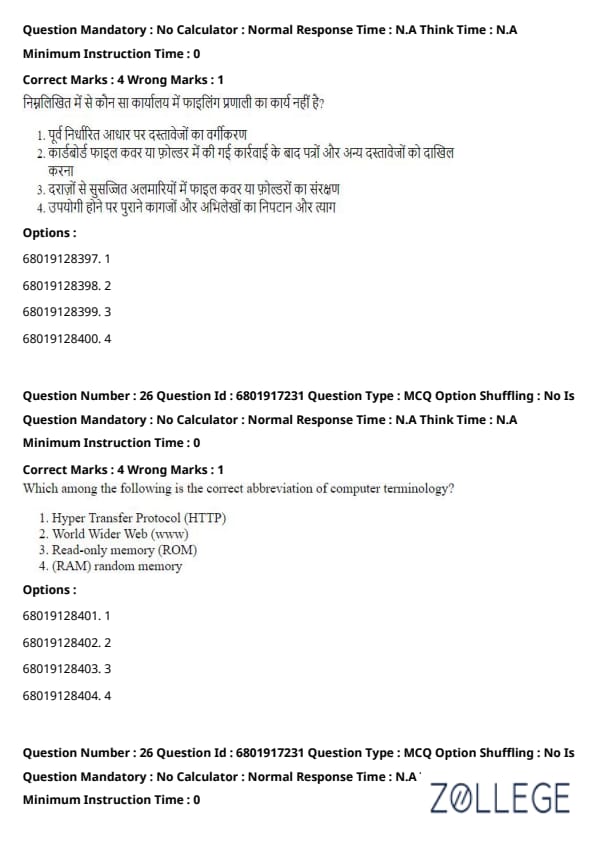
Question 25:
Which among the following is not a function of the filing system in an office?
View Solution
Solution: The primary functions of a filing system include document classification, secure preservation, and orderly filing of important papers and correspondence. Disposing of papers when they are still useful contradicts the purpose of systematic documentation and archiving.
Quick Tip: Filing systems ensure easy retrieval and safekeeping of documents, supporting organizational efficiency.
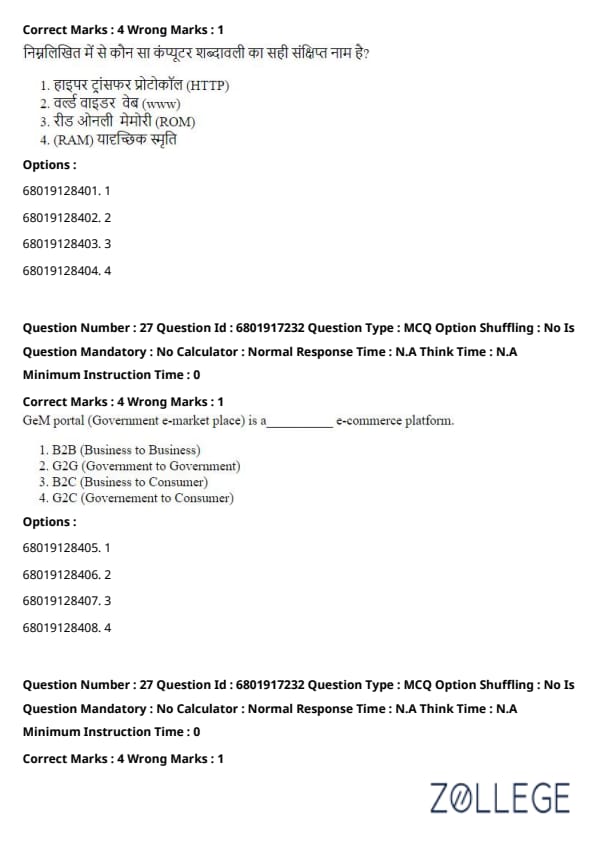
Question 26:
Which among the following is the correct abbreviation of computer terminology?
View Solution
Solution:
- Hyper Text Transfer Protocol (HTTP) is the correct abbreviation for HTTP, not "Hyper Transfer Protocol.”
- The correct term is "World Wide Web (www),” not "World Wider Web.”
- Read-only memory (ROM) is correctly abbreviated as ROM and refers to a type of non-volatile memory used in computers.
- Random Access Memory (RAM) is the correct term, not "(RAM) random memory.”
Quick Tip: Always verify standard computer abbreviations to avoid confusion and ensure clarity in technical contexts.
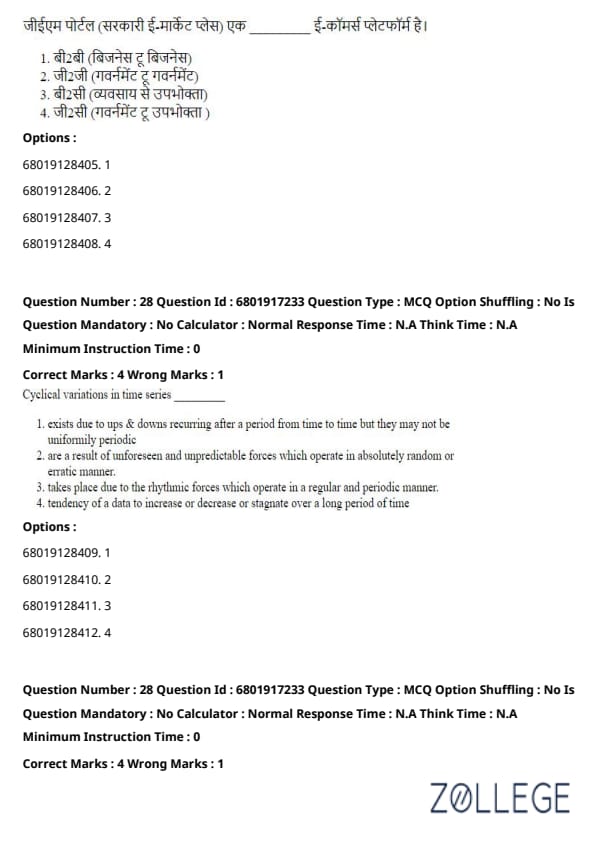
Question 27:
GeM portal (Government e-marketplace) is a _______ e-commerce platform.
View Solution
Solution: The Government e-Marketplace (GeM) platform is designed to facilitate procurement of goods and services required by various government departments and organizations. It operates as a Government-to-Government (G2G) platform, enabling streamlined, transparent, and efficient purchasing processes for government entities.
Quick Tip: GeM ensures efficient procurement and enhances transparency in government purchases, aligning with G2G practices.
Question 28:
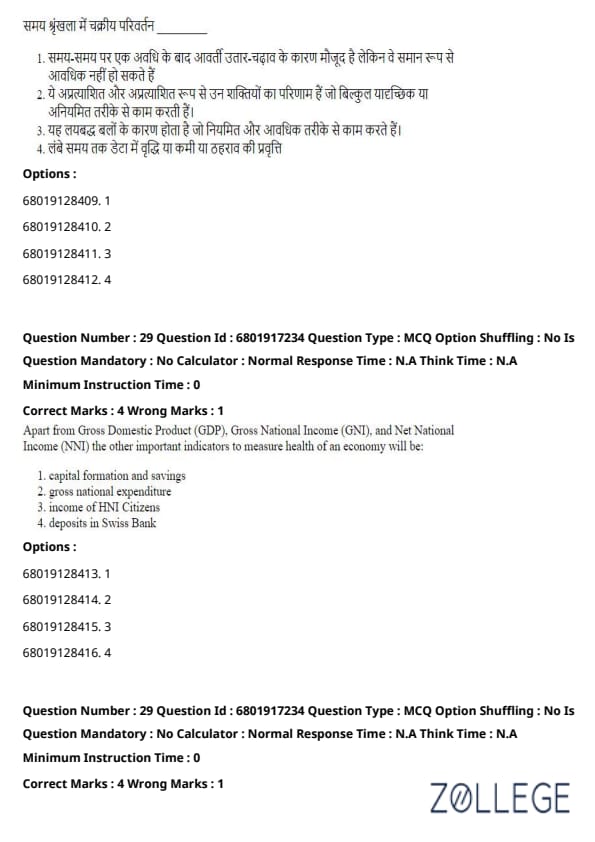
Cyclical variations in time series:
View Solution
Solution: Cyclical variations refer to oscillations in time series data that occur over periods, reflecting the influence of economic, business, or natural cycles. These variations are not strictly periodic but are identified by recurring patterns. For example, economic booms and recessions are cyclical patterns that may not adhere to a strict timeline.
Quick Tip: Cyclical variations are crucial for analyzing trends in business and economics, though their periodicity may vary.
Question 29:
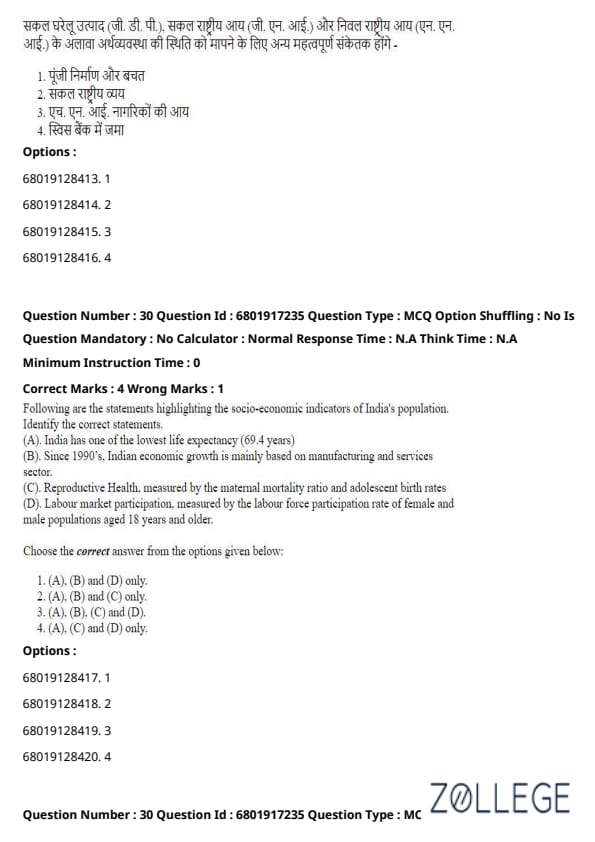
Apart from Gross Domestic Product (GDP), Gross National Income (GNI), and Net National Income (NNI), the other important indicators to measure the health of an economy will be:
View Solution
Solution: The health of an economy is gauged by several macroeconomic indicators like GDP, GNI, and NNI. Among the given options, capital formation and savings are crucial for assessing economic growth as they reflect the ability of an economy to invest in infrastructure and development. Gross national expenditure focuses on consumption but does not directly measure growth potential, while options (c) and (d) are not standard indicators.
Quick Tip: Focus on understanding how savings and investments drive long-term economic growth.
Question 30:
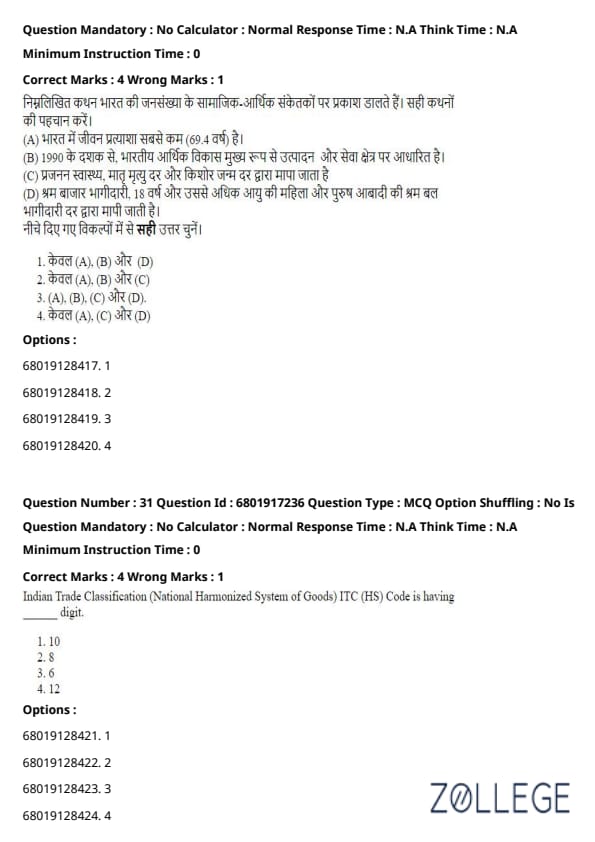
Following are the statements highlighting the socio-economic indicators of India's population. Identify the correct statements:
Choose the correct answer from the options given below:
View Solution
Solution: All the given statements accurately highlight socio-economic indicators in India: (A) India's life expectancy is relatively low compared to global standards. (B) Since the 1990s, economic growth has shifted towards manufacturing and services sectors, away from agriculture. (C) Reproductive health is a critical metric for assessing socio-economic development. (D) Labour market participation reflects economic inclusiveness and opportunities for both genders.
Quick Tip: Socio-economic indicators provide a holistic view of a country's development and quality of life.
Question 31:
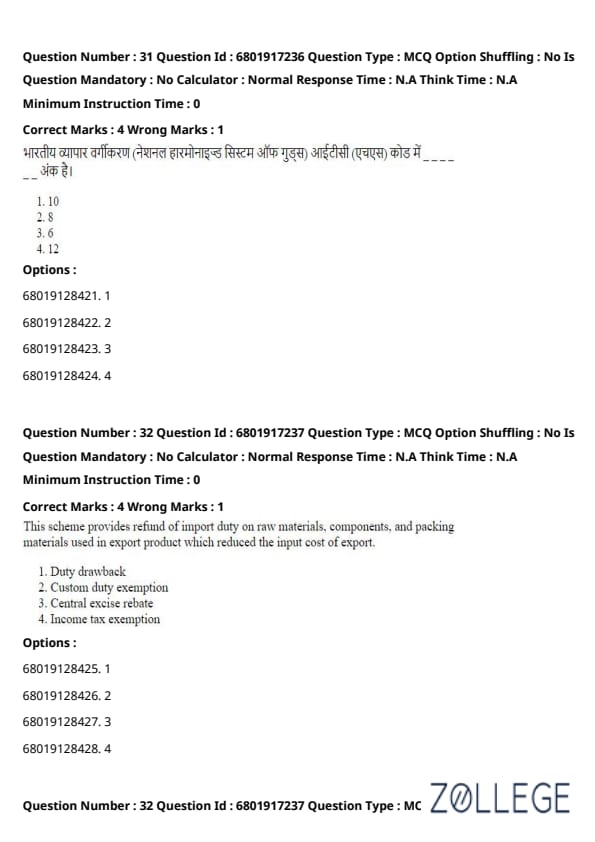
Indian Trade Classification (National Harmonized System of Goods) ITC (HS) Code is having ______ digit.
View Solution
Solution: The ITC (HS) code, which is used in India for the classification of traded goods, is an 8-digit code. It is based on the Harmonized System (HS) of coding developed by the World Customs Organization (WCO) and serves as a standard for the identification of goods in international trade.
Quick Tip: The ITC (HS) Code facilitates systematic and uniform documentation of goods for trade compliance.
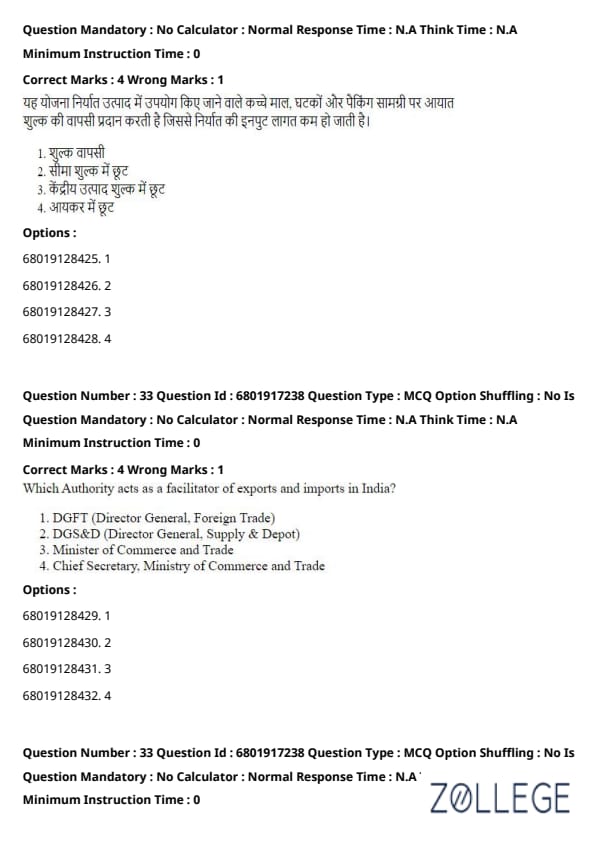
Question 32:
This scheme provides a refund of import duty on raw materials, components, and packing materials used in export product which reduces the input cost of export.
View Solution
Solution: The Duty Drawback Scheme is a government incentive that allows exporters to claim a refund of the import duty paid on raw materials, components, and packaging materials used in the manufacturing of export goods. This refund helps to make Indian exports more competitive in the global market by reducing the overall cost of production.
Quick Tip: Duty Drawback is a crucial tool for export promotion by reducing input costs and boosting profitability.
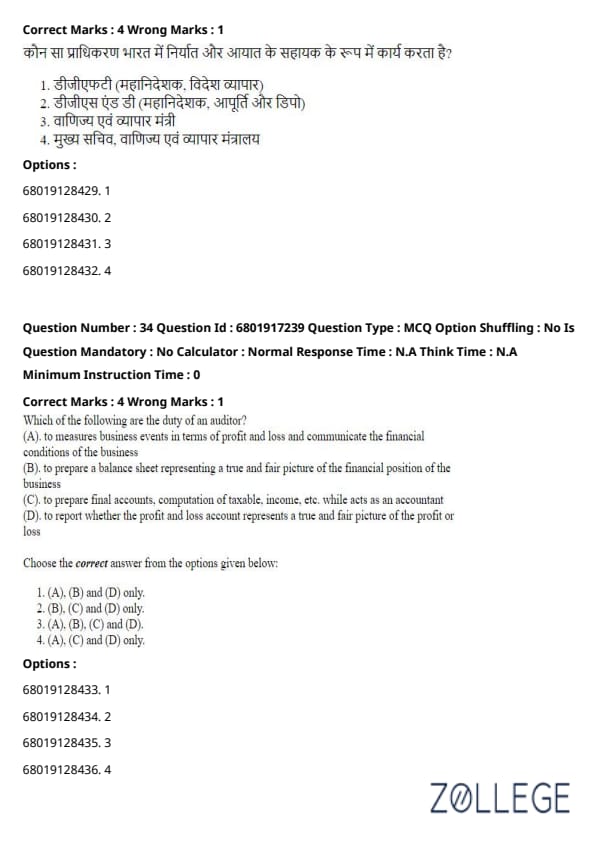
Question 33:
Which Authority acts as a facilitator of exports and imports in India?
View Solution
Solution: The Directorate General of Foreign Trade (DGFT) is responsible for formulating and implementing the Foreign Trade Policy in India. It facilitates exports and imports, promotes trade through various incentives, and regulates trade in accordance with international agreements.
Quick Tip: DGFT plays a key role in driving India's foreign trade and ensuring adherence to global trade norms.
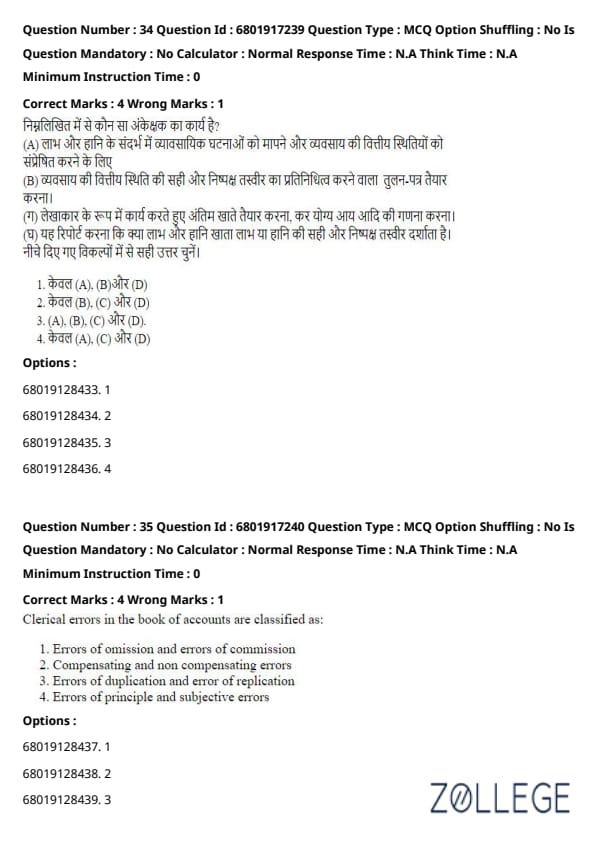
Question 34:
Which of the following are the duty of an auditor?
Choose the correct answer from the options given below:
View Solution
Solution: An auditor's duty includes analyzing financial statements, ensuring that the balance sheet reflects a true financial position, and reporting the fairness of profit and loss accounts. Preparing final accounts and computation of taxable income is the responsibility of an accountant, not the auditor.
Quick Tip: Auditors focus on verifying accuracy and compliance, while accountants handle preparation and computation tasks.
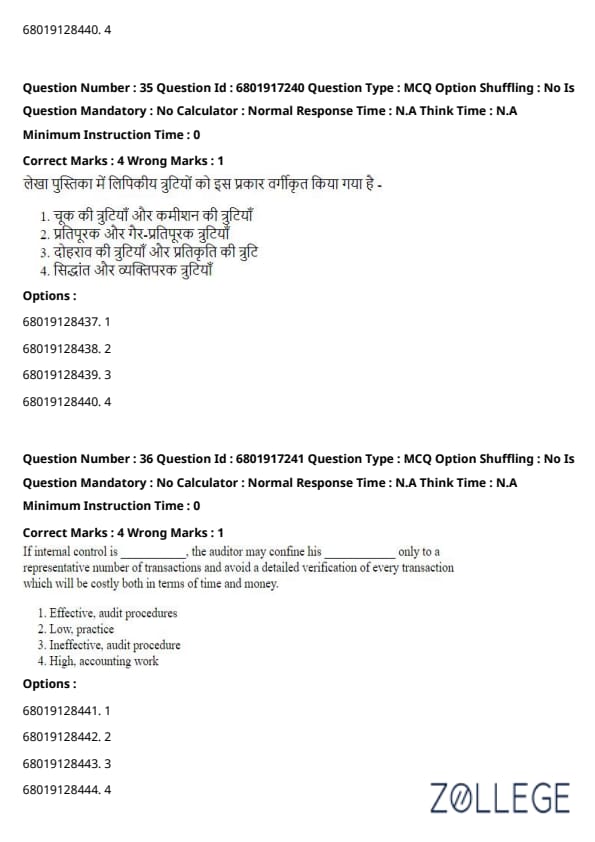
Question 35:
Clerical errors in the book of accounts are classified as:
View Solution
Solution: Clerical errors are generally categorized into errors of omission (leaving out transactions) and errors of commission (incorrectly recording transactions). These errors typically occur due to human oversight or misunderstanding.
Quick Tip: Review accounts periodically to minimize omissions and commissions in bookkeeping.
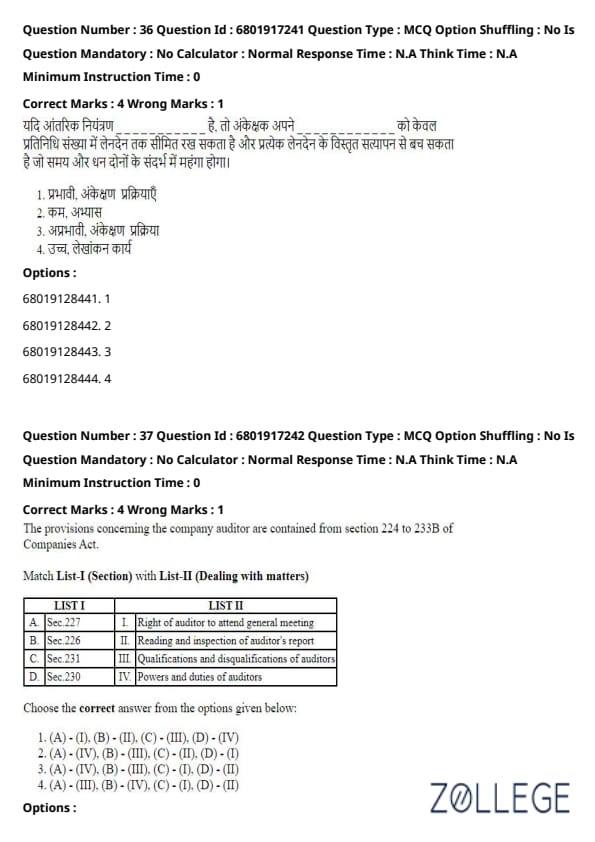
Question 36:
If internal control is _____, the auditor may confine his _____ only to a representative number of transactions and avoid a detailed verification of every transaction which will be costly both in terms of time and money.
View Solution
Solution: When internal controls are effective, auditors rely on the control system and limit their detailed testing to a sample of transactions. This reduces time and cost associated with extensive audits. Effective controls ensure reliability and efficiency in financial reporting.
Quick Tip: Strong internal controls reduce the need for exhaustive transaction-level verification, optimizing audit efficiency.
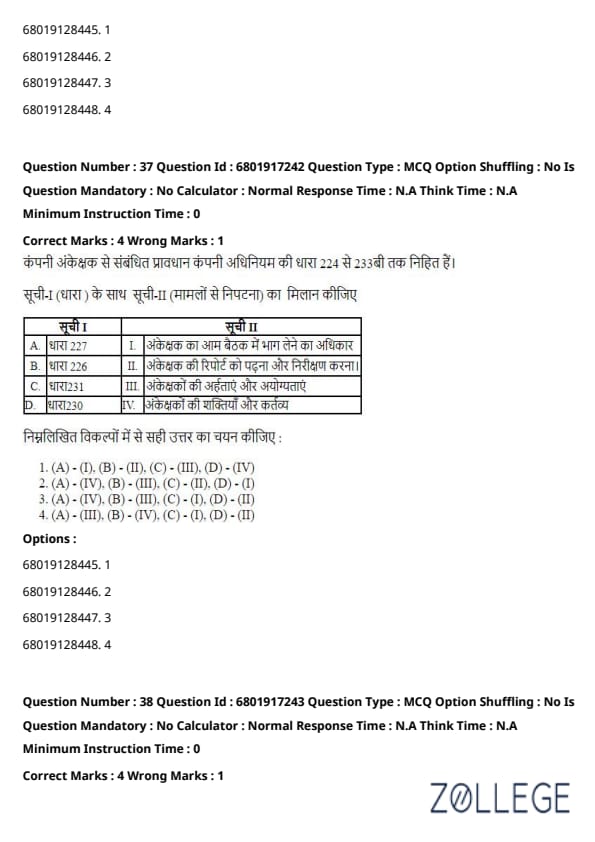
Question 37:
Match List-I (Section) with List-II (Dealing with matters):
| LIST I | LIST II |
|---|---|
| A. Sec.227 | I. Right of auditor to attend general meeting |
| B. Sec.226 | II. Reading and inspection of auditor's report |
| C. Sec.231 | III. Qualifications and disqualifications of auditors |
| D. Sec.230 | IV. Powers and duties of auditors |
Choose the correct answer from the options given below:
View Solution
Solution: The Companies Act outlines specific provisions for auditors: Sec.227 deals with the qualifications and disqualifications of auditors. Sec.226 grants auditors the right to attend general meetings. Sec.231 defines the powers and duties of auditors. Sec.230 emphasizes the importance of reading and inspecting the auditor's report.
Quick Tip: Auditors' roles and rights are crucial for ensuring financial transparency and compliance in organizations.
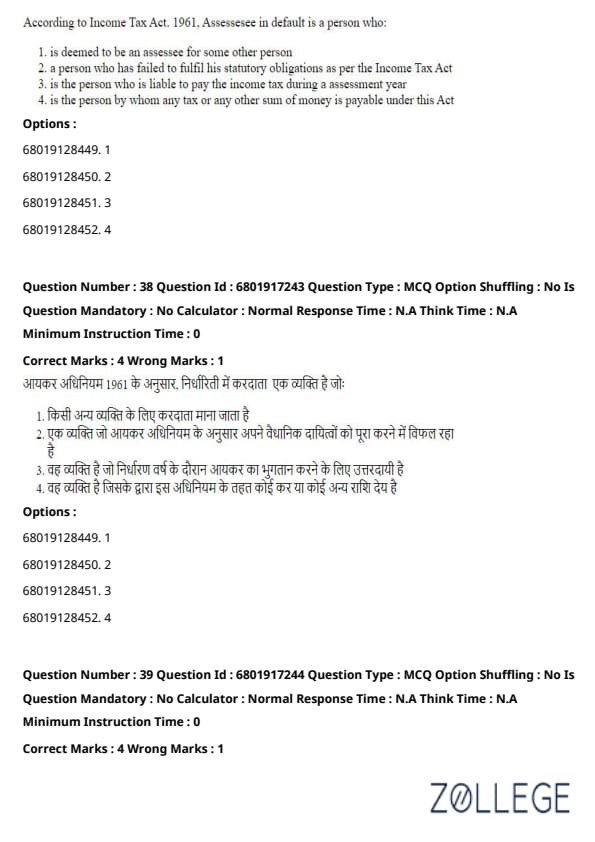
Question 38:
According to Income Tax Act, 1961, Assessee in default is a person who:
View Solution
Solution: An assessee in default is a person who has not complied with the statutory requirements laid out in the Income Tax Act. This includes failure to deduct or pay tax at the source or any other obligation under the Act. Such failure can lead to penalties or prosecution as specified in the Act.
Quick Tip: Understand the term "assessee in default" in the context of statutory tax obligations for clarity during assessments.
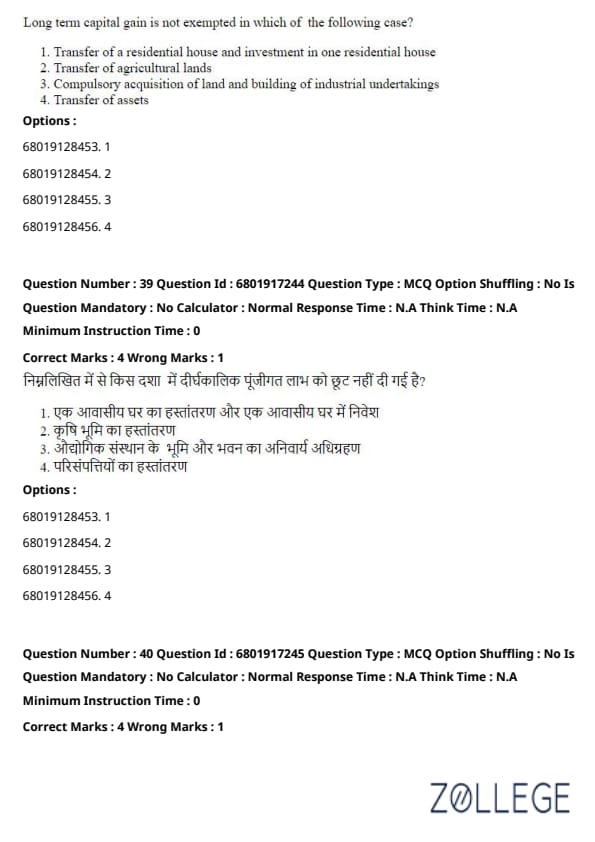
Question 39:
Long term capital gain is not exempted in which of the following case?
View Solution
Solution: Exemptions under long-term capital gains are specific to particular transactions like reinvestment in residential properties, agricultural land, or compulsory acquisition for public projects. However, a general "transfer of assets" does not qualify for exemption unless explicitly specified under the Income Tax Act.
Quick Tip: Remember to check Section 54 and other related provisions for clarity on exemptions in long-term capital gains.
Question 40:
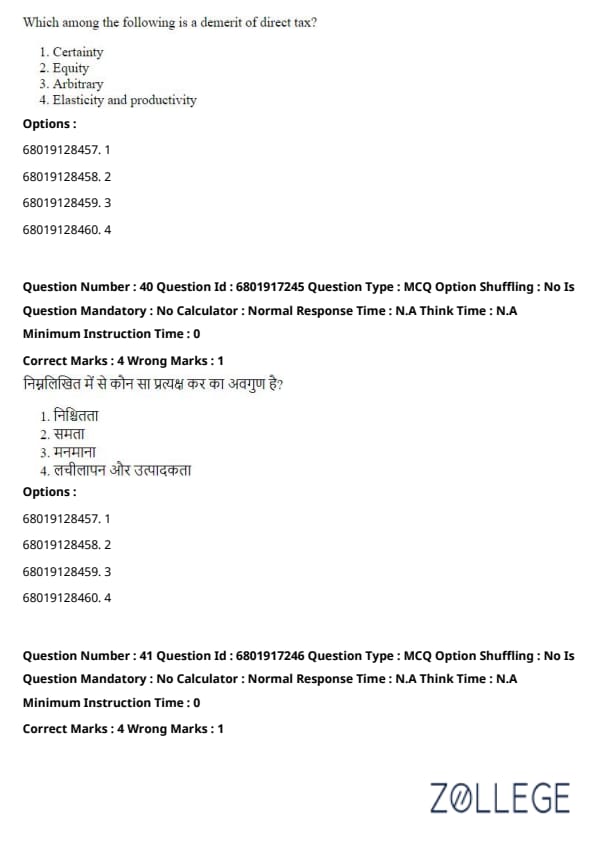
Which among the following is a demerit of direct tax?
View Solution
Solution: A major criticism of direct taxes is their potential for arbitrariness in assessment or enforcement, leading to perceived unfairness or inequity. This issue arises primarily when there is discretion in valuation or interpretation, making compliance more challenging for taxpayers.
Quick Tip: Focus on understanding both merits and demerits of direct taxes to build balanced knowledge in tax systems.
Question 41:
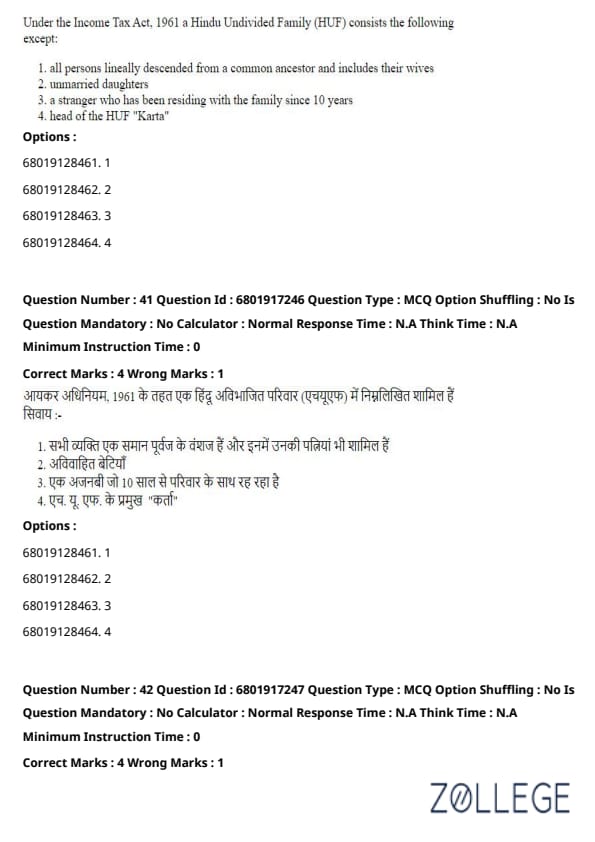
Under the Income Tax Act, 1961 a Hindu Undivided Family (HUF) consists of the following except:
View Solution
Solution: A Hindu Undivided Family (HUF) comprises all persons lineally descended from a common ancestor, including their wives and unmarried daughters, with the "Karta" as the head. Strangers residing with the family do not constitute part of the HUF under the Income Tax Act, 1961.
Quick Tip: The HUF structure is exclusive to family members, ensuring tax benefits are confined to eligible descendants.
Question 42:
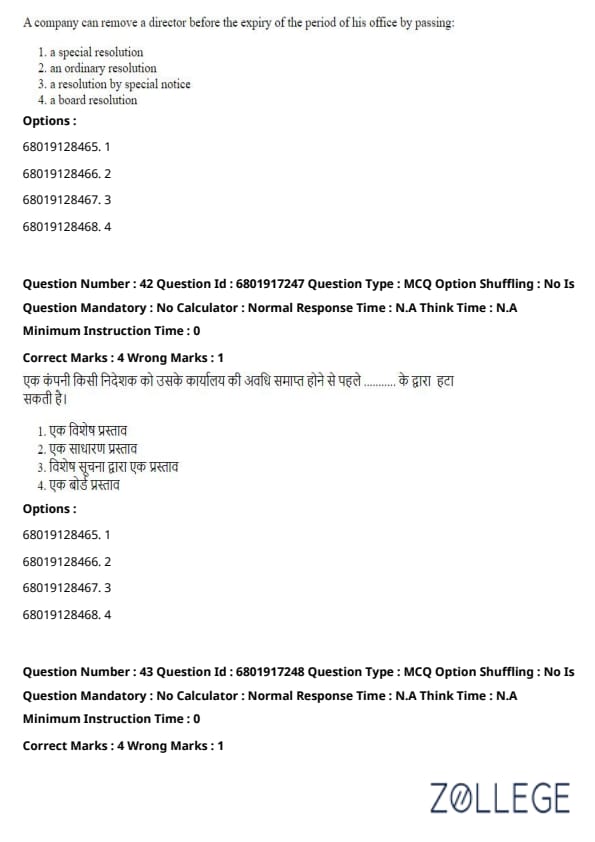
A company can remove a director before the expiry of the period of his office by passing:
View Solution
Solution: As per the Companies Act, a director can be removed by passing an ordinary resolution at a general meeting. However, a special notice must be given to the company and its members before moving the resolution. This ensures proper procedure is followed, respecting the rights of all stakeholders.
Quick Tip: Check the procedural requirements under the Companies Act before initiating the removal of a director.
Question 43:
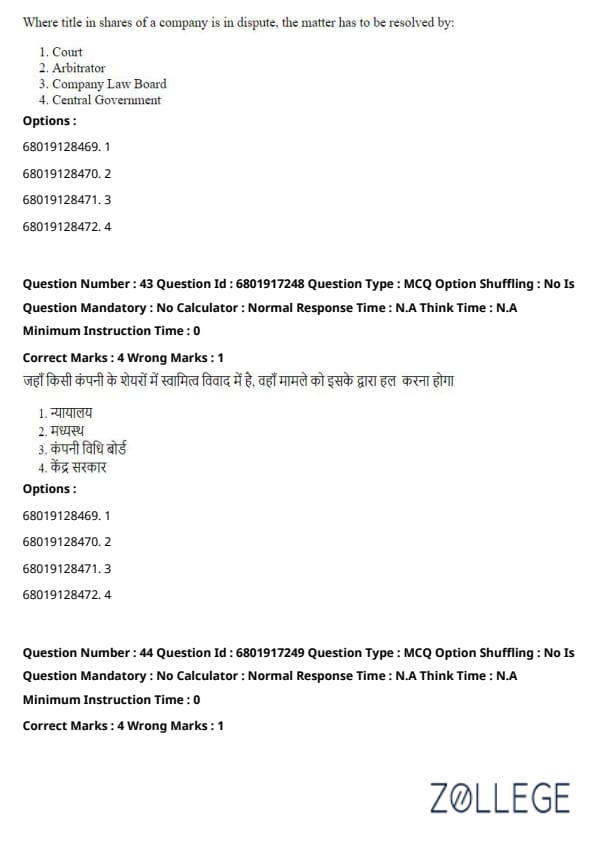
Where title in shares of a company is in dispute, the matter has to be resolved by:
View Solution
Solution: Disputes regarding the title in shares of a company are legal issues that need to be resolved by a court of law. Courts have the jurisdiction to interpret ownership and settle disputes arising from claims over shares. The Company Law Board or other regulatory bodies do not have the authority to decide title disputes.
Quick Tip: Share title disputes require legal intervention; ensure proper documentation to avoid such conflicts.
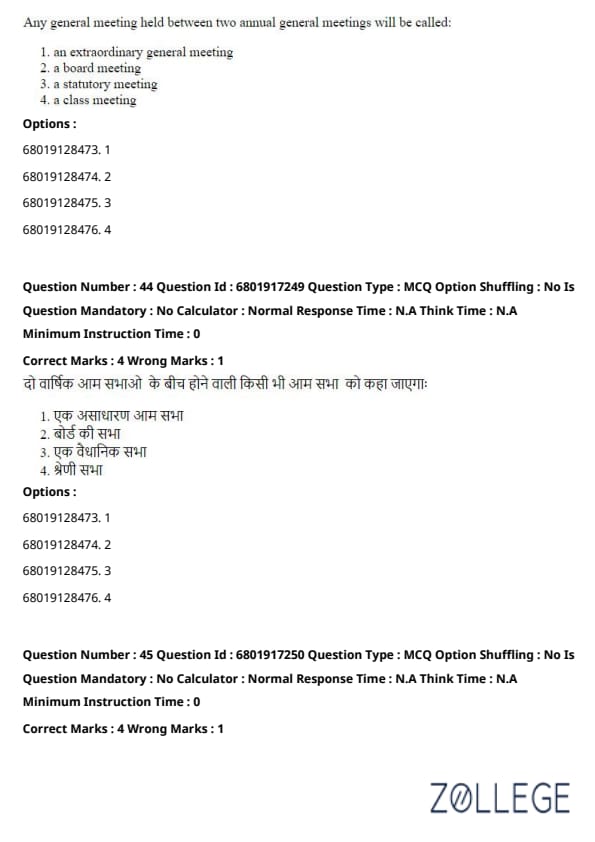
Question 44:
Any general meeting held between two annual general meetings will be called:
View Solution
Solution: An extraordinary general meeting (EGM) is any general meeting of a company's members that is not an annual general meeting (AGM). EGMs are convened to address urgent matters that cannot wait until the next AGM. These meetings often involve significant decisions, such as amendments to the company's constitution or urgent managerial decisions.
Quick Tip: Extraordinary general meetings are crucial for discussing and resolving issues that arise between two AGMs.
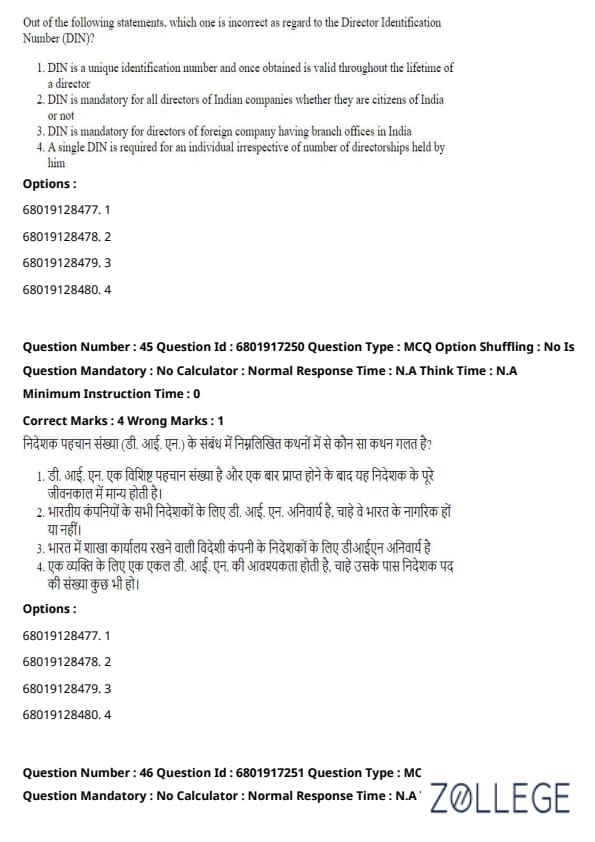
Question 45:
Out of the following statements, which one is incorrect as regards the Director Identification Number (DIN)?
View Solution
Solution: Director Identification Number (DIN) is a unique identifier assigned to directors of Indian companies under the Companies Act, 2013. While DIN is mandatory for all directors of Indian companies, it is not required for directors of foreign companies that merely have branch offices in India. It simplifies the identification of directors for regulatory and compliance purposes and remains valid throughout the director's lifetime.
Quick Tip: DIN ensures streamlined compliance for Indian companies and avoids duplication of director identities.
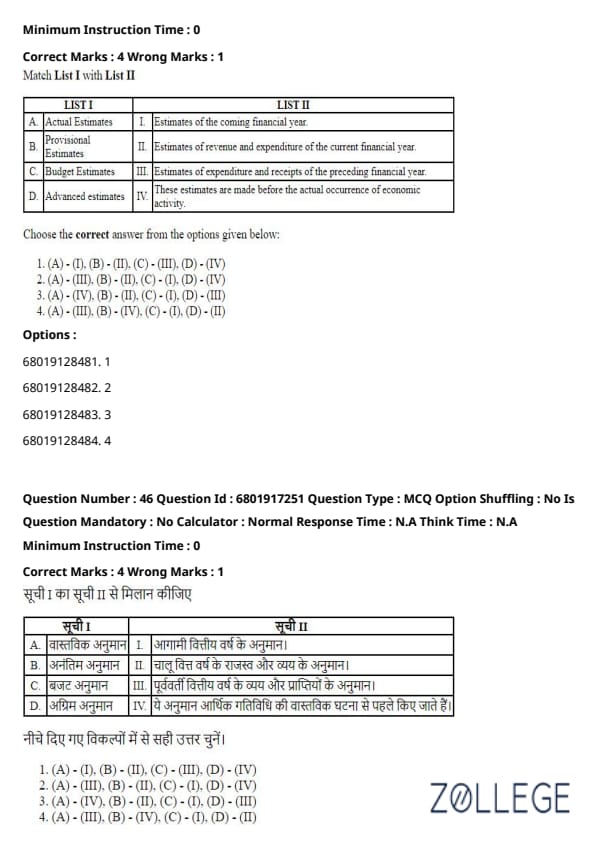
Question 46:
Match List I with List II:
| LIST I | LIST II |
|---|---|
| A. Actual Estimates | I. Estimates of the coming financial year. |
| B. Provisional Estimates | II. Estimates of revenue and expenditure of the current financial year. |
| C. Budget Estimates | III. Estimates of expenditure and receipts of the preceding financial year. |
| D. Advanced Estimates | IV. These estimates are made before the actual occurrence of economic activity. |
Choose the correct answer from the options given below:
View Solution
Solution: The correct matching of List I with List II is based on the definitions:
- Actual Estimates (A): Represent the finalized data of expenditure and receipts of the preceding financial year.
- Provisional Estimates (B): Indicate the estimated revenue and expenditure of the current financial year.
- Budget Estimates (C): Forecast the revenue and expenditure for the coming financial year as planned in the budget.
- Advanced Estimates (D): Are projections made before any actual economic activity has taken place.
Quick Tip: Remember, actual estimates are retrospective, while budget and advanced estimates are forward-looking financial terms.
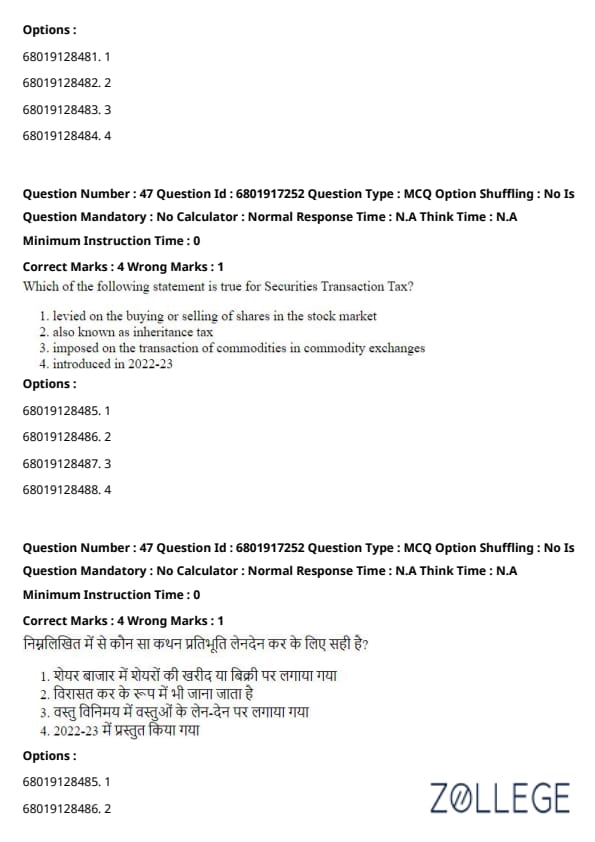
Question 47:
Which of the following statement is true for Securities Transaction Tax?
View Solution
Solution: Securities Transaction Tax (STT) is a direct tax imposed on the purchase and sale of securities listed on recognized stock exchanges in India. It is not related to inheritance or commodity exchanges and was introduced earlier than 2022-23. This tax ensures transparency and simplifies tax compliance for stock market transactions.
Quick Tip: STT applies only to equity and equity-related instruments traded on stock exchanges.
Question 48:
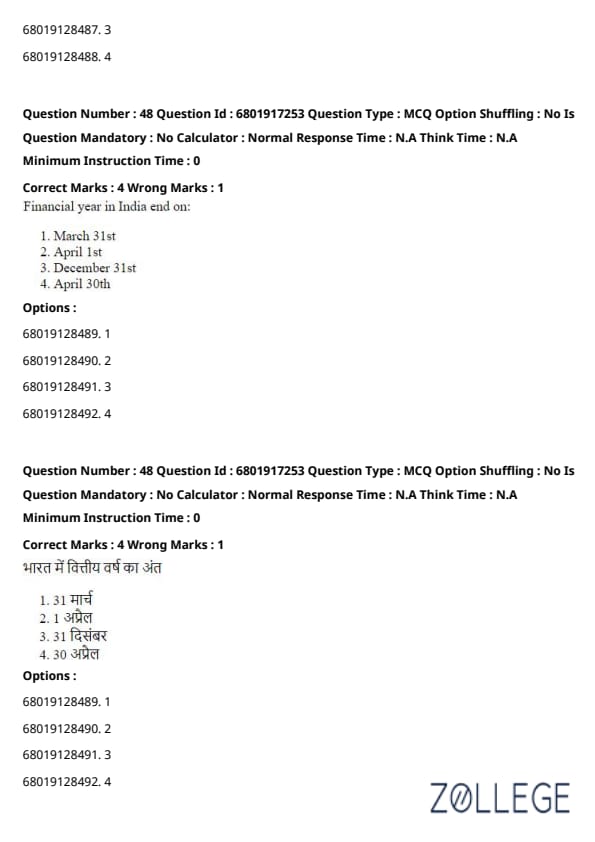
Financial year in India ends on:
View Solution
Solution: The financial year in India begins on April 1st and ends on March 31st of the following year. This accounting period is adopted by businesses, governments, and other entities for tax and financial reporting purposes. March 31st marks the closure of accounts for the financial year.
Quick Tip: The financial year in India runs from April 1st to March 31st, aligning with the fiscal policies and tax schedules.
Question 49:
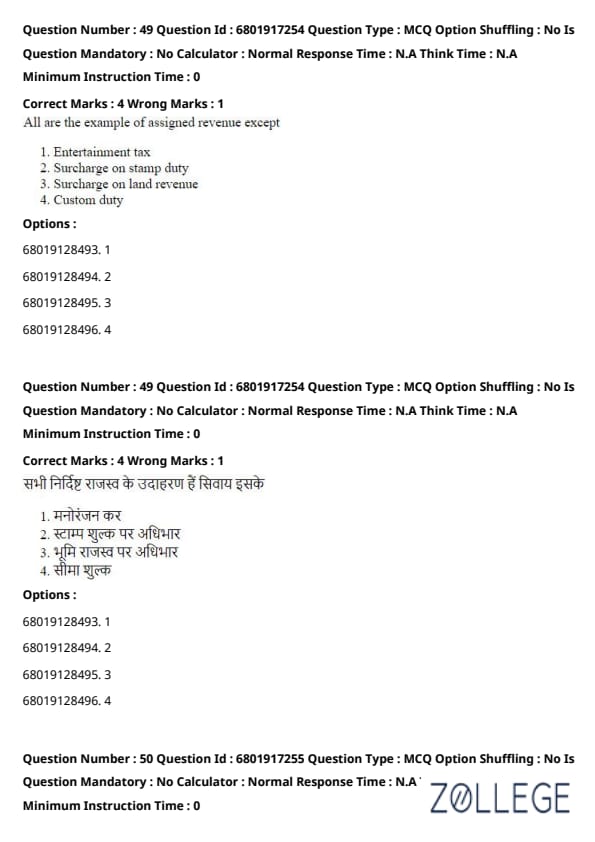
All are the example of assigned revenue except:
View Solution
Solution: Assigned revenues refer to taxes and charges assigned by higher levels of government (state or central) to local governments for collection and utilization. Examples include entertainment tax, surcharge on stamp duty, and surcharge on land revenue. However, custom duty is a central tax and does not fall under the category of assigned revenue, as it is levied and collected exclusively by the central government.
Quick Tip: Custom duty is a central tax and not an assigned revenue, differentiating it from other state-level taxes and surcharges.
Question 50:
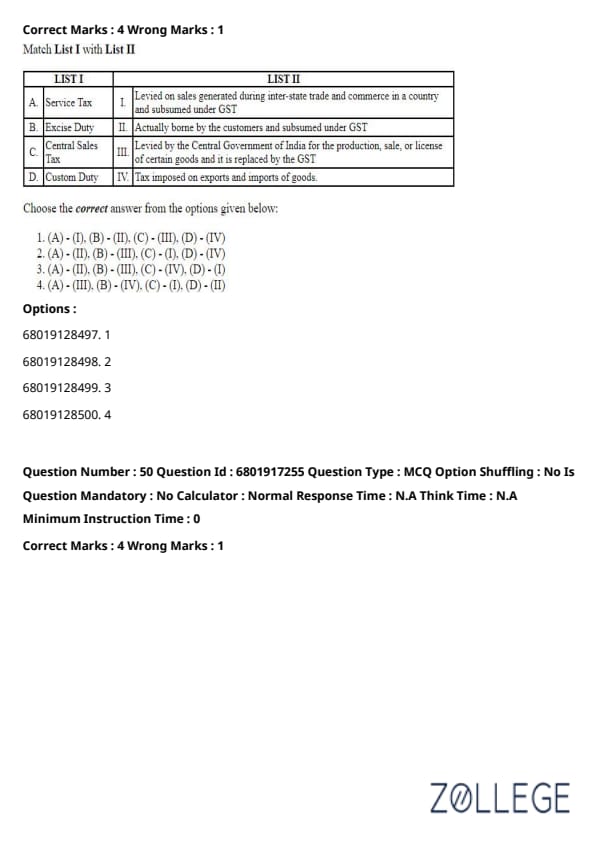
Match List I with List II:
| LIST I | LIST II |
|---|---|
| A. Service Tax | I. Levied on sales generated during inter-state trade and commerce in a country and subsumed under GST |
| B. Excise Duty | II. Actually borne by the customers and subsumed under GST |
| C. Central Sales Tax | III. Levied by the Central Government of India for the production, sale, or license of certain goods and it is replaced by the GST |
| D. Custom Duty | IV. Tax imposed on exports and imports of goods. |
View Solution
Solution:
- Service Tax: It is a tax on services provided by businesses, ultimately borne by the customers. Subsumed under GST.
- Excise Duty: This is imposed by the Central Government on the manufacture of goods, now replaced by GST.
- Central Sales Tax: Levied on inter-state trade, it has also been replaced by GST.
- Custom Duty: A tax imposed on imports and exports, this remains outside the GST framework.
Quick Tip: Custom Duty remains a separate tax on international trade, while Service Tax, Excise Duty, and Central Sales Tax have been integrated into CST.
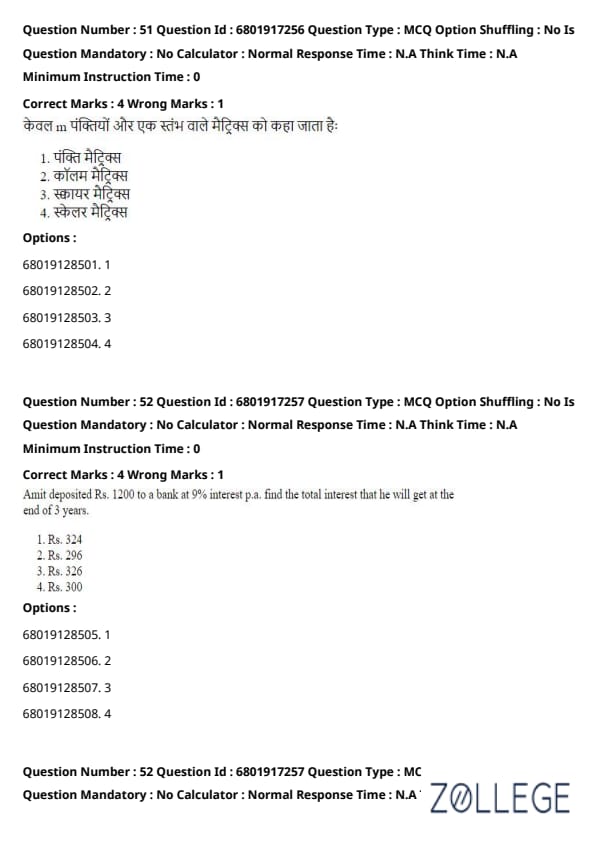
Question 51:
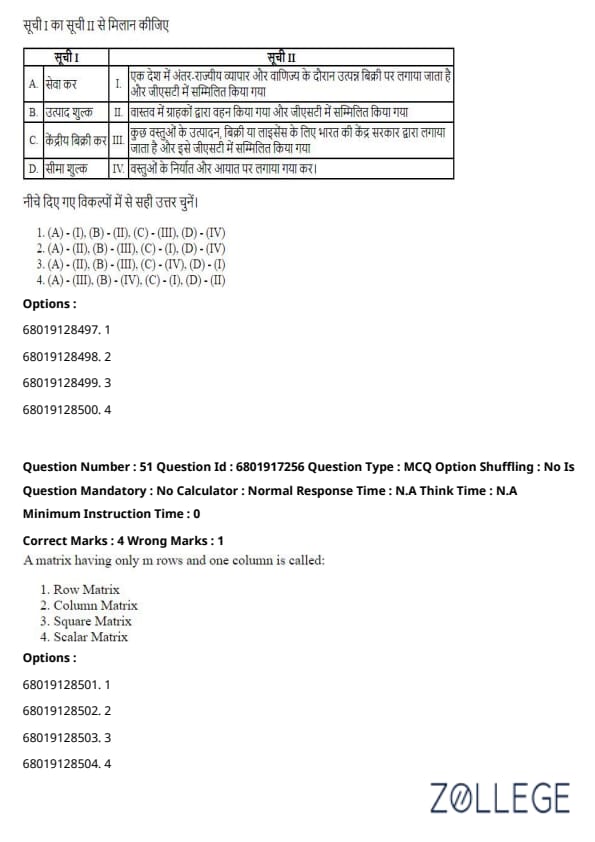
A matrix having only m rows and one column is called:
View Solution
Solution: A column matrix is a matrix that consists of only one column and m rows. For example:
⎧
a
b
c
⎩
is a column matrix.
Quick Tip: A column matrix always has one column and multiple rows.
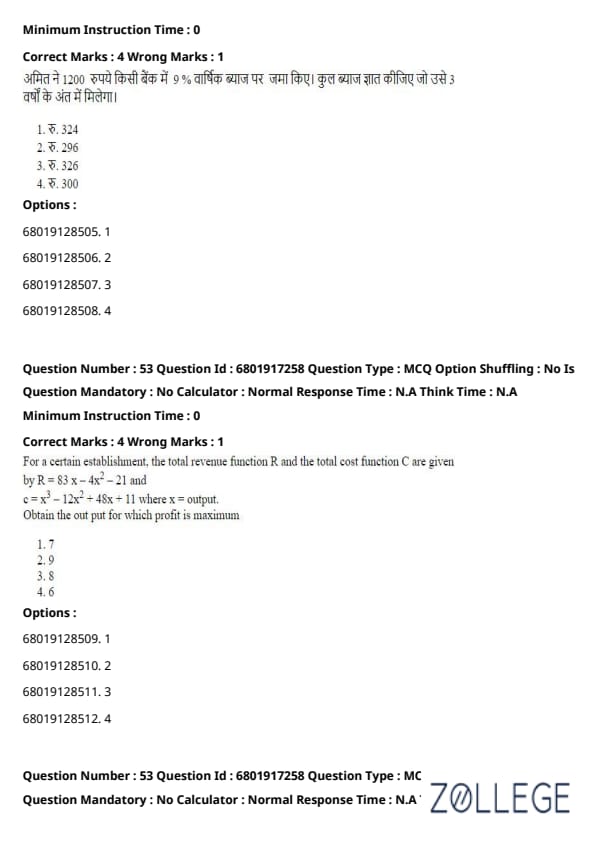
Question 52:
Amit deposited Rs. 1200 to a bank at 9% interest p.a. Find the total interest that he will get at the end of 3 years.
View Solution
Solution: The formula for simple interest is:
Simple Interest (SI) = (P × R × T) / 100
Here, P = 1200, R = 9%, T = 3 years.
SI = (1200 × 9 × 3) / 100 = 324
Thus, the total interest is Rs. 324.
Quick Tip: Always use the formula SI = (P × R × T) / 100 for simple interest calculations.
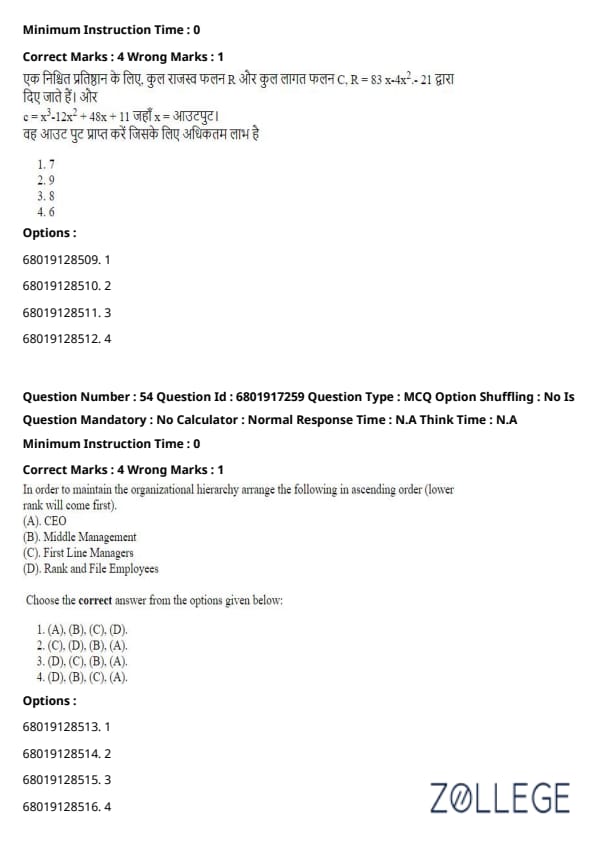
Question 53:
For a certain establishment, the total revenue function R and the total cost function C are given by R = 83x - 4x² - 21 and C = x³ – 12x² + 48x + 11 where x = output. Obtain the output for which profit is maximum.
View Solution
Solution: Profit is given by P(x) = R(x) – C(x). Substituting R and C:
P(x) = (83x - 4x² − 21) − (x³ – 12x² + 48x + 11)
Simplifying, P(x) = -x³ + 8x² + 35x - 32
To maximize profit, find dP(x)/dx = 0:
dP/dx = -3x² + 16x + 35
Setting dP/dx = 0: -3x² + 16x + 35 = 0
Solving this quadratic equation yields x = 3.8 as the point of maximum profit.
Quick Tip: For profit maximization problems, always differentiate the profit function and solve for critical points.
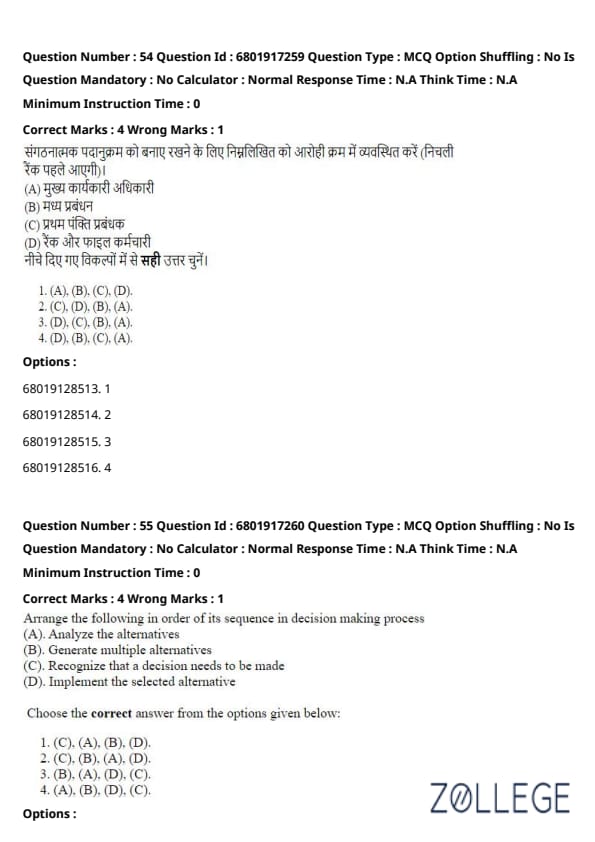
Question 54:
In order to maintain the organizational hierarchy arrange the following in ascending order (lower rank will come first):
Choose the correct answer from the options given below:
View Solution
Solution: The correct hierarchy from the lowest to the highest rank is: 1. Rank and File Employees 2. First Line Managers 3. Middle Management 4. CEO
Quick Tip: Hierarchy ensures clarity in roles and responsibilities within an organization.
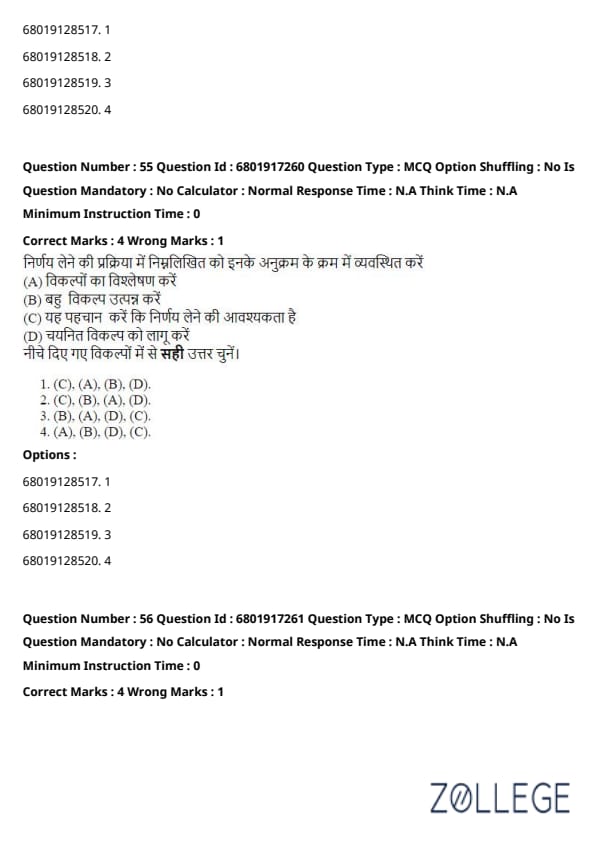
Question 55:
Arrange the following in order of its sequence in decision-making process:
Choose the correct answer from the options given below:
View Solution
Solution: The decision-making process begins with recognizing that a decision needs to be made. The steps are: 1. Recognize the need for a decision 2. Generate multiple alternatives 3. Analyze the alternatives 4. Implement the selected alternative
Quick Tip: Follow a systematic approach in decision-making to ensure effective results.
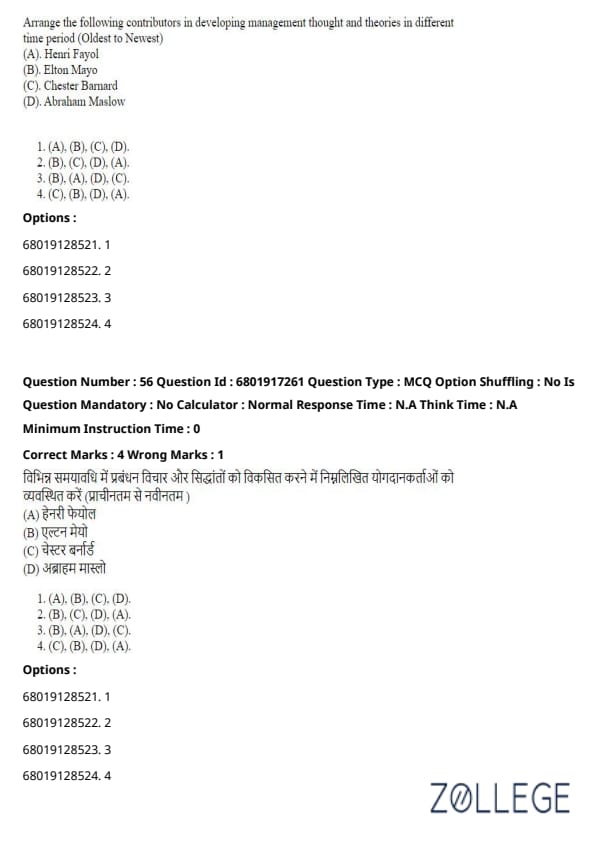
Question 56:
Arrange the following contributors in developing management thought and theories in different time periods (Oldest to Newest):
Choose the correct answer from the options given below:
View Solution
Solution: The timeline of contributors is as follows:
- Henri Fayol (1841-1925): Known for administrative management theory.
- Elton Mayo (1880-1949): Developed the human relations approach.
- Chester Barnard (1886–1961): Known for theories on organizational cooperation.
- Abraham Maslow (1908–1970): Proposed the hierarchy of needs theory.
Quick Tip: Studying the timeline of contributors provides a clear understanding of the evolution of management theories.
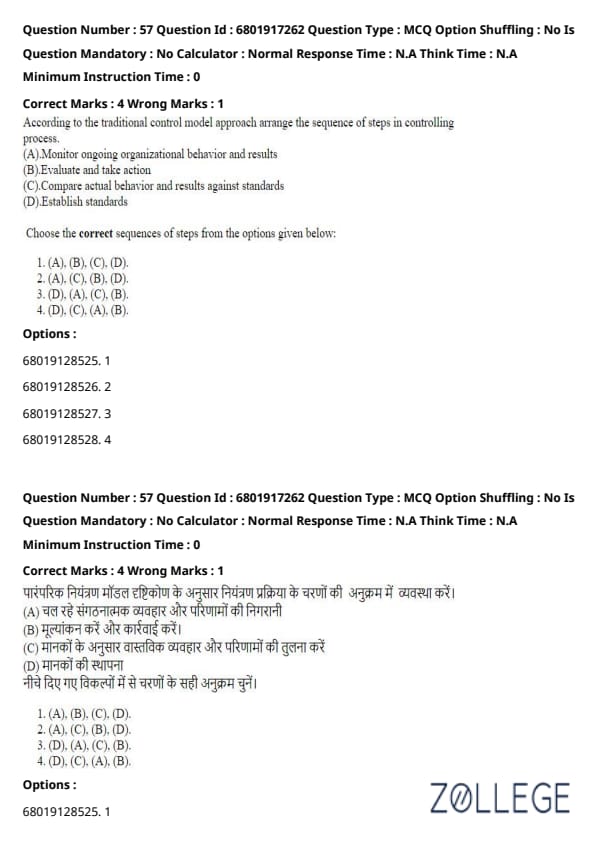
Question 57:
According to the traditional control model approach, arrange the sequence of steps in the controlling process:
Choose the correct sequences of steps from the options given below:
View Solution
Solution: The correct sequence of steps in the controlling process is: 1. Establish standards 2. Monitor ongoing organizational behavior and results 3. Compare actual behavior and results against standards 4. Evaluate and take action
Quick Tip: Control processes ensure alignment with organizational goals through monitoring and corrective actions.
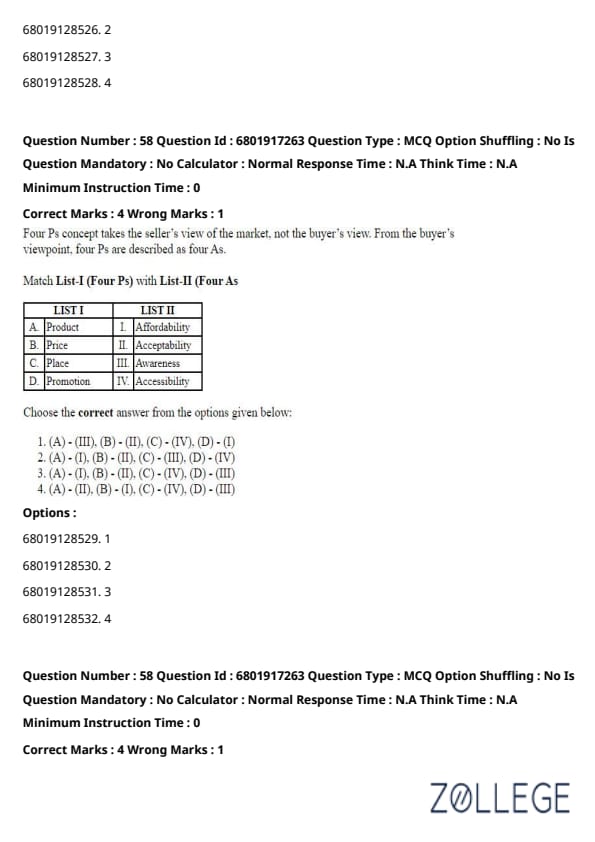
Question 58:
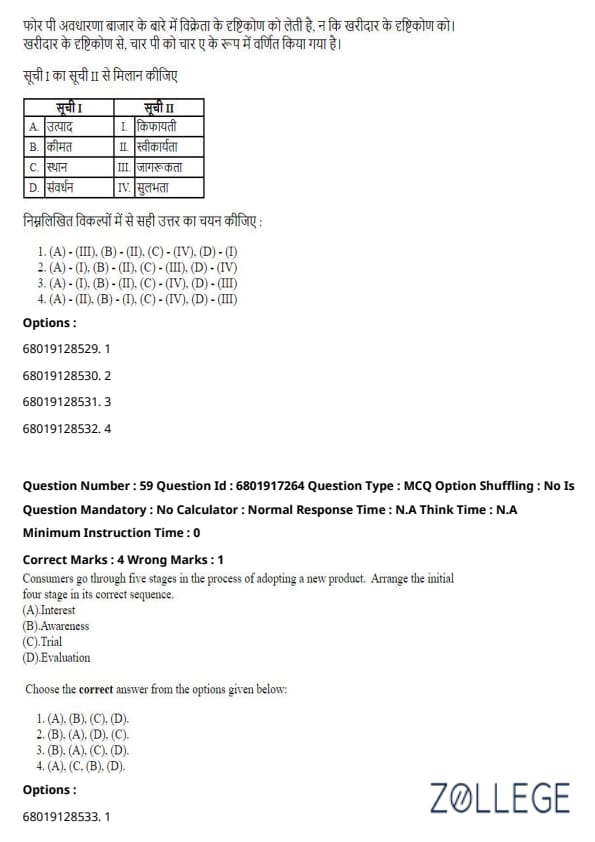
Four Ps concept takes the seller's view of the market, not the buyer's view. From the buyer's viewpoint, four Ps are described as four As. Match List-I (Four Ps) with List-II (Four As):
| LIST I | LIST II |
|---|---|
| A. Product | I. Affordability |
| B. Price | II. Acceptability |
| C. Place | III. Awareness |
| D. Promotion | IV. Accessibility |
Choose the correct answer from the options given below:
View Solution
Solution: The Four Ps (Product, Price, Place, Promotion) align with the buyer's view as follows:
- Product corresponds to Acceptability, focusing on meeting customer needs.
- Price relates to Affordability, ensuring the product fits the buyer's budget.
- Place corresponds to Accessibility, ensuring availability.
- Promotion aligns with Awareness, creating knowledge about the product.
Quick Tip: The Four As focus on customer-centric marketing by aligning products with buyer needs and preferences.
Question 59:
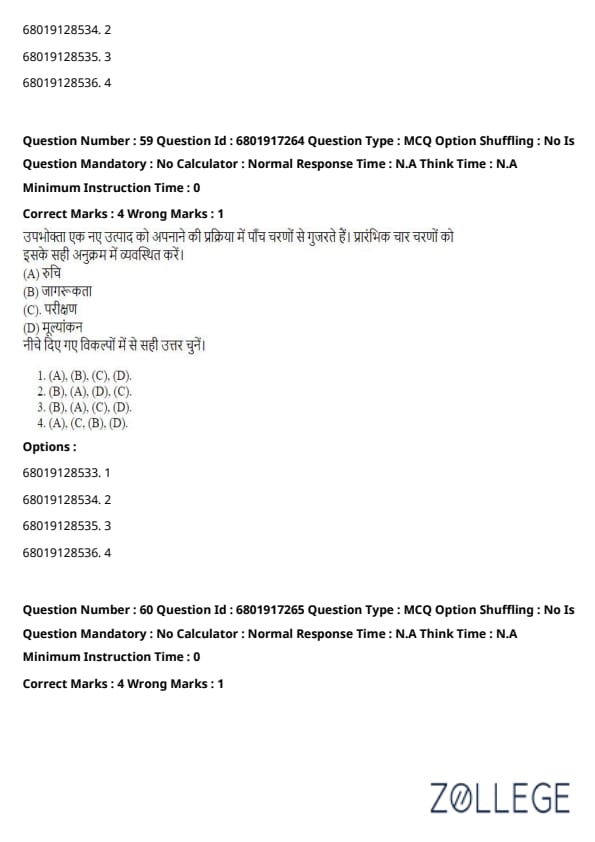
Consumers go through five stages in the process of adopting a new product. Arrange the initial four stages in its correct sequence:
Choose the correct answer from the options given below:
View Solution
Solution: The process of adopting a new product follows these stages:
- Awareness: The buyer becomes aware of the product.
- Interest: The buyer seeks more information and develops interest.
- Evaluation: The buyer assesses whether the product meets their needs.
- Trial: The buyer tests or uses the product before making a decision.
Quick Tip: Understanding the adoption process helps in designing better marketing strategies to engage customers at each stage.
Question 60:
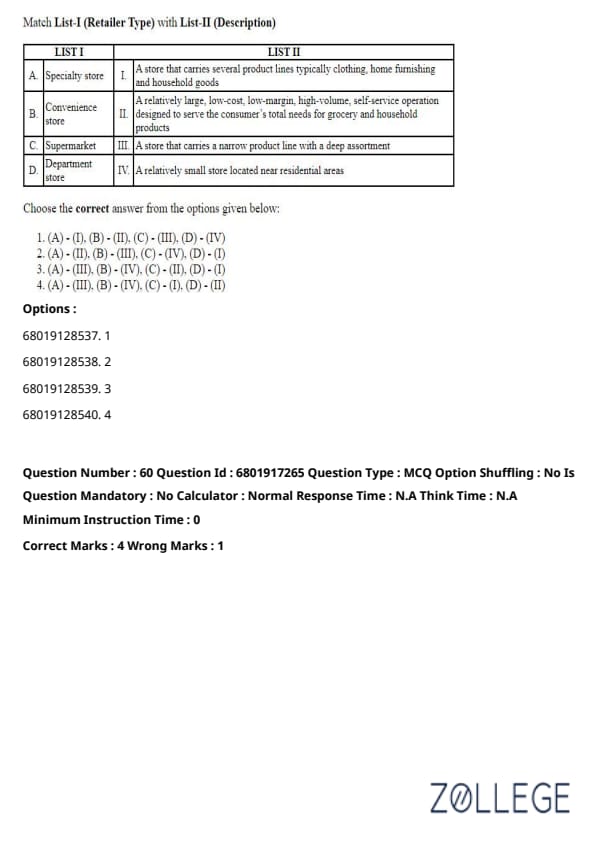
Match List-I (Retailer Type) with List-II (Description):
| LIST I | LIST II |
|---|---|
| A. Specialty store | I. A store that carries several products like clothing, home furnishing, household goods |
| B. Convenience store | II. A relatively large, low-cost, low-margin, high-volume, self-service operation designed to serve the consumer's total needs for grocery and household products |
| C. Supermarket | III. A store that carries a narrow product line with a deep assortment |
| D. Department store | IV. A relatively small store located near residential areas |
Choose the correct answer from the options given below:
View Solution
Solution:
- Specialty store (A) focuses on a narrow product line with a deep assortment, such as a store that specializes in clothing or home goods, hence it matches with III.
- Convenience store (B) is typically a small store located near residential areas, offering a limited selection of everyday items, so it corresponds with IV.
- Supermarket (C) carries a broad range of products, especially groceries and household goods, matching with I.
- Department store (D) carries several product lines, typically clothing, home furnishings, and household goods, hence it aligns with II.
Quick Tip: When identifying retailer types, consider the breadth and depth of the product offerings. Specialty stores focus on depth within a narrow product line, while supermarkets offer variety but less depth in each category.
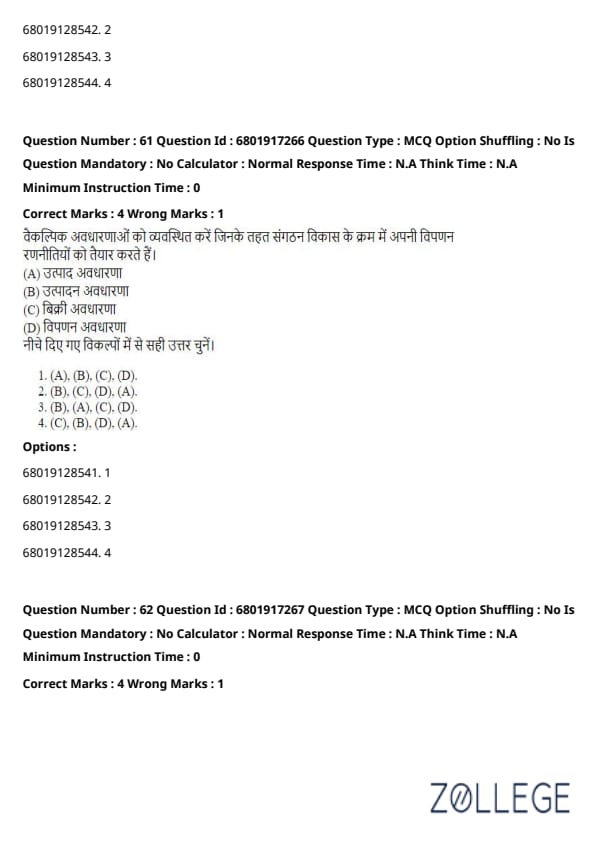
Question 61:
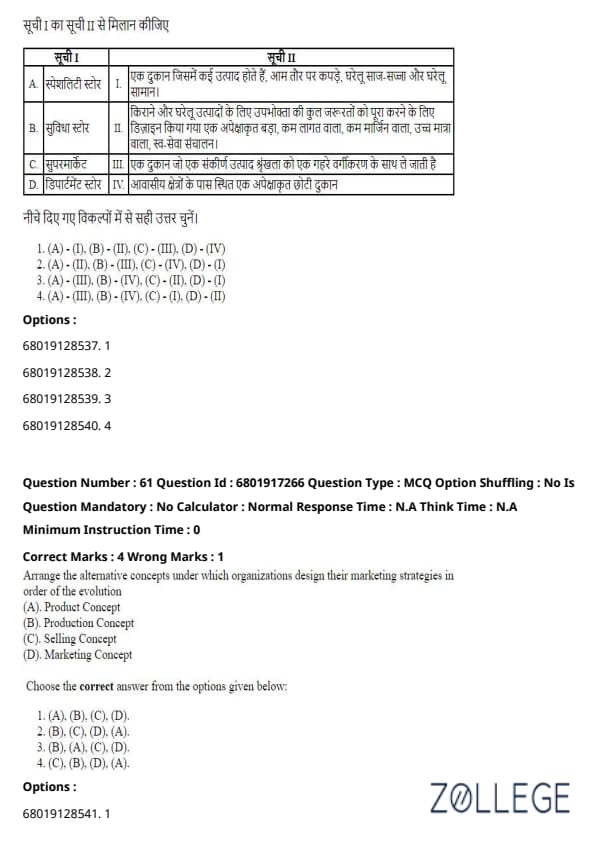
Arrange the alternative concepts under which organizations design their marketing strategies in order of evolution:
Choose the correct answer from the options given below:
View Solution
Solution: The evolution of marketing strategies is as follows:
- Production Concept: Focuses on large-scale production and cost efficiency.
- Product Concept: Emphasizes product quality and features.
- Selling Concept: Centers on aggressive promotion and sales tactics.
- Marketing Concept: Prioritizes customer needs and satisfaction.
Quick Tip: The marketing concept emphasizes creating value for customers, marking a shift from product-centric to customer-centric strategies.
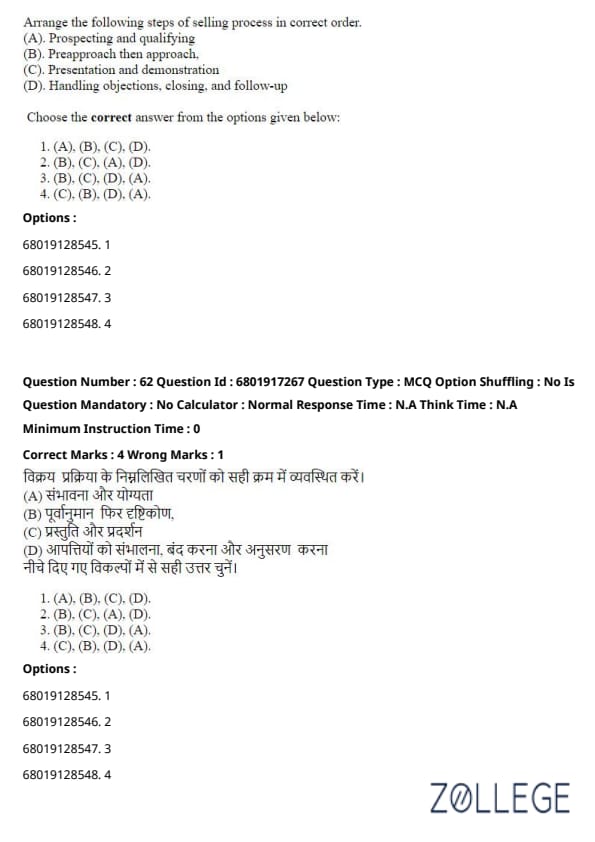
Question 62:
Arrange the following steps of the selling process in the correct order:
Choose the correct answer from the options given below:
View Solution
Solution: The steps in the selling process are:
- Prospecting and qualifying: Identifying potential customers and determining their needs.
- Preapproach then approach: Gathering information and planning before making contact, followed by meeting the customer.
- Presentation and demonstration: Explaining the product's value and features to persuade the customer.
- Handling objections, closing, and follow-up: Addressing concerns, completing the sale, and maintaining a relationship.
Quick Tip: Effective selling involves building relationships through careful planning, presentation, and follow-up.
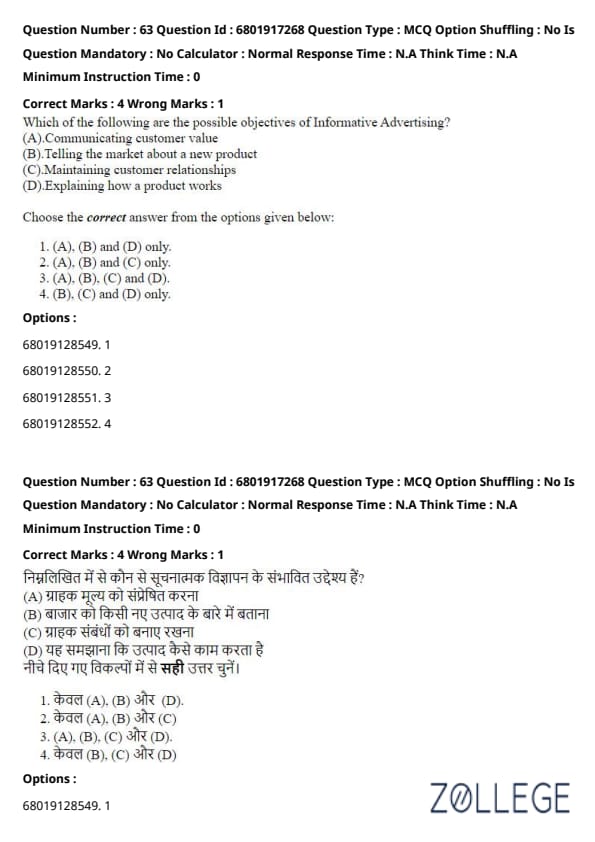
Question 63:
Which of the following are the possible objectives of Informative Advertising?
Choose the correct answer from the options given below:
View Solution
Solution: The objectives of informative advertising are:
- Communicating customer value: Highlighting the benefits of the product to customers.
- Telling the market about a new product: Creating awareness for a newly launched product.
- Explaining how a product works: Educating customers about the product's functionality.
Quick Tip: Informative advertising focuses on creating awareness and educating customers about the product.
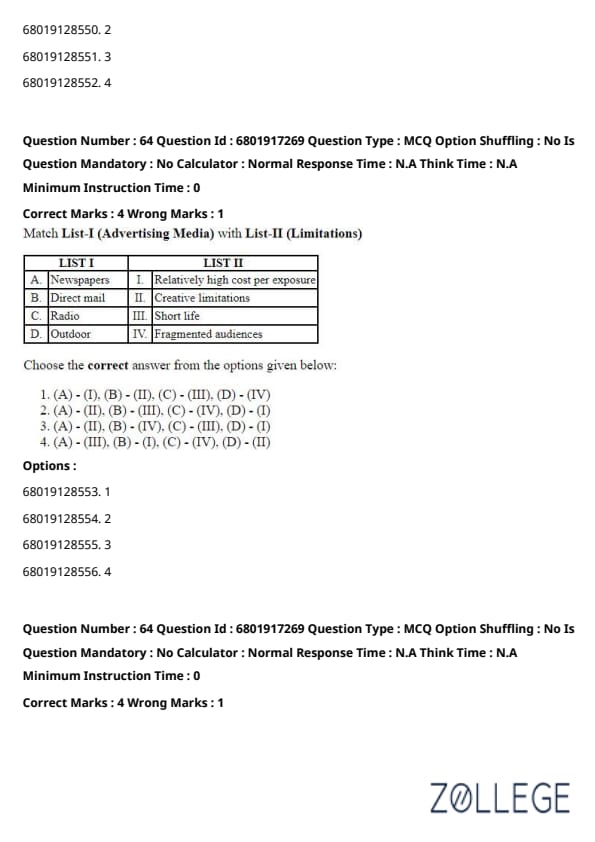
Question 64:
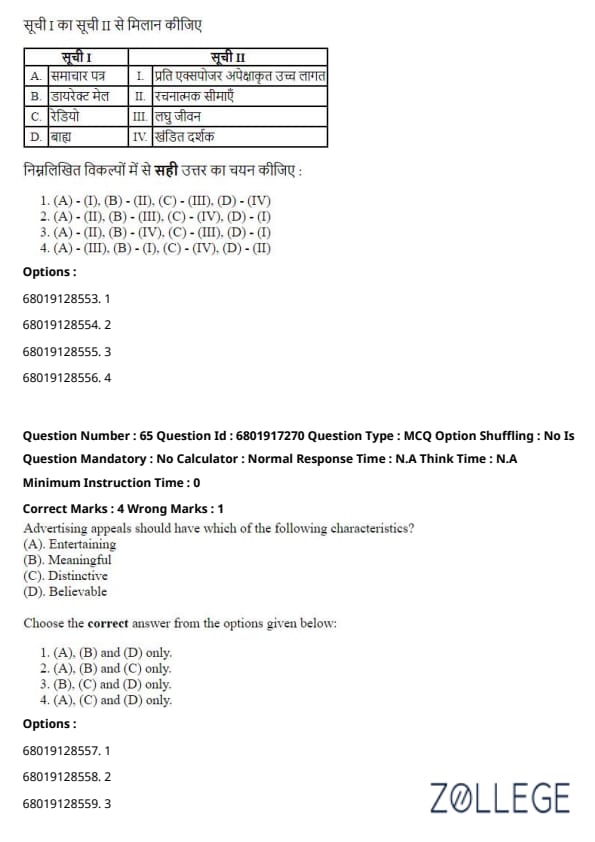
Match List-I (Advertising Media) with List-II (Limitations):
| LIST I | LIST II |
|---|---|
| A. Newspapers | I. Relatively high cost per exposure |
| B. Direct mail | II. Creative limitations |
| C. Radio | III. Short life |
| D. Outdoor | IV. Fragmented audiences |
Table 2: Match List I with List II
Choose the correct answer from the options given below:
View Solution
Solution:
- Newspapers: Short life, as they are discarded after reading.
- Direct mail: High cost per exposure due to personalized distribution.
- Radio: Fragmented audiences due to varied channels and listener preferences.
- Outdoor: Creative limitations because of space constraints.
Quick Tip: Each advertising medium has unique limitations that impact its effectiveness.
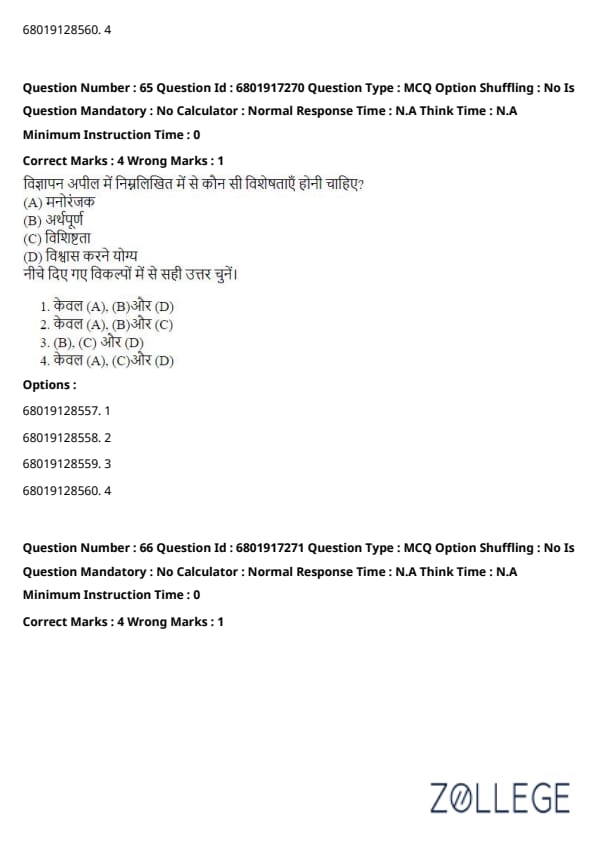
Question 65:
Advertising appeals should have which of the following characteristics:
Choose the correct answer from the options given below:
View Solution
Solution: Effective advertising appeals are:
- Meaningful: Conveying a clear and relevant message.
- Distinctive: Standing out from competitors.
- Believable: Gaining customer trust.
Quick Tip: Focus on meaningful, distinctive, and believable appeals for impactful advertising.
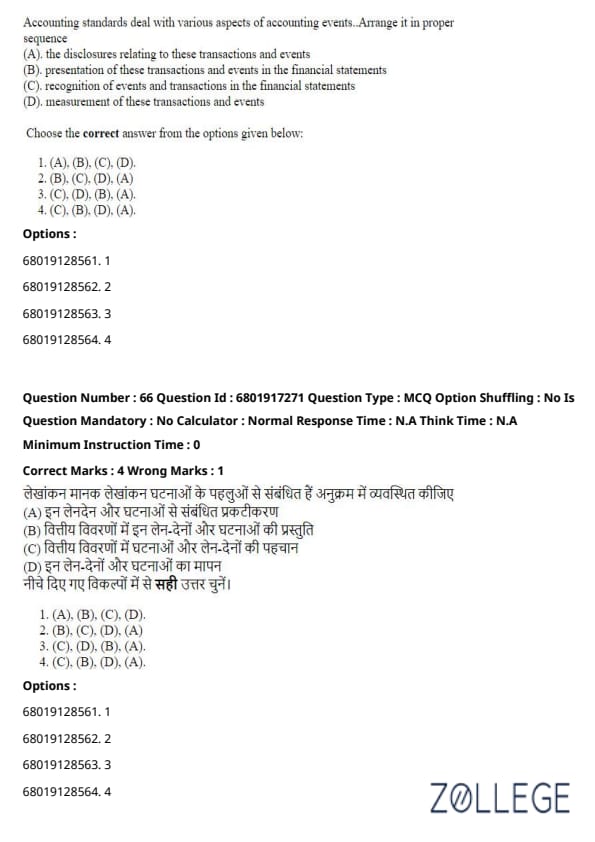
Question 66:
Accounting standards deal with various aspects of accounting events. Arrange them in the proper sequence:
Choose the correct answer from the options given below:
View Solution
Solution: The sequence is as follows:
- Recognition: Identify events and transactions that qualify for financial reporting.
- Measurement: Quantify these transactions in financial terms.
- Presentation: Arrange them appropriately in financial statements.
- Disclosure: Provide additional details for transparency.
Quick Tip: Follow the sequence: recognition, measurement, presentation, and disclosure for proper financial reporting.
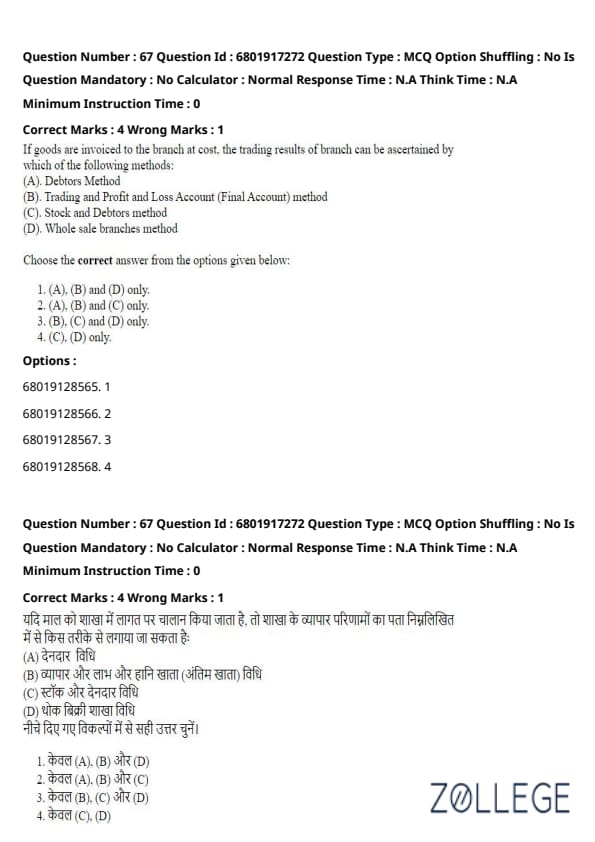
Question 67:
If goods are invoiced to the branch at cost, the trading results of the branch can be ascertained by which of the following methods:
Choose the correct answer from the options given below:
View Solution
Solution: The following methods ascertain the trading results of branches invoiced at cost:
- Debtors Method: Tracks transactions and outstanding balances.
- Trading and Profit and Loss Account Method: Prepares financial statements for the branch.
- Stock and Debtors Method: Combines stock records and debtor balances.
Quick Tip: Use the appropriate method based on the branch accounting requirements and invoicing method.
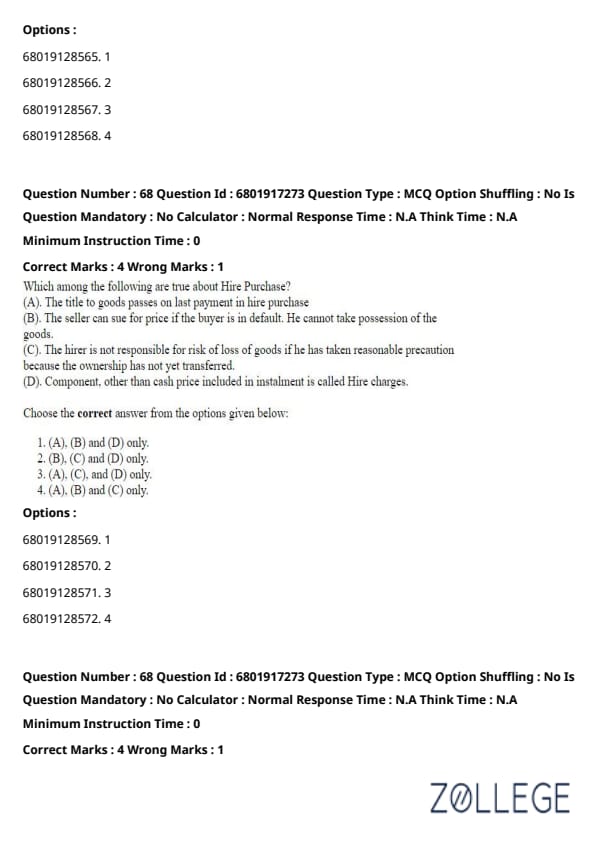
Question 68:
Which among the following are true about Hire Purchase?
Choose the correct answer from the options given below:
View Solution
Solution:
- (A) - True, in a hire purchase agreement, the title of the goods is transferred only when the last installment is paid.
- (B) - True, in case of default, the seller can claim the price but cannot take possession of the goods without legal action.
- (C) - False, the hirer is responsible for the risk of loss of goods even before the title is transferred if reasonable precautions were not taken.
- (D) - True, hire charges are the additional amounts included in the installment besides the cash price of the goods.
Quick Tip: In a hire purchase agreement, ownership transfer occurs only after the final payment, but risk and responsibility are with the hirer during the contract.
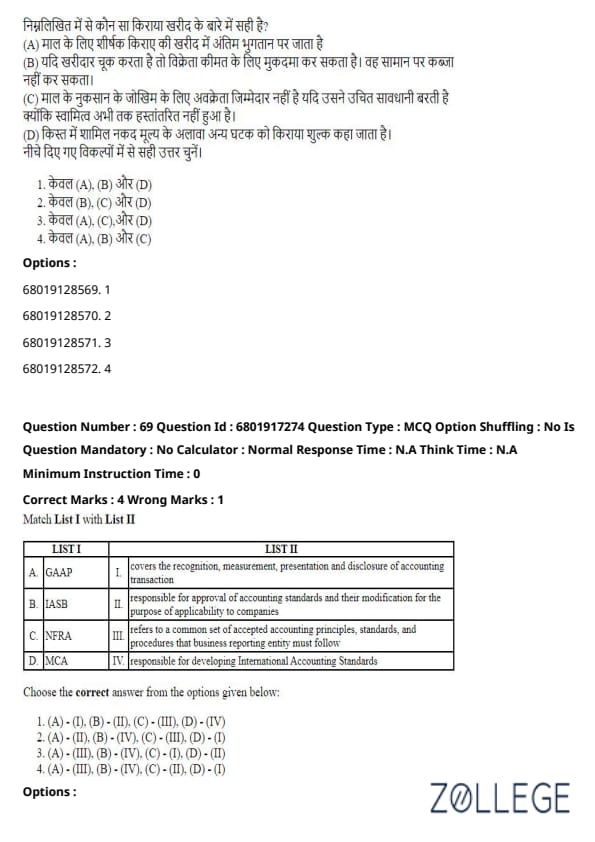
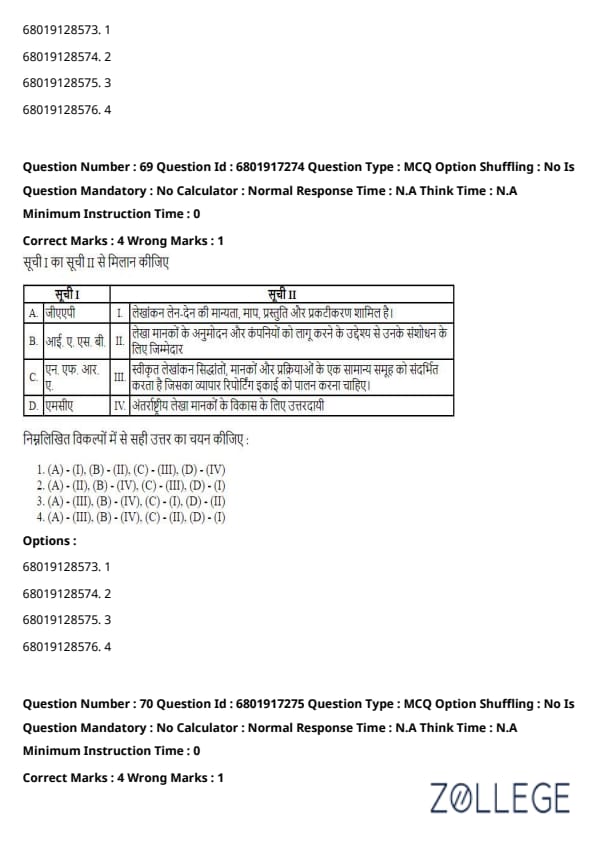
Question 69:
Match List I with List II:
| LIST I | LIST II |
|---|---|
| A. GAAP | I. Covers the recognition, measurement, presentation, and disclosure of accounting transactions |
| B. IASB | II. Responsible for the approval of accounting standards and their modification for the purpose of applicability to companies |
| C. NFRA | III. Refers to a common set of accepted accounting principles, standards, and procedures that business reporting entities must follow |
| D. MCA | IV. Responsible for developing International Accounting Standards |
Choose the correct answer from the options given below:
View Solution
Solution:
- GAAP (Generally Accepted Accounting Principles): Refers to the common set of accepted accounting principles, standards, and procedures.
- IASB (International Accounting Standards Board): Responsible for developing International Accounting Standards.
- NFRA (National Financial Reporting Authority): Responsible for approving accounting standards and modifying them for application.
- MCA (Ministry of Corporate Affairs): Covers the recognition, measurement, presentation, and disclosure of accounting transactions.
Quick Tip: GAAP and IASB set the foundation for accounting practices, while NFRA and MCA implement and enforce the standards.
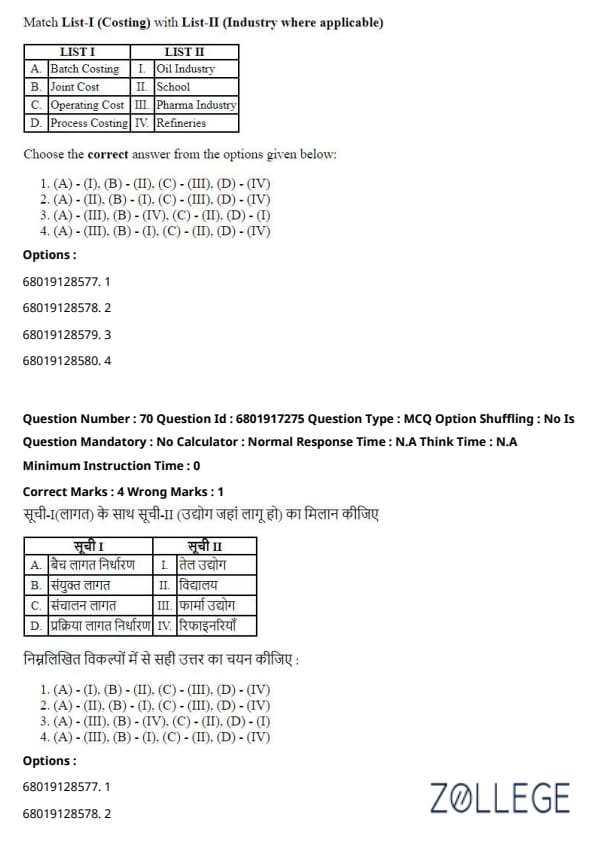
Question 70:
Match List-I (Costing) with List-II (Industry where applicable):
| LIST I | LIST II |
|---|---|
| A. Batch Costing | I. Oil Industry |
| B. Joint Cost | II. School |
| C. Operating Cost | III. Pharma Industry |
| D. Process Costing | IV. Refineries |
Choose the correct answer from the options given below:
View Solution
Solution:
- Batch Costing: Applicable in the Pharma Industry, where production occurs in batches.
- Joint Cost: Relevant to the Oil Industry, where costs are shared between multiple products.
- Operating Cost: Pertains to a School, as it refers to ongoing operational expenses.
- Process Costing: Used in Refineries, where products go through a continuous production process.
Quick Tip: Different industries adopt specific costing methods based on their production processes and product types.
Question 71:
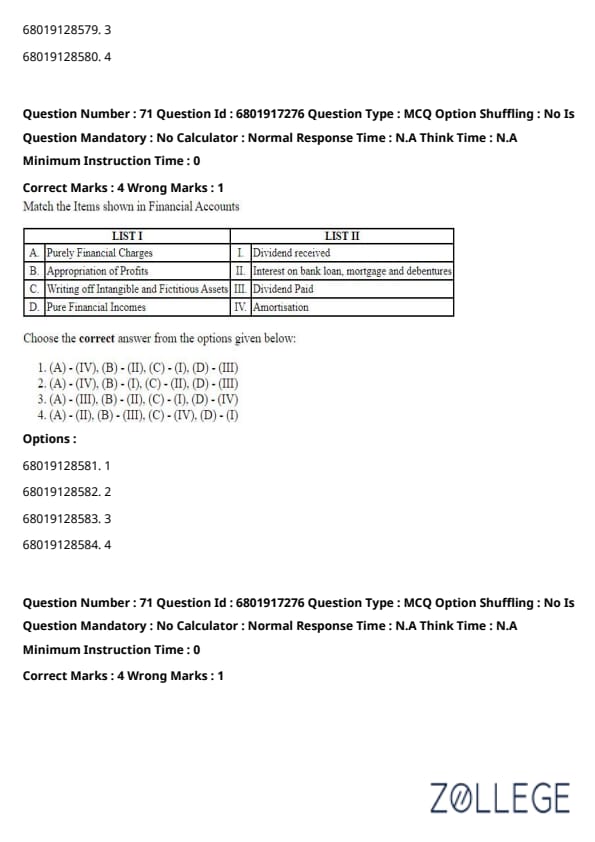
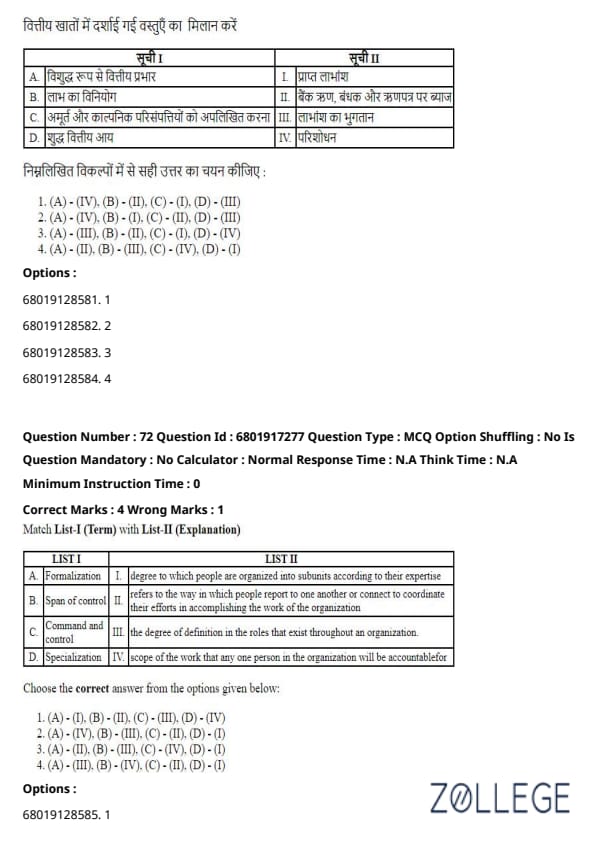
Match the Items shown in Financial Accounts:
| LIST I | LIST II |
|---|---|
| A. Purely Financial Charges | I. Dividend received |
| B. Appropriation of Profits | II. Interest on bank loan, mortgage, and debentures |
| C. Writing off Intangible and Fictitious Assets | III. Dividend Paid |
| D. Pure Financial Incomes | IV. Amortization |
Choose the correct answer from the options given below:
View Solution
Solution:
- Purely Financial Charges: These are related to expenses like interest, which is related to the cost of borrowing, categorized under Amortization (IV).
- Appropriation of Profits: This refers to how profits are allocated, which is related to the Dividend Paid (III).
- Writing off Intangible and Fictitious Assets: This involves eliminating non-physical assets from the balance sheet, typically associated with Interest on bank loan, mortgage, and debentures (II).
- Pure Financial Incomes: These refer to income items like Dividend received (I).
Quick Tip: Financial accounts classify income and expenses into different categories such as financial charges, income, and profits, each with specific reporting methods.
Question 72:
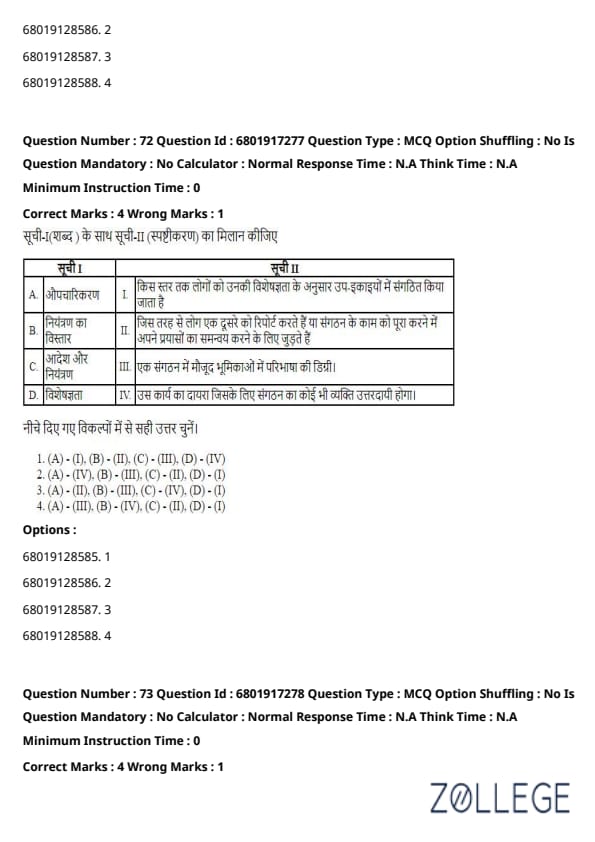
Match List-I (Term) with List-II (Explanation):
| LIST I | LIST II |
|---|---|
| A. Formalization | I. Degree to which people are organized into subunits according to their expertise. |
| B. Span of control | II. Refers to the way in which people report to one another or connect to coordinate their efforts in accomplishing the work of the organization. |
| C. Command and control | III. The degree of definition in the roles that exist throughout an organization. |
| D. Specialization | IV. Scope of the work that any one person in the organization will be accountable for. |
Choose the correct answer from the options given below:
View Solution
Solution:
- Formalization (A): Refers to the degree of definition in roles across an organization (III).
- Span of Control (B): Refers to the scope of work and accountability of individuals within the organization (IV).
- Command and Control (C): Refers to how individuals report to one another and coordinate efforts (II).
- Specialization (D): Refers to organizing people according to their expertise within subunits (I).
Quick Tip: Understanding organizational structure helps in defining roles, responsibilities, and workflow within a company.
Question 73:
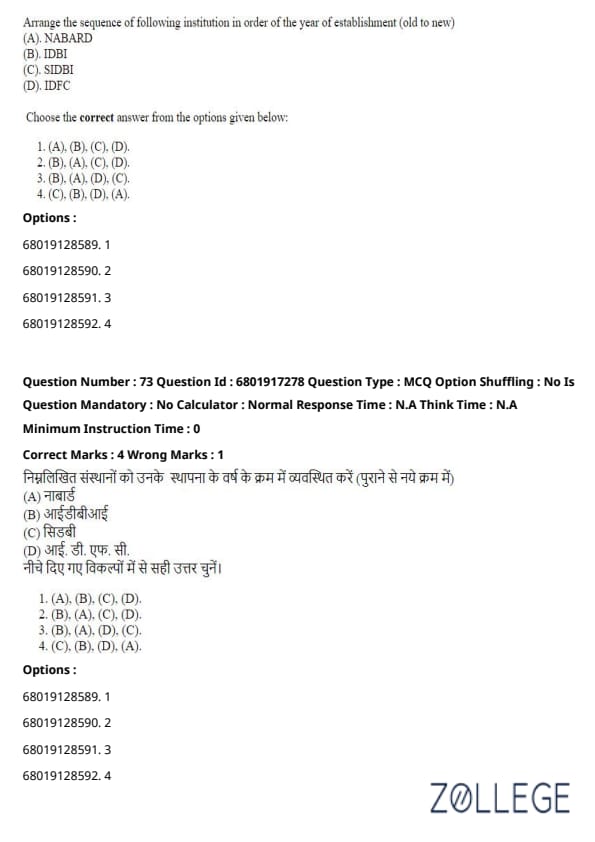
Arrange the sequence of the following institution in order of the year of establishment (old to new):
Choose the correct answer from the options given below:
View Solution
Solution: The institutions listed and their years of establishment are as follows:
- IDBI (Industrial Development Bank of India) - 1964
- NABARD (National Bank for Agriculture and Rural Development) - 1982
- SIDBI (Small Industries Development Bank of India) - 1990
- IDFC (Infrastructure Development Finance Company) - 1997
Quick Tip: To remember the order of these institutions, focus on their main objectives: IDBI was the first to promote industrial growth, followed by NABARD, which focuses on agriculture and rural development, SIDBI focusing on small industries, and IDFC, which came in the late '90s focusing on infrastructure development.
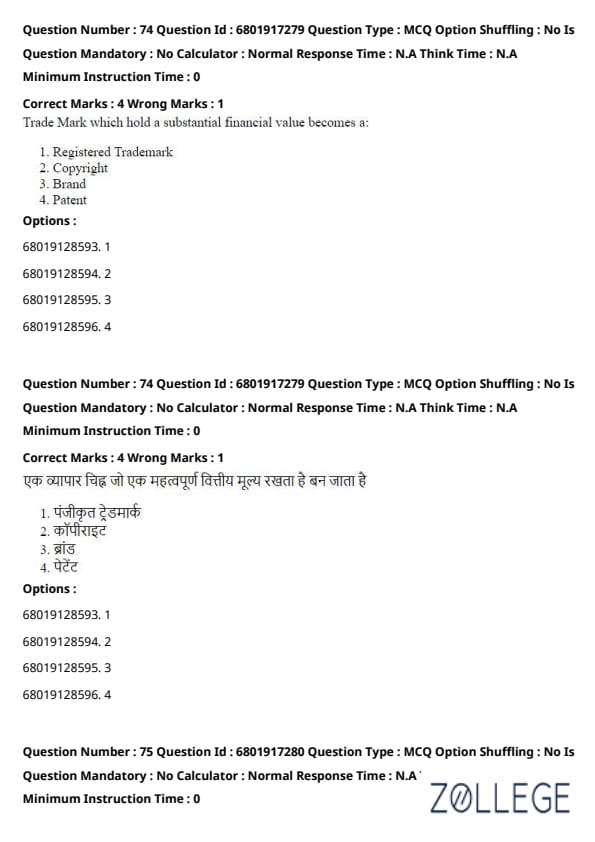
Question 74:
Trade Mark which hold a substantial financial value becomes:
View Solution
Solution: A trademark that holds substantial financial value becomes a Brand. Brands are valuable assets that are built over time and represent the identity, reputation, and market presence of a company.
Quick Tip: When a trademark develops financial value over time, it becomes synonymous with the business itself, thus transforming into a Brand.
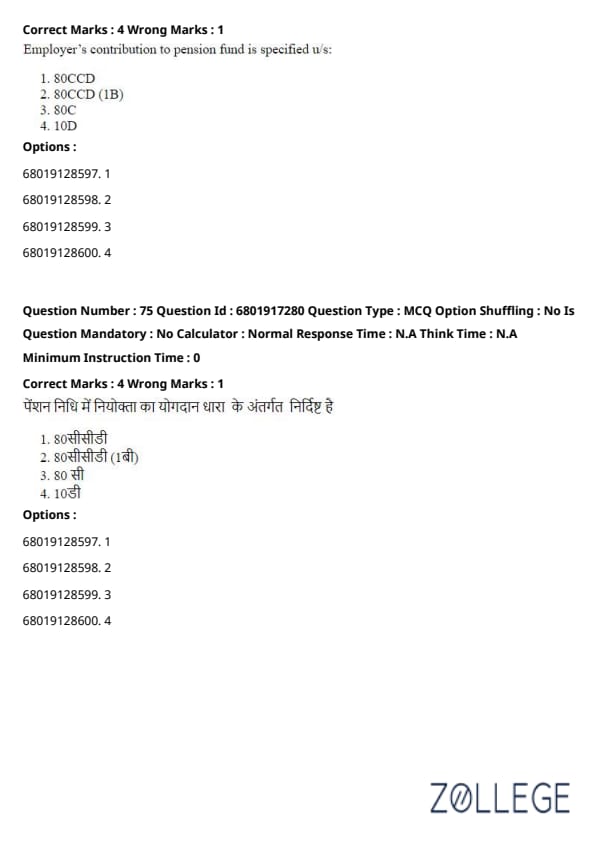
Question 75:
Employer's contribution to pension fund is specified u/s:
View Solution
Solution: Employer's contribution to the pension fund is specified under Section 80CCD. This section provides tax benefits for contributions made by both the employee and the employer towards the pension scheme, helping to promote retirement savings.
Quick Tip: Section 80CCD specifically addresses pension fund contributions, including those made by the employer, and offers tax deductions under the Income Tax Act.
*The article might have information for the previous academic years, please refer the official website of the exam.