CUET PG 2024 English Question Paper Pdf- Check Solutions with Answer Key Pdf
- Question Paper 2025
- Question Paper 2024
- Question Paper 2023
- Mathematics Papers
- Statistics Question Paper
- English Question Paper
- Chemistry Question Paper
- Pol. Sci. Question Paper
- History Question Paper
- Commerce Question Papers
- Life Science Papers
- Geology Question Papers
- Journalism Question Paper
- B.Ed. HSS Question Paper
- Botany Question Paper
- B.Ed. Question Papers


Content Strategist | Updated On - Jan 15, 2025
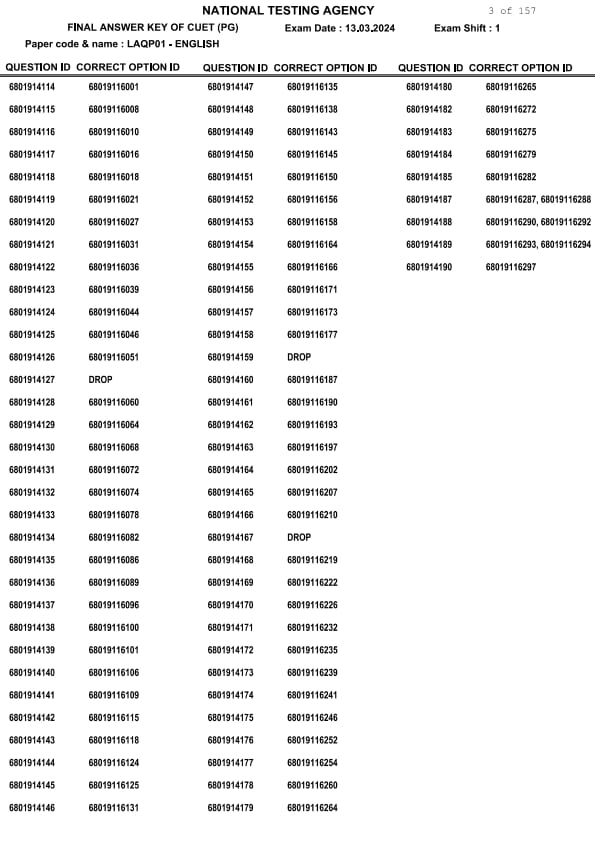
CUET PG 2024 English 13th March 2024 Shift 1 Question Paper with Solution PDF is available for download here. Students found Reading Comprehension moderate, Literary Chronology (e.g., Shakespearean works) challenging, and Critical Theories (e.g., Sigmund Freud's "Uncanny") moderate to difficult. Literary Chronology carried the highest weightage, and the overall difficulty level was moderate.
CUET PG 2024 English Question Paper with Answer Key PDF
| CUET PG 2024 English Question Paper with Answer Key |  Download Download |
Check Solution |
CUET PG 2024 English Questions with Solutions
Question 1:
Match the Text (List-I) to the Genre/Type (List-II):
| List I (Name of the Text) | List II (Genre/Type) |
|---|---|
| A. Paradise Lost | I. Dramatic Monologue |
| B. "Porphyria's Lover" | II. Satire |
| C. King Lear | III. Epic |
| D. The Dunciad | IV. Tragedy |
View Solution
Paradise Lost is an epic, "Porphyria's Lover" is a dramatic monologue, King Lear is a tragedy, and The Dunciad is a satire.
Question 2:
In T.S. Eliot's poem, The Love Song of J. Alfred Prufrock, identify the figures of speech in the line:
"I should have been a pair of ragged claws scuttling across the floors of silent seas."
View Solution
The line uses Synecdoche (part representing the whole) and Alliteration (repetition of consonant sounds).
Question 3:
Who among the following are seminal thinkers of the Enlightenment Age?
View Solution
Immanuel Kant and René Descartes were central thinkers of the Enlightenment.
Question 4:
Arrange these comedies of William Shakespeare in their chronological order (oldest first):
View Solution
The Taming of the Shrew (C) is the oldest, followed by A Midsummer Night’s Dream (D), As You Like It (B), and The Tempest (A).
The chronological arrangement of these works reflects Shakespeare's evolving narrative complexity and thematic depth in his comedies.
Question 5:
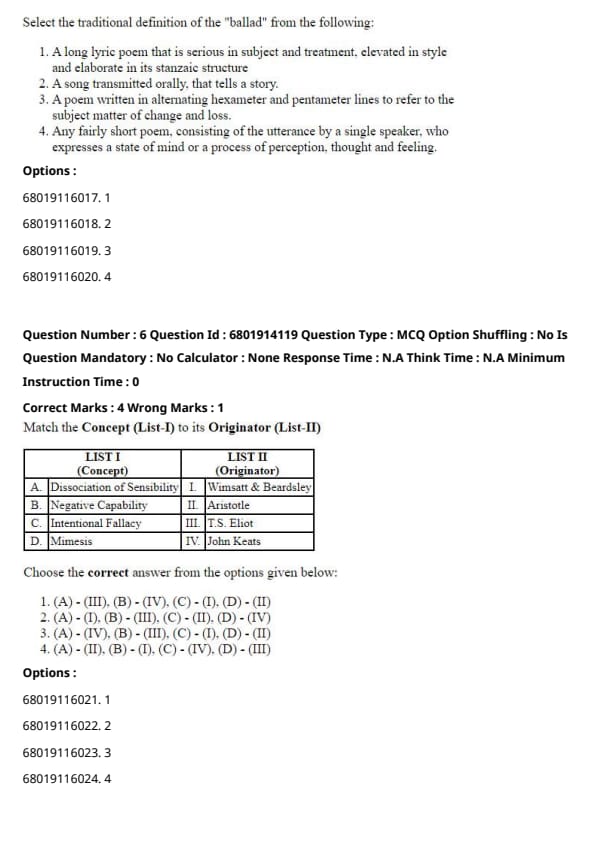
Select the traditional definition of the "ballad":
View Solution
A ballad is traditionally an orally transmitted song that tells a story.
Question 6:
Match the Concept (List-I) to its Originator (List-II):
| List I (Concept) | List II (Originator) |
|---|---|
| A. Dissociation of Sensibility | I. Wimsatt & Beardsley |
| B. Negative Capability | II. Aristotle |
| C. Intentional Fallacy | III. T.S. Eliot |
| D. Mimesis | IV. John Keats |
View Solution
The correct matches between the concepts and their originators are:
- Dissociation of Sensibility was introduced by T.S. Eliot.
- Negative Capability was a term coined by John Keats.
- Intentional Fallacy was introduced by Wimsatt & Beardsley.
- Mimesis was conceptualized by Aristotle.
Question 7:
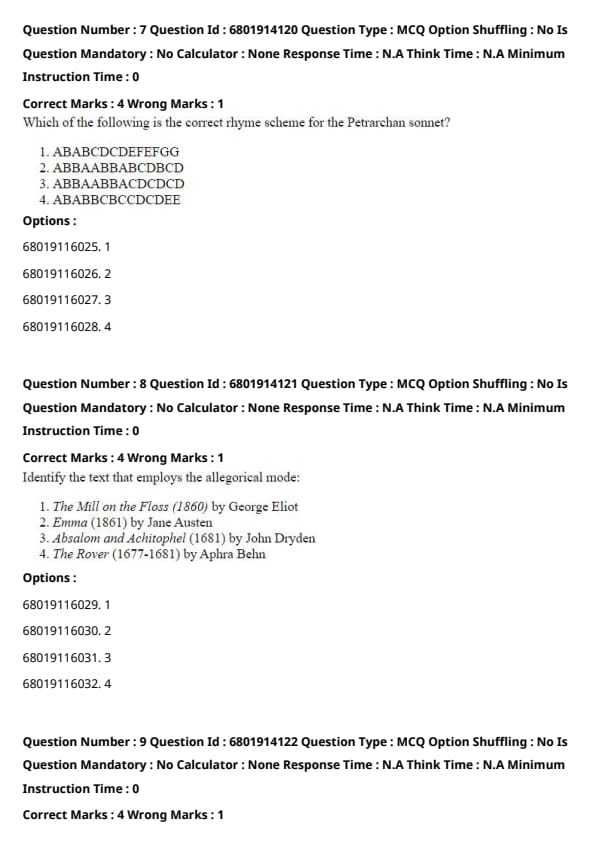
Which of the following is the correct rhyme scheme for the Petrarchan sonnet?
View Solution
The Petrarchan sonnet is characterized by an octave with the rhyme scheme ABBAABBA, followed by a sestet with variations like CDCDCD.
Question 8:
Identify the text that employs the allegorical mode:
View Solution
Absalom and Achitophel by John Dryden uses allegory to critique political events in 17th-century England.
Question 9:
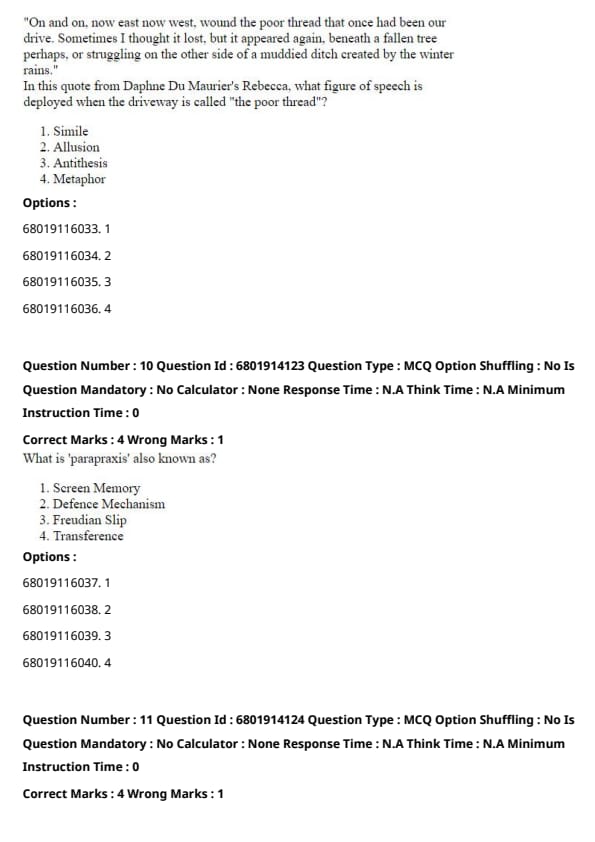
In Daphne Du Maurier's Rebecca, the driveway is called "the poor thread." What figure of speech is used?
View Solution
Describing the driveway as "the poor thread" is a metaphor, implying fragility and continuity.
Question 10:
What is 'parapraxis' also known as?
View Solution
Parapraxis, or a Freudian Slip, is an unintentional error in speech or action that reveals subconscious thoughts.
Question 11:
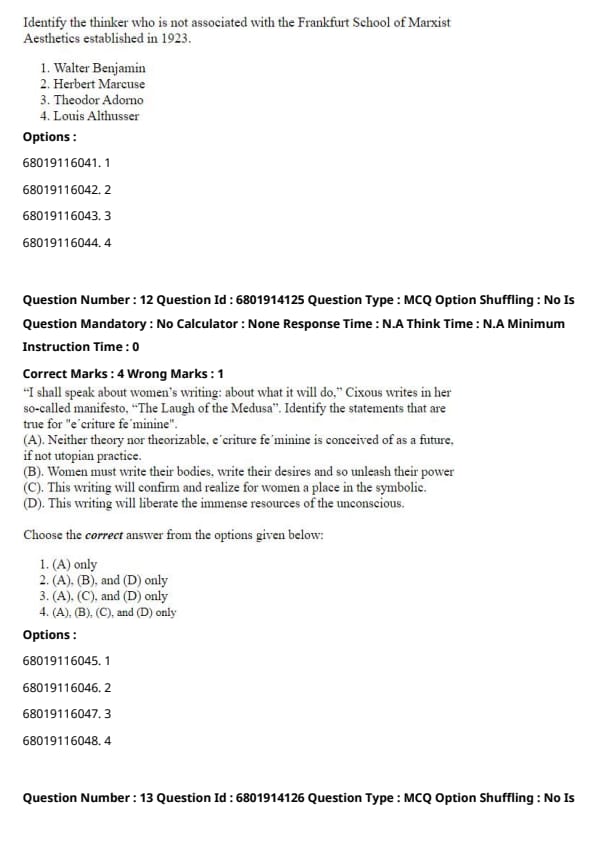
Identify the thinker who is not associated with the Frankfurt School of Marxist Aesthetics established in 1923.
View Solution
The Frankfurt School was founded in 1923 and included thinkers like Walter Benjamin, Herbert Marcuse, and Theodor Adorno. Louis Althusser, although a Marxist theorist, was not part of this school.
Question 12:
“I shall speak about women’s writing: about what it will do,” Cixous writes in her so-called manifesto, The Laugh of the Medusa. Identify the statements that are true for écriture féminine:
- (A). Neither theory nor theorizable, écriture féminine is conceived of as a future, if not utopian practice.
- (B). Women must write their bodies, write their desires and so unleash their power.
- (C). This writing will confirm and realize for women a place in the symbolic.
- (D). This writing will liberate the immense resources of the unconscious.
View Solution
- (A): Écriture féminine is conceived of as a future, if not utopian, practice.
- (B): Cixous emphasizes that women must write their bodies and desires.
- (D): It liberates the immense resources of the unconscious. Statement (C) does not align with her views.
Question 13:
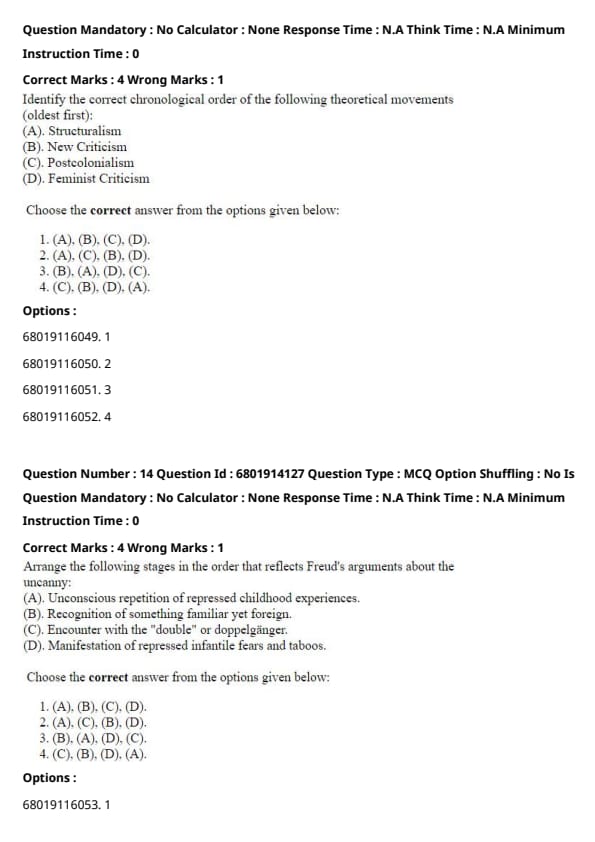
Identify the correct chronological order of the following theoretical movements (oldest first):
- (A) Structuralism
- (B) New Criticism
- (C) Postcolonialism
- (D) Feminist Criticism
View Solution
- New Criticism (B) originated in the 1920s–1930s.
- Structuralism (A) began in the 1950s.
- Feminist Criticism (D) gained momentum in the 1960s–1970s.
- Postcolonialism (C) developed primarily in the late 20th century.
Question 14:
Arrange the following stages in the order that reflects Freud's arguments about the uncanny:
- (A) Unconscious repetition of repressed childhood experiences.
- (B) Recognition of something familiar yet foreign.
- (C) Encounter with the "double" or doppelgänger.
- (D) Manifestation of repressed infantile fears and taboos.
View Solution
The uncanny, as described by Freud, involves:
- Recognition of something familiar yet foreign (B).
- Unconscious repetition of repressed childhood experiences (A).
- Manifestation of repressed infantile fears and taboos (D).
- Encounter with the "double" or doppelgänger (C).
Question 15:
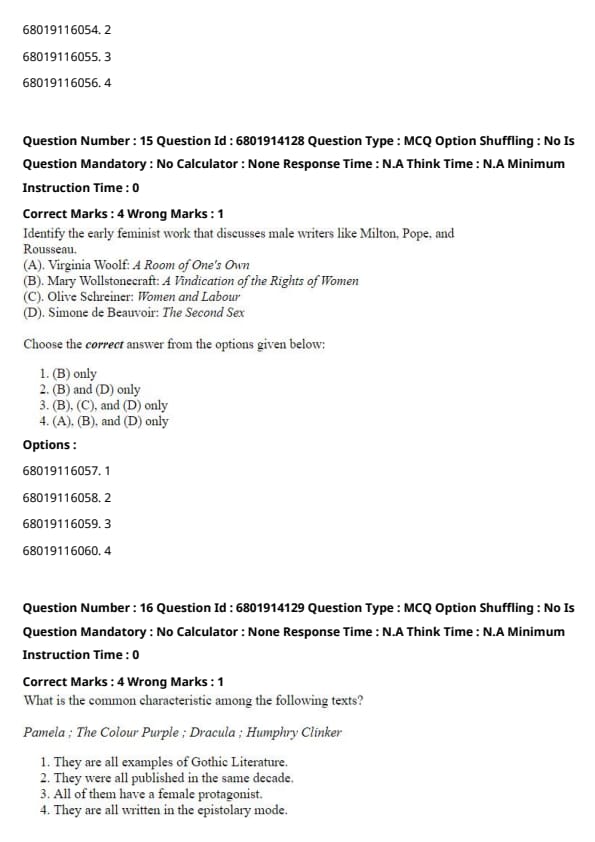
Identify the early feminist work that discusses male writers like Milton, Pope, and Rousseau:
- (A) Virginia Woolf: A Room of One's Own
- (B) Mary Wollstonecraft: A Vindication of the Rights of Women
- (C) Olive Schreiner: Women and Labour
- (D) Simone de Beauvoir: The Second Sex
View Solution
The feminist works discussing Milton, Pope, and Rousseau include:
- Virginia Woolf's A Room of One's Own.
- Mary Wollstonecraft's A Vindication of the Rights of Women.
- Simone de Beauvoir's The Second Sex.
Question 16:
What is the common characteristic among the following texts: Pamela, The Colour Purple, Dracula, Humphry Clinker?
View Solution
Each of these texts employs the epistolary format, presenting the narrative through letters or diary entries, a technique that enhances the immediacy and intimacy of the storytelling.
Question 17:
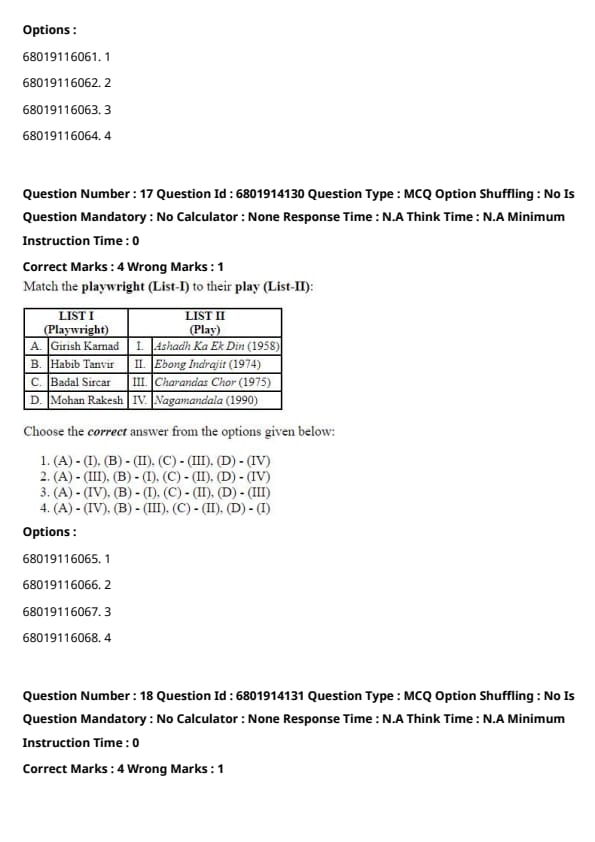
Match the playwright (List-I) to their play (List-II):
| List I (Playwright) | List II (Play) |
|---|---|
| A. Girish Karnad | I. Ashadh Ka Ek Din (1958) |
| B. Habib Tanvir | II. Ebong Indrajit (1974) |
| C. Badal Sircar | III. Charandas Chor (1975) |
| D. Mohan Rakesh | IV. Nagamandala (1990) |
View Solution
The correct matches are: (A) Girish Karnad - Nagamandala (1990); (B) Habib Tanvir - Charandas Chor (1975); (C) Badal Sircar - Ebong Indrajit (1974); (D) Mohan Rakesh - Ashadh Ka Ek Din (1958).
Question 18:
Which of the following is written by the African-American author Octavia Butler?
- (A). Fledgling (2005)
- (B). The Left Hand of Darkness (1969)
- (C). Parable of the Sower (1993)
- (D). The Ones Who Walk Away from Omelas (1973)
View Solution
Octavia Butler authored Fledgling (2005) and Parable of the Sower (1993). The Left Hand of Darkness and The Ones Who Walk Away from Omelas were written by Ursula K. Le Guin.
Question 19:
In which Absurdist play, first written in French as Fin de partie, would you find the following characters: Hamm, Clov, Nagg, and Nell?
View Solution
Endgame by Samuel Beckett features the characters Hamm, Clov, Nagg, and Nell. The play is a cornerstone of Absurdist theatre, exploring themes of existential despair and human dependency.
Question 20:
Identify the poet of poems like “Background, Casually”, “The Railway Clerk”, and “Goodbye Party for Miss Pushpa T.S.”:
View Solution
Nissim Ezekiel, a prominent Indian poet writing in English, is known for his wit, irony, and observations of Indian society, as reflected in these poems.
Question 21:
Who is the author of the 2014 novel, The Black Hill?
View Solution
Mamang Dai, a celebrated Indian writer and poet, authored the novel The Black Hill (2014), which won the Sahitya Akademi Award.
Question 22:
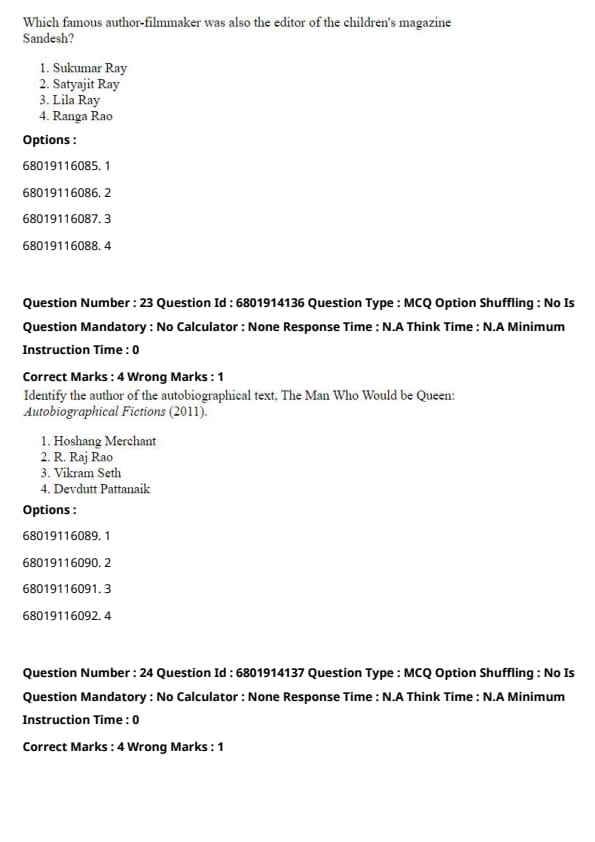
Which famous author-filmmaker was also the editor of the children's magazine Sandesh?
View Solution
Satyajit Ray revived the children's magazine Sandesh, which was originally started by his grandfather, Upendrakishore Ray.
Question 23:
Identify the author of the autobiographical text, The Man Who Would be Queen: Autobiographical Fictions (2011).
View Solution
Hoshang Merchant, a prominent Indian poet and writer, authored The Man Who Would be Queen, blending autobiography and fiction.
Question 24:
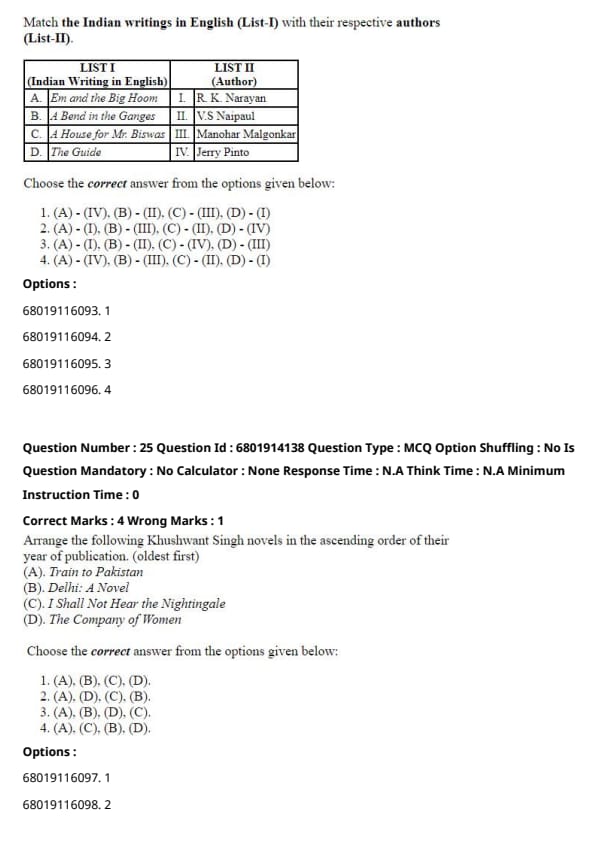
Match the Indian writings in English (List-I) with their respective authors (List-II):
| List I (Indian Writing in English) | List II (Author) |
|---|---|
| A. Em and the Big Hoom | IV. Jerry Pinto |
| B. A Bend in the Ganges | III. Manohar Malgonkar |
| C. A House for Mr. Biswas | II. V.S. Naipaul |
| D. The Guide | I. R.K. Narayan |
View Solution
The correct matches are: (A) Em and the Big Hoom by Jerry Pinto, (B) A Bend in the Ganges by Manohar Malgonkar, (C) A House for Mr. Biswas by V.S. Naipaul, (D) The Guide by R.K. Narayan.
Question 25:
Arrange the following Khushwant Singh novels in the ascending order of their year of publication (oldest first):
- (A). Train to Pakistan
- (B). Delhi: A Novel
- (C). I Shall Not Hear the Nightingale
- (D). The Company of Women
View Solution
The chronological order of publication is: (A) Train to Pakistan (1956), (C) I Shall Not Hear the Nightingale (1959), (B) Delhi: A Novel (1990), (D) The Company of Women (1999).
Question 26:
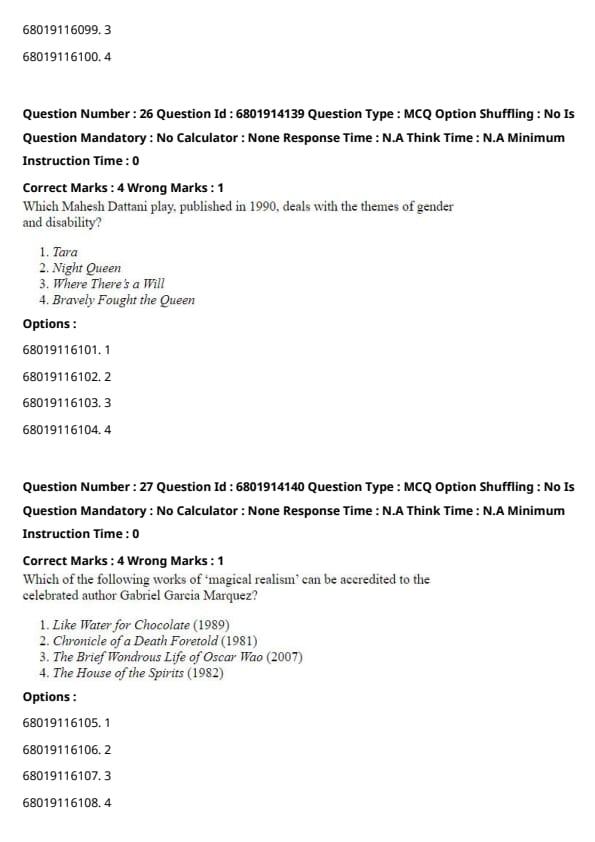
Which Mahesh Dattani play, published in 1990, deals with the themes of gender and disability?
View Solution
Tara is a poignant play by Mahesh Dattani exploring gender bias and societal attitudes toward disability.
Question 27:
Which of the following works of ‘magical realism’ can be accredited to the celebrated author Gabriel Garcia Marquez?
View Solution
Gabriel Garcia Marquez, a pioneer of magical realism, is known for Chronicle of a Death Foretold and other works like One Hundred Years of Solitude.
Question 28:
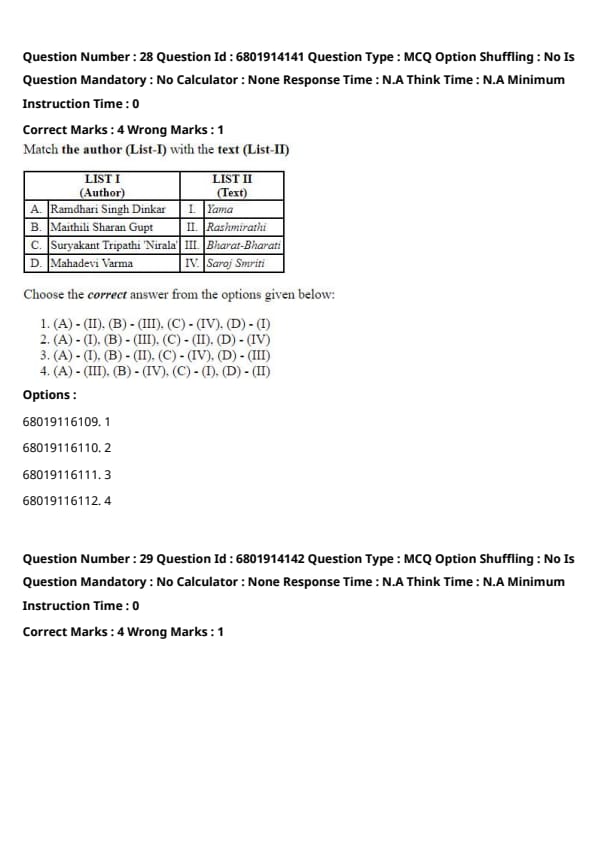
Match the author (List-I) with the text (List-II):
| List I (Author) | List II (Text) |
|---|---|
| A. Ramdhari Singh Dinkar | II. Rashmirathi |
| B. Maithili Sharan Gupt | III. Bharat-Bharati |
| C. Suryakant Tripathi Nirala | IV. Saroj Smriti |
| D. Mahadevi Varma | I. Yama |
View Solution
- Ramdhari Singh Dinkar: Rashmirathi
- Maithili Sharan Gupt: Bharat-Bharati
- Suryakant Tripathi Nirala: Saroj Smriti
- Mahadevi Varma: Yama
Question 29:
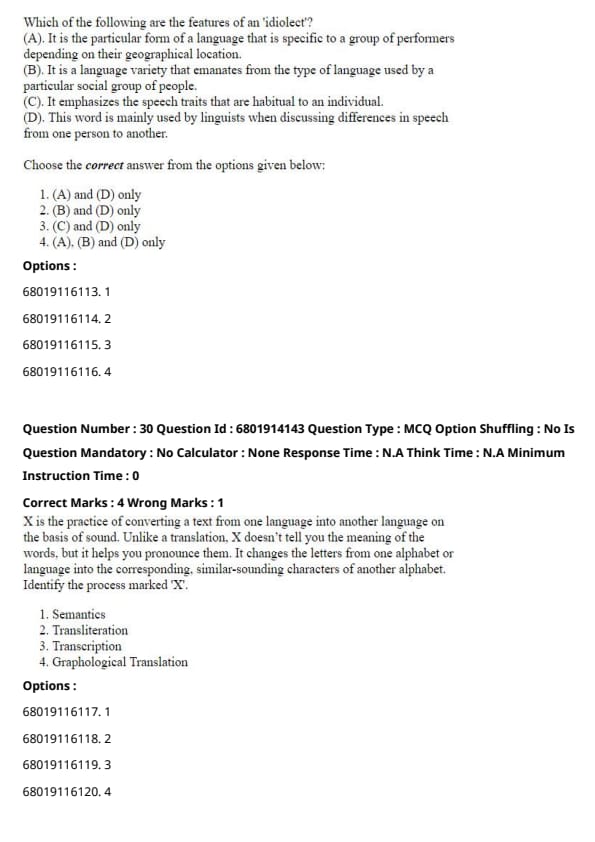
Which of the following are the features of an 'idiolect'?
- (A) It is the particular form of a language that is specific to a group of performers depending on their geographical location.
- (B) It is a language variety that emanates from the type of language used by a particular social group of people.
- (C) It emphasizes the speech traits that are habitual to an individual.
- (D) This word is mainly used by linguists when discussing differences in speech from one person to another.
View Solution
An idiolect refers to: - (C): Speech traits habitual to an individual. - (D): Differences in speech from one person to another.
Question 30:
X is the practice of converting a text from one language into another language on the basis of sound. Unlike a translation, X doesn’t tell you the meaning of the words but helps you pronounce them. It changes the letters from one alphabet or language into the corresponding, similar-sounding characters of another alphabet. Identify the process marked 'X':
View Solution
Transliteration converts text from one script to another, preserving pronunciation rather than meaning.
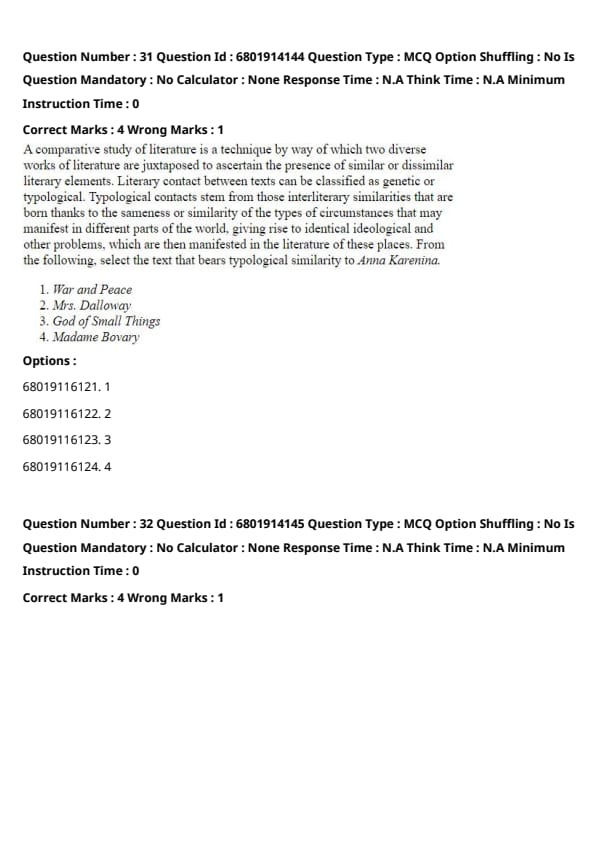
Question 31:
A comparative study of literature is a technique by way of which two diverse works of literature are juxtaposed to ascertain the presence of similar or dissimilar literary elements. Literary contact between texts can be classified as genetic or typological. Typological contacts stem from those interliterary similarities that are born thanks to the sameness or similarity of the types of circumstances that may manifest in different parts of the world, giving rise to identical ideological and other problems, which are then manifested in the literature of these places. From the following, select the text that bears typological similarity to Anna Karenina.
View Solution
Both Anna Karenina by Leo Tolstoy and Madame Bovary by Gustave Flaubert explore themes of marital discord, infidelity, and societal expectations, making them typologically similar.Question 32:
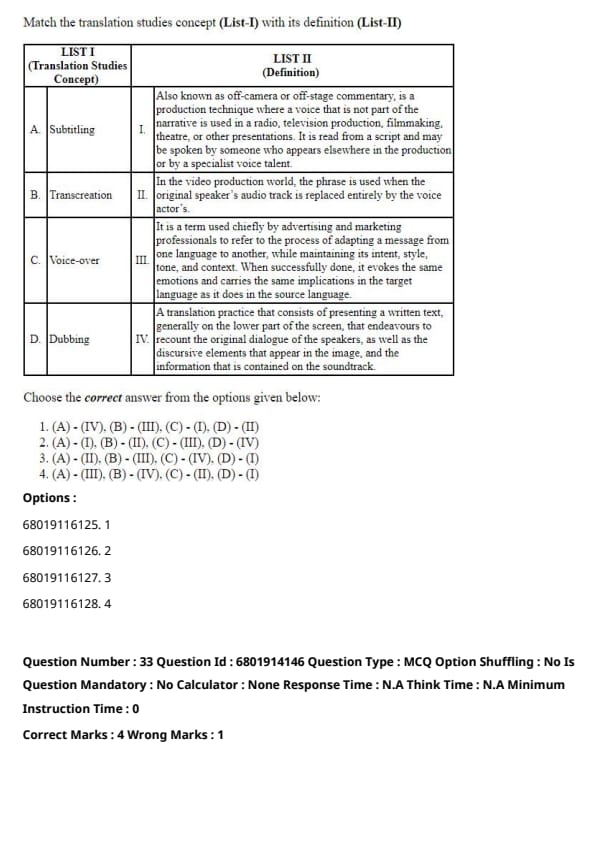
Match the translation studies concept (List-I) with its definition (List-II):
| List I (Translation Studies Concept) | List II (Definition) |
|---|---|
| A. Subtitling | A translation practice that consists of presenting a written text, generally on the lower part of the screen, that recounts the original dialogue of the speakers and includes discursive elements from the image and soundtrack. |
| B. Transcreation | Adapting a message from one language to another, maintaining its intent, style, tone, and context, often used in advertising and marketing. |
| C. Voice-over | A technique where commentary or narration is read off-camera or off-stage. |
| D. Dubbing | A technique replacing the original speaker’s audio track entirely with another language’s voice. |
View Solution
The concepts match their definitions as follows: A. Subtitling: Displays text on the screen representing dialogue and other audio information. B. Transcreation: Adapts content to maintain its impact in another language. C. Voice-over: Commentary or narration added off-camera. D. Dubbing: Replaces the original dialogue with another language’s voice track.Question 33:
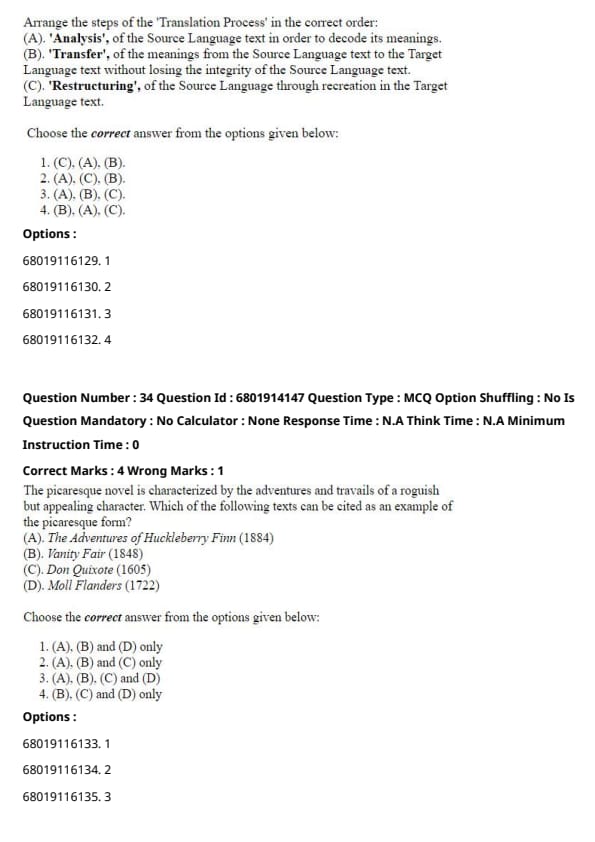
Arrange the steps of the 'Translation Process' in the correct order:
(A) 'Analysis' of the Source Language text in order to decode its meanings.
(B) 'Transfer' of the meanings from the Source Language text to the Target Language text without losing the integrity of the Source Language text.
(C) 'Restructuring' of the Source Language through recreation in the Target Language text.
View Solution
The correct sequence of the translation process is: Analysis: Decoding the meaning of the Source Language text. Transfer: Transferring the meaning to the Target Language while preserving integrity. Restructuring: Recreating the Source Language text in the Target Language.Question 34:
The picaresque novel is characterized by the adventures and travails of a roguish but appealing character. Which of the following texts can be cited as an example of the picaresque form?
(A) The Adventures of Huckleberry Finn (1884)
(B) Vanity Fair (1848)
(C) Don Quixote (1605)
(D) Moll Flanders (1722)
View Solution
All four texts exhibit elements of the picaresque form: The Adventures of Huckleberry Finn (Mark Twain), Vanity Fair (William Makepeace Thackeray), Don Quixote (Miguel de Cervantes), Moll Flanders (Daniel Defoe).Question 35:
Which novelist has had the rare honour of winning the Nobel Prize for Literature for his/her non-fiction writings?
View Solution
Svetlana Alexievich, a Belarusian journalist and author, won the Nobel Prize in Literature (2015) for her non-fiction works, including Voices from Chernobyl and The Unwomanly Face of War.Question 36:
In which elegy would you find these famous lines:
"I hold it true, whate'er befall:
I feel it when I sorrow most
'Tis better to have loved and lost
Than never to have loved at all."
View Solution
These lines are from Alfred Lord Tennyson's In Memoriam A.H.H., written in memory of his close friend Arthur Henry Hallam.Question 37:
V.S. Naipaul received the Booker Prize in 1971 for this novel:
View Solution
V.S. Naipaul's In a Free State, a blend of stories and travelogue, won the Booker Prize in 1971 for its innovative narrative style and exploration of displacement.Question 38:
Arrange the following novels of Stephen King in the chronological order of their publication (oldest first):
(A) Carrie
(B) Joyland
(C) Misery
(D) The Shining
View Solution
Stephen King's novels were published in the following order: Carrie (1974), The Shining (1977), Misery (1987), and Joyland (2013).Question 39:
Place the famous fictional detectives in the order of their first literary appearance (oldest first):
(A) Byomkesh Bakshi
(B) Sherlock Holmes
(C) Hercule Poirot
(D) Dupont
View Solution
The detectives first appeared in the following order: Dupont (The Murders in the Rue Morgue, 1841), Sherlock Holmes (A Study in Scarlet, 1887), Hercule Poirot (The Mysterious Affair at Styles, 1920), and Byomkesh Bakshi (Satyanweshi, 1932).Question 40:
Identify the author, who is said to have produced the first bestseller in Hindi:
View Solution
Devakinandan Khatri's Chandrakanta is regarded as the first bestseller in Hindi literature.Question 41:
Identify the author-translator duo who are correctly matched:
(A) Abdulrazak Gurnah - Simon Bruni
(B) Elena Ferrante - Ann Goldstein
(C) Han Kang - Deborah Smith
(D) Olga Tokarczuk - Jennifer Croft
View Solution
The correct matches are Elena Ferrante - Ann Goldstein, Han Kang - Deborah Smith, and Olga Tokarczuk - Jennifer Croft. Abdulrazak Gurnah's works are primarily written in English.Question 42:
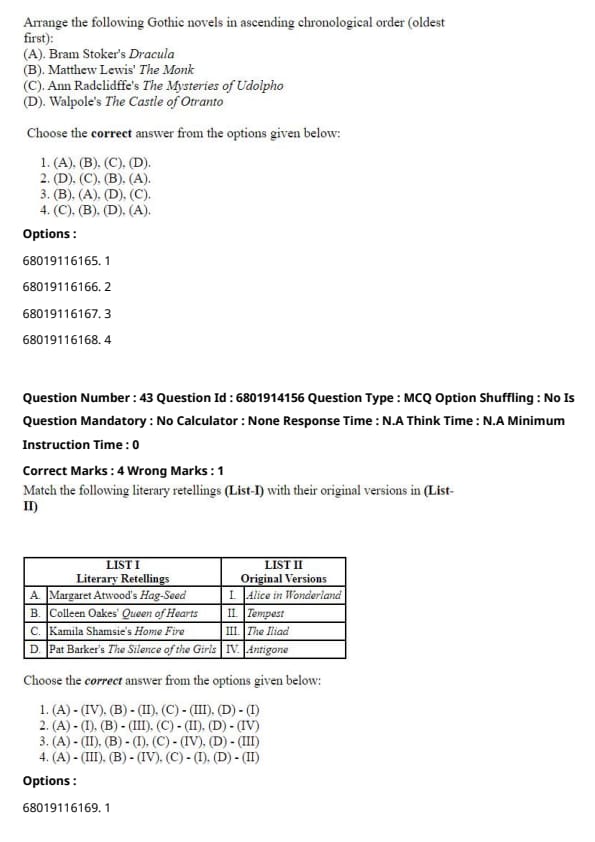
Arrange the following Gothic novels in ascending chronological order (oldest first):
(A) Bram Stoker's Dracula
(B) Matthew Lewis' The Monk
(C) Ann Radcliffe's The Mysteries of Udolpho
(D) Walpole's The Castle of Otranto
View Solution
The novels were published in the following order: Walpole's The Castle of Otranto (1764), Ann Radcliffe's The Mysteries of Udolpho (1794), Matthew Lewis' The Monk (1796), and Bram Stoker's Dracula (1897).Question 43:
Match the following literary retellings (List-I) with their original versions in (List-II):
| List I (Literary Retellings) | List II (Original Versions) |
|---|---|
| A. Margaret Atwood's Hag-Seed | I. The Tempest |
| B. Colleen Oakes' Queen of Hearts | II. Alice in Wonderland |
| C. Kamila Shamsie's Home Fire | III. Antigone |
| D. Pat Barker's The Silence of the Girls | IV. The Iliad |
View Solution
The literary retellings match their original works as follows:- Margaret Atwood's Hag-Seed: The Tempest
- Colleen Oakes' Queen of Hearts: Alice in Wonderland
- Kamila Shamsie's Home Fire: Antigone
- Pat Barker's The Silence of the Girls: The Iliad
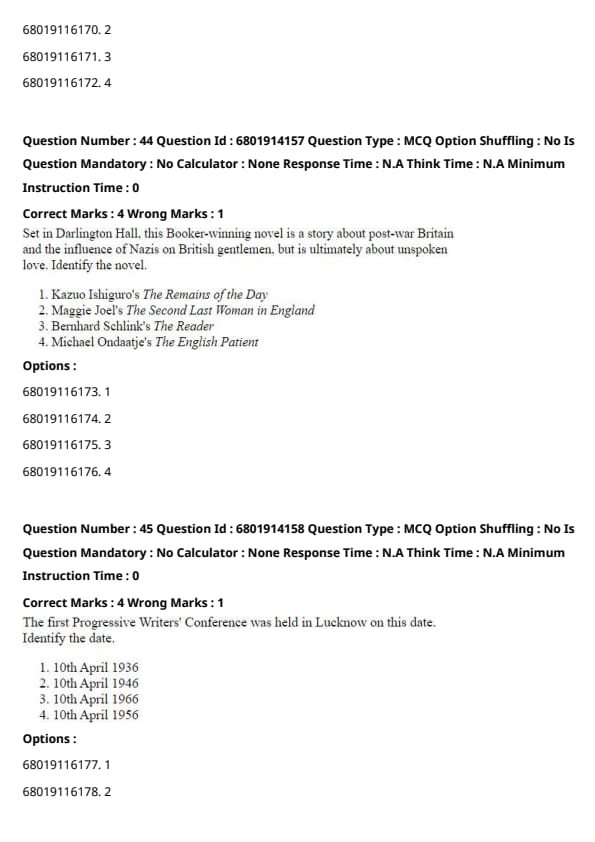
Question 44:
Set in Darlington Hall, this Booker-winning novel is a story about post-war Britain and the influence of Nazis on British gentlemen, but is ultimately about unspoken love. Identify the novel:
View Solution
Kazuo Ishiguro's The Remains of the Day explores themes of duty, regret, and suppressed emotions during the interwar and postwar periods.Question 45:
The first Progressive Writers' Conference was held in Lucknow on this date. Identify the date:
View Solution
The Progressive Writers' Conference in Lucknow in 1936 marked a significant moment in modern Indian literature, bringing together writers advocating social reform through their works.Question 46:
Identify the writer(s) associated with the Harlem Renaissance.
(A) Claude McKay
(B) Zora Neale Hurston
(C) William Faulkner
(D) Langston Hughes
View Solution
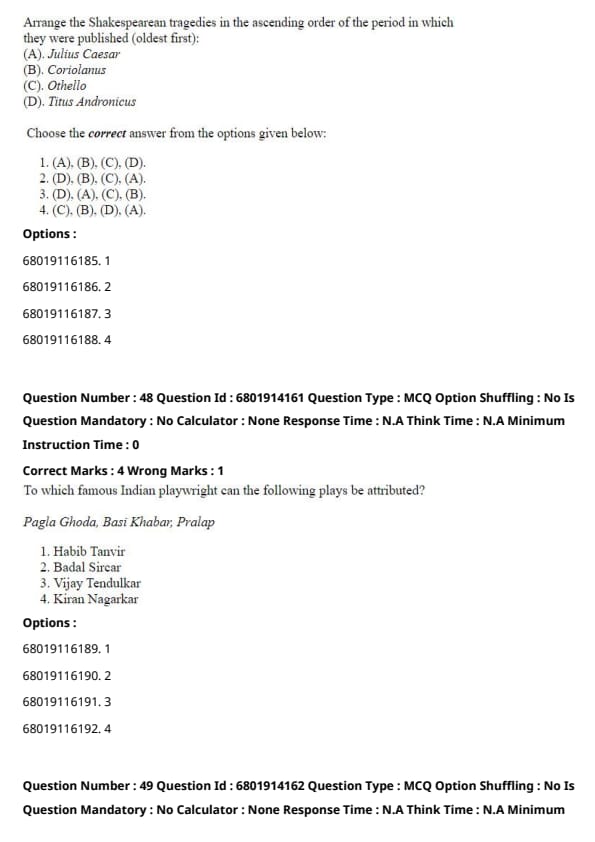
Claude McKay, Zora Neale Hurston, and Langston Hughes are iconic figures of the Harlem Renaissance. William Faulkner, although a prominent writer, was not part of this movement.Question 47:
Arrange the Shakespearean tragedies in the ascending order of the period in which they were published (oldest first):
(A) Julius Caesar
(B) Coriolanus
(C) Othello
(D) Titus Andronicus
View Solution
The correct chronological order is: Titus Andronicus (1594), Julius Caesar (1599), Othello (1603), and Coriolanus (1608).Question 48:
To which famous Indian playwright can the following plays be attributed? Pagla Ghoda, Basi Khabar, Pralap.
View Solution
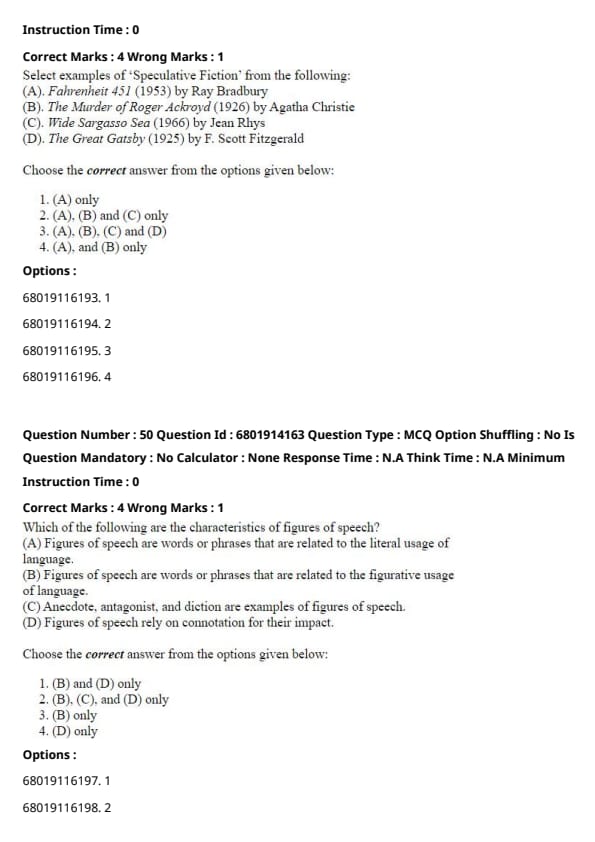
Badal Sircar is known for his avant-garde plays and his contribution to Indian theatre with themes of social reform and existentialism.Question 49:
Select examples of ‘Speculative Fiction’ from the following:
(A) Fahrenheit 451 (1953) by Ray Bradbury
(B) The Murder of Roger Ackroyd (1926) by Agatha Christie
(C) Wide Sargasso Sea (1966) by Jean Rhys
(D) The Great Gatsby (1925) by F. Scott Fitzgerald
View Solution
Speculative fiction encompasses genres like science fiction and dystopian literature. Ray Bradbury's Fahrenheit 451 is a prime example of dystopian speculative fiction.Question 50:
Which of the following are the characteristics of figures of speech?
(A) Figures of speech are words or phrases that are related to the literal usage of language.
(B) Figures of speech are words or phrases that are related to the figurative usage of language.
(C) Anecdote, antagonist, and diction are examples of figures of speech.
(D) Figures of speech rely on connotation for their impact.
View Solution
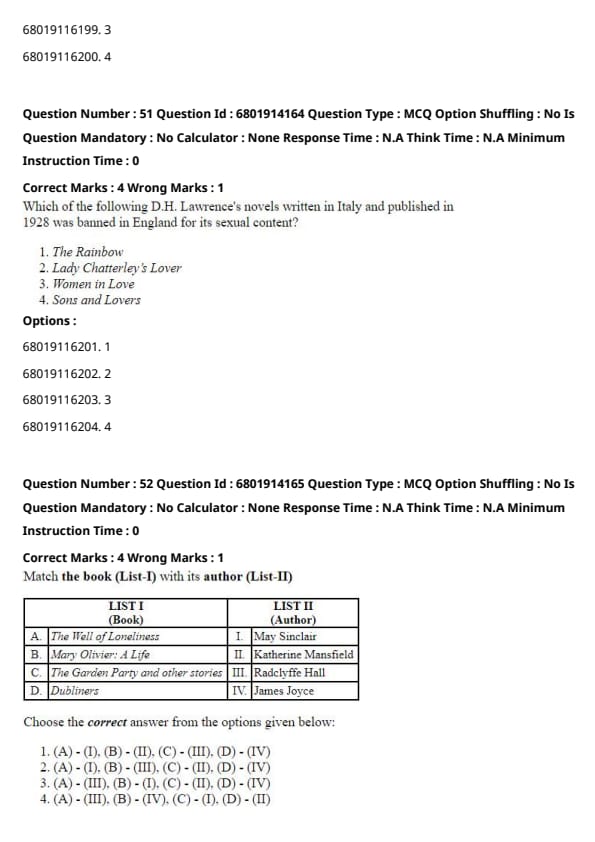
Figures of speech involve figurative language that relies on connotation to convey meaning, rather than the literal use of words. They add depth, creativity, and richness to language.Question 51:
Which of the following D.H. Lawrence's novels, written in Italy and published in 1928, was banned in England for its sexual content?
View Solution
D.H. Lawrence's Lady Chatterley’s Lover was banned in England for its explicit sexual content, sparking debates about censorship and artistic freedom.Question 52:
Match the book (List-I) with its author (List-II):
| List I (Book) | List II (Author) |
|---|---|
| A. The Well of Loneliness | I. May Sinclair |
| B. Mary Olivier: A Life | II. Katherine Mansfield |
| C. The Garden Party and Other Stories | III. Radclyffe Hall |
| D. Dubliners | IV. James Joyce |
View Solution
- The Well of Loneliness is authored by Radclyffe Hall, an important work exploring LGBTQ+ themes.- Mary Olivier: A Life, written by May Sinclair, is a feminist narrative.
- The Garden Party and Other Stories by Katherine Mansfield is a celebrated modernist text.
- Dubliners by James Joyce is a classic collection of short stories depicting Irish life.
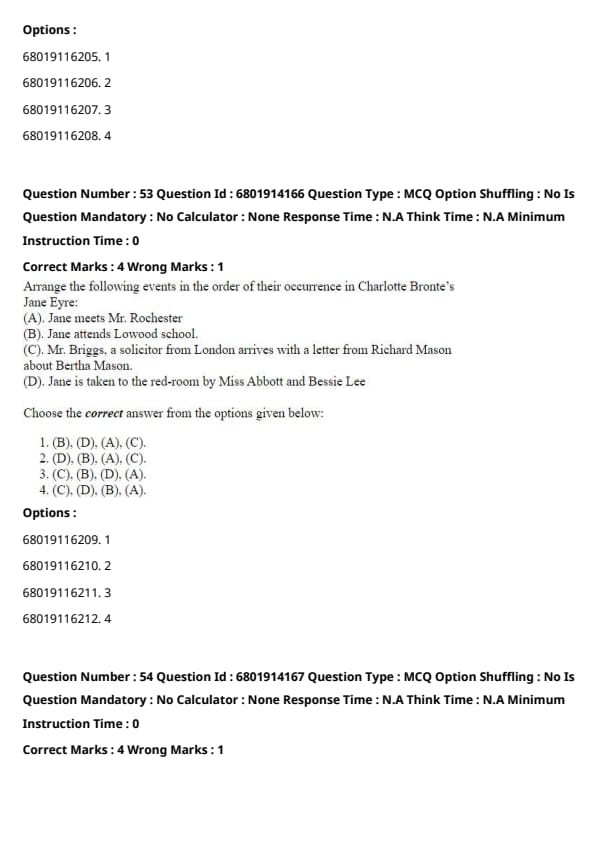
Question 53:
Arrange the following events in the order of their occurrence in Charlotte Bronte’s Jane Eyre:
(A) Jane meets Mr. Rochester
(B) Jane attends Lowood School
(C) Mr. Briggs, a solicitor from London, arrives with a letter from Richard Mason about Bertha Mason
(D) Jane is taken to the red-room by Miss Abbott and Bessie Lee
View Solution
The chronological order of events in Jane Eyre is:1. Jane is taken to the red-room as a punishment during her childhood (D).
2. Jane attends Lowood School for her education (B).
3. Jane meets Mr. Rochester, her employer, at Thornfield Hall (A).
4. Mr. Briggs arrives with the letter revealing the existence of Bertha Mason (C).
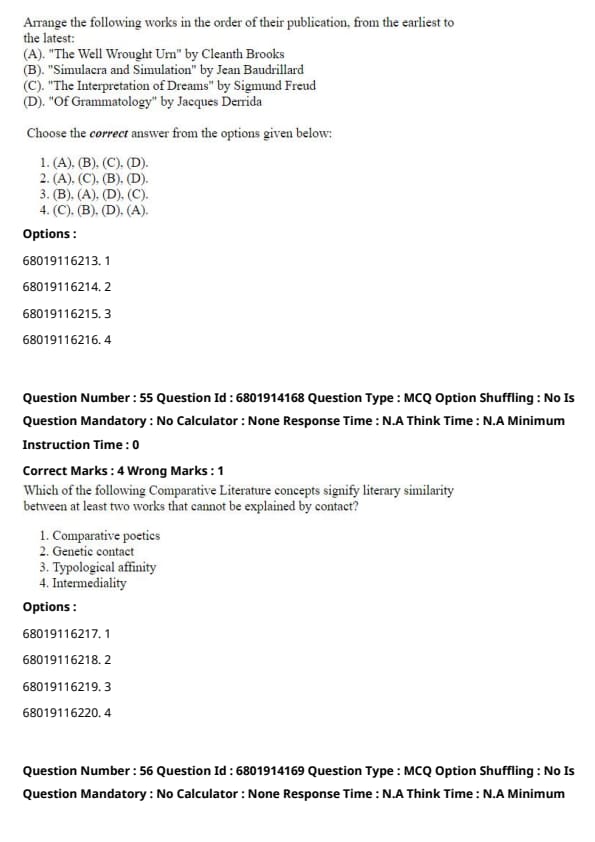
Question 54:
Arrange the following works in the order of their publication, from the earliest to the latest:
(A) The Well Wrought Urn by Cleanth Brooks
(B) Simulacra and Simulation by Jean Baudrillard
(C) The Interpretation of Dreams by Sigmund Freud
(D) Of Grammatology by Jacques Derrida
View Solution
The order of publication for these works is:1. The Interpretation of Dreams by Sigmund Freud (1900)
2. The Well Wrought Urn by Cleanth Brooks (1947)
3. Of Grammatology by Jacques Derrida (1967)
4. Simulacra and Simulation by Jean Baudrillard (1981).
Question 55:
Which of the following Comparative Literature concepts signify literary similarity between at least two works that cannot be explained by contact?
View Solution
Typological affinity refers to literary parallels that arise due to shared cultural or ideological circumstances rather than direct influence.Question 56:
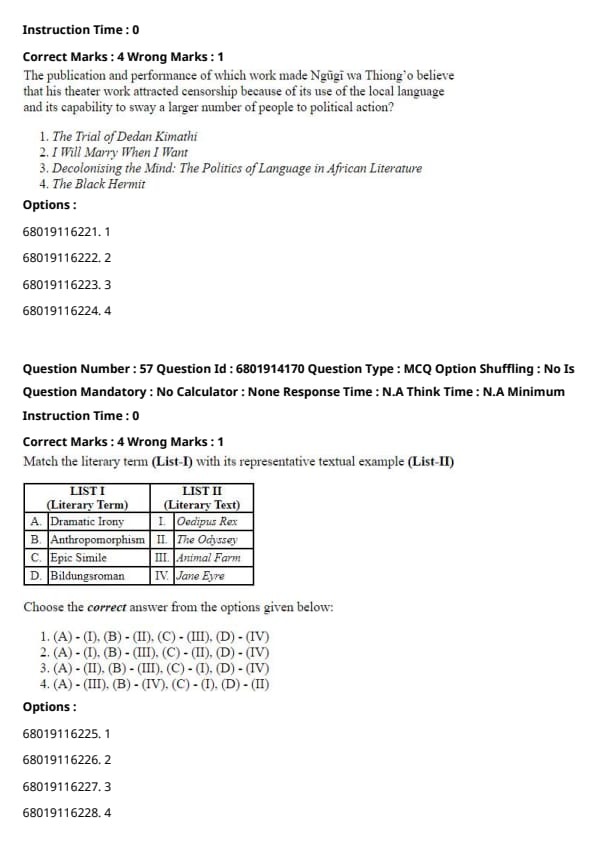
The publication and performance of which work made Ngũgĩ wa Thiong’o believe that his theater work attracted censorship because of its use of the local language and its capability to sway a larger number of people to political action?
View Solution
The play I Will Marry When I Want, written in Gikuyu, highlighted political issues and was viewed as a threat by authorities, leading to its censorship.Question 57:
Match the literary term (List-I) with its representative textual example (List-II):
| List I (Literary Term) | List II (Literary Text) |
|---|---|
| A. Dramatic Irony | I. Oedipus Rex |
| B. Anthropomorphism | II. The Odyssey |
| C. Epic Simile | III. Animal Farm |
| D. Bildungsroman | IV. Jane Eyre |
View Solution
- Dramatic Irony is central to Sophocles’ Oedipus Rex.- Anthropomorphism is evident in Orwell’s Animal Farm.
- Epic Simile is a hallmark of Homer’s The Odyssey.
- Jane Eyre exemplifies the Bildungsroman genre.
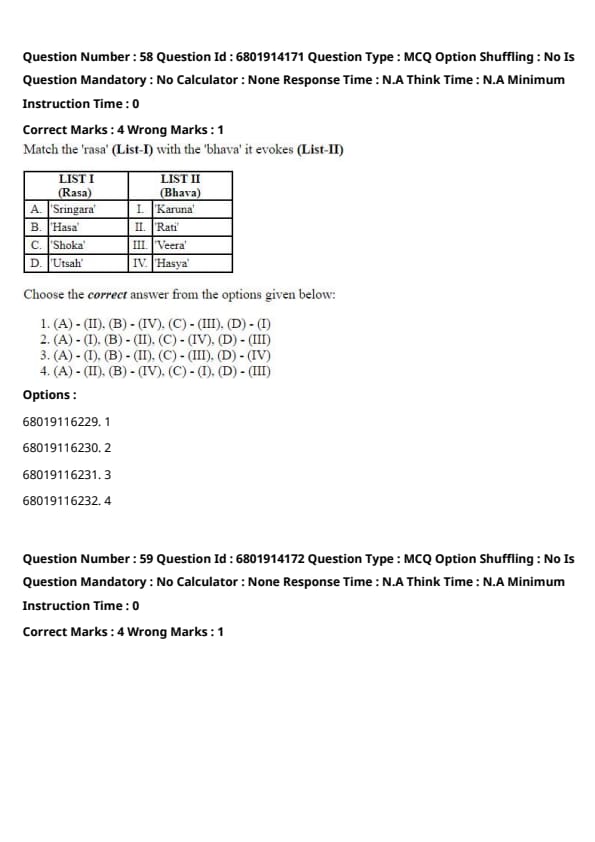
Question 58:
Match the 'rasa' (List-I) with the 'bhava' it evokes (List-II):
| List I (Rasa) | List II (Bhava) |
|---|---|
| A. Sringara | I. Karuna |
| B. Hasa | II. Rati |
| C. Shoka | III. Hasya |
| D. Utsaha | IV. Veera |
View Solution
The classical Indian aesthetic theory pairs rasa (emotion) with bhava (state of mind):- Sringara (Rati): Love or attraction
- Hasa (Hasya): Humor or laughter
- Shoka (Karuna): Sorrow
- Utsaha (Veera): Energy or heroism.
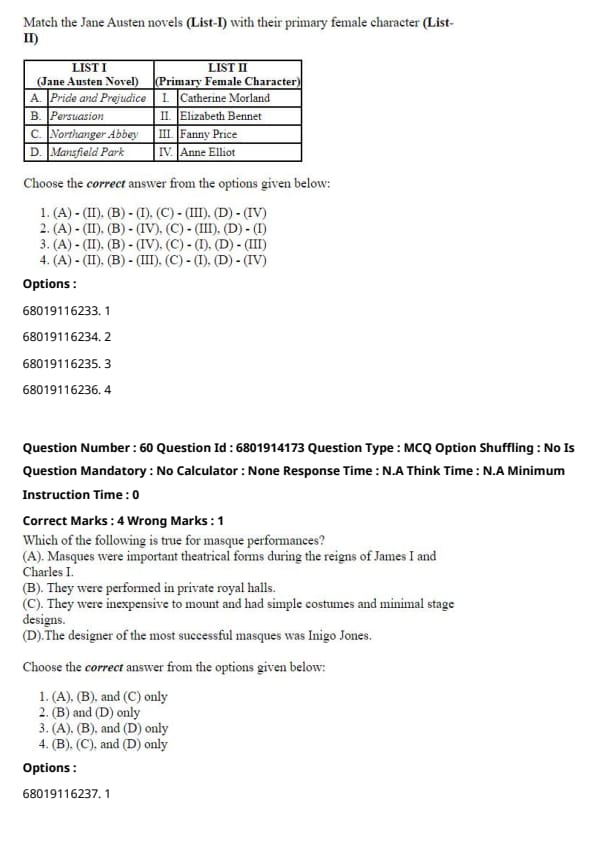
Question 59:
Match the Jane Austen novels (List-I) with their primary female characters (List-II):
| List I (Jane Austen Novel) | List II (Primary Female Character) |
|---|---|
| A. Pride and Prejudice | I. Catherine Morland |
| B. Persuasion | II. Elizabeth Bennet |
| C. Northanger Abbey | III. Fanny Price |
| D. Mansfield Park | IV. Anne Elliot |
View Solution
The primary female characters of Jane Austen’s novels are as follows:- Pride and Prejudice: Elizabeth Bennet
- Persuasion: Anne Elliot
- Northanger Abbey: Catherine Morland
- Mansfield Park: Fanny Price.
Question 60:
Which of the following is true for masque performances?
(A). Masques were important theatrical forms during the reigns of James I and Charles I.
(B). They were performed in private royal halls.
(C). They were inexpensive to mount and had simple costumes and minimal stage designs.
(D). The designer of the most successful masques was Inigo Jones.
View Solution
Masque performances were elaborate theatrical forms prevalent during the reigns of James I and Charles I. These performances:- Were staged in private royal halls (B).
- Featured lavish costumes and sets, often designed by Inigo Jones (D).
- Were crucial cultural expressions of their time (A).
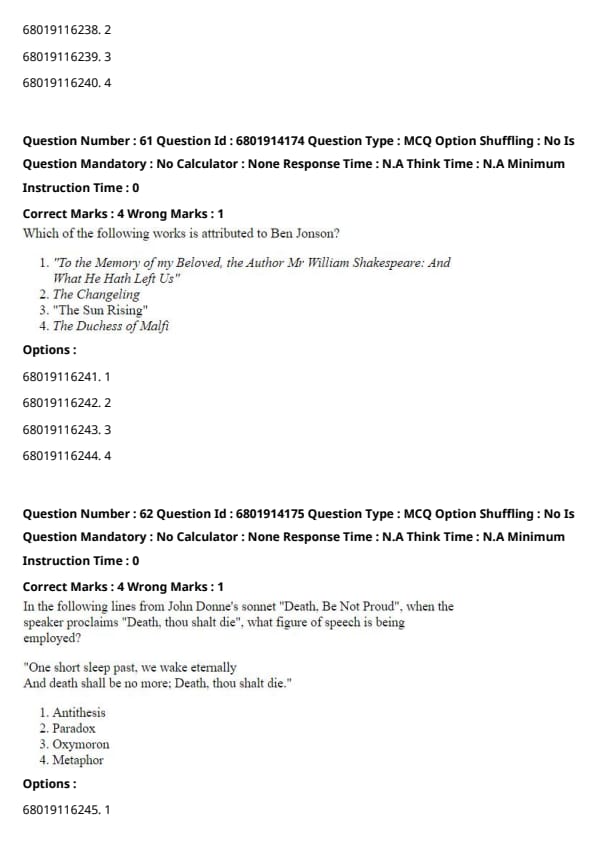
Question 61:
Which of the following works is attributed to Ben Jonson?
View Solution
Ben Jonson’s elegy "To the Memory of My Beloved" is a tribute to his friend and contemporary, William Shakespeare.Question 62:
In the following lines from John Donne's sonnet "Death, Be Not Proud," when the speaker proclaims "Death, thou shalt die," what figure of speech is being employed?
"One short sleep past, we wake eternally
And death shall be no more: Death, thou shalt die."
View Solution
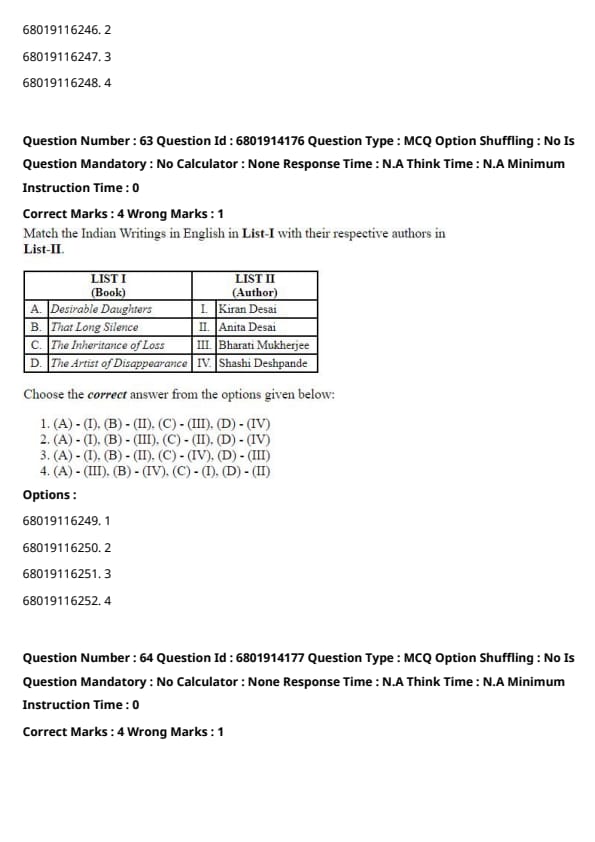
The statement "Death, thou shalt die" is a paradox, as it presents the contradictory idea that death itself can die, emphasizing the eternal nature of life after death.Question 63:
Match the Indian Writings in English in List-I with their respective authors in List-II:
| List I (Book) | List II (Author) |
|---|---|
| A. Desirable Daughters | I. Kiran Desai |
| B. That Long Silence | II. Anita Desai |
| C. The Inheritance of Loss | III. Bharati Mukherjee |
| D. The Artist of Disappearance | IV. Shashi Deshpande |
View Solution
The correct pairing of books with their authors is:- Desirable Daughters: Bharati Mukherjee (A - III)
- That Long Silence: Shashi Deshpande (B - IV)
- The Inheritance of Loss: Kiran Desai (C - I)
- The Artist of Disappearance: Anita Desai (D - II).
Question 64:
Match the literary awards in List-I with their correct description in List-II:
| List I (Literary Award) | List II (Description) |
|---|---|
| A. Booker Prize | II. Awarded annually for the best novel written in English and published in the United Kingdom or Ireland |
| B. Hugo Award | I. Recognizes outstanding achievement in science fiction and fantasy literature |
| C. Pulitzer Prize | III. Honours exceptional work in the field of journalism, literature, and musical composition |
| D. Nobel Prize in Literature | IV. Recognizes authors, regardless of nationality, who have produced "in the field of literature the most distinguished work in an idealistic direction" |
View Solution
The correct matches are:- Booker Prize: Awarded for the best novel written in English and published in the UK or Ireland (II).
- Hugo Award: Recognizes achievements in science fiction and fantasy literature (I).
- Pulitzer Prize: Honours exceptional work in journalism, literature, and musical composition (III).
- Nobel Prize in Literature: Awarded for distinguished literary work in an idealistic direction (IV).
Question 65:
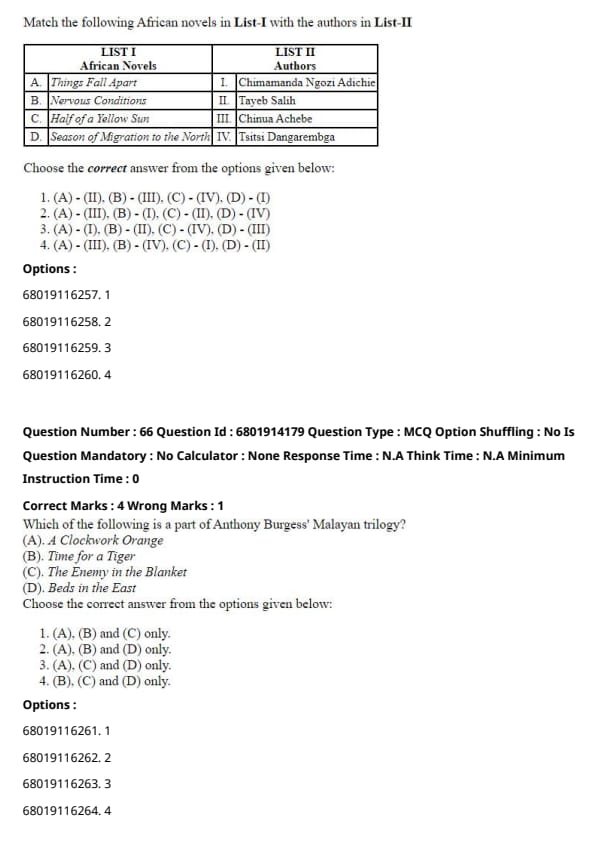
Match the following African novels in List-I with the authors in List-II:
| List I (African Novels) | List II (Authors) |
|---|---|
| A. Things Fall Apart | III. Chinua Achebe |
| B. Nervous Conditions | IV. Tsitsi Dangarembga |
| C. Half of a Yellow Sun | I. Chimamanda Ngozi Adichie |
| D. Season of Migration to the North | II. Tayeb Salih |
View Solution
The correct matches are:- Things Fall Apart: Chinua Achebe (A - III).
- Nervous Conditions: Tsitsi Dangarembga (B - IV).
- Half of a Yellow Sun: Chimamanda Ngozi Adichie (C - I).
- Season of Migration to the North: Tayeb Salih (D - II).
Question 66:
Which of the following is a part of Anthony Burgess' Malayan trilogy?
(A). A Clockwork Orange
(B). Time for a Tiger
(C). The Enemy in the Blanket
(D). Beds in the East
View Solution
The Malayan Trilogy by Anthony Burgess comprises:The three novels included are:
- Time for a Tiger
- The Enemy in the Blanket
- Beds in the East
A Clockwork Orange is a separate, standalone work.
Question 67:
Which of the following are the features of the MAT Project in India known as "MANTRA Machine Translation System"?
(A). Translates English texts to Hindi in specific domains of public administration, gazette notifications, office orders and memos, and circulars.
(B). Project MANTRA-Rajbhasha based on this technology, developed by C-DAC, received funding by the Dept. of Official Languages, Ministry of Home Affairs, GoI.
(C). Jointly being developed by Carnegie Mellon Univ, USA, Indian Institute of Science, Bangalore, and International Institute of Information Technology, Hyderabad.
(D). Inducted into “The 1999 Innovation Collection” on Info-Tech at the Smithsonian Institution’s National Museum of American History, Washington DC, USA.
View Solution
The MANTRA Machine Translation System in India includes:The project has the following features:
- (A) Translation of English texts into Hindi in domains like public administration.
- (B) Funding and support from the Department of Official Languages.
- (D) Recognition by the Smithsonian Institution for its innovation.
(C) refers to another unrelated project and is not part of MANTRA.
Read More
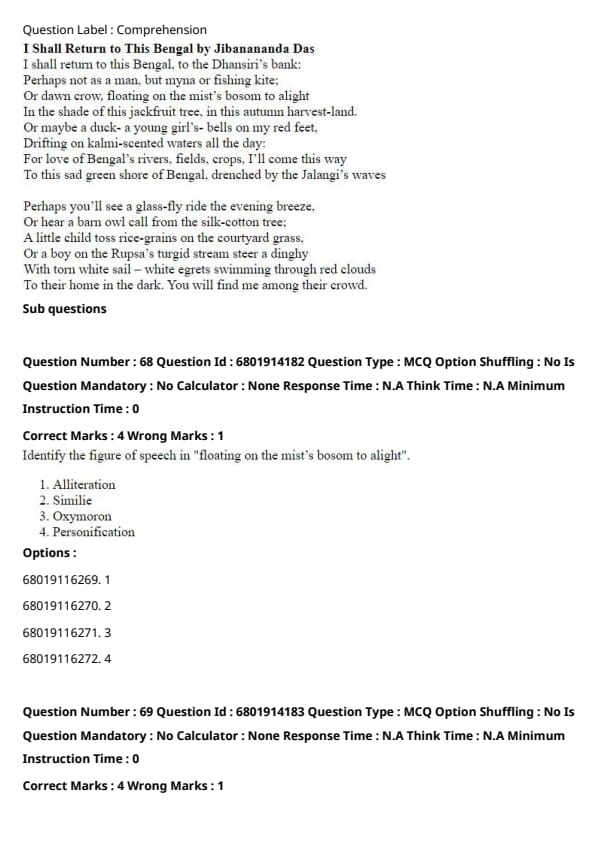
The poet vividly describes his love for the rivers, fields, and creatures of Bengal. By imagining himself returning in various non-human forms, the poet expresses his yearning for a connection to the land, transcending the boundaries of human existence and political turmoil.
Question 68:
Identify the figure of speech in "floating on the mist’s bosom to alight."
View Solution
The phrase "floating on the mist’s bosom" attributes human-like qualities to mist, making it an example of personification.Question 69:
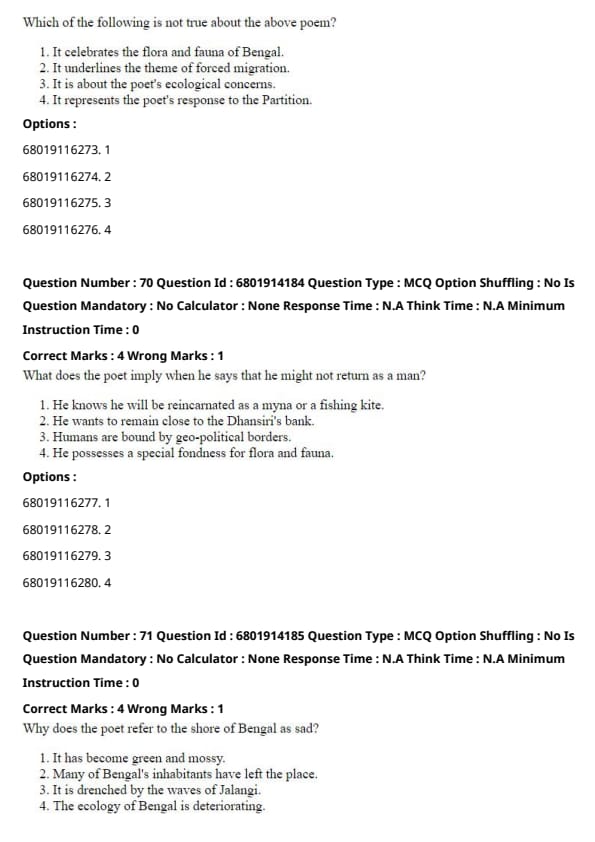
Which of the following is not true about the above poem?
View Solution
The poem celebrates Bengal’s natural beauty and suggests themes of identity and displacement. However, it does not primarily address ecological concerns.Question 70:
What does the poet imply when he says that he might not return as a man?
View Solution
The poet's suggestion that he might return as a bird or animal highlights his wish to transcend human restrictions, including geo-political borders.Question 71:
Why does the poet refer to the shore of Bengal as sad?
View Solution
The poet's reference to the sadness of Bengal's shore reflects the displacement and migration of its people, a recurring theme in his work.Read More
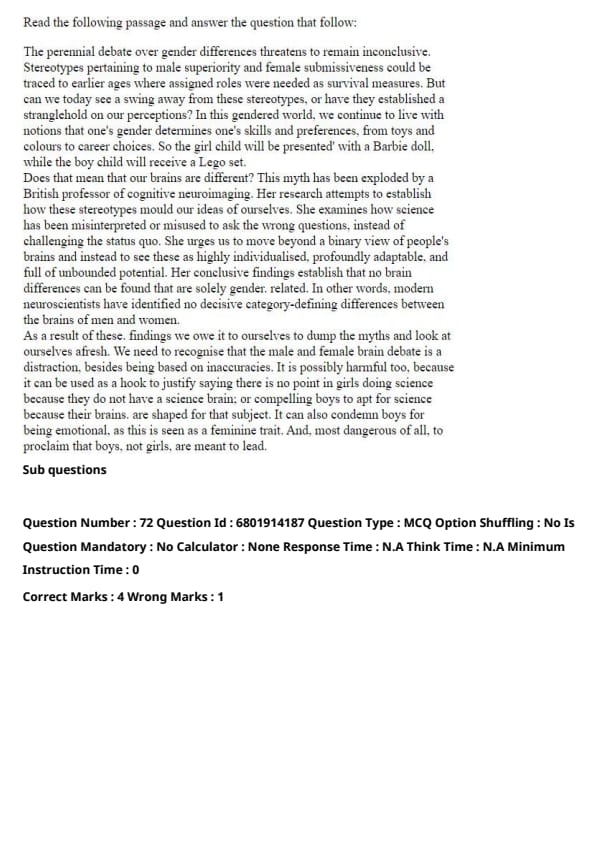
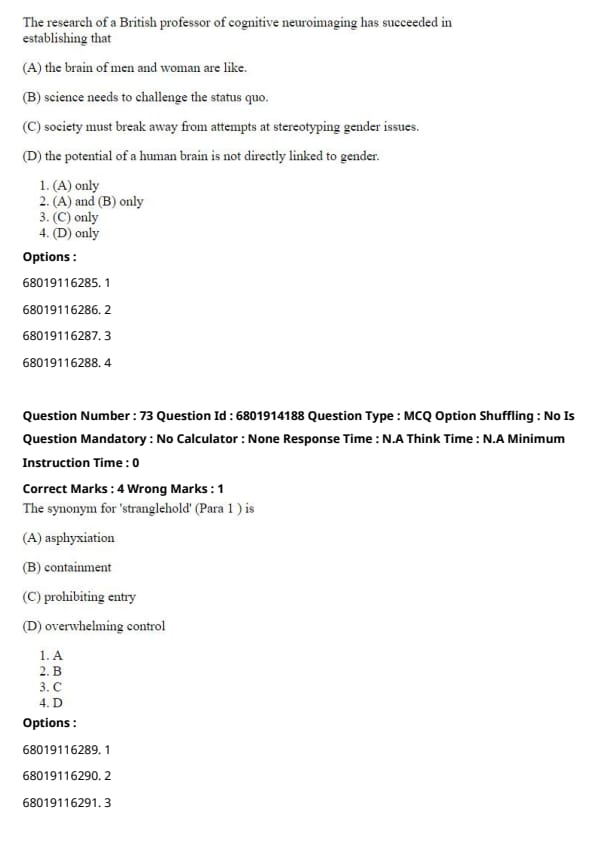
So the girl child will be presented with a Barbie doll, while the boy child will receive a Lego set. Does that mean that our brains are different? This myth has been exploded by a British professor of cognitive neuroimaging. Her research attempts to establish how these stereotypes mould our ideas of ourselves. She examines how science has been misinterpreted or misused to ask the wrong questions, instead of challenging the status quo. She urges us to move beyond a binary view of people's brains and instead to see these as highly individualised, profoundly adaptable, and full of unbounded potential. Her conclusive findings establish that no brain differences can be found that are solely gender-related. In other words, modern neuroscientists have identified no decisive category-defining differences between the brains of men and women. As a result of these findings, we owe it to ourselves to dump the myths and look at ourselves afresh. We need to recognise that the male and female brain debate is a distraction, besides being based on inaccuracies. It is possibly harmful too, because it can be used as a hook to justify saying there is no point in girls doing science because they do not have a science brain, or compelling boys to opt for science because their brains are shaped for that subject. It can also condemn boys for being emotional, as this is seen as a feminine trait. And, most dangerous of all, to proclaim that boys, not girls, are meant to lead.
Question 72:
The research of a British professor of cognitive neuroimaging has succeeded in establishing that:
View Solution
The research emphasizes the need to break stereotypes and highlights that gender does not solely define brain potential.Question 73:
The synonym for 'stranglehold' (Para 1) is:
View Solution
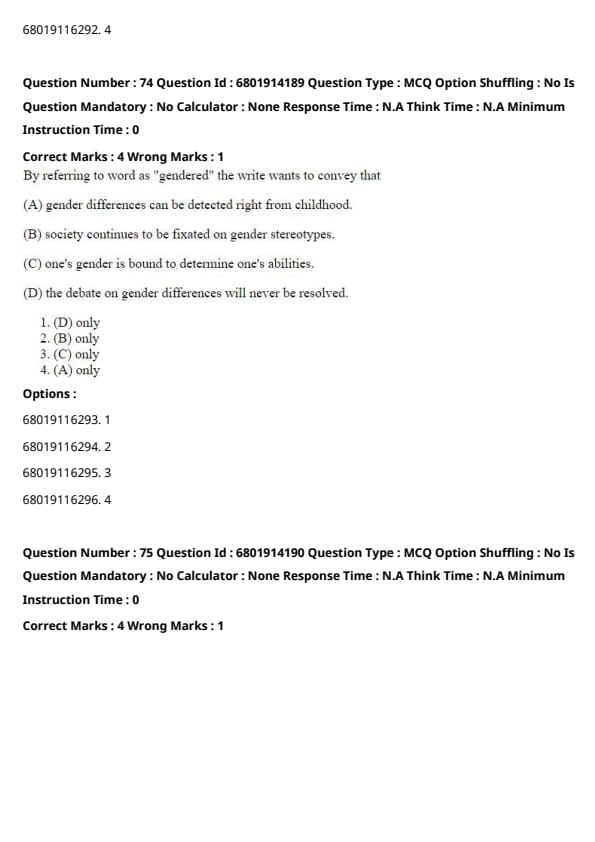
The term 'stranglehold' in this context refers to containment or restriction, illustrating the rigid grip of stereotypes.Question 74:
By referring to the world as "gendered," the writer wants to convey that:
View Solution
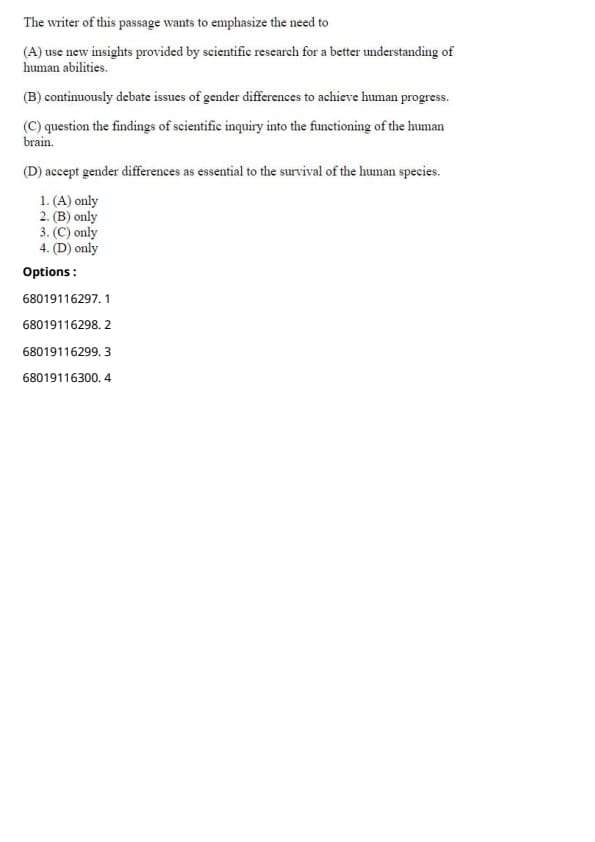
The term "gendered" critiques societal fixation on stereotypes, emphasizing the need to move past them for equitable opportunities.Question 75:
The writer of this passage wants to emphasize the need to:
View Solution
The passage highlights the necessity of leveraging insights from scientific research to challenge stereotypes and better understand human potential.












*The article might have information for the previous academic years, please refer the official website of the exam.