CUET PG 2024 Question Paper with Answer Key PDF for History (March 13 - Shift 2)
- Question Paper 2025
- Question Paper 2024
- Question Paper 2023
- Mathematics Papers
- Statistics Question Paper
- English Question Paper
- Chemistry Question Paper
- Pol. Sci. Question Paper
- History Question Paper
- Commerce Question Papers
- Life Science Papers
- Geology Question Papers
- Journalism Question Paper
- B.Ed. HSS Question Paper
- Botany Question Paper
- B.Ed. Question Papers


Content Writer | Updated On - Mar 10, 2025
CUET PG Question Papers are the most important study material for effective exam preparation. We at Zollege have provided all CUET PG Previous Year Papers with Solution PDFs here. CUET PG 2024 History exam was conducted successfully on March 13 by NTA.
Students can freely download the CUET PG previous year's question paper PDFs along with their solutions here. We strongly encourage CUET PG aspirants to scan through all the CUET PG Question Paper to know the overall difficulty level, CUET PG Syllabus and understand the changes in CUET PG Exam Pattern over the years.
CUET PG 2024 History Question Paper with Answer Key PDF
| CUET PG 2024 History Question Paper with Answer Key |  Download Download |
Check Solution |
History 2024 Questions with Solutions
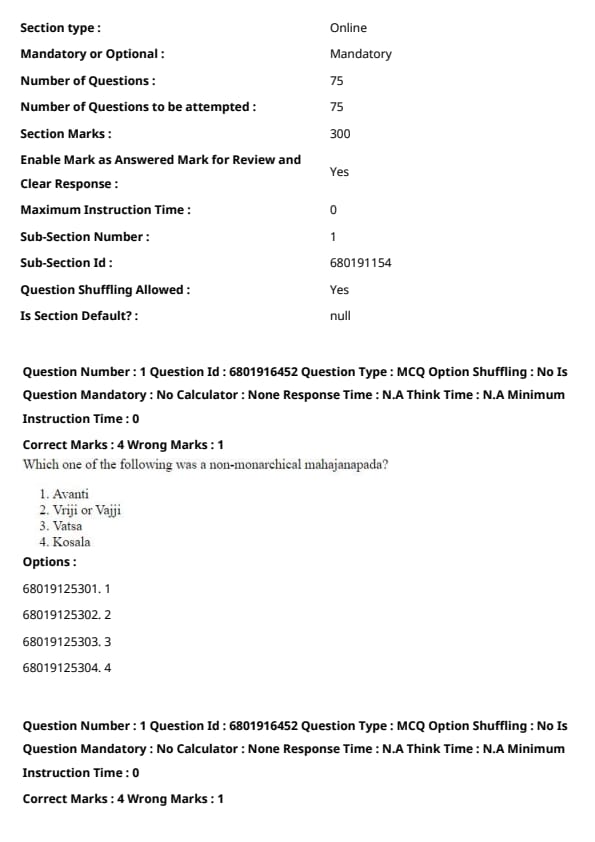
Question 1:
Which one of the following was a non-monarchical mahajanapada?
View Solution
Solution: Vriji or Vajji was a confederacy of eight clans, including the Licchavis, which was governed through a republican system. Unlike the monarchies of other mahajanapadas, Vajji maintained a non-monarchical form of governance.
Quick Tip: The Vajji confederacy is often cited as one of the early examples of a republican form of government in Indian history.
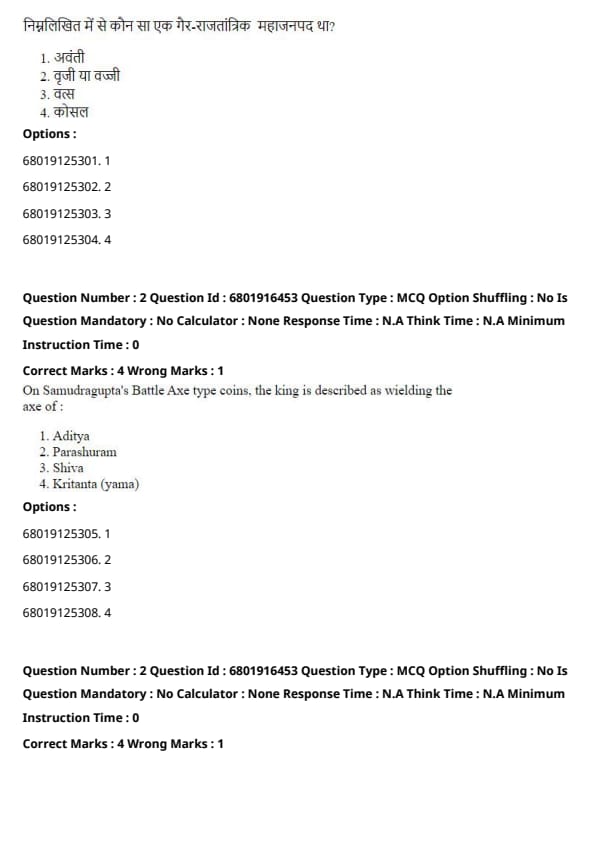
Question 2:
On Samudragupta's Battle Axe type coins, the king is described as wielding the axe of:
View Solution
Solution: Samudragupta's coins depict him as a valiant warrior wielding the axe of Kritanta (Yama), emphasizing his divine right to rule and his martial prowess. This symbol aligns with the Gupta dynasty's efforts to portray themselves as chosen by the gods.
Quick Tip: Coins were an essential medium for Gupta rulers to project their royal ideology and divine authority.
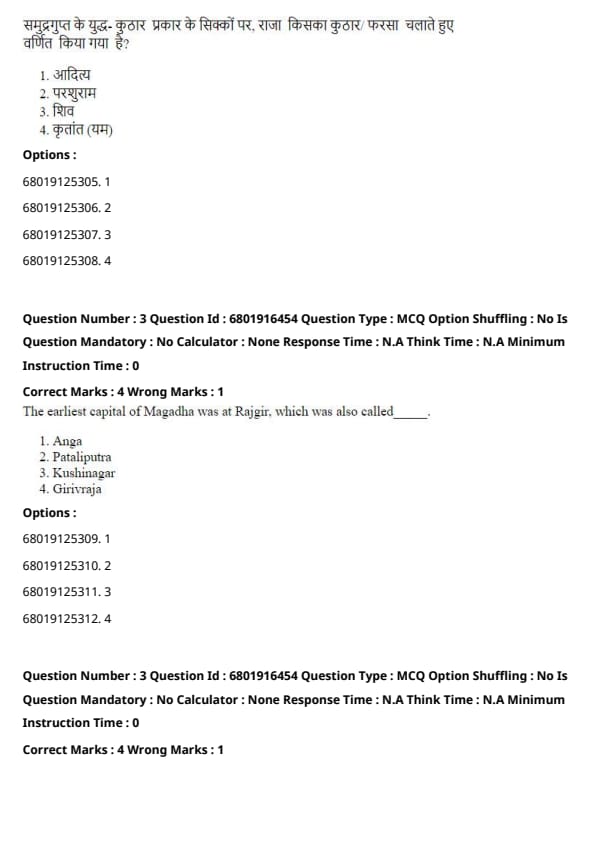
Question 3:
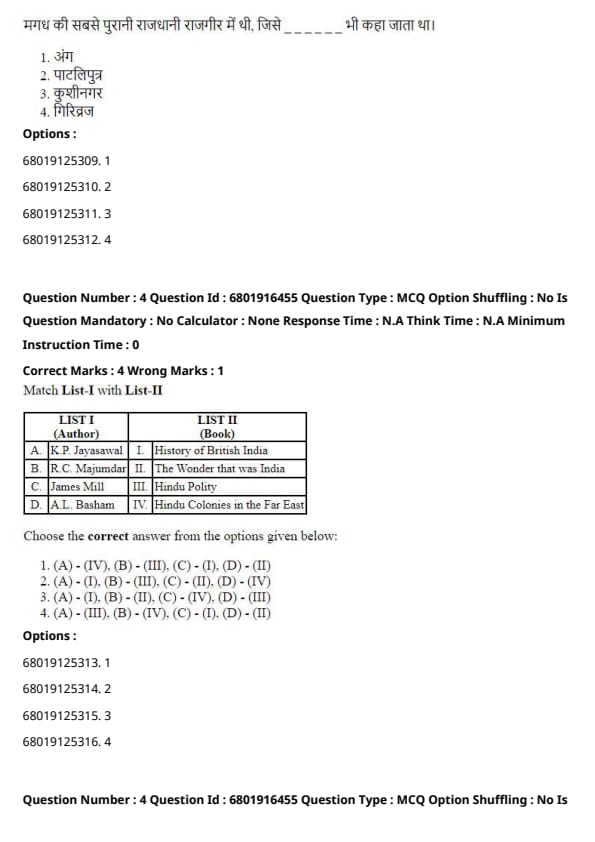
The earliest capital of Magadha was at Rajgir, which was also called:
View Solution
Solution: Girivraja, located in the present-day Rajgir in Bihar, served as the first capital of Magadha. The city was strategically surrounded by hills, making it a naturally fortified settlement.
Quick Tip: The shift of Magadha's capital to Pataliputra occurred during the reign of Ajatashatru, due to its strategic location near the Ganges.
Question 4:
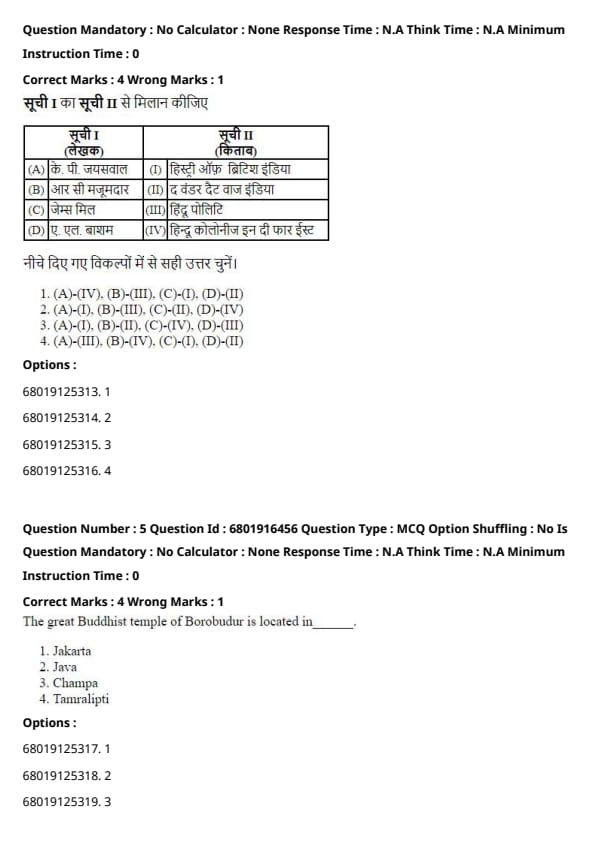
Match List-I with List-II:
| List-I Author |
List-II Book |
|---|---|
| A. K.P. Jayasawal | III. Hindu Polity |
| B. R.C. Majumdar | IV. Hindu Colonies in the Far East |
| C. James Mill | I. History of British India |
| D. A.L. Basham | II. The Wonder that was India |
Choose the correct answer from the options given below:
View Solution
Solution: Each author contributed significantly to Indian historical studies. James Mill's "History of British India" critiqued Indian culture from a colonial perspective, while A.L. Basham's work celebrated India's cultural heritage.
Quick Tip: Books like "The Wonder that was India” are considered seminal in presenting a balanced perspective on Indian history and culture.
Question 5:
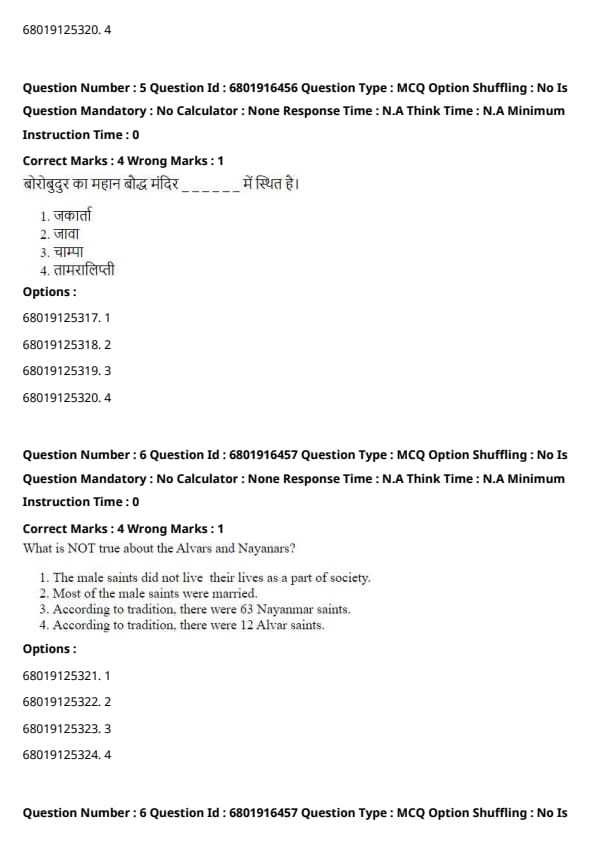
The great Buddhist temple of Borobudur is located in:
View Solution
Solution: Borobudur, a UNESCO World Heritage Site, is located in Central Java, Indonesia. It is one of the largest Buddhist monuments in the world, built during the Sailendra dynasty.
Quick Tip: Borobudur represents the zenith of Buddhist architectural and artistic expression in Southeast Asia.
Question 6:
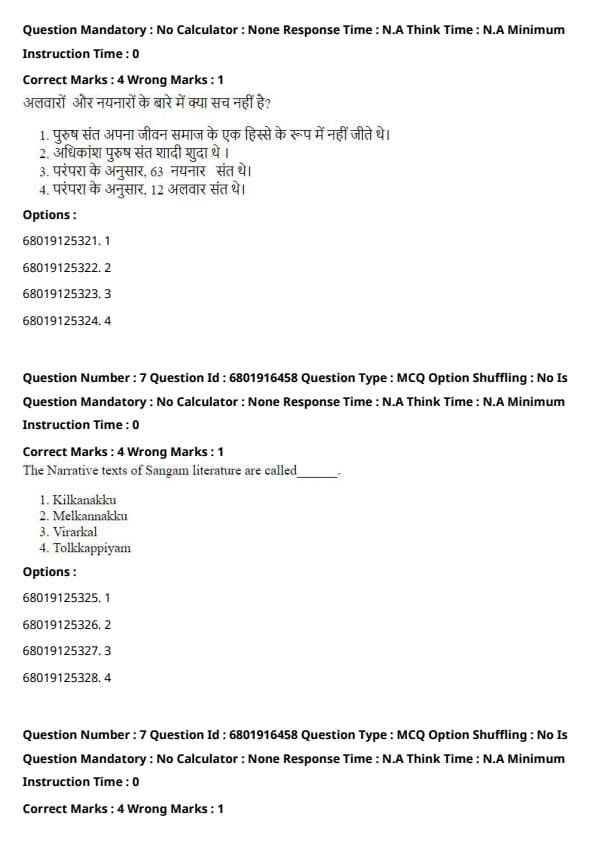
What is NOT true about the Alvars and Nayanars?
View Solution
Solution: The Alvars and Nayanars were Tamil poet-saints devoted to Vishnu and Shiva, respectively. Most of them lived within society and played an active role in spreading Bhakti.
Quick Tip: Their hymns contributed significantly to Tamil devotional literature, forming the basis for later Bhakti movements.
Question 7:
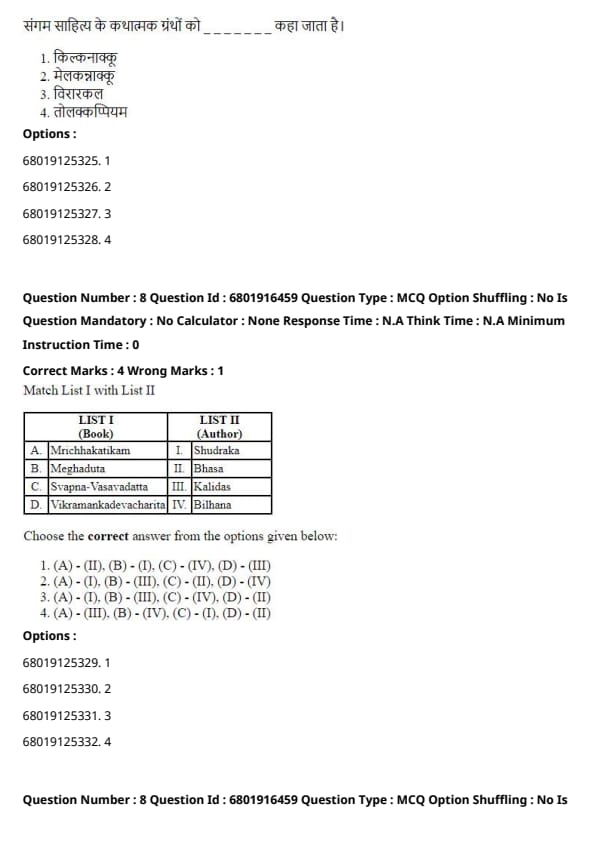
The Narrative texts of Sangam literature are called:
View Solution
Solution: The Sangam literature is classified into two broad categories: Melkannakku (Eighteen Greater Texts) and Kilkanakku (Eighteen Lesser Texts). The narrative texts belong to the Melkannakku category.
Quick Tip: Sangam literature provides invaluable insights into the social, political, and cultural life of ancient Tamilakam.
Question 8:
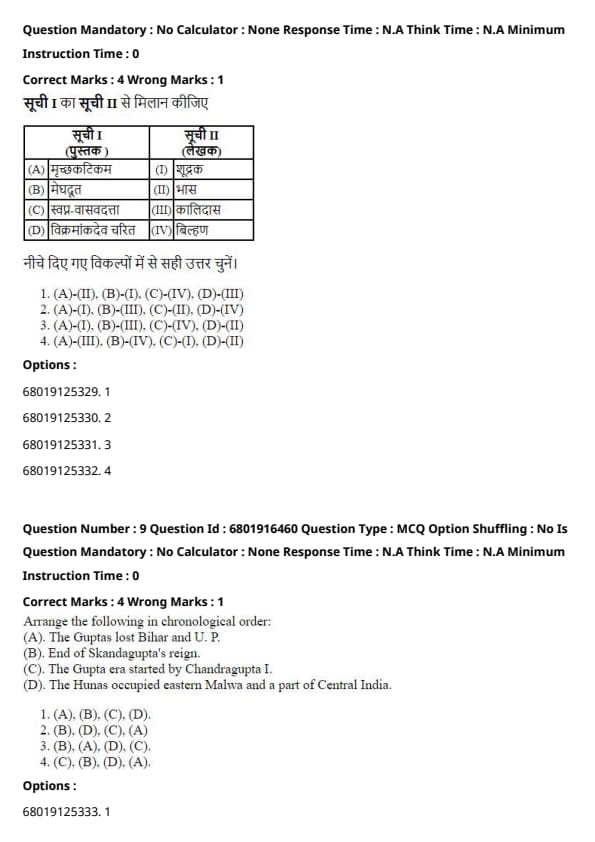
Match List-I with List-II:
| List-I Book |
List-II Author |
|---|---|
| A. Mrichhakatikam | I. Shudraka |
| B. Meghaduta | II. Kalidas |
| C. Svapna-Vasavadatta | III. Bhasa |
| D. Vikramankadevacharita | IV. Bilhana |
Choose the correct answer from the options given below:
View Solution
Solution: Each of these works is a significant contribution to Indian classical literature. Mrichhakatikam by Shudraka is a renowned Sanskrit play, and Meghaduta by Kalidas is one of the finest lyrical poems.
Quick Tip: Bhasa, one of India's oldest playwrights, is known for works like Svapna-Vasavadatta, which profoundly influenced later Sanskrit drama.
Question 9:
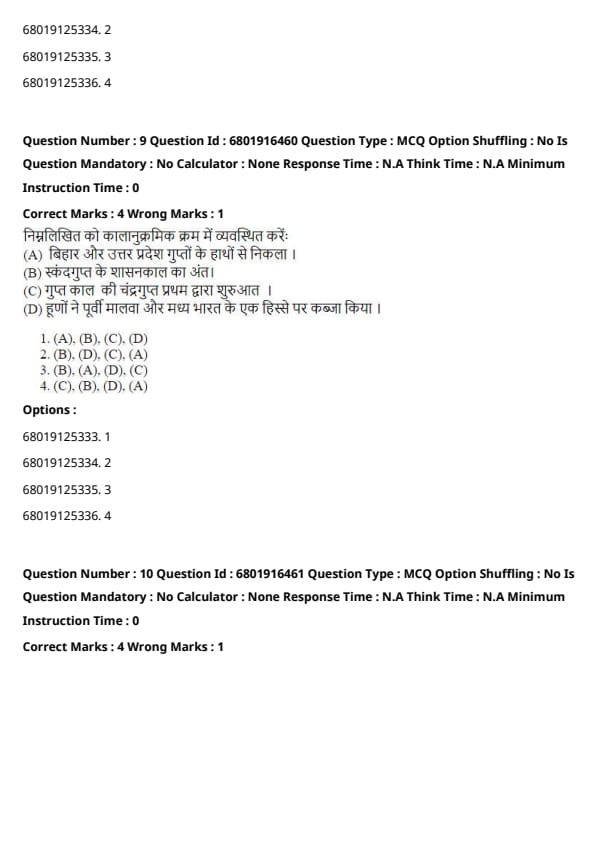
Arrange the following in chronological order:
(A). The Guptas lost Bihar and U. P.
(B). End of Skandagupta's reign.
(C). The Gupta era started by Chandragupta I.
(D). The Hunas occupied eastern Malwa and a part of Central India.
View Solution
Solution: The Gupta era started under Chandragupta I and saw significant cultural and administrative achievements. However, the invasions by the Hunas and internal weaknesses led to the gradual decline of Gupta power.
Quick Tip: Skandagupta was one of the last strong rulers of the Gupta dynasty, known for his efforts in repelling the Huna invasions.
Question 10:
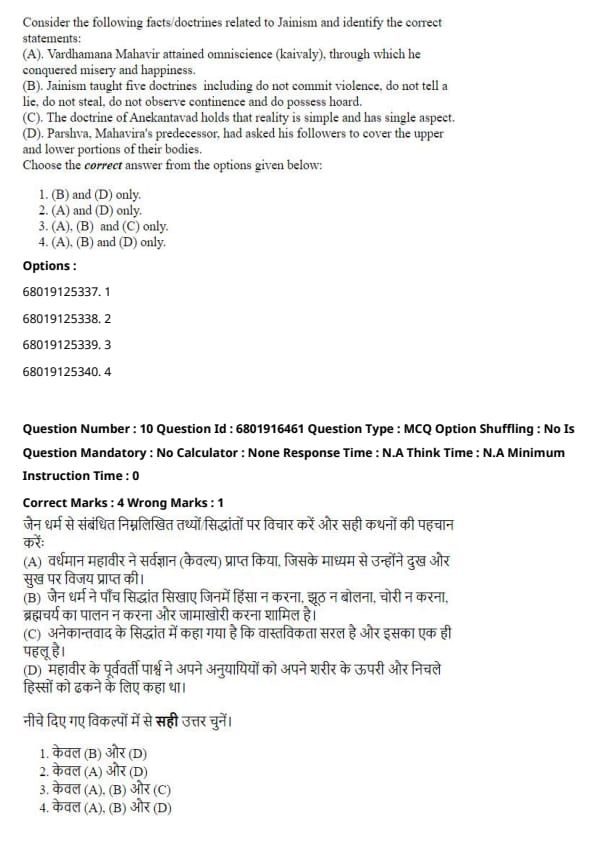
Consider the following facts/doctrines related to Jainism and identify the correct statements:
Statements:
(A) Vardhamana Mahavir attained omniscience (kaivaly), through which he conquered misery and happiness.
(B) Jainism taught five doctrines including do not commit violence, do not tell a lie, do not steal, do observe continence, and do not possess hoard.
(C) The doctrine of Anekantavad holds that reality is simple and has a single aspect.
(D) Parshva, Mahavira's predecessor, had asked his followers to cover the upper and lower portions of their bodies.
View Solution
Solution: Mahavira emphasized non-violence (ahimsa) and asceticism. The doctrine of Anekantavad emphasizes the complexity and multi-faceted nature of reality, which is contrary to the simplified assertion in statement (C).
Quick Tip: Parshvanatha, the 23rd Tirthankara, simplified Jainism's principles, which were later expanded by Mahavira.
Question 11:
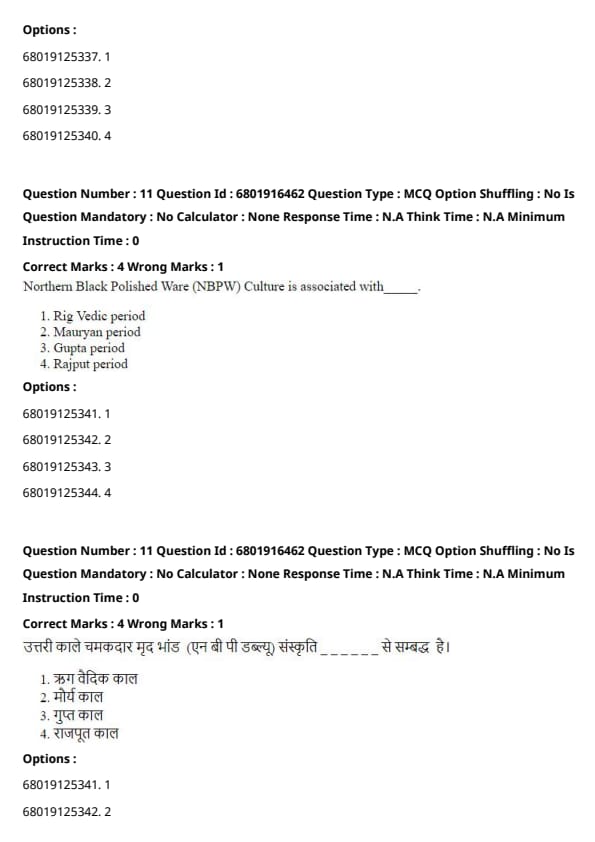
Northern Black Polished Ware (NBPW) Culture is associated with:
View Solution
Solution: The Northern Black Polished Ware Culture is a hallmark of the early historic period in India, particularly associated with the Mauryan period, showcasing advanced pottery techniques and urbanization.
Quick Tip:The Mauryan period marked significant developments in art, culture, and trade, reflected in archaeological findings like NBPW.
Question 12:
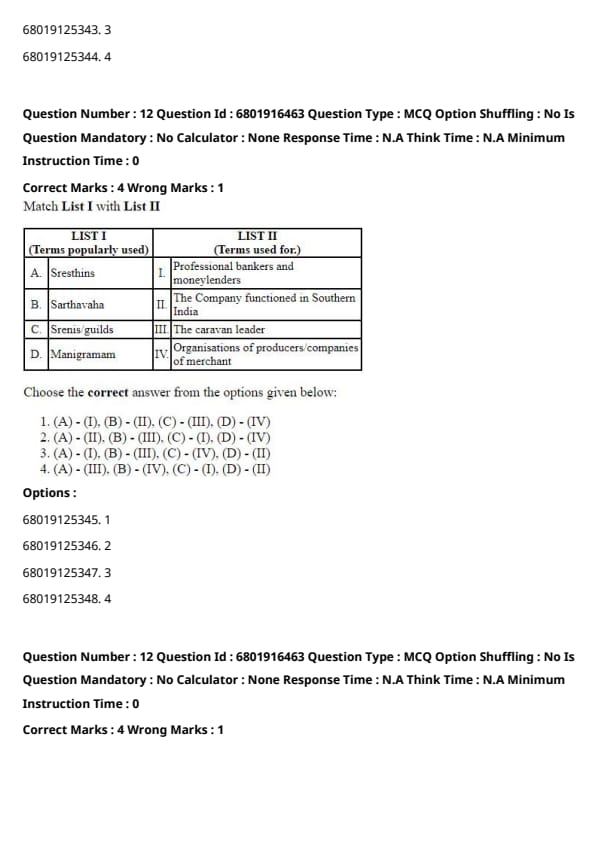
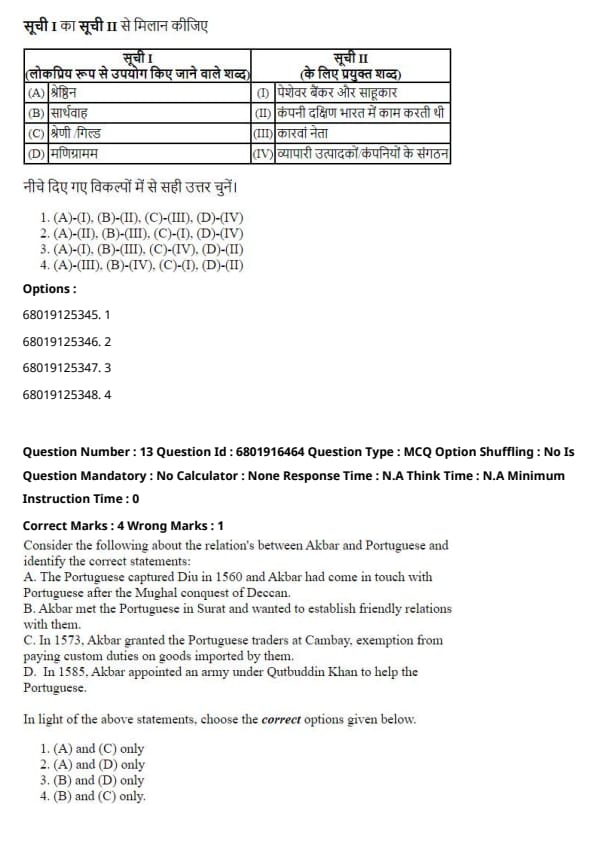
Match List-I with List-II:
| List-I Terms Popularly Used |
List-II Meaning |
|---|---|
| A. Sresti | I. Professional bankers and moneylenders |
| B. Srenis/Guilds | II. Organizations of producers/companies of merchants |
| C. Karavanika | III. The caravan leader |
| D. Nigama | IV. The Company functioned in Southern India |
Choose the correct answer from the options given below:
View Solution
Solution: The terms in List-I are associated with specific roles in ancient Indian economic and trade systems. For example, Sresti refers to professional bankers, while Nigama was related to organizations functioning in Southern India.
Quick Tip: Guilds (Srenis) played a critical role in regulating trade and commerce in ancient India.
Question 13:
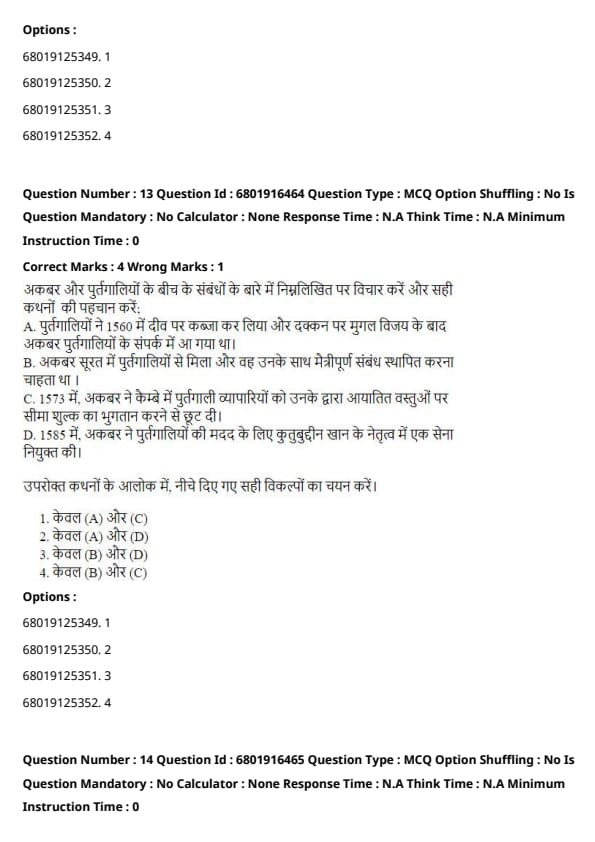
Consider the following about the relations between Akbar and Portuguese and identify the correct statements:
(A) The Portuguese captured Diu in 1560 and Akbar had come in touch with the Portuguese after the Mughal conquest of Deccan.
(B) Akbar met the Portuguese in Surat and wanted to establish friendly relations with them.
(C) In 1573, Akbar granted the Portuguese traders at Cambay exemption from paying custom duties on goods imported by them.
(D) In 1585, Akbar appointed an army under Qutbuddin Khan to help the Portuguese.
View Solution
Solution: Akbar's relations with the Portuguese were marked by diplomatic exchanges and trade agreements. The exemption granted in 1573 reflects Akbar's intent to maintain friendly relations.
Quick Tip: Akbar's policy of religious and cultural tolerance extended to fostering diplomatic ties with foreign powers.
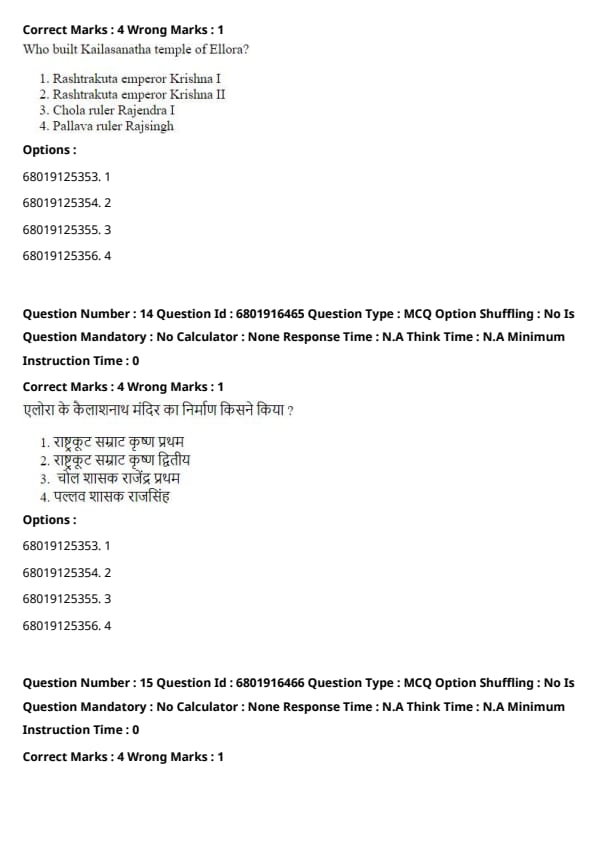
Question 14:
Who built the Kailasanatha temple of Ellora?
View Solution
Solution: The Kailasanatha temple at Ellora is a masterpiece of Indian rock-cut architecture, commissioned by Rashtrakuta emperor Krishna I in the 8th century CE.
Quick Tip: Ellora's Kailasanatha temple is an example of the architectural grandeur achieved during the Rashtrakuta period.
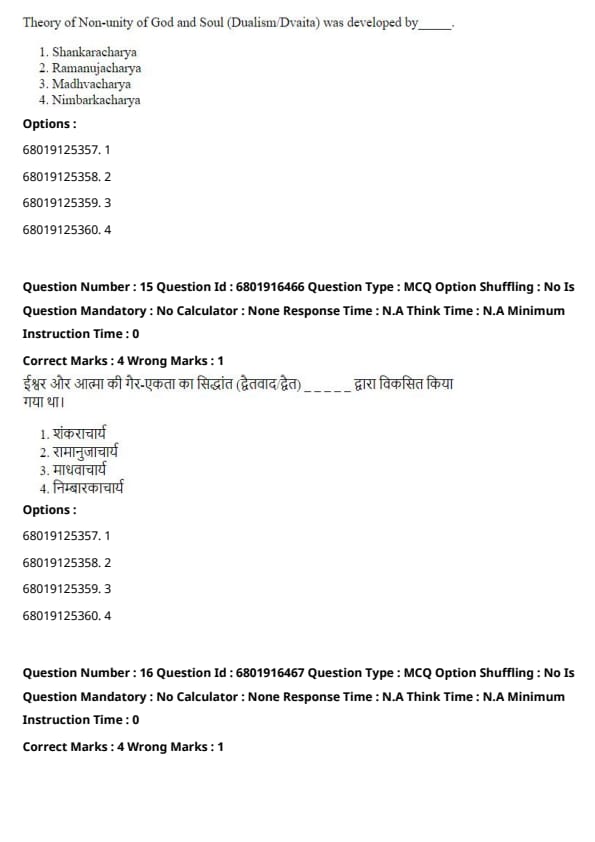
Question 15:
The theory of Non-unity of God and Soul (Dualism/Dvaita) was developed by:
View Solution
Solution: Madhvacharya, a 13th-century philosopher, propounded the Dvaita (dualism) school of Vedanta, emphasizing the distinction between God and the soul.
Quick Tip: Dvaita philosophy contrasts with Advaita Vedanta, which emphasizes the unity of Atman and Brahman.
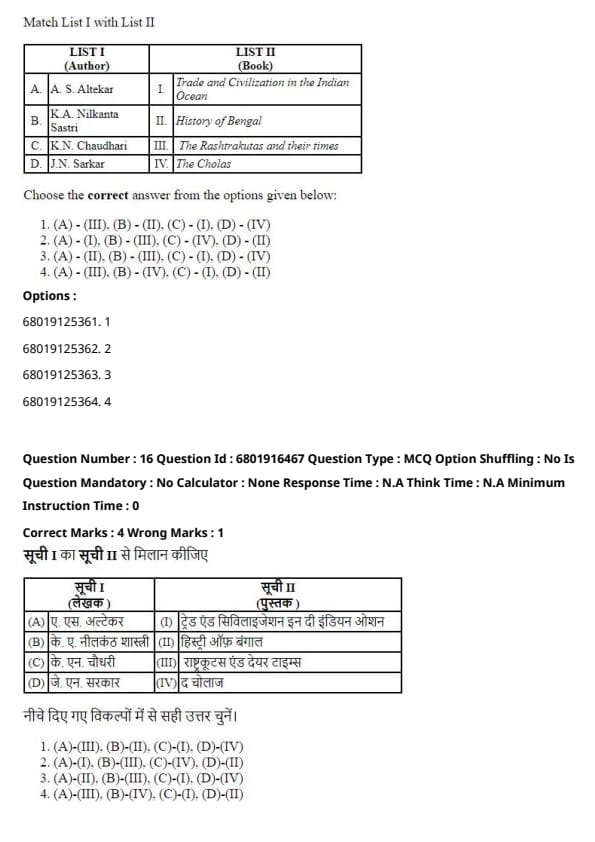
Question 16:
Match List-I with List-II:
| List-I Author |
List-II Book |
|---|---|
| A. K.A. Nilakanta Sastri | I. The Cholas |
| B. K.N. Chaudhuri | II. Trade and Civilization in the Indian Ocean |
| C. J.N. Sarkar | III. Rashtrakutas and their Times |
| D. J.N. Sarkar | IV. History of Bengal |
Choose the correct answer from the options given below:
View Solution
Solution: Correct Matching with author name
- K.A. Nilakanta Sastri -The Cholas
- K.N. Chaudhuri - Trade and Civilization in the Indian Ocean
- Rashtrakutas and their Times - A.S. Altekar
- History of Bengal - R.C. Majumdar
Quick Tip: Understand the contributions of these historians helps contextualize the cultural and economic development of India.
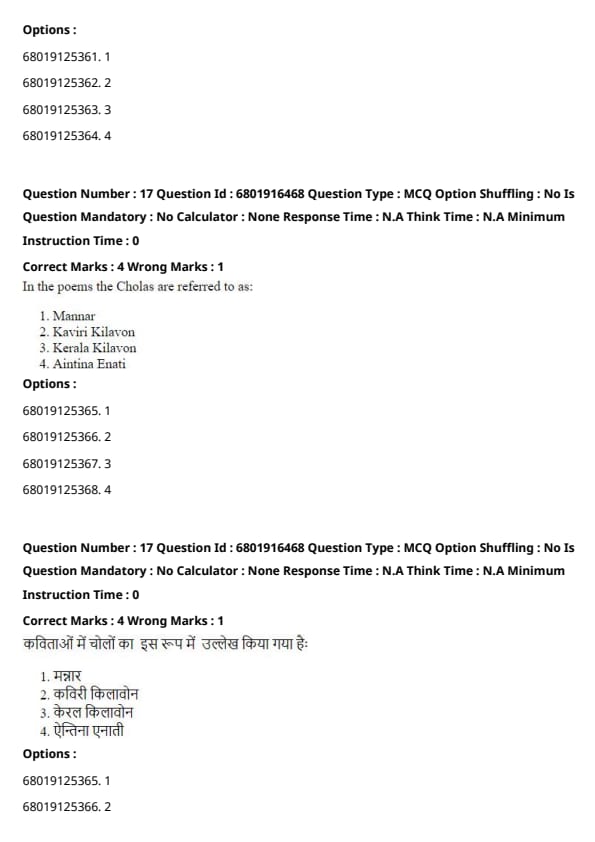
Question 17:
In the poems, the Cholas are referred to as:
View Solution
Solution:The Cholas are often glorified in Tamil literature and are referred to as Kaviri Kilavon, emphasizing their association with the Kaveri River and its fertile plains.
Quick Tip:The Cholas were renowned for their contributions to art, architecture, and literature in South India.
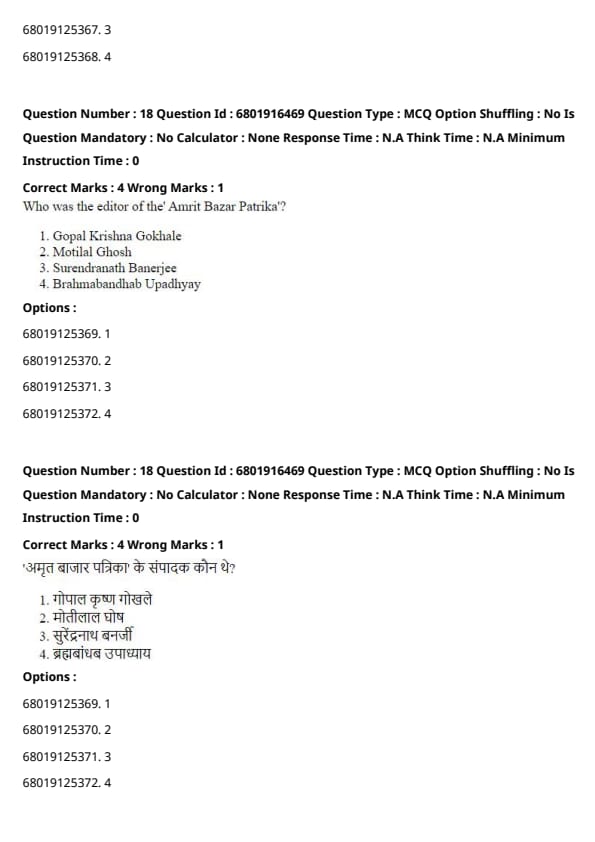
Question 18:
Who was the editor of the Amrit Bazar Patrika?
View Solution
Solution: Amrit Bazar Patrika, established in the 19th century, played a pivotal role in the Indian independence movement under the editorship of Motilal Ghosh.
Quick Tip:Newspapers like Amrit Bazar Patrika were instrumental in spreading nationalist ideas during the freedom struggle.
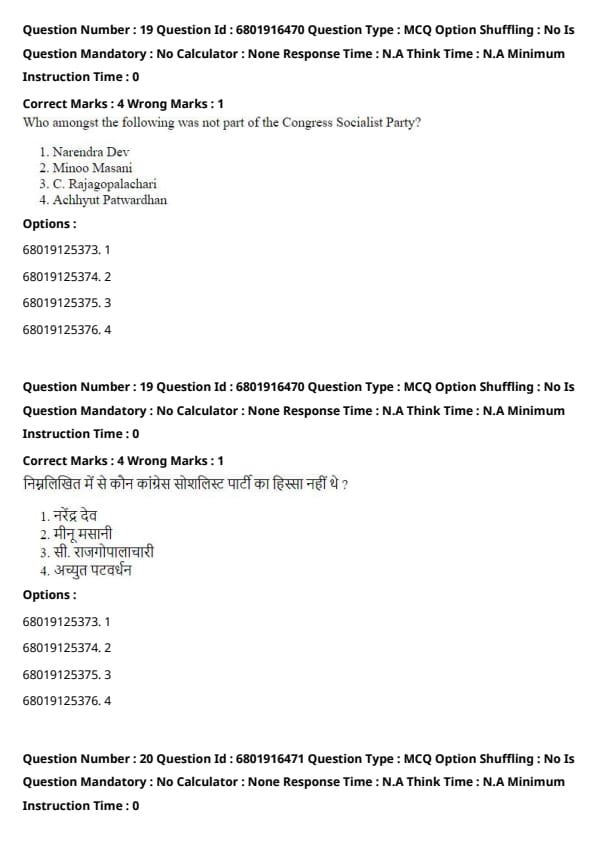
Question 19:
Who amongst the following was not part of the Congress Socialist Party?
View Solution
Solution: C. Rajagopalachari was not associated with the Congress Socialist Party, as his political ideologies were more aligned with the conservative wing of the Congress.
Quick Tip: The Congress Socialist Party was established in 1934 to promote socialist ideals within the Indian National Congress.
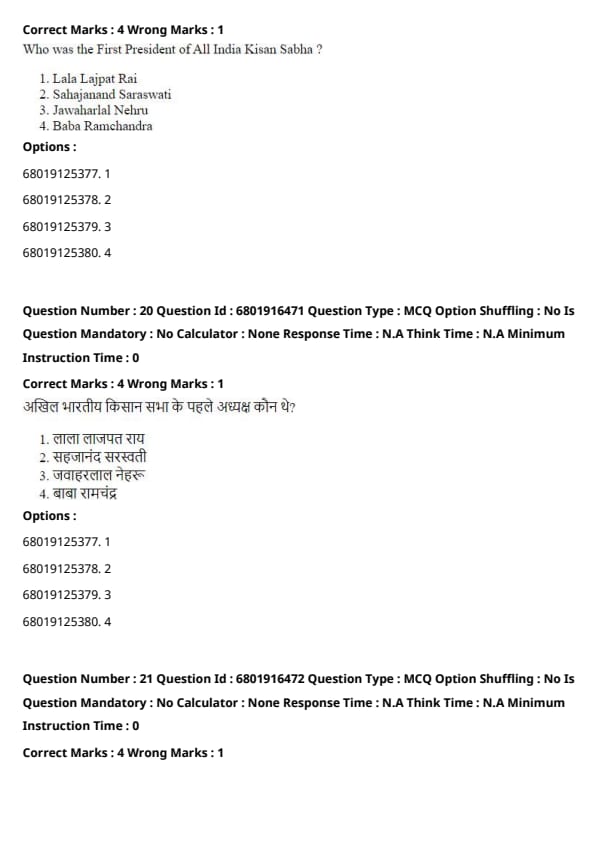
Question 20:
Who was the First President of All India Kisan Sabha?
View Solution
Solution: The All India Kisan Sabha was formed in 1936 to address the issues of peasants and farmers, with Sahajanand Saraswati as its first president.
Quick Tip: The All India Kisan Sabha played a significant role in mobilizing peasants during the Indian independence movement.
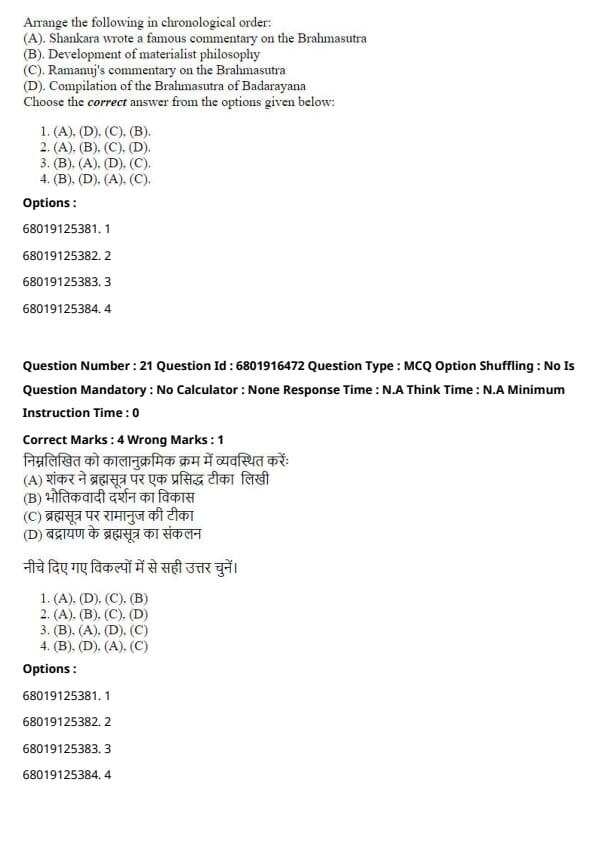
Question 21:
Arrange the following in chronological order:
(A) Shankara wrote a famous commentary on the Brahmasutra
(B) Development of materialist philosophy
(C) Ramanuj's commentary on the Brahmasutra
(D) Compilation of the Brahmasutra of Badarayana
View Solution
Solution: The chronological order reflects the sequence of philosophical development in India, starting with materialist philosophy and moving towards spiritual commentaries. Materialist philosophy predates the compilation of the Brahmasutra. Shankara and Ramanuj wrote their respective commentaries later.
Quick Tip: Studying the chronological progression of Indian philosophy helps understand the transition from materialism to spiritual commentaries.
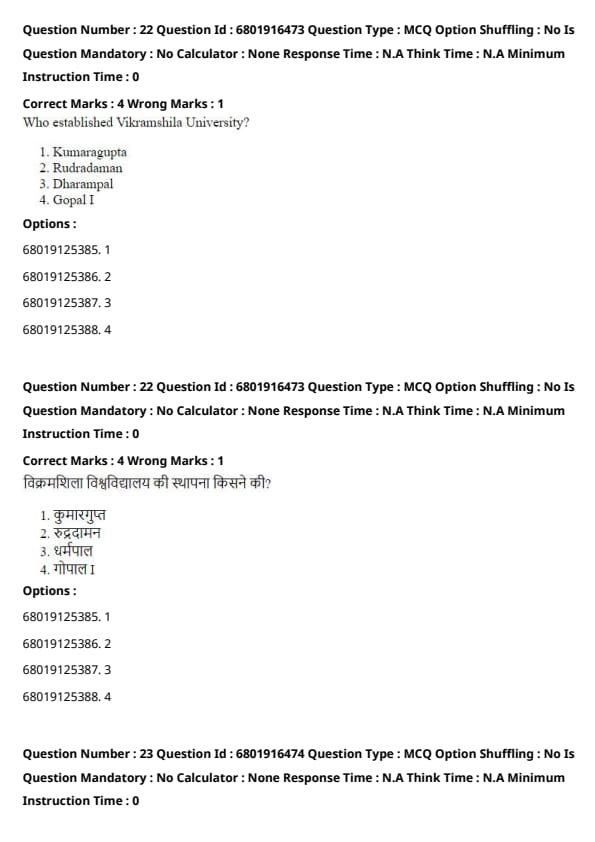
Question 22:
Who established Vikramshila University?
View Solution
Solution: Vikramshila University was established by King Dharampal of the Pala dynasty. It became a prominent center of Buddhist learning in medieval India.
Quick Tip: Understanding the historical significance of ancient universities like Vikramshila highlights India's rich tradition of education.
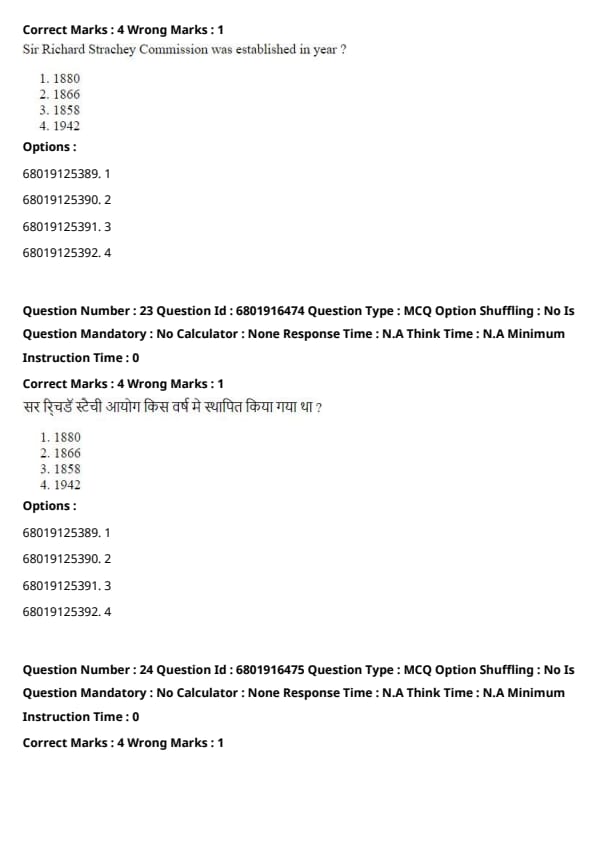
Question 23:
Sir Richard Strachey Commission was established in the year?
View Solution
Solution: Sir Richard Strachey Commission was set up in 1880 to study famine relief measures. It recommended better irrigation systems and transportation facilities to prevent famines.
Quick Tip: Learning about commissions like this helps understand British administrative measures during colonial rule.
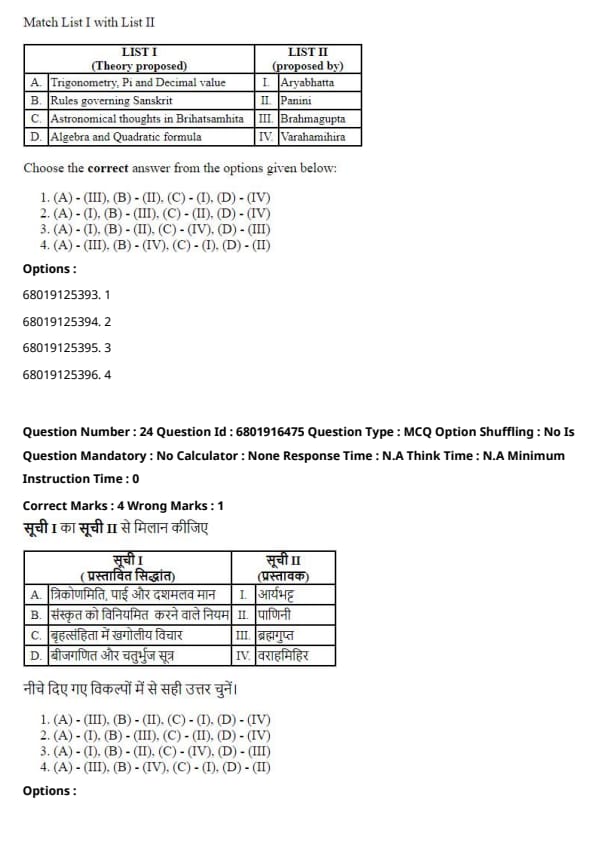
Question 24:
Match List-I with List-II:
| List-I Theory Proposed |
List-II Proposed by |
|---|---|
| A. Trigonometry and Decimal Value | I. Aryabhatta |
| B. Rules governing Sanskrit | II. Panini |
| C. Astronomical thoughts in Brihatsamhita | III. Varahamihira |
| D. Algebra and Quadratic Formula | IV. Brahmagupta |
Choose the correct answer from the options given below:
View Solution
Solution:The contributions of these mathematicians and grammarians are foundational to Indian science and linguistics.
Aryabhatta introduced trigonometry; Panini authored the grammar of Sanskrit; Varahamihira developed astronomical concepts; Brahmagupta advanced algebra.
Quick Tip: These scholars laid the groundwork for advancements in mathematics, astronomy, and linguistics.
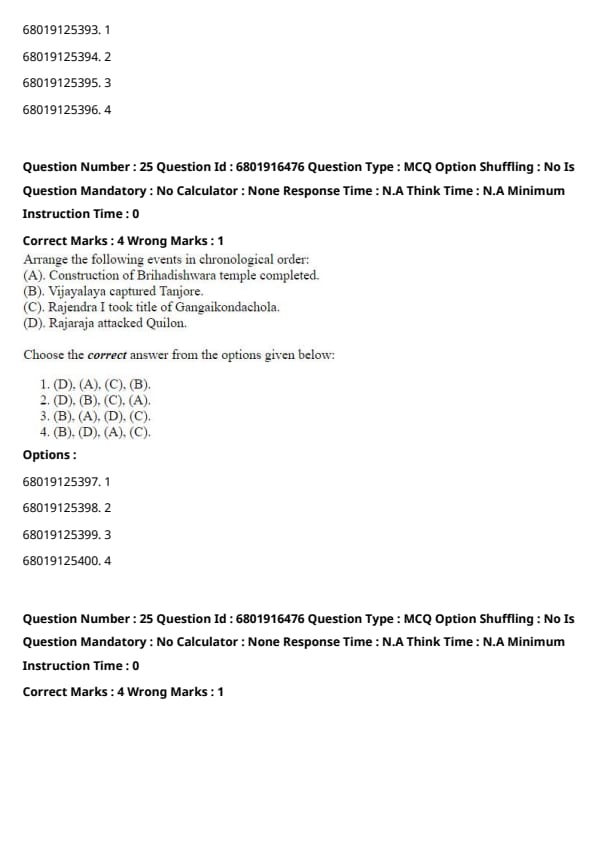
Question 25:
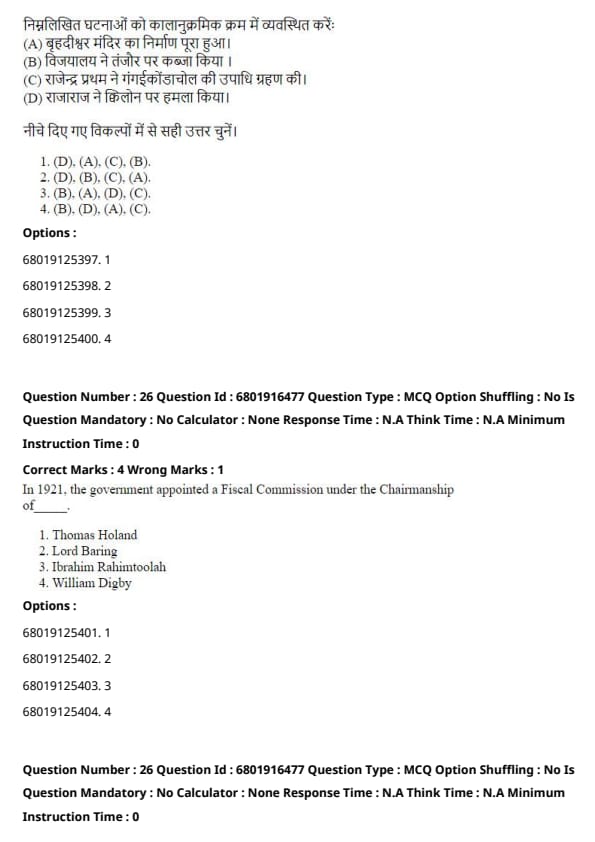
Arrange the following events in chronological order:
(A) Construction of Brihadishwara temple completed.
(B) Vijayalaya captured Tanjore.
(C) Rajendra I took the title of Gangaikondachola.
(D) Rajaraja attacked Quilon.
View Solution
Solution: Vijayalaya's capture of Tanjore marks the beginning of Chola dominance. Subsequent events include Rajaraja's campaigns, the construction of Brihadishwara temple, and Rajendra's conquests.
Quick Tip: Studying the chronological events of the Chola dynasty reveals their architectural and military prowess.
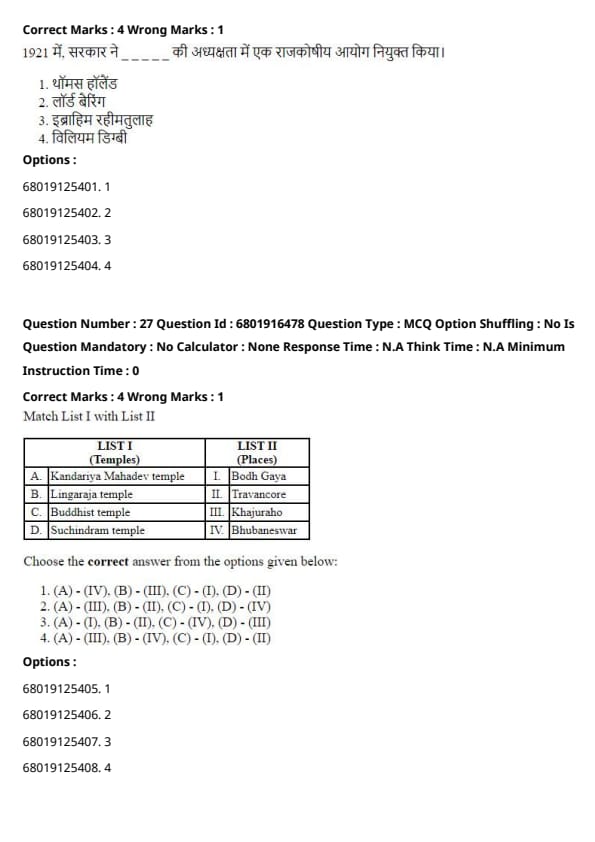
Question 26:
In 1921, the government appointed a Fiscal Commission under the Chairmanship of:
View Solution
Solution: The Fiscal Commission was set up to examine and provide recommendations on fiscal policy. Ibrahim Rahimtoolah's role exemplified his leadership and expertise in economic matters during this period.
Quick Tip: Studying such commissions offers insights into colonial India's economic reforms.
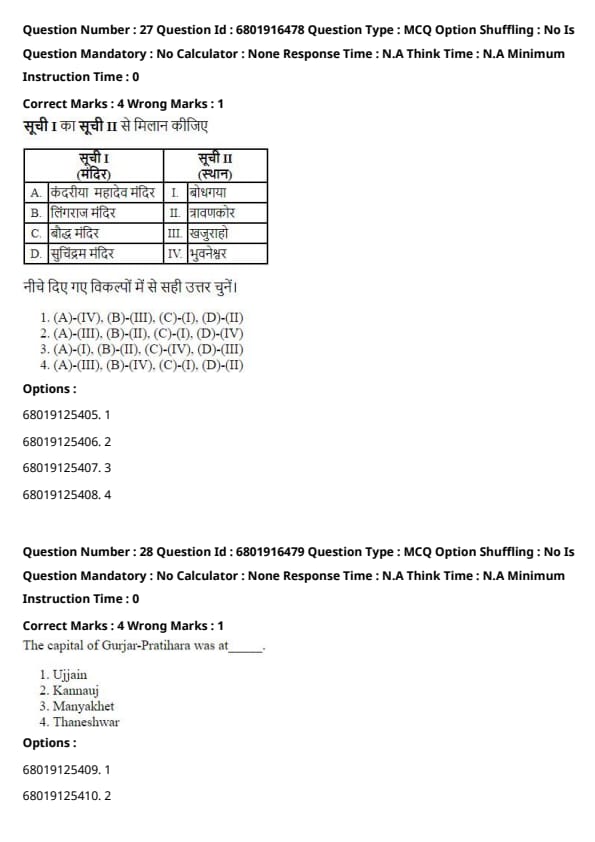
Question 27:
Match List-I with List-II:
| List-I Temples |
List-II Places |
|---|---|
| A. Kandariya Mahadev temple | I. Khajuraho |
| B. Lingaraja temple | II. Bhubaneswar |
| C. Buddhist temple | III. Bodh Gaya |
| D. Suchindram temple | IV. Travancore |
Choose the correct answer from the options given below:
View Solution
Solution: Kandariya Mahadev temple is a prominent structure in Khajuraho. Lingaraja temple is located in Bhubaneswar, Odisha. Buddhist temples like the Mahabodhi Temple are in Bodh Gaya. Suchindram temple is in Travancore, reflecting regional architectural diversity.
Quick Tip: Knowing the geographical distribution of temples helps understand India's cultural and religious heritage.
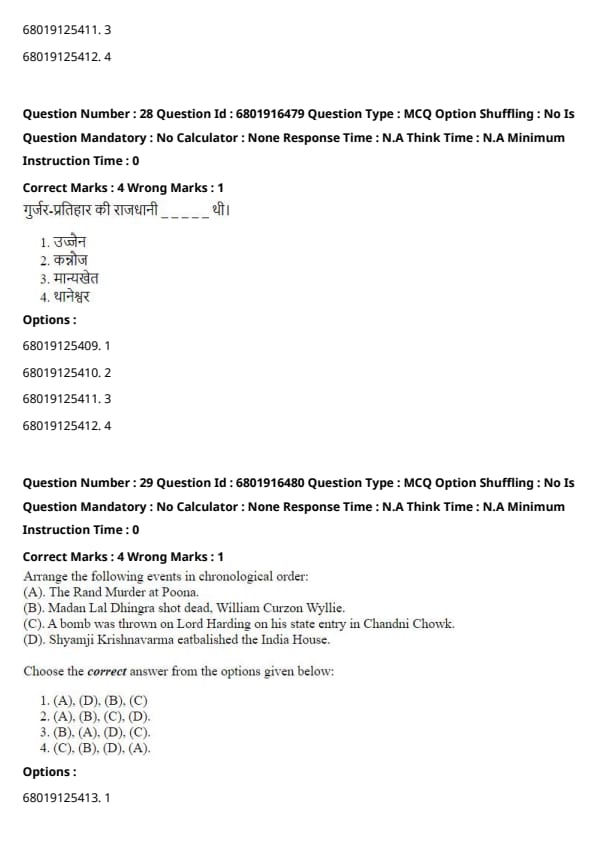
Question 28:
The capital of Gurjar-Pratihara was at:
View Solution
Solution: Kannauj was the political and cultural capital of the Gurjar-Pratihara dynasty. It played a significant role in early medieval Indian history as a center of power.
Quick Tip: Understanding the capitals of historical empires aids in grasping the dynamics of medieval Indian polity.
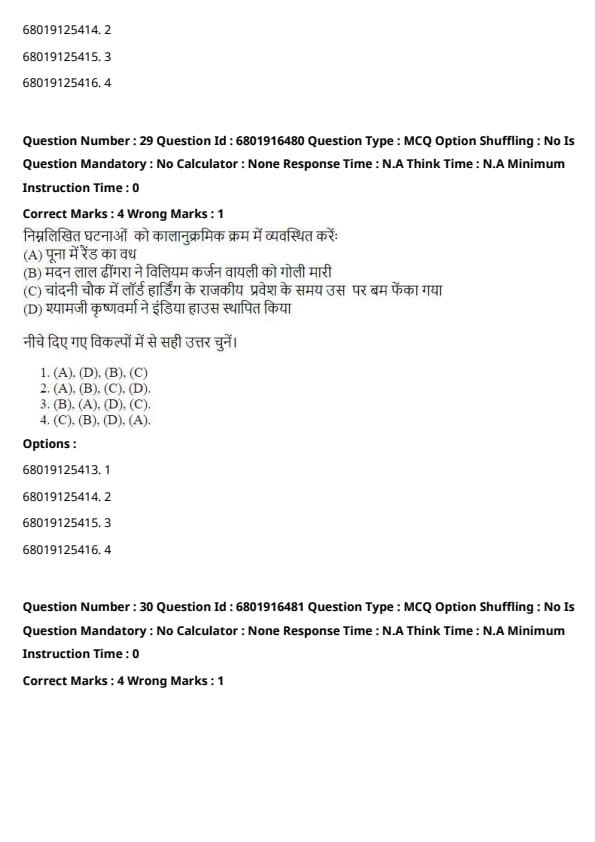
Question 29:
Arrange the following events in chronological order:
(A) The Rand Murder at Poona.
(B) Madan Lal Dhingra shot dead William Curzon Wyllie.
(C) A bomb was thrown on Lord Harding on his state entry in Chandni Chowk.
(D) Shyamji Krishnavarma established the India House.
View Solution
Solution: The events reflect the sequence of revolutionary activities during the freedom struggle. The Rand murder happened first, followed by the establishment of India House, and later revolutionary actions by Madan Lal Dhingra and the Chandni Chowk incident.
Quick Tip: Chronological arrangement of such events showcases the evolution of revolutionary activities in India's struggle for independence.
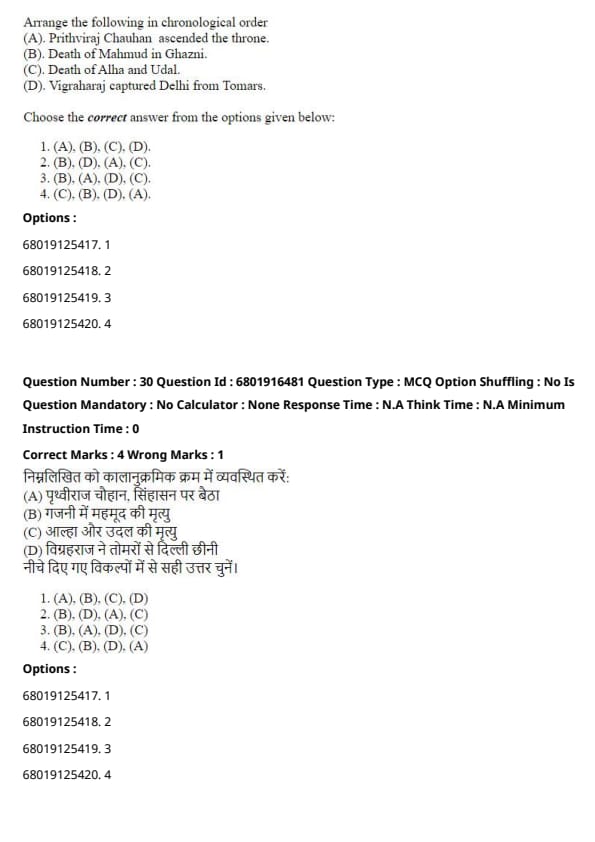
Question 30:
Arrange the following in chronological order:
(A) Prithviraj Chauhan ascended the throne.
(B) Death of Mahmud in Ghazni.
(C) Death of Alha and Udal.
(D) Vigraharaj captured Delhi from Tomars.
View Solution
Solution: Mahmud's death marks the starting point of this sequence. Vigraharaj's capture of Delhi and Prithviraj Chauhan's reign followed, with Alha and Udal's death occurring later.
Quick Tip: Placing events in order highlights the historical transitions of power in medieval India.
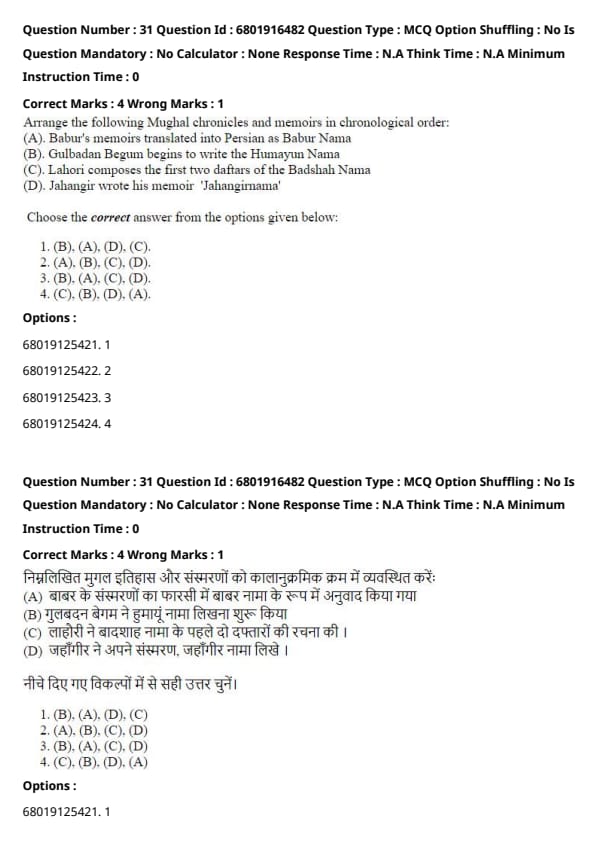
Question 31:
Arrange the following Mughal chronicles and memoirs in chronological order:
(A) Babur's memoirs translated into Persian as Babur Nama
(B) Gulbadan Begum begins to write the Humayun Nama
(C) Lahori composes the first two daftars of the Badshah Nama
(D) Jahangir wrote his memoir 'Jahangirnama'
View Solution
Solution: Gulbadan Begum began writing Humayun Nama early. Babur Nama was translated later. Jahangir wrote his memoir after Babur Nama's translation. Lahori composed Badshah Nama subsequently.
Quick Tip: Focus on the historical timeline of Mughal literary works to understand their cultural contributions.
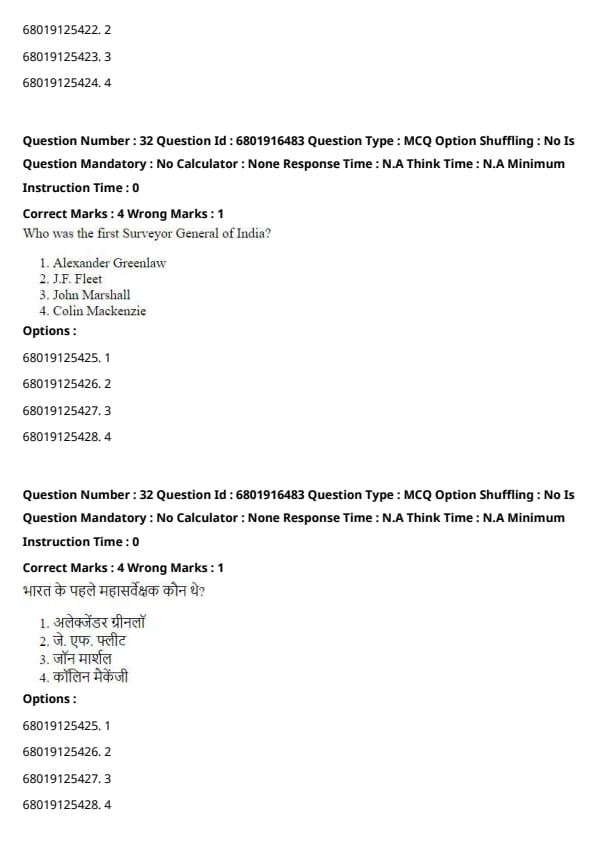
Question 32:
Who was the first Surveyor General of India?
View Solution
Solution: Colin Mackenzie was appointed as the first Surveyor General of India in 1815. He conducted extensive surveys and mapping during his tenure.
Quick Tip: Remember the contributions of Colin Mackenzie to Indian cartography and historical documentation.
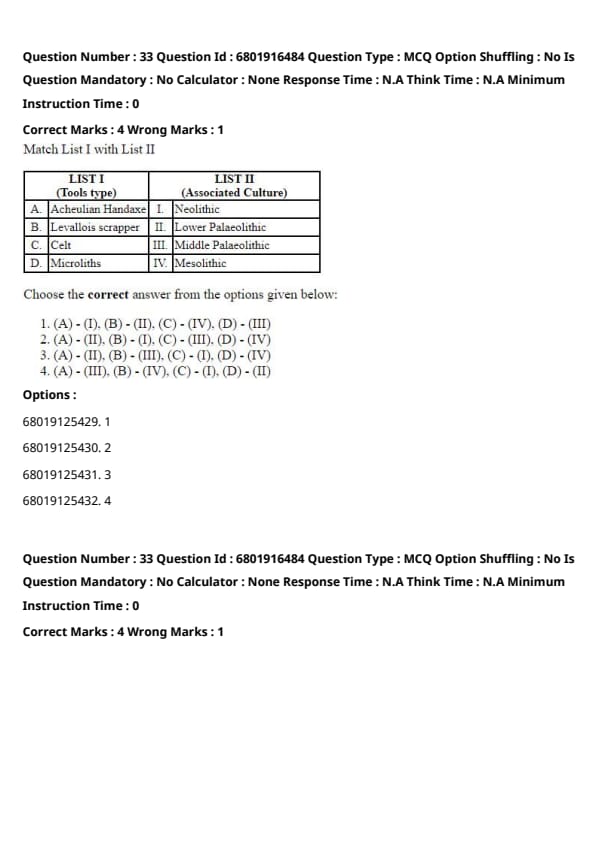
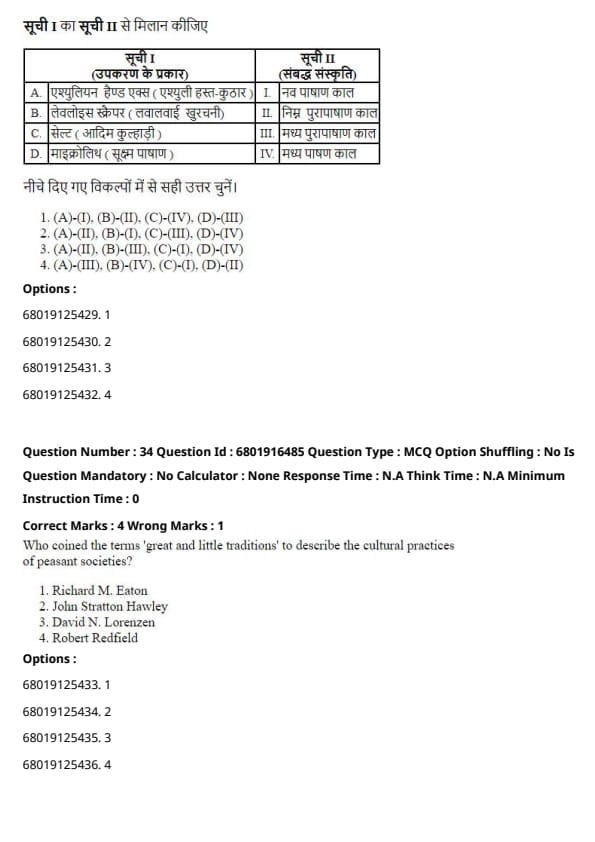
Question 33:
Match List I with List II:
| List-I Tool Type |
List-II Associated Culture |
|---|---|
| A. Acheulian Handaxe | I. Lower Palaeolithic |
| B. Levallois Scrapper | II. Middle Palaeolithic |
| C. Celt | III. Neolithic |
| D. Microliths | IV. Mesolithic |
Choose the correct answer from the options given below:
View Solution
Solution: Acheulian tools belong to the Lower Palaeolithic period. Levallois scrappers are from the Middle Palaeolithic era. Celts are associated with Neolithic culture. Microliths are characteristic of the Mesolithic period.
Quick Tip: Understanding tool typology helps in tracing the development of early human civilizations.
Question 34:
Who coined the terms 'great and little traditions' to describe the cultural practices of peasant societies?
View Solution
Solution: Robert Redfield introduced the concepts of 'great and little traditions' in the study of peasant societies. He differentiated between elite cultural elements and localized traditions.
Quick Tip: Study Robert Redfield's theories for a deeper understanding of cultural anthropology.
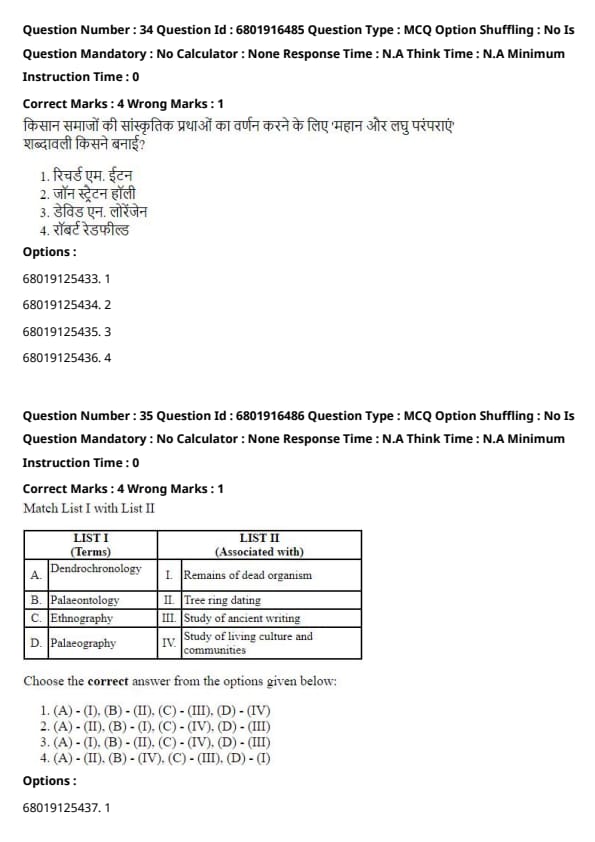
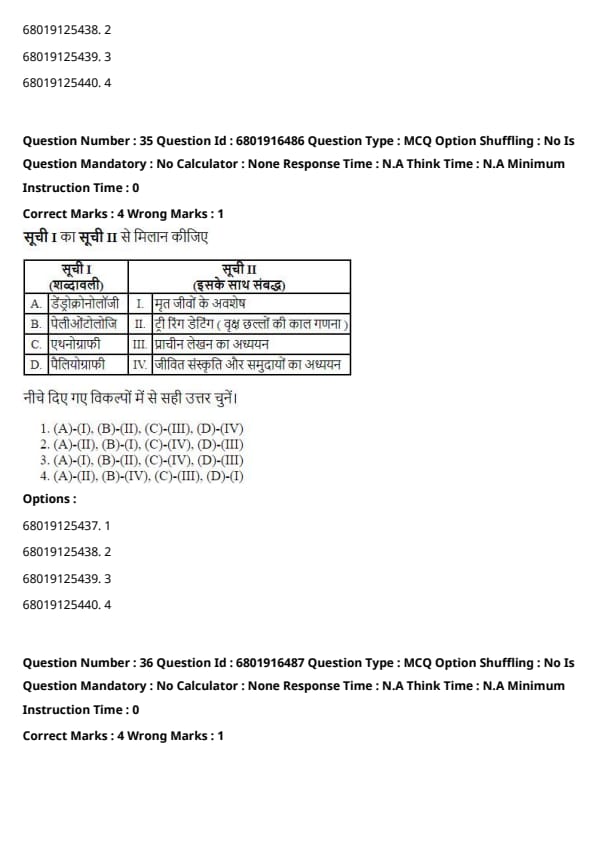
Question 35:
Match List I with List II:
| List-I Terms |
List-II Associated With |
|---|---|
| A. Dendrochronology | I. Tree ring dating |
| B. Palaeontology | II. Remains of dead organisms |
| C. Palaeography | III. Study of ancient writing |
| D. Ethnography | IV. Study of living cultures and communities |
Choose the correct answer from the options given below:
View Solution
Solution:- Dendrochronology involves tree-ring analysis for dating. - Palaeontology studies remains of organisms. - Palaeography focuses on deciphering ancient scripts. - Ethnography examines living cultures and communities.
Quick Tip: Know the interdisciplinary methods used in archaeology for a holistic understanding.
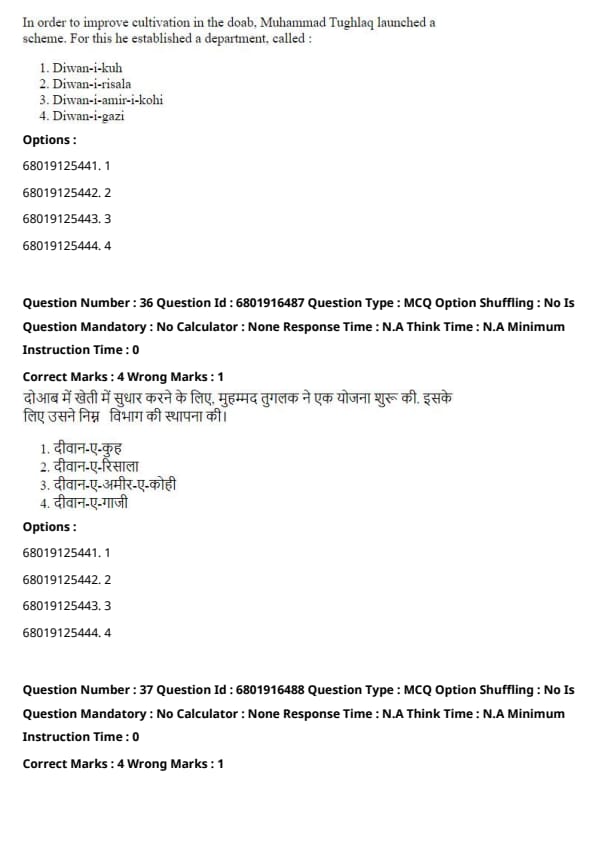
Question 36:
In order to improve cultivation in the Doab, Muhammad Tughlaq launched a scheme. For this, he established a department called:
View Solution
Solution: Muhammad Tughlaq's department Diwan-i-amir-i-kohi aimed to enhance agricultural productivity in the Doab region.
Quick Tip: Focus on Muhammad Tughlaq's administrative reforms for an understanding of medieval agrarian policies.
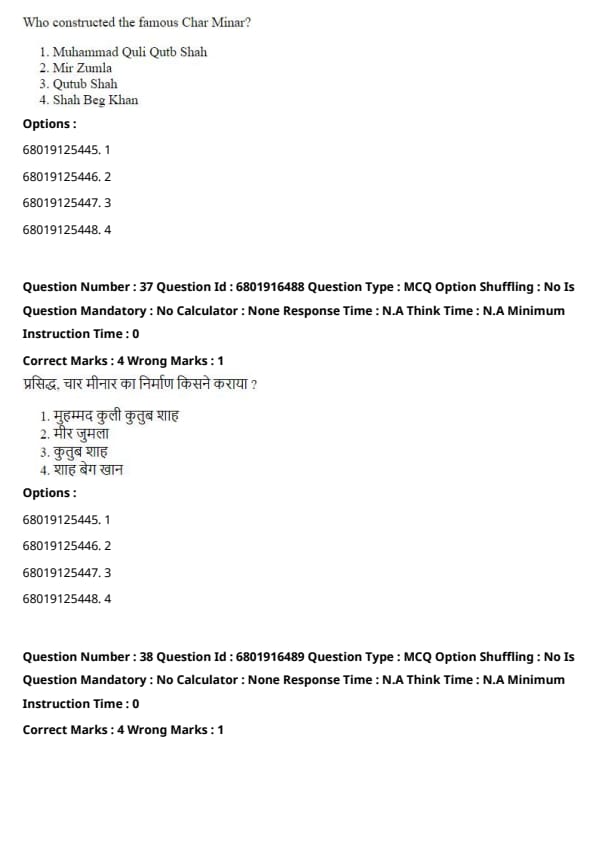
Question 37:
Who constructed the famous Char Minar?
View Solution
Solution: Muhammad Quli Qutb Shah, the founder of Hyderabad, constructed the Char Minar in 1591 to commemorate the eradication of the plague in the city.
Quick Tip: Char Minar is an architectural marvel symbolizing Hyderabad's rich history.
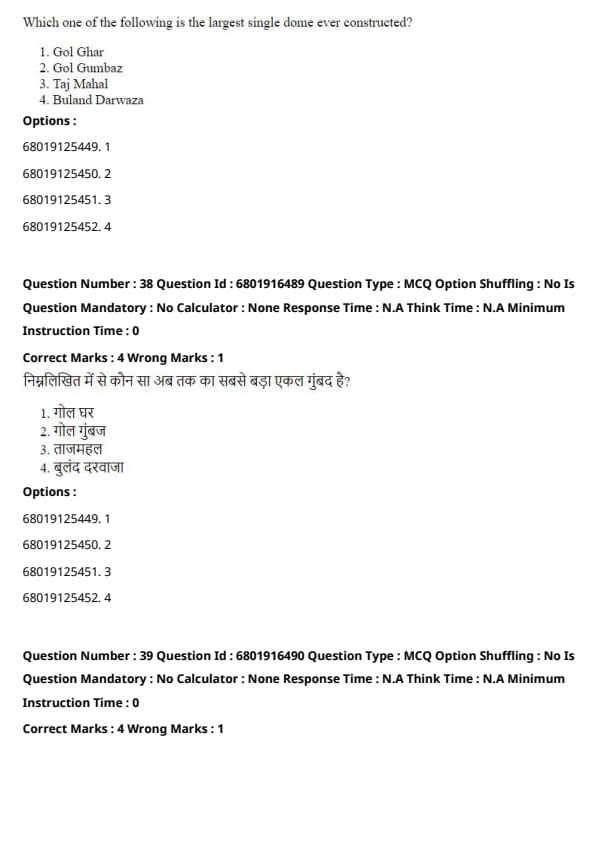
Question 38:
Which one of the following is the largest single dome ever constructed?
View Solution
Solution: Gol Gumbaz, located in Bijapur, Karnataka, has the largest single dome ever constructed. It is the mausoleum of Muhammad Adil Shah, the Sultan of Bijapur.
Quick Tip: Understand the architectural advancements of the Deccan Sultanates to appreciate structures like Gol Gumbaz.
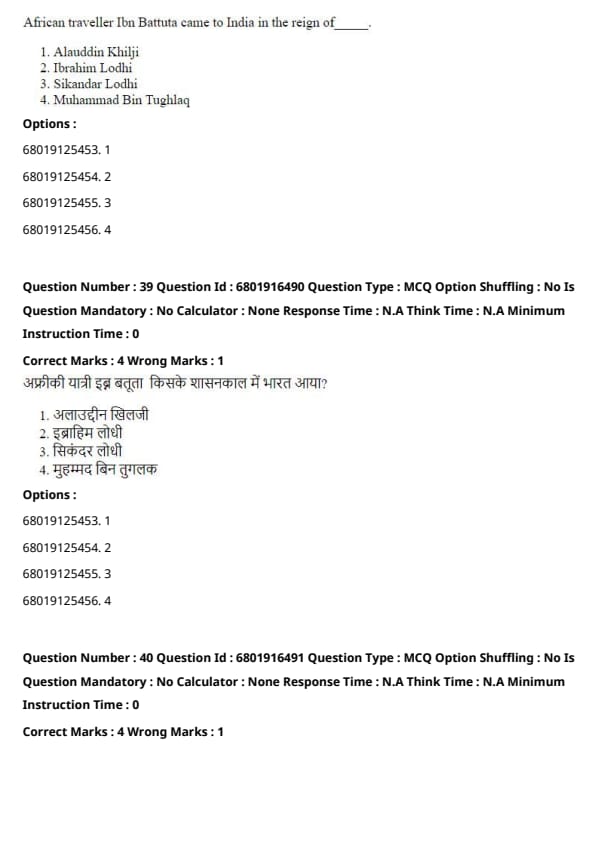
Question 39:
African traveller Ibn Battuta came to India during the reign of:
View Solution
Solution: Ibn Battuta came to India in 1334 during the reign of Muhammad Bin Tughlaq and served as a Qadi (judge) in his court.
Quick Tip: Ibn Battuta's travelogue provides valuable insights into the socio-economic conditions of medieval India.
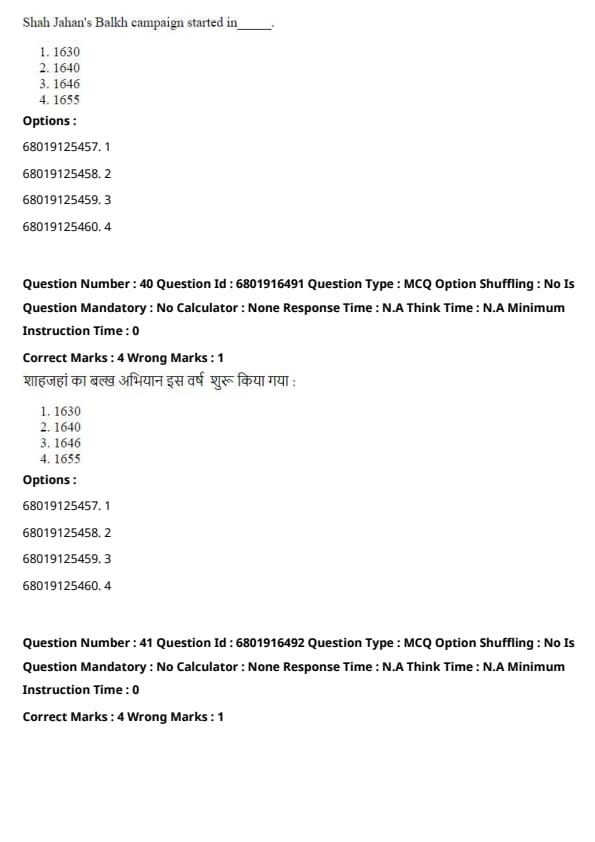
Question 40:
Shah Jahan's Balkh campaign started in:
View Solution
Solution: Shah Jahan launched the Balkh campaign in 1646 to secure the Mughal Empire's northwestern frontier and strengthen his influence in Central Asia.
Quick Tip: Study Shah Jahan's military campaigns to understand his territorial expansion strategies.
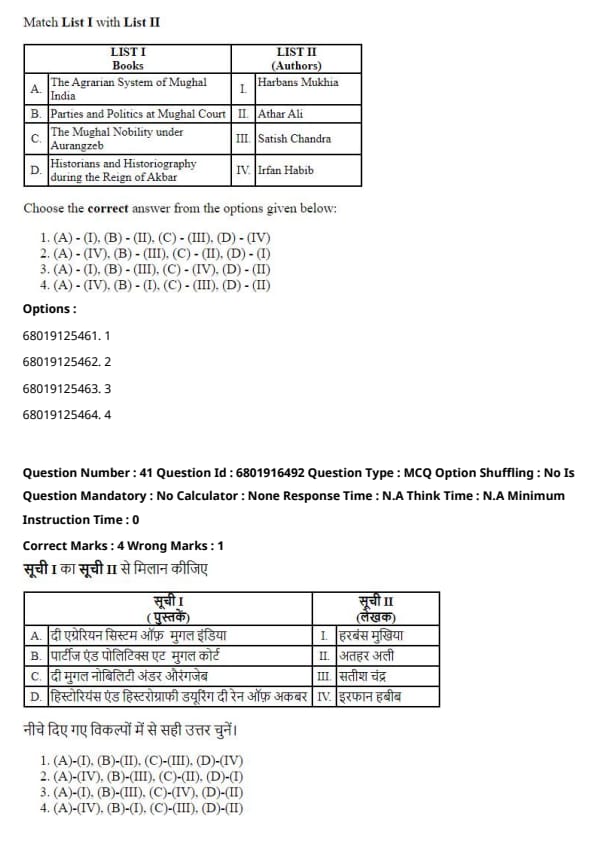
Question 41:
Match List I with List II:
| List-I Books |
List-II Authors |
|---|---|
| A. The Agrarian System of Mughal India | IV. Irfan Habib |
| B. Parties and Politics at Mughal Court | I. Harbans Mukhia |
| C. The Mughal Nobility under Aurangzeb | II. Athar Ali |
| D. Historians and Historiography during Akbar's Reign | III. Satish Chandra |
Choose the correct answer from the options given below:
View Solution
Solution: The associations match key works and their authors, reflecting the scholarly focus on Mughal history.
Quick Tip: Understand the contributions of historians like Irfan Habib and Satish Chandra to Mughal historiography.
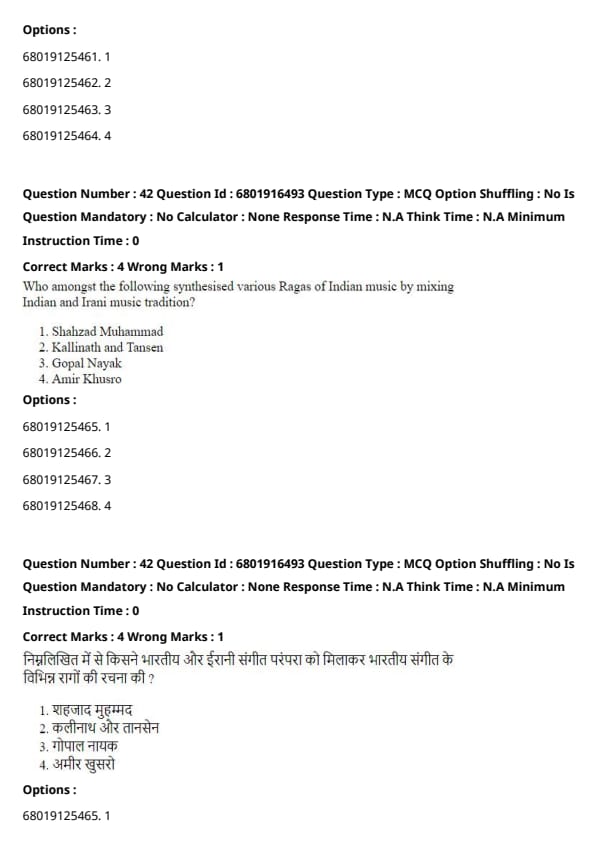
Question 42:
Who amongst the following synthesized various Ragas of Indian music by mixing Indian and Irani music traditions?
View Solution
Solution: Amir Khusro, a Sufi musician and poet, is credited with blending Persian and Indian musical traditions, creating new Ragas.
Quick Tip: Amir Khusro is also known as the "father of Qawwali" and a pioneer in Indian classical music.
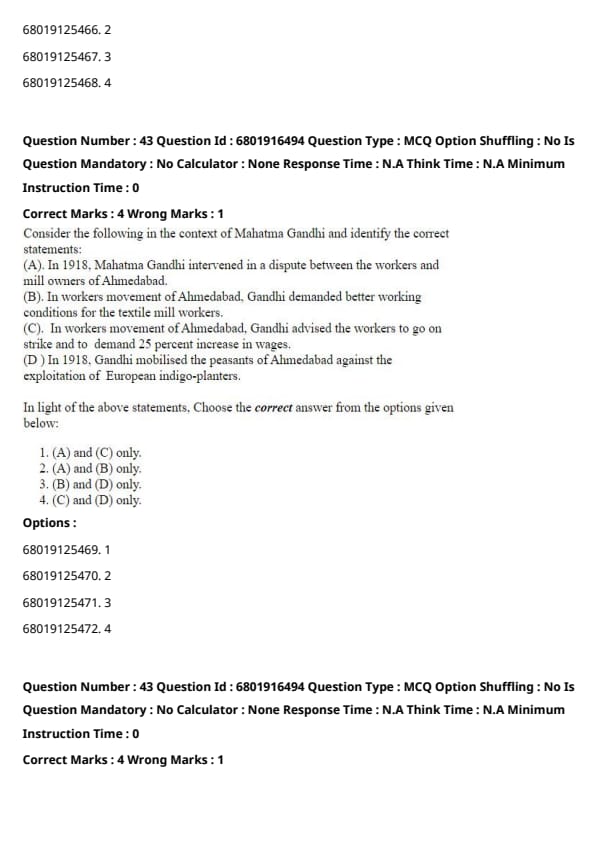
Question 43:
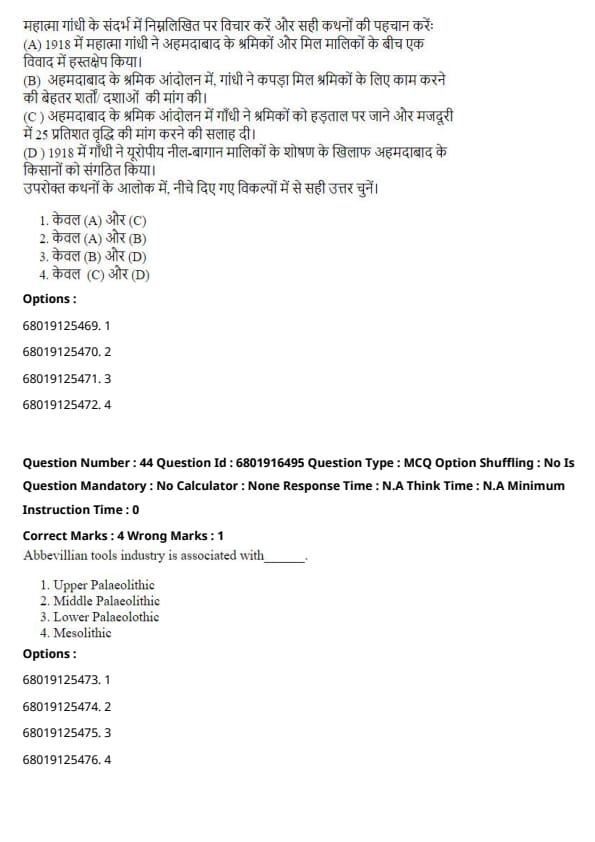
Consider the following statements about Mahatma Gandhi and identify the correct ones:
(A) In 1918, Mahatma Gandhi intervened in a dispute between workers and mill owners of Ahmedabad.
(B) Gandhi demanded better working conditions for textile mill workers in Ahmedabad.
(C) Gandhi advised workers to go on strike, demanding a 25
(D) Gandhi mobilized Ahmedabad peasants against European indigo planters.
View Solution
Solution: Statements (A) and (B) pertain to Gandhi's involvement in the Ahmedabad mill workers' movement, which marked one of his early leadership roles in labor disputes.
Quick Tip: Gandhi used hunger strikes as a tool during the Ahmedabad labor movement.
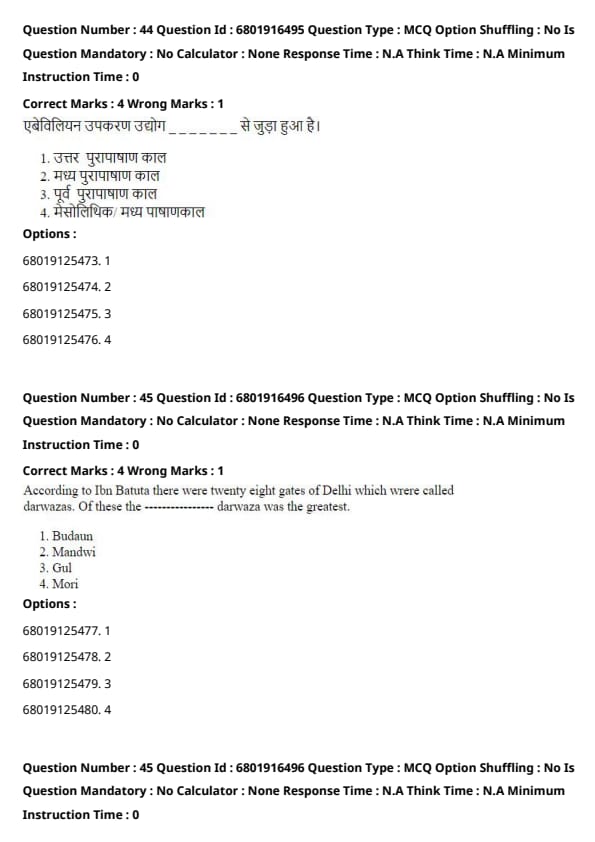
Question 44:
Abbevillian tools industry is associated with:
View Solution
Solution: The Abbevillian industry is one of the earliest known Lower Palaeolithic cultures, characterized by bifacial tools.
Quick Tip: Study stone tool traditions to understand early human technological advancements.
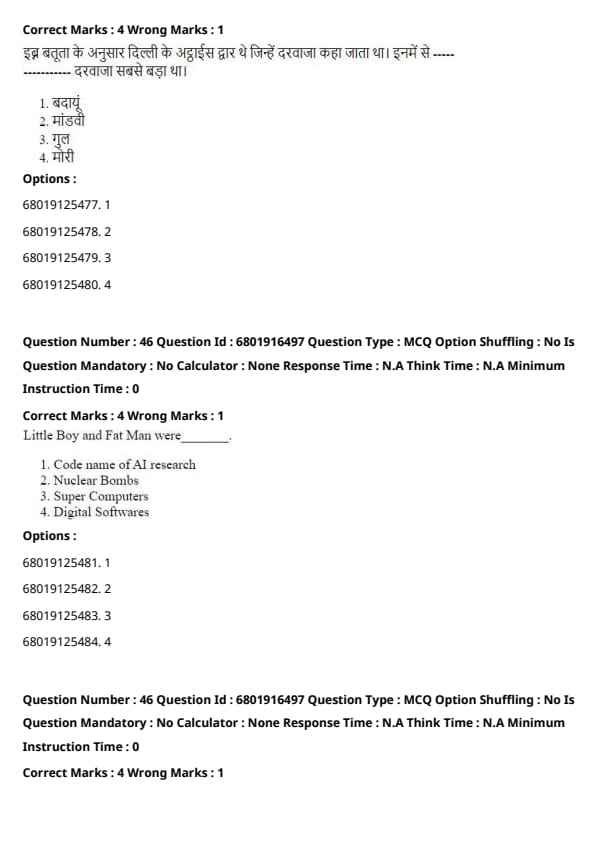
Question 45:
According to Ibn Battuta, there were twenty-eight gates of Delhi, called Darwazas. Which one was the greatest?
View Solution
Solution: The Budaun Darwaza, as noted by Ibn Battuta, was the largest and most prominent among Delhi's gates during the Sultanate period.
Quick Tip: Ibn Battuta's travelogue provides rich descriptions of medieval Delhi's architecture.
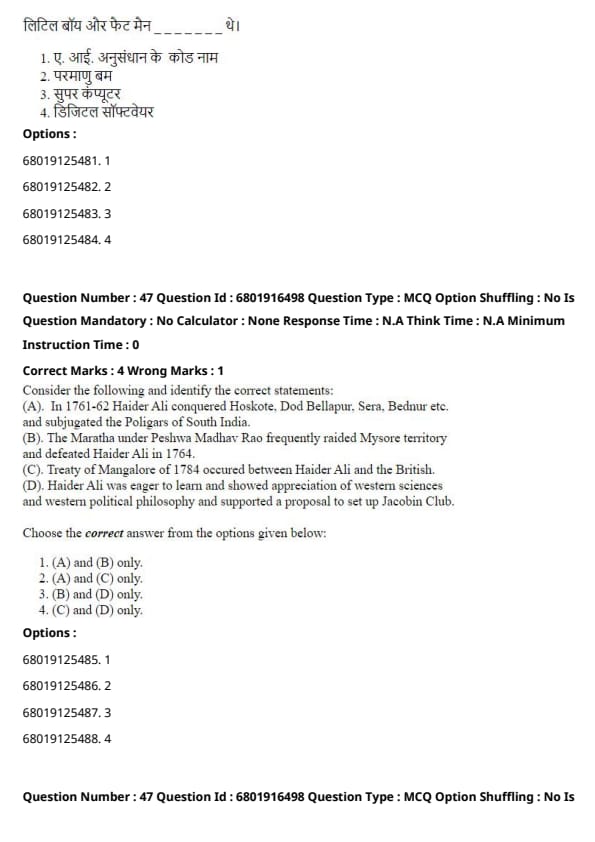
Question 46:
Little Boy and Fat Man were:
View Solution
Solution: Little Boy and Fat Man were the code names for the atomic bombs dropped on Hiroshima and Nagasaki, respectively, during World War II.
Quick Tip: Study key events of World War II to understand their global impact.
Question 47:
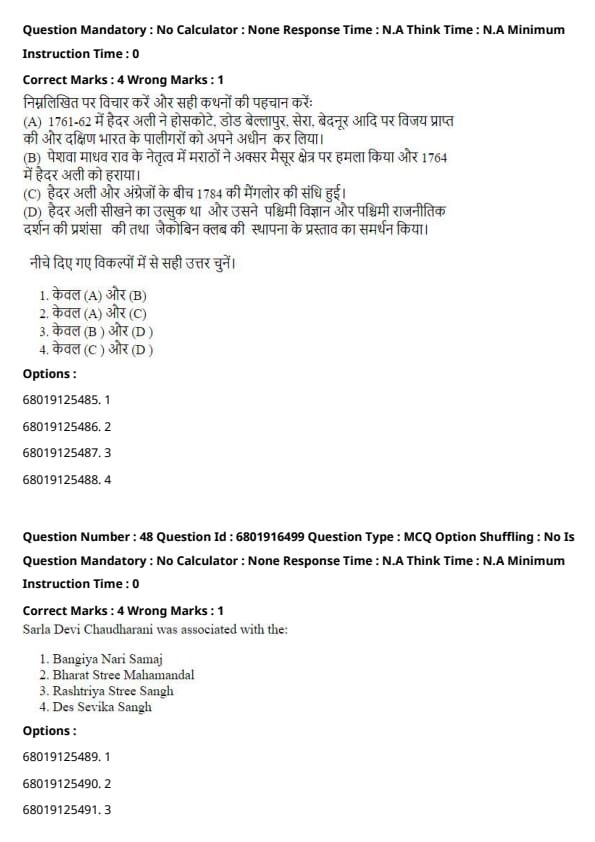
Consider the following and identify the correct statements:
(A) In 1761-62, Haider Ali conquered territories like Hoskote and Sera and subdued the Poligars.
(B) The Marathas under Madhav Rao defeated Haider Ali in 1764.
(C) The Treaty of Mangalore in 1784 occurred between Haider Ali and the British.
(D) Haider Ali appreciated western sciences and supported the establishment of a Jacobin Club.
View Solution
Solution: Statement (C) is incorrect as the Treaty of Mangalore was between Tipu Sultan (Haider Ali's son) and the British. Haider Ali's strategic and military expansions are highlighted in statements (A) and (B).
Quick Tip: Differentiate between Haider Ali and Tipu Sultan's treaties and conflicts.
Question 48:
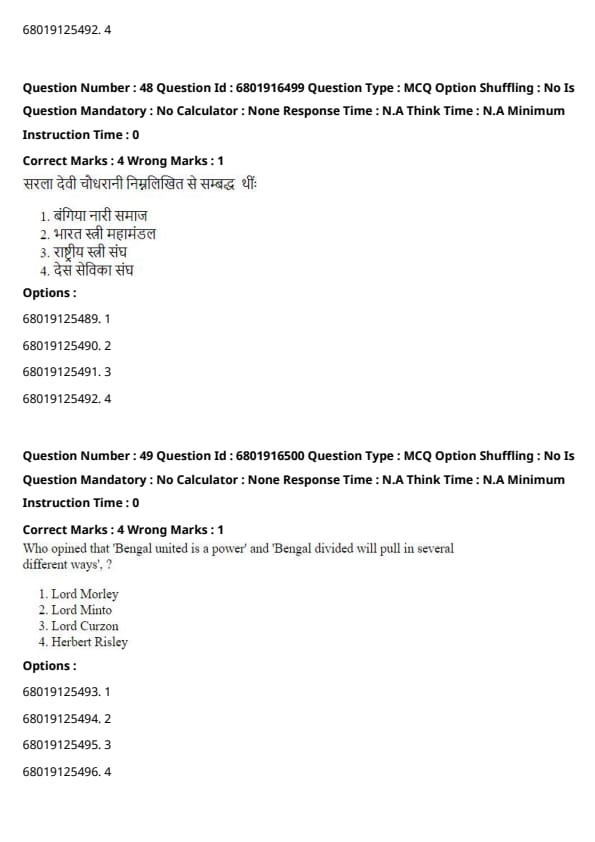
Sarla Devi Chaudharani was associated with the:
View Solution
Solution: Sarla Devi Chaudharani was an early feminist who established the Bharat Stree Mahamandal in 1910 to promote women's education and rights.
Quick Tip: Learn about key women's movements and their leaders in Indian history.
Question 49:
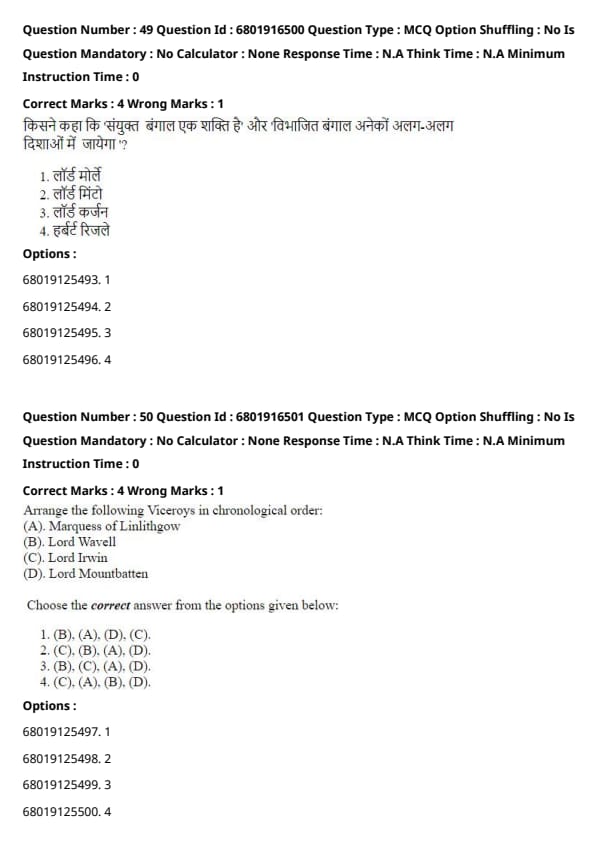
Who opined that 'Bengal united is a power' and 'Bengal divided will pull in several different ways'?
View Solution
Solution: This statement was made by Lord Curzon, architect of the Partition of Bengal (1905), highlighting his divisive policies to weaken nationalist sentiment.
Quick Tip: Understand the political implications of the Partition of Bengal and the Swadeshi movement.
Question 50:
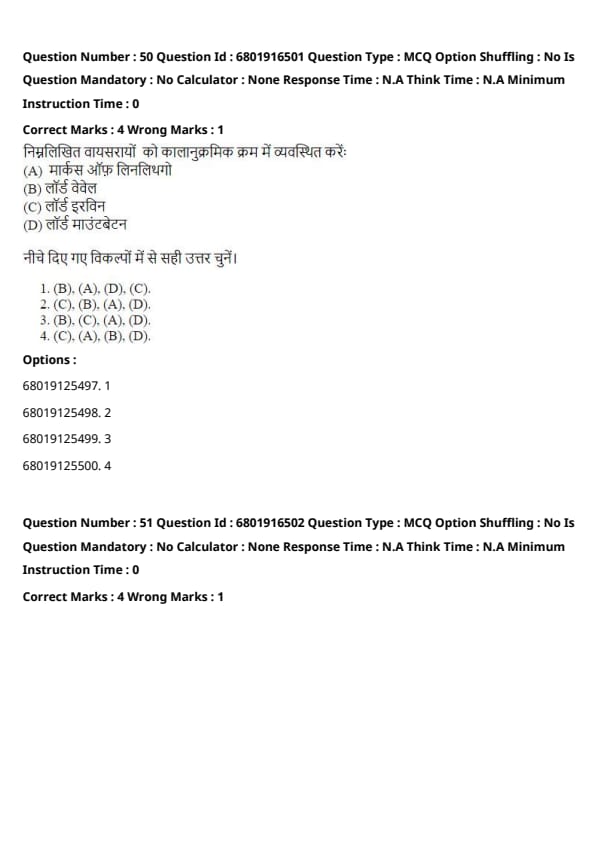
Arrange the following Viceroys in chronological order:
(A) Marquess of Linlithgow
(B) Lord Wavell
(C) Lord Irwin
(D) Lord Mountbatten
View Solution
Solution: The chronological order is as follows: Lord Irwin (1926–31), Marquess of Linlithgow (1936–43), Lord Wavell (1943–47), and Lord Mountbatten (1947–48).
Quick Tip: Chronology of Viceroys is essential for understanding British policies in India.
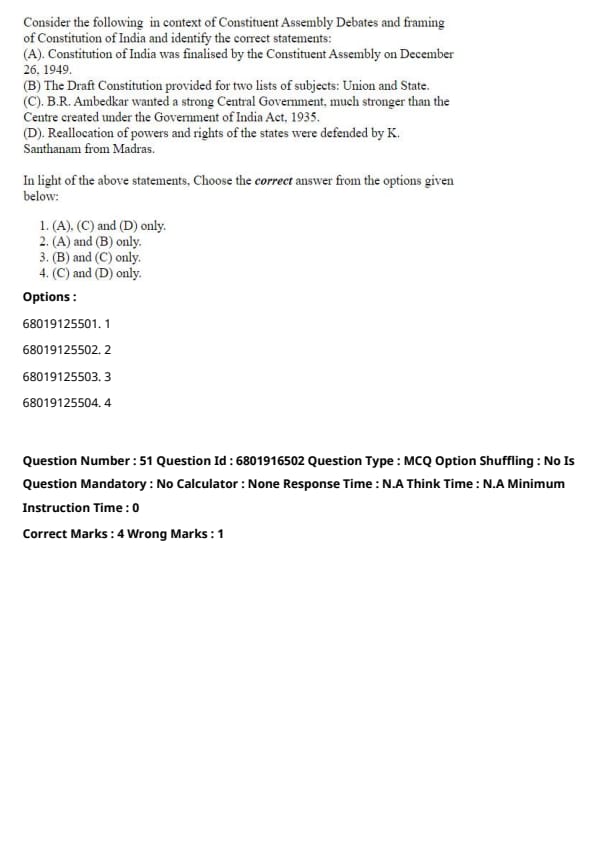
Question 51:
Consider the following statements about the Constituent Assembly Debates:
(A) Constitution of India was finalized on December 26, 1949.
(B) The Draft Constitution had two lists of subjects: Union and State.
(C) B.R. Ambedkar wanted a strong Central Government, stronger than the 1935 Act.
(D) K. Santhanam defended the states' rights in the debates.
View Solution
Solution: Statement (A) is incorrect as the Constitution was finalized on November 26, 1949. Statement (B) oversimplifies the federal structure outlined in the Draft Constitution.
Quick Tip: Focus on key debates in the framing of the Indian Constitution.
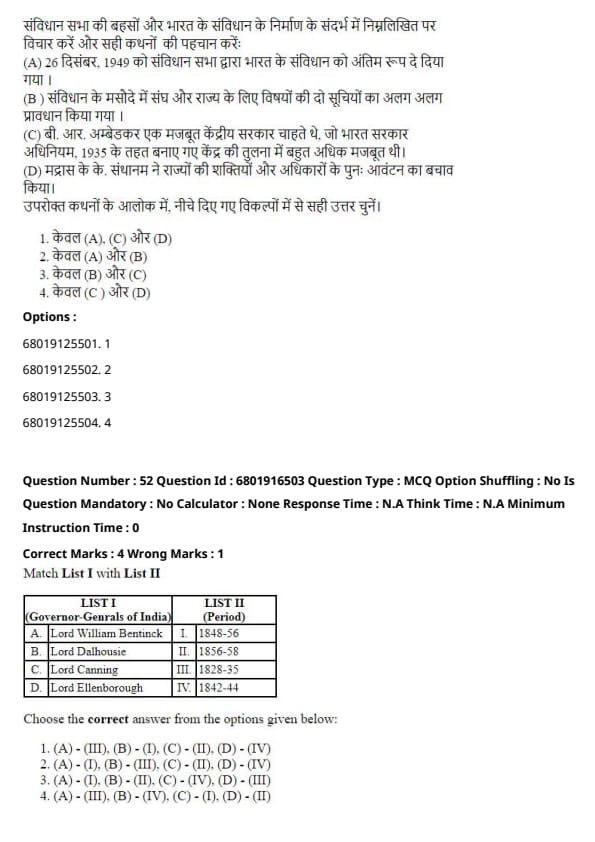
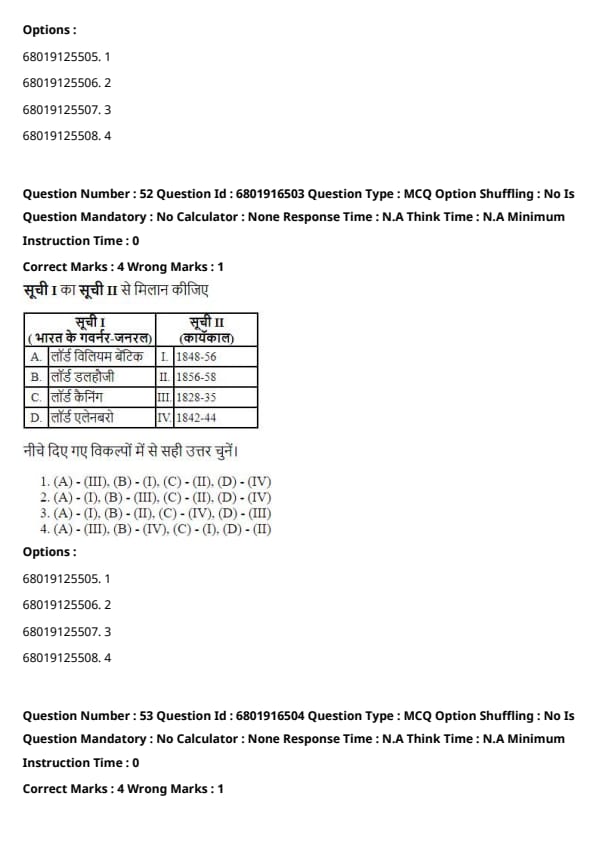
Question 52:
Match List I with List II:
| List-I Governor-Generals of India |
List-II Period |
|---|---|
| A. Lord William Bentinck | III. 1828–35 |
| B. Lord Dalhousie | I. 1848–56 |
| C. Lord Canning | II. 1856–58 |
| D. Lord Ellenborough | IV. 1842–44 |
Choose the correct answer from the options given below:
View Solution
Solution: Lord William Bentinck (1828–35) focused on social reforms. Lord Dalhousie (1848–56) introduced the Doctrine of Lapse. Lord Canning (1856–58) was the last Governor-General of India. Lord Ellenborough (1842–44) dealt with the First Afghan War.
Quick Tip: Focus on the reforms and policies of each Governor-General.
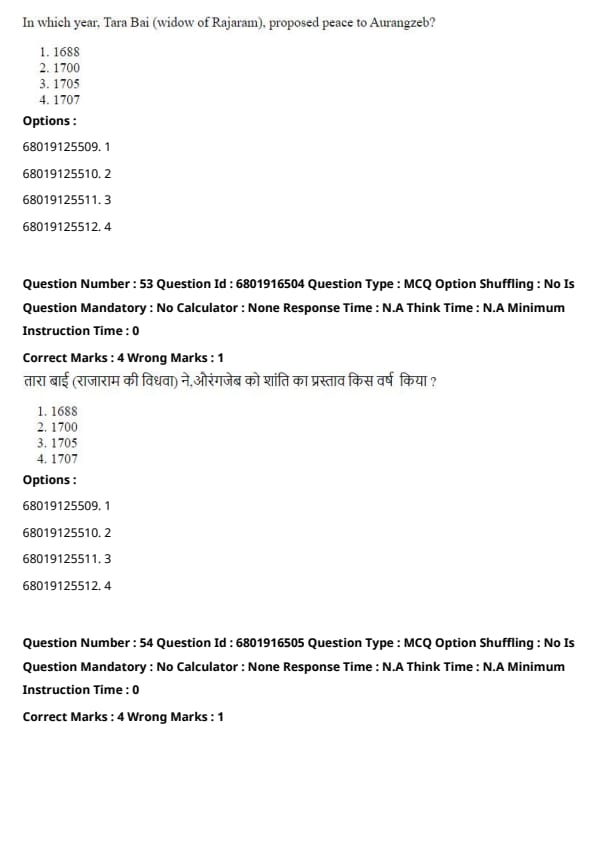
Question 53:
In which year did Tara Bai (widow of Rajaram) propose peace to Aurangzeb?
View Solution
Solution: Tara Bai led the Marathas after Rajaram's death in 1700 and proposed peace to Aurangzeb during this year to consolidate her position.
Quick Tip: Understand the timeline of Maratha resistance against Aurangzeb.
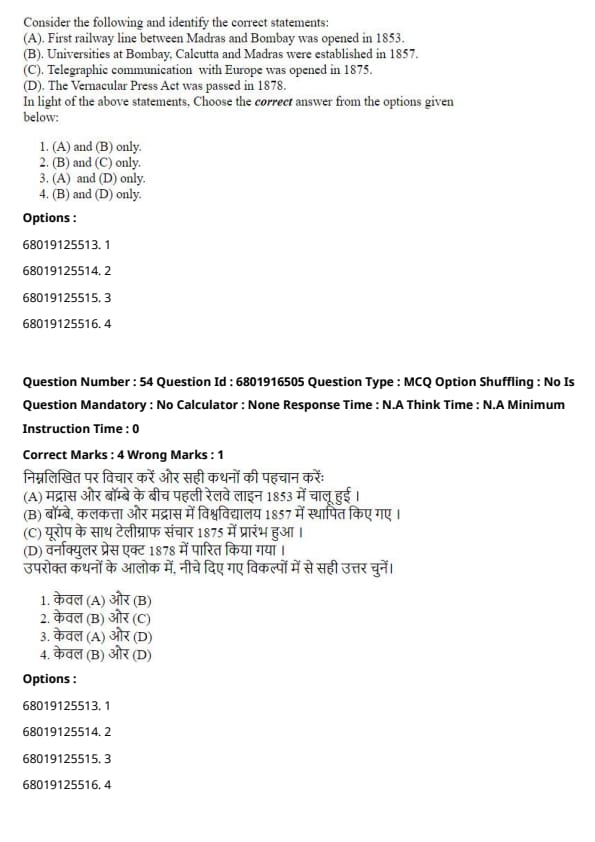
Question 54:
Consider the following and identify the correct statements:
(A) First railway line between Madras and Bombay was opened in 1853.
(B) Universities at Bombay, Calcutta, and Madras were established in 1857.
(C) Telegraphic communication with Europe was opened in 1875.
(D) The Vernacular Press Act was passed in 1878.
View Solution
Solution: Statement (A) is incorrect as the first railway line was between Bombay and Thane in 1853. Statements (B) and (D) are accurate, while (C) is incorrect as telegraph communication with Europe began in 1865.
Quick Tip: Memorize major events in the modernization of India during British rule.
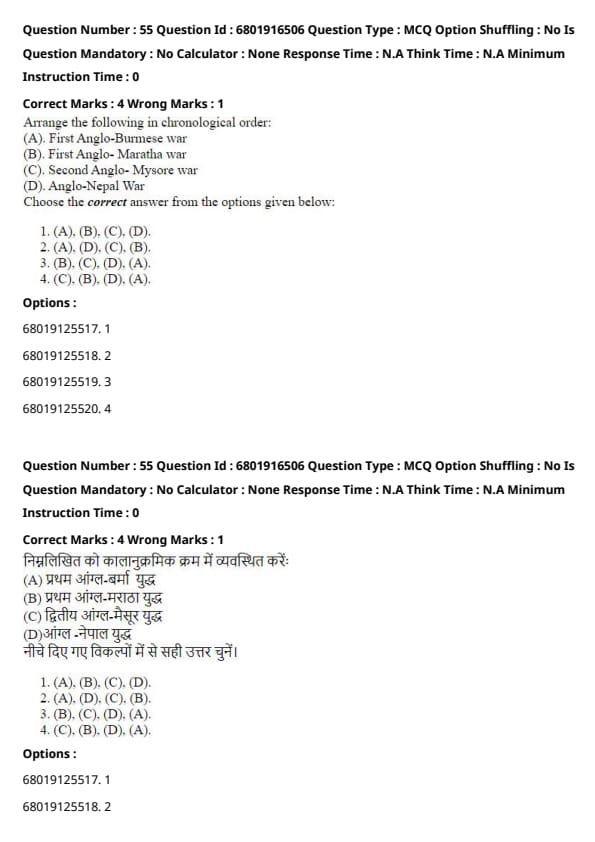
Question 55:
Arrange the following in chronological order:
(A) First Anglo-Burmese War
(B) First Anglo-Maratha War
(C) Second Anglo-Mysore War
(D) Anglo-Nepal War
View Solution
Solution:Chronology: First Anglo-Maratha War (1775–82), Second Anglo-Mysore War (1780–84), Anglo-Nepal War (1814–16), and First Anglo-Burmese War (1824–26).
Quick Tip: Organize Anglo wars by region for better recall of sequences.
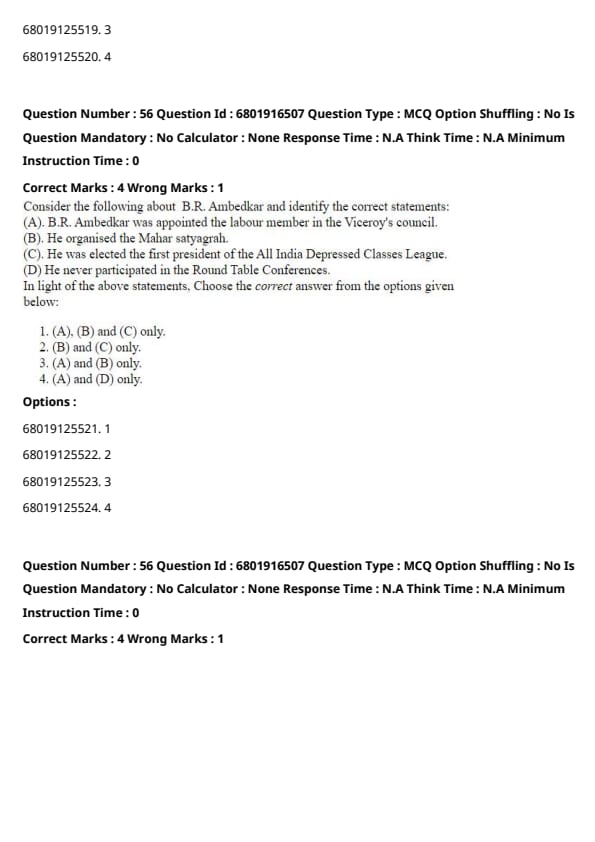
Question 56:
Consider the following about B.R. Ambedkar and identify the correct statements:
(A) B.R. Ambedkar was appointed the labour member in the Viceroy's council.
(B) He organised the Mahar Satyagraha.
(C) He was elected the first president of the All India Depressed Classes League.
(D) He never participated in the Round Table Conferences.
View Solution
Solution: Statement (A) is true; Ambedkar was appointed to the Viceroy's Executive Council as the Labour Member. Statement (B) is true; he organized the Mahar Satyagraha in 1927. Statement (C) is incorrect; he founded the Independent Labour Party but not the All India Depressed Classes League. Statement (D) is incorrect; Ambedkar participated in all three Round Table Conferences.
Quick Tip: Focus on Ambedkar's contributions to social reforms and political participation.
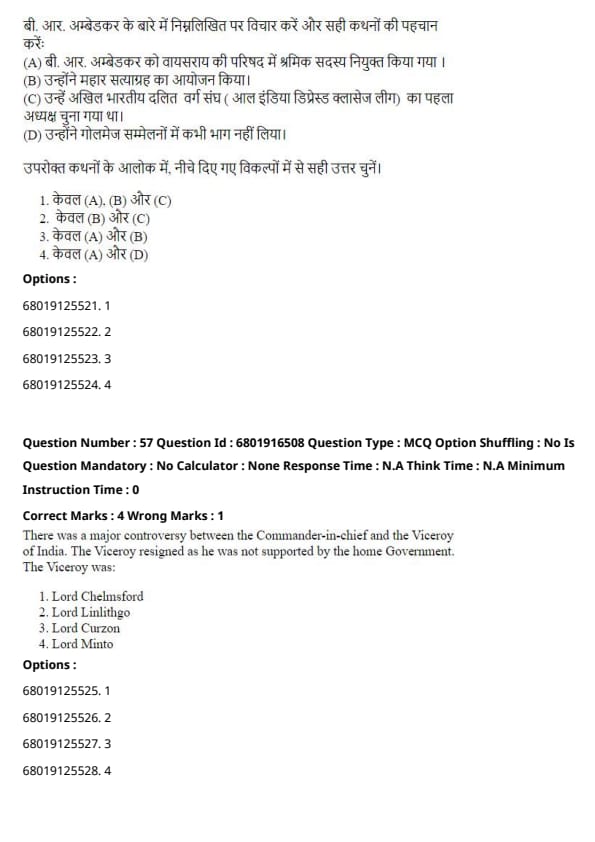
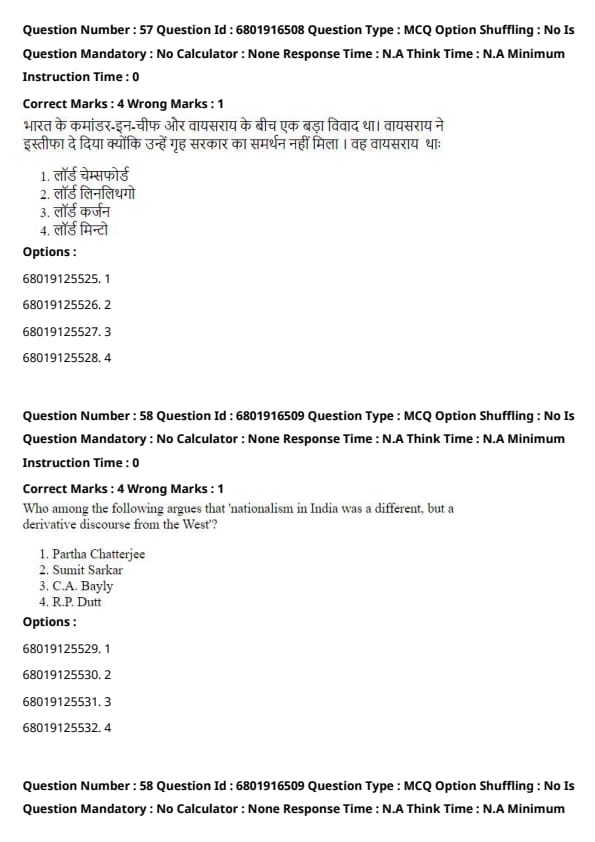
Question 57:
There was a major controversy between the Commander-in-Chief and the Viceroy of India. The Viceroy resigned as he was not supported by the home Government. The Viceroy was:
View Solution
Solution: The controversy revolved around the control of the military. Curzon clashed with Kitchener, the Commander-in-Chief, over administrative authority. The lack of support from London forced Curzon to resign in 1905.
Quick Tip: Understand the administrative challenges faced by Viceroys.
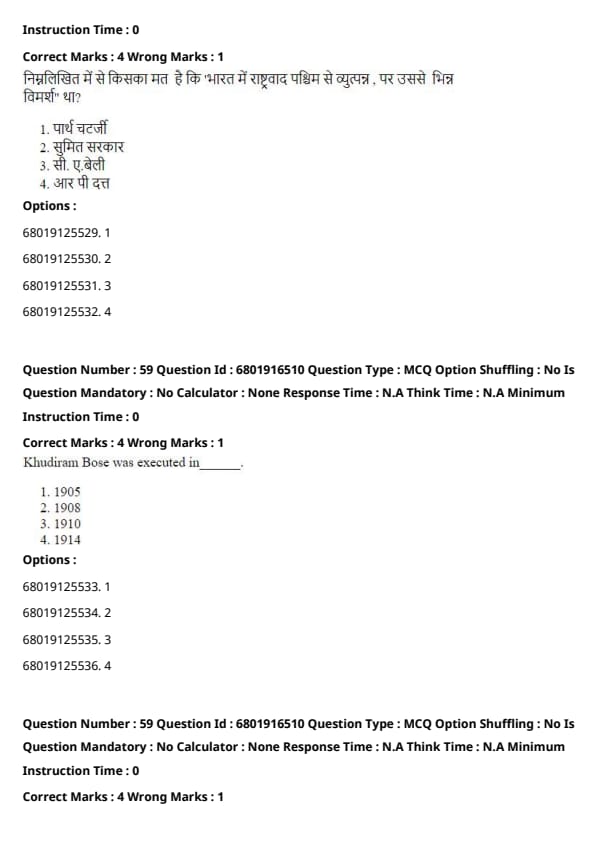
Question 58:
Who among the following argues that 'nationalism in India was a different, but a derivative discourse from the West'?
View Solution
Solution: Partha Chatterjee, in his works, argues that Indian nationalism borrowed from Western ideas but created its unique identity within the colonial context.
Quick Tip: Focus on key authors and their views on Indian nationalism.
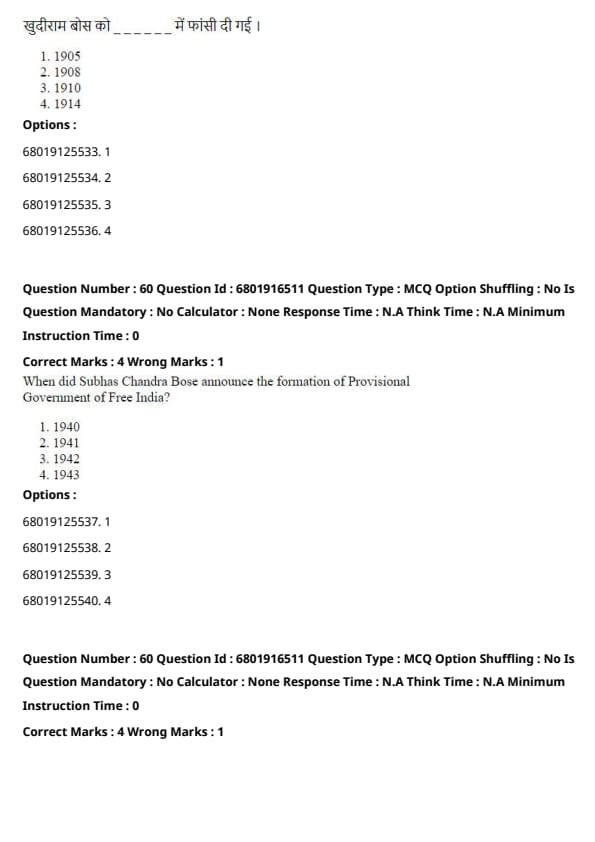
Question 59:
Khudiram Bose was executed in:
View Solution
Solution: Khudiram Bose was hanged on August 11, 1908, for his involvement in the Muzaffarpur Conspiracy case.
Quick Tip: Remember key events of early revolutionary movements.
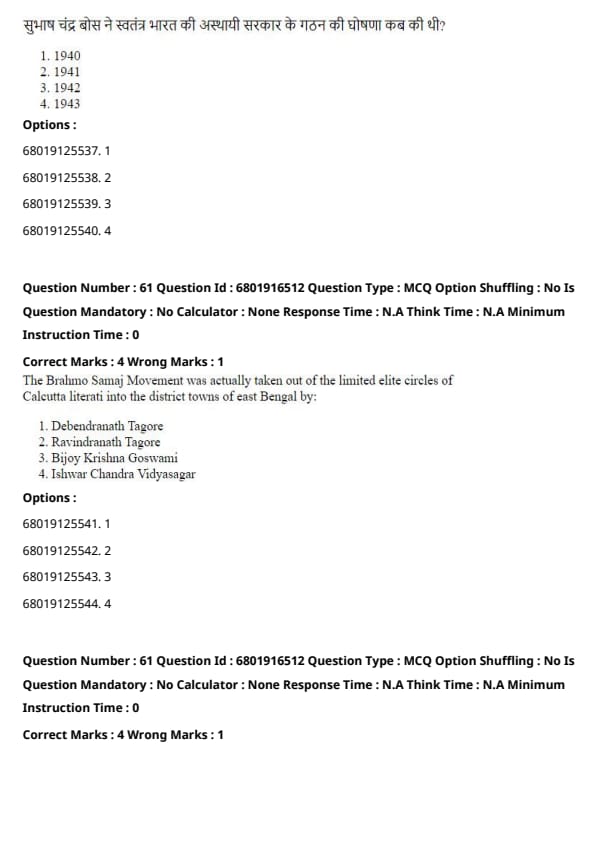
Question 60:
When did Subhas Chandra Bose announce the formation of the Provisional Government of Free India?
View Solution
Solution: Subhas Chandra Bose announced the establishment of the Provisional Government of Free India on October 21, 1943, in Singapore.
Quick Tip: Understand Bose's contributions to the Indian freedom struggle.
Question 61:
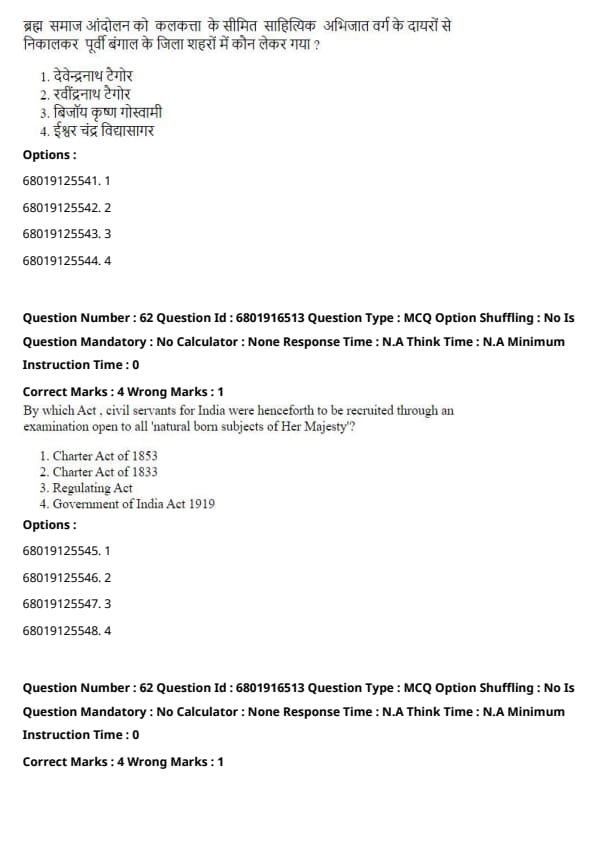
The Brahmo Samaj Movement was actually taken out of the limited elite circles of Calcutta literati into the district towns of East Bengal by:
View Solution
Solution: Bijoy Krishna Goswami played a key role in spreading the Brahmo Samaj Movement to towns beyond Calcutta, making it accessible to a broader audience in East Bengal.
Quick Tip: Focus on contributions of prominent individuals in social reform movements.
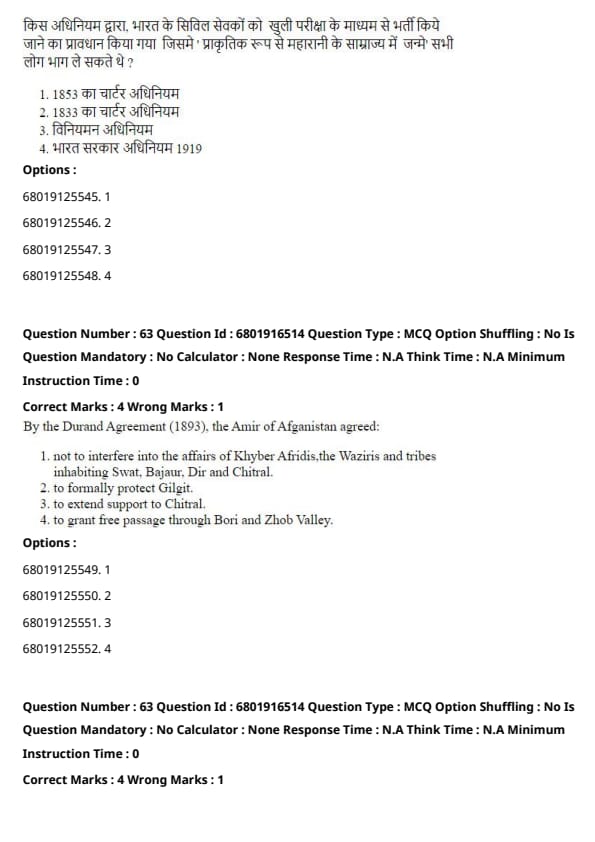
Question 62:
By which Act were civil servants for India henceforth to be recruited through an examination open to all 'natural born subjects of Her Majesty'?
View Solution
Solution: The Charter Act of 1853 introduced open competition for recruitment into the Indian Civil Service, breaking the monopoly of the East India Company.
Quick Tip: Understand key legislative changes introduced by the Charter Acts.
Question 63:
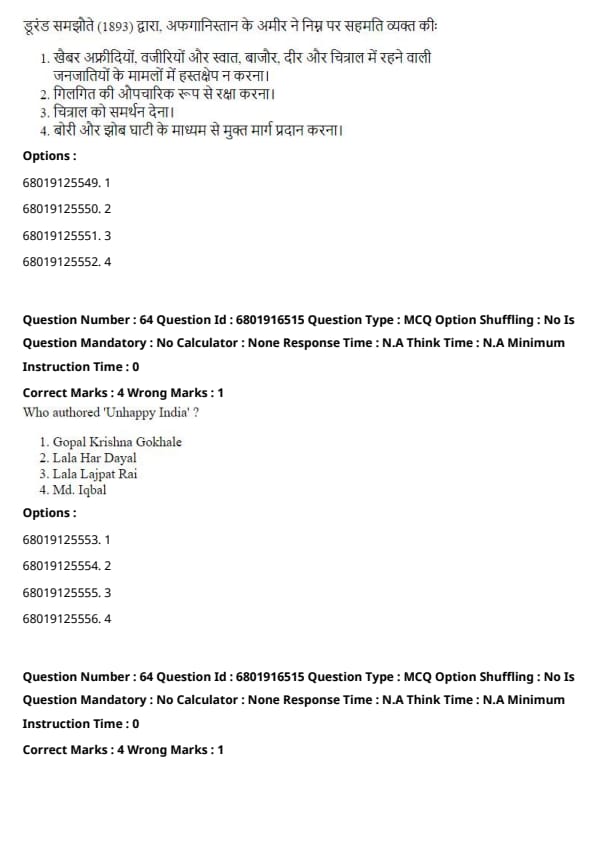
By the Durand Agreement (1893), the Amir of Afghanistan agreed:
View Solution
Solution: The Durand Agreement demarcated the boundary between British India and Afghanistan and restricted Afghan influence in certain tribal regions.
Quick Tip: Understand the geopolitical implications of the Durand Line.
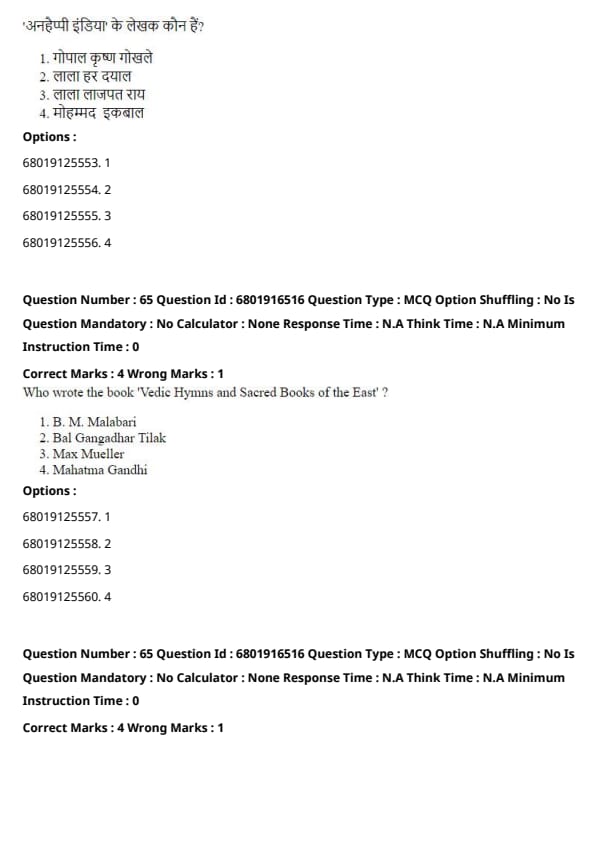
Question 64:
Who authored 'Unhappy India'?
View Solution
Solution: Lala Lajpat Rai wrote 'Unhappy India' as a critique of British policies and their impact on Indian society.
Quick Tip: Remember the contributions of prominent nationalist leaders to Indian literature.
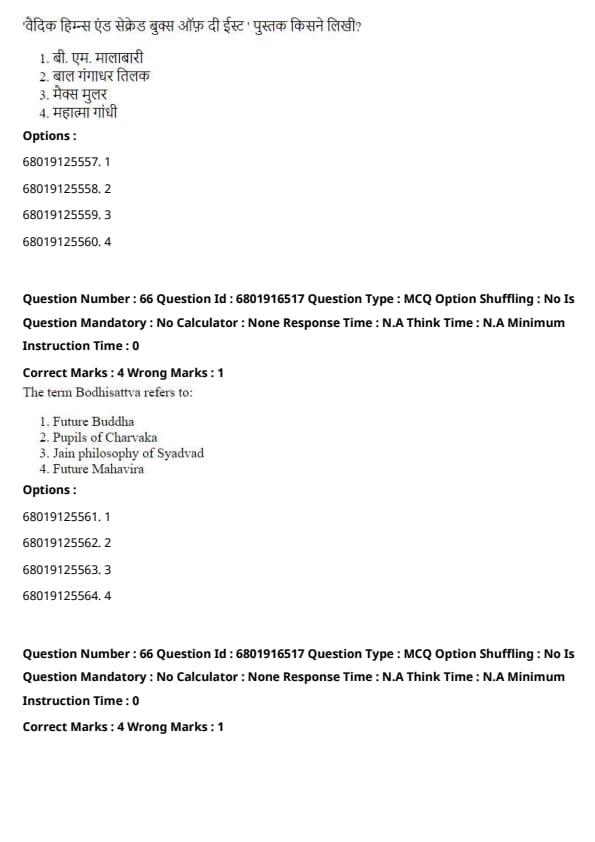
Question 65:
Who wrote the book "Vedic Hymns and Sacred Books of the East"?
View Solution
Solution: Max Mueller was a German scholar who translated and edited significant works related to Indian philosophy and spirituality.
Quick Tip: Focus on contributions of Western scholars to Indian studies.
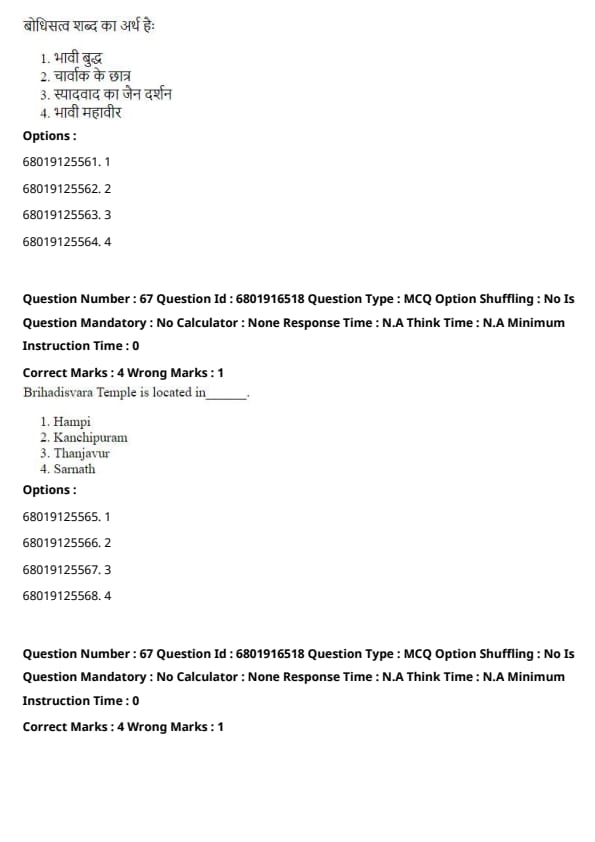
Question 66:
The term Bodhisattva refers to:
View Solution
Solution:A Bodhisattva is an enlightened being who delays entry into Nirvana to help others attain enlightenment.
Quick Tip:Understand key terms in Buddhist philosophy
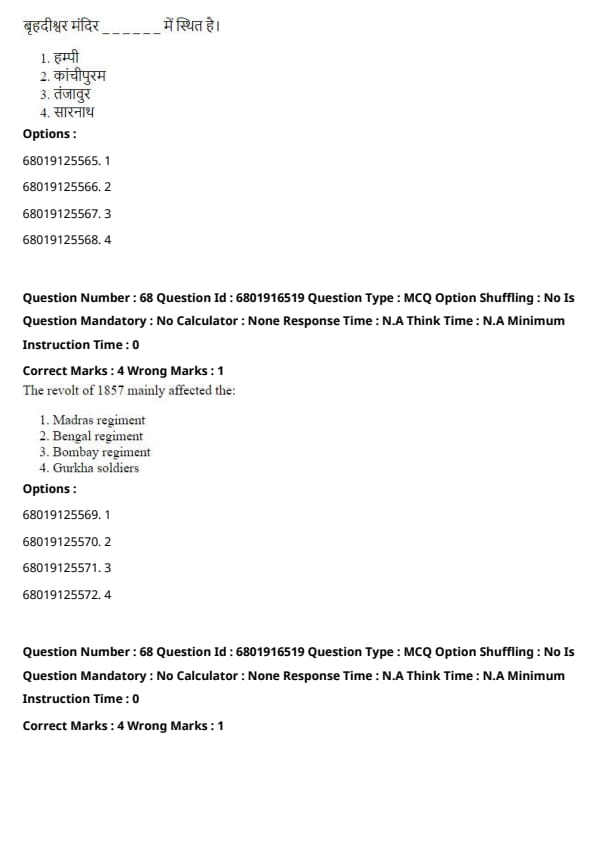
Question 67:
Brihadisvara Temple is located in:
View Solution
Solution:The Brihadisvara Temple, built by Raja Raja Chola I, is a UNESCO World Heritage Site.
Quick Tip:Focus on iconic architectural achievements of Indian dynasties.
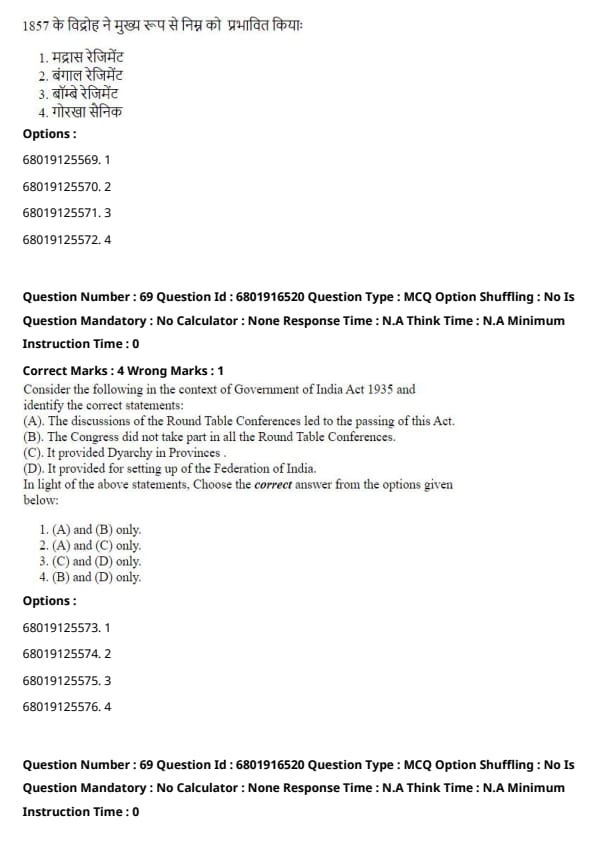
Question 68:
The revolt of 1857 mainly affected the:
View Solution
Solution:The Bengal Regiment was at the forefront of the Sepoy Mutiny due to grievances related to pay, conditions, and cultural insensitivity.
Quick Tip:Study the impact of the 1857 revolt on different sections of the military.
Question 69:
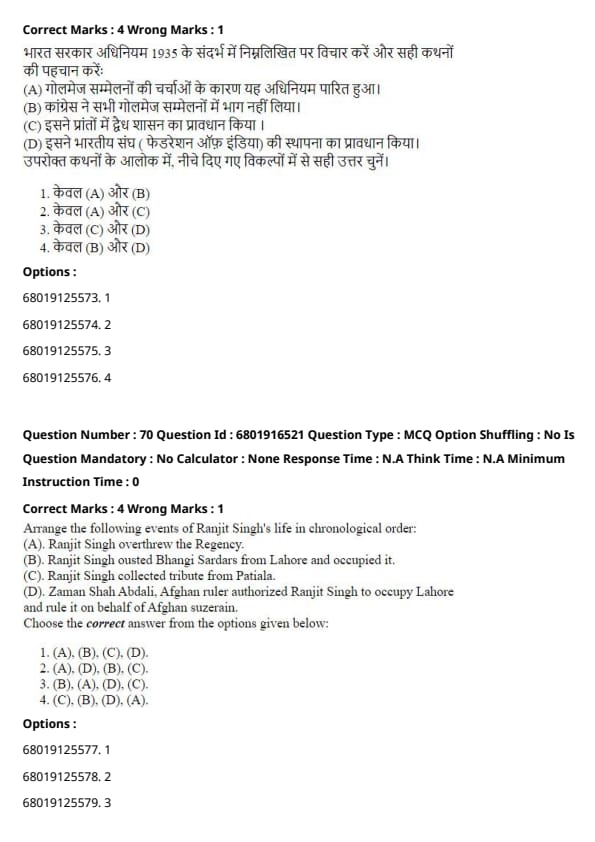
Consider the following in the context of Government of India Act 1935 and identify the correct statements:
(A) The discussions of the Round Table Conferences led to the passing of this Act.
(B) The Congress did not take part in all the Round Table Conferences.
(C) It provided Dyarchy in Provinces.
(D) It provided for setting up of the Federation of India.
View Solution
Solution:- Dyarchy was introduced at the provincial level under the Government of India Act 1935. - The Act also aimed to establish a federation, though it was never fully implemented.
Quick Tip: Focus on the provisions of the Government of India Acts.
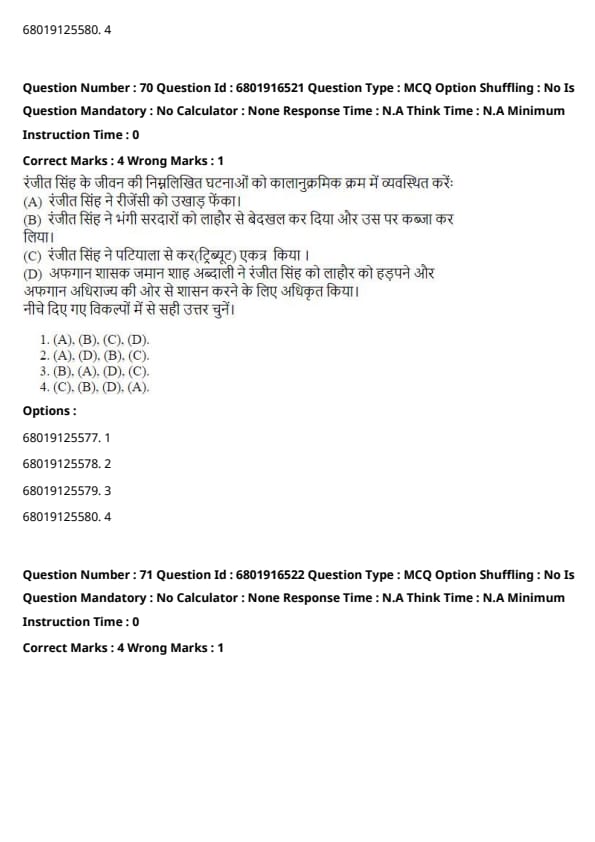
Question 70:
Arrange the following events of Ranjit Singh's life in chronological order:
(A) Ranjit Singh overthrew the Regency.
(B) Ranjit Singh ousted Bhangi Sardars from Lahore and occupied it.
(C) Ranjit Singh collected tribute from Patiala.
(D) Zaman Shah Abdali, Afghan ruler, authorized Ranjit Singh to occupy Lahore and rule it on behalf of Afghan suzerain.
View Solution
Solution:- Ranjit Singh consolidated his rule by overthrowing the Regency and securing authorization from Zaman Shah Abdali before conquering Lahore and expanding his influence.
Quick Tip:Chronology is key for historical events; keep timelines clear.
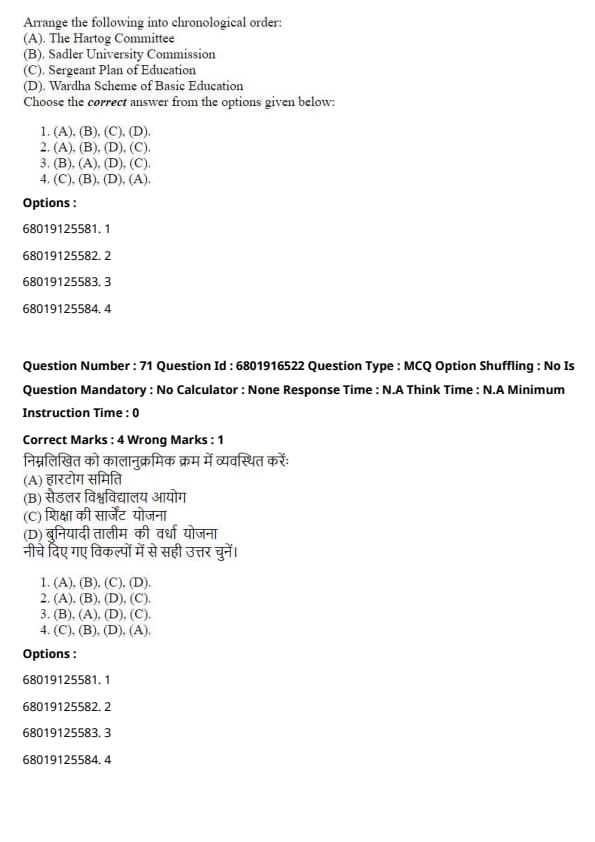
Question 71:
Arrange the following into chronological order:
(A) The Hartog Committee
(B) Sadler University Commission
(C) Sergeant Plan of Education
(D) Wardha Scheme of Basic Education
View Solution
Solution: The chronological order is as follows: Sadler University Commission (1917-19), Hartog Committee (1929), Wardha Scheme of Basic Education (1937), and Sergeant Plan of Education (1944).
Quick Tip: Remember the timeline of educational reforms during British India.
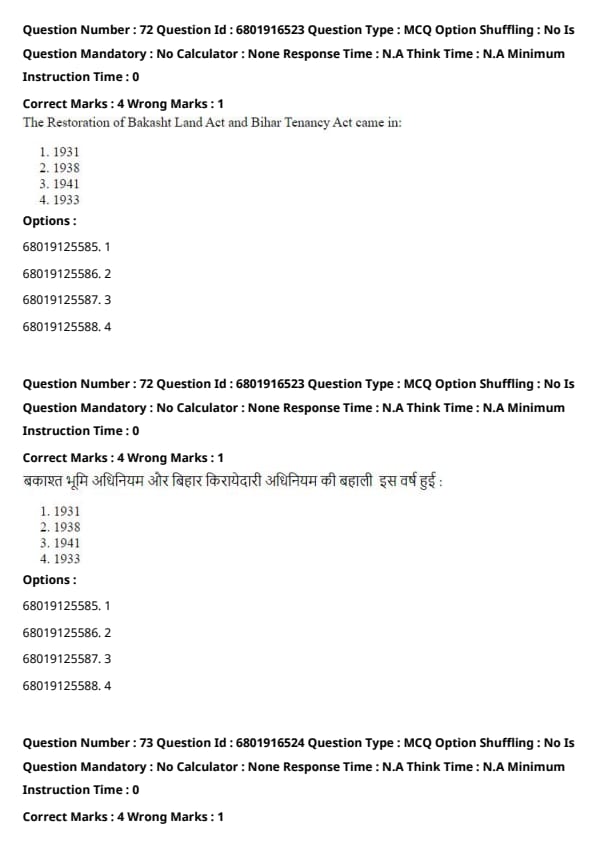
Question 72:
The Restoration of Bakasht Land Act and Bihar Tenancy Act came in:
View Solution
Solution: These acts were passed in 1938 as part of the efforts to address agrarian issues in Bihar under the Congress ministries.
Quick Tip: Link legislative reforms to the socio-political context of their time.
Question 73:
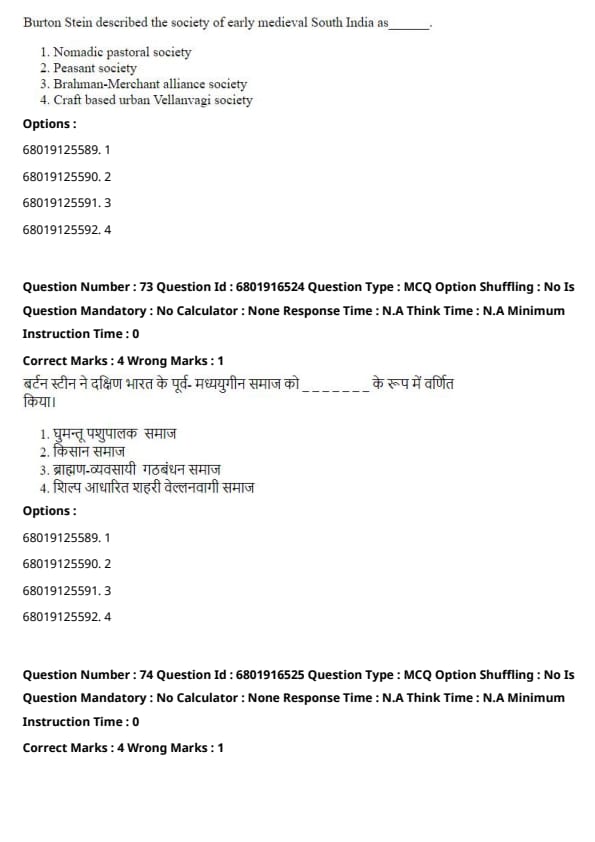
Burton Stein described the society of early medieval South India as:
View Solution
Solution: Burton Stein characterized early medieval South India as a peasant society where the agrarian economy played a pivotal role.
Quick Tip: Focus on the historiographical interpretations of South Indian history.
Question 74:
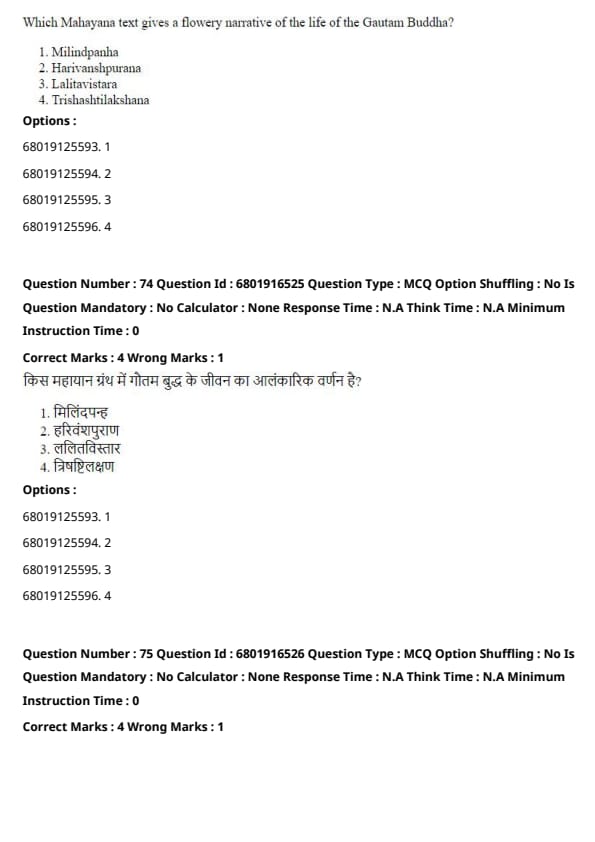
Which Mahayana text gives a flowery narrative of the life of the Gautama Buddha?
View Solution
Solution: The Lalitavistara is a Mahayana Buddhist text that provides an elaborate and poetic account of the Buddha's life.
Quick Tip: Understand the importance of religious texts in providing insights into cultural narratives.
Question 75:
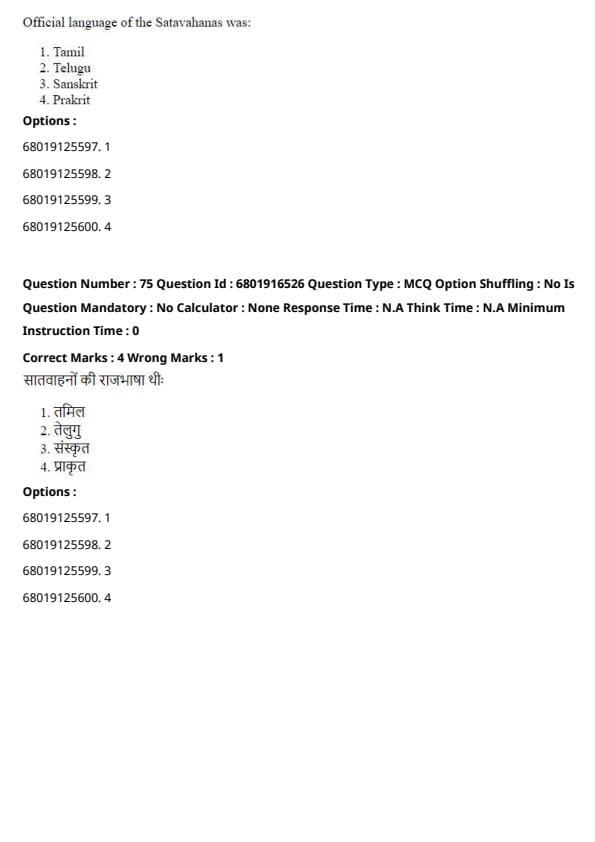
Official language of the Satavahanas was:
View Solution
Solution: The Satavahanas used Prakrit as their official language, evident from their inscriptions and records.
Quick Tip: Focus on linguistic aspects of ancient Indian dynasties for better historical understanding.
*The article might have information for the previous academic years, please refer the official website of the exam.