CUET PG 2024 LLM Question Paper Pdf- Check Solutions with Answer Key Pdf
- Question Paper 2025
- Question Paper 2024
- Question Paper 2023
- Mathematics Papers
- Statistics Question Paper
- English Question Paper
- Chemistry Question Paper
- Pol. Sci. Question Paper
- History Question Paper
- Commerce Question Papers
- Life Science Papers
- Geology Question Papers
- Journalism Question Paper
- B.Ed. HSS Question Paper
- Botany Question Paper
- B.Ed. Question Papers


Content Strategist | Updated On - Jan 15, 2025
CUET PG 2024 LLM 20th March 2024 Shift 2 Question Paper with Solution PDF is available for download here. Students found the Constitutional Law section easy, Jurisprudence and International Law moderate, and Law of Contracts topics difficult. The Law of Contracts section carried the highest weightage, and the overall difficulty level was moderate to difficult.
CUET PG 2024 LLM Question Paper with Answer Key PDF
| CUET PG 2024 LLM Question Paper with Answer Key |  Download Download |
Check Solution |
LLM 2024 Questions with Solutions
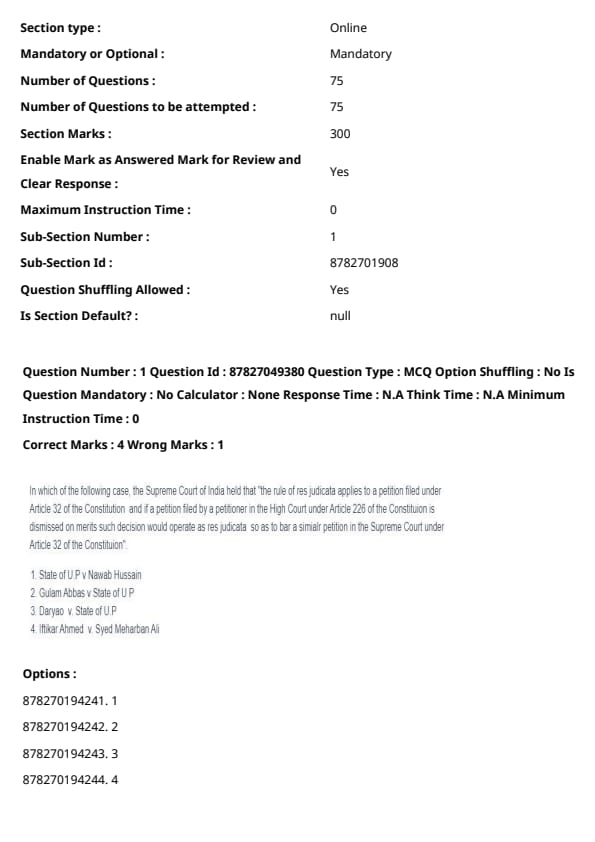
Question 1:
In which of the following case, the Supreme Court of India held that “the rule of res judicata applies to a petition filed under Article 32 of the Constitution and if a petition filed by a petitioner in the High Court under Article 226 of the Constitution is dismissed on merits such decision would operate as res judicata so as to bar a similar petition in the Supreme Court under Article 32 of the Constitution”?
View Solution
In the landmark case of Daryao v. State of U.P., the Supreme Court of India established that the principle of res judicata applies to petitions filed under Article 32 of the Constitution. This means that if a petition under Article 226 has been dismissed on its merits by the High Court, a similar petition in the Supreme Court under Article 32 would be barred by the doctrine of res judicata. This ensures finality and prevents repeated litigation on the same cause of action.
Key Takeaway: Daryao v. State of U.P. is crucial for understanding the application of res judicata to petitions under Article 32 following a decision on merits under Article 226.
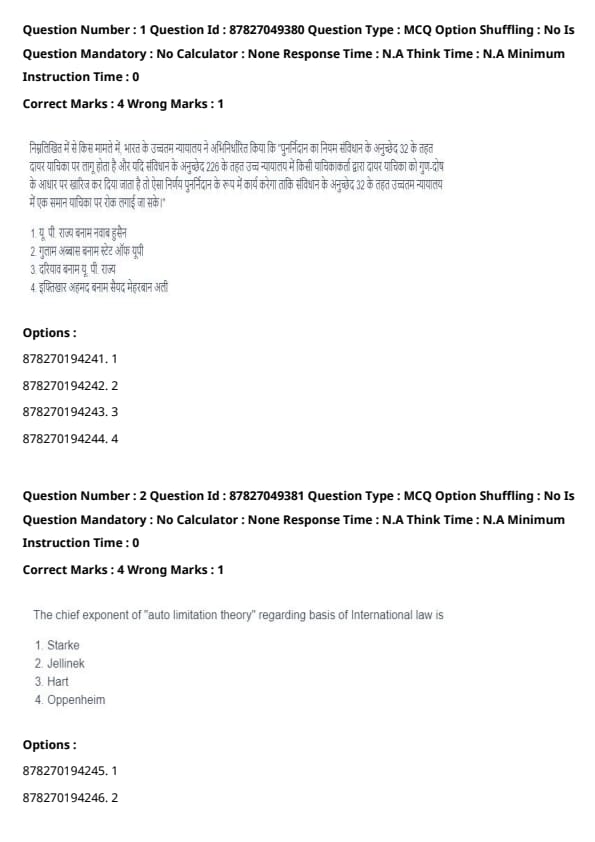
Question 2:
The chief exponent of “auto-limitation theory” regarding the basis of International law is:
View Solution
The “auto-limitation theory” posits that the basis of international law lies in the self-imposed limitations of sovereign states. According to this theory, a state’s sovereignty is the source of all legal obligations, and the state limits its own power by consenting to be bound by international law. The chief exponent of this theory is Georg Jellinek, who argued that states are free actors but voluntarily accept limitations to ensure stability and coexistence.
Key Takeaway: Georg Jellinek is associated with the auto-limitation theory, emphasizing the voluntary acceptance of international legal norms by sovereign states.
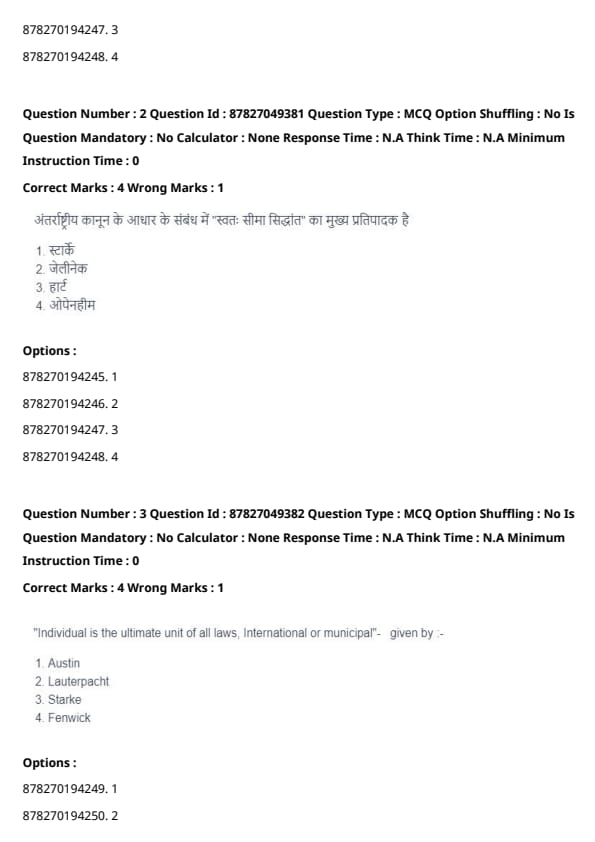
Question 3:
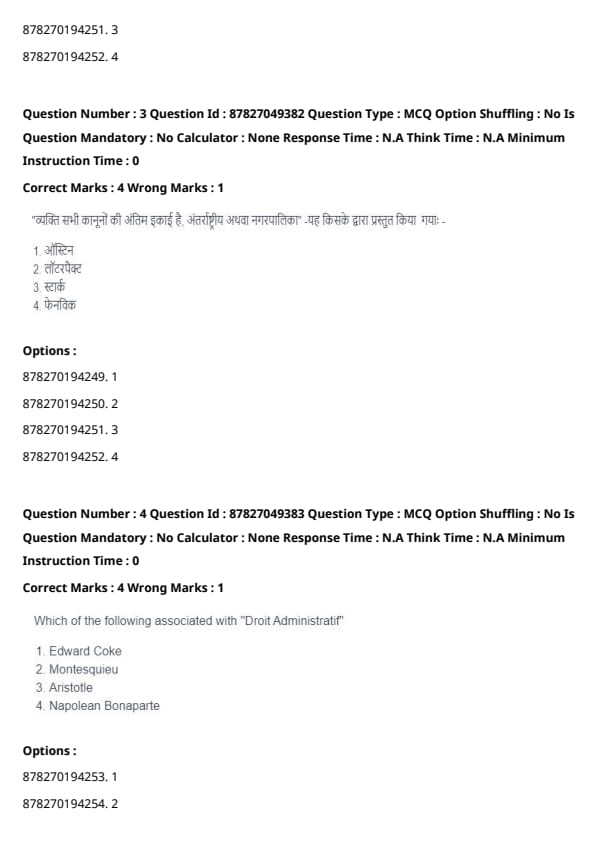
“Individual is the ultimate unit of all laws, International or municipal” - given by:
View Solution
This concept is most famously associated with Hersch Lauterpacht. He emphasized the centrality of the individual in legal frameworks, asserting that the individual is the ultimate unit of all laws, whether international or municipal. While other thinkers like Austin, Starke, and Fenwick have contributed significantly to legal theory, Lauterpacht’s focus on the individual stands out.
Key Takeaway: Lauterpacht's work highlights the importance of the individual as the focal point of legal systems.
Question 4:
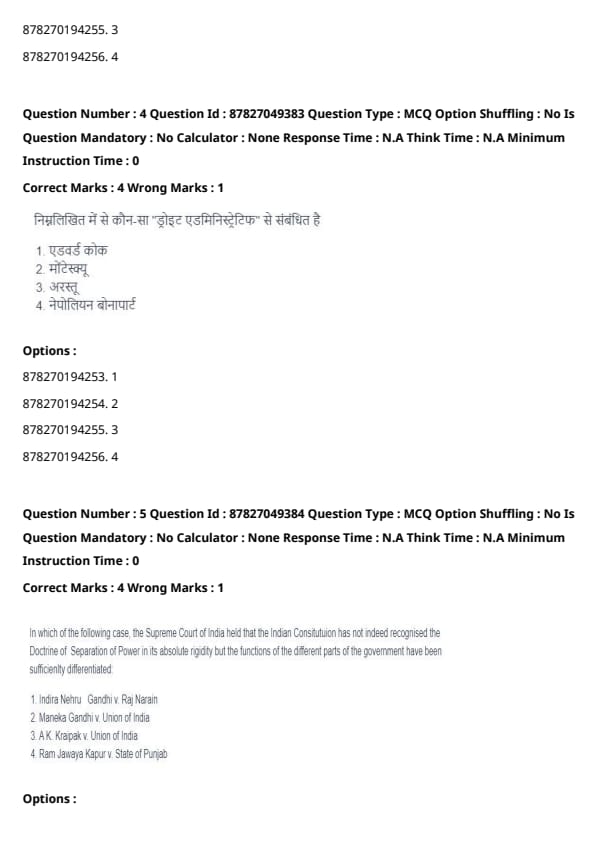
Which of the following is associated with “Droit Administratif”?
View Solution
The concept of “Droit Administratif,” a specialized body of rules governing the actions of public administration, is closely associated with the legal and political system of France. Napoleon Bonaparte played a significant role in its establishment, particularly with the introduction of the Conseil d’État, a cornerstone of the French administrative system.
Key Takeaway: Napoleon Bonaparte and his reforms are integral to the development of Droit Administratif.
Question 5:
In which of the following case, the Supreme Court of India held that the Indian Constitution has not indeed recognized the Doctrine of Separation of Power in its absolute rigidity but the functions of the different parts of the government have been sufficiently differentiated?
View Solution
In Ram Jawaya Kapur v. State of Punjab, the Supreme Court discussed the doctrine of separation of powers within the Indian constitutional framework. The court clarified that the Constitution doesn’t adopt a rigid separation of powers but provides for a functional differentiation among the legislative, executive, and judicial branches, ensuring their distinctive roles.
Key Takeaway: The Indian Constitution embraces functional differentiation of powers rather than absolute separation.
Question 6:
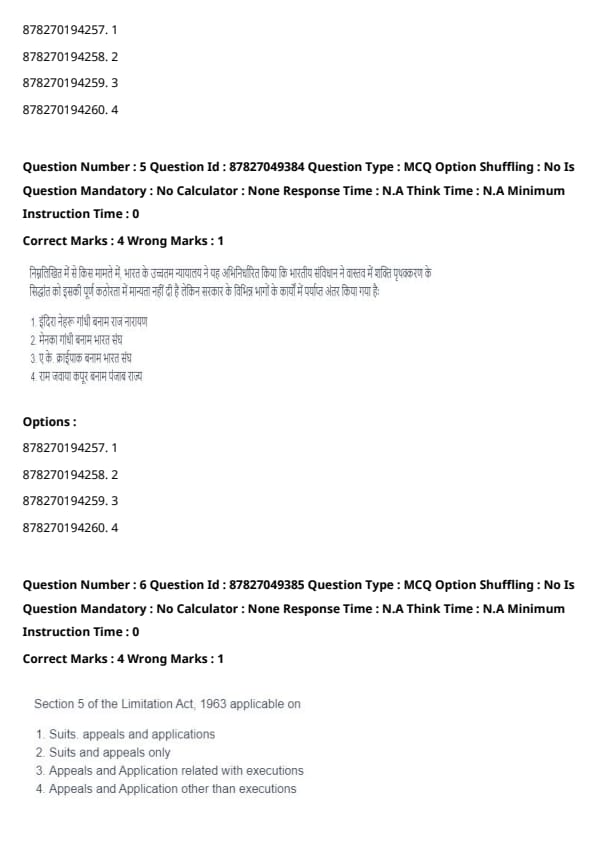
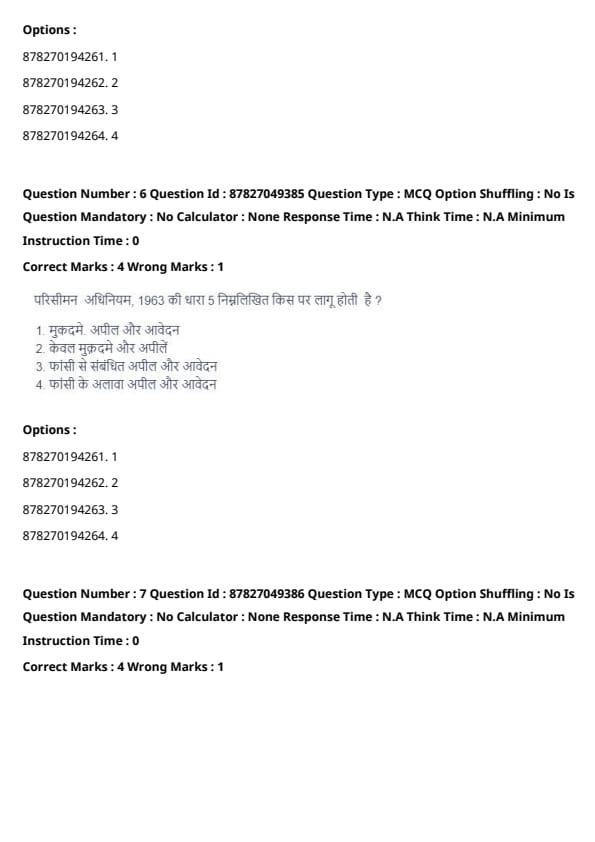
Section 5 of the Limitation Act, 1963 is applicable on:
View Solution
Section 5 of the Limitation Act, 1963 deals with the extension of the prescribed period in certain cases. According to this section, the court can admit an appeal or application after the prescribed period if the appellant or applicant satisfies the court that they had sufficient cause for not preferring the appeal or making the application within such period. However, this section specifically excludes certain applications, such as those related to execution proceedings.
Key Takeaway: Section 5 covers extensions for appeals and most applications, but not for applications related to execution proceedings.
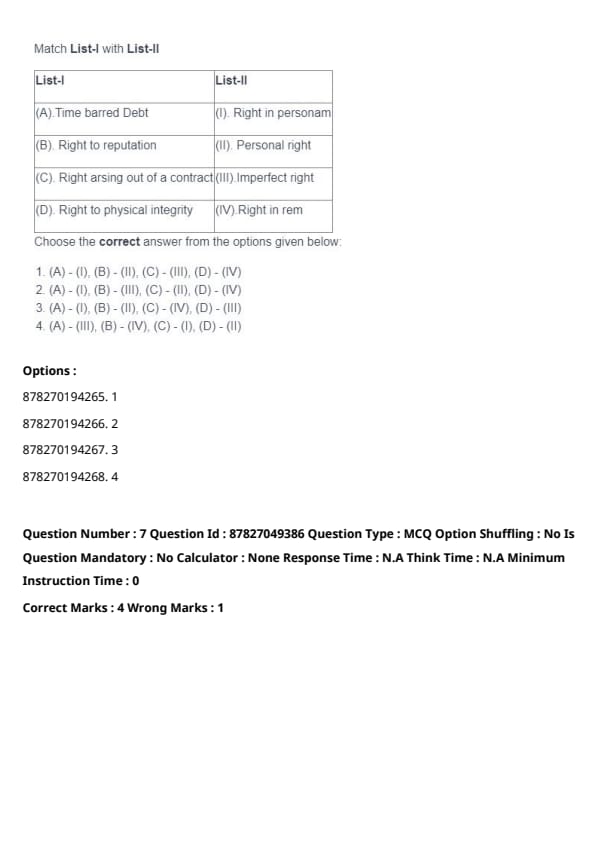
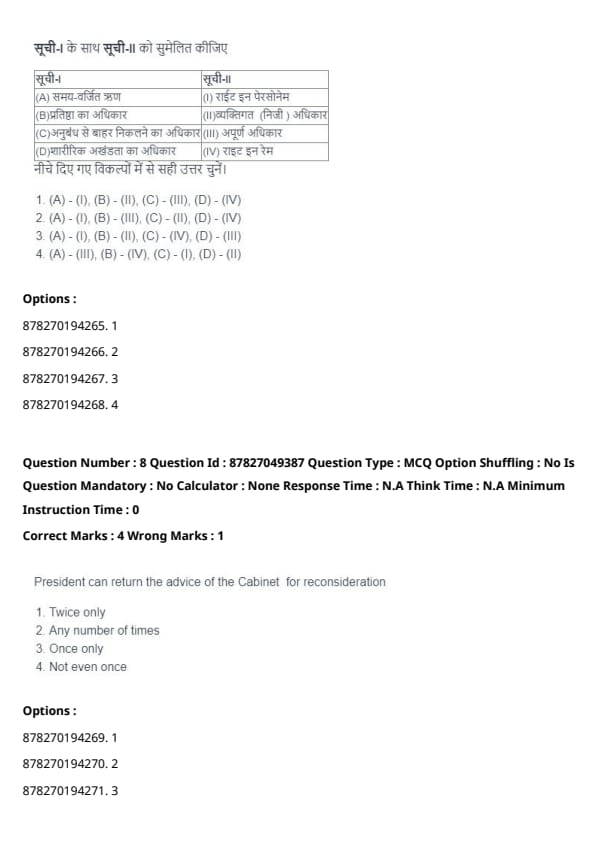
Question 7:
Match List-I with List-II:
| List-I | List-II |
|---|---|
| (A) Time barred debt | (I) Imperfect right |
| (B) Right to reputation | (II) Right in rem |
| (C) Right arising out of a contract | (III) Right in personam |
| (D) Right to physical integrity | (IV) Personal right |
View Solution
- A time-barred debt is considered an imperfect right, as it cannot be enforced due to the expiration of the limitation period.
- A right to reputation is a right in rem, enforceable against the world at large.
- A right arising out of a contract is a right in personam, enforceable against a specific individual.
- A right to physical integrity is a personal right, connected to an individual’s dignity and life.
Key Takeaway: Understand the distinctions between imperfect rights, personal rights, and rights in rem or personam.
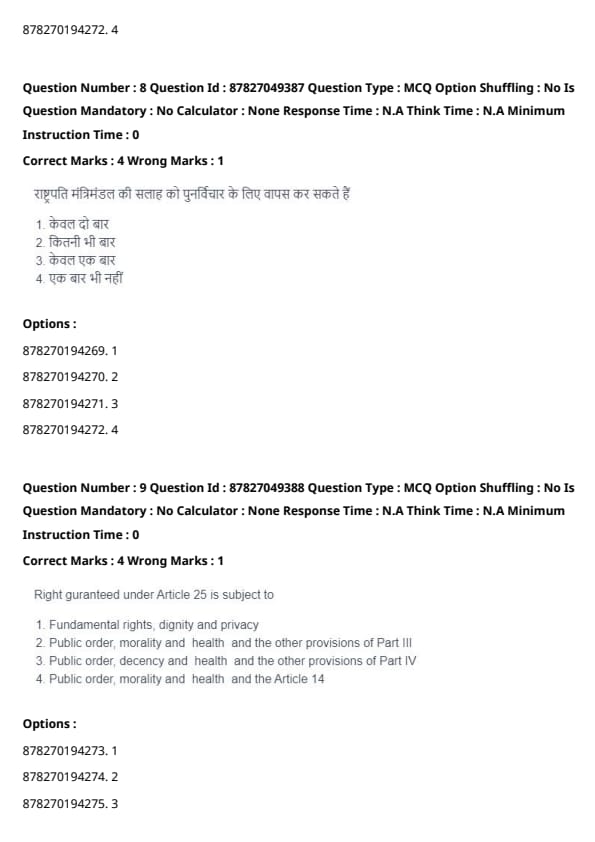
Question 8:
The President can return the advice of the Cabinet for reconsideration:
View Solution
Under Article 74(1) of the Constitution of India, the President is bound to act in accordance with the advice of the Council of Ministers. However, as per the 44th Amendment Act of 1978, the President can send the advice back for reconsideration once. If the Council of Ministers reiterates their advice, the President is constitutionally bound to act on it.
Key Takeaway: The President can return the advice to the Cabinet only once for reconsideration, as per the 44th Amendment Act.
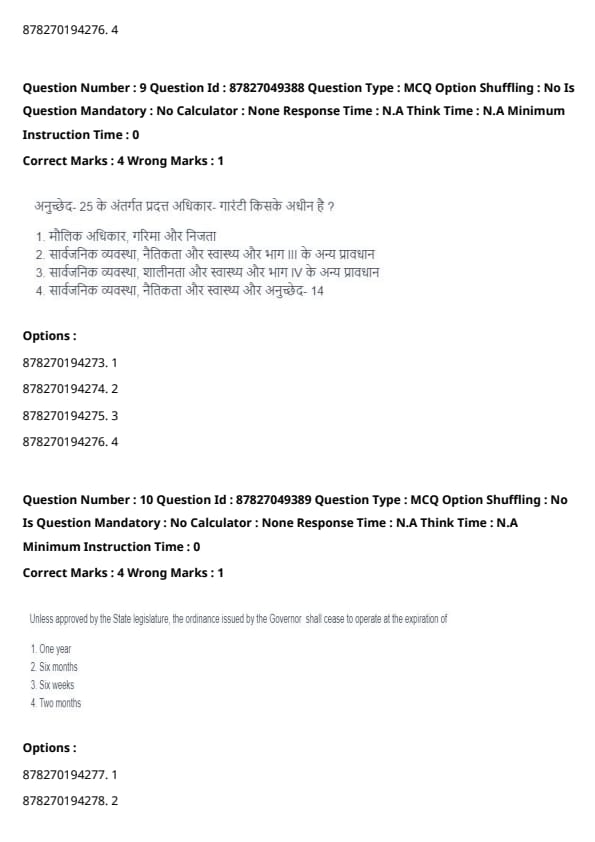
Question 9:
The right guaranteed under Article 25 is subject to:
View Solution
Article 25 of the Indian Constitution guarantees freedom of conscience and the right to freely profess, practice, and propagate religion. However, this right is not absolute and is subject to restrictions to ensure public order, morality, and health, as well as compliance with other fundamental rights under Part III of the Constitution.
Key Takeaway: Article 25 rights are limited by public order, morality, health, and other provisions of Part III.
Question 10:
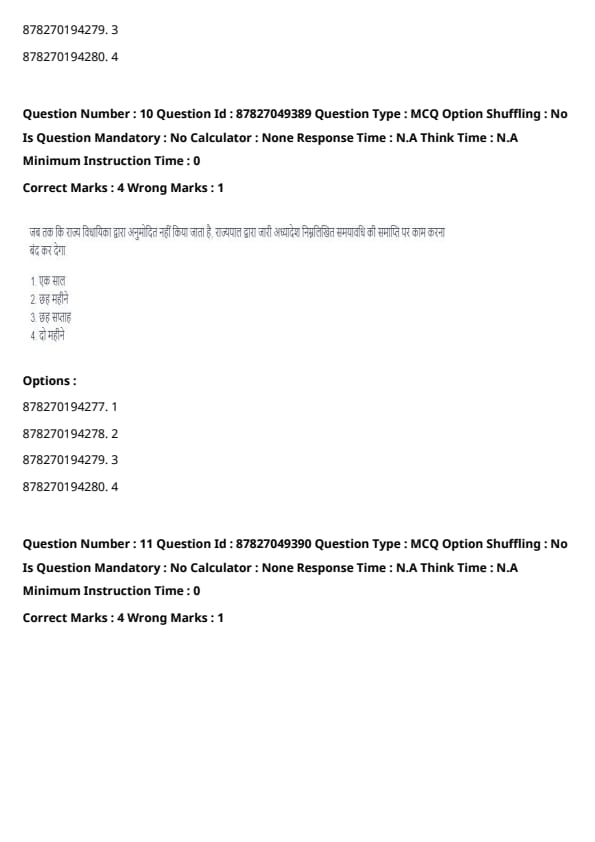
Unless approved by the State Legislature, the ordinance issued by the Governor shall cease to operate at the expiration of:
View Solution
Under Article 213 of the Constitution, the Governor of a State has the power to promulgate ordinances when the state legislature is not in session. However, such ordinances cease to operate unless approved by the legislature within six weeks from the reassembly of the State Legislature.
Key Takeaway: Ordinances by the Governor must be approved by the State Legislature within six weeks of its reassembly, as per Article 213.
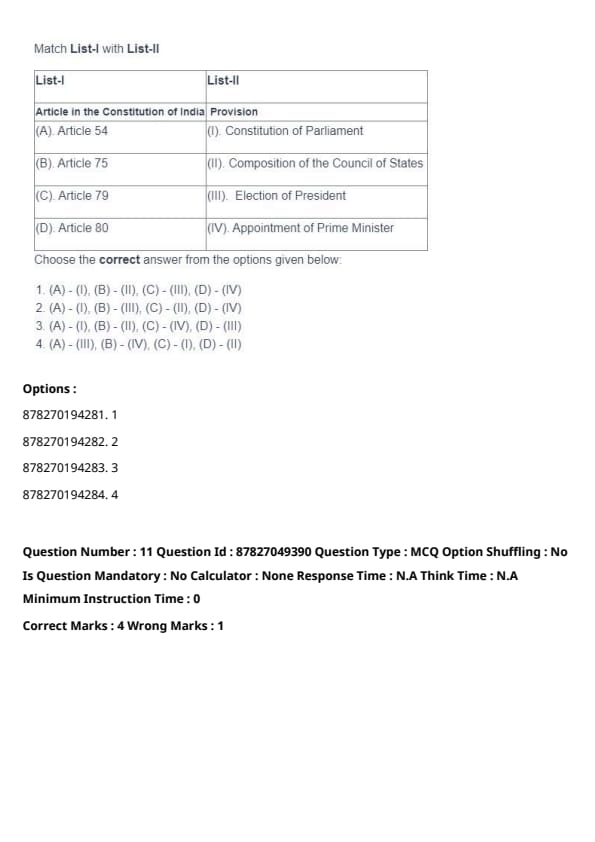
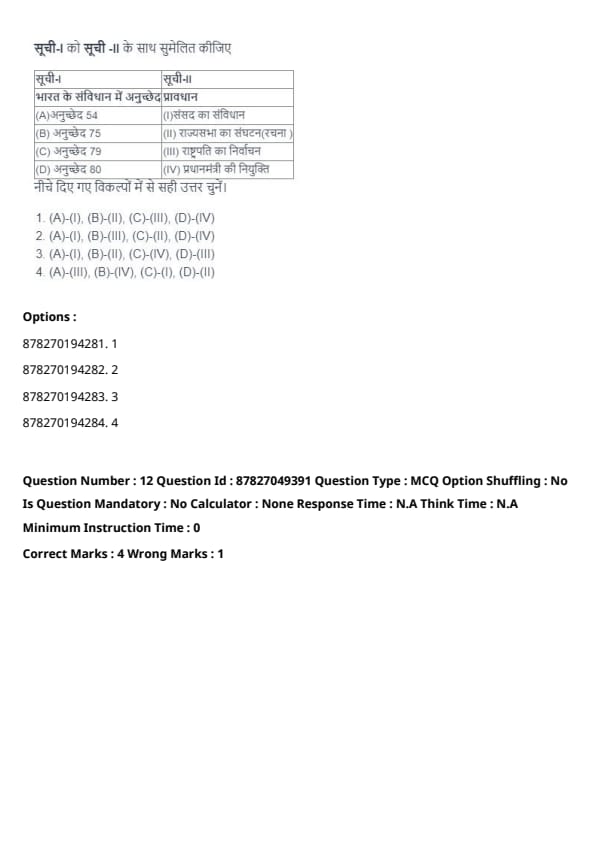
Question 11:
Match List-I with List-II:
| List-I | List-II |
|---|---|
| (A) Article 54 | (I) Constitution of Parliament |
| (B) Article 75 | (II) Composition of the Council of States |
| (C) Article 79 | (III) Election of President |
| (D) Article 80 | (IV) Appointment of Prime Minister |
View Solution
- Article 54 deals with the election of the President of India.
- Article 75 relates to the appointment of the Prime Minister.
- Article 79 describes the Constitution of the Parliament.
- Article 80 pertains to the composition of the Council of States (Rajya Sabha).
Key Takeaway: Memorize the article numbers for key provisions related to the President, PM, and Parliament.
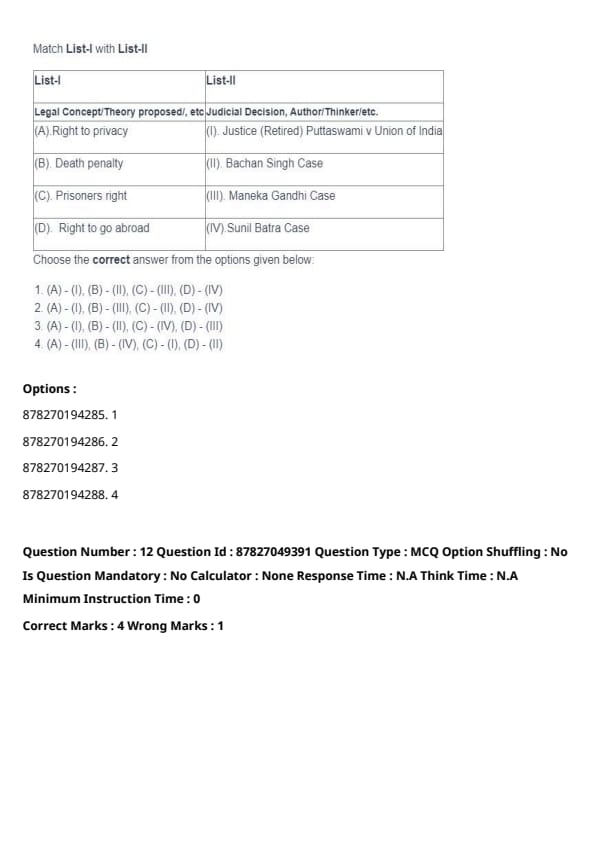
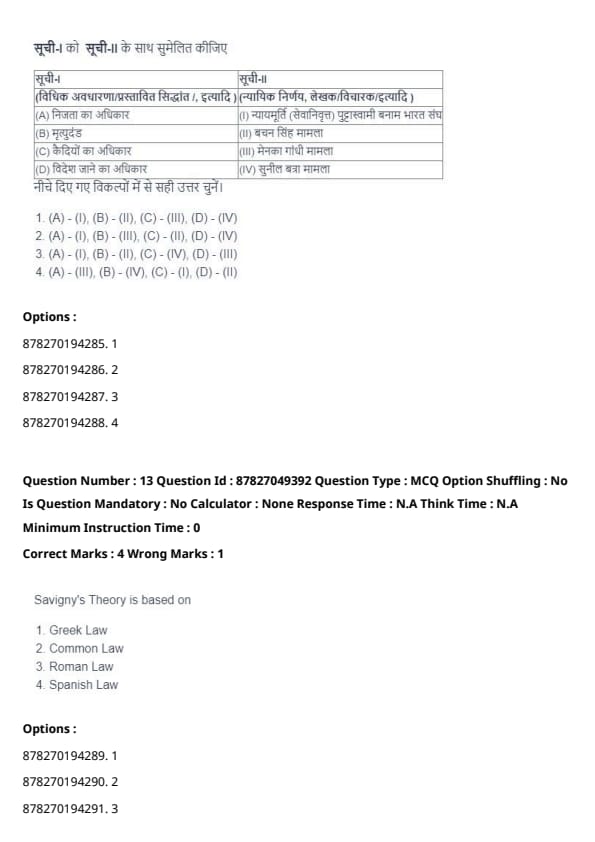
Question 12:
Match List-I with List-II:
| List-I | List-II |
|---|---|
| (A) Right to privacy | (I) Justice (Retired) Puttaswami v. Union of India |
| (B) Death penalty | (II) Bachan Singh Case |
| (C) Prisoners' rights | (III) Maneka Gandhi Case |
| (D) Right to go abroad | (IV) Sunil Batra Case |
View Solution
- Right to privacy was recognized in Justice (Retired) Puttaswami v. Union of India.
- The legal framework for the death penalty was elaborated in the Bachan Singh Case.
- Prisoners' rights were discussed in detail in the Sunil Batra Case.
- The right to go abroad was emphasized in the Maneka Gandhi Case.
Key Takeaway: Link landmark cases to their corresponding legal concepts for clarity in constitutional law.
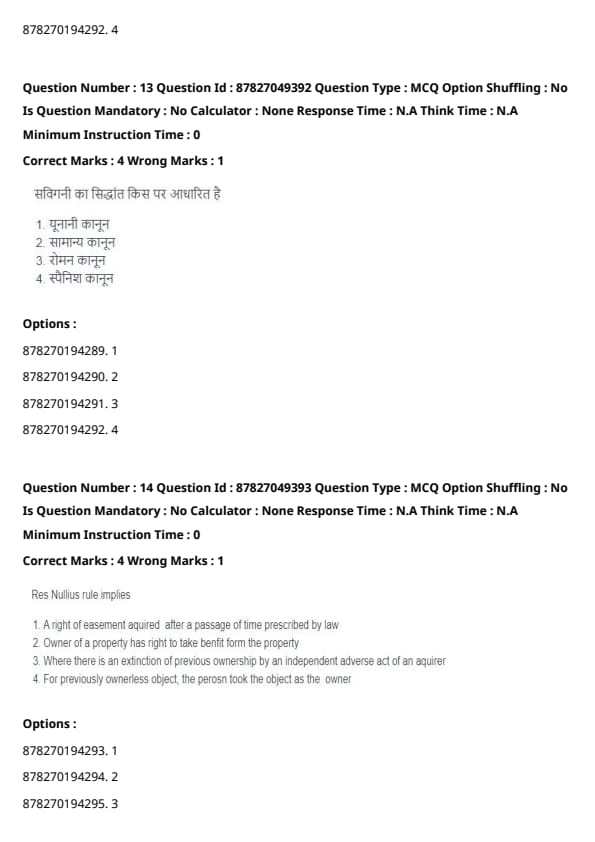
Question 13:
Savigny’s Theory is based on:
View Solution
Friedrich Carl von Savigny’s theory of law, particularly his historical school of jurisprudence, is heavily influenced by Roman Law. He argued that law develops organically, reflecting the unique spirit (“Volksgeist”) of a society. His ideas were deeply rooted in the historical development of Roman Law.
Key Takeaway: Savigny’s historical school of jurisprudence is closely associated with Roman Law.
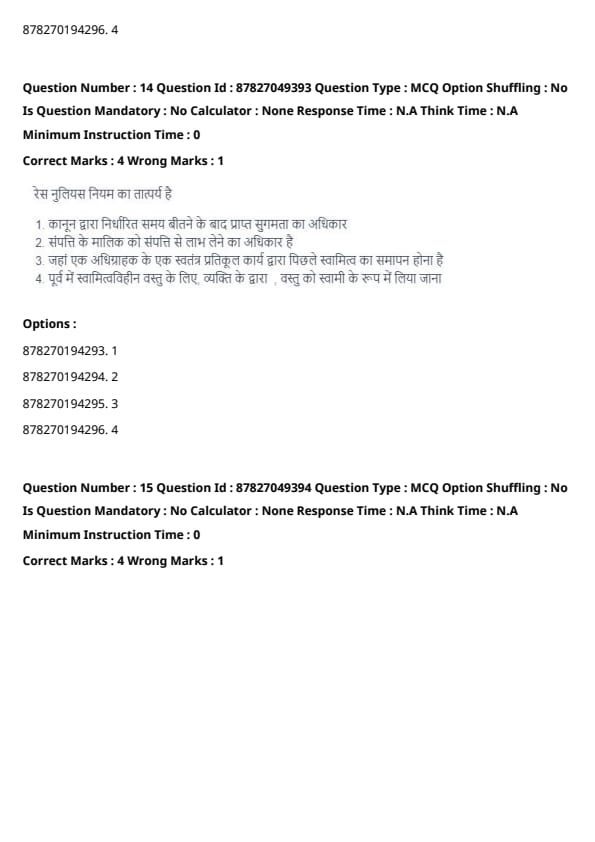
Question 14:
Res Nullius rule implies:
View Solution
The term “res nullius” is Latin for “nobody’s thing.” It refers to property or an object that belongs to no one. The res nullius rule implies that an object or property that previously had no owner belongs to the person who takes possession of it.
Key Takeaway: Res Nullius means “nobody’s thing” and relates to acquiring ownership of previously unowned property.
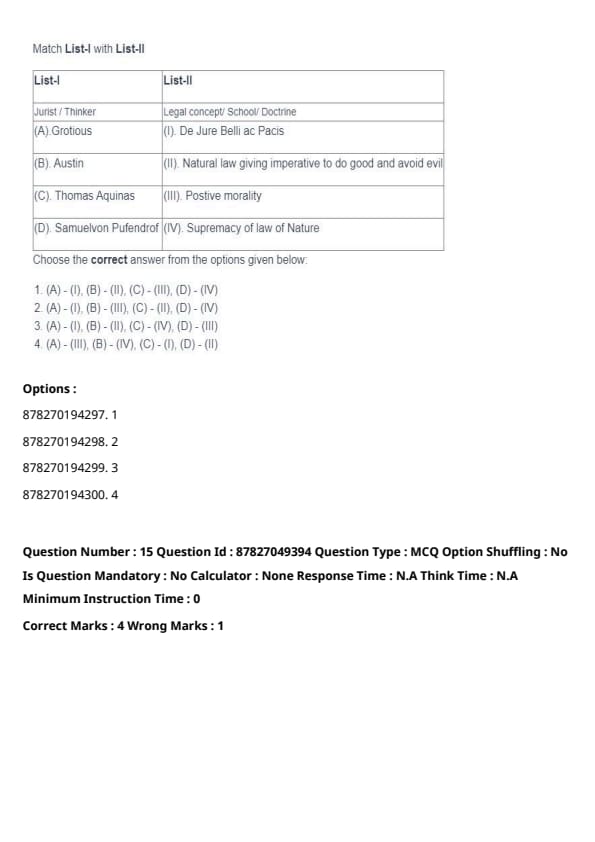
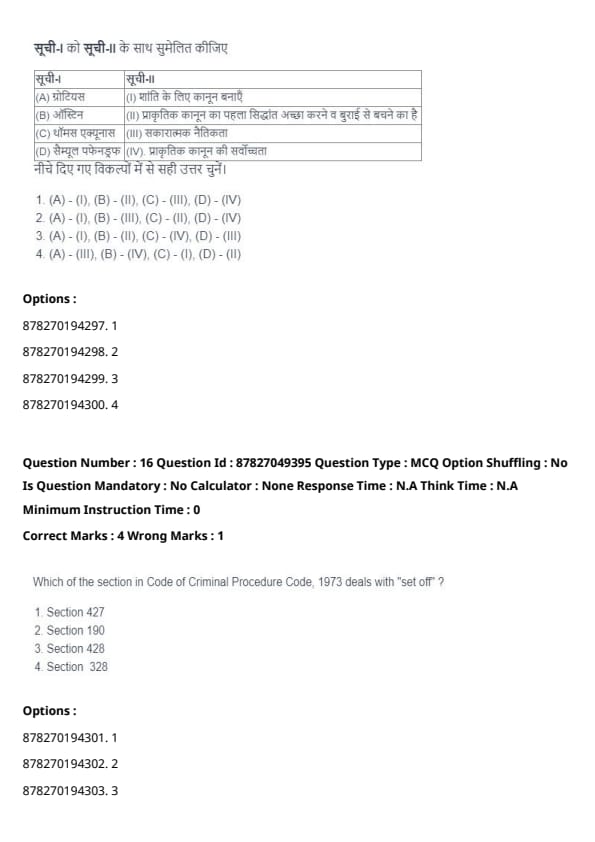
Question 15:
Match List-I with List-II:
| List-I | List-II |
|---|---|
| (A) Grotius | (I) De Jure Belli ac Pacis |
| (B) Austin | (II) Positive morality |
| (C) Thomas Aquinas | (III) Natural law giving imperative to do good and avoid evil |
| (D) Samuel von Pufendorf | (IV) Supremacy of law of Nature |
View Solution
- Grotius is associated with De Jure Belli ac Pacis, which deals with laws of war and peace.
- Austin emphasized positive morality as the basis of legal systems.
- Thomas Aquinas focused on natural law, which advocates doing good and avoiding evil.
- Samuel von Pufendorf supported the supremacy of the law of nature.
Key Takeaway: Link jurists and thinkers to their foundational legal theories and doctrines.
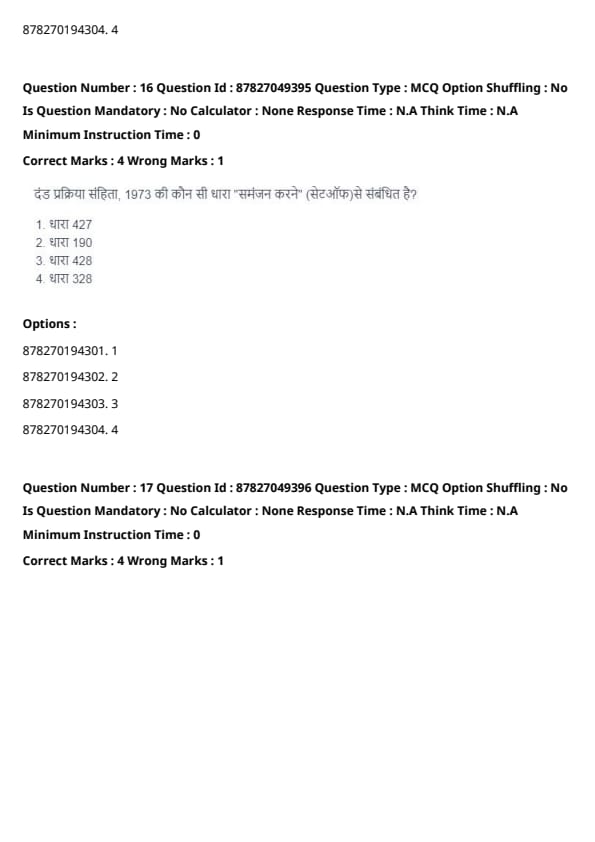
Question 16:
Which section of the Code of Criminal Procedure, 1973 deals with “set off”?
View Solution
Section 428 of the Code of Criminal Procedure (CrPC), 1973 provides for the concept of “set off.” It allows the period of detention undergone by an accused during the investigation, inquiry, or trial for the same case to be set off against the term of imprisonment imposed upon conviction. This provision ensures that the pre-conviction custody period is credited towards the overall sentence.
Key Takeaway: Section 428 CrPC ensures crediting of pre-conviction custody towards a prison sentence.
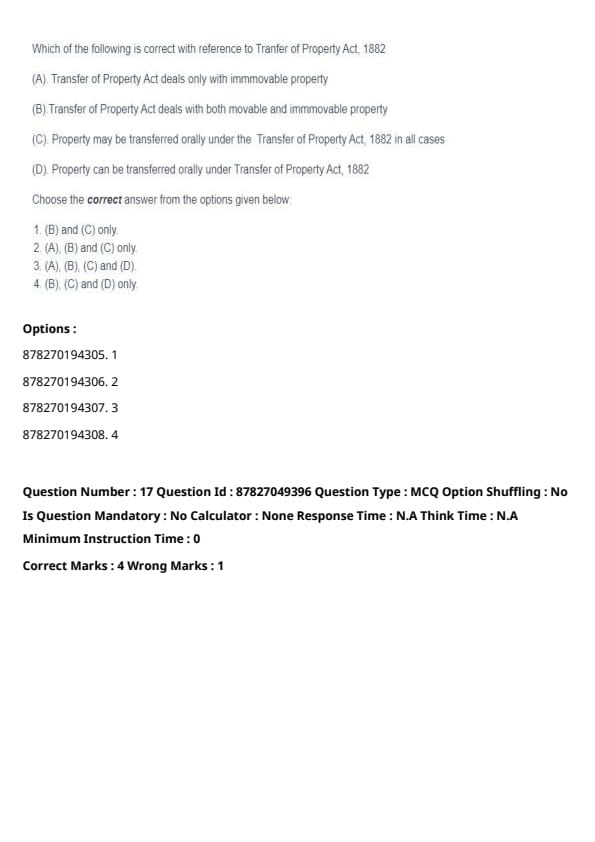
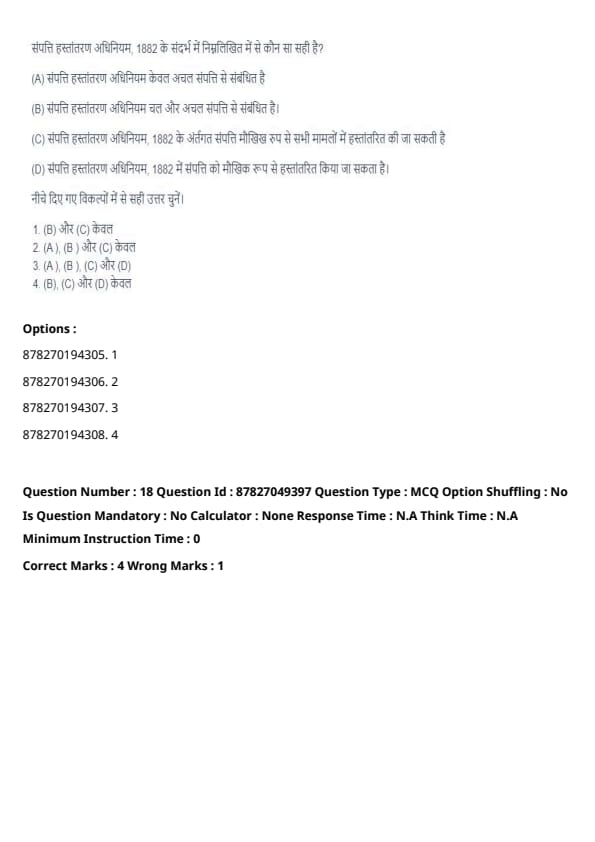
Question 17:
Which of the following is correct with reference to the Transfer of Property Act, 1882?
View Solution
The Transfer of Property Act, 1882 primarily deals with immovable property, though some provisions pertain to movable property. While most transfers require written documentation, the Act does not exclude all oral transfers. Due to the ambiguity in the options provided, this question has been dropped.
Key Takeaway: The Transfer of Property Act primarily addresses immovable property but includes limited provisions for movable property. Some oral transfers are valid under the Act.
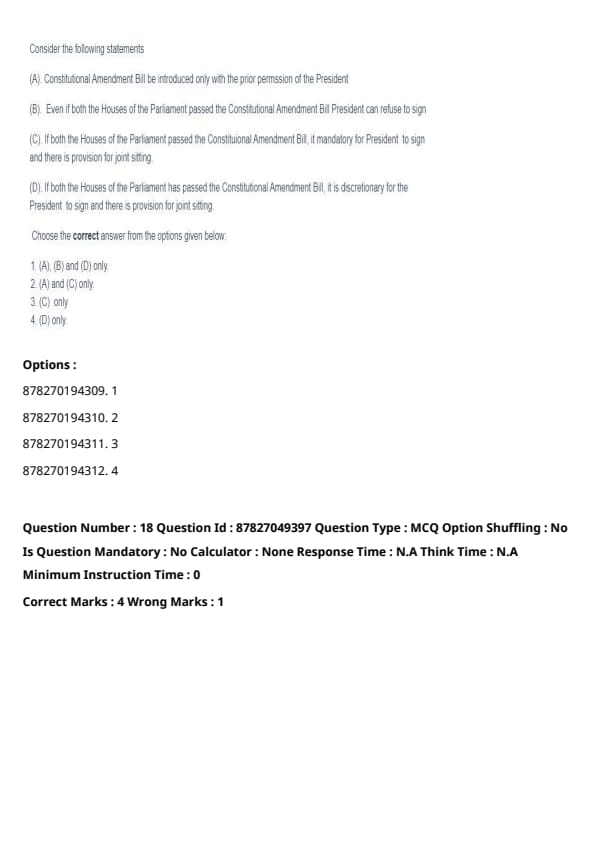
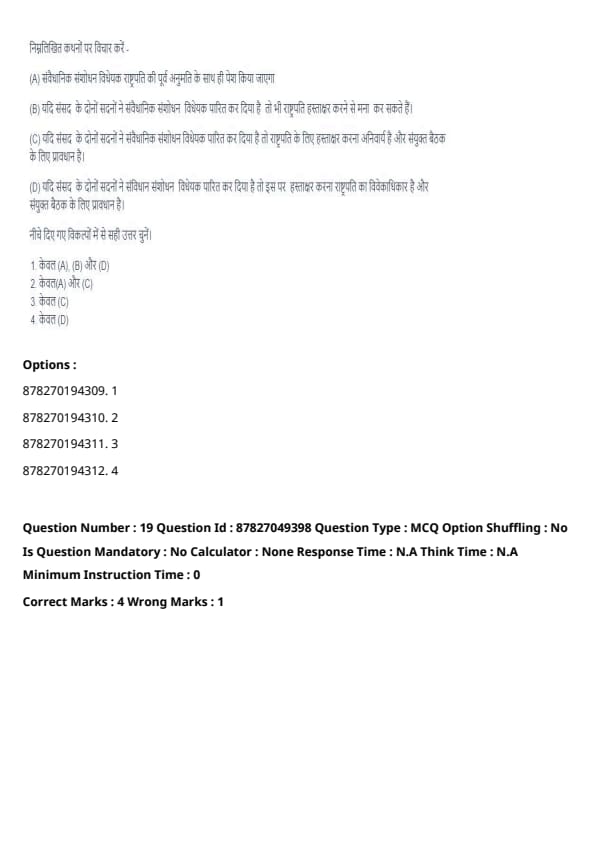
Question 18:
Consider the following statements:
View Solution
A Constitutional Amendment Bill does not require prior permission from the President to be introduced in Parliament. Once the Bill is passed by both Houses with a special majority under Article 368 of the Indian Constitution, it is mandatory for the President to give assent. The President cannot veto or return the Bill for reconsideration, and there is no provision for a joint sitting for such Bills.
Key Takeaway: The President must assent to a Constitutional Amendment Bill once passed by both Houses, and there is no provision for a joint sitting.
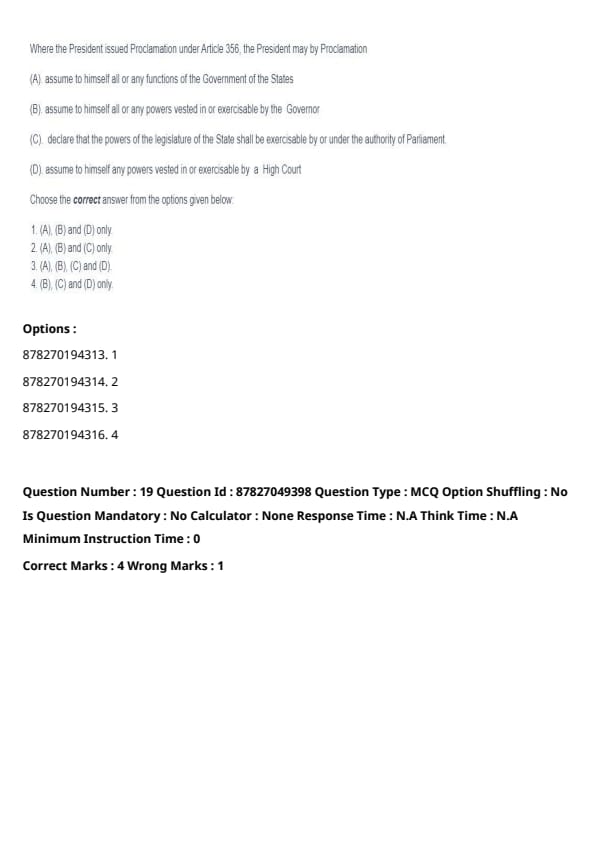
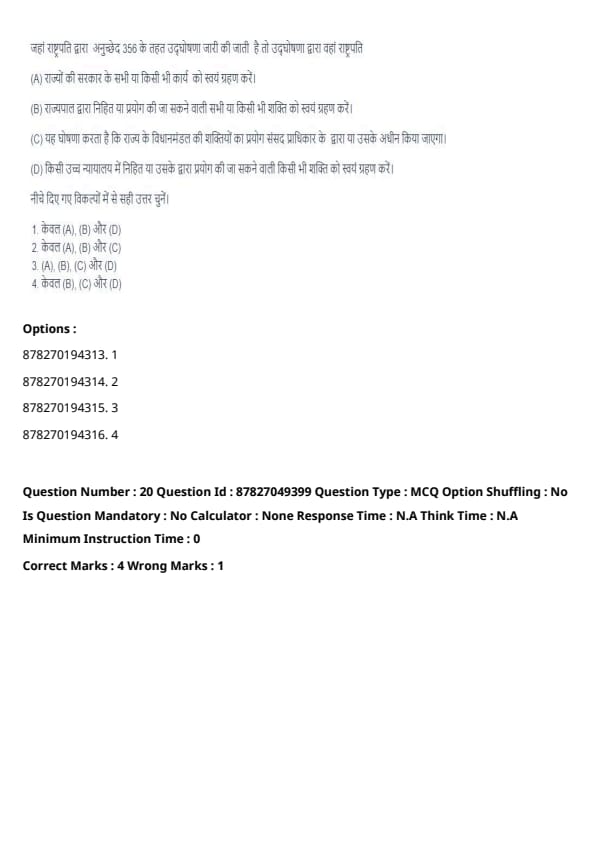
Question 19:
Where the President issues a proclamation under Article 356, the President may by proclamation:
View Solution
Article 356 allows the President to impose President’s Rule in a State when constitutional machinery fails. Under this provision, the President can:
- Assume the functions of the State Government
- Assume powers vested in the Governor
- Declare that the State legislature's powers will be exercised by Parliament.
However, the President cannot assume the powers of a High Court as it remains an independent judiciary entity.
Key Takeaway: President’s Rule extends to taking over State Government and legislative powers but excludes High Court powers.
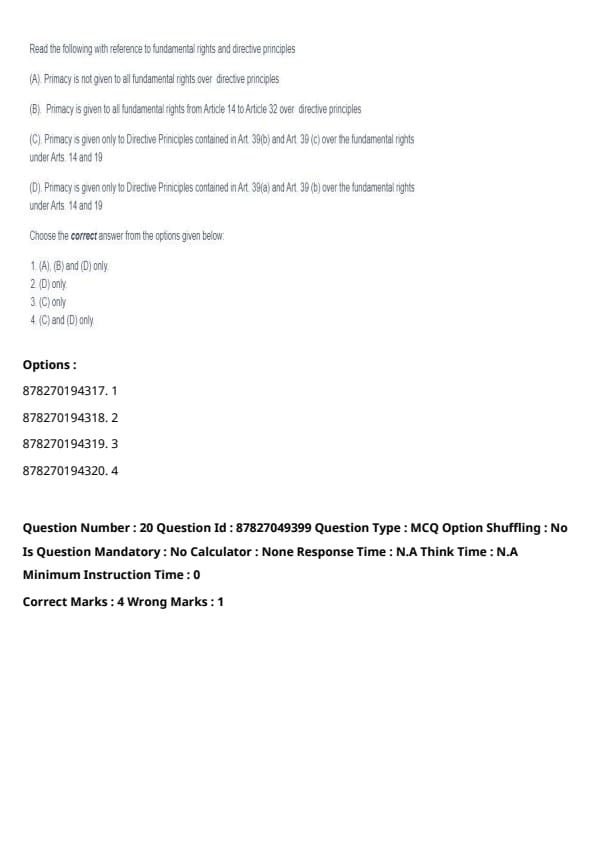
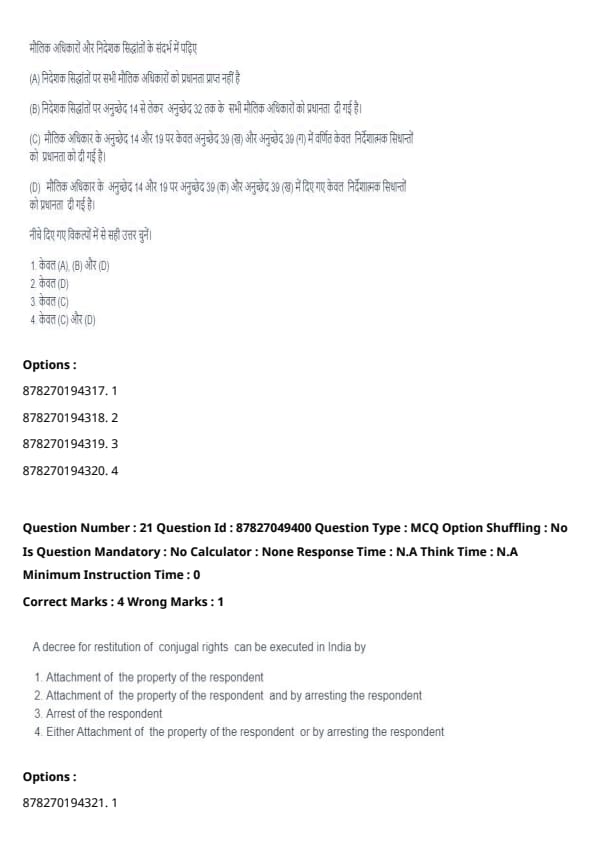
Question 20:
Read the following with reference to Fundamental Rights and Directive Principles:
View Solution
Through various landmark judgments, the Supreme Court has clarified that Fundamental Rights generally have primacy over Directive Principles. However, Articles 39(b) and 39(c) of the Directive Principles, related to equitable distribution of resources and prevention of concentration of wealth, are exceptions. These principles have primacy over Fundamental Rights under Articles 14 and 19 in specific contexts to promote socialism and equitable economic structures.
Key Takeaway: Articles 39(b) and 39(c) of Directive Principles can override Fundamental Rights under Articles 14 and 19 in specific circumstances.
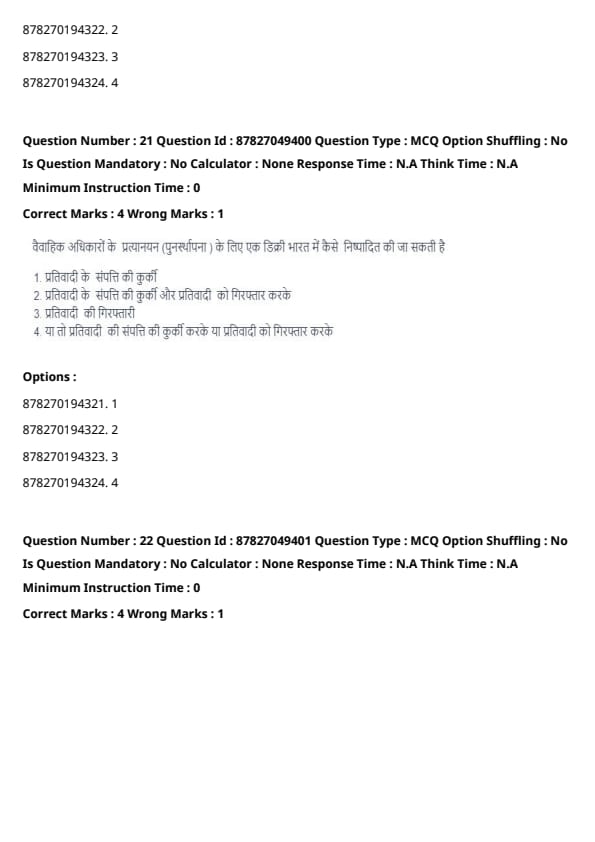
Question 21:
A decree for restitution of conjugal rights can be executed in India by:
View Solution
A decree for restitution of conjugal rights is aimed at compelling one spouse to resume cohabitation with the other. Under the Code of Civil Procedure, this decree can only be executed through the attachment of the respondent’s property. Arrest or imprisonment is not permitted to enforce such decrees in the current legal framework.
Key Takeaway: Restitution of conjugal rights decrees can only be executed by attaching the defendant’s property, not through arrest.
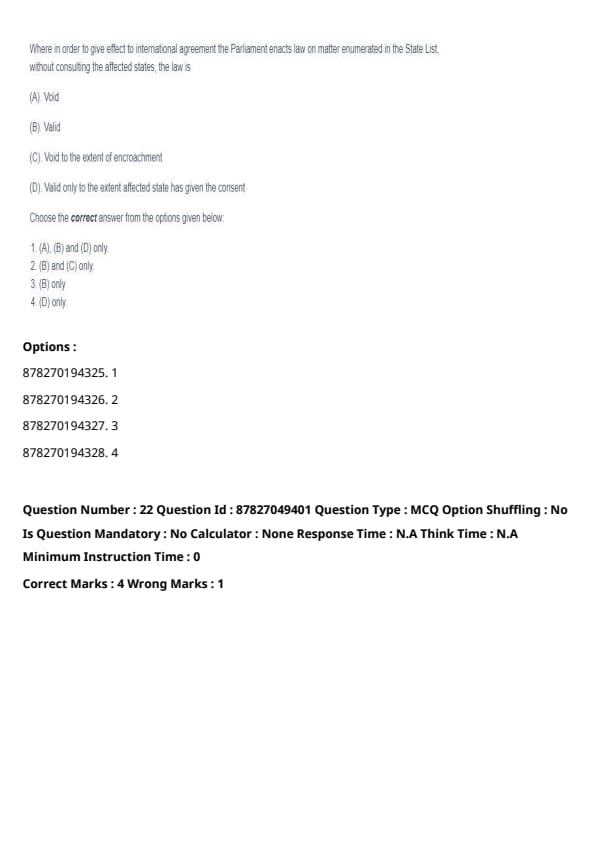
Question 22:
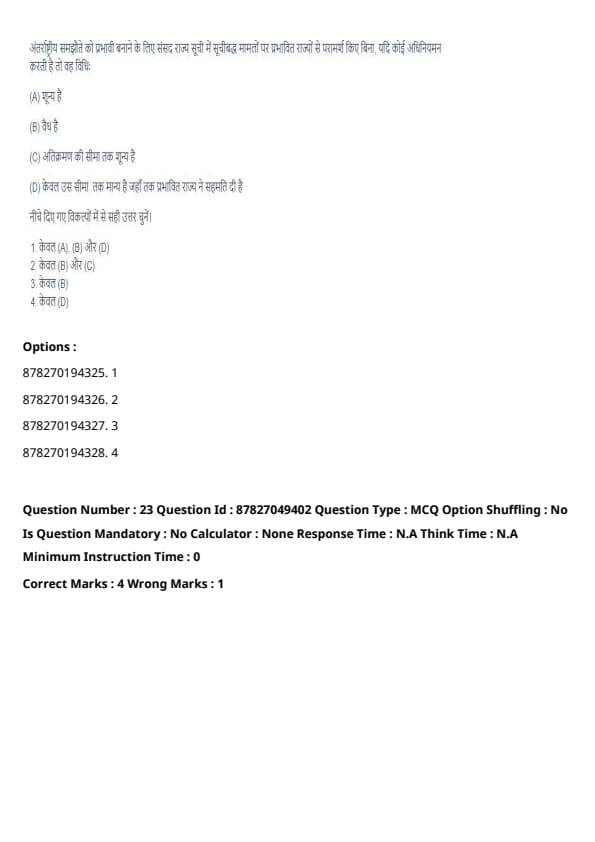
Where, in order to give effect to an international agreement, the Parliament enacts a law on a matter enumerated in the State List without consulting the affected states, the law is:
View Solution
Under Article 253 of the Indian Constitution, Parliament has the power to make laws for implementing international treaties or agreements. This power extends even to matters listed under the State List without requiring the consent of the affected states. Such laws are deemed valid to ensure India’s compliance with international obligations.
Key Takeaway: Parliament can legislate on State List subjects to implement international agreements, and such laws are valid under Article 253.
Question 23:
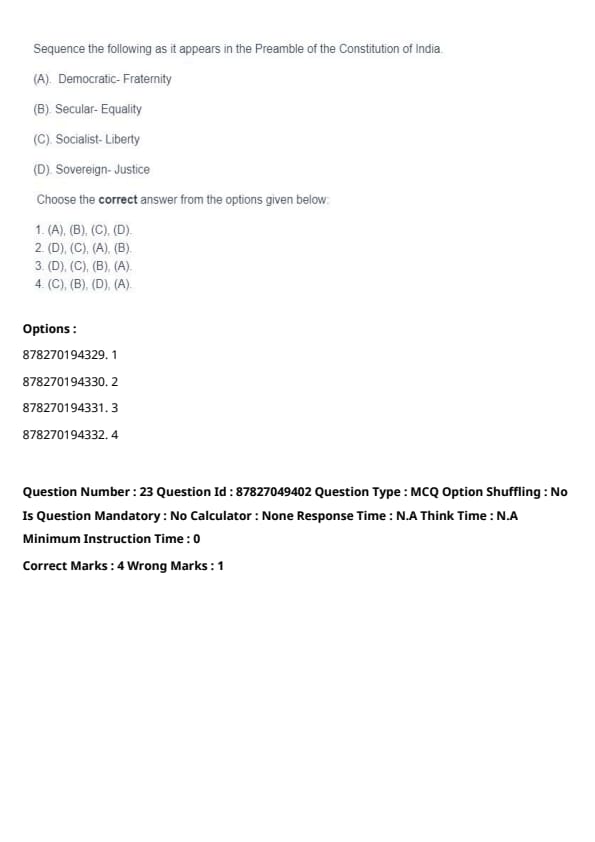
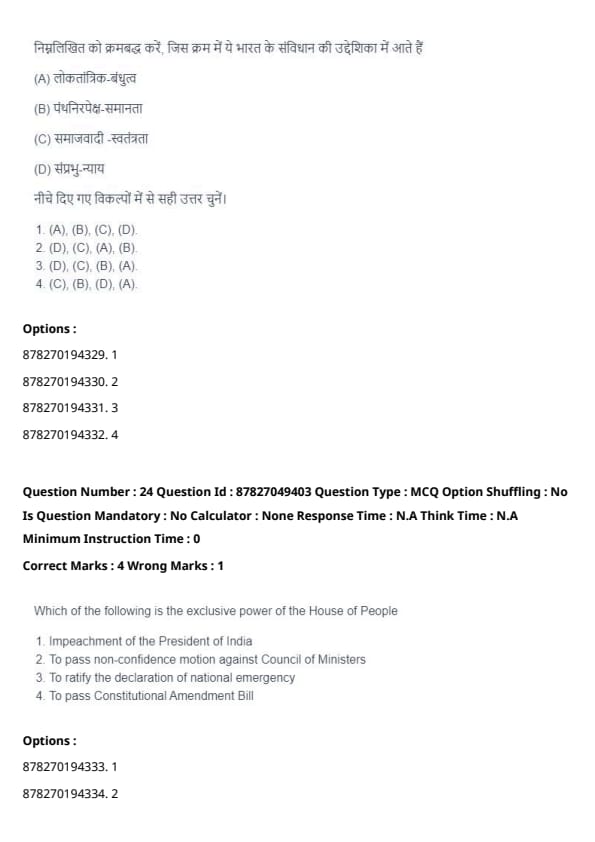
Sequence the following as they appear in the Preamble of the Constitution of India:
View Solution
The correct sequence in the Preamble of the Constitution of India is:
1. Sovereign
2. Socialist
3. Secular
4. Democratic
5. Justice
6. Liberty
7. Equality
8. Fraternity
Thus, the correct order of the given options is Sovereign - Justice, Socialist - Liberty, Secular - Equality, Democratic - Fraternity.
Key Takeaway: Remember the sequence in the Preamble: Sovereign, Socialist, Secular, Democratic, Justice, Liberty, Equality, Fraternity.
Question 24:
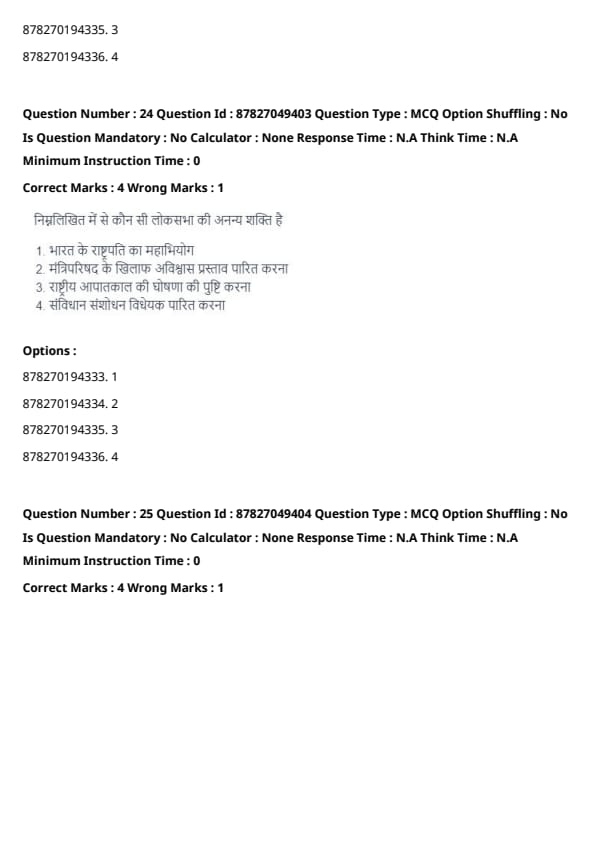
Which of the following is the exclusive power of the House of the People?
View Solution
The Lok Sabha (House of the People) has the exclusive power to pass a non-confidence motion against the Council of Ministers. This ensures the accountability of the executive branch to the legislative branch. Other powers, such as impeachment of the President and ratification of national emergency, involve both Houses of Parliament.
Key Takeaway: The Lok Sabha exclusively holds the power to pass a non-confidence motion against the Council of Ministers.
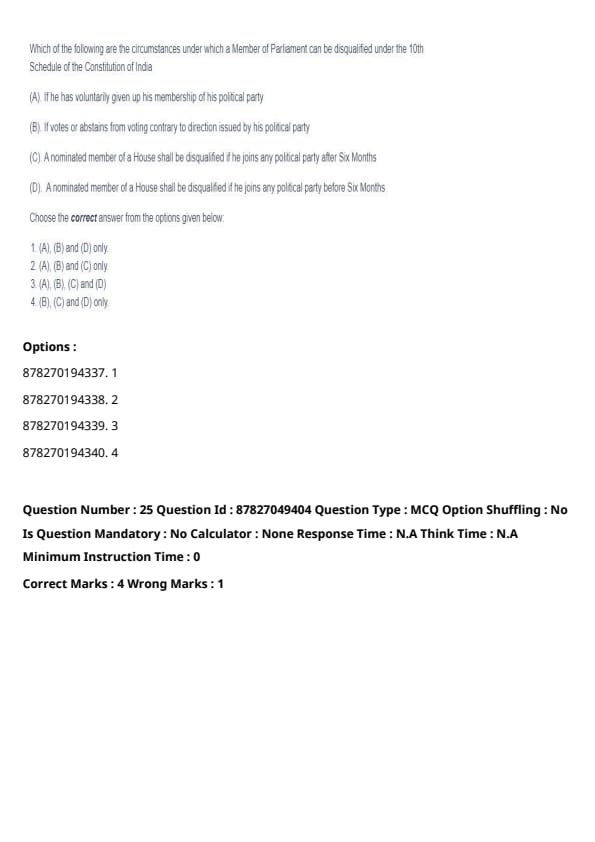
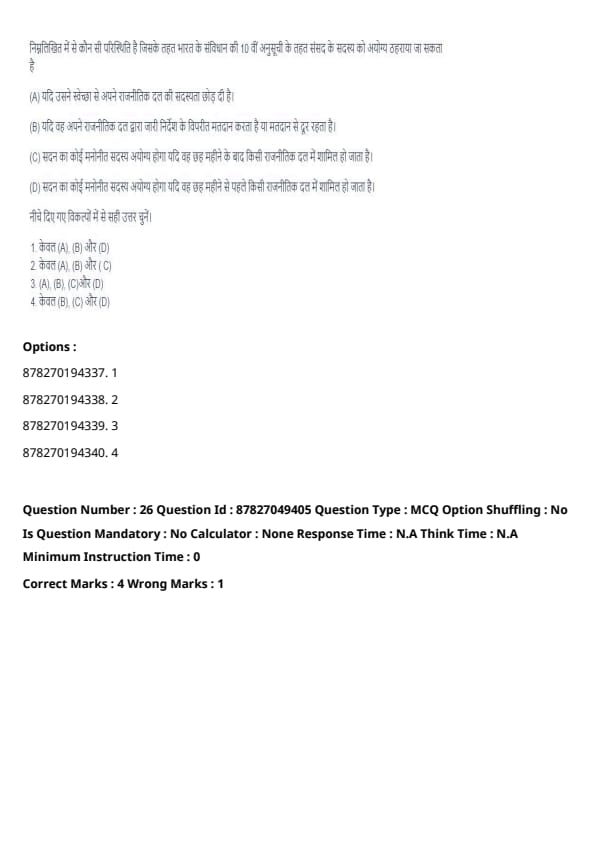
Question 25:
Which of the following are the circumstances under which a Member of Parliament can be disqualified under the 10th Schedule of the Constitution of India?
View Solution
The Tenth Schedule, or the Anti-Defection Law, provides for the disqualification of Members of Parliament and State Legislatures. A member can be disqualified if they:
- Voluntarily give up membership of their political party
- Vote or abstain from voting contrary to their party’s direction
- Nominated members are disqualified if they join a political party before six months.
Key Takeaway: Anti-Defection Law outlines specific grounds for disqualification, including voluntary resignation and voting contrary to party direction.
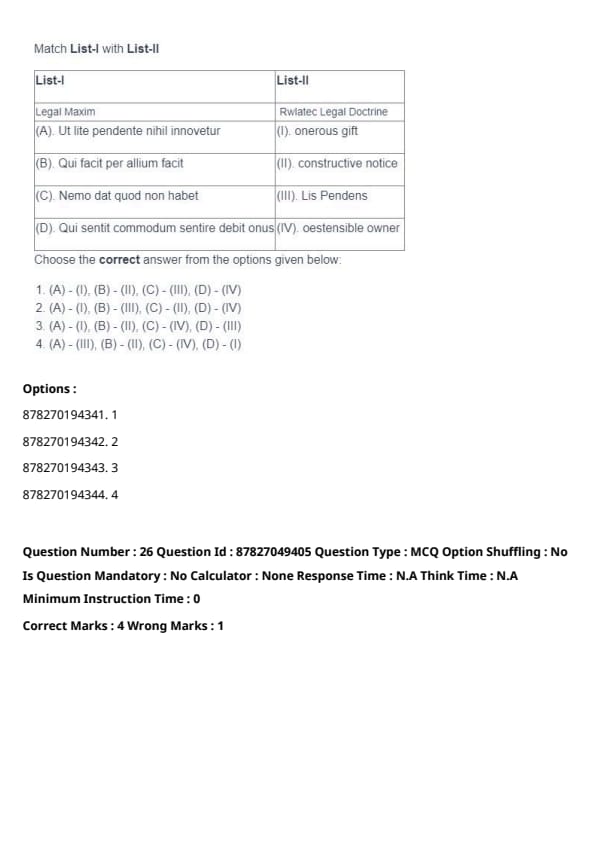
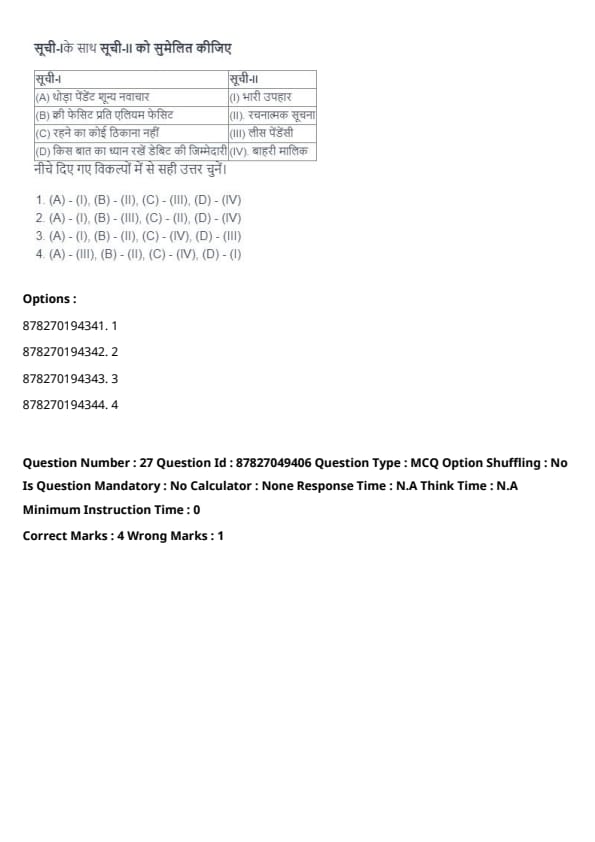
Question 26:
Match List-I with List-II:
| List-I (Legal Maxim) | List-II (Related Legal Doctrine) |
|---|---|
| (A) Ut lite pendente nihil innovetur | (I) Onerous gift |
| (B) Qui facit per alium facit | (II) Constructive notice |
| (C) Nemo dat quod non habet | (III) Lis Pendens |
| (D) Qui sentit commodum sentire debit onus | (IV) Ostensible owner |
View Solution
- "Ut lite pendente nihil innovetur" relates to the doctrine of Lis Pendens, which prevents changes to property during pending litigation.
- "Qui facit per alium facit" means "He who acts through another acts himself," and is related to constructive notice.
- "Nemo dat quod non habet" translates to "No one can give what they don't have," related to ostensible ownership.
- "Qui sentit commodum sentire debit onus" means "He who receives a benefit must also bear the burden," related to onerous gift.
Key Takeaway: Memorize the meanings of these legal maxims and their related doctrines for clarity.
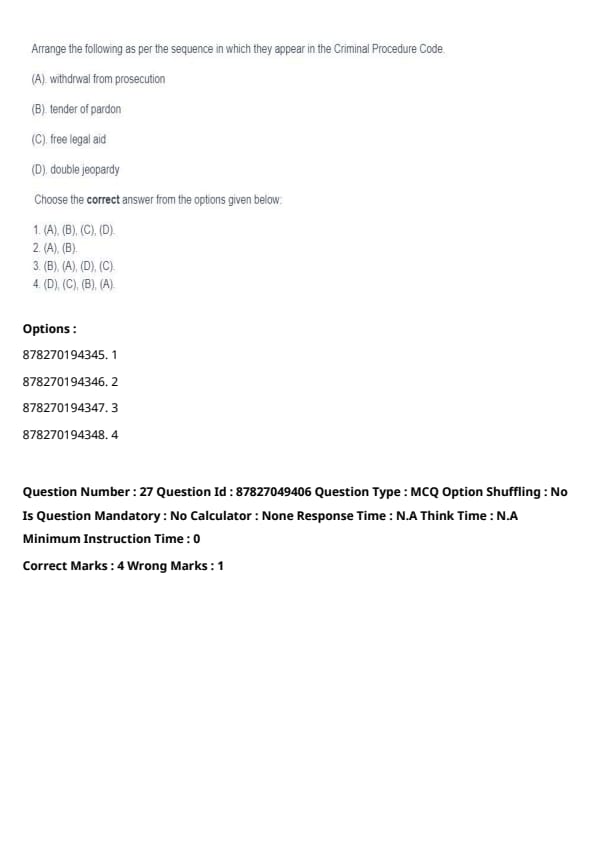
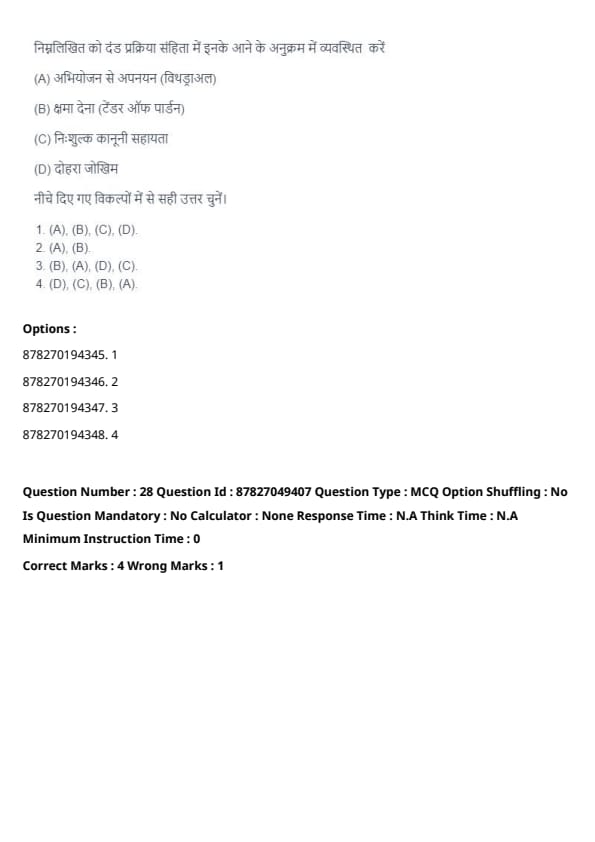
Question 27:
Arrange the following as per the sequence in which they appear in the Criminal Procedure Code:
View Solution
The correct order based on their appearance in the Code of Criminal Procedure, 1973 is:
- Double Jeopardy (Section 300)
- Free Legal Aid (Section 304)
- Tender of Pardon (Section 306)
- Withdrawal from Prosecution (Section 321)
Key Takeaway: Remember the sequence based on the relevant sections of CrPC for better understanding.
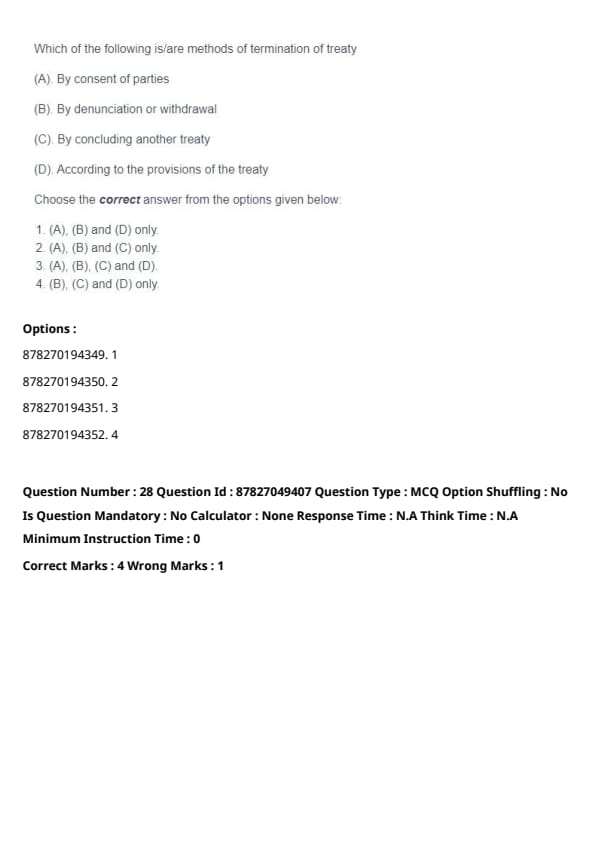
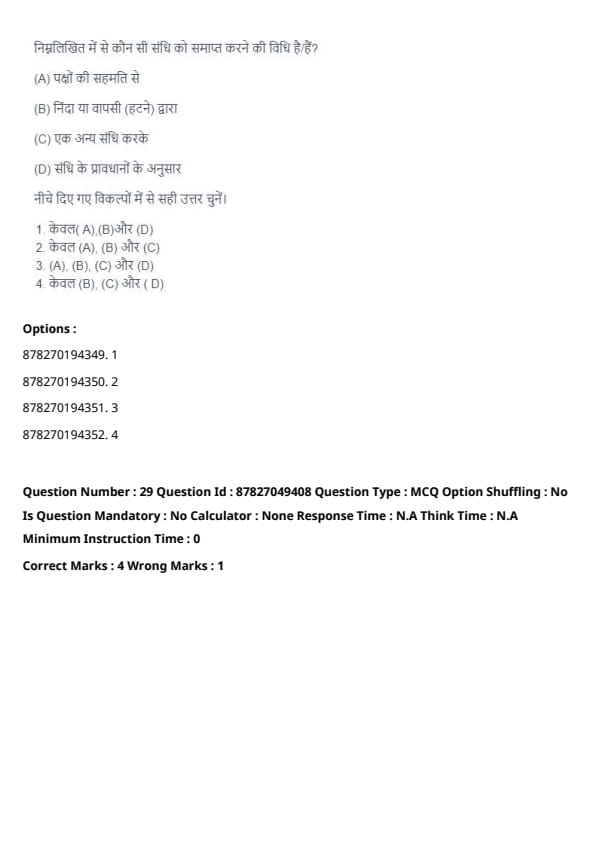
Question 28:
Which of the following is/are methods of termination of a treaty?
View Solution
According to the Vienna Convention on the Law of Treaties, a treaty can be terminated through the following methods:
- By consent of all parties.
- By denunciation or withdrawal as per treaty terms or international law.
- By concluding another treaty that replaces the old one.
- According to provisions specified within the treaty itself.
Key Takeaway: Treaties can be terminated by mutual consent, withdrawal, new treaties, or by their own provisions.
Question 29:
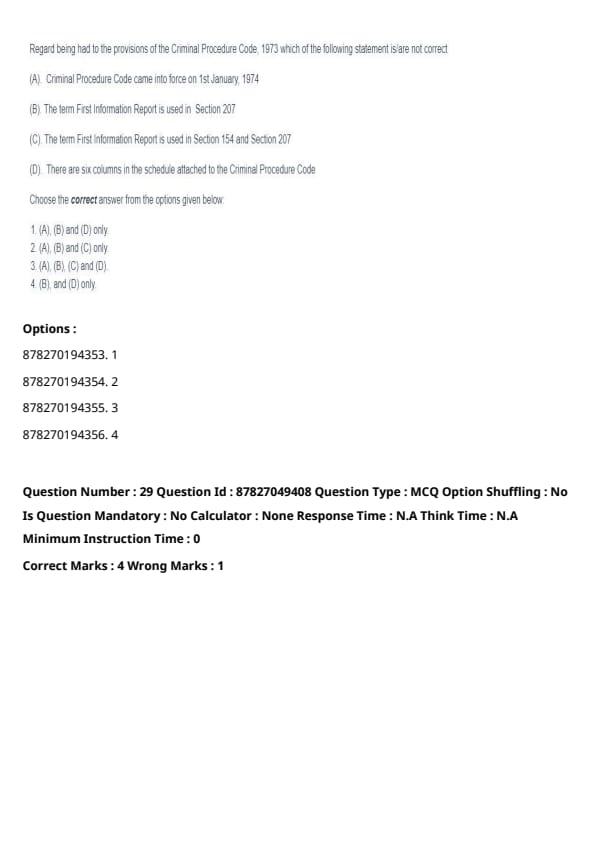
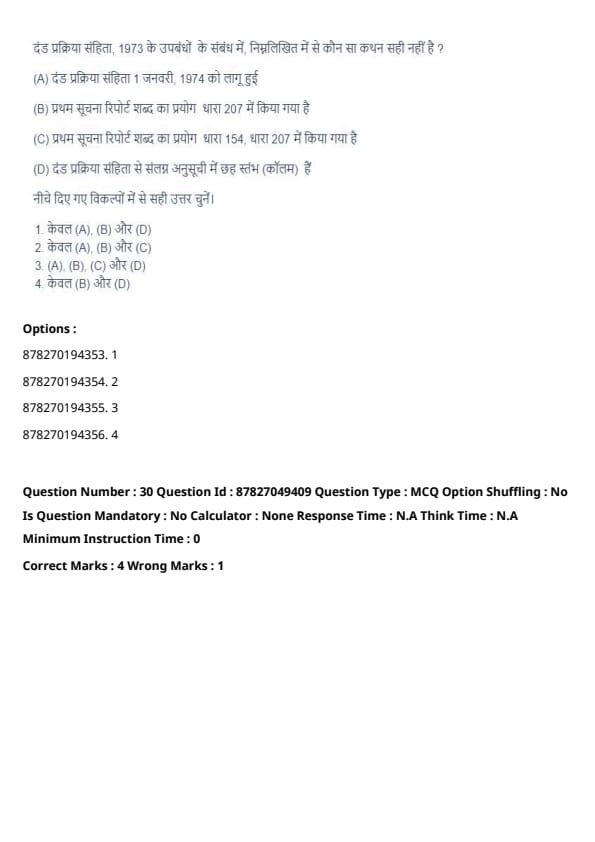
With regard to the Criminal Procedure Code, 1973, which of the following statements is/are not correct?
View Solution
- The CrPC came into force on April 1, 1974, not January 1, 1974.
- The term 'First Information Report' (FIR) is mentioned in Section 154, not Section 207.
- The schedule attached to the CrPC contains eight columns, not six.
Key Takeaway: The CrPC came into force on April 1, 1974; FIR is mentioned in Section 154, and the schedule contains eight columns.
Question 30:
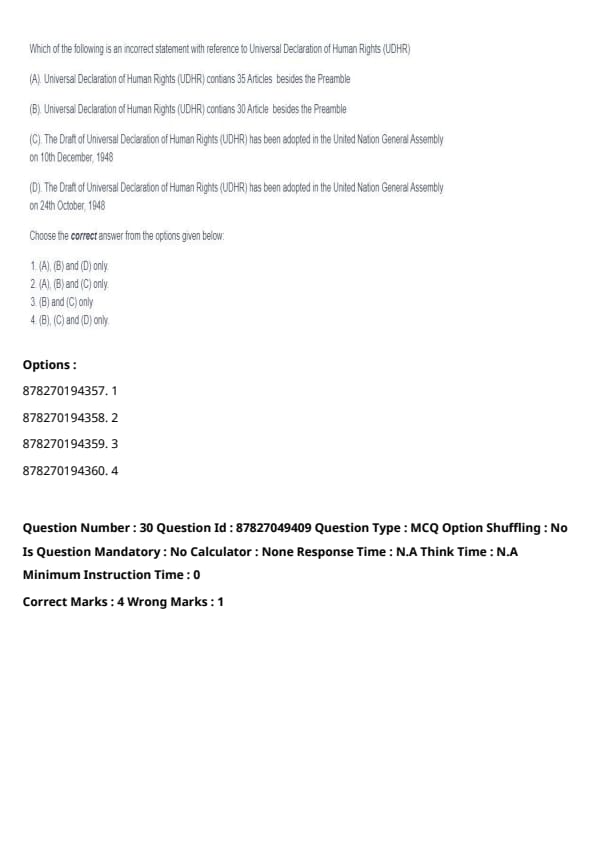
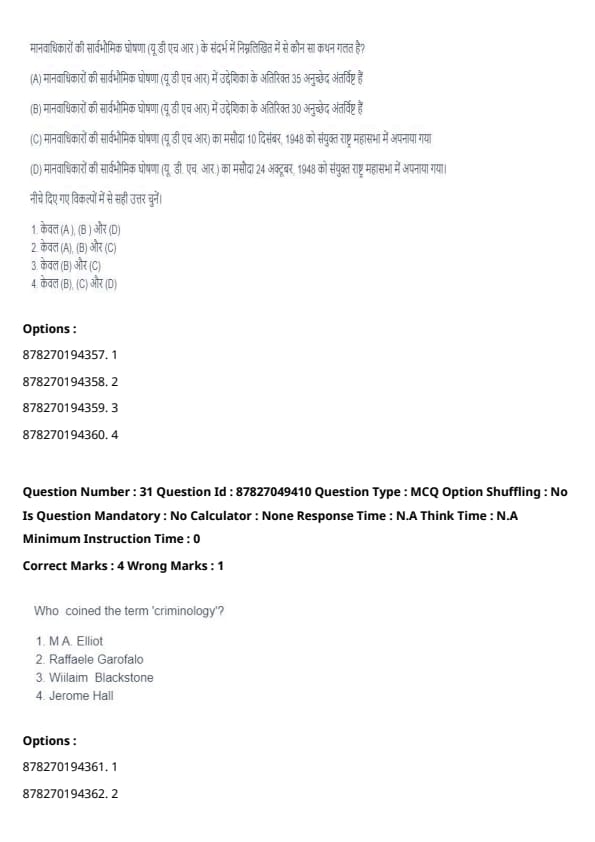
Which of the following is an incorrect statement with reference to the Universal Declaration of Human Rights (UDHR)?
View Solution
- The Universal Declaration of Human Rights (UDHR) contains 30 articles in its main body, not 35.
- It was adopted by the United Nations General Assembly on 10th December, 1948, not 24th October, 1948.
Key Takeaway: The UDHR contains 30 Articles and was adopted on 10th December, 1948.
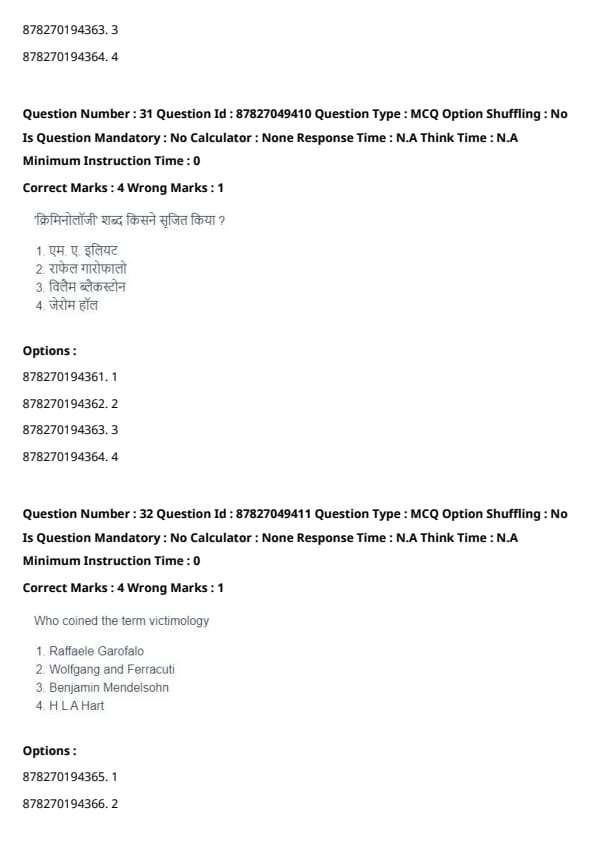
Question 31:
Who coined the term ‘criminology’?
View Solution
The term “criminology” was coined by Raffaele Garofalo, an Italian jurist, in 1885. It refers to the study of crimes, criminals, their behavior, and its causes.
Key Takeaway: Raffaele Garofalo introduced the term criminology in 1885.
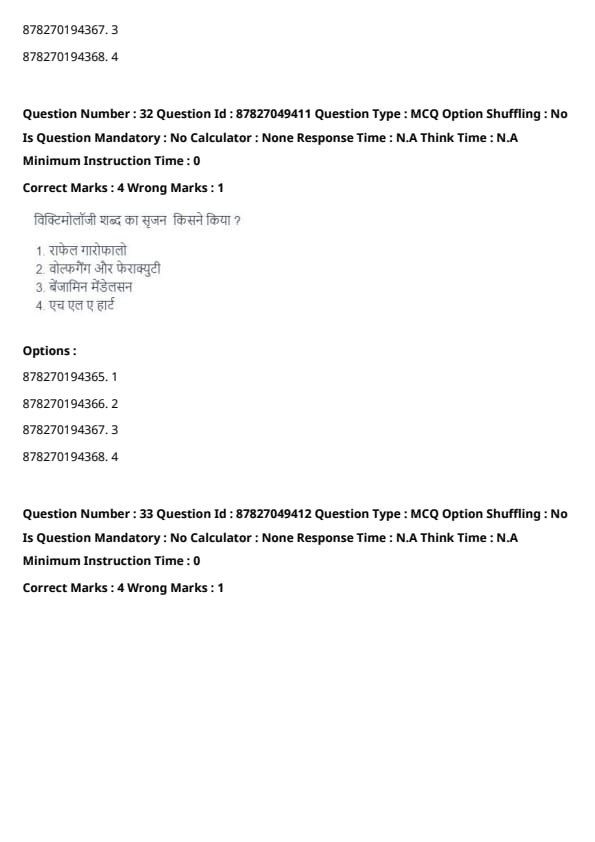
Question 32:
Who coined the term ‘victimology’?
View Solution
Benjamin Mendelsohn, a Romanian-Israeli lawyer, is credited with coining the term “victimology” in the mid-20th century. Victimology is the scientific study of victims of crime. Mendelsohn is also known as the father of victimology.
Key Takeaway: Benjamin Mendelsohn introduced the term victimology and is considered the father of the field.
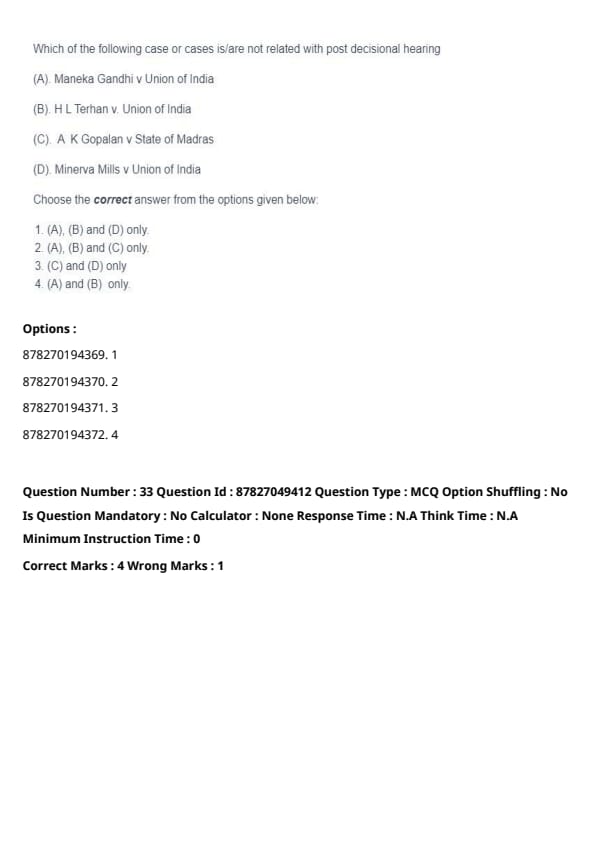
Question 33:
Which of the following case or cases is/are not related to post-decisional hearing?
View Solution
- A K Gopalan v. State of Madras: This case adopted a narrow interpretation of Article 21 and did not address post-decisional hearing.
- Minerva Mills v. Union of India: While significant, this case is not specifically related to post-decisional hearing.
- Maneka Gandhi v. Union of India: This case expanded the concept of procedural fairness, including post-decisional hearing.
- HL Terhan v. Union of India: This case also dealt with principles of natural justice.
Key Takeaway: Maneka Gandhi v. Union of India is a landmark case expanding procedural fairness, including post-decisional hearing.
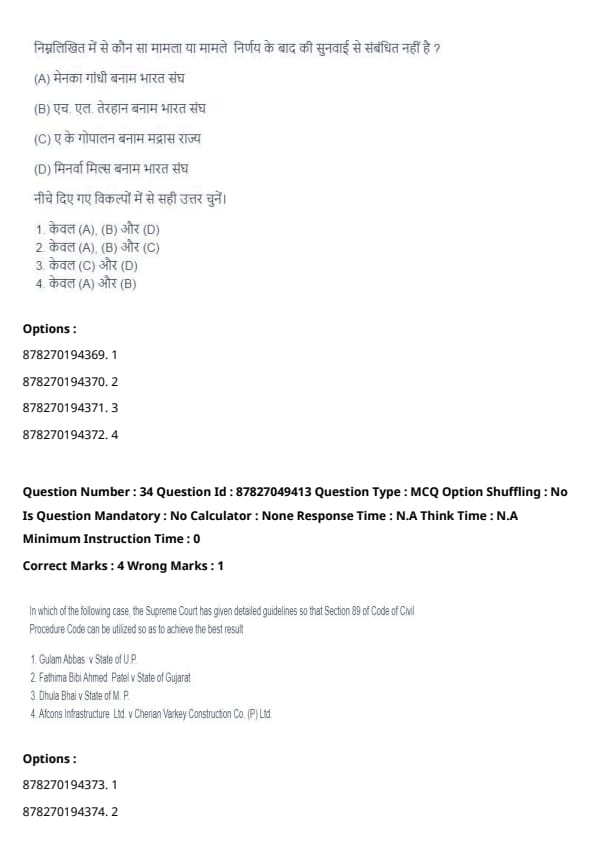
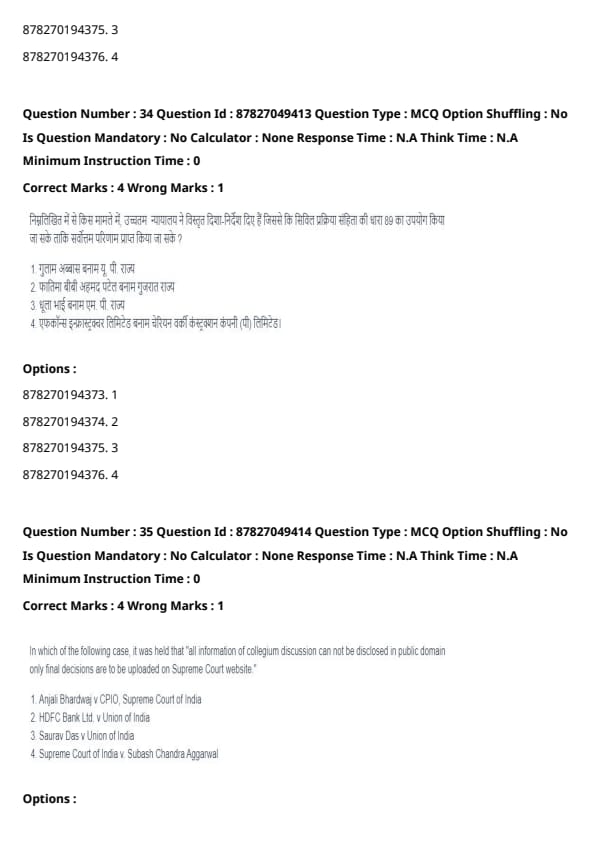
Question 34:
In which of the following case, the Supreme Court has given detailed guidelines so that Section 89 of the Code of Civil Procedure can be utilized to achieve the best result?
View Solution
In Afcons Infrastructure Ltd. v. Cherian Varkey Construction Co. (P) Ltd., the Supreme Court of India provided detailed guidelines on the applicability of Section 89 of the Code of Civil Procedure (CPC), which deals with alternative dispute resolution mechanisms such as mediation, arbitration, and conciliation. The aim is to reduce unnecessary litigation and ensure effective use of ADR mechanisms.
Key Takeaway: The Afcons case established guidelines for effective utilization of ADR under Section 89 CPC.
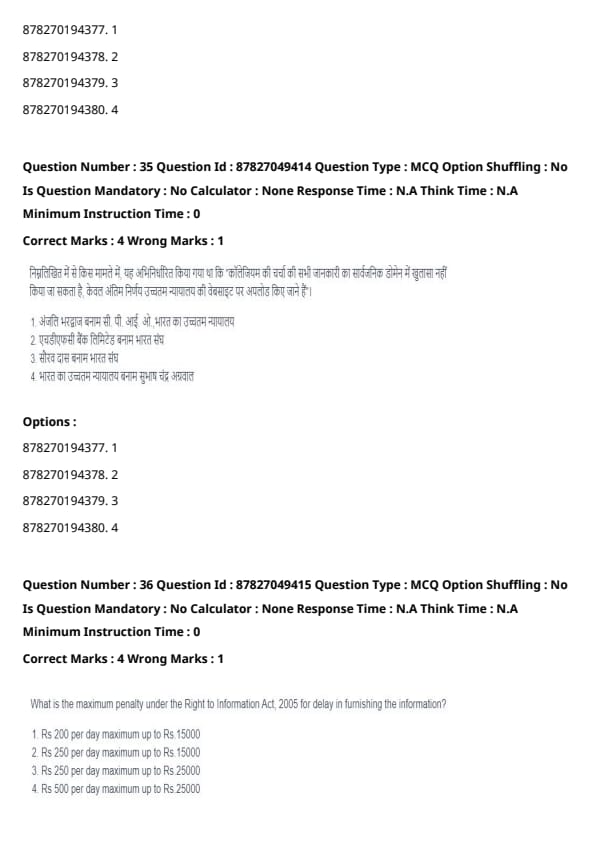
Question 35:
In which of the following case, it was held that “all information of collegium discussion cannot be disclosed in the public domain, and only final decisions are to be uploaded on the Supreme Court website?”
View Solution
In Anjali Bhardwaj v. CPIO, Supreme Court of India, the Supreme Court clarified that while the final decisions and recommendations of the collegium must be made public, the discussions and deliberations during the process are confidential and cannot be disclosed. This ensures the confidentiality of judicial processes.
Key Takeaway: Collegium discussions remain confidential; only final decisions are disclosed.
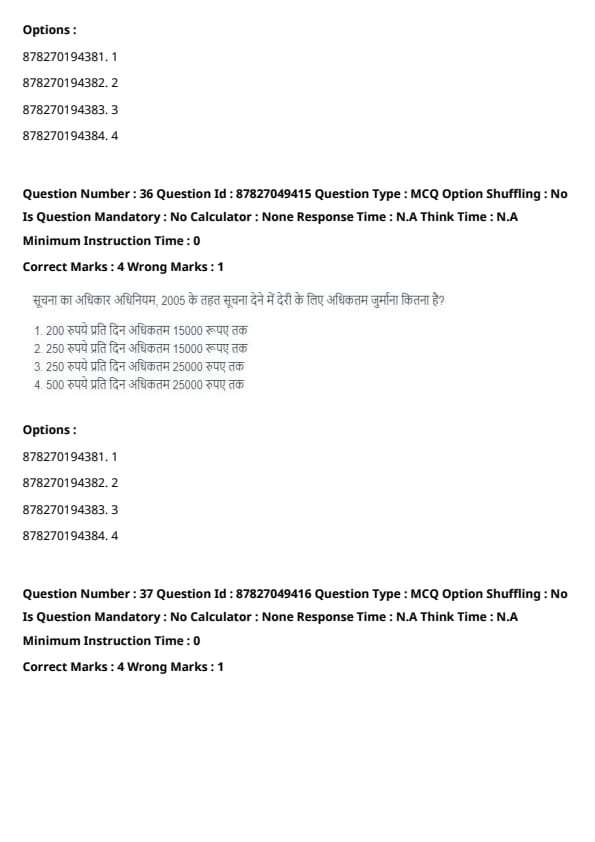
Question 36:
What is the maximum penalty under the Right to Information Act, 2005 for delay in furnishing the information?
View Solution
Under Section 20(1) of the Right to Information Act, 2005, a penalty of Rs 250 per day can be imposed for delays in providing information, subject to a maximum of Rs 25,000. This penalty is imposed by the Information Commission on the designated Public Information Officer (PIO) for failing to furnish information on time.
Key Takeaway: RTI Act imposes a penalty of Rs 250 per day, up to a maximum of Rs 25,000 for delays in furnishing information.
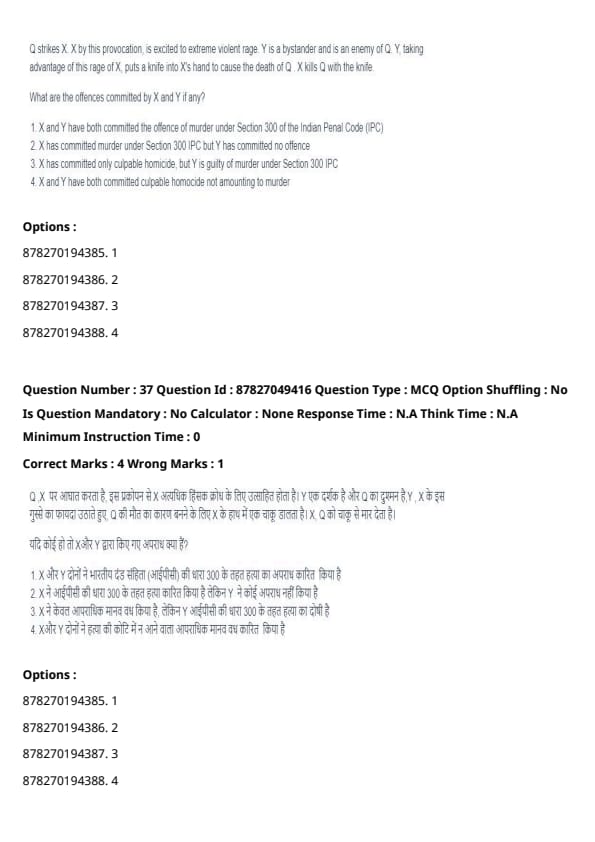
Question 37:
Q strikes X. X, provoked to extreme violent rage, is handed a knife by Y, a bystander and enemy of Q. X kills Q with the knife. What are the offences committed by X and Y, if any?
View Solution
- X was provoked into committing the act in a fit of rage, classifying it as culpable homicide not amounting to murder under the IPC due to grave and sudden provocation.
- Y, however, intentionally handed the knife to X with the intent to cause Q's death. This makes Y guilty of murder under Section 300 IPC as he aided the act with malicious intent.
Key Takeaway: Provoked acts might constitute culpable homicide, while aiding with intent can escalate to murder charges.
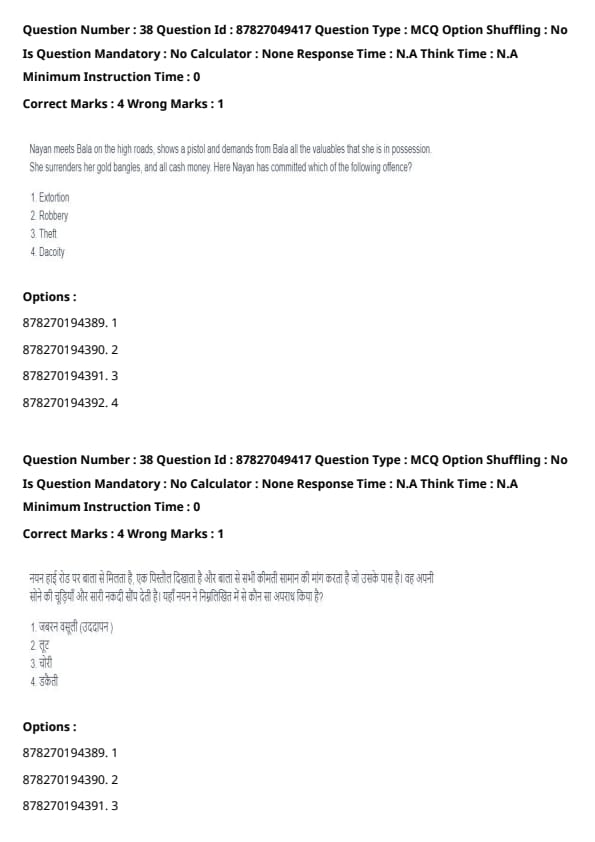
Question 38:
Nayan meets Bala on the road, shows a pistol, and demands valuables. Bala surrenders her gold bangles and cash. What offence has Nayan committed?
View Solution
Robbery involves the use of force or threat of force to commit theft. Nayan's use of a pistol to compel Bala to surrender her belongings constitutes robbery under the IPC. Extortion, theft, and dacoity have distinct definitions that do not align with this situation.
Key Takeaway: Robbery involves the use or threat of force to commit theft, distinguishing it from extortion and theft.
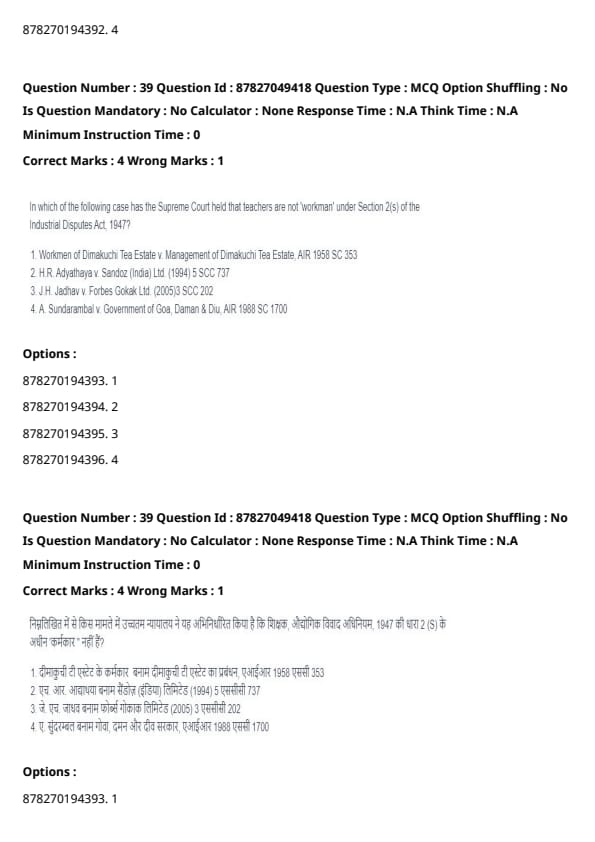
Question 39:
In which of the following case has the Supreme Court held that teachers are not ‘workman’ under Section 2(s) of the Industrial Disputes Act, 1947?
View Solution
In A. Sundarambal v. Government of Goa, Daman Diu, the Supreme Court ruled that teachers do not fall under the definition of 'workman' as their work is intellectual and educational, rather than manual, clerical, or skilled labor.
Key Takeaway: Teachers are excluded from the definition of ‘workman’ under the Industrial Disputes Act as clarified in the A. Sundarambal case.
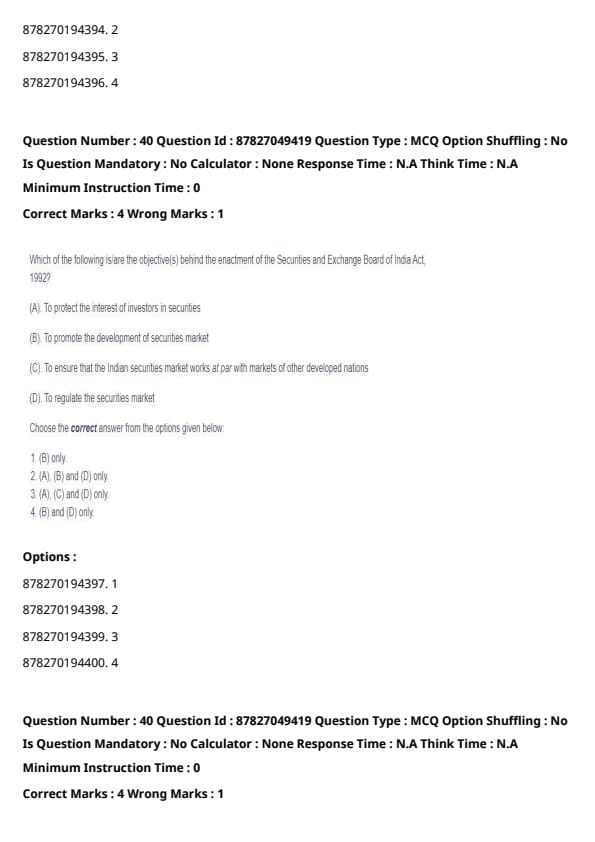
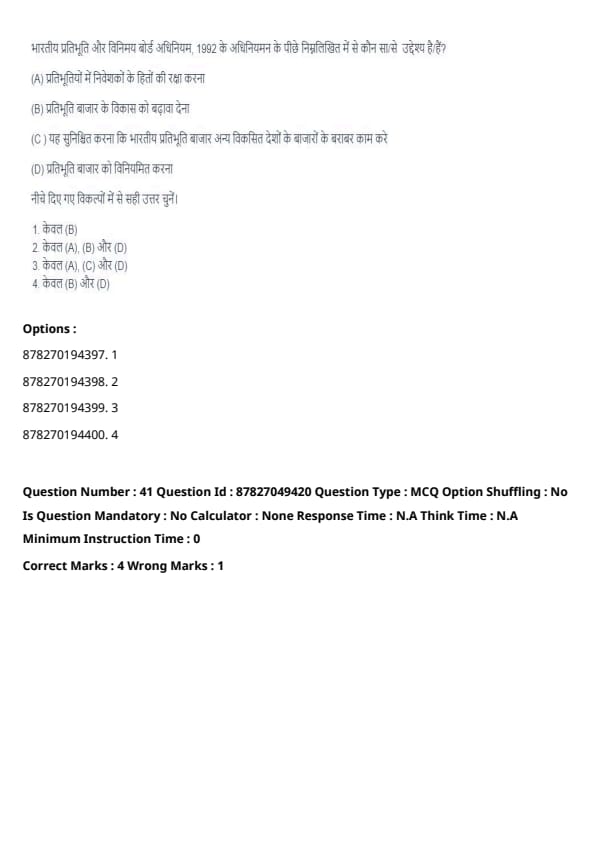
Question 40:
Which of the following are the objectives behind the enactment of the Securities and Exchange Board of India Act, 1992?
View Solution
The Securities and Exchange Board of India Act, 1992 was enacted with the following objectives:
- To protect the interests of investors in securities.
- To promote the development of the securities market.
- To regulate the securities market.
While ensuring parity with developed nations is a desired outcome, it is not explicitly mentioned as an objective in the Act.
Key Takeaway: The SEBI Act aims to protect investors, regulate the market, and promote its development.
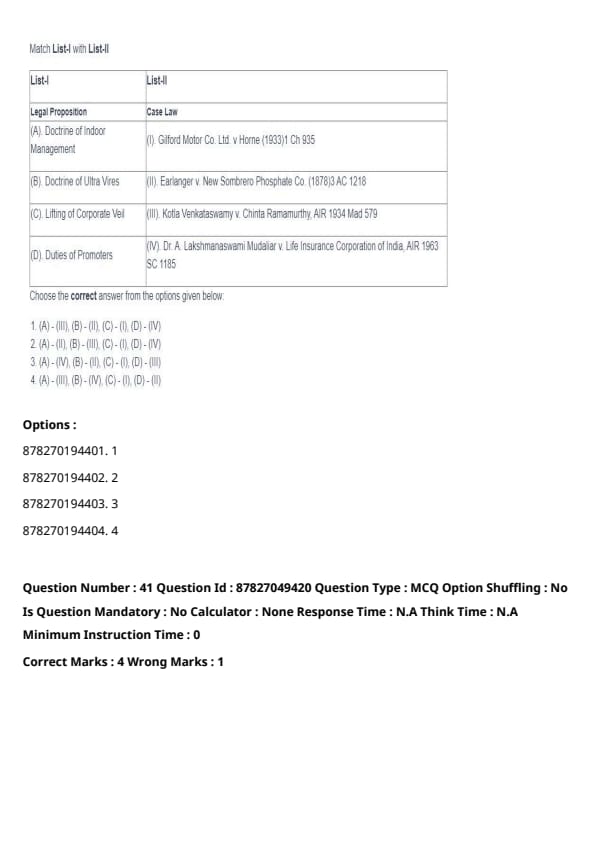
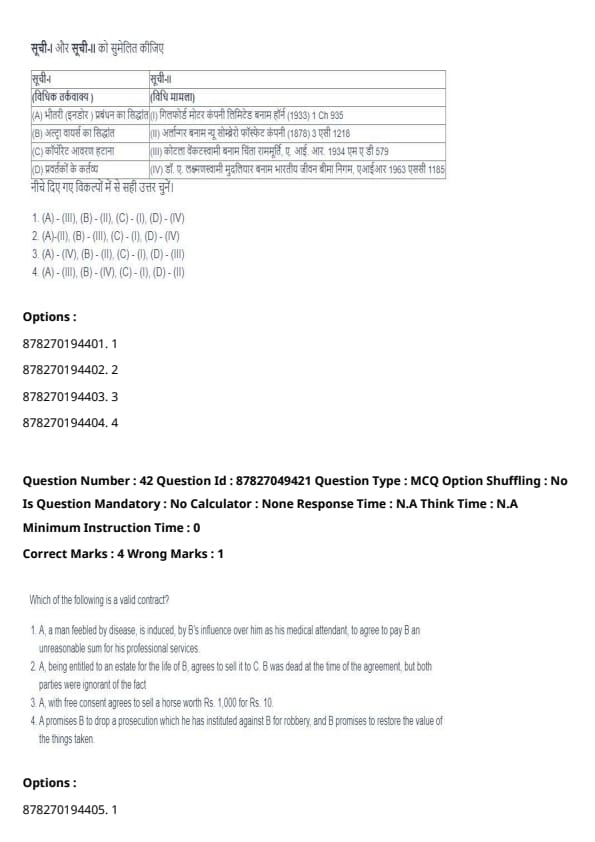
Question 41:
Match List-I with List-II:
| List-I (Legal Proposition) | List-II (Case Law) |
|---|---|
| (A) Doctrine of Indoor Management | (I) Gilford Motor Co. Ltd. v. Horne |
| (B) Doctrine of Ultra Vires | (II) Earlanger v. New Sombrero Phosphate Co. |
| (C) Lifting of Corporate Veil | (III) Kotla Venkataswamy v. Chinta Ramamurthy |
| (D) Duties of Promoters | (IV) Dr. A. Lakshmanaswami Mudaliar v. LIC of India |
View Solution
- The Doctrine of Indoor Management relates to Kotla Venkataswamy v. Chinta Ramamurthy.
- The Doctrine of Ultra Vires is highlighted in Earlanger v. New Sombrero Phosphate Co..
- Lifting of Corporate Veil is demonstrated in Gilford Motor Co. Ltd. v. Horne.
- Duties of Promoters are outlined in Dr. A. Lakshmanaswami Mudaliar v. LIC of India.
Key Takeaway: Familiarize yourself with landmark cases associated with company law principles.
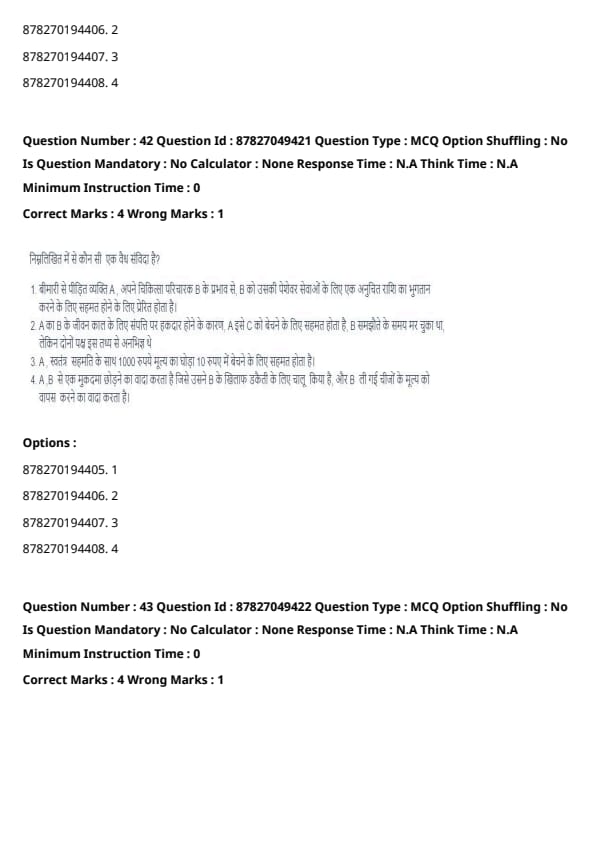
Question 42:
Which of the following is a valid contract?
View Solution
- Option (1) involves undue influence and is invalid.
- Option (2) involves mutual mistake of fact, rendering the contract void.
- Option (3) presents a valid contract, as free consent is present. Courts do not assess the adequacy of consideration.
- Option (4) lacks a lawful object and is void as it contravenes public policy.
Key Takeaway: A valid contract requires free consent, lawful consideration, and a lawful object.
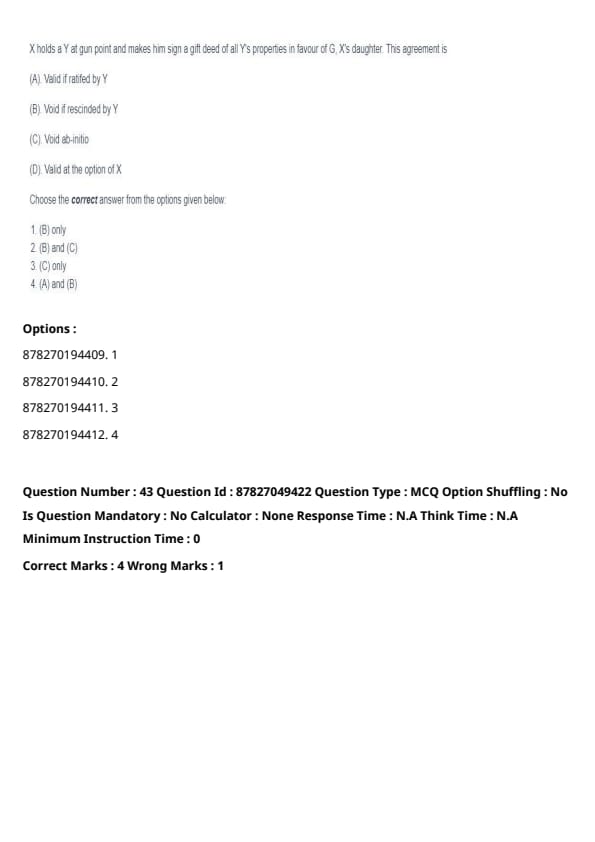
Question 43:
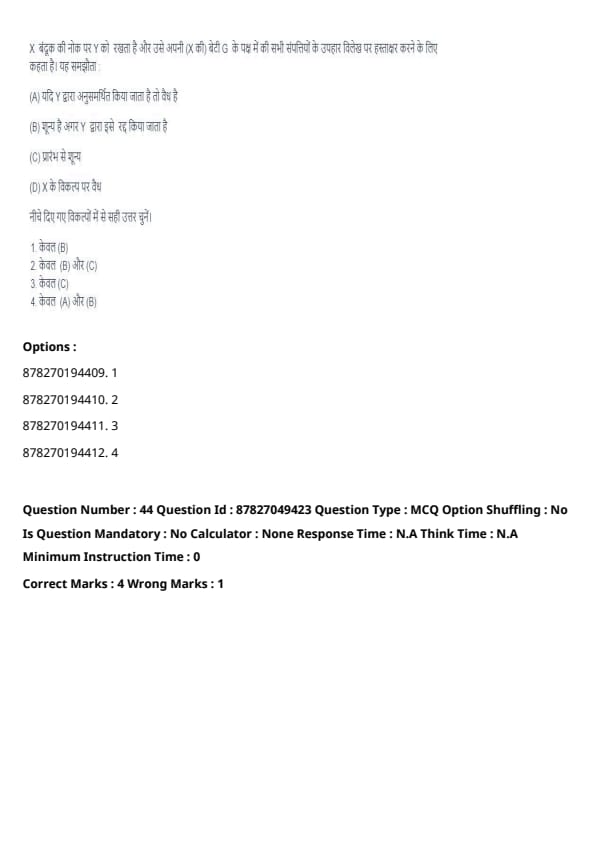
X holds Y at gunpoint and makes him sign a gift deed of all Y’s properties in favor of G, X’s daughter. This agreement is:
View Solution
When consent to an agreement is obtained through coercion or duress, as in this case, it renders the agreement void ab initio (void from the beginning). Such an agreement has no legal validity and cannot be made valid by ratification.
Key Takeaway: Agreements made under coercion or duress are void ab initio.
Question 44:
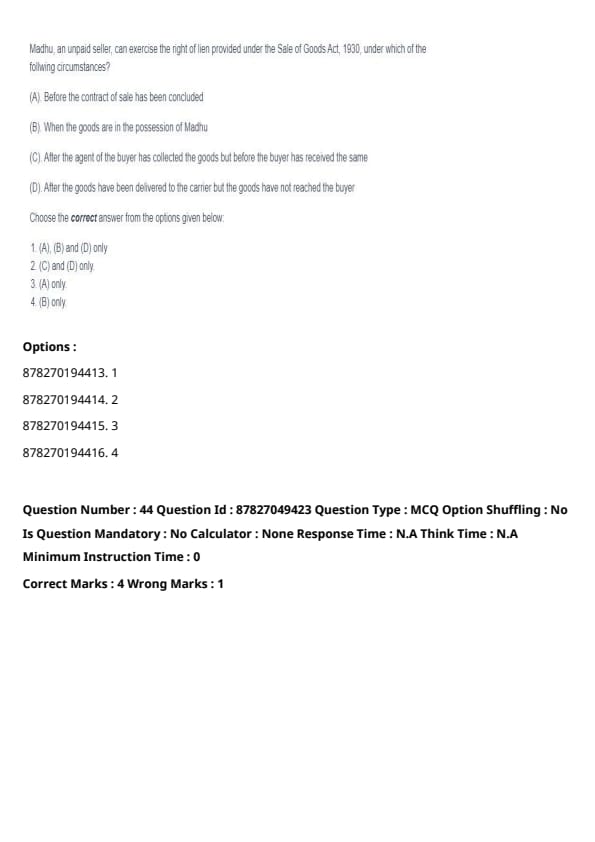
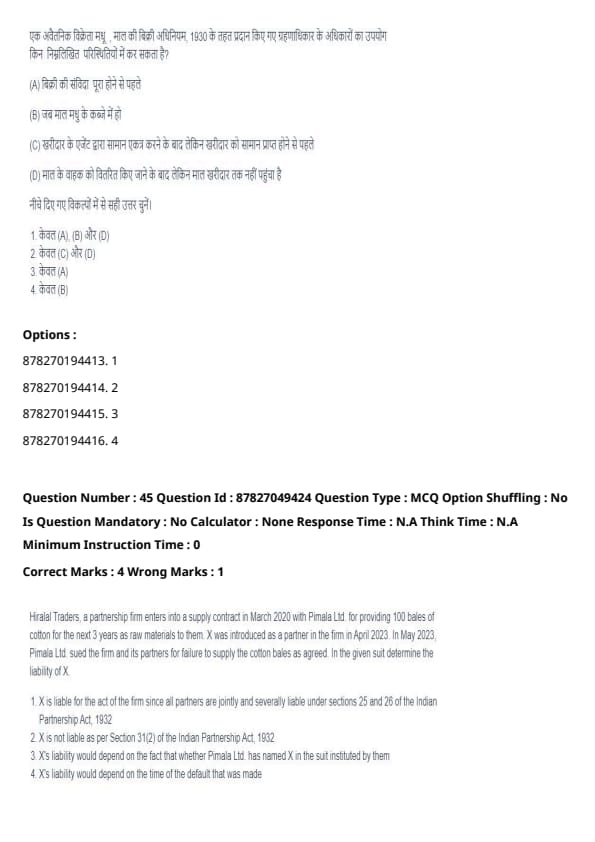
Madhu, an unpaid seller, can exercise the right of lien under the Sale of Goods Act, 1930, under which of the following circumstances?
View Solution
- Right of lien is exercisable only when the unpaid seller retains possession of the goods.
- If possession has transferred to the buyer or their agent, the lien cannot be exercised.
- If goods are in transit, the seller may invoke stoppage in transit, not lien.
Key Takeaway: Right of lien applies only when the unpaid seller retains possession of the goods.
Question 45:
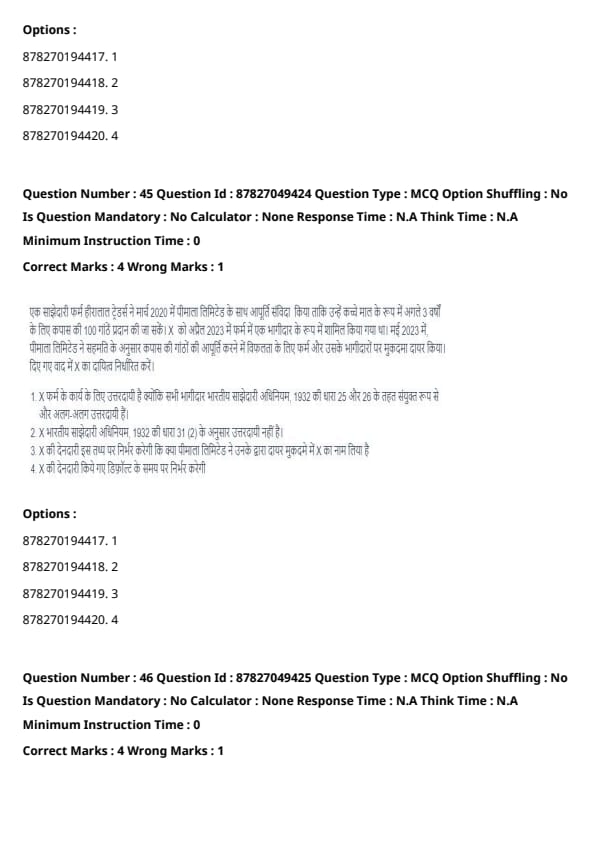
Hiralal Traders, a partnership firm, enters into a supply contract in March 2020. X is introduced as a partner in April 2023. Pimala Ltd. sues the firm in May 2023 for failure to supply cotton bales. What is the liability of X?
View Solution
Under Section 31(2) of the Indian Partnership Act, a new partner is not liable for any acts of the firm prior to their joining. X became a partner in April 2023, while the contract was signed in March 2020. Therefore, X is not liable for obligations arising from that contract.
Key Takeaway: A new partner is not liable for prior debts of the firm under Section 31(2) of the Indian Partnership Act, 1932.
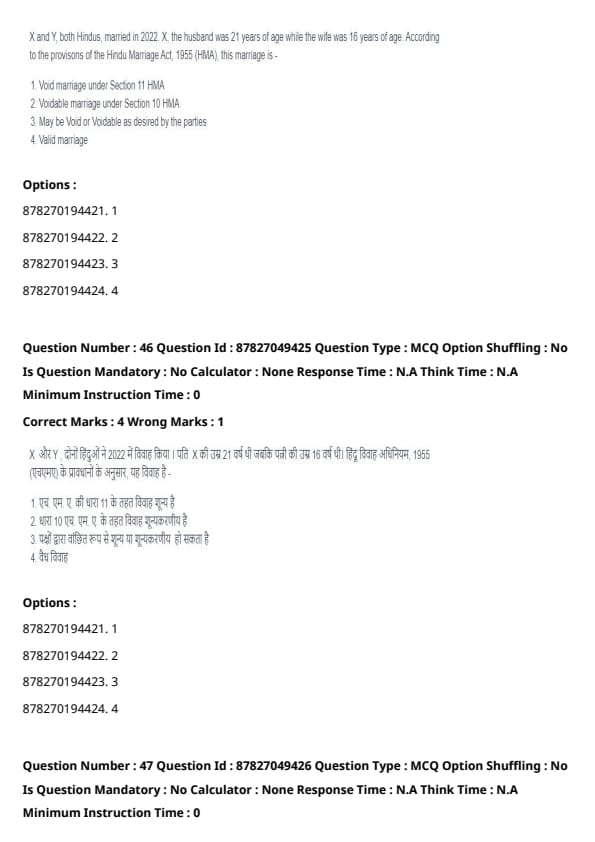
Question 46:
X and Y, both Hindus, married in 2022. X, the husband, was 21 years of age, while Y, the wife, was 16 years of age. According to the provisions of the Hindu Marriage Act, 1955 (HMA), this marriage is:
View Solution
Under the Hindu Marriage Act, 1955, the minimum age for marriage is 21 years for the male and 18 years for the female. If the marriage takes place when either party is underage, it is voidable at the instance of the underage party under Section 10 HMA, not void under Section 11. However, due to ambiguities in the question regarding amendments and changes in the law, this question has been dropped.
Key Takeaway: A marriage where either party is under the prescribed age is voidable under the Hindu Marriage Act, 1955.
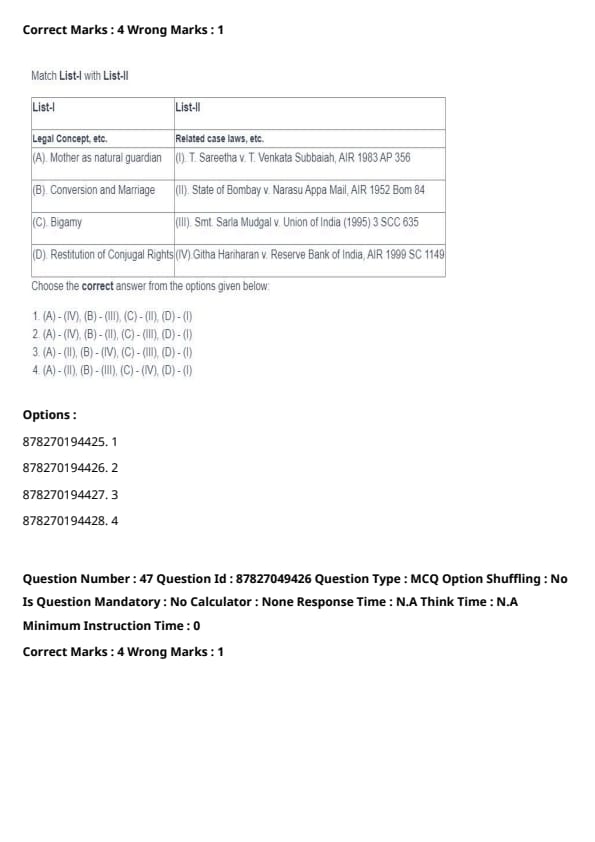
Question 47:
Match List-I with List-II:
| List-I (Legal Concept) | List-II (Related Case Laws) |
|---|---|
| (A) Mother as natural guardian | (I) T. Sareetha v. T. Venkata Subbaiah |
| (B) Conversion and Marriage | (II) State of Bombay v. Narasu Appa Mail |
| (C) Bigamy | (III) Smt. Sarla Mudgal v. Union of India |
| (D) Restitution of Conjugal Rights | (IV) Githa Hariharan v. Reserve Bank of India |
View Solution
- Mother as natural guardian: Githa Hariharan v. Reserve Bank of India.
- Conversion and Marriage: Smt. Sarla Mudgal v. Union of India.
- Bigamy: State of Bombay v. Narasu Appa Mail.
- Restitution of Conjugal Rights: T. Sareetha v. T. Venkata Subbaiah.
Key Takeaway: Familiarize yourself with family law cases and their related legal concepts.
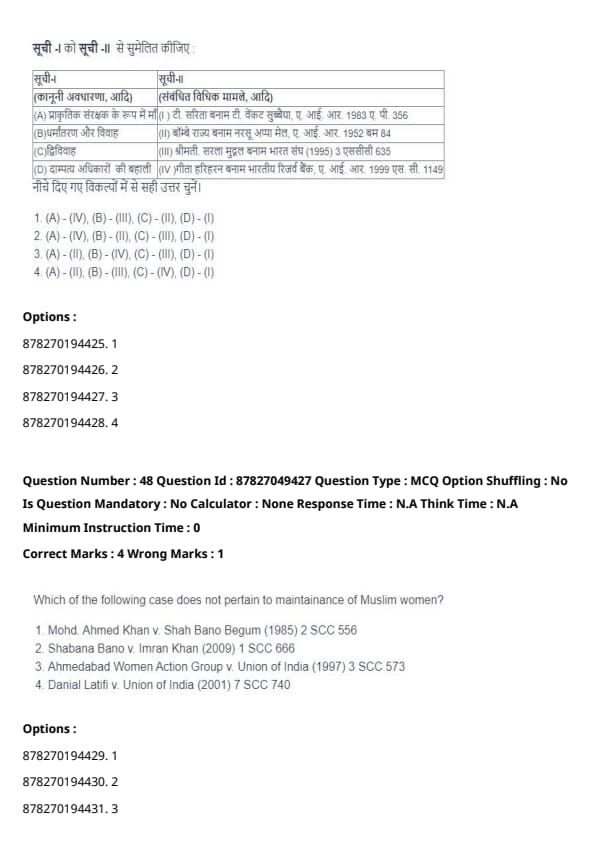
Question 48:
Which of the following case does not pertain to maintenance of Muslim women?
View Solution
- Mohd. Ahmed Khan v. Shah Bano Begum: A landmark case affirming a Muslim woman's right to maintenance under Section 125 CrPC.
- Shabana Bano v. Imran Khan: Further expanded Muslim women's right to maintenance under the Muslim Women Act.
- Danial Latifi v. Union of India: Upheld the validity of the Muslim Women Act, ensuring fair provisions.
- Ahmedabad Women Action Group v. Union of India: Did not directly deal with maintenance but rather issues of bigamy and women’s rights.
Key Takeaway: Ahmedabad Women Action Group case is unrelated to maintenance of Muslim women.
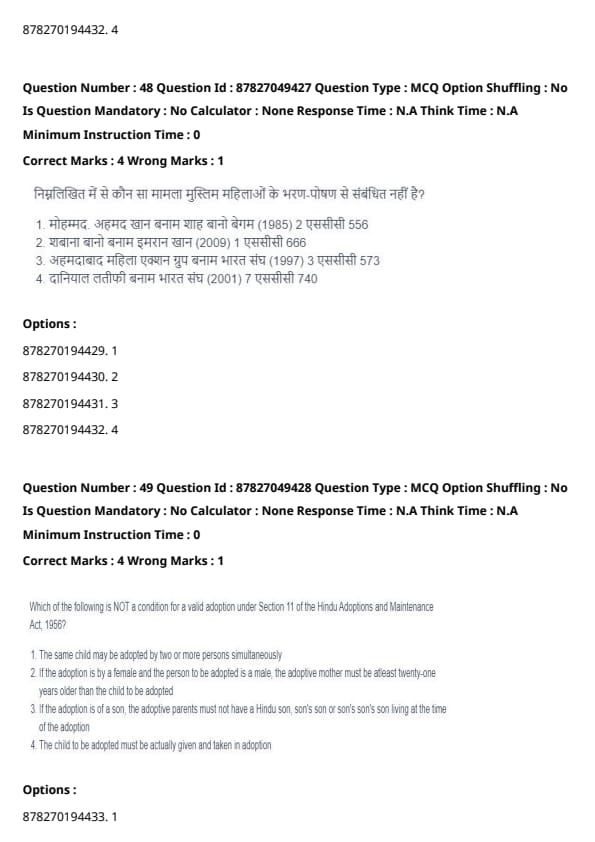
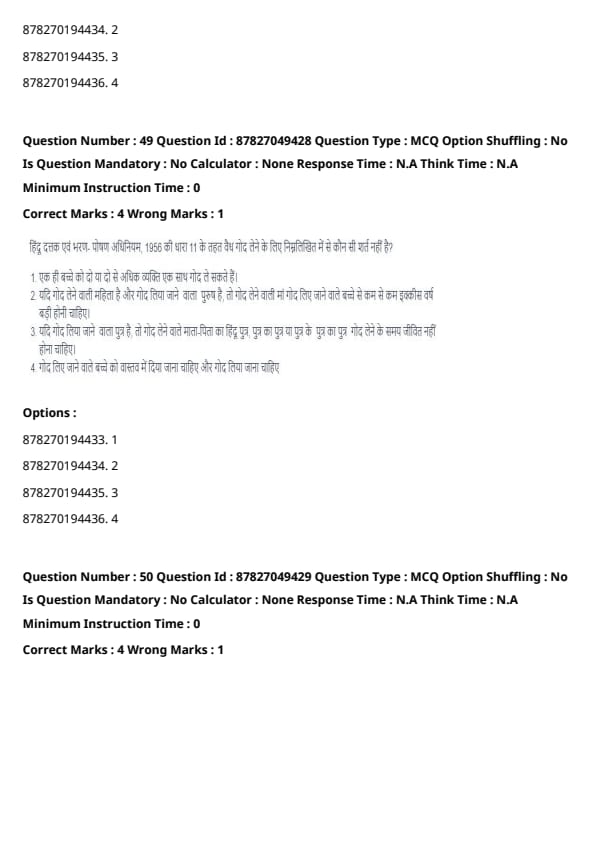
Question 49:
Which of the following is NOT a condition for a valid adoption under Section 11 of the Hindu Adoptions and Maintenance Act, 1956?
View Solution
- A child cannot be adopted by two or more people simultaneously. Adoption can only be by one individual or a married couple.
- Other conditions, such as age difference between the adoptive parent and child, absence of another son in the family, and actual giving and taking, are essential for a valid adoption.
Key Takeaway: A child cannot be adopted simultaneously by two or more persons.
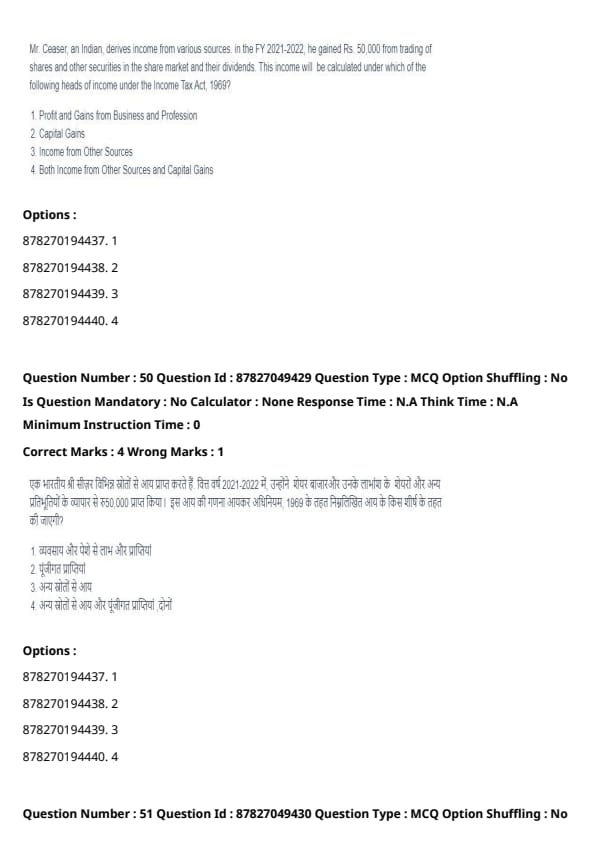
Question 50:
Mr. Ceaser, an Indian, derives income from trading shares and their dividends in FY 2021-2022. Under which head of income is this calculated as per the Income Tax Act, 1969?
View Solution
- Income from trading shares is categorized under “Profits and Gains from Business and Profession” as it involves frequent transactions.
- Dividend income is categorized under “Income from Other Sources.”
Thus, the two heads are applicable, depending on the nature of the income.
Key Takeaway: Share trading income and dividends fall under different heads of income for taxation purposes.
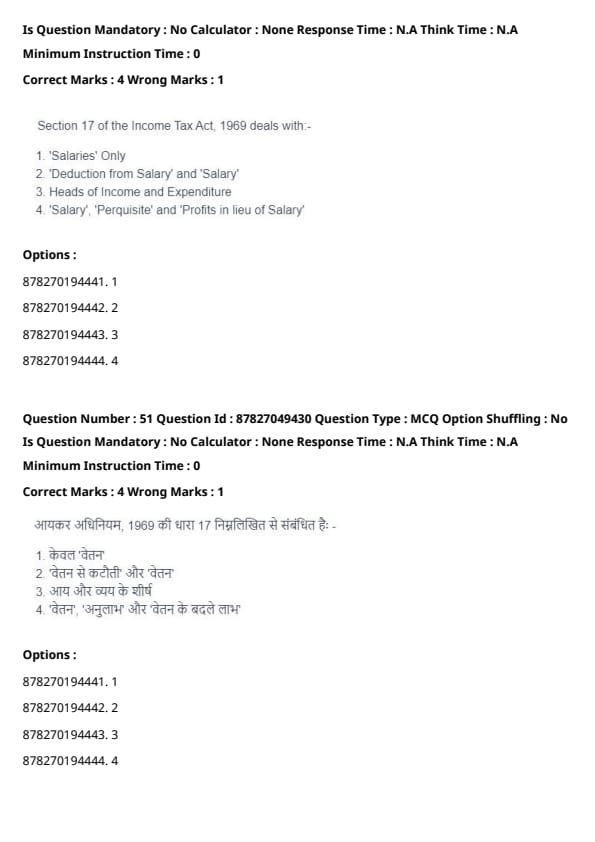
Question 51:
Section 17 of the Income Tax Act, 1969 deals with:
View Solution
Section 17 of the Income Tax Act, 1969 provides the definition of “salary” for income computation. It includes:
- Salary
- Perquisites (benefits or allowances granted by an employer)
- Profits in lieu of salary (compensations or profits).
Key Takeaway: Section 17 defines all components of salary, including perquisites and profits in lieu of salary.
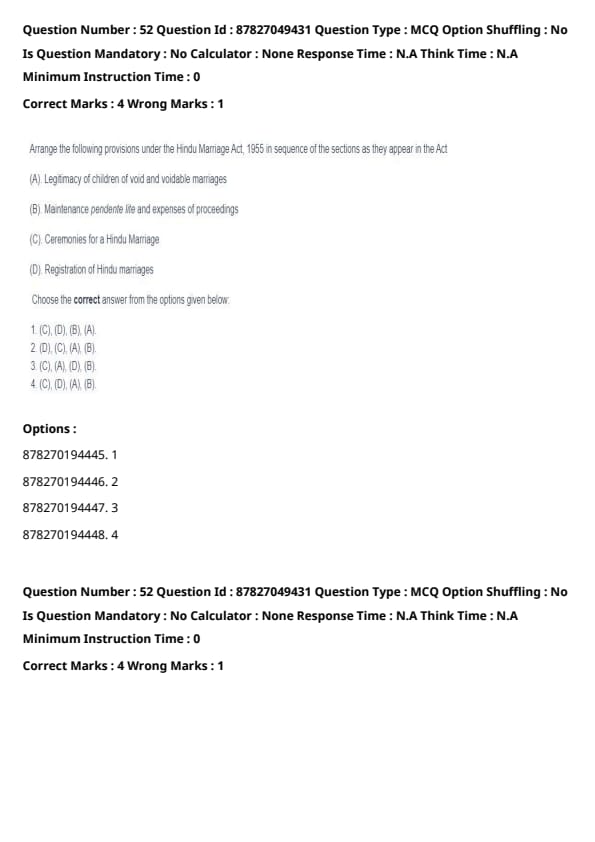
Question 52:
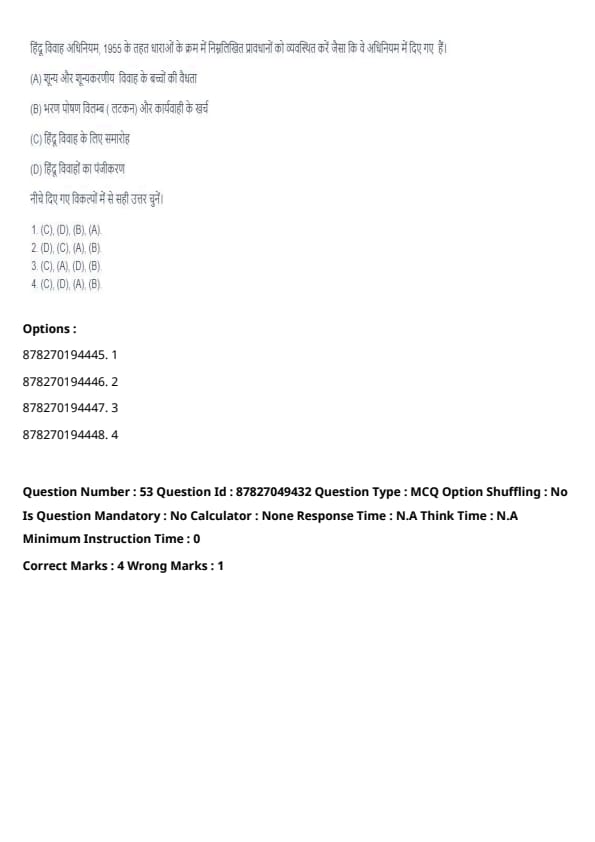
Arrange the following provisions under the Hindu Marriage Act, 1955 in the sequence of their appearance in the Act:
View Solution
The correct order of sections under the Hindu Marriage Act, 1955 is:
1. Ceremonies for a Hindu Marriage (Section 7)
2. Registration of Hindu marriages (Section 8)
3. Legitimacy of children of void and voidable marriages (Section 16)
4. Maintenance pendente lite and expenses of proceedings (Section 24)
Key Takeaway: Memorize the sequence of provisions for quick recall in exams.
Question 53:
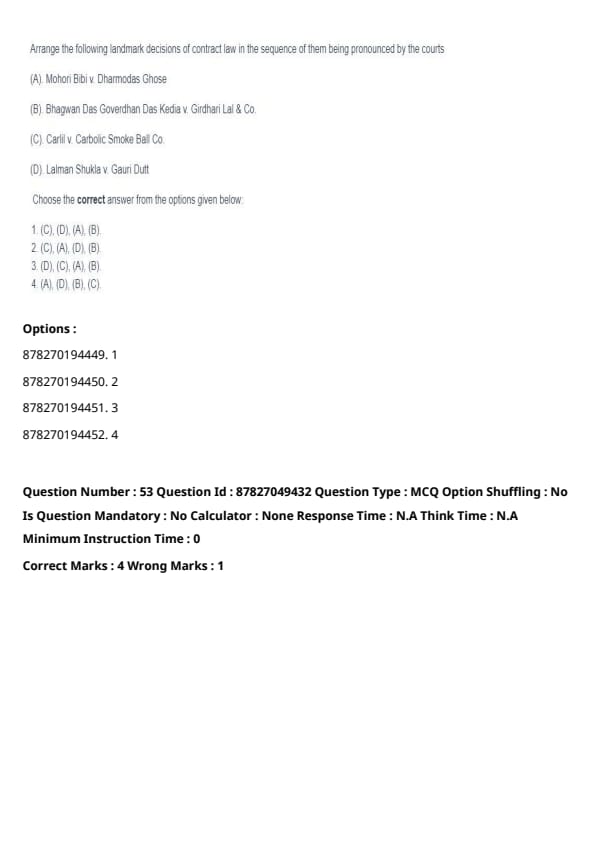
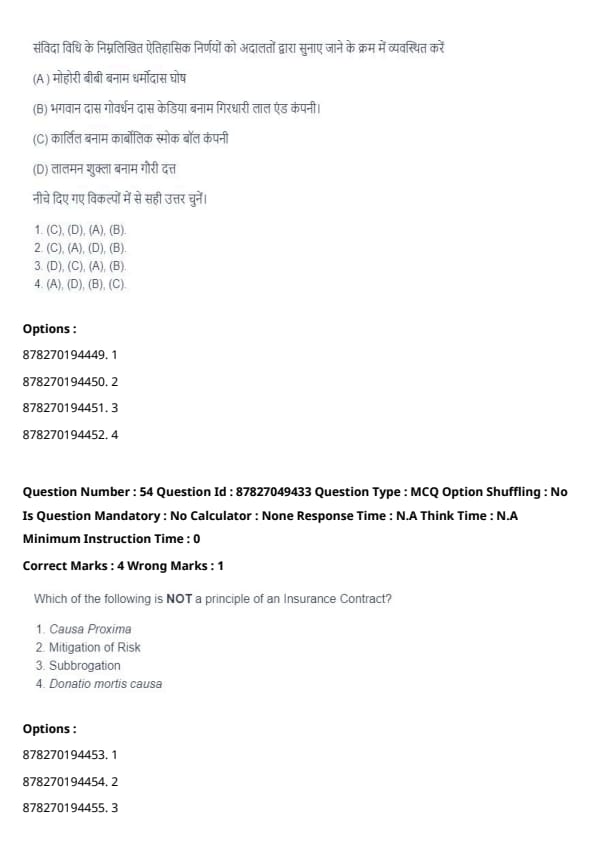
Arrange the following landmark decisions of contract law in the sequence of them being pronounced by the courts:
View Solution
The correct chronological order is:
1. Carlil v. Carbolic Smoke Ball Co. (1893): Established rules for unilateral contracts.
2. Mohori Bibi v. Dharmodas Ghose (1903): Defined the legal position of minors in contracts.
3. Lalman Shukla v. Gauri Dutt (1913): Dealt with the requirement of offer knowledge.
4. Bhagwan Das Goverdhan Das Kedia v. Girdhari Lal & Co. (1966): Addressed contracts made through telephone.
Key Takeaway: Learn the sequence of landmark cases to understand the evolution of contract law.
Question 54:
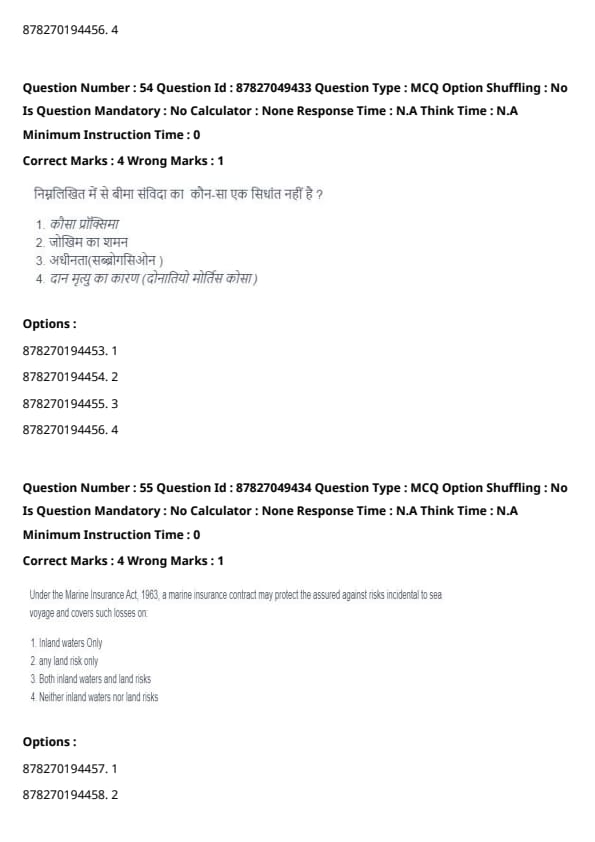
Which of the following is NOT a principle of an Insurance Contract?
View Solution
- Causa Proxima: Refers to proximate cause doctrine.
- Mitigation of Risk: Requires minimizing risks.
- Subrogation: Gives insurers the right to recover from third parties.
- Donatio mortis causa: Refers to gifts in contemplation of death, unrelated to insurance.
Key Takeaway: Donatio mortis causa is not a principle of insurance contracts.
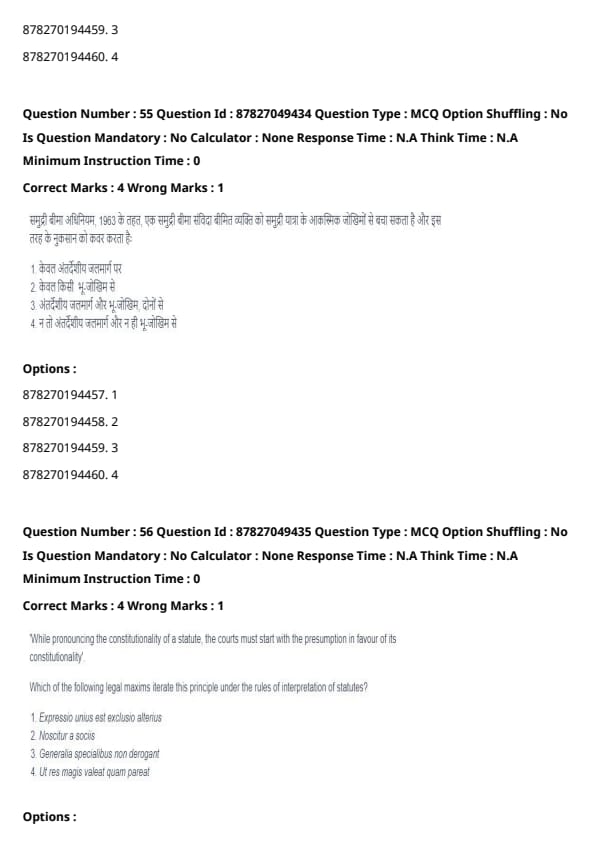
Question 55:
Under the Marine Insurance Act, 1963, a marine insurance contract may protect the assured against risks incidental to sea voyage and covers such losses on:
View Solution
Under the Marine Insurance Act, 1963, a marine insurance contract may cover:
- Sea voyages
- Inland waterways
- Land risks incidental to the sea voyage.
Marine insurance provides broad protection for goods in transit, ensuring coverage during the entire journey.
Key Takeaway: Marine insurance covers both inland waterways and land risks related to sea voyages.
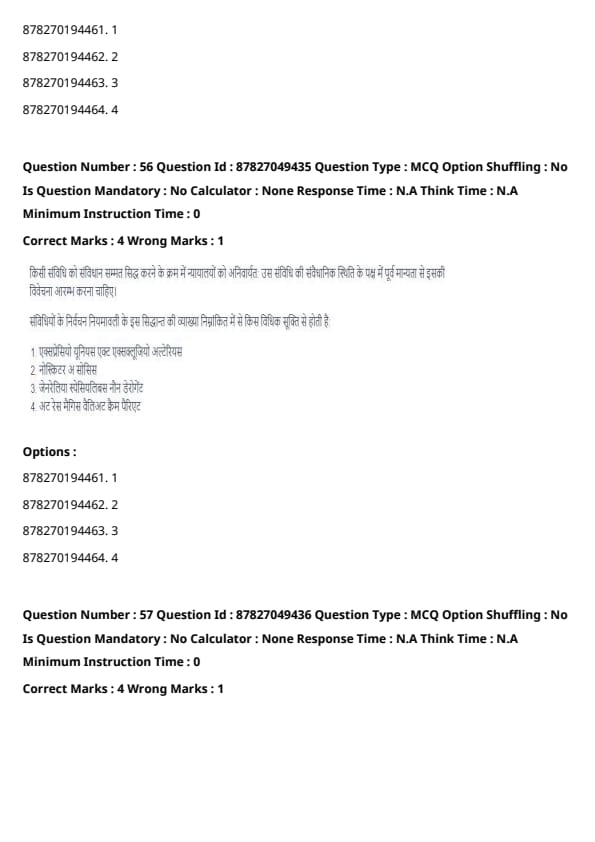
Question 56:
‘While pronouncing the constitutionality of a statute, the courts must start with the presumption in favour of its constitutionality’. Which of the following legal maxims iterate this principle under the rules of interpretation of statutes?
View Solution
The legal maxim “Ut res magis valeat quam pereat” translates to “It is better for a thing to have effect than to be made void.” Courts should strive to interpret statutes in a way that upholds their constitutionality and makes them workable rather than void.
Other maxims:
- Expressio unius est exclusio alterius: Express mention of one excludes others.
- Noscitur a sociis: A word is known by the company it keeps.
- Generalia specialibus non derogant: General law does not override specific law.
Key Takeaway: “Ut res magis valeat quam pereat” emphasizes the presumption of constitutionality.
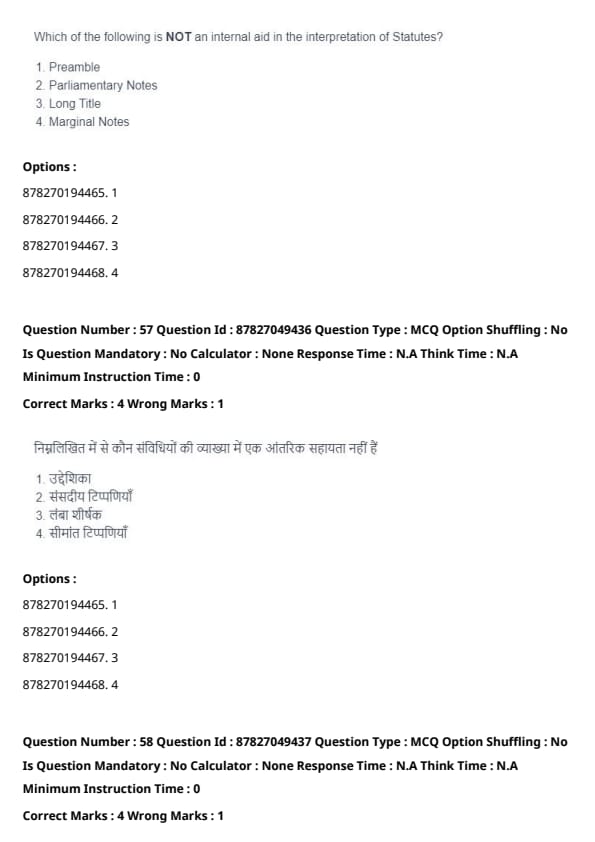
Question 57:
Which of the following is NOT an internal aid in the interpretation of statutes?
View Solution
Internal aids to statutory interpretation include those found within the statute itself:
- Preamble: Indicates the intent and objectives of the statute.
- Long Title: Specifies the scope of the statute.
- Marginal Notes: Provide context for specific sections.
Parliamentary Notes, such as debates or committee reports, are external aids.
Key Takeaway: Parliamentary Notes are external aids, whereas Preamble, Long Title, and Marginal Notes are internal aids.
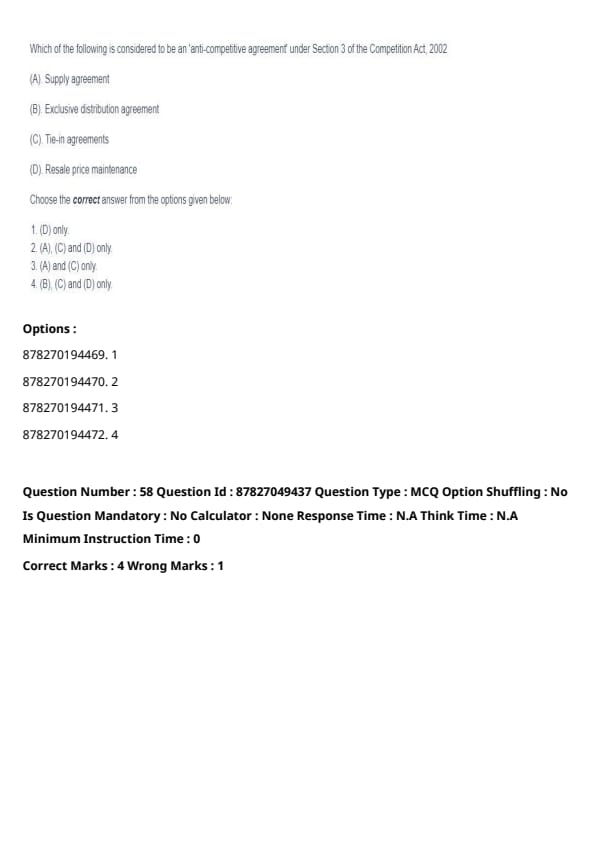
Question 58:
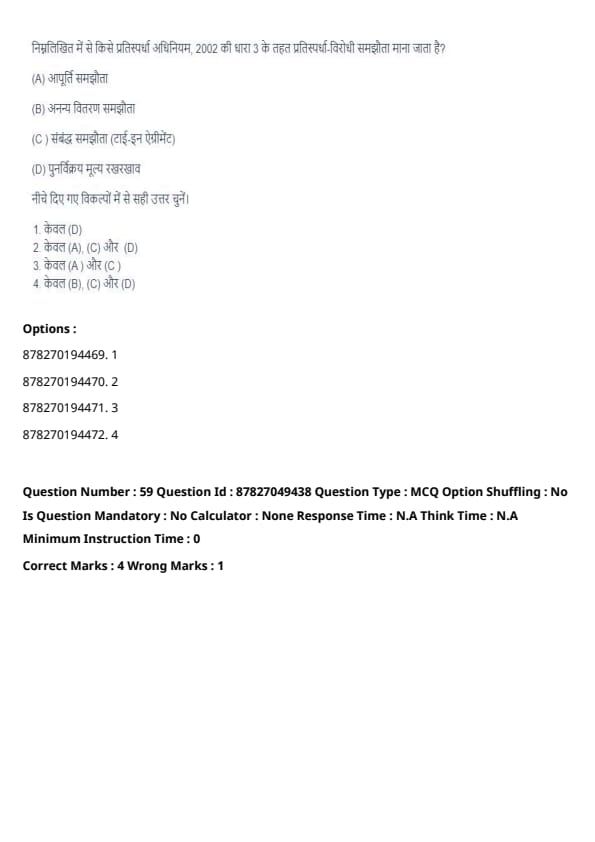
Which of the following is considered to be an ‘anti-competitive agreement’ under Section 3 of the Competition Act, 2002?
View Solution
Anti-competitive agreements under Section 3 include:
- Exclusive distribution agreements: Limit consumer choice and market competition.
- Tie-in agreements: Force consumers to purchase unrelated products.
- Resale price maintenance: Prevent resellers from setting their own prices.
Supply agreements alone are not inherently anti-competitive unless they hinder competition.
Key Takeaway: Exclusive distribution, tie-in agreements, and resale price maintenance are anti-competitive under the Competition Act, 2002.
Question 59:
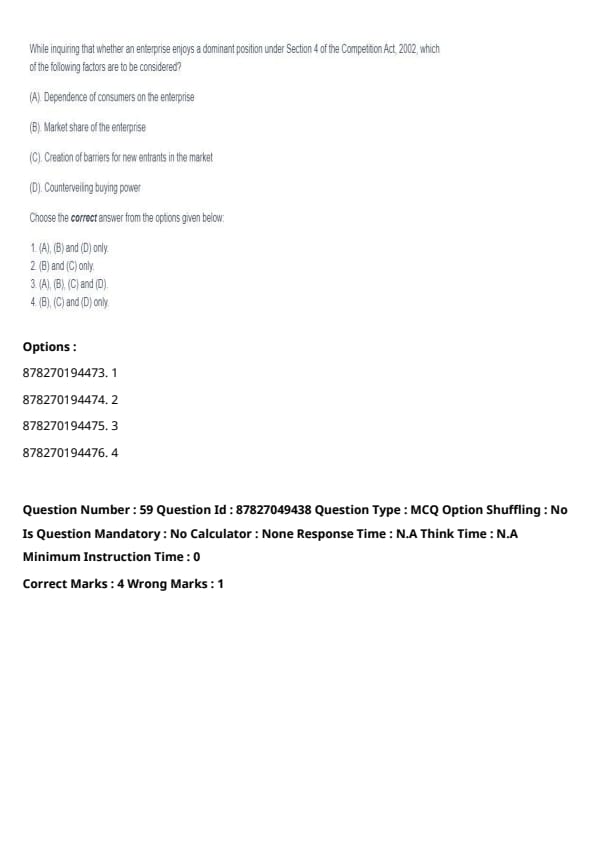
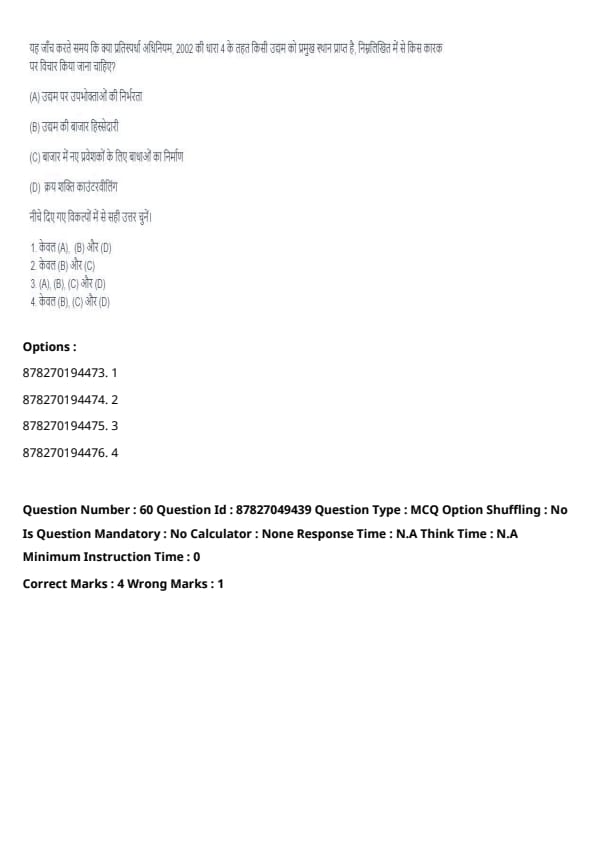
While inquiring whether an enterprise enjoys a dominant position under Section 4 of the Competition Act, 2002, which of the following factors are to be considered?
View Solution
Factors for determining dominant position include:
- Consumer dependence: Extent of reliance on the enterprise.
- Market share: Percentage of market controlled.
- Barriers to entry: Impediments for new competitors.
- Countervailing buying power: Ability of buyers to counteract market power.
Key Takeaway: All these factors are considered to assess market dominance under Section 4.
Question 60:
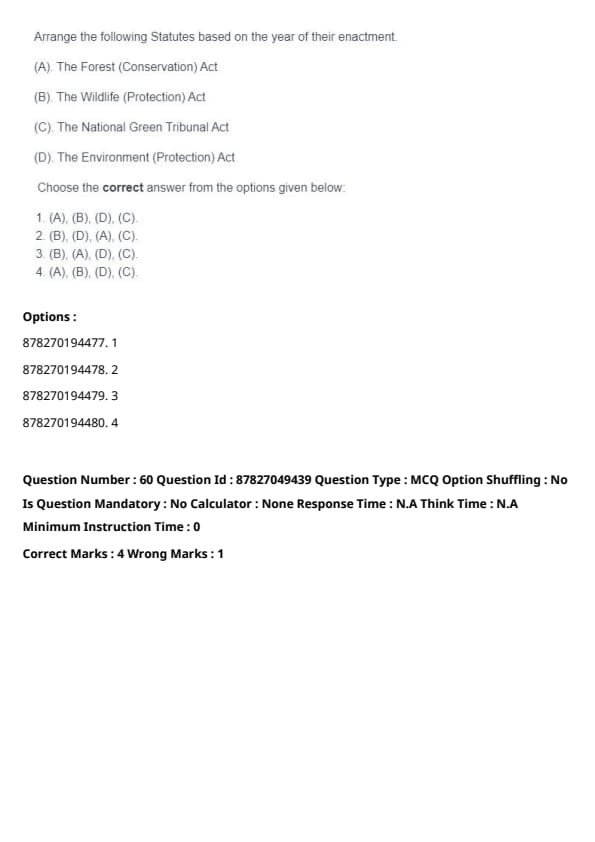
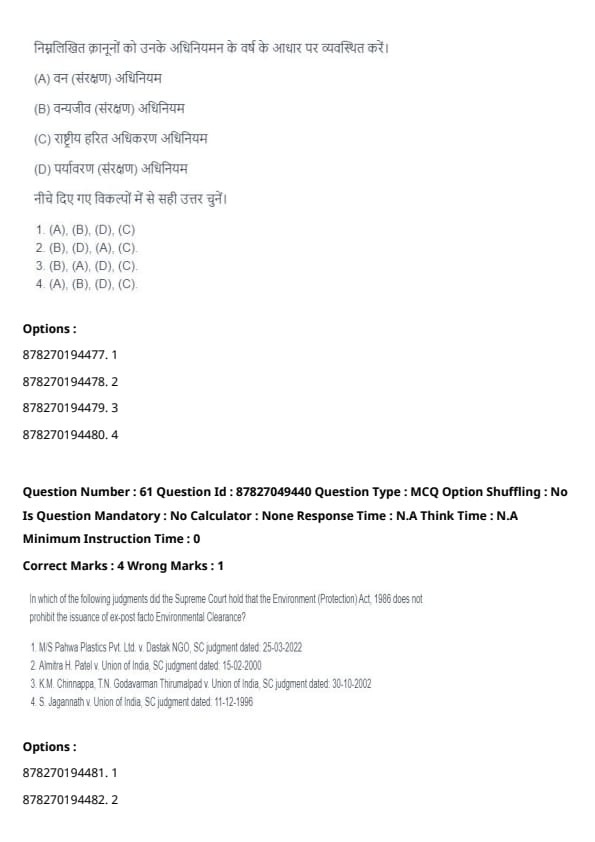
Arrange the following statutes based on the year of their enactment:
View Solution
The correct chronological order is:
1. The Wildlife (Protection) Act: Enacted in 1972.
2. The Forest (Conservation) Act: Enacted in 1980.
3. The Environment (Protection) Act: Enacted in 1986.
4. The National Green Tribunal Act: Enacted in 2010.
Key Takeaway: Remember the timeline of key environmental statutes for accurate answers.
Question 61:
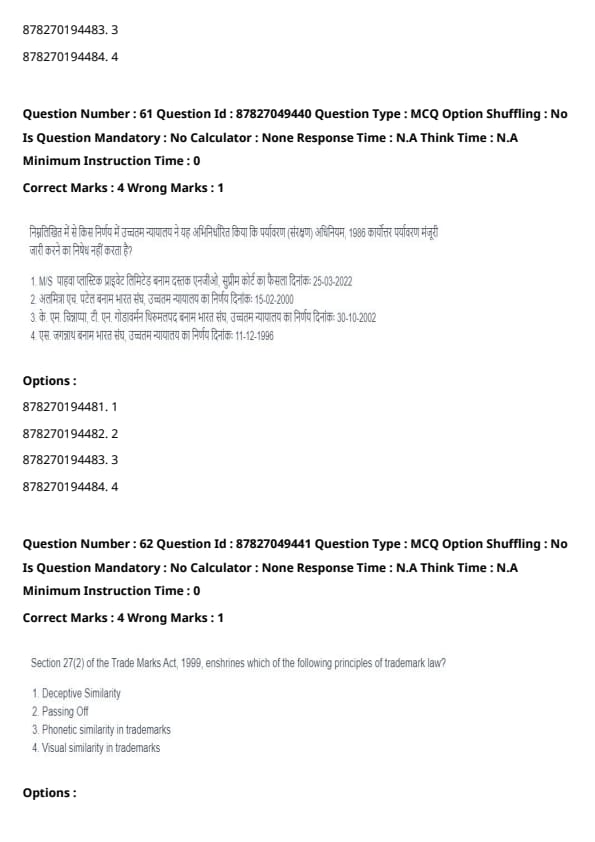
In which of the following judgments did the Supreme Court hold that the Environment (Protection) Act, 1986 does not prohibit the issuance of ex-post facto Environmental Clearance?
View Solution
In M/S Pahwa Plastics Pvt. Ltd. v. Dastak NGO, the Supreme Court ruled that the Environment (Protection) Act, 1986 does not explicitly prohibit ex-post facto environmental clearances. The Court stated that such clearances could be allowed on a case-by-case basis.
Key Takeaway: Remember the Pahwa Plastics case for the principle on ex-post facto environmental clearances.
Question 62:
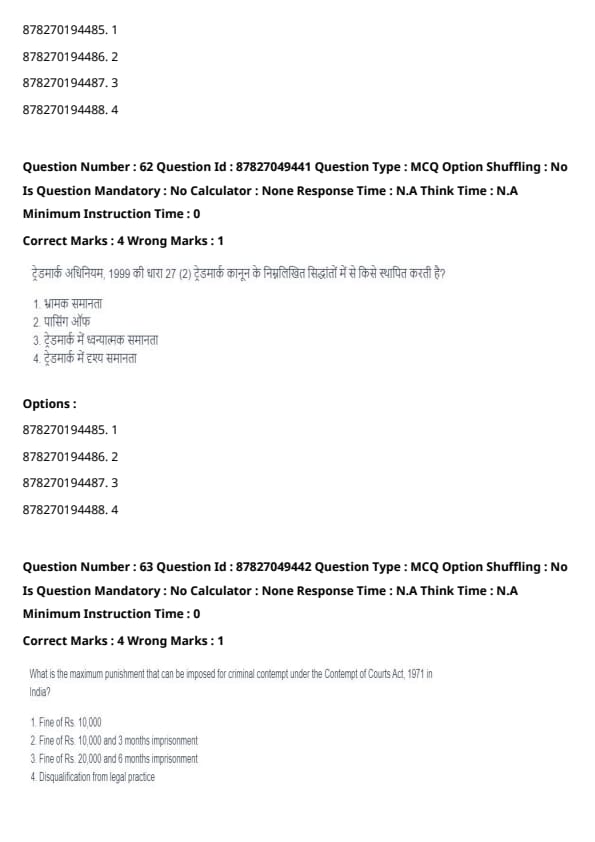
Section 27(2) of the Trade Marks Act, 1999, enshrines which of the following principles of trademark law?
View Solution
Section 27(2) of the Trade Marks Act, 1999, deals with the common law remedy of passing off. This section acknowledges the rights of unregistered trademark owners to protect their marks against misuse, even if the trademark is not registered.
Key Takeaway: Section 27(2) provides for the common law remedy of passing off in trademark law.
Question 63:
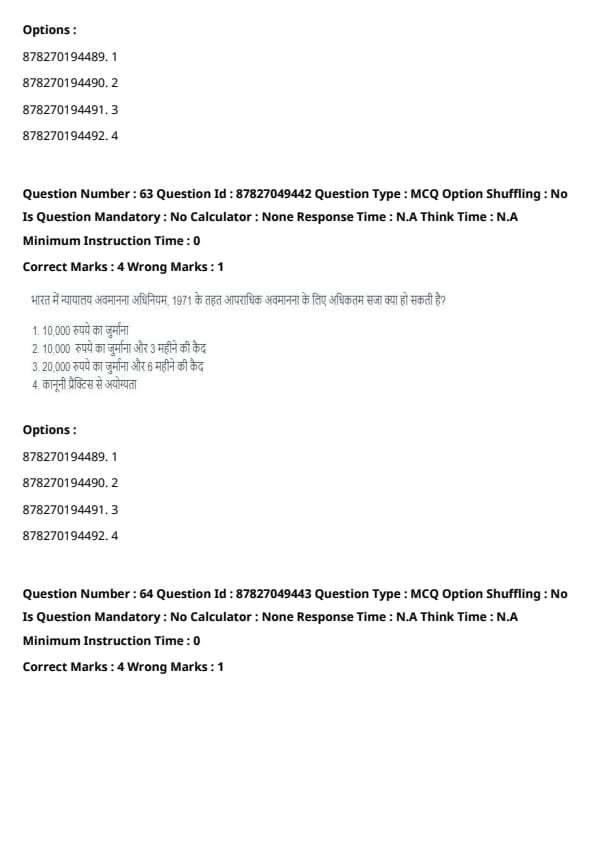
What is the maximum punishment that can be imposed for criminal contempt under the Contempt of Courts Act, 1971 in India?
View Solution
The Contempt of Courts Act, 1971, provides for a maximum punishment of Rs. 20,000 fine and/or six months imprisonment for criminal contempt. Disqualification from legal practice is not a punishment explicitly mentioned under the Act.
Key Takeaway: The maximum penalty for criminal contempt is Rs. 20,000 fine and six months imprisonment.
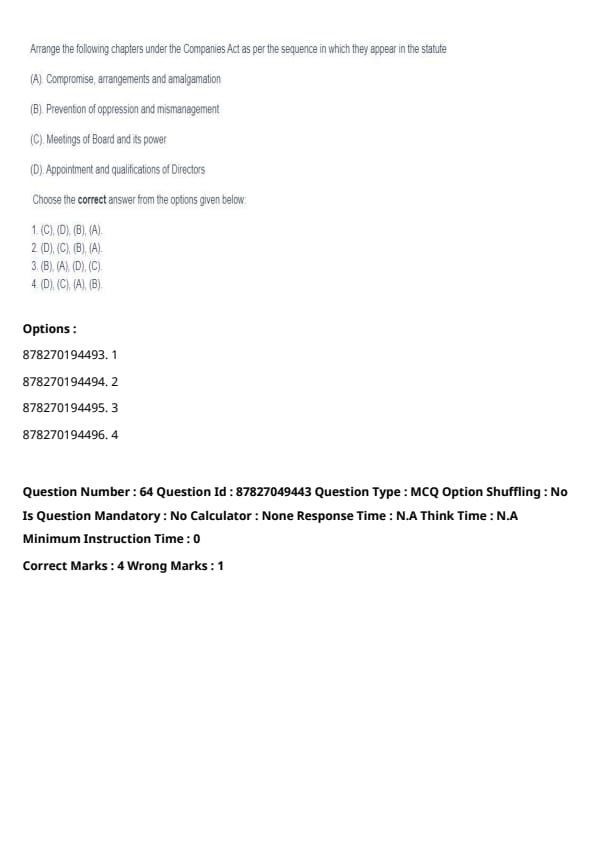
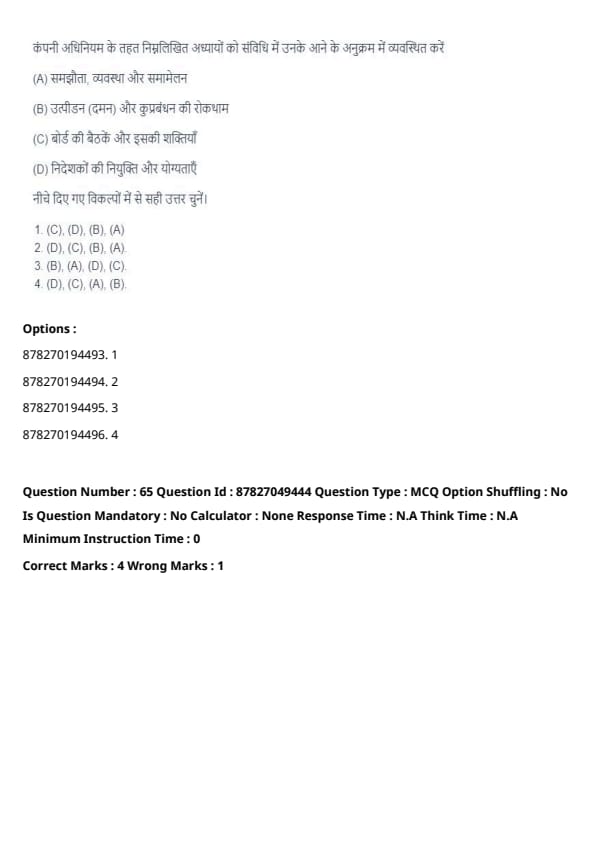
Question 64:
Arrange the following chapters under the Companies Act as per the sequence in which they appear in the statute:
View Solution
The correct order of chapters under the Companies Act is:
1. Appointment and qualifications of Directors.
2. Meetings of Board and its powers.
3. Prevention of oppression and mismanagement.
4. Compromise, arrangements, and amalgamation.
Key Takeaway: Remember the sequence of chapters as they relate to governance and management in the Companies Act.
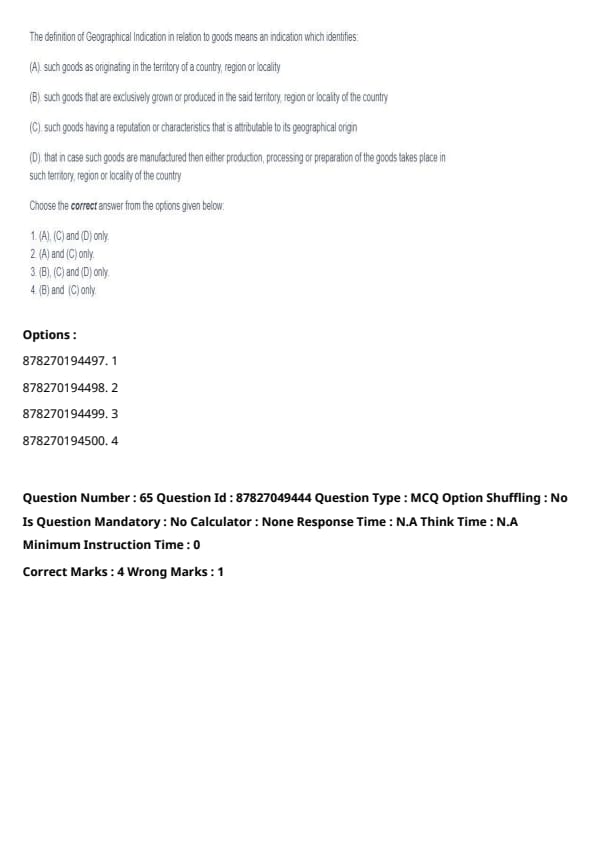
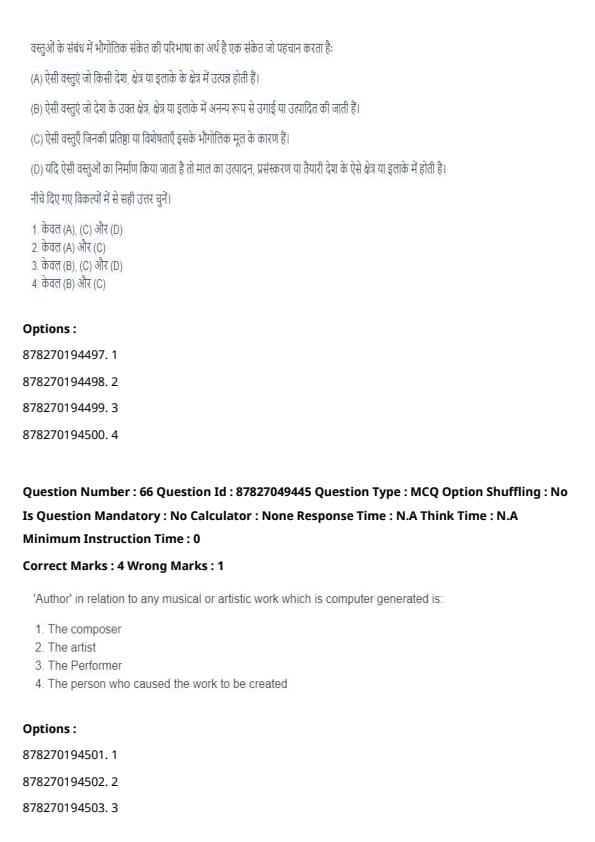
Question 65:
The definition of Geographical Indication in relation to goods means an indication which identifies:
View Solution
A Geographical Indication (GI) identifies products that:
- Originate in a specific territory (Option 1).
- Have reputation or characteristics attributable to that origin (Option 3).
- If manufactured, involve production, processing, or preparation in the identified territory (Option 4).
Option (2) is incorrect as GIs are not limited to exclusive production in the identified region.
Key Takeaway: Geographical Indications are primarily related to origin, reputation, and specific characteristics tied to the geographical area.
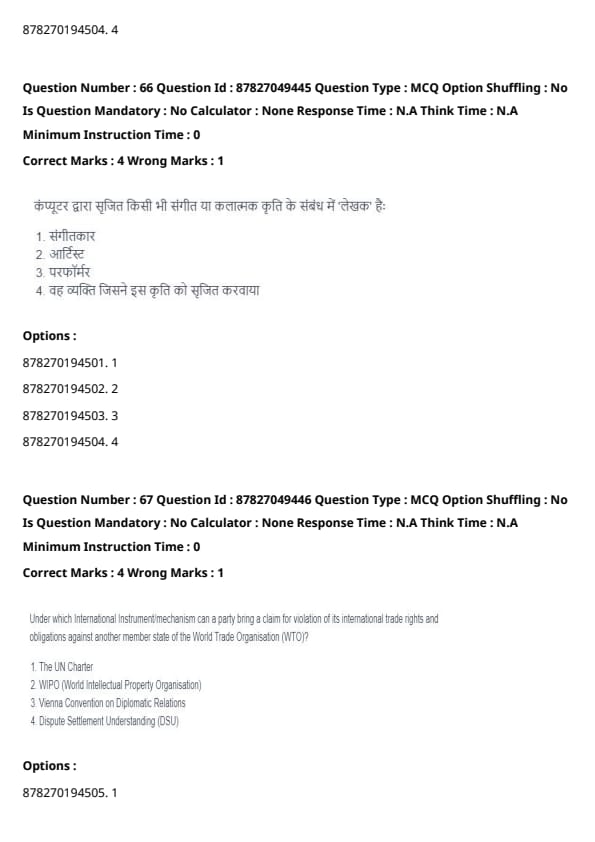
Question 66:
‘Author’ in relation to any musical or artistic work which is computer-generated is:
View Solution
For computer-generated works, copyright law recognizes the person who initiated and caused the work to come into existence as the author. This applies because such works are created with minimal to no human creative input in the final product.
Key Takeaway: For computer-generated works, the author is the person who caused the work to be created.
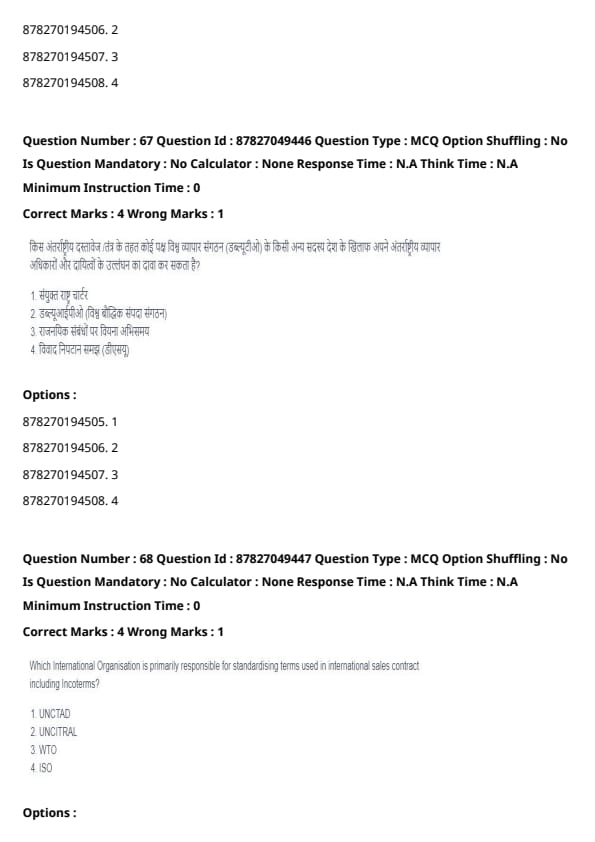
Question 67:
Under which International Instrument/mechanism can a party bring a claim for violation of its international trade rights and obligations against another member state of the World Trade Organisation (WTO)?
View Solution
The Dispute Settlement Understanding (DSU) is the mechanism used by the WTO to resolve trade disputes between member states. It provides a structured process for addressing violations of trade rights and obligations.
Key Takeaway: Claims for trade disputes under WTO are filed under the Dispute Settlement Understanding (DSU).
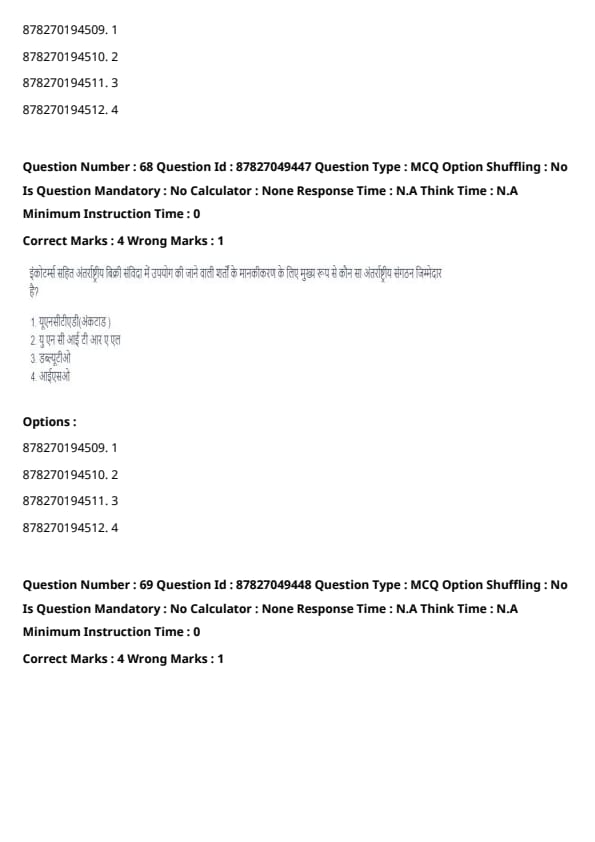
Question 68:
Which International Organisation is primarily responsible for standardising terms used in international sales contracts, including Incoterms?
View Solution
The United Nations Commission on International Trade Law (UNCITRAL) is the primary body responsible for the standardization of international trade terms. While Incoterms are maintained by the International Chamber of Commerce (ICC), UNCITRAL influences their development significantly.
Key Takeaway: UNCITRAL is the primary body for standardizing terms in international sales contracts.
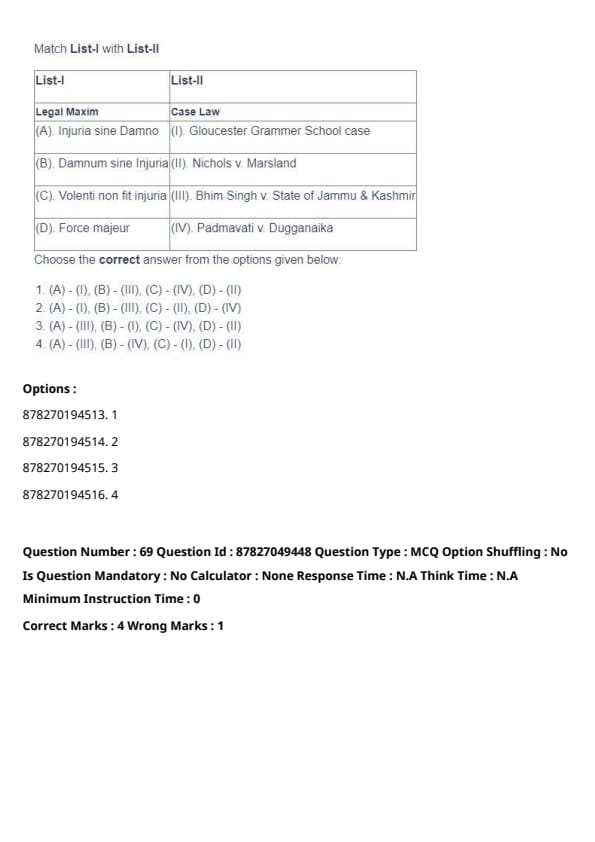
Question 69:
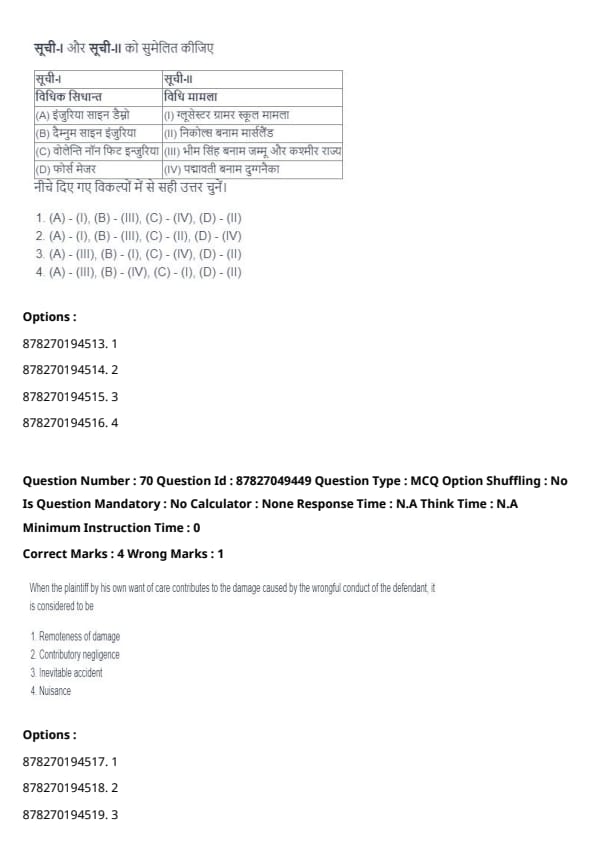
Match List-I with List-II:
| List-I (Legal Maxim) | List-II (Case Law) |
|---|---|
| (A) Injuria sine Damno | (I) Gloucester Grammer School case |
| (B) Damnum sine Injuria | (II) Nichols v. Marsland |
| (C) Volenti non fit injuria | (III) Bhim Singh v. State of Jammu & Kashmir |
| (D) Force Majeure | (IV) Padmavati v. Dugganaika |
View Solution
- Injuria sine Damno: Violation of legal rights without damages, discussed in Bhim Singh v. State of Jammu & Kashmir.
- Damnum sine Injuria: Damages without legal injury, demonstrated in Gloucester Grammer School case.
- Volenti non fit injuria: Consent as a defense, explained in Padmavati v. Dugganaika.
- Force Majeure: Acts of God, discussed in Nichols v. Marsland.
Key Takeaway: Memorize case laws that align with tort law principles.
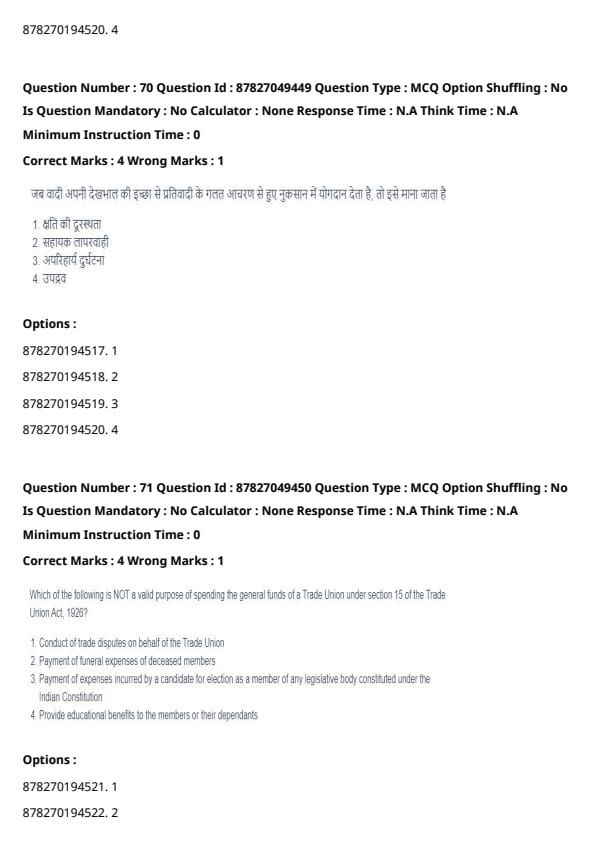
Question 70:
When the plaintiff by his own want of care contributes to the damage caused by the wrongful conduct of the defendant, it is considered to be:
View Solution
Contributory negligence occurs when the plaintiff’s own negligence contributes to their injury or damage. The other concepts are:
- Remoteness of damage: Damage too far removed from the defendant's act.
- Inevitable accident: An event that could not have been prevented despite reasonable care.
- Nuisance: Unreasonable interference with someone’s enjoyment of property.
Key Takeaway: Contributory negligence involves the plaintiff’s role in their own harm.
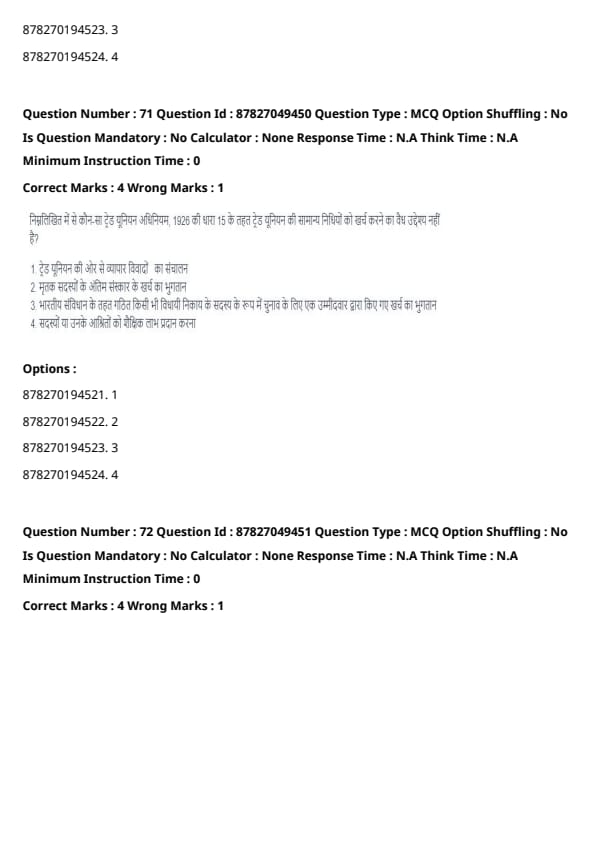
Question 71:
Which of the following is NOT a valid purpose of spending the general funds of a Trade Union under section 15 of the Trade Union Act, 1926?
View Solution
Section 15 of the Trade Union Act, 1926, lists purposes for which the general funds of a registered trade union may be used. These include:
- Conducting trade disputes.
- Providing benefits to members, such as funeral expenses and educational benefits.
However, funds cannot be used for election expenses of a candidate for legislative bodies.
Key Takeaway: Trade Union funds cannot be used for political election expenses.
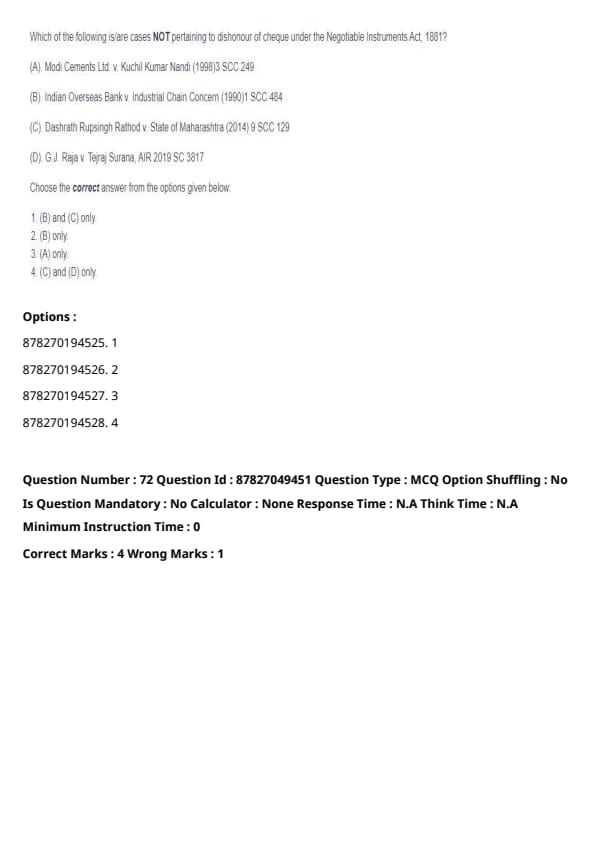
Question 72:
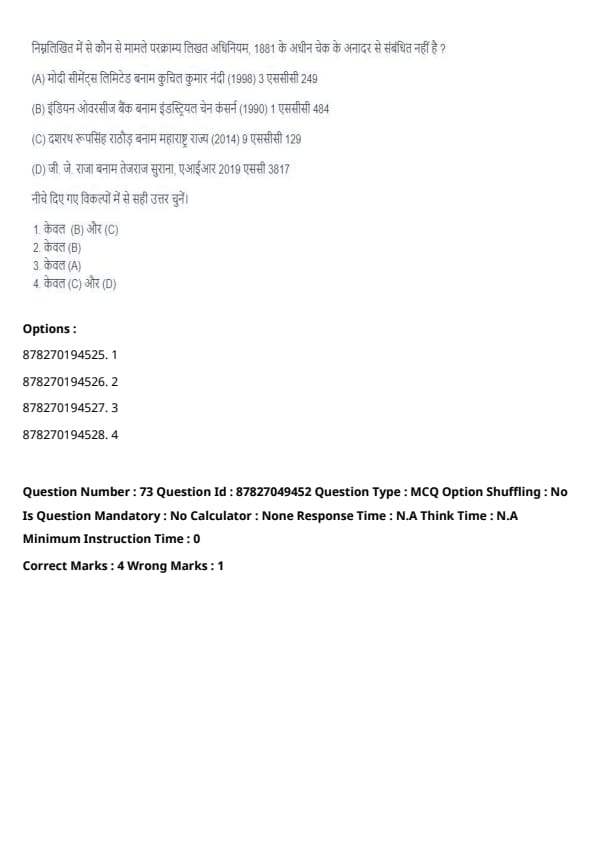
Which of the following is/are cases NOT pertaining to dishonour of cheque under the Negotiable Instruments Act, 1881?
View Solution
The following cases pertain to dishonour of cheques:
- Modi Cements Ltd. v. Kuchil Kumar Nandi: Discusses insufficiency of funds.
- Dashrath Rupsingh Rathod v. State of Maharashtra: Deals with territorial jurisdiction.
- G.J. Raja v. Tejraj Surana: Related to dishonour of cheque.
Indian Overseas Bank v. Industrial Chain Concern primarily deals with loan recovery and does not address dishonour of cheque.
Key Takeaway: Indian Overseas Bank v. Industrial Chain Concern does not relate to cheque dishonour cases.
Question 73:
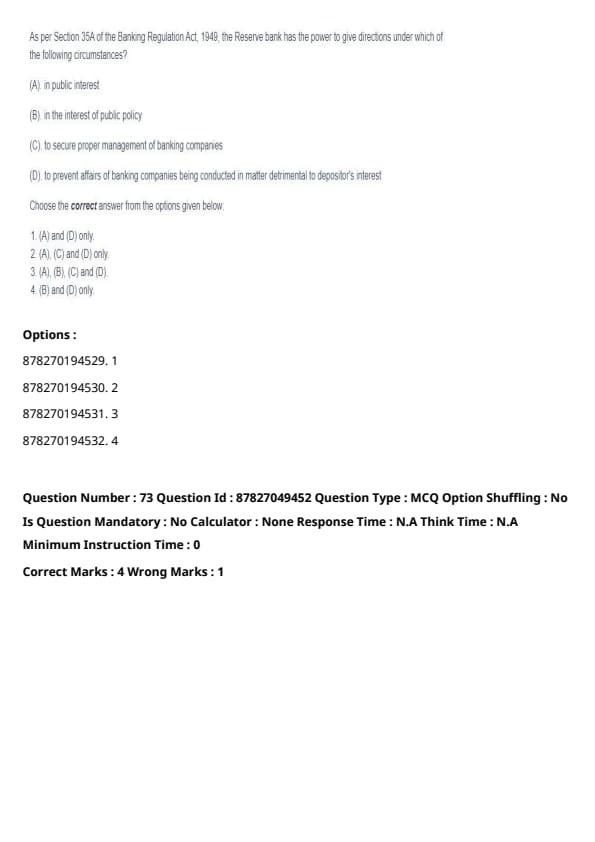
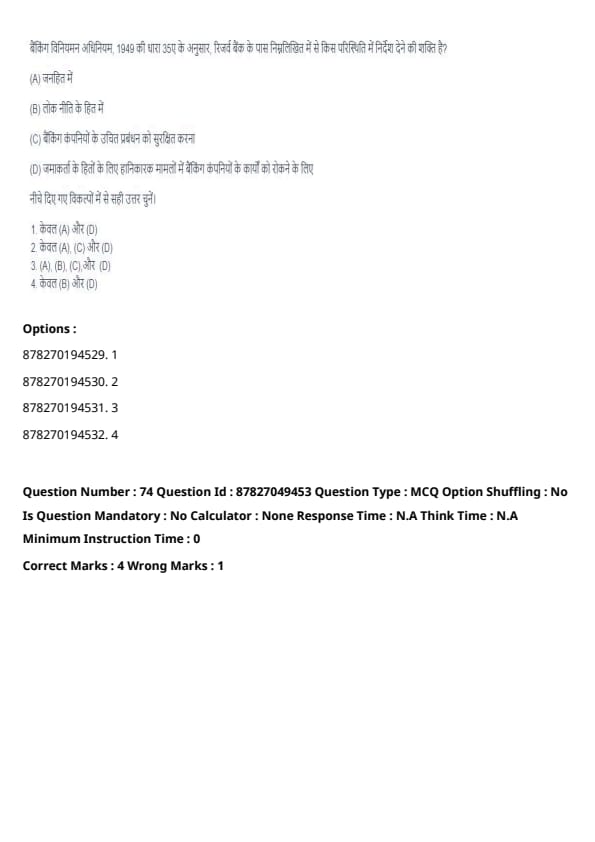
As per Section 35A of the Banking Regulation Act, 1949, the Reserve Bank has the power to give directions under which of the following circumstances?
View Solution
Section 35A empowers the RBI to issue directions to banking companies under the following circumstances:
- In public interest.
- To secure proper management of banking companies.
- To prevent actions detrimental to depositor’s interest.
The term ‘public policy’ is not explicitly mentioned as a ground in Section 35A.
Key Takeaway: RBI issues directives in public interest, depositor protection, and proper management but not for public policy.
Question 74:
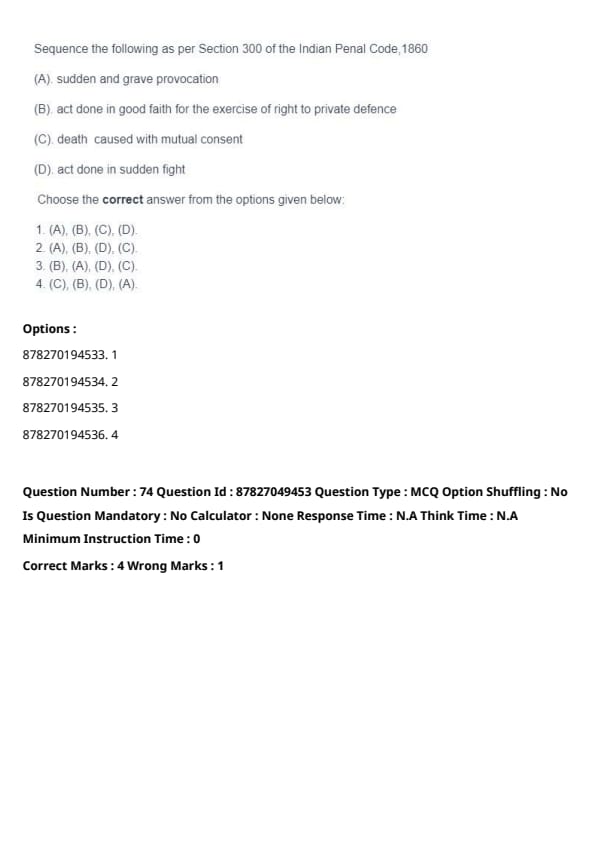
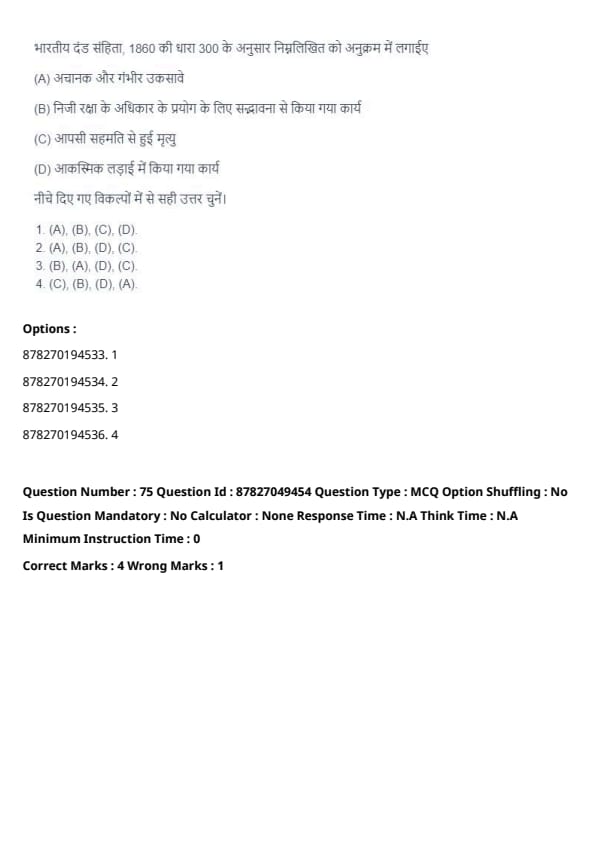
Sequence the following as per Section 300 of the Indian Penal Code, 1860:
View Solution
Section 300 IPC defines murder and lists exceptions where culpable homicide is not murder in the following sequence:
1. Sudden and grave provocation.
2. Act done in exercise of the right to private defence.
3. Act done in sudden fight.
4. Death caused with mutual consent.
Key Takeaway: Follow the exact order of exceptions under Section 300 IPC.
Question 75:
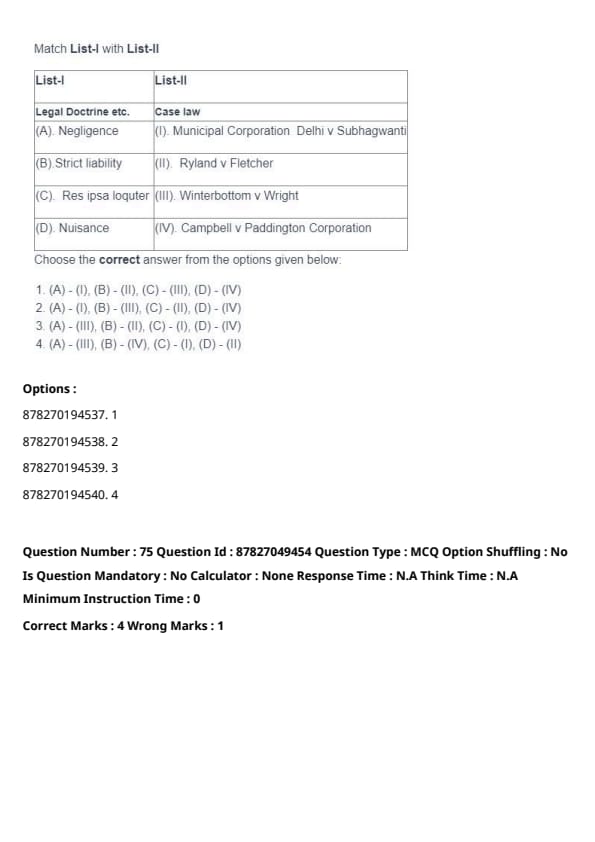
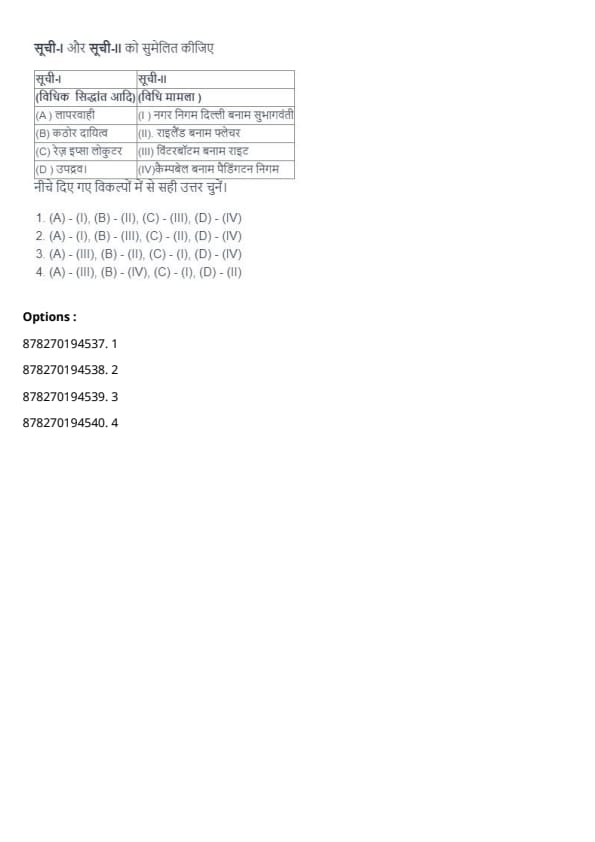
Match List-I with List-II:
| List-I (Legal Doctrine) | List-II (Case Law) |
|---|---|
| (A) Negligence | (I) Municipal Corporation Delhi v. Subhagwanti |
| (B) Strict Liability | (II) Ryland v. Fletcher |
| (C) Res ipsa loquitur | (III) Winterbottom v. Wright |
| (D) Nuisance | (IV) Campbell v. Paddington Corporation |
View Solution
- Negligence: Established in Winterbottom v. Wright.
- Strict Liability: Explained in Ryland v. Fletcher.
- Res ipsa loquitur: Discussed in Municipal Corporation Delhi v. Subhagwanti.
- Nuisance: Addressed in Campbell v. Paddington Corporation.
Key Takeaway: Match key doctrines with their corresponding landmark cases in tort law.
*The article might have information for the previous academic years, please refer the official website of the exam.