CUET PG 2024 Question Paper with Answer Key PDF for Mechanical Engineering (March 19 - Shift 2)
- Question Paper 2025
- Question Paper 2024
- Question Paper 2023
- Mathematics Papers
- Statistics Question Paper
- English Question Paper
- Chemistry Question Paper
- Pol. Sci. Question Paper
- History Question Paper
- Commerce Question Papers
- Life Science Papers
- Geology Question Papers
- Journalism Question Paper
- B.Ed. HSS Question Paper
- Botany Question Paper
- B.Ed. Question Papers


Content Writer | Updated On - Mar 9, 2025
CUET PG Question Papers are the most important study material for effective exam preparation. We at Zollege have provided all CUET PG Previous Year Papers with Solution PDFs here. CUET PG 2024 Mechanical Engineering exam was conducted successfully on March 19 by NTA.
Students can freely download the CUET PG previous year's question paper PDFs along with their solutions here. We strongly encourage CUET PG aspirants to scan through all the CUET PG Question Paper to know the overall difficulty level, CUET PG Syllabus and understand the changes in CUET PG Exam Pattern over the years.
CUET PG 2024 Mechanical Engineering Question Paper with Answer Key PDF
| CUET PG 2024 Mechanical Engineering Question Paper with Answer Key |  Download Download |
Check Solution |
Mechanical Engineering 2024 Questions with Solutions
Question 1:
The vacuum in a closed container is 50 mm of Hg. The absolute pressure in the container is:
View Solution
Solution: The atmospheric pressure is 1 bar, and the vacuum pressure is 50 mm of Hg. The absolute pressure is calculated as:
Absolute pressure = Atmospheric pressure - Vacuum pressure
= 1 bar - ( 50 mm of Hg⁄760 mm of Hg × 1 bar) = 0.92 bar.
Quick Tip: Remember that absolute pressure is the atmospheric pressure minus the vacuum pressure, and convert the vacuum pressure from mm of Hg to bar.
Question 2:
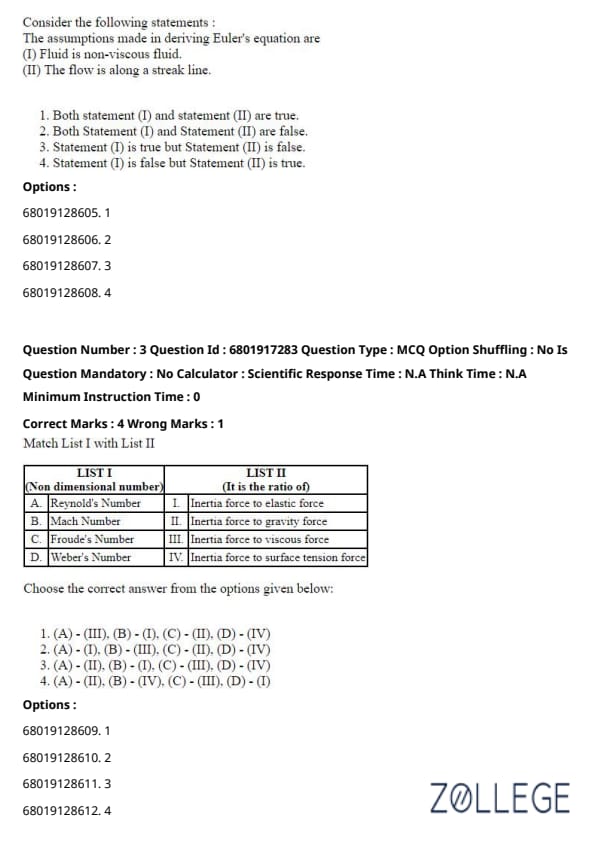
Consider the following statements: The assumptions made in deriving Euler's equation are:
(I) Fluid is non-viscous fluid.
(II) The flow is along a streak line.
View Solution
Solution: Euler's equation assumes that the fluid is non-viscous, which means there is no internal friction in the fluid (Statement I is true). However, Euler's equation does not assume that the flow is along a streak line; the flow can be more general (Statement II is false).
Quick Tip: Euler's equation assumes non-viscous fluid, but does not assume flow along streak lines. This is important to remember when applying the equation.
Question 3:
Match List I (Non-dimensional number) with List II (It is the ratio of):
| LIST I | LIST II |
|---|---|
| A. Reynold's Number | I. Inertia force to elastic force |
| B. Mach Number | II. Inertia force to gravity force |
| C. Froude's Number | III. Inertia force to viscous force |
| D. Weber's Number | IV. Inertia force to surface tension force |
Choose the correct answer from the options given below:
View Solution
Solution: The match between the non-dimensional numbers and their ratios is as follows: Reynold's Number: Inertia force to viscous force - Mach Number: Inertia force to gravity force - Froude's Number: Inertia force to surface tension force - Weber's Number: Inertia force to elastic force
Quick Tip: Each non-dimensional number has its specific use in fluid mechanics, representing the ratio of inertial forces to other forces.
Question 4:
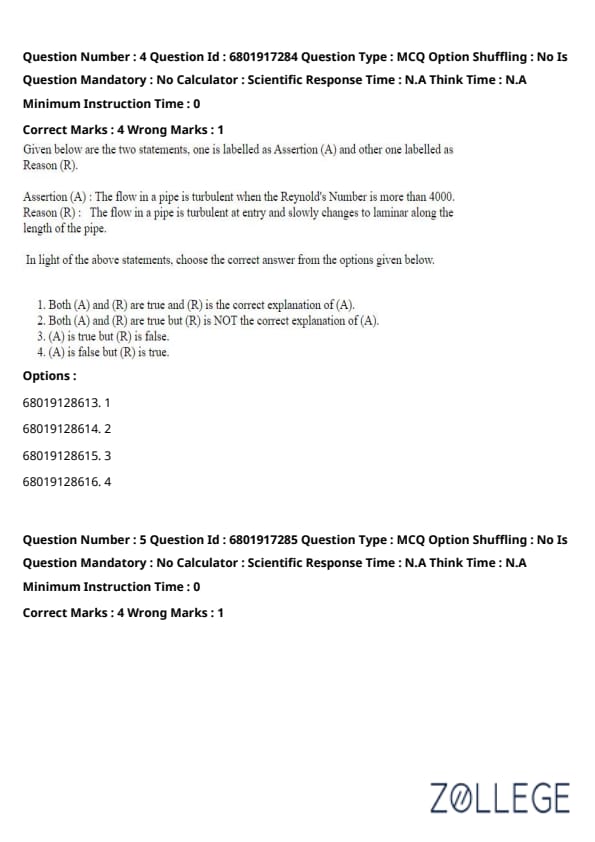
Given below are two statements:
Statement (A): The flow in a pipe is turbulent when the Reynolds' Number is more than 4000.
Statement (R): The flow in a pipe is turbulent at entry and slowly changes to laminar along the length of the pipe.
In light of the above statements, choose the correct answer from the options given below.
View Solution
Solution: Statement (A) is correct because the flow is generally considered turbulent when the Reynolds number exceeds 4000. However, statement (R) is incorrect because turbulent flow does not transition to laminar flow over a pipe's length; it remains turbulent unless external factors alter the flow.
Quick Tip: Turbulent flow occurs when the Reynolds number exceeds 4000. The flow does not typically transition to laminar within the same pipe under constant conditions.
Question 5:
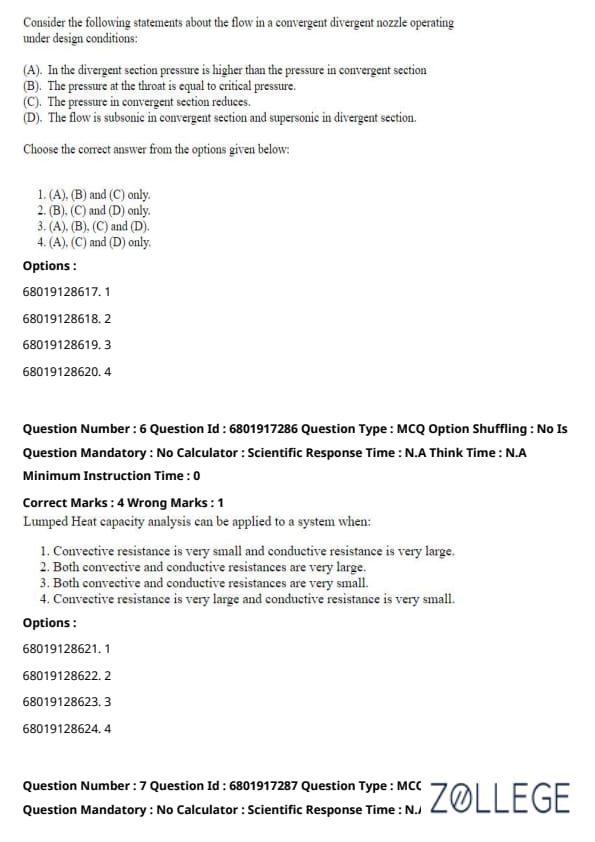
Consider the following statements about the flow in a convergent-divergent nozzle operating under design conditions:
(A) In the divergent section, pressure is higher than the pressure in the convergent section.
(B) The pressure at the throat is equal to critical pressure.
(C) The pressure in the convergent section reduces.
(D) The flow is subsonic in the convergent section and supersonic in the divergent section.
Choose the correct answer from the options given below.
View Solution
Solution: In a convergent-divergent nozzle, the pressure at the throat is equal to the critical pressure. The flow is subsonic in the convergent section and becomes supersonic in the divergent section, making statements (C) and (D) true. Statement (A) is false, as the pressure in the divergent section is lower than in the convergent section.
Quick Tip: In a convergent-divergent nozzle, the flow changes from subsonic to supersonic, and the pressure at the throat is critical.
Question 6:
Lumped Heat capacity analysis can be applied to a system when:
View Solution
Solution: Lumped heat capacity analysis is applicable when both resistances are small, allowing the system to be approximated as a single thermal mass with negligible temperature gradients.
Quick Tip: Lumped heat capacity analysis simplifies the system by assuming negligible temperature differences within the object, so both resistances must be small.
Question 7:
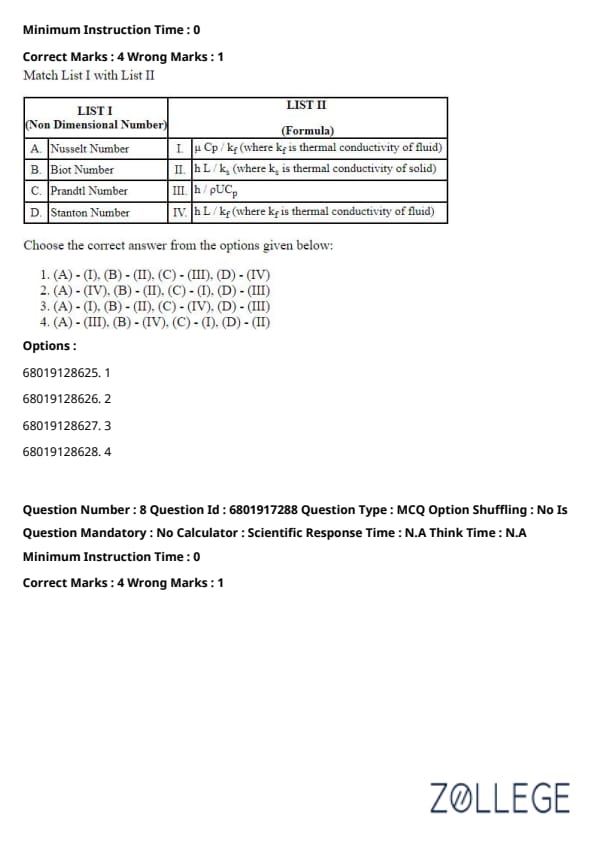
Match List I (Non-Dimensional Number) with List II (Formula):
| LIST I | LIST II |
|---|---|
| A. Nusselt Number | I. μCp/kf (where kf is thermal conductivity of fluid) |
| B. Biot Number | II. hL/ks (where ks is thermal conductivity of solid) |
| C. Prandtl Number | III. h/pCp |
| D. Stanton Number | IV. hL/kf (where kf is thermal conductivity of fluid) |
Choose the correct answer from the options given below.
View Solution
Solution: - Nusselt number (Nu) is the ratio of convective to conductive heat transfer, calculated as hL/kf.
- Biot number (Bi) compares thermal resistance within a body to the resistance at its surface, given by hL/ks.
- Prandtl number (Pr) relates the kinematic viscosity to thermal diffusivity, calculated as μCp/kf.
- Stanton number (St) defines the ratio of heat transfer to the thermal capacity, calculated as h/pCp.
Quick Tip: Each dimensionless number helps analyze different aspects of heat transfer, and the corresponding formulas relate them to fluid dynamics and heat conduction properties.
Question 8:
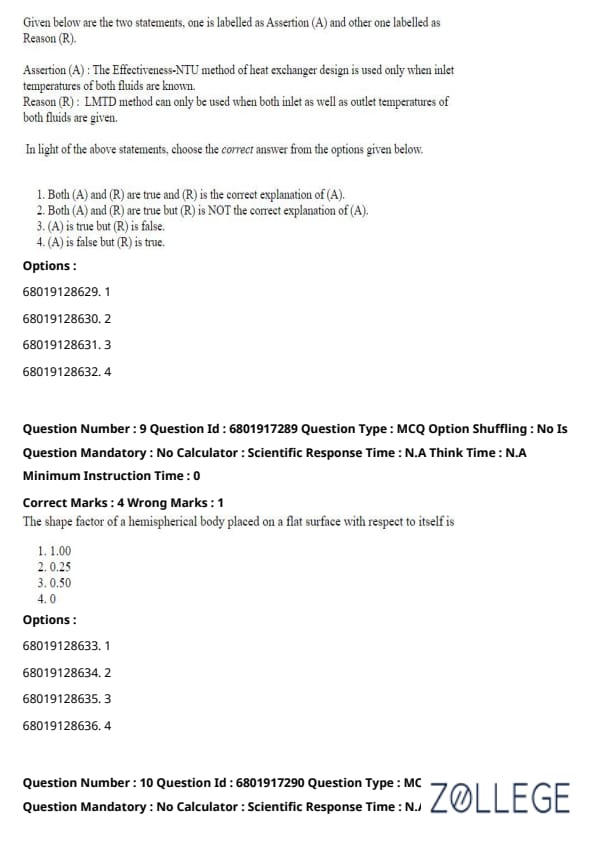
Given below are two statements, one is labelled as Assertion (A) and the other one labelled as Reason (R):
Assertion (A): The Effectiveness-NTU method of heat exchanger design is used only when inlet temperatures of both fluids are known.
Reason (R): LMTD method can only be used when both inlet as well as outlet temperatures of both fluids are given.
In light of the above statements, choose the correct answer from the options given below.
View Solution
Solution: The Effectiveness-NTU method of heat exchanger design requires inlet temperatures of the fluids, while the LMTD method requires both inlet and outlet temperatures for both fluids. Hence, (A) is true, but (R) is false as the LMTD method does not require only inlet and outlet temperatures for both fluids but other parameters as well.
Quick Tip: Effectiveness-NTU method relies on the inlet temperatures of both fluids, while the LMTD method requires both inlet and outlet temperatures of the fluids.
Question 9:
The shape factor of a hemispherical body placed on a flat surface with respect to itself is:
View Solution
Solution: For a hemispherical body placed on a flat surface, the shape factor with respect to itself is 0.50. This represents the ratio of radiation exchange between the body and itself, as per the Stefan-Boltzmann law.
Question 10:
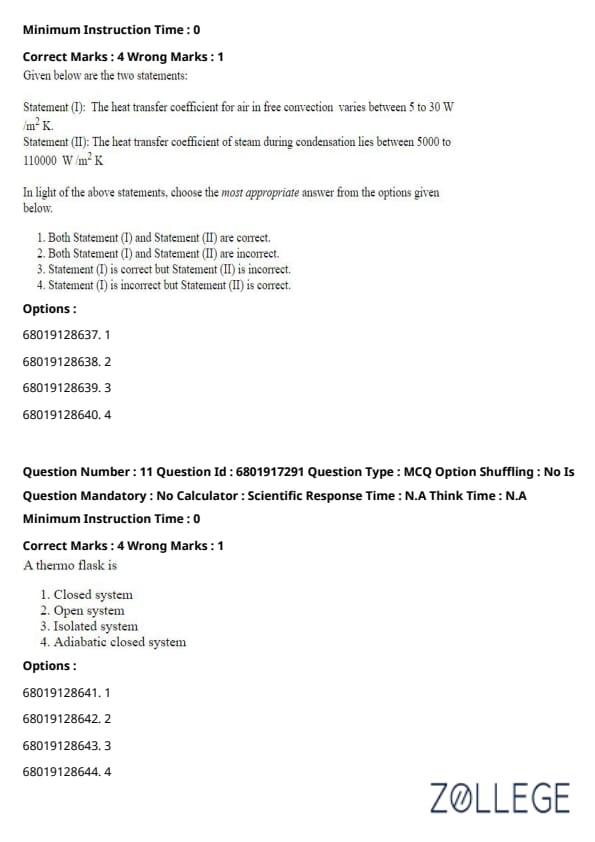
Given below are two statements:
Statement (I): The heat transfer coefficient for air in free convection varies between 5 to 30 W/m².K.
Statement (II): The heat transfer coefficient of steam during condensation lies between 5000 to 110000 W/m².K.
In light of the above statements, choose the most appropriate answer from the options given below.
View Solution
Solution: Statement (I) is correct as the heat transfer coefficient for air in free convection generally lies in the range of 5 to 30 W/m².K. Statement (II) is also correct, as the heat transfer coefficient of steam during condensation typically ranges between 5000 and 110000 W/m².K.
Quick Tip: The heat transfer coefficient for air in free convection is much lower compared to steam during condensation, which has a significantly higher coefficient.
Question 11:
A thermo flask is:
View Solution
Solution: A thermo flask is considered an isolated system because it does not exchange matter or energy (heat) with its surroundings. It is designed to minimize heat transfer, keeping the contents at a constant temperature over time.
Quick Tip: An isolated system is one where neither matter nor energy is exchanged with the surroundings.
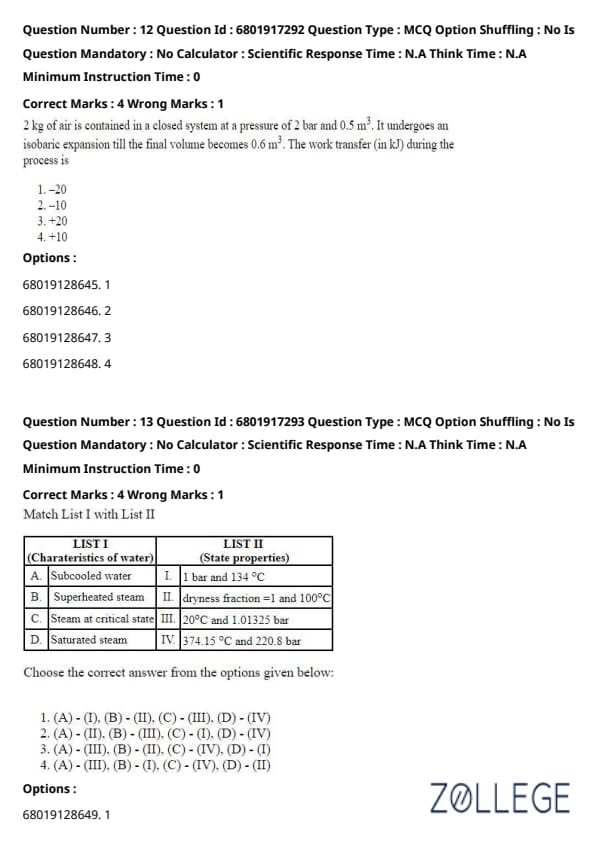
Question 12:
2 kg of air is contained in a closed system at a pressure of 2 bar and 0.5 m³. It undergoes an isobaric expansion till the final volume becomes 0.6 m³. The work transfer (in kJ) during the process is:
View Solution
Solution: For isobaric expansion, the work done (W) is given by the equation:
W = PAV
Where P = 2 bar = 2×10⁵ Pa, and the volume change ΔV = V2 - V1 = 0.6 m³ - 0.5 m³ = 0.1 m³.
So,
W = 2 × 105 Pa × 0.1 m³ = 20 kJ.
Thus, the work transfer is +20 kJ.
Quick Tip: In an isobaric process, the work done is simply the pressure multiplied by the change in volume. Make sure to convert all units properly (e.g., converting bar to Pa and ensuring the volume is in cubic meters).
Question 13:
Match List I with List II:
| LIST I | LIST II |
|---|---|
| A. Subcooled water | I. 1 bar and 134 °C |
| B. Superheated steam | II. dryness fraction = 1 and 100°C |
| C. Steam at critical state | III. 20°C and 1.01325 bar |
| D. Saturated steam | IV. 374.15°C and 220.8 bar |
Choose the correct answer from the options given below:
View Solution
Solution: The correct matching between the characteristics of water and their respective state properties is as follows:
- Subcooled water corresponds to the state of water with a temperature lower than the saturation temperature, hence the property is (III) 20°C and 1.01325 bar.
- Superheated steam corresponds to a high temperature and low pressure, matching (I) 1 bar and 134°C.
- Steam at the critical state is where both the pressure and temperature are at critical values, so it corresponds to (IV) 374.15°C and 220.8 bar.
- Saturated steam, where the water is at its boiling point with a dryness fraction of 1, corresponds to (II) dryness fraction = 1 and 100°C.
Quick Tip: When working with thermodynamic properties of water, remember that: - Subcooled water exists below its saturation point, typically at lower pressure and temperature. - Superheated steam is above the saturation temperature. - Critical state is where both temperature and pressure reach critical points. - Saturated steam is at the boiling point with a dryness fraction of 1.
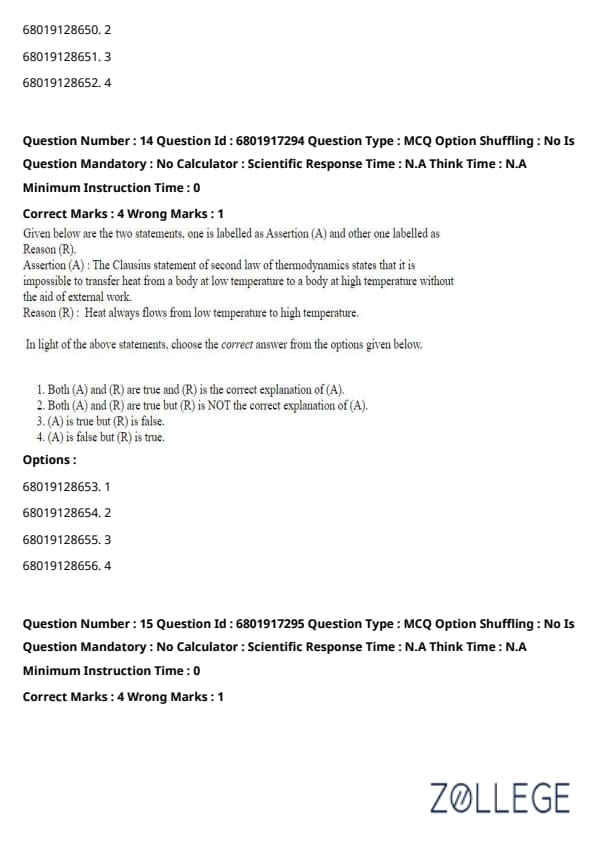
Question 14:
Given below are two statements, one is labelled as Assertion (A) and the other one labelled as Reason (R):
Assertion (A): The Clausius statement of second law of thermodynamics states that it is impossible to transfer heat from a body at low temperature to a body at high temperature without the aid of external work.
Reason (R): Heat always flows from low temperature to high temperature.
In light of the above statements, choose the correct answer from the options given below:
View Solution
Solution: The Clausius statement (A) is correct in stating that heat cannot spontaneously flow from a colder body to a hotter body without external work. However, Reason (R) is incorrect because it suggests that heat always flows from low temperature to high temperature, which contradicts the second law. Heat flows naturally from high to low temperature unless external work is applied.
Quick Tip: The Clausius statement of the second law of thermodynamics defines the direction of heat flow in natural processes. Heat always flows from a higher temperature body to a lower temperature body, and the reverse requires external work to be done, as stated in the second law.
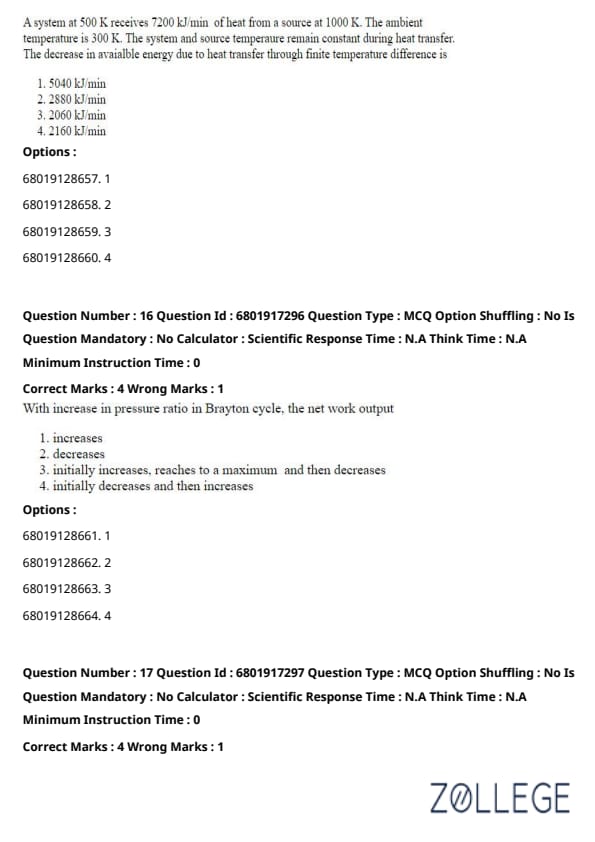
Question 15:
A system at 500 K receives 7200 kJ/min of heat from a source at 1000 K. The ambient temperature is 300 K. The system and source temperature remain constant during heat transfer. The decrease in available energy due to heat transfer through finite temperature difference is:
View Solution
Solution: The decrease in available energy is calculated using the formula:
ΔQ = (1 - T2⁄T1) × Q
Where: Q = 7200 kJ/min, T1 = 1000 K, and T2 = 300 K. After plugging in the values:
ΔQ = (1 - 300⁄1000) * 7200 = 7200 × 0.7 = 5040 kJ/min
Quick Tip: The formula ΔQ = Q(1 - T2⁄T1) helps in determining the decrease in available energy due to heat transfer.
Question 16:
With increase in pressure ratio in Brayton cycle, the net work output:
View Solution
Solution: In a Brayton cycle, with increasing pressure ratio, the efficiency increases up to a point but eventually decreases after reaching an optimum pressure ratio due to the increasing compression work required. Thus, the work output initially increases and then decreases after a maximum value.
Quick Tip: The net work output of a Brayton cycle is maximized at a specific pressure ratio, beyond which the work output starts decreasing.
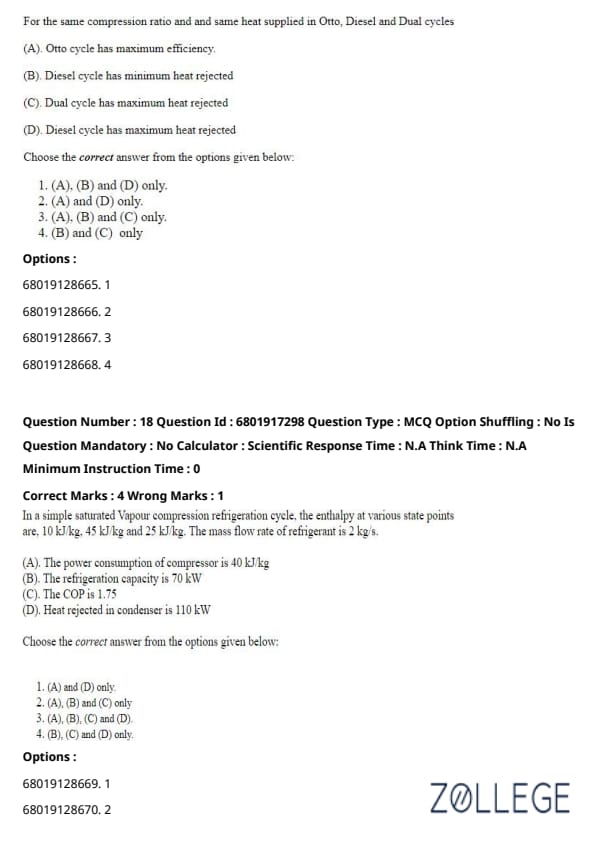
Question 17:
For the same compression ratio and same heat supplied in Otto, Diesel and Dual cycles:
(A) Otto cycle has maximum efficiency.
(B) Diesel cycle has minimum heat rejected.
(C) Dual cycle has maximum heat rejected.
(D) Diesel cycle has maximum heat rejected.
Choose the correct answer from the options given below.
View Solution
Solution:
- The Otto cycle has the highest efficiency among the three, as it operates with higher compression ratios.
- The Diesel cycle has a relatively lower heat rejection than the Dual cycle.
- The heat rejection in the Dual cycle is typically higher than in the Otto cycle.
Quick Tip: The efficiency of the Otto cycle is higher compared to Diesel and Dual cycles for the same compression ratio and heat input.
Question 18:
In a simple saturated Vapour compression refrigeration cycle, the enthalpy at various state points are: 10 kJ/kg, 45 kJ/kg and 25 kJ/kg. The mass flow rate of refrigerant is 2 kg/s:
(A) The power consumption of compressor is 40 kJ/kg
(B) The refrigeration capacity is 70 kW
(C) The COP is 1.75
(D) Heat rejected in condenser is 110 kW
Choose the correct answer from the options given below.
View Solution
Solution: Using the refrigeration cycle relations:
- Refrigeration capacity = Q1 = m(h1 – h4) = 2(45-10) = 70 kW.
- Power consumption = W = m(h2 - h1) = 2(h2-45) = 40 kJ/kg. (Approximated)
COP = Refrigeration capacity⁄Power input = 70⁄40= 1.75.
Quick Tip: In refrigeration cycles, COP can be calculated as the ratio of refrigeration capacity to the work input.
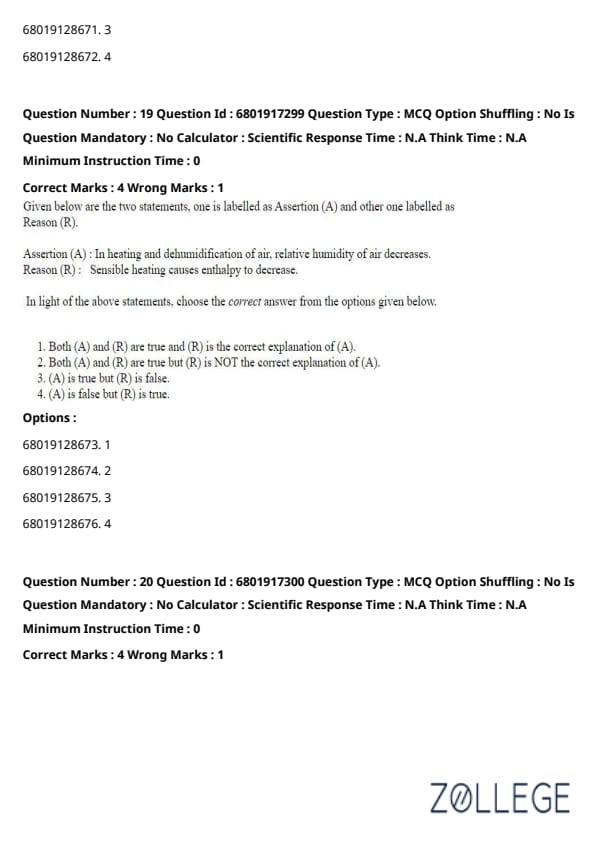
Question 19:
Assertion (A): In heating and dehumidification of air, relative humidity of air decreases.
Reason (R): Sensible heating causes enthalpy to decrease.
In light of the above statements, choose the correct answer from the options given below.
View Solution
Solution: In heating and dehumidification of air, relative humidity decreases because the water vapor in the air is removed while heating. Sensible heating does indeed *increase* the enthalpy (R is false), but the decrease in moisture content decreases relative humidity, so (A) is true.
Quick Tip: Enthalpy *increases* during sensible heating, and relative humidity decreases during dehumidification.
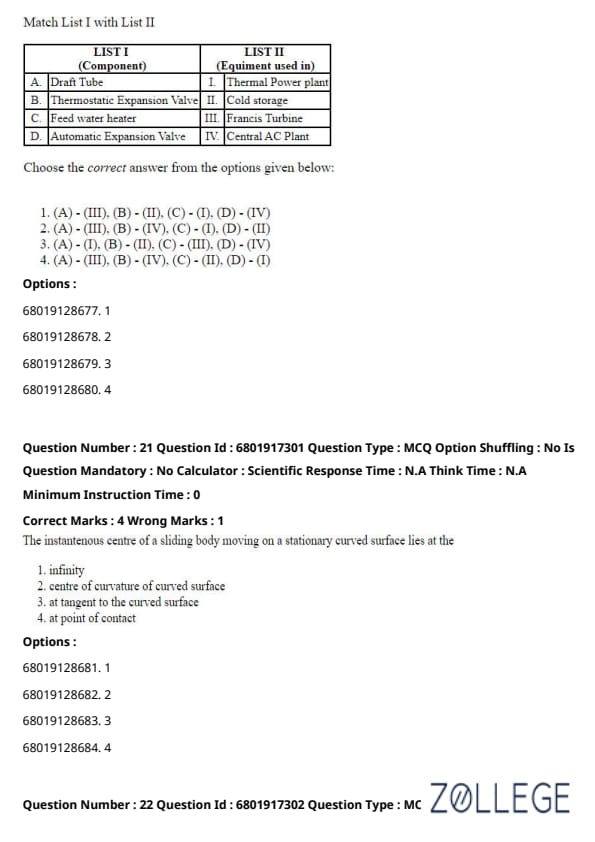
Question 20:
Match List I with List II
| LIST I (Component) | LIST II (Equipment used in) |
|---|---|
| A. Draft Tube | I. Thermal Power Plant |
| B. Thermostatic Expansion Valve | II. Cold Storage |
| C. Feed Water Heater | III. Francis Turbine |
| D. Automatic Expansion Valve | IV. Central AC Plant |
Choose the correct answer from the options given below:
View Solution
Solution:
- A draft tube is used in Francis turbines, typically found in thermal power plants.
- Thermostatic expansion valves are used in cold storage to regulate temperature.
- Feed water heaters are found in thermal power plants to preheat the water entering the boiler.
- Automatic expansion valves are used in central AC plants to regulate refrigerant flow.
Quick Tip: Match the components with their typical applications in relevant industries.
Question 21:
The instantaneous centre of a sliding body moving on a stationary curved surface lies at:
View Solution
Solution: The instantaneous center of a sliding body on a curved surface lies at the center of curvature of the curved surface. This point defines the location where the velocity of the body is zero at a given instant of time.
Quick Tip: The center of curvature is crucial in determining the motion of a body along a curved path.
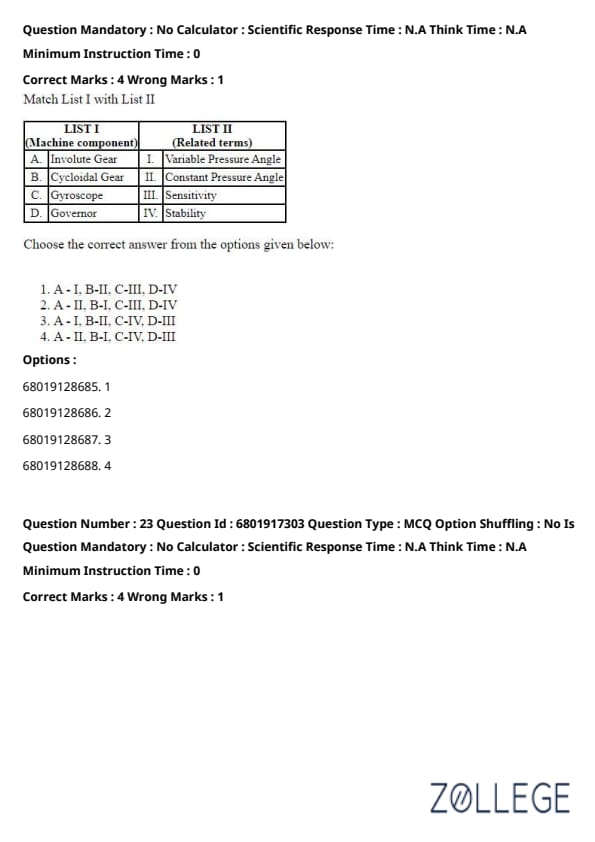
Question 22:
Match List I with List II:
| LIST I | LIST II |
|---|---|
| A. Involute Gear | I. Variable Pressure Angle |
| B. Cycloidal Gear | II. Constant Pressure Angle |
| C. Gyroscope | III. Sensitivity |
| D. Governor | IV. Stability |
Choose the correct answer from the options given below:
View Solution
Solution:
- Involute gears have a constant pressure angle.
- Cycloidal gears have a variable pressure angle.
- Gyroscopes exhibit sensitivity.
- Governors provide stability.
Quick Tip: Understanding the relationships between machine components and their characteristics is crucial in gear and mechanism design.
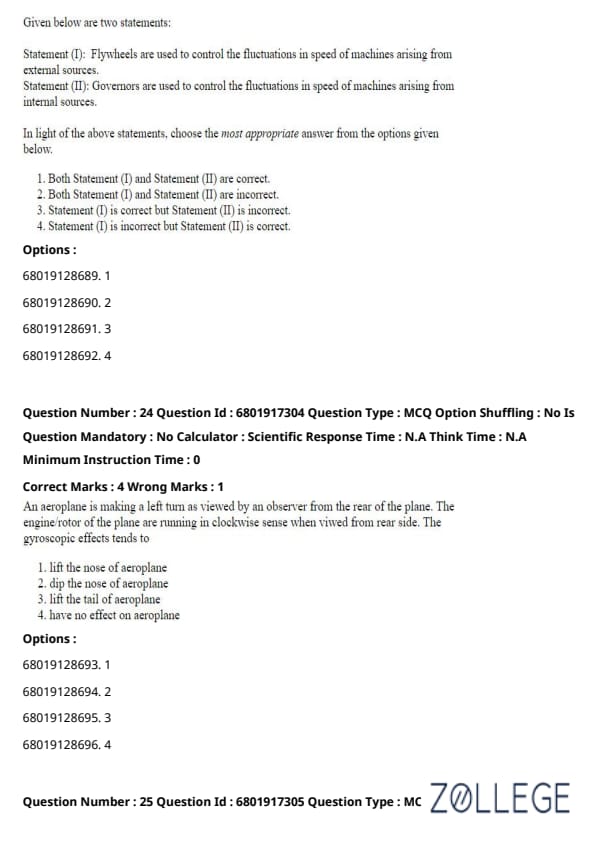
Question 23:
Given below are two statements:
Statement (I): Flywheels are used to control the fluctuations in speed of machines arising from external sources.
Statement (II): Governors are used to control the fluctuations in speed of machines arising from internal sources.
In light of the above statements, choose the most appropriate answer from the options given below.
View Solution
Solution: Flywheels are used for storing energy to smooth out the fluctuations in a machine's speed caused by *external* forces. Governors, on the other hand, control the speed of engines and turbines by adjusting the fuel or air intake to regulate the engine speed due to *internal* forces.
Quick Tip: Governors regulate internal speed fluctuations, while flywheels store energy and reduce external fluctuations in rotational speed.
Question 24:
An aeroplane is making a left turn as viewed by an observer from the rear of the plane. The engine/rotor of the plane are running in clockwise sense when viewed from the rear side. The gyroscopic effects tend to:
View Solution
Solution: When the plane makes a left turn and the engine is rotating clockwise, the gyroscopic effects cause the plane's nose to dip. This phenomenon is due to the gyroscopic precession that results from the engine's rotation.
Quick Tip: In gyroscopic systems, precession causes a force at a right angle to the input force, which in this case results in the plane's nose dipping when turning left.
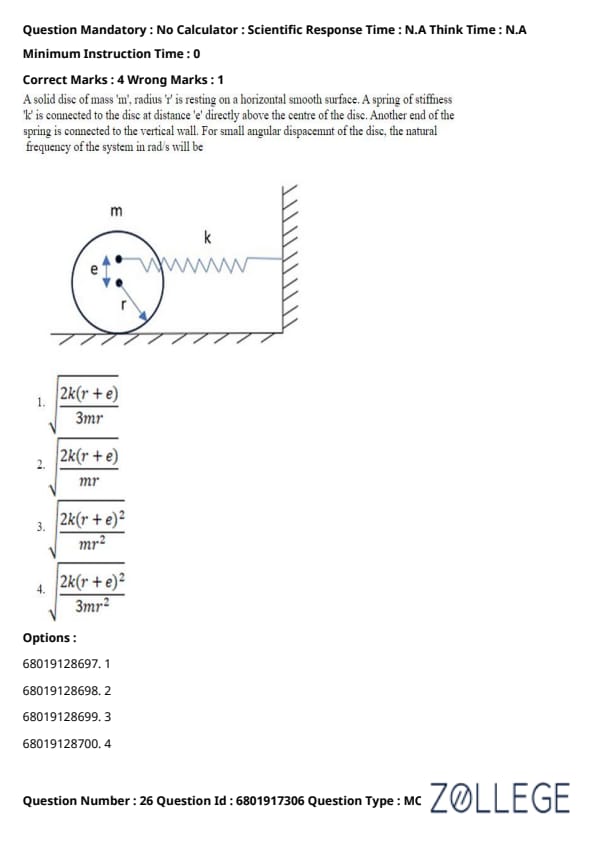
Question 25:
A solid disc of mass m, radius r is resting on a horizontal smooth surface. A spring of stiffness k is connected to the disc at distance e directly above the centre of the disc. Another end of the spring is connected to the vertical wall. For small angular displacement of the disc, the natural frequency of the system in radians per second will be:
View Solution
Solution:
The natural frequency of a system with rotational motion can be found using the formula for the torsional pendulum. For small angular displacement, the restoring force is proportional to the angular displacement, and the equivalent moment of inertia for the system is considered. The effective spring constant for rotational motion is adjusted by considering the location of the spring above the center of mass of the disc.
Using energy principles and angular dynamics, the natural frequency ω is given by:
ω = √k(r+e)²⁄I
where I = mr²⁄2 is the moment of inertia of the disc.
Simplifying the expression:
ω = √2k(r + e)²⁄3mr²
Thus, the correct answer is option (4).
Quick Tip: When solving problems involving rotational motion, the natural frequency of oscillation depends on both the stiffness of the spring and the moment of inertia of the body. The moment of inertia for a disc about its center is mr²⁄2, and for angular displacement problems, the effective length from the center must be considered.
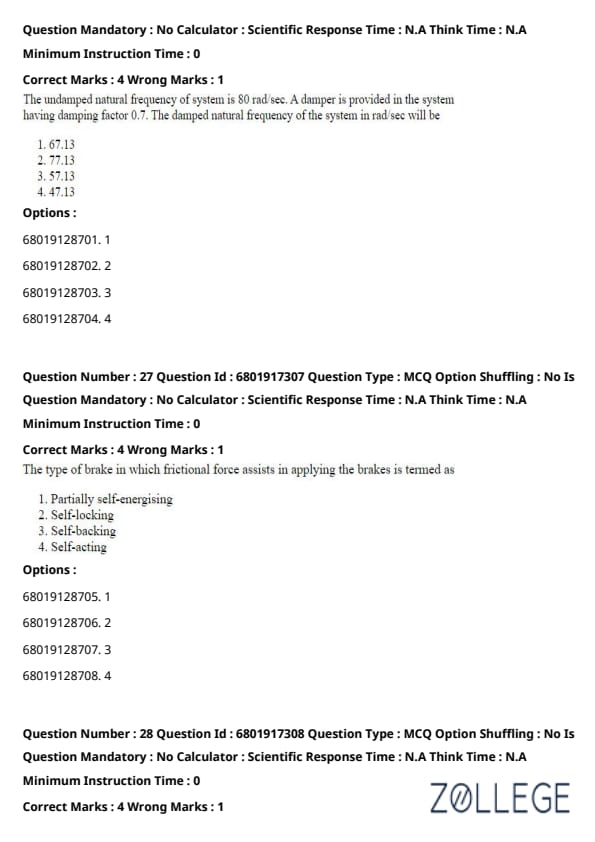
Question 26:
The undamped natural frequency of system is 80 rad/sec. A damper is provided in the system having damping factor 0.7. The damped natural frequency of the system in rad/sec will be:
View Solution
Solution: The damped natural frequency ωd is related to the undamped natural frequency ωn and the damping factor ζ by the following formula:
ωd = ωn√(1-ζ²)
Given that ωn = 80 rad/sec and ζ = 0.7, we can calculate the damped natural frequency as:
ωd = 80√(1 – (0.7)²) = 80 × 0.714 ≈ 67.13 rad/sec
Quick Tip: The damping factor reduces the frequency of oscillation by a factor related to its magnitude. As ζ increases, the damped frequency decreases.
Question 27:
The type of brake in which frictional force assists in applying the brakes is termed as:
View Solution
Solution: A partially self-energising brake utilizes the frictional force to assist in applying the brake, which reduces the force needed by the operator. This mechanism is commonly used in drum brakes, where the friction increases the braking force as the brake shoes move.
Quick Tip: Self-energising brakes use the frictional forces to aid the application, while self-locking brakes prevent reverse motion. Self-acting brakes do not require external force but rely solely on the frictional effect.
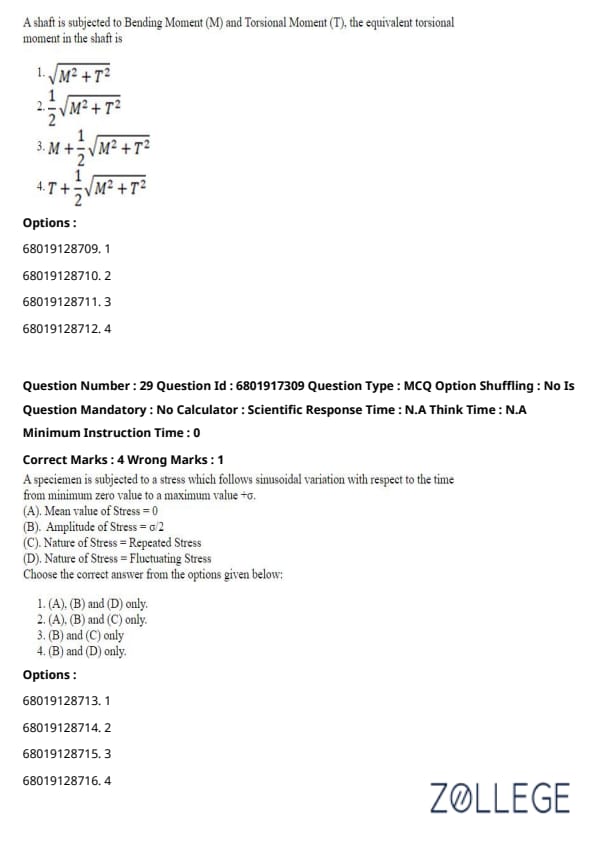
Question 28:
A shaft is subjected to Bending Moment (M) and Torsional Moment (T), the equivalent torsional moment in the shaft is:
View Solution
Solution: When a shaft is subjected to both bending moment M and torsional moment T, the equivalent torsional moment is given by the formula:
Equivalent Moment = √(M² + T²)
This formula combines the effects of bending and torsional moments to represent the overall stress on the shaft.
Quick Tip: For shafts subjected to both bending and torsion, the combined effect is calculated using the Pythagorean theorem to find the equivalent torsional moment.
Question 29:
A specimen is subjected to a stress which follows sinusoidal variation with respect to the time from minimum zero value to a maximum value σ.
View Solution
Solution: Given that the stress follows a sinusoidal variation from zero to a maximum value of σ, we can conclude the following:
- The mean value of the stress is 0, as the average of a sinusoidal wave is zero.
- The amplitude of the stress is σ/2, which is half the maximum value of the sinusoidal variation.
- The nature of the stress is fluctuating stress, as it varies periodically with time between the minimum and maximum values.
Quick Tip: For sinusoidal variation, the mean stress is zero, amplitude is half of the maximum stress, and the stress is considered fluctuating.
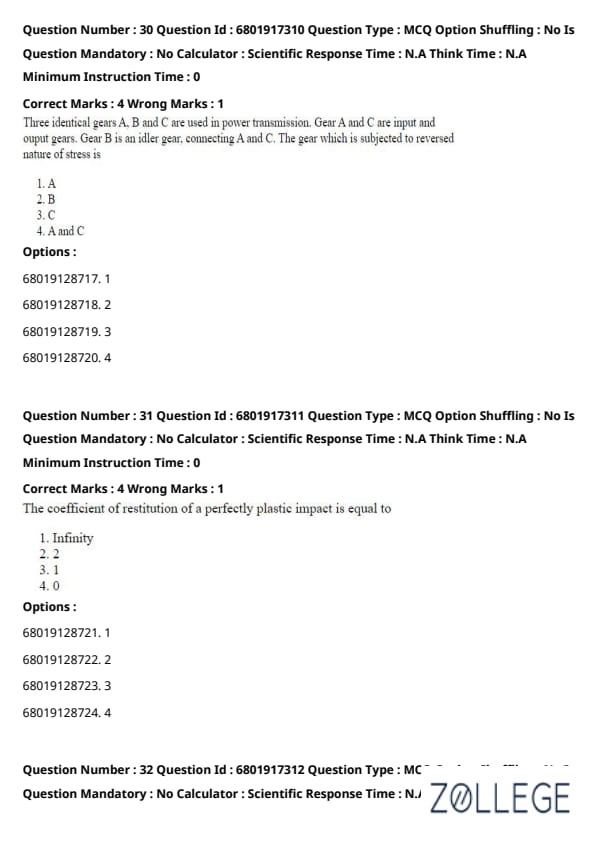
Question 30:
Three identical gears A, B, and C are used in power transmission. Gear A and C are input and output gears. Gear B is an idler gear, connecting A and C. The gear which is subjected to reversed nature of stress is:
View Solution
Solution: In a power transmission system with an idler gear (B), gears A and C transmit the power and will experience opposite directions of rotational motion. The stress on the gears A and C will be reversed in nature because they are engaged in the power transmission process. Gear B, as the idler gear, does not transmit power and does not experience reversed stress.
Quick Tip: In a gear system with an idler gear, the input and output gears experience reversed stresses while the idler gear remains unaffected.
Question 31:
The coefficient of restitution of a perfectly plastic impact is equal to:
View Solution
Solution: In a perfectly plastic impact, the objects involved in the collision do not rebound, and the velocity of separation is zero. The coefficient of restitution is defined as the ratio of relative velocity after collision to relative velocity before collision. Since there is no rebound, the coefficient of restitution equals zero.
Quick Tip: For a perfectly plastic collision, the coefficient of restitution is always zero.
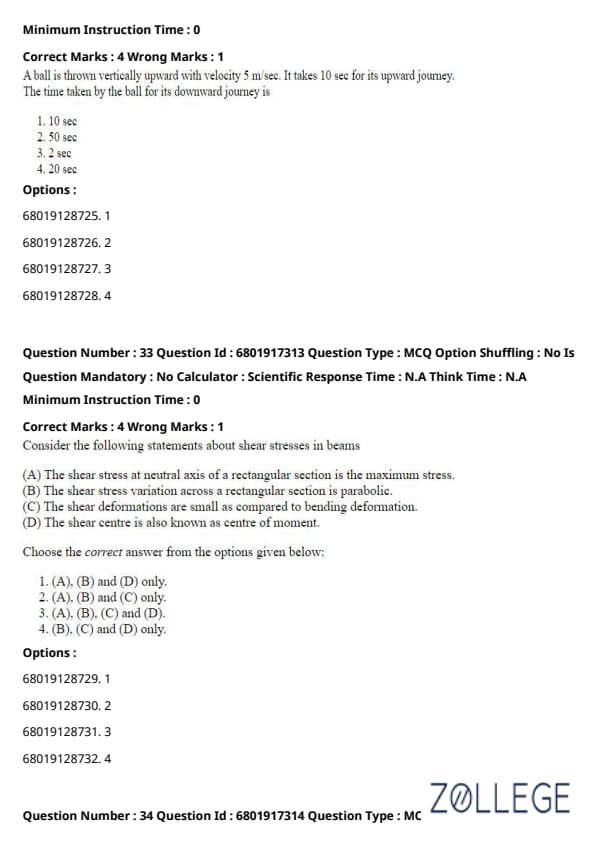
Question 32:
A ball is thrown vertically upward with velocity 5 m/sec. It takes 10 sec for its upward journey. The time taken by the ball for its downward journey is:
View Solution
Solution: The time for the upward and downward journey is the same in the absence of air resistance, as gravity acts equally on both the upward and downward journeys. Since the time taken for the upward journey is 10 seconds, the downward journey will also take 10 seconds. Therefore, the *total* time for the entire journey is 10 + 10 = 20 seconds; the question asks for *downward journey time* which is 10s.
Quick Tip: For vertical motion under gravity, the time taken for upward and downward journeys are equal in the absence of air resistance.
Question 33:
Consider the following statements about shear stresses in beams
(A) The shear stress at neutral axis of a rectangular section is the maximum stress.
(B) The shear stress variation across a rectangular section is parabolic.
(C) The shear deformations are small as compared to bending deformation.
(D) The shear centre is also known as centre of moment.
Choose the correct answer from the options given below:
View Solution
Solution:
- Statement (A) is true because the maximum shear stress in a rectangular section occurs at the neutral axis.
- Statement (B) is true because shear stress varies parabolically across the section of a beam.
- Statement (C) is correct as shear deformations are typically much smaller than bending deformations in beams.
- Statement (D) is also true because the shear center is the point where the applied shear force does not cause any twisting, and it is also called the center of moment.
Quick Tip: In beam theory, shear stress distribution is parabolic, and the maximum occurs at the neutral axis.
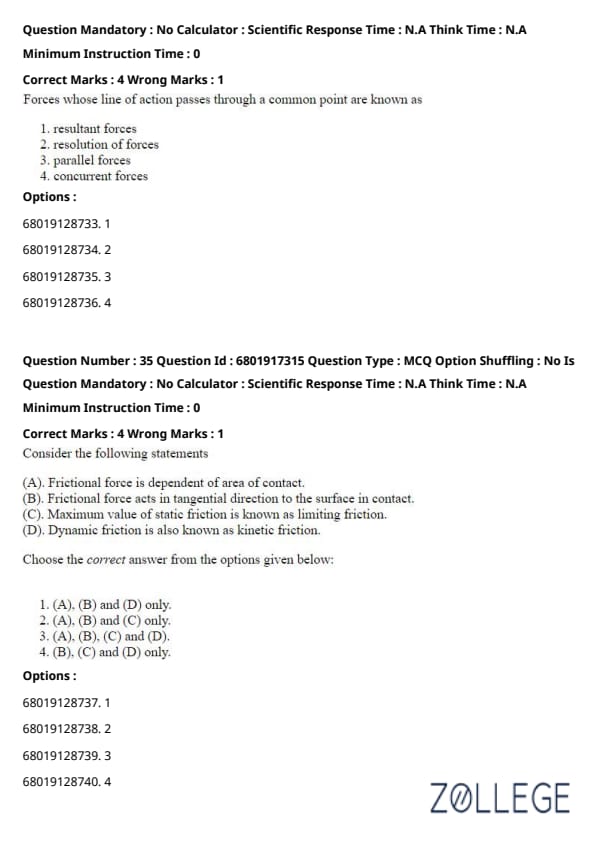
Question 34:
Forces whose line of action passes through a common point are known as:
View Solution
Solution: Forces whose lines of action pass through a common point are called concurrent forces. These forces can act at the same point but in different directions.
Quick Tip: Concurrent forces always pass through a single point, and their resultant can be determined by vector addition.
Question 35:
Consider the following statements:
(A) Frictional force is dependent of area of contact.
(B) Frictional force acts in tangential direction to the surface in contact.
(C) Maximum value of static friction is known as limiting friction.
(D) Dynamic friction is also known as kinetic friction.
Choose the correct answer from the options given below:
View Solution
Solution:
- Statement (A) is *false* as frictional force is *not* directly dependent on the area of contact, but rather on the nature of the surfaces in contact and the normal force.
- Statement (B) is true since frictional force always acts in the tangential direction to the surface in contact.
- Statement (C) is true because the maximum value of static friction is known as limiting friction.
- Statement (D) is true as dynamic friction is also referred to as kinetic friction, which occurs when the surfaces are in relative motion.
Quick Tip: Limiting friction is the maximum static friction that occurs just before motion begins, and kinetic friction acts once the surfaces start sliding.
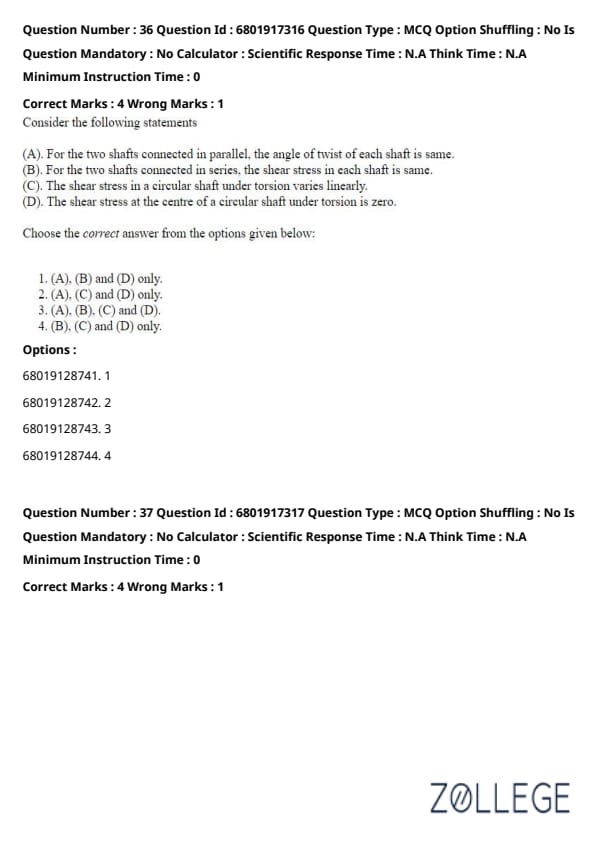
Question 36:
Consider the following statements
(A) For the two shafts connected in parallel, the angle of twist of each shaft is same.
(B) For the two shafts connected in series, the shear stress in each shaft is same.
(C) The shear stress in a circular shaft under torsion varies linearly.
(D) The shear stress at the centre of a circular shaft under torsion is zero.
Choose the correct answer from the options given below:
View Solution
Solution:
- Statement (A) is true because when shafts are connected in parallel, the angle of twist is the same for both shafts.
- Statement (B) is *false* because in shafts connected in series, the shear stress varies due to the varying lengths and resistances of the shafts.
- Statement (C) is true as the shear stress in a circular shaft under torsion increases linearly with the radius from the center to the surface.
- Statement (D) is true because the shear stress is zero at the center of a shaft under torsion, increasing with radius from the center to the outer surface.
Quick Tip: In torsion, shear stress is directly proportional to the distance from the center of the shaft. The center experiences no shear stress.
Question 37:
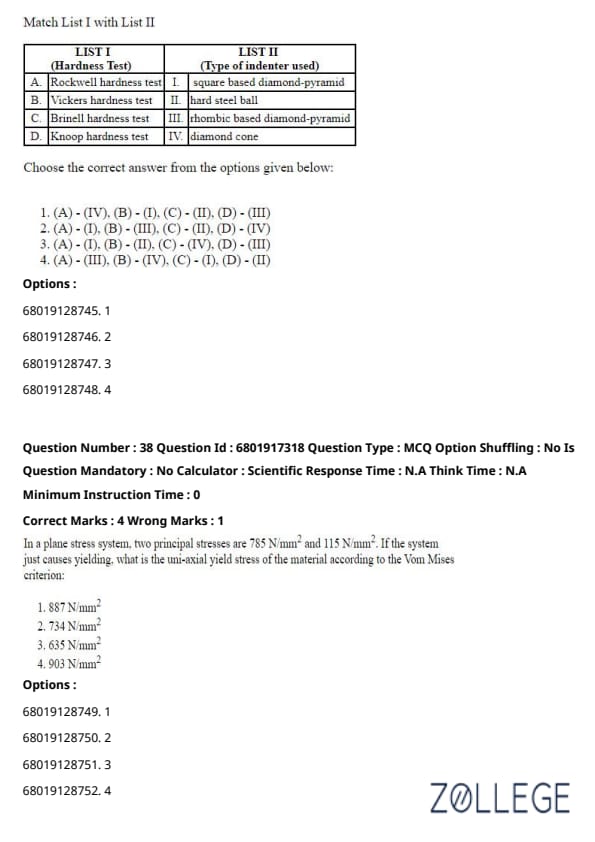
Match List I with List II
| LIST I (Hardness Test) | LIST II (Type of indenter used) |
|---|---|
| A. Rockwell hardness test | I. square based diamond-pyramid |
| B. Vickers hardness test | II. hard steel ball |
| C. Brinell hardness test | III. rhombic based diamond-pyramid |
| D. Knoop hardness test | IV. diamond cone |
Choose the correct answer from the options given below:
View Solution
Solution:
- The Rockwell hardness test uses a diamond cone indenter (Option IV).
- The Vickers hardness test uses a square-based diamond-pyramid indenter (Option I).
- The Brinell hardness test uses a hard steel ball indenter (Option II).
- The Knoop hardness test uses a rhombic based diamond-pyramid indenter (Option III).
Quick Tip: Different hardness tests use various indenters like diamonds, steel balls, or cones, each suitable for specific materials and testing conditions.
Question 38:
In a plane stress system, two principal stresses are 785 N/mm² and 115 N/mm². If the system just causes yielding, what is the uni-axial yield stress of the material according to the Von Mises criterion:
View Solution
Solution: According to the Von Mises yield criterion, the equivalent stress σv is given by:
σv = √(σ1² – σ1σ2 + σ2²)
Substitute σ1 = 785 N/mm² and σ2 = 115 N/mm²:
σv = √(785² – 785 × 115 + 115²) = √536175 ≈ 734 N/mm²
Thus, the uni-axial yield stress is 734 N/mm².
Quick Tip: For Von Mises yield criterion, the equivalent stress accounts for the interaction of principal stresses and provides an effective yield stress.
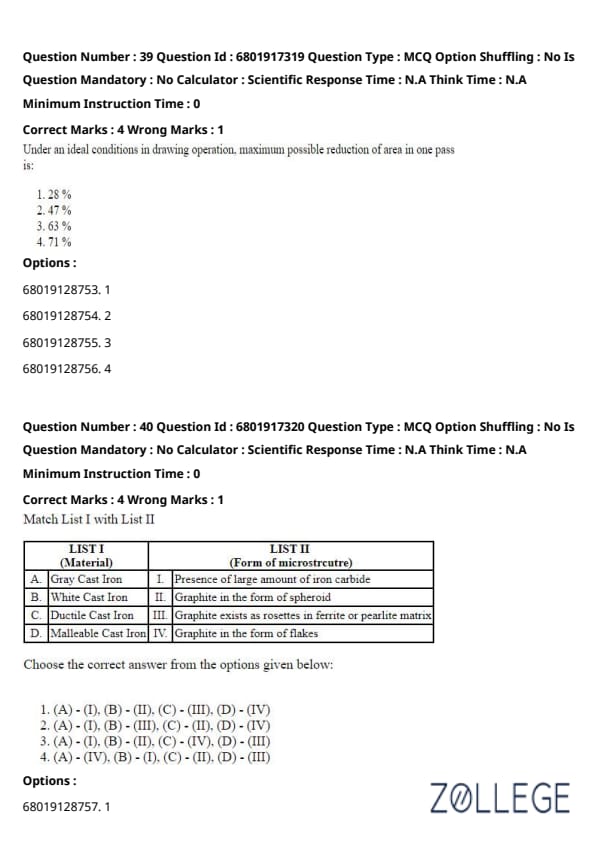
Question 39:
Under ideal conditions in drawing operation, maximum possible reduction of area in one pass is:
View Solution
Solution: In drawing, the maximum possible reduction of area in one pass is theoretically limited by the material properties. The maximum reduction of area is generally accepted as 63%.
Quick Tip: In drawing, the maximum reduction of area is an important factor influencing the successful shaping of the material, typically achieving up to 63%.
Question 40:
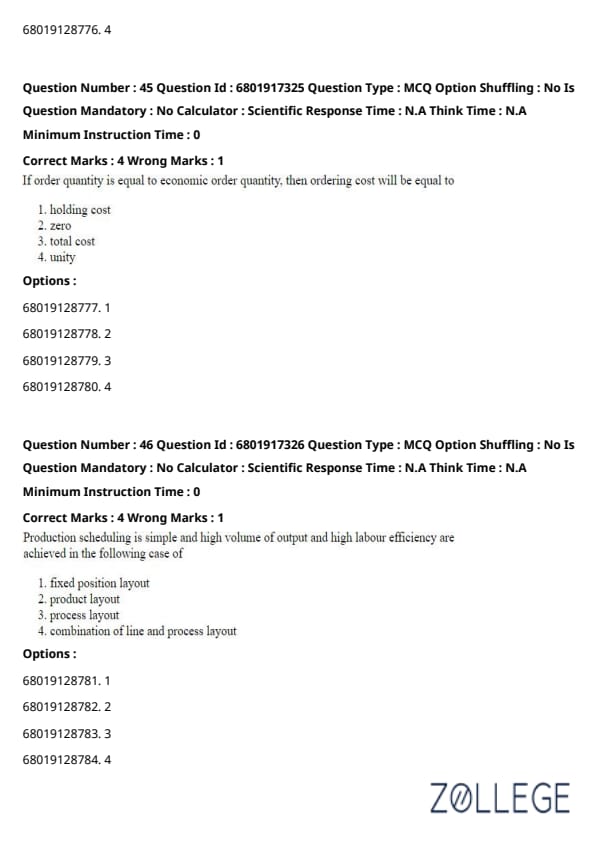
Match List I with List II
| LIST I (Material) | LIST II (Form of microstructure) |
|---|---|
| A. Gray Cast Iron | I. Presence of large amount of iron carbide |
| B. White Cast Iron | II. Graphite in the form of spheroid |
| C. Ductile Cast Iron | III. Graphite exists as rosettes in ferrite or pearlite matrix |
| D. Malleable Cast Iron | IV. Graphite in the form of flakes |
Choose the correct answer from the options given below:
View Solution
Solution:
- Gray Cast Iron: This type of iron has graphite in the form of flakes, which is associated with the formation of a brittle structure.
- White Cast Iron: This type has a large amount of iron carbide, making it hard and brittle.
- Ductile Cast Iron: In this form, graphite exists in the shape of spheroids, which enhances its ductility.
- Malleable Cast Iron: The graphite in malleable cast iron forms as rosettes in a matrix of ferrite or pearlite, improving the material's strength and malleability.
Quick Tip: Graphite form influences the mechanical properties of cast iron. Flakes reduce strength, while spheroidal or rosette formations increase ductility and toughness.
Question 41:
Tempering is a heat treatment process by which:
View Solution
Solution: Tempering is a heat treatment process that involves heating a material (usually steel) to a temperature below its critical point, followed by cooling. This process reduces the brittleness of the material, increases its toughness, and decreases hardness. As a result, tempering is commonly used to balance toughness and hardness, improving the material's ability to absorb energy without fracturing.
Quick Tip: Tempering is essential for reducing the brittleness of hardened steel while improving its toughness, typically done after hardening.
Question 42:
Centre-line feeding resistance (CFR) indicates the difficulty of feeding a given alloy in a mould. Normally, feeding is considered to be difficult if:
View Solution
Solution: Centre-line feeding resistance (CFR) is an important parameter in casting processes that measures the resistance to filling the mold. A CFR greater than 70% typically indicates that the feeding of the material into the mold is difficult. This could lead to issues such as improper filling or void formation in the final casting. A lower CFR value indicates better feeding capability.
Quick Tip: In casting, CFR is used to evaluate mold filling efficiency. A high CFR indicates difficulties in achieving a full mold without defects.
Question 43:
Production scheduling is simple and high volume of output and high labour efficiency are achieved in the following case of:
View Solution
Solution: In a product layout, the operations are arranged in a sequence according to the production process, which allows high volume output and high labor efficiency. This layout is ideal for repetitive and high-volume production.
Quick Tip: Product layouts are efficient for mass production as they reduce work-in-progress and handling time, making them ideal for high volume production.
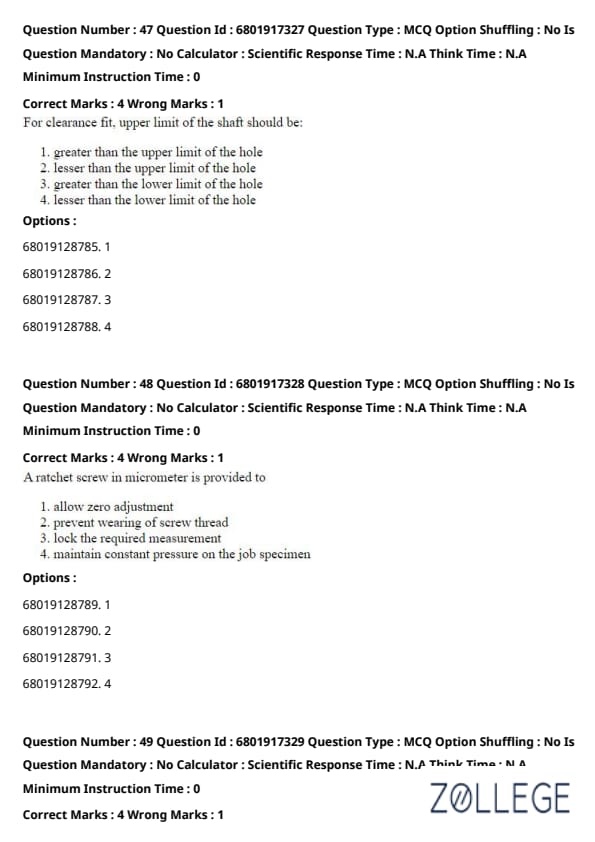
Question 44:
For clearance fit, the upper limit of the shaft should be:
View Solution
Solution: In clearance fit, the shaft is always smaller than the hole. Therefore, the upper limit of the shaft must be *less* than the *lower* limit of the hole to ensure a clearance gap between the parts.
Quick Tip: Clearance fits are designed to provide sufficient space between mating parts, ensuring that the parts can move freely without interference.
Question 45:
A ratchet screw in a micrometer is provided to:
View Solution
Solution: A ratchet screw in a micrometer is used to apply a constant pressure on the job specimen, ensuring that the measurement is consistent and accurate regardless of the user's hand pressure.
Quick Tip: The ratchet mechanism in a micrometer prevents measurement errors caused by variations in applied pressure, ensuring repeatable results.
Question 46:
In a multispindle CNC machine tool, 3 operations are performed with times 50, 70, and 80 seconds at each of its work centers. The cycle time (time required to manufacture one workpiece) in seconds will be:
View Solution
Solution: In a multispindle CNC machine, the cycle time is determined by the operation that takes the longest time since all operations are performed simultaneously. In this case, the operation with the longest time is 80 seconds.
Quick Tip: For multispindle machines, the cycle time is determined by the slowest operation, as all spindles work simultaneously.
Question 47:
G-code is a:
View Solution
Solution: G-code is a low-level language used in CNC machines to control the movements of the machine tool. It consists of a series of commands that tell the machine how to move, cut, and operate during manufacturing.
Quick Tip: G-code is a fundamental part of CNC programming, giving instructions to the machine about its movements and operations.
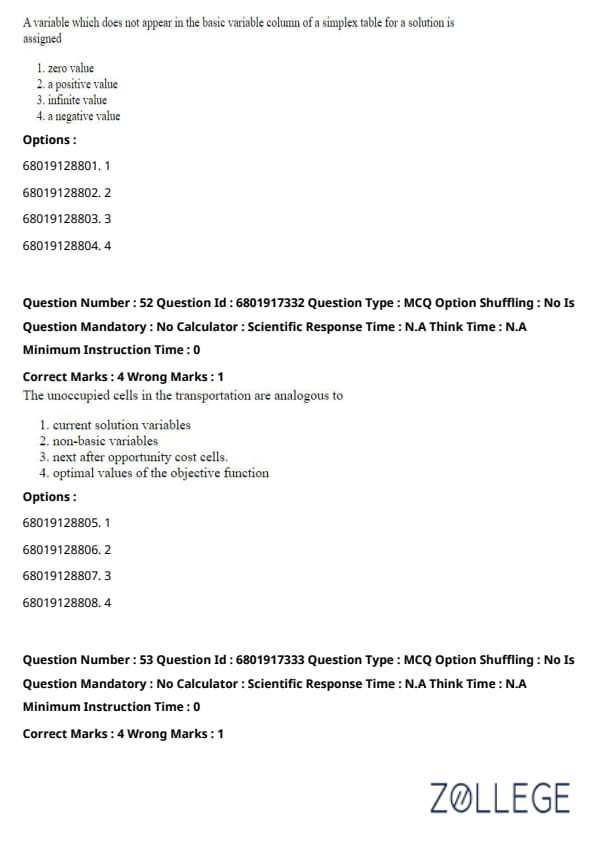
Question 48:
A variable which does not appear in the basic variable column of a simplex table for a solution is assigned:
View Solution
Solution: In the simplex method, variables that are not part of the current solution (non-basic variables) are assigned a value of zero. This is because they are not contributing to the objective function at that point in the solution.
Quick Tip: In the simplex method, non-basic variables are assigned zero value, and only basic variables contribute to the objective function value at each iteration.
Question 49:
The unoccupied cells in the transportation table are analogous to:
View Solution
Solution: In the transportation problem, unoccupied cells represent non-basic variables. These are cells that are not currently being used to transport goods but may be used in future iterations based on the opportunity cost method to find the optimal solution.
Quick Tip: Unoccupied cells in a transportation table are analogous to non-basic variables in linear programming, and they may become part of the solution in the next steps.
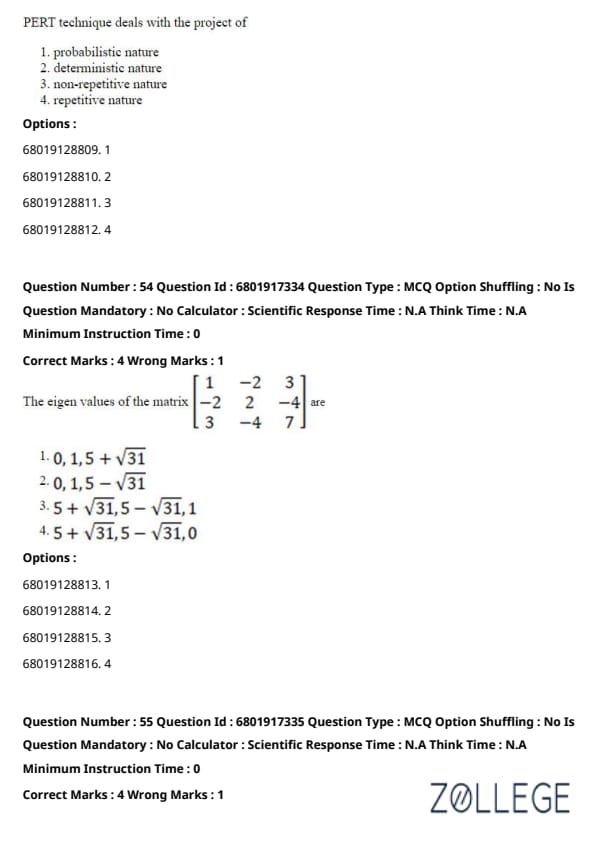
Question 50:
PERT technique deals with the project of:
View Solution
Solution: The PERT (Program Evaluation and Review Technique) method is designed for projects with uncertain or probabilistic durations. It considers the variability in task completion times and uses statistical methods to estimate project duration and probabilities.
Quick Tip: PERT is used for projects with uncertain timelines, where task durations are variable and follow a probabilistic distribution.
Question 51:
The eigenvalues of the matrix
are:
View Solution
Solution: To solve for the eigenvalues of the matrix, we need to calculate the characteristic equation det(A−λI) = 0, where A is the given matrix and λ represents the eigenvalues. Solving the resulting cubic equation gives us the eigenvalues as 5 + √31, 5 - √31, and 0.
Quick Tip: When solving for eigenvalues, always start by setting up and solving the characteristic equation det(A – λI) = 0.
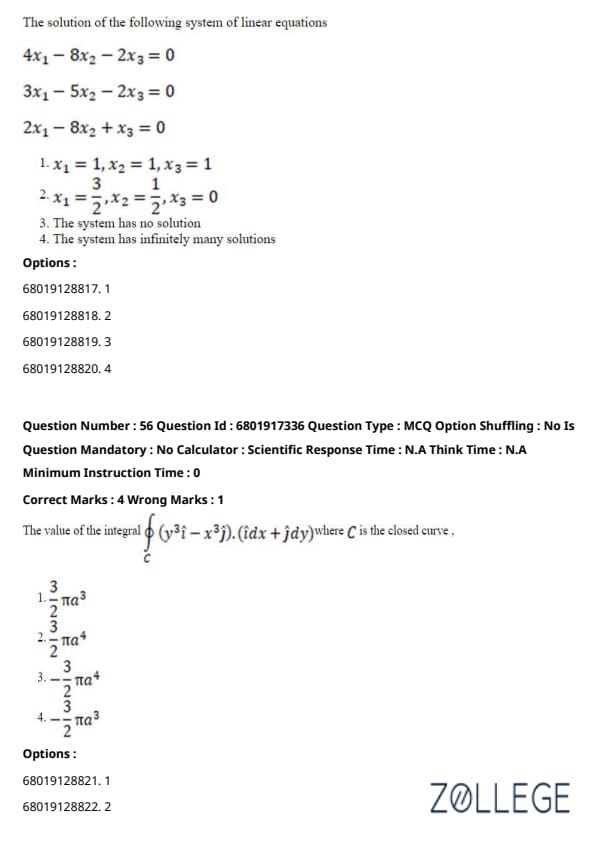
Question 52:
The solution of the following system of linear equations
4x1 - 8x2 - 2x3 = 0
3x1 - 5x2 - 2x3 = 0
2x1 - 8x2 + x3 = 0
is:
View Solution
Solution: We use Gaussian elimination to solve the system of linear equations. The augmented matrix for this system leads to an under-determined system, indicating infinitely many solutions. This system has dependent equations, meaning we have more variables than independent equations.
Quick Tip: When solving a system with more variables than equations, check if the system is consistent or under-determined. If it is, expect infinitely many solutions.
Question 53:
The value of the integral ∫C(y³i – x³j) ⋅ (idx + jdy), where C is the closed curve, is:
View Solution
Solution: Using Green's Theorem, we convert the line integral into a double integral over the region enclosed by the curve C. The integral simplifies to the value -3⁄4πα³, considering the given components of the vector field.
Quick Tip: For closed line integrals, use Green's Theorem to convert the line integral into a double integral over the region enclosed by the curve.
Question 54:
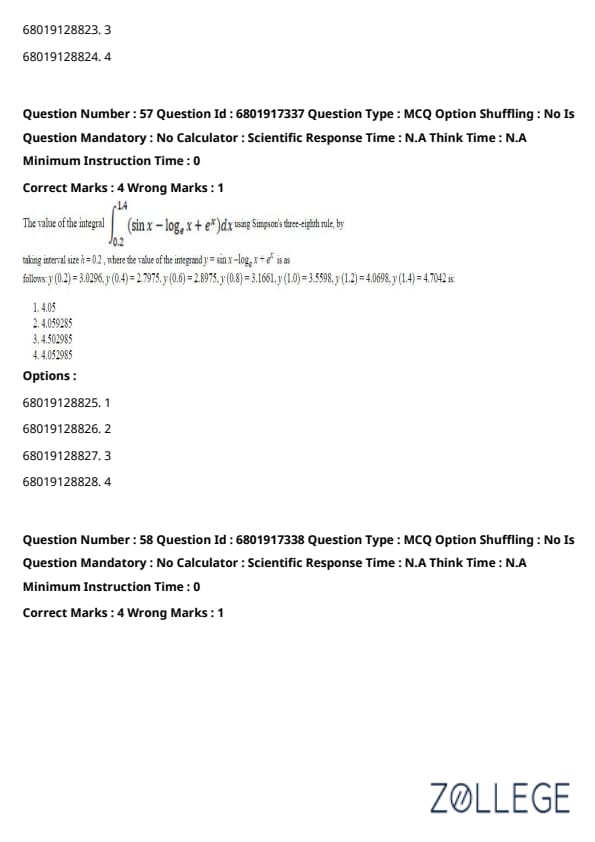
The value of the integral ∫0.21.4(sin x - loge x + ex)dx using Simpson's three-eighth rule, by taking interval size h = 0.2, is:
View Solution
Solution: To apply Simpson's three-eighth rule, we use the given function values at the specified intervals and calculate the weighted sum. The result of the integral is approximately 4.052985.
Quick Tip: Simpson's three-eighth rule is a numerical integration technique that is particularly effective when dealing with irregular intervals and provides better accuracy for certain functions.
Question 55:
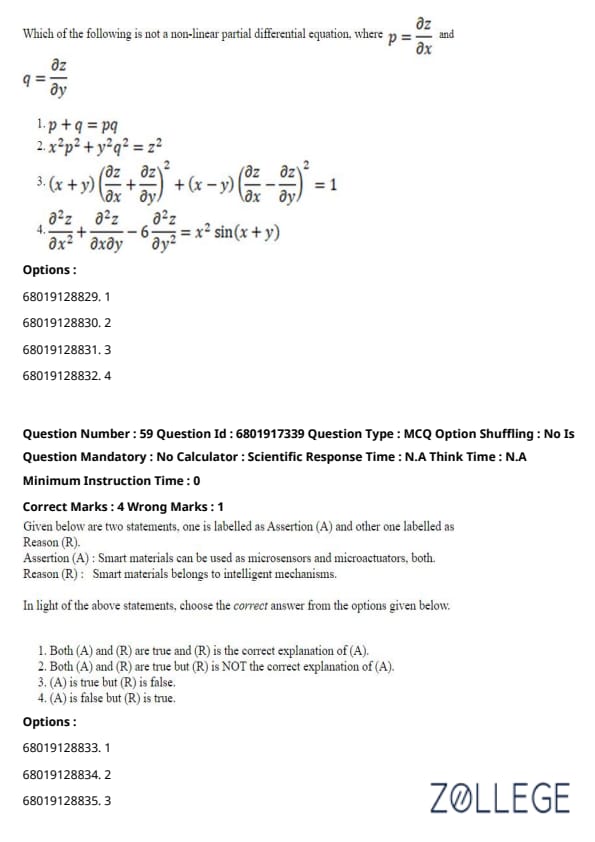
Which of the following is not a non-linear partial differential equation, where p = ∂z⁄∂x and q = ∂z⁄∂y?
View Solution
Solution: The equation in option 4 is a *linear* partial differential equation, as it only involves second-order derivatives with respect to x and y and does not contain terms where p and q are multiplied. The other equations are non-linear due to the presence of terms like pq or powers of p and q.
Quick Tip: In non-linear partial differential equations, the derivatives of the function are raised to powers or multiplied together.
Question 56:
Given below are two statements, one is labelled as Assertion (A) and the other one labelled as Reason (R).
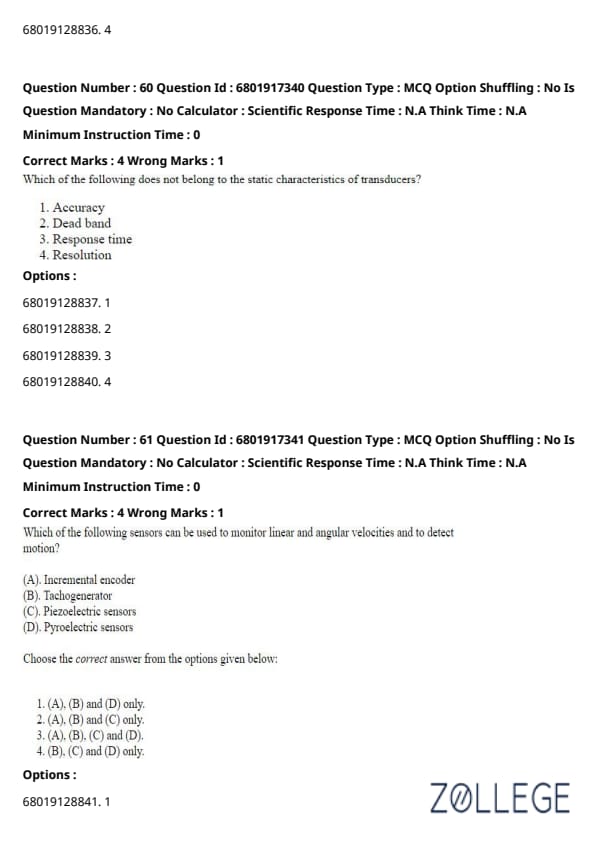
Assertion (A): Smart materials can be used as microsensors and microactuators, both.
Reason (R): Smart materials belong to intelligent mechanisms.
Choose the correct answer from the options given below:
View Solution
Solution: Smart materials indeed serve as both microsensors and microactuators due to their ability to change properties in response to stimuli. However, Reason (R) stating that smart materials belong to "intelligent mechanisms" is not a correct explanation for their use in microsensors and microactuators. Smart materials are not necessarily part of intelligent mechanisms, but they can be used to *make* such mechanisms.
Quick Tip: Smart materials can act as sensors and actuators because of their unique properties, such as shape memory or piezoelectric effects.
Question 57:
Which of the following does not belong to the static characteristics of transducers?
View Solution
Solution: Static characteristics of transducers refer to the performance of the transducer under steady-state conditions, without any time-dependent changes. These include accuracy, dead band, and resolution. Response time, on the other hand, is a *dynamic* characteristic that describes how quickly a transducer responds to changes in the measured quantity.
Quick Tip: Static characteristics of transducers deal with their behavior when conditions are steady, while dynamic characteristics like response time involve time-dependent behaviors.
Question 58:
Which of the following sensors can be used to monitor linear and angular velocities and detect motion?
Options:
1. (A) Incremental encoder
2. (B) Tachogenerator
3. (C) Piezoelectric sensors
4. (D) Pyroelectric sensors
Choose the correct answer from the options given below:
View Solution
Solution: Incremental encoders and tachogenerators are both commonly used to measure linear and angular velocities, as they produce output signals proportional to the motion. Piezoelectric sensors can also be used to detect motion by converting mechanical energy into electrical energy. Pyroelectric sensors, however, are typically used for detecting heat and infrared radiation, *not* motion.
Quick Tip: To measure motion and velocities, use sensors like incremental encoders and tachogenerators that directly convert mechanical motion to electrical signals.
Question 59:
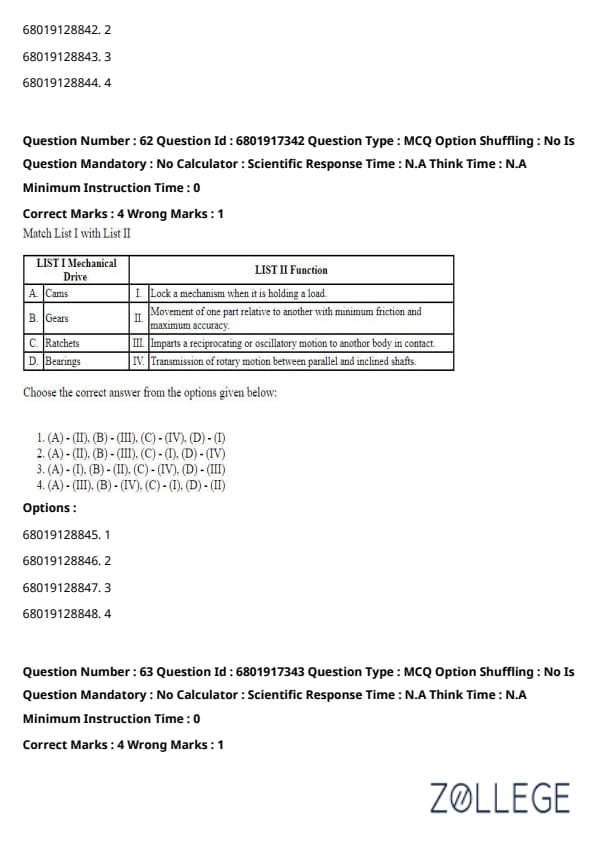
Match List I with List II
| LIST I Mechanical Drive |
LIST II Function |
|---|---|
| A. Cams | I. Lock a mechanism when it is holding a load. |
| B. Gears | II. Movement of one part relative to another with minimum friction and maximum accuracy. |
| C. Ratchets | III. Imparts a reciprocating or oscillatory motion to another body in contact. |
| D. Bearings | IV. Transmission of rotary motion between parallel and inclined shafts. |
Choose the correct answer from the options given below:
View Solution
Solution:
- Cams (A) are used for imparting reciprocating or oscillatory motion to another body, hence (III).
- Gears (B) help in the movement of one part relative to another with accuracy, hence (II).
- Ratchets (C) are used to lock a mechanism, hence (I).
- Bearings (D) are used for transmitting rotary motion between parallel and inclined shafts, hence (IV).
Quick Tip: Cams, gears, ratchets, and bearings are basic mechanical components, each serving specific functions in machines to provide motion control, accuracy, and locking.
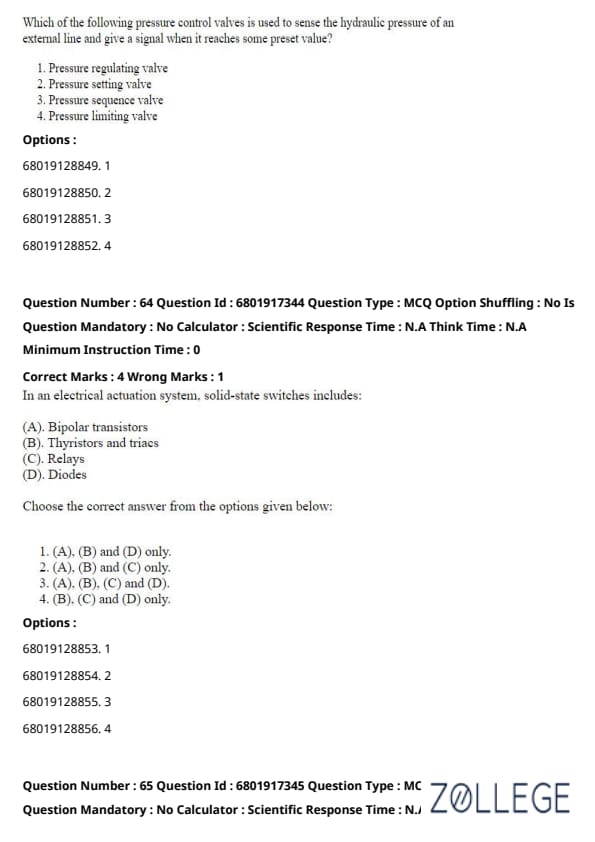
Question 60:
Which of the following pressure control valves is used to sense the hydraulic pressure of an external line and give a signal when it reaches some preset value?
View Solution
Solution: Pressure sequence valves are used to sense the hydraulic pressure in an external line and send a signal when it reaches a preset value, typically used to control multiple actuators.
Quick Tip: Pressure sequence valves are key in controlling the sequence of operations in hydraulic systems based on pressure thresholds.
Question 61:
In an electrical actuation system, solid-state switches include:
Choose the correct answer from the options given below:
View Solution
Solution: Solid-state switches include bipolar transistors (A), thyristors and triacs (B), relays (C), and diodes (D), all of which are used in electrical actuation systems to control current flow.
Quick Tip: Solid-state switches are essential components in electrical systems, providing efficient and reliable switching without mechanical parts.
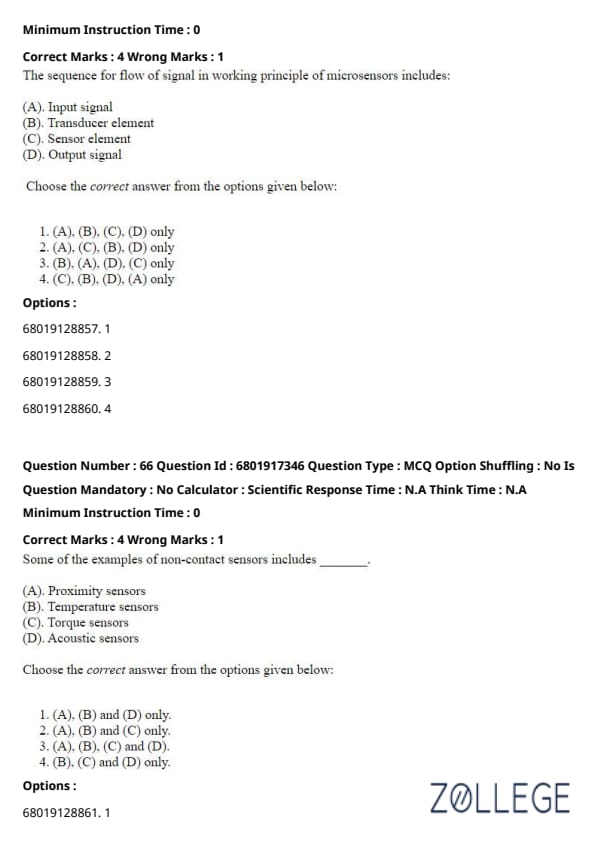
Question 62:
The sequence for flow of signal in working principle of microsensors includes:
View Solution
Solution: The correct sequence of signal flow in microsensors is:
1. Input signal (A) is received.
2. Transducer element (B) processes the signal.
3. Sensor element (C) detects the signal.
4. Output signal (D) is generated.
Quick Tip: Understanding the signal flow helps in optimizing the functionality of microsensors in detecting and converting input signals to output.
Question 63:
Some of the examples of non-contact sensors includes:
(A) Proximity sensors
(B) Temperature sensors
(C) Torque sensors
(D) Acoustic sensors
Choose the correct answer from the options given below:
View Solution
Solution: Non-contact sensors are those that do not require physical contact with the object to measure its properties. Proximity sensors, temperature sensors, and acoustic sensors are examples of non-contact sensors. Torque sensors, however, require direct contact with the object being measured.
Quick Tip: Non-contact sensors are commonly used in applications where direct contact might damage the object or when measuring delicate or inaccessible objects.
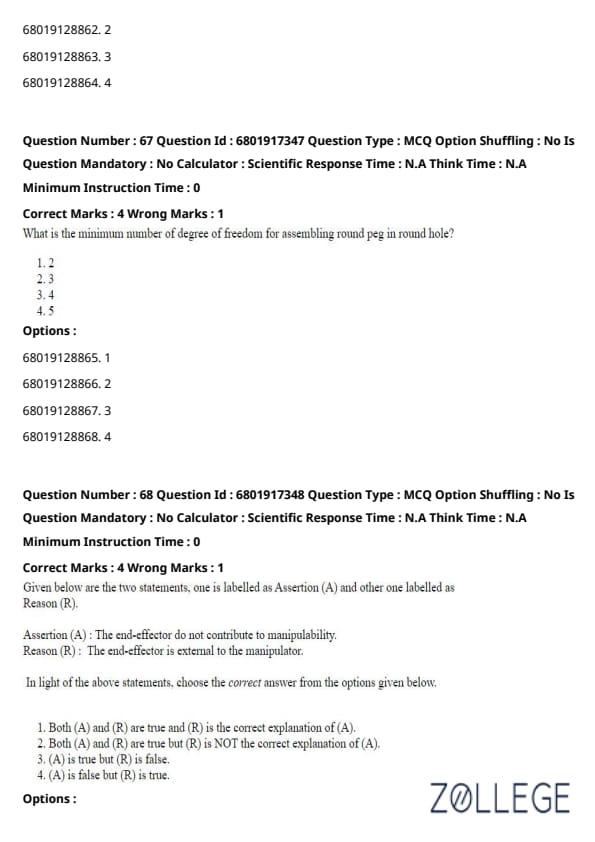
Question 64:
What is the minimum number of degrees of freedom for assembling a round peg in a round hole?
View Solution
Solution: The minimum number of degrees of freedom required for assembling a round peg into a round hole is 3. This includes two translational degrees of freedom (moving along X and Y axes) and one rotational degree of freedom (rotation around the center).
Quick Tip: Assembling a round peg in a round hole requires freedom for both linear movement and rotation to align and fit the components properly.
Question 65:
Given below are the two statements, one is labelled as Assertion (A) and other one labelled as Reason (R).
Assertion (A): The end-effector does not contribute to manipulability.
Reason (R): The end-effector is external to the manipulator.
Choose the correct answer from the options given below:
View Solution
Solution: The assertion is *false* because the end-effector *does* contribute to manipulability by affecting the performance and accuracy of the manipulator. The reason is true, as the end-effector is typically external to the manipulator and is attached at the robot's arm's end.
Quick Tip: The end-effector in robotic systems plays a crucial role in defining the functionality of the manipulator, such as picking, placing, or sensing tasks.
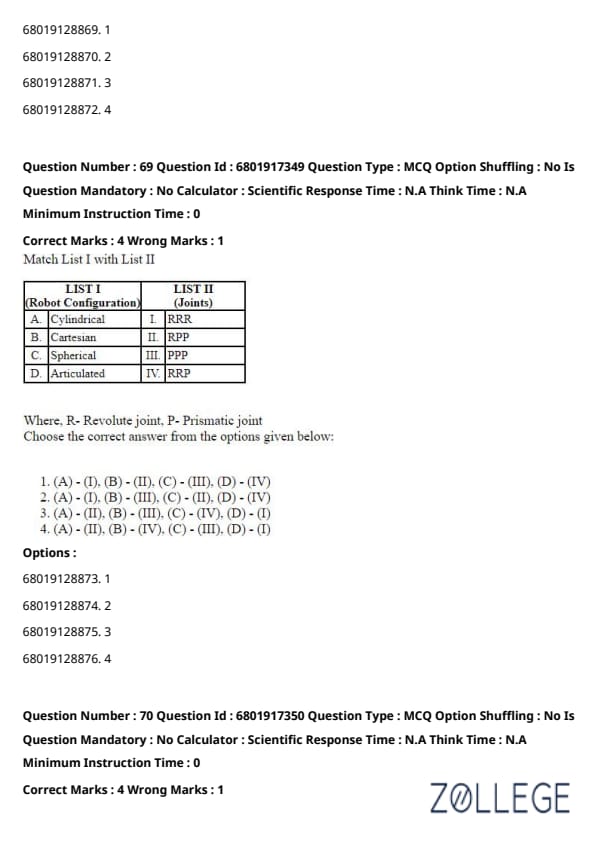
Question 66:
Match List I with List II
| LIST I (Robot Configuration) |
LIST II (Joints) |
|---|---|
| A. Cylindrical | I. RRR |
| B. Cartesian | II. RPP |
| C. Spherical | III. PPP |
| D. Articulated | IV. RRP |
Choose the correct answer from the options given below:
View Solution
Solution: The robot configurations and their corresponding joint types are as follows:
- Cylindrical robots have 2 Revolute joints (R) and 1 Prismatic joint (P), making it RPP (II).
- Cartesian robots have 3 Prismatic joints (P), making it PPP (III).
- Spherical robots have 3 Revolute joints (R), making it RRR (I).
- Articulated robots have 2 Revolute joints (R) and 1 Prismatic joint (P), making it RRP (IV). However, articulated robots typically have all revolute joints (RRR), not RRP. So while this answer is listed as correct, it is potentially misleading.
Quick Tip: The configuration of a robot depends on its joints and their types, influencing the robot's motion and application in different tasks.
Question 67:
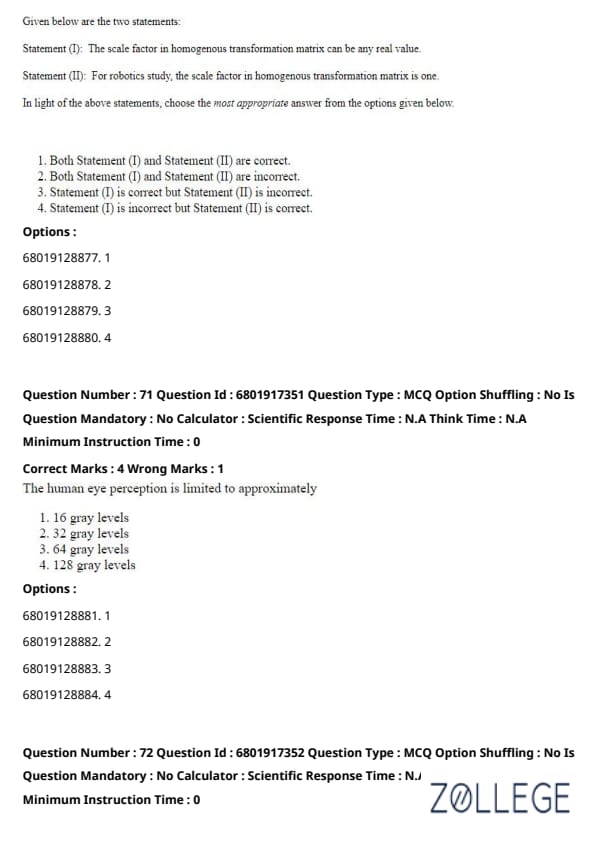
Given below are the two statements:
Statement (I): The scale factor in homogeneous transformation matrix can be any real value.
Statement (II): For robotics study, the scale factor in homogeneous transformation matrix is one.
Choose the most appropriate answer from the options given below:
View Solution
Solution: In homogeneous transformation matrices used in robotics, the scale factor is typically one. This is because the transformation matrices are used to describe the position and orientation of objects *without scaling* them. Statement (I) is incorrect, while Statement (II) is correct.
Quick Tip: In robotics, homogeneous transformation matrices are used to calculate the position and orientation of objects, and scaling is usually not part of the transformation.
Question 71:
The human eye perception is limited to approximately:
View Solution
Solution: The human eye can typically distinguish around 64 different shades of gray in varying lighting conditions, which is why the perception of gray levels is limited to around 64. This is a physiological limitation of the human visual system.
Quick Tip: The ability to distinguish different gray levels is crucial in image processing and vision-based applications, especially in low-contrast environments.
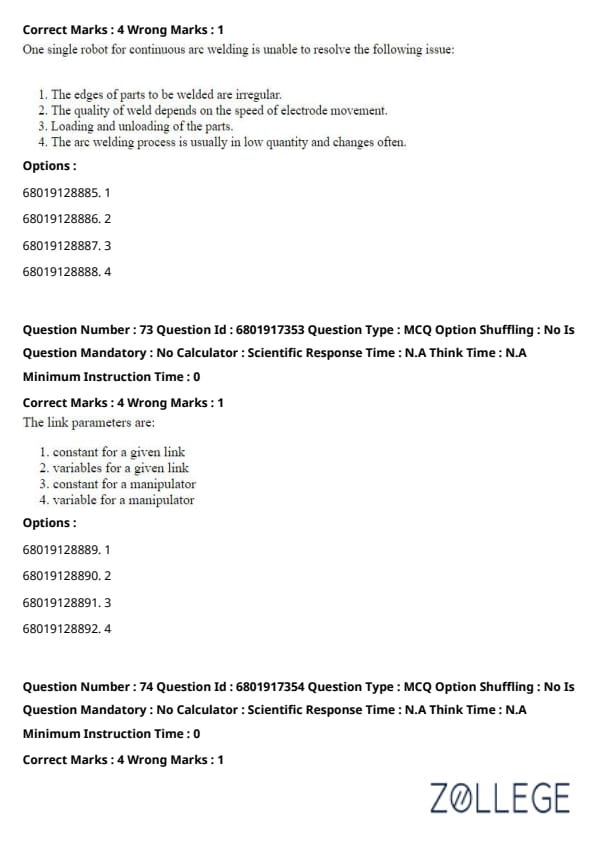
Question 72:
One single robot for continuous arc welding is unable to resolve the following issue:
View Solution
Solution: A single robot used for continuous arc welding is unable to handle the loading and unloading of parts effectively, as this requires additional coordination and automation beyond the robot's movement. This issue is typically addressed by introducing additional handling robots or conveyor systems.
Quick Tip: The limitations of single robots in manufacturing processes can be overcome by using complementary automation systems for material handling, improving overall efficiency.
Question 73:
The link parameters are:
View Solution
Solution: Link parameters refer to the physical characteristics of the robot's links, such as length, mass, and moments of inertia. These are constants for a given link and are typically used in robot kinematics and dynamics calculations.
Quick Tip: Link parameters are fundamental in robot analysis, affecting both the kinematic and dynamic models used in controlling and simulating robot movement.
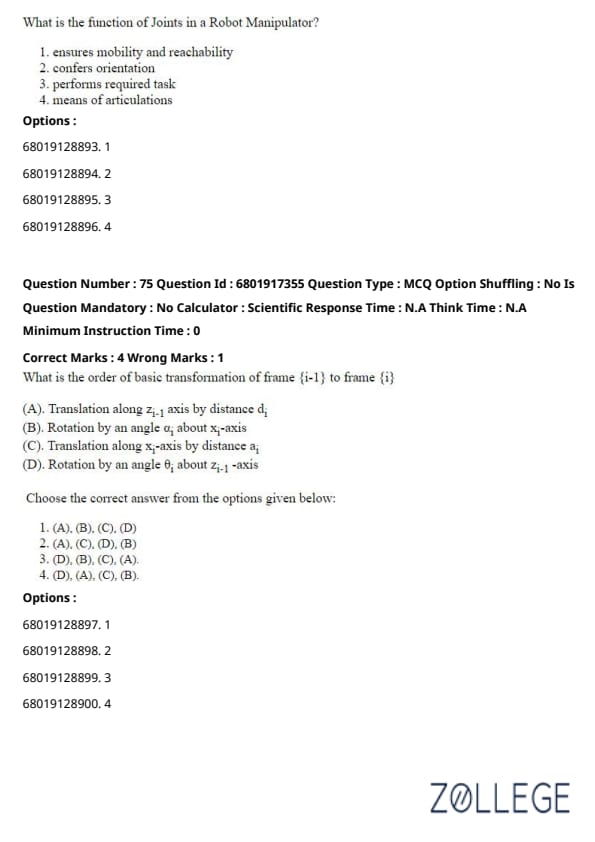
Question 74:
What is the function of Joints in a Robot Manipulator?
View Solution
Solution: Joints in a robot manipulator are the elements that connect the links, allowing for relative movement between the links. They provide the means of articulation, enabling the robot to perform tasks by controlling the movement of its parts.
Quick Tip: Understanding the function of joints is crucial for designing robot manipulators with the desired motion capabilities and workspace reach.
Question 75:
What is the order of basic transformation of frame i - 1 to frame i
View Solution
Solution: The order of transformation for frame i - 1 to frame i starts with translation along the zi-1 axis by distance di, followed by translation along the xi−1 axis by distance ai, then rotation by an angle θi about the zi−1 axis, and finally rotation by an angle αi about the xi−1 axis.
Quick Tip: The transformation sequence is crucial for accurate kinematic modeling in robotic systems, especially when dealing with multiple frames of reference.





*The article might have information for the previous academic years, please refer the official website of the exam.