CUET PG 2024 Plant Biotechnology Question Paper Pdf- Check Solutions with Answer Key Pdf
- Question Paper 2025
- Question Paper 2024
- Question Paper 2023
- Mathematics Papers
- Statistics Question Paper
- English Question Paper
- Chemistry Question Paper
- Pol. Sci. Question Paper
- History Question Paper
- Commerce Question Papers
- Life Science Papers
- Geology Question Papers
- Journalism Question Paper
- B.Ed. HSS Question Paper
- Botany Question Paper
- B.Ed. Question Papers


Content Strategist | Updated On - Jan 15, 2025
CUET PG 2024 Plant Biotechnology 13th March 2024 Shift 2 Question Paper with Solution PDF is available for download here. Students found Plant Tissue Culture easy, Molecular Markers moderate, and Genetic Engineering difficult. Genetic Engineering carried the highest weightage, and the overall difficulty level was moderate to difficult.
CUET PG 2024 Plant Biotechnology Question Paper with Answer Key PDF
| CUET PG 2024 Plant Biotechnology Question Paper with Answer Key |  Download Download |
Check Solution |
CUET PG Plant Biotechnology 2024 Questions with Solutions
Question 1:
Very often plants produce undifferentiated mass of cells at the site of a wound, which is known as:
View Solution
An embryo represents the early developmental stage in both plants and animals, characterized by rapid cellular division, differentiation, and establishment of the foundational structures of the organism.
In plants, the embryo develops within the seed, originating from the fertilized ovule after the fusion of male and female gametes. This process occurs during sexual reproduction and marks the beginning of a new generation in the plant’s life cycle.
It is composed of several distinct parts, including the radicle (future root), hypocotyl (stem-like structure below the cotyledons), epicotyl (stem-like structure above the cotyledons), and cotyledons (seed leaves). These structures are essential for the establishment of the seedling, as they enable the plant to germinate and grow by utilizing the stored nutrients within the seed. Beyond its role in reproduction, plant embryos can play a role in tissue regeneration and repair.
Question 2:
Root culture is used to produce:
View Solution
Root cultures specialize in producing secondary metabolites, like alkaloids. These compounds are commonly used in medicinal products due to their biochemical properties. For instance, alkaloids like morphine and codeine, derived from Papaver somniferum (opium poppy), are potent analgesics used to manage pain.
Root cultures, whether derived from whole plants or through techniques like hairy root induction via Agrobacterium rhizogenes, offer a stable and scalable system for producing these valuable compounds. These cultures can be optimized using biotechnological interventions, such as elicitors, nutrient modifications, or genetic engineering, to enhance the yield of specific alkaloids.
Question 3:
Synthetic seeds are:
View Solution
Synthetic seeds are artificially created seed-like structures, encapsulating somatic embryos or other propagules in a protective gel matrix, typically sodium alginate. These seeds are enriched with nutrients, growth regulators, or antifungal agents to enhance viability and germination.
They offer advantages such as ease of handling, storage, and transportation, along with enabling mass propagation and preservation of valuable plant germplasm. Synthetic seeds are particularly useful for propagating elite genotypes, conserving endangered species, and supporting reforestation efforts.
Despite challenges like low conversion rates and genetic stability, advancements in encapsulation and germination methods are improving their efficiency and applicability.
Question 4:
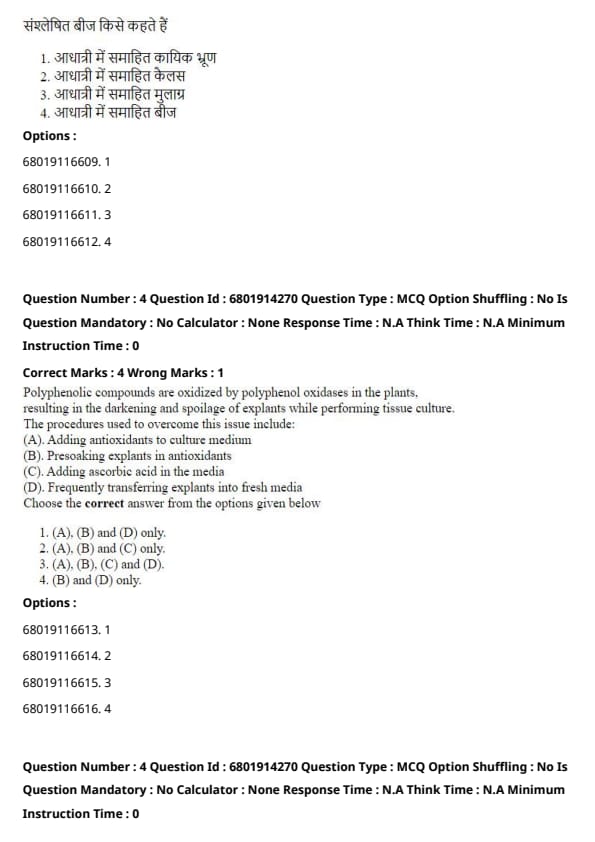
Polyphenolic compounds are oxidized by polyphenol oxidases in plants, resulting in the darkening and spoilage of explants while performing tissue culture. The procedures used to overcome this issue include:
Choose the correct answer from the options given below:
View Solution
Polyphenolic compounds in plants can oxidize and cause spoilage of explants in tissue culture due to the action of polyphenol oxidases. Various strategies are employed to prevent this:
- Adding antioxidants to the culture medium: Antioxidants neutralize free radicals and prevent oxidation.
- Presoaking explants in antioxidants: This step reduces polyphenol oxidation before placing explants into the culture medium.
- Adding ascorbic acid to the media: Ascorbic acid (Vitamin C) is a powerful antioxidant that prevents enzymatic browning.
- Frequent transfer of explants into fresh media: Regularly transferring explants prevents the accumulation of oxidized compounds in the media.
Thus, all options (A), (B), (C), and (D) are correct for overcoming this issue.
Question 5:
The procedures used to overcome darkening of explants include:
View Solution
Ascorbic acid, commonly known as vitamin C, is a potent antioxidant that plays a crucial role in plant tissue culture by mitigating oxidative stress. It scavenges reactive oxygen species (ROS) and free radicals, which can accumulate during the excision or handling of explants, preventing cellular damage.
By reducing oxidative browning and phenolic accumulation, ascorbic acid maintains the viability and health of explants. Its addition to culture media enhances tissue regeneration, ensuring optimal growth and development. This property makes it an essential component in improving the success rates of in vitro plant propagation.
Question 6:
Cytokinins:
Choose the correct answer from the options given below:
View Solution
Cytokinins, derived from adenine, are key plant growth regulators that promote cell division and shoot formation, especially in the presence of auxins. They influence processes like chloroplast development, nutrient mobilization, and delay of senescence.
Unlike auxins or gibberellins, cytokinins do not significantly contribute to cell elongation. Instead, their role is crucial in maintaining cellular proliferation and regulating shoot-to-root balance in tissue culture and plant development.
Question 7:
Match List-I with List-II:
| List-I | List-II |
|---|---|
| (A) Seed Culture | (III) Development of seedless fruits |
| (B) Anther Culture | (IV) Haploid production |
| (C) Endosperm Culture | (I) Useful for obtaining genetic manipulation |
| (D) Protoplast Culture | (II) Generating plants of small seeds |
View Solution
- (A) Seed Culture: Development of seedless fruits.
- (B) Anther Culture: Haploid production.
- (C) Endosperm Culture: Useful for obtaining genetic manipulation.
- (D) Protoplast Culture: Generating plants of small seeds.
Question 8:
Match List-I with List-II:
| List-I | List-II |
|---|---|
| (A) Cellulase | (I) Fungi |
| (B) Pectinase | (III) Aspergillus spp. |
| (C) Zymolyase | (IV) Helix spp. |
| (D) Macerase | (II) Bacteria |
View Solution
- (A) Cellulase: Fungi.
- (B) Pectinase: Aspergillus spp.
- (C) Zymolyase: Helix spp.
- (D) Macerase: Bacteria.
Question 9:
Match List-I with List-II:
| List-I (Crop) | List-II (Somaclonal variants obtained) |
|---|---|
| (A) Rice | (III) Glyphosate resistance |
| (B) Maize | (IV) Glycine mutant |
| (C) Carrot | (II) Grain color |
| (D) Wheat | (I) High carotene content |
View Solution
- (A) Rice: Glyphosate resistance.
- (B) Maize: Glycine mutant.
- (C) Carrot: Grain color.
- (D) Wheat: High carotene content.
Question 10:
Match List-I with List-II:
| List-I (Phases of plant cells in culture) | List-II (Changes in growth pattern) |
|---|---|
| (A) Lag phase | (III) Cells prepare to divide |
| (B) Exponential phase | (IV) Highest rate of cell division |
| (C) Linear phase | (II) Cell division slows but cell expansion increases |
| (D) Deceleration phase | (I) Rate of cell division and elongation decreases |
View Solution
- (A) Lag phase: Cells prepare to divide.
- (B) Exponential phase: Highest rate of cell division.
- (C) Linear phase: Cell division slows but cell expansion increases.
- (D) Deceleration phase: Rate of cell division and elongation decreases.
Question 11:
Shoot tip culture is performed through the following steps:
Choose the correct answer from the options given below:
View Solution
- (A) Shoot tip collection from the plant: The initial step is collecting the shoot tip for culturing.
- (D) Primary culture of tip: The collected shoot tip is placed in a nutrient-rich medium for primary culture.
- (B) Axillary shoot proliferation: Shoots proliferate from the cultured tip.
- (C) Rooting of shoots: The proliferated shoots are transferred to rooting media to develop roots.
Question 12:
Different steps for regeneration via organogenesis:
Choose the correct answer from the options given below:
View Solution
- (C) Initial explant: The starting material is taken from a plant.
- (B) Callus formation: Cells dedifferentiate and form an unorganized mass (callus).
- (A) Shoot formation: Shoots are induced from the callus.
- (D) Plantlet: Fully developed plantlets are obtained.
Question 13:
Following steps are used in Bergmann cell plating technique:
Choose the correct answer from the options given below:
View Solution
- (D) Cell suspension: Preparation of a suspension of cells.
- (A) Passing cells through gauge: Cells are passed through a fine gauge to ensure uniformity.
- (B) Mixing cells with molten agar medium: Uniform mixing of cells in a growth medium.
- (C) Plating cells in petridishes: The mixture is plated in petridishes for culture.
Question 14:
In vitro techniques to produce haploids are used to generate:
View Solution
Haploids are used to produce homozygous lines. This is because haploid plants contain a single set of chromosomes, and doubling them using techniques like colchicine results in completely homozygous lines, which are essential for plant breeding and genetics research.
Question 15:
The chromosome number of a haploid plant can be doubled using:
View Solution
Colchicine is used to double the chromosome number in haploid plants. It works by inhibiting spindle fiber formation during cell division, resulting in the duplication of chromosomes without cytokinesis, thereby producing a diploid plant from a haploid.
Question 16:
Different plant tissue culture methods used to produce haploids:
View Solution
Haploids are produced by culturing male gametophytic tissues, such as anthers or isolated microspores, under specific conditions that trigger embryogenesis or direct plantlet formation. These techniques bypass fertilization, resulting in plants with a single set of chromosomes.
Haploids are invaluable in plant breeding, enabling rapid development of homozygous lines through chromosome doubling. This accelerates the creation of improved cultivars with desirable traits, making anther and microspore culture essential tools in modern agriculture.
Question 17:
Development of haploid plants from male gametophytic tissue is known as:
View Solution
Androgenesis involves the induction of haploid plant development directly from male gametophytic tissues, such as pollen grains or microspores, under in vitro conditions. This method bypasses the zygotic pathway, leading to haploid plants with a single set of chromosomes.
By doubling their chromosomes, fully homozygous lines can be achieved in a single generation. Androgenesis is a crucial tool in plant breeding, expediting the development of uniform and improved crop varieties.
Question 18:
When anthers containing microspores at the middle to late uninucleate stage are cultured on solid media, they form:
View Solution
Culturing anthers with microspores on solid media often results in the formation of a callus, a mass of undifferentiated cells. This process involves dedifferentiation of microspores triggered by stress or specific culture conditions.
The callus can subsequently be induced to regenerate into haploid plants by manipulating growth regulators and environmental factors. This technique is widely used in plant breeding to develop homozygous lines quickly and efficiently.
Question 19:
Microspores may give rise to the plants having:
View Solution
Microspores naturally develop into haploid plants containing a single set of chromosomes, ideal for plant breeding. To achieve diploid plants, colchicine or other antimitotic agents are used to inhibit spindle formation during cell division, resulting in chromosome doubling.
This process creates homozygous diploid plants in a single generation, bypassing the need for multiple breeding cycles. Such plants are essential for developing stable and improved crop varieties.
Question 20:
Problem of mixoploidy associated with anther culture was overcome by:
View Solution
Mixoploidy, a condition where cells within a tissue have different ploidy levels, is a common issue in anther culture. Microspore culture helps to overcome this problem by isolating individual microspores and allowing them to develop into uniform haploid plants.
Question 21:
Gynogenic embryogenesis can be developed by culturing:
View Solution
Gynogenic embryogenesis refers to the development of an embryo from female gametophytic tissues such as the ovary or ovule. This technique is widely used in breeding programs to produce haploids and analyze the maternal genome.
Question 22:
Chromosome elimination technique was established for the production of:
View Solution
Chromosome elimination techniques involve selectively removing chromosomes to produce haploid plants. This process is often used in hybridization and doubled haploid breeding programs to create homozygous lines rapidly.
Question 23:
For the development of diploid plantlets, the order of tissue culture steps will be:
View Solution
- (D) Colchicine treatment to double the chromosomes.
- (A) Development of haploid plantlets.
- (B) Collection of flowers to initiate anther culture.
- (C) Isolation and culture of anthers.
Question 24:
Different steps involved in the elimination of chromosomes in cereals through plant tissue culture:
View Solution
- (C) Crossing plants to create hybrids.
- (B) Chromosome elimination to create haploids.
- (D) Developing monoploid plants from haploids.
- (A) Embryo culture to regenerate plantlets.
Question 25:
Homozygous lines developed through the anther culture must be analyzed to check their ploidy status through:
View Solution
Chromosome counting is the most reliable and precise method for determining the ploidy level of homozygous lines derived from anther culture. This technique involves directly counting the number of chromosomes in root tip cells, providing an accurate assessment of ploidy.
In contrast, methods like plastid counting and nucleoli evaluation are indirect, offering less certainty in confirming ploidy status. Despite being less precise, these alternative methods can still provide useful preliminary insights into the ploidy of plant tissues.
Question 26:
Match List-I with List-II:
| List-I (In plant tissue culture) | List-II (Related method/process/example) |
|---|---|
| (A) Ploidy level checking | (III) Plastid number in stomata |
| (B) Diploidization | (IV) Endomitosis |
| (C) Exclusive generation of male plants | (II) Haploid induction |
| (D) Gynogenic plants | (I) Morus indica |
View Solution
- (A) Ploidy level checking: Ploidy levels are checked by counting plastids in stomata.
- (B) Diploidization: Diploidization involves endomitosis for chromosome doubling.
- (C) Exclusive generation of male plants: Haploid induction generates exclusive male plants.
- (D) Gynogenic plants: Gynogenic plants are linked to Morus indica as a model.
Question 27:
Most commonly used chemical for protoplast fusion is:
View Solution
Polyethylene Glycol (PEG) is commonly used in protoplast fusion to enhance the process of membrane fusion by reducing electrostatic repulsion between the membranes of individual protoplasts. It works by facilitating the adhesion of the protoplast membranes, allowing them to merge and form hybrid cells.
PEG is particularly useful in plant genetic engineering and somatic hybridization. This method enables the combination of genetic material from different plant species, creating novel genotypes with desirable traits.
Question 28:
Protoplasts are:
View Solution
Protoplasts are isolated plant cells that have undergone enzymatic digestion to remove the cell wall, leaving the plasma membrane and internal organelles, such as the nucleus, mitochondria, and chloroplasts, intact.
This process allows for direct manipulation of the cell’s genetic material, facilitating experiments like gene transformation, somatic hybridization, and chromosome analysis. Protoplasts are crucial in plant biotechnology, enabling techniques like genome editing and regeneration of whole plants.
Question 29:
Plant cell protoplasts can be prepared by treating cells with:
View Solution
Protoplasts are isolated through enzymatic digestion of the plant cell wall using a combination of cellulase, hemicellulase, and pectinase. These enzymes specifically break down the major components of the cell wall: cellulose, hemicellulose, and pectin.
The process results in the removal of the rigid cell wall, leaving behind the protoplast, which consists of the plasma membrane and internal organelles. This technique is essential for various applications in plant biotechnology, including genetic modification and somatic cell fusion.
Question 30:
Fluorescein diacetate (FDA) stain is used for:
View Solution
FDA (fluorescein diacetate) stain is a fluorochrome used to assess the viability of protoplasts by detecting enzymatic activity and membrane integrity. When FDA enters viable cells, intracellular esterases cleave it into fluorescein, emitting green fluorescence under UV light.
This fluorescence indicates that the cell’s enzymes are active and the plasma membrane is intact, signifying cell viability. Non-viable cells, which lack membrane integrity, do not fluoresce, allowing for the identification of healthy protoplasts in culture.
Question 31:
Agar in plant tissue culture acts as:
View Solution
Agar is commonly used in plant tissue culture as a solidifying agent. It provides a stable surface for plant growth and nutrient uptake.
Question 32:
Following sequence is followed for the protoplast culture:
View Solution
Protoplast culture involves the isolation of protoplasts through enzymatic treatment of cells to remove cell walls, followed by culture under specific conditions.
Question 33:
Different steps in the generation of somaclonal variation without in vitro selection:
View Solution
Somaclonal variation arises during callus formation and plant regeneration. It is a result of genetic or epigenetic changes occurring in vitro.
Question 34:
Following are the disadvantages of somaclonal variation:
View Solution
A key disadvantage of somaclonal variation is the instability and poor heritability of traits, which limits their practical application.
Question 35:
The somatic hybrids produced through protoplast fusion need authentication and purification due to low efficiency of fusion. This may be performed by the following complementations:
View Solution
Resistance markers are used to identify successful hybrid cells, ensuring authentication and selection in somatic hybridization.
Question 36:
Match List I with List II:
| List I (First species) | List II (Second species) |
|---|---|
| (A) Solanum tuberosum | (III) L. esculentum |
| (B) Arabidopsis thaliana | (IV) B. campestris |
| (C) Datura innoxia | (I) Atropa belladonna |
| (D) Oryza sativa | (II) Echinochloa oryzicola |
View Solution
- Solanum tuberosum is paired with L. esculentum.
- Arabidopsis thaliana matches B. campestris.
- Datura innoxia links with Atropa belladonna.
- Oryza sativa is paired with Echinochloa oryzicola.
Question 37:
Match List I with List II:
| List I (Somatic hybrids) | List II (Traits transferred via protoplast fusion) |
|---|---|
| (A) Nicotiana tabacum | (III) Tobacco mosaic virus resistance |
| (B) Solanum spp. | (IV) Potato virus X resistance |
| (C) Brassica spp. | (I) Black rot resistance |
| (D) Nicotiana rustica | (II) High nicotine content |
View Solution
- Nicotiana tabacum contributes resistance to tobacco mosaic virus.
- Solanum spp. provides resistance to potato virus X.
- Brassica spp. exhibits black rot resistance.
- Nicotiana rustica transfers high nicotine content.
Question 38:
Match List I with List II:
| List I (Terms related to plant tissue culture) | List II (Suitable explanation of the terms) |
|---|---|
| (A) Cybrids | (IV) Cytoplasmic sterile line is fused with another cell line mixing the cytoplasmic genome |
| (B) Somatic embryos | (I) In vitro development of plants through tissue culture |
| (C) Micropropagation | (III) Development of male plants from anther |
| (D) Androgenesis | (II) Embryos produced from somatic cells |
View Solution
- Cybrids involve cytoplasmic genome mixing.
- Somatic embryos arise from somatic cells.
- Micropropagation is the in vitro development of plants.
- Androgenesis develops male plants from anther culture.
Question 39:
Match List I with List II:
| List I (Plants) | List II (Somaclonal variants for herbicide resistance) |
|---|---|
| (A) Nicotiana tabacum | (III) Glyphosate |
| (B) Beta vulgaris | (II) Chlorosulfuron |
| (C) Glycine max | (IV) Imazethapyr |
| (D) Datura inoxia | (I) Imidazolinone |
View Solution
- Nicotiana tabacum develops resistance to glyphosate.
- Beta vulgaris is resistant to chlorosulfuron.
- Glycine max shows resistance to imazethapyr.
- Datura inoxia is resistant to imidazolinone.
Question 40:
Nitrobacter spp involved in nitrogen cycle converts:
View Solution
Nitrobacter spp. is a nitrifying bacterium responsible for oxidizing nitrite (NO2−) into nitrate (NO3−). This is a crucial step in the nitrogen cycle, enhancing soil fertility by making nitrogen available for plants.
Question 41:
Nitrification is a process of conversion of:
View Solution
Nitrification is the biological oxidation of ammonium (NH4+) to nitrites (NO2−) and then to nitrates (NO3−) by nitrifying bacteria. This process is critical for converting ammonium into forms usable by plants.
Question 42:
Free-living bacteria having nitrogenase converts atmospheric nitrogen to:
View Solution
Free-living nitrogen-fixing bacteria (e.g., Azotobacter) possess nitrogenase, which reduces atmospheric nitrogen (N2) to ammonium (NH4+). This process is known as biological nitrogen fixation and is vital for maintaining the nitrogen cycle.
Question 43:
Nitrosomonas spp. is useful for plants because it:
View Solution
Nitrosomonas spp. is a nitrifying bacterium that oxidizes ammonia (NH3) into nitrites (NO2−), an essential step in the nitrogen cycle. This helps in making nitrogen available to plants in usable forms.
Question 44:
Leguminous plants have bacteria for:
View Solution
Leguminous plants form symbiotic relationships with nitrogen-fixing bacteria like Rhizobium. These bacteria convert atmospheric nitrogen (N2) into ammonia (NH3), which is further utilized by plants for growth.
Question 45:
Denitrification is carried by:
View Solution
Denitrification is the process of reducing nitrates (NO3−) back to nitrogen gas (N2) or nitrous oxide (N2O) by denitrifying bacteria like Pseudomonas and Thiobacillus. This process is crucial for completing the nitrogen cycle.
Question 46:
Nodules for the purpose of nitrogen fixation in non-leguminous plants are induced by:
View Solution
Frankia is an actinobacterium that induces nodulation in non-leguminous plants such as Alnus and Casuarina, facilitating nitrogen fixation. Unlike Rhizobium, which is specific to leguminous plants, Frankia forms nodules in these non-leguminous hosts.
Question 47:
Biological nitrogen fixation is performed by:
View Solution
Azotobacter and Beijerinckia are free-living nitrogen-fixing bacteria. They convert atmospheric nitrogen into ammonia, making it accessible for plant use. They play a critical role in nitrogen fixation in the soil, especially for non-leguminous crops.
Question 48:
Biological nitrogen fixation is performed by some:
Choose the correct answer from the options given below:
View Solution
Biological nitrogen fixation is carried out by a variety of organisms, including:
- Symbiotic bacteria like Rhizobium in legume root nodules.
- Free-living anaerobic bacteria like Clostridium.
- Cyanobacteria like Nostoc and Anabaena, which fix nitrogen in aquatic and terrestrial environments.
- Free-living aerobic bacteria like Azotobacter in well-aerated soils.
These organisms utilize the enzyme nitrogenase to convert atmospheric nitrogen into ammonia, which can be assimilated by plants.
Question 49:
Match List I with List II:
| List I (Host Plant) | List II (N-fixing symbionts) |
|---|---|
| (A) Sugarcane | (II) Azotobacter |
| (B) Water fern | (III) Anabaena |
| (C) Casuarina | (IV) Frankia |
| (D) Gunnera | (I) Nostoc |
View Solution
- Sugarcane associates with Azotobacter for nitrogen fixation.
- Water fern forms symbiotic relationships with Anabaena.
- Casuarina associates with Frankia.
- Gunnera is associated with Nostoc.
Question 50:
Match List I with List II:
| List I (Plant) | List II (Free-living Plant Growth Promoting Bacteria) |
|---|---|
| (A) Soybean | (IV) Bradyrhizobium japonicum |
| (B) Alfalfa | (III) Sinorhizobium meliloti |
| (C) Clover | (I) Rhizobium leguminosarum |
| (D) Sesbania | (II) Azorhizobium |
View Solution
- Soybean associates with Bradyrhizobium japonicum.
- Alfalfa is linked to Sinorhizobium meliloti.
- Clover forms symbiosis with Rhizobium leguminosarum.
- Sesbania is associated with Azorhizobium.
Question 51:
Nodulation process in plants occurs in different steps. Arrange the following in the correct sequence:
Choose the correct answer from the options given below:
View Solution
The nodulation process begins with:
- Contact of Rhizobium with the root hair.
- Curling of the root hair to facilitate bacterial entry.
- Infection thread progression into the root cortex cells.
- Plant cell differentiation leads to nodule formation.
Question 52:
The systematic production of proteinase inhibitors in young tomato plants is triggered by a complex sequence of events. Arrange the following in the correct order:
Choose the correct answer from the options given below:
View Solution
- Synthesis of prosystemin at the wound site.
- Synthesis of systemin.
- Synthesis of jasmonic acid as a signal molecule.
- Activation of several genes, including those encoding proteinase inhibitors.
Question 53:
The correct order of steps for developing a transgenic plant through plant tissue culture will be:
Choose the correct answer from the options given below:
View Solution
- Explant selection as the initial step for plant tissue culture.
- Addition of acetosyringone and Agrobacterium containing the transgene to infect the explant.
- Regeneration on a selection media to ensure transgenic development.
- Development of a putative transgenic adult plant as the final product.
Question 54:
Which of the following molecule DOES NOT have an auxin-like activity?
View Solution
Auxins promote plant growth, primarily elongation of cells in stems. Examples include 1-Naphthalene Acetic Acid and 2,4-Dichlorophenoxy Acetic Acid. Benzyladenine is a cytokinin, not an auxin, as it promotes cell division rather than elongation.
Question 55:
Which of the following tissue would be most suitable for raising virus-free plants?
View Solution
Shoot tips are actively dividing meristematic tissues, typically free from viral infections due to their high metabolic rate and lack of vascular connections to infected tissues. Immature embryos or leaf mesophyll cells are less reliable for virus elimination.
Question 56:
During the organogenesis from the callus, relatively high ratio of BAP to IAA, would be favoured for:
View Solution
A higher ratio of cytokinin (such as BAP) to auxin (IAA) promotes shoot development from callus tissue by stimulating cell division and bud formation. Conversely, a lower cytokinin to auxin ratio favors root induction, as auxins play a key role in root meristem development. This balance is crucial for controlling the direction of plant regeneration during tissue culture.
Question 57:
Which of the following is a carbohydrate, but CANNOT be used as carbon source for in vitro plant tissue culture?
View Solution
- While myo-inositol is a carbohydrate, it is not metabolized as a carbon source.
- Sucrose and maltose are commonly used as energy sources in plant tissue culture media.
Question 58:
Match the following plant tissue culture media components in List I with their functions in List II:
| List I (Components) | List II (Functions) |
|---|---|
| (A) Gelrite | (IV) Media solidification agent |
| (B) 2,4-Dichlorophenoxyacetic acid | (III) Callus induction |
| (C) Polyvinylpyrrolidone | (I) Prevent oxidation of phenols |
| (D) Abscisic acid | (II) Stress hormone |
View Solution
- Gelrite solidifies culture media.
- 2,4-D is an auxin used for callus induction.
- Polyvinylpyrrolidone prevents phenol oxidation in culture media.
- Abscisic acid acts as a stress hormone.
Question 59:
In plant tissue culture, explants are dedifferentiated to form callus. Callus tissue can be regenerated into complete plantlets primarily by altering the concentration of:
View Solution
Plantlet regeneration relies on a delicate balance between auxins and cytokinins, two key plant hormones. High auxin concentrations stimulate rooting by promoting cell division and elongation in the root meristem. On the other hand, higher levels of cytokinin encourage shoot regeneration by stimulating cell differentiation and bud formation. The appropriate ratio of these hormones is crucial for optimal plant regeneration, ensuring both healthy root and shoot development during tissue culture processes.
Question 60:
For ex vitro rooting, shoots are treated with .......... and transplanted directly in the potting mix. Choose the correct option:
View Solution
Auxins such as Indole-3-butyric acid (IBA) or Naphthaleneacetic acid (NAA) are commonly used to promote root formation in plant shoots by stimulating cell division and elongation in the root meristem. These hormones are crucial in plant tissue culture for ensuring the successful development of roots on regenerated shoots. Successful rooting increases the survival rate of transplanted plants, ensuring healthy growth in their new environment.
Question 61:
Colchicine is used for the production of:
View Solution
Colchicine is an alkaloid that disrupts spindle fiber formation during cell division, preventing chromosome segregation. This results in doubling of chromosome number, leading to the production of polyploid cells. Polyploids are commonly used in agriculture for creating larger and more robust plants.
Question 62:
Technique of anther culture was described for the first time by:
View Solution
Guha and Maheshwari developed the technique of anther culture in 1964. This method involves culturing anthers to produce haploid plants, which are valuable in genetic studies and plant breeding. It was a revolutionary step in plant tissue culture.
Question 63:
Which of the following tissue would be most suitable for the development of haploids from a male sterile plant?
View Solution
Ovules are part of the female reproductive structure and can be used to develop haploids through gynogenesis. This process involves culturing unfertilized ovules or ovaries to generate haploid plants. It is a critical method for developing haploids from male sterile plants.
Question 64:
Which of the following statement is NOT TRUE for the haploid plants?
View Solution
Haploids are essential in breeding programs, especially for developing disease-resistant varieties. Double haploids, created by chromosome doubling, enable genome mapping and homozygosity. Statement (D) is incorrect as haploids are indeed used in creating disease-resistant plants.
Question 65:
Following are the various stages of a diploid plant generation from anthers:
Choose the correct answer from the options given below:
View Solution
- Explant preparation.
- Incubating anthers on culture media.
- Differentiation of callus.
- Chromosome doubling using colchicine.
- Haploid plantlets formed.
- Formation of homozygous diploid plants.
Question 66:
Frequency of albino production is high in:
View Solution
Albino plants are often produced during androgenesis due to disruptions in plastid segregation or mutations in the plastid genome. In androgenesis, the development of haploid plants from male gametophytic tissues can lead to irregular inheritance of plastids, resulting in non-functional chloroplasts. These plants lack chlorophyll and exhibit an albino phenotype.
Question 67:
Choose the correct combination of statements from the given list:
Choose the correct answer from the options given below:
View Solution
- Haploid plants are critical for breeding as they expedite the development of homozygous lines.
- Haploids have been successfully integrated into breeding programs across various crops.
Question 68:
Match List I with List II:
| List I | List II |
|---|---|
| (A) Polyethylene glycol | (I) Fusogen |
| (B) Homokaryons | (II) Cell wall degrading enzymes |
| (C) Doubled haploids | (III) Somatic hybrids |
| (D) Macerozyme | (IV) Anther culture |
View Solution
- Polyethylene glycol acts as a fusogen in somatic hybridization.
- Homokaryons require cell wall degrading enzymes for preparation.
- Doubled haploids are often used in anther culture for plant breeding.
- Macerozyme is used for somatic hybrid preparation.
Question 69:
The first isolation of protoplasts by mechanical method was achieved by:
View Solution
Klercker pioneered the mechanical isolation of protoplasts in the early 20th century, which was a significant breakthrough in plant biology. By developing methods to remove the cell wall, he enabled the study of plant cells at a deeper level, free from the rigid structure. This innovation laid the foundation for advancements in plant tissue culture, genetic engineering, and somatic hybridization. His work opened the door for manipulating plant cells, fostering new techniques in crop improvement and plant biotechnology.
Question 70:
Water fern Azolla can be used as biofertilizer because:
View Solution
Azolla, a water fern, forms a symbiotic relationship with the cyanobacterium Anabaena, which is capable of fixing atmospheric nitrogen. The cyanobacteria convert nitrogen gas (N2) into ammonia (NH3), a bioavailable form of nitrogen that enriches the soil. This mutualistic association benefits both partners, as the fern provides a protected environment and nutrients for the cyanobacteria. Azolla is commonly used as a natural fertilizer in rice paddies and other agricultural systems, reducing the need for synthetic nitrogen fertilizers.
Question 71:
How many ATPs are required to generate four molecules of NH3 during symbiotic nitrogen fixation?
View Solution
For the fixation of nitrogen, 8 ATPs are consumed for each molecule of NH3. Thus, for 4 molecules of NH3, a total of 4 × 8 = 32 ATPs are required.
Question 72:
Which of the following element plays a key role in the process of biological nitrogen fixation in legumes?
View Solution
Molybdenum (Mo) is an essential trace element that acts as a cofactor for the nitrogenase enzyme, which is crucial for nitrogen fixation in plants. It enables the enzyme to catalyze the conversion of atmospheric nitrogen (N2) into ammonia (NH3), a form usable by plants for growth. Without sufficient molybdenum, nitrogen fixation efficiency is reduced, leading to impaired plant development. Molybdenum also plays a role in other enzymatic processes, such as nitrate reduction, supporting overall plant nutrition.
Question 73:
Which of the following is a biological control method to control pests?
View Solution
Companion planting is an agricultural practice where specific plants are grown together to enhance each other’s growth, repel pests, and reduce the need for chemical pesticides. Certain plant combinations work synergistically, with some plants emitting natural compounds that deter harmful insects or attract beneficial predators. For example, planting marigolds with tomatoes can help repel nematodes, while basil near tomatoes can deter aphids. This natural pest control method promotes biodiversity and sustainability in gardening and farming.
Question 74:
Which of the following organism can be used as a biocontrol agent in the treatment of plant diseases?
View Solution
Trichoderma species are widely recognized for their biocontrol properties, as they effectively suppress a broad range of plant pathogens. These fungi compete for nutrients and space, produce antimicrobial metabolites, and can induce plant resistance to disease. Trichoderma species also promote plant growth by enhancing nutrient uptake and stimulating root development. As biocontrol agents, they offer an eco-friendly alternative to chemical pesticides, improving sustainable agricultural practices.
Question 75:
Nitrogen fixation by Rhizobium in nodule requires:
View Solution
The nitrogenase enzyme, responsible for converting atmospheric nitrogen (N2) into ammonia (NH3) during nitrogen fixation, operates optimally in an anaerobic environment. Oxygen inhibits its activity by binding to the enzyme, preventing the reduction of nitrogen. To protect nitrogenase from oxygen damage, nitrogen-fixing organisms, such as certain bacteria and plants, often create specialized microenvironments, like the root nodules in legumes. These adaptations ensure efficient nitrogen fixation, essential for plant growth and soil fertility.




















































































*The article might have information for the previous academic years, please refer the official website of the exam.