CUET PG 2024 Question Paper with Answer Key PDF for Psychology (March 20 - Shift 3)
- Question Paper 2025
- Question Paper 2024
- Question Paper 2023
- Mathematics Papers
- Statistics Question Paper
- English Question Paper
- Chemistry Question Paper
- Pol. Sci. Question Paper
- History Question Paper
- Commerce Question Papers
- Life Science Papers
- Geology Question Papers
- Journalism Question Paper
- B.Ed. HSS Question Paper
- Botany Question Paper
- B.Ed. Question Papers


Content Strategist | Updated On - Jan 14, 2025
CUET PG 2024 Psychology 20th March 2024 Shift 3 Question Paper with Solution PDF is available for download here. Students found the Cognitive Psychology section easy, Developmental Psychology and Social Psychology moderate, and Research Methods and Statistics topics difficult. The Research Methods and Statistics section carried the highest weightage, and the overall difficulty level was moderate to difficult.
CUET PG 2024 Psychology Question Paper with Answer Key PDF
| CUET PG 2024 Psychology Question Paper with Answer Key |  Download Download |
Check Solution |
Psychology 2024 Questions with Solutions
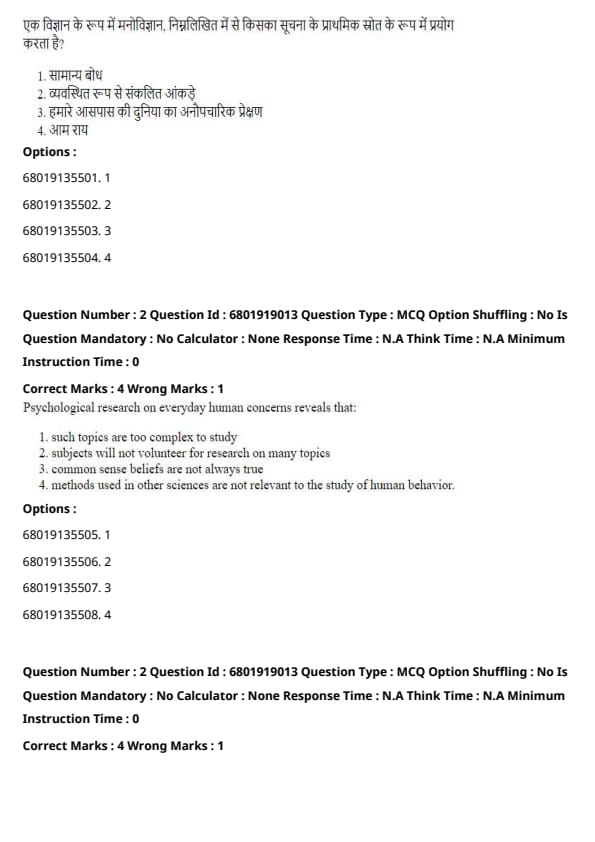
Question 1:
As a science, which of the following does psychology use as its primary source of information?
View Solution
Psychology, as a science, relies on empirical research methods that involve systematic data collection, rather than common sense or casual observations. This ensures that conclusions about behavior and mental processes are based on evidence and not on subjective opinions or anecdotal reports.
Scientific rigor in psychology requires carefully controlled studies, statistical analyses, and peer review to validate findings.
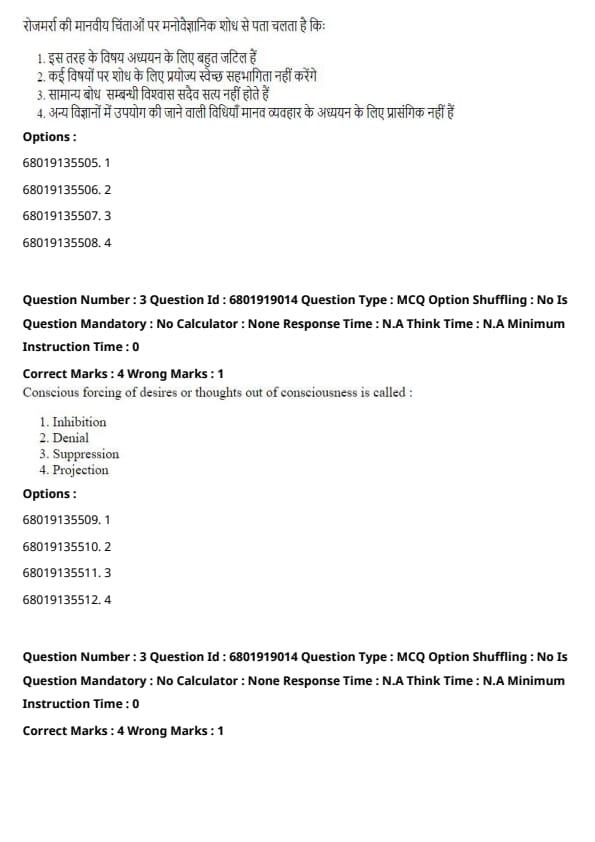
Question 2:
Psychological research on everyday human concerns reveals that:
View Solution
Many of our everyday assumptions about human behavior are based on “common sense,” yet systematic psychological research often shows these assumptions can be false or overly simplistic.
Always question “common sense” in psychology. Rigorous research methods frequently reveal unexpected aspects of behavior.
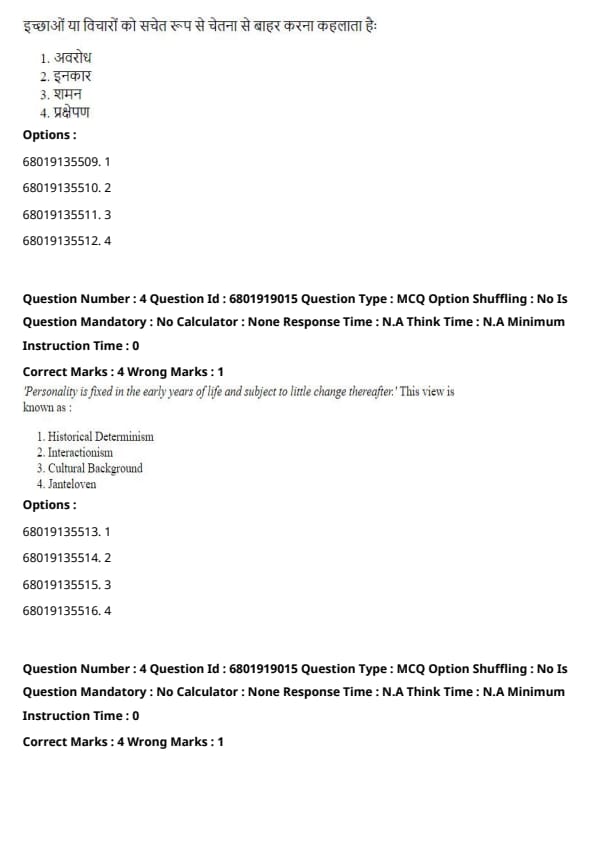
Question 3:
Conscious forcing of desires or thoughts out of consciousness is called:
View Solution
Suppression is a conscious defense mechanism in which a person deliberately tries to push unwanted thoughts, desires, or memories out of their awareness. It differs from repression, which is unconscious.
“Denial” is refusal to accept reality; “inhibition” curbs impulses; “projection” attributes one’s own impulses to others.
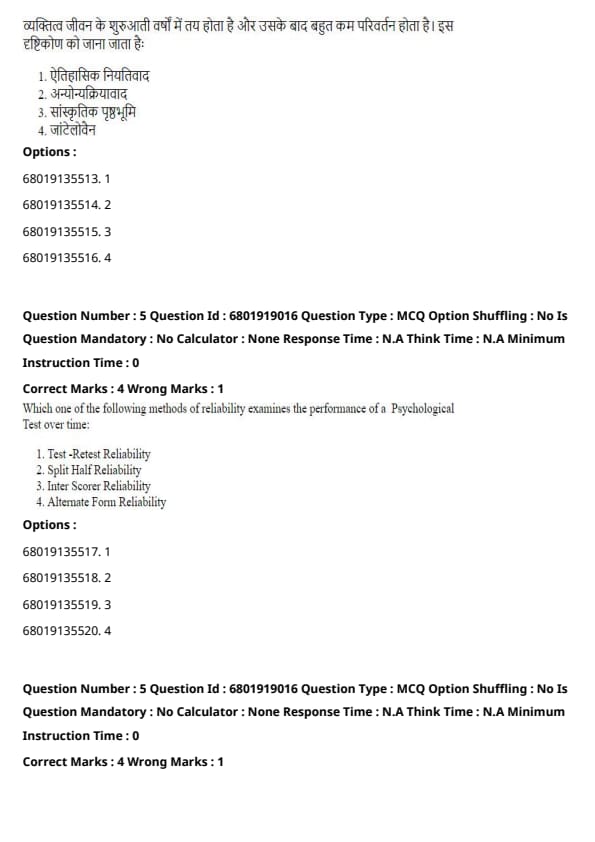
Question 4:
"Personality is fixed in the early years of life and subject to little change thereafter." This view is known as:
View Solution
Historical determinism (particularly in psychoanalytic traditions) holds that early childhood events and influences shape personality in such a way that it is largely set by adulthood, with little room for later change.
In contrast, Interactionism posits that personality results from continuous interaction between the individual and environment throughout life.
Question 5:
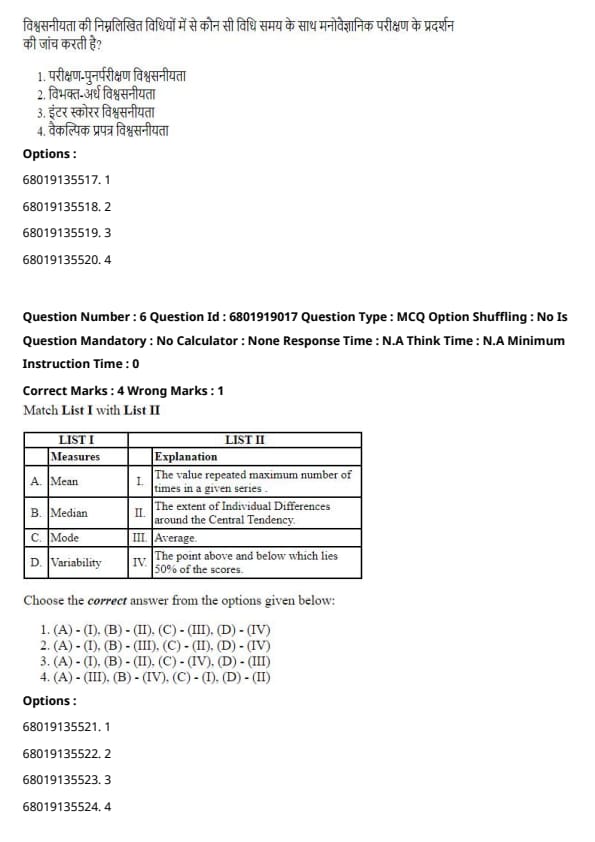
Which one of the following methods of reliability examines the performance of a psychological test over time?
View Solution
Test-Retest Reliability is determined by administering the same test to the same group of individuals on two different occasions and then correlating the two sets of scores to gauge consistency over time.
High test-retest reliability indicates that test scores are stable and reproducible over time.
Question 6:
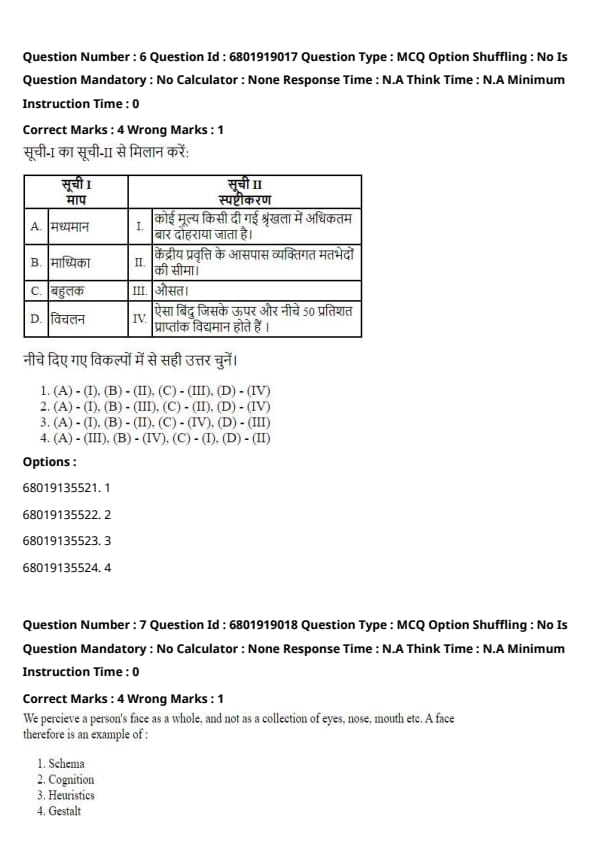
Match List I with List II:
- A. Mean
B. Median
C. Mode
D. Variability
- I. The value repeated maximum number of times in a given series
II. The extent of individual differences around the central tendency
III. Average
IV. The point above and below which lies 50% of the scores
View Solution
Mean → Average (III),
Median → The point above/below which lies 50% of the scores (IV),
Mode → Value repeated the maximum number of times (I),
Variability → Extent of individual differences around the central tendency (II).
Measures of central tendency (mean, median, mode) describe distribution centers, while measures of variability (range, variance, standard deviation) describe spread.
Question 7:
We perceive a person's face as a whole, and not as a collection of eyes, nose, mouth, etc. A face therefore is an example of:
View Solution
“Gestalt” (German for “form” or “shape”) refers to the school of psychology emphasizing that the whole is more than the sum of its parts. We naturally organize stimuli into coherent wholes (e.g., perceiving a face, rather than discrete features).
Gestalt principles help explain perception phenomena like figure-ground, proximity, closure, and similarity.
Question 8:
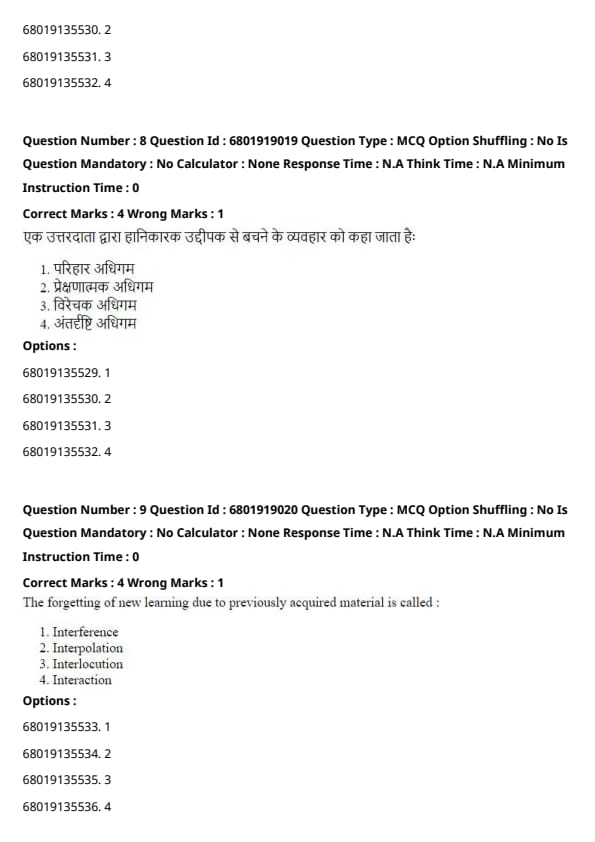
The behavior of avoiding a noxious stimulus by a responder is called:
View Solution
Avoidance learning occurs when a subject (human or animal) modifies its behavior to prevent or postpone exposure to an unpleasant or harmful stimulus.
In observational learning, behaviors are learned by watching others. Cathartic learning is not a standard psychological term; insight learning involves a sudden “aha” moment.
Question 9:
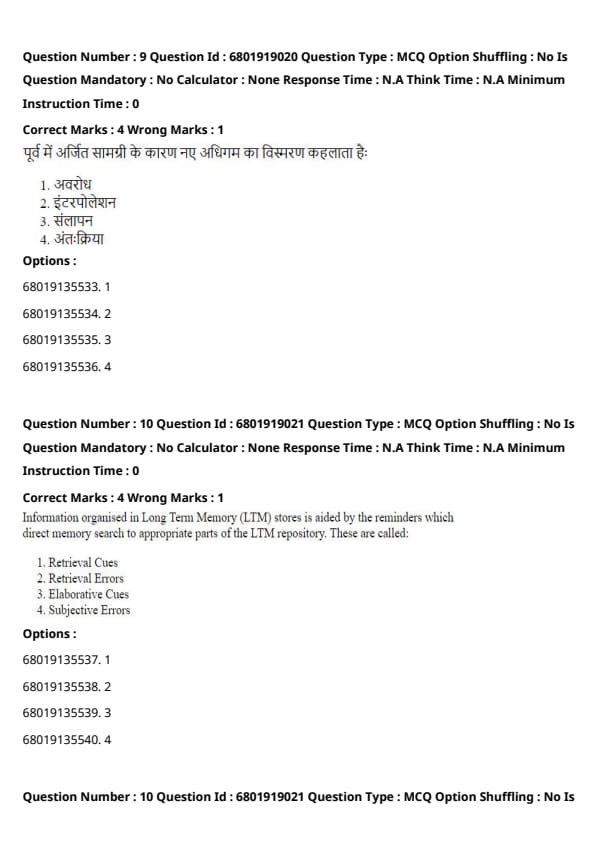
The forgetting of new learning due to previously acquired material is called:
View Solution
Proactive interference occurs when old information interferes with the recall of new information. Thus, previously acquired material can hamper the ability to remember new learning.
Retroactive interference is the opposite process—new learning interferes with old memories.
Question 10:
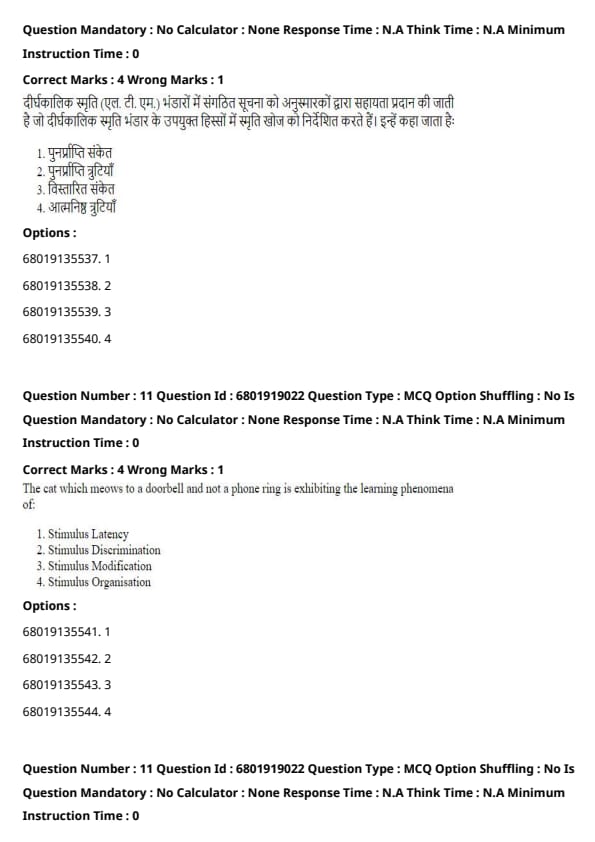
Information organized in Long-Term Memory (LTM) stores is aided by the reminders which direct memory search to appropriate parts of the LTM repository. These are called:
View Solution
Retrieval cues are stimuli or hints that help access memories stored in LTM. They “point” the mind to the correct location of stored information, facilitating recall.
Effective cues often involve the same context or emotional state as when the memory was encoded.
Question 11:
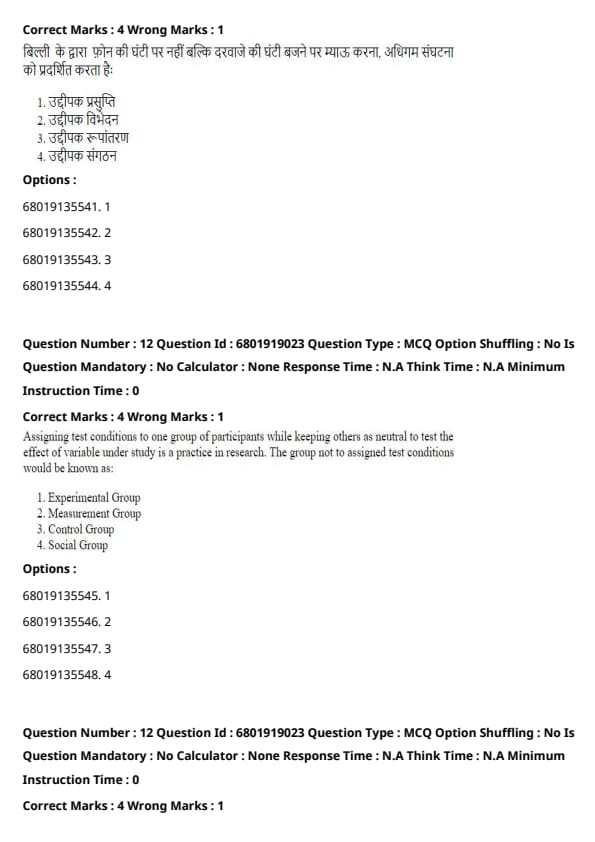
The cat which meows to a doorbell and not a phone ring is exhibiting the learning phenomenon of:
View Solution
Stimulus discrimination occurs when an organism learns to respond to one specific stimulus (e.g., a doorbell) but not to other similar stimuli (e.g., a phone ring), indicating it can differentiate between them.
In contrast, stimulus generalization would be if the cat meowed to both doorbell and phone ring, failing to distinguish between them.
Question 12:
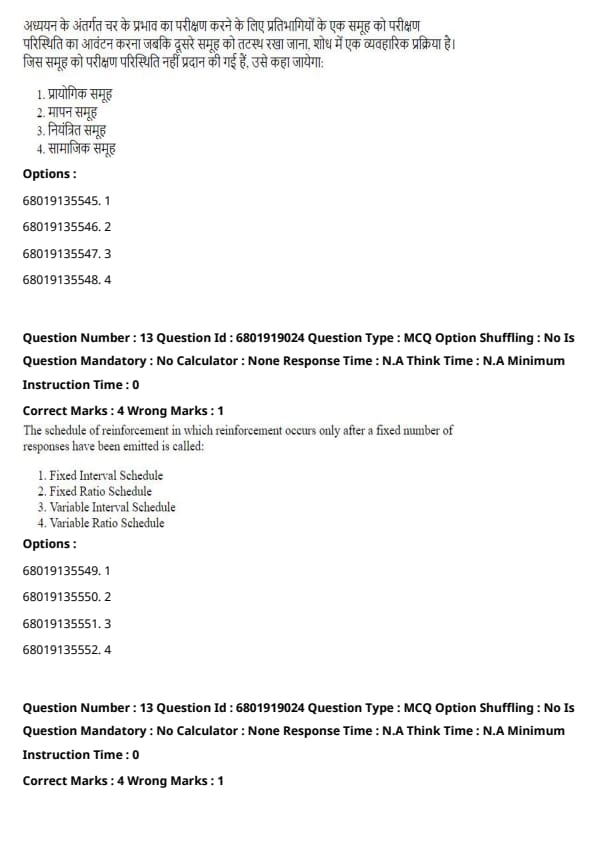
Assigning test conditions to one group of participants while keeping others neutral to test the effect of a variable under study is a practice in research. The group not assigned test conditions is known as:
View Solution
In an experimental design, the control group does not receive the experimental treatment and is used as a baseline to compare with the experimental group, which receives the treatment or intervention.
A well-designed experiment often uses random assignment to ensure the control and experimental groups are comparable.
Question 13:
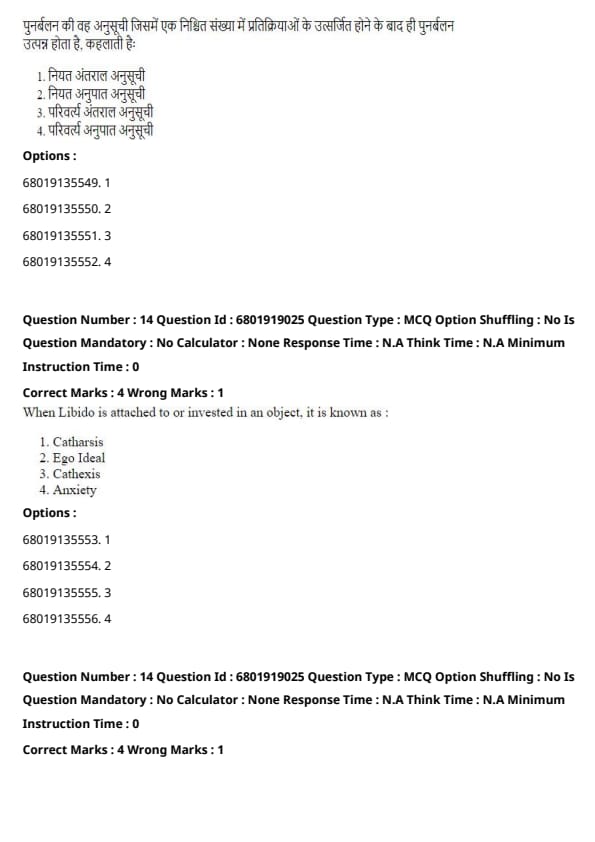
The schedule of reinforcement in which reinforcement occurs only after a fixed number of responses have been emitted is called:
View Solution
In a Fixed Ratio (FR) schedule, a subject receives reinforcement after every predetermined number of responses. For instance, an FR-10 schedule means the subject is rewarded after every 10th response.
“Fixed Interval” (FI) schedules are based on time, not the number of responses.
Question 14:
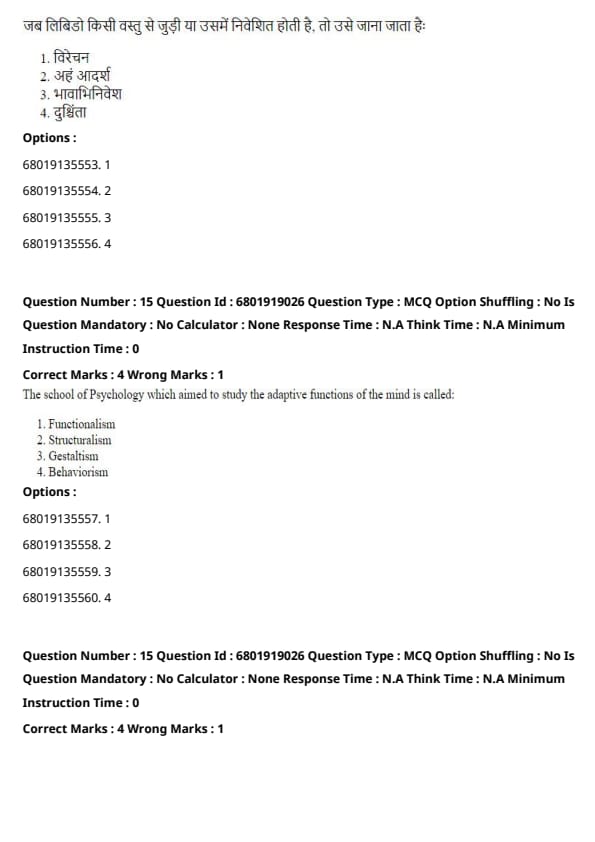
When Libido is attached to or invested in an object, it is known as:
View Solution
In psychoanalytic theory, cathexis refers to the process of investing emotional or libidinal energy in an idea, person, or object. This concept is central to Freud’s view of the psyche.
“Catharsis” is the release of emotional tension; “Ego ideal” and “anxiety” relate to different psychoanalytic processes.
Question 15:
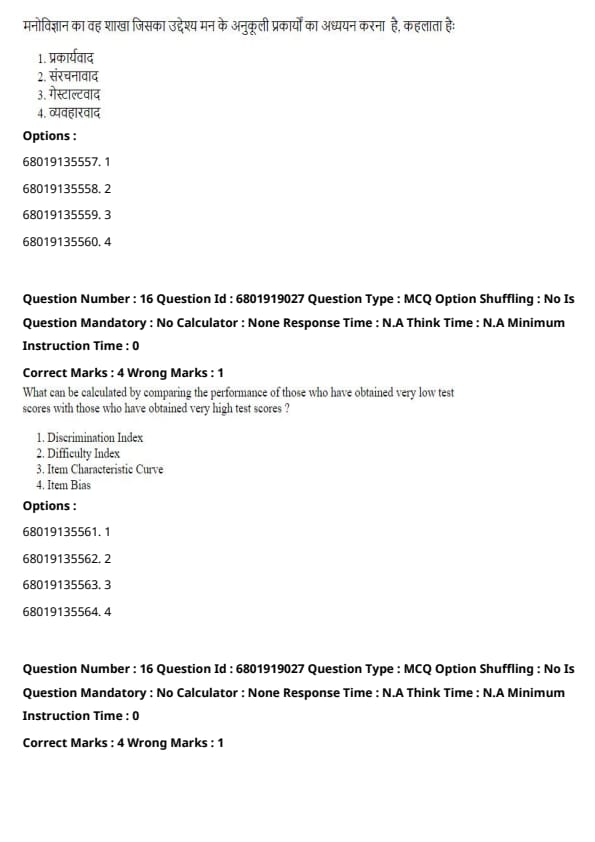
The school of Psychology which aimed to study the adaptive functions of the mind is called:
View Solution
Functionalism (associated with William James and others) focused on how mental processes help organisms adapt to their environment. Structuralism, in contrast, aimed to break down mental processes into basic elements.
The key question in functionalism is “What is the function or purpose of a given psychological process?”
Question 16:
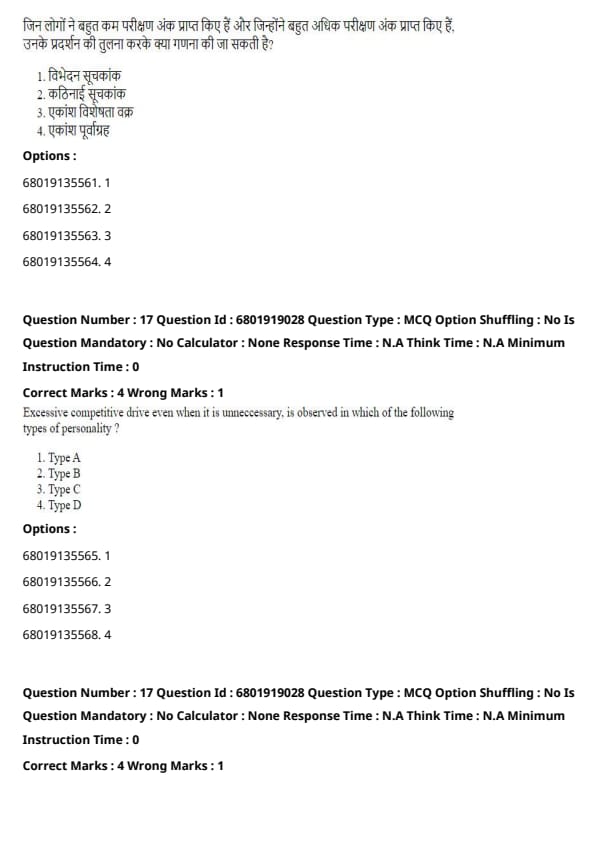
What can be calculated by comparing the performance of those who have obtained very low test scores with those who have obtained very high test scores?
View Solution
The Discrimination Index of a test item indicates how well the item differentiates between high-performing (upper group) and low-performing (lower group) test takers. It is typically calculated based on the proportion of correct responses in these two groups.
A positive discrimination index means high scorers are more likely to get the item right than low scorers, indicating a good item.
Question 17:
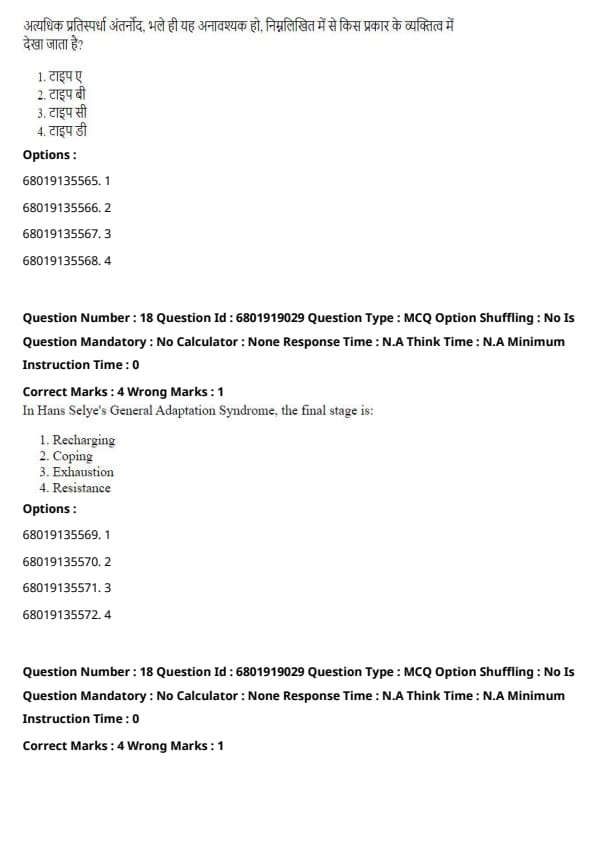
Excessive competitive drive even when it is unnecessary, is observed in which of the following types of personality?
View Solution
Type A personality is characterized by high levels of competitiveness, time urgency, and aggressiveness. They are often described as workaholics who push themselves unnecessarily.
Type B personalities are more relaxed, Type C are associated with cancer-prone traits (coping style), and Type D (“distressed”) is linked with negative affectivity and social inhibition.
Question 18:
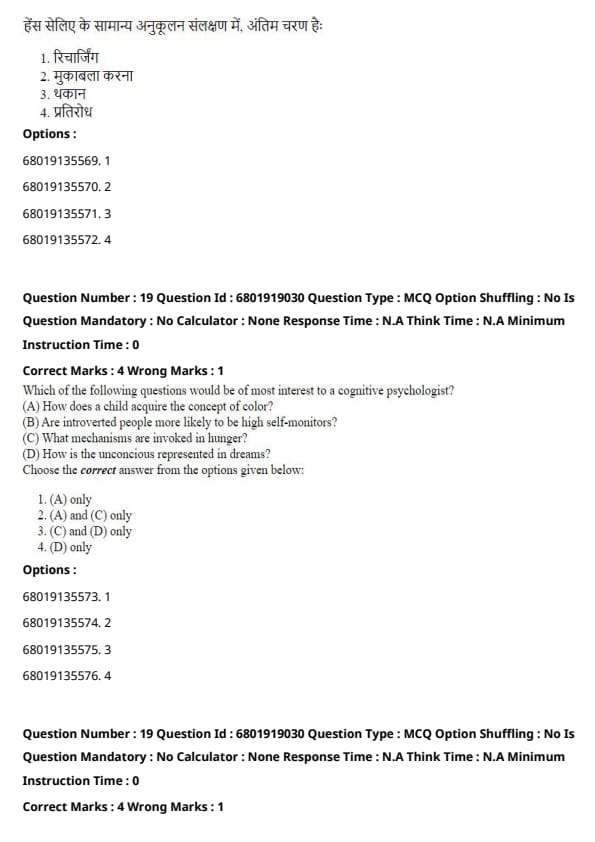
In Hans Selye's General Adaptation Syndrome, the final stage is:
View Solution
Hans Selye’s General Adaptation Syndrome (GAS) has three stages: Alarm, Resistance, and Exhaustion. If stress continues for too long, the body can no longer sustain the resistance stage and enters exhaustion.
Prolonged stress leading to the exhaustion stage can result in increased vulnerability to illness.
Question 19:
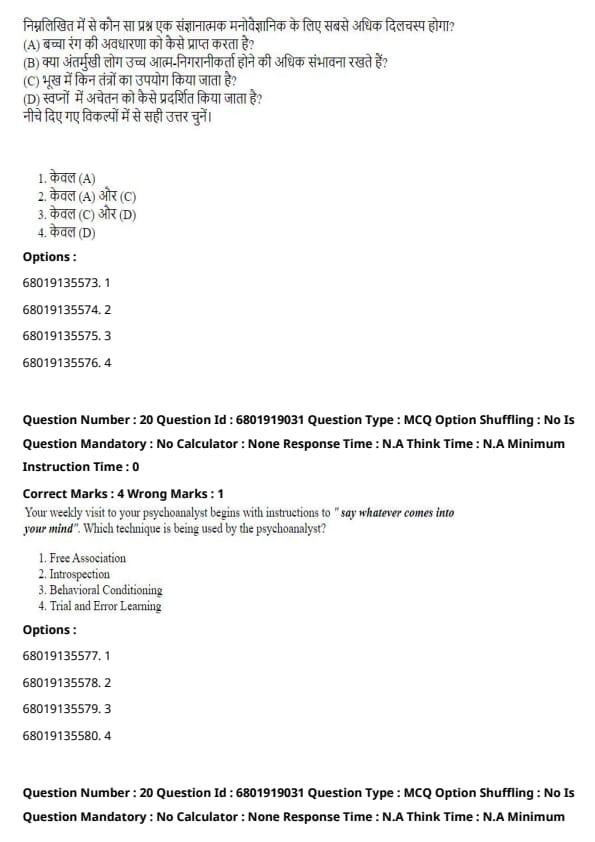
Which of the following questions would be of most interest to a cognitive psychologist?
View Solution
Cognitive psychologists study internal mental processes such as perception, memory, problem-solving, and language. Studying how a child acquires the concept of color directly relates to cognitive development and mental processes.
(B) relates more to personality/social psychology, (C) is a question in physiological/biological psychology, and (D) has roots in psychoanalytic theory.
Question 20:
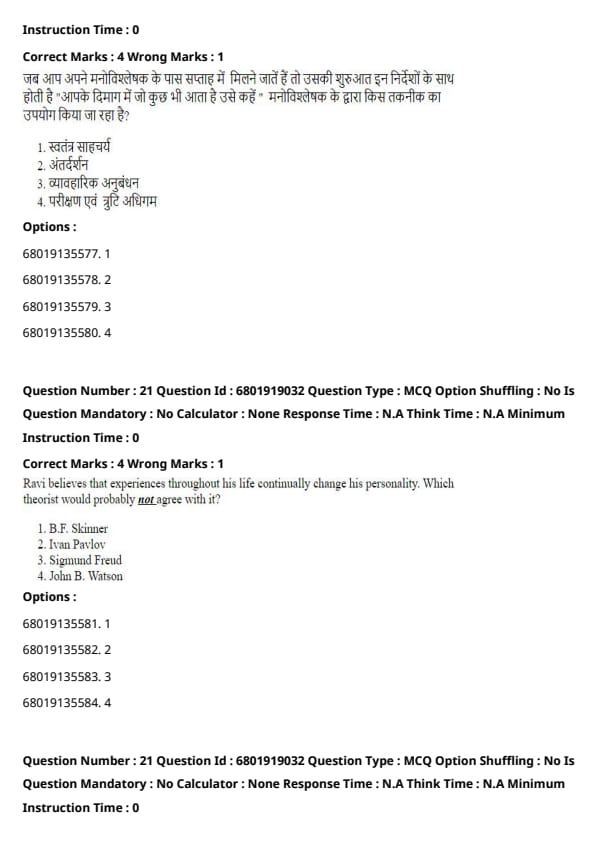
Your weekly visit to your psychoanalyst begins with instructions to "say whatever comes into your mind." Which technique is being used by the psychoanalyst?
View Solution
Free Association is a psychoanalytic technique where the patient is encouraged to verbalize all thoughts without censorship. This method is used to uncover repressed memories and feelings.
Introspection focuses on self-observation of conscious thoughts; behavioral conditioning and trial-and-error learning relate to learning theories rather than psychoanalysis.
Question 21:
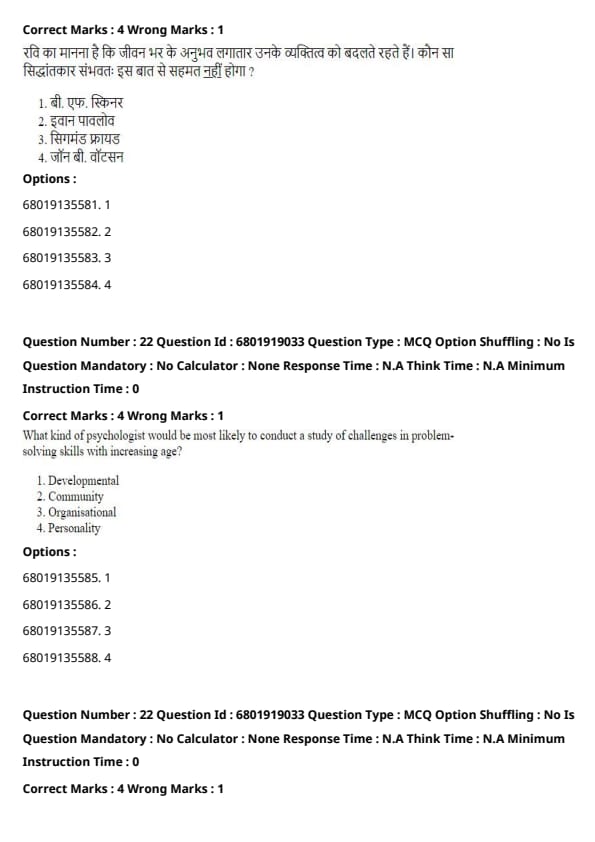
Ravi believes that experiences throughout his life continually change his personality. Which theorist would probably not agree with this?
View Solution
Freud’s approach (psychoanalytic theory) emphasizes early childhood experiences as the primary determinants of personality development. According to historical determinism, Freud viewed personality as largely fixed by the end of early childhood. In contrast, behaviorists like B.F. Skinner and John B. Watson, and even Pavlov’s conditioning principles, emphasize ongoing learning and changes due to experience.
Freud’s theory focuses on psychosexual stages and the formative influence of early development, leaving limited room for major personality changes later in life.
Question 22:
What kind of psychologist would be most likely to conduct a study of challenges in problem-solving skills with increasing age?
View Solution
Developmental psychologists study how and why individuals change or remain the same over the course of their life, including cognitive functions like problem-solving, language, and social interaction.
“Community psychology” focuses on social issues and well-being in community settings; “Organisational psychology” deals with workplace behavior; “Personality psychology” focuses on individual personality traits.
Question 23:
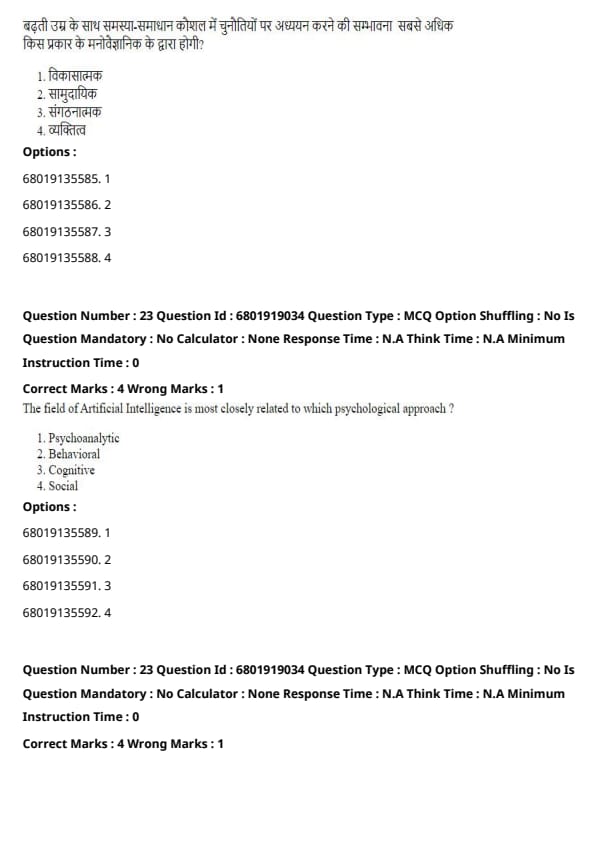
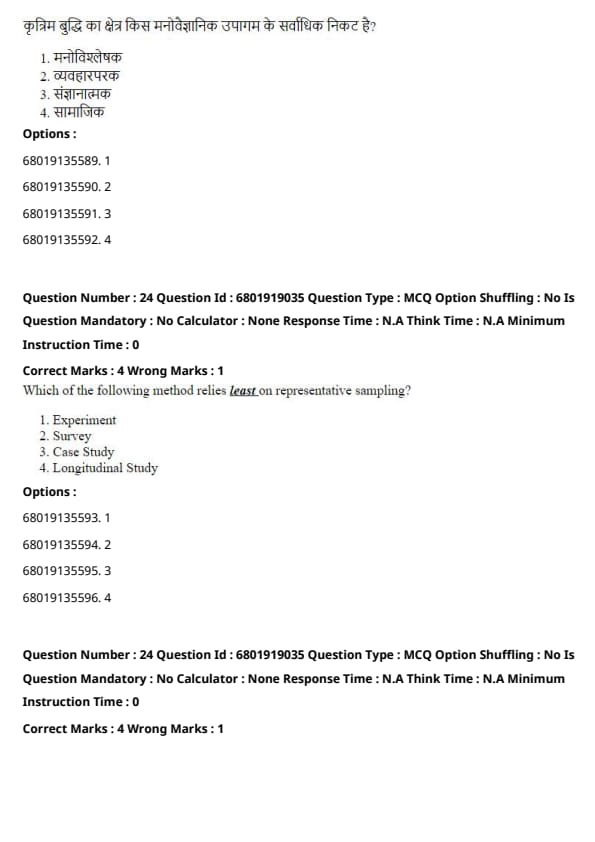
The field of Artificial Intelligence is most closely related to which psychological approach?
View Solution
Artificial Intelligence (AI) studies how to model or simulate intelligent behavior, closely aligning with cognitive psychology’s focus on mental processes such as thinking, problem-solving, and perception.
AI often uses concepts like information processing and computational models, which parallel cognitive psychology’s emphasis on how the mind processes information.
Question 24:
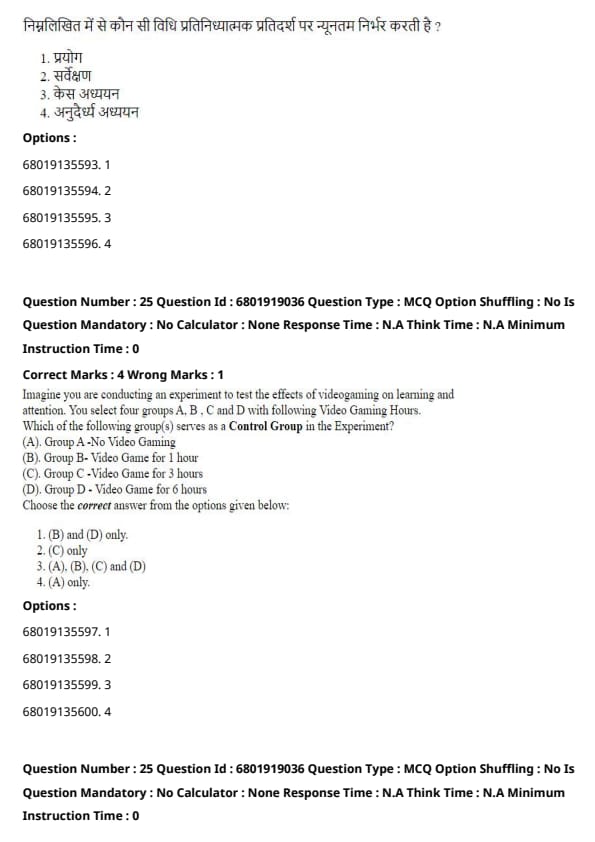
Which of the following method relies least on representative sampling?
View Solution
Case studies involve an in-depth, detailed examination of a single individual or a very small group. They do not generally require large or representative samples, as they focus on one instance or a few instances intensively.
Surveys typically require representative samples to generalize results. Experiments and longitudinal studies also often strive for representativeness, though their sampling strategies may vary.
Question 25:
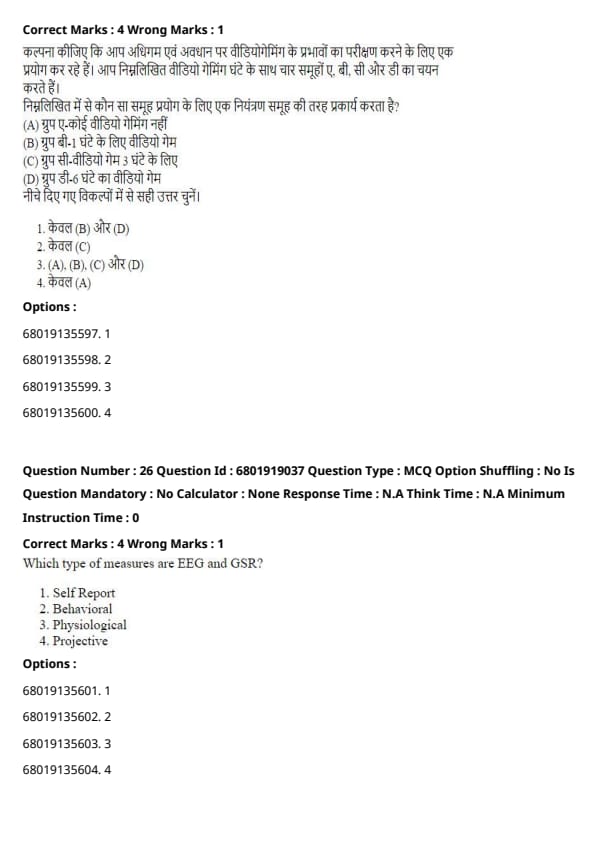
Imagine you are conducting an experiment to test the effects of video gaming on learning and attention. You select four groups: A, B, C, and D with the following Video Gaming Hours. Which of the following group(s) serve(s) as a Control Group in the experiment?
(A) Group A: No Video Gaming
(B) Group B: Video Game for 1 hour
(C) Group C: Video Game for 3 hours
(D) Group D: Video Game for 6 hours
View Solution
A control group is the one that does not receive the independent variable manipulation. Here, Group A has no video gaming, which makes it the standard comparison group.
Groups B, C, and D are experimental groups because each receives a certain amount of gaming.
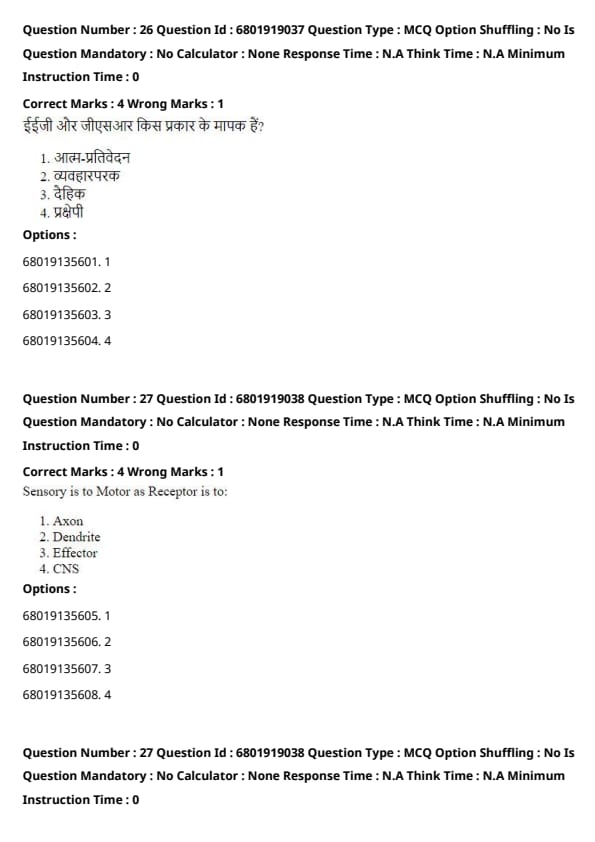
Question 26:
Which type of measures are EEG and GSR?
View Solution
EEG (Electroencephalogram) measures electrical activity of the brain, and GSR (Galvanic Skin Response) measures changes in skin conductance. Both are direct physiological recordings of bodily processes, not dependent on self-report or direct behavioral observation.
Self-report relies on participants’ subjective accounts. Behavioral measures observe actions. Projective measures (e.g., Rorschach) interpret responses to ambiguous stimuli.
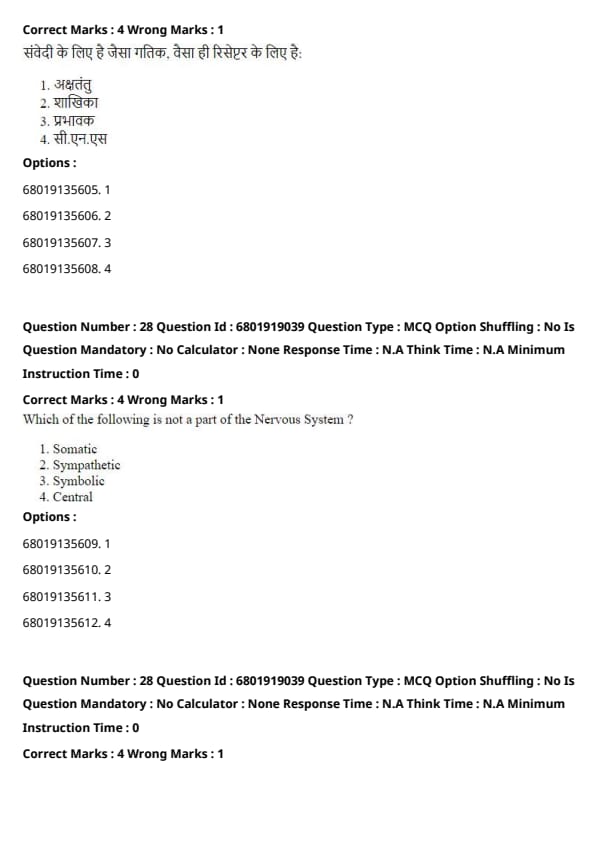
Question 27:
Sensory is to Motor as Receptor is to:
View Solution
“Receptors” receive sensory stimuli; “effectors” carry out motor responses (e.g., muscles, glands). Hence, the analogy is: Sensory : Motor :: Receptor : Effector.
The relationship is that receptors detect incoming information, while effectors enable an organism to act or respond.
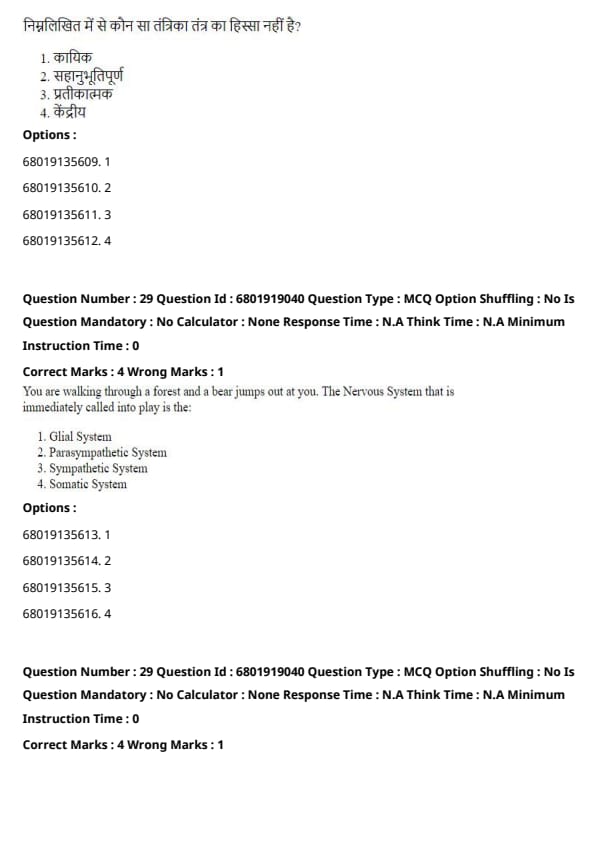
Question 28:
Which of the following is not a part of the Nervous System?
View Solution
The somatic nervous system (voluntary control of body movements), sympathetic nervous system (part of autonomic, fight-or-flight response), and central nervous system (brain and spinal cord) are established subdivisions of the nervous system. The term “symbolic” is not a recognized subdivision of the nervous system.
The nervous system is broadly divided into the Central (CNS) and Peripheral (PNS). PNS has the Somatic and Autonomic branches (the latter includes sympathetic and parasympathetic).
Question 29:
You are walking through a forest and a bear jumps out at you. The Nervous System that is immediately called into play is the:
View Solution
The sympathetic branch of the autonomic nervous system initiates the “fight-or-flight” response: increasing heart rate, dilating pupils, and redirecting blood flow to muscles.
The parasympathetic system counters these effects (“rest-and-digest”), while the somatic system controls voluntary movements, and glial cells support neurons.
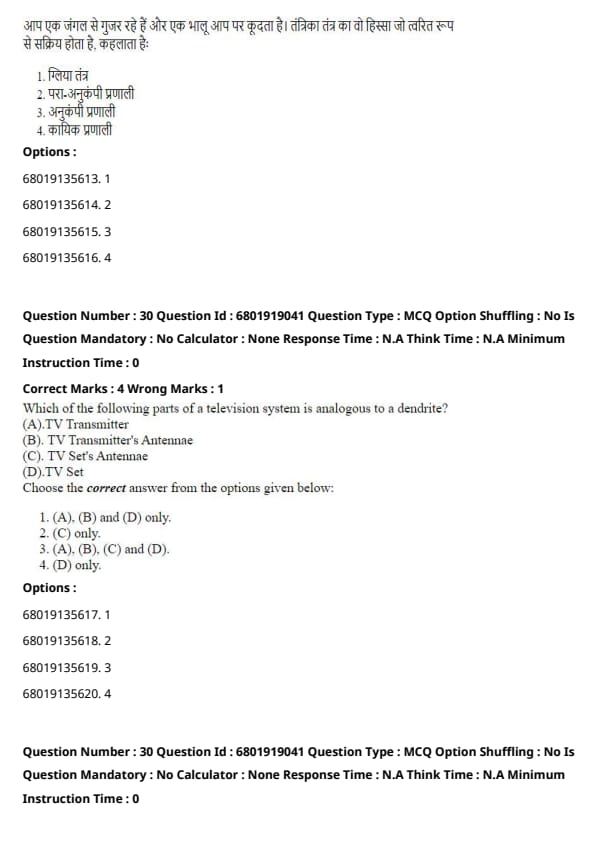
Question 30:
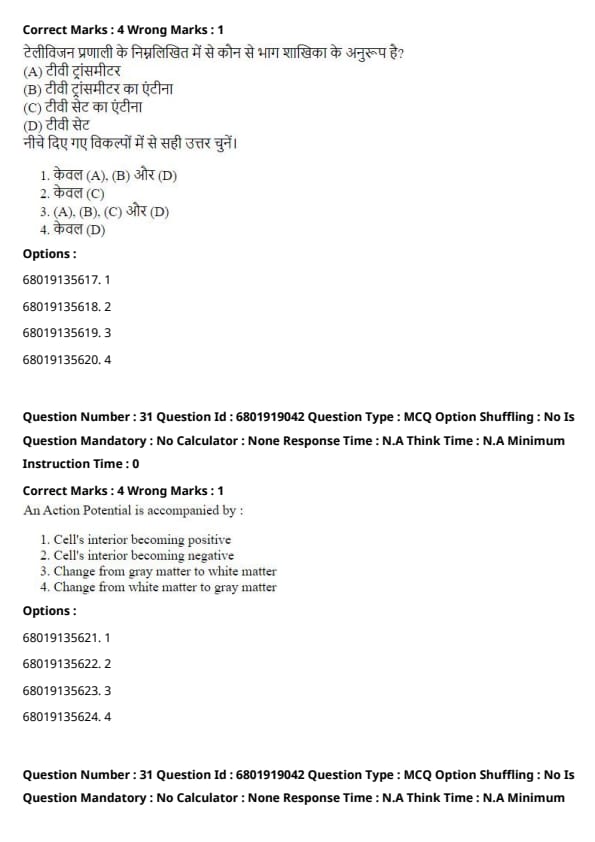
Which of the following parts of a television system is analogous to a dendrite?
View Solution
Dendrites are the “receiving” parts of the neuron. In the TV analogy, the TV Set’s Antennae corresponds to the receptor that receives signals (electromagnetic waves). The transmitter and transmitter’s antenna send signals (more like axons), while the TV set itself processes signals (akin to the cell body).
Dendrite = receiver, Axon = sender. Hence, the “receiver antenna” is analogous to the dendrite.
Question 31:
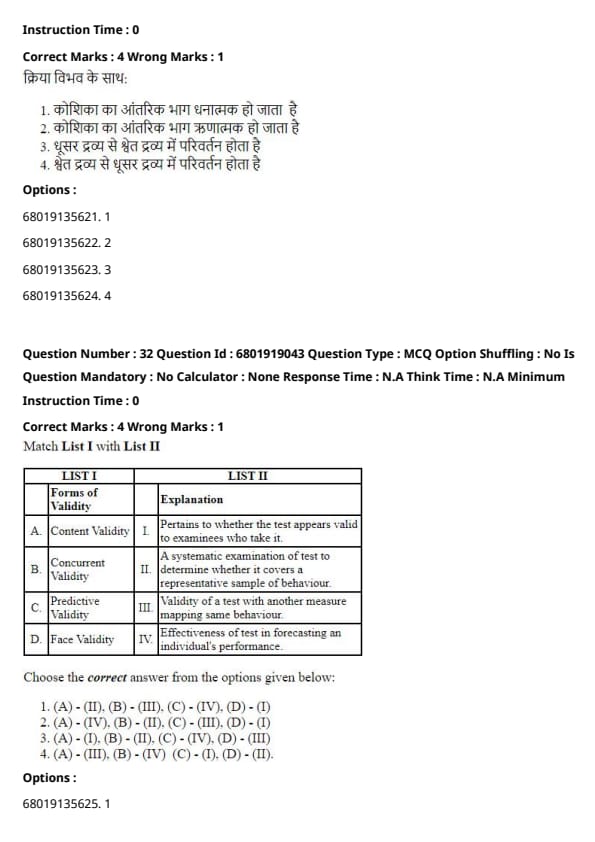
An Action Potential is accompanied by:
View Solution
During an action potential (the “firing” of a neuron), there is a rapid influx of sodium ions (Na+) causing the inside of the cell membrane to become temporarily positive relative to the outside. This is called depolarization.
After the peak of the action potential, potassium ions (K+) flow out, repolarizing the neuron back to a negative interior. But the hallmark moment is when the interior becomes positive.
Question 32:
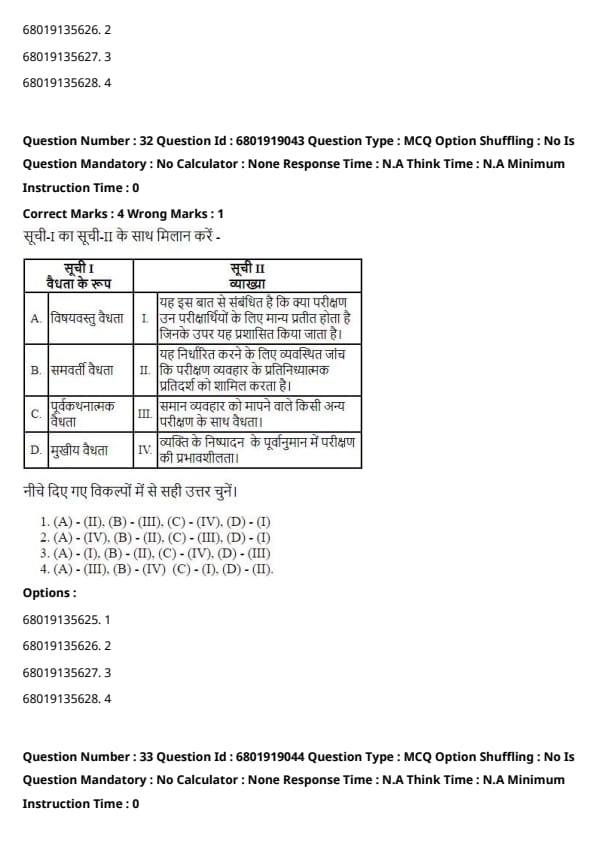
Match List I with List II:
| List II (Explanation) | List I (Forms of Validity) |
|---|---|
| I. Pertains to whether the test appears valid to examinees who take it. | D. Face Validity |
| II. A systematic examination of the test to determine whether it covers a representative sample of behaviour. | A. Content Validity |
| III. Validity of a test with another measure mapping the same behaviour. | B. Concurrent Validity |
| IV. Effectiveness of a test in forecasting an individual’s performance. | C. Predictive Validity |
View Solution
- A. Content Validity → (II) Representative coverage of behaviour domain
B. Concurrent Validity → (III) Correlation with another measure of the same behaviour
C. Predictive Validity → (IV) Forecasting future performance
D. Face Validity → (I) Appears valid to the test-takers
Face validity is the least scientific form of validity, focusing on whether a test “looks” valid to those taking it.
Question 33:
Which of the following structures is not part of the central core of the human brain?
View Solution
The central core of the brain includes the medulla, pons, midbrain, reticular formation, and parts of the forebrain like the thalamus and hypothalamus. The temporal lobe is part of the cerebral cortex, which is outside the central core.
The lobes of the cortex (frontal, parietal, temporal, and occipital) are considered higher-level processing areas, not “central core” structures.
Question 34:
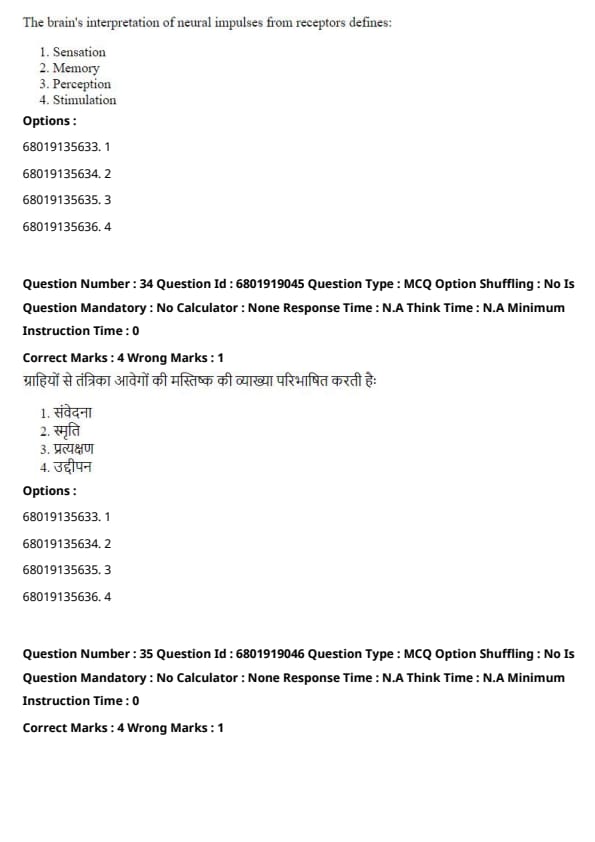
The brain’s interpretation of neural impulses from receptors defines:
View Solution
Sensation refers to the initial detection of stimuli by the sensory organs. Perception is the further organization, interpretation, and integration of these sensory signals into meaningful experiences.
So, we “sense” visual data with our eyes, and “perceive” shapes, faces, and motion in our brain.
Question 35:
The minimum amount of light energy that must be present for vision is called:
View Solution
An absolute threshold is the smallest intensity of a stimulus that a person can detect 50% of the time under ideal conditions. In the context of light energy, it is the minimal detectable level of illumination for vision.
“Lumens” is a measure of total visible light output, while “critical ratio” is not a standard sensory psychology term.
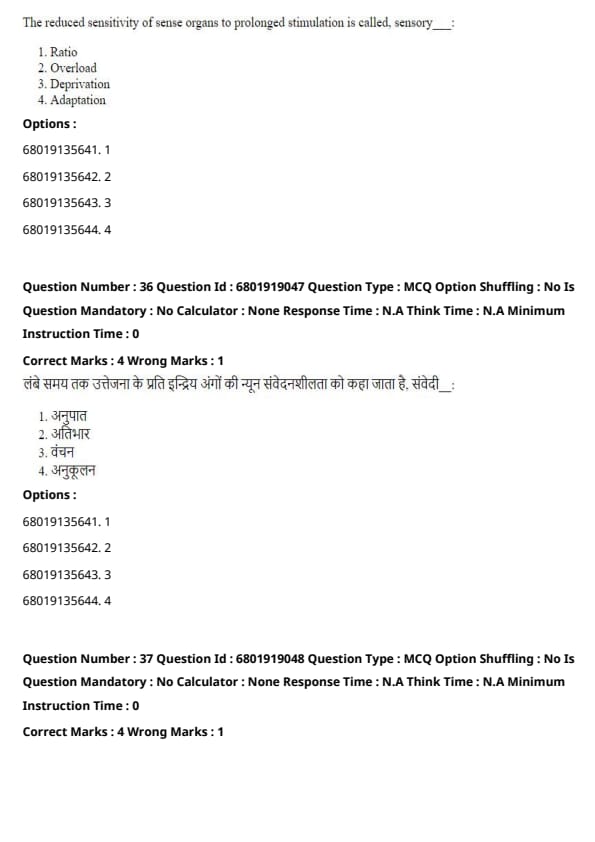
Question 36:
The reduced sensitivity of sense organs to prolonged stimulation is called sensory:
View Solution
Sensory adaptation refers to the decline in sensitivity to a constant stimulus. For instance, when you first jump into a cold pool, the water feels very cold; soon you “get used to it” (adaptation).
Sensory overload is too much stimulus, while deprivation is too little. Adaptation is the diminished response to unchanging stimulation.
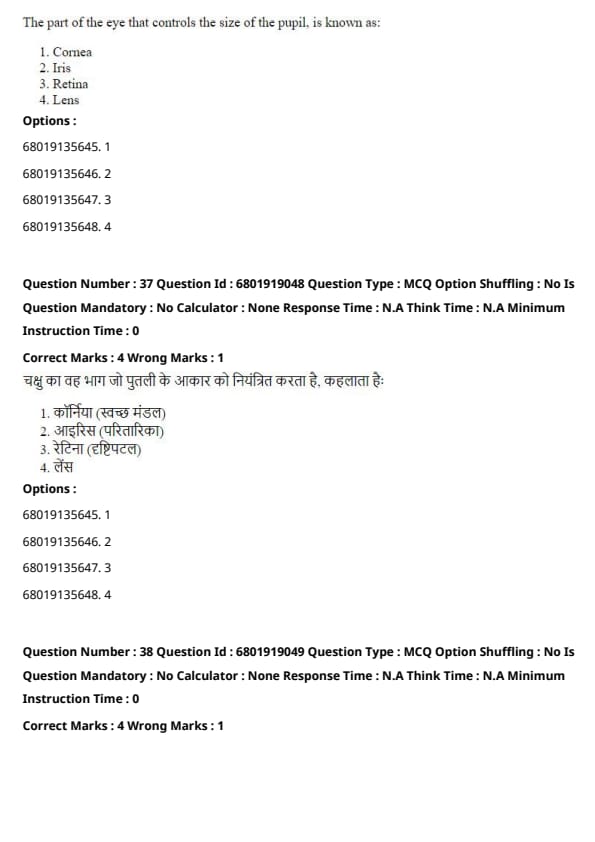
Question 37:
The part of the eye that controls the size of the pupil is known as:
View Solution
The iris is the colored part of the eye that expands or contracts to change pupil size, regulating the amount of light entering the eye.
Cornea is the clear covering, the lens focuses light, and the retina contains photoreceptors (rods and cones).
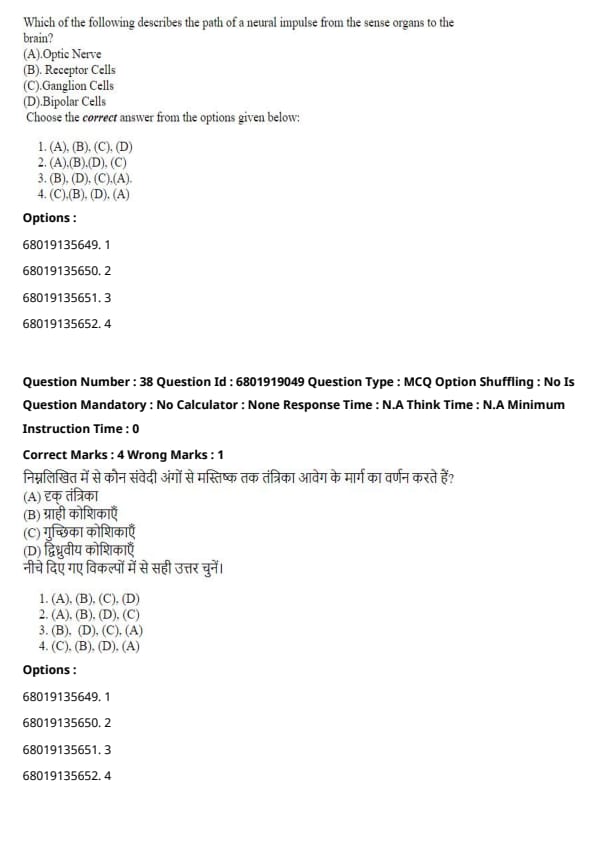
Question 38:
Which of the following describes the path of a neural impulse from the sense organs to the brain?
(A) Optic Nerve
(B) Receptor Cells
(C) Ganglion Cells
(D) Bipolar Cells
Choose the correct answer from the options given below:
View Solution
In the visual system (for example, in the retina):
- Receptor Cells (rods and cones) receive the light stimulus.
Bipolar Cells receive signals from the photoreceptors.
Ganglion Cells receive signals from the bipolar cells.
The axons of the ganglion cells form the Optic Nerve (A) carrying the signal to the brain.
Specifically for sight: Light → rods/cones (receptors) → bipolar cells → ganglion cells → optic nerve → brain (visual cortex).
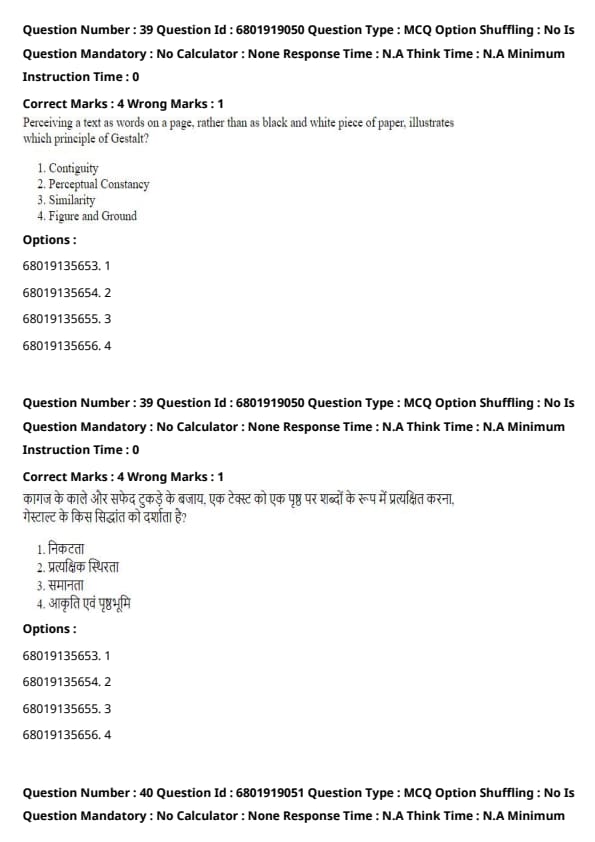
Question 39:
Perceiving a text as words on a page, rather than as black and white pieces of paper, illustrates which principle of Gestalt?
View Solution
The text (figure) stands out against the background (the white page). Gestalt psychology describes how we organize visual elements into figures that stand out from the ground (background).
Perceptual constancy refers to perceiving objects as unchanging despite changes in illumination or viewpoint. Similarity deals with grouping similar items; contiguity is about nearness in time and space.
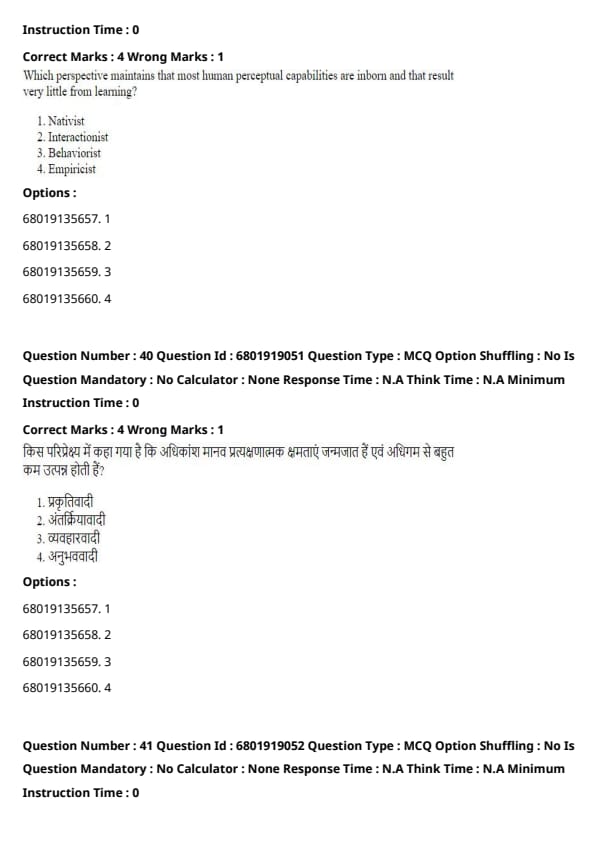
Question 40:
Which perspective maintains that most human perceptual capabilities are inborn and result very little from learning?
View Solution
The nativist perspective claims that certain skills or abilities are “hard-wired” into the brain at birth. In terms of perception, nativists argue that basic perceptual processes are largely innate, with minimal influence from experience.
In contrast, empiricist or behaviorist views emphasize learning from the environment, and interactionist sees a blend of innate and learned factors.
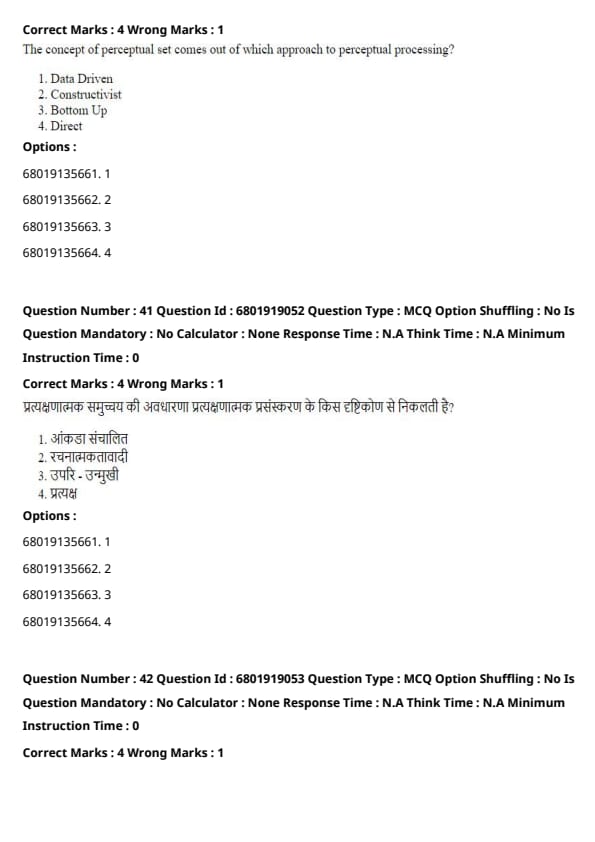
Question 41:
The concept of perceptual set comes out of which approach to perceptual processing?
View Solution
A constructivist (top-down) approach suggests that our perceptions are shaped by prior knowledge, expectations, and experiences. Perceptual set (or expectancy) is precisely about how our mind “constructs” perception based on these factors.
Data-driven (bottom-up) processing emphasizes how sensory input drives perception, whereas the constructivist view stresses the role of cognition and prior knowledge.
Question 42:
Which of the following is not a depth cue that is potentially available for only one eye?
View Solution
Binocular disparity requires both eyes because it involves the slightly different view each eye has of the same object. Motion parallax, linear perspective, and texture gradient are monocular cues (available to one eye alone).
Monocular depth cues are often referred to as “pictorial cues,” which can be conveyed in a two-dimensional image, whereas binocular cues require two eyes with overlapping fields of view.
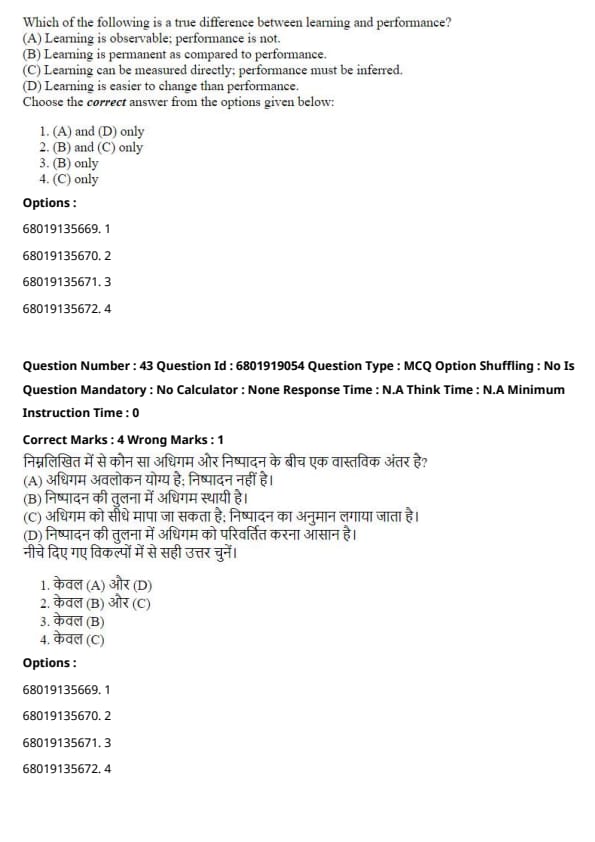
Question 43:
Which of the following is a true difference between learning and performance?
Choose the correct answer from the options given below:
View Solution
A standard definition of learning in psychology is “a relatively permanent change in behavior (or behavior potential) due to experience.” Thus, learning is considered relatively permanent. By contrast, performance is the observable expression of what has been learned. It can vary with motivation, fatigue, or context. Hence, (B) is correct.
(A) is inverted: Performance is observable; learning is inferred.
(C) is also inverted: Performance can be measured directly; learning must be inferred from performance.
(D) is incorrect as stated.
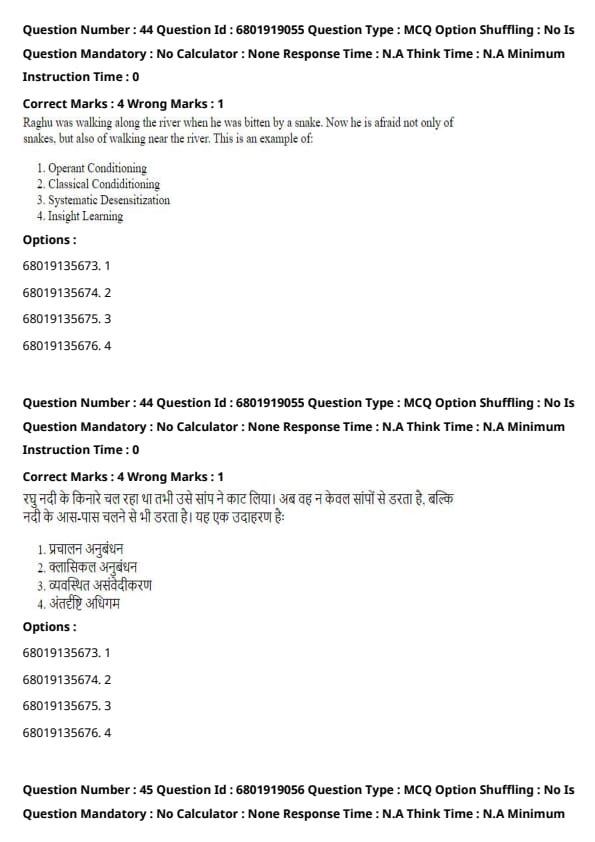
Question 44:
Raghu was walking along the river when he was bitten by a snake. Now he is afraid not only of snakes, but also of walking near the river. This is an example of:
View Solution
Classical conditioning involves learning an association between two stimuli. The painful snake bite (unconditioned stimulus) elicits fear (unconditioned response). The previously neutral context (walking near the river) can become a conditioned stimulus that also elicits fear (conditioned response).
This scenario illustrates how fear can generalize to associated contexts or cues beyond the original feared stimulus (the snake).
Question 45:
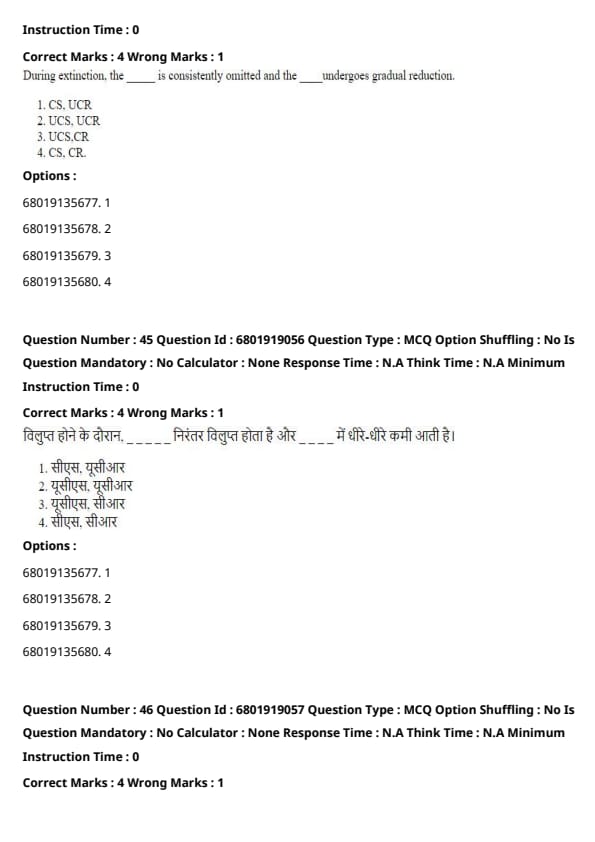
During extinction, the __ is consistently omitted and the __ undergoes gradual reduction.
View Solution
In classical conditioning, extinction occurs when the conditioned stimulus (CS) is repeatedly presented without the unconditioned stimulus (UCS). Over time, the conditioned response (CR) diminishes and may eventually disappear. Thus, the UCS is omitted and the CR undergoes reduction.
For instance, if a dog salivates (CR) to a bell (CS) because the bell was paired with food (UCS), stopping the food (UCS) after the bell eventually leads to extinction of salivation (CR).
Question 46:
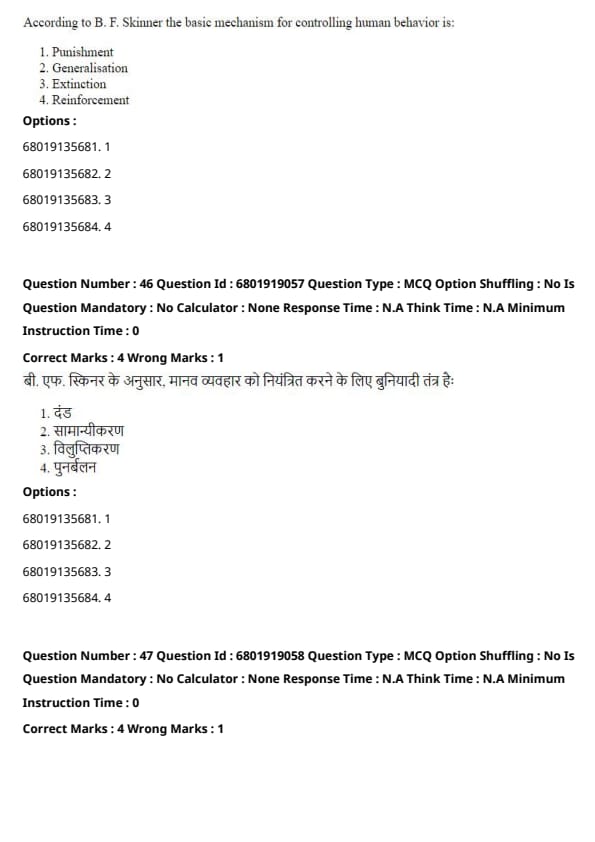
According to B. F. Skinner, the basic mechanism for controlling human behavior is:
View Solution
B. F. Skinner’s operant conditioning framework posits that behavior is shaped and maintained by its consequences. Reinforcement (positive or negative) increases the likelihood of the behavior recurring.
While punishment, extinction, and generalization are related concepts in operant conditioning, Skinner emphasized reinforcement as the primary tool for behavior control and modification.
Question 47:
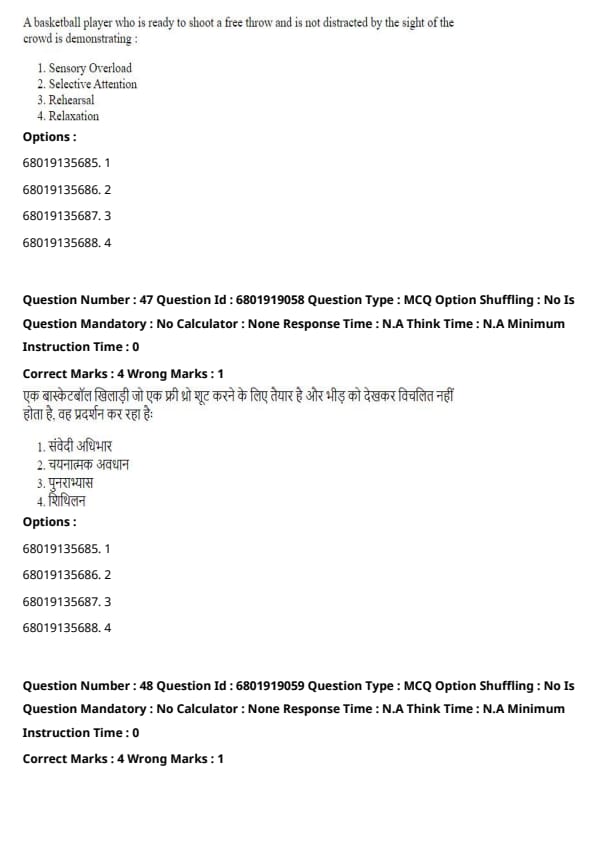
A basketball player who is ready to shoot a free throw and is not distracted by the sight of the crowd is demonstrating:
View Solution
Selective attention involves focusing conscious awareness on a particular stimulus (the basket) and filtering out others (the crowd). The player’s concentration helps ignore distracting visual or auditory input from the audience.
Rehearsal refers to practice (often verbal or mental), whereas relaxation concerns reducing tension. Sensory overload is having more stimulation than one can handle.
Question 48:
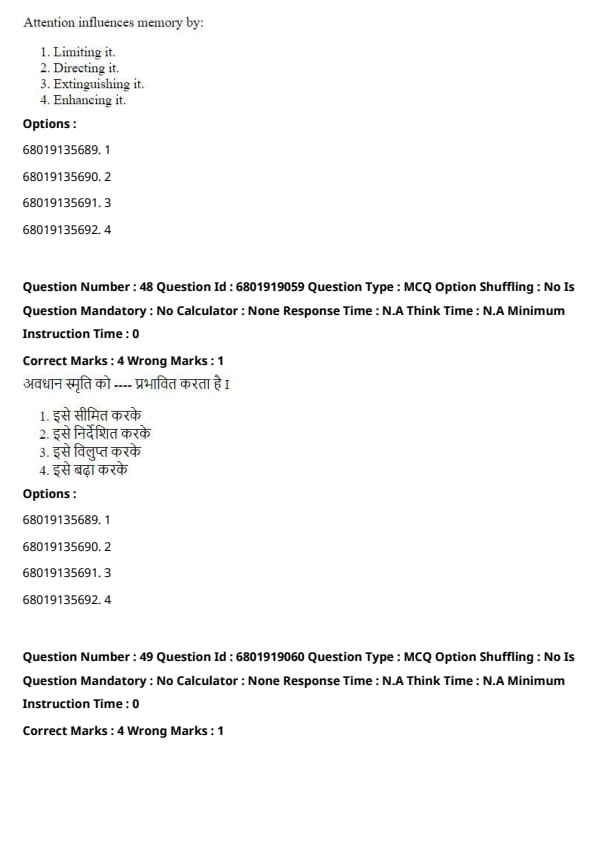
Attention influences memory by:
View Solution
Paying attention is a critical first step in the encoding process. By focusing on specific stimuli, attention enhances the likelihood that information will be effectively encoded and later retrieved.
If you never attend to something, it rarely gets encoded into long-term memory. Quality attention fosters more robust memory traces.
Question 49:
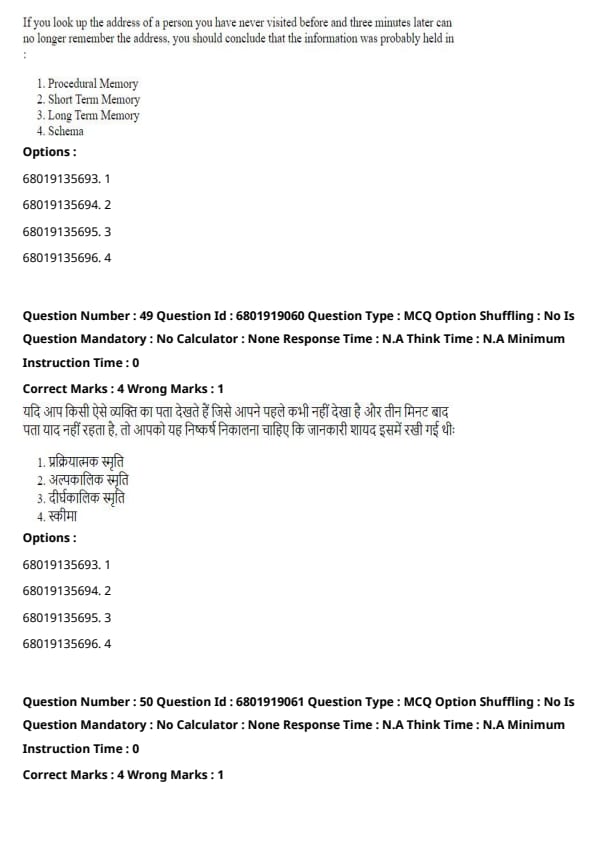
If you look up the address of a person you have never visited before and three minutes later can no longer remember the address, you should conclude that the information was probably held in:
View Solution
Short-Term Memory (STM), also called working memory, typically retains information for up to about 20–30 seconds (maybe a bit longer with rehearsal). If not actively rehearsed, the information is quickly lost.
Procedural memory involves how to do tasks (e.g., riding a bike). Long-term memory can last indefinitely if properly encoded. A schema is a conceptual framework guiding information processing.
Question 50:
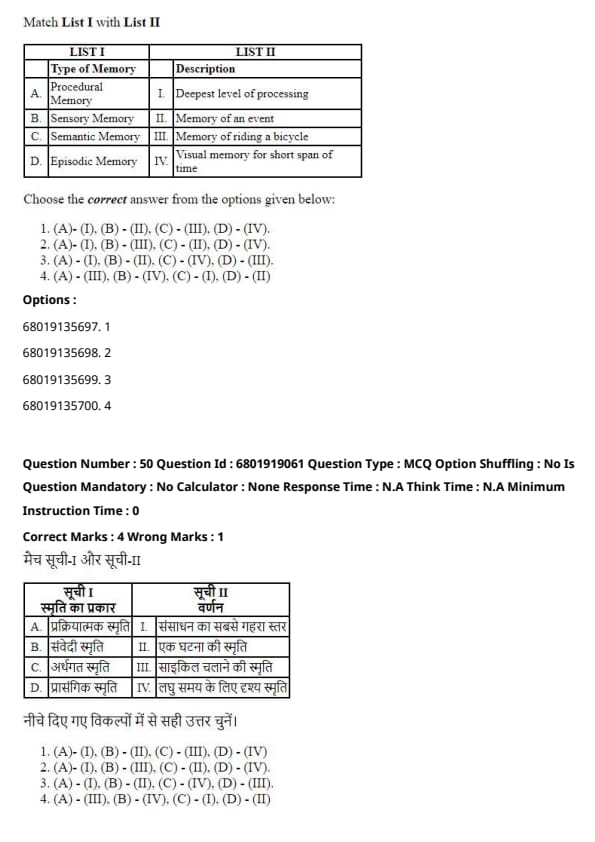
Match List I with List II:
| List I (Type of Memory) | List II (Description) |
|---|---|
| A. Procedural Memory | III. Memory of riding a bicycle |
| B. Sensory Memory | IV. Visual memory for short span of time |
| C. Semantic Memory | I. Deepest level of processing (related to meaning) |
| D. Episodic Memory | II. Memory of an event |
View Solution
Procedural Memory (A) is memory for skills and actions—like riding a bicycle (III).
Sensory Memory (B) includes iconic (visual) memory and echoic (auditory) memory; (IV) matches short-duration visual memory.
Semantic Memory (C) is memory for meaning and general knowledge—often considered the “deepest level of processing” (I).
Episodic Memory (D) is memory of personal events (II).
Semantic = meanings, facts, and knowledge. Episodic = personal experiences. Procedural = skills/actions. Sensory = immediate, brief raw data (visual or auditory).
Question 51:
Parul remembers things from the past very well but cannot incorporate present events into her memory. She is suffering from:
View Solution
Anterograde amnesia refers to an inability to form new memories after the onset of the amnesia. Patients can often recall long-past events but have difficulty encoding new experiences into long-term memory.
Retrograde amnesia refers to the loss of memories before the onset of amnesia, while anterograde amnesia prevents new memories from forming after the onset.
Question 52:
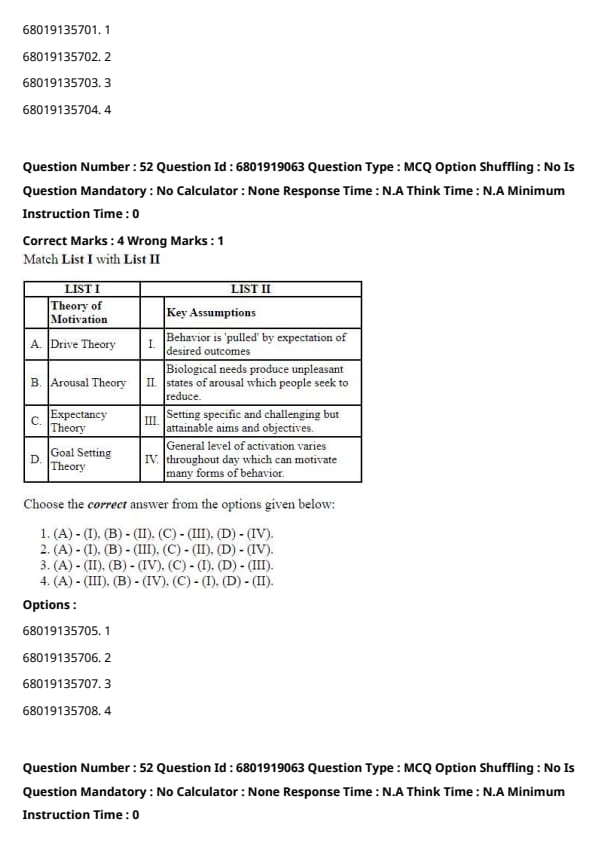
Match List I with List II:
| List II (Key Assumptions) | List I (Theory of Motivation) |
|---|---|
| Behavior is “pulled” by expectation of desired outcomes | Expectancy Theory |
| Biological needs produce unpleasant states of arousal that people seek to reduce | Drive Theory |
| Setting specific and challenging but attainable aims and objectives | Goal Setting Theory |
| General level of activation varies throughout the day, which can motivate many forms of behavior | Arousal Theory |
View Solution
- Drive Theory: Motivated to reduce internal tension from unmet biological needs.
- Arousal Theory: Seeking optimal levels of arousal for performance.
- Expectancy Theory: Anticipating desired outcomes motivates behavior.
- Goal Setting Theory: Specific, challenging goals improve performance.
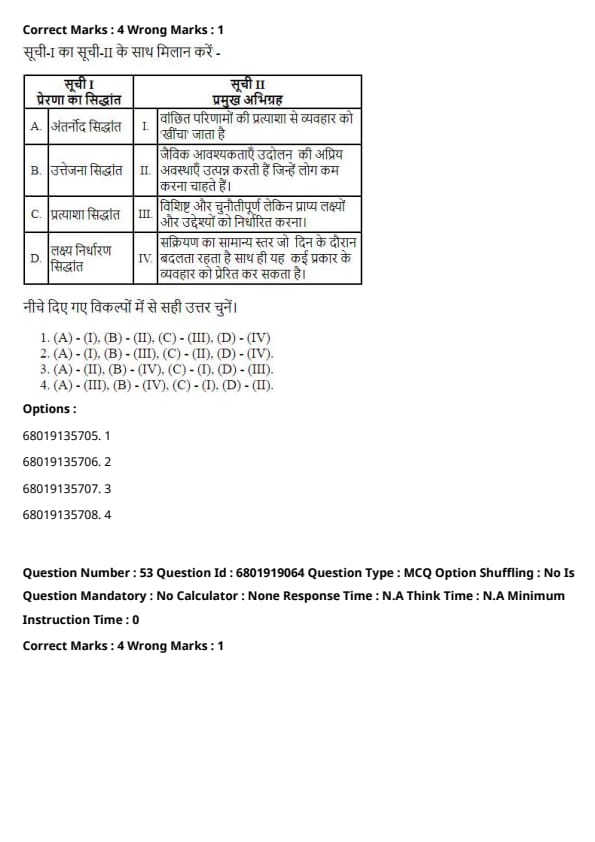
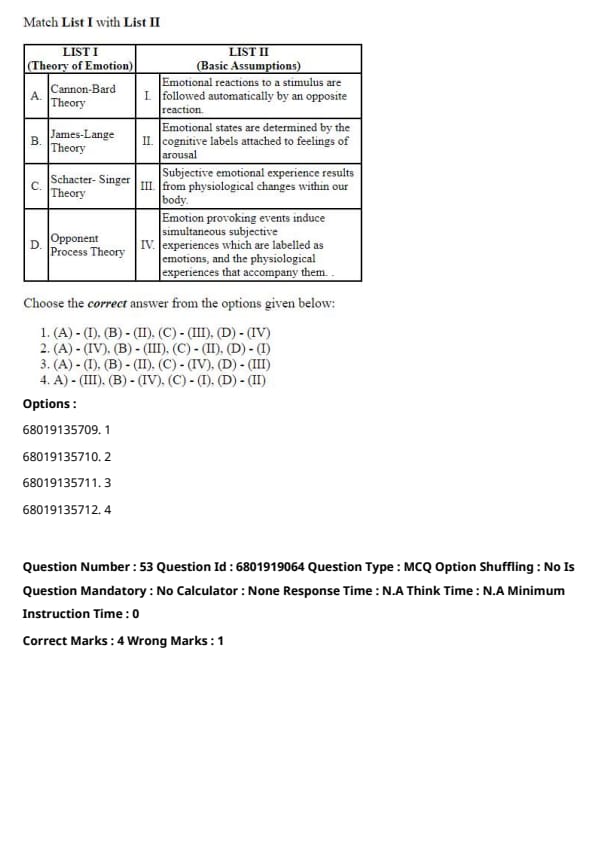
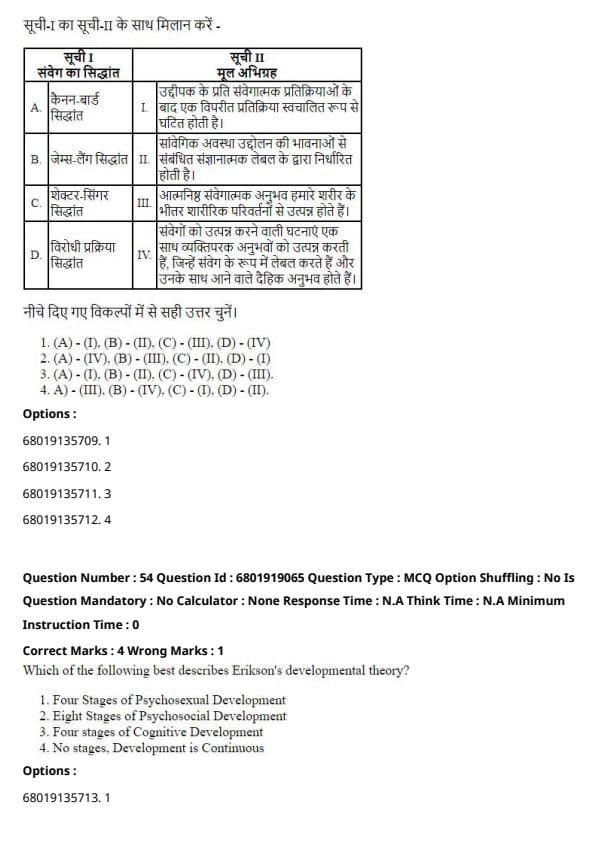
Question 53:
Match List I with List II:
| List II (Basic Assumptions) | List I (Theory of Emotion) |
|---|---|
| Emotional reactions to a stimulus are followed automatically by an opposite reaction | Opponent Process Theory |
| Emotional states are determined by the cognitive labels attached to feelings of arousal | Schachter-Singer Theory |
| Subjective emotional experience results from physiological changes within our body | James-Lange Theory |
| Emotion-provoking events induce simultaneous subjective experiences and physiological experiences | Cannon-Bard Theory |
View Solution
- Cannon-Bard Theory: Simultaneous physiological arousal and emotional experience.
- James-Lange Theory: Physiological changes precede emotion.
- Schachter-Singer Theory: Arousal and cognitive labels define emotion.
- Opponent Process Theory: Primary emotional responses are followed by an opposite reaction.
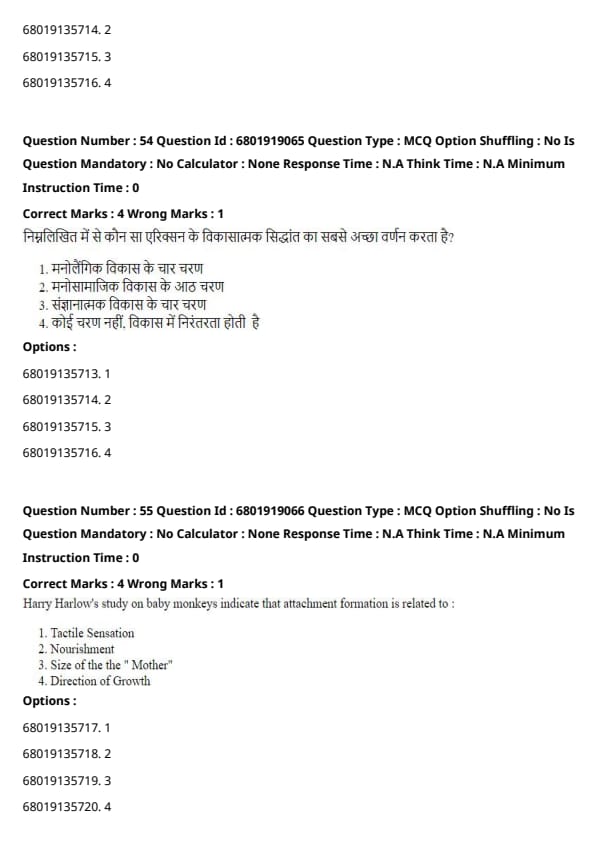
Question 54:
Which of the following best describes Erikson’s developmental theory?
View Solution
Erik Erikson outlined eight stages of psychosocial development, each characterized by a distinct crisis or developmental task (e.g., trust vs. mistrust, autonomy vs. shame).
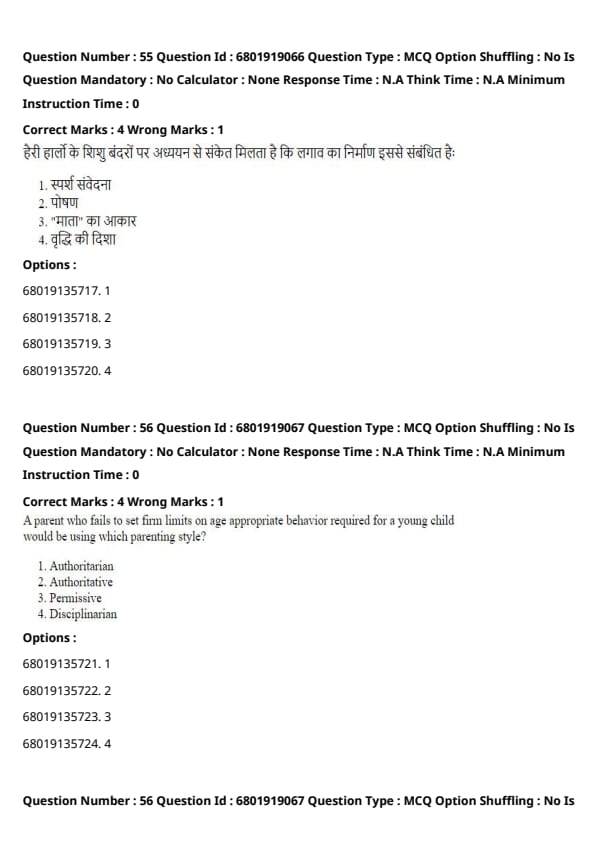
Question 55:
Harry Harlow’s study on baby monkeys indicates that attachment formation is related to:
View Solution
Harlow’s studies revealed that baby monkeys preferred the comfort of the soft, cloth mother over the wire mother with food, highlighting the importance of contact comfort in attachment.
Question 56:
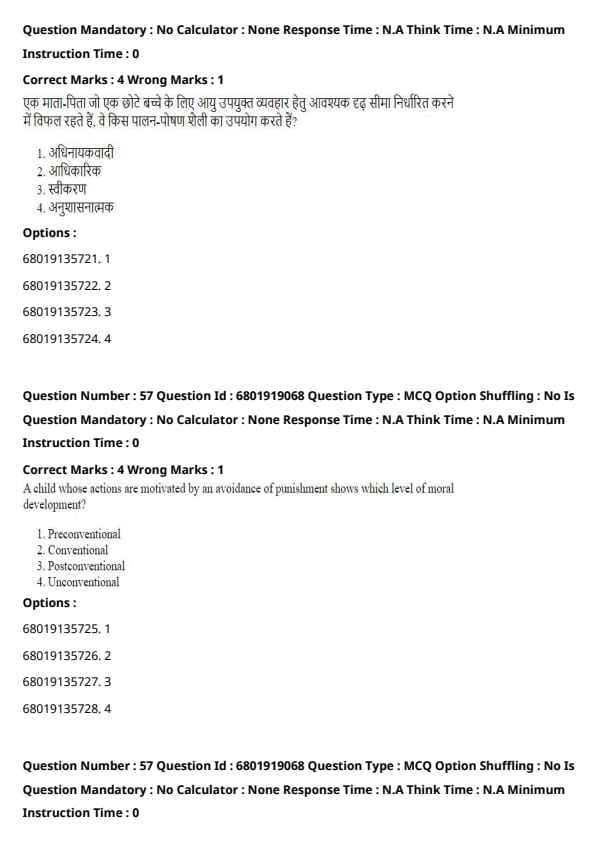
A parent who fails to set firm limits on age-appropriate behavior required for a young child would be using which parenting style?
View Solution
Permissive parents are non-demanding and non-controlling. They have few rules and rarely enforce consistent guidelines, often leading to children with less self-regulation and more behavioral issues.
Authoritative parents combine reasonable demands with high responsiveness; authoritarian parents are highly demanding but not very responsive.
Question 57:
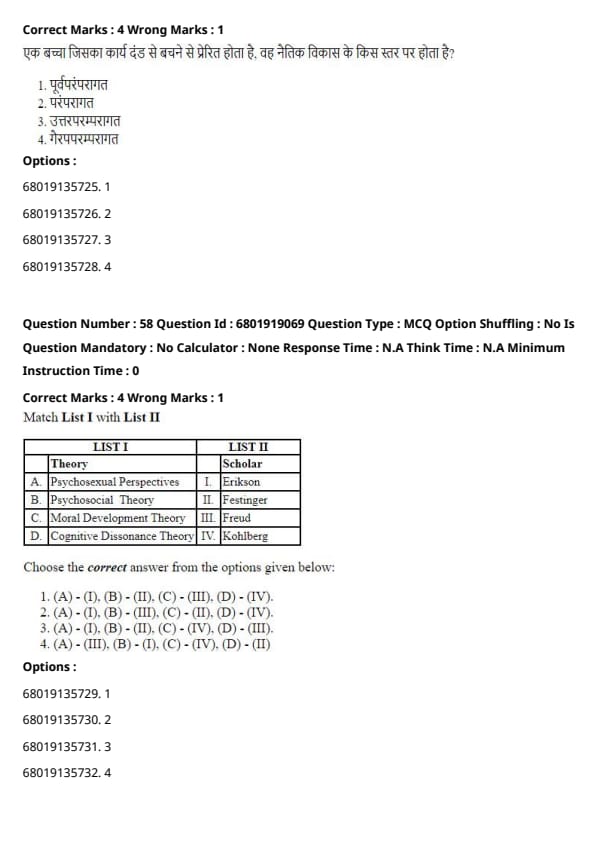
A child whose actions are motivated by an avoidance of punishment shows which level of moral development?
View Solution
According to Kohlberg’s stages of moral development, the Preconventional level is characterized by external consequences (e.g., avoiding punishment or seeking rewards) as the basis for moral decision-making.
Conventional morality focuses on societal rules and approval of others; postconventional considers abstract principles and universal ethical considerations.
Question 58:
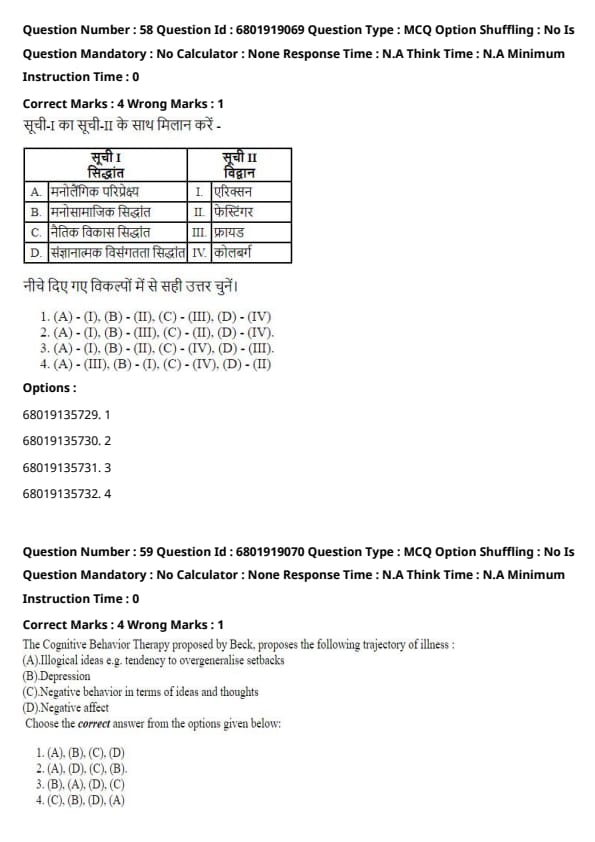
Match List I with List II:
| List I (Theory) | List II (Scholar) |
|---|---|
| A. Psychosexual Perspectives | III. Freud |
| B. Psychosocial Theory | I. Erikson |
| C. Moral Development Theory | IV. Kohlberg |
| D. Cognitive Dissonance Theory | II. Festinger |
View Solution
- Psychosexual Perspectives (A) -> Freud (III).
- Psychosocial Theory (B) -> Erikson (I).
- Moral Development Theory (C) -> Kohlberg (IV).
- Cognitive Dissonance Theory (D) -> Festinger (II).
Freud = psychosexual, Erikson = psychosocial, Kohlberg = moral, Festinger = cognitive dissonance.
Question 59:
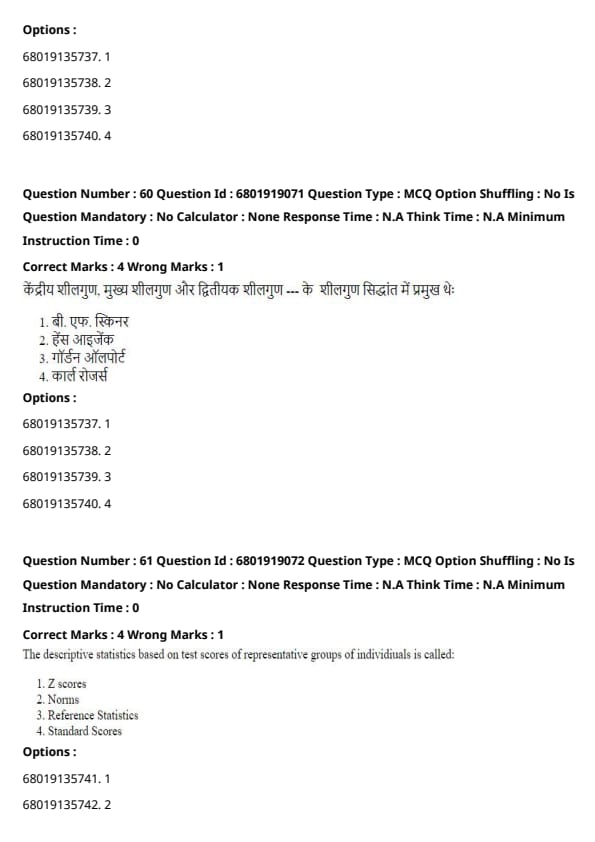
The Cognitive Behavior Therapy proposed by Beck, proposes the following trajectory of illness:
View Solution
In Beck's Cognitive Therapy, distorted or illogical thinking patterns (A) often trigger a negative affect (D), such as hopelessness or sadness. This negative emotional state then fuels negative behaviors and thought patterns (C), reinforcing a loop of maladaptive thinking. Ultimately, these persistent negative cognitions, affects, and behaviors precipitate or exacerbate depression (B).
Beck’s approach highlights that changing these illogical ideas and negative affect can break the cycle and alleviate the depressive state.
Question 60:
Central Traits, Cardinal Traits, and Secondary Traits were prominent in the trait theory of:
View Solution
Gordon Allport distinguished among three kinds of traits:
Cardinal traits: pervasive characteristics that dominate an individual’s personality.
Central traits: general building blocks of personality.
Secondary traits: preferences and situational traits that are less consistent.
B. F. Skinner was a behaviorist, Hans Eysenck identified broad factors (e.g., extraversion, neuroticism), and Carl Rogers focused on humanistic self-concepts.
Question 61:
The descriptive statistics based on test scores of representative groups of individuals is called:
View Solution
Norms are typical or average scores obtained by administering a test to a large, representative sample. They serve as reference points to interpret an individual’s score in comparison to the group.
Z-scores or standard scores are transformations of raw scores; norms are the data distributions (means, percentiles) gathered from representative samples.
Question 62:
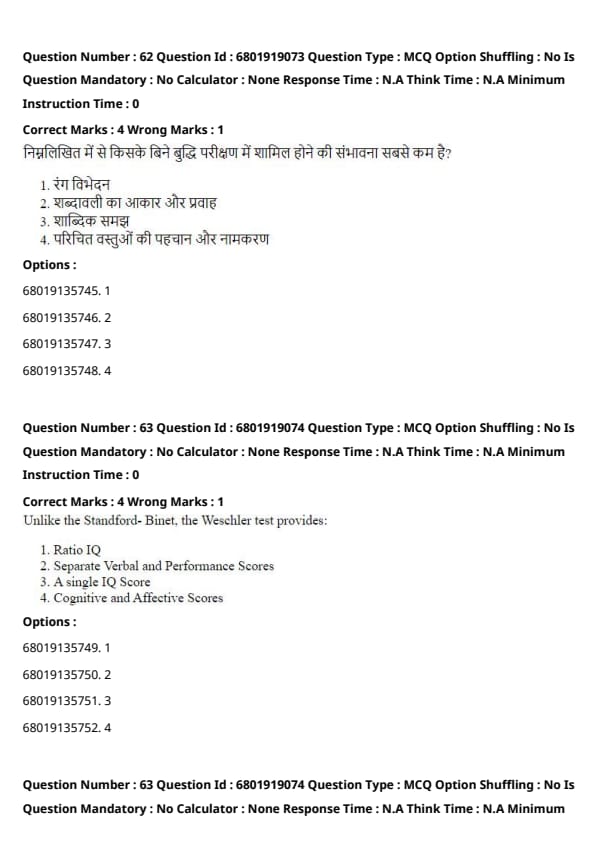
Which of the following is least likely to be included in a Binet intelligence test?
View Solution
Traditional Binet-type tests emphasize language, comprehension, memory, and problem-solving skills. Direct color discrimination tasks are generally not part of the classic Binet scales.
Binet-type items typically include tasks like vocabulary, sentence comprehension, digit span, object recognition, but not specialized perceptual discrimination of colors.
Question 63:
Unlike the Stanford-Binet, the Wechsler test provides:
View Solution
Wechsler intelligence scales (e.g., WAIS, WISC) yield both a Verbal IQ and a Performance IQ (nonverbal), as well as a combined Full-Scale IQ. The Stanford-Binet traditionally provided a single overall IQ (originally a “ratio IQ”).
Wechsler introduced the concept of a “Deviation IQ” and separated tasks into verbal versus performance domains.
Question 64:
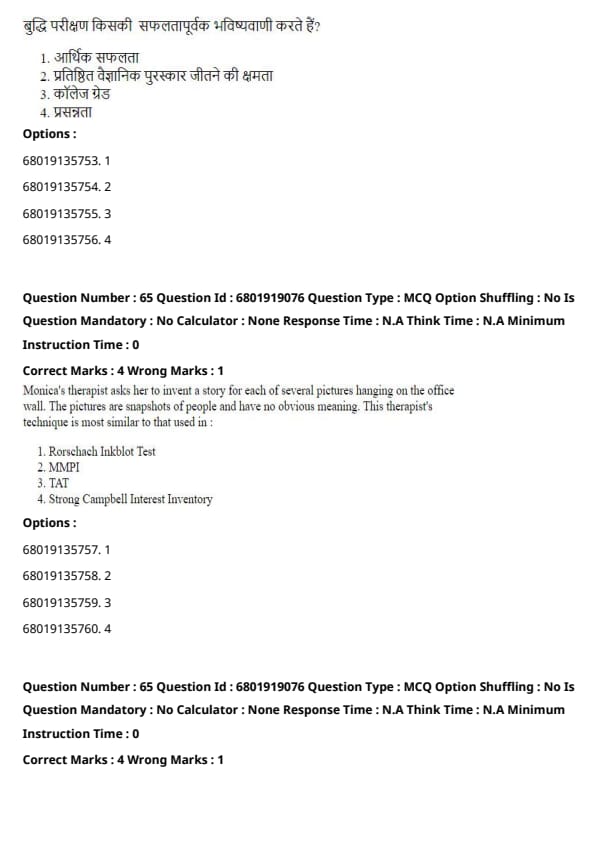
What do intelligence tests successfully predict?
View Solution
Standardized intelligence tests correlate moderately well with academic performance (e.g., college GPA). However, IQ by itself is not a robust predictor of factors like personal wealth, scientific award-winning, or long-term happiness.
IQ tests measure a narrow band of cognitive skills, which is more directly linked to academic performance than more complex real-world achievements.
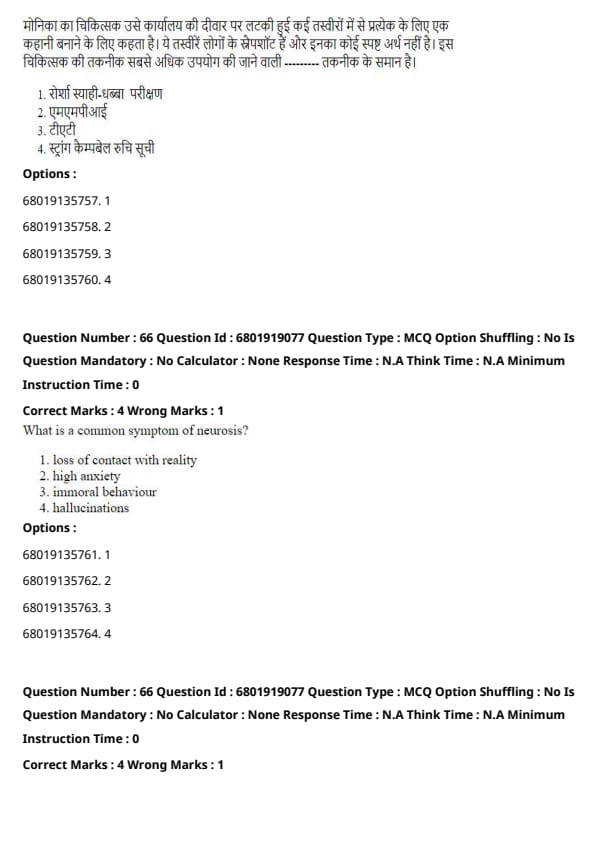
Question 65:
Monica’s therapist asks her to invent a story for each of several pictures hanging on the office wall. The pictures are snapshots of people and have no obvious meaning. This therapist's technique is most similar to that used in:
View Solution
The Thematic Apperception Test (TAT) presents ambiguous pictures of people and scenes, prompting the subject to create stories that may reveal underlying motives, emotions, and themes of the personality.
Rorschach uses inkblots, MMPI is an objective personality inventory, and the Strong-Campbell is a vocational interest test.
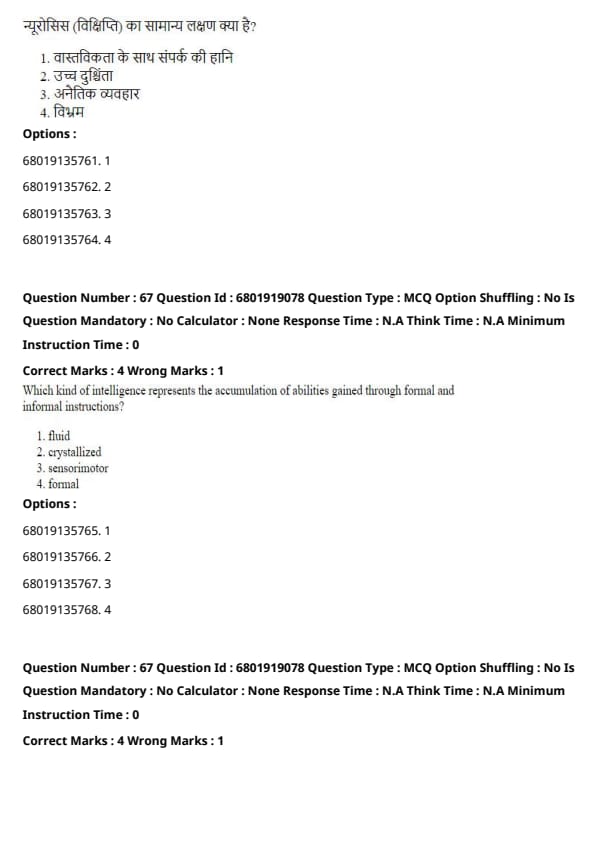
Question 66:
What is a common symptom of neurosis?
View Solution
In older, less-used terminology, “neurosis” often involved excessive anxiety, phobias, or obsessions, but without major distortions of reality. True loss of contact with reality (delusions or hallucinations) is more indicative of psychosis.
Although “neurosis” is no longer an official DSM classification, the term historically denoted anxiety-based disorders without psychotic features.
Question 67:
Which kind of intelligence represents the accumulation of abilities gained through formal and informal instruction?
View Solution
Crystallized intelligence (as per Cattell’s theory) consists of the knowledge and skills one gains over time through education and experience. Fluid intelligence, by contrast, is the capacity to reason and solve novel problems independently of acquired knowledge.
Crystallized intelligence involves vocabulary, general knowledge, and semantic memory. Fluid intelligence underlies problem-solving and pattern recognition.
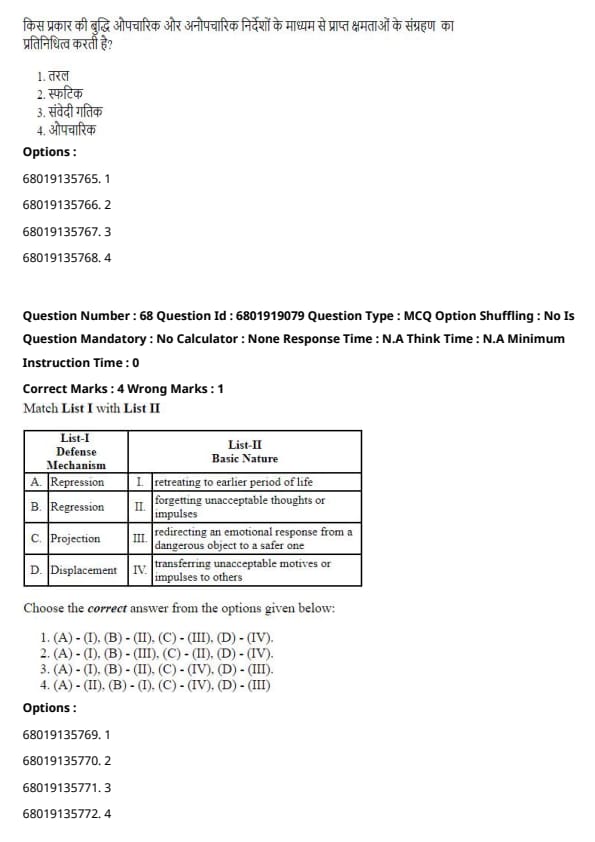
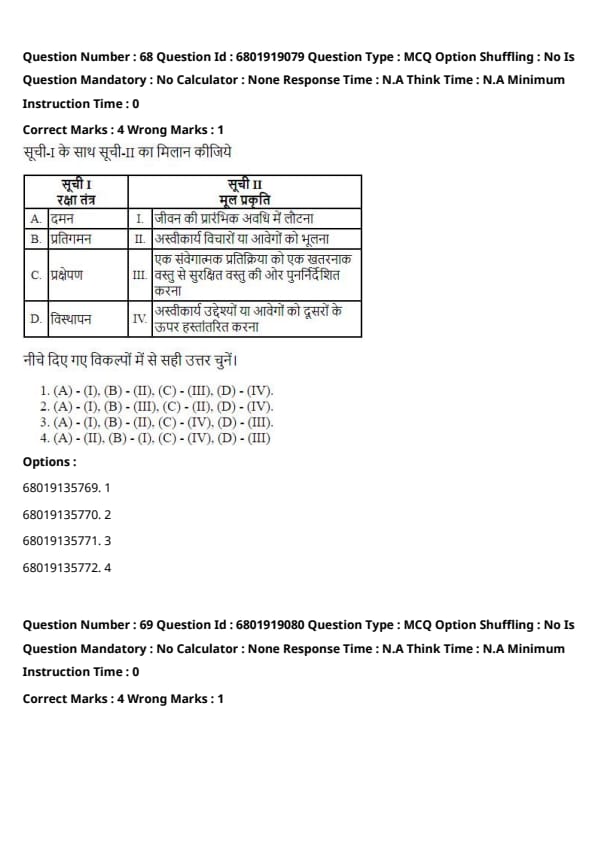
Question 68:
Match List I with List II:
| List II (Basic Nature) | List I (Defense Mechanism) |
|---|---|
| I. Retreating to an earlier period of life | B. Regression |
| II. Forgetting unacceptable thoughts or impulses | A. Repression |
| III. Redirecting an emotional response from a dangerous object to a safer one | D. Displacement |
| IV. Transferring unacceptable motives or impulses to others | C. Projection |
Choose the correct answer from the options given below:
(1) (A)→(I), (B)→(II), (C)→(III), (D)→(IV)
(2) (A)→(I), (B)→(III), (C)→(II), (D)→(IV)
(3) (A)→(I), (B)→(II), (C)→(IV), (D)→(III)
(4) (A)→(II), (B)→(I), (C)→(IV), (D)→(III)
View Solution
- Repression (A) to (II): Blocking or "forgetting" unacceptable ideas or impulses. - Regression (B) to (I): Reverting to an earlier, more childlike form of behavior. - Projection (C) to (IV): Attributing one's own unacceptable impulses to others. - Displacement (D) to (III): Shifting feelings to a safer, more acceptable target.
Displacement example: Yelling at a family member instead of an intimidating boss. Projection example: Accusing someone else of feeling the anger that you actually feel.
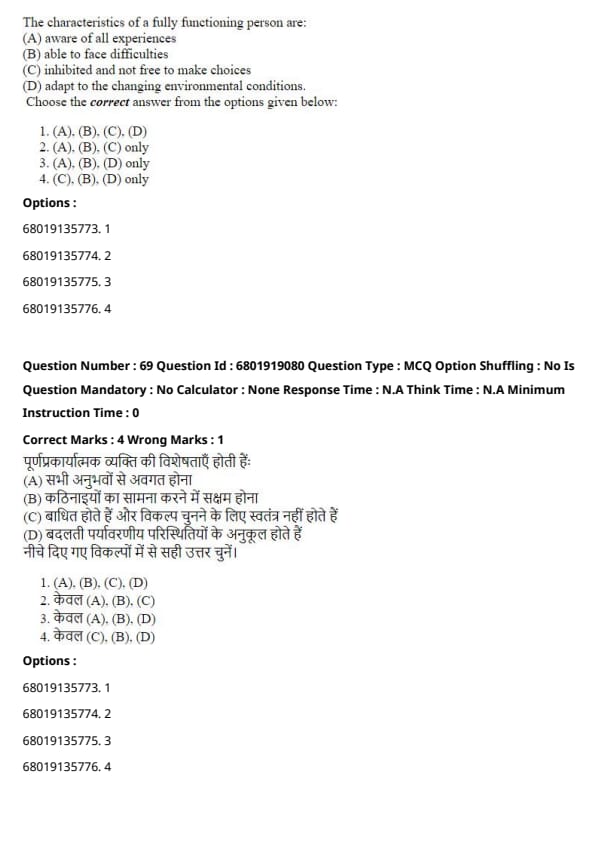
Question 69:
The characteristics of a fully functioning person are:
View Solution
According to Carl Rogers’ concept of the fully functioning person, key features include being aware of experiences (A), having the courage to face challenges (B), and the ability to adapt to changing circumstances (D). Fully functioning individuals are not inhibited or restricted in their capacity to make free choices, which rules out (C).
A fully functioning person also shows openness to experience and a trust in themselves, consistent with Rogers’ humanistic perspective.
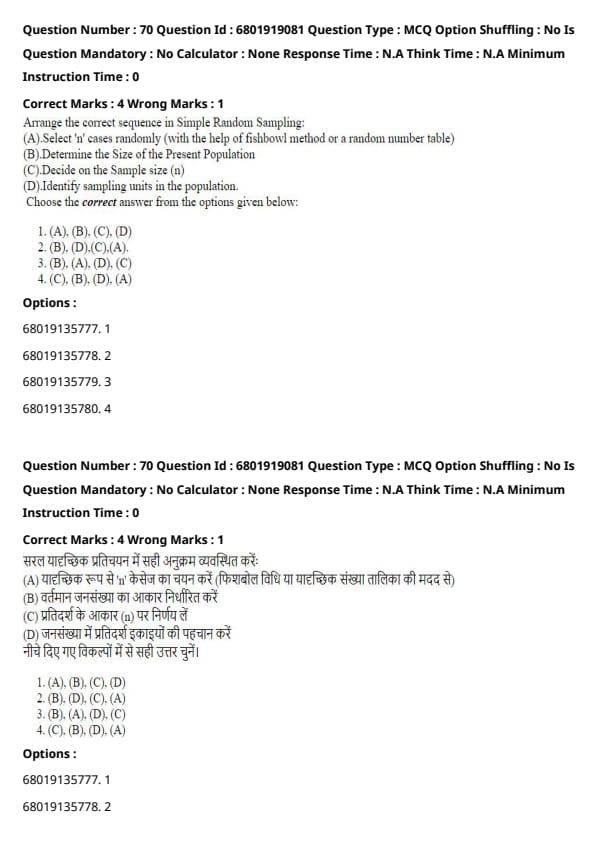
Question 70:
Arrange the correct sequence in Simple Random Sampling:
View Solution
The usual steps for simple random sampling:
A. Determine the population size (B)
B. Identify the sampling units in the population (D)
C. Decide on the sample size (n) (C)
D. Randomly select n cases (A)
It’s important to clearly define the population and its units, then figure out how many you need, and only then draw randomly from that frame.
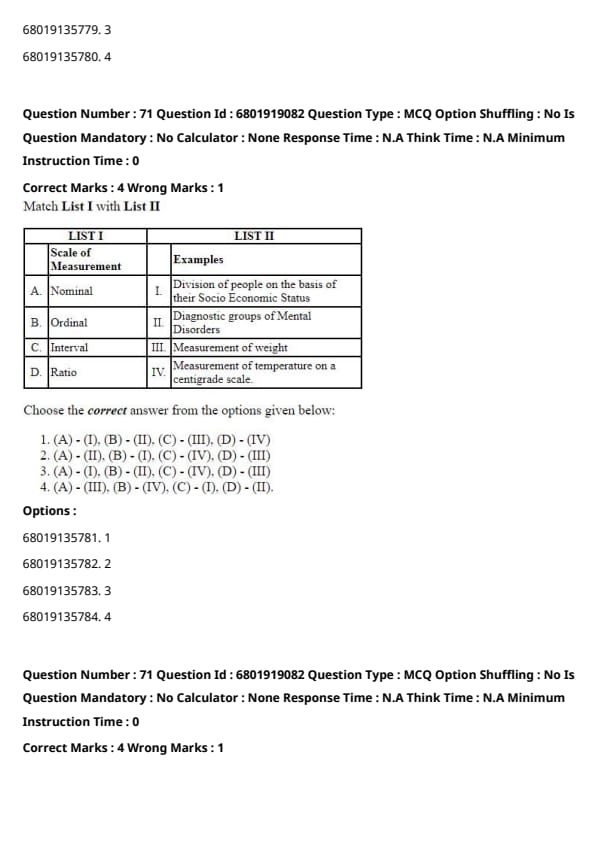
Question 71:
Match List I with List II:
| List II (Examples) | List I (Scale of Measurement) |
|---|---|
| I. Division of people on the basis of their Socio-Economic Status | B. Ordinal |
| II. Diagnostic groups of Mental Disorders | A. Nominal |
| III. Measurement of weight | D. Ratio |
| IV. Measurement of temperature on a centigrade scale | C. Interval |
Choose the correct answer from the options given below:
(1) (A) →(I), (B) →(II), (C) →(III), (D) →(IV)
(2) (A) →(II), (B) →(I), (C) →(IV), (D) →(III)
(3) (A) →(I), (B) →(II), (C) →(IV), (D) →(III)
(4) (A) →(III), (B) →(IV), (C) →(I), (D) →(II)
View Solution
- Nominal (A) to (II) (Diagnostic groups of Mental Disorders) - Ordinal (B) to (I) (Division of people on the basis of Socio-Economic Status) - Interval (C) to (IV) (Measurement of temperature on a centigrade scale) - Ratio (D) to (III) (Measurement of weight)
Nominal = "naming" or categorizing; Ordinal = ranking; Interval = numeric scale without true zero; Ratio = numeric scale with absolute zero.
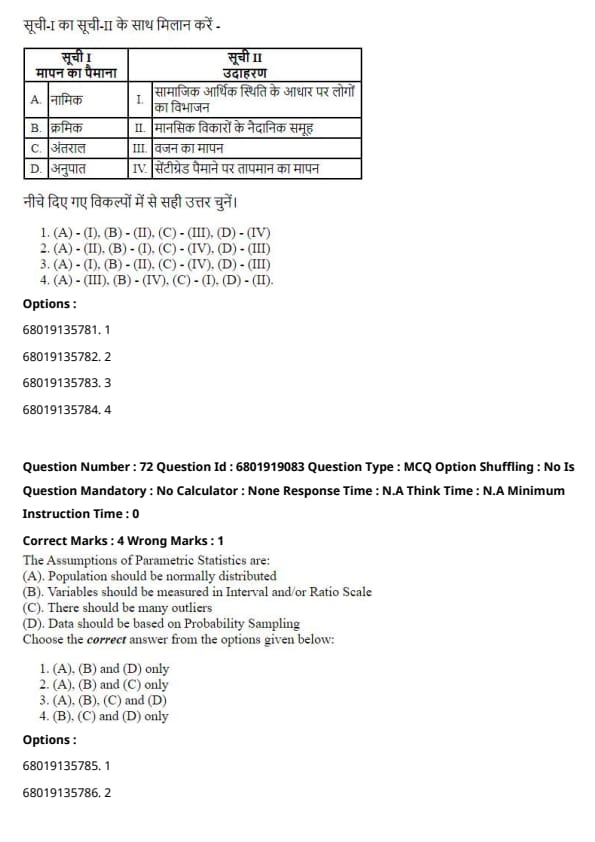
Question 72:
The assumptions of Parametric Statistics are:
View Solution
Typical parametric assumptions include: - The population from which samples are drawn is normally distributed (A). - The variables are measured at interval or ratio level (B). - The sample is randomly drawn from the population (D).
Having “many outliers” (C) is actually problematic for parametric tests, not an assumption.
Additional assumptions can include homogeneity of variance for certain tests (e.g., ANOVA). Excessive outliers can violate normality and unduly influence parametric analyses.
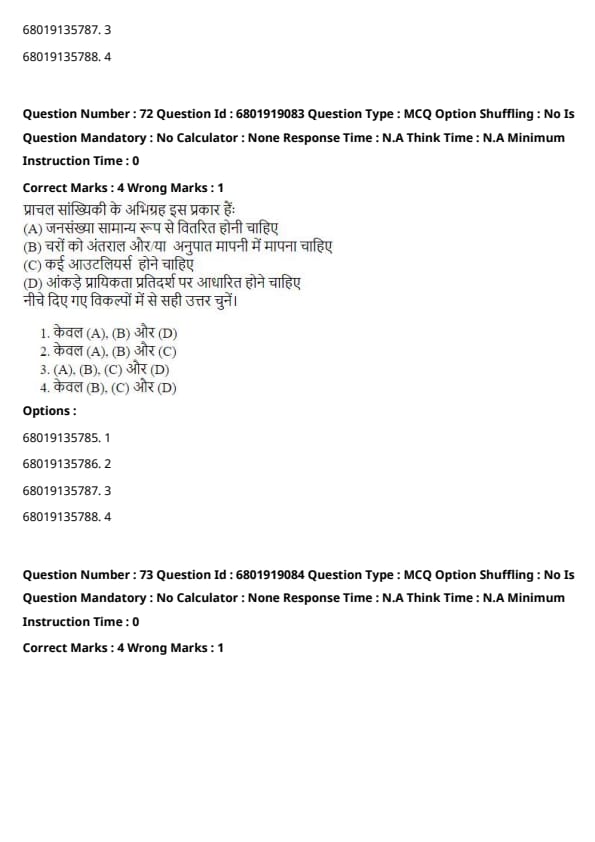
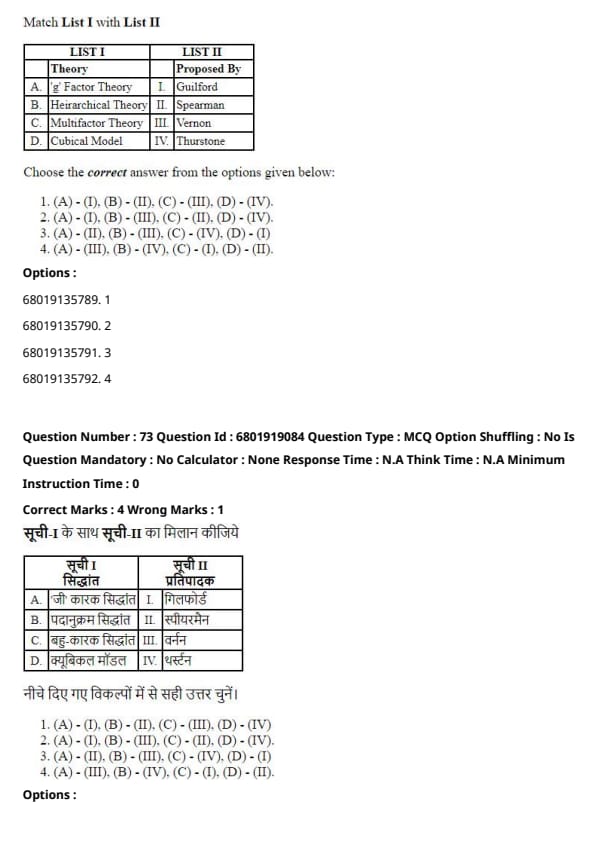
Question 73:
Match List I with List II:
| List I (Theory) | List II (Proposed By) |
|---|---|
| D. Cubical Model | I. Guilford |
| A. 'g' Factor Theory | II. Spearman |
| B. Hierarchical Theory | III. Vernon |
| C. Multifactor Theory | IV. Thurstone |
Choose the correct answer from the options given below:
(1) (A) →(I), (B) →(II), (C) →(III), (D) →(IV)
(2) (A) →(I), (B) →(III), (C) →(II), (D) →(IV)
(3) (A) →(II), (B) →(III), (C) →(IV), (D) →(I)
(4) (A) →(III), (B) →(IV), (C) →(I), (D) →(II)
View Solution
- 'g' Factor Theory (A) to Spearman (II). - Hierarchical Theory (B) to Vernon (III). - Multifactor Theory (C) to Thurstone (IV) (primary mental abilities). - Cubical Model (D) to Guilford (I) (Structure of Intellect model).
Spearman proposed "g" for general intelligence; Thurstone identified multiple primary mental abilities; Guilford had the "3D" or "SOI" model; Vernon proposed a hierarchical model bridging "g" and more specific factors.
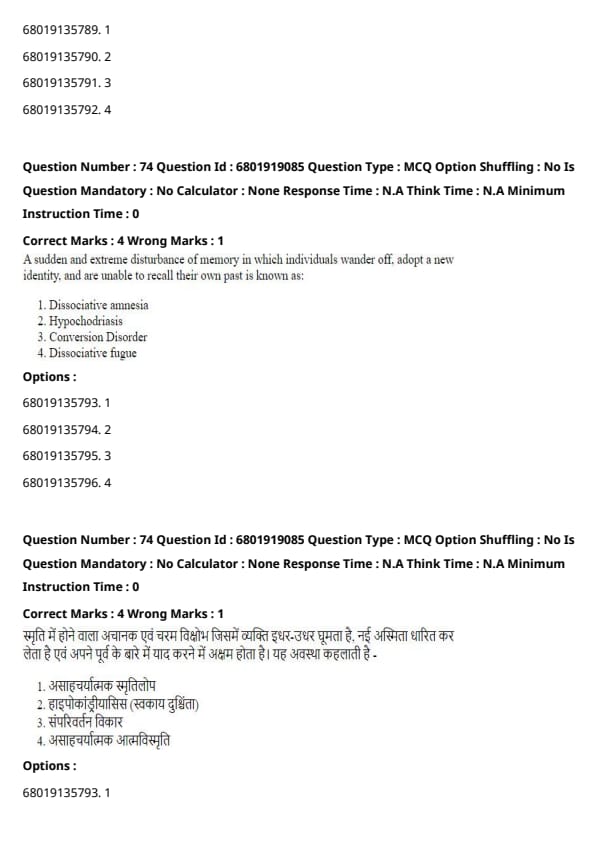
Question 74:
A sudden and extreme disturbance of memory in which individuals wander off, adopt a new identity, and are unable to recall their own past is known as:
View Solution
Dissociative Fugue (now categorized under Dissociative Amnesia in DSM-5 with “fugue” specifier) involves unexpected travel away from one’s usual surroundings and confusion about one’s personal identity. Dissociative Amnesia generally involves memory loss without wandering or assuming a new identity. Hypochondriasis is excessive worry about having a serious illness. Conversion Disorder involves neurological symptoms (e.g., numbness, paralysis) without a medical basis.
Dissociative Fugue is a rare phenomenon often triggered by severe stress or trauma, leading to a temporary new life pattern.
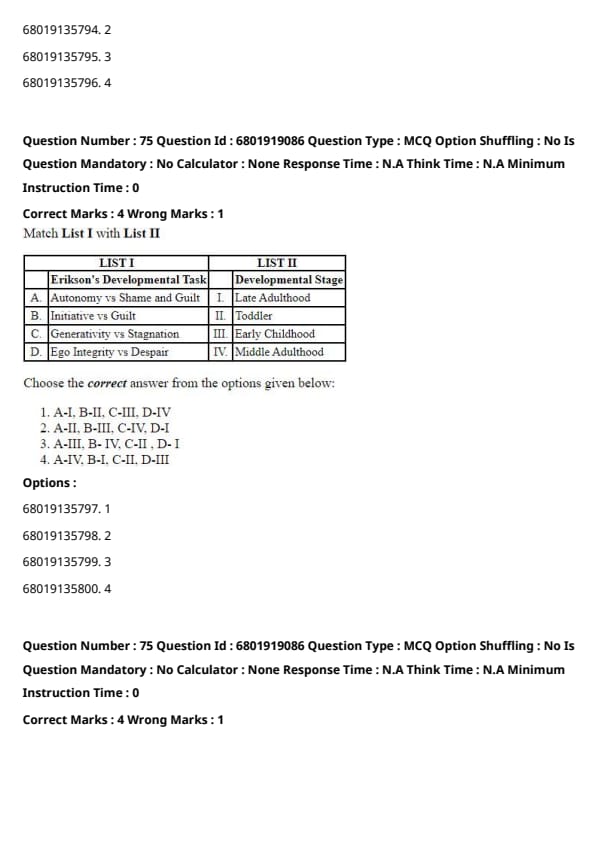
Question 75:
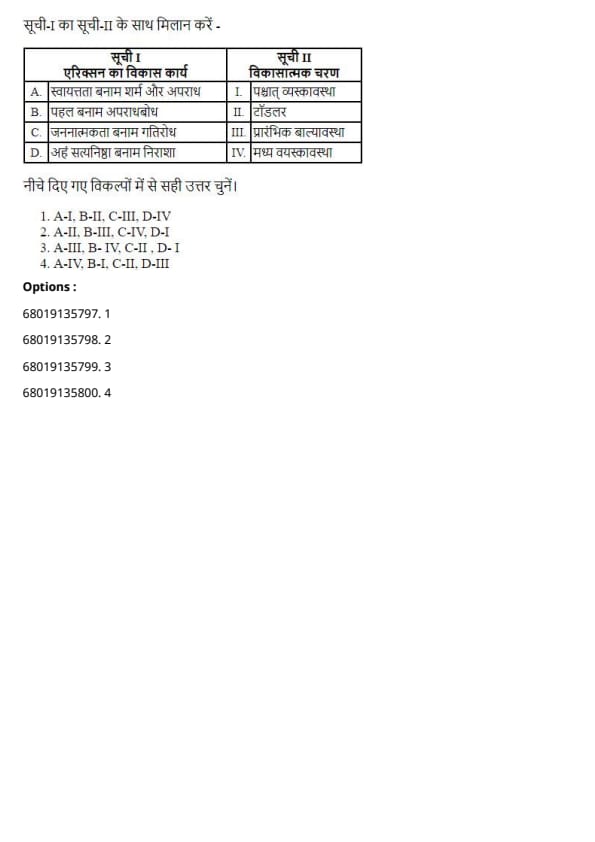
Match List I with List II:
| List I (Erikson's Developmental Task) | List II (Developmental Stage) |
|---|---|
| A. Autonomy vs. Shame and Doubt | II. Toddler |
| B. Initiative vs. Guilt | III. Early Childhood |
| C. Generativity vs. Stagnation | IV. Middle Adulthood |
| D. Ego Integrity vs. Despair | I. Late Adulthood |
Choose the correct answer from the options given below:
(1) A-I, B-II, C-III, D-IV
(2) A-II, B-III, C-IV, D-I
(3) A-III, B-IV, C-II, D-I
(4) A-IV, B-I, C-II, D-III
View Solution
Erikson's stages: 1. Autonomy vs. Shame occurs in the toddler years (approximately 1-3 years). 2. Initiative vs. Guilt occurs in early childhood (approximately 3-5/6 years). 3. Generativity vs. Stagnation occurs in middle adulthood (approximately 40-65 years). 4. Ego Integrity vs. Despair occurs in late adulthood (65+ years).
Other Eriksonian stages include: Trust vs. Mistrust (infancy), Industry vs. Inferiority (school age), Identity vs. Role Confusion (adolescence), and Intimacy vs. Isolation (young adulthood).










*The article might have information for the previous academic years, please refer the official website of the exam.