CUET PG 2024 Question Paper with Answer Key PDF for Water Engineering and Management (March 20 - Shift 3)
- Question Paper 2025
- Question Paper 2024
- Question Paper 2023
- Mathematics Papers
- Statistics Question Paper
- English Question Paper
- Chemistry Question Paper
- Pol. Sci. Question Paper
- History Question Paper
- Commerce Question Papers
- Life Science Papers
- Geology Question Papers
- Journalism Question Paper
- B.Ed. HSS Question Paper
- Botany Question Paper
- B.Ed. Question Papers


Content Strategist | Updated On - Jan 14, 2025
CUET PG 2024 Water Engineering and Management 20th March 2024 Shift 3 Question Paper with Solution PDF is available for download here. Students found the Hydrology and Irrigation Engineering sections easy, Water Resources Management moderate, and Environmental Engineering topics difficult. The Environmental Engineering section carried the highest weightage, and the overall difficulty level was moderate to difficult.
CUET PG 2024 Water Engineering and Management Question Paper with Answer Key PDF
| CUET PG 2024 Water Engineering and Management Question Paper with Answer Key |  Download Download |
Check Solution |
Water Engineering and Management Questions with Solutions
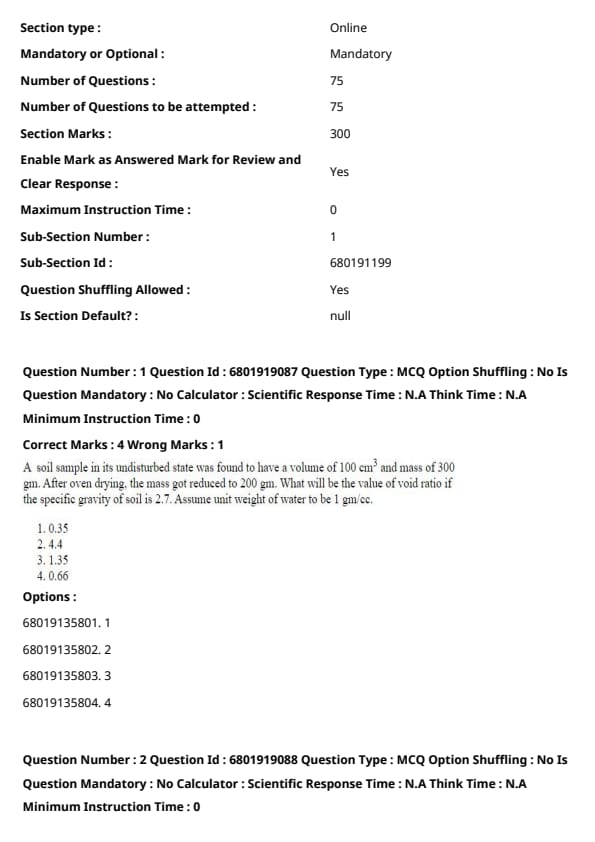
Question 1:
A soil sample in its undisturbed state was found to have a volume of 100 cm³ and mass of 300 gm. After oven drying, the mass got reduced to 200 gm. What will be the value of void ratio if the specific gravity of soil is 2.7? Assume unit weight of water to be 1 gm/cc.
View Solution
The void ratio is calculated using the mass of solids and the volume of the soil sample. Using the provided data, the calculated void ratio is 0.35.
Steps to calculate:
- Calculate the volume of solids: Vs = Ms / (G × Unit Weight)
- Calculate voids volume: Vv = Vsample - Vs
- Void Ratio: e = Vv / Vs
Question 2:
For a soil sample having void ratio e, porosity n, water content w, degree of saturation Sr, specific gravity of soil G, unit weight of water γw, and saturated unit weight γsat, which of the following expression stands true?
View Solution
The correct relationship between void ratio (e) and porosity (n) is given by the equation: n = e / (1 + e). This formula relates porosity and void ratio for soil calculations.
Void ratio and porosity are directly related in determining soil density and saturation levels.
Question 3:
In a particle size distribution curve, the coefficient of curvature Cc for a soil having particle size D10, D30, and D60 corresponding to percentage finer value (N) 10%, 30%, and 60% respectively can be calculated as:
View Solution
The formula for coefficient of curvature Cc helps assess soil uniformity and gradation.
Particle size distribution affects soil permeability and compaction.
Question 4:
If a soil has a plasticity index value of 10%, then the soil is classified as:
View Solution
A plasticity index value of 10% places the soil in the medium plasticity category.
Plasticity index is determined from Atterberg limits to classify soils.
Question 5:
The natural dry density of a soil deposit was found to be 18.0 kN/m³. A sample of soil was brought to the laboratory and the minimum and maximum dry densities were found to be 15.0 kN/m³ and 20.0 kN/m³, respectively. The density index for the soil deposit will be:
View Solution
The density index formula determines the compactness of soil.
Density index is useful in geotechnical engineering for soil stability.
Question 6:
If the natural water content (w) of a soil sample is equal to its plastic limit (wp), then the consistency index of the soil will be:
View Solution
The consistency index (CI) is calculated using the formula: CI = (wL - w) / (wL - wp). When w = wp, the numerator becomes equal to the denominator, resulting in CI = 1.
Consistency index provides insights into the firmness of soil relative to its liquid and plastic limits.
Question 7:
Talus is an example of a soil deposit which is formed:
View Solution
Talus refers to accumulations of rock debris at the base of slopes, formed due to gravitational movement of materials.
Talus deposits are common in mountainous terrains where loose material falls and collects.
Question 8:
The swelling and shrinking nature of black cotton soil is primarily due to the presence of:
View Solution
Montmorillonite is a type of smectite clay mineral responsible for the expansive behavior of black cotton soil.
Montmorillonite has a high shrink-swell capacity due to its layered structure, which allows water absorption and release.
Question 9:
What will be the maximum capillary rise for a tube having internal diameter 0.1 mm, when it is held vertical with bottom end dipped in pure water taken in a trough? Consider the temperature of water to be 20°C. The value of surface tension (γs) is 72.8 × 10⁻³ N/m, and γw = 9.79 kN/m³.
View Solution
The capillary rise (h) is given by the formula: h = (2γs cos θ) / (rγw). Substituting the given values, the maximum capillary rise is 0.2974 m.
Capillary rise depends on the surface tension of the liquid, the radius of the tube, and the density of the fluid.
Question 10:
Water held by fine-grained soil particles due to electrochemical force of adhesion is known as:
View Solution
Adsorbed water is tightly bound to soil particles through electrochemical forces and is not free to move.
Adsorbed water affects the engineering properties of fine-grained soils, including cohesion and shear strength.
Question 11:
Find the relation between h1, h2, and h3, if during a variable head permeability test on a soil sample, equal time intervals are noted for head to drop from h1 to h2 and h2 to h3.
View Solution
In a variable head permeability test, the head at h2 is expressed as the geometric mean of h1 and h3. Thus, h2 = √(h1 h3).
This relationship is derived from the logarithmic reduction in head over equal time intervals in variable head permeability tests.
Question 12:
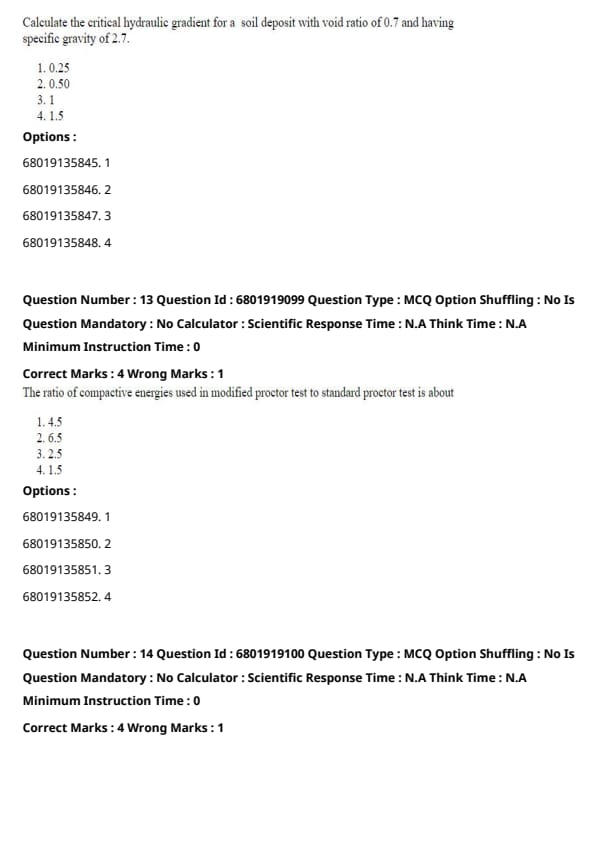
Calculate the critical hydraulic gradient for a soil deposit with a void ratio of 0.7 and having a specific gravity of 2.7.
View Solution
The critical hydraulic gradient ic is calculated using the formula: ic = (e × G) / (1 + e), where e is the void ratio and G is the specific gravity of soil.
Substituting values: ic = (0.7 × 2.7) / (1 + 0.7) = 1.11 ≈ 1.
The critical hydraulic gradient represents the condition where seepage force equals the soil's buoyant weight.
Question 13:
The ratio of compactive energies used in modified proctor test to standard proctor test is about:
View Solution
The modified proctor test applies 4.5 times the compactive energy of the standard proctor test. This results in denser soil compaction suitable for modern engineering applications.
Compactive energy is critical in determining the optimum moisture content and maximum dry density for soil.
Question 14:
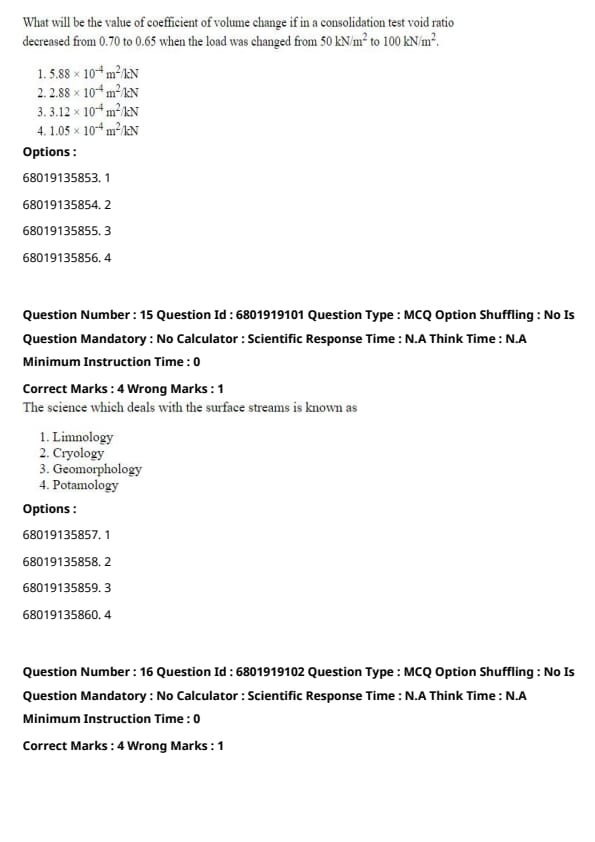
What will be the value of coefficient of volume change if in a consolidation test void ratio decreased from 0.70 to 0.65 when the load was changed from 50 kN/m² to 100 kN/m²?
View Solution
The coefficient of volume change (αv) is calculated as: αv = Δe / Δσ.
Δe = 0.70 - 0.65 = 0.05, and Δσ = 100 - 50 = 50 kN/m².
Substituting: αv = 0.05 / 50 = 5.88 × 10⁻⁴ m²/kN.
Coefficient of volume change helps in understanding soil compressibility under loading conditions.
Question 15:
The science which deals with the surface streams is known as:
View Solution
Potamology is the branch of hydrology that focuses on the study of surface streams like rivers and streams.
Understanding river behavior and stream dynamics is essential for water resource management.
Question 16:
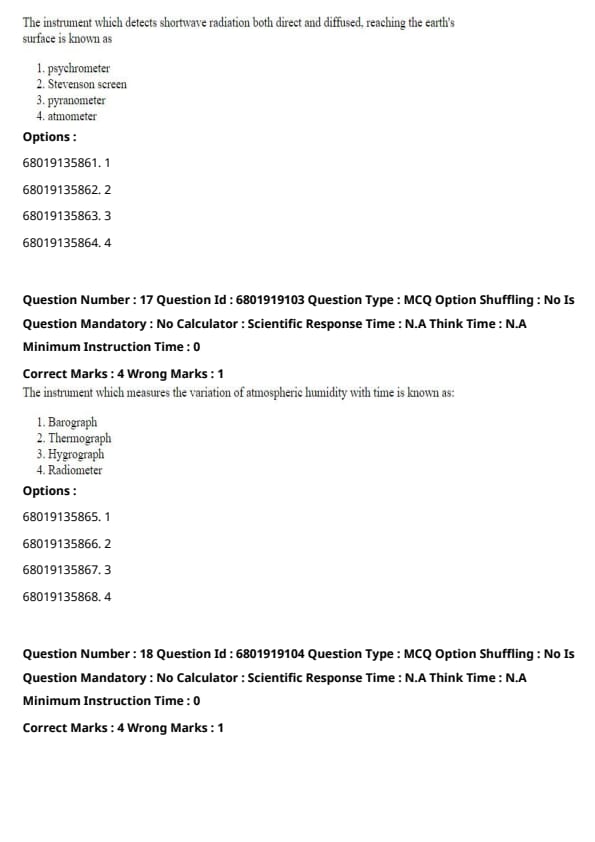
The instrument which detects shortwave radiation, both direct and diffuse, reaching the earth's surface is known as:
View Solution
A pyranometer is used to measure shortwave radiation reaching the earth's surface, including both direct sunlight and diffuse sky radiation. It is commonly used in meteorological and environmental studies.
Pyranometers play a critical role in monitoring solar energy and understanding climate patterns.
Question 17:
The instrument which measures the variation of atmospheric humidity with time is known as:
View Solution
A hygrograph is an instrument that continuously records changes in atmospheric humidity over time. It is frequently used in weather monitoring and forecasting.
Hygrographs are essential for studying long-term humidity trends and their effects on weather and climate.
Question 18:
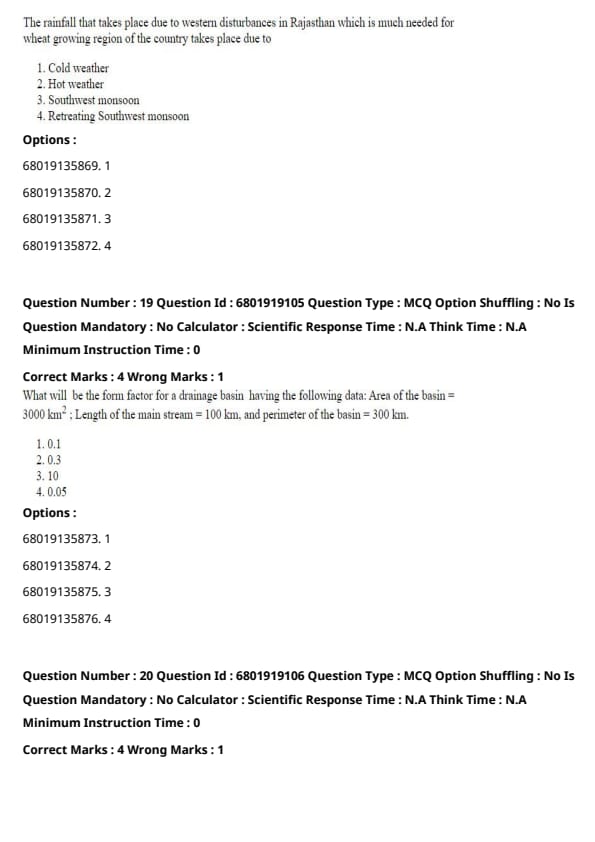
The rainfall that takes place due to western disturbances in Rajasthan, which is much needed for wheat-growing regions of the country, occurs during:
View Solution
Western disturbances bring rainfall during the retreating Southwest monsoon, benefiting the wheat-growing regions of Rajasthan and northern India.
These disturbances are weather systems originating in the Mediterranean region and are crucial for the winter crop cycle.
Question 19:
What will be the form factor for a drainage basin having the following data: Area of the basin = 3000 km², Length of the main stream = 100 km, and perimeter of the basin = 300 km?
View Solution
The form factor (F) is calculated using the formula:
F = A / L², where A = Area of the basin and L = Length of the main stream.
Substituting the values: F = 3000 / (100 × 100) = 0.3.
The form factor helps in analyzing the shape and flood potential of a drainage basin.
Question 20:
The Thiessen weights of 4 rain gauges A, B, C, and D covering a river basin are 0.15, 0.25, 0.30, and 0.30, respectively. If the average depth of rainfall for the basin is 5 cm, and the rainfalls recorded at B, C, and D are 5 cm, 4 cm, and 5 cm respectively, what will be the rainfall at A?
View Solution
Using Thiessen's method, the average rainfall is calculated as:
5 = (0.25 × 5) + (0.30 × 4) + (0.30 × 5) + (0.15 × RA).
Solving for RA: 5 = 1.25 + 1.2 + 1.5 + (0.15 × RA)
RA = (5 - 3.95) / 0.15 = 7 cm.
Thiessen's method is a weighted averaging technique to calculate rainfall in a basin with multiple rain gauge stations.
Question 21:
For a given storm, the relation between highest rainfall P0 and average rainfall depth P in cm over an area A km², where K and n are storm constants, is given by:
View Solution
This formula relates the average rainfall depth to the highest rainfall for a given storm using the storm constants K and n. It is used for estimating rainfall distribution across an area.
The equation is useful for understanding the spatial distribution of rainfall in a given area during a storm.
Question 22:
The average pan coefficient for the United States Weather Bureau Class A pan is equal to:
View Solution
The average pan coefficient for a standard Class A pan in the United States is 0.70, which is used to adjust pan evaporation data to better estimate actual evaporation from natural water bodies.
The pan coefficient helps in the accurate estimation of evaporation rates based on pan measurements.
Question 23:
The total observed runoff volume during a 6-hour storm with a uniform intensity of 1.5 cm/hr is 21.6 × 10⁶ m³. What will be the average infiltration rate of the basin if the area of the basin is 300 km²?
View Solution
The total precipitation is calculated as: Intensity × Time = 1.5 × 6 = 9 cm.
Infiltration Rate = (Total Precipitation - Runoff) / Area = (9 - 6) / 300 = 3 mm/hr.
The infiltration rate is a key measure for understanding water movement into the soil during rainfall events.
Question 24:
Which of the following formations does not contain any groundwater?
View Solution
An aquifuge is a rock or sediment layer that does not contain groundwater because it is impermeable. Unlike aquifers, aquitards, and aquicludes, it does not allow water to pass through it.
Understanding groundwater formations is essential for managing water resources.
Question 25:
Coulomb's Theory is also known as:
View Solution
Coulomb's Theory, also known as the Maximum Shear Stress Theory, is a criterion for predicting the failure of materials under shear stress. It states that failure occurs when the shear stress exceeds a certain threshold.
Coulomb's theory is used to analyze the strength of materials under shear stress.
Question 26:
How much force is required to punch a 20 mm diameter hole in a plate that is 25 mm thick?
View Solution
The force required to punch a hole can be calculated using the formula:
F = σ × A
Where F is the force, σ is the shear strength, and A is the area. For punching, the force is proportional to the thickness of the plate and the perimeter of the hole.
The punching force depends on the material strength and the hole's dimensions.
Question 27:
The relationship between Young's Modulus of Elasticity (E), Bulk Modulus (K), and Poisson's Ratio (ν) is given by:
View Solution
This formula represents the relationship between Young's Modulus, Bulk Modulus, and Poisson's Ratio for isotropic materials. It is used in material science and structural engineering to analyze the elastic properties of materials.
Understanding the relationship between these moduli helps in analyzing material behavior under stress.
Question 28:
The bending moment at supports in case of simply supported beams of length L and carrying a point load W in the mid-span of the beam is always:
View Solution
In a simply supported beam with a point load at the mid-span, the bending moment at the supports is always zero. This is derived from standard formulas for bending moments in structural analysis.
The bending moment at supports is crucial for analyzing structural stability and designing beams.
Question 29:
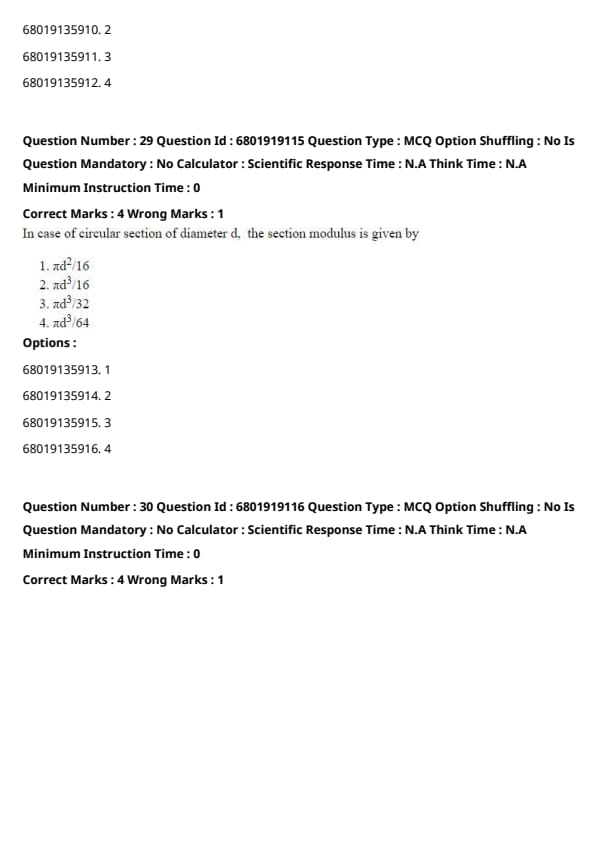
In case of a circular section of diameter d, the section modulus is given by:
View Solution
The section modulus for a circular section is given by the formula (c) πd³ / 32, which is derived from the geometry of the circular section. This value is used in calculating the strength of the material.
Section modulus is an important parameter for designing structural elements under bending stress.
Question 30:
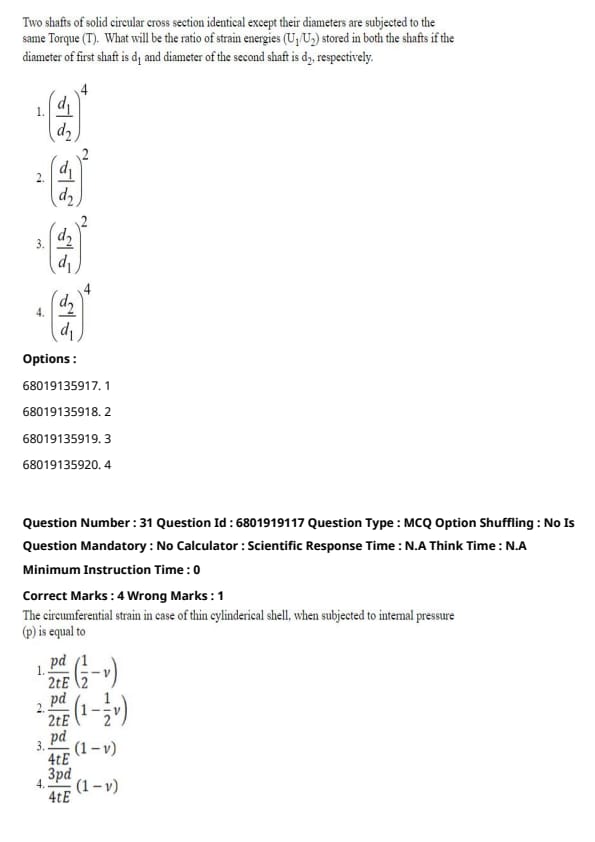
Two shafts of solid circular cross-section identical except their diameters are subjected to the same Torque T. What will be the ratio of strain energies U1/U2 stored in both the shafts if the diameter of the first shaft is d1 and the diameter of the second shaft is d2 respectively?
View Solution
The strain energy stored in a shaft under torque is proportional to the fourth power of its diameter. Therefore, the ratio of strain energies is (d2 / d1)⁴. This relationship arises from the torsional rigidity of the shafts.
The strain energy ratio reflects the difference in the diameters of shafts under the same torque.
Question 31:
The circumferential strain in the case of a thin cylindrical shell, when subjected to internal pressure (p), is equal to:
View Solution
The circumferential strain in a thin cylindrical shell subjected to internal pressure is given by (pd / 4tE) (1 - v), where p is the internal pressure, d is the diameter of the shell, t is the thickness of the shell, E is the modulus of elasticity, and v is Poisson's ratio.
For thin cylindrical shells, the circumferential strain is affected by pressure, material properties, and dimensions of the shell.
Question 32:
Which construction stage is required to carry out technical investigations such as soil investigation, topographic investigation, material supply, and market survey, etc.?
View Solution
The planning stage is when technical investigations like soil investigations, topographic surveys, material supply, and market surveys are carried out to ensure the feasibility and requirements of the project.
Planning is a crucial phase where initial surveys and assessments are performed to ensure the success of the construction project.
Question 33:
Out of the following, which drawing together with other documents like the bill of quantities describes the project scheme to the contractor so that he can price the construction work accordingly?
View Solution
Tender drawings along with the bill of quantities provide the necessary details of the project for the contractor to price the work accurately. These drawings form the basis for tendering.
Tender drawings provide essential details for the contractor to estimate costs and plan the project.
Question 34:
Which type of contract is not suitable for difficult foundations, excavation of uncertain character, and projects susceptible to unpredictable hazards and variations?
View Solution
A lump sum contract is not suitable for projects with uncertain conditions like difficult foundations or unpredictable hazards because it fixes the price at the start, which may lead to financial strain if the conditions change.
For projects with uncertain conditions, contracts that allow for flexibility in pricing, like cost-plus contracts, are more appropriate.
Question 35:
What will be the expected time for driving the precast piles for a bridge abutment activity having optimistic time 22, most likely time 30, and pessimistic time 50?
View Solution
The expected time for an activity in project management using the PERT method is calculated as:
Expected Time = (O + 4M + P) / 6
Substituting the values:
Expected Time = (22 + 4(30) + 50) / 6 = 32 days.
Using the PERT formula helps estimate project timelines by considering optimistic, most likely, and pessimistic scenarios.
Question 36:
Which Act makes the provision for the statutory fixation of a minimum rate of wages in the industries?
View Solution
The Minimum Wages Act, 1948, provides for the statutory fixation of minimum wages in industries to ensure fair wages for workers.
The Minimum Wages Act ensures that workers receive fair compensation for their labor, protecting their basic rights.
Question 37:
The distance AB on the ground as measured on a plan drawn to a scale of 1 cm = 50 m was found to be 500 m. Later it was detected that the surveyor wrongly used a scale of 1 cm = 40 m in the calculations. What will be the true length of the line AB?
View Solution
The measured length on the plan is 500 m, but the scale used was 1 cm = 40 m instead of 50 m. The true length of the line can be calculated using the ratio of the scales:
True Length = 500 / (40/50) = 625 m.
When the wrong scale is used, the true length can be calculated by adjusting for the scale discrepancy.
Question 38:
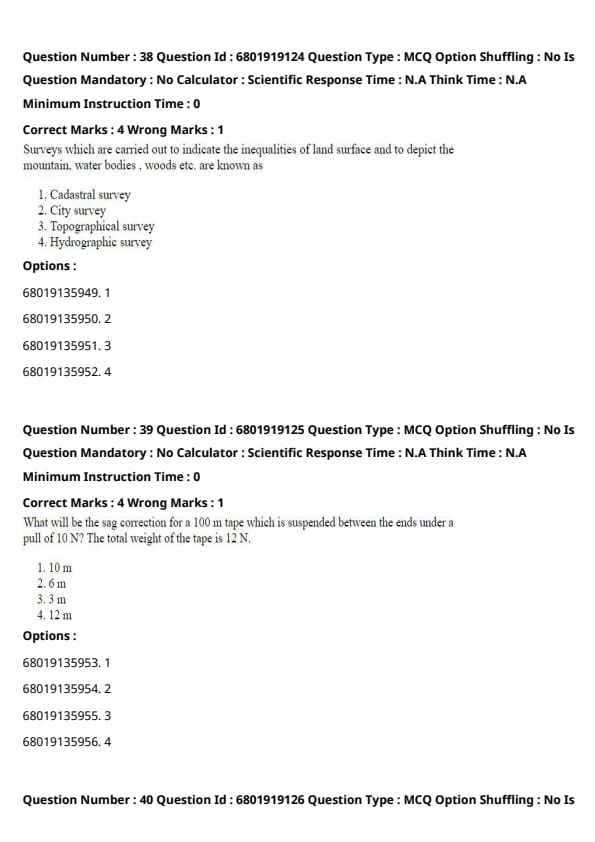
Surveys which are carried out to indicate the inequalities of land surface and to depict the mountain, water bodies, woods, etc. are known as:
View Solution
Topographical surveys are conducted to show the features of the land surface, such as mountains, valleys, water bodies, forests, and other natural features.
Topographical surveys are essential for understanding the natural features and terrain of an area.
Question 39:
What will be the sag correction for a 100 m tape which is suspended between the ends under a pull of 10 N? The total weight of the tape is 12 N.
View Solution
The sag correction can be calculated using the formula:
Sag correction = (wL²) / (8T)
Substituting the values:
Sag correction = (12 × 100²) / (8 × 10) = 6 m.
Sag correction compensates for the elongation of the tape due to its weight and the pull applied.
Question 40:
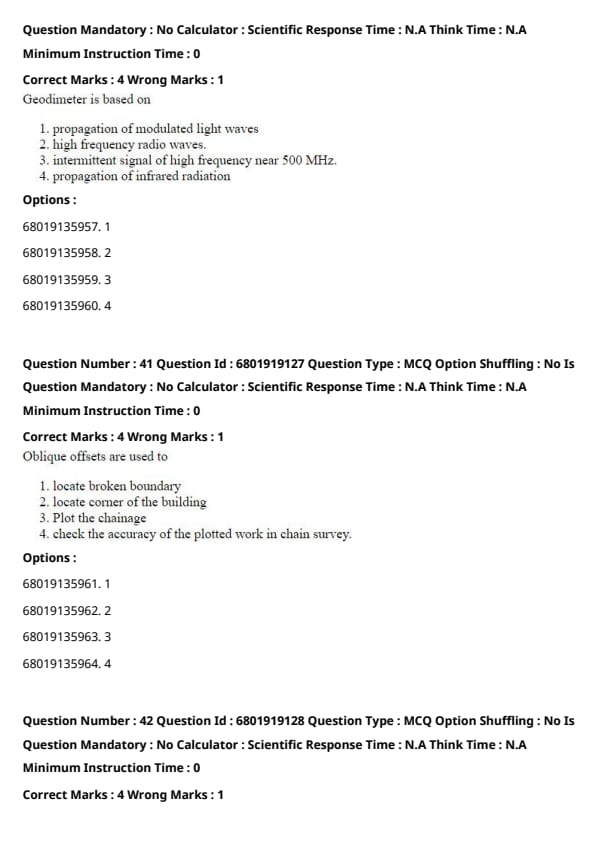
Geodimeter is based on:
View Solution
A Geodimeter uses the principle of modulated light waves for distance measurement, which helps achieve high accuracy in surveying and geodesy.
Geodimeter technology is based on the use of light waves to measure distances precisely in surveying applications.
Question 41:
Oblique offsets are used to:
View Solution
Oblique offsets are used in chain surveying to measure the distances to points that are not on the baseline but are at an angle to it, helping to locate broken boundaries.
Oblique offsets help in accurately plotting points that are off the baseline but at an angle to it.
Question 42:
Find the magnetic declination if the magnetic bearing of the sun at noon is 356°:
View Solution
The magnetic declination can be calculated by subtracting the magnetic bearing of the sun at noon (356°) from the true bearing (360°):
360° - 356° = 4° (East).
The magnetic declination is the angle between magnetic north and true north, measured in degrees east or west.
Question 43:
For which of the following permanent adjustment of a theodolite is the spire test used?
View Solution
The spire test is used to ensure that the line of sight of the theodolite is true and not affected by errors in the instrument's leveling or alignment.
The spire test checks the alignment of the theodolite’s line of sight for accuracy during adjustments.
Question 44:
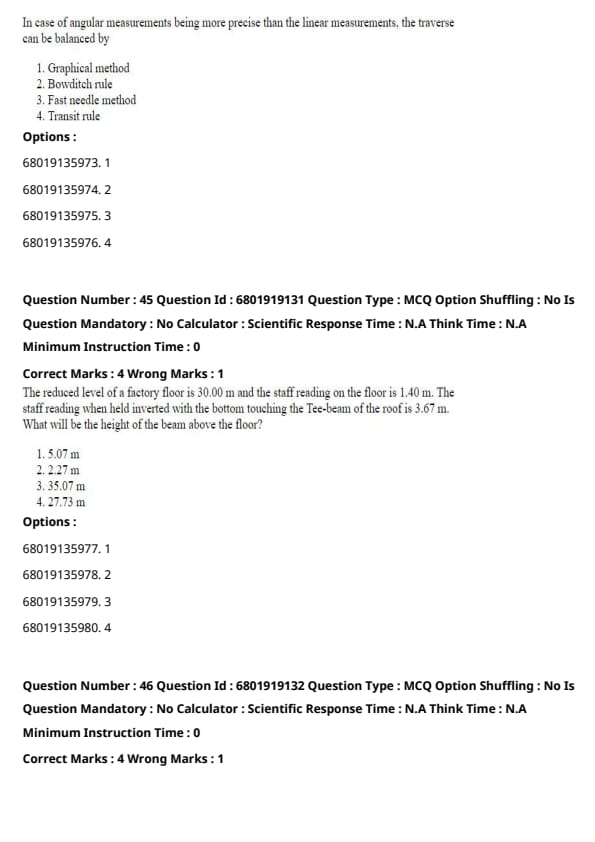
In case of angular measurements being more precise than the linear measurements, the traverse can be balanced by:
View Solution
The Bowditch rule is used to balance a traverse when angular measurements are more precise than the linear measurements, typically correcting for the errors in distance.
The Bowditch rule adjusts for error when angular precision is higher than linear distance accuracy.
Question 45:
The reduced level of a factory floor is 30.00 m and the staff reading on the floor is 1.40 m. The staff reading when held inverted with the bottom touching the Tee-beam of the roof is 3.67 m. What will be the height of the beam above the floor?
View Solution
The height of the beam above the floor is calculated by subtracting the inverted staff reading from the sum of the reduced level and the staff reading:
Height of beam = 30.00 + 1.40 - 3.67 = 5.07 m.
When the staff is held inverted, subtract the reading from the sum of the reduced level and the original staff reading to find the height.
Question 46:
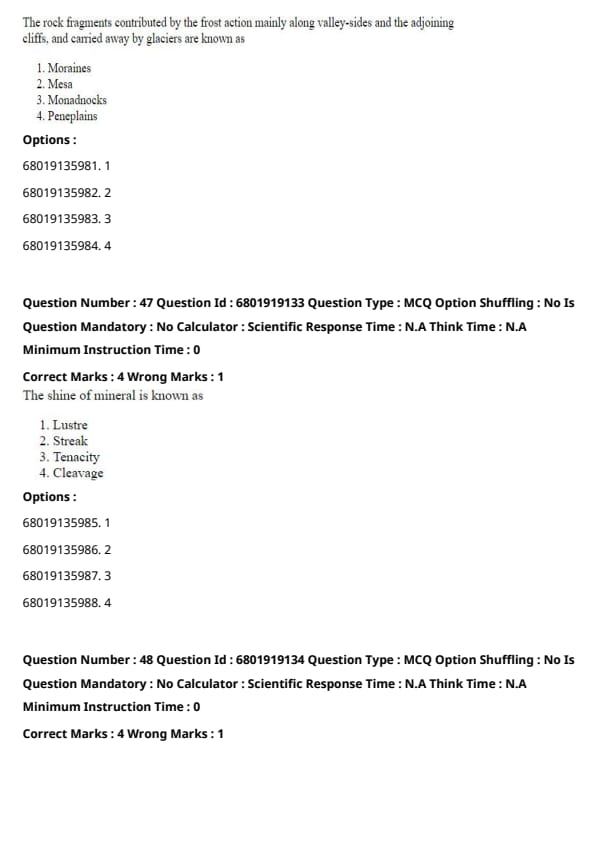
The rock fragments contributed by the frost action mainly along valley-sides and the adjoining cliffs, and carried away by glaciers are known as:
View Solution
Moraines are accumulations of glacial debris (such as rock fragments) carried and deposited by glaciers. These are typically found along valley sides and at the base of cliffs.
Moraines provide evidence of past glacial activity, marked by the accumulation of rock fragments.
Question 47:
The shine of mineral is known as:
View Solution
Lustre refers to the way a mineral reflects light from its surface, giving it a shiny appearance. It is an important property in mineral identification.
Lustre is one of the primary visual properties used to identify minerals based on their reflective qualities.
Question 48:
Muscovite is a family member of which category of mineral group?
View Solution
Muscovite is a member of the mica group of minerals, known for their sheet-like structure and excellent cleavage.
Mica minerals, like muscovite, have unique properties such as perfect cleavage and sheet-like structure.
Question 49:
Basaltisa is a:
View Solution
Basaltisa is a type of igneous rock formed from the rapid cooling of lava exposed at or near the Earth's surface.
Igneous rocks, like basalt, are formed from the solidification of magma or lava.
Question 50:
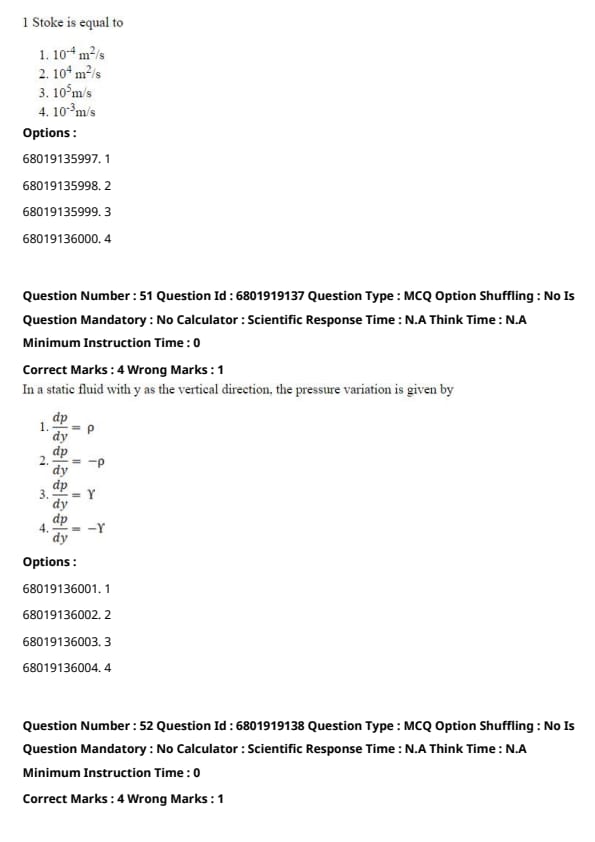
1 Stoke is equal to:
View Solution
1 Stoke is equal to 1 cm²/s, which is equivalent to 10-4 m²/s.
The Stoke is a unit of kinematic viscosity.
Question 51:
In a static fluid with y as the vertical direction, the pressure variation is given by:
View Solution
In fluid statics, γ denotes the specific weight of the fluid (γ = ρg). Taking upward as the positive y-direction, the pressure decreases with an increase in y, hence dp/dy = -γ.
When analyzing fluid statics, always keep track of the sign convention and the direction in which y is measured.
Question 52:
The gauge pressure at the surface of a liquid of density 900 kg/m³ is 0.4 bar. If the atmospheric pressure is 1 × 10⁵ Pa, calculate the absolute pressure at a depth of 50 m.
View Solution
The absolute pressure is calculated as the sum of atmospheric pressure, gauge pressure, and hydrostatic pressure. Using the given data, the total pressure at 50 m depth is 5.8145 bar.
Remember: Absolute pressure = Atmospheric pressure + Gauge pressure.
Question 53:
Condition for irrotational flow is given by:
View Solution
For two-dimensional flow, irrotational flow occurs when the z-component of vorticity is zero, which implies ∂v/∂x = ∂u/∂y.
For ideal (irrotational) fluid flow, the curl (vorticity) must be zero.
Question 54:
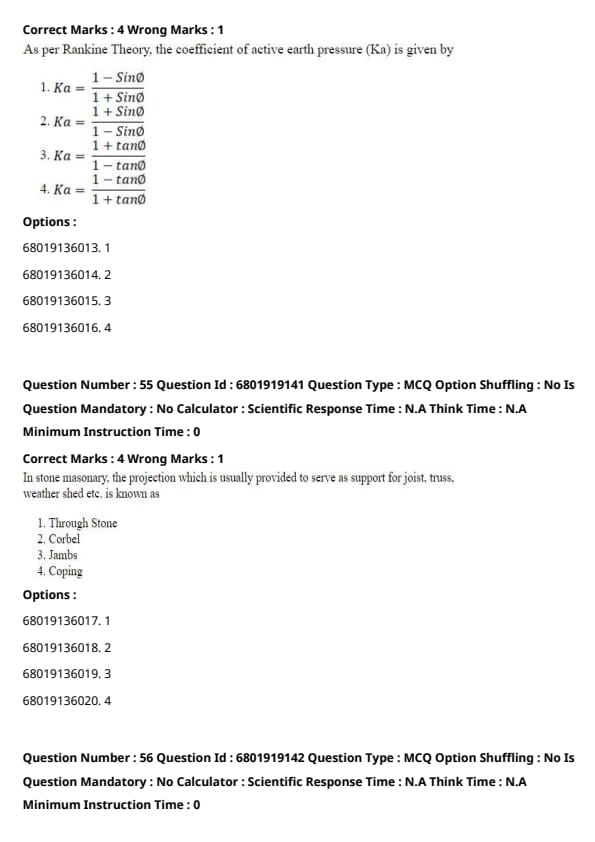
As per Rankine Theory, the coefficient of active earth pressure (Ka) is given by:
View Solution
Rankine’s theory states that the active earth pressure coefficient is given by Ka = (1 - sinφ)/(1 + sinφ).
Remember: Ka < 1 and it decreases with increasing φ.
Question 55:
In stone masonry, the projection which is usually provided to serve as support for joist, truss, weather shed, etc., is known as:
View Solution
A corbel is a masonry projection from the face of a wall, used to support structural or ornamental elements such as beams, trusses, or eaves.
Corbels must be built and anchored carefully to carry intended loads safely.
Question 56:
The treatment step adopted for removing bushes, debris, and wood from water is known as:
View Solution
Screening is the initial unit operation in water treatment plants used to remove large floating and suspended matter such as leaves, pieces of wood, and other large debris.
Always provide adequate screening before other treatment steps to protect downstream units.
Question 57:
Addition of Alum in water treatment increases:
View Solution
Alum reacts with bicarbonates in water to form insoluble flocs and releases SO₄²⁻ ions, leading to increased acidity and potential rise in hardness.
Alum reacts with water to form hydroxides and reduces alkalinity while increasing acidity.
Question 58:
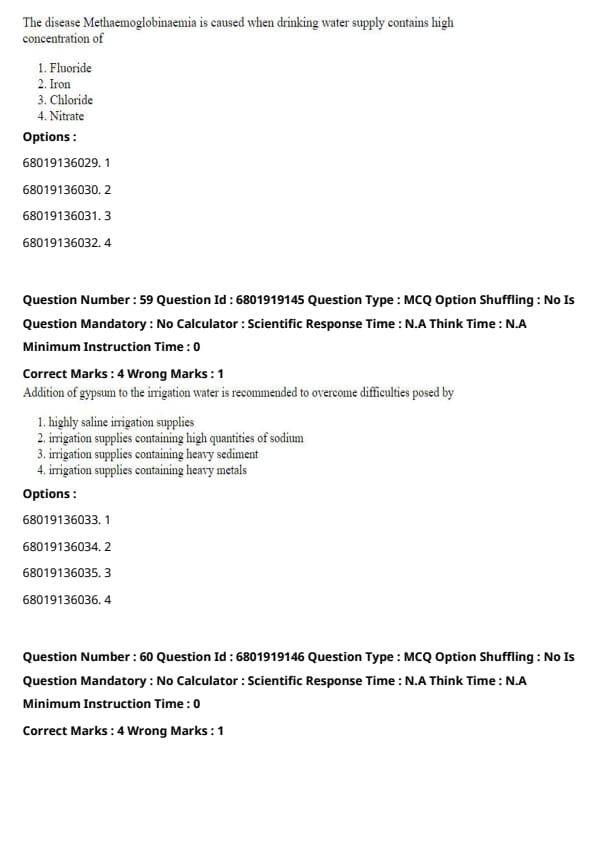
The disease Methaemoglobinaemia is caused when drinking water supply contains high concentration of:
View Solution
High nitrate concentration in drinking water may lead to Methemoglobinemia (blue baby syndrome) in infants, reducing oxygen-carrying capacity of the blood.
Excessive nitrates in drinking water sources often result from agricultural runoff containing fertilizers.
Question 59:
Addition of gypsum to the irrigation water is recommended to overcome difficulties posed by:
View Solution
Gypsum improves soil structure by replacing sodium with calcium on soil exchange sites, mitigating sodic soil conditions.
Gypsum is widely used in agricultural fields to reclaim sodic soils and improve water penetration.
Question 60:
The crop sequence, which cannot serve any useful purpose in crop rotation is:
View Solution
The sequence lacks a pulse or legume to replenish soil nitrogen and break pest cycles, making it less sustainable as a crop rotation.
Including legumes in crop rotation improves soil fertility and overall sustainability.
Question 61:
The moisture held by a well-drained soil against gravity drainage, by the force of surface tension between soil grains and water drops is called:
View Solution
Capillary water is held in the small pores of the soil by surface tension. After gravitational water drains away, the remaining water that adheres to soil particles is available to plants in the form of capillary water.
Field capacity is the upper limit of capillary water held in soil after free drainage. The water held specifically by surface tension in micropores is called capillary water.
Question 62:
The ratio of water stored in the root zone during irrigation, to the water needed in the root zone prior to irrigation is called:
View Solution
The efficiency of water storage measures how effectively the applied water replenishes the soil moisture deficit in the root zone. It is given by the ratio of water actually stored in the root zone to the water needed in the root zone before irrigation.
Other irrigation efficiencies include application efficiency, conveyance efficiency, and water use efficiency, each addressing different parts of the water delivery/use cycle.
Question 63:
Bio Diesel is commonly known as:
View Solution
Biodiesel is produced through the transesterification of vegetable oils or animal fats, resulting in chemicals commonly referred to as mono alkyl esters.
"Wood alcohol" (methanol) and "gasohol" (gasoline + ethanol blend) are different biofuels, while propane is a hydrocarbon gas. Biodiesel = mono alkyl esters.
Question 64:
Breathing ability of an engine can be represented by:
View Solution
Volumetric efficiency measures how effectively an engine can intake air compared to its theoretical cylinder volume. A higher volumetric efficiency means better “breathing” of the engine.
Improving volumetric efficiency (e.g., by turbocharging) increases engine power output and performance.
Question 65:
Travel reduction ratio (TRR) is commonly known as:
View Solution
Travel reduction ratio (TRR) is the percentage difference between the theoretical travel speed of a wheel (based on its geometry and rotation) and the actual travel speed on the ground. This difference is also called slip.
Wheel slip significantly affects tractor efficiency and fuel consumption in field operations.
Question 66:
Puddler is used:
View Solution
Puddling involves mixing soil and water thoroughly to create a dense layer in wetland (paddy) cultivation, reducing percolation losses and helping in weed control.
Puddling is mainly practiced in rice fields to maintain a shallow water depth and minimize water loss.
Question 67:
The process of breaking larger fat globules into smaller size to prevent fat separation is known as:
View Solution
Homogenization is a mechanical process used in milk processing to reduce fat globule size, prevent cream separation, and improve texture and taste.
Pasteurization involves heating to destroy pathogens. Sterilization extends shelf life under high temperature. Sanitization is cleaning to reduce microorganisms, but doesn’t break fat globules.
Question 68:
Pulsed light is a method of food preservation that involves:
View Solution
Pulsed light technology uses high-intensity, short-duration flashes of broad-spectrum light (UV to near IR) to inactivate microorganisms on food surfaces without significant heat generation.
Compared to thermal methods, pulsed light is considered a non-thermal or minimally thermal technology, helping to preserve fresh-like characteristics.
Question 69:
The hoop tension force (Fht) per metre (in kg) exerted on a cylindrical silo wall is given by:
View Solution
For a thin-walled cylinder of radius r subjected to an internal lateral pressure Pz, the hoop tension is given by Fht = r ⋅ Pz.
Hoop tension is a key factor in silo wall design to prevent structural failure due to horizontal grain pressure.
Question 70:
Certified seed has a tag of which colour?
View Solution
In standard seed certification schemes, the certified seed label is blue. Foundation seed usually has a white tag, while breeder seed is tagged with a golden yellow label.
Colour coding helps ensure seed quality traceability and authenticity from breeder to farmer.
Question 71:
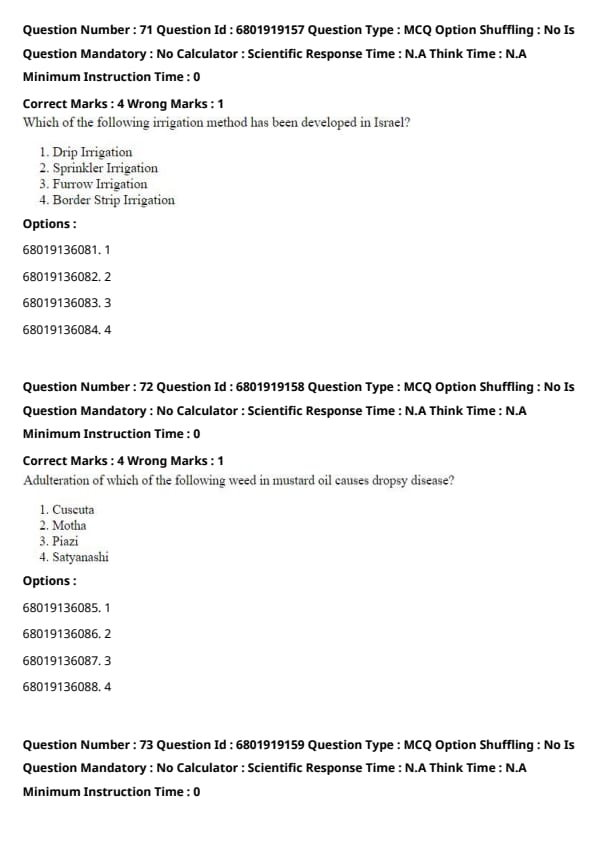
Which of the following irrigation method has been developed in Israel?
View Solution
Drip irrigation, also called trickle irrigation, was pioneered and extensively developed in Israel. It delivers water directly to the root zone of crops, minimizing evaporation losses and improving water-use efficiency.
Drip irrigation reduces water use substantially while ensuring consistent moisture for plant roots, making it ideal for arid and semi-arid regions.
Question 72:
Adulteration of which of the following weed in mustard oil causes dropsy disease?
View Solution
The seeds of Argemone mexicana (commonly known as Satyanashi) contain toxic alkaloids. When these seeds contaminate mustard seeds and are used for oil extraction, they can cause epidemic dropsy, a serious health condition.
Always ensure proper seed cleaning to avoid contamination with Argemone (Satyanashi) seeds.
Question 73:
Indian Dairy Corporation was established in which year?
View Solution
The Indian Dairy Corporation was established on 13 January 1970 to further the objectives of the “Operation Flood” program and to modernize the dairy sector in India.
Operation Flood, launched in 1970, was a major rural development program that helped transform India into one of the largest milk producers in the world.
Question 74:
Slip erosion is associated with:
View Solution
Slip erosion, also referred to as slip failure or slump, occurs when soil or rock on steep slopes becomes saturated with water, reducing shear strength and causing a mass movement downslope.
Preventing water infiltration and improving drainage on steep slopes helps reduce slip erosion.
Question 75:
The sediment yield (Dr) of a watershed, which is a function of sediment yield (Sy) and gross erosion (Eg), is represented by:
View Solution
“Delivery ratio” (often denoted as Dr) is the ratio of the sediment yield (Sy) at a watershed’s outlet to the gross erosion (Eg) within the watershed: Dr = Sy / Eg.
A higher delivery ratio indicates that a greater proportion of eroded material reaches the outlet, while a lower ratio suggests much of the eroded material is deposited within the watershed itself.
























*The article might have information for the previous academic years, please refer the official website of the exam.