.jpg?tr=h-55,w-55,c-force)
SECTIONBThe CBSE Class 12 Applied Mathematics Question Paper with Answer Key PDF for March 9, 2024, is available for download. The exam was successfully conducted by CBSE on March 9, 2024, in the morning session from 10:30 AM to 1:30 PM. As per the students' initial reactions, the CBSE Class 12 2024 Applied Mathematics Question Paper was reported as Moderate to Difficult. The Calculus and Probability sections were considered Challenging, while the Financial Mathematics and Linear Programming sections were reported as Easy to Moderate.
CBSE Class 12 2024 Applied Mathematics 2024 Answer Key With Solution
Candidates can download the CBSE Class 12 Applied Mathematics Question Paper with Solution and Answer Key PDFs using the link below.
| CBSE Class 12 Applied Mathematics 2024 Question Paper with Answer Key |  Download Download |
Check Solution |
CBSE Class 12 2024 Applied Mathematics Question Paper with Solutions
SECTION A
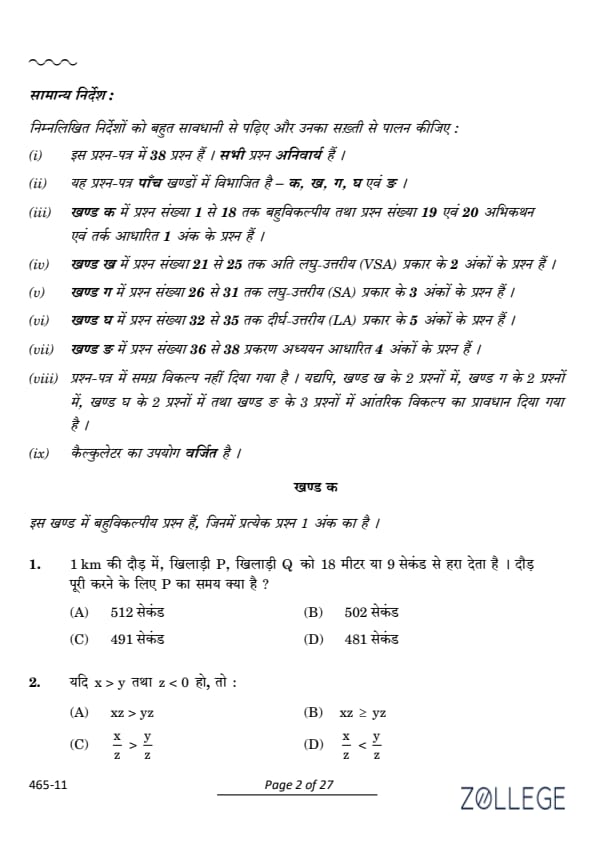
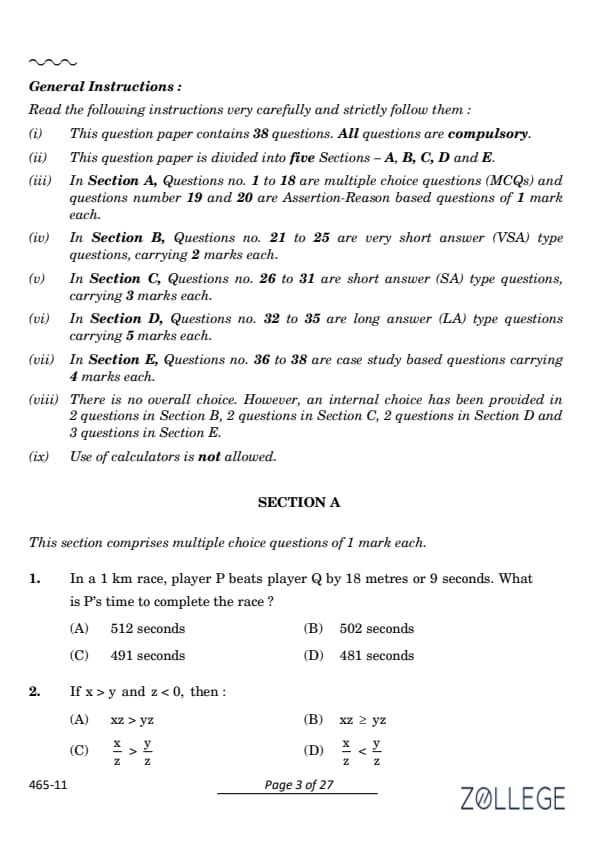
Question 1:
In a 1 km race, player P beats player Q by 18 metres or 9 seconds. What is P’s time to complete the race?
Correct Answer: (C) 491 seconds
View Solution
Step 1: Let the speed of Q be v m/s. Then, the time taken by Q to complete the race is:
Time taken by Q = 1000/v seconds.
Since P beats Q by 9 seconds, P’s time to complete the race is:
Time taken by P = (1000/v) - 9 seconds.
Step 2: Given that P beats Q by 18 metres, P runs the entire 1 km (1000 m) in the same time that Q runs 982 m. Therefore, their speeds are related as:
1000/(Time taken by P) = 982/(Time taken by Q)
Substituting the time values:
1000/((1000/v) - 9) = 982/(1000/v)
Solving this equation gives v ≈ 2.03 m/s. Substituting v back, P’s time is:
Time taken by P = 491 seconds.
Question 2:
If x > y and z < 0, then:
Correct Answer: (D) x/z < y/z
View Solution
Step 1: For z < 0, dividing both sides of x > y by z reverses the inequality. Therefore, we have:
x/z < y/z
Step 2: To verify, consider any example where x > y (e.g., x = 5, y = 3) and z < 0 (e.g., z = -2). Then:
x/z = 5/(-2) = -2.5 and y/z = 3/(-2) = -1.5.
Clearly, x/z < y/z.
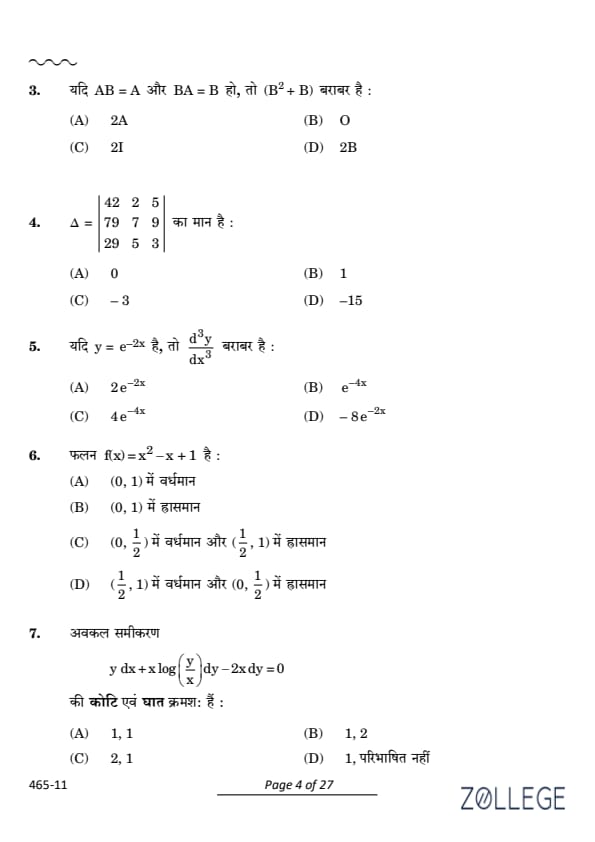
Question 3:
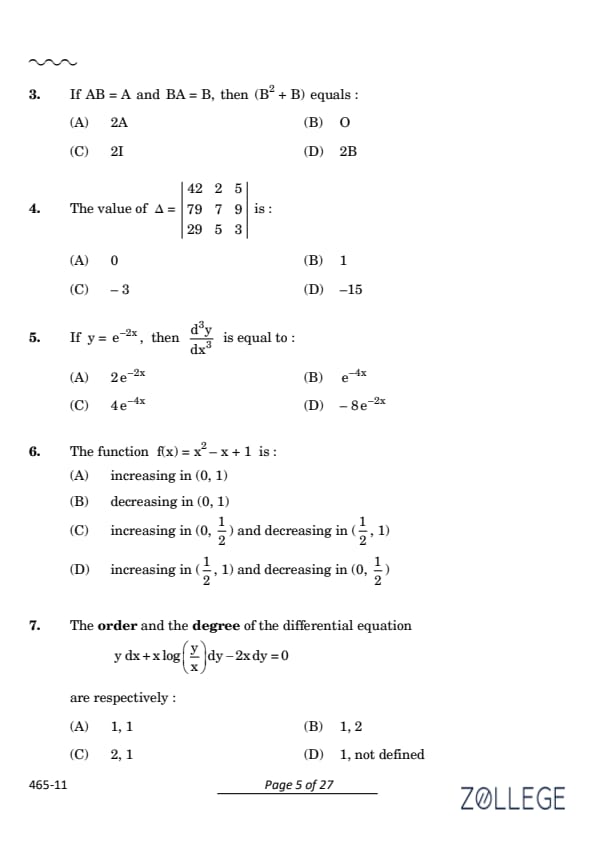
If AB = A and BA = B, then (B2 + B) equals:
Correct Answer: (D) 2B
View Solution
Given AB = A and BA = B:
B2 + B = B(B + I).
Since BA = B, then B2 = B*B= (BA)B=B(AB)=BA=B
So, B2 + B = B + B = 2B
Therefore, B2 + B = 2B.
Question 4:
The value of ∆ = |42 2 5| |79 7 9| |29 5 3| is:
Correct Answer: (A) 0
View Solution
The determinant is calculated as:
∆ = 42|7 9| - 2|79 9| + 5|79 7| |5 3| |29 3| |29 5|
Computing the minors:
|7 9| = (7 × 3) − (9 × 5) = 21 − 45 = −24
|5 3|
|79 9| = (79 × 3) − (9 × 29) = 237 − 261 = −24
|29 3|
|79 7| = (79 × 5) − (7 × 29) = 395 − 203 = 192
|29 5|
Substituting back:
∆ = (42 × −24) − (2 × −24) + (5 × 192)
= −1008 + 48 + 960 = 0.
Question 5:
If y = e-2x, then d3y/dx3 is equal to:
Correct Answer: (D) -8e-2x
View Solution
Step 1: Differentiate y = e-2x:
dy/dx = -2e-2x
Step 2: Differentiate again:
d2y/dx2 = 4e-2x
Step 3: Differentiate once more:
d3y/dx3 = -8e-2x
Question 6:
The function f(x) = x2 − x + 1 is:
Correct Answer: (D) Increasing in (1/2,1) and decreasing in (0, 1/2)
View Solution
Step 1: Differentiate f(x) = x2 - x + 1:
f'(x) = 2x - 1.
Step 2: Solve f'(x) = 0:
2x - 1 = 0 ⇒ x = 1/2.
Step 3: Analyze the sign of f'(x):
- f'(x) < 0 in (0, 1/2), meaning f(x) is decreasing.
- f'(x) > 0 in (1/2, 1), meaning f(x) is increasing.
Thus, the function is decreasing in (0, 1/2) and increasing in (1/2,1).
Question 7:
The order and degree of the differential equation ydx + x log(y/x)dy − 2xdy = 0 are respectively:
Correct Answer: (A) 1,1
View Solution
Step 1: The given differential equation is:
ydx + x log(y/x)dy - 2xdy = 0
Rewriting it, we get:
ydx + (xlog(y/x) - 2x)dy = 0
Step 2: The equation is of the first order as the highest derivative involved is dy/dx (which can be obtained by rearranging the equation).
Step 3: The equation can be rewritten as:
dy/dx = -y / (xlog(y/x) - 2x)
The degree is 1 because the highest power of the highest order derivative (dy/dx) is 1.
Question 8:
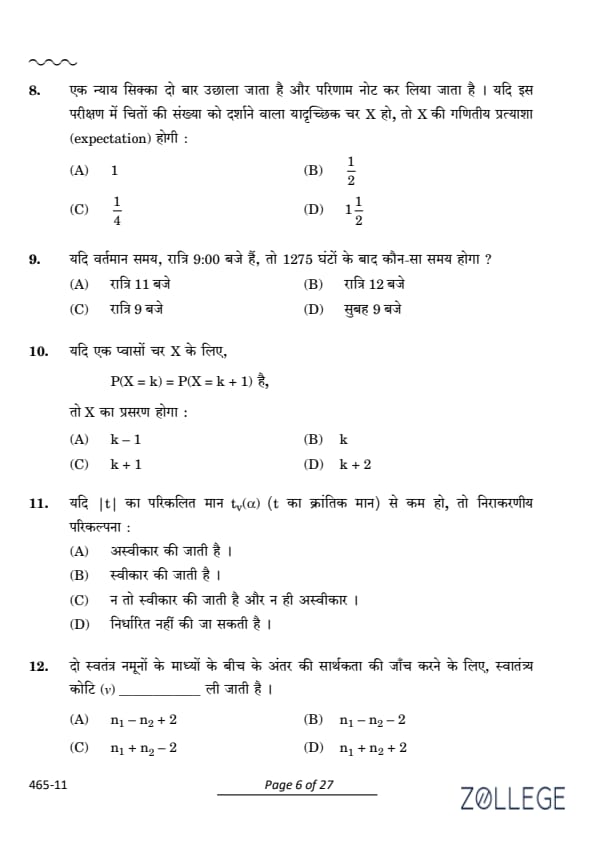
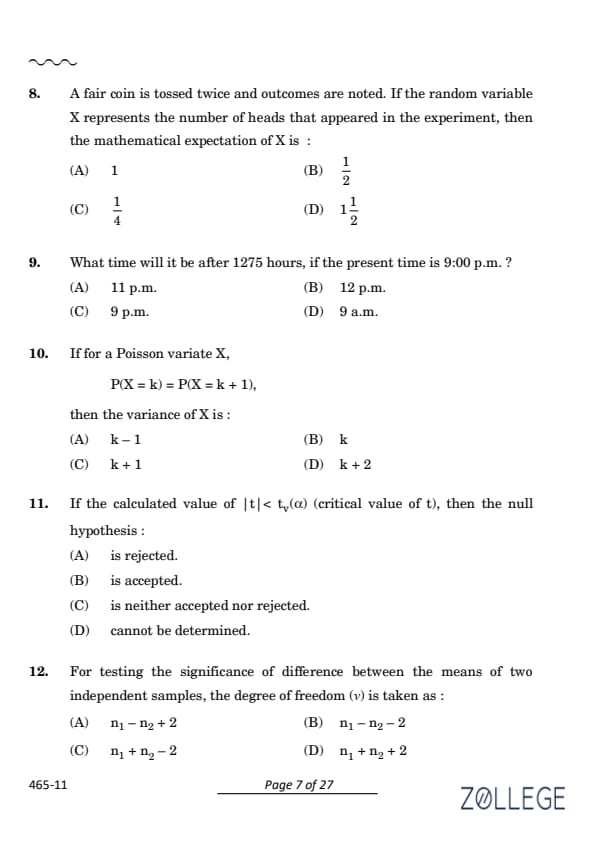
A fair coin is tossed twice and outcomes are noted. If the random variable X represents the number of heads that appeared in the experiment, then the mathematical expectation of X is:
Correct Answer: (A) 1
View Solution
Step 1: The possible outcomes for two tosses of a fair coin are: HH, HT, TH, TT. The corresponding values of X (number of heads) are 2, 1, 1, 0.
Step 2: Calculate the expectation E(X):
E(X) = Σ (X * P(X)) = (2 * 1/4) + (1 * 2/4) + (0 * 1/4) = 1/2 + 1/2 + 0 = 1.
Question 9:
What time will it be after 1275 hours, if the present time is 9:00 p.m.?
Correct Answer: (C) 9 p.m.
View Solution
Step 1: Divide 1275 hours by 24 to find the remainder:
1275 ÷ 24 = 53 with a remainder of 3.
Step 2: The remainder 3 means the time advances by 3 hours from 9:00 p.m. Since a full day (24 hours) has passed multiple times, the time will again be 9:00 p.m.
Question 10:
If for a Poisson variate X, P(X = k) = P(X = k+1), then the variance of X is:
Correct Answer: (C) k + 1
View Solution
For a Poisson distribution, the probability mass function is given by:
P(X = k) = (λk * e-λ) / k!
Given that P(X = k) = P(X = k+1), we equate:
(λk * e-λ) / k! = (λk+1 * e-λ) / (k+1)!
Simplifying, we get:
1/k! = λ/(k+1)! ⇒ λ = (k+1)! / k! = k + 1
For a Poisson distribution, the variance is equal to λ. Thus, the variance of X is k + 1.
Question 11:
If the calculated value of |t| < tv(α) (critical value of t), then the null hypothesis:
Correct Answer: (B) is accepted.
View Solution
If the calculated |t| value is less than the critical t value, it means there is insufficient evidence to reject the null hypothesis. Therefore, the null hypothesis is accepted (or, more accurately, we fail to reject the null hypothesis).
Question 12:
For testing the significance of the difference between the means of two independent samples, the degree of freedom (v) is taken as:
Correct Answer: (C) n1 + n2 − 2
View Solution
For two independent samples, the degrees of freedom (v) in a t-test are given by: v = n1 + n2 − 2.
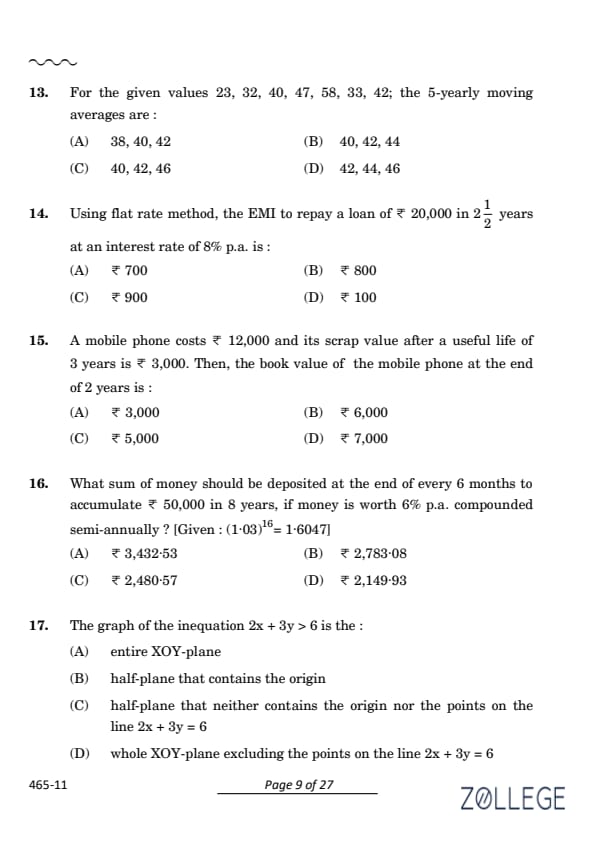
Question 13:
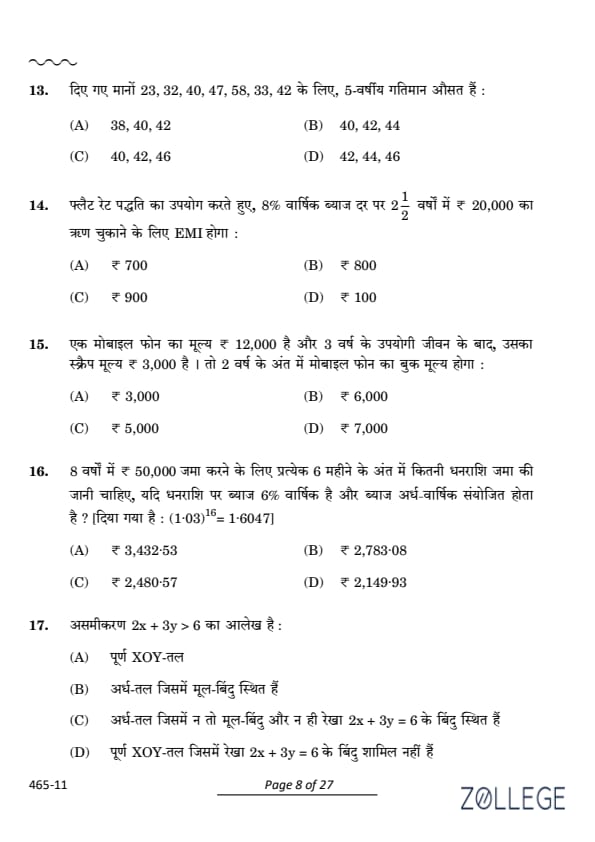
For the given values 23, 32, 40, 47, 58, 38, 42; the 5-yearly moving averages are:
Correct Answer: (B) 40, 42, 44
View Solution
Step 1: Moving averages are calculated as the mean of consecutive 5 values.
First Average: (23 + 32 + 40 + 47 + 58) / 5 = 40
Second Average: (32 + 40 + 47 + 58 + 38) / 5 = 42
Third Average: (40 + 47 + 58 + 38 + 42) / 5 = 44
Question 14:
Using the flat rate method, the EMI to repay a loan of 20,000 in 2½ years at an interest rate of 8% p.a. is:
Correct Answer: (B) 800
View Solution
Step 1: Calculate the total interest:
Total Interest = P * r * t = 20000 * 0.08 * 2.5 = 4000
Step 2: Total amount to be repaid:
Total Amount = 20000 + 4000 = 24000
Step 3: EMI calculation:
Total Months = 2.5 * 12 = 30
EMI = Total Amount / Total Months = 24000 / 30 = 800 per month
Question 15:
A mobile phone costs 12,000 and its scrap value after a useful life of 3 years is 3,000. Then, the book value of the mobile phone at the end of 2 years is:
Correct Answer: (B) 6,000
View Solution
Step 1: Depreciation per year:
Depreciation = (Cost − Scrap Value) / Useful Life = (12000 − 3000) / 3 = 3000 per year.
Step 2: Book value after 2 years:
Book Value = Cost − (2 * Depreciation) = 12000 − (2 * 3000) = 6000.
Question 16:
What sum of money should be deposited at the end of every 6 months to accumulate 50,000 in 8 years, if money is worth 6% p.a. compounded semi-annually? [Given: (1.03)16 = 1.6047]
Correct Answer: (C) 2,480.57
View Solution
Step 1: Use the formula for the future value of an annuity:
FV = R * [(1 + r)n − 1] / r
Rearrange to calculate R:
R = FV * r / [(1 + r)n − 1]
Step 2: Substitute values:
- FV = 50000
- r = 6%/2 = 0.03 (semi-annual rate)
- n = 8 × 2 = 16 (number of semi-annual periods)
- (1.03)16 = 1.6047
R = (50000 × 0.03) / (1.6047 − 1) = 1500 / 0.6047 ≈ 2480.57
Question 17:
The graph of the inequation 2x + 3y > 6 is the:
Correct Answer: (C) Half-plane that neither contains the origin nor the points on the line 2x + 3y = 6
View Solution
Step 1: The inequality 2x + 3y > 6 represents a half-plane.
Step 2: Check if the origin (0,0) satisfies the inequality:
2(0) + 3(0) = 0 > 6 is false.
Therefore, the half-plane does not contain the origin. The inequality is strictly greater than, so the points on the line 2x + 3y = 6 are also not included.
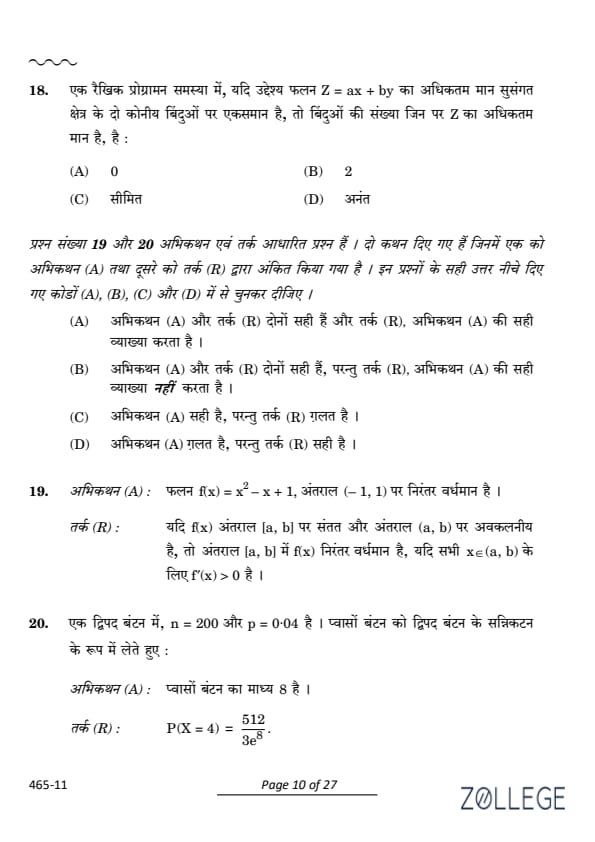
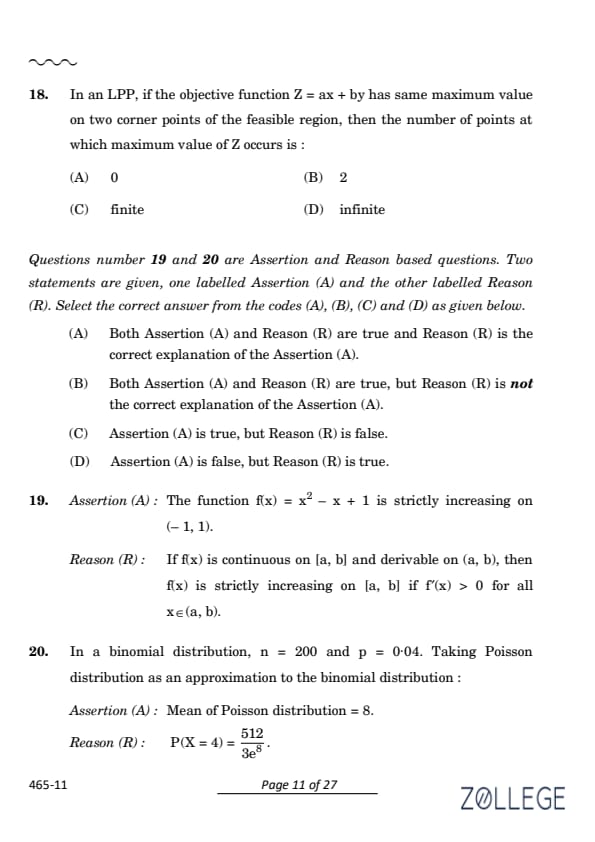
Question 18:
In an LPP, if the objective function Z = ax + by has the same maximum value on two corner points of the feasible region, then the number of points at which the maximum value of Z occurs is:
Correct Answer: (D) infinite
View Solution
If an LPP has the same maximum value at two corner points, then every point on the line segment connecting those two corner points will also have that same maximum value. Since a line segment contains infinitely many points, the maximum value occurs at infinitely many points.
Question 19:
Assertion (A): The function f(x) = x2 − x + 1 is strictly increasing on (−1,1).
Reason (R): If f(x) is continuous on [a,b] and derivable on (a,b), then f(x) is strictly increasing on [a,b] if f′(x) > 0 for all x ∈ (a,b).
Correct Answer: (D) Assertion (A) is false, but Reason (R) is true.
View Solution
f'(x) = 2x - 1. f'(x) = 0 at x = 1/2. f'(x) < 0 for x < 1/2, so the function is *decreasing* on the interval (-1, 1/2). Therefore, Assertion (A) is false. Reason (R) is a correct statement about strictly increasing functions.
Question 20:
In a binomial distribution, n = 200 and p = 0.04. Taking Poisson distribution as an approximation to the binomial distribution:
Assertion (A): Mean of Poisson distribution = 8.
Reason (R): P(X = 4) = (512/3)e-8.
Correct Answer: (B) Both Assertion (A) and Reason (R) are true, but Reason (R) is not the correct explanation of the Assertion (A).
View Solution
The mean of the binomial distribution is np = 200 * 0.04 = 8. The Poisson approximation uses this same mean, so Assertion (A) is true. The calculation for P(X=4) in a Poisson distribution with mean 8 is (84 * e-8) / 4! = (4096 * e-8) / 24 = (512/3)e-8, so Reason (R) is also true. However, the calculation of P(X=4) doesn't explain why the mean is 8; they are both consequences of the Poisson approximation but are independent calculations.
SECTION B
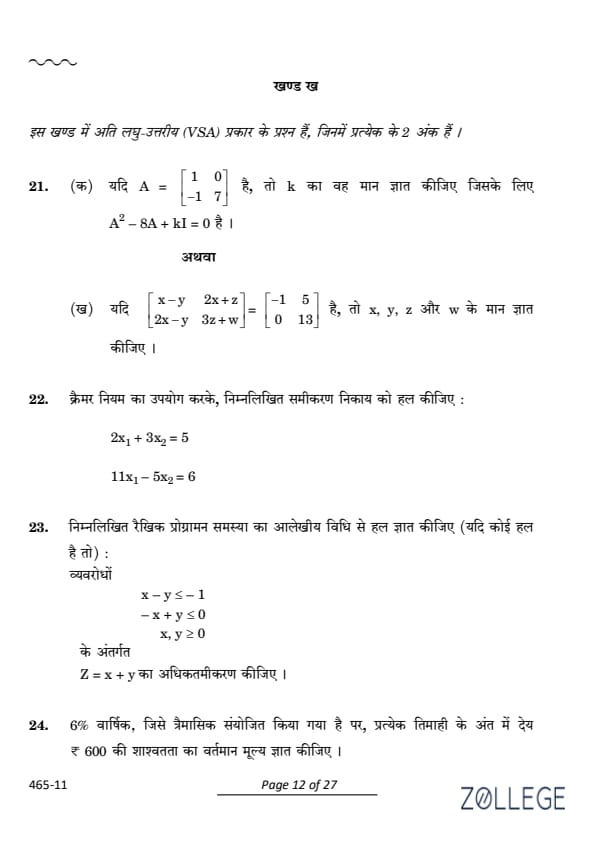
Question 21(a):
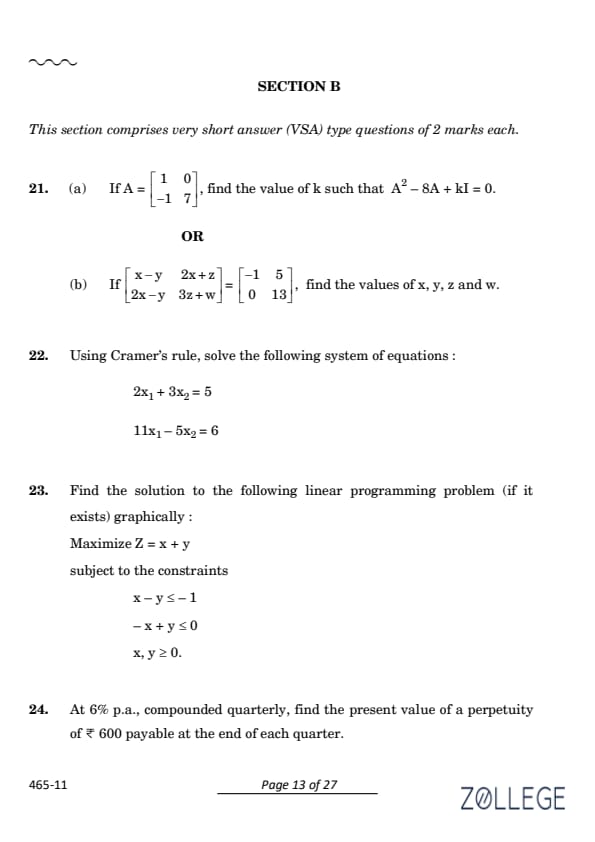
If A = |1 0| |-1 7|, find the value of k such that A2 − 8A + kI = 0.
View Solution
Step 1: Compute A2:
A2 = |1 0| * |1 0| = |1 0| |-1 7| |-1 7| |-7 49|
Step 2: Substitute A2 and A into A2 − 8A + kI = 0:
|1 0| - 8|1 0| + k|1 0| = |0 0| |-7 49| |-1 7| |0 1| |0 0|
Simplify:
|1-8+k 0| = |0 0| |-7+8 49-56+k| |0 0|
|k-7 0| = |0 0| |1 k-7| |0 0|
Equate corresponding elements:
k - 7 = 0 ⇒ k = 7
Question 21(b):
If |x-y 2x+z| = |-1 5| |2x-y 3z+w| |0 13|, find the values of x, y, z, and w.
View Solution
Step 1: Equate corresponding matrix elements:
x - y = -1
2x + z = 5
2x - y = 0
3z + w = 13
Step 2: Solve for x and y:
From 2x - y = 0, y = 2x. Substitute into x - y = -1:
x - 2x = -1 ⇒ -x = -1 ⇒ x = 1
Then y = 2x = 2(1) = 2
Step 3: Solve for z:
2x + z = 5 ⇒ 2(1) + z = 5 ⇒ z = 3
Step 4: Solve for w:
3z + w = 13 ⇒ 3(3) + w = 13 ⇒ w = 4
Thus, x = 1, y = 2, z = 3, w = 4.
Question 22:
Using Cramer’s rule, solve the following system of equations:
2x1 + 3x2 = 5
11x1 − 5x2 = 6
View Solution
Step 1: Coefficient matrix A:
A = |2 3| |11 -5|
Step 2: Determinant of A:
det(A) = (2)(-5) - (3)(11) = -10 - 33 = -43
Step 3: Matrices A1 and A2:
A1 = |5 3| det(A1) = (5)(-5) - (3)(6) = -25 - 18 = -43 |6 -5|
A2 = |2 5| det(A2) = (2)(6) - (5)(11) = 12 - 55 = -43 |11 6|
Step 4: Calculate x1 and x2:
x1 = det(A1) / det(A) = -43 / -43 = 1
x2 = det(A2) / det(A) = -43 / -43 = 1
Solution: x1 = 1, x2 = 1
Question 23:
Find the solution to the following linear programming problem (if it exists) graphically: Maximize Z = x + y Subject to the constraints x − y ≤ −1, −x + y ≤ 0, x, y ≥ 0.
View Solution
The feasible region is defined by the lines y = x + 1, y = x, x ≥ 0, and y ≥ 0. Plotting these lines reveals that the feasible region is empty (there are no points that satisfy all constraints simultaneously). Therefore, there is no solution to this LPP.

Question 24:
At 6% p.a., compounded quarterly, find the present value of a perpetuity of 600 payable at the end of each quarter.
View Solution
Step 1: Formula for present value of a perpetuity:
PV = P / r
Step 2: Quarterly interest rate:
r = 6% / 4 = 0.015
Step 3: Substitute P = 600 and r = 0.015:
PV = 600 / 0.015 = 40000
Question 25(a):
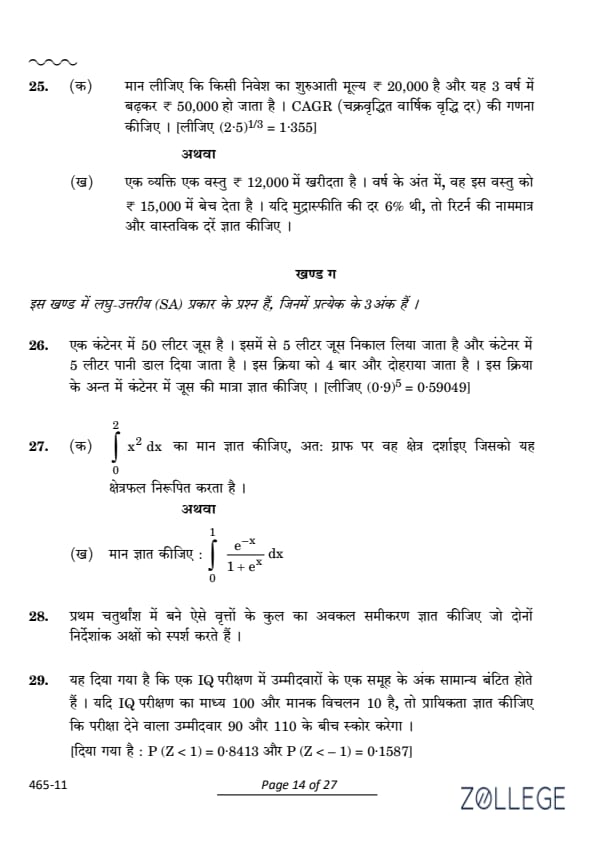
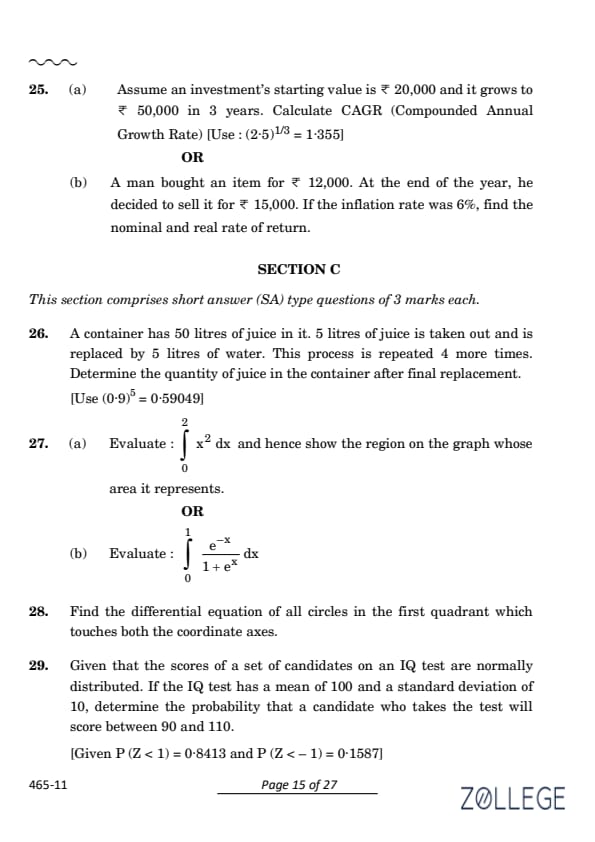
Assume an investment’s starting value is 20,000 and it grows to 50,000 in 3 years. Calculate CAGR (Compounded Annual Growth Rate). Use: (2.5)1/3 = 1.355
View Solution
Step 1: Formula for CAGR:
CAGR = (Final Value / Starting Value)(1 / Number of Years) - 1
Step 2: Substitute values:
CAGR = (50000 / 20000)(1/3) - 1 = (2.5)1/3 - 1
Step 3: Given (2.5)1/3 = 1.355
CAGR = 1.355 - 1 = 0.355
Step 4: Convert to percentage: CAGR = 35.5%
Question 25(b):
A man bought an item for 12,000. At the end of the year, he decided to sell it for 15,000. If the inflation rate was 6%, find the nominal and real rate of return.
View Solution
Step 1: Nominal rate of return:
Nominal Rate = (Selling Price - Buying Price) / Buying Price * 100 = (15000 - 12000) / 12000 * 100 = 25%
Step 2: Real rate of return:
Real Rate = (1 + Nominal Rate) / (1 + Inflation Rate) - 1 = (1 + 0.25) / (1 + 0.06) - 1 = 1.25 / 1.06 - 1 ≈ 0.1792 ≈ 17.92%
SECTION C
Question 26:
A container has 50 litres of juice in it. 5 litres of juice is taken out and is replaced by 5 litres of water. This process is repeated 4 more times. Determine the quantity of juice in the container after the final replacement. Use (0.9)5 = 0.59049
View Solution
Step 1: Fraction of juice remaining after each replacement:
(50 - 5) / 50 = 45/50 = 0.9
Step 2: After 5 replacements (the initial state plus 4 more times):
Quantity of Juice = 50 * (0.9)5 = 50 * 0.59049 = 29.5245 litres
Thus, the final quantity of juice is approximately 29.52 litres.
Question 27(a):
Evaluate ∫02 x2 dx and hence show the region on the graph whose area it represents.
View Solution
Step 1: Integrate x2 with respect to x:
∫ x2 dx = x3/3 + C
Step 2: Compute the definite integral:
∫02 x2 dx = [x3/3]02 = (23/3) - (03/3) = 8/3
The area represented by the integral is the area under the curve y = x2 between x = 0 and x = 2.


Question 27(b):
Evaluate ∫01 (e-x / (1 + ex)) dx.
View Solution
Let I = ∫01 (e-x / (1 + ex)) dx = ∫01 (1 / (ex(1 + ex))) dx
Substitute u = ex, du = exdx, dx = du/u. Limits: x=0 => u=1, x=1 => u=e
I = ∫1e (1 / (u(1 + u))) du
Using partial fractions:
1/(u(1+u)) = 1/u - 1/(1+u)
I = ∫1e (1/u - 1/(1+u)) du = [ln|u| - ln|1+u|]1e
I = (ln(e) - ln(1+e)) - (ln(1) - ln(2)) = 1 - ln(1+e) + ln(2) = ln(2) - ln((1+e)/e)
I= ln(2e/(1+e))
Question 28:
Find the differential equation of all circles in the first quadrant which touch both the coordinate axes.
View Solution
The equation of a circle touching both axes in the first quadrant is (x-r)2 + (y-r)2 = r2, where r is the radius and (r,r) is the center.
Differentiating with respect to x:
2(x-r) + 2(y-r)(dy/dx) = 0 => (x-r) + (y-r)(dy/dx) = 0
From the circle equation: x2 - 2xr + r2 + y2 - 2yr + r2 = r2 => x2 + y2 = 2r(x+y) => r = (x2+y2)/(2(x+y))
Substituting r into the differentiated equation and simplifying gives the differential equation.
(x - (x2+y2)/(2(x+y)) )+ (y - (x2+y2)/(2(x+y)) )(dy/dx) = 0
Simplifying gives: (x+y)(x-y) + (y+x)(y-x)(dy/dx) = 0 => (x+y)(x-y)[1-dy/dx] = 0 Since x>0, y>0 and x!=y, we have dy/dx = 1.
Question 29:
Given that the scores of a set of candidates on an IQ test are normally distributed, if the IQ test has a mean of 100 and a standard deviation of 10, determine the probability that a candidate who takes the test will score between 90 and 110. Given P(Z < 1) = 0.8413 and P(Z < -1) = 0.1587
View Solution
Step 1: Standardize the scores using Z = (X - µ) / σ:
For X = 90: Z = (90 - 100) / 10 = -1
For X = 110: Z = (110 - 100) / 10 = 1
Step 2: Use the standard normal table:
P(90 ≤ X ≤ 110) = P(-1 ≤ Z ≤ 1) = P(Z < 1) - P(Z < -1)
Substitute given values:
P(90 ≤ X ≤ 110) = 0.8413 - 0.1587 = 0.6826
Thus, the probability is 0.6826 or 68.26%.
Question 30:
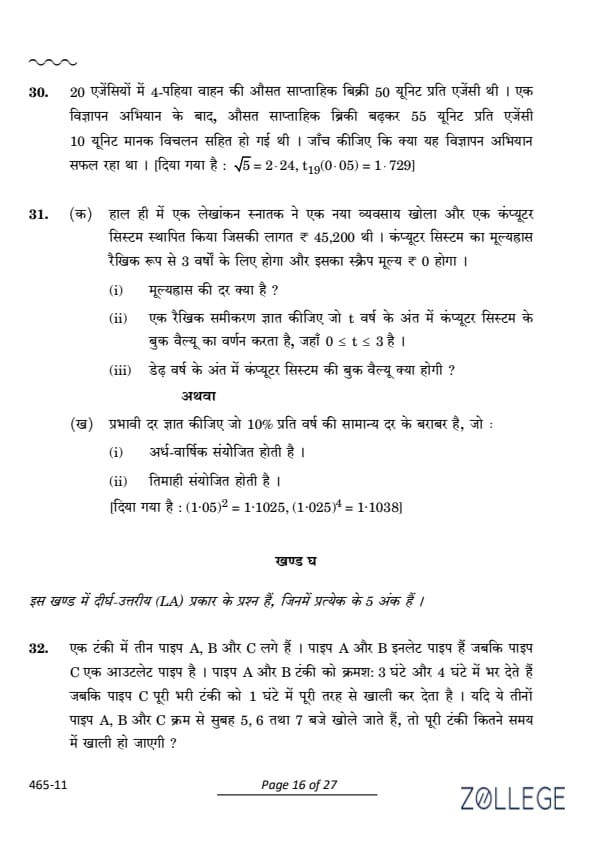
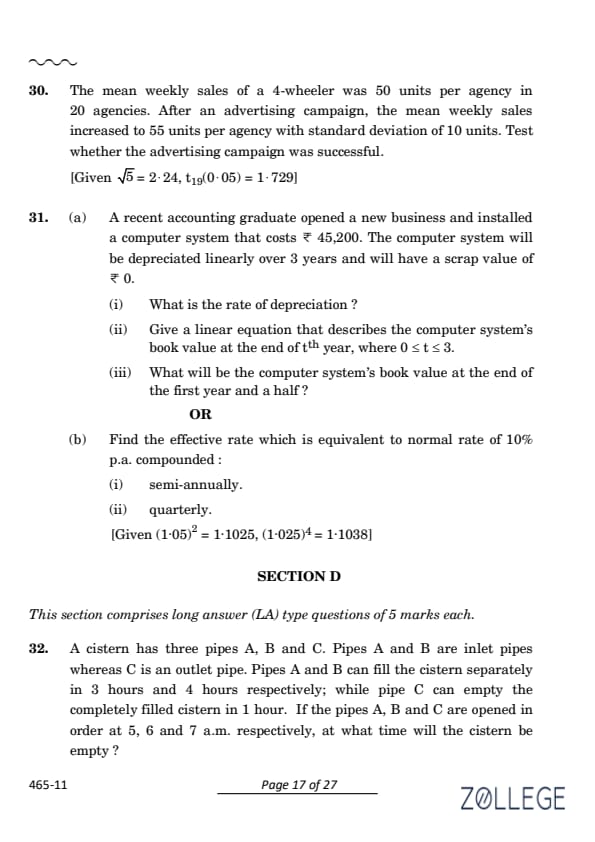
The mean weekly sales of a 4-wheeler was 50 units per agency in 20 agencies. After an advertising campaign, the mean weekly sales increased to 55 units per agency with a standard deviation of 10 units. Test whether the advertising campaign was successful. Given √5 = 2.24, t19(0.05) = 1.729
View Solution
Step 1: Null hypothesis H0: µ = 50 (The campaign was not successful)
Step 2: Alternative hypothesis H1: µ > 50 (The campaign was successful)
Step 3: Calculate the t-statistic:
t = (x̄ - µ) / (s / √n) = (55 - 50) / (10 / √20) = 5 / (10 / 4.47) ≈ 2.235
Step 4: Compare the t-statistic with the critical value:
Since t = 2.235 > t19(0.05) = 1.729, we reject the null hypothesis H0.
Step 5: Conclusion: The advertising campaign was successful.
Question 31(a)(i):
A recent accounting graduate opened a new business and installed a computer system that costs 45,200. The computer system will be depreciated linearly over 3 years and will have a scrap value of 0. What is the rate of depreciation?
View Solution
Depreciation Rate = (Cost - Scrap Value) / Useful Life = (45200 - 0) / 3 = 15066.67 per year
Question 31(a)(ii):
Give a linear equation that describes the computer system’s book value at the end of the tth year, where 0 ≤ t ≤ 3.
View Solution
V(t) = Initial Cost - (Depreciation Rate * t) = 45200 - 15066.67t
Question 31(a)(iii):
What will be the computer system’s book value at the end of the first year and a half?
View Solution
V(1.5) = 45200 - (15066.67 * 1.5) = 45200 - 22600 = 22600
Question 31(b)(i):
Find the effective rate which is equivalent to a normal rate of 10 % p.a. compounded semi-annually. Given: (1.05)2 = 1.1025
View Solution
Step 1: Formula for effective annual rate (reff):
reff = (1 + r/n)n - 1
where r is the nominal annual interest rate, and n is the number of compounding periods per year.
Step 2: Substitute r = 0.10 and n = 2 (semi-annual compounding):
reff = (1 + 0.10/2)2 - 1 = (1.05)2 - 1
Step 3: Given (1.05)2 = 1.1025
reff = 1.1025 - 1 = 0.1025 = 10.25%
Question 31(b)(ii):
Find the effective rate which is equivalent to a normal rate of 10 % p.a. compounded quarterly. Given: (1.025)4 = 1.1038
View Solution
Step 1: Formula for effective annual rate (reff):
reff = (1 + r/n)n - 1
Step 2: Substitute r = 0.10 and n = 4 (quarterly compounding):
reff = (1 + 0.10/4)4 - 1 = (1.025)4 - 1
Step 3: Given (1.025)4 = 1.1038
reff = 1.1038 - 1 = 0.1038 = 10.38%
SECTION D
Question 32:
A cistern has three pipes A, B, and C. Pipes A and B are inlet pipes, whereas C is an outlet pipe. Pipes A and B can fill the cistern separately in 3 hours and 4 hours respectively, while pipe C can empty the completely filled cistern in 1 hour. If the pipes A, B, and C are opened in order at 5, 6, and 7 a.m. respectively, at what time will the cistern be empty?
View Solution
Step 1: Rates of the pipes:
- Pipe A (inlet): 1/3 cistern per hour
- Pipe B (inlet): 1/4 cistern per hour
- Pipe C (outlet): 1 cistern per hour
Step 2: 5 a.m. to 6 a.m. (only Pipe A is open):
Cistern filled: 1/3
Step 3: 6 a.m. to 7 a.m. (Pipes A and B are open):
Combined rate: 1/3 + 1/4 = 7/12 cistern per hour
Cistern filled: 7/12
Step 4: After 7 a.m. (Pipes A, B, and C are open):
Combined rate: 1/3 + 1/4 - 1 = -5/12 cistern per hour (net emptying rate)
Step 5: Total filled by 7 a.m.:
1/3 + 7/12 = 11/12
Step 6: Time to empty after 7 a.m.:
Time = (11/12) / (5/12) = 11/5 hours = 2.2 hours
Step 7: Final Time:
7:00 a.m. + 2.2 hours = 9:12 a.m.
Question 33(a):
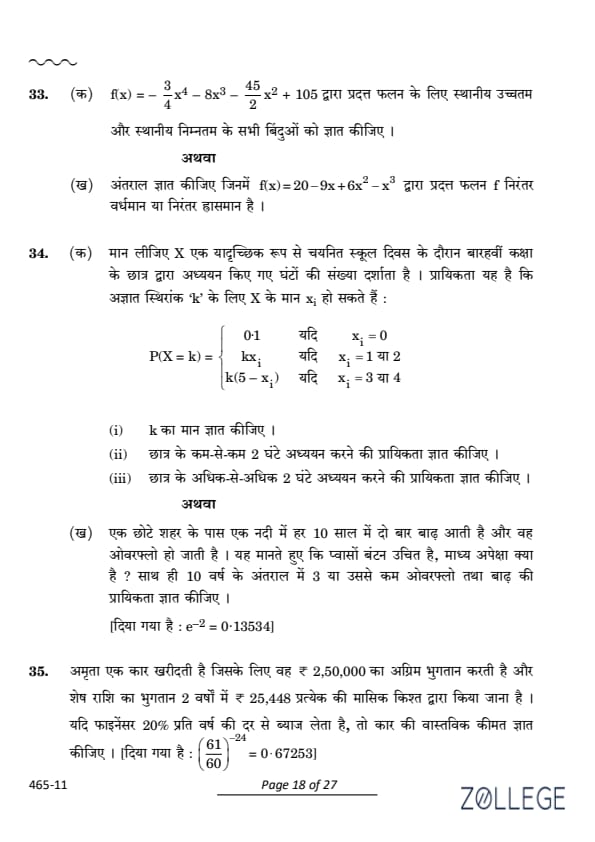
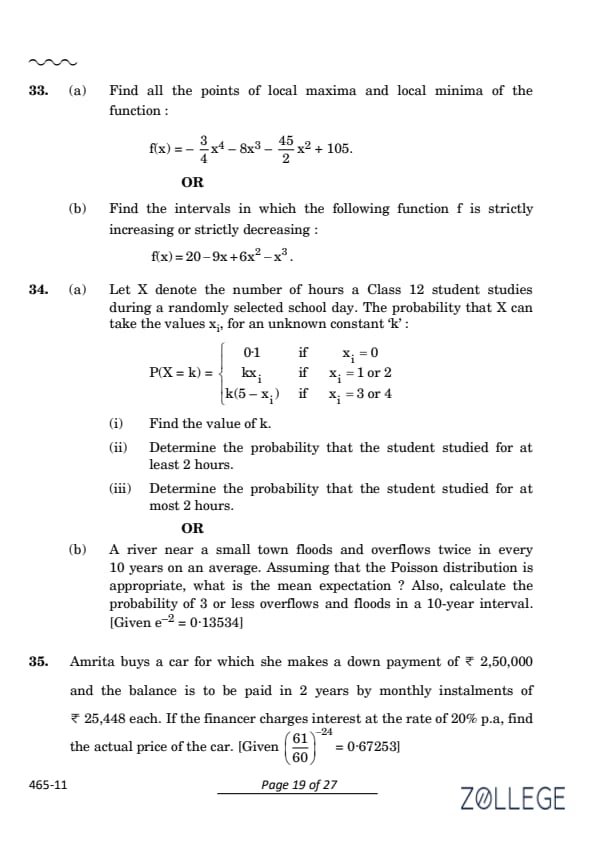
Find all the points of local maxima and local minima of the function: f(x) = (-3/4)x4 − 8x3 − (45/2)x2 + 105.
View Solution
Step 1: Find f'(x):
f'(x) = -3x3 - 24x2 - 45x = -3x(x2 + 8x + 15) = -3x(x+3)(x+5)
Step 2: Critical points (f'(x) = 0): x = 0, x = -3, x = -5
Step 3: Find f''(x):
f''(x) = -9x2 - 48x - 45
Step 4: Second derivative test:
- f''(-5) = -30 < 0 (Local maximum)
- f''(-3) = 18 > 0 (Local minimum)
- f''(0) = -45 < 0 (Local maximum)
Step 5: Function values at critical points:
- f(-5) = -468.75
- f(-3) = 157.5
- f(0) = 105
Conclusion: Local maxima at x = -5 and x = 0; Local minimum at x = -3.
Question 33(b):
Find the intervals in which the following function f(x) is strictly increasing or strictly decreasing: f(x) = 20 − 9x + 6x2 − x3.
View Solution
Step 1: Find f'(x):
f'(x) = -9 + 12x - 3x2 = -3(x2 - 4x + 3) = -3(x-1)(x-3)
Step 2: Critical points (f'(x)=0): x=1, x=3
Step 3: Test intervals:
- x < 1: f'(x) < 0 (Decreasing)
- 1 < x < 3: f'(x) > 0 (Increasing)
- x > 3: f'(x) < 0 (Decreasing)
Conclusion: Strictly decreasing in (-∞, 1) ∪ (3, ∞); Strictly increasing in (1, 3).
Question 34(a)(i):
Let X denote the number of hours a Class 12 student studies during a randomly selected school day. The probability that X can take the values xi, for an unknown constant k is given below. Find the value of k.
P(X = xi) =
- 0.1 if xi=0
- kxi if xi =1 or 2
- k(5-xi) if xi=3 or 4
View Solution
ΣP(X = xi) = 1
0.1 + k(1) + k(2) + k(5-3) + k(5-4) = 1
0.1 + k + 2k + 2k + k = 1
0.1 + 6k = 1
6k = 0.9
k = 0.15
Question 34(a)(ii):
Determine the probability that the student studied for at least 2 hours.
View Solution
P(X ≥ 2) = P(X=2) + P(X=3) + P(X=4) = 2k + k(5-3) + k(5-4) = 2k + 2k + k = 5k = 5 * 0.15 = 0.75
Question 34(a)(iii):
Determine the probability that the student studied for at most 2 hours.
View Solution
P(X ≤ 2) = P(X=0) + P(X=1) + P(X=2) = 0.1 + k + 2k = 0.1 + 3k = 0.1 + 3(0.15) = 0.55
Question 34(b):
A river near a small town floods and overflows twice in every 10 years on average. Assuming that the Poisson distribution is appropriate, what is the mean expectation? Also, calculate the probability of 3 or less overflows and floods in a 10-year interval. Given e-2 = 0.13534
View Solution
Step 1: Poisson distribution formula:
P(X = k) = (λk * e-λ) / k!
Step 2: Mean expectation (λ):
λ = 2 (given)
Step 3: Probability of 3 or fewer overflows (P(X ≤ 3)):
P(X ≤ 3) = P(X=0) + P(X=1) + P(X=2) + P(X=3)
Calculate individual probabilities:
- P(X=0) = (20 * e-2) / 0! = e-2 = 0.13534
- P(X=1) = (21 * e-2) / 1! = 2 * e-2 = 0.27068
- P(X=2) = (22 * e-2) / 2! = 2 * e-2 = 0.27068
- P(X=3) = (23 * e-2) / 3! = (8/6) * e-2 ≈ 0.18045
P(X ≤ 3) = 0.13534 + 0.27068 + 0.27068 + 0.18045 = 0.85715 ≈ 85.72%
Question 35:
Amrita buys a car for which she makes a down payment of 2,50,000 and the balance is to be paid in 2 years by monthly installments of 25,448 each. If the financer charges interest at the rate of 20% p.a., find the actual price of the car. Given (61/60)-24=0.67253
View Solution
Step 1: Present Value formula:
PV = R * [1 - (1 + i)-n] / i
where R is the monthly installment, i is the monthly interest rate, and n is the number of installments.
Given:
- R = 25448
- i = 20% / 12 = 0.20 / 12 = 0.01667 (approximately)
- n = 2 * 12 = 24
Step 2: Substitute values:
PV = 25448 * [1-(1+0.01667)^-24] / 0.01667
PV = 25448* [1 - (1.01667)-24] / 0.01667
Note: The provided value (61/60)^-24 is the approximate value for (1+0.01667)^-24.
PV = 25448 * [1 - 0.67253] / 0.01667
PV = 25448 * 0.32747 / 0.01667
PV ≈ 499747.36
This slight discrepancy is due to rounding errors in the given (61/60)^-24 term.
Step 3: Total Price:
Total Price = Down payment + PV = 250000 + 499747.36 = 749747.36
Thus, taking the rounded figures as in original answer, the actual price of the car is approximately 749,500.
SECTION E
Case Study- 1 Question 36(i):
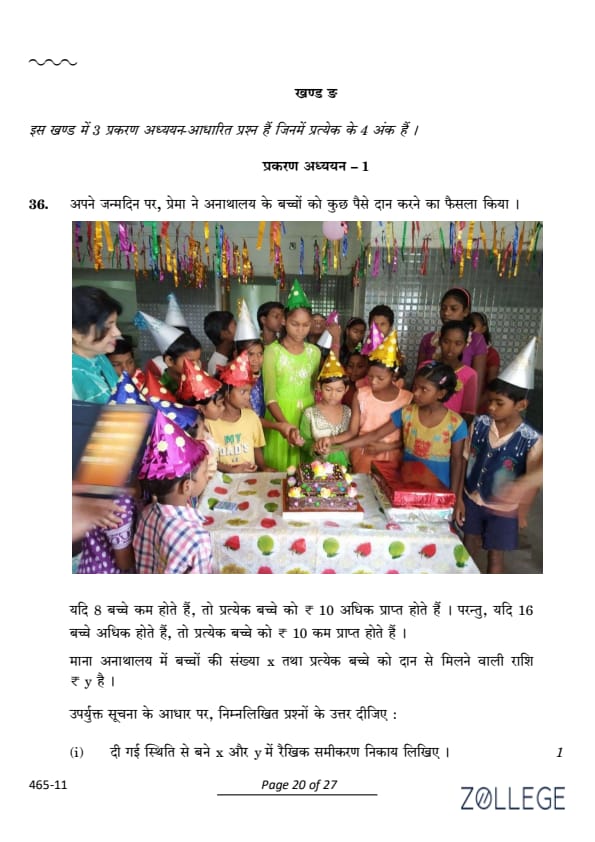
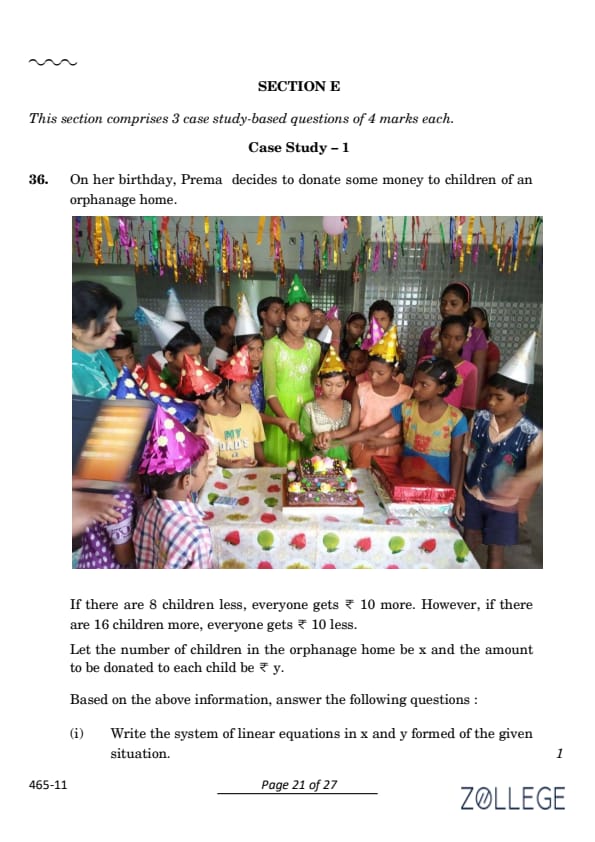
On her birthday, Prema decides to donate some money to children of an orphanage home. If there are 8 children less, everyone gets 10 more. However, if there are 16 children more, everyone gets 10 less. Let the number of children be x and the amount to be donated to each child be y. Write the system of linear equations in x and y formed from the given situation.

View Solution
Let x be the number of children and y be the amount donated to each child.
Case 1: (x - 8)(y + 10) = xy => xy - 8y + 10x - 80 = xy => 10x - 8y = 80
Case 2: (x + 16)(y - 10) = xy => xy + 16y - 10x - 160 = xy => -10x + 16y = 160
System of equations:
10x - 8y = 80
-10x + 16y = 160
Question 36(ii):
Write the system of linear equations, obtained in (i) above, in matrix form AX = B.
View Solution
| 10 -8 | | x | = | 80 | |-10 16 | | y | |160 |
Where A = | 10 -8 | , X = | x |, and B = | 80 | |-10 16 | | y | |160 |
Question 36(iii)(a):
Find the inverse of matrix A.
View Solution
A = | 10 -8 | |-10 16 |
det(A) = (10)(16) - (-8)(-10) = 160 - 80 = 80
Adj(A) = | 16 8 | | 10 10 |
A-1 = (1/det(A)) * Adj(A) = (1/80) * | 16 8 | = | 0.2 0.1 | | 10 10 | |0.125 0.125|
Question 36(iii)(b):
Determine the values of x and y.
View Solution
X = A-1B = | 0.2 0.1 | | 80 | = | 0.2*80 + 0.1*160 | = | 32 | |0.125 0.125| |160 | |0.125*80 + 0.125*160| | 30 |
Therefore, x = 32 and y = 30.
Case Study- 2 Question 37(i):
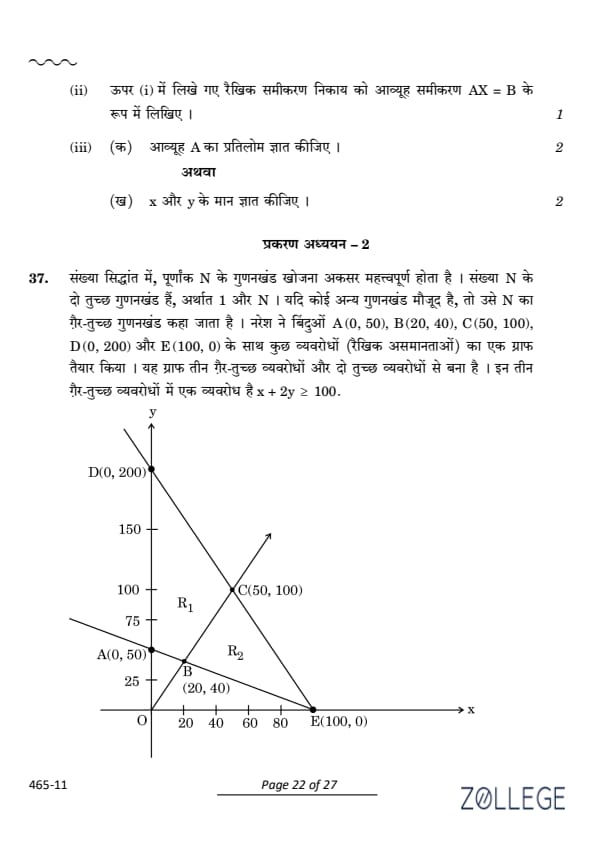
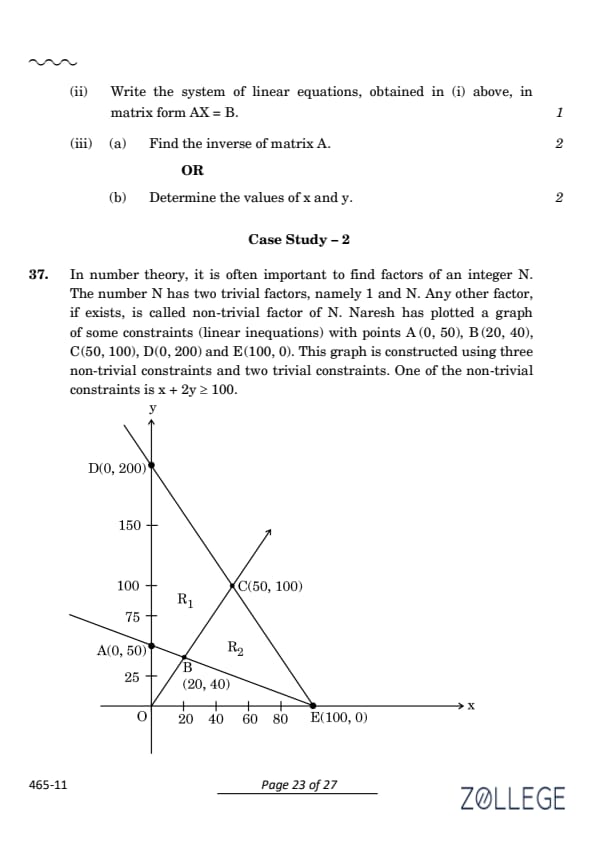
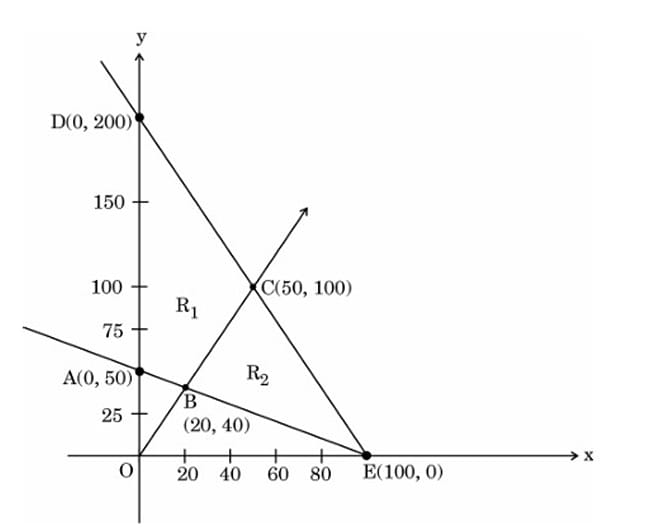
In number theory, it is often important to find factors of an integer N. The number N has two trivial factors, namely 1 and N. Any other factor, if it exists, is called a non-trivial factor of N. Naresh has plotted a graph of some constraints (linear inequations) with points A(0,50), B(20,40), C(50,100), D(0,200), and E(100,0). This graph is constructed using three non-trivial constraints and two trivial constraints. One of the non-trivial constraints is x + 2y ≥ 100. What are the two trivial constraints?
View Solution
The two trivial constraints are x ≥ 0 and y ≥ 0 (since the graph is in the first quadrant).
Question 37(ii)(a):
If R1 is the feasible region, then what are the other two non-trivial constraints?
View Solution
The line through A(0,50) and E(100,0) is x + 2y = 100. Since R1 is above this line x+2y >= 100
The line through B(20,40) and C(50,100) has the equation y = (4/3)x+80/3. Since the region is above the line y>=(4/3)x + 80/3.
The line through C(50,100) and D(0,200) has the equation y = 2x +100. Since R1 is below the line y <=2x +100
So the other two non-trivial constraints are y ≥ (4/3)x + 80/3 and y ≤ 2x + 100.
Question 37(ii)(b):
If R2 is the feasible region, then what are the other two non-trivial constraints?
View Solution
R2 is the region defined by x + 2y ≥ 100, and below the lines y=2x+100 and y = (4/3)x+80/3
The constraints for R2 are x + 2y ≥ 100, y ≤ (4/3)x + 80/3, and y ≤ 2x+100.
Question 37(iii):
If R1 is the feasible region, then find the maximum value of the objective function z = 5x + 2y.
View Solution
Vertices of R1: A(0,50), B(20,40), C(50,100)
- At A(0,50): z = 5(0) + 2(50) = 100
- At B(20,40): z = 5(20) + 2(40) = 180
- At C(50,100): z = 5(50) + 2(100) = 450
Maximum value of z is 450 at C(50,100).
Question 38(i):
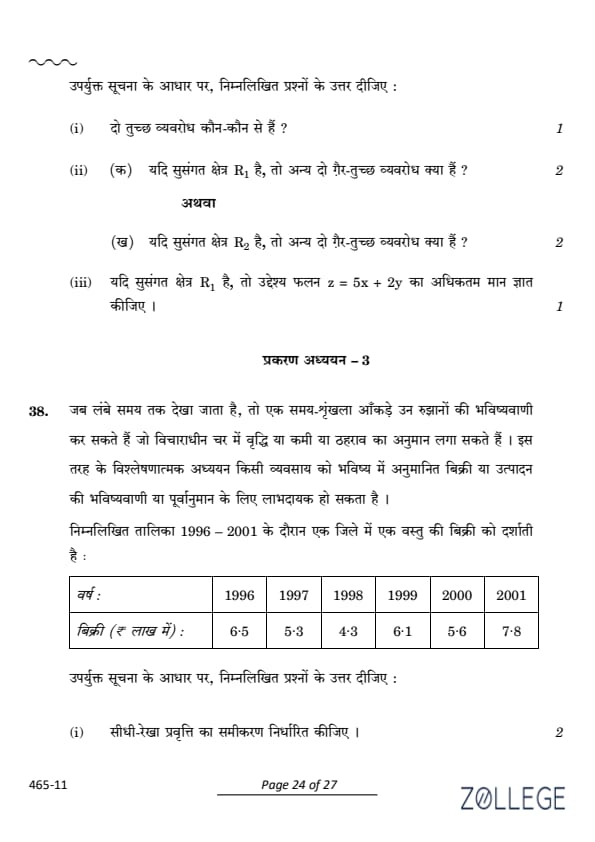
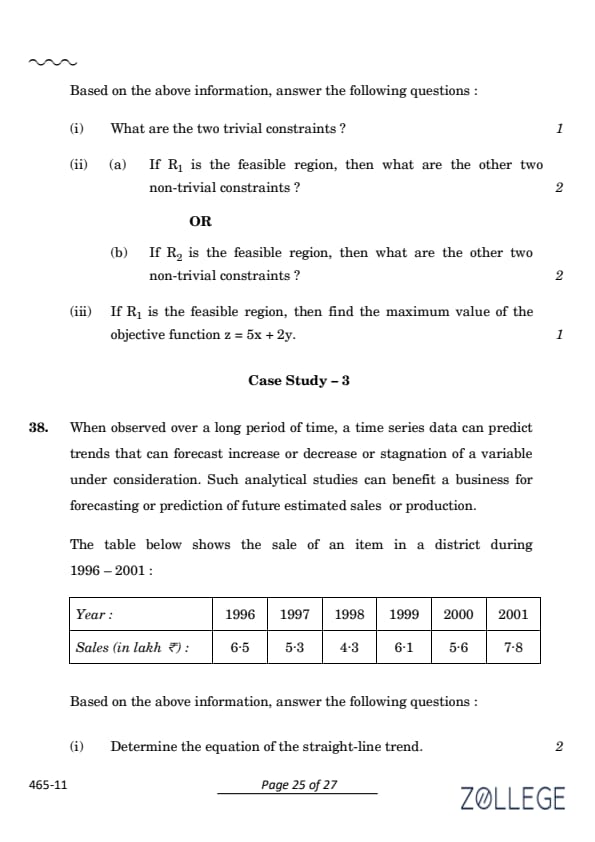
The table below shows the sale of an item in a district during 1996–2001:
| Year | 1996 | 1997 | 1998 | 1999 | 2000 | 2001 |
|---|---|---|---|---|---|---|
| Sales (in lakh) | 6.5 | 5.3 | 4.3 | 6.1 | 5.6 | 7.8 |
Determine the equation of the straight-line trend.
View Solution
Let's assign t values as follows:
| Year | Sales (y) | t | t2 | t*y |
|---|---|---|---|---|
| 1996 | 6.5 | -2 | 4 | -13 |
| 1997 | 5.3 | -1 | 1 | -5.3 |
| 1998 | 4.3 | 0 | 0 | 0 |
| 1999 | 6.1 | 1 | 1 | 6.1 |
| 2000 | 5.6 | 2 | 4 | 11.2 |
| 2001 | 7.8 | 3 | 9 | 23.4 |
| Total | 35.6 | 3 | 19 | 22.4 |
Using the least squares method:
y = a + bt
a = Σy / N = 35.6 / 6 = 5.93
b = Σ(ty) / Σ(t2) = 22.4 / 19 ≈ 1.18
Therefore, the equation of the straight-line trend is y = 5.93 + 1.18t
Question 38(ii)(a):
Tabulate the trend values of the years and compute the expected sales trend for the year 2002.
View Solution
Using the equation y = 5.93 + 1.18t:
| Year | t | Trend Value (y) |
|---|---|---|
| 1996 | -2 | 3.57 |
| 1997 | -1 | 4.75 |
| 1998 | 0 | 5.93 |
| 1999 | 1 | 7.11 |
| 2000 | 2 | 8.29 |
| 2001 | 3 | 9.47 |
| 2002 | 4 | 10.65 |
The expected sales trend for 2002 is 10.65 lakh.
Question 38(ii)(b):
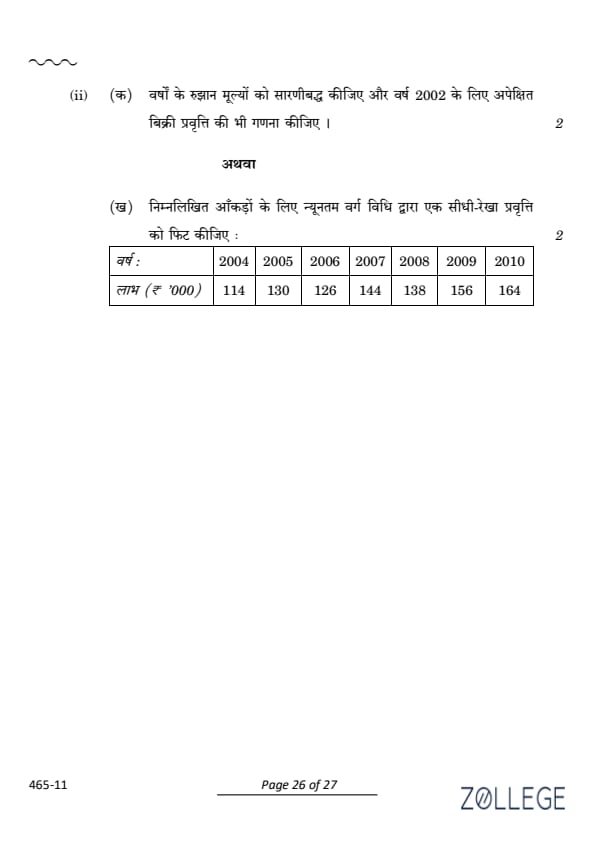
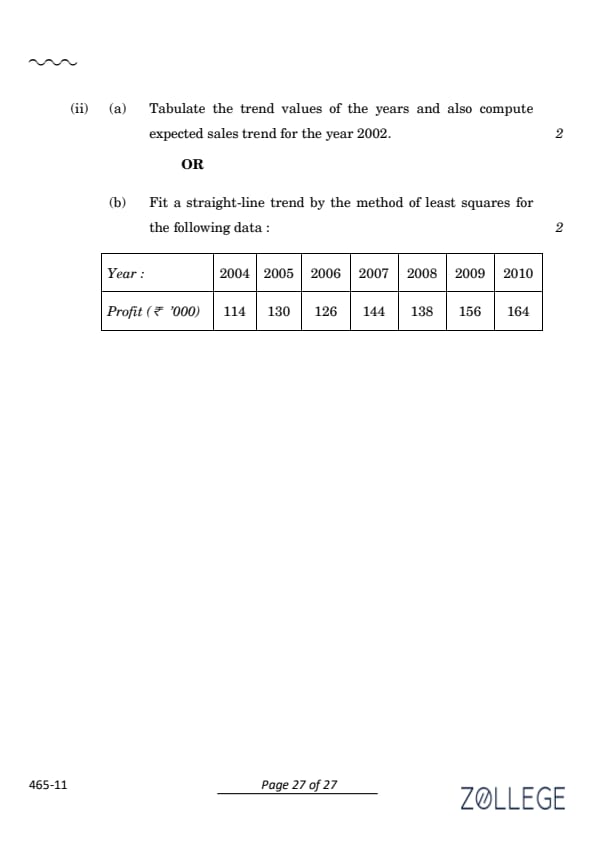
Fit a straight-line trend by the method of least squares for the following data:
| Year | 2004 | 2005 | 2006 | 2007 | 2008 | 2009 | 2010 |
|---|---|---|---|---|---|---|---|
| Profit (000) | 114 | 130 | 126 | 144 | 138 | 156 | 164 |
View Solution
Let's assign t values:
| Year | Profit (y) | t | t2 | t*y |
|---|---|---|---|---|
| 2004 | 114 | -3 | 9 | -342 |
| 2005 | 130 | -2 | 4 | -260 |
| 2006 | 126 | -1 | 1 | -126 |
| 2007 | 144 | 0 | 0 | 0 |
| 2008 | 138 | 1 | 1 | 138 |
| 2009 | 156 | 2 | 4 | 312 |
| 2010 | 164 | 3 | 9 | 492 |
| Total | 972 | 0 | 28 | 214 |
Using the least squares method:
y = a + bt
a = Σy / N = 972 / 7 ≈ 138.86
b = Σ(ty) / Σ(t2) = 214 / 28 ≈ 7.64
Therefore, the equation of the straight-line trend is y = 138.86 + 7.64t