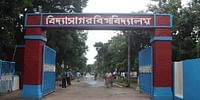
Netaji Subhas Open University (NSOU) began operating in 1997 as a state open and distance learning university established by the Government of West Bengal under West Bengal Act XIX. It is recognised by the University Grants Commission (UGC), holds a NAAC A grade, and serves as West Bengal's principal institution for open and distance education.
NSOU secured the 2nd position in India's Open Universities category under NIRF 2024. Its headquarters is at 1 Woodburn Park, Kolkata, in the historic residence of Sarat Chandra Bose.
The university reaches learners in urban and rural parts of West Bengal through more than 120 study centres. Its main regional centres include Kalyani, Siliguri, and Purulia.
- Undergraduate study includes BA and BA (Hons.) in Bengali, Economics, English, History, Political Science, Public Administration, and Sociology. Students can also pursue B.Sc and B.Sc (Hons.) in Botany, Chemistry, Geography, Mathematics, Physics, and Zoology, along with B.Com, B.Ed, and B.Lib.I.Sc.
- At the postgraduate level, NSOU runs MA courses in 9 humanities and social science subjects and M.Sc courses in Environmental Science, Geography, Mathematics, and Zoology. M.Com, MSW, M.Ed, M.Lib, and MBA are also offered.
- Doctoral study is available in Commerce, Education, History, Library and Information Science, Management, Political Science, Sociology, Humanities and Social Sciences, and Science.
- Diploma-level options include PGDM in Retail Management and postgraduate diplomas in Disaster Management, Financial Management, Hospital Management, Import-Export Management, Psychological Counselling, Taxation, Advertising and PR, Physician Assistant, and Journalism. Diploma courses in Food Processing and Graphic Design are available as well.
NSOU Courses and Fees
NSOU offers undergraduate programmes with total fees ranging from INR 5,750 to INR 40,000. Fees differ by course, subject, and study duration. The MBA and M.Ed carry higher fees than the university's other professional programmes.
| Programme | Duration | Eligibility | Total Fees |
|---|---|---|---|
| BA (standard, 7 subjects) | 3 years | 10+2 in any stream with 45% | INR 15,150 |
| BA (Hons., 8 subjects) | 3 years | 10+2 in any stream with 45% | INR 15,150 |
| B.Sc (standard sciences) | 3 years | 10+2 Science with 45% | INR 21,150 |
| B.Sc (Hons. sciences) | 3 years | 10+2 Science with 45% | INR 15,600 to INR 21,750 |
| B.Com | 3 years | 10+2 in any stream with 45% | INR 15,150 |
| B.Ed | 2 years | Graduation in a relevant subject with 50% | INR 40,000 |
| B.Lib.I.Sc | 1 year | Graduation in any discipline | INR 5,750 |
| MA in 9 subjects, including Bengali, English, History, and Education | 2 years | Relevant Bachelor's degree with 45% | INR 9,100 |
| MA in Journalism and Mass Communication | 2 years | Graduation in any discipline with 45% | INR 27,500 |
| M.Com | 2 years | B.Com or an equivalent degree with 45% | INR 9,100 |
| M.Sc in Geography, Environmental Science, or Zoology | 2 years | B.Sc in the relevant subject with 50% | INR 36,000 |
| M.Sc in Mathematics | 2 years | B.Sc Mathematics with 50% | INR 11,900 |
| MSW | 2 years | Graduation in any discipline with 45% | INR 11,900 |
| MBA | 2 years | Graduation in any discipline with 50% | INR 1.00 Lakh |
| M.Ed | 2 years | B.Ed with 50% | INR 85,000 |
| PhD in 9 disciplines | 3 years minimum | Master's degree in the relevant subject with 55% | INR 30,000 |
| PG diplomas in management, healthcare, media, and other fields | 1 year | Graduation in any discipline | INR 3,000 to INR 30,000 |
Subject to revision. Kindly check with the official sources to confirm
The full fee is INR 15,150 for the 3-year BA and INR 21,150 for the standard B.Sc. A 2-year MA costs INR 9,100, while the 2-year distance MBA costs INR 1.00 Lakh. The minimum 3-year PhD fee is INR 30,000, and M.Ed costs INR 85,000. Applicants should confirm the latest course fee schedule on the official NSOU website.
NSOU Admission Process
NSOU uses merit-based open admission for most undergraduate and postgraduate courses. Applicants must satisfy the stated academic requirements and apply during the university's formal application window. Most programmes do not require an entrance examination. Applications for several courses are accepted at the same time through the central admission portal and designated study centres.
- Check the academic eligibility and minimum marks prescribed for the chosen programme.
- Complete registration through the NSOU central admission portal within the announced application period.
- For most courses, selection is based on marks from the qualifying examination. PhD applicants must follow the entrance test and interview process.
| Programme | Mode | Admission Route |
|---|---|---|
| BA, B.Sc, B.Com, and B.Lib | Distance learning | Merit based on 10+2 marks |
| B.Ed | Open and distance learning | NCTE-approved admission based on graduation marks |
| MA, M.Com, M.Sc, MSW, and M.Lib | Distance learning | Merit based on qualifying degree marks |
| MBA | Distance learning | Merit based on qualifying degree marks |
| M.Ed | Distance learning | Merit based on B.Ed marks |
| PhD | Research mode | NSOU PhD Entrance Test and interview |
| PG diplomas and diplomas | Distance learning | Merit or open admission, depending on the programme |
UG Programmes: BA, B.Sc, B.Com, B.Ed, and B.Lib
Class 12 or equivalent examination marks determine admission to BA, B.Sc, and B.Com. A graduation degree is needed for B.Ed and B.Lib.I.Sc.
- BA and B.Com applicants need 10+2 in any stream with a 45% aggregate.
- B.Sc applicants must have completed 10+2 in the Science stream with a 45% aggregate.
- B.Ed requires graduation in a relevant subject with a 50% aggregate, subject to NCTE norms.
- B.Lib.I.Sc accepts a graduation degree in any discipline, with no minimum percentage stated.
- Selection depends on qualifying examination marks, without an entrance test or interview.
The open university system also accepts learners returning to higher education after a gap and those who did not begin or finish higher education immediately after Class 12.
Postgraduate Programmes: MA, M.Com, M.Sc, MBA, M.Ed, and MSW
Qualifying degree marks are used for postgraduate selection. MA, M.Com, MSW, and most M.Sc applicants do not have to take an entrance examination.
- MA and M.Com require a relevant Bachelor's degree with a 45% aggregate.
- M.Sc applicants need a B.Sc in the relevant science subject with a 50% aggregate.
- MBA admission requires graduation in any discipline with a 50% aggregate.
- M.Ed applicants must hold a B.Ed with a 50% aggregate and meet NCTE norms.
PhD Programmes
Admission to a PhD is decided through the university's PhD Entrance Test followed by a departmental interview. Applicants who have qualified UGC-NET or CSIR-NET with JRF do not need to take the entrance test.
- A relevant Master's degree with a 55% aggregate is required. The minimum is 50% for SC, ST, and PwD applicants.
- Final selection considers the PhD Entrance Test score and performance in the departmental interview.
NSOU Rankings
NSOU is among the limited number of state open universities included in the national ranking framework. It placed 2nd in the Open Universities category of NIRF 2024. IGNOU, a central university, held the 1st position, making NSOU the highest-ranked state open university in that category.
| Ranking Body | Category | 2024 Rank |
|---|---|---|
| NIRF | Open Universities | 2 |
NIRF introduced the Open Universities category in 2024. NSOU's 2nd rank reflects its position in Indian open and distance education. Its NAAC A grade is another quality marker used for open universities alongside the NIRF ranking.
NSOU Scholarships
Students at NSOU can apply for government-funded scholarships and fee support. The university functions as a nodal centre for Central Government and West Bengal Government scholarship schemes available to enrolled learners, including eligible SC, ST, and OBC students.
| Scholarship | Eligibility | Coverage |
|---|---|---|
| West Bengal State Scholarship for SC, ST, and OBC students | Reserved-category NSOU students who meet West Bengal domicile and income conditions | Annual stipend according to West Bengal Government norms |
| Central Sector Scholarship through NSP | Students with family income below INR 4.5 Lakhs per year and at least 80% in 10+2 | INR 10,000 to INR 20,000 per year under applicable NSP rates |
| Post-Matric Scholarship for SC and ST students | SC and ST students studying in recognised undergraduate or postgraduate programmes | Maintenance allowance and full fee coverage according to the government schedule |
| Kanyashree Prakalpa of the West Bengal Government | Female students aged 18 to 19 from economically weaker backgrounds | One-time grant of INR 25,000 after enrolment in higher education |
Applications must be filed through the National Scholarship Portal at scholarships.gov.in or the West Bengal Government scholarship portal, as applicable. NSOU study centres help enrolled students prepare scholarship documents during each academic year.
NSOU Campus and Infrastructure
The university's main administrative office operates from 1 Woodburn Park, Kolkata, the historic family residence of Sarat Chandra Bose. Since NSOU follows an open and distance learning model, it does not have a conventional residential campus. Teaching is delivered through printed course material, digital learning resources, and personal contact programmes at study centres.
More than 120 study centres operate across West Bengal, including the Kalyani Regional Centre in Nadia district. These centres distribute learning material, hold contact classes, and serve as local examination venues. Along with its correspondence model, NSOU provides enrolled students with e-content and recorded lectures through its expanding digital system. Study materials are dispatched after enrolment is confirmed, while term-end examinations are generally held in December and June according to the academic calendar.
Hostel accommodation is not provided. Students, including working adults, homemakers, rural learners, and part-time learners, usually study from home and use their assigned study centres for university services.
NSOU vs IGNOU vs Nalanda Open University
NSOU, IGNOU, and Nalanda Open University all provide flexible open and distance education at relatively low fees. NSOU is a West Bengal state university, IGNOU is a national central university, and Nalanda Open University is operated at the state level in Bihar.
| Parameter | NSOU, Kolkata | IGNOU, New Delhi | Nalanda Open University, Patna |
|---|---|---|---|
| Type | State Open University in West Bengal | Central Open University with national coverage | State Open University in Bihar |
| Established | 1997 | 1985 | 1987 |
| NIRF Open Universities 2024 | 2 | 1 | Not ranked |
| NAAC Grade | A | A++ after reaccreditation | B+ |
| Total BA Fee for 3 Years | INR 15,150 | Comparable low fees | Comparable low fees |
| Reach | 120+ study centres in West Bengal | 67 regional centres and 3,000+ study centres nationwide | Study centres across Bihar |
| Primary Beneficiary | Working adults and rural learners in West Bengal | Learners from across India | Learners based in Bihar |
IGNOU has the widest course portfolio and nationwide recognition among the three. Its reach can suit students who may relocate or want a degree with broad national portability. NSOU concentrates on West Bengal through an extensive local study centre network and Bengali-language learning content. It also follows the state's curriculum tradition. Nalanda Open University provides similar flexible and affordable programmes mainly for learners in Bihar.
NSOU FAQs
Ques. Which approvals and accreditation does NSOU hold?
Ans. Netaji Subhas Open University is recognised by the University Grants Commission under Section 2(f) of the UGC Act. The UGC's Distance Education Bureau also permits it to offer courses through open and distance learning. NSOU has a NAAC A grade.
Ques. How much does the complete NSOU BA course cost?
Ans. Both the BA and BA (Hons.) have a total fee of INR 15,150 for three years, paid annually. The complete B.Sc fee is INR 21,150. These courses are among India's lower-cost higher education options.
Ques. Where does NSOU stand in the NIRF Open Universities ranking?
Ans. NSOU held the 2nd position in India in the Open Universities category of NIRF 2024. It was the highest-ranked state open university, with the central university IGNOU placed above it.
Ques. Can an NSOU qualification be used when applying for government employment?
Ans. Yes. NSOU degrees are recognised by the UGC, the Association of Indian Universities, and the Government of West Bengal. Its BA, B.Sc, B.Com, MA, M.Sc, MBA, and other qualifications can be used for government job applications and examinations such as WBCS, UPSC, and banking exams, provided the applicant meets the recruiting authority's specific eligibility rules.
Ques. Is residential hostel accommodation available at NSOU?
Ans. No. As an open and distance learning university, NSOU does not operate hostels. Learners study from home and use its network of more than 120 West Bengal study centres for contact programmes, examinations, and the collection of study material.
Ques. Which scholarship schemes can NSOU students apply for?
Ans. Eligible students may seek support through the Central Sector Scholarship on NSP, Post-Matric scholarships for SC, ST, and OBC students, and West Bengal state scholarship schemes. Eligible female students may also receive support under Kanyashree Prakalpa. Applications are submitted through the National Scholarship Portal or the West Bengal scholarship portal, and NSOU study centres can help students complete the process.