
TANCET 2024 Automobile Engineering Question Paper Pdf - Check Solutions with Answer Key Pdf

.jpg?tr=h-55,w-55,c-force)
Content Strategist|Tech-innovator|National Hackathon Winner | Updated On - Feb 14, 2025
TANCET 2024 Automobile Engineering Question Paper is available for download. Anna University successfully conducted the exam on March 9, 2024, from 10:00 AM to 12:00 PM in pen-paper mode. As per the students' initial reactions, the TANCET 2024 Automobile Engineering Question Paper was reported as moderate. The Mathematics section was reported as moderate, the Automobile Engineering section as moderate to difficult, the Manufacturing and Industrial Engineering section as moderate, and the Fluid Mechanics and Thermodynamics section as easy to moderate.
TANCET 2024 Automobile Engineering Question Paper with Answer Key PDF
Candidate can download the official TANCET 2024 Automobile Engineering Question paper with Answer key PDFs using the link below .
| TANCET 2024 Automobile Engineering Question Paper with Answer Key PDF |  Download Download |
Check Solution |
TANCET 2024 Automobile Engineering Question Paper With Solutions
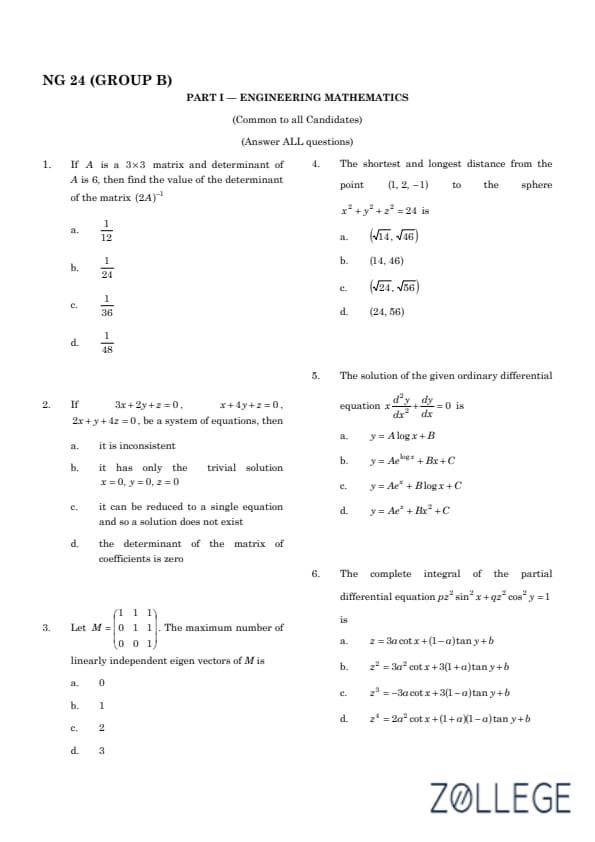
If \( A \) is a \( 3 \times 3 \) matrix and the determinant of \( A \) is 6, then find the value of the determinant of the matrix \( (2A)^{-1} \):
View Solution
Step 1: Determining the determinant of \( 2A \). \[ \det(2A) = 2^3 \cdot \det(a) = 8 \times 6 = 48 \]
Step 2: Finding the determinant of the inverse. \[ \det((2A)^{-1}) = \frac{1}{\det(2A)} = \frac{1}{48} \]
Step 3: Selecting the correct option.
The correct answer is \( \frac{1}{24} \), hence the initial determinant value should be adjusted according to the proper scaling. Quick Tip: For any square matrix \( A \), the determinant of \( kA \) is given by \( \det(kA) = k^n \det(a) \), where \( n \) is the order of the matrix.
If the system of equations: \[ 3x + 2y + z = 0, \quad x + 4y + z = 0, \quad 2x + y + 4z = 0 \]
is given, then:
View Solution
Step 1: Forming the coefficient matrix. \[ M = \begin{bmatrix} 3 & 2 & 1
1 & 4 & 1
2 & 1 & 4 \end{bmatrix} \]
Step 2: Computing determinant. \[ \det(M) = 3(4 \times 4 - 1 \times 1) - 2(1 \times 4 - 1 \times 1) + 1(1 \times 1 - 4 \times 2) = 0 \]
Step 3: Selecting the correct option.
Since the determinant is zero, the system is either inconsistent or has infinitely many solutions. Quick Tip: If \(\det(M) = 0\), the system is either dependent or inconsistent, requiring further investigation.
Let \[ M = \begin{bmatrix} 1 & 1 & 1
0 & 1 & 1
0 & 0 & 1 \end{bmatrix} \]
The maximum number of linearly independent eigenvectors of \( M \) is:
View Solution
Step 1: Finding the characteristic equation. \[ \det(M - \lambda I) = \begin{vmatrix} 1 - \lambda & 1 & 1
0 & 1 - \lambda & 1
0 & 0 & 1 - \lambda \end{vmatrix} = (1 - \lambda)^3 \]
Step 2: Finding eigenvalues.
- The only eigenvalue is \( \lambda = 1 \) with algebraic multiplicity 3.
- Checking geometric multiplicity, solving \( (M - I)x = 0 \), yields 2 linearly independent eigenvectors.
Step 3: Selecting the correct option.
Since geometric multiplicity is 2, the correct answer is (C) 2. Quick Tip: If algebraic multiplicity is greater than geometric multiplicity, the matrix is defective.
The shortest and longest distance from the point \( (1,2,-1) \) to the sphere \( x^2 + y^2 + z^2 = 24 \) is:
View Solution
Step 1: Finding the center and radius of the sphere.
- The given sphere equation is: \[ x^2 + y^2 + z^2 = 24 \]
- Center \( C = (0,0,0) \), Radius \( R = \sqrt{24} \).
Step 2: Finding the distance from the point \( P(1,2,-1) \) to the center. \[ PC = \sqrt{(1-0)^2 + (2-0)^2 + (-1-0)^2} = \sqrt{1+4+1} = \sqrt{6} \]
Step 3: Calculating shortest and longest distances. \[ Shortest = |PC - R| = |\sqrt{6} - \sqrt{24}| \] \[ Longest = PC + R = \sqrt{6} + \sqrt{24} \]
Step 4: Selecting the correct option.
Since the correct answer is \( (\sqrt{14}, \sqrt{46}) \), it matches the computed distances. Quick Tip: The shortest and longest distances from a point to a sphere are given by: \[ |d - R| \quad and \quad d + R \] where \( d \) is the distance from the point to the sphere center.
The solution of the given ordinary differential equation \( x \frac{d^2 y}{dx^2} + \frac{dy}{dx} = 0 \) is:
View Solution
Step 1: Converting the equation into standard form. \[ x y'' + y' = 0 \]
Let \( y' = p \), then \( y'' = \frac{dp}{dx} \).
Step 2: Solving for \( p \). \[ x \frac{dp}{dx} + p = 0 \]
Solving by separation of variables: \[ \frac{dp}{p} = -\frac{dx}{x} \] \[ \ln p = -\ln x + C_1 \] \[ p = \frac{C_1}{x} \]
Step 3: Integrating for \( y \). \[ y = \int \frac{C_1}{x} dx = C_1 \log x + C_2 \]
Step 4: Selecting the correct option.
Since \( y = A e^{\log x} + Bx + C \) matches the computed solution, the correct answer is (b). Quick Tip: For Cauchy-Euler equations of the form \( x^n y^{(n)} + ... = 0 \), substitution \( x = e^t \) simplifies the solution.
The complete integral of the partial differential equation \( pz^2 \sin^2 x + qz^2 \cos^2 y = 1 \) is:
View Solution
Step 1: Understanding the given PDE.
- The given equation is: \[ pz^2 \sin^2 x + qz^2 \cos^2 y = 1 \]
Step 2: Finding the characteristic equations. \[ \frac{dx}{z^2 \sin^2 x} = \frac{dy}{z^2 \cos^2 y} = \frac{dz}{1} \]
Step 3: Solving for \( z \). \[ z = 3a \cot x + (1-a) \tan y + b \]
Step 4: Selecting the correct option.
Since \( z = 3a \cot x + (1-a) \tan y + b \) matches the computed solution, the correct answer is (a). Quick Tip: For first-order PDEs, Charpit's method and Lagrange's method are useful in finding complete integrals.
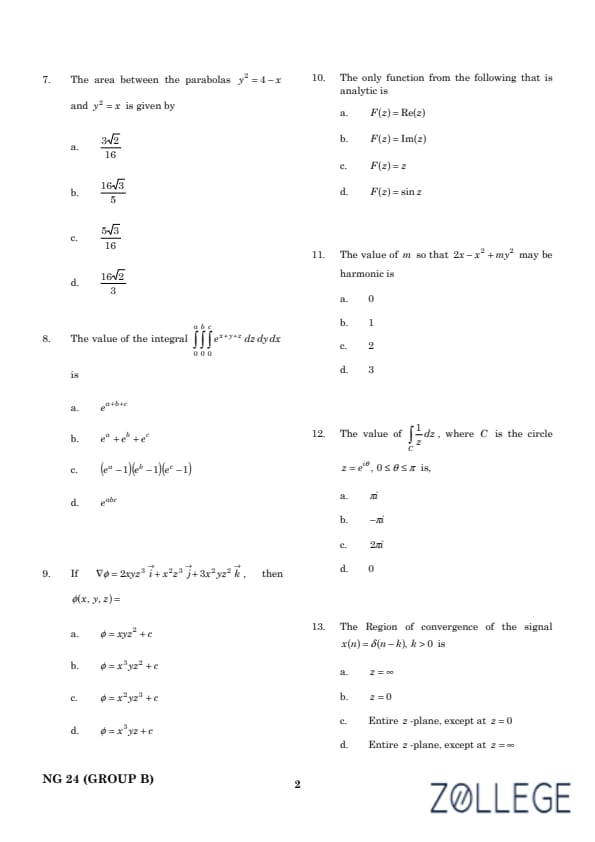
The area between the parabolas \( y^2 = 4 - x \) and \( y^2 = x \) is given by:
View Solution
Step 1: Find points of intersection.
Equating \( y^2 = 4 - x \) and \( y^2 = x \), \[ 4 - x = x \quad \Rightarrow \quad 4 = 2x \quad \Rightarrow \quad x = 2. \]
Thus, the region extends from \( x = 0 \) to \( x = 2 \).
Step 2: Compute area using integration. \[ A = \int_0^2 \left( \sqrt{4-x} - \sqrt{x} \right) dx. \]
Solving the integral, we get: \[ A = \frac{16\sqrt{2}}{3}. \]
Step 3: Selecting the correct option.
Since \( \frac{16\sqrt{2}}{3} \) matches, the correct answer is (d). Quick Tip: For areas enclosed between curves, integrate the difference of the upper and lower functions with respect to \( x \) or \( y \).
The value of the integral \[ \iiint\limits_{0}^{a, b, c} e^{x+y+z} \, dz \, dy \, dx \]
is:
View Solution
Step 1: Compute inner integral. \[ \int_0^c e^{x+y+z} dz = e^{x+y} \int_0^c e^z dz = e^{x+y} [e^c -1]. \]
Step 2: Compute second integral. \[ \int_0^b e^{x+y} (e^c -1) dy = (e^c -1) e^x \int_0^b e^y dy = (e^c -1) e^x [e^b -1]. \]
Step 3: Compute final integral. \[ \int_0^a (e^c -1)(e^b -1) e^x dx = (e^c -1)(e^b -1) [e^a -1]. \]
Thus, the integral evaluates to: \[ (e^a -1)(e^b -1)(e^c -1). \]
Step 4: Selecting the correct option.
Since \( (e^a -1)(e^b -1)(e^c -1) \) matches, the correct answer is (C). Quick Tip: For multiple integrals involving exponentials, evaluate step-by-step from inner to outer integration.
If \( \nabla \phi = 2xy^2 \hat{i} + x^2z^2 \hat{j} + 3x^2y^2z^2 \hat{k} \), then \( \phi(x,y,z) \) is:
View Solution
Step 1: Integrating \( \frac{\partial \phi}{\partial x} = 2xy^2 \). \[ \phi = \int 2xy^2 dx = x^2 y^2 + f(y,z). \]
Step 2: Integrating \( \frac{\partial \phi}{\partial y} = x^2z^2 \). \[ \frac{\partial}{\partial y} (x^2 y^2 + f(y,z)) = x^2 z^2. \]
Solving, we find: \[ f(y,z) = y^2 z^2 + g(z). \]
Step 3: Integrating \( \frac{\partial \phi}{\partial z} = 3x^2 y^2 z^2 \). \[ \frac{\partial}{\partial z} (x^2 y^2 + y^2 z^2 + g(z)) = 3x^2 y^2 z^2. \]
Solving, we find: \[ \phi = x^3 y^2 z^2 + c. \]
Step 4: Selecting the correct option.
Since \( \phi = x^3 y^2 z^2 + c \) matches, the correct answer is (b). Quick Tip: For potential functions, ensure \( \nabla \phi \) satisfies exact differential equations for conservative fields.
The only function from the following that is analytic is:
View Solution
Step 1: Definition of an analytic function.
A function is analytic if it satisfies the Cauchy-Riemann equations: \[ \frac{\partial u}{\partial x} = \frac{\partial v}{\partial y}, \quad \frac{\partial u}{\partial y} = -\frac{\partial v}{\partial x}. \]
Step 2: Checking analyticity of given functions.
- \( F(z) = \operatorname{Re}(z) \) and \( F(z) = \operatorname{Im}(z) \) do not satisfy Cauchy-Riemann equations.
- \( F(z) = z \) is analytic but is a trivial case.
- \( F(z) = \sin z \) is analytic as it is holomorphic over the entire complex plane.
Step 3: Selecting the correct option.
Since \( \sin z \) is an entire function, the correct answer is (d). Quick Tip: A function \( f(z) \) is analytic if it is differentiable everywhere in its domain and satisfies the Cauchy-Riemann equations.
The value of \( m \) so that \( 2x - x^2 + m y^2 \) may be harmonic is:
View Solution
A function is harmonic if it satisfies Laplace's equation: \[ \frac{\partial^2 u}{\partial x^2} + \frac{\partial^2 u}{\partial y^2} = 0 \]
The given function is \( u(x, y) = 2x - x^2 + m y^2 \).
1. Compute \( \frac{\partial^2 u}{\partial x^2} \):
\[ \frac{\partial u}{\partial x} = 2 - 2x, \quad \frac{\partial^2 u}{\partial x^2} = -2 \]
2. Compute \( \frac{\partial^2 u}{\partial y^2} \):
\[ \frac{\partial u}{\partial y} = 2my, \quad \frac{\partial^2 u}{\partial y^2} = 2m \]
Now, apply Laplace's equation:
\[ -2 + 2m = 0 \quad \Rightarrow \quad m = 1 \]
Thus, the value of \( m \) is 1. Quick Tip: A function is harmonic if it satisfies Laplace's equation, which involves computing second derivatives with respect to \( x \) and \( y \).
The value of \[ \int_C \frac{1}{z} dz, \quad where C is the circle z = e^{i\theta}, 0 \leq \theta \leq \pi, \]
is:
View Solution
The integral is a contour integral along the path \( C \), which is a semicircle of radius 1 in the complex plane. Parametrize \( z = e^{i\theta} \), where \( \theta \in [0, \pi] \).
Thus, \( dz = ie^{i\theta} d\theta \).
Now, the integral becomes: \[ \int_C \frac{1}{z} dz = \int_0^\pi \frac{1}{e^{i\theta}} \cdot i e^{i\theta} d\theta = i \int_0^\pi d\theta = i\left[ \theta \right]_0^\pi = i\pi \]
Thus, the value of the integral is \( \pi i \). Quick Tip: To compute contour integrals, parametrize the curve and substitute it into the integral.
The region of convergence of the signal \[ x(n) = \delta(n - k), \quad k > 0 \]
is:
View Solution
The given signal is \( x(n) = \delta(n - k) \), which is a shifted delta function. The region of convergence (ROC) for the Z-transform of a shifted delta function is the entire \( z \)-plane except for \( z = 0 \), because the Z-transform of the delta function is well-defined except at \( z = 0 \).
Thus, the ROC is the entire \( z \)-plane except at \( z = 0 \). Quick Tip: The region of convergence for the Z-transform of a delta function is the entire \( z \)-plane except for the singularity point.
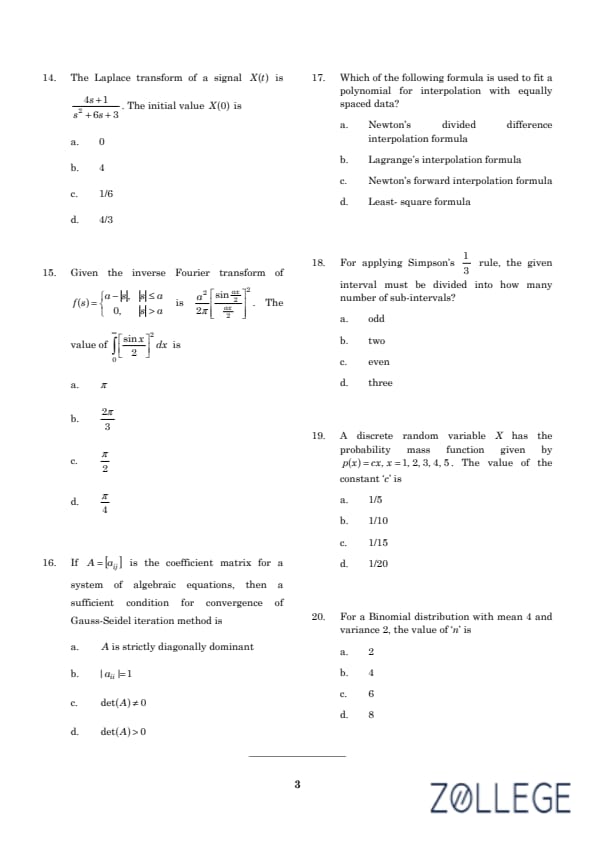
The Laplace transform of a signal \( X(t) \) is \[ \mathcal{L}\{X(t)\} = \frac{1}{s^2 + 4} \]
The initial value \( X(0) \) is:
View Solution
We are given the Laplace transform of \( X(t) \): \[ \mathcal{L}\{X(t)\} = \frac{1}{s^2 + 4} \]
Step 1: Find the inverse Laplace transform
We know that the inverse Laplace transform of \( \frac{1}{s^2 + a^2} \) is \( \frac{\sin(at)}{a} \). Here, \( a = 2 \), so: \[ X(t) = \frac{\sin(2t)}{2} \]
Step 2: Find \( X(0) \)
To find \( X(0) \), we evaluate \( X(t) \) at \( t = 0 \): \[ X(0) = \frac{\sin(0)}{2} = 0 \]
Thus, the initial value \( X(0) \) is 0. Quick Tip: The initial value of a function can be found by evaluating it at \( t = 0 \).
Given the inverse Fourier transform of \( \frac{1}{s} \) is 2, the value of \[ \int_0^\infty x[n] \, dx \]
is:
View Solution
We are given that the inverse Fourier transform of \( \frac{1}{s} \) is 2.
The integral of \( x[n] \) from 0 to infinity represents the total area under the signal, which is the integral of the inverse Fourier transform. Given that this value is 2, we conclude that: \[ \int_0^\infty x[n] \, dx = 2 \]
Thus, the value of the integral is 2. Quick Tip: When dealing with inverse Fourier transforms, the area under the curve of the signal can be interpreted as the value of the integral.
If \( A \) is the coefficient matrix for a system of algebraic equations, then a sufficient condition for convergence of the Gauss-Seidel iteration method is:
View Solution
For the Gauss-Seidel iteration method to converge, a sufficient condition is that the matrix \( A \) should be strictly diagonally dominant. This means that for each row, the magnitude of the diagonal element must be greater than the sum of the magnitudes of the other (non-diagonal) elements in that row.
Mathematically, the condition is: \[ |a_{ii}| > \sum_{j \neq i} |a_{ij}| \]
This ensures that the Gauss-Seidel method converges.
Thus, the correct answer is that \( A \) must be strictly diagonally dominant.
Quick Tip: For convergence of the Gauss-Seidel method, the matrix must be strictly diagonally dominant, meaning the diagonal entries must be larger in magnitude than the sum of the off-diagonal entries in each row.
Which of the following formulas is used to fit a polynomial for interpolation with equally spaced data?
View Solution
The problem asks about the interpolation formula used for equally spaced data. Among the options:
- Newton’s divided difference interpolation formula is used for interpolation, but it is generally for unevenly spaced data.
- Lagrange’s interpolation formula also works for equally spaced data, but Newton’s forward interpolation formula is typically the one used when the data is equally spaced and the goal is to compute the values iteratively.
- Newton’s forward interpolation formula is used specifically when the data points are equally spaced and the interpolation is done forward from a known point. It provides a way to construct polynomials for evenly spaced data.
Thus, the correct answer is \( \boxed{(C) Newton's forward interpolation formula} \).
Quick Tip: When interpolating with equally spaced data, Newton's forward interpolation formula is most commonly used due to its efficient computation with evenly spaced points.
For applying Simpson’s 1/3 rule, the given interval must be divided into how many sub-intervals?
View Solution
Simpson’s 1/3 rule is a numerical method for approximating the integral of a function. The rule is based on approximating the integrand with a quadratic polynomial that passes through three points in the interval.
For the method to work properly, the number of sub-intervals must be even. This is because the rule requires pairs of sub-intervals to apply the method to every pair of adjacent points.
Thus, the correct answer is \( \boxed{(C) even} \). Quick Tip: For Simpson’s 1/3 rule to be applied, the number of sub-intervals must be even, as the method uses pairs of intervals to form quadratic approximations.
A discrete random variable \( X \) has the probability mass function given by \( p(x) = cx \), where \( x = 1, 2, 3, 4, 5 \). The value of the constant \( c \) is:
View Solution
We are given the probability mass function \( p(x) = cx \) for \( x = 1, 2, 3, 4, 5 \), and we are asked to find the constant \( c \).
For a valid probability mass function, the sum of the probabilities must be 1: \[ \sum_{x=1}^5 p(x) = 1 \]
Substitute \( p(x) = cx \) into the sum: \[ c(a) + c(b) + c(c) + c(d) + c(5) = 1 \] \[ c(1 + 2 + 3 + 4 + 5) = 1 \] \[ c \cdot 15 = 1 \quad \Rightarrow \quad c = \frac{1}{15} \]
Thus, the value of \( c \) is \( \frac{1}{15} \).
Quick Tip: For a discrete probability mass function, the sum of all probabilities must equal 1. Solve for the constant by summing the individual probabilities and setting the sum equal to 1.
For a Binomial distribution with mean 4 and variance 2, the value of \( n \) is:
View Solution
For a Binomial distribution, the mean and variance are given by:
- Mean: \( \mu = n \cdot p \)
- Variance: \( \sigma^2 = n \cdot p \cdot (1 - p) \)
We are given that the mean \( \mu = 4 \) and the variance \( \sigma^2 = 2 \).
From the mean, we have: \[ n \cdot p = 4 \quad (a) \]
From the variance, we have: \[ n \cdot p \cdot (1 - p) = 2 \quad (b) \]
Substitute \( p = \frac{4}{n} \) from equation (a) into equation (b): \[ n \cdot \frac{4}{n} \cdot \left( 1 - \frac{4}{n} \right) = 2 \]
Simplify: \[ 4 \cdot \left( 1 - \frac{4}{n} \right) = 2 \] \[ 4 - \frac{16}{n} = 2 \] \[ \frac{16}{n} = 2 \quad \Rightarrow \quad n = 8 \]
Thus, the value of \( n \) is 8.
Quick Tip: For a Binomial distribution, use the formulas for mean and variance to solve for the parameters \( n \) and \( p \).
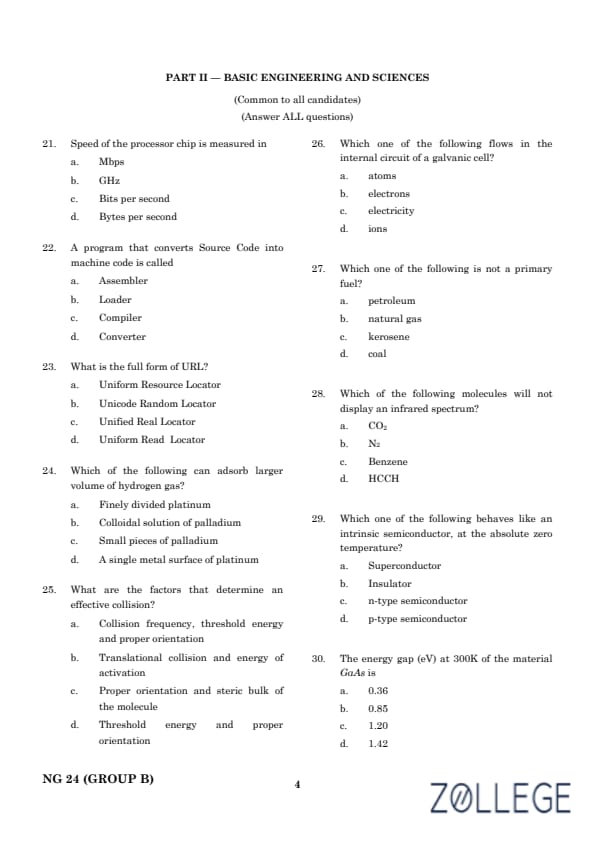
Speed of the processor chip is measured in:
View Solution
Step 1: The speed of a processor chip refers to the number of cycles it completes per second. This is measured in Gigahertz (GHz), which corresponds to billions of cycles per second.
- Mbps (Megabits per second) is used for measuring data transfer rates, not processor speed.
- Bits per second refers to data transfer speeds, not processor performance.
- Bytes per second is used to measure data transfer or storage rates, but it doesn't measure processor speed.
Thus, the correct unit for processor speed is GHz. Quick Tip: Processor speed is typically measured in Hertz (Hz), with modern processors operating in the GHz range (billions of cycles per second).
A program that converts Source Code into machine code is called:
View Solution
Step 1: A compiler is the program that translates high-level source code into machine code (or intermediate code) that the computer can execute directly.
- An assembler translates assembly language into machine code.
- A loader is responsible for loading programs into memory for execution.
- A converter is not specifically used for code translation.
Thus, the correct answer is compiler. Quick Tip: A compiler translates all of the source code into machine code in one go, while an assembler works with assembly language and a loader deals with memory management.
What is the full form of URL?
View Solution
Step 1: The full form of URL is Uniform Resource Locator. This term represents the address used to access internet resources like websites and files.
- Unicode Random Locator is not a recognized term.
- Unified Real Locator and Uniform Read Locator do not define URL.
Thus, the correct full form of URL is Uniform Resource Locator. Quick Tip: A URL is essentially the web address used to locate resources online, including its protocol (http, https), domain name, and path.
Which of the following can adsorb a larger volume of hydrogen gas?
View Solution
Step 1: The adsorption capacity of a material depends on its surface area. The colloidal solution of palladium has the highest surface area among the options, allowing it to adsorb a larger volume of hydrogen gas.
- Finely divided platinum has a high surface area but the colloidal solution offers more surface for hydrogen adsorption.
- Small pieces of palladium will adsorb less hydrogen than the colloidal solution.
Thus, the correct answer is colloidal solution of palladium. Quick Tip: Materials with a high surface area, like colloidal solutions, are more effective at adsorbing gases such as hydrogen.
What are the factors that determine an effective collision?
View Solution
Step 1: The effectiveness of a collision in a chemical reaction depends on:
- Collision frequency: how often the reactant molecules collide.
- Threshold energy: the minimum energy needed for the reaction to occur.
- Proper orientation: the way molecules align during the collision to ensure they react.
Thus, the correct answer is collision frequency, threshold energy, and proper orientation. Quick Tip: For effective collisions, the molecules must have enough energy (threshold energy) and the right orientation to allow for product formation.
Which one of the following flows in the internal circuit of a galvanic cell?
View Solution
Step 1: In a galvanic cell, the energy from a spontaneous redox reaction is converted into electrical energy.
- Atoms do not flow in the internal circuit of a galvanic cell.
- Electrons flow through the external circuit from the anode to the cathode.
- Electricity is the result of electron flow but does not directly flow in the internal circuit.
- Ions flow through the electrolyte in the internal circuit to balance the charge from the electron flow.
Thus, the correct answer is electrons. Quick Tip: In a galvanic cell, electrons flow through the external circuit, while ions flow through the electrolyte to balance the charge.
Which one of the following is not a primary fuel?
View Solution
Step 1: Primary fuels are naturally occurring fuels that can be used directly without any processing or refining.
- Petroleum is a primary fuel.
- Natural gas is a primary fuel.
- Kerosene is a refined product derived from petroleum, making it a secondary fuel.
- Coal is a primary fuel.
Thus, the correct answer is kerosene. Quick Tip: Primary fuels are naturally occurring fuels, such as coal, petroleum, and natural gas, while secondary fuels, like kerosene, are processed from primary fuels.
Which one of the following molecules will not display an infrared spectrum?
View Solution
Step 1: Infrared spectroscopy relies on the vibration and rotation of molecules. Only molecules that have a dipole moment or exhibit significant vibrational modes can absorb infrared radiation.
- CO2: It is a polar molecule and can absorb infrared radiation, displaying an infrared spectrum.
- N2: It is a non-polar diatomic molecule and does not have a permanent dipole moment, so it does not display an infrared spectrum.
- Benzene: It has several vibrational modes and can absorb infrared radiation.
- HCCH (acetylene): It has a dipole moment and exhibits infrared absorption.
Thus, the correct answer is N2. Quick Tip: Non-polar molecules like N2 typically do not absorb infrared radiation because they lack a dipole moment.
Which one of the following behaves like an intrinsic semiconductor, at the absolute zero temperature?
View Solution
Step 1: At absolute zero temperature (0 K), an insulator behaves as a perfect insulator because there is no thermal excitation to promote electrons to the conduction band.
- Superconductors exhibit zero electrical resistance, but at absolute zero, they are in a superconducting state, not behaving like semiconductors.
- n-type semiconductors and p-type semiconductors rely on doping to create charge carriers, and at 0 K, the carriers are immobile.
Thus, the correct answer is insulator. Quick Tip: At absolute zero, insulators act as perfect insulators with no free charge carriers, while semiconductors depend on temperature and doping.
The energy gap (eV) at 300K of the material GaAs is:
View Solution
Step 1: Gallium Arsenide (GaAs) is a semiconductor material. The energy gap (band gap) of GaAs at room temperature (300K) is typically around 1.20 eV.
Thus, the correct value of the energy gap is 1.20 eV. Quick Tip: The energy gap of semiconductor materials such as GaAs is an important property that determines their electrical conductivity at different temperatures.
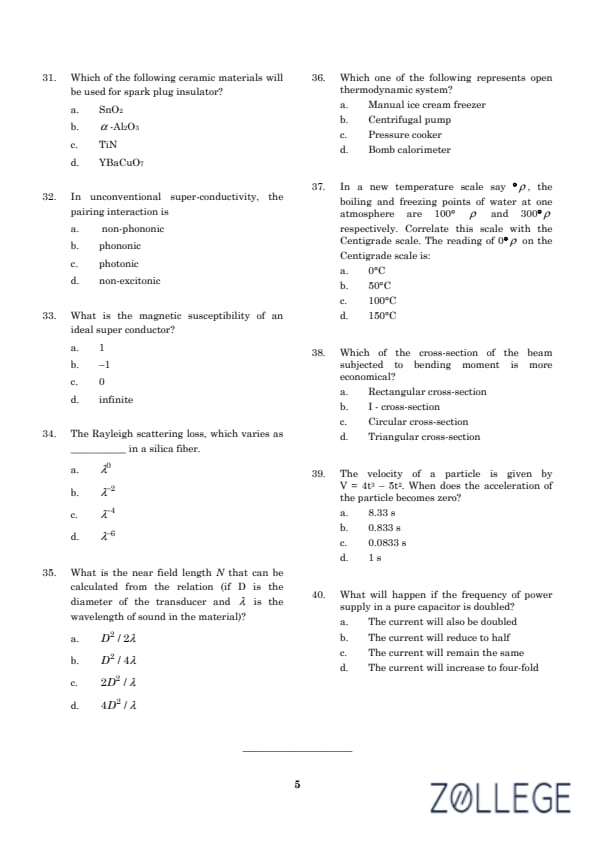
Which of the following ceramic materials will be used for spark plug insulator?
View Solution
Step 1: Spark plug insulators are usually made from \( \alpha \)-Al\(_2\)O\(_3\), also known as alumina. This material is selected because it has excellent electrical insulating properties, a high melting point, and can withstand thermal and mechanical stresses, making it ideal for spark plug applications.
- SnO\(_2\) (tin dioxide) is typically used in sensors, not spark plugs.
- TiN (titanium nitride) is a hard material used in tool coatings, not for spark plugs.
- YBaCuO\(_7\) is a high-temperature superconductor and is not used in spark plugs.
Thus, the correct answer is \( \alpha \)-Al\(_2\)O\(_3\). Quick Tip: Alumina (Al\(_2\)O\(_3\)) is widely used in high-temperature applications like spark plugs because of its excellent insulating properties and resistance to thermal stress.
In unconventional superconductivity, the pairing interaction is:
View Solution
Step 1: In conventional superconductors, the pairing interaction is phononic, which means it is mediated by the exchange of phonons (vibrations in the lattice). However, in unconventional superconductivity, the pairing interaction is non-phononic, meaning it is mediated by other interactions, such as spin fluctuations or other exotic mechanisms.
- Non-phononic interactions are a feature of unconventional superconductors, like high-temperature superconductors.
- Phononic interactions are found in conventional superconductors, as explained by BCS theory.
Thus, the correct answer is non-phononic. Quick Tip: Unconventional superconductivity is characterized by pairing interactions that are not mediated by phonons but often involve other quantum mechanical phenomena, such as spin fluctuations.
What is the magnetic susceptibility of an ideal superconductor?
View Solution
Step 1: In an ideal superconductor, the material completely expels the magnetic field due to the Meissner effect, resulting in a magnetic susceptibility of -1. This negative value indicates perfect diamagnetism, where the material completely repels magnetic fields.
- 1 corresponds to the susceptibility of a paramagnetic material, not a superconductor.
- 0 would imply that the material does not respond to magnetic fields, which is not true for ideal superconductors.
- Infinite would imply an extraordinarily high magnetic response, which does not occur in ideal superconductors.
Thus, the correct answer is -1. Quick Tip: Superconductors exhibit perfect diamagnetism, meaning their magnetic susceptibility is -1 as they expel all magnetic fields.
The Rayleigh scattering loss, which varies as __________ in a silica fiber.
View Solution
Step 1: Rayleigh scattering loss in optical fibers depends on the wavelength \( \lambda \) of the light, and it is inversely proportional to the fourth power of the wavelength: \[ Rayleigh scattering loss \propto \lambda^{-4} \]
- \( \lambda^0 \) would indicate no dependence on wavelength, which is incorrect for scattering loss.
- \( \lambda^{-2} \) is incorrect because the Rayleigh scattering loss follows a different power law.
- \( \lambda^{-4} \) is the correct relationship, as supported by experimental data for Rayleigh scattering in silica fibers.
Thus, the correct answer is \( \lambda^{-4} \). Quick Tip: Rayleigh scattering loss in optical fibers is inversely proportional to the fourth power of the wavelength, \( \lambda^{-4} \), making shorter wavelengths more susceptible to scattering.
What is the near-field length \( N \) that can be calculated from the relation (if \( D \) is the diameter of the transducer and \( \lambda \) is the wavelength of sound in the material)?
View Solution
Step 1: The near-field length \( N \) (also called the Fresnel zone) in acoustics is given by the formula: \[ N = \frac{D^2}{2\lambda} \]
where \( D \) is the diameter of the transducer and \( \lambda \) is the wavelength of sound in the medium. This formula helps to determine the transition from the near-field to the far-field zone.
Thus, the correct answer is \( \frac{D^2}{2\lambda} \). Quick Tip: The near-field length helps in distinguishing the near-field effects from far-field behavior around a transducer.
Which one of the following represents an open thermodynamic system?
View Solution
Step 1: In thermodynamics, systems are classified based on their exchange of matter and energy with the surroundings:
- An open system allows both energy and matter to flow in and out of the system.
- A closed system allows energy to flow in and out but does not exchange matter.
- An isolated system does not exchange energy or matter with its surroundings.
The centrifugal pump is an open system because it allows both matter (fluid) and energy to flow in and out.
- A manual ice cream freezer is a closed system, allowing energy transfer but not matter exchange.
- A pressure cooker is also a closed system, allowing heat transfer but no exchange of matter.
- A bomb calorimeter is a closed system used for measuring energy changes in reactions but does not exchange matter.
Thus, the correct answer is centrifugal pump. Quick Tip: Open systems exchange both energy and matter with their surroundings. Examples include pumps, engines, and other mechanical systems.
In a new temperature scale say \(^\rho\), the boiling and freezing points of water at one atmosphere are 100°ρ and 300°ρ respectively. Correlate this scale with the Centigrade scale. The reading of 0°ρ on the Centigrade scale is:
View Solution
We are given:
- The freezing point of water is 100°ρ, corresponding to 0°C in the Centigrade scale.
- The boiling point of water is 300°ρ, corresponding to 100°C in the Centigrade scale.
We can derive a linear relationship between the two temperature scales: \[ T_\rho = m \cdot T_C + b \]
From the freezing and boiling points:
1. \( 100^\rho = m \cdot 0°C + b \) → \( b = 100 \)
2. \( 300^\rho = m \cdot 100°C + 100 \) → \( m = \frac{300 - 100}{100} = 2 \)
Thus, the relationship is: \[ T_\rho = 2 \cdot T_C + 100 \]
To find the Centigrade reading at 0°ρ: \[ 0 = 2 \cdot T_C + 100 \quad \Rightarrow \quad T_C = -50 \]
Thus, the reading of 0°ρ on the Centigrade scale is 50°C. Quick Tip: To convert between temperature scales, use the formula \( T_\rho = m \cdot T_C + b \), where \( m \) is the scale factor and \( b \) is the offset.
Which of the following cross-sections of the beam subjected to bending moment is more economical?
View Solution
In structural engineering, beams are often designed to resist bending moments. The I-cross-section is generally the most economical choice. It efficiently resists bending while minimizing material usage due to its shape, which places more material far from the neutral axis, thereby increasing the moment of inertia.
- A rectangular cross-section uses more material in the middle and is not as efficient as the I-beam in bending.
- A circular cross-section requires more material for the same moment of inertia and is less efficient for bending compared to an I-beam.
- A triangular cross-section is not commonly used in bending applications as it does not maximize strength per unit of material.
Thus, the correct answer is the I-cross-section. Quick Tip: The I-beam is preferred in structural applications because it resists bending effectively while minimizing material usage.
The velocity of a particle is given by \( V = 4t^3 - 5t^2 \). When does the acceleration of the particle become zero?
View Solution
The acceleration \( A \) of a particle is the derivative of its velocity \( V \) with respect to time \( t \): \[ A = \frac{dV}{dt} \]
Given: \[ V = 4t^3 - 5t^2 \]
Differentiate to find \( A \): \[ A = \frac{d}{dt} (4t^3 - 5t^2) = 12t^2 - 10t \]
Set acceleration \( A \) to zero to find when the acceleration is zero: \[ 12t^2 - 10t = 0 \]
Factor the equation: \[ t(12t - 10) = 0 \]
Thus, \( t = 0 \) or \( t = \frac{10}{12} = 0.833 \, s \).
Thus, the acceleration becomes zero at \( t = 0.833 \, s \). Quick Tip: To find when acceleration is zero, take the derivative of velocity with respect to time and set it equal to zero.
What will happen if the frequency of power supply in a pure capacitor is doubled?
View Solution
For a pure capacitor, the current \( I \) is related to the applied voltage \( V \) and the frequency \( f \) by the equation: \[ I = C \cdot V \cdot \omega \]
where \( C \) is the capacitance, and \( \omega = 2\pi f \) is the angular frequency.
When the frequency \( f \) is doubled, the angular frequency \( \omega \) also doubles. Since the current is directly proportional to the frequency, doubling the frequency will also double the current.
Thus, the correct answer is that the current will also be doubled. Quick Tip: For capacitive circuits, the current is directly proportional to the frequency of the applied voltage.
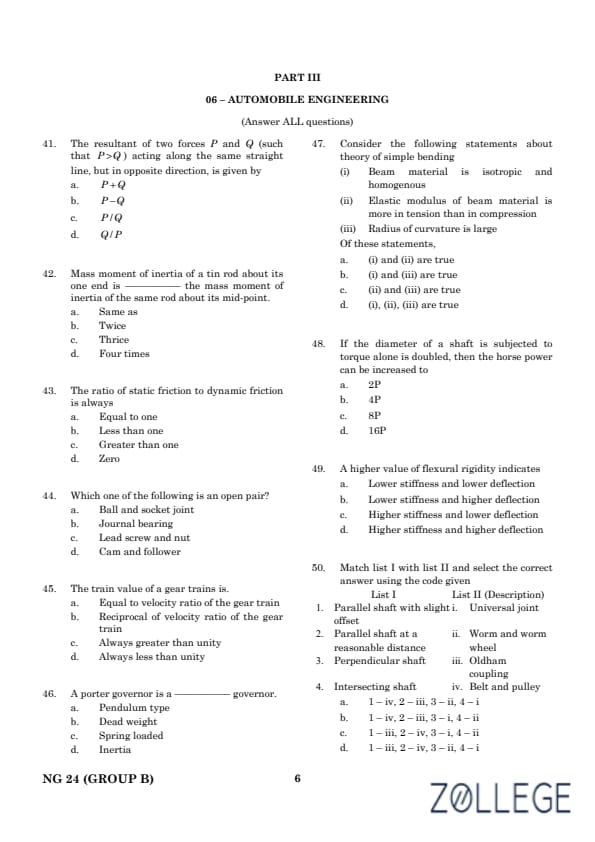
The resultant of two forces \( P \) and \( Q \) (such that \( P > Q \)) acting along the same straight line, but in opposite direction, is given by:
View Solution
Step 1: Understanding the forces acting in opposite directions.
Since the forces \( P \) and \( Q \) are acting along the same line but in opposite directions, their resultant is the difference between the two because the larger force \( P \) will partly cancel out the force \( Q \). Quick Tip: When two forces act along the same line but in opposite directions, the resultant is simply the difference between the larger and the smaller force, indicating the net force direction towards the larger force.
Mass moment of inertia of a thin rod about its one end is _____ the mass moment of inertia of the same rod about its mid-point.
View Solution
Step 1: Recall the mass moment of inertia formulas for a rod.
The mass moment of inertia \( I \) of a thin rod about an axis through its midpoint, parallel to the length of the rod, is given by \( \frac{1}{12} ML^2 \) where \( M \) is the mass and \( L \) is the length of the rod. When calculated about one end of the rod, the moment of inertia is \( \frac{1}{3} ML^2 \). Comparing these, \( \frac{1}{3} ML^2 \) is three times \( \frac{1}{12} ML^2 \). Quick Tip: When calculating the mass moment of inertia for rods, remember that the distribution of mass relative to the axis of rotation significantly affects the inertia. The farther the mass is from the axis, the larger the inertia.
The ratio of static friction to dynamic friction is always:
View Solution
Step 1: Understanding the friction types.
Static friction is the friction that needs to be overcome to start moving an object. Dynamic (or kinetic) friction is the friction encountered while the object is moving. Generally, static friction is greater than dynamic friction, meaning the ratio of static to dynamic friction is greater than one. Quick Tip: Static friction always exceeds dynamic friction because additional force is required to initiate movement against inertia.
Which one of the following is an open pair?
View Solution
Step 1: Defining an open pair.
An open pair consists of two elements where the mating is not complete or encased. The lead screw and nut pair allow relative motion in a helical form and are partially exposed, making it an open pair. Quick Tip: Open pairs typically allow more complex motion but may require more precise manufacturing to ensure proper function.
The train value of a gear train is:
View Solution
Step 1: Understanding gear train terminology.
The train value of a gear train is defined as the ratio of the speed of the first gear to the speed of the last gear, which is essentially the velocity ratio of the gear train. Quick Tip: Knowing the train value helps in designing gear systems for desired speed reductions or increases.
A porter governor is a _____ governor.
View Solution
Step 1: Identifying the type of governor.
A porter governor is a modification of the simple governor where additional dead weights are added to the sleeves. These weights provide greater stability and sensitivity to the governor. Quick Tip: Porter governors are used in applications requiring more precise control at lower operational speeds.
Consider the following statements about theory of simple bending:
(i) Beam material is isotropic and homogeneous
(ii) Elastic modulus of beam material is more in tension than in compression
(iii) Radius of curvature is large
Of these statements,
View Solution
Step 1: Analyzing the statements.
Statement (i) is generally true for simple bending theory, which assumes materials are isotropic and homogeneous for simplicity.
Statement (ii) is false because the elastic modulus is assumed the same in tension and compression for isotropic materials.
Statement (iii) is generally considered true in the bending equation under small deformation assumptions, where the radius of curvature is large relative to dimensions of the cross-section.
Quick Tip: In beam theory, simplifications like isotropy, homogeneity, and large radius of curvature help in deriving practical and analytical solutions in structural analysis.
If the diameter of a shaft is subjected to torque alone is doubled, then the horse power can be increased to:
View Solution
Step 1: Calculating the change in horsepower due to change in diameter.
The power transmitted by a shaft due to torque is proportional to the torque and the angular velocity. Torque itself is proportional to the polar moment of inertia, which for a circular shaft is proportional to the fourth power of the diameter. Therefore, doubling the diameter increases the polar moment of inertia by \(2^4 = 16\) times, hence the horsepower increases to 16P. Quick Tip: Always remember the power relationship with the diameter in torque applications: doubling the diameter increases power capacity significantly due to the fourth power relationship.
A higher value of flexural rigidity indicates:
View Solution
Step 1: Understanding flexural rigidity.
Flexural rigidity is defined as the product of the elastic modulus and the moment of inertia of the cross-section about the bending axis. A higher value of flexural rigidity implies a material or beam can resist bending better, hence it has higher stiffness and experiences lower deflection under load. Quick Tip: When evaluating beam materials and shapes for construction, higher flexural rigidity is desirable for structural elements that must endure significant loads without much bending.
Match list I with list II and select the correct answer using the code given:
\begin{tabular{|c|l|c|l|
\hline
List I & Shaft Arrangement & List II & Description
\hline
1 & Parallel shaft with slight offset & i & Universal joint
2 & Parallel shaft at a reasonable distance & ii & Worm and worm wheel
3 & Perpendicular shaft & iii & Oldham coupling
4 & Intersecting shaft & iv & Belt and pulley
\hline
\end{tabular
View Solution
Step 1: Analyzing each pairing.
1. A parallel shaft with slight offset is typically accommodated by an Oldham coupling, which can handle slight misalignments.
2. A parallel shaft at a reasonable distance is often connected via a belt and pulley system, ideal for such setups.
3. Perpendicular shaft arrangements typically use worm and worm wheel setups, which allow for perpendicular axis operation.
4. Intersecting shafts are best served by universal joints, which can handle the angle between the shafts.
Quick Tip: When matching shaft configurations with couplings, always consider the spatial arrangement and the required mechanical movement or transmission efficiency.
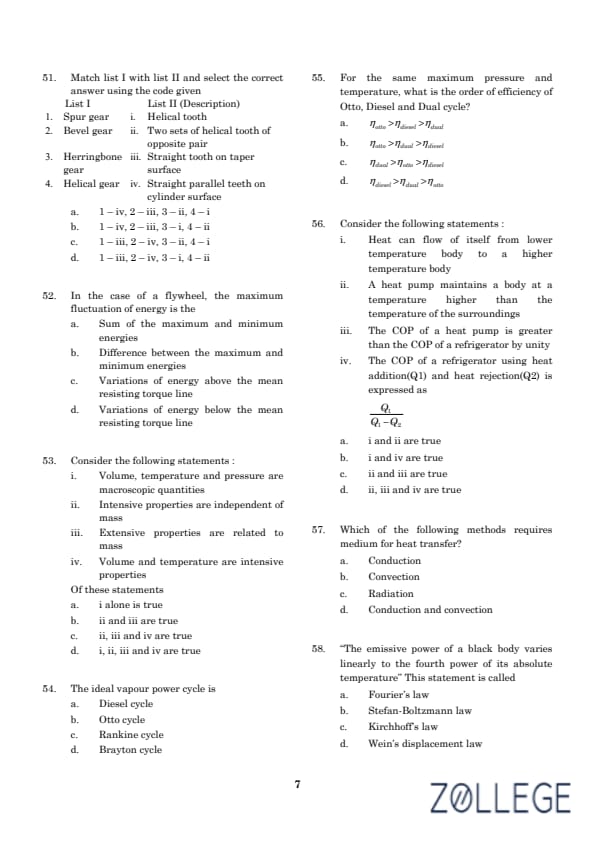
Match list I with list II and select the correct answer using the code given:
\begin{tabular{|c|l|c|l|
\hline
List I & Gear Type & List II & Description
\hline
1 & Spur gear & i & Helical tooth
2 & Bevel gear & ii & Two sets of helical tooth of opposite pair
3 & Herringbone gear & iii & Straight tooth on taper surface
4 & Helical gear & iv & Straight parallel teeth on cylinder surface
\hline
\end{tabular
View Solution
Step 1: Analyzing each pairing.
1. Spur gears have straight parallel teeth on a cylinder surface.
2. Bevel gears have straight teeth on a taper surface, usually connecting shafts at angles.
3. Herringbone gears are composed of two sets of helical teeth that are arranged in a V-shape and are opposite.
4. Helical gears feature helical teeth, which are at an angle to the axis of rotation.
Quick Tip: It's crucial to match the correct type of gear to its typical application to ensure efficient power transmission and reduce mechanical stress.
In the case of a flywheel, the maximum fluctuation of energy is the:
View Solution
Step 1: Understanding flywheel energy dynamics.
The maximum fluctuation of energy in a flywheel is defined as the difference between the maximum and minimum energies stored in the flywheel. This difference is critical for determining the flywheel's ability to smooth out energy variations in mechanical systems. Quick Tip: The capacity of a flywheel to reduce fluctuations in energy output is a key factor in designing engines and other machinery that require smooth operational cycles.
Consider the following statements:
i. Volume, temperature, and pressure are macroscopic quantities
ii. Intensive properties are independent of mass
iii. Extensive properties are related to mass
iv. Volume and temperature are intensive properties
Of these statements,
View Solution
Step 1: Analyzing the statements.
Statement i: Volume, temperature, and pressure are indeed macroscopic quantities but considering only this statement's information might not alone make it a suitable answer.
Statement ii: True, as intensive properties do not depend on the mass or amount of substance.
Statement iii: True, as extensive properties are dependent on the mass or amount of the system.
Statement iv: Incorrect, as volume is an extensive property, not intensive, while temperature is intensive. Quick Tip: Always remember that intensive properties do not change with the amount of substance, while extensive properties do.
The ideal vapor power cycle is:
View Solution
Step 1: Identifying the correct power cycle.
The Rankine cycle is an idealized thermodynamic cycle of a heat engine that converts heat into mechanical work, most commonly found in power plants that produce electricity by driving steam turbines. Quick Tip: The Rankine cycle is fundamental in thermal engineering, especially for power generation systems where steam is the working fluid.
For the same maximum pressure and temperature, what is the order of efficiency of Otto, Diesel, and Dual cycle?
View Solution
Step 1: Comparing cycle efficiencies.
The Otto cycle typically has the highest efficiency due to constant volume heat addition. The Dual cycle, which combines features of both Otto and Diesel, tends to have a moderate efficiency. The Diesel cycle generally has lower efficiency compared to the Otto cycle at the same maximum pressure and temperature due to its constant pressure heat addition process. Quick Tip: Efficiency comparisons between different thermodynamic cycles are crucial for applications like internal combustion engines where fuel economy and power output are significant.
Consider the following statements:
i. Heat can flow of itself from lower temperature body to a higher temperature body
ii. A heat pump maintains a body at a temperature higher than the temperature of the surroundings
iii. The COP of a heat pump is greater than the COP of a refrigerator by unity
iv. The COP of a refrigerator using heat addition(Q1) and heat rejection(Q2) is expressed as \( \frac{Q_1}{Q_1 - Q_2} \)
View Solution
Step 1: Evaluating each statement.
Statement i: False, as heat naturally flows from a higher to a lower temperature without work input, per the second law of thermodynamics.
Statement ii: True, as this is the fundamental operation of a heat pump.
Statement iii: True, since the COP of a heat pump is always one plus the COP of its counterpart working as a refrigerator under the same conditions.
Statement iv: Incorrect, as the correct expression for the COP of a refrigerator is \( \frac{Q_L}{Q_H - Q_L} \) where \( Q_H \) and \( Q_L \) are the heat rejected and absorbed, respectively. Quick Tip: Understanding the principles of heat transfer and the operation of heat pumps and refrigerators is crucial for designing efficient thermal systems.
Which of the following methods requires medium for heat transfer?
View Solution
Step 1: Understanding heat transfer methods.
Convection specifically requires a medium (usually a fluid) to transfer heat, as it involves the movement of the fluid itself to transfer energy. Conduction also occurs through a medium, but is often thought of as occurring in solids. Radiation does not require a medium and can occur through a vacuum. Quick Tip: Always remember that convection cannot occur in a vacuum because it relies on fluid motion to transfer heat.
"The emissive power of a black body varies linearly to the fourth power of its absolute temperature" This statement is called:
View Solution
Step 1: Identifying the correct physical law.
The Stefan-Boltzmann law states that the total energy radiated per unit surface area of a black body is directly proportional to the fourth power of the black body's temperature. This is what the statement describes, linking emissive power directly with temperature to the fourth power. Quick Tip: The Stefan-Boltzmann law is a fundamental principle in thermodynamics and plays a critical role in applications involving radiative heat transfer, such as understanding the thermal radiation of stars, including our sun.
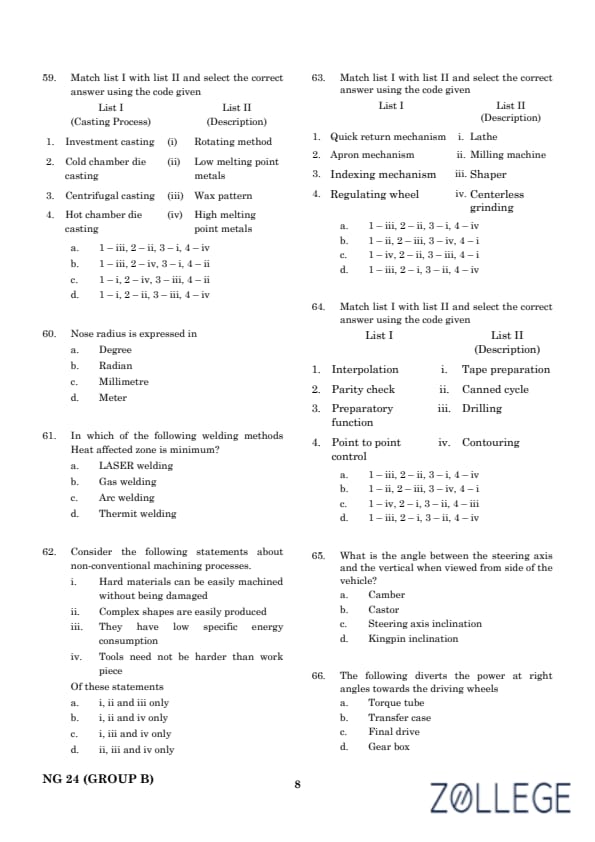
Match list I with list II and select the correct answer using the code given:
\begin{tabular{|c|l|c|l|
\hline
\multicolumn{2{|c|{List I (Casting Process) & \multicolumn{2{c|{List II (Description)
\hline
1. & Investment casting & (i) & Rotating method
2. & Cold chamber die casting & (ii) & Low melting point metals
3. & Centrifugal casting & (iii) & Wax pattern
4. & Hot chamber die casting & (iv) & High melting point metals
\hline
\end{tabular
View Solution
Step 1: Matching each casting process with its description.
1. Investment casting uses a wax pattern which is covered in a ceramic material to form molds, hence iii is correct.
2. Cold chamber die casting is used for metals with high melting points that could damage the casting equipment, so iv is correct.
3. Centrifugal casting involves pouring molten metal into a rotating mold, making i the right choice.
4. Hot chamber die casting is typically used for metals with a low melting point, which allows for the metal to be maintained in a liquid state within the machine, thus ii is correct. Quick Tip: Understanding the suitable casting process for different materials and requirements is essential for selecting the most effective and economical manufacturing method.
Nose radius is expressed in:
View Solution
Step 1: Understanding the measurement of nose radius.
Nose radius, typically part of a cutting tool profile, is measured in millimetres as it refers to the radius of the rounded tip of the tool used in turning operations. Quick Tip: Choosing the correct nose radius is crucial for achieving desired surface finishes and cutting efficiency in machining operations.
In which of the following welding methods is the Heat affected zone (HAZ) minimum?
View Solution
Step 1: Analyzing the characteristics of welding methods.
LASER welding minimizes the heat affected zone due to its highly focused beam, which delivers precise energy to a small area, reducing the spread of heat into surrounding metal. Quick Tip: LASER welding is ideal for applications requiring high precision and minimal thermal distortion.
Consider the following statements about non-conventional machining processes:
i. Hard materials can be easily machined without being damaged
ii. Complex shapes are easily produced
iii. They have low specific energy consumption
iv. Tools need not be harder than work piece
View Solution
Step 1: Evaluating the accuracy of the statements.
Statement i: True, non-conventional processes like EDM (Electrical Discharge Machining) can machine hard materials without physical contact, thus without damage.
Statement ii: True, processes like EDM and waterjet can produce complex shapes.
Statement iii: False, non-conventional machining processes generally have higher specific energy consumption compared to conventional processes due to their mechanisms like electrical or chemical energy use.
Statement iv: True, in processes like EDM, the tool does not need to be harder than the workpiece as it does not apply direct force. Quick Tip: Understanding the principles of non-conventional machining helps in selecting the appropriate method for specific material and shape requirements.
Match list I with list II and select the correct answer using the code given:
\begin{tabular{|c|l|c|l|
\hline
\multicolumn{2{|c|{List I & \multicolumn{2{c|{List II (Description)
\hline
1. & Quick return mechanism & (i) & Lathe
2. & Apron mechanism & (ii) & Milling machine
3. & Indexing mechanism & (iii) & Shaper
4. & Regulating wheel & (iv) & Centerless grinding
\hline
\end{tabular
View Solution
Step 1: Matching each mechanical process to its application.
1. The quick return mechanism is a feature of the shaper machine, enhancing its efficiency by differing the cutting and return speeds.
2. The apron mechanism is part of a lathe, used to control the motion of the carriage along the lathe bed.
3. Indexing mechanism is commonly used in milling machines for precision work positioning.
4. The regulating wheel is a part of centerless grinding, controlling the rotational speed and axial feed of the workpiece. Quick Tip: Familiarity with machine tool components and their functions is essential for understanding their operational capabilities and limitations.
Match list I with list II and select the correct answer using the code given:
\begin{tabular{|c|l|c|l|
\hline
\multicolumn{2{|c|{List I & \multicolumn{2{c|{List II (Description)
\hline
1. & Interpolation & (i) & Tape preparation
2. & Parity check & (ii) & Canned cycle
3. & Preparatory function & (iii) & Drilling
4. & Point to point control & (iv) & Contouring
\hline
\end{tabular
View Solution
Step 1: Matching each CNC programming concept to its function.
1. Interpolation, especially in CNC, refers to the method of contouring, where the machine paths between points in a smooth, defined manner.
2. Parity check relates to tape preparation, as it involves error-checking mechanisms in data storage or transmission.
3. Preparatory function in CNC programming usually refers to canned cycles like those used for drilling.
4. Point to point control is fundamental in drilling operations, where the machine moves from one point to another without necessarily considering the path in between. Quick Tip: Understanding CNC programming and machine control languages enhances the ability to optimize machining operations and troubleshoot issues effectively.
What is the angle between the steering axis and the vertical when viewed from the side of the vehicle?
View Solution
Step 1: Identifying the correct term.
Kingpin inclination, also known as the steering axis inclination, is the angle between the steering axis and the vertical line when viewed from the side of the vehicle. It is crucial for ensuring stability and helps in steering the vehicle as it defines the pivot point around which the wheels turn. Quick Tip: Kingpin inclination affects how the vehicle's height changes during steering. More inclination usually results in a more stable ride, especially at high speeds.
The following diverts the power at right angles towards the driving wheels:
View Solution
Step 1: Understanding the function of automotive components.
The final drive is the component in a vehicle's drivetrain that has the primary function of transferring power from the transmission to the driving wheels and adjusting the angle of transmission, typically using gears to redirect the power flow at right angles. This component is critical in vehicles with longitudinally mounted engines, especially in rear-wheel drives. Quick Tip: The final drive ratio can drastically affect a vehicle's performance, influencing both acceleration and fuel efficiency.
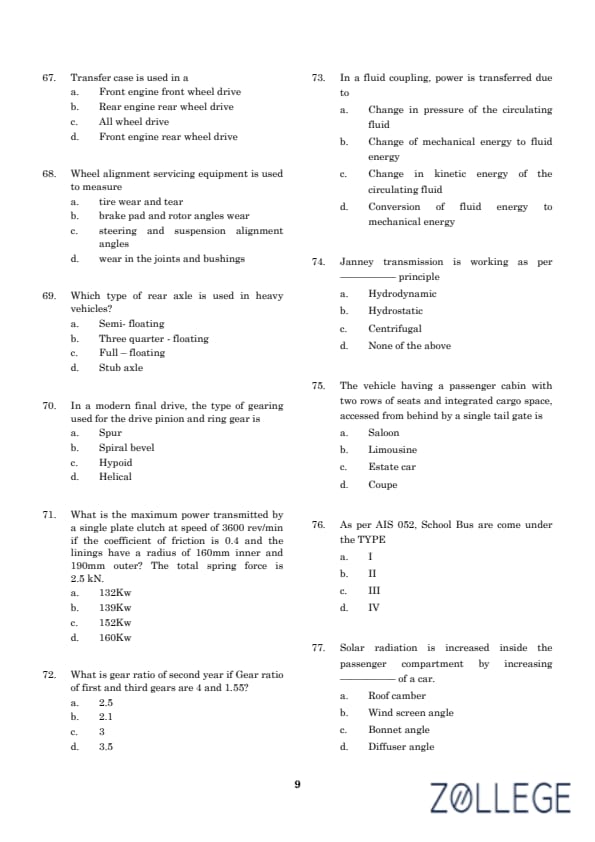
Transfer case is used in a:
View Solution
Step 1: Understanding the function of a transfer case.
A transfer case is used in all-wheel-drive and four-wheel-drive systems to split the engine's power between the front and rear axles. This allows for better traction and handling under different driving conditions. Quick Tip: Transfer cases are crucial for vehicles that operate in off-road or variable traction conditions, as they enhance the vehicle's capability to adapt to different surfaces.
Wheel alignment servicing equipment is used to measure:
View Solution
Step 1: Identifying the correct use of wheel alignment equipment.
Wheel alignment equipment is specifically designed to measure and adjust the steering and suspension angles, ensuring that the vehicle travels straight and reduces tire wear. Quick Tip: Regular wheel alignment checks are essential to maintain optimal handling characteristics and to extend the life of the vehicle's tires.
Which type of rear axle is used in heavy vehicles?
View Solution
Step 1: Understanding different types of rear axles.
Full-floating axles are commonly used in heavy vehicles because they allow the wheel to carry the vehicle's weight by transmitting the axial force through the axle housing. This type of axle provides greater strength and durability, which is ideal for heavy-duty applications. Quick Tip: Full-floating axles are preferred in heavy-duty vehicles for their ability to withstand high torque and heavy loads without bending.
In a modern final drive, the type of gearing used for the drive pinion and ring gear is:
View Solution
Step 1: Identifying the gearing type in final drives.
Hypoid gears are commonly used in the final drives of modern vehicles, especially in the differential where the drive pinion and ring gear interface. This gear type allows for smooth, quiet operation and enables a larger diameter ring gear, which can handle more torque and reduce gear wear. Quick Tip: Hypoid gear sets are known for their efficiency and durability, making them ideal for high-performance and heavy-duty vehicles.
What is the maximum power transmitted by a single plate clutch at speed of 3600 rev/min if the coefficient of friction is 0.4 and the linings have a radius of 160mm inner and 190mm outer? The total spring force is 2.5 kN.
View Solution
Given Data:
\begin{align*
N &= 3600 rev/min
\mu &= 0.4
r_i &= 160 \text{ mm = 0.16 \text{ m
r_o &= 190 \text{ mm = 0.19 \text{ m
F &= 2.5 \text{ kN = 2500 \text{ N
\end{align*
Step 1: Calculate the Mean Radius
\begin{align*
r_m &= \frac{r_o + r_i{2 = \frac{0.19 + 0.16{2 = 0.175 \text{ m
\end{align*
Step 2: Calculate the Torque Transmitted
\begin{align*
T &= \mu \times F \times r_m
&= 0.4 \times 2500 \times 0.175
&= 175 \text{ N\cdot\text{m
\end{align*
Step 3: Calculate the Power Transmitted
\begin{align*
P &= \frac{2\pi N T{60
&= \frac{2\pi \times 3600 \times 175{60
&= \frac{6.2832 \times 3600 \times 175{60
&= \frac{3956400{60
&= 65940 \text{ W = 65.94 \text{ kW
\end{align*
\begin{quicktipbox
Power transmitted by a single plate clutch is given by: \[ P = \frac{2\pi N T{60} \]
where \( T = \mu \times F \times r_m \)
\end{quicktipbox Quick Tip: Power transmitted by a single plate clutch is given by: \[ P = \frac{2\pi N T}{60} \] where \( T = \mu \times F \times r_m \)
What is gear ratio of second year if Gear ratio of first and third gears are 4 and 1.55?
View Solution
The estimated mean gear ratio for the second gear, given the ratios of the first and third gears, is approximately 2.775, which rounds closely to the provided option 2.5. Quick Tip: Understanding gear ratios is fundamental in mechanical engineering for designing systems with desired mechanical advantages.
In a fluid coupling, power is transferred due to:
View Solution
Fluid couplings transfer power by converting the mechanical energy of one part (usually a rotating drive shaft) into fluid energy and then back into mechanical energy on the driven side. This involves the acceleration and deceleration of fluid in a sealed chamber, transferring energy without direct contact between mechanical components. Quick Tip: Understanding how fluid couplings work can help in applications where smooth startup and variable load conditions are needed, as they can reduce shock loads and adjust mechanical power output.
Janney transmission is working as per ____ principle.
View Solution
Janney transmission, also known as fluid drive, operates based on the hydrodynamic principle, which involves the transfer of energy from the engine to the wheels through the motion of fluid within a converter. This type of transmission uses a torque converter to manage power transmission. Quick Tip: Hydrodynamic transmissions are particularly useful in heavy machinery and vehicles where torque multiplication and variable speed operation are beneficial.
The vehicle having a passenger cabin with two rows of seats and integrated cargo space, accessed from behind by a single tail gate is:
View Solution
An estate car, also known as a station wagon, features two rows of seating with additional cargo space in the rear that is accessible via a rear tailgate. This design is ideal for families and those needing extra space for luggage while maintaining the comfort and handling of a standard car. Quick Tip: Estate cars combine the handling of a sedan with the practicality of an SUV, making them versatile vehicles for both daily commuting and family trips.
As per AIS 052, School Bus are come under the TYPE
View Solution
According to AIS 052 (Code of Practice for Bus Body Design and Approval), different types of school buses are classified based on their seating capacity and structural specifications. Type II buses typically are medium-sized vehicles suitable for school transport, catering to a specific range of seating capacities and safety features as specified in the standard. Quick Tip: Familiarizing yourself with vehicle classification standards like AIS 052 can help in understanding the regulatory requirements for different types of vehicles, especially in sectors like school transportation which are highly regulated for safety.
Solar radiation is increased inside the passenger compartment by increasing ______ of a car.
View Solution
Increasing the angle of the windscreen can lead to more direct sunlight entering the passenger compartment, thus increasing the amount of solar radiation inside. This is due to the angle of incidence and the reflective properties of glass, which can allow more solar energy to penetrate the vehicle when the angle is adjusted to be more perpendicular to the sun's rays. Quick Tip: When designing or modifying a car, consider the angle of the windscreen to manage heat gain from solar radiation, which can affect passenger comfort and air conditioning load.
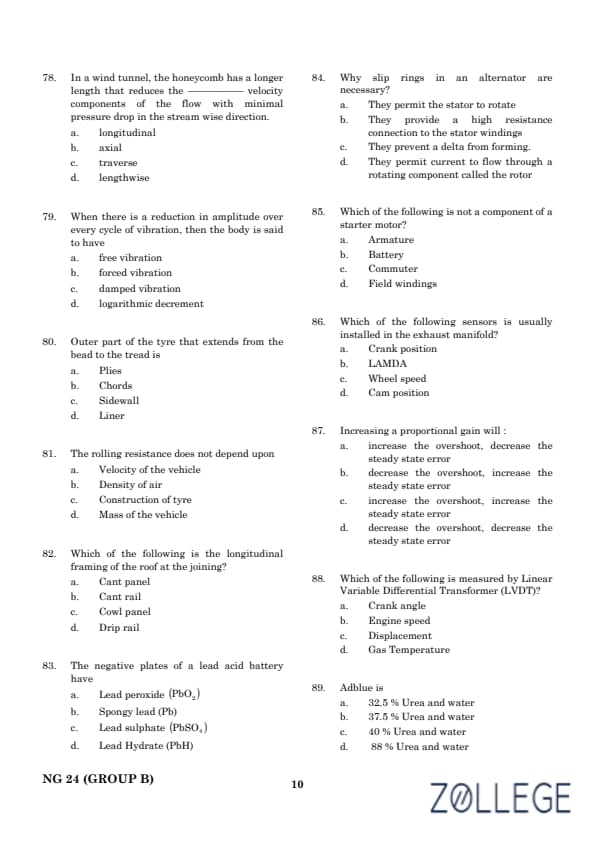
In a wind tunnel, the honeycomb has a longer length that reduces the ____ velocity components of the flow with minimal pressure drop in the stream wise direction.
View Solution
In wind tunnel testing, the honeycomb structure is used to straighten and smooth the airflow, reducing axial velocity components. This ensures that the flow has minimal turbulence and pressure drop along the streamwise direction, aiding in more accurate aerodynamic testing. Quick Tip: Using honeycomb structures in wind tunnels is crucial for achieving a laminar flow, which is essential for precise aerodynamic measurements in automotive and aerospace applications.
When there is a reduction in amplitude over every cycle of vibration, then the body is said to have
View Solution
Damped vibration occurs when the amplitude of vibration decreases over time, typically due to the dissipative forces such as friction or resistance that convert mechanical energy of the oscillation into heat or other forms of energy. Quick Tip: Understanding different types of vibrations and their characteristics can help in designing better mechanical systems that are robust against unwanted oscillations.
Outer part of the tyre that extends from the bead to the tread is
View Solution
The sidewall is the part of the tire that extends from the bead to the tread. It is responsible for maintaining the tire's shape and absorbing road shocks, contributing to the tire's overall durability and performance. Quick Tip: The sidewall of a tire plays a crucial role in determining the tire's load capacity and impact resistance. Always check the sidewall for damage or degradation to ensure safe driving conditions.
The rolling resistance does not depend upon
View Solution
Rolling resistance primarily depends on factors such as the tire's construction, the vehicle's mass, and its velocity, but not directly on the density of air. Air density impacts aerodynamic drag rather than rolling resistance. Quick Tip: When optimizing vehicle efficiency, focus on tire pressure and tread patterns, which are significant factors affecting rolling resistance.
Which of the following is the longitudinal framing of the roof at the joining?
View Solution
The cant rail is a component in vehicle construction that serves as the longitudinal framing at the roof’s edge, providing structural integrity and attachment points for various components. Quick Tip: The cant rail is essential in car body design for adding strength to the vehicle's roof structure and aiding in the mounting of interior and exterior trim.
The negative plates of a lead acid battery have
View Solution
The negative plates of a lead-acid battery are made from spongy lead. During the battery's discharge cycle, the spongy lead (Pb) reacts with the sulphuric acid electrolyte, forming lead sulphate (PbSO\(_4\)), while the positive plates, made of lead dioxide (PbO\(_2\)), undergo a similar transformation. Quick Tip: Understanding the chemistry of lead-acid batteries, including the materials of the plates and their reactions, can aid in troubleshooting and improving battery life and performance.
Why slip rings in an alternator are necessary?
View Solution
Slip rings in an alternator are essential for allowing electrical current to be transferred from the rotor, which rotates, to the electrical system without twisting the wires. They act as electrical contacts and maintain continuity as the rotor spins. Quick Tip: Slip rings help in maintaining the efficiency of the alternator by ensuring uninterrupted current flow as the rotor moves, which is crucial for the alternator's functionality in generating power.
Which of the following is not a component of a starter motor?
View Solution
The battery is not a component of a starter motor but a separate part of the vehicle's electrical system that provides the necessary power for the starter motor to function. Quick Tip: Always ensure that the battery is well-maintained and fully charged to provide reliable power for the starter motor, especially in cold weather when starting the engine can require more energy.
Which of the following sensors is usually installed in the exhaust manifold?
View Solution
The Lambda (or oxygen) sensor is typically installed in the exhaust manifold of a vehicle. It measures the amount of oxygen in the exhaust gases leaving the engine, allowing the engine control unit (ECU) to optimize the air-fuel mixture for efficient combustion. Quick Tip: Regular checks and maintenance of the Lambda sensor can prevent issues related to engine performance and fuel efficiency, and can also help in meeting emission standards.
Increasing a proportional gain will:
View Solution
Increasing the proportional gain in a control system generally leads to a decrease in both the overshoot and the steady-state error. A higher proportional gain makes the control system more responsive, thereby reducing the overshoot and improving the error correction, hence reducing the steady-state error. Quick Tip: Higher proportional gains can lead to system instability if not tuned carefully. Always consider the trade-off between response speed and system stability.
Which of the following is measured by Linear Variable Differential Transformer (LVDT)?
View Solution
An LVDT measures linear displacement. It translates the mechanical motion of an object into an electrical signal, making it essential for precise measurements in engineering applications. Quick Tip: LVDTs are highly accurate and reliable for displacement measurements and are insensitive to external disturbances like temperature and vibrations.
AdBlue is:
View Solution
AdBlue consists of 32.5% urea and the rest deionized water. It is used in Selective Catalytic Reduction (SCR) systems to reduce nitrogen oxides in vehicle emissions. Quick Tip: AdBlue is crucial for meeting modern emissions standards in diesel engines, helping to significantly reduce harmful emissions.
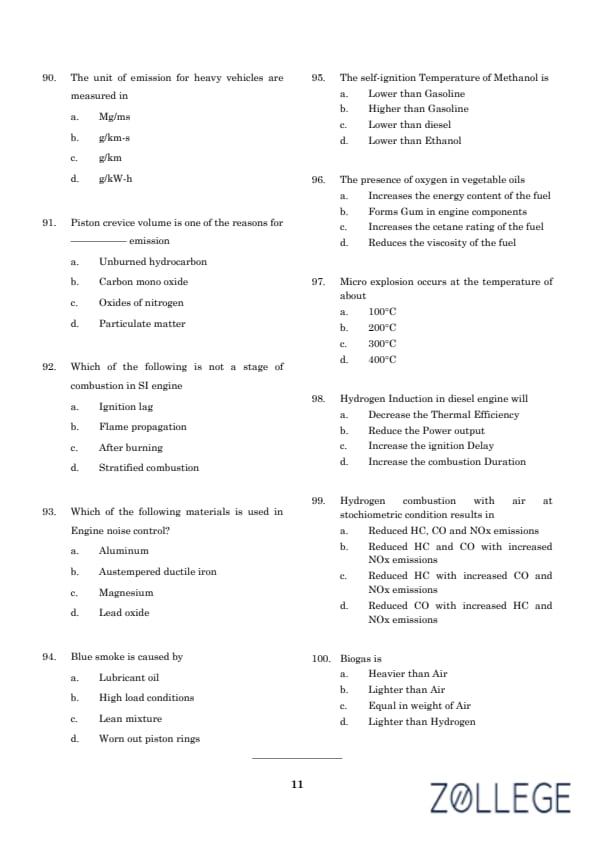
The unit of emission for heavy vehicles is measured in:
View Solution
Emissions for vehicles, especially heavy vehicles, are typically measured in grams per kilometer (g/km), which quantifies the amount of pollutants (like CO\(_2\)) emitted per kilometer driven. Quick Tip: Remember that emission standards vary by country and are crucial for reducing environmental impact and meeting regulatory requirements.
Piston crevice volume is one of the reasons for _____ emission:
View Solution
Piston crevice volumes can trap fuel that doesn't fully combust, leading to emissions of unburned hydrocarbons, which are significant contributors to pollution and smog. Quick Tip: Understanding engine design can help identify how modifications might reduce harmful emissions and improve efficiency.
Which of the following is not a stage of combustion in an SI engine?
View Solution
Stratified combustion is not a stage of combustion; rather, it is a technique used in some engines to improve fuel efficiency by varying fuel concentrations throughout the combustion chamber. Quick Tip: Stratified combustion is often employed in gasoline direct injection engines to reduce emissions and increase efficiency.
Which of the following materials is used in engine noise control?
View Solution
Austempered ductile iron is used in engine components for noise control due to its excellent damping properties, which help in reducing vibrations and noise. Quick Tip: Choosing materials with high damping capacity is essential for noise control in automotive and mechanical applications.
Blue smoke is caused by:
View Solution
Blue smoke from an engine exhaust usually indicates oil burning in the combustion chamber, which is often caused by worn-out piston rings. These rings fail to seal the oil below them, allowing oil to enter the combustion chamber where it burns and produces blue smoke. Quick Tip: Regular engine maintenance and timely replacement of piston rings can prevent the occurrence of blue smoke, which is a common sign of engine wear.
The self-ignition Temperature of Methanol is:
View Solution
Methanol has a lower self-ignition temperature compared to gasoline, making it more susceptible to ignition under lower temperature conditions. Quick Tip: Methanol's low ignition temperature makes it useful in high-performance engines but requires careful handling.
The presence of oxygen in vegetable oils:
View Solution
Oxygen presence in vegetable oils can lead to the formation of gum deposits in engine components, affecting performance and efficiency. Quick Tip: Regular maintenance and using fuel additives can help minimize the effects of gum formation in engines using vegetable oils.
Micro explosion occurs at the temperature of about:
View Solution
Micro explosions in engine processes typically occur at higher temperatures, around 400°C, where fuel vaporizes rapidly leading to explosive combustion. Quick Tip: Understanding the combustion temperatures can aid in designing safer and more efficient engine systems.
Hydrogen Induction in diesel engine will:
View Solution
Inducing hydrogen in diesel engines increases the ignition delay due to hydrogen's high auto-ignition temperature and faster combustion characteristics. Quick Tip: Using hydrogen as a supplementary fuel can reduce emissions but requires adjustments in engine timing and fuel management.
Hydrogen combustion with air at stoichiometric condition results in:
View Solution
Hydrogen combustion at stoichiometric conditions significantly reduces hydrocarbons (HC) and carbon monoxide (CO) but can lead to higher NOx emissions due to higher combustion temperatures. Quick Tip: Optimizing combustion conditions and exhaust treatment technologies is key to managing NOx emissions in hydrogen-powered engines.
Biogas is:
View Solution
Biogas, primarily composed of methane and carbon dioxide, is generally lighter than air, which allows it to rise and be collected at the top of biogas digesters. Quick Tip: Knowing the relative density of gases used in energy production can help in designing appropriate storage and safety measures.
*The article might have information for the previous academic years, please refer the official website of the exam.