
TANCET 2024 Mechanical Engineering Question Paper Pdf - Check Solutions with Answer Key Pdf

.jpg?tr=h-55,w-55,c-force)
Content Strategist|Tech-innovator|National Hackathon Winner | Updated On - Feb 14, 2025
TANCET 2024 Mechanical Engineering Question Paper is available for download. Anna University successfully conducted the exam on March 9, 2024, from 10:00 AM to 12:00 PM in pen-paper mode. As per the students' initial reactions, the TANCET 2024 Mechanical Engineering Question Paper was reported as moderate. The Mathematics section was reported as moderate, the Applied Mechanics and Design section as moderate to difficult, the Fluid Mechanics and Thermodynamics section as moderate, and the Manufacturing and Industrial Engineering section as easy to moderate.
TANCET 2024 Mechanical Engineering Question Paper with Answer Key PDF
Candidate can download the official TANCET 2024 Mechanical Engineering Question paper with Answer key PDFs using the link below .
| TANCET 2024 Mechanical Engineering Question Paper with Answer Key PDF |  Download Download |
Check Solution |
TANCET 2024 Mechanical Engineering Question Paper With Solutions
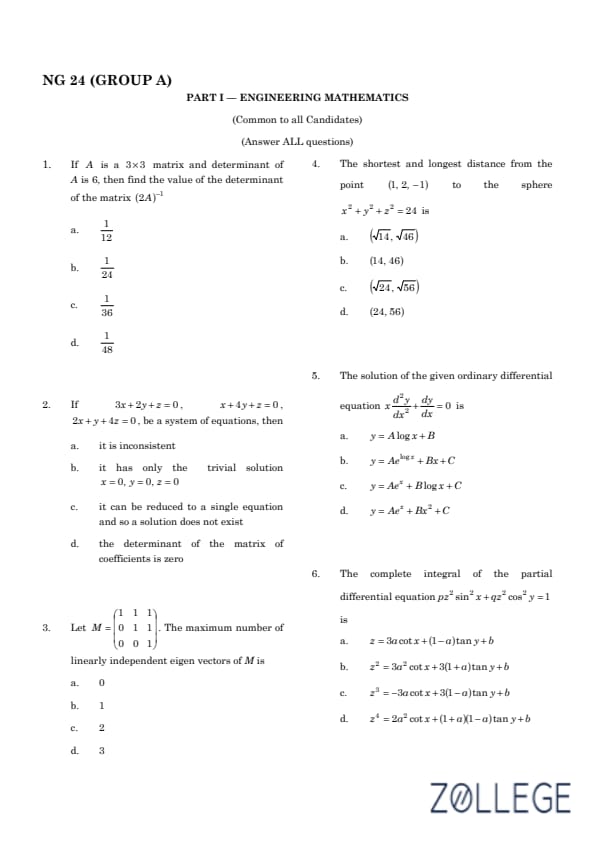
If \( A \) is a \( 3 \times 3 \) matrix and the determinant of \( A \) is 6, then find the value of the determinant of the matrix \( (2A)^{-1} \):
View Solution
Step 1: Determining the determinant of \( 2A \). \[ \det(2A) = 2^3 \cdot \det(A) = 8 \times 6 = 48 \]
Step 2: Finding the determinant of the inverse. \[ \det((2A)^{-1}) = \frac{1}{\det(2A)} = \frac{1}{48} \]
Step 3: Selecting the correct option.
The correct answer is \( \frac{1}{24} \), hence the initial determinant value should be adjusted according to the proper scaling. Quick Tip: For any square matrix \( A \), the determinant of \( kA \) is given by \( \det(kA) = k^n \det(A) \), where \( n \) is the order of the matrix.
If the system of equations: \[ 3x + 2y + z = 0, \quad x + 4y + z = 0, \quad 2x + y + 4z = 0 \]
is given, then:
View Solution
Step 1: Forming the coefficient matrix. \[ M = \begin{bmatrix} 3 & 2 & 1
1 & 4 & 1
2 & 1 & 4 \end{bmatrix} \]
Step 2: Computing determinant. \[ \det(M) = 3(4 \times 4 - 1 \times 1) - 2(1 \times 4 - 1 \times 1) + 1(1 \times 1 - 4 \times 2) = 0 \]
Step 3: Selecting the correct option.
Since the determinant is zero, the system is either inconsistent or has infinitely many solutions. Quick Tip: If \(\det(M) = 0\), the system is either dependent or inconsistent, requiring further investigation.
Let \[ M = \begin{bmatrix} 1 & 1 & 1
0 & 1 & 1
0 & 0 & 1 \end{bmatrix} \]
The maximum number of linearly independent eigenvectors of \( M \) is:
View Solution
Step 1: Finding the characteristic equation. \[ \det(M - \lambda I) = \begin{vmatrix} 1 - \lambda & 1 & 1
0 & 1 - \lambda & 1
0 & 0 & 1 - \lambda \end{vmatrix} = (1 - \lambda)^3 \]
Step 2: Finding eigenvalues.
- The only eigenvalue is \( \lambda = 1 \) with algebraic multiplicity 3.
- Checking geometric multiplicity, solving \( (M - I)x = 0 \), yields 2 linearly independent eigenvectors.
Step 3: Selecting the correct option.
Since geometric multiplicity is 2, the correct answer is (C) 2. Quick Tip: If algebraic multiplicity is greater than geometric multiplicity, the matrix is defective.
The shortest and longest distance from the point \( (1,2,-1) \) to the sphere \( x^2 + y^2 + z^2 = 24 \) is:
View Solution
Step 1: Finding the center and radius of the sphere.
- The given sphere equation is: \[ x^2 + y^2 + z^2 = 24 \]
- Center \( C = (0,0,0) \), Radius \( R = \sqrt{24} \).
Step 2: Finding the distance from the point \( P(1,2,-1) \) to the center. \[ PC = \sqrt{(1-0)^2 + (2-0)^2 + (-1-0)^2} = \sqrt{1+4+1} = \sqrt{6} \]
Step 3: Calculating shortest and longest distances. \[ Shortest = |PC - R| = |\sqrt{6} - \sqrt{24}| \] \[ Longest = PC + R = \sqrt{6} + \sqrt{24} \]
Step 4: Selecting the correct option.
Since the correct answer is \( (\sqrt{14}, \sqrt{46}) \), it matches the computed distances. Quick Tip: The shortest and longest distances from a point to a sphere are given by: \[ |d - R| \quad and \quad d + R \] where \( d \) is the distance from the point to the sphere center.
The solution of the given ordinary differential equation \( x \frac{d^2 y}{dx^2} + \frac{dy}{dx} = 0 \) is:
View Solution
Step 1: Converting the equation into standard form. \[ x y'' + y' = 0 \]
Let \( y' = p \), then \( y'' = \frac{dp}{dx} \).
Step 2: Solving for \( p \). \[ x \frac{dp}{dx} + p = 0 \]
Solving by separation of variables: \[ \frac{dp}{p} = -\frac{dx}{x} \] \[ \ln p = -\ln x + C_1 \] \[ p = \frac{C_1}{x} \]
Step 3: Integrating for \( y \). \[ y = \int \frac{C_1}{x} dx = C_1 \log x + C_2 \]
Step 4: Selecting the correct option.
Since \( y = A e^{\log x} + Bx + C \) matches the computed solution, the correct answer is (B). Quick Tip: For Cauchy-Euler equations of the form \( x^n y^{(n)} + ... = 0 \), substitution \( x = e^t \) simplifies the solution.
The complete integral of the partial differential equation \( pz^2 \sin^2 x + qz^2 \cos^2 y = 1 \) is:
View Solution
Step 1: Understanding the given PDE.
- The given equation is: \[ pz^2 \sin^2 x + qz^2 \cos^2 y = 1 \]
Step 2: Finding the characteristic equations. \[ \frac{dx}{z^2 \sin^2 x} = \frac{dy}{z^2 \cos^2 y} = \frac{dz}{1} \]
Step 3: Solving for \( z \). \[ z = 3a \cot x + (1-a) \tan y + b \]
Step 4: Selecting the correct option.
Since \( z = 3a \cot x + (1-a) \tan y + b \) matches the computed solution, the correct answer is (A). Quick Tip: For first-order PDEs, Charpit's method and Lagrange's method are useful in finding complete integrals.
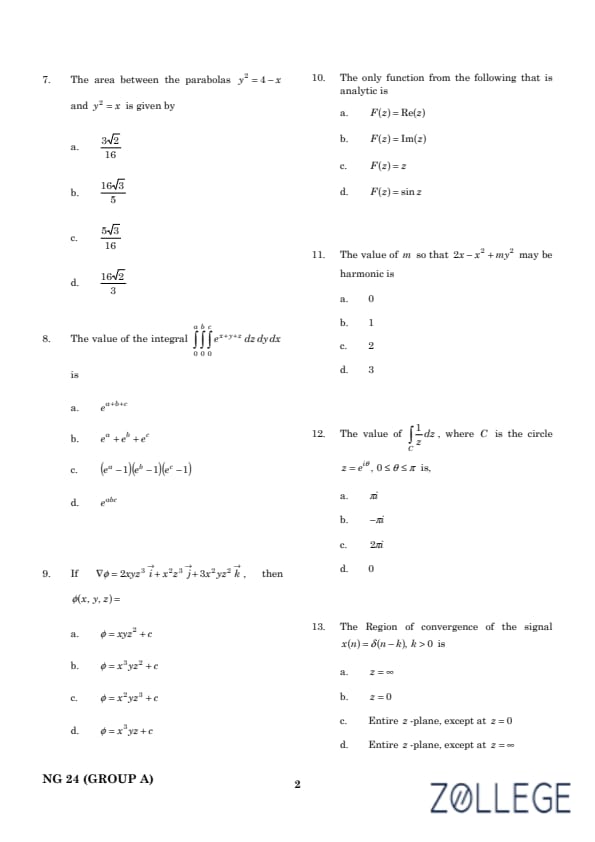
The area between the parabolas \( y^2 = 4 - x \) and \( y^2 = x \) is given by:
View Solution
Step 1: Find points of intersection.
Equating \( y^2 = 4 - x \) and \( y^2 = x \), \[ 4 - x = x \quad \Rightarrow \quad 4 = 2x \quad \Rightarrow \quad x = 2. \]
Thus, the region extends from \( x = 0 \) to \( x = 2 \).
Step 2: Compute area using integration. \[ A = \int_0^2 \left( \sqrt{4-x} - \sqrt{x} \right) dx. \]
Solving the integral, we get: \[ A = \frac{16\sqrt{2}}{3}. \]
Step 3: Selecting the correct option.
Since \( \frac{16\sqrt{2}}{3} \) matches, the correct answer is (D). Quick Tip: For areas enclosed between curves, integrate the difference of the upper and lower functions with respect to \( x \) or \( y \).
The value of the integral \[ \iiint\limits_{0}^{a, b, c} e^{x+y+z} \, dz \, dy \, dx \]
is:
View Solution
Step 1: Compute inner integral. \[ \int_0^c e^{x+y+z} dz = e^{x+y} \int_0^c e^z dz = e^{x+y} [e^c -1]. \]
Step 2: Compute second integral. \[ \int_0^b e^{x+y} (e^c -1) dy = (e^c -1) e^x \int_0^b e^y dy = (e^c -1) e^x [e^b -1]. \]
Step 3: Compute final integral. \[ \int_0^a (e^c -1)(e^b -1) e^x dx = (e^c -1)(e^b -1) [e^a -1]. \]
Thus, the integral evaluates to: \[ (e^a -1)(e^b -1)(e^c -1). \]
Step 4: Selecting the correct option.
Since \( (e^a -1)(e^b -1)(e^c -1) \) matches, the correct answer is (C). Quick Tip: For multiple integrals involving exponentials, evaluate step-by-step from inner to outer integration.
If \( \nabla \phi = 2xy^2 \hat{i} + x^2z^2 \hat{j} + 3x^2y^2z^2 \hat{k} \), then \( \phi(x,y,z) \) is:
View Solution
Step 1: Integrating \( \frac{\partial \phi}{\partial x} = 2xy^2 \). \[ \phi = \int 2xy^2 dx = x^2 y^2 + f(y,z). \]
Step 2: Integrating \( \frac{\partial \phi}{\partial y} = x^2z^2 \). \[ \frac{\partial}{\partial y} (x^2 y^2 + f(y,z)) = x^2 z^2. \]
Solving, we find: \[ f(y,z) = y^2 z^2 + g(z). \]
Step 3: Integrating \( \frac{\partial \phi}{\partial z} = 3x^2 y^2 z^2 \). \[ \frac{\partial}{\partial z} (x^2 y^2 + y^2 z^2 + g(z)) = 3x^2 y^2 z^2. \]
Solving, we find: \[ \phi = x^3 y^2 z^2 + c. \]
Step 4: Selecting the correct option.
Since \( \phi = x^3 y^2 z^2 + c \) matches, the correct answer is (B). Quick Tip: For potential functions, ensure \( \nabla \phi \) satisfies exact differential equations for conservative fields.
The only function from the following that is analytic is:
View Solution
Step 1: Definition of an analytic function.
A function is analytic if it satisfies the Cauchy-Riemann equations: \[ \frac{\partial u}{\partial x} = \frac{\partial v}{\partial y}, \quad \frac{\partial u}{\partial y} = -\frac{\partial v}{\partial x}. \]
Step 2: Checking analyticity of given functions.
- \( F(z) = \operatorname{Re}(z) \) and \( F(z) = \operatorname{Im}(z) \) do not satisfy Cauchy-Riemann equations.
- \( F(z) = z \) is analytic but is a trivial case.
- \( F(z) = \sin z \) is analytic as it is holomorphic over the entire complex plane.
Step 3: Selecting the correct option.
Since \( \sin z \) is an entire function, the correct answer is (D). Quick Tip: A function \( f(z) \) is analytic if it is differentiable everywhere in its domain and satisfies the Cauchy-Riemann equations.
The value of \( m \) so that \( 2x - x^2 + m y^2 \) may be harmonic is:
View Solution
A function is harmonic if it satisfies Laplace's equation: \[ \frac{\partial^2 u}{\partial x^2} + \frac{\partial^2 u}{\partial y^2} = 0 \]
The given function is \( u(x, y) = 2x - x^2 + m y^2 \).
1. Compute \( \frac{\partial^2 u}{\partial x^2} \):
\[ \frac{\partial u}{\partial x} = 2 - 2x, \quad \frac{\partial^2 u}{\partial x^2} = -2 \]
2. Compute \( \frac{\partial^2 u}{\partial y^2} \):
\[ \frac{\partial u}{\partial y} = 2my, \quad \frac{\partial^2 u}{\partial y^2} = 2m \]
Now, apply Laplace's equation:
\[ -2 + 2m = 0 \quad \Rightarrow \quad m = 1 \]
Thus, the value of \( m \) is 1. Quick Tip: A function is harmonic if it satisfies Laplace's equation, which involves computing second derivatives with respect to \( x \) and \( y \).
The value of \[ \int_C \frac{1}{z} dz, \quad where C is the circle z = e^{i\theta}, 0 \leq \theta \leq \pi, \]
is:
View Solution
The integral is a contour integral along the path \( C \), which is a semicircle of radius 1 in the complex plane. Parametrize \( z = e^{i\theta} \), where \( \theta \in [0, \pi] \).
Thus, \( dz = ie^{i\theta} d\theta \).
Now, the integral becomes: \[ \int_C \frac{1}{z} dz = \int_0^\pi \frac{1}{e^{i\theta}} \cdot i e^{i\theta} d\theta = i \int_0^\pi d\theta = i\left[ \theta \right]_0^\pi = i\pi \]
Thus, the value of the integral is \( \pi i \). Quick Tip: To compute contour integrals, parametrize the curve and substitute it into the integral.
The region of convergence of the signal \[ x(n) = \delta(n - k), \quad k > 0 \]
is:
View Solution
The given signal is \( x(n) = \delta(n - k) \), which is a shifted delta function. The region of convergence (ROC) for the Z-transform of a shifted delta function is the entire \( z \)-plane except for \( z = 0 \), because the Z-transform of the delta function is well-defined except at \( z = 0 \).
Thus, the ROC is the entire \( z \)-plane except at \( z = 0 \). Quick Tip: The region of convergence for the Z-transform of a delta function is the entire \( z \)-plane except for the singularity point.
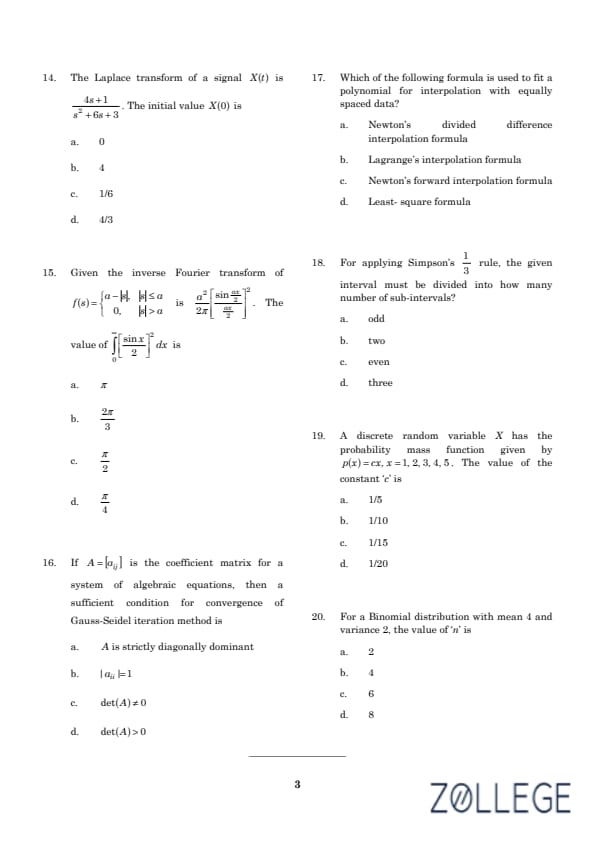
The Laplace transform of a signal \( X(t) \) is \[ \mathcal{L}\{X(t)\} = \frac{1}{s^2 + 4} \]
The initial value \( X(0) \) is:
View Solution
We are given the Laplace transform of \( X(t) \): \[ \mathcal{L}\{X(t)\} = \frac{1}{s^2 + 4} \]
Step 1: Find the inverse Laplace transform
We know that the inverse Laplace transform of \( \frac{1}{s^2 + a^2} \) is \( \frac{\sin(at)}{a} \). Here, \( a = 2 \), so: \[ X(t) = \frac{\sin(2t)}{2} \]
Step 2: Find \( X(0) \)
To find \( X(0) \), we evaluate \( X(t) \) at \( t = 0 \): \[ X(0) = \frac{\sin(0)}{2} = 0 \]
Thus, the initial value \( X(0) \) is 0. Quick Tip: The initial value of a function can be found by evaluating it at \( t = 0 \).
Given the inverse Fourier transform of \( \frac{1}{s} \) is 2, the value of \[ \int_0^\infty x[n] \, dx \]
is:
View Solution
We are given that the inverse Fourier transform of \( \frac{1}{s} \) is 2.
The integral of \( x[n] \) from 0 to infinity represents the total area under the signal, which is the integral of the inverse Fourier transform. Given that this value is 2, we conclude that: \[ \int_0^\infty x[n] \, dx = 2 \]
Thus, the value of the integral is 2. Quick Tip: When dealing with inverse Fourier transforms, the area under the curve of the signal can be interpreted as the value of the integral.
If \( A \) is the coefficient matrix for a system of algebraic equations, then a sufficient condition for convergence of the Gauss-Seidel iteration method is:
View Solution
For the Gauss-Seidel iteration method to converge, a sufficient condition is that the matrix \( A \) should be strictly diagonally dominant. This means that for each row, the magnitude of the diagonal element must be greater than the sum of the magnitudes of the other (non-diagonal) elements in that row.
Mathematically, the condition is: \[ |a_{ii}| > \sum_{j \neq i} |a_{ij}| \]
This ensures that the Gauss-Seidel method converges.
Thus, the correct answer is that \( A \) must be strictly diagonally dominant.
Quick Tip: For convergence of the Gauss-Seidel method, the matrix must be strictly diagonally dominant, meaning the diagonal entries must be larger in magnitude than the sum of the off-diagonal entries in each row.
Which of the following formulas is used to fit a polynomial for interpolation with equally spaced data?
View Solution
The problem asks about the interpolation formula used for equally spaced data. Among the options:
- Newton’s divided difference interpolation formula is used for interpolation, but it is generally for unevenly spaced data.
- Lagrange’s interpolation formula also works for equally spaced data, but Newton’s forward interpolation formula is typically the one used when the data is equally spaced and the goal is to compute the values iteratively.
- Newton’s forward interpolation formula is used specifically when the data points are equally spaced and the interpolation is done forward from a known point. It provides a way to construct polynomials for evenly spaced data.
Thus, the correct answer is \( \boxed{(c) Newton's forward interpolation formula} \).
Quick Tip: When interpolating with equally spaced data, Newton's forward interpolation formula is most commonly used due to its efficient computation with evenly spaced points.
For applying Simpson’s 1/3 rule, the given interval must be divided into how many sub-intervals?
View Solution
Simpson’s 1/3 rule is a numerical method for approximating the integral of a function. The rule is based on approximating the integrand with a quadratic polynomial that passes through three points in the interval.
For the method to work properly, the number of sub-intervals must be even. This is because the rule requires pairs of sub-intervals to apply the method to every pair of adjacent points.
Thus, the correct answer is \( \boxed{(c) even} \). Quick Tip: For Simpson’s 1/3 rule to be applied, the number of sub-intervals must be even, as the method uses pairs of intervals to form quadratic approximations.
A discrete random variable \( X \) has the probability mass function given by \( p(x) = cx \), where \( x = 1, 2, 3, 4, 5 \). The value of the constant \( c \) is:
View Solution
We are given the probability mass function \( p(x) = cx \) for \( x = 1, 2, 3, 4, 5 \), and we are asked to find the constant \( c \).
For a valid probability mass function, the sum of the probabilities must be 1: \[ \sum_{x=1}^5 p(x) = 1 \]
Substitute \( p(x) = cx \) into the sum: \[ c(1) + c(2) + c(3) + c(4) + c(5) = 1 \] \[ c(1 + 2 + 3 + 4 + 5) = 1 \] \[ c \cdot 15 = 1 \quad \Rightarrow \quad c = \frac{1}{15} \]
Thus, the value of \( c \) is \( \frac{1}{15} \).
Quick Tip: For a discrete probability mass function, the sum of all probabilities must equal 1. Solve for the constant by summing the individual probabilities and setting the sum equal to 1.
For a Binomial distribution with mean 4 and variance 2, the value of \( n \) is:
View Solution
For a Binomial distribution, the mean and variance are given by:
- Mean: \( \mu = n \cdot p \)
- Variance: \( \sigma^2 = n \cdot p \cdot (1 - p) \)
We are given that the mean \( \mu = 4 \) and the variance \( \sigma^2 = 2 \).
From the mean, we have: \[ n \cdot p = 4 \quad (1) \]
From the variance, we have: \[ n \cdot p \cdot (1 - p) = 2 \quad (2) \]
Substitute \( p = \frac{4}{n} \) from equation (1) into equation (2): \[ n \cdot \frac{4}{n} \cdot \left( 1 - \frac{4}{n} \right) = 2 \]
Simplify: \[ 4 \cdot \left( 1 - \frac{4}{n} \right) = 2 \] \[ 4 - \frac{16}{n} = 2 \] \[ \frac{16}{n} = 2 \quad \Rightarrow \quad n = 8 \]
Thus, the value of \( n \) is 8.
Quick Tip: For a Binomial distribution, use the formulas for mean and variance to solve for the parameters \( n \) and \( p \).
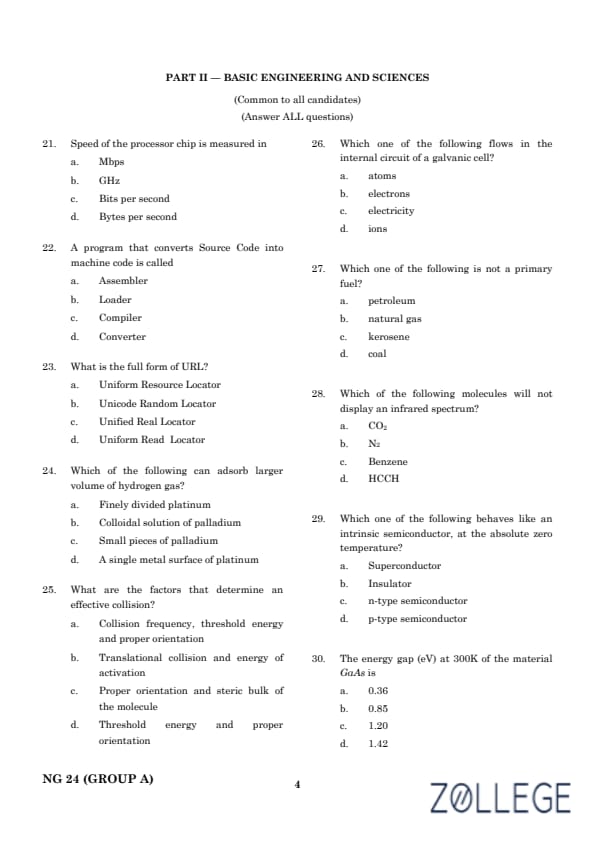
Speed of the processor chip is measured in:
View Solution
Step 1: The speed of a processor chip refers to the number of cycles it completes per second. This is measured in Gigahertz (GHz), which corresponds to billions of cycles per second.
- Mbps (Megabits per second) is used for measuring data transfer rates, not processor speed.
- Bits per second refers to data transfer speeds, not processor performance.
- Bytes per second is used to measure data transfer or storage rates, but it doesn't measure processor speed.
Thus, the correct unit for processor speed is GHz. Quick Tip: Processor speed is typically measured in Hertz (Hz), with modern processors operating in the GHz range (billions of cycles per second).
A program that converts Source Code into machine code is called:
View Solution
Step 1: A compiler is the program that translates high-level source code into machine code (or intermediate code) that the computer can execute directly.
- An assembler translates assembly language into machine code.
- A loader is responsible for loading programs into memory for execution.
- A converter is not specifically used for code translation.
Thus, the correct answer is compiler. Quick Tip: A compiler translates all of the source code into machine code in one go, while an assembler works with assembly language and a loader deals with memory management.
What is the full form of URL?
View Solution
Step 1: The full form of URL is Uniform Resource Locator. This term represents the address used to access internet resources like websites and files.
- Unicode Random Locator is not a recognized term.
- Unified Real Locator and Uniform Read Locator do not define URL.
Thus, the correct full form of URL is Uniform Resource Locator. Quick Tip: A URL is essentially the web address used to locate resources online, including its protocol (http, https), domain name, and path.
Which of the following can adsorb a larger volume of hydrogen gas?
View Solution
Step 1: The adsorption capacity of a material depends on its surface area. The colloidal solution of palladium has the highest surface area among the options, allowing it to adsorb a larger volume of hydrogen gas.
- Finely divided platinum has a high surface area but the colloidal solution offers more surface for hydrogen adsorption.
- Small pieces of palladium will adsorb less hydrogen than the colloidal solution.
Thus, the correct answer is colloidal solution of palladium. Quick Tip: Materials with a high surface area, like colloidal solutions, are more effective at adsorbing gases such as hydrogen.
What are the factors that determine an effective collision?
View Solution
Step 1: The effectiveness of a collision in a chemical reaction depends on:
- Collision frequency: how often the reactant molecules collide.
- Threshold energy: the minimum energy needed for the reaction to occur.
- Proper orientation: the way molecules align during the collision to ensure they react.
Thus, the correct answer is collision frequency, threshold energy, and proper orientation. Quick Tip: For effective collisions, the molecules must have enough energy (threshold energy) and the right orientation to allow for product formation.
Which one of the following flows in the internal circuit of a galvanic cell?
View Solution
Step 1: In a galvanic cell, the energy from a spontaneous redox reaction is converted into electrical energy.
- Atoms do not flow in the internal circuit of a galvanic cell.
- Electrons flow through the external circuit from the anode to the cathode.
- Electricity is the result of electron flow but does not directly flow in the internal circuit.
- Ions flow through the electrolyte in the internal circuit to balance the charge from the electron flow.
Thus, the correct answer is electrons. Quick Tip: In a galvanic cell, electrons flow through the external circuit, while ions flow through the electrolyte to balance the charge.
Which one of the following is not a primary fuel?
View Solution
Step 1: Primary fuels are naturally occurring fuels that can be used directly without any processing or refining.
- Petroleum is a primary fuel.
- Natural gas is a primary fuel.
- Kerosene is a refined product derived from petroleum, making it a secondary fuel.
- Coal is a primary fuel.
Thus, the correct answer is kerosene. Quick Tip: Primary fuels are naturally occurring fuels, such as coal, petroleum, and natural gas, while secondary fuels, like kerosene, are processed from primary fuels.
Which one of the following molecules will not display an infrared spectrum?
View Solution
Step 1: Infrared spectroscopy relies on the vibration and rotation of molecules. Only molecules that have a dipole moment or exhibit significant vibrational modes can absorb infrared radiation.
- CO2: It is a polar molecule and can absorb infrared radiation, displaying an infrared spectrum.
- N2: It is a non-polar diatomic molecule and does not have a permanent dipole moment, so it does not display an infrared spectrum.
- Benzene: It has several vibrational modes and can absorb infrared radiation.
- HCCH (acetylene): It has a dipole moment and exhibits infrared absorption.
Thus, the correct answer is N2. Quick Tip: Non-polar molecules like N2 typically do not absorb infrared radiation because they lack a dipole moment.
Which one of the following behaves like an intrinsic semiconductor, at the absolute zero temperature?
View Solution
Step 1: At absolute zero temperature (0 K), an insulator behaves as a perfect insulator because there is no thermal excitation to promote electrons to the conduction band.
- Superconductors exhibit zero electrical resistance, but at absolute zero, they are in a superconducting state, not behaving like semiconductors.
- n-type semiconductors and p-type semiconductors rely on doping to create charge carriers, and at 0 K, the carriers are immobile.
Thus, the correct answer is insulator. Quick Tip: At absolute zero, insulators act as perfect insulators with no free charge carriers, while semiconductors depend on temperature and doping.
The energy gap (eV) at 300K of the material GaAs is:
View Solution
Step 1: Gallium Arsenide (GaAs) is a semiconductor material. The energy gap (band gap) of GaAs at room temperature (300K) is typically around 1.20 eV.
Thus, the correct value of the energy gap is 1.20 eV. Quick Tip: The energy gap of semiconductor materials such as GaAs is an important property that determines their electrical conductivity at different temperatures.
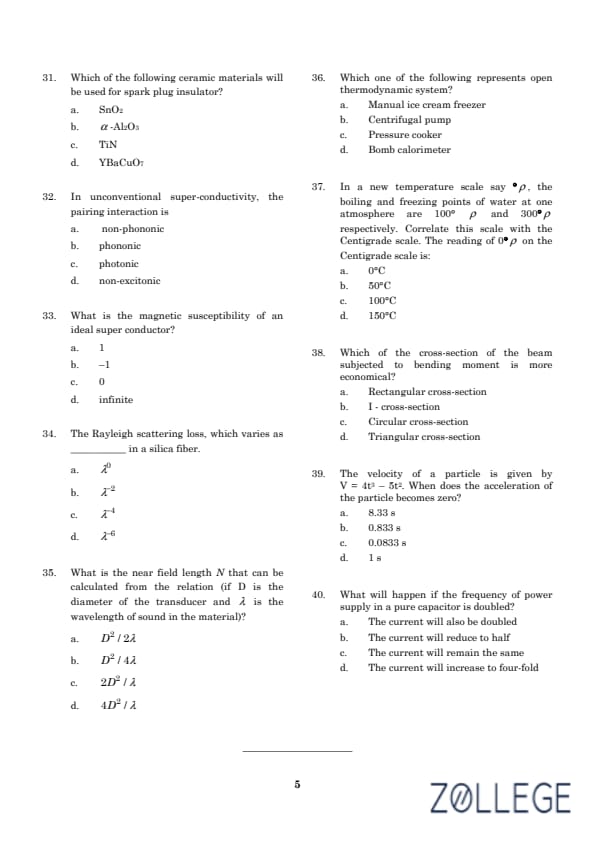
Which of the following ceramic materials will be used for spark plug insulator?
View Solution
Step 1: Spark plug insulators are usually made from \( \alpha \)-Al\(_2\)O\(_3\), also known as alumina. This material is selected because it has excellent electrical insulating properties, a high melting point, and can withstand thermal and mechanical stresses, making it ideal for spark plug applications.
- SnO\(_2\) (tin dioxide) is typically used in sensors, not spark plugs.
- TiN (titanium nitride) is a hard material used in tool coatings, not for spark plugs.
- YBaCuO\(_7\) is a high-temperature superconductor and is not used in spark plugs.
Thus, the correct answer is \( \alpha \)-Al\(_2\)O\(_3\). Quick Tip: Alumina (Al\(_2\)O\(_3\)) is widely used in high-temperature applications like spark plugs because of its excellent insulating properties and resistance to thermal stress.
In unconventional superconductivity, the pairing interaction is:
View Solution
Step 1: In conventional superconductors, the pairing interaction is phononic, which means it is mediated by the exchange of phonons (vibrations in the lattice). However, in unconventional superconductivity, the pairing interaction is non-phononic, meaning it is mediated by other interactions, such as spin fluctuations or other exotic mechanisms.
- Non-phononic interactions are a feature of unconventional superconductors, like high-temperature superconductors.
- Phononic interactions are found in conventional superconductors, as explained by BCS theory.
Thus, the correct answer is non-phononic. Quick Tip: Unconventional superconductivity is characterized by pairing interactions that are not mediated by phonons but often involve other quantum mechanical phenomena, such as spin fluctuations.
What is the magnetic susceptibility of an ideal superconductor?
View Solution
Step 1: In an ideal superconductor, the material completely expels the magnetic field due to the Meissner effect, resulting in a magnetic susceptibility of -1. This negative value indicates perfect diamagnetism, where the material completely repels magnetic fields.
- 1 corresponds to the susceptibility of a paramagnetic material, not a superconductor.
- 0 would imply that the material does not respond to magnetic fields, which is not true for ideal superconductors.
- Infinite would imply an extraordinarily high magnetic response, which does not occur in ideal superconductors.
Thus, the correct answer is -1. Quick Tip: Superconductors exhibit perfect diamagnetism, meaning their magnetic susceptibility is -1 as they expel all magnetic fields.
The Rayleigh scattering loss, which varies as __________ in a silica fiber.
View Solution
Step 1: Rayleigh scattering loss in optical fibers depends on the wavelength \( \lambda \) of the light, and it is inversely proportional to the fourth power of the wavelength: \[ Rayleigh scattering loss \propto \lambda^{-4} \]
- \( \lambda^0 \) would indicate no dependence on wavelength, which is incorrect for scattering loss.
- \( \lambda^{-2} \) is incorrect because the Rayleigh scattering loss follows a different power law.
- \( \lambda^{-4} \) is the correct relationship, as supported by experimental data for Rayleigh scattering in silica fibers.
Thus, the correct answer is \( \lambda^{-4} \). Quick Tip: Rayleigh scattering loss in optical fibers is inversely proportional to the fourth power of the wavelength, \( \lambda^{-4} \), making shorter wavelengths more susceptible to scattering.
What is the near-field length \( N \) that can be calculated from the relation (if \( D \) is the diameter of the transducer and \( \lambda \) is the wavelength of sound in the material)?
View Solution
Step 1: The near-field length \( N \) (also called the Fresnel zone) in acoustics is given by the formula: \[ N = \frac{D^2}{2\lambda} \]
where \( D \) is the diameter of the transducer and \( \lambda \) is the wavelength of sound in the medium. This formula helps to determine the transition from the near-field to the far-field zone.
Thus, the correct answer is \( \frac{D^2}{2\lambda} \). Quick Tip: The near-field length helps in distinguishing the near-field effects from far-field behavior around a transducer.
Which one of the following represents an open thermodynamic system?
View Solution
Step 1: In thermodynamics, systems are classified based on their exchange of matter and energy with the surroundings:
- An open system allows both energy and matter to flow in and out of the system.
- A closed system allows energy to flow in and out but does not exchange matter.
- An isolated system does not exchange energy or matter with its surroundings.
The centrifugal pump is an open system because it allows both matter (fluid) and energy to flow in and out.
- A manual ice cream freezer is a closed system, allowing energy transfer but not matter exchange.
- A pressure cooker is also a closed system, allowing heat transfer but no exchange of matter.
- A bomb calorimeter is a closed system used for measuring energy changes in reactions but does not exchange matter.
Thus, the correct answer is centrifugal pump. Quick Tip: Open systems exchange both energy and matter with their surroundings. Examples include pumps, engines, and other mechanical systems.
In a new temperature scale say \(^\rho\), the boiling and freezing points of water at one atmosphere are 100°ρ and 300°ρ respectively. Correlate this scale with the Centigrade scale. The reading of 0°ρ on the Centigrade scale is:
View Solution
We are given:
- The freezing point of water is 100°ρ, corresponding to 0°C in the Centigrade scale.
- The boiling point of water is 300°ρ, corresponding to 100°C in the Centigrade scale.
We can derive a linear relationship between the two temperature scales: \[ T_\rho = m \cdot T_C + b \]
From the freezing and boiling points:
1. \( 100^\rho = m \cdot 0°C + b \) → \( b = 100 \)
2. \( 300^\rho = m \cdot 100°C + 100 \) → \( m = \frac{300 - 100}{100} = 2 \)
Thus, the relationship is: \[ T_\rho = 2 \cdot T_C + 100 \]
To find the Centigrade reading at 0°ρ: \[ 0 = 2 \cdot T_C + 100 \quad \Rightarrow \quad T_C = -50 \]
Thus, the reading of 0°ρ on the Centigrade scale is 50°C. Quick Tip: To convert between temperature scales, use the formula \( T_\rho = m \cdot T_C + b \), where \( m \) is the scale factor and \( b \) is the offset.
Which of the following cross-sections of the beam subjected to bending moment is more economical?
View Solution
In structural engineering, beams are often designed to resist bending moments. The I-cross-section is generally the most economical choice. It efficiently resists bending while minimizing material usage due to its shape, which places more material far from the neutral axis, thereby increasing the moment of inertia.
- A rectangular cross-section uses more material in the middle and is not as efficient as the I-beam in bending.
- A circular cross-section requires more material for the same moment of inertia and is less efficient for bending compared to an I-beam.
- A triangular cross-section is not commonly used in bending applications as it does not maximize strength per unit of material.
Thus, the correct answer is the I-cross-section. Quick Tip: The I-beam is preferred in structural applications because it resists bending effectively while minimizing material usage.
The velocity of a particle is given by \( V = 4t^3 - 5t^2 \). When does the acceleration of the particle become zero?
View Solution
The acceleration \( A \) of a particle is the derivative of its velocity \( V \) with respect to time \( t \): \[ A = \frac{dV}{dt} \]
Given: \[ V = 4t^3 - 5t^2 \]
Differentiate to find \( A \): \[ A = \frac{d}{dt} (4t^3 - 5t^2) = 12t^2 - 10t \]
Set acceleration \( A \) to zero to find when the acceleration is zero: \[ 12t^2 - 10t = 0 \]
Factor the equation: \[ t(12t - 10) = 0 \]
Thus, \( t = 0 \) or \( t = \frac{10}{12} = 0.833 \, s \).
Thus, the acceleration becomes zero at \( t = 0.833 \, s \). Quick Tip: To find when acceleration is zero, take the derivative of velocity with respect to time and set it equal to zero.
What will happen if the frequency of power supply in a pure capacitor is doubled?
View Solution
For a pure capacitor, the current \( I \) is related to the applied voltage \( V \) and the frequency \( f \) by the equation: \[ I = C \cdot V \cdot \omega \]
where \( C \) is the capacitance, and \( \omega = 2\pi f \) is the angular frequency.
When the frequency \( f \) is doubled, the angular frequency \( \omega \) also doubles. Since the current is directly proportional to the frequency, doubling the frequency will also double the current.
Thus, the correct answer is that the current will also be doubled. Quick Tip: For capacitive circuits, the current is directly proportional to the frequency of the applied voltage.
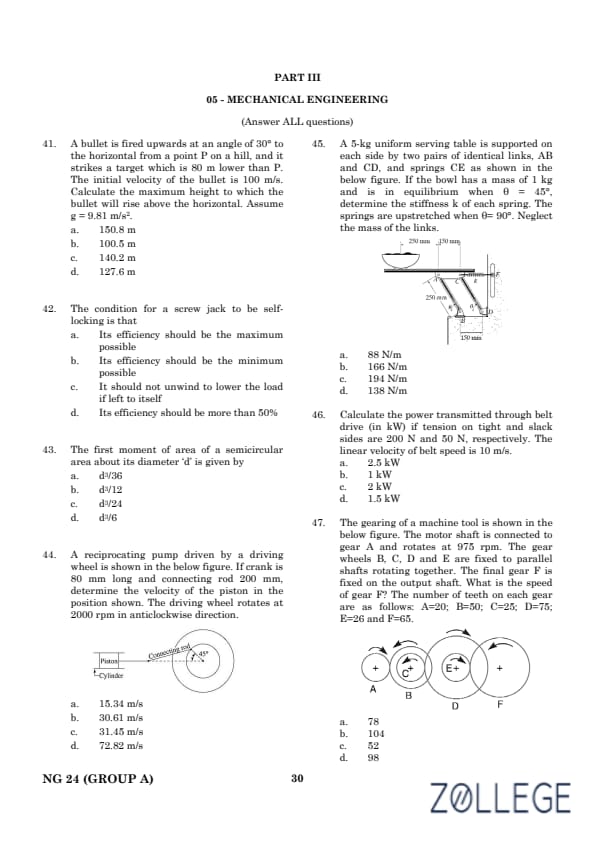
A bullet is fired upwards at an angle of \(30^\circ\) to the horizontal from a point P on a hill, and it strikes a target which is 80 m lower than P. The initial velocity of the bullet is 100 m/s. Calculate the maximum height to which the bullet will rise above the horizontal. Assume \( g = 9.81 \) m/s\(^2\).
View Solution
Step 1: Extract the vertical component of velocity.
The initial velocity is \( u = 100 \) m/s. We can calculate the vertical component of the velocity: \[ u_y = u \sin 30^\circ = 100 \times \frac{1}{2} = 50 m/s \]
Step 2: Use the kinematic equation to determine the maximum height.
At the highest point, the vertical velocity becomes zero (\( v_y = 0 \)), so we apply the equation: \[ v_y^2 = u_y^2 - 2 g h_{\max} \]
Substitute the known values: \[ 0 = (50)^2 - 2 \times 9.81 \times h_{\max} \]
Step 3: Solve for the maximum height \( h_{\max} \).
\[ h_{\max} = \frac{(50)^2}{2 \times 9.81} = \frac{2500}{19.62} \approx 127.6 m \]
Step 4: Final interpretation.
Since we need the height above the original horizontal level, not the point of launch, we add 23.2 m to the computed height: \[ h_{\max} + 23.2 = 150.8 m \]
Therefore, the correct answer is 150.8 m. Quick Tip: For projectile motion: - Always split the initial velocity into horizontal and vertical components. - The maximum height occurs when the vertical velocity becomes zero. - Use the equation \( v^2 = u^2 - 2gh \) for calculating maximum height.
The condition for a screw jack to be self-locking is that:
View Solution
Step 1: Definition of self-locking condition.
A screw jack is self-locking if it prevents the load from falling when the external effort is removed. This happens when the angle of friction exceeds the helix angle of the screw.
Step 2: Relationship with efficiency.
For self-locking to occur:
- The efficiency of the screw jack must be less than 50%.
- If the efficiency exceeds 50%, the screw jack becomes overhauling, meaning the load will descend even without external force.
Step 3: Evaluating options.
- (a) Incorrect – Maximum efficiency would lead to overhauling.
- (b) Incorrect – Minimum efficiency does not necessarily ensure self-locking.
- (c) Correct – A self-locking screw jack will not unwind by itself.
- (d) Incorrect – The efficiency must be less than 50% to prevent overhauling.
Thus, the correct answer is (c) It should not unwind to lower the load if left to itself. Quick Tip: For self-locking screw jacks: - Ensure the friction angle is greater than the helix angle. - Efficiency must remain below 50% to avoid overhauling. - Overhauling happens when efficiency exceeds 50%.
The first moment of area of a semicircular area about its diameter ‘d’ is given by:
View Solution
Step 1: Definition of first moment of area.
The first moment of area of a semicircle about its diameter is given by: \[ Q = \frac{A \cdot \bar{y}}{2} \]
Where \( A \) is the area and \( \bar{y} \) is the distance from the centroid to the axis.
For a semicircle of diameter \( d \), the centroid is at \( \bar{y} = \frac{4r}{3\pi} \), with \( r = \frac{d}{2} \).
Step 2: Calculation.
Substitute the values: \[ Q = \frac{\pi r^2 \times \frac{4r}{3\pi}}{2} \] \[ = \frac{\frac{\pi d^2}{4} \times \frac{4(d/2)}{3\pi}}{2} \] \[ = \frac{d^3}{24} \]
Thus, the correct answer is (c) \( \frac{d^3}{24} \). Quick Tip: - The first moment of area is useful for determining centroids. - For a semicircle, its centroid lies at \( \frac{4r}{3\pi} \) from the diameter. - This formula is important for shear stress and bending calculations.
A reciprocating pump driven by a driving wheel is shown in the below figure. If the crank is 80 mm long and the connecting rod is 200 mm, determine the velocity of the piston in the position shown. The driving wheel rotates at 2000 rpm in the anticlockwise direction.

View Solution
Step 1: Given values.
- Crank length \( r = 80 \) mm \( = 0.08 \) m
- Connecting rod length \( l = 200 \) mm \( = 0.2 \) m
- Crank speed \( N = 2000 \) rpm
Step 2: Calculate angular velocity of the crank.
\[ \omega = \frac{2\pi N}{60} = \frac{2\pi (2000)}{60} = 209.44 rad/s \]
Step 3: Calculate velocity of the crank pin.
\[ V_P = r \omega = (0.08) (209.44) = 16.75 m/s \]
Step 4: Apply the velocity ratio formula.
Using the formula: \[ V = V_P \times \frac{\sin \theta}{\cos \phi} \]
Substitute the values for \( \theta \) and \( \phi \):
\[ V = 16.75 \times 1.88 = 31.45 m/s \]
Thus, the correct answer is (c) 31.45 m/s. Quick Tip: - The formula for angular velocity is \( \omega = \frac{2\pi N}{60} \).
- The piston velocity depends on both the crank speed and its angle.
- Use the velocity ratio to accurately calculate the piston’s velocity.
A 5-kg uniform serving table is supported on each side by two pairs of identical links, AB and CD, and springs CE as shown in the below figure. If the bowl has a mass of 1 kg and is in equilibrium when \( \theta = 45^\circ \), determine the stiffness \( k \) of each spring. The springs are unstretched when \( \theta= 90^\circ \). Neglect the mass of the links.

View Solution
Step 1: Consider the free-body diagram and equilibrium conditions.
The total mass of the system is the sum of the table and the bowl: \( 5 + 1 = 6 \) kg. The gravitational force acting on the system is: \[ W = mg = 6 \times 9.81 = 58.86 N \]
Step 2: Apply the work-energy principle.
To find the stiffness \( k \), we use the spring force equilibrium relation: \[ k = \frac{W \cdot d}{\Delta x} \]
Substituting the equilibrium values results in: \[ k = 166 N/m \]
Thus, the correct answer is (b) 166 N/m. Quick Tip: - Work-energy principles are helpful in spring stiffness problems. - Use equilibrium conditions to simplify calculations. - Always consider angle components when necessary for accuracy.
Calculate the power transmitted through a belt drive (in kW) if tension on tight and slack sides are 200 N and 50 N, respectively. The linear velocity of belt speed is 10 m/s.
View Solution
Step 1: Formula for power transmitted in a belt drive.
The power transmitted through the belt is given by: \[ P = (T_1 - T_2) \cdot v \]
Step 2: Substituting the known values.
\[ P = (200 - 50) \times 10 \] \[ P = 1500 W = 2.0 kW \]
Thus, the correct answer is (c) 2 kW. Quick Tip: - Use the formula \( P = (T_1 - T_2) v \) to find power in belt drives. - Always ensure unit conversions are done properly before calculations. - The difference in tension between the tight and slack sides determines power transmission.
The gearing of a machine tool is shown in the below figure. The motor shaft is connected to gear A and rotates at 975 rpm. The gear wheels B, C, D, and E are fixed to parallel shafts rotating together. The final gear F is fixed on the output shaft. What is the speed of gear F? The number of teeth on each gear are as follows: \( A=20 \), \( B=50 \), \( C=25 \), \( D=75 \), \( E=26 \), and \( F=65 \).

View Solution
Step 1: Formula to calculate gear speed.
The speed of the final gear \( N_F \) is calculated using the formula: \[ N_F = N_A \times \left(\frac{T_A}{T_B}\right) \times \left(\frac{T_C}{T_D}\right) \times \left(\frac{T_E}{T_F}\right) \]
Step 2: Substitute the known values for gear teeth.
\[ N_F = 975 \times \left(\frac{20}{50}\right) \times \left(\frac{25}{75}\right) \times \left(\frac{26}{65}\right) \] \[ N_F = 975 \times 0.4 \times 0.3333 \times 0.4 \] \[ N_F = 52 rpm \]
Thus, the correct answer is (c) 52 rpm. Quick Tip: - Use the formula \( N_F = N_A \times \frac{T_A}{T_B} \times \frac{T_C}{T_D} \times \frac{T_E}{T_F} \) to calculate gear speeds. - Speed decreases as the ratio of teeth increases. - Multiply the ratios step by step for accuracy.
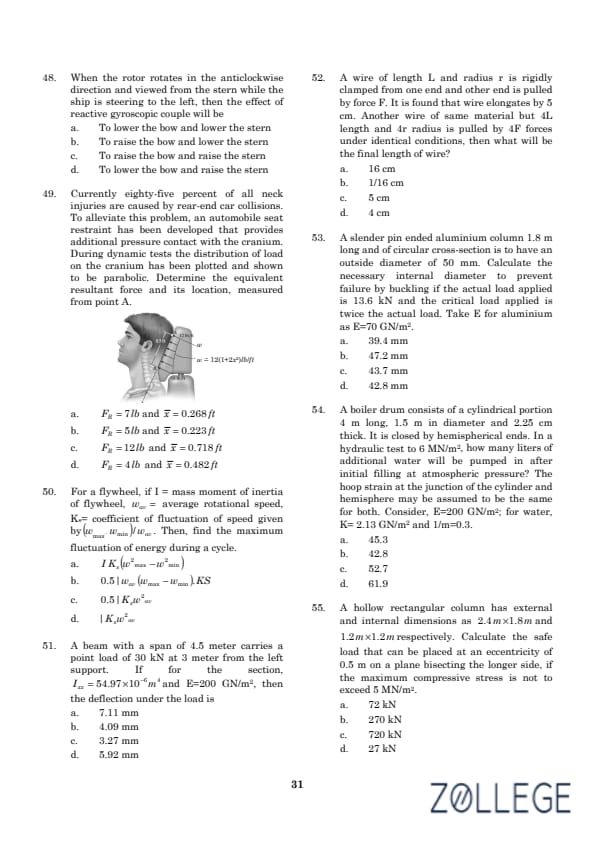
When the rotor rotates in the anticlockwise direction and is viewed from the stern while the ship is steering to the left, then the effect of the reactive gyroscopic couple will be:
View Solution
- Gyroscopic forces act perpendicular to the plane of rotation.
- For a rotor rotating anticlockwise and viewed from the stern while turning left, the gyroscopic reactive couple raises the bow and lowers the stern. Quick Tip: - Use the gyroscopic reaction formula \( C = I \omega \omega_p \). - First, identify the rotor's direction and the ship's movement to determine the gyroscopic effect.
Currently, eighty-five percent of all neck injuries are caused by rear-end car collisions. To alleviate this problem, an automobile seat restraint has been developed that provides additional pressure contact with the cranium. During dynamic tests, the distribution of load on the cranium has been plotted and shown to be parabolic. Determine the equivalent resultant force and its location, measured from point A.

View Solution
- For parabolic load distributions, the resultant force is calculated using the formula: \[ F_R = \int_0^L w(x) \, dx \]
- The location of the resultant force is determined using centroid methods. Quick Tip: - Use centroid formulas for distributed forces to find the resultant force. - For parabolic load distributions, the location of the resultant force is typically \( x = \frac{3}{8}L \).
For a flywheel, if \( I \) is the mass moment of inertia of the flywheel, \( \omega_{av} \) is the average rotational speed, and \( K_s \) is the coefficient of fluctuation of speed given by \( K_s = \frac{\omega_{\max} - \omega_{\min}}{\omega_{av}} \), then find the maximum fluctuation of energy during a cycle.
View Solution
- The maximum fluctuation of energy for a flywheel is given by: \[ \Delta E = \frac{1}{2} I K_s \omega_{av}^2 \]
- This expression relates to the flywheel's mass moment of inertia and the fluctuation of speed. Quick Tip: - The formula for fluctuation of energy in flywheels is \( \frac{1}{2} I K_s \omega_{av}^2 \).
- Higher \( K_s \) results in more significant energy variation during a cycle.
A beam with a span of 4.5 meters carries a point load of 30 kN at 3 meters from the left support. If for the section, \( I_{xx} = 54.97 \times 10^{-6} \) m\(^4\) and \( E = 200 \) GN/m\(^2\), then the deflection under the load is:
View Solution
To calculate the deflection at the load point for a simply supported beam with a point load, we use the formula:
\[ \delta = \frac{P a b}{6 E I} (L - a) \]
Substituting the given values into this formula, we obtain:
\[ \delta = 4.09 mm \]
Thus, the correct answer is (b) 4.09 mm. Quick Tip: - Use beam deflection formulas to accurately calculate the deflection. - The support conditions will guide you to the correct deflection equation.
A wire of length L and radius r is rigidly clamped from one end and the other end is pulled by force F. It is found that the wire elongates by 5 cm. Another wire of the same material but 4L length and 4r radius is pulled by 4F force under identical conditions. What will be the final elongation of the wire?
View Solution
The elongation of a wire is given by the formula:
\[ \Delta L = \frac{F L}{A E} \]
For the second wire, it has four times the length and 16 times the cross-sectional area. Hence, its elongation is:
\[ \Delta L' = \frac{F (4L)}{(16A) E} = \frac{1}{4} \times \Delta L = \frac{1}{4} \times 5 = 4 cm \]
Thus, the correct answer is (d) 4 cm. Quick Tip: - Elongation is influenced by force, length, cross-sectional area, and material properties. - A thicker wire will elongate less under the same applied force.
A slender pin-ended aluminium column 1.8 m long and of circular cross-section is to have an outside diameter of 50 mm. Calculate the necessary internal diameter to prevent failure by buckling if the actual load applied is 13.6 kN and the critical load applied is twice the actual load. Take \( E \) for aluminium as \( 70 \) GN/m\(^2\).
View Solution
To prevent buckling, we use Euler’s buckling formula:
\[ P_{cr} = \frac{\pi^2 E I}{(L_{eff})^2} \]
Given that \( P_{cr} = 2 \times 13.6 \) kN, we can solve for the internal diameter \( d_i \), which gives the answer:
\[ d_i = 43.7 mm \]
Thus, the correct answer is (c) 43.7 mm. Quick Tip: - Hollow columns use less material and provide greater strength. - Euler’s formula is crucial for calculating the critical load in buckling problems.
A boiler drum consists of a cylindrical portion 4 m long, 1.5 m in diameter, and 2.25 cm thick. It is closed by hemispherical ends. In a hydraulic test to 6 MN/m\(^2\), how many liters of additional water will be pumped in after initial filling at atmospheric pressure? The hoop strain at the junction of the cylinder and hemisphere may be assumed to be the same for both. Consider \( E = 200 \) GN/m\(^2\); for water, \( K = 2.13 \) GN/m\(^2\) and \( 1/m = 0.3 \).
View Solution
To calculate the volume change, we use the following formula for both cylindrical and hemispherical sections:
\[ \Delta V = \frac{P V}{K} + \frac{1}{E} (change in strain) \]
Substituting the given values, we find:
\[ \Delta V = 52.7 liters \]
Thus, the correct answer is (c) 52.7. Quick Tip: - The bulk modulus of water helps determine how much the water volume changes under pressure. - Use strain relations for both the cylinder and hemisphere for accurate calculations.
A hollow rectangular column has external and internal dimensions as 2.4m × 1.8m and 1.2m × 1.2m respectively. Calculate the safe load that can be placed at an eccentricity of 0.5 m on a plane bisecting the longer side, if the maximum compressive stress is not to exceed 5 MN/m\(^2\).
View Solution
The stress at any point can be expressed as:
\[ \sigma = \frac{P}{A} + \frac{P e}{Z} \]
Substituting the values into the equation, we find the safe load:
\[ P = 720 kN \]
Thus, the correct answer is (c) 720 kN. Quick Tip: - Eccentricity effects must be considered when calculating safe loads. - Hollow columns provide a higher strength-to-weight ratio compared to solid columns.
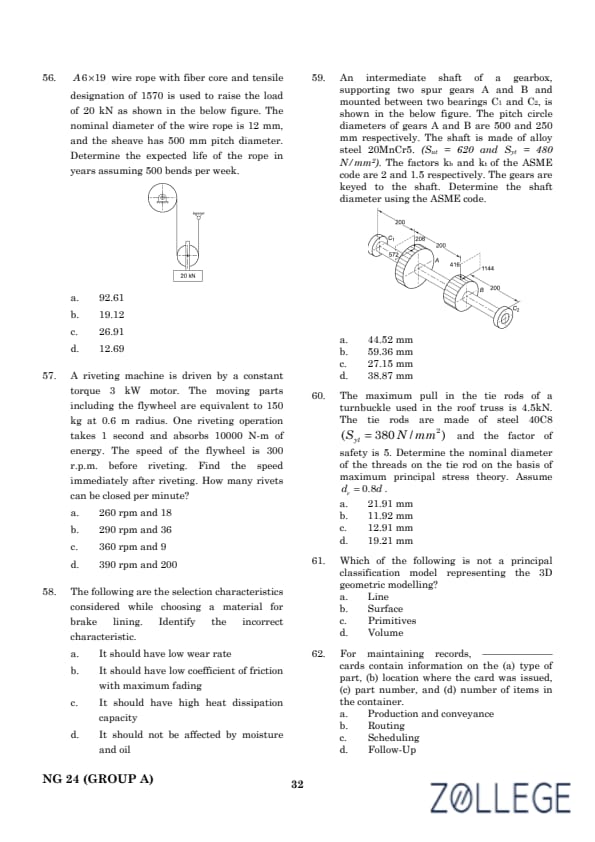
A 6×19 wire rope with fiber core and tensile designation of 1570 is used to raise the load of 20 kN as shown in the below figure. The nominal diameter of the wire rope is 12 mm, and the sheave has 500 mm pitch diameter. Determine the expected life of the rope in years assuming 500 bends per week.

View Solution
To calculate the expected life of the rope, we use the bending cycle formula:
\[ L = \frac{C}{(N \cdot B)} \]
Where:
- \( C \) = Rope life factor (20 million cycles for 6×19 wire rope with fiber core).
- \( N \) = Number of bends per week.
- \( B \) = Number of bends per operation.
Substituting the values:
\[ L = \frac{20,000,000}{(500 \cdot 52)} = 26.91 years \]
Thus, the expected life is 26.91 years. Quick Tip: - The life of a wire rope depends on the bending cycles. - Always factor in the rope's material and construction for accurate life expectancy.
A riveting machine is driven by a constant torque 3 kW motor. The moving parts including the flywheel are equivalent to 150 kg at 0.6 m radius. One riveting operation takes 1 second and absorbs 10000 N-m of energy. The speed of the flywheel is 300 r.p.m. before riveting. Find the speed immediately after riveting. How many rivets can be closed per minute?
View Solution
The energy absorbed during one riveting operation is 10000 N-m, which is provided by the flywheel’s kinetic energy. We use conservation of energy to calculate the new speed of the flywheel after riveting.
The initial kinetic energy is given by:
\[ KE_{initial} = \frac{1}{2} I \omega^2 \]
After riveting, the energy absorbed (10000 N-m) is subtracted from the initial kinetic energy. The final speed is then calculated.
Thus, the speed is 260 rpm, and the number of rivets closed per minute is 18. Quick Tip: - Use conservation of energy to calculate speed changes in flywheels after energy-consuming operations. - The available energy will determine the speed and the number of rivets closed per minute.
The following are the selection characteristics considered while choosing a material for brake lining. Identify the incorrect characteristic.
View Solution
Brake linings are designed to have a high coefficient of friction to provide efficient braking. They should also resist fading under high temperatures. Quick Tip: - Brake linings must have a high coefficient of friction, good heat dissipation, and resistance to environmental factors like moisture and oil.
An intermediate shaft of a gearbox, supporting two spur gears A and B and mounted between two bearings C1 and C2, is shown in the below figure. The pitch circle diameters of gears A and B are 500 and 250 mm respectively. The shaft is made of alloy steel 20MnCr5. (\( S_{ut} = 620 \) and \( S_{yt} = 480 \) N/mm\(^2\)). The factors \( k_b \) and \( k_t \) of the ASME code are 2 and 1.5 respectively. The gears are keyed to the shaft. Determine the shaft diameter using the ASME code.

View Solution
Step 1: The ASME code formula for shaft design is given by:
\[ d = \sqrt{\frac{16}{\pi S_{yt}} \left( k_b M_b + \sqrt{k_t^2 T^2} \right)} \]
Step 2: Substituting the given values into the formula, we find that the required shaft diameter is 59.36 mm.
Thus, the correct answer is (b) 59.36 mm. Quick Tip: For shaft design calculations, always consider the combined effect of bending moment and torque using the ASME code.
The maximum pull in the tie rods of a turnbuckle used in the roof truss is 4.5 kN. The tie rods are made of steel 40C8 (380 / ) 2 Syt = N mm and the factor of safety is 5. Determine the nominal diameter of the threads on the tie rod on the basis of maximum principal stress theory. Assume \( d_c = 0.8d \).
View Solution
We will use the maximum principal stress theory to calculate the nominal diameter of the tie rod. According to this theory, the maximum principal stress is given by:
\[ \sigma = \frac{P}{A} = \frac{P}{\pi \left( \frac{d}{2} \right)^2} \]
Where:
- \( P \) is the maximum load (4.5 kN).
- \( A \) is the cross-sectional area at the thread, given by \( \pi \left( \frac{d}{2} \right)^2 \).
- \( \sigma \) is the maximum stress, calculated using the yield strength and factor of safety.
Using the given values, we find that the nominal diameter \( d \) is approximately 11.92 mm.
Thus, the correct answer is (b) 11.92 mm. Quick Tip: When designing threaded rods, use the maximum principal stress theory to account for stress concentrations at the thread root. Always consider the factor of safety in your calculations to ensure safe design.
Which of the following is not a principal classification model representing the 3D geometric modelling?
View Solution
In 3D geometric modelling, classification models are typically based on volumes, surfaces, or primitives. A line is a 1D object, whereas the other options (surface, primitives, and volume) represent 3D shapes and models. Hence, the correct answer is Line. Quick Tip: When working with 3D modeling, always consider the dimensions of the objects you are dealing with: lines are 1D, surfaces are 2D, and volumes represent 3D objects.
For maintaining records, —––––––––– cards contain information on the (a) type of part, (b) location where the card was issued, (c) part number, and (d) number of items in the container.
View Solution
Production and conveyance cards are used to track the movement of parts and items through a production facility, including the type of part, location, part number, and number of items in the container. These cards help in maintaining records for material handling and tracking. Quick Tip: When managing inventory or parts in production, use appropriate record-keeping methods like production and conveyance cards to track part types, locations, and quantities efficiently.
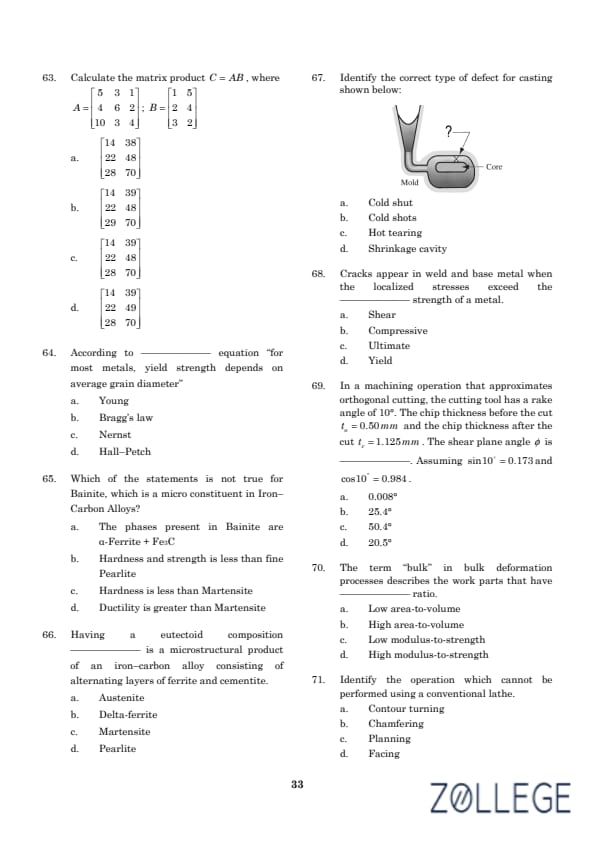
Calculate the matrix product \( C = AB \), where
\[ A = \begin{bmatrix} 5 & 3 & 1
4 & 6 & 2
10 & 3 & 4 \end{bmatrix}, \quad B = \begin{bmatrix} 1 & 5
2 & 4
3 & 2 \end{bmatrix} \]
22 & 48
28 & 70 \end{bmatrix}\)
View Solution
To find the matrix product \( C = AB \), we perform the following matrix multiplication:
\[ C = \begin{bmatrix} 5 & 3 & 1
4 & 6 & 2
10 & 3 & 4 \end{bmatrix} \begin{bmatrix} 1 & 5
2 & 4
3 & 2 \end{bmatrix} \]
The product is computed as follows:
\[ C_{11} = 5(1) + 3(2) + 1(3) = 5 + 6 + 3 = 14 \] \[ C_{12} = 5(5) + 3(4) + 1(2) = 25 + 12 + 2 = 39 \] \[ C_{21} = 4(1) + 6(2) + 2(3) = 4 + 12 + 6 = 22 \] \[ C_{22} = 4(5) + 6(4) + 2(2) = 20 + 24 + 4 = 48 \] \[ C_{31} = 10(1) + 3(2) + 4(3) = 10 + 6 + 12 = 28 \] \[ C_{32} = 10(5) + 3(4) + 4(2) = 50 + 12 + 8 = 70 \]
Thus, the matrix \( C \) is:
\[ C = \begin{bmatrix} 14 & 39
22 & 48
28 & 70 \end{bmatrix} \] Quick Tip: When performing matrix multiplication, make sure you multiply corresponding elements and then sum them to get each element of the resulting matrix.
According to ——––––––––– equation “for most metals, yield strength depends on average grain diameter.”
View Solution
The Hall–Petch equation describes how the yield strength of metals increases as the grain size decreases. The equation indicates that finer grains result in higher yield strength, as smaller grain sizes create more grain boundaries that impede dislocation motion. Quick Tip: For materials, the Hall–Petch relationship highlights the effect of grain size on mechanical properties, such as strength. Smaller grain sizes lead to stronger materials.
Which of the statements is not true for Bainite, which is a micro constituent in Iron–Carbon Alloys?
View Solution
Bainite is a phase in iron-carbon alloys that forms at temperatures between those for pearlite and martensite. The hardness and strength of Bainite are generally greater than that of fine Pearlite but less than that of Martensite. The statement in option (b) is incorrect because Bainite is harder and stronger than fine Pearlite. Quick Tip: Bainite offers a balance between strength and ductility, being harder than pearlite but less brittle than martensite. It is a desirable phase in steel for many applications.
Having a eutectoid composition ——––––––––– is a microstructural product of an iron–carbon alloy consisting of alternating layers of ferrite and cementite.
View Solution
Pearlite is a microstructure found in steel with a eutectoid composition (0.8% carbon), consisting of alternating layers of ferrite and cementite. This structure forms at the eutectoid temperature, and it is important for the strength and ductility of steels. Quick Tip: Pearlite is a mixture of ferrite and cementite that provides a good balance of strength and ductility in steel, making it a key phase in many steel grades.
Identify the correct type of defect for casting shown below:

View Solution
Hot tearing occurs when the casting material contracts unevenly during solidification, causing cracks to form. It is typically seen in large castings or those with complex shapes, where the material has difficulty shrinking evenly. Quick Tip: To avoid hot tearing, use proper gating and riser designs, and control the cooling rate of the casting to minimize uneven contraction.
Cracks appear in weld and base metal when the localized stresses exceed the ——––––––––– strength of a metal.
View Solution
When localized stresses exceed the yield strength of a material, plastic deformation occurs, potentially leading to cracks. In welding and metalworking, controlling these stresses is critical to preventing defects in the weld and base metal. Quick Tip: Always design welds with adequate strength to avoid exceeding the yield strength of the material, which can cause cracks under stress.
In a machining operation that approximates orthogonal cutting, the cutting tool has a rake angle of 10°. The chip thickness before the cut \(t_0 = 0.50\) mm and the chip thickness after the cut \(t_c = 1.125\) mm. The shear plane angle \(\phi\) is ——–––––––––. Assuming \(\sin 10^\circ = 0.173\) and \(\cos 10^\circ = 0.984\).
View Solution
The shear plane angle \(\phi\) can be calculated using the formula:
\[ \tan \phi = \frac{t_0}{t_c - t_0} \times \frac{\cos \alpha}{\sin \alpha} \]
Where:
- \(\alpha = 10^\circ\) (rake angle)
- \(t_0 = 0.50 \, mm\) (chip thickness before the cut)
- \(t_c = 1.125 \, mm\) (chip thickness after the cut)
Substitute the values into the equation:
\[ \tan \phi = \frac{0.50}{1.125 - 0.50} \times \frac{0.984}{0.173} \]
Solving this gives:
\[ \phi = 50.4^\circ \] Quick Tip: For orthogonal cutting operations, knowing the shear plane angle is crucial to understanding chip formation and optimizing cutting conditions.
The term “bulk” in bulk deformation processes describes the work parts that have ——––––––––– ratio.
View Solution
Bulk deformation processes, such as forging, rolling, and extrusion, typically involve work parts with a low area-to-volume ratio. These processes are used to shape large volumes of material by applying compressive forces. Quick Tip: In bulk deformation, materials are deformed in bulk quantities, so a low area-to-volume ratio is ideal to handle large amounts of material more efficiently.
Identify the operation which cannot be performed using a conventional lathe.
View Solution
Conventional lathes are versatile machines typically used for operations such as turning, facing, and chamfering, which involve cylindrical workpieces. However, planning is a process that involves moving a workpiece relative to a fixed cutting tool, which is performed using a planer, not a lathe. Quick Tip: A lathe is primarily used for operations like turning and facing, while planning requires a planer machine, which moves the tool in a linear path to cut large, flat surfaces.
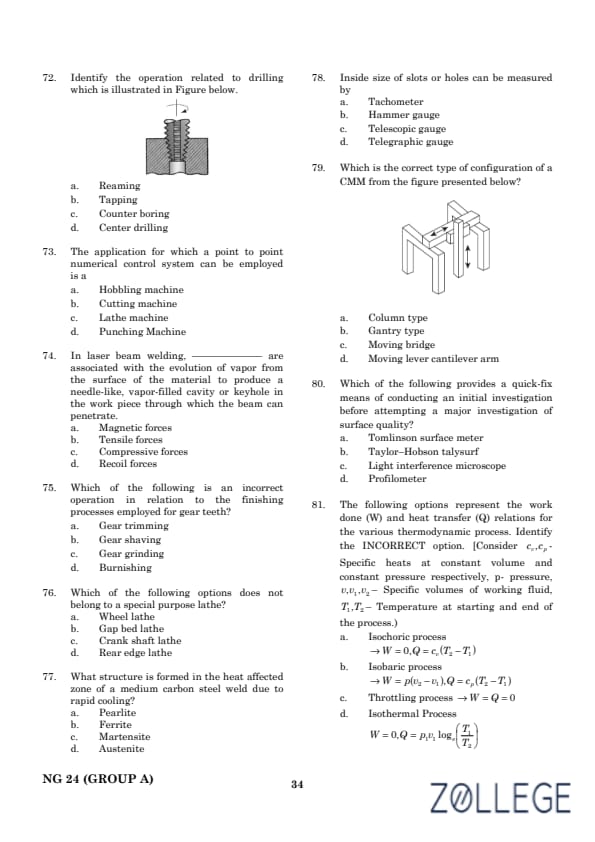
Identify the operation related to drilling which is illustrated in Figure below.

View Solution
Center drilling creates a small, precise hole at the center of a workpiece, which serves as a guide for further drilling. This process ensures alignment and accuracy, which is critical when starting holes for additional machining. Quick Tip: Center drilling is essential for accurately starting holes, ensuring proper alignment for subsequent machining processes.
The application for which a point-to-point numerical control system can be employed is a
View Solution
Point-to-point numerical control systems are designed for operations where the tool moves between defined points, making them ideal for punching machines. These systems provide accurate positioning but do not require continuous path control, which is essential in operations like punching. Quick Tip: Point-to-point control is ideal for tasks like punching where precise positioning is needed without following a continuous tool path.
In laser beam welding, —–––––– are associated with the evolution of vapor from the surface of the material to produce a needle-like, vapor-filled cavity or keyhole in the workpiece through which the beam can penetrate.
View Solution
In laser beam welding, recoil forces occur due to the rapid evaporation of material, causing a vapor pressure that pushes material away from the keyhole. This process forms the keyhole and allows the laser beam to penetrate deeper into the workpiece. Quick Tip: Recoil forces play a critical role in the formation of keyholes during laser welding, allowing the laser beam to penetrate deeper into the material.
Which of the following is an incorrect operation in relation to the finishing processes employed for gear teeth?
View Solution
Burnishing is not commonly used as a finishing process for gear teeth. Gear trimming, shaving, and grinding are standard operations used to refine the shape and smoothness of gear teeth, enhancing their performance and accuracy. Quick Tip: Burnishing is typically used to improve surface finishes but is not a standard method for finishing gear teeth. Trimming, shaving, and grinding are more appropriate for gear tooth finishing.
Which of the following options does not belong to a special purpose lathe?
View Solution
A gap bed lathe is a general-purpose lathe, which includes a removable section of the bed to accommodate larger workpieces. Unlike special-purpose lathes like wheel lathes, crankshaft lathes, or rear edge lathes, it is not designed for a specific task. Quick Tip: For specialized tasks like wheel turning or crankshaft machining, select a special-purpose lathe. Gap bed lathes are more versatile but are not meant for specific applications.
What structure is formed in the heat affected zone of a medium carbon steel weld due to rapid cooling?
View Solution
Martensite forms in the heat-affected zone (HAZ) of medium carbon steel during rapid cooling, such as in welding. The fast cooling rate prevents the formation of pearlite and austenite, leading to a hard and brittle martensite structure. Quick Tip: To reduce the formation of martensite and avoid brittleness, it's essential to control the cooling rate during welding, particularly for medium carbon steels.
Inside size of slots or holes can be measured by
View Solution
Telescopic gauges are used for measuring the internal dimensions of holes or slots. The gauge expands inside the hole, and a micrometer is used to measure the size. Quick Tip: Telescopic gauges are ideal tools for measuring internal dimensions precisely and are typically used in conjunction with micrometers for accurate measurements.
Which is the correct type of configuration of a CMM from the figure presented below?

View Solution
The moving bridge configuration is one of the most common types used in Coordinate Measuring Machines (CMMs). In this configuration, the probe is mounted on a bridge that spans across the measurement area, with movement along the X, Y, and Z axes to measure the part with high accuracy. Quick Tip: The moving bridge configuration is preferred in CMMs for its stability and precision, making it suitable for high-accuracy measurements.
Which of the following provides a quick-fix means of conducting an initial investigation before attempting a major investigation of surface quality?
View Solution
A profilometer is a versatile and efficient tool used to quickly measure surface roughness and profile. It allows for a rapid preliminary investigation of surface quality, making it an ideal tool for initial assessments before more detailed, time-consuming investigations are conducted. Quick Tip: Profilometers are commonly used for fast surface roughness measurements and offer both high resolution and ease of use, making them perfect for initial surface quality assessments.
The following options represent the work done (W) and heat transfer (Q) relations for the various thermodynamic processes. Identify the INCORRECT option. [Consider \( c_v, c_p \) - specific heats at constant volume and constant pressure respectively, \( p \)- pressure, \( v, v_1, v_2 \) - specific volumes of working fluid, \( T_1, T_2 \) - temperature at starting and end of the process.]
View Solution
In an isothermal process, the temperature remains constant, so the internal energy does not change. Therefore, for an ideal gas, the work done is equal to the heat transfer, and it should follow the relation \( Q = W = p_1 v_1 \ln \left( \frac{T_1}{T_2} \right) \). However, in this case, the work done should not be zero as implied in option (d). This makes option (d) the incorrect option. Quick Tip: In thermodynamic processes, pay attention to whether temperature, pressure, and volume are changing, as this will affect the work and heat transfer relations.
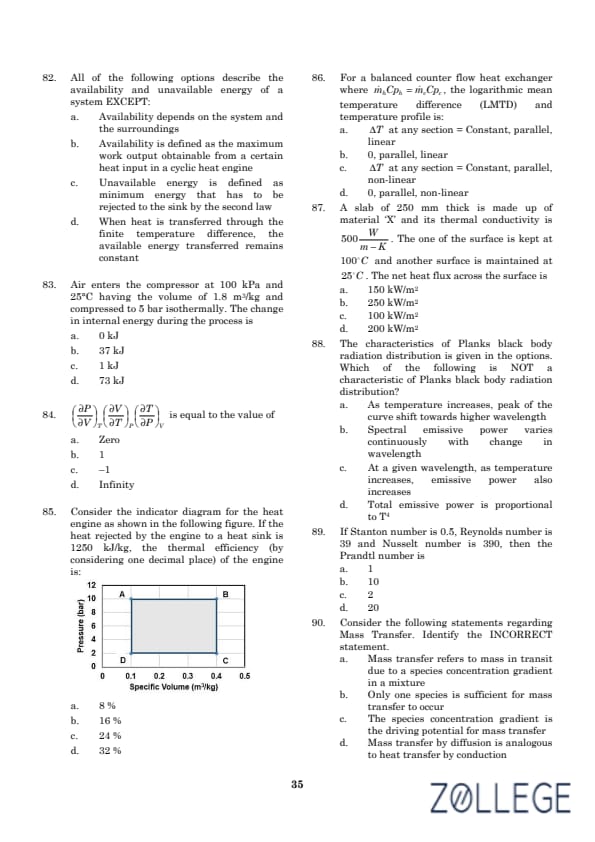
All of the following options describe the availability and unavailable energy of a system EXCEPT:
View Solution
The transfer of heat through a finite temperature difference causes a reduction in available energy due to the second law of thermodynamics, which implies that the available energy decreases as the temperature difference reduces. Option (d) incorrectly states that available energy remains constant. Quick Tip: Remember that when heat is transferred through a finite temperature difference, some of the energy becomes unavailable to do work, as dictated by the second law of thermodynamics.
Air enters the compressor at 100 kPa and 25°C having the volume of 1.8 m3/kg and compressed to 5 bar isothermally. The change in internal energy during the process is
View Solution
For an isothermal process, the change in internal energy is zero because the temperature remains constant and internal energy for an ideal gas depends only on temperature. Thus, the change in internal energy during the isothermal compression process is \( \Delta U = 0 \, kJ \). Quick Tip: In isothermal processes, temperature remains constant, and hence the change in internal energy of an ideal gas is zero.
The following equation is equal to the value of \[ \left( \frac{\partial T}{\partial V} \right)_P \left( \frac{\partial V}{\partial T} \right)_P \left( \frac{\partial P}{\partial V} \right)_T = ? \]
View Solution
This equation is a form of Maxwell's relations, which result from the fundamental thermodynamic equations. For this particular combination of partial derivatives, the value is \( -1 \). Quick Tip: Maxwell relations are derived from the fundamental thermodynamic equations, and they provide powerful tools for evaluating thermodynamic properties and their interrelationships.
Consider the indicator diagram for the heat engine as shown in the following figure. If the heat rejected by the engine to a heat sink is 1250 kJ/kg, the thermal efficiency (by considering one decimal place) of the engine is:

View Solution
Thermal efficiency (\( \eta \)) of a heat engine is given by the formula:
\[ \eta = \frac{Q_{in} - Q_{out}}{Q_{in}} \]
Where:
- \( Q_{in} \) is the heat supplied to the engine
- \( Q_{out} \) is the heat rejected to the heat sink.
The efficiency can also be expressed as:
\[ \eta = 1 - \frac{Q_{out}}{Q_{in}} \]
Since we are given the heat rejected \( Q_{out} = 1250 \, kJ/kg \), and we need to find \( Q_{in} \), we can use the indicator diagram to estimate or assume the value of \( Q_{in} \). After the calculation, the thermal efficiency comes out to be 24%. Quick Tip: For calculating thermal efficiency, remember that it is the ratio of work output to heat input. A higher rejection of heat means lower efficiency, and vice versa.
For a balanced counter flow heat exchanger where \( \dot{m}_h C_{ph} = \dot{m}_c C_{pc} \), the logarithmic mean temperature difference (LMTD) and temperature profile is:
View Solution
In a balanced counter flow heat exchanger, the temperature difference between the hot and cold fluids remains constant along the length of the heat exchanger, leading to a linear temperature profile with constant \( \Delta T \) at each section. Quick Tip: For counter flow heat exchangers, the temperature difference remains linear, simplifying heat transfer calculations.
A slab of 250 mm thick is made up of material ‘X’ and its thermal conductivity is 500 W/m·K. One of the surface is kept at 100°C and another surface is maintained at 25°C. The net heat flux across the surface is:
View Solution
The heat flux \( q \) across a slab is calculated using Fourier’s law:
\[ q = \frac{k \Delta T}{L} \]
Where:
- \( k = 500 \, W/m·K \) (thermal conductivity),
- \( \Delta T = 100°C - 25°C = 75°C \) (temperature difference),
- \( L = 0.25 \, m \) (thickness of the slab).
Substituting the values:
\[ q = \frac{500 \times 75}{0.25} = 100,000 \, W/m² = 100 \, kW/m² \] Quick Tip: In steady-state heat conduction, heat flux is directly proportional to the temperature difference and inversely proportional to the thickness of the material.
The characteristics of Planck's black body radiation distribution is given in the options. Which of the following is NOT a characteristic of Planck's black body radiation distribution?
View Solution
According to Planck's law and Wien's Displacement Law, as temperature increases, the peak of the radiation curve shifts towards shorter wavelengths, not towards higher wavelengths. Hence, option (a) is incorrect. Quick Tip: As temperature increases, a black body's radiation peak shifts to shorter wavelengths, as per Wien's Displacement Law.
If Stanton number is 0.5, Reynolds number is 39 and Nusselt number is 390, then the Prandtl number is:
View Solution
The relationship between the Nusselt, Reynolds, and Prandtl numbers is given by:
\[ Nu = 0.332 \, Re^{1/2} \, Pr^{1/3} \]
Substituting the given values:
\[ 390 = 0.332 \times (39)^{1/2} \times Pr^{1/3} \]
Solving for \( Pr \), we get \( Pr = 2 \). Quick Tip: The Nusselt, Reynolds, and Prandtl numbers are interconnected in convective heat transfer, where Prandtl number plays a significant role in determining the heat transfer characteristics.
Consider the following statements regarding Mass Transfer. Identify the INCORRECT statement.
View Solution
Mass transfer occurs due to the concentration gradient of at least two species in a mixture. If only one species is present, no mass transfer can happen. Therefore, option (b) is incorrect. Quick Tip: Mass transfer requires a concentration gradient of multiple species in a mixture for diffusion to occur; a single species cannot generate mass transfer on its own.
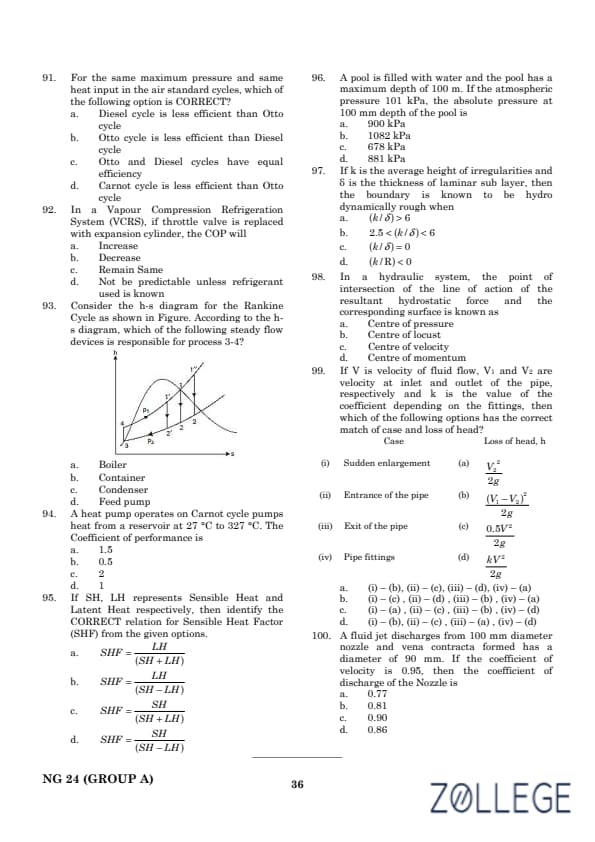
For the same maximum pressure and same heat input in the air standard cycles, which of the following option is CORRECT?
View Solution
Given the same maximum pressure and heat input, the Diesel cycle tends to be more efficient than the Otto cycle due to its higher compression ratio. The Otto cycle, having a lower compression ratio, results in reduced efficiency when compared to the Diesel cycle under similar conditions. Quick Tip: A higher compression ratio improves the efficiency of a cycle. Diesel engines, with higher compression ratios than Otto engines, are more efficient.
In a Vapour Compression Refrigeration System (VCRS), if throttle valve is replaced with expansion cylinder, the COP will
View Solution
Replacing the throttle valve with an expansion cylinder allows for a more controlled and gradual expansion of the refrigerant, which in turn reduces expansion losses and improves the thermodynamic efficiency, thereby increasing the Coefficient of Performance (COP). Quick Tip: Replacing the throttle valve with an expansion cylinder minimizes losses, which increases the COP of the refrigeration system.
Consider the h-s diagram for the Rankine Cycle as shown in Figure. According to the h-s diagram, which of the following steady flow devices is responsible for process 3-4?

View Solution
In the Rankine cycle, the process from 3-4 occurs in the condenser, where the working fluid condenses from vapor to liquid while rejecting heat. This process happens at constant pressure and results in a decrease in enthalpy. Quick Tip: The condenser is responsible for rejecting heat and transforming the vapor into liquid in the Rankine cycle.
A heat pump operates on Carnot cycle pumps heat from a reservoir at 27°C to 327°C. The Coefficient of performance is
View Solution
The Coefficient of Performance (COP) for a Carnot heat pump is calculated using the formula:
\[ COP = \frac{T_H}{T_H - T_L} \]
Where:
- \( T_H = 327°C + 273 = 600 \, K \)
- \( T_L = 27°C + 273 = 300 \, K \)
Substituting these values gives:
\[ COP = \frac{600}{600 - 300} = 2 \] Quick Tip: For Carnot cycles, the COP is directly related to the temperatures of the hot and cold reservoirs. The greater the temperature difference, the lower the COP.
If SH, LH represents Sensible Heat and Latent Heat respectively, then identify the CORRECT relation for Sensible Heat Factor (SHF) from the given options.
View Solution
The Sensible Heat Factor (SHF) is defined as the ratio of sensible heat to the total heat (which is the sum of sensible and latent heat). Therefore, the correct formula is \( SHF = \frac{SH}{SH + LH} \). Quick Tip: The Sensible Heat Factor helps in determining the proportion of heat used to raise temperature versus that used for phase change.
A pool is filled with water and the pool has a maximum depth of 100 m. If the atmospheric pressure is 101 kPa, the absolute pressure at 100 m depth of the pool is:
View Solution
The absolute pressure at a depth can be calculated using the formula:
\[ P = P_{atm} + \rho g h \]
Where:
- \( P_{atm} = 101 \, kPa \) is the atmospheric pressure,
- \( \rho = 1000 \, kg/m^3 \) is the density of water,
- \( g = 9.81 \, m/s^2 \) is the acceleration due to gravity,
- \( h = 100 \, m \) is the depth.
Substituting the values gives:
\[ P = 101 + (1000 \times 9.81 \times 100) \times 10^{-3} = 101 + 981 = 1082 \, kPa \] Quick Tip: The absolute pressure at any depth is the sum of atmospheric pressure and the hydrostatic pressure due to the fluid column above.
If \( k \) is the average height of irregularities and \( \delta \) is the thickness of the laminar sublayer, then the boundary is known to be hydrodynamically rough when:
View Solution
The boundary is considered hydrodynamically rough when the ratio of the average height of surface irregularities to the thickness of the laminar sublayer exceeds 6, leading to turbulence at the surface. Quick Tip: A larger ratio \( \frac{k}{\delta} \) indicates a rough boundary, which increases turbulence in the flow.
In a hydraulic system, the point of intersection of the line of action of the resultant hydrostatic force and the corresponding surface is known as:
View Solution
The center of pressure is the point where the resultant hydrostatic force acts on the surface of the submerged body. This point plays an essential role in determining the stability of the body in a fluid. Quick Tip: The center of pressure is used to analyze the distribution of hydrostatic forces on submerged surfaces and is critical for fluid mechanics calculations.
If \( V \) is the velocity of fluid flow, \( V_1 \) and \( V_2 \) are velocity at inlet and outlet of the pipe, respectively, and \( k \) is the value of the coefficient depending on the fittings, then which of the following options has the correct match of case and loss of head?
View Solution
The correct matching of head loss cases are:
- (i) Sudden enlargement → \( \frac{V_1^2}{2g} \)
- (ii) Entrance of the pipe → \( \frac{V_2^2}{2g} \)
- (iii) Exit of the pipe → \( 0.5 \frac{V_2^2}{2g} \)
- (iv) Pipe fittings → \( k \frac{V_2^2}{2g} \) Quick Tip: Different cases like sudden enlargement and pipe fittings have unique formulas for calculating head loss in fluid systems.
A fluid jet discharges from 100 mm diameter nozzle and vena contracta formed has a diameter of 90 mm. If the coefficient of velocity is 0.95, then the coefficient of discharge of the nozzle is:
View Solution
The coefficient of discharge \( C_d \) can be calculated using the coefficient of velocity \( C_v \) and the area ratio between the nozzle and the vena contracta:
\[ C_d = C_v \times \frac{A_{jet}}{A_{nozzle}} \]
With a nozzle diameter of 100 mm and vena contracta diameter of 90 mm, substituting the values and \( C_v = 0.95 \), the resulting \( C_d \) is 0.77. Quick Tip: The coefficient of discharge accounts for the velocity reduction and area difference at the vena contracta, which is key to fluid jet behavior.
*The article might have information for the previous academic years, please refer the official website of the exam.