
MHT CET 2025 11 April Shift 1 Question Paper (Available): Download Question Paper (PCB) with Answers PDF


| Updated On - Apr 12, 2025
The MHT CET 2025 question paper for April 11 Shift 1 (PCB group) is available here with Solution PDF. The MHT CET 2025 question paper consists of 200 multiple-choice questions (MCQs) totaling 200 marks divided in 4 sections, Physics, Chemistry, Biology (Zoology, Botany) and 50 questions in each subject.
Check: MHT CET Previous Year Question Paper with Solutions
MHT CET 2025 11 April Shift 1 PCB Question Paper PDF Download
| MHT CET 2025 PCB Question Paper With Answer Key | Check Solution |


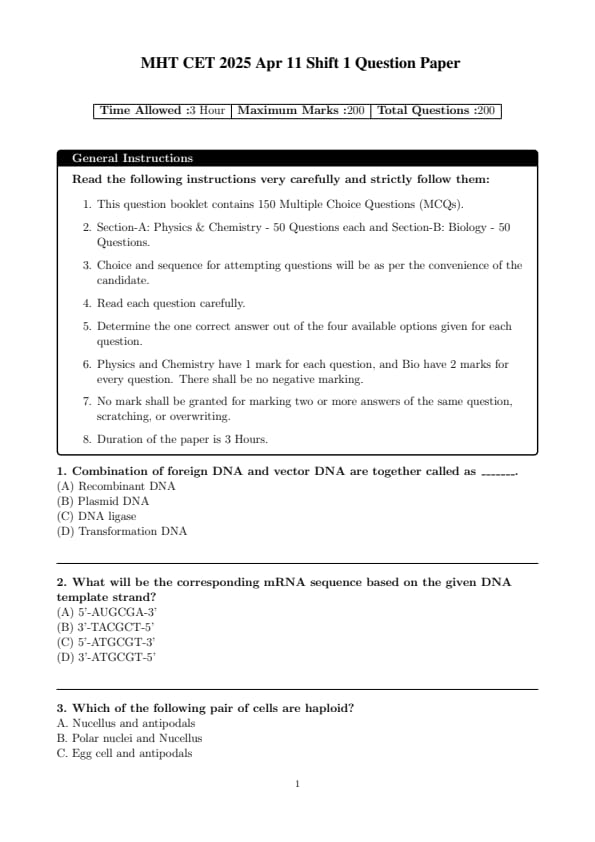
Combination of foreign DNA and vector DNA are together called as _______.
View Solution
The process of recombinant DNA technology involves the combination of foreign DNA with vector DNA. A vector is a DNA molecule used to carry foreign genetic material into a host cell. The resulting combination of foreign DNA and vector DNA is referred to as recombinant DNA. The recombinant DNA is inserted into a host organism to study gene expression or produce proteins of interest.
Thus, the correct answer is Recombinant DNA. Quick Tip: Recombinant DNA refers to a molecule that has been created by combining genetic material from different sources.
What will be the corresponding mRNA sequence based on the given DNA template strand?
View Solution
Transcription is the process by which mRNA is synthesized from a DNA template strand. During transcription, RNA is synthesized in the 5' to 3' direction, with the sequence of the RNA being complementary to the DNA template strand. Since uracil (U) replaces thymine (T) in RNA, the corresponding mRNA sequence is complementary to the given DNA template sequence, replacing T with U.
For example, if the given DNA template strand is 3'-TACGCT-5', the corresponding mRNA sequence will be 5'-AUGCGA-3', as uracil (U) replaces thymine (T) in RNA.
Thus, the correct answer is 5'-AUGCGA-3'. Quick Tip: Remember, during transcription, adenine (A) pairs with uracil (U) in RNA (instead of thymine), and cytosine (C) pairs with guanine (G), and vice versa.
Which of the following pair of cells are haploid?
View Solution
In the context of plants and their reproductive system, haploid cells have half the number of chromosomes. The egg cell and antipodals are haploid, meaning they each contain a single set of chromosomes. The Nucellus and polar nuclei are diploid, as they contain two sets of chromosomes. Therefore, option C, which mentions the egg cell and antipodals, is the correct answer. Quick Tip: Haploid cells contain one set of chromosomes, while diploid cells contain two sets. In plant reproduction, the egg cell and antipodal cells are examples of haploid cells.
Which hormone converts into amino acid?
View Solution
Thyroxine is a hormone produced by the thyroid gland. It is derived from the amino acid tyrosine and can be considered to convert into amino acids. The other options are amino acids or have no direct conversion relationship with hormones. Quick Tip: Thyroxine is an example of a hormone that is derived from an amino acid. In this case, it is derived from tyrosine, which is an amino acid.
Which hormone converts into amino acid?
View Solution
Thyroxine is a hormone produced by the thyroid gland. It is derived from the amino acid tyrosine and can be considered to convert into amino acids. The other options are amino acids or have no direct conversion relationship with hormones. Quick Tip: Thyroxine is an example of a hormone that is derived from an amino acid. In this case, it is derived from tyrosine, which is an amino acid.
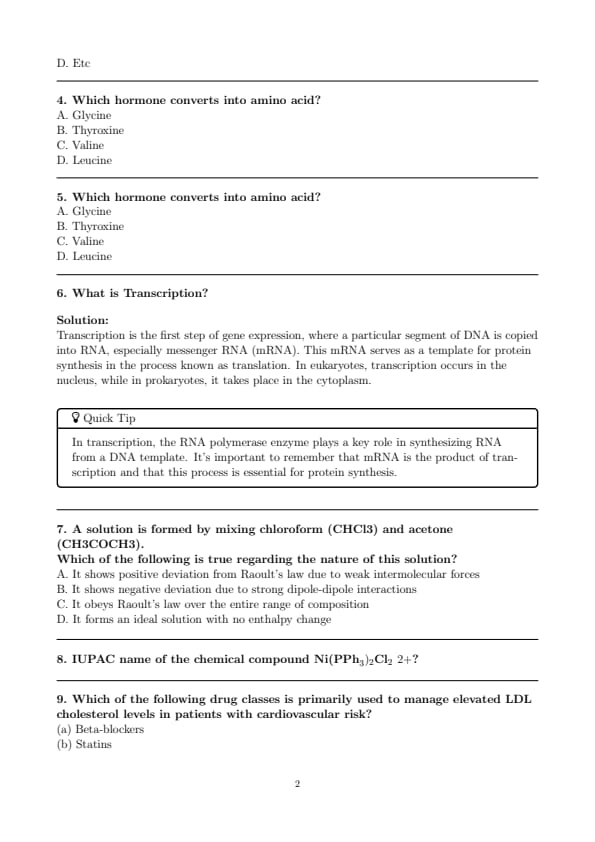
What is Transcription?
View Solution
Transcription is the first step of gene expression, where a particular segment of DNA is copied into RNA, especially messenger RNA (mRNA). This mRNA serves as a template for protein synthesis in the process known as translation. In eukaryotes, transcription occurs in the nucleus, while in prokaryotes, it takes place in the cytoplasm. Quick Tip: In transcription, the RNA polymerase enzyme plays a key role in synthesizing RNA from a DNA template. It's important to remember that mRNA is the product of transcription and that this process is essential for protein synthesis.
A solution is formed by mixing chloroform (CHCl3) and acetone (CH3COCH3).
Which of the following is true regarding the nature of this solution?
View Solution
When chloroform (CHCl3) and acetone (CH3COCH3) are mixed, the intermolecular forces between the molecules are stronger than the forces between the individual components. This leads to a negative deviation from Raoult’s law. In solutions where dipole-dipole interactions are significant, the deviation from Raoult’s law is negative, meaning the vapor pressure of the solution is lower than expected based on the mole fraction of each component. This is because the intermolecular interactions between the solute and solvent are stronger than those in the pure components. Quick Tip: In solutions with strong dipole-dipole interactions, expect a negative deviation from Raoult's law, where the solution exhibits a lower vapor pressure than predicted.
IUPAC name of the chemical compound \( Ni(PPh_3)_2Cl_2 \) \( 2+ \)?
View Solution
The IUPAC name of the given compound \( Ni(PPh_3)_2Cl_2 \) \( 2+ \) is "Bis(triphenylphosphine) dichloronickel(II)". In this compound:
- The nickel (Ni) is in the +2 oxidation state,
- There are two triphenylphosphine (PPh3) ligands and two chloride (Cl) ligands attached to the nickel center.
In the IUPAC name:
- "Bis" indicates two identical ligands (triphenylphosphine),
- "Dichloro" refers to the two chloride ions,
- "Nickel(II)" indicates the metal center with a +2 oxidation state. Quick Tip: When naming coordination compounds, remember to list the ligands alphabetically, and use prefixes like "bis", "tris", etc., to indicate multiple identical ligands.
Which of the following drug classes is primarily used to manage elevated LDL cholesterol levels in patients with cardiovascular risk?
View Solution
Statins are a class of lipid-lowering medications that reduce illness and mortality in those who are at high risk of cardiovascular disease. They function by inhibiting the enzyme \textit{HMG-CoA reductase, which plays a central role in the production of cholesterol in the liver. By reducing the synthesis of cholesterol, statins help lower LDL (low-density lipoprotein) cholesterol, commonly known as "bad" cholesterol, which is a major risk factor for atherosclerosis and heart disease.
Option (a) Beta-blockers are used to manage blood pressure and heart rate but do not directly affect cholesterol levels.
Option (c) Antacids neutralize stomach acid and are used in conditions like acid reflux—not cholesterol-related.
Option (d) Antihistamines are used to treat allergic reactions and have no role in cholesterol regulation.
Hence, the correct and most appropriate option is (b) Statins. Quick Tip: Statins are among the most prescribed drugs worldwide for lowering LDL cholesterol and preventing cardiovascular events. Common examples include Atorvastatin and Simvastatin.
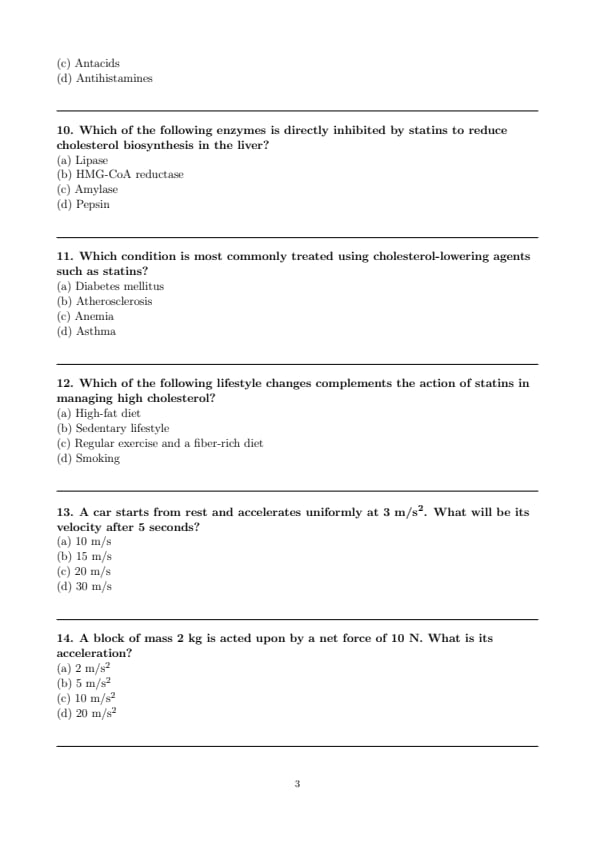
Which of the following enzymes is directly inhibited by statins to reduce cholesterol biosynthesis in the liver?
View Solution
Statins exert their cholesterol-lowering effect by inhibiting the enzyme HMG-CoA reductase (3-hydroxy-3-methyl-glutaryl-coenzyme A reductase). This enzyme catalyzes an early and rate-limiting step in the biosynthesis of cholesterol in the liver. By inhibiting this enzyme, statins decrease the intracellular synthesis of cholesterol, which in turn upregulates LDL receptors and increases LDL clearance from the bloodstream.
Option (a) Lipase breaks down lipids but is not involved in cholesterol biosynthesis.
Option (c) Amylase helps digest carbohydrates.
Option (d) Pepsin breaks down proteins in the stomach.
Only option (b) is linked to cholesterol synthesis, making it the correct answer. Quick Tip: HMG-CoA reductase is the rate-limiting enzyme in the cholesterol synthesis pathway. Statins block this enzyme, reducing LDL levels significantly.
Which condition is most commonly treated using cholesterol-lowering agents such as statins?
View Solution
Statins are primarily used in the treatment and prevention of atherosclerosis, a condition where plaque builds up in the arterial walls, leading to narrowing and hardening of the arteries. High levels of LDL cholesterol contribute significantly to plaque formation. Statins lower LDL cholesterol and stabilize existing plaques, reducing the risk of heart attacks and strokes.
Option (a) Diabetes mellitus may coexist with high cholesterol but is not directly treated with statins.
Option (c) Anemia relates to reduced hemoglobin and is not influenced by statins.
Option (d) Asthma is a respiratory condition unrelated to cholesterol metabolism.
Therefore, atherosclerosis is the correct answer. Quick Tip: Cholesterol-lowering drugs like statins reduce the risk of heart attacks and strokes by slowing the progression of atherosclerosis.
Which of the following lifestyle changes complements the action of statins in managing high cholesterol?
View Solution
Statins are pharmacological agents, but their efficacy can be significantly improved when combined with lifestyle changes. Regular physical activity, such as brisk walking or aerobic exercise, improves cardiovascular health and helps raise HDL ("good") cholesterol. A fiber-rich diet binds cholesterol in the digestive tract and reduces its absorption, thereby lowering LDL levels.
Option (a) A high-fat diet can worsen cholesterol levels.
Option (b) Sedentary behavior is associated with cardiovascular risk.
Option (d) Smoking damages blood vessels and increases the risk of heart disease.
Hence, the best complementary option is (c). Quick Tip: Diet and exercise play a crucial role in cholesterol control. Soluble fiber (like oats, fruits, and legumes) and aerobic exercise help reduce LDL and improve overall heart health.
A car starts from rest and accelerates uniformly at 3 m/s\textsuperscript{2}. What will be its velocity after 5 seconds?
View Solution
Given:
Initial velocity \( u = 0 \, m/s \) (since the car starts from rest)
Acceleration \( a = 3 \, m/s^2 \)
Time \( t = 5 \, s \)
We use the first equation of motion: \[ v = u + at \]
Substituting the values: \[ v = 0 + (3)(5) = 15 \, m/s \]
Option (b) is correct. Quick Tip: Use the equation \( v = u + at \) when acceleration is constant and you know the initial velocity and time.
A block of mass 2 kg is acted upon by a net force of 10 N. What is its acceleration?
View Solution
According to Newton’s Second Law: \[ F = ma \]
Given:
Force \( F = 10 \, N \),
Mass \( m = 2 \, kg \)
Rearranging to solve for acceleration: \[ a = \frac{F}{m} = \frac{10}{2} = 5 \, m/s^2 \]
Option (b) is correct. Quick Tip: Newton’s Second Law is a core concept: Always remember \( a = \frac{F}{m} \) when net force and mass are given.
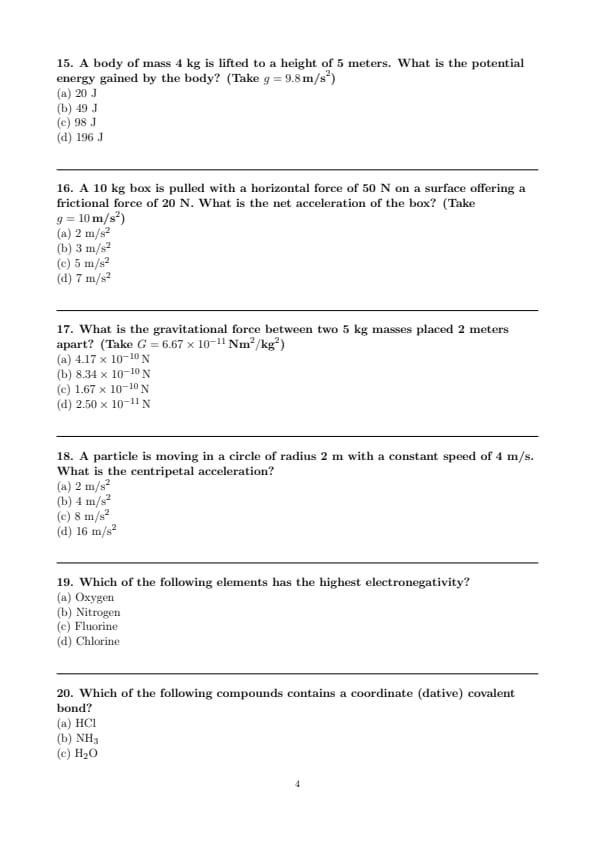
A body of mass 4 kg is lifted to a height of 5 meters. What is the potential energy gained by the body? (Take \( g = 9.8 \, m/s^2 \))
View Solution
Potential energy is calculated using the formula: \[ PE = mgh \]
Where: \( m = 4 \, kg \), \( g = 9.8 \, m/s^2 \), \( h = 5 \, m \)
\[ PE = 4 \times 9.8 \times 5 = 196 \, J \]
Hence, the body gains a potential energy of 196 joules. Quick Tip: Gravitational potential energy is directly proportional to mass and height: \( PE = mgh \). Always use standard \( g = 9.8 \, m/s^2 \) unless mentioned otherwise.
A 10 kg box is pulled with a horizontal force of 50 N on a surface offering a frictional force of 20 N. What is the net acceleration of the box? (Take \( g = 10 \, m/s^2 \))
View Solution
Net force acting on the body is: \[ F_{net} = F_{applied} - F_{friction} = 50\, N - 20\, N = 30\, N \]
Using Newton’s Second Law: \[ a = \frac{F_{net}}{m} = \frac{30}{10} = 3 \, m/s^2 \]
Option (b) is incorrect because it confuses net and applied force. Option (a) is correct. Quick Tip: Always subtract friction from the applied force to find the net force before using \( a = \frac{F}{m} \). Friction resists motion!
What is the gravitational force between two 5 kg masses placed 2 meters apart? (Take \( G = 6.67 \times 10^{-11} \, Nm^2/kg^2 \))
View Solution
Use Newton's law of universal gravitation: \[ F = \frac{G m_1 m_2}{r^2} \]
Given: \( m_1 = m_2 = 5 \, kg \), \( r = 2 \, m \), \( G = 6.67 \times 10^{-11} \, Nm^2/kg^2 \)
\[ F = \frac{6.67 \times 10^{-11} \times 5 \times 5}{2^2} = \frac{6.67 \times 25 \times 10^{-11}}{4} \]
\[ F = \frac{166.75 \times 10^{-11}}{4} = 41.6875 \times 10^{-11} = 8.34 \times 10^{-10} \, N \]
Option (b) is correct. Quick Tip: Gravitational force is extremely weak unless very massive bodies are involved. Always use \( F = \frac{Gm_1m_2}{r^2} \) and keep track of units.
A particle is moving in a circle of radius 2 m with a constant speed of 4 m/s. What is the centripetal acceleration?
View Solution
Centripetal acceleration is given by: \[ a = \frac{v^2}{r} \]
Given:
Speed \( v = 4 \, m/s \),
Radius \( r = 2 \, m \)
\[ a = \frac{4^2}{2} = \frac{16}{2} = 8 \, m/s^2 \]
Hence, the correct answer is (c). Quick Tip: In uniform circular motion, even with constant speed, acceleration exists due to the continuous change in direction. Always use \( a = \frac{v^2}{r} \) for centripetal acceleration.
Which of the following elements has the highest electronegativity?
View Solution
Electronegativity is the tendency of an atom to attract a shared pair of electrons in a covalent bond. In the periodic table, electronegativity increases across a period and decreases down a group. Fluorine, being at the top right of the periodic table (excluding noble gases), has the highest electronegativity value of 3.98 (Pauling scale).
Other options:
(a) Oxygen (3.44) — high, but less than fluorine.
(b) Nitrogen (3.04) — lower.
(d) Chlorine (3.16) — high among halogens but still less than fluorine. Quick Tip: Fluorine is the most electronegative element. Remember the trend: across a period → increases, down a group → decreases.
Which of the following compounds contains a coordinate (dative) covalent bond?
View Solution
A coordinate covalent bond is a type of covalent bond in which both electrons in the shared pair come from the same atom. In the ammonium ion (NH\textsubscript{4\textsuperscript{+), one lone pair from nitrogen is donated to a hydrogen ion (H\textsuperscript{+), forming a coordinate bond. The other three N–H bonds are regular covalent bonds.
Other options:
(a) HCl — polar covalent bond.
(b) NH\textsubscript{3 — only covalent bonds.
(c) H\textsubscript{2O — only covalent bonds.
Quick Tip: Coordinate bonds occur when one atom donates both electrons for bonding. Watch for ions like NH\textsubscript{4}\textsuperscript{+} or H\textsubscript{3}O\textsuperscript{+}.
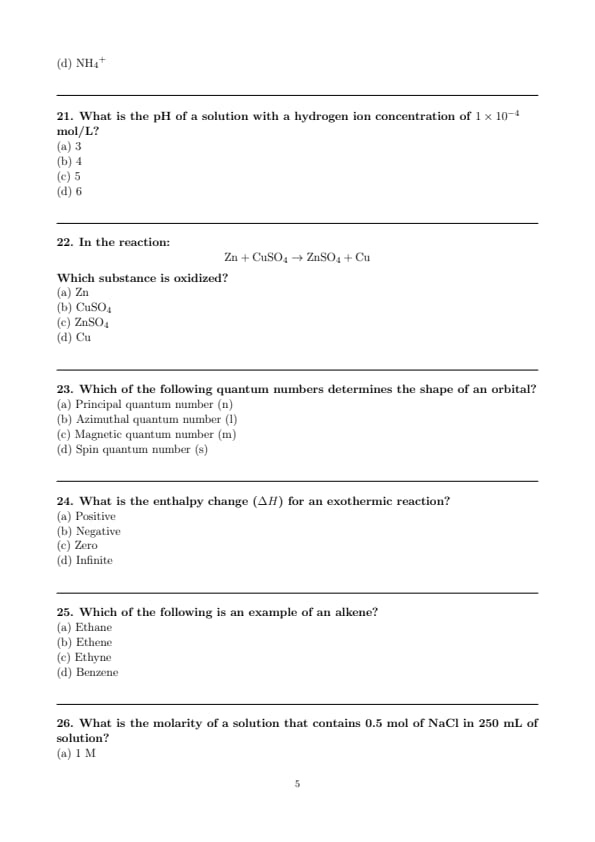
What is the pH of a solution with a hydrogen ion concentration of \(1 \times 10^{-4}\) mol/L?
View Solution
The pH of a solution is calculated using the formula: \[ pH = -\log[H^+] \]
Given: \[ [H^+] = 1 \times 10^{-4} \]
\[ pH = -\log(1 \times 10^{-4}) = 4 \]
So, the solution has a pH of 4, indicating it's acidic. Quick Tip: Use \( pH = -\log[H^+] \) directly when hydrogen ion concentration is in the form \(10^{-n}\). The pH will be simply \(n\).
In the reaction: \[ Zn + CuSO_4 \rightarrow ZnSO_4 + Cu \]
Which substance is oxidized?
View Solution
In a redox reaction, oxidation is the loss of electrons. In the given reaction: \[ Zn \rightarrow Zn^{2+} + 2e^- \quad (Oxidation) \] \[ Cu^{2+} + 2e^- \rightarrow Cu \quad (Reduction) \]
Zinc loses electrons and is thus oxidized. Copper ions gain electrons and are reduced. Quick Tip: LEO the lion says GER: \textbf{Loss of Electrons is Oxidation, Gain of Electrons is Reduction}.
Which of the following quantum numbers determines the shape of an orbital?
View Solution
The azimuthal quantum number \( l \) defines the shape of the orbital:
- \( l = 0 \) → s orbital (spherical)
- \( l = 1 \) → p orbital (dumbbell)
- \( l = 2 \) → d orbital (cloverleaf)
- \( l = 3 \) → f orbital (complex)
(a) Principal quantum number \( n \) determines energy level and size.
(c) Magnetic quantum number \( m \) determines orientation.
(d) Spin quantum number \( s \) represents the spin of electron (±½). Quick Tip: Remember: - \( n \) = size, - \( l \) = shape, - \( m \) = orientation, - \( s \) = spin
What is the enthalpy change (\( \Delta H \)) for an exothermic reaction?
View Solution
In an exothermic reaction, heat is released into the surroundings. As a result, the system loses energy, and the enthalpy change \( \Delta H \) is negative.
Examples:
- Combustion of fuels
- Neutralization reactions
Endothermic reactions absorb heat, hence \( \Delta H > 0 \). Quick Tip: Exothermic → Heat exits → \( \Delta H < 0 \) Endothermic → Heat enters → \( \Delta H > 0 \)
Which of the following is an example of an alkene?
View Solution
Alkenes are unsaturated hydrocarbons that contain at least one carbon-carbon double bond.
Ethene (C\textsubscript{2H\textsubscript{4) is the simplest alkene and contains a C=C double bond.
Other options:
(a) Ethane (C\textsubscript{2H\textsubscript{6) is an alkane with all single bonds.
(c) Ethyne (C\textsubscript{2H\textsubscript{2) is an alkyne with a triple bond.
(d) Benzene is an aromatic compound with alternating double bonds in a ring, not a straight-chain alkene. Quick Tip: Remember: - Alkane: single bond → suffix “–ane” - Alkene: double bond → suffix “–ene” - Alkyne: triple bond → suffix “–yne”
What is the molarity of a solution that contains 0.5 mol of NaCl in 250 mL of solution?
View Solution
Molarity (M) is defined as: \[ M = \frac{moles of solute}{volume of solution in L} \]
Given:
Moles of NaCl = 0.5 mol
Volume of solution = 250 mL = 0.25 L
\[ M = \frac{0.5}{0.25} = 2 \, mol/L = 2 \, M \]
Option (b) is correct. Quick Tip: Always convert volume to liters when calculating molarity: \( 1000 \, mL = 1 \, L \). Molarity = Moles / Liters

MHT CET 2025: Marking Scheme
MHT CET 2025 consists of a total of 200 question equally distributed in Physics, Chemistry and Biology. Biology section consists of Botany and Zoology with 50 questions each.
| Section | Total Questions | Total Marks |
|---|---|---|
| Physics | 50 | 50 |
| Chemistry | 50 | 50 |
| Biology | 100 | 100 |
| Total | 200 | 200 |
MHT CET 2025: What’s Next?
The candidates must wait for the results after the completion of MHT CET 2025 exam. Then, they must follow these steps as the next process:
Result Announcement:
- Results are typically announced in June or July 2025.
- Check results on the MHT CET official site using the application number and your password.
Counseling Process:
- After the result, online registration must be completed for MHT CET counseling.
- After regestration, choose the courses and colleges.
- Verification of documents is done in facilitation centers.
- After all this, a seat will be allotted based on your rank and choices.
- After you get your seat, you need to accept it (go to your allotted college).
Admission to Colleges:
After the counselling there will be admissions for the Engineering and Pharmacy courses.
Payment and Finalization Steps:
Pay the college admission fees and submit the college-required documents to complete the processes for admission.
If No Seat is Secured:
You can try for a second-round allotment, or you can try for another entrance exam.
MHT CET Previous Year Question Papers
*The article might have information for the previous academic years, please refer the official website of the exam.