
MHT CET 2025 11 April Shift 2 Question Paper (Available): Download Question Paper (PCB) with Answers PDF


| Updated On - Apr 12, 2025
The MHT CET 2025 question paper for April 11 Shift 2 (PCB group) is available here with Solution PDF. The MHT CET 2025 question paper consists of 200 multiple-choice questions (MCQs) totaling 200 marks divided in 4 sections, Physics, Chemistry, Biology (Zoology, Botany) and 50 questions in each subject.
Check: MHT CET Previous Year Question Paper with Solutions
MHT CET 2025 11 April Shift 2 PCB Question Paper PDF Download
| MHT CET 2025 PCB Question Paper With Answer Key | Check Solution |


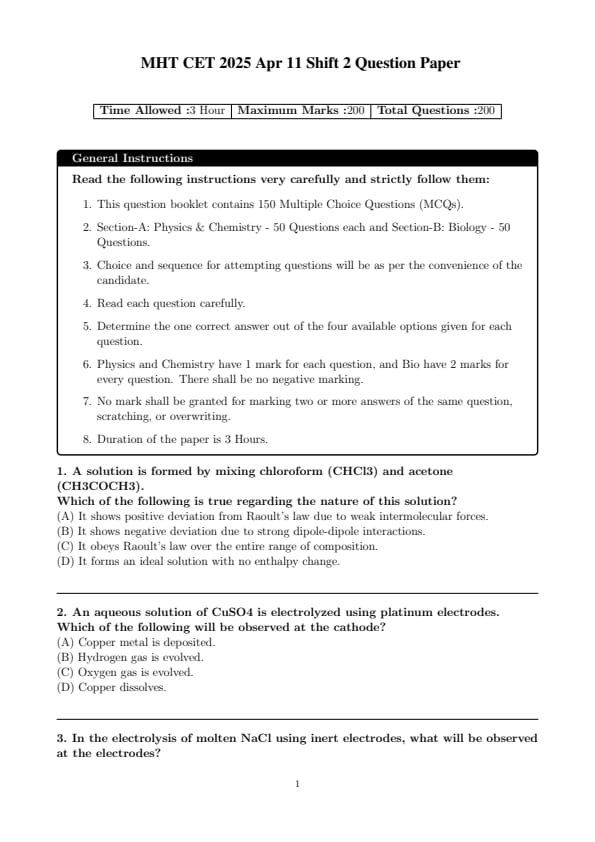
A solution is formed by mixing chloroform (CHCl3) and acetone (CH3COCH3).
Which of the following is true regarding the nature of this solution?
View Solution
When chloroform (CHCl3) and acetone (CH3COCH3) are mixed, they form a solution that exhibits a positive deviation from Raoult's law. This is because the intermolecular forces between the molecules of chloroform and acetone are weaker than those between similar molecules. As a result, the vapor pressure of the solution is higher than expected, indicating a positive deviation from Raoult's law. Quick Tip: When dealing with solutions, remember that positive deviation occurs when the forces between different molecules are weaker than those between the same molecules. In contrast, negative deviation occurs when the forces are stronger.
An aqueous solution of CuSO4 is electrolyzed using platinum electrodes.
Which of the following will be observed at the cathode?
View Solution
During the electrolysis of an aqueous CuSO4 solution, copper metal is deposited at the cathode. This is because the copper ions (Cu\(^{2+}\)) are reduced to copper metal (Cu) at the cathode. The half-reaction at the cathode is:
\[ Cu^{2+} + 2e^- \rightarrow Cu \]
At the anode, oxygen gas is evolved, but the question asks about the cathode, where copper is deposited. Hence, option (A) is the correct answer. Quick Tip: During electrolysis, at the cathode, reduction occurs (metal deposition or hydrogen evolution). At the anode, oxidation occurs (oxygen evolution or metal dissolution).
In the electrolysis of molten NaCl using inert electrodes, what will be observed at the electrodes?
View Solution
In the electrolysis of molten NaCl using inert electrodes, sodium metal is deposited at the cathode (reduction occurs at the cathode), and chlorine gas is evolved at the anode (oxidation occurs at the anode). The half-reactions at the electrodes are as follows:
At the cathode (reduction): \[ Na^+ + e^- \rightarrow Na \quad (Sodium is deposited) \]
At the anode (oxidation): \[ 2Cl^- \rightarrow Cl_2 + 2e^- \quad (Chlorine gas is evolved) \]
Thus, the correct observation is sodium deposited at the cathode and chlorine gas evolved at the anode. Quick Tip: In electrolysis, remember that reduction occurs at the cathode (metal deposition or hydrogen evolution), and oxidation occurs at the anode (gas evolution or metal dissolution).
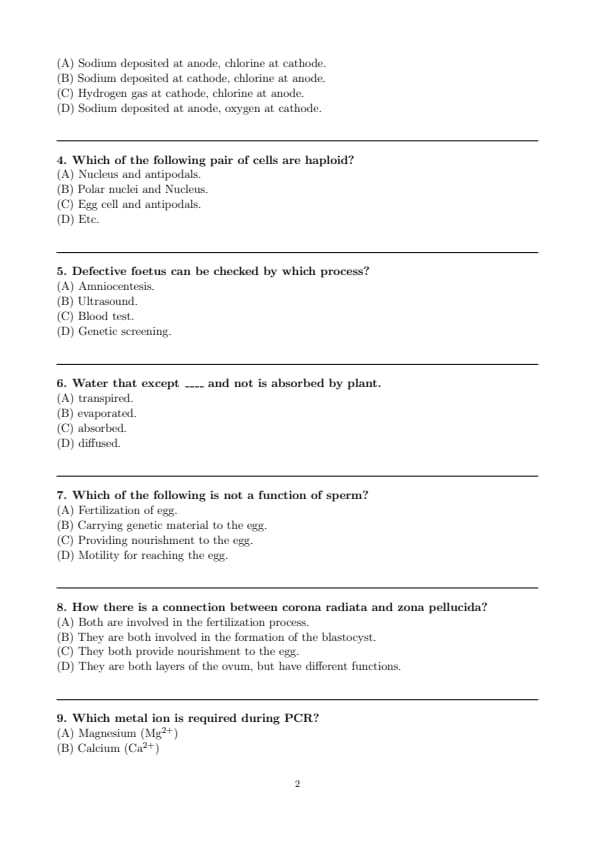
Which of the following pair of cells are haploid?
View Solution
In this question, we are asked to identify which pair of cells are haploid. Haploid cells contain a single set of chromosomes.
- The egg cell is a haploid cell, as it contains half the number of chromosomes required for fertilization.
- Antipodal cells, which are formed in the female gametophyte, are also haploid.
On the other hand:
- The nucleus and polar nuclei are diploid (contain two sets of chromosomes).
- The nucleus of the ovule is also diploid.
Therefore, the correct answer is option (C), where both the egg cell and antipodal cells are haploid. Quick Tip: In plants, the egg cell and antipodal cells are haploid, while the central cell and polar nuclei are typically diploid.
Defective foetus can be checked by which process?
View Solution
Amniocentesis is a medical procedure used to detect genetic disorders and birth defects in a foetus. In this process, a small amount of amniotic fluid is taken from the sac surrounding the foetus, which contains cells from the foetus. These cells are then analyzed for any genetic disorders.
The other options are not primarily used for detecting defective foetuses in the same way:
- Ultrasound can help detect structural anomalies, but it is not a definitive method for genetic analysis.
- Blood tests can check for certain conditions but do not analyze genetic defects directly in the foetus.
- Genetic screening involves analyzing the genes of the parents or the foetus, but amniocentesis is more specific for direct testing of the foetus. Quick Tip: Amniocentesis is the most reliable method for detecting genetic abnormalities in a foetus, especially after the 15th week of pregnancy.
Water that except ____ and not is absorbed by plant.
View Solution
The correct word to fill in the blank is "transpired". Transpiration is the process by which water is lost from a plant through evaporation from the plant's leaves, primarily through stomata. Water that is transpired is lost into the atmosphere and is not absorbed by the plant.
- "Evaporated" could also be associated with water loss but typically refers to the transition of water from a liquid to a gas.
- "Absorbed" and "diffused" both suggest processes where water is taken in by the plant, which contradicts the context of the sentence.
Thus, the correct answer is option (A), as it refers specifically to water lost and not absorbed by the plant. Quick Tip: Remember that transpiration refers to the water vapor released from plants into the atmosphere, and it is essential for the plant’s water cycle but does not contribute to the plant’s absorption of water.
Which of the following is not a function of sperm?
View Solution
The primary functions of sperm include:
- Fertilization of the egg (A),
- Carrying genetic material (B),
- Providing motility to reach the egg (D).
However, sperm do not provide nourishment to the egg. This function is typically provided by the egg's own cytoplasm, which contains nutrients necessary for the early development of the embryo. Thus, option (C) is the correct answer. Quick Tip: Sperm's role is mainly related to genetic contribution and motility, while nourishment of the egg is a function of the egg cell itself.
How there is a connection between corona radiata and zona pellucida?
View Solution
The corona radiata and zona pellucida are both layers of the egg (ovum) but serve different functions:
- The corona radiata is a layer of follicular cells that surround the egg, providing protection and nutrients.
- The zona pellucida is a glycoprotein layer that surrounds the egg, playing a critical role in fertilization by binding sperm and preventing polyspermy.
Thus, they are both layers of the ovum but have distinct roles in the reproductive process. Quick Tip: Remember, the zona pellucida facilitates fertilization by interacting with sperm, while the corona radiata assists in nourishing and protecting the egg.
Which metal ion is required during PCR?
View Solution
Polymerase Chain Reaction (PCR) is a technique used to amplify DNA. Magnesium ions (Mg\(^{2+}\)) are essential for the activity of DNA polymerase, the enzyme that synthesizes the new DNA strand. These ions help in stabilizing the DNA polymerase and enable the correct binding of nucleotides to the growing DNA strand during PCR.
Thus, the correct metal ion required during PCR is magnesium (Mg\(^{2+}\)). Quick Tip: In PCR, magnesium ions are critical for enzyme activation and efficient DNA synthesis. Too much or too little can hinder the reaction.
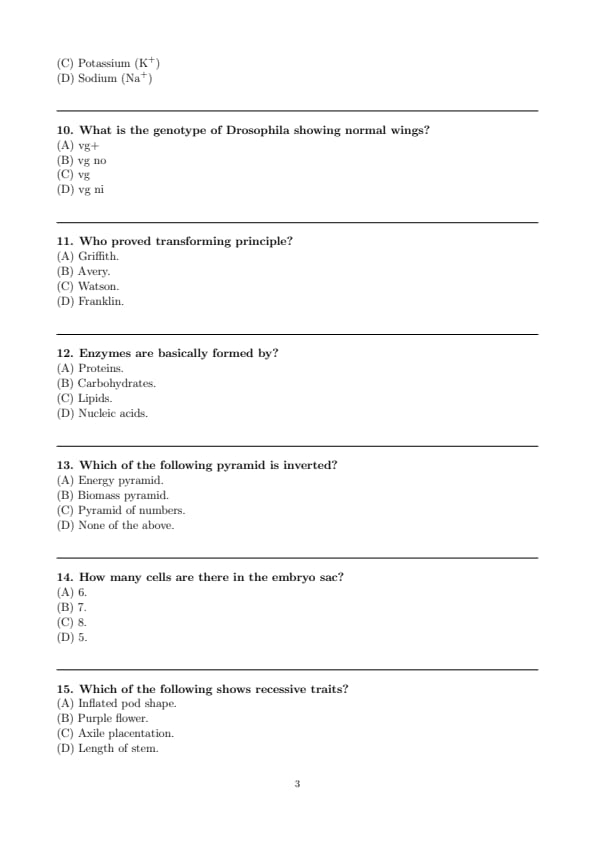
What is the genotype of Drosophila showing normal wings?
View Solution
In Drosophila, the gene responsible for wing shape is the "vg" gene. The "vg+" allele represents the normal wing shape, while the "vg" allele is associated with vestigial (abnormal) wings. Therefore, the genotype for normal wings in Drosophila is "vg+", where the "+" indicates the dominant normal wing allele.
- "vg" refers to the recessive allele for vestigial wings.
- "vg no" and "vg ni" are not commonly associated genotypes in this context.
Thus, the correct answer is option (A), "vg+". Quick Tip: In Drosophila, the "vg+" allele is dominant and results in normal wings, while the "vg" allele causes vestigial wings.
Who proved transforming principle?
View Solution
The transforming principle was first demonstrated by Frederick Griffith in 1928. Griffith's experiment showed that a non-virulent strain of bacteria could be transformed into a virulent strain when exposed to heat-killed virulent bacteria, indicating that some "transforming factor" was responsible for the genetic transformation. This discovery laid the groundwork for later work by Avery and others, who identified DNA as the transforming principle. Quick Tip: Griffith's experiment provided the first evidence of genetic transformation, but it was later research by Avery, MacLeod, and McCarty that identified DNA as the transforming principle.
Enzymes are basically formed by?
View Solution
Enzymes are biological catalysts that speed up chemical reactions in living organisms. They are primarily composed of proteins. Some enzymes also require non-protein molecules called cofactors or coenzymes to function. However, the core structure of the enzyme itself is made up of proteins, which are composed of amino acids.
- Carbohydrates, lipids, and nucleic acids serve other important roles in the cell but do not typically function as enzymes.
Thus, the correct answer is option (A) Proteins. Quick Tip: Remember, enzymes are proteins that act as catalysts, lowering the activation energy required for reactions. They are specific to substrates and can be regulated.
Which of the following pyramid is inverted?
View Solution
The pyramid of numbers can be inverted in certain ecosystems. Normally, in an ecological pyramid, the number of organisms decreases as you move from the base (producers) to the top (consumers). However, in certain cases, such as in large trees or parasitic ecosystems, the pyramid of numbers can be inverted, with more consumers than producers at a given level.
- The energy pyramid and biomass pyramid generally follow a normal shape, where each successive level has less energy or biomass than the level below it.
Thus, the correct answer is option (C), as the pyramid of numbers can be inverted in some ecosystems. Quick Tip: In ecological pyramids, the pyramid of numbers can sometimes be inverted, especially in cases where large producers support a large number of smaller consumers, like in a tree or a parasitic system.
How many cells are there in the embryo sac?
View Solution
The embryo sac in plants is formed within the ovule and typically consists of 7 cells. These cells include:
1. One egg cell,
2. Two synergids,
3. Three antipodal cells,
4. One central cell with two polar nuclei.
This structure is found in most flowering plants, and the number of cells in the embryo sac is typically seven. Quick Tip: In flowering plants, the embryo sac consists of 7 cells and 8 nuclei, with one central cell containing two polar nuclei.
Which of the following shows recessive traits?
View Solution
In Mendelian inheritance, recessive traits are expressed only when an individual has two copies of the recessive allele (homozygous). Among the options:
- Inflated pod shape is a recessive trait in pea plants, as it is expressed when the individual has two recessive alleles for pod shape.
- Purple flowers, axile placentation, and length of stem are typically dominant traits in pea plants.
Thus, the correct answer is option (A), Inflated pod shape. Quick Tip: Recessive traits are expressed only when both alleles for that trait are recessive. In Mendelian genetics, dominant traits mask the expression of recessive traits.

MHT CET 2025: Expected Cut-Off
The cut-off for MHT CET 2025 will be published after the exam by the official request. However, based on previous year data, we have provided expected cutoff
| Category | Expected Cut off |
| General | 145–160 |
| Other Backward Classes (OBC) | 135–145 |
| Scheduled Castes (SC) | 120–135 |
| Scheduled Tribes (ST) | 110–125 |
| Economically Weaker Section (EWS) | 145–155 |
| Persons with Disabilities (PWD) | 95–110 |
MHT CET 2025: Marking Scheme
MHT CET 2025 consists of a total of 200 question equally distributed in Physics, Chemistry and Biology. Biology section consists of Botany and Zoology with 50 questions each.
| Section | Total Questions | Total Marks |
|---|---|---|
| Physics | 50 | 50 |
| Chemistry | 50 | 50 |
| Biology | 100 | 100 |
| Total | 200 | 200 |
MHT CET Previous Year Question Papers
*The article might have information for the previous academic years, please refer the official website of the exam.