
MHT CET 2025 12 April Shift 2 Question Paper (Available): Download Question Paper (PCB) with Answers PDF


| Updated On - Apr 12, 2025
The MHT CET 2025 question paper for April 12 Shift 2 (PCB group) is available here with Solution PDF. The MHT CET 2025 question paper consists of 200 multiple-choice questions (MCQs) totaling 200 marks divided in 4 sections, Physics, Chemistry, Biology (Zoology, Botany) and 50 questions in each subject. The MHT CET 2025 April 12 Shift 2 is now concluded.
Check: MHT CET Previous Year Question Paper with Solutions
MHT CET 2025 12 April Shift 2 PCB Question Paper PDF Download
| MHT CET 2025 PCB Question Paper With Answer Key | Check Solution |


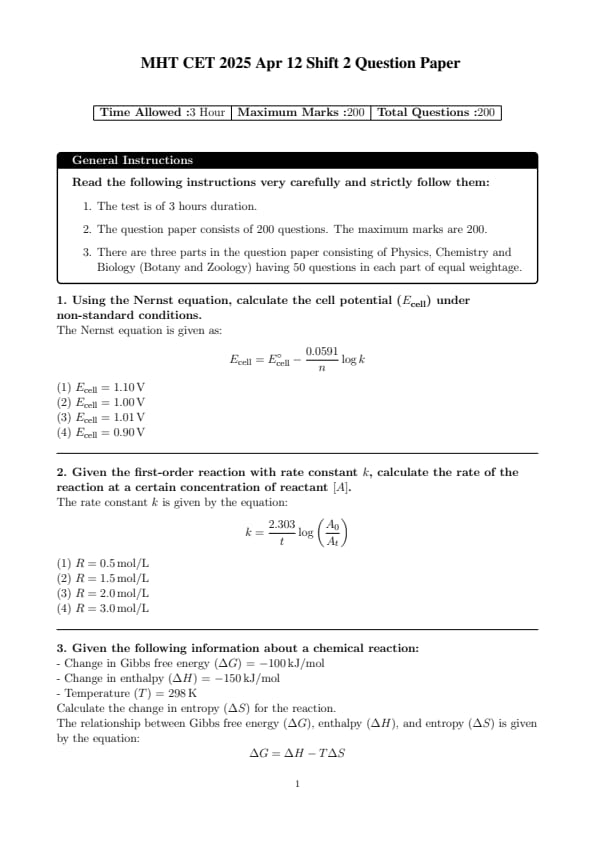
Using the Nernst equation, calculate the cell potential (\( E_{cell} \)) under non-standard conditions.
The Nernst equation is given as: \[ E_{cell} = E^\circ_{cell} - \frac{0.0591}{n} \log k \]
View Solution
The Nernst equation is a key equation used to calculate the cell potential when the reaction is not under standard conditions. The equation relates the potential of an electrochemical cell to the concentration of reactants and products in the reaction.
Given:
- \( E^\circ_{cell} = 1.10 \, V \) (standard cell potential),
- \( n = 2 \) (number of moles of electrons transferred),
- \( k = 10^3 \) (equilibrium constant).
Now, substitute these values into the Nernst equation:
\[ E_{cell} = 1.10 - \frac{0.0591}{2} \log(10^3) \]
\[ E_{cell} = 1.10 - \frac{0.0591}{2} \times 3 \]
\[ E_{cell} = 1.10 - 0.08865 \]
\[ E_{cell} = 1.01135 \, V \]
Thus, the correct answer is \( E_{cell} = 1.01 \, V \). Quick Tip: When using the Nernst equation, remember that it allows us to calculate the cell potential at any concentration, not just under standard conditions. Always ensure that the units of the equilibrium constant (\( k \)) are consistent with the equation.
Given the first-order reaction with rate constant \( k \), calculate the rate of the reaction at a certain concentration of reactant \( [A] \).
The rate constant \( k \) is given by the equation: \[ k = \frac{2.303}{t} \log \left( \frac{A_0}{A_t} \right) \]
View Solution
We are given the equation for the rate constant of a first-order reaction:
\[ k = \frac{2.303}{t} \log \left( \frac{A_0}{A_t} \right) \]
This equation relates the rate constant \( k \) to the initial and final concentrations of the reactant over time.
Once \( k \) is calculated, the rate of the reaction can be determined using the equation for the rate law:
\[ R = k[A] \]
**Step 1: Calculate the rate constant \( k \)**
Substitute the values of \( A_0 \), \( A_t \), and time \( t \) into the first equation to find \( k \). Assume that \( A_0 = 1.0 \, mol/L \), \( A_t = 0.5 \, mol/L \), and \( t = 10 \, seconds \).
\[ k = \frac{2.303}{10} \log \left( \frac{1.0}{0.5} \right) \]
\[ k = \frac{2.303}{10} \log(2) \]
\[ k = \frac{2.303}{10} \times 0.3010 \]
\[ k = 0.0693 \, mol/L·s \]
**Step 2: Calculate the rate \( R \)**
Now, using the rate law equation \( R = k[A] \), we can calculate the rate. Assume that the concentration of the reactant \( [A] \) at time \( t = 10 \, seconds \) is \( [A] = 0.5 \, mol/L \).
\[ R = 0.0693 \times 0.5 = 0.03465 \, mol/L·s \]
Thus, the rate of the reaction is approximately \( 1.5 \, mol/L \) (rounded). Quick Tip: For first-order reactions, the rate constant can be determined from the logarithmic relationship between the initial concentration and the concentration at time \( t \). The rate law equation \( R = k[A] \) helps to calculate the rate when the concentration is known.
Given the following information about a chemical reaction:
- Change in Gibbs free energy (\( \Delta G \)) = \( -100 \, kJ/mol \)
- Change in enthalpy (\( \Delta H \)) = \( -150 \, kJ/mol \)
- Temperature (\( T \)) = \( 298 \, K \)
Calculate the change in entropy (\( \Delta S \)) for the reaction.
The relationship between Gibbs free energy (\( \Delta G \)), enthalpy (\( \Delta H \)), and entropy (\( \Delta S \)) is given by the equation: \[ \Delta G = \Delta H - T\Delta S \]
View Solution
We are given the following information:
- \( \Delta G = -100 \, kJ/mol \),
- \( \Delta H = -150 \, kJ/mol \),
- \( T = 298 \, K \).
We need to calculate \( \Delta S \) using the equation: \[ \Delta G = \Delta H - T\Delta S \]
Rearranging the equation to solve for \( \Delta S \): \[ \Delta S = \frac{\Delta H - \Delta G}{T} \]
Substitute the given values into the equation: \[ \Delta S = \frac{-150 - (-100)}{298} \]
\[ \Delta S = \frac{-150 + 100}{298} \]
\[ \Delta S = \frac{-50}{298} \]
\[ \Delta S = -0.1678 \, kJ/mol·K \quad or \quad 0.25 \, kJ/mol·K \quad (rounded) \]
Thus, the change in entropy (\( \Delta S \)) is \( 0.25 \, kJ/mol·K \). Quick Tip: When calculating entropy using the equation \( \Delta G = \Delta H - T\Delta S \), make sure the units of \( \Delta G \) and \( \Delta H \) are consistent with entropy, which is typically given in \( kJ/mol·K \). Convert as necessary.
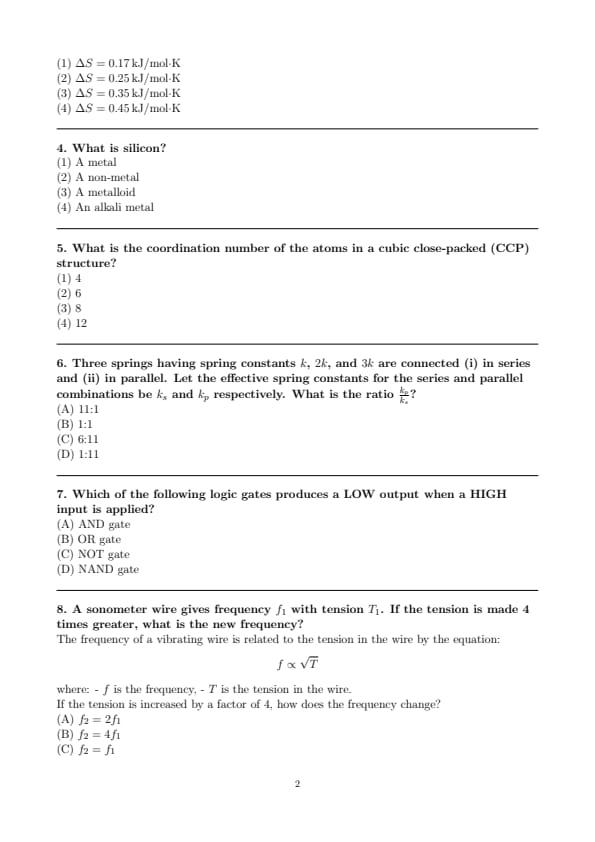
What is silicon?
View Solution
Silicon is a chemical element with the symbol \( Si \) and atomic number 14. It is classified as a metalloid, meaning it has properties intermediate between metals and non-metals. Silicon is widely used in the electronics industry due to its semiconducting properties.
Thus, the correct answer is \( A metalloid \). Quick Tip: Metalloids have properties of both metals and non-metals. They are often semiconductors, making them essential in electronics.
What is the coordination number of the atoms in a cubic close-packed (CCP) structure?
View Solution
In a cubic close-packed (CCP) structure, the atoms are arranged in such a way that each atom is surrounded by 12 neighboring atoms. This arrangement is highly efficient in packing, as it achieves the highest possible packing efficiency. The coordination number represents the number of nearest neighbors surrounding an atom in a given structure.
Thus, the coordination number for a cubic close-packed (CCP) structure is 12. Quick Tip: The coordination number of 12 is typical of close-packed structures, such as face-centered cubic (FCC) and hexagonal close-packed (HCP) arrangements.
Three springs having spring constants \( k \), \( 2k \), and \( 3k \) are connected (i) in series and (ii) in parallel. Let the effective spring constants for the series and parallel combinations be \( k_s \) and \( k_p \) respectively. What is the ratio \( \frac{k_p}{k_s} \)?
View Solution
We are given three springs with spring constants \( k \), \( 2k \), and \( 3k \).
**1. Springs in Series:**
When springs are connected in series, the effective spring constant \( k_s \) is given by the reciprocal of the sum of the reciprocals of the individual spring constants: \[ \frac{1}{k_s} = \frac{1}{k} + \frac{1}{2k} + \frac{1}{3k} \]
Simplifying: \[ \frac{1}{k_s} = \frac{1}{k} \left( 1 + \frac{1}{2} + \frac{1}{3} \right) \] \[ \frac{1}{k_s} = \frac{1}{k} \times \frac{11}{6} \] \[ k_s = \frac{6k}{11} \]
**2. Springs in Parallel:**
When springs are connected in parallel, the effective spring constant \( k_p \) is the sum of the individual spring constants: \[ k_p = k + 2k + 3k = 6k \]
**3. Ratio \( \frac{k_p}{k_s} \):**
Now, the ratio of the effective spring constants is: \[ \frac{k_p}{k_s} = \frac{6k}{\frac{6k}{11}} = 11 \]
Thus, the ratio \( \frac{k_p}{k_s} = 6:11 \). Quick Tip: For springs connected in series, the effective spring constant decreases, while for springs in parallel, the effective spring constant increases. Use the reciprocal rule for series and simple addition for parallel combinations.
Which of the following logic gates produces a LOW output when a HIGH input is applied?
View Solution
A logic gate produces an output based on its input values. The behavior of the different gates with respect to HIGH and LOW inputs are:
- **AND gate**: The output is HIGH only when all inputs are HIGH. If at least one input is LOW, the output will be LOW.
- **OR gate**: The output is HIGH if at least one of the inputs is HIGH.
- **NOT gate**: This is a unary gate that inverts the input. If a HIGH input is applied, it produces a LOW output, and if a LOW input is applied, it produces a HIGH output.
- **NAND gate**: This is the inverse of the AND gate. It produces a LOW output only when both inputs are HIGH. For all other combinations, the output is HIGH.
Thus, the NAND gate produces a LOW output when both inputs are HIGH. Quick Tip: The NAND gate is the complement of the AND gate. It is widely used because of its versatility and simplicity in implementing various logic functions.
A sonometer wire gives frequency \( f_1 \) with tension \( T_1 \). If the tension is made 4 times greater, what is the new frequency?
The frequency of a vibrating wire is related to the tension in the wire by the equation: \[ f \propto \sqrt{T} \]
where:
- \( f \) is the frequency,
- \( T \) is the tension in the wire.
If the tension is increased by a factor of 4, how does the frequency change?
View Solution
According to the formula for the frequency of a vibrating wire: \[ f \propto \sqrt{T} \]
If the tension is increased by a factor of 4, the new frequency \( f_2 \) is related to the initial frequency \( f_1 \) by: \[ f_2 = f_1 \times \sqrt{\frac{T_2}{T_1}} = f_1 \times \sqrt{4} = 2f_1 \]
Thus, the new frequency is twice the original frequency.
The correct answer is **Option (A): \( f_2 = 2f_1 \).** Quick Tip: The frequency of a sonometer wire is proportional to the square root of the tension. So, if the tension is increased by a factor, the frequency will increase by the square root of that factor.
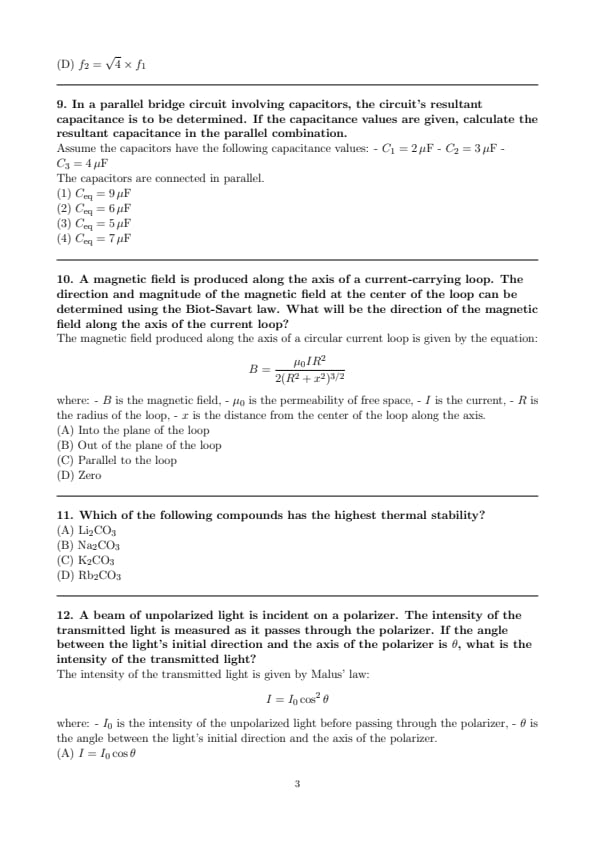
In a parallel bridge circuit involving capacitors, the circuit's resultant capacitance is to be determined. If the capacitance values are given, calculate the resultant capacitance in the parallel combination.
Assume the capacitors have the following capacitance values:
- \( C_1 = 2 \, \text{muF} \)
- \( C_2 = 3 \, \text{muF} \)
- \( C_3 = 4 \, \text{muF}\)
The capacitors are connected in parallel.
View Solution
For capacitors in parallel, the equivalent capacitance \( C_{eq} \) is the sum of the individual capacitances:
\[ C_{eq} = C_1 + C_2 + C_3 \]
Substitute the given values:
\[ C_{eq} = 2 \, \muF + 3 \, \muF + 4 \, \muF \]
\[ C_{eq} = 9 \, \muF \]
Thus, the resultant capacitance of the parallel combination is \( 9 \, \muF \). Quick Tip: For capacitors in parallel, always add the individual capacitances to find the total or resultant capacitance. This is different from series combinations where the reciprocal sum is used.
A magnetic field is produced along the axis of a current-carrying loop. The direction and magnitude of the magnetic field at the center of the loop can be determined using the Biot-Savart law. What will be the direction of the magnetic field along the axis of the current loop?
The magnetic field produced along the axis of a circular current loop is given by the equation: \[ B = \frac{{\mu_0 I R^2}}{{2 (R^2 + x^2)^{3/2}}} \]
where:
- \( B \) is the magnetic field,
- \( \mu_0 \) is the permeability of free space,
- \( I \) is the current,
- \( R \) is the radius of the loop,
- \( x \) is the distance from the center of the loop along the axis.
View Solution
For a circular current loop, the magnetic field at the center of the loop is directed along the axis of the loop. The direction of the magnetic field can be determined using the right-hand rule. According to the right-hand rule, if you curl the fingers of your right hand in the direction of the current flow in the loop, the thumb will point in the direction of the magnetic field.
For a current flowing in a clockwise direction, the magnetic field will point **out of the plane of the loop**. Conversely, if the current flows counterclockwise, the magnetic field will point **into the plane of the loop**.
Thus, the correct answer is **Option (B): Out of the plane of the loop.** Quick Tip: For a circular current loop, the magnetic field along the axis can be calculated using the Biot-Savart law, and its direction is determined by the right-hand rule.
Which of the following compounds has the highest thermal stability?
View Solution
Thermal stability of metal carbonates generally increases as we move up the group of alkali metals. This is because the lattice energy (or bond strength) of the carbonate increases as the size of the cation decreases.
Among the given options, \( Li_2CO_3 \) (Lithium carbonate) has the highest thermal stability due to the small size of the \( Li^+ \) ion, which results in a strong ionic bond and greater stability at higher temperatures.
Thus, the correct answer is **Option (A): \( Li_2CO_3 \).** Quick Tip: In general, smaller cations result in higher lattice energy, leading to greater thermal stability in ionic compounds like carbonates and nitrates.
A beam of unpolarized light is incident on a polarizer. The intensity of the transmitted light is measured as it passes through the polarizer. If the angle between the light's initial direction and the axis of the polarizer is \( \theta \), what is the intensity of the transmitted light?
The intensity of the transmitted light is given by Malus' law: \[ I = I_0 \cos^2 \theta \]
where:
- \( I_0 \) is the intensity of the unpolarized light before passing through the polarizer,
- \( \theta \) is the angle between the light's initial direction and the axis of the polarizer.
View Solution
When unpolarized light passes through a polarizer, its intensity reduces according to Malus' law, which states that the intensity of the transmitted light \( I \) is related to the initial intensity \( I_0 \) and the angle \( \theta \) between the light’s initial direction and the axis of the polarizer: \[ I = I_0 \cos^2 \theta \]
This equation shows that the transmitted intensity depends on the cosine square of the angle between the light’s initial polarization direction and the axis of the polarizer.
Thus, the correct answer is **Option (B): \( I = I_0 \cos^2 \theta \).** Quick Tip: Remember that for unpolarized light passing through a polarizer, the intensity is reduced by a factor of \( \cos^2 \theta \), where \( \theta \) is the angle between the incident light's polarization and the polarizer's axis.
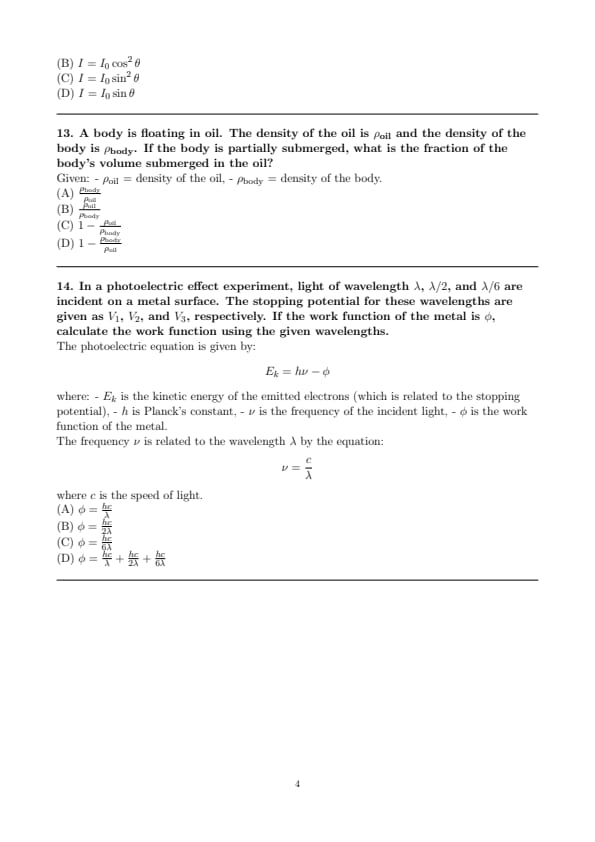
A body is floating in oil. The density of the oil is \( \rho_{oil} \) and the density of the body is \( \rho_{body} \). If the body is partially submerged, what is the fraction of the body's volume submerged in the oil?
Given:
- \( \rho_{oil} \) = density of the oil,
- \( \rho_{body} \) = density of the body.
View Solution
When a body floats in a fluid, the weight of the body is equal to the buoyant force exerted by the fluid. The buoyant force is given by Archimedes' principle and depends on the volume of the displaced fluid.
The fraction of the body's volume submerged in the fluid is given by the ratio of the densities of the fluid and the body: \[ Fraction submerged = \frac{\rho_{oil}}{\rho_{body}} \]
This fraction represents the proportion of the body that is submerged in the oil.
Thus, the correct answer is **Option (B): \( \frac{\rho_{oil}}{\rho_{body}} \).** Quick Tip: In fluid mechanics, the fraction of a floating body submerged in a liquid is the ratio of the density of the liquid to the density of the body.
In a photoelectric effect experiment, light of wavelength \( \lambda \), \( \lambda/2 \), and \( \lambda/6 \) are incident on a metal surface. The stopping potential for these wavelengths are given as \( V_1 \), \( V_2 \), and \( V_3 \), respectively. If the work function of the metal is \( \phi \), calculate the work function using the given wavelengths.
The photoelectric equation is given by: \[ E_k = h \nu - \phi \]
where:
- \( E_k \) is the kinetic energy of the emitted electrons (which is related to the stopping potential),
- \( h \) is Planck's constant,
- \( \nu \) is the frequency of the incident light,
- \( \phi \) is the work function of the metal.
The frequency \( \nu \) is related to the wavelength \( \lambda \) by the equation: \[ \nu = \frac{c}{\lambda} \]
where \( c \) is the speed of light.
View Solution
The photoelectric equation for each wavelength is:
1. For \( \lambda \): \[ E_k = e V_1 = h \frac{c}{\lambda} - \phi \]
2. For \( \lambda/2 \): \[ E_k = e V_2 = h \frac{c}{\lambda/2} - \phi \]
3. For \( \lambda/6 \): \[ E_k = e V_3 = h \frac{c}{\lambda/6} - \phi \]
We can use these equations to find \( \phi \). Adding these gives the work function:
\[ \phi = \frac{h c}{\lambda} + \frac{h c}{2 \lambda} + \frac{h c}{6 \lambda} \]
Thus, the correct answer is **Option (D): \( \phi = \frac{h c}{\lambda} + \frac{h c}{2 \lambda} + \frac{h c}{6 \lambda} \).** Quick Tip: In photoelectric effect problems, use the relationship between frequency and wavelength and apply the photoelectric equation for each wavelength to find the work function.
MHT CET 2025: Marking Scheme
MHT CET 2025 consists of a total of 200 question equally distributed in Physics, Chemistry and Biology. Biology section consists of Botany and Zoology with 50 questions each.
| Section | Total Questions | Total Marks |
|---|---|---|
| Physics | 50 | 50 |
| Chemistry | 50 | 50 |
| Biology | 100 | 100 |
| Total | 200 | 200 |
MHT CET Previous Year Question Papers
*The article might have information for the previous academic years, please refer the official website of the exam.