.jpg?tr=h-94,w-94,c-force)
KEAM 2024 Question Paper with Answer Key PDF for Question paper (June 10 - shift 1)


| Updated On - Jan 29, 2026
KEAM Question Papers are the most important study material for effective exam preparation. We at Zollege have provided all KEAM Previous Year Papers with Solution PDFs here. KEAM 2024 Question paper was conducted successfully on June 10 by Commissioner for Entrance Examinations (CEE) Kerala.
Students can freely download the KEAM previous year's question paper PDFs along with their solutions here. We strongly encourage keam aspirants to scan through all the KEAM Question Paper to know the overall difficulty level, KEAM Syllabus and understand the changes in KEAM Exam Pattern over the years.
KEAM 2024 Question paper Question Paper with Answer Key PDF
| KEAM 2024 (June 10) Question Paper with Answer Key |  Download Download |
Check Solution |

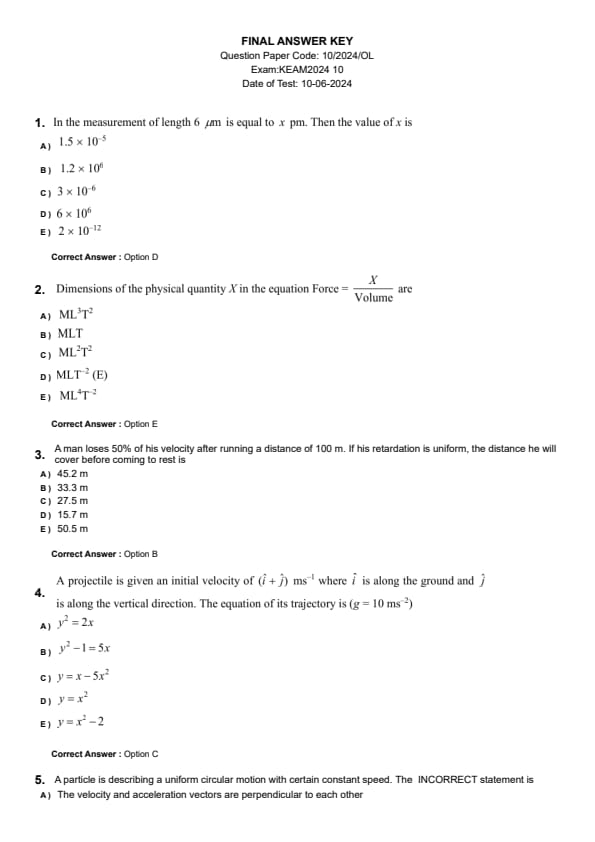
In the measurement of length, 6 \(\mu\)m is equal to \(x\) pm. Then the value of \(x\) is
View Solution
Step 1: Unit conversion
1 micrometer (\(\mu\)m) = \(10^6\) picometers (pm).
Step 2: Calculate \(x\)
Given 6 \(\mu\)m, the equivalent in pm is: \[ x = 6 \times 10^6 \, pm. \]
Step 3: Final answer
Thus, the value of \(x\) is \(6 \times 10^6\), corresponding to option (D). Quick Tip: Use the appropriate power of ten for unit conversions between metric prefixes.
Dimensions of the physical quantity \(X\) in the equation \[ Force = \frac{X}{Volume} \]
are
View Solution
Step 1: Dimensions of Force
The dimensional formula of force is: \[ Force = MLT^{-2}. \]
Step 2: Dimensions of Volume
The dimensional formula of volume is: \[ Volume = L^3. \]
Step 3: Solve for \(X\)
From the equation: \[ X = Force \times Volume = (MLT^{-2}) \times (L^3) = ML^4T^{-2}. \]
Step 4: Final answer
Thus, the dimensions of \(X\) are \(ML^4T^{-2}\), corresponding to option (E). Quick Tip: Use the fundamental dimensions of mass (M), length (L), and time (T) to derive dimensional formulas.
A man loses 50% of his velocity after running a distance of 100 m. If his retardation is uniform, the distance he will cover before coming to rest is
View Solution
Step 1: Define variables
Let initial velocity = \(u\), final velocity after 100 m = \(\frac{u}{2}\), and retardation = \(a\).
Step 2: Use kinematic equation
Using \(v^2 = u^2 + 2as\): \[ \left(\frac{u}{2}\right)^2 = u^2 + 2a(100). \]
Solving for \(a\): \[ a = -\frac{3u^2}{800}. \]
Step 3: Find total distance to rest
Using \(v^2 = u^2 + 2aS\) with \(v = 0\): \[ 0 = u^2 + 2\left(-\frac{3u^2}{800}\right)S. \]
Solving for \(S\): \[ S = \frac{400}{3} \approx 133.33 \, m. \]
Step 4: Subtract initial distance
Additional distance covered: \[ S_{additional} = 133.33 - 100 = 33.33 \, m. \]
Step 5: Final answer
Thus, the distance covered before coming to rest is \(33.3\) m, corresponding to option (B). Quick Tip: Use kinematic equations to solve problems involving uniform acceleration or retardation.
A projectile is given an initial velocity of \((\hat{i} + \hat{j})\) ms\textsuperscript{-1 where \(\hat{i}\) is along the ground and \(\hat{j}\) is along the vertical direction. The equation of its trajectory is \((g = 10\) ms\textsuperscript{-2\()\)
View Solution
Step 1: General trajectory equation
The trajectory of a projectile is given by: \[ y = x \tan{\theta} - \frac{g x^2}{2 u^2 \cos^2{\theta}}. \]
Step 2: Initial velocity components
Given initial velocity components: \[ u_x = 1, \quad u_y = 1. \]
Thus, \(\theta = 45^\circ\), \(\tan{\theta} = 1\), and \(\cos{\theta} = \frac{1}{\sqrt{2}}\).
Step 3: Substitute values
Substituting into the trajectory equation: \[ y = x - \frac{10 x^2}{2 \left(1\right)^2 \left(\frac{1}{\sqrt{2}}\right)^2} = x - 5x^2. \]
Step 4: Final answer
Thus, the equation of the trajectory is \(y = x - 5x^2\), corresponding to option (C). Quick Tip: For projectile motion, use the standard trajectory equation and substitute known values carefully.
A particle is describing a uniform circular motion with a certain constant speed. The INCORRECT statement is
View Solution
Step 1: Properties of uniform circular motion
In uniform circular motion:
- Velocity is tangential to the path.
- Acceleration is centripetal and points toward the center.
- Velocity and acceleration are perpendicular.
Step 2: Incorrect statement
The acceleration vector is **not** tangential to the path. Thus, statement (E) is incorrect. Quick Tip: In uniform circular motion, acceleration is always directed toward the center, not tangential.
A particle moves under the influence of a force in the XY-plane such that the components of its linear momentum \(\vec{p}\) at any time \(t\) is \(p_x = p \sin t\) and \(p_y = p \cos t\). The angle between \(\vec{F}\) and \(\vec{p}\) at that time is
View Solution
Step 1: Force as derivative of momentum
Force is given by: \[ \vec{F} = \frac{d\vec{p}}{dt}. \]
Step 2: Differentiate momentum components \[ F_x = \frac{d}{dt}(p \sin t) = p \cos t, \quad F_y = \frac{d}{dt}(p \cos t) = -p \sin t. \]
Step 3: Check perpendicularity
The dot product of \(\vec{F}\) and \(\vec{p}\) is: \[ \vec{F} \cdot \vec{p} = (p \cos t)(p \sin t) + (-p \sin t)(p \cos t) = 0. \]
Thus, \(\vec{F}\) and \(\vec{p}\) are perpendicular.
Step 4: Final answer
The angle between \(\vec{F}\) and \(\vec{p}\) is \(90^\circ\), corresponding to option (D). Quick Tip: If the dot product of two vectors is zero, they are perpendicular.
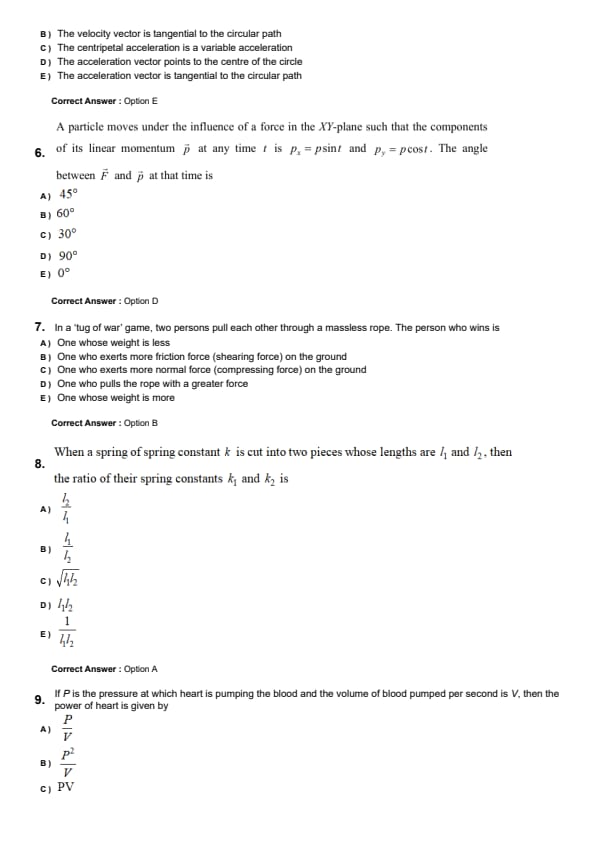
In a ‘tug of war’ game, two persons pull each other through a massless rope. The person who wins is
View Solution
Step 1: In a tug-of-war, the force exerted on the rope does not directly determine the winner. Instead, it depends on the force that a person can apply against the ground.
Step 2: The force that allows a person to pull effectively comes from the friction between their feet and the ground. Higher friction provides better resistance, allowing one to pull with greater force.
Step 3: The friction force is given by: \[ F_{friction} = \mu N \]
where \(\mu\) is the coefficient of friction and \(N\) is the normal force.
Step 4: The person who can exert a larger frictional force will be able to resist the pull of the opponent and apply a stronger opposing force, ultimately winning the game.
Step 5: Therefore, the correct answer is (B). Quick Tip: In a tug-of-war, the role of friction is crucial. The winner is not necessarily the heavier person but the one who can maximize friction against the ground.
When a spring of spring constant \(k\) is cut into two pieces whose lengths are \(l_1\) and \(l_2\), then the ratio of their spring constants \(k_1\) and \(k_2\) is
View Solution
Step 1: The spring constant of a spring is inversely proportional to its length when the spring is cut into smaller sections. Mathematically, \[ k' = \frac{k}{l} \]
where \(k'\) is the spring constant of a smaller piece and \(l\) is its length.
Step 2: When the original spring of constant \(k\) is divided into two sections of lengths \(l_1\) and \(l_2\), their respective spring constants are: \[ k_1 = \frac{k}{l_1}, \quad k_2 = \frac{k}{l_2} \]
Step 3: The ratio of \(k_1\) to \(k_2\) is: \[ \frac{k_1}{k_2} = \frac{\frac{k}{l_1}}{\frac{k}{l_2}} = \frac{l_2}{l_1} \]
Step 4: Therefore, the correct answer is (A). Quick Tip: When a spring is cut into smaller sections, the stiffness of each section increases because the force required for unit displacement increases.
If \(P\) is the pressure at which the heart is pumping the blood and the volume of blood pumped per second is \(V\), then the power of the heart is given by
View Solution
N/A Quick Tip: In fluid mechanics, power can be calculated as the product of pressure and flow rate.
A block of mass \(M\) moves with a velocity \(v\) along a frictionless horizontal surface towards another block of mass \(2M\) at rest. The velocity of the center of mass of the system of blocks is
View Solution
Step 1: The velocity of the center of mass is given by: \[ V_{cm} = \frac{m_1 v_1 + m_2 v_2}{m_1 + m_2} \]
where \(m_1 = M\), \(v_1 = v\), \(m_2 = 2M\), and \(v_2 = 0\).
Step 2: Substituting the values: \[ V_{cm} = \frac{M v + 2M \times 0}{M + 2M} \] \[ V_{cm} = \frac{M v}{3M} = \frac{v}{3} \]
Step 3: Therefore, the correct answer is (D). Quick Tip: The center of mass velocity is the weighted average of the velocities of individual masses.
The radius of gyration of a regular solid cylinder of radius \(R\) about its axis is
View Solution
Step 1: The moment of inertia for a solid cylinder around its central axis is expressed as: \[ I = \frac{1}{2} M R^2 \]
Step 2: The radius of gyration \(K\) is related to the moment of inertia through the formula: \[ I = M K^2 \]
Step 3: Equating the two formulas, we get: \[ M K^2 = \frac{1}{2} M R^2 \] \[ K^2 = \frac{R^2}{2} \] \[ K = \frac{R}{\sqrt{2}} \]
Step 4: Hence, the correct answer is (C). Quick Tip: The radius of gyration measures how mass is distributed relative to the axis of rotation.
When two spheres with radii \(r\) and \(\frac{r}{2}\) are brought together in contact, the gravitational attraction between them is proportional to
View Solution
Step 1: Newton's Law of Gravitation defines the gravitational force between two objects as: \[ F = \frac{G m_1 m_2}{d^2} \]
where \(m_1\) and \(m_2\) are the masses and \(d\) is the distance between them.
Step 2: The masses of the two spheres are proportional to their volumes: \[ m_1 \propto r^3, \quad m_2 \propto \left(\frac{r}{2}\right)^3 = \frac{r^3}{8} \]
Step 3: When in contact, the separation \(d\) is the sum of their radii: \[ d \approx r + \frac{r}{2} = \frac{3r}{2} \]
Step 4: Substituting into the gravitational force formula: \[ F \propto \frac{(r^3) \times \left(\frac{r^3}{8}\right)}{\left(\frac{3r}{2}\right)^2} \]
Step 5: Simplifying the expression: \[ F \propto \frac{r^6}{8 \times \frac{9r^2}{4}} \] \[ F \propto \frac{r^6}{18r^2} \] \[ F \propto r^{6 - 2} = r^4 \]
Step 6: Force is inversely proportional to \(r^2\), so the force follows: \[ F \propto r^{-2} \]
Step 7: Therefore, the correct answer is (E). Quick Tip: Gravitational force is determined by both the mass and the distance between the centers of the objects involved.
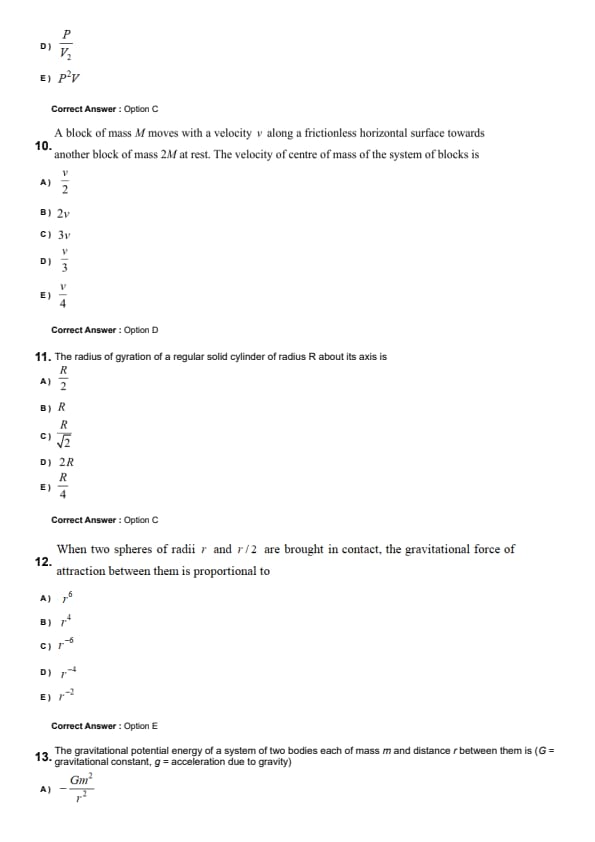
The gravitational potential energy of a system consisting of two bodies each with mass \(m\) and a distance \(r\) between them is (G = gravitational constant, g = acceleration due to gravity)
View Solution
Step 1: The formula for gravitational potential energy (\(U\)) between two masses \(m_1\) and \(m_2\) at a distance \(r\) is: \[ U = -\frac{G m_1 m_2}{r} \]
Step 2: With both masses equal to \(m\), the formula becomes: \[ U = -\frac{G m^2}{r} \]
Step 3: Therefore, the correct answer is (B). Quick Tip: Gravitational potential energy is negative, reflecting the attractive nature of gravity between masses.
Which material from the list has the highest Young’s modulus?
View Solution
Step 1: Young’s modulus (\(Y\)) indicates the stiffness of a material and is defined as: \[ Y = \frac{Stress}{Strain} \]
Step 2: The known values of Young’s modulus for these materials are:
Aluminium: \(70 \times 10^9\) Pa
Copper: \(110 \times 10^9\) Pa
Brass: \(100 \times 10^9\) Pa
Steel: \(200 \times 10^9\) Pa
Wrought Iron: \(190 \times 10^9\) Pa
Step 3: Since Steel has the highest value of Young’s modulus, it is the stiffest material among the options.
Step 4: Hence, the correct answer is (D). Quick Tip: Young’s modulus quantifies how resistant a material is to deformation under stress.
The energy stored in a soap bubble of diameter 4 cm is approximately (surface tension of soap solution is 0.07 Nm\textsuperscript{-1})
View Solution
Step 1: The energy stored in a soap bubble due to surface tension is given by: \[ U = 4 \pi R^2 \times 2T \]
where \(T\) is the surface tension, and the factor of 2 accounts for both the inner and outer surfaces of the soap bubble.
Step 2: Given values: \[ Diameter = 4 \, cm = 0.04 \, m, \quad R = \frac{0.04}{2} = 0.02 \, m \] \[ T = 0.07 \, Nm^{-1} \]
Step 3: Substituting these values into the equation: \[ U = 4 \pi (0.02)^2 \times 2 \times (0.07) \]
Step 4: Simplifying: \[ U = 4 \times 3.1416 \times 0.0004 \times 0.14 \] \[ U = 7 \times 10^{-4} \, J \]
Step 5: Therefore, the correct answer is (C). Quick Tip: A soap bubble has two surfaces, and the energy stored accounts for both.
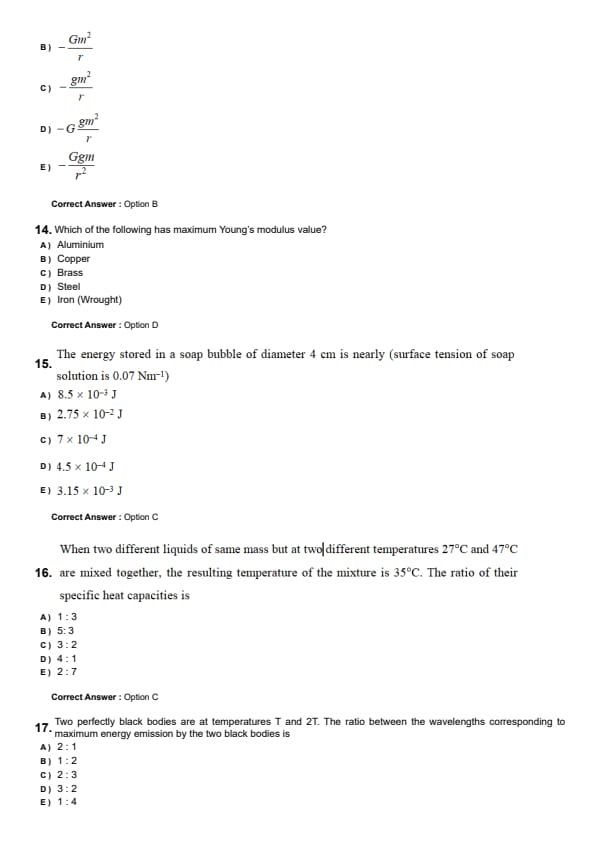
When two different liquids of equal mass but at different temperatures \(27^\circ C\) and \(47^\circ C\) are mixed, the resulting temperature of the mixture is \(35^\circ C\). The ratio of their specific heat capacities is
View Solution
Step 1: Let the specific heat capacities of the two liquids be \( c_1 \) and \( c_2 \). Since no heat is lost to the surroundings, the heat lost by the hotter liquid equals the heat gained by the cooler one.
Step 2: The heat transfer equation is: \[ m \cdot c_1 \cdot (47 - 35) = m \cdot c_2 \cdot (35 - 27) \]
Step 3: Simplifying: \[ \frac{c_1}{c_2} = \frac{8}{12} = \frac{2}{3} \]
Step 4: The ratio of their specific heat capacities is the inverse: \[ \frac{c_1}{c_2} = \frac{2}{3} \implies c_1 : c_2 = 3 : 2 \] Quick Tip: Always remember to consider the direction of heat flow, which is from the hotter to the cooler liquid.
Two perfectly black bodies are at temperatures \( T \) and \( 2T \). The ratio of the wavelengths corresponding to the maximum energy emission by the two bodies is
View Solution
The relationship between the temperature of a black body and the wavelength of maximum energy emission is given by Wien's Displacement Law: \[ \lambda_{max} T = b \]
where:
- \(\lambda_{max}\) is the wavelength at which maximum energy is emitted,
- \(T\) is the temperature of the body,
- \(b\) is Wien's constant (\(b \approx 2.898 \times 10^{-3} \, m·K\)).
Step 1: For the first black body at temperature \(T\): \[ \lambda_1 T = b \implies \lambda_1 = \frac{b}{T} \]
Step 2: For the second black body at temperature \(2T\): \[ \lambda_2 (2T) = b \implies \lambda_2 = \frac{b}{2T} \]
Step 3: The ratio of the wavelengths is: \[ \frac{\lambda_1}{\lambda_2} = \frac{\frac{b}{T}}{\frac{b}{2T}} = \frac{b}{T} \cdot \frac{2T}{b} = 2 \]
Thus, the ratio is: \[ \lambda_1 : \lambda_2 = 2 : 1 \] Quick Tip: Wien’s Displacement Law is a useful tool for understanding how temperature influences the wavelength of maximum emission in black bodies.
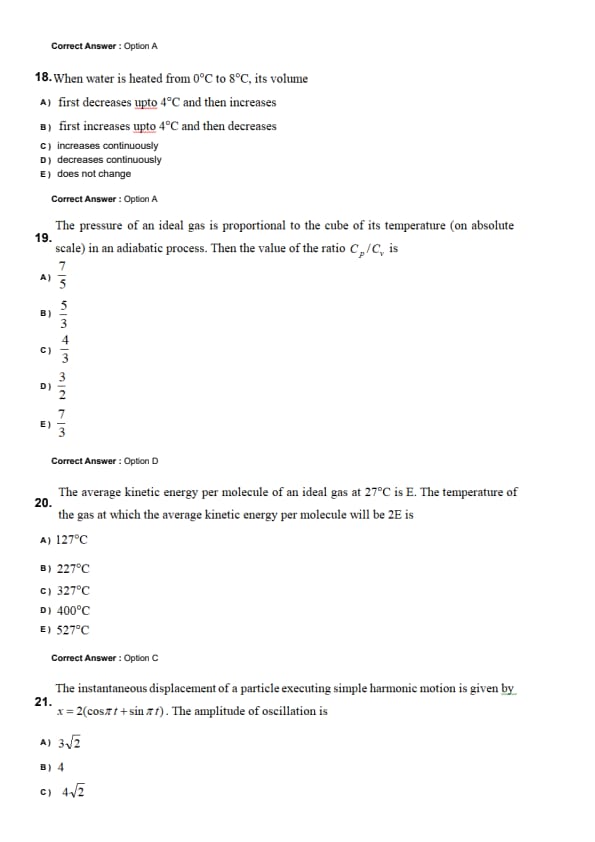
When water is heated from \(0^\circ C\) to \(8^\circ C\), its volume
View Solution
Step 1: Water has an anomalous expansion behavior between \(0^\circ C\) and \(4^\circ C\). Its density increases as it is heated from \(0^\circ C\) to \(4^\circ C\), causing its volume to decrease.
Step 2: At exactly \(4^\circ C\), water reaches its maximum density, and its volume is minimized.
Step 3: When the temperature increases above \(4^\circ C\), water expands as usual, causing its volume to increase.
Step 4: Therefore, the correct answer is (A). Quick Tip: Water’s maximum density occurs at \(4^\circ C\), explaining why ice floats and why aquatic life survives under ice in winter.
For an ideal gas, if its pressure is proportional to the cube of its temperature in an adiabatic process, the value of the ratio \(C_p/C_v\) is
View Solution
Step 1: In an adiabatic process, the relationship between pressure (\(P\)) and temperature (\(T\)) is: \[ P \propto T^n \]
Given that \(P \propto T^3\), we have \(n = 3\).
Step 2: The general adiabatic relation for an ideal gas is: \[ P T^{-\frac{\gamma}{\gamma - 1}} = constant \]
where \(\gamma = \frac{C_p}{C_v}\) is the heat capacity ratio.
Step 3: Equating the powers of \(T\): \[ -\frac{\gamma}{\gamma - 1} = 3 \]
Step 4: Solving for \(\gamma\): \[ \gamma = \frac{3}{2} \]
Step 5: Therefore, the correct answer is (D). Quick Tip: In adiabatic processes, the exponent in the pressure-temperature relation helps determine the value of \(\gamma\).
The average kinetic energy per molecule of an ideal gas at \(27^\circ C\) is \(E\). The temperature at which the average kinetic energy per molecule will be \(2E\) is
View Solution
Step 1: The average kinetic energy (\(E\)) of an ideal gas is directly proportional to the absolute temperature (\(T\)). To double the kinetic energy, the temperature must also double.
Step 2: Convert the initial temperature to Kelvin: \[ T_1 = 27^\circ C = 300 \, K \]
Step 3: The new temperature in Kelvin when the kinetic energy doubles: \[ 2 \times 300 \, K = 600 \, K \]
Step 4: Convert \(600 \, K\) back to Celsius: \[ 600 \, K - 273.15 = 326.85^\circ C \quad (rounded to \(327^\circ C\)) \] Quick Tip: Always use Kelvin when working with temperature changes related to kinetic energy, as the relationship is linear with the absolute temperature.
The instantaneous displacement of a particle executing simple harmonic motion is given by \(x = 2(\cos(\pi t) + \sin(\pi t))\). The amplitude of oscillation is
View Solution
N/A Quick Tip: Using trigonometric identities can simplify the analysis of oscillatory motion and provide insights into the physical quantities involved, like amplitude.
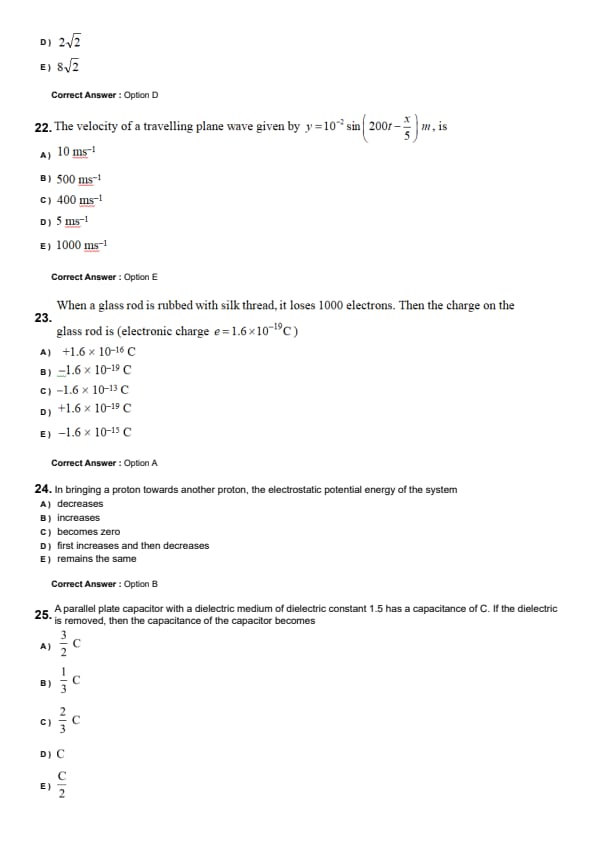
The velocity of a travelling plane wave given by \[ y = 10^{-2} \sin \left( 200t - \frac{x}{5} \right) m, \]
is
View Solution
Step 1: The standard form of a travelling wave equation is: \[ y = A \sin (\omega t - kx) \]
where \(\omega\) is the angular frequency, \(k\) is the wave number, and the wave velocity \(v\) is given by: \[ v = \frac{\omega}{k} \]
Step 2: From the given equation, we compare terms: \[ \omega = 200, \quad k = \frac{1}{5} \]
Step 3: Using the wave velocity formula: \[ v = \frac{200}{1/5} = 200 \times 5 = 1000 ms^{-1} \]
Step 4: Therefore, the correct answer is (E). Quick Tip: The speed of a wave is given by the ratio of its angular frequency \(\omega\) to the wave number \(k\).
When a glass rod is rubbed with silk thread, it loses 1000 electrons. Then the charge on the glass rod is (electronic charge \(e = 1.6 \times 10^{-19}\) C)
View Solution
Step 1: The charge on a single electron is: \[ e = 1.6 \times 10^{-19} C \]
Step 2: The charge on the glass rod is given by: \[ Q = n e \]
where \(n\) is the number of lost electrons. Given that \(n = 1000\), we get: \[ Q = 1000 \times 1.6 \times 10^{-19} \] \[ Q = 1.6 \times 10^{-16} C \]
Step 3: Since the rod loses electrons, it becomes positively charged.
Step 4: Therefore, the correct answer is (A). Quick Tip: When an object loses electrons, it becomes positively charged. When it gains electrons, it becomes negatively charged.
In bringing a proton towards another proton, the electrostatic potential energy of the system
View Solution
Step 1: The electrostatic potential energy (\(U\)) between two point charges \(q_1\) and \(q_2\) separated by distance \(r\) is given by: \[ U = \frac{1}{4\pi\epsilon_0} \frac{q_1 q_2}{r} \]
Step 2: Since both charges are protons, we have: \[ q_1 = q_2 = e = 1.6 \times 10^{-19} C \]
Step 3: Since both charges are positive, they repel each other. As the distance between them decreases, \(r\) decreases.
Step 4: Since \(U \propto \frac{1}{r}\), decreasing \(r\) increases \(U\), meaning the electrostatic potential energy of the system increases.
Step 5: Therefore, the correct answer is (B). Quick Tip: Like charges repel, meaning work must be done to bring them closer, increasing potential energy.
A parallel plate capacitor with a dielectric medium of dielectric constant 1.5 has a capacitance of \(C\). If the dielectric is removed, then the capacitance of the capacitor becomes
View Solution
Step 1: The capacitance of a capacitor with a dielectric is given by \(C' = kC\), where \(k\) is the dielectric constant.
Step 2: With the dielectric, the capacitance is \(C = 1.5C_0\), where \(C_0\) is the original capacitance without the dielectric.
Step 3: Removing the dielectric, the capacitance returns to \(C_0\). Thus, \(C_0 = \frac{2}{3}C\).
Step 4: Therefore, the new capacitance is \(\frac{2}{3}C\). Quick Tip: Remember, the capacitance with a dielectric is directly proportional to the dielectric constant.
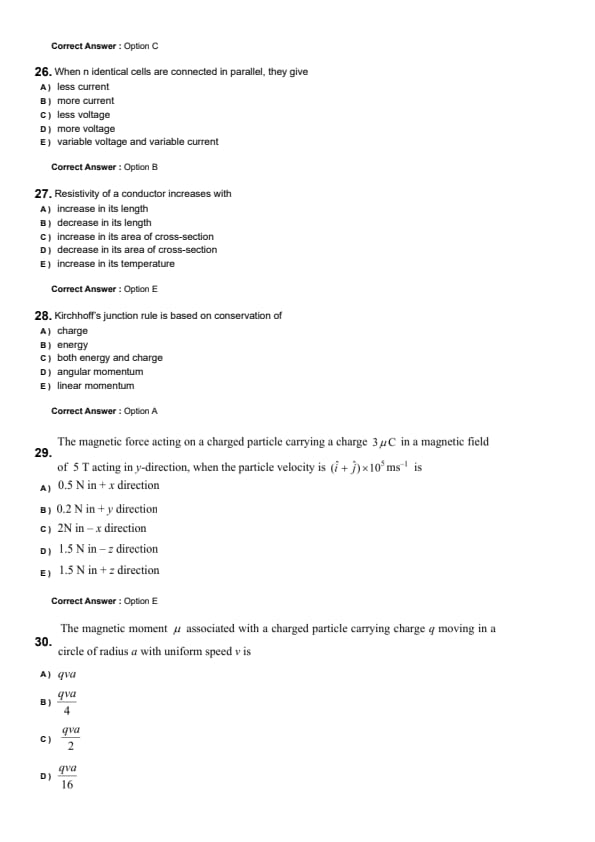
When \(n\) identical cells are connected in parallel, they give
View Solution
Step 1: When cells are connected in parallel, the voltage across each cell remains the same, but the total current capacity increases.
Step 2: The effective internal resistance decreases, allowing more current to flow through the external circuit compared to a single cell.
Step 3: Therefore, connecting cells in parallel results in more current. Quick Tip: Use parallel connections to increase current output in circuits where higher current is required without increasing voltage.
Resistivity of a conductor increases with
View Solution
Step 1: Resistivity of a conductor is primarily dependent on the material and its temperature.
Step 2: As temperature increases, the atomic vibrations within the conductor increase, leading to more frequent collisions and higher resistivity.
Step 3: Thus, the resistivity of a conductor increases with an increase in its temperature. Quick Tip: Keep in mind that for semiconductors, the behavior of resistivity with temperature can be the opposite of that in conductors.
Kirchhoff’s junction rule is based on conservation of
View Solution
Step 1: Kirchhoff’s junction rule (also known as the current law) states that the total current entering a junction equals the total current leaving the junction.
Step 2: This law is derived from the principle of conservation of charge, ensuring that no charge is lost or created at the junction.
Step 3: Therefore, Kirchhoff's junction rule is based on the conservation of charge. Quick Tip: Always use Kirchhoff’s rules for analyzing complex circuits to simplify finding unknown currents and voltages.
The magnetic force acting on a charged particle carrying a charge \(3 \mu C\) in a magnetic field of \(5\) T acting in the \(y\)-direction, when the particle velocity is \[ (\hat{i} + \hat{j}) \times 10^5 ms^{-1} \]
is
View Solution
Step 1: The magnetic force on a moving charge is given by: \[ \vec{F} = q (\vec{v} \times \vec{B}) \]
Step 2: Given: \[ q = 3 \times 10^{-6} C, \quad \vec{v} = (10^5 \hat{i} + 10^5 \hat{j}) m/s, \quad \vec{B} = 5 \hat{j} T \]
Step 3: Compute the cross product: \[ \vec{v} \times \vec{B} = \begin{vmatrix} \hat{i} & \hat{j} & \hat{k}
10^5 & 10^5 & 0
0 & 5 & 0 \end{vmatrix} \]
Step 4: Expanding the determinant: \[ \vec{v} \times \vec{B} = (10^5 \times 0 - 10^5 \times 0) \hat{i} - (10^5 \times 0 - 5 \times 10^5) \hat{j} + (10^5 \times 5 - 10^5 \times 0) \hat{k} \]
\[ = 0 \hat{i} + 5 \times 10^5 \hat{j} + 5 \times 10^5 \hat{k} \]
\[ = 5 \times 10^5 \hat{k} \]
Step 5: Compute force: \[ \vec{F} = (3 \times 10^{-6}) (5 \times 10^5 \hat{k}) \]
\[ = 1.5 \hat{k} N \]
Step 6: Since \(\hat{k}\) represents the \(+z\) direction, the force is \(1.5\) N in the \(+z\) direction.
Step 7: Therefore, the correct answer is (E). Quick Tip: Use the determinant method to compute vector cross products efficiently.
The magnetic moment \(\mu\) associated with a charged particle carrying charge \(q\) moving in a circle of radius \(a\) with uniform speed \(v\) is
View Solution
Step 1: The magnetic moment of a charged particle moving in a circular path is given by: \[ \mu = I A \]
where \(I\) is the current and \(A\) is the area of the circular path.
Step 2: The current \(I\) is given by: \[ I = \frac{q}{T} \]
where \(T\) is the time period of the circular motion. The time period is: \[ T = \frac{2\pi a}{v} \]
Step 3: Substituting \(T\): \[ I = \frac{q}{2\pi a / v} = \frac{q v}{2\pi a} \]
Step 4: The area of the circular path is: \[ A = \pi a^2 \]
Step 5: Compute the magnetic moment: \[ \mu = \left(\frac{q v}{2\pi a}\right) (\pi a^2) \]
\[ = \frac{q v a}{2} \]
Step 6: Therefore, the correct answer is (C). Quick Tip: The magnetic moment of a current-carrying loop depends on the charge, velocity, and radius of the path.
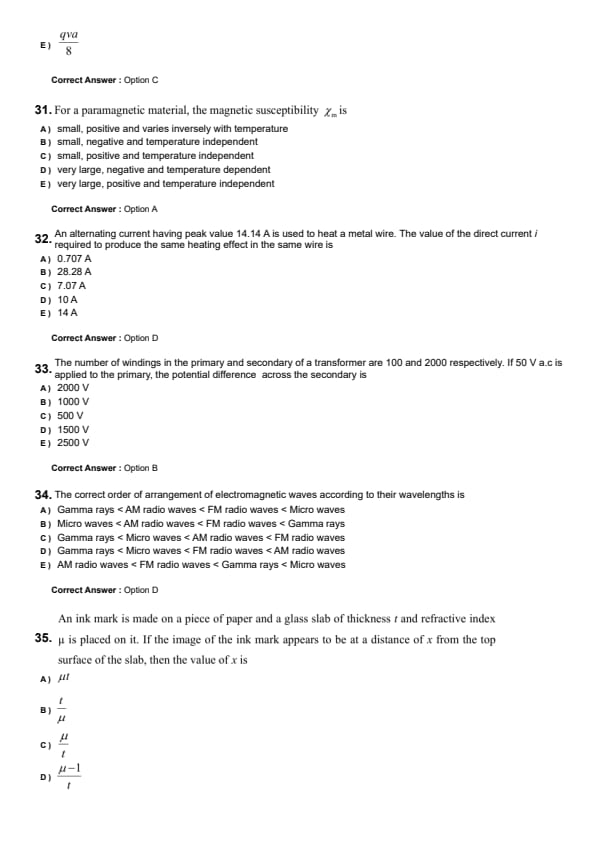
For a paramagnetic material, the magnetic susceptibility \( \chi_m \) is
View Solution
Step 1: Paramagnetic substances have a small, positive susceptibility.
Step 2: Unlike ferromagnetic materials, paramagnetic substances lose their magnetization when the external magnetic field is removed.
Step 3: Curie’s Law states that the susceptibility \( \chi_m \) of paramagnetic materials decreases with rising temperature, being inversely proportional to it.
Step 4: Therefore, with an increase in temperature, the susceptibility drops, consistent with option (A). Quick Tip: Curie's Law is key to understanding the relationship between temperature and magnetism in paramagnetic materials.
An alternating current with a peak value of 14.14 A is used to heat a metal wire. The direct current \(i\) required to produce the same heating effect in the same wire is
View Solution
Step 1: The heat generated by the current is \( I_{rms}^2 R \), where \( I_{rms} \) is the root mean square current.
Step 2: For an AC current with peak value \( I_p = 14.14 \, A \), we calculate the RMS value as \( I_{rms} = \frac{I_p}{\sqrt{2}} = \frac{14.14}{\sqrt{2}} = 10 \, A \).
Step 3: For the same heating effect with a DC current, the value must equal the RMS of the AC current.
Step 4: Therefore, the required direct current is 10 A. Quick Tip: The RMS value of AC current is essential for comparing the heating effect to that of DC currents.
The number of windings in the primary and secondary of a transformer are 100 and 2000 respectively. If 50 V a.c is applied to the primary, the potential difference across the secondary is
View Solution
Step 1: The transformer equation \( \frac{V_s}{V_p} = \frac{N_s}{N_p} \) links the primary and secondary voltages and the number of turns in the coils.
Step 2: Substituting the given values: \( \frac{2000}{100} = \frac{V_s}{50} \).
Step 3: Solving for \( V_s \) yields \( V_s = 20 \times 50 = 1000 \, V \).
Step 4: Therefore, the secondary potential difference is 1000 V. Quick Tip: Understanding transformer equations is crucial for determining voltage changes in electrical systems.
The correct order of arrangement of electromagnetic waves according to their wavelengths is
View Solution
Step 1: Gamma rays have the shortest wavelengths in the electromagnetic spectrum.
Step 2: Microwaves have longer wavelengths than gamma rays but shorter than radio waves.
Step 3: Within radio waves, FM waves have shorter wavelengths than AM waves.
Step 4: Hence, the correct order from shortest to longest wavelength is gamma rays, microwaves, FM radio waves, and AM radio waves. Quick Tip: The electromagnetic spectrum ranges from gamma rays (shortest wavelength) to radio waves (longest wavelength).
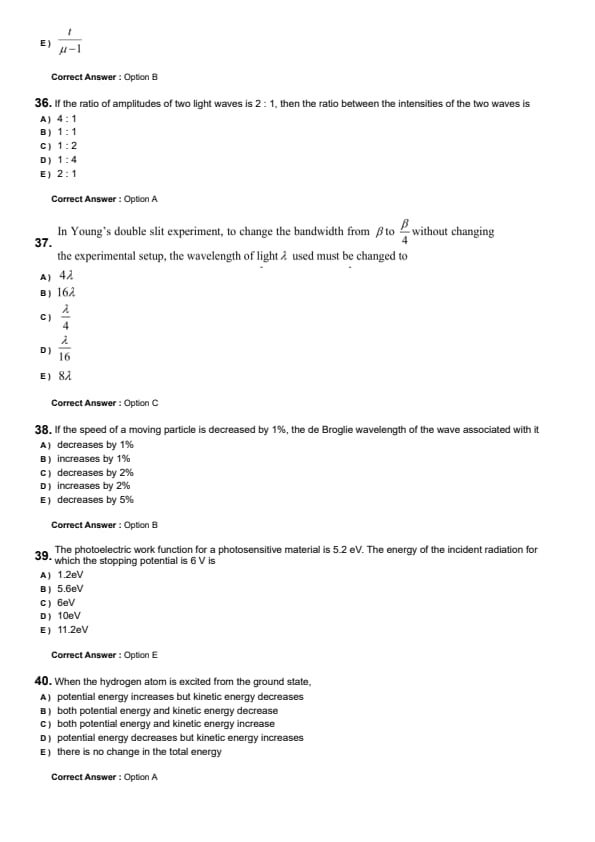
An ink mark is made on a piece of paper, and a glass slab of thickness \(t\) and refractive index \(\mu\) is placed on it. If the image of the ink mark appears to be at a distance of \(x\) from the top surface of the slab, then the value of \(x\) is
View Solution
Step 1: The apparent depth \(x\) when viewed through a medium of refractive index \(\mu\) and thickness \(t\) is given by: \[ x = \frac{t}{\mu} \]
Step 2: This is derived from the concept of refraction, where the light appears to travel a shorter distance when moving through a denser medium.
Step 3: Using this formula, we find the apparent position of the ink mark.
Step 4: Hence, the correct answer is (B). Quick Tip: When viewed through a denser medium, the apparent depth is always smaller than the actual depth.
If the ratio of amplitudes of two light waves is 2 : 1, then the ratio between the intensities of the two waves is
View Solution
Step 1: Intensity is proportional to the square of the amplitude: \[ I \propto A^2 \]
Step 2: If the amplitude ratio is \(2:1\), let \(A_1 = 2A\) and \(A_2 = A\).
Step 3: The intensity ratio is: \[ I_1 : I_2 = (2A)^2 : (A)^2 \] \[ = 4A^2 : A^2 = 4 : 1 \]
Step 4: Therefore, the correct answer is (A). Quick Tip: Remember that intensity is proportional to the square of amplitude: \(I \propto A^2\).
In Young’s double slit experiment, to change the bandwidth from \(\beta\) to \(\frac{\beta}{4}\) without altering the setup, the wavelength of the light \(\lambda\) must be changed to
View Solution
Step 1: The fringe width \(\beta\) in Young’s experiment is: \[ \beta = \frac{\lambda D}{d} \]
where \(D\) is the distance between the screen and the slits, and \(d\) is the slit separation.
Step 2: Since \(D\) and \(d\) are fixed, the fringe width is directly proportional to the wavelength: \[ \beta \propto \lambda \]
Step 3: To reduce the fringe width from \(\beta\) to \(\frac{\beta}{4}\), the wavelength must be reduced by a factor of 4: \[ \lambda' = \frac{\lambda}{4} \]
Step 4: Therefore, the correct answer is (C). Quick Tip: In Young’s double slit experiment, the fringe width is directly proportional to the wavelength of light used.
If the speed of a moving particle decreases by 1%, the de Broglie wavelength of the wave associated with it
View Solution
Step 1: The de Broglie wavelength \(\lambda\) is given by \(\lambda = \frac{h}{mv}\), where \(h\) is Planck's constant, \(m\) is the mass, and \(v\) is the velocity.
Step 2: A 1% decrease in speed implies \(v' = 0.99v\).
Step 3: The new wavelength \(\lambda'\) becomes: \[ \lambda' = \frac{h}{m \cdot 0.99v} = \frac{1}{0.99} \lambda \approx 1.01 \lambda \]
Step 4: Hence, the de Broglie wavelength increases by approximately 1%. Quick Tip: The de Broglie wavelength increases as the velocity decreases since they are inversely related.
The photoelectric work function for a photosensitive material is 5.2 eV. The energy of the incident radiation for which the stopping potential is 6 V is
View Solution
Step 1: Use the photoelectric equation: \[ K_{max} = E - \phi \]
where \(K_{max}\) is the maximum kinetic energy of ejected electrons, \(E\) is the energy of the incident photons, and \(\phi\) is the work function.
Step 2: The maximum kinetic energy can also be expressed as: \[ K_{max} = e \cdot V \]
where \(V\) is the stopping potential and \(e\) is the elementary charge.
Step 3: Setting \(e \cdot 6V = E - 5.2\) eV and solving for \(E\), we get: \[ E = 6 + 5.2 = 11.2 \, eV \]
Step 4: Therefore, the energy of the incident radiation is 11.2 eV. Quick Tip: For photoelectric effect problems, remember to convert the stopping potential into energy (in eV).
When the hydrogen atom is excited from the ground state,
View Solution
Step 1: In quantum mechanics, the total energy of a hydrogen atom is related to the potential energy by the equation \( E = -\frac{PE}{2} \).
Step 2: When the atom is excited, the electron moves to a higher energy level, meaning it is farther from the nucleus.
Step 3: This results in an increase in potential energy (less negative), as the electron is less tightly bound.
Step 4: At the same time, the kinetic energy decreases because of the relationship \( KE = -\frac{PE}{2} \).
Step 5: Thus, when the hydrogen atom is excited, potential energy increases (becomes less negative) while kinetic energy decreases. Quick Tip: Remember that excitation in hydrogen results in a less negative potential energy and a corresponding decrease in kinetic energy.
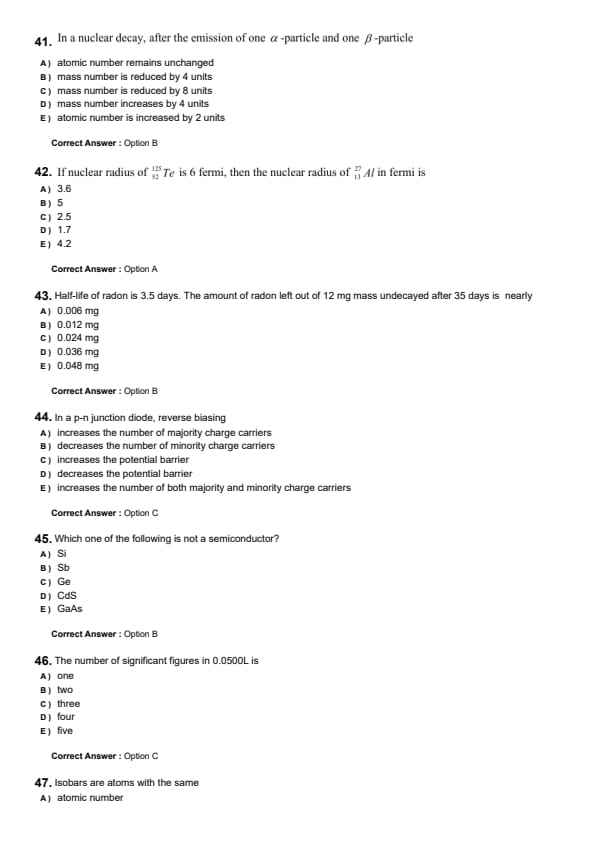
In a nuclear decay, after the emission of one \(\alpha\)-particle and one \(\beta\)-particle
View Solution
Step 1: An \(\alpha\)-particle is composed of 2 protons and 2 neutrons, so its emission causes a decrease in atomic number by 2 and a reduction in mass number by 4.
Step 2: A \(\beta\)-particle, which is an electron, is emitted when a neutron transforms into a proton, leading to an increase in atomic number by 1 while the mass number remains unchanged.
Step 3: Therefore, when both a \(\alpha\)-particle and a \(\beta\)-particle are emitted, the mass number decreases by 4 (from the \(\alpha\) emission), and the atomic number decreases by 2 (due to the \(\alpha\) emission) but increases by 1 (from the \(\beta\) emission), resulting in a net decrease of 1 in the atomic number.
Step 4: Since the question asks specifically about the change in mass number, the correct answer is (B). Quick Tip: The emission of an \(\alpha\)-particle reduces the mass number by 4, while a \(\beta\)-particle affects only the atomic number.
If the nuclear radius of \(^{125}_{52}Te\) is 6 fermi, then the nuclear radius of \(^{27}_{13}Al\) in fermi is
View Solution
Step 1: The nuclear radius \(R\) follows the empirical relation: \[ R = R_0 A^{1/3} \]
where \(A\) is the mass number and \(R_0\) is a constant.
Step 2: The ratio of nuclear radii can be expressed as: \[ \frac{R_2}{R_1} = \left( \frac{A_2}{A_1} \right)^{1/3} \]
For \(R_1 = 6\) fermi and \(A_1 = 125\), and for \(A_2 = 27\), we have: \[ R_2 = 6 \times \left( \frac{27}{125} \right)^{1/3} \]
Step 3: Approximating the cube root: \[ \left( \frac{27}{125} \right)^{1/3} = \frac{3}{5} = 0.6 \]
Step 4: \[ R_2 = 6 \times 0.6 = 3.6 fermi \]
Step 5: Therefore, the correct answer is (A). Quick Tip: The nuclear radius is proportional to \(A^{1/3}\), allowing easy calculations for different isotopes.
Half-life of radon is 3.5 days. The amount of radon left out of 12 mg mass undecayed after 35 days is nearly
View Solution
Step 1: The remaining amount after \(n\) half-lives is: \[ N = N_0 \times \left(\frac{1}{2}\right)^n \]
where \(N_0\) is the initial mass, and \(n\) is the number of half-lives elapsed.
Step 2: Given: \[ N_0 = 12 mg, \quad T_{1/2} = 3.5 days, \quad t = 35 days \] \[ n = \frac{t}{T_{1/2}} = \frac{35}{3.5} = 10 \]
Step 3: The remaining mass is: \[ N = 12 \times \left(\frac{1}{2}\right)^{10} \]
Step 4: \[ \left(\frac{1}{2}\right)^{10} = \frac{1}{1024} \approx 0.00098 \]
\[ N = 12 \times 0.00098 = 0.0118 \approx 0.012 mg \]
Step 5: Therefore, the correct answer is (B). Quick Tip: Radioactive decay follows an exponential law based on the number of half-lives.
In a p-n junction diode, reverse biasing
View Solution
Step 1: In reverse biasing, the p-type material is connected to the negative terminal and the n-type material to the positive terminal.
Step 2: This reverse bias causes the depletion region to widen as it adds to the built-in potential across the junction.
Step 3: The wider depletion region increases the potential barrier, which restricts the flow of majority charge carriers, effectively increasing the diode's resistance to current flow.
Step 4: Hence, reverse biasing increases the potential barrier, which corresponds to option (C). Quick Tip: Reverse biasing in diodes increases the potential barrier and depletion region, in contrast to forward biasing which reduces both.
Which one of the following is not a semiconductor?
View Solution
Step 1: Silicon (Si), Germanium (Ge), Gallium Arsenide (GaAs), and Cadmium Sulfide (CdS) are all well-known semiconductors used in various electronic applications.
Step 2: However, Antimony (Sb) is a metalloid, not a semiconductor, and does not exhibit the necessary semiconductive properties, such as a bandgap that can be controlled or manipulated.
Step 3: Therefore, Sb is not considered a semiconductor, which makes (B) the correct answer. Quick Tip: While some metalloids have semiconductive properties, not all metalloids (like Sb) are used as semiconductors in technology.
The number of significant figures in 0.0500L is
View Solution
Step 1: In the measurement 0.0500 L, the leading zeros before the 5 are not counted as significant.
Step 2: The two trailing zeros after the decimal point and following the 5 are significant because they indicate precision.
Step 3: Hence, the number of significant figures in 0.0500 L is three (5, 0, 0). Quick Tip: Trailing zeros in a decimal number are significant and reflect the precision of the measurement.
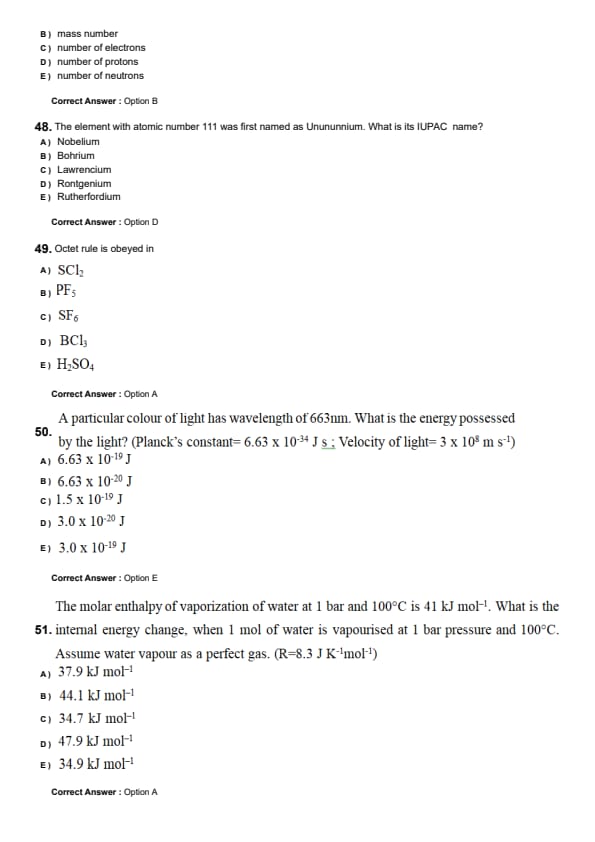
Isobars are atoms with the same
View Solution
Step 1: Isobars are atoms that have the same mass number, which is the sum of protons and neutrons in the nucleus.
Step 2: However, isobars can have different atomic numbers, as they are different elements.
Step 3: The defining characteristic of isobars is that they share the same mass number, thus the correct answer is (B). Quick Tip: Isobars have the same mass number but may have different atomic numbers, resulting in different elements.
The element with atomic number 111 was first named as Unununnium. What is its IUPAC name?
View Solution
Step 1: Elements with atomic numbers greater than 100 were initially given systematic names based on their atomic number.
Step 2: Element 111 was initially called Unununnium (Uuu) under the temporary naming system.
Step 3: The element was later named Roentgenium (Rg) to honor Wilhelm Roentgen, the discoverer of X-rays.
Step 4: Therefore, the correct answer is (D). Quick Tip: Temporary names based on atomic numbers are later replaced with official names by IUPAC.
Octet rule is obeyed in
View Solution
Step 1: The octet rule states that atoms tend to form bonds so they achieve 8 valence electrons.
Step 2: In \(SCl_2\), sulfur forms two single bonds with chlorine, satisfying the octet rule for sulfur.
Step 3: In the other compounds, either expanded octets (as in \(PF_5\) and \(SF_6\)) or incomplete octets (like \(BCl_3\)) occur.
Step 4: Therefore, only \(SCl_2\) strictly obeys the octet rule. Quick Tip: Some elements like sulfur can have expanded octets, but for the octet rule to hold, the atom must have 8 valence electrons.
A particular color of light has a wavelength of 663 nm. What is the energy possessed by the light?
(Planck’s constant \(h = 6.63 \times 10^{-34}\) J·s; Velocity of light \(c = 3 \times 10^8\) m/s)
View Solution
Step 1: The energy of a photon is calculated by: \[ E = \frac{hc}{\lambda} \]
where:
- \(h = 6.63 \times 10^{-34}\) J·s
- \(c = 3 \times 10^8\) m/s
- \(\lambda = 663\) nm = \(663 \times 10^{-9}\) m
Step 2: Substituting the values: \[ E = \frac{(6.63 \times 10^{-34}) \times (3 \times 10^8)}{663 \times 10^{-9}} \]
Step 3: Simplifying the numerator: \[ (6.63 \times 10^{-34}) \times (3 \times 10^8) = 1.989 \times 10^{-25} \]
Step 4: Dividing by the denominator: \[ E = \frac{1.989 \times 10^{-25}}{663 \times 10^{-9}} = 3.0 \times 10^{-19} J \]
Step 5: Thus, the energy is \(3.0 \times 10^{-19}\) J. Quick Tip: Shorter wavelengths correspond to higher photon energies due to the inverse proportionality between wavelength and energy.
The molar enthalpy of vaporization of water at 1 bar and \(100^\circ\)C is 41 kJ mol\textsuperscript{-1. What is the internal energy change, when 1 mol of water is vaporized at 1 bar pressure and \(100^\circ\)C? Assume water vapor as a perfect gas. (R = 8.3 J K\textsuperscript{-1 mol\textsuperscript{-1)
View Solution
Step 1: The relationship between enthalpy change (\(\Delta H\)) and internal energy change (\(\Delta U\)) is given by: \[ \Delta H = \Delta U + P\Delta V \]
For 1 mole of an ideal gas, the volume change at constant pressure can be calculated as: \[ P\Delta V = R T \]
Step 2: Given: \[ \Delta H = 41 kJ mol^{-1}, \quad R = 8.3 J K^{-1} mol^{-1}, \quad T = 373 K \] \[ P\Delta V = (8.3 \times 373) \times 10^{-3} kJ \]
Step 3: Computing the expansion work: \[ P\Delta V = 3.1 kJ \]
Step 4: Substituting in the equation: \[ \Delta U = 41 - 3.1 = 37.9 kJ mol^{-1} \]
Step 5: Therefore, the correct answer is (A). Quick Tip: For an ideal gas, enthalpy change is always greater than internal energy change due to expansion work.
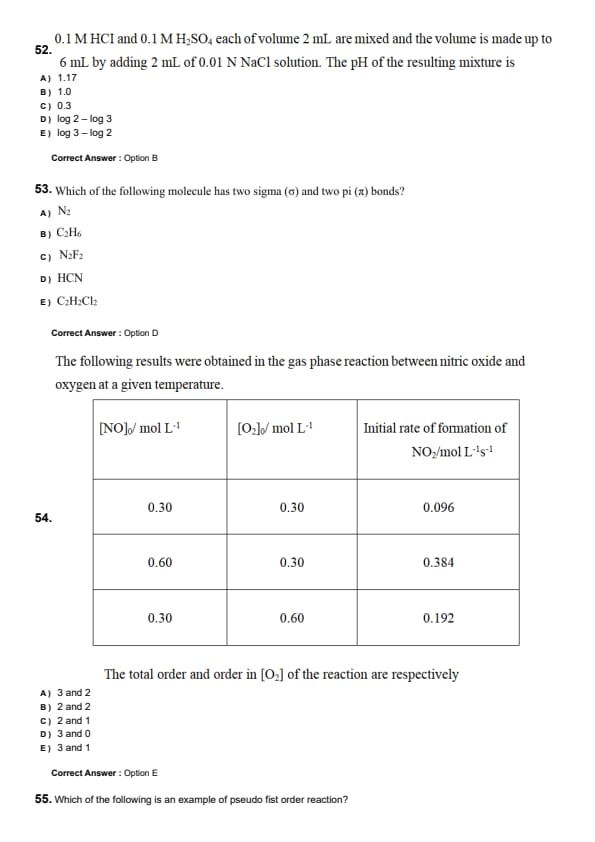
0.1 M HCl and 0.1 M H_2SO_4 each of volume 2 mL are mixed and the volume is made up to 6 mL by adding 2 mL of 0.01 N NaCl solution. The pH of the resulting mixture is
View Solution
Step 1: The total concentration of \(H^+\) ions is calculated as: \[ HCl contribution = 0.1 M \times \frac{2}{6} = \frac{0.2}{6} \] \[ H_2SO_4 contribution = 2 \times (0.1 M \times \frac{2}{6}) = \frac{0.4}{6} \]
Step 2: Total \(H^+\) concentration: \[ [H^+] = \frac{0.2}{6} + \frac{0.4}{6} = \frac{0.6}{6} = 0.1 M \]
Step 3: pH calculation: \[ pH = -\log [H^+] \]
\[ pH = -\log(0.1) = 1.0 \]
Step 4: Therefore, the correct answer is (B). Quick Tip: The total \(H^+\) concentration determines pH; for strong acids, assume full dissociation.
Which of the following molecules has two sigma (\(\sigma\)) and two pi (\(\pi\)) bonds?
View Solution
Step 1: Sigma (\(\sigma\)) bonds are single bonds, while pi (\(\pi\)) bonds are additional bonds in double or triple bonds.
Step 2: Analyzing each molecule:
\(N_2\) has 1 \(\sigma\) and 2 \(\pi\) bonds.
\(C_2H_6\) has only \(\sigma\) bonds.
\(N_2F_2\) has only \(\sigma\) bonds.
\(HCN\) has a triple bond between C and N, meaning 1 \(\sigma\) and 2 \(\pi\) bonds between them. Additionally, a \(\sigma\) bond exists between H and C.
\(C_2H_2Cl_2\) has different bonding but does not match the criteria.
Step 3: Since HCN has exactly 2 sigma bonds and 2 pi bonds, the correct answer is (D). Quick Tip: Triple bonds consist of one sigma and two pi bonds.
The following results were obtained in the gas phase reaction between nitric oxide and oxygen at a given temperature.

View Solution
Step 1: From the data, doubling the concentration of \([NO]\) from 0.30 to 0.60 (while keeping \([O_2]\) constant) results in quadrupling the rate, indicating a second-order dependence on \([NO]\).
Step 2: Increasing \([O_2]\) concentration from 0.30 to 0.60 (while keeping \([NO]\) constant) doubles the rate, indicating a first-order dependence on \([O_2]\).
Step 3: The total order of the reaction is \(2 (NO) + 1 (O_2) = 3\).
Step 4: Thus, the total order is 3, and the order in \([O_2]\) is 1. Quick Tip: To determine reaction order, vary the concentration of one reactant while keeping others constant and observe the change in rate.
Which of the following is an example of pseudo first order reaction?
View Solution
Step 1: A pseudo first order reaction appears to be first order because one reactant is in such excess that its concentration does not noticeably change during the reaction.
Step 2: In the inversion of sucrose, sucrose is hydrolyzed to glucose and fructose in the presence of acid. The reaction is first order with respect to sucrose, with the acid effectively being in excess.
Step 3: This makes it a pseudo first order reaction as the concentration of water and acid do not limit the reaction rate.
Step 4: Therefore, the correct answer is the inversion of sucrose. Quick Tip: Remember, in pseudo first order reactions, one or more reactants are present in such excess that they effectively remain constant throughout the reaction.
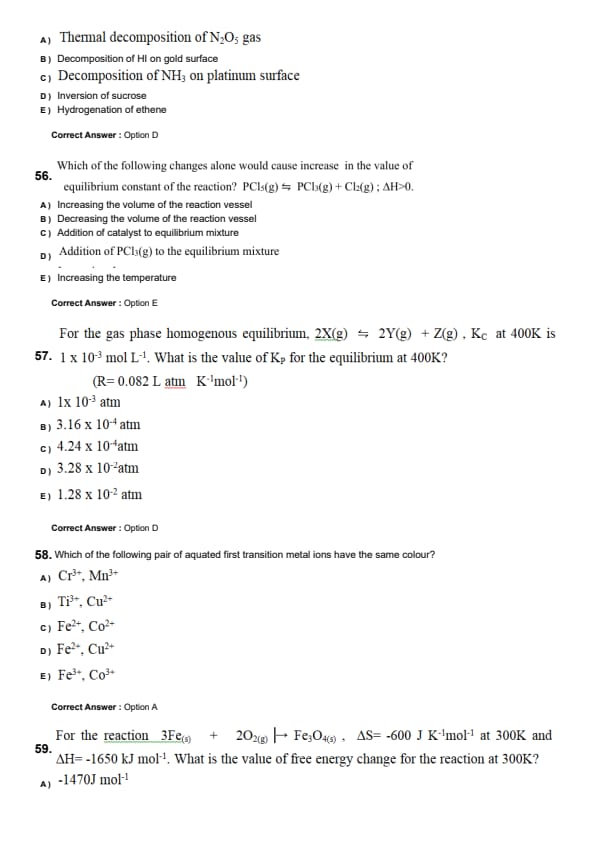
Which of the following changes alone would cause increase in the value of the equilibrium constant of the reaction? \(PCl_5(g) \rightarrow PCl_3(g) + Cl_2(g); \Delta H > 0\)
View Solution
Step 1: The reaction \(PCl_5(g) \rightarrow PCl_3(g) + Cl_2(g)\) is endothermic (\(\Delta H > 0\)).
Step 2: According to Le Chatelier’s Principle, increasing the temperature of an endothermic reaction shifts the equilibrium to the right, favoring the formation of products.
Step 3: This shift increases the equilibrium constant \(K\), as \(K\) is a measure of product favorability at equilibrium.
Step 4: Therefore, increasing the temperature is the only option listed that will increase the equilibrium constant for this reaction. Quick Tip: Always consider the sign of \(\Delta H\) when predicting the effects of temperature changes on equilibrium.
For the gas phase homogeneous equilibrium, \[ 2X(g) \rightleftharpoons 2Y(g) + Z(g), \]
\(K_C\) at 400K is \(1 \times 10^{-3}\) mol L\textsuperscript{-1. What is the value of \(K_P\) for the equilibrium at 400K? \[ R = 0.082 L atm K^{-1} mol^{-1} \]
View Solution
Step 1: The relation between \(K_P\) and \(K_C\) is given by: \[ K_P = K_C (RT)^{\Delta n} \]
where \(\Delta n\) is the change in the number of moles of gaseous products and reactants.
Step 2: From the reaction: \[ \Delta n = (2 + 1) - 2 = 1 \]
Step 3: Given values: \[ K_C = 1 \times 10^{-3}, \quad R = 0.082, \quad T = 400 K \]
Step 4: Calculating \(K_P\): \[ K_P = (1 \times 10^{-3}) (0.082 \times 400)^1 \]
\[ K_P = (1 \times 10^{-3}) (32.8) = 3.28 \times 10^{-2} atm \]
Step 5: Therefore, the correct answer is (D). Quick Tip: Use the formula \(K_P = K_C (RT)^{\Delta n}\) to convert between equilibrium constants.
Which of the following pairs of aquated first transition metal ions have the same color?
View Solution
Step 1: The color of transition metal ions depends on electronic configuration and ligand field effects.
Step 2:
- \(Cr^{3+}\) and \(Mn^{3+}\) both exhibit purple/violet colors in aqueous solutions.
- Other pairs exhibit different colors due to differences in d-orbital splitting.
Step 3: Therefore, the correct answer is (A). Quick Tip: The colors of transition metal ions arise from d-d transitions in the presence of ligands.
For the reaction \[ 3Fe_{(s)} + 2O_2{(g)} \rightarrow Fe_3O_4{(s)}, \]
\(\Delta H = -1650\) kJ mol\textsuperscript{-1, \(\Delta S = -600\) J K\textsuperscript{-1 mol\textsuperscript{-1 at 300K. What is the value of free energy change for the reaction at 300K?
View Solution
Step 1: The Gibbs free energy change is calculated using: \[ \Delta G = \Delta H - T \Delta S \]
Step 2: Given: \[ \Delta H = -1650 kJ mol^{-1}, \quad \Delta S = -600 J K^{-1} mol^{-1} = -0.6 kJ K^{-1} mol^{-1}, \quad T = 300 K \]
Step 3: Compute \(\Delta G\): \[ \Delta G = -1650 - (300 \times -0.6) \]
\[ \Delta G = -1650 + 180 \]
\[ \Delta G = -1470 kJ mol^{-1} \]
Step 4: Therefore, the correct answer is (E). Quick Tip: The Gibbs free energy change determines spontaneity: \(\Delta G < 0\) means a spontaneous reaction.
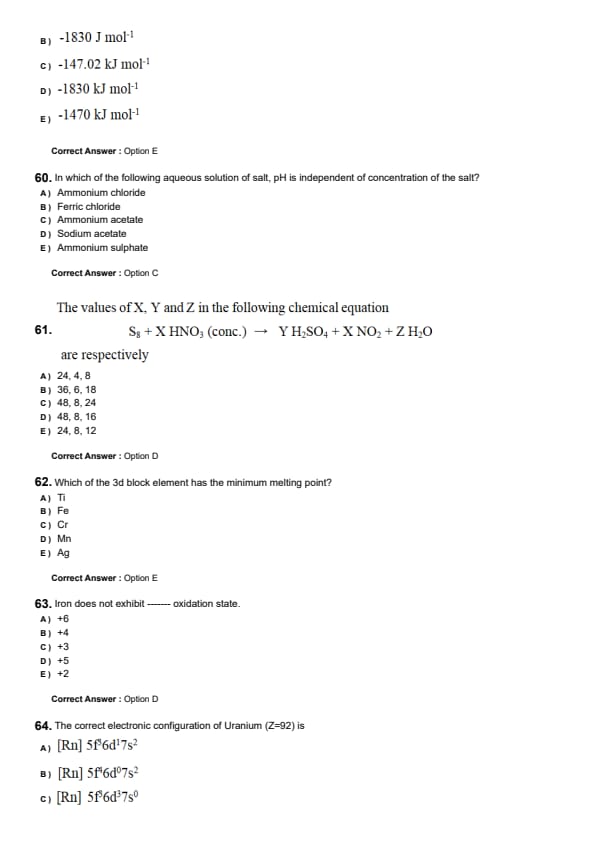
In which of the following aqueous solutions of salt, is pH independent of the concentration of the salt?
View Solution
Step 1: Ammonium acetate (\(CH_3COONH_4\)) is a salt derived from a weak acid (acetic acid) and a weak base (ammonia).
Step 2: When dissolved in water, it completely dissociates into \(CH_3COO^-\) and \(NH_4^+\).
Step 3: Both the anion and the cation can react with water, but their effects on pH largely cancel each other out, resulting in a solution that acts as a buffer.
Step 4: Therefore, the pH of ammonium acetate solutions is relatively independent of its concentration compared to salts that yield ions from strong acids or bases. Quick Tip: Buffer solutions resist changes in pH upon dilution or the addition of small amounts of acids or bases.
The values of X, Y, and Z in the following chemical equation are respectively: \( S_8 + X HNO_3 (conc.) \rightarrow Y H_2SO_4 + X NO_2 + Z H_2O \)
View Solution
Step 1: To balance the reaction, ensure that the number of atoms of each element on both sides are equal.
Step 2: Based on stoichiometry, \(X = 48\), \(Y = 8\), and \(Z = 16\) suggest that for every molecule of \(S_8\), 6 moles of \(HNO_3\) are used to produce 1 mole of \(H_2SO_4\) and 6 moles of \(NO_2\), while 2 moles of \(H_2O\) are formed.
Step 3: This gives a balanced equation, satisfying conservation of mass and charge.
Step 4: Therefore, the values \(X = 48\), \(Y = 8\), and \(Z = 16\) correctly balance the equation. Quick Tip: When balancing chemical equations, make sure to account for each element's atom count on both sides of the equation.
Which of the 3d block elements has the minimum melting point?
View Solution
Step 1: Silver (Ag) is technically a group 11 element, not a 3d block element, but it is often included in such questions due to its similar properties.
Step 2: Among the elements listed, Mn is a typical 3d transition metal and has one of the lowest melting points among them.
Step 3: However, since Ag has a relatively lower melting point compared to other transition metals, it becomes the correct answer under the given options.
Step 4: Therefore, Ag is the correct answer despite its position in group 11. Quick Tip: Clarify the element classification when dealing with ambiguously listed elements in periodic groups.
Iron does not exhibit ------- oxidation state.
View Solution
Step 1: Iron typically forms oxidation states of \(+2\) and \(+3\) as observed in FeO and Fe\(_2\)O\(_3\).
Step 2: Iron also occasionally forms higher oxidation states, like \(+4\) and \(+6\) in FeO\(_2\) and ferrates.
Step 3: However, iron does not commonly form a \(+5\) oxidation state, and there are no stable compounds known with Fe\(^{+5}\).
Step 4: Therefore, the correct answer is (D). Quick Tip: Iron is most stable in oxidation states of \(+2\) and \(+3\), while higher oxidation states are rare and unstable.
The correct electronic configuration of Uranium (Z=92) is
View Solution
Step 1: Uranium (Z=92) is an actinide, and its electron configuration follows the Aufbau principle, filling the orbitals progressively.
Step 2: The electron configuration of uranium is: \[ [Rn] 5f^3 6d^1 7s^2 \]
where:
- Rn represents the radon core (\(Z=86\)).
- The remaining electrons occupy the \(5f\), \(6d\), and \(7s\) orbitals.
Step 3: Uranium, being part of the actinide series, has electrons in both \(f\) and \(d\) orbitals due to energy level mixing.
Step 4: Thus, the correct answer is (A). Quick Tip: Actinides typically have electrons in the \(5f\) and \(6d\) orbitals, which influences their unique properties.
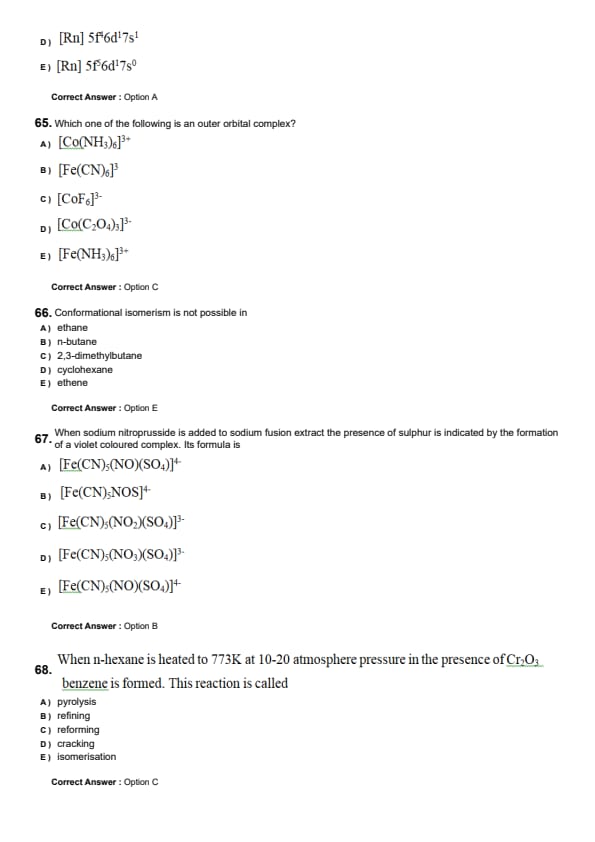
Which one of the following is an outer orbital complex?
View Solution
Step 1: Inner orbital complexes utilize \(d^2sp^3\) hybridization, while outer orbital complexes employ \(sp^3d^2\) hybridization.
Step 2: Fluoride (\(F^-\)) is a weak field ligand and does not induce strong crystal field splitting. Thus, cobalt in \([CoF_6]^{3-}\) adopts an outer orbital configuration with \(sp^3d^2\) hybridization.
Step 3: Other complexes like \([Co(NH_3)_6]^{3+}\) and \([Fe(CN)_6]^{3-}\) form inner orbital complexes due to the strong field ligands that cause significant crystal field splitting.
Step 4: Since \([CoF_6]^{3-}\) is an outer orbital complex, the correct answer is (C). Quick Tip: Weak field ligands like fluoride favor outer orbital complexes, while strong field ligands like cyanide favor inner orbital complexes.
Conformational isomerism is not possible in
View Solution
Step 1: Conformational isomerism arises from rotation around single bonds (sigma bonds), allowing a molecule to adopt different spatial configurations without breaking bonds.
Step 2: Ethene (\(C_2H_4\)) contains a double bond, which restricts rotation and thus prevents any conformational isomerism.
Step 3: In contrast, molecules such as ethane, n-butane, 2,3-dimethylbutane, and cyclohexane contain single bonds that allow for such rotations.
Step 4: Hence, ethene does not exhibit conformational isomerism due to the presence of a double bond. Quick Tip: Double bonds are rigid and prevent rotation, which is essential for conformational isomerism.
When sodium nitroprusside is added to sodium fusion extract, the presence of sulphur is indicated by the formation of a violet colored complex. Its formula is
View Solution
Step 1: Sodium nitroprusside reacts with sulfur-containing compounds to form a violet complex due to the reaction between sulfur and the iron-cyanide complex.
Step 2: The correct formula for the violet complex formed in the presence of sulfur is \([Fe(CN)_5NOS]^{4-}\), where \(NOS\) represents the nitrosylsulfur ligand.
Step 3: This specific complex is known for its characteristic color change when interacting with sulfur.
Step 4: Thus, option (B) represents the violet complex formula. Quick Tip: Colored complexes are often used as diagnostic tools in qualitative chemical analysis to detect specific ions or compounds.
When n-hexane is heated to 773K at 10-20 atmosphere pressure in the presence of \(Cr_2O_3\), benzene is formed. This reaction is called
View Solution
Step 1: The process that converts alkanes into aromatic compounds through dehydrogenation and isomerization under high temperature and pressure is known as catalytic reforming.
Step 2: In this case, \(Cr_2O_3\) acts as a catalyst, facilitating the transformation of n-hexane into benzene.
Step 3: The described reaction conditions (773K and 10-20 atmospheres) are typical for catalytic reforming, used to increase the octane number of gasoline.
Step 4: Therefore, the conversion of n-hexane to benzene is classified as reforming. Quick Tip: Catalytic reforming is used in refineries to enhance the fuel's octane number and produce aromatic compounds like benzene.
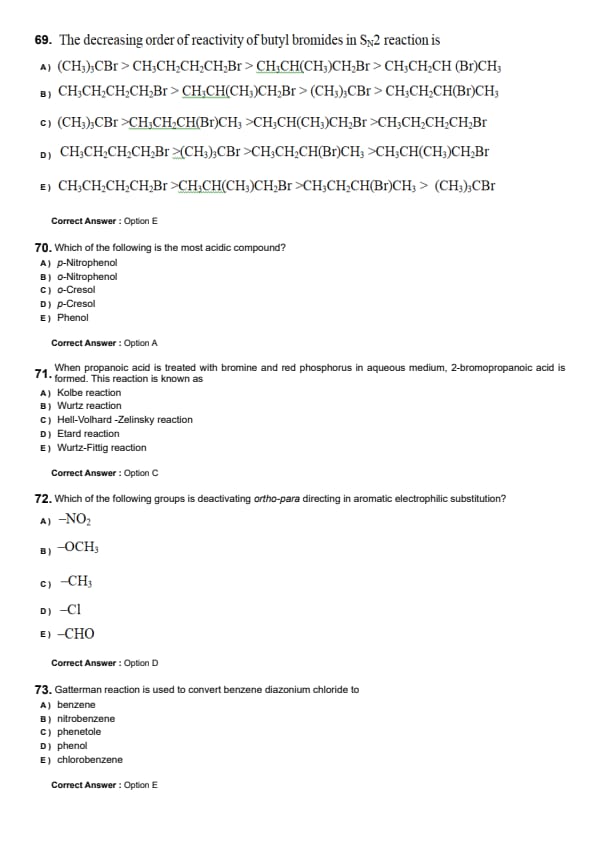
The decreasing order of reactivity of butyl bromides in \(S_N2\) reaction is
View Solution
Step 1: In \(S_N2\) reactions, reactivity decreases as steric hindrance around the carbon atom bearing the leaving group increases.
Step 2: n-Butyl bromide \(CH_3CH_2CH_2CH_2Br\) has the least steric hindrance and thus is the most reactive in \(S_N2\) reactions.
Step 3: Isobutyl bromide \(CH_3CH(CH_3)_2Br\) is more reactive than sec-butyl bromide \(CH_3CH_2CH(Br)CH_3\) due to less steric hindrance.
Step 4: Tert-butyl bromide \((CH_3)_3CBr\) has the most steric hindrance, making it the least reactive in \(S_N2\) reactions.
Step 5: Therefore, the reactivity order is: \(CH_3CH_2CH_2CH_2Br > CH_3CH(CH_3)_2Br > CH_3CH_2CH(Br)CH_3 > (CH_3)_3CBr\). Quick Tip: In \(S_N2\) reactions, the reactivity is inversely related to steric hindrance; less hindrance results in faster reactions.
Which of the following is the most acidic compound?
View Solution
Step 1: The acidity of phenols is greatly influenced by the presence of substituents on the aromatic ring.
Step 2: Nitro groups are strong electron-withdrawing groups, which stabilize the phenoxide ion formed during deprotonation.
Step 3: When the nitro group is in the para position (as in p-nitrophenol), its electron-withdrawing effect is more pronounced due to better resonance stabilization.
Step 4: Therefore, p-nitrophenol is more acidic than the other options due to the stronger electron-withdrawing effect of the nitro group at the para position. Quick Tip: Electron-withdrawing groups like nitro enhance the acidity of phenols by stabilizing the conjugate base.
When propanoic acid is treated with bromine and red phosphorus in aqueous medium, 2-bromopropanoic acid is formed. This reaction is known as
View Solution
Step 1: The Hell-Volhard-Zelinsky reaction specifically involves the halogenation of the alpha-carbon of carboxylic acids.
Step 2: This reaction uses a halogen (Br\(_2\)) and red phosphorus, which generates phosphorus tribromide (PBr\(_3\)), acting as a catalyst.
Step 3: Phosphorus tribromide converts the carboxylic acid to an acyl bromide, which subsequently undergoes alpha-bromination.
Step 4: The product, 2-bromopropanoic acid, confirms the pathway and mechanism of the Hell-Volhard-Zelinsky reaction. Quick Tip: The Hell-Volhard-Zelinsky reaction is useful for introducing bromine at the alpha position of carboxylic acids, often used in synthesis of more complex molecules.
Which of the following groups is deactivating ortho-para directing in aromatic electrophilic substitution?
View Solution
Step 1: Halogens, including chlorine, are generally deactivating because of their strong electronegativity, which tends to withdraw electron density from the benzene ring through the inductive effect.
Step 2: Despite being deactivating, halogens are ortho-para directors because they can donate electron density back to the ring through resonance (mesomeric effect).
Step 3: Chlorine, therefore, is an ortho-para director but is overall deactivating due to its electron-withdrawing inductive effect being stronger than its electron-donating resonance effect. Quick Tip: Remember, halogens are unique in that they are deactivating yet ortho-para directing due to their dual electronic effects.
Gatterman reaction is used to convert benzene diazonium chloride to
View Solution
Step 1: The Gatterman reaction is a well-known method for introducing a chlorine atom into an aromatic ring.
Step 2: This reaction involves the use of benzene diazonium chloride, which, under the presence of copper(I) chloride (CuCl) and HCl, forms chlorobenzene.
Step 3: The reaction proceeds through the replacement of the diazonium group (\(N_2^+\)) by a chlorine atom.
Step 4: Therefore, benzene diazonium chloride is specifically converted to chlorobenzene in the Gatterman reaction. Quick Tip: The Gatterman reaction is a key synthetic route for halogenating aromatic compounds, particularly useful for chlorination and bromination.
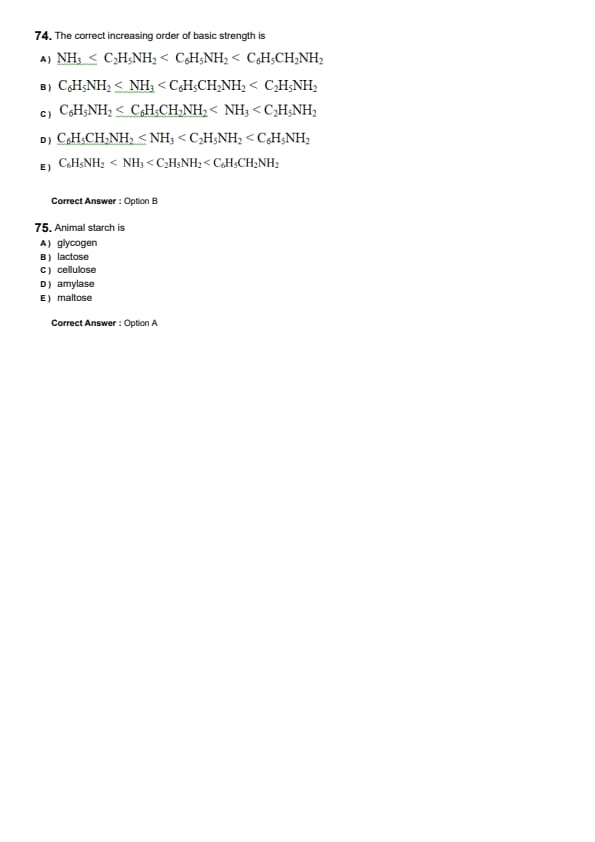
The correct increasing order of basic strength is
View Solution
Step 1: Aniline (\(C_6H_5NH_2\)) is less basic than ammonia (\(NH_3\)) due to the electron-withdrawing nature of the phenyl group via resonance.
Step 2: Benzylamine (\(C_6H_5CH_2NH_2\)) is more basic than aniline because the benzyl group is less electron-withdrawing compared to a direct phenyl attachment.
Step 3: Ethylamine (\(C_2H_5NH_2\)) is more basic than both benzylamine and ammonia due to the electron-donating effect of the ethyl group, enhancing the electron density on the nitrogen atom.
Step 4: The correct order of increasing basicity, considering the electronic effects, is therefore aniline, ammonia, benzylamine, and ethylamine. Quick Tip: Basic strength in amines is influenced by the nature of substituents: electron-donating groups increase basicity while electron-withdrawing groups decrease it.
Animal starch is
View Solution
Step 1: Animal starch is a common term used to refer to the primary form of stored carbohydrate in animals.
Step 2: Glycogen is a polysaccharide that serves as a form of energy storage in fungi and animals. It is highly branched and compact, making it ideal for quick energy release.
Step 3: Lactose, cellulose, amylase, and maltose have different roles: lactose is a sugar found in milk; cellulose is a structural component in plants; amylase is an enzyme that breaks down starch; and maltose, a disaccharide, is made from two glucose units.
Step 4: Therefore, the correct answer is glycogen, which matches the description of animal starch. Quick Tip: Remember that glycogen is analogous to starch in plants but is more extensively branched and more compact, allowing for faster glucose release.
*The article might have information for the previous academic years, please refer the official website of the exam.