.jpg?tr=h-94,w-94,c-force)
KEAM 2026 Engineering April 17 Question Paper with Solution PDF


Content Writer | Updated On - Apr 18, 2026
CEE Kerala is conducting the KEAM 2026 Engineering exam on April 17 from 2 PM to 5 PM in CBT Mode.The KEAM 2026 Engineering question paper include three sections: Physics, Chemistry, and Mathematics, with 150 questions totaling 600 marks. As per the KEAM 2026 marking scheme, +4 marks will be awarded for every correct answer, and -1 mark will be deducted for every wrong answer.
KEAM 2026 April 17 Question Paper with Solution PDF is available here for download.
KEAM 2026 April 17 Question Paper with Solution PDF
| KEAM 2026 April 17 Question Paper | Download PDF | Check Solution |

The electric field inside a uniformly charged spherical shell of radius R is:
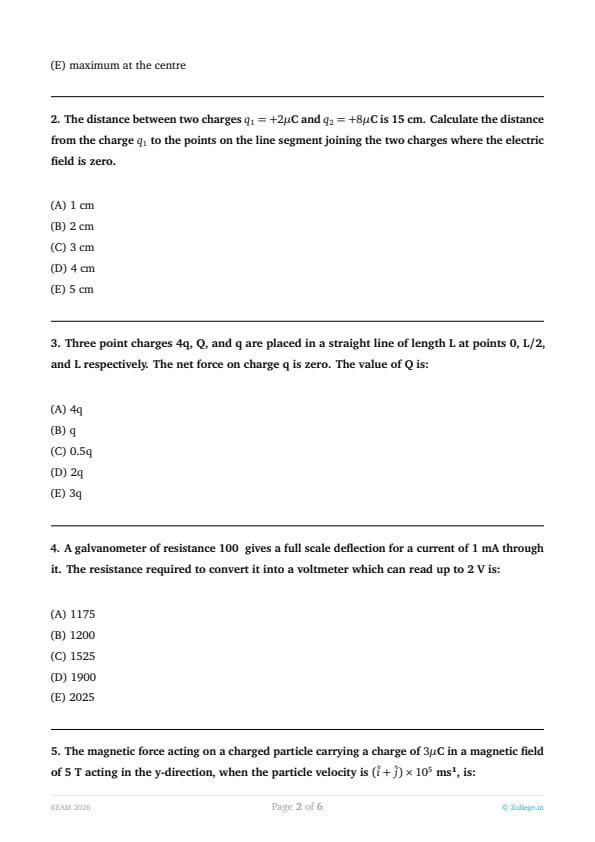
The distance between two charges \( q_1 = +2\mu \)C and \( q_2 = +8\mu \)C is 15 cm. Calculate the distance from the charge \( q_1 \) to the points on the line segment joining the two charges where the electric field is zero.
Three point charges 4q, Q, and q are placed in a straight line of length L at points 0, L/2, and L respectively. The net force on charge q is zero. The value of Q is:
A galvanometer of resistance 100 Ω gives a full scale deflection for a current of 1 mA through it. The resistance required to convert it into a voltmeter which can read up to 2 V is:
The magnetic force acting on a charged particle carrying a charge of \( 3\mu \)C in a magnetic field of 5 T acting in the y-direction, when the particle velocity is \( (\hat{i} + \hat{j}) \times 10^{5} \) ms⁻¹, is:
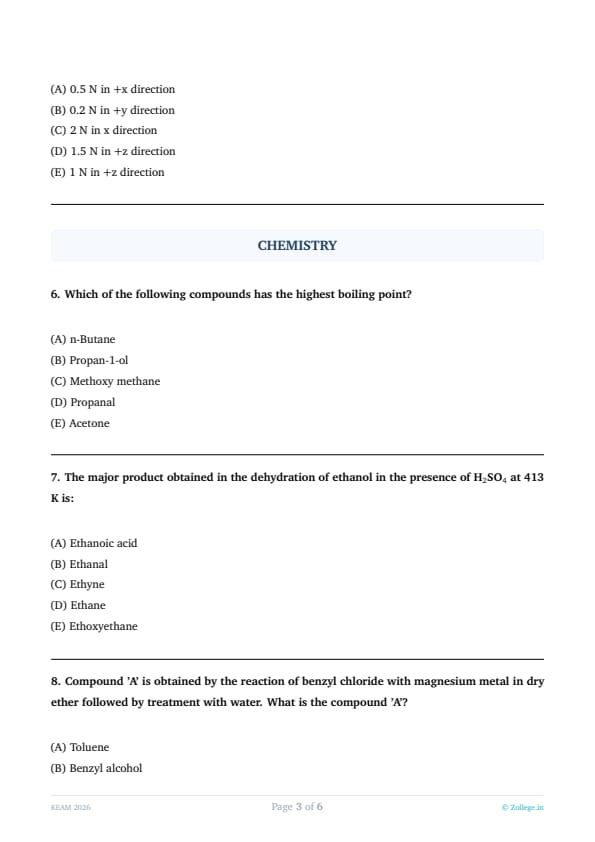
Which of the following compounds has the highest boiling point?
The major product obtained in the dehydration of ethanol in the presence of H\(_2\)SO\(_4\) at 413 K is:
Compound ’A’ is obtained by the reaction of benzyl chloride with magnesium metal in dry ether followed by treatment with water. What is the compound ’A’?
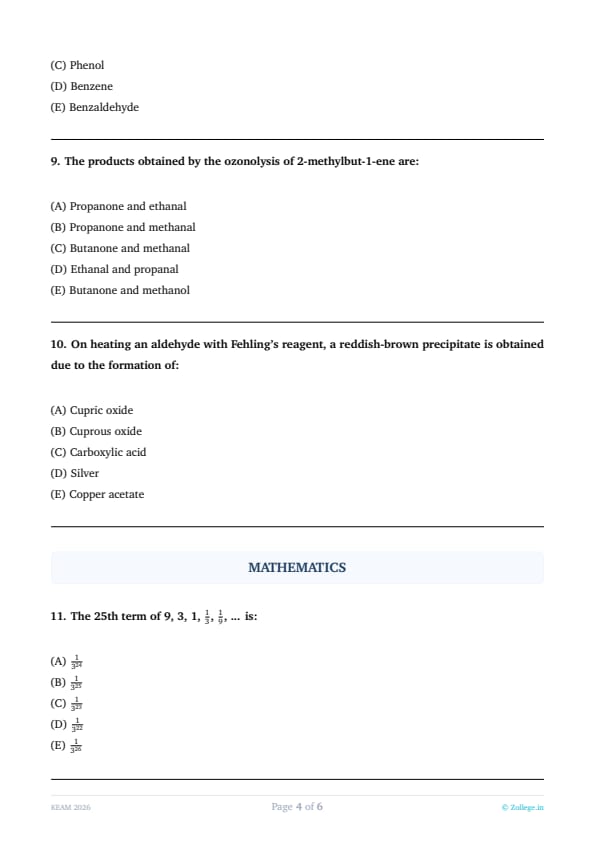
The products obtained by the ozonolysis of 2-methylbut-1-ene are:
On heating an aldehyde with Fehling’s reagent, a reddish-brown precipitate is obtained due to the formation of:
The 25th term of 9, 3, 1, \( \frac{1}{3} \), \( \frac{1}{9} \), ... is:
Five digit number is formed using the digits 0, 1, 2, 3, 4, and 5 without repetitions. Number of five digit numbers which are divisible by 10 is:
Let U be the universal set and let A and B be any two subsets of U. If n(U) = 25, n(A) = 14, n(A\(\cap\)B) = 6 and n(A\(\cup\)B) = 20, then n(B′) is equal to:
A straight line passing through (6,1,3) meets the line \( \frac{x-1}{2} = \frac{y}{1} = \frac{z-2}{3} \) at Q. If the lines are perpendicular to each other, then the coordinates of Q are:
The three vertices of a triangle are (0,0), (3,1) and (1,3). If this triangle is inscribed in a circle, then the equation of the circle is:



*The article might have information for the previous academic years, please refer the official website of the exam.