.jpg?tr=h-94,w-94,c-force)
KEAM 2026 Engineering April 18 Question Paper with Solution PDF


Content Writer | Updated On - Apr 20, 2026
CEE Kerala is conducting the KEAM 2026 Engineering exam on April 18 from 2 PM to 5 PM in CBT Mode. The KEAM 2026 Engineering question paper includes three sections: Physics, Chemistry, and Mathematics, with 150 questions totaling 600 marks. As per the KEAM 2026 marking scheme, +4 marks will be awarded for every correct answer, and -1 mark will be deducted for every wrong answer.
KEAM 2026 April 18 Question Paper with Solution PDF is available here for download.
KEAM 2026 Engineering April 18 Question Paper with Solution PDF
| KEAM 2026 Engineering April 18 Question Paper | Download PDF | Check Solution |

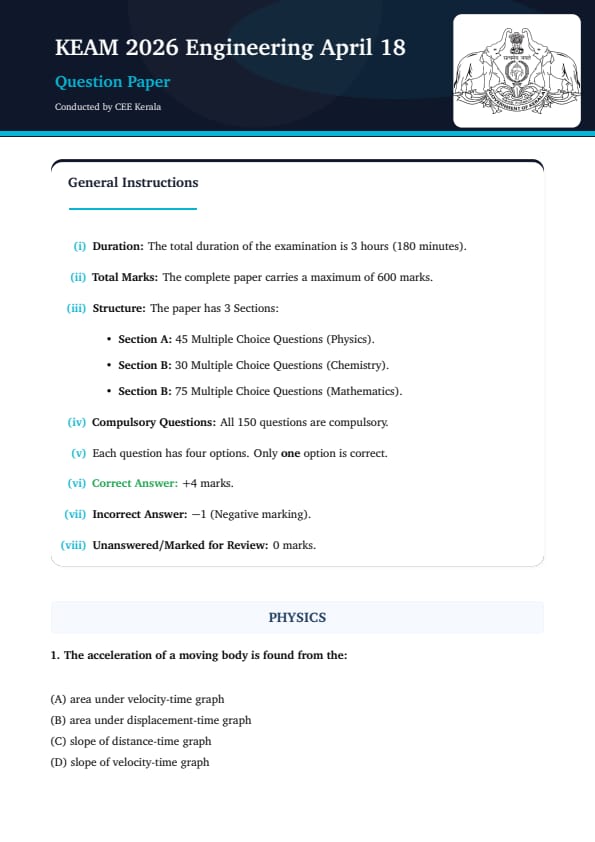
The acceleration of a moving body is found from the:
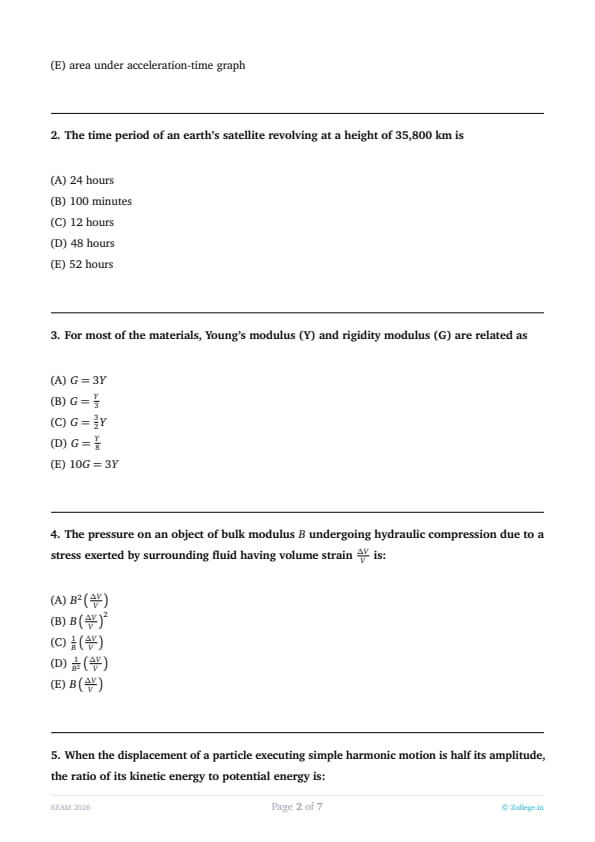
The time period of an earth’s satellite revolving at a height of 35,800 km is
For most of the materials, Young’s modulus (Y) and rigidity modulus (G) are related as
The pressure on an object of bulk modulus \(B\) undergoing hydraulic compression due to a stress exerted by surrounding fluid having volume strain \(\frac{\Delta V}{V}\) is:
When the displacement of a particle executing simple harmonic motion is half its amplitude, the ratio of its kinetic energy to potential energy is:
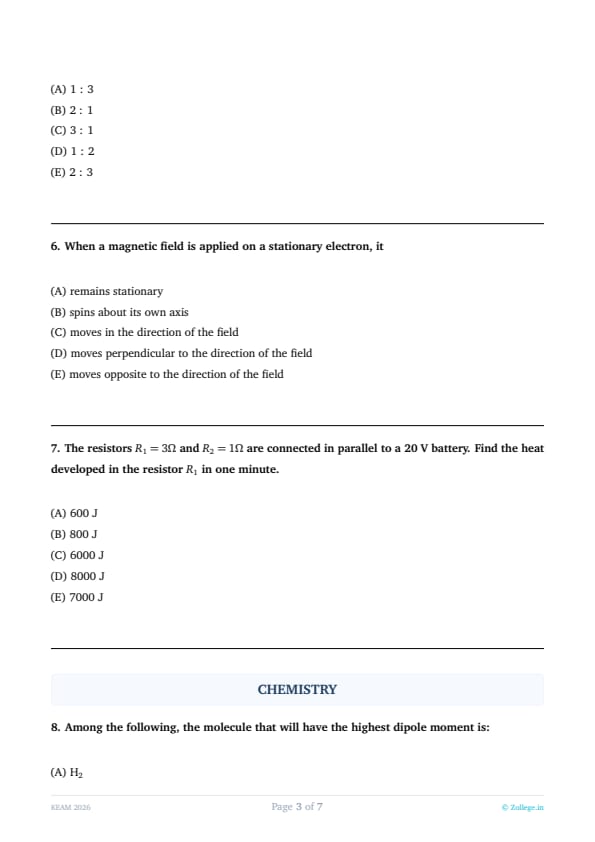
When a magnetic field is applied on a stationary electron, it
The resistors \(R_1 = 3\Omega\) and \(R_2 = 1\Omega\) are connected in parallel to a 20 V battery. Find the heat developed in the resistor \(R_1\) in one minute.
Among the following, the molecule that will have the highest dipole moment is:
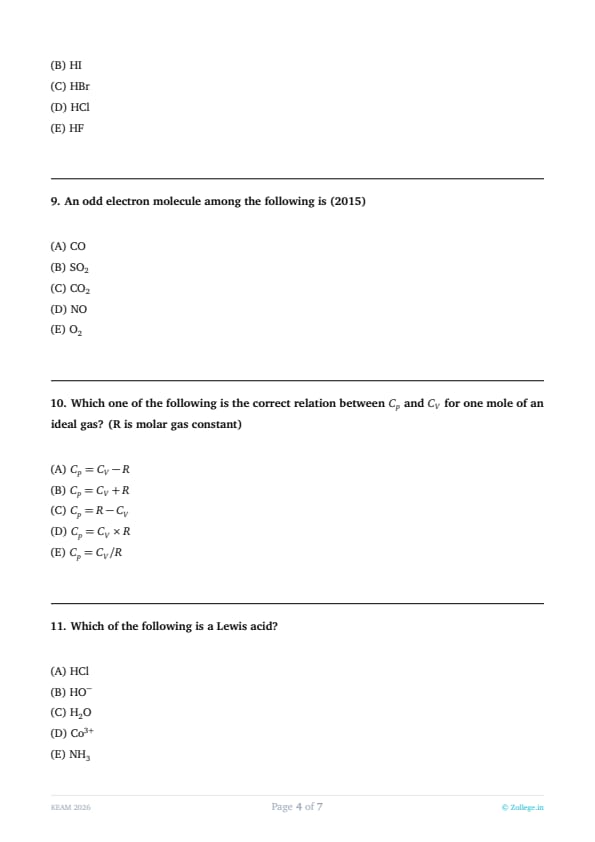
An odd electron molecule among the following is (2015)
Which one of the following is the correct relation between \(C_p\) and \(C_V\) for one mole of an ideal gas? (R is molar gas constant)
Which of the following is a Lewis acid?
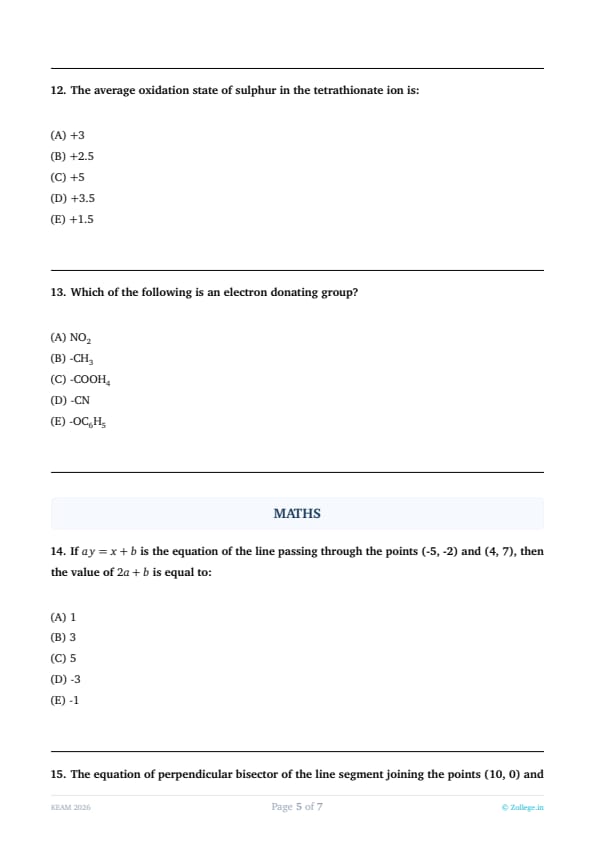
The average oxidation state of sulphur in the tetrathionate ion is:
Which of the following is an electron donating group?
If \(a y = x + b\) is the equation of the line passing through the points (-5, -2) and (4, 7), then the value of \(2a + b\) is equal to:
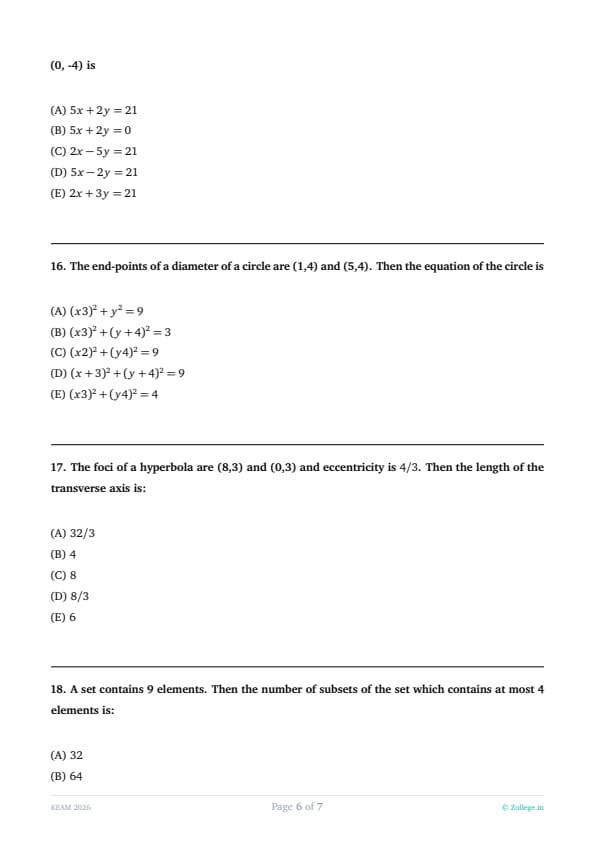
The equation of perpendicular bisector of the line segment joining the points (10, 0) and (0, -4) is
The end-points of a diameter of a circle are (−1,4) and (5,4). Then the equation of the circle is
The foci of a hyperbola are (8,3) and (0,3) and eccentricity is \(4/3\). Then the length of the transverse axis is:
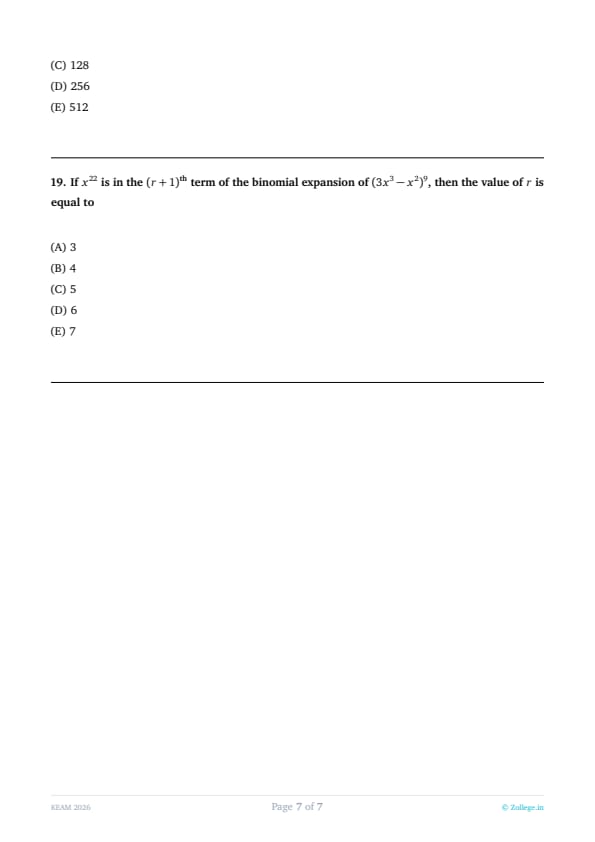
A set contains 9 elements. Then the number of subsets of the set which contains at most 4 elements is:
If \(x^{22}\) is in the \((r + 1)^{th}\) term of the binomial expansion of \((3x^3 - x^2)^9\), then the value of \(r\) is equal to
KEAM 2026 Preparation
*The article might have information for the previous academic years, please refer the official website of the exam.