.jpg?tr=h-94,w-94,c-force)
KEAM 2026 Engineering April 20 Question Paper with Solution PDF


Content Curator | Updated On - Apr 20, 2026
CEE Kerala is conducting the KEAM 2026 Engineering exam on April 20 from 2 PM to 5 PM in CBT Mode. The KEAM 2026 Engineering question paper includes three sections: Physics, Chemistry, and Mathematics, with 150 questions totaling 600 marks. As per the KEAM 2026 marking scheme, +4 marks will be awarded for every correct answer, and -1 mark will be deducted for every wrong answer.
KEAM 2026 April 20 Question Paper with Solution PDF is available here for download.
KEAM 2026 Engineering April 20 Question Paper with Solution PDF
| KEAM 2026 Engineering April 20 Question Paper | Download PDF | Check Solution |

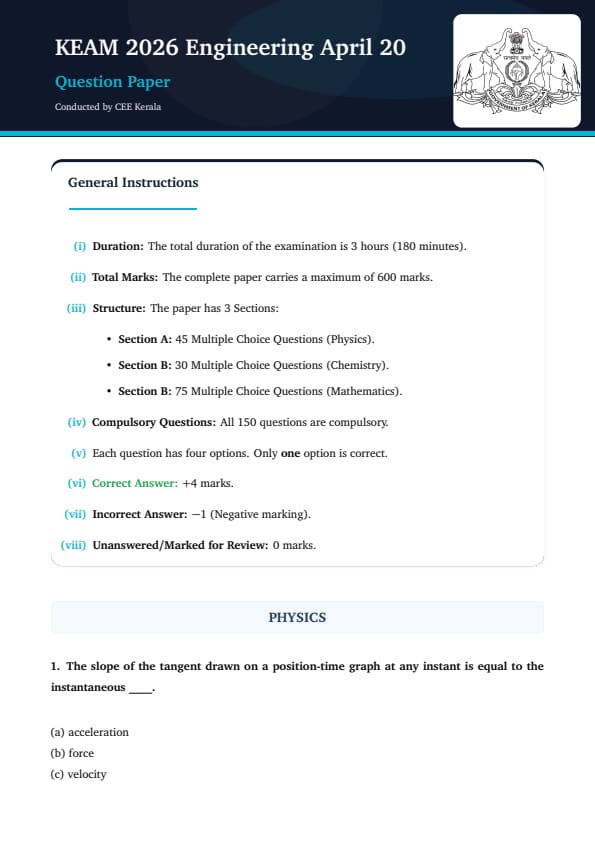
The slope of the tangent drawn on a position-time graph at any instant is equal to the instantaneous ______.
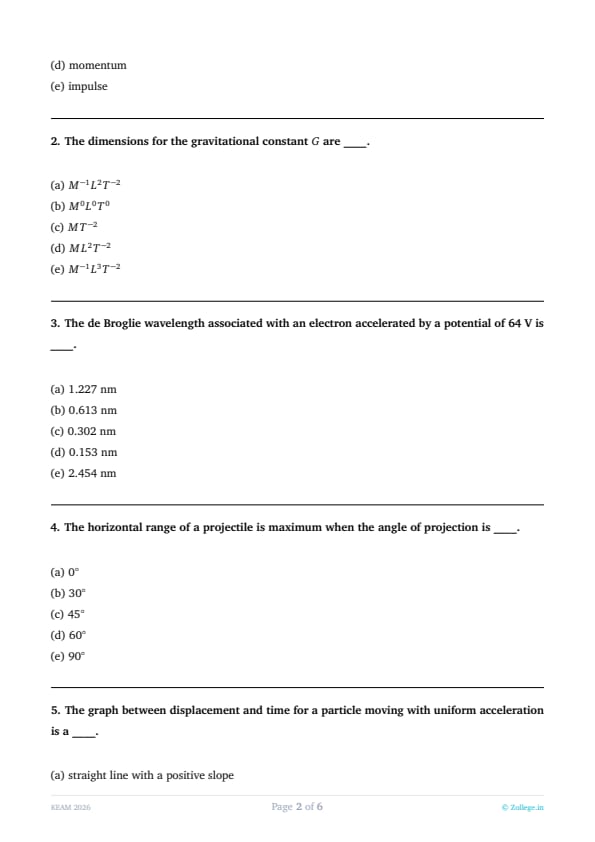
The dimensions for the gravitational constant \(G\) are _____.
The de Broglie wavelength associated with an electron accelerated by a potential of 64 V is _____.
The horizontal range of a projectile is maximum when the angle of projection is _____.
The graph between displacement and time for a particle moving with uniform acceleration is a _____.
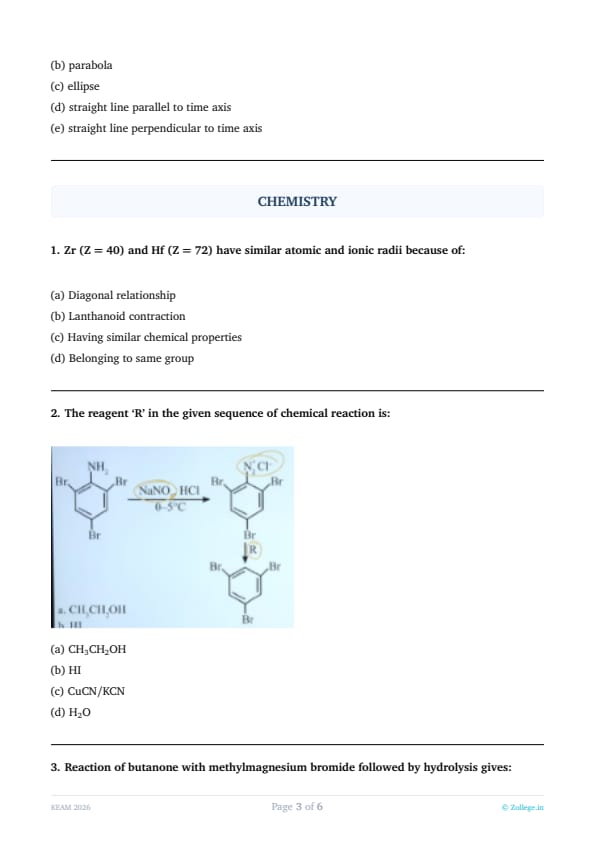
Zr (Z = 40) and Hf (Z = 72) have similar atomic and ionic radii because of:
The reagent 'R' in the given sequence of chemical reaction is:

Reaction of butanone with methylmagnesium bromide followed by hydrolysis gives:
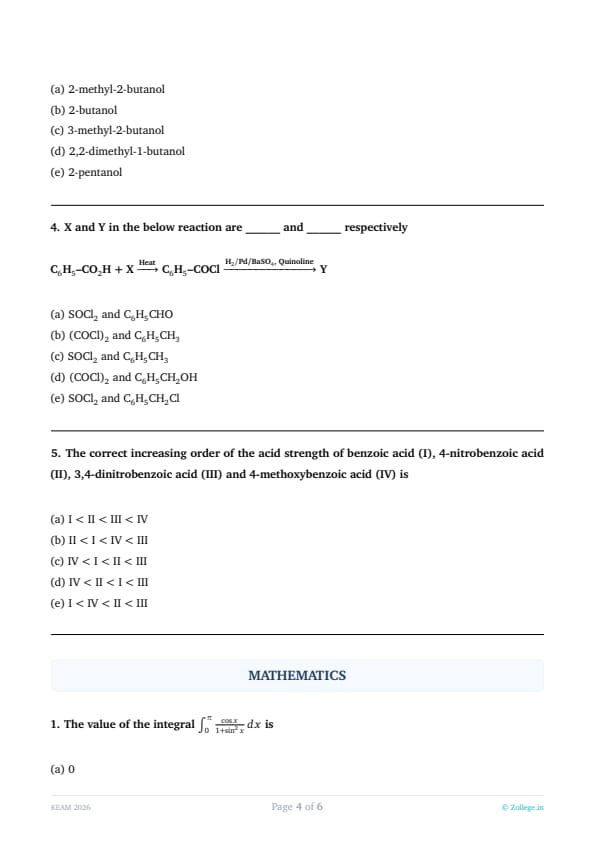
X and Y in the below reaction are _____ and _____ respectively
\[ C_6H_5-CO_2H + X \xrightarrow{Heat} C_6H_5-COCl \xrightarrow{H_2/Pd/BaSO_4, Quinoline} Y \]
The correct increasing order of the acid strength of benzoic acid (I), 4-nitrobenzoic acid (II), 3,4-dinitrobenzoic acid (III) and 4-methoxybenzoic acid (IV) is
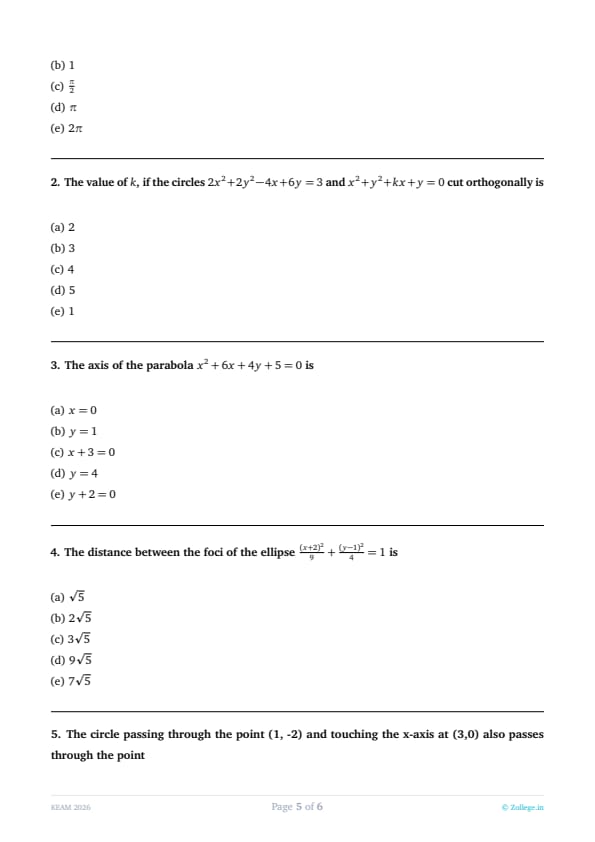
The value of the integral \(\int_{0}^{\pi} \frac{\cos x}{1+\sin^2 x} dx\) is
The value of \(k\), if the circles \(2x^2+2y^2-4x+6y=3\) and \(x^2+y^2+kx+y=0\) cut orthogonally is
The axis of the parabola \(x^2+6x+4y+5=0\) is
The distance between the foci of the ellipse \(\frac{(x+2)^2}{9} + \frac{(y-1)^2}{4} = 1\) is
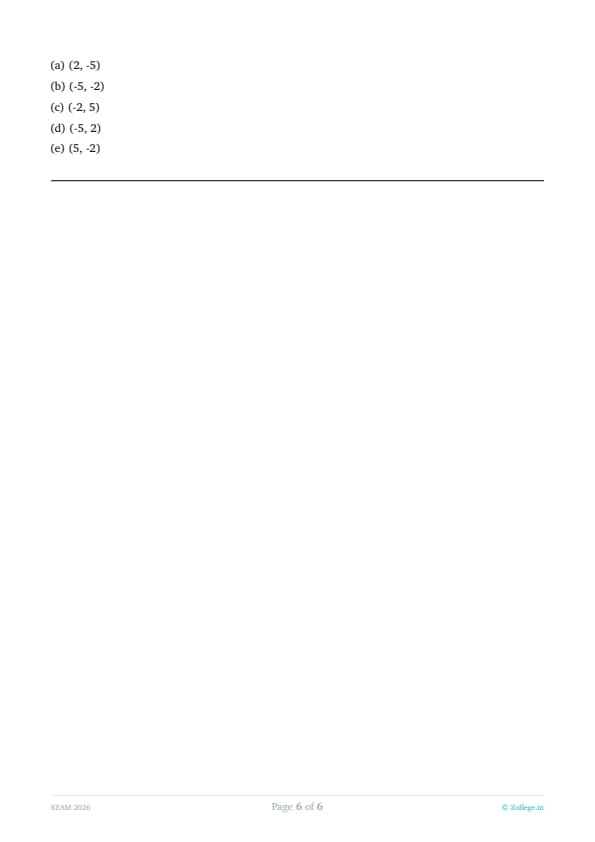
The circle passing through the point \((1, -2)\) and touching the x-axis at \((3,0)\) also passes through the point
KEAM 2026 Preparation Tips
*The article might have information for the previous academic years, please refer the official website of the exam.