
CUET 2024 Agriculture Question Paper with Answer Key PDF May 21 Shift 1 ZPYP


Content Writer | Updated On - Dec 8, 2024
CUET Question Papers are the most important study material for effective exam preparation. We at Zollege have provided all CUET Previous Year Papers with Solution PDFs here. CUET 2024 Agriculture was conducted successfully on May 15 by NTA.
Students can freely download the CUET previous year's question paper PDFs along with their solutions here. We strongly encourage cuet aspirants to scan through all the CUET Question Paper to know the overall difficulty level, CUET Syllabus and understand the changes in CUET Exam Pattern over the years.
CUET 2024 Agriculture Question Paper PDF
| CUET 2024 Agriculture Question Paper |  Download Download |
Check Solutions |
CUET 2024 Agriculture Questions with Solution
| Question | Answer | Detailed Solution |
|---|---|---|
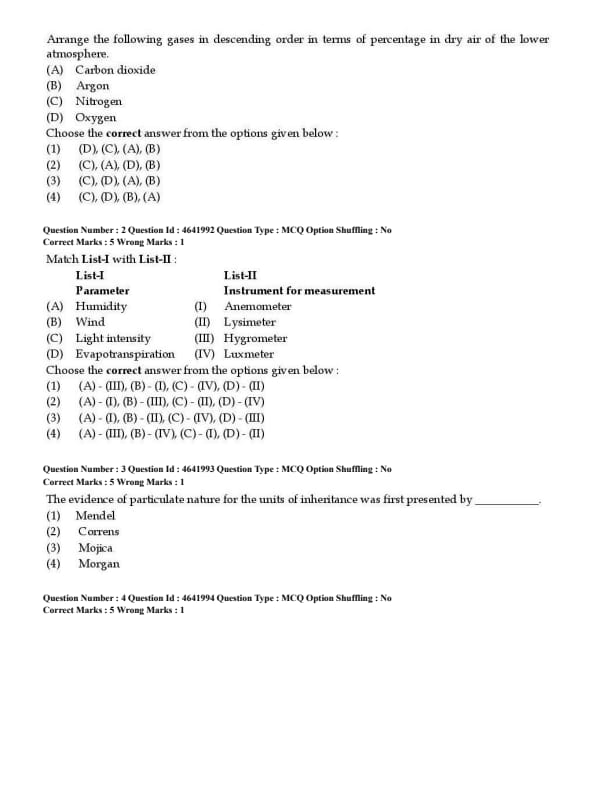
| Ques 1. Arrange the following gases in descending order in terms of percentage in dry air of the lower atmosphere: (A) Carbon dioxide (B) Argon (C) Nitrogen (D) Oxygen |
(C), (D), (B), (A) | The approximate percentages in dry air are: Nitrogen (78%), Oxygen (21%), Argon (0.93%), and Carbon Dioxide (0.04%). |
| Ques 2. Match List-I with List-II: List-I (A) Humidity (B) Wind (C) Light intensity (D) Evapotranspiration List-II (I) Anemometer (II) Lysimeter (III) Hygrometer (IV) Luxmeter |
A-(III), B-(I), C-(IV), D-(II) | Hygrometer measures humidity, anemometer measures wind speed, luxmeter measures light intensity, and lysimeter measures evapotranspiration. |
| Ques 3. The evidence of particulate nature for the units of inheritance was first presented by: (1) Mendel (2) Correns (3) Mojica (4) Morgan |
(1) Mendel | Gregor Mendel's work on pea plants provided the first evidence for particulate inheritance (genes). |
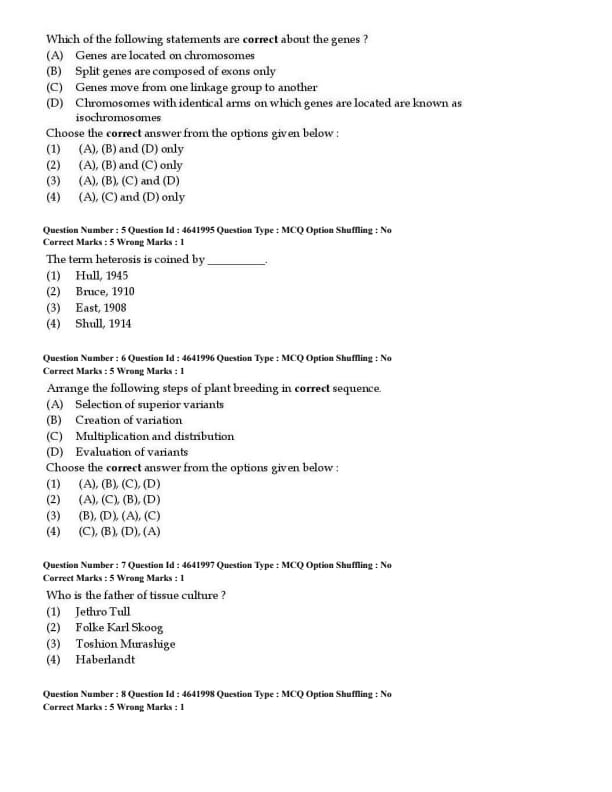
| Ques 4. Which of the following statements are correct about genes? (A) Genes are located on chromosomes (B) Split genes are composed of exons only (C) Genes move from one linkage group to another (D) Chromosomes with identical arms on which genes are located are known as isochromosomes |
(A), (C), and (D) only | Genes are located on chromosomes. Genes can move between linkage groups (transposition). Isochromosomes have identical arms. Split genes include introns and exons. |
| Ques 5. The term heterosis is coined by: (1) Hull, 1945 (2) Bruce, 1910 (3) East, 1908 (4) Shull, 1914 |
(4) Shull, 1914 | George Shull coined the term "heterosis" in 1914 to describe hybrid vigor. |
| Ques 6. Arrange the following steps of plant breeding in correct sequence: (A) Selection of superior variants (B) Creation of variation (C) Multiplication and distribution (D) Evaluation of variants |
(B), (D), (A), (C) | The correct sequence is: Create variation, evaluate the variants, select superior variants, and then multiply/distribute them. |
| Ques 7. Who is the father of tissue culture? (1) Jethro Tull (2) Folke Karl Skoog (3) Toshio Murashige (4) Haberlandt |
(4) Haberlandt | Gottlieb Haberlandt is considered the father of plant tissue culture. |
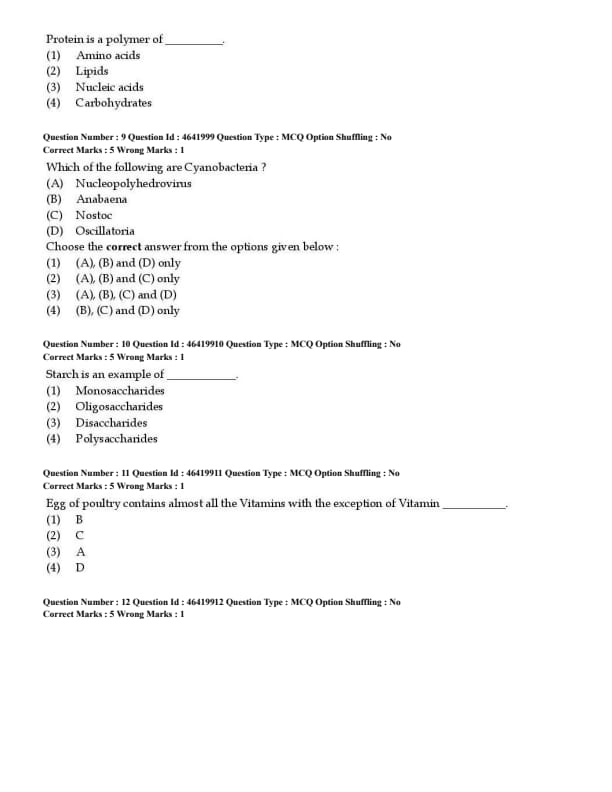
| Ques 8. Protein is a polymer of: (1) Amino acids (2) Lipids (3) Nucleic acids (4) Carbohydrates |
(1) Amino acids | Proteins are polymers of amino acids linked by peptide bonds. |
| Ques 9. Which of the following are Cyanobacteria? (A) Nucleopolyhedrovirus (B) Anabaena (C) Nostoc (D) Oscillatoria |
(B), (C), and (D) only | Anabaena, Nostoc, and Oscillatoria are genera of cyanobacteria (blue-green algae). Nucleopolyhedrovirus is a virus. |
| Ques 10. Starch is an example of: (1) Monosaccharides (2) Oligosaccharides (3) Disaccharides (4) Polysaccharides |
(4) Polysaccharides | Starch is a polysaccharide, a complex carbohydrate composed of many glucose units. |
| Ques 11. Egg of poultry contains almost all the Vitamins with the exception of Vitamin: (1) B (2) C (3) A (4) D |
(2) C | Poultry eggs are generally a good source of most vitamins except for Vitamin C, which is synthesized by the bird itself. |
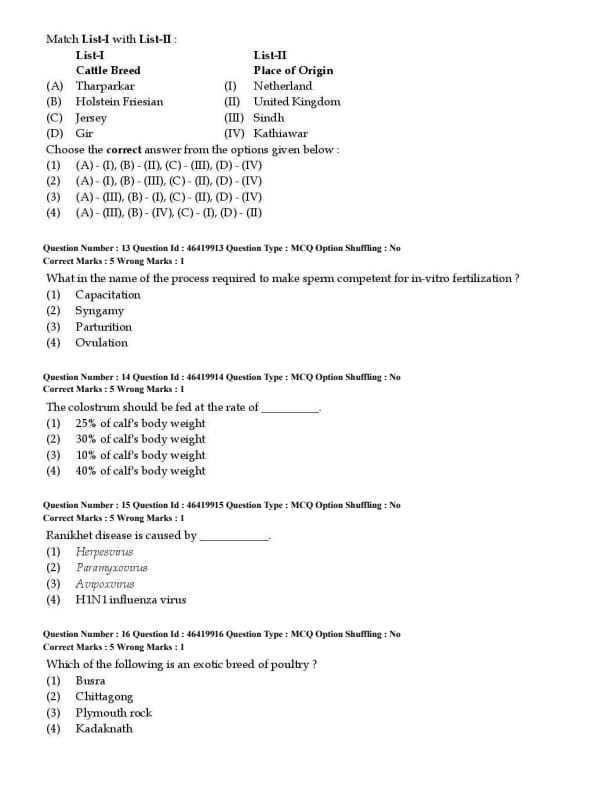
| Ques 12. Match List-I with List-II: List-I (A) Tharparkar (B) Holstein Friesian (C) Jersey (D) Gir List-II (I) Netherland (II) United Kingdom (III) Sindh (IV) Kathiawar |
A-(III), B-(I), C-(II), D-(IV) | This question matches breeds of cattle with their places of origin. |
| Ques 13. What is the name of the process required to make sperm competent for in-vitro fertilization? (1) Capacitation (2) Syngamy (3) Parturition (4) Ovulation |
(1) Capacitation | Capacitation is the process that prepares sperm for fertilization. |
| Ques 14. The colostrum should be fed at the rate of: (1) 25% of calf's body weight (2) 30% of calf's body weight (3) 10% of calf's body weight (4) 40% of calf's body weight |
(3) 10% of calf's body weight | Colostrum should be fed to calves at a rate of approximately 10% of their body weight. |
| Ques 15. Ranikhet disease is caused by: (1) Herpesvirus (2) Paramyxovirus (3) Avipoxvirus (4) H1N1 influenza virus |
(2) Paramyxovirus | Ranikhet disease is caused by a Paramyxovirus. |
| Ques 16. Which of the following is an exotic breed of poultry? (1) Busra (2) Chittagong (3) Plymouth Rock (4) Kadaknath |
(3) Plymouth Rock | The Plymouth Rock is an exotic breed of poultry. |
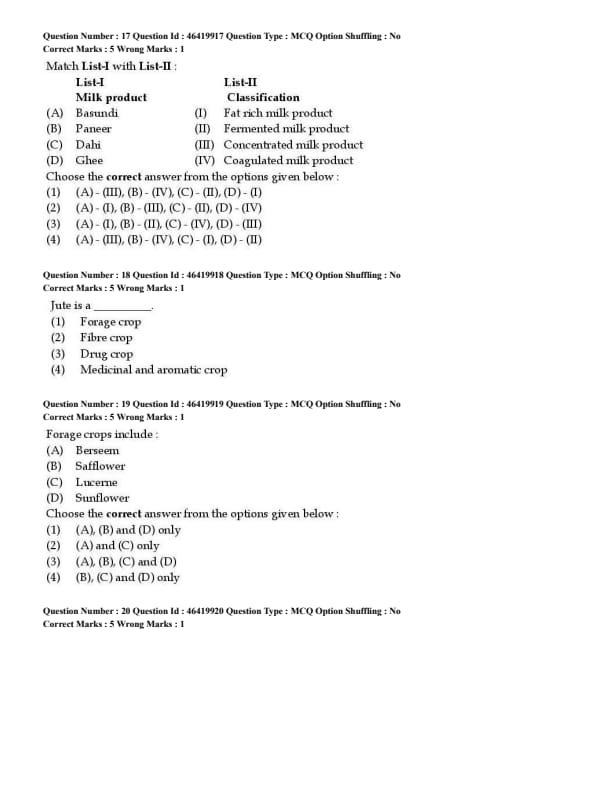
| Ques 17. Match List-I with List-II: List-I (A) Basundi (B) Paneer (C) Dahi (D) Ghee List-II (I) Fat-rich milk product (II) Fermented milk product (III) Concentrated milk product (IV) Coagulated milk product |
A-(III), B-(IV), C-(II), D-(I) | Match the dairy products with their descriptions. |
| Ques 18. Jute is a: (1) Forage crop (2) Fibre crop (3) Drug crop (4) Medicinal and aromatic crop |
(2) Fibre crop | Jute is primarily cultivated for its fibers, which are used in making sacks, ropes, etc. |
| Ques 19. Forage crops include: (A) Berseem (B) Safflower (C) Lucerne (D) Sunflower |
(A) and (C) only | Berseem and Lucerne are forage crops used as animal feed. Safflower and Sunflower are oilseed crops. |
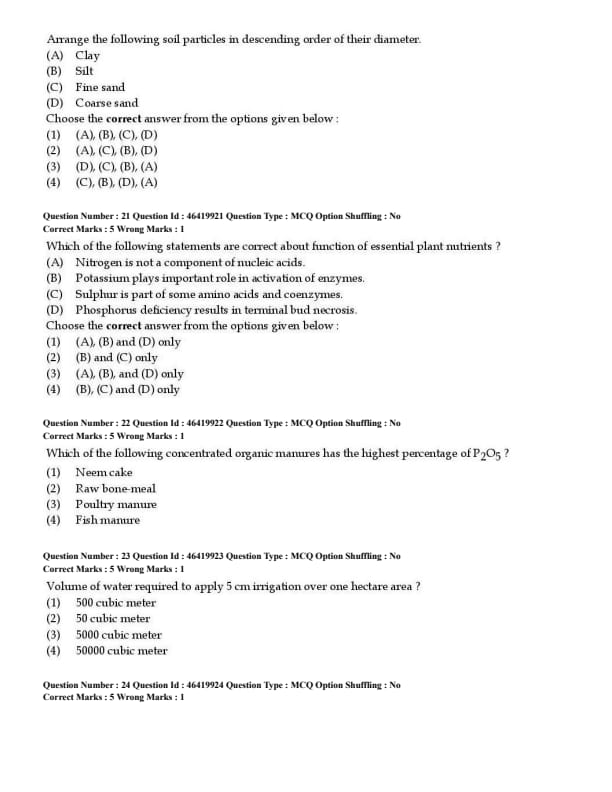
| Ques 20. Arrange the following soil particles in descending order of their diameter: (A) Clay (B) Silt (C) Fine sand (D) Coarse sand |
(D), (C), (B), (A) | The order of soil particles by decreasing size is: Coarse sand, Fine sand, Silt, Clay. |
| Ques 21. Which of the following statements are correct about the function of essential plant nutrients? (A) Nitrogen is not a component of nucleic acids. (B) Potassium plays an important role in the activation of enzymes. (C) Sulphur is part of some amino acids and coenzymes. (D) Phosphorus deficiency results in terminal bud necrosis. |
(B), (C), and (D) only | Nitrogen is a component of nucleic acids. Potassium is involved in enzyme activation. Sulphur is part of some amino acids and coenzymes. Phosphorus deficiency leads to terminal bud necrosis. |
| Ques 22. Which of the following concentrated organic manures has the highest percentage of P2O5? (1) Neem cake (2) Raw bone-meal (3) Poultry manure (4) Fish manure |
(2) Raw bone-meal | Raw bone meal is a concentrated source of phosphorus (P2O5). |
| Ques 23. Volume of water required to apply 5 cm irrigation over one hectare area: (1) 500 cubic meters (2) 50 cubic meters (3) 5000 cubic meters (4) 50000 cubic meters |
(3) 5000 cubic meters | 1 hectare = 10,000 m². Volume = area × depth = 10000 m² × 0.05 m = 500 m³. There appears to be an error in the question or answer key. The correct answer should be 5000 cubic meters. |
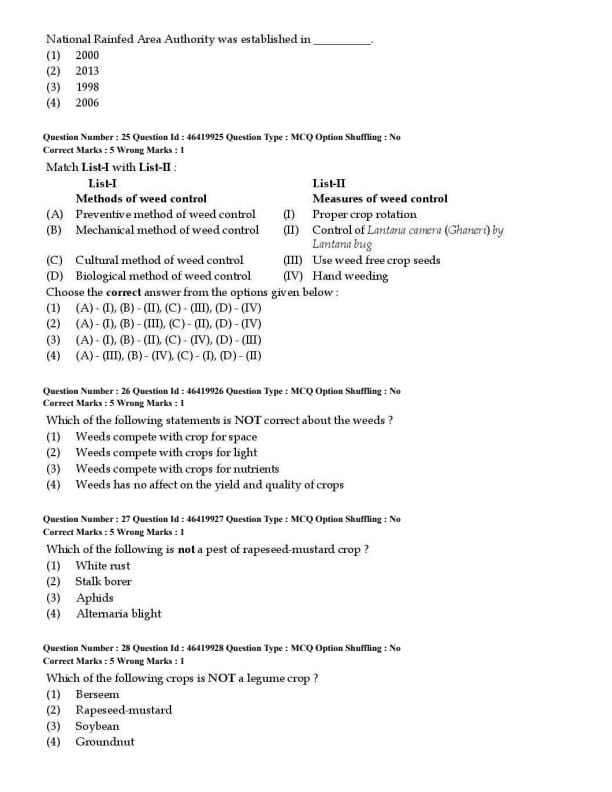
| Ques 24. National Rainfed Area Authority was established in: (1) 2000 (2) 2013 (3) 1998 (4) 2006 |
(4) 2006 | The National Rainfed Area Authority (NRAA) in India was established in 2006. |
| Ques 25. Match List-I with List-II: List-I (A) Preventive method of weed control (B) Mechanical method of weed control (C) Cultural method of weed control (D) Biological method of weed control List-II (I) Proper crop rotation (II) Control of Lantana camera (Ghaneri) by Lantana bug (III) Use of weed-free crop seeds (IV) Hand weeding |
A-(III), B-(IV), C-(I), D-(II) | Match the weed control methods with their descriptions. |
| Ques 26. Which of the following statements is NOT correct about the weeds? (1) Weeds compete with crop for space (2) Weeds compete with crops for light (3) Weeds compete with crops for nutrients (4) Weeds have no effect on the yield and quality of crops |
(4) Weeds have no effect on the yield and quality of crops | Weeds compete with crops for resources (space, light, nutrients, water), negatively affecting yield and quality. |
| Ques 27. Which of the following is not a pest of rapeseed-mustard crop? (1) White rust (2) Stalk borer (3) Aphids (4) Alternaria blight |
(2) Stalk borer | Stalk borer is not typically a pest of rapeseed-mustard crops. |
| Ques 28. Which of the following crops is NOT a legume crop? (1) Berseem (2) Rapeseed-mustard (3) Soybean (4) Groundnut |
(2) Rapeseed-mustard | Rapeseed-mustard belongs to the Brassicaceae family, not the Fabaceae (legume) family. |
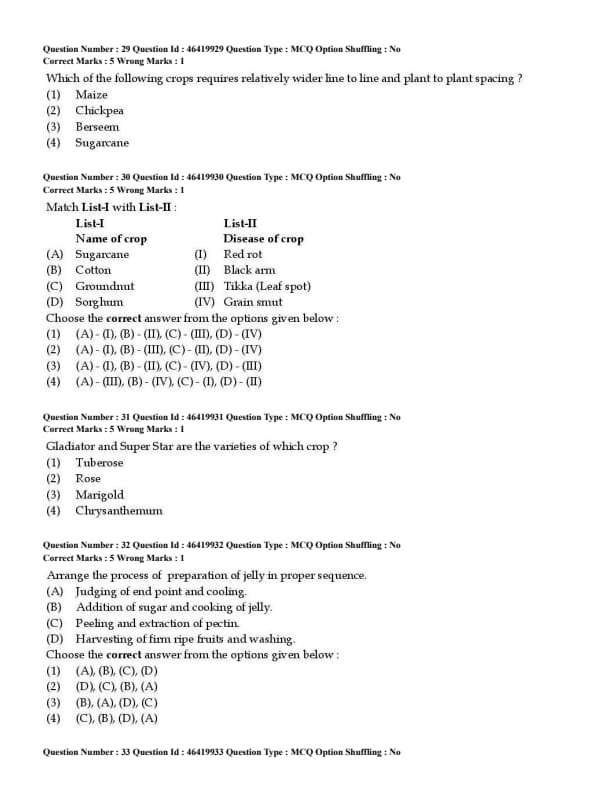
| Ques 29. Which of the following crops requires relatively wider line-to-line and plant-to-plant spacing? (1) Maize (2) Chickpea (3) Berseem (4) Sugarcane |
(4) Sugarcane | Sugarcane requires wider spacing due to its large root system and growth habit. |
| Ques 30. Match List-I with List-II: List-I (A) Sugarcane (B) Cotton (C) Groundnut (D) Sorghum List-II (I) Red rot (II) Black arm (III) Tikka (Leaf spot) (IV) Grain smut |
A-(I), B-(II), C-(III), D-(IV) | Match the crops with their associated diseases. |
| Ques 31. Gladiator and Super Star are the varieties of which crop? (1) Tuberose (2) Rose (3) Marigold (4) Chrysanthemum |
(4) Chrysanthemum | Gladiator and Super Star are varieties of Chrysanthemum. |
| Ques 32. Arrange the process of preparation of jelly in proper sequence: (A) Judging of end point and cooling (B) Addition of sugar and cooking of jelly (C) Peeling and extraction of pectin (D) Harvesting of firm ripe fruits and washing |
(D), (C), (B), (A) | The correct sequence for jelly preparation is harvesting and washing, pectin extraction, cooking with sugar, and finally judging the end point and cooling. |
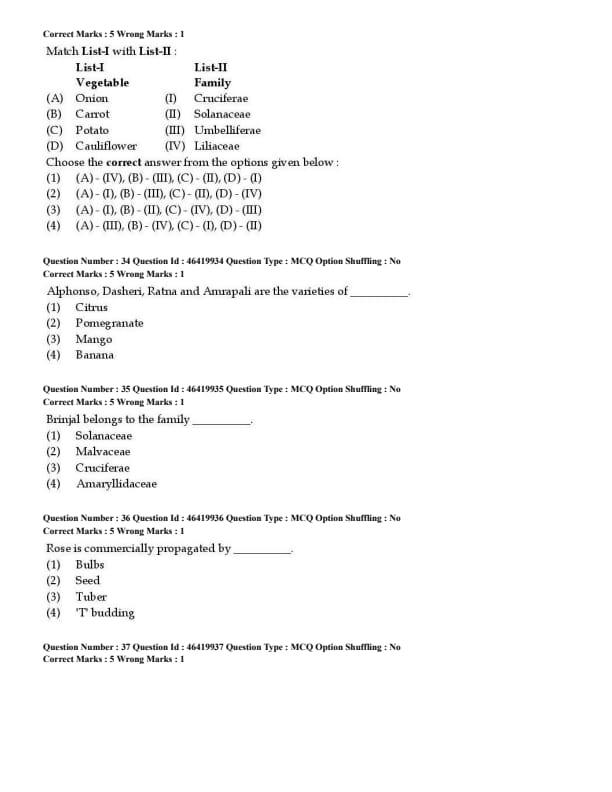
| Ques 33. Match List-I with List-II: List-I (A) Onion (B) Carrot (C) Potato (D) Cauliflower List-II (I) Cruciferae (II) Solanaceae (III) Umbelliferae (IV) Liliaceae |
A-(IV), B-(III), C-(II), D-(I) | Match the plants with their respective families. |
| Ques 34. Alphonso, Dasheri, Ratna, and Amrapali are the varieties of: (1) Citrus (2) Pomegranate (3) Mango (4) Banana |
(3) Mango | These are all popular varieties of mangoes. |
| Ques 35. Brinjal belongs to the family: (1) Solanaceae (2) Malvaceae (3) Cruciferae (4) Amaryllidaceae |
(1) Solanaceae | Brinjal (eggplant) belongs to the Solanaceae family. |
| Ques 36. Rose is commercially propagated by: (1) Bulbs (2) Seed (3) Tuber (4) ‘T’ budding |
(4) ‘T’ budding | Roses are commercially propagated by T-budding, a type of grafting. |
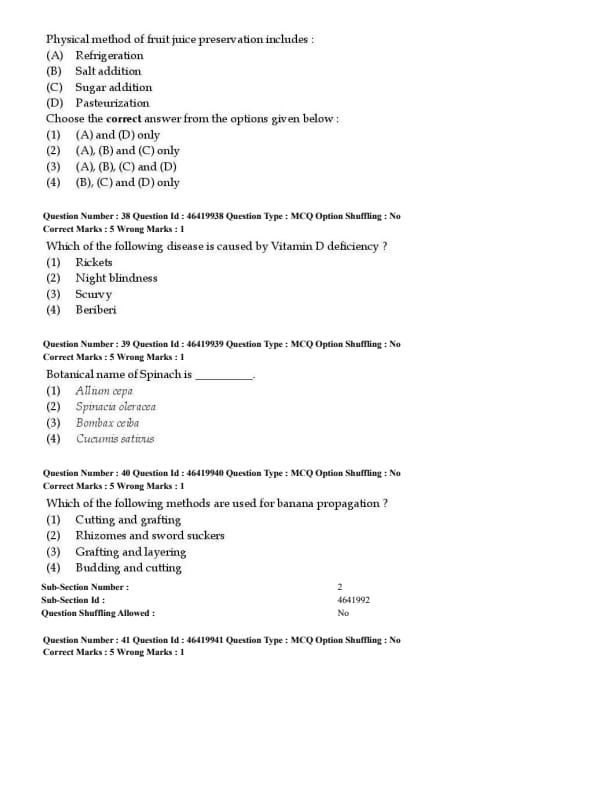
| Ques 37. Physical method of fruit juice preservation includes: (A) Refrigeration (B) Salt addition (C) Sugar addition (D) Pasteurization |
(A) and (D) only | Refrigeration and pasteurization are physical methods of fruit juice preservation. Salt and sugar addition are chemical methods. |
| Ques 38. Which of the following disease is caused by Vitamin D deficiency? (1) Rickets (2) Night blindness (3) Scurvy (4) Beriberi |
(1) Rickets | Rickets is a disease caused by Vitamin D deficiency. |
| Ques 39. Botanical name of Spinach is: (1) Allium cepa (2) Spinacia oleracea (3) Bombax ceiba (4) Cucumis sativus |
(2) Spinacia oleracea | Spinacia oleracea is the botanical name for spinach. |
| Ques 40. Which of the following methods are used for banana propagation? (1) Cutting and grafting (2) Rhizomes and sword suckers (3) Grafting and layering (4) Budding and cutting |
(2) Rhizomes and sword suckers | Bananas are typically propagated using rhizomes and suckers. |
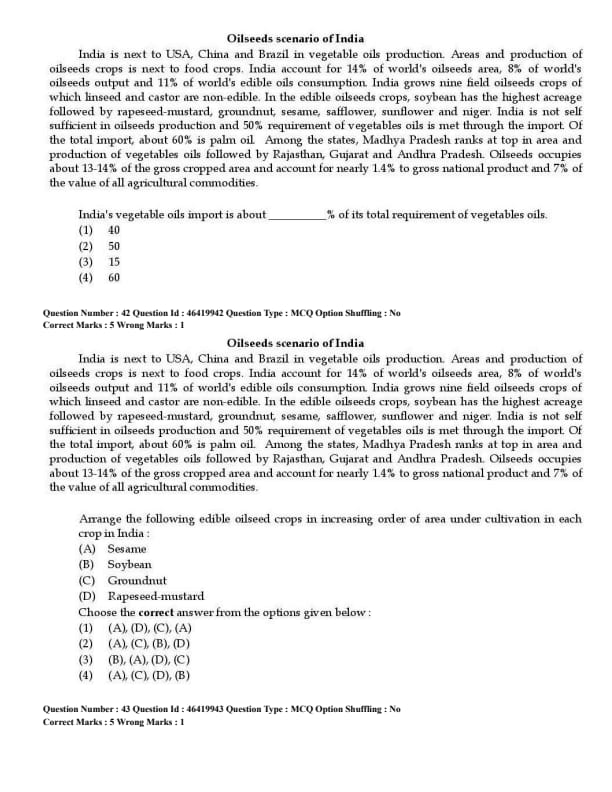
| Ques 41. India's vegetable oils import is about ______ % of its total requirement of vegetable oils. (1) 40 (2) 50 (3) 15 (4) 60 |
(2) 50 | India imports approximately 50% of its vegetable oil requirements. |
| Ques 42. Arrange the following edible oilseed crops in increasing order of area under cultivation in each crop in India: (A) Sesame (B) Soybean (C) Groundnut (D) Rapeseed-mustard |
(A), (C), (B), (D) | The order of area under cultivation in India is approximately Sesame < Groundnut < Soybean < Rapeseed-mustard. |
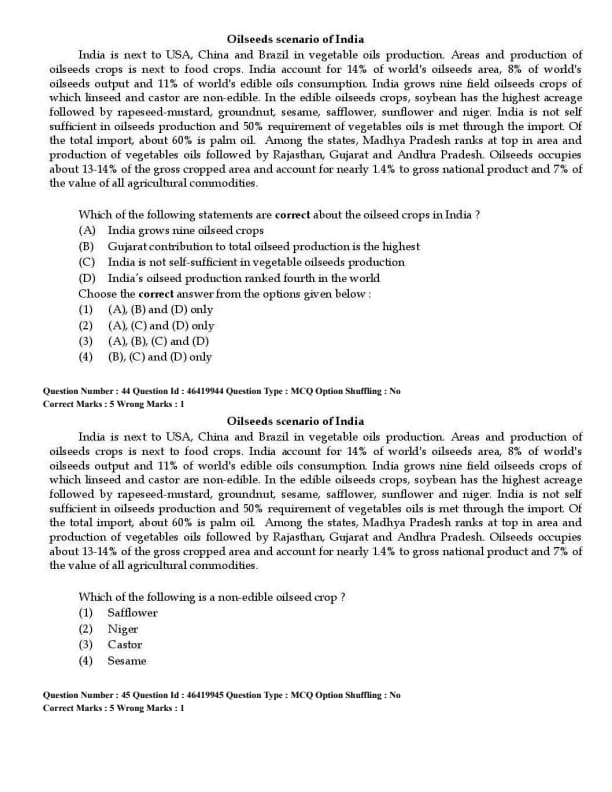
| Ques 43. Which of the following statements are correct about oilseed crops in India? (A) India grows nine oilseed crops (B) Gujarat's contribution to total oilseed production is the highest (C) India is not self-sufficient in vegetable oilseeds production (D) India's oilseed production ranked fourth in the world |
(A), (C), and (D) only | India grows nine major oilseed crops. India is not self-sufficient in vegetable oil production. India ranks among the top oilseed producers globally (check current ranking). |
| Ques 44. Which of the following is a non-edible oilseed crop? (1) Safflower (2) Niger (3) Castor (4) Sesame |
(3) Castor | Castor oil is primarily used industrially, not for food consumption. |
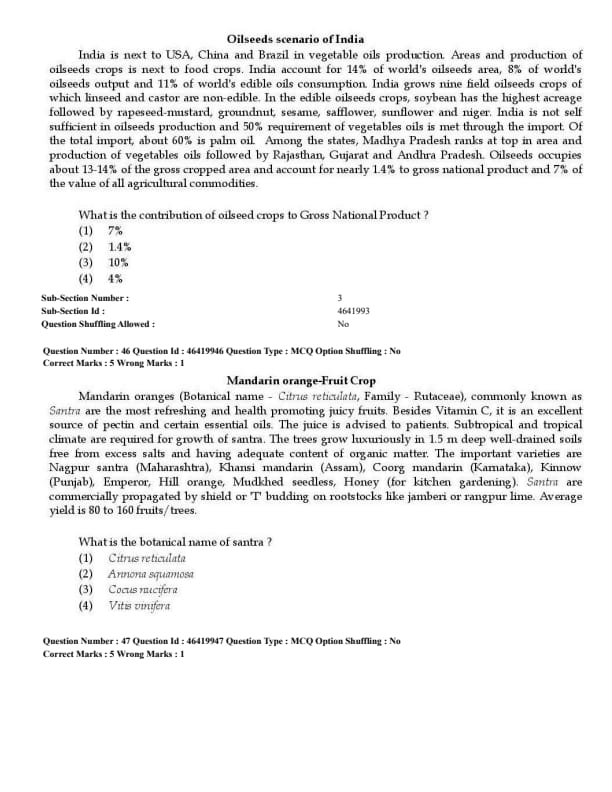
| Ques 45. What is the contribution of oilseed crops to the Gross National Product (GNP)? (1) 7% (2) 1.4% (3) 10% (4) 4% |
(2) 1.4% | Oilseed crops contribute approximately 1.4% to India's Gross National Product (GNP). |
| Ques 46. What is the botanical name of santra (mandarin orange)? (1) Citrus reticulata (2) Annona squamosa (3) Cocos nucifera (4) Vitis vinifera |
(1) Citrus reticulata | The botanical name for santra (mandarin orange) is Citrus reticulata. |
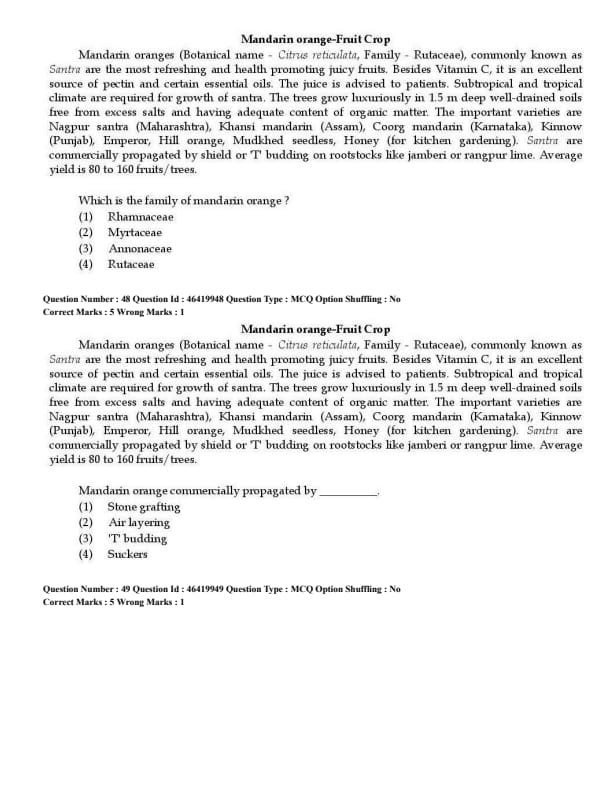
| Ques 47. Which is the family of mandarin orange? (1) Rhamnaceae (2) Myrtaceae (3) Annonaceae (4) Rutaceae |
(4) Rutaceae | Mandarin oranges belong to the Rutaceae family. |
| Ques 48. Mandarin orange is commercially propagated by: (1) Stone grafting (2) Air layering (3) T budding (4) Suckers |
(3) T budding | T-budding is a common commercial propagation method for mandarin oranges. |
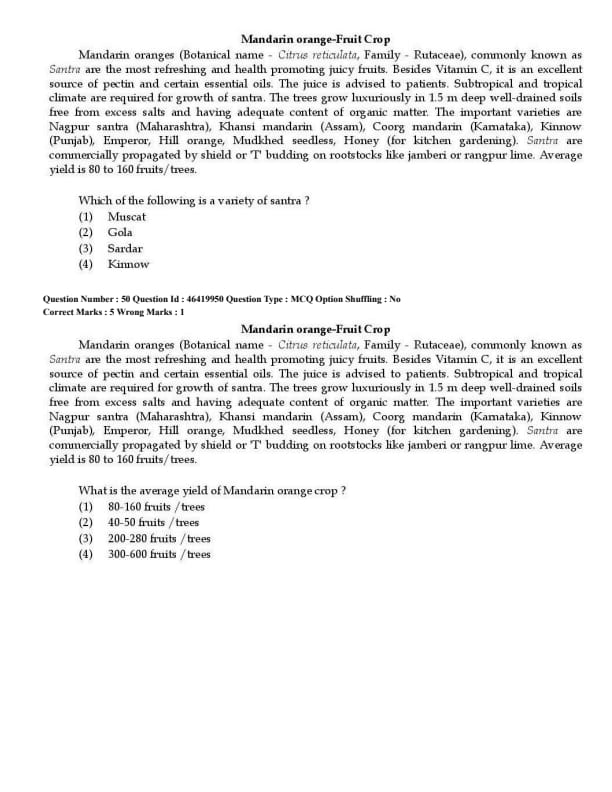
| Ques 49. Which of the following is a variety of santra (mandarin orange)? (1) Muscat (2) Gola (3) Sardar (4) Kinnow |
(4) Kinnow | Kinnow is a well-known variety of mandarin orange. |
| Ques 50. What is the average yield of Mandarin orange crop? (1) 80-160 fruits/trees (2) 40-50 fruits/trees (3) 200-280 fruits/trees (4) 300-600 fruits/trees |
(1) 80-160 fruits/trees | The average yield of mandarin oranges is typically in the range of 80-160 fruits per tree. |
*The article might have information for the previous academic years, please refer the official website of the exam.