
CUET 2024 Question Paper with Answer Key and Solution PDF for Business Studies


| Updated On - Dec 8, 2024
CUET Question Papers are the most important study material for effective exam preparation. We at Zollege have provided all CUET Previous Year Papers with Solution PDFs here. CUET 2024 Business Studies was conducted successfully on May 17 by NTA.
Students can freely download the CUET previous year's question paper PDFs along with their solutions here. We strongly encourage cuet aspirants to scan through all the CUET Question Paper to know the overall difficulty level, CUET Syllabus and understand the changes in CUET Exam Pattern over the years.
CUET 2024 Business Studies Question Paper with Answer Key PDF
| CUET 2024 Business Studies Question Paper with Answer Key SET A |  Download Download |
Check Solution |
| CUET 2024 Business Studies Question Paper with Answer Key SET B | Download |
Check Solution |
| CUET 2024 Business Studies Question Paper with Answer Key SET C | Download |
Check Solution |
| CUET 2024 Business Studies Question Paper with Answer Key SET D | Download |
Check Solution |
| CUET 2024 Business Studies Online Question Paper with Answer Key | Download |
Check Solution |
CUET 2024 Business Studies Questions with Solutions Set A
| Question | Answer | Detailed Solution |
|---|---|---|
| Q1: Identify the Principle of Management where Taylor pioneered the introduction of the method of scientific inquiry into the domain of management practice. (1) Science, not rule of thumb (2) Harmony not discord (3) Cooperation, not individualism (4) Development of each and every person to the greatest efficiency and prosperity |
(1) Science, not rule of thumb | Taylor emphasized using scientific methods to find the best way to perform tasks. He advised for replacing the traditional "rule of thumb" methods with a scientific approach, which would improve efficiency. |
| Q2: Match List-I with List-II on the basis of Management Principles: List-I (A) Obedience to organizational rules (B) Unity of direction (C) Remuneration of employees (D) Discipline List-II (I) One boss for every individual employee (II) One head and one plan (III) Remuneration should be just and equitable (IV) Unity of command |
(3) (A) - (I), (B) - (II), (C) - (IV), (D) - (III) | (A) refers to unity of command, where each employee should receive orders from one boss. (B) unity of direction means having one head and one plan for a group of activities. (C) refers to just and equitable remuneration. (D) discipline relates to obedience and respect for organizational rules. |
| Q3: The aim of which technique given by F.W. Taylor is to reduce a given line or a product to fixed types, sizes, and characteristics? (1) Method study (2) Time study (3) Standardization of work (4) Functional foremanship |
(3) Standardization of work | Standardization in Taylor's principles aims to reduce variation in product types, sizes, and characteristics, ensuring uniformity and efficiency in production. |
| Q4: Match List-I with List-II on the basis of Management Principles: List-I (A) Employees turnover should be minimized (B) Emphasizes kindliness and justice (C) Chain of authority and communication from top to bottom (D) Promotes team spirit List-II (I) Stability of personnel (II) Equity (III) Scalar chain (IV) Espirit de corps |
(3) (A) - (I), (B) - (II), (C) - (IV), (D) - (III) | (A) refers to stability of personnel, reducing turnover. (B) emphasizes fairness and justice in equity. (C) is the scalar chain for proper communication. (D) is about building team spirit, or Espirit de corps. |
| Q5: Under which dimension of business environment is "Online Booking of Air Tickets" included? (1) Legal dimension (2) Economic dimension (3) Technical dimension (4) Social dimension |
(3) Technical dimension | Online booking of air tickets relates to advancements in technology, falling under the technical dimension of the business environment. |
| Q6: Which of the following is an example of economic environment? (1) Money supply in economy (2) Constitution of the country (3) Life expectancy (4) Population shifts |
(1) Money supply in the economy | The money supply is a critical aspect of the economic environment, affecting inflation, interest rates, and overall economic activity. |
| Q7: Which of the following is an example of legal environment? (1) Death/Birth Ratio (2) Trade Union Act (3) Prevailing Political System (4) Public Debt |
(2) Trade Union Act | The legal environment includes laws and regulations like the Trade Union Act, which governs labor relations and collective bargaining. |
| Q8: Which of the following does not characterize the business environment? (1) Inter-related (2) External forces (3) Market orientation and product (4) Relativity |
(3) Market orientation and product | The business environment is characterized by inter-related and external forces, but market orientation and product focus are internal strategic decisions. |
| Q9: Identify the correct sequence of steps under the Planning function: (A) Setting objectives (B) Identifying alternative courses of action (C) Developing premises (D) Evaluating alternative courses of action (1) (A), (B), (C), (D) (2) (A), (C), (B), (D) (3) (B), (A), (D), (C) (4) (C), (B), (D), (A) |
(2) (A), (C), (B), (D) | The correct sequence is setting objectives, developing premises, identifying alternatives, and then evaluating them. This reflects logical planning in organizations. |
| Q10: Identify the correct sequence of Selection process: (A) Selection decision (B) Employment interview (C) Selection tests (D) Reference checking (1) (A), (B), (C), (D) (2) (A), (C), (B), (D) (3) (B), (A), (D), (C) (4) (C), (B), (D), (A) |
(4) (C), (B), (D), (A) | The selection process usually begins with tests, followed by interviews, reference checks, and finally a decision. This helps in evaluating candidates effectively. |
| Q11: "It is a joint programme of training in which educational institutions and business firms cooperate." Identify the method of training. (1) Vestibule training (2) Apprenticeship training (3) Internship training (4) Job rotation |
(3) Internship training | Internship training involves cooperation between educational institutions and businesses to provide students with practical, on-the-job experience while they continue their formal education. It helps students gain insights into real-world work environments. |
| Q12: Match List-I with List-II on the basis of meaning and name of the concept: (A) Choosing the most appropriate candidate (B) Candidate is given an introduction to superiors (C) Learning the skills related to a job (D) Searching for prospective employees List-II: (I) Selection (II) Orientation (III) Recruitment (IV) Training (1) (A) - (I), (B) - (II), (C) - (III), (D) - (IV) (2) (A) - (I), (B) - (III), (C) - (II), (D) - (IV) (3) (A) - (I), (B) - (II), (C) - (IV), (D) - (III) (4) (A) - (III), (B) - (IV), (C) - (I), (D) - (II) |
(3) (A) - (I), (B) - (II), (C) - (IV), (D) - (III) | The correct matching is: (A) Choosing the candidate is Selection, (B) Introducing the candidate to superiors is Orientation, (C) Learning job skills is Training, and (D) Searching for employees is Recruitment. These are distinct HR processes. |
| Q13: Which of the following is a process of incitement or inducing subordinates to act in a desired manner to achieve organizational goals? (1) Motivation (2) Supervision (3) Leadership (4) Communication |
(1) Motivation | Motivation involves stimulating subordinates to act in a way that helps achieve organizational goals. It is about encouraging effort and dedication through incentives, recognition, or job satisfaction. |
| Q14: Find the correct sequence of needs as given by Maslow in his Need Hierarchy Theory: (A) Belongingness needs (B) Safety and Security needs (C) Self-actualization needs (D) Esteem needs (1) (A), (B), (C), (D) (2) (A), (C), (B), (D) (3) (B), (A), (D), (C) (4) (C), (B), (D), (A) |
(3) (B), (A), (D), (C) | Maslow's Hierarchy of Needs is arranged as follows: Safety and Security needs, followed by Belongingness needs, then Esteem needs, and finally Self-actualization needs. This theory explains human motivation in a hierarchical order. |
| Q15: "________________ is a process of influencing the behavior of people by making them strive voluntarily towards the achievement of organizational goals." (1) Motivation (2) Supervision (3) Leadership (4) Communication |
(3) Leadership | Leadership involves influencing and guiding people toward the voluntary pursuit of organizational objectives. It includes setting a vision and encouraging others to follow and contribute to achieving shared goals. |
| Q16: Which of the following is not a limitation of Controlling? (1) Costly affair (2) Resistance from employees (3) Ensure order and discipline (4) Little control on external factors |
(3) Ensure order and discipline | Controlling will ensure that there is an order and discipline within an organization-an advantage and not a limitation. Other options like high costs, employee resistance, and little control on external factors are valid limitations of controlling. |
| Q17: Identify the correct sequence of the Controlling process: (A) Analyzing deviations (B) Measurement of actual performance (C) Setting up standards (D) Comparison of actual performance with standards. (1) (A), (B), (C), (D) (2) (A), (C), (B), (D) (3) (B), (A), (D), (C) (4) (C), (B), (D), (A) |
(4) (C), (B), (D), (A) | The correct sequence of controlling starts with setting standards, measuring actual performance, comparing the results with standards, and finally analyzing deviations. This logical flow ensures performance evaluation and correction. |
| Q18: "Only a 5% increase in labor cost may be more troublesome than a 15% increase in postal charges." Identify the concept in the statement. (1) Deviation (2) Critical point control (3) Break-even analysis (4) Critical path method |
(2) Critical point control | Critical point control focuses on key areas that significantly impact the organization. A small variation in a critical area (like labor cost) is more concerning than a larger deviation in a less critical one (postal charges). |
| Q19: Identify the function performed by Financial Market: "Holders of assets can readily sell their financial assets through the mechanism of the financial market." (1) Reduce the cost of transactions (2) Provide liquidity to financial assets (3) Facilitate price discovery (4) Mobilization of savings and channeling them into the most productive uses |
(2) Provide liquidity to financial assets | Financial markets provide liquidity, allowing investors to convert assets into cash easily. This is crucial for maintaining flexibility and reducing risks. |
| Q20: If any of the parties are not satisfied by the order of ________________, they can appeal against such an order to the State Commission on the grounds of facts or law within a period of forty-five days from the date of the order. (1) District Commission (2) State Commission (3) National Commission (4) Local Court |
(1) District Commission | Appeals from the District Commission can be made to the State Commission within 45 days, as per consumer protection law. |
| Q21: Identify the importance of consumer protection: "Business organizations make money by selling goods and providing services to consumers. Thus, consumers form an important group among the many stakeholders of business, and like other stakeholders, their interest has to be well taken care of." (1) Moral justification (2) Business uses society’s resources (3) Social responsibility (4) Long-term interest of business |
(3) Social responsibility | The statement reflects the social responsibility of businesses to protect consumer interests since consumers are crucial stakeholders and contribute to business success. |
| Q22: Identify the Consumer Right: "The consumer has the freedom to access a variety of products at competitive prices. This implies that the marketers should offer a wide variety of products in terms of quality, brand, prices, size, etc." (1) Right to Safety (2) Right to Seek Redressal (3) Right to be Assured (4) Right to Consumer Education |
(3) Right to be Assured | The right to be assured ensures that consumers can choose from a variety of products at fair prices, enhancing market competition and consumer satisfaction. |
| Q23: Identify the method of floatation in the Primary Market wherein a company sells securities en bloc at an agreed price to a broker. (1) Rights issue (2) Offer for sale (3) e-IPOs (4) Offer through Prospectus |
(2) Offer for sale | In an offer for sale, a company sells securities en bloc to a broker, who then sells them to the public. This method is different from issuing securities directly to investors. |
| Q24: Match List-I with List-II on the basis of meaning and the term: (A) Right to command (B) Obligation to perform a task (C) Accountability (D) Basis of management hierarchy List-II: (I) Answerability (II) Delegation (III) Authority (IV) Responsibility (1) (A) - (I), (B) - (II), (C) - (III), (D) - (IV) (2) (A) - (I), (B) - (III), (C) - (II), (D) - (IV) (3) (A) - (I), (B) - (II), (C) - (IV), (D) - (III) (4) (A) - (III), (B) - (IV), (C) - (I), (D) - (II) |
(4) (A) - (III), (B) - (IV), (C) - (I), (D) - (II) | Authority is the right to command, responsibility is the obligation to perform tasks, accountability is answerability for outcomes, and delegation refers to transferring responsibility to subordinates. |
| Q25: Identify the correct sequence of the Organizing function of management: (A) Establishing authority and reporting relationships (B) Departmentalization (C) Identification and division of work (D) Assignment of duties (1) (A), (B), (C), (D) (2) (A), (C), (B), (D) (3) (B), (A), (D), (C) (4) (C), (B), (D), (A) |
(4) (C), (B), (D), (A) | The organizing function begins with identifying and dividing work, then departmentalization, followed by assigning duties, and finally establishing authority relationships to ensure smooth functioning. |
| Q26: The formal organisation can be better understood by a study of its features which are as follows: (A) It specifies the relationships among various job positions and the nature of their interrelationship. (B) It is a means to achieve the objectives specified in the plans, as it lays down rules and procedures essential for their achievement. (C) Independent channels of communication without specified direction of flow of information are developed by group members. (D) It is deliberately designed by the top management to facilitate the smooth functioning of the organisation. Choose the correct answer from the options given below: (1) (A), (B) and (D) only (2) (A), (B) and (C) only (3) (A), (B), (C) and (D) (4) (B), (C) and (D) only |
(1) (A), (B) and (D) only | Formal organisations are structured and well-defined, specifying the roles and interrelationships of various positions, and are deliberately created by the management to ensure that the organisation’s goals are achieved. |
| Q27: The informal organisation offers many benefits. Important among them are given below: (A) Prescribed lines of communication are not followed. Thus, informal organisation leads to faster spread of information as well as quick feedback. (B) It helps to fulfil the social needs of the members and allows them to find like-minded people. This enhances their job satisfaction since it gives them a sense of belongingness in the organisation. (C) It contributes towards fulfilment of organisational objectives by compensating for inadequacies in the formal organisation. (D) Unity of command is maintained through an established chain of command. Choose the correct answer from the options given below: (1) (A), (B) and (D) only (2) (A), (B) and (C) only (3) (A), (B), (C) and (D) (4) (B), (C) and (D) only |
(2) (A), (B) and (C) only | Informal organisations develop spontaneously based on social interactions and relationships among individuals. They provide faster communication, enhance job satisfaction, and support formal objectives, but they do not necessarily adhere to formal rules like unity of command. |
| Q28: Identify the correct sequence of trading settlement procedure: (A) The investor has to sign a broker client agreement. (B) The investor has to open a ’Demat’ Account. (C) An order confirmation slip is issued to the investor by the broker. (D) The broker will then go online and connect to the main stock exchange. Choose the correct answer from the options given below: (1) (A), (B), (C), (D) (2) (A), (C), (B), (D) (3) (B), (A), (D), (C) (4) (C), (B), (D), (A) |
(1) (A), (B), (C), (D) | The trading settlement process follows a specific sequence starting with the signing of the broker-client agreement (A), opening a Demat account (B), receiving an order confirmation slip (C), and concluding with online connection to the main exchange (D). |
| Q29: The market where existing securities are bought and sold is known as: (1) Primary market (2) Secondary market (3) Capital market (4) Financial market |
(2) Secondary market | The secondary market facilitates trading of already issued securities among investors, providing liquidity and price discovery for assets that have been issued in the primary market. |
| Q30: Qualities of a successful entrepreneur do not include: (1) Initiative (2) Self-confidence (3) Risk avoider (4) Wealth creators |
(3) Risk avoider | Entrepreneurship involves taking calculated risks to achieve business success. Successful entrepreneurs possess initiative, confidence, and wealth creation abilities; they are not typically risk avoiders. |
| Q31: Identify the function performed by SEBI: ”It controls insider trading, takeover bids and imposes penalties for such practices.” (1) Protective functions (2) Regulatory functions (3) Developmental functions (4) Preventive functions |
(2) Regulatory functions | The correct function performed by SEBI is regulatory, ensuring the protection and orderly functioning of the securities market by controlling practices like insider trading and imposing necessary penalties. |
| Q32: Financial management aims at choosing the best investment and financing alternatives by focusing on their costs and benefits. Its objective is to: (1) Increase the shareholders’ wealth (2) Decrease the shareholders’ wealth (3) Increase the shareholders’ capital (4) Decrease the shareholders’ capital |
(1) Increase the shareholders’ wealth | Financial management focuses on making decisions that maximize the value for shareholders, ensuring optimal allocation of resources to achieve growth and profitability. |
| Q33: A proper matching of funds requirements and their availability is sought to be achieved by: (1) Financial planning (2) Financial control (3) Capital budgeting (4) Investment decisions |
(1) Financial planning | Financial planning ensures that an organization has adequate funds to meet its short-term and long-term needs. It involves forecasting financial requirements and developing strategies to acquire and utilize funds effectively. |
| Q34: Debt is ______, but is more for a business because the payment of interest and the return of principal is obligatory for the business. (1) Cheaper, risky (2) Cheaper, safe (3) Expensive, risky (4) Expensive, safe |
(1) Cheaper, risky | Debt is considered a cheaper source of finance due to the lower cost compared to equity. However, it involves a higher risk for the business because of the obligatory payments associated with interest and principal. |
| Q35: ”Coordination unifies unrelated interests into purposeful work activity.” Identify the nature of coordination. (1) Coordination is an all pervasive function (2) Coordination is a continuous process (3) Coordination ensures unity of action (4) Coordination integrates group efforts |
(4) Coordination integrates group efforts | Coordination aligns the efforts of various individuals and departments towards a common objective, ensuring unity of action and efficient functioning within an organization. |
| Q36: Akash Industries has installed a waste recycling plant in its premises and does not dump their waste material anymore. This plant is providing employment to many people. Identify the objective of management which the company is achieving by doing the aforesaid activity. (1) Social objective (2) Economic objective (3) Personal objective (4) Growth |
(1) Social objective | By installing a waste recycling plant, Akash Industries contributes positively to society by reducing waste and generating employment, aligning with the social objectives of management. |
| Q37: ”Management always works by keeping an end result or aim of the organisation. All activities of managers are directed towards the end result.” From the above statement, identify the feature of management. (1) Management is multidimensional (2) Management is continuous (3) Management is intangible (4) Management is a goal-oriented process |
(4) Management is a goal-oriented process | The statement highlights that all managerial activities focus on achieving specific goals and objectives, making management a goal-oriented process. |
| Q38: The key position of top-level management is: (1) Managing Director (2) Production Manager (3) Marketing Manager (4) Plant Supervisor |
(1) Managing Director | Top-level management typically comprises key decision-makers like the Managing Director, who oversee the organization’s strategic direction. |
| Q39: Match List-I with List-II: List-I (A) Intelligence test (B) Aptitude test (C) Personality test (D) Trade test List-II (I) Indicator of a person’s capacity to develop (II) Clues to a person’s emotions, values, etc. (III) Measure existing skills of the individual (IV) Indicator of a person’s learning ability and ability to make judgements |
(1) (A) - (I), (B) - (II), (C) - (III), (D) - (IV) | Intelligence tests assess development capacity, aptitude tests gauge potential and values, personality tests measure traits, and trade tests evaluate skills. |
| Q40: Which of the following are advantages of functional structure of an organisation? (A) Leads to occupational specialisation. (B) Places less emphasis on organisational objectives. (C) Promotes coordination and control within a department. (D) Increases operational efficiency. |
(3) (A), (C) and (D) only | Functional structure enhances specialization, improves efficiency, and fosters coordination within departments, although it may lead to departmental isolation. |
| Q41: In the above case ”Just Foodie” is using various variables of Marketing Mix. Identify the variable used in the following statement: ”To make their products available to customers at right time, right place, they are also selling their products to grocery stores in addition to their own outlets.” (1) Product (2) Price (3) Promotion (4) Physical distribution |
(4) Physical distribution | The given statement emphasizes making products available to customers at the right place and time, referring to distribution activities, which is a key function of physical distribution in the marketing mix. |
| Q42: Identify the element of marketing mix in the following statement: ”The taste, quality, and packing are given utmost care.” (1) Product mix (2) Price mix (3) Promotion mix (4) Physical distribution mix |
(1) Product mix | The statement highlights the aspects of product quality, taste, and packing, which are all components of the product mix in marketing. |
| Q43: ”They are able to charge higher prices than their competitors.” Which element of marketing mix is discussed in the statement? (1) Product mix (2) Price mix (3) Promotion mix (4) Physical distribution mix |
(2) Price mix | Charging higher prices than competitors directly refers to the price mix, which deals with pricing strategies for products and services. |
| Q44: ”To increase their sales, they are using different offers like: Free gifts, Cash backs, etc.” Identify the marketing mix element from the above statement. (1) Product mix (2) Price mix (3) Promotion mix (4) Physical distribution mix |
(3) Promotion mix | The use of free gifts, cash backs, and similar offers refers to the promotion mix, which aims at enhancing sales through marketing strategies. |
| Q45: ”To increase their sales, they are using different offers like: Free gifts, Cash backs, etc. They are offering discounts to customers on various occasions.” Which tool of promotion mix is used in the given statement? (1) Advertisement (2) Sales promotion (3) Personal selling (4) Publicity |
(2) Sales promotion | Offering discounts and providing special offers are typical tools of sales promotion aimed at boosting sales volume. |
| Q46: Identify the function of management highlighted in the above case. (1) Organising (2) Staffing (3) Directing (4) Planning |
(4) Planning | Planning is a primary function of management that involves setting objectives and determining the best course of action to achieve them. In this case, it reflects the deliberate effort to strategize and outline activities before execution. |
| Q47: ”If the goals are well defined, employees are aware of what the organisation has to do and what they must do to achieve those goals.” Identify the significance of managerial function highlighted in this statement. (1) Facilitates decision making (2) Reduces overlapping and wasteful activities (3) Reduces risks of uncertainty (4) Provides direction |
(4) Provides direction | Providing direction is a key aspect of managerial functions. It helps ensure that all employees are aligned with the organisational goals, thereby clarifying their roles and reducing ambiguity. |
| Q48: ”Changes or events cannot be eliminated, but they can be anticipated and managerial responses to them can be developed.” Identify the significance of managerial function highlighted in this statement. (1) Provides direction (2) Reduces risks of uncertainty (3) Reduces overlapping and wasteful activities (4) Facilitates decision making |
(2) Reduces risks of uncertainty | Reducing risks of uncertainty is critical for effective management. Anticipating changes allows for proactive measures to be taken, minimizing potential disruptions. |
| Q49: ”Policy formation serves as the basis of coordinating the activities and efforts of different divisions, departments and individuals. It helps in avoiding confusion and misunderstanding.” Identify the significance of managerial function highlighted in this statement. (1) Facilitates decision making (2) Reduces risks of uncertainty (3) Provides direction (4) Reduces overlapping and wasteful activities |
(4) Reduces overlapping and wasteful activities | Effective policy formulation helps streamline operations, eliminate redundancy, and improve coordination among various segments of the organization. |
| Q50: ”Manager can look into the future and make a choice from amongst various alternative courses of action.” Identify the significance of managerial function highlighted in this statement. (1) Provides direction (2) Reduces risks of uncertainty (3) Reduces overlapping and wasteful activities (4) Facilitates decision making |
(4) Facilitates decision making | Decision making is an essential managerial activity that involves choosing the best course of action among alternatives to achieve organisational objectives effectively. |
CUET 2024 Business Studies Questions with solutions Set B
| Question | Answer | Detailed Solution |
|---|---|---|
| Q1: Identify the correct sequence of Organizing function of management. (A) Establishing authority and reporting relationships (B) Departmentalisation (C) Identification and division of work (D) Assignment of duties Choose the correct answer from the options given below: |
(4) (C), (B), (D), (A) | The organizing function unfolds in a specific sequence: (C) Identification and division of work, (B) Departmentalization, (D) Assignment of duties, and (A) Establishing authority and reporting relationships. |
| Q2: Identify the Consumer Right – ”The consumer has the freedom to access a variety of products at competitive prices. This implies that the marketers should offer a wide variety of products in terms of quality, brand, prices, size, etc.” (1) Right to Safety (2) Right to Seek Redressal (3) Right to be Assured (4) Right to Consumer Education Choose the correct answer from the options given below: |
(3) Right to be Assured | The statement refers to the consumer’s right to access a variety of products at competitive prices, which directly corresponds to the Right to be Assured. |
| Q3: Identify the method of flotation in the Primary Market wherein a company sells securities en bloc at an agreed price to a broker. (1) Rights issue (2) Offer for sale (3) e-IPOs (4) Offer through Prospectus Choose the correct answer from the options given below: |
(2) Offer for sale | The description matches the process of an "Offer for Sale," where a company sells its securities in bulk ("en bloc") to a broker at an agreed price. |
| Q4: Match List-I with List-II on the basis of meaning and the term: List-I (Meaning) List-II (Term) (A) Right to command (I) Answerability (B) Obligation to perform task (II) Delegation (C) Accountability (III) Authority (D) Basis of management hierarchy (IV) Responsibility Choose the correct answer from the options given below: |
(4) (A) - (III), (B) - (IV), (C) - (I), (D) - (II) | (A) Right to command: Authority (III), (B) Obligation to perform task: Responsibility (IV), (C) Accountability: Answerability (I), (D) Basis of management hierarchy: Delegation (II). |
| Q5: The formal organisation can be better understood by a study of its features which are as follows: (A) It specifies the relationships among various job positions and the nature of their inter-relationship. This clarifies who has to report to whom. (B) It is a means to achieve the objectives specified in the plans, as it lays down rules and procedures essential for their achievement. (C) Independent channels of communication without specified direction of flow of information are developed by group members. (D) It is deliberately designed by the top management to facilitate the smooth functioning of the organisation. Which of the following options are correct? (1) (A), (B) and (D) only (2) (A), (B) and (C) only (3) (A), (B), (C) and (D) (4) (B), (C) and (D) only Choose the correct answer from the options given below: |
(1) (A), (B) and (D) only | (A), (B), and (D) are correct. (C) is incorrect as it describes informal organizations, not formal ones. |
| Q6: The informal organisation offers many benefits. Important among them are given below: (A) Prescribed lines of communication are not followed. Thus, informal organisation leads to faster spread of information as well as quick feedback. (B) It helps to fulfil the social needs of the members and allows them to find like-minded people. This enhances their job satisfaction since it gives them a sense of belongingness in the organisation. (C) It contributes towards fulfilment of organisational objectives by compensating for inadequacies in the formal organisation. (D) Unity of command is maintained through an established chain of command. Choose the correct answer from the options given below: |
(2) (A), (B) and (C) only | (A), (B), and (C) are correct: Informal organizations enhance communication speed, provide social support, and compensate for formal organizational weaknesses. (D) is incorrect, as unity of command is a feature of formal organizations. |
| Q7: Identify the correct sequence of trading & settlement procedure: (A) The investor has to sign a broker client agreement. (B) The investor has to open a 'Demat' Account. (C) An order confirmation slip is issued to the investor by the broker. (D) The broker will then go online and connect to the main stock exchange. Choose the correct answer from the options given below: |
(1) (A), (B), (C), (D) | The correct sequence is: (A) Broker Client Agreement → (B) Demat Account Opening → (D) Broker Connects to Exchange → (C) Order Confirmation. |
| Q8: The market where existing securities are bought and sold is known as: (1) Primary market (2) Secondary market (3) Capital market (4) Financial market Choose the correct answer from the options given below: |
(2) Secondary market | The secondary market is where existing securities are traded among investors. The primary market involves the issuance of new securities. |
| Q9: Qualities of successful entrepreneur do not include: (1) Initiative (2) Self-confidence (3) Risk avoider (4) Wealth creators Choose the correct answer from the options given below: |
(3) Risk avoider | Successful entrepreneurs are often distinguished by their willingness to take calculated risks. Being a "risk avoider" is not a quality typically associated with entrepreneurial success, as entrepreneurship inherently involves taking risks. On the other hand, initiative, self-confidence, and the ability to create wealth are essential traits for successful entrepreneurs. |
| Q10: Identify the function performed by SEBI: “It controls insider trading, takeover bids and imposes penalties for such practices.” (1) Protective functions (2) Regulatory functions (3) Developmental functions (4) Preventive functions Choose the correct answer from the options given below: |
(2) Regulatory functions | The actions described in the question – controlling insider trading, overseeing takeover bids, and imposing penalties – fall under the regulatory functions of SEBI (Securities and Exchange Board of India). SEBI’s role includes establishing and enforcing rules and regulations to maintain fairness and transparency in the securities market. |
| Q11: Financial management aims at choosing the best investment and financing alternatives by focusing on their costs and benefits. Its objective is to: (1) Increase the shareholders’ wealth (2) Decrease the shareholders’ wealth (3) Increase the shareholders’ capital (4) Decrease the shareholders’ capital Choose the correct answer from the options given below: |
(1) Increase the shareholders’ wealth | The main objective of financial management is to maximize the value of the company, which directly enhances shareholders’ wealth. This goal is achieved by making optimal decisions regarding investment and financing alternatives that maximize the company’s returns. |
| Q12: A proper matching of funds requirements and their availability is sought to be achieved by: (1) Financial planning (2) Financial control (3) Capital budgeting (4) Investment decisions Choose the correct answer from the options given below: |
(1) Financial planning | Financial planning involves forecasting future financial needs and determining how to meet those needs by aligning available funds with expected requirements. This ensures that funds are used efficiently and are available when needed. |
| Q13: Debt is ______ but is more risky for a business because the payment of interest and the return of principal is obligatory for the business. (1) Cheaper, risky (2) Cheaper, safe (3) Expensive, risky (4) Expensive, safe Choose the correct answer from the options given below: |
(1) Cheaper, risky | Debt financing tends to be cheaper than equity financing because the interest on debt is tax-deductible. However, it comes with the risk of mandatory interest payments and principal repayment, which may put the business in financial distress if not managed properly. |
| Q14: “Coordination unifies unrelated interests into purposeful work activity.” Identify the nature of coordination. (1) Coordination is an all pervasive function (2) Coordination is a continuous process (3) Coordination ensures unity of action (4) Coordination integrates group efforts Choose the correct answer from the options given below: |
(4) Coordination integrates group efforts | The statement emphasizes how coordination helps align different, unrelated interests into a collective effort towards achieving a common objective. This reflects how coordination integrates the efforts of different individuals or groups to work together efficiently. |
| Q15: Akash Industries has installed a waste recycling plant in its premises and does not dump their waste material anymore. This plant is providing employment to many people. Identify the objective of management which the company is achieving by doing the aforesaid activity. (1) Social objective (2) Economic objective (3) Personal objective (4) Growth Choose the correct answer from the options given below: |
(1) Social objective | By installing a waste recycling plant and providing employment while also focusing on reducing waste, Akash Industries is addressing a social objective. This involves contributing to the welfare of society by promoting environmental responsibility and creating job opportunities. |
| Q16: “Management always works by keeping an end result or aim of the organisation. All activities of managers are directed towards the end result.” From the above statement, identify the feature of management. (1) Management is multidimensional (2) Management is continuous (3) Management is intangible (4) Management is a goal-oriented process Choose the correct answer from the options given below: |
(4) Management is a goal-oriented process | The statement highlights the goal-directed nature of management, emphasizing that all managerial activities are focused on achieving a specific end result. This characteristic defines management as a goal-oriented process, where every action is aligned with the organization’s objectives. |
| Q17: The key position of top-level management is: (1) Managing Director (2) Production Manager (3) Marketing Manager (4) Plant Supervisor Choose the correct answer from the options given below: |
(1) Managing Director | The Managing Director (MD) holds the highest position in the top-level management hierarchy. The MD is responsible for overseeing the overall strategic direction and operations of the company, while production managers, marketing managers, and plant supervisors hold lower levels of responsibility. |
| Q18: Match List-I with List-II. List-I (A) Intelligence test (B) Aptitude test (C) Personality test (D) Trade test List-II (I) Indicator of a person’s capacity to develop (II) Clues to a person’s emotions, values, etc. (III) Measure existing skills of the individual (IV) Indicator of a person’s learning ability and ability to make judgments Choose the correct answer from the options given below: |
(2) (A) - (IV), (B) - (I), (C) - (II), (D) - (III) | The correct matching of the tests with their descriptions is as follows: • (A) Intelligence test (IV) Indicator of a person’s learning ability and ability to make judgments: Intelligence tests measure cognitive abilities, such as reasoning and learning capacity. • (B) Aptitude test (I) Indicator of a person’s capacity to develop: Aptitude tests assess a person’s potential to develop certain skills or abilities. • (C) Personality test (II) Clues to a person’s emotions, values, etc.: Personality tests provide insights into an individual’s emotional traits and personal values. • (D) Trade test (III) Measure existing skills of the individual: Trade tests evaluate an individual’s proficiency in specific job-related skills. Therefore, the correct answer is (2) (A) - (IV), (B) - (I), (C) - (II), (D) - (III). |
| Q19: Which of the following are advantages of functional structure of an organisation? (A) Leads to occupational specialisation. (B) Places less emphasis on organisational objectives. (C) Promotes coordination and control within a department. (D) Increases operational efficiency. Choose the correct answer from the options given below: |
(3) (A), (C) and (D) only | In a functional organizational structure, the following advantages apply: • (A) Leads to occupational specialization: Employees within a function become specialists in their area, leading to higher expertise. • (C) Promotes coordination and control within a department: Functions that are grouped together make it easier to manage and coordinate activities. • (D) Increases operational efficiency: Specialization and clearer roles within a department contribute to more efficient operations. However, (B) Places less emphasis on organizational objectives is incorrect, as a well-managed functional structure should always emphasize the overall goals of the organization. |
| Q20: In the above case “Just Foodie” is using various variables of Marketing Mix. Identify the variable used in the following statement: “To make their products available to customers at right time, right place, they are also selling their products to grocery stores in addition to their own outlets.” (1) Product (2) Price (3) Promotion (4) Physical distribution Choose the correct answer from the options given below: |
(4) Physical distribution | The statement highlights the physical distribution strategy used by “Just Foodie,” which involves making their products accessible through different retail channels (both their own outlets and grocery stores). This is a key aspect of the physical distribution element in the marketing mix. |
| Q21: Identify the element of the marketing mix in the following statement: “The taste, quality, and packaging are given utmost care.” (1) Product mix (2) Price mix (3) Promotion mix (4) Physical distribution mix Choose the correct answer from the options given below: |
(1) Product mix | This statement emphasizes key product features such as taste, quality, and packaging, which are all part of the product mix in the marketing strategy. |
| Q22: “They are able to charge a higher price than their competitors.” Which element of the marketing mix is discussed in the statement? (1) Product mix (2) Price mix (3) Promotion mix (4) Physical distribution mix Choose the correct answer from the options given below: |
(2) Price mix | The statement focuses on the pricing strategy, specifically the ability to charge a premium price compared to competitors, which is part of the price mix in the marketing strategy. |
| Q23: “To increase their sales, they are using different offers like free gifts, cash backs, etc. They are offering discounts to customers on various occasions.” Identify the marketing mix element from the above statement. (1) Product mix (2) Price mix (3) Promotion mix (4) Physical distribution mix Choose the correct answer from the options given below: |
(3) Promotion mix | The statement describes various promotional activities like free gifts, cash backs, and discounts. These are all part of the promotion mix, which aims to boost sales and customer engagement. |
| Q24: “To increase their sales, they are using different offers like free gifts, cash backs, etc. They are offering discounts to customers on various occasions.” Which tool of the promotion mix is used in the given statement? (1) Advertisement (2) Sales promotion (3) Personal selling (4) Publicity Choose the correct answer from the options given below: |
(2) Sales promotion | Free gifts, cash backs, and discounts are all examples of sales promotion techniques, which are used to encourage immediate purchases and stimulate short-term sales. |
| Q25: Identify the function of management highlighted in the above case. (1) Organising (2) Staffing (3) Directing (4) Planning Choose the correct answer from the options given below: |
(4) Planning | The case highlights Indian Oil’s strategic initiatives such as global expansion and investment planning, indicating that the company is focused on the planning function of management. This includes defining goals, anticipating challenges, and formulating strategies to meet future demands. |
| Q26: “If the goals are well defined, employees are aware of what the organisation has to do and what they must do to achieve those goals.” Identify the significance of the managerial function highlighted in this statement. (1) Facilitates decision making (2) Reduces overlapping and wasteful activities (3) Reduces risks of uncertainty (4) Provides direction Choose the correct answer from the options given below: |
(4) Provides direction | Clear goals provide employees with a sense of direction and purpose, guiding their efforts towards achieving organizational objectives. This reflects the managerial function of providing direction. |
| Q27: “Changes or events cannot be eliminated, but they can be anticipated and managerial responses to them can be developed.” Identify the significance of the managerial function highlighted in this statement. (1) Provides direction (2) Reduces risks of uncertainty (3) Reduces overlapping and wasteful activities (4) Facilitates decision making Choose the correct answer from the options given below: |
(2) Reduces risks of uncertainty | The statement highlights the importance of planning to mitigate uncertainty. By anticipating potential changes and developing responses, management can reduce risks and prepare for unforeseen events. |
| Q28: “Policy formation serves as the basis of coordinating the activities and efforts of different divisions, departments, and individuals. It helps in avoiding confusion and misunderstanding.” Identify the significance of the managerial function highlighted in this statement. (1) Facilitates decision making (2) Reduces risks of uncertainty (3) Provides direction (4) Reduces overlapping and wasteful activities Choose the correct answer from the options given below: |
(4) Reduces overlapping and wasteful activities | The statement emphasizes the role of policies in minimizing confusion and ensuring that resources are efficiently used. By providing a structured framework, policies help in reducing overlapping activities and wasteful efforts, leading to better coordination and use of resources. |
| Q29: “Manager can look into the future and make a choice from amongst various alternative courses of action.” Identify the significance of the managerial function highlighted in this statement. (1) Provides direction (2) Reduces risks of uncertainty (3) Reduces overlapping and wasteful activities (4) Facilitates decision making Choose the correct answer from the options given below: |
(4) Facilitates decision making | The statement focuses on the decision-making process, which involves evaluating various alternatives and selecting the best course of action based on future projections and available information. |
| Q30: Identify the Principle of Management where Taylor pioneered the introduction of the method of scientific inquiry into the domain of management practice. (1) Science, not rule of thumb (2) Harmony not discord (3) Cooperation, not individualism (4) Development of each and every person to the greatest efficiency and prosperity Choose the correct answer from the options given below: |
(1) Science, not rule of thumb | Frederick Winslow Taylor introduced the principle of using scientific methods to improve workplace efficiency. His approach replaced the traditional “rule of thumb” methods with systematic analysis and data-driven decision-making to optimize processes. |
| Q31: Match List-I with List-II on the basis of Management Principles: List-I List-II (A) Obedience to organisational rules (I) Unity of direction (B) One boss for every individual employee (II) Remuneration of employees (C) One head and one plan (III) Discipline (D) Remuneration should be just and equitable (IV) Unity of command Choose the correct answer from the options given below: |
(4) (A) - (III), (B) - (IV), (C) - (I), (D) - (II) | The correct matching is: (A) Obedience to organisational rules (III) Discipline: Discipline refers to adherence to rules and regulations. (B) One boss for every individual employee (IV) Unity of command: Each employee should report to one boss. (C) One head and one plan (I) Unity of direction: Aligning efforts towards a single goal. (D) Remuneration should be just and equitable (II) Remuneration of employees: Fair compensation for employees. |
| Q32: The aim of which technique given by F.W. Taylor is to reduce a given line or a product to fixed types, sizes and characteristics? (1) Method study (2) Time study (3) Standardisation of work (4) Functional foremanship Choose the correct answer from the options given below: |
(3) Standardisation of work | Standardisation of work is a technique developed by F.W. Taylor that establishes fixed procedures, sizes, and characteristics to reduce variations and improve efficiency. It leads to consistency and minimizes waste. |
| Q33: Match List-I with List-II on the basis of Management Principles: List-I (Meaning) List-II (Term) (A) Employees turnover should be minimised (I) Stability of personnel (B) Emphasises kindness and justice (II) Equity (C) Chain of authority and communication from top to bottom (III) Esprit de corps (D) Promotes team spirit (IV) Scalar chain Choose the correct answer from the options given below: |
(3) (A) - (I), (B) - (II), (C) - (IV), (D) - (III) | The correct matching is: (A) Employees turnover should be minimised (I) Stability of personnel: A stable workforce reduces turnover. (B) Emphasises kindness and justice (II) Equity: Fairness and justice in treatment. (C) Chain of authority and communication from top to bottom (IV) Scalar chain: Defines the formal chain of authority. (D) Promotes team spirit (III) Esprit de corps: Fosters unity and teamwork. |
| Q34: Under which dimension of business environment is "Online Booking of Air Tickets" included? (1) Legal dimension (2) Economic dimension (3) Technical dimension (4) Social dimension Choose the correct answer from the options given below: |
(3) Technical dimension | "Online Booking of Air Tickets" involves the use of technology, such as the internet and software systems, to facilitate and streamline booking processes. This falls under the technical dimension of the business environment. |
| Q35: Which of the following is an example of the economic environment? (1) Money supply in economy (2) Constitution of the country (3) Life expectancy (4) Population shifts Choose the correct answer from the options given below: |
(1) Money supply in economy | The money supply is an economic factor that influences inflation, interest rates, and investment levels in the economy, making it an essential component of the economic environment. |
| Q36: Which of the following is an example of legal environment? (1) Death/Birth Ratio (2) Trade Union Act (3) Prevailing Political System (4) Public Debt Choose the correct answer from the options given below: |
(2) Trade Union Act | The Trade Union Act is part of the legal environment, as it regulates labor relations and impacts business operations through laws and policies governing employees' rights and work conditions. |
| Q37: Which of the following does not characterise business environment? (1) Inter-related (2) External forces (3) Market orientation and product (4) Relativity Choose the correct answer from the options given below: |
(3) Market orientation and product | Business environment is characterized by inter-related external forces and relativity. Market orientation and product focus relate more to business strategy than the environment itself. |
| Q38: Identify the correct sequence of steps under the Planning function: (A) Setting objectives (B) Identifying alternative courses of action (C) Developing premises (D) Evaluating alternative courses of action Choose the correct answer from the options given below: |
(2) (A), (C), (B), (D) | The correct sequence for the planning function is: (A) Setting objectives (define goals), (C) Developing premises (establish assumptions), (B) Identifying alternative courses of action (explore options), and (D) Evaluating alternative courses of action (choose the best option). |
| Q39: Identify the correct sequence of Selection process: (A) Selection decision (B) Employment interview (C) Selection tests (D) Reference checking Choose the correct answer from the options given below: |
(4) (C), (B), (D), (A) | The selection process typically follows these steps: (C) Selection tests (assess candidate skills), (B) Employment interviews (evaluate further), (D) Reference checking (verify candidate claims), and finally, (A) Selection decision (choose the best candidate). |
| Q40: "It is a joint programme of training in which educational institutions and business firms cooperate." Identify the method of training. (1) Vestibule training (2) Apprenticeship training (3) Internship training (4) Job rotation Choose the correct answer from the options given below: |
(3) Internship training | Internship training is a collaborative program where educational institutions and businesses work together to provide students with real-world experience in their field of study, combining academic learning with practical exposure. |
| Q41: Match List-I with List-II on the basis of meaning and name of the concept: List-I List-II (A) Choosing the most appropriate candidate (B) Candidate is given an introduction to superiors (C) Learning the skills related to a job (D) Searching for prospective employees Choose the correct answer from the options given below: |
(3) (A) - (I), (B) - (II), (C) - (IV), (D) - (III) | (A) Choosing the most appropriate candidate corresponds to (I) Selection, as it is the process of selecting the best candidate. (B) Candidate introduction corresponds to (II) Orientation, which helps new employees get familiar with their work. (C) Learning the skills corresponds to (IV) Training, the process to equip individuals with necessary job skills. (D) Searching for prospective employees corresponds to (III) Recruitment, the process of attracting candidates. |
| Q42: Which of the following is a process of incitement or inducing subordinates to act in a desired manner to achieve organisational goals? (1) Motivation (2) Supervision (3) Leadership (4) Communication Choose the correct answer from the options given below: |
(1) Motivation | Motivation is the process of inspiring individuals to take actions that align with the goals of the organization, fostering a drive for achievement. |
| Q43: Find the correct sequence of needs as given by Maslow in his Need Hierarchy Theory: (A) Belongingness needs (B) Safety and Security needs (C) Self-actualisation needs (D) Esteem needs Choose the correct answer from the options given below: |
(3) (B), (A), (D), (C) | Maslow's hierarchy starts with (B) Safety and Security needs, followed by (A) Belongingness needs, then (D) Esteem needs, and finally (C) Self-actualisation needs. |
| Q44: “____ is a process of influencing the behaviour of people by making them strive voluntarily towards achievement of organisational goals.” (1) Motivation (2) Supervision (3) Leadership (4) Communication Choose the correct answer from the options given below: |
(3) Leadership | Leadership is the act of influencing and guiding others to achieve the goals of the organization, which may include motivation but encompasses a broader spectrum of influencing behavior. |
| Q45: Which of the following is not a limitation of Controlling? (1) Costly affair (2) Resistance from employees (3) Ensure order and discipline (4) Little control on external factors Choose the correct answer from the options given below: |
(3) Ensure order and discipline | Controlling aims to ensure organizational goals are met, but "Ensure order and discipline" is not a limitation; rather, it is a key objective of the controlling function. The other options represent challenges or limitations in the controlling process. |
| Q46: Identify the correct sequence of Controlling process: (A) Analysing deviations (B) Measurement of actual performance (C) Setting up standards (D) Comparison of actual performance with standards Choose the correct answer from the options given below: |
(4) (C), (B), (D), (A) | The controlling process follows this order: (C) Setting up standards, (B) Measuring actual performance, (D) Comparing actual performance with standards, and (A) Analyzing deviations to take corrective action. |
| Q47: “Only a 5% increase in labour cost may be more troublesome than a 15% increase in postal charges.” Identify the concept pointed out in the statement. (1) Deviation (2) Critical point control (3) Break-even analysis (4) Critical path method Choose the correct answer from the options given below: |
(2) Critical point control | The statement illustrates critical point control, which focuses on the factors that have the most significant impact on business operations, like labor costs, even if the percentage increase is small. |
| Q48: Identify the function performed by Financial Market from the following statement: “Holders of assets can readily sell their financial assets through the mechanism of the financial market.” (1) Reduce the cost of transactions (2) Provide liquidity to financial assets (3) Facilitate price discovery (4) Mobilisation of savings and channellising them into the most productive uses Choose the correct answer from the options given below: |
(2) Provide liquidity to financial assets | Financial markets provide liquidity by enabling the quick buying and selling of assets at market prices, ensuring ease of transaction without large price fluctuations. |
| Q49: If any of the parties are not satisfied by the order of ____, they can appeal against such order to the State Commission on the grounds of facts or law within a period of forty-five days from the date of order. (1) District Commission (2) State Commission (3) National Commission (4) Local Court Choose the correct answer from the options given below: |
(1) District Commission | The appeal process allows dissatisfied parties to appeal to the State Commission within 45 days of the District Commission's order in consumer disputes. |
| Q50: Identify the importance of consumer protection discussed in the following lines — “Business organisations make money by selling goods and providing services to consumers. Thus, consumers form an important group among the many stakeholders of business and like other stakeholders, their interest has to be well taken care of.” (1) Moral justification (2) Business uses society’s resources (3) Social responsibility (4) Long-term interest of business Choose the correct answer from the options given below: |
(3) Social responsibility | The statement reflects social responsibility, where businesses are responsible for protecting and ensuring the welfare of their consumers as part of their role in society. |
CUET 2024 Business Studies Question Paper (SET C) with Solutions
| Question | Answer | Solution |
|---|---|---|
| 1. Find the correct sequence of needs as given by Maslow in his Need Hierarchy Theory. (A) Belongingness needs (B) Safety and Security needs (C) Self-actualisation needs (D) Esteem needs |
(3) (B), (A), (D), (C) | Maslow's hierarchy: Safety and Security, Belongingness, Esteem, Self-actualization. |
| 2. "...is a process of influencing the behaviour of people by making them strive voluntarily towards achievement of organisational goals." (1) Motivation (2) Supervision (3) Leadership (4) Communication |
(3) Leadership | Leadership encompasses strategies to inspire and direct teams towards success. |
| 3. Match List-I with List-II on the basis of meaning and name of the concept. List-I (A) Choosing the most appropriate candidate (B) Candidate is given an introduction to superiors (C) Learning the skills related to a job (D) Searching for prospective employees List-II (I) Selection (II) Orientation (III) Recruitment (IV) Training |
(3) (A) - (I), (B) - (II), (C) - (IV), (D) - (III) | Matching HR concepts: Selection, Orientation, Training, Recruitment. |
| 4. Which of the following is a process of incitement or inducing subordinates to act in a desired manner to achieve organisational goals? (1) Motivation (2) Supervision (3) Leadership (4) Communication |
(1) Motivation | Motivation drives individuals to align actions with organizational goals. |
| 5. Which of the following is not a limitation of Controlling? (1) Costly affair (2) Resistance from employees (3) Ensure order and discipline (4) Little control on external factors |
(3) Ensure order and discipline | Controlling aims to ensure order and discipline; cost, resistance, and limited external control are limitations. |
| 6. Identify the correct sequence of Controlling process: (A) Analysing deviations (B) Measurement of actual performance (C) Setting up standards (D) Comparison of actual performance with standards |
(4) (C), (B), (D), (A) | Controlling steps: Setting standards, Measuring performance, Comparing, Analyzing deviations. |
| 7. "Only a 5% increase in labour cost may be more troublesome than a 15% increase in postal charges." Identify the concept pointed out in the statement. (1) Deviation (2) Critical point control (3) Break-even analysis (4) Critical path method |
(2) Critical point control | Critical point control focuses on factors with disproportionate impact. |
| 8. Identify the function performed by Financial Market from the following statement: "Holders of assets can readily sell their financial assets through the mechanism of the financial market." (1) Reduce the cost of transactions (2) Provide liquidity to financial assets (3) Facilitate price discovery (4) Mobilisation of savings and channellising them into the most productive uses |
(2) Provide liquidity to financial assets | Financial markets provide liquidity, allowing quick asset sales. |
| 9. If any of the parties are not satisfied by the order of _____, they can appeal against such order to the State Commission on the grounds of facts or law within a period of forty-five days from the date of order. (1) District Commission (2) State Commission (3) National Commission (4) Local Court |
(1) District Commission | Appeals process in consumer dispute redressal starts at the District Commission. |
| 10. Identify the importance of consumer protection discussed in the following lines “Business organisations make money by selling goods and providing services to consumers. Thus, consumers form an important group among the many stakeholders of business and like other stakeholders, their interest has to be well taken care of." (1) Moral justification (2) Business uses society's resources (3) Social responsibility (4) Long-term interest of business |
(3) Social responsibility | Protecting consumers is a key aspect of social responsibility for businesses. |
| 11. Identify the Consumer Right - "The consumer has the freedom to access a variety of products at competitive prices. This implies that the marketers should offer a wide variety of products in terms of quality, brand, prices, size, etc.” (1) Right to Safety (2) Right to Seek Redressal (3) Right to be Assured (4) Right to Consumer Education |
(3) Right to be Assured | This consumer right guarantees product choice and competitive pricing. |
| 12. Identify the method of flotation in the Primary Market wherein a company sells securities en bloc at an agreed price to a broker. (1) Rights issue (2) Offer for sale (3) e-IPOs (4) Offer through Prospectus |
(2) Offer for sale | An "Offer for Sale" involves a bulk sale of securities to a broker. |
| 13. Match List-I with List-II on the basis of meaning and the term: List-I (Meaning) (A) Right to command (B) Obligation to perform task (C) Accountability (D) Basis of management hierarchy List-II (Term) (I) Answerability (II) Delegation (III) Authority (IV) Responsibility |
(4) (A) - (III), (B) - (IV), (C) - (I), (D) - (II) | Matching management terms: Authority, Responsibility, Accountability, Delegation. |
| 14. Identify the correct sequence of Organizing function of management. (A) Establishing authority and reporting relationships (B) Departmentalisation (C) Identification and division of work (D) Assignment of duties |
(4) (C), (B), (D), (A) | Organizing steps: Dividing work, Departmentalization, Assigning duties, Establishing authority. |
| 15. The formal organisation can be better understood by a study of its features which are as follows: (A) It specifies the relationships among various job positions and the nature of their inter-relationship. This clarifies who has to report to whom. (B) It is a means to achieve the objectives specified in the plans, as it lays down rules and procedures essential for their achievement. (C) Independent channels of communication without specified direction of flow of information are developed by group members. (D) It is deliberately designed by the top management to facilitate the smooth functioning of the organisation. |
(1) (A), (B) and (D) only | Formal organization characteristics: Defined relationships, Rules & procedures, Deliberate design. |
| 16. The informal organisation offers many benefits. Important among them are given below: (A) Prescribed lines of communication are not followed. Thus, informal organisation leads to faster spread of information as well as quick feedback. (B) It helps to fulfil the social needs of the members and allows them to find like minded people. This enhances their job satisfaction since it gives them a sense of belongingness in the organisation. (C) It contributes towards fulfilment of organisational objectives by compensating for inadequacies in the formal organisation. (D) Unity of command is maintained through an established chain of command. |
(2) (A), (B) and (C) only | Informal organization benefits: Faster communication, Social needs fulfillment, Compensates for formal inadequacies. |
| 17. Identify the correct sequence of trading & settlement procedure: (A) The investor has to sign a broker client agreement. (B) The investor has to open a 'Demat' Account. (C) An order confirmation slip is issued to the investor by the broker. (D) The broker will then go online and connect to the main stock exchange. |
(1) (A), (B), (C), (D) | Trading & settlement steps: Broker agreement, Demat account, Broker connects to exchange, Order confirmation. |
| 18. The market where existing securities are bought and sold is known as (1) Primary market (2) Secondary market (3) Capital market (4) Financial market |
(2) Secondary market | Secondary market: Trading of existing securities. |
| 19. Qualities of successful entrepreneur do not include: (1) Initiative (2) Self-confidence (3) Risk avoider (4) Wealth creators |
(3) Risk avoider | Successful entrepreneurs are typically risk-takers. |
| 20. Identify the function performed by SEBI: "It controls insider trading, takeover bids and imposes penalties for such practices." (1) Protective functions (2) Regulatory functions (3) Developmental functions (4) Preventive functions |
(2) Regulatory functions | SEBI's regulatory role includes controlling and penalizing market misconduct. |
| 21. Financial management aims at choosing the best investment and financing alternatives by focusing on their costs and benefits. Its objective is to: (1) Increase the shareholders' wealth (2) Decrease the shareholders' wealth (3) Increase the shareholders' capital (4) Decrease the shareholders' capital |
(1) Increase the shareholders' wealth | Financial management's primary aim is maximizing shareholder wealth. |
| 22. A proper matching of funds requirements and their availability is sought to be achieved by (1) Financial planning (2) Financial control (3) Capital budgeting (4) Investment decisions |
(1) Financial planning | Financial planning aligns funds with needs. |
| 23. Debt is _______ but is more _______ for a business because the payment of interest and the return of principal is obligatory for the business. (1) Cheaper, risky (2) Cheaper, safe (3) Expensive, risky (4) Expensive, safe |
(1) Cheaper, risky | Debt is cheaper but carries the risk of financial strain if not managed properly. |
| 24. “Coordination unifies unrelated interests into purposeful work activity." Identify the nature of coordination. (1) Coordination is an all pervasive function (2) Coordination is a continuous process (3) Coordination ensures unity of action (4) Coordination integrates group efforts |
(4) Coordination integrates group efforts | Coordination integrates diverse efforts towards a common goal. |
| 25. Akash Industries has installed a waste recycling plant in its premises and does not dump their waste material anymore. This plant is providing employment to many people. Identify the objective of management which the company is achieving by doing the aforesaid activity. (1) Social objective (2) Economic objective (3) Personal objective (4) Growth |
(1) Social objective | Recycling and job creation are key elements of a social objective. |
| 26. "Management always works by keeping an end result or aim of the organisation. All activities of managers are directed towards the end result." From the above statement, identify the feature of management. (1) Management is multidimensional (2) Management is continuous (3) Management is intangible (4) Management is a goal-oriented process |
(4) Management is a goal-oriented process | Management is fundamentally goal-directed. |
| 27. The key position of top-level management is (1) Managing Director (2) Production Manager (3) Marketing Manager (4) Plant Supervisor |
(1) Managing Director | The Managing Director holds the top position in the management hierarchy. |
| 28. Match List-I with List-II. List-I (A) Intelligence test (B) Aptitude test (C) Personality test (D) Trade test List-II (I) Indicator of a person's capacity to develop (II) Clues to a person's emotions, values, etc. (III) Measure existing skills of the individual (IV) Indicator of a person's learning ability and ability to make judgements |
(2) (A) - (IV), (B) - (I), (C) - (II), (D) - (III) | Matching psychological tests with their descriptions. |
| 29. Which of the following are advantages of functional structure of an organisation? (A) Leads to occupational specialisation. (B) Places less emphasis on organisational objectives. (C) Promotes coordination and control within a department. (D) Increases operational efficiency. |
(3) (A), (C) and (D) only | Advantages of functional structure: Specialization, Coordination, Efficiency. |
| 30. In the above case "Just Foodie" is using various variables of Marketing Mix. Identify the variable used in the following statement: "To make their products available to customers at right time, right place, they are also selling their products to grocery stores in addition to their own outlets." (1) Product (2) Price (3) Promotion (4) Physical distribution |
(4) Physical distribution | Physical distribution focuses on product placement and timely delivery. |
| 31. Identify the element of the marketing mix in the following statement: "The taste, quality, and packaging are given utmost care.” (1) Product mix (2) Price mix (3) Promotion mix (4) Physical distribution mix |
(1) Product mix | Taste, quality, and packaging are core aspects of the product mix. |
| 32. "They are able to charge a higher price than their competitors.” Which element of the marketing mix is discussed in the statement? (1) Product mix (2) Price mix (3) Promotion mix (4) Physical distribution mix |
(2) Price mix | Pricing strategies are part of the price mix in marketing. |
| 33. “To increase their sales, they are using different offers like free gifts, cash backs, etc. They are offering discounts to customers on various occasions." Identify the marketing mix element from the above statement. (1) Product mix (2) Price mix (3) Promotion mix (4) Physical distribution mix |
(3) Promotion mix | Free gifts, cash backs, and discounts are promotional tools. |
| 34. “To increase their sales, they are using different offers like free gifts, cash backs, etc. They are offering discounts to customers on various occasions." Which tool of the promotion mix is used in the given statement? (1) Advertisement (2) Sales promotion (3) Personal selling (4) Publicity |
(2) Sales promotion | Free gifts and discounts are sales promotion techniques. |
| 35. Identify the function of management highlighted in the above case. (1) Organising (2) Staffing (3) Directing (4) Planning |
(4) Planning | The case highlights strategic planning and investment strategies. |
| 36. "If the goals are well defined, employees are aware of what the organisation has to do and what they must do to achieve those goals." Identify the significance of the managerial function highlighted in this statement. (1) Facilitates decision making (2) Reduces overlapping and wasteful activities (3) Reduces risks of uncertainty (4) Provides direction |
(4) Provides direction | Well-defined goals provide clear direction for employees. |
| 37. "Changes or events cannot be eliminated, but they can be anticipated and managerial responses to them can be developed." Identify the significance of the managerial function highlighted in this statement. (1) Provides direction (2) Reduces risks of uncertainty (3) Reduces overlapping and wasteful activities (4) Facilitates decision making |
(2) Reduces risks of uncertainty | Planning helps mitigate uncertainty by anticipating changes. |
| 38. "Policy formation serves as the basis of coordinating the activities and efforts of different divisions, departments, and individuals. It helps in avoiding confusion and misunderstanding.” Identify the significance of the managerial function highlighted in this statement. (1) Facilitates decision making (2) Reduces risks of uncertainty (3) Provides direction (4) Reduces overlapping and wasteful activities |
(4) Reduces overlapping and wasteful activities | Policies streamline activities and reduce redundancy. |
| 39. "Manager can look into the future and make a choice from amongst various alternative courses of action.” Identify the significance of the managerial function highlighted in this statement. (1) Provides direction (2) Reduces risks of uncertainty (3) Reduces overlapping and wasteful activities (4) Facilitates decision making |
(4) Facilitates decision making | Looking ahead and choosing among options is a key aspect of decision-making. |
| 40. Identify the Principle of Management where Taylor pioneered the introduction of the method of scientific inquiry into the domain of management practice. (1) Science, not rule of thumb (2) Harmony not discord (3) Cooperation, not individualism (4) Development of each and every person to the greatest efficiency and prosperity |
(1) Science, not rule of thumb | Taylor's emphasis on scientific methods for management. |
| 41. Match List-I with List-II on the basis of Management Principles: List-I (A) Obedience to organisational rules (B) One boss for every individual employee (C) One head and one plan (D) Remuneration should be just and equitable List-II (I) Unity of direction (II) Remuneration of employees (III) Discipline (IV) Unity of command |
(4) (A) - (III), (B) - (IV), (C) - (I), (D) - (II) | Matching management principles with their descriptions. |
| 42. The aim of which technique given by F.W. Taylor is to reduce a given line or a product to fixed types, sizes and characteristics? (1) Method study (2) Time study (3) Standardisation of work (4) Functional foremanship |
(3) Standardisation of work | Standardization reduces variation in products and processes. |
| 43. Match List-I with List-II on the basis of Management Principles: List-I (Meaning) (A) Employees turnover should be minimised (B) Emphasises kindness and justice (C) Chain of authority and communication from top to bottom (D) Promotes team spirit List-II (Term) (I) Stability of personnel (II) Equity (III) Esprit de corps (IV) Scalar chain |
(3) (A) - (I), (B) - (II), (C) - (IV), (D) - (III) | Matching management principles with their descriptions. |
| 44. Under which dimension of business environment is "Online Booking of Air Tickets" included? (1) Legal dimension (2) Economic dimension (3) Technical dimension (4) Social dimension |
(3) Technical dimension | Online booking relies on technology. |
| 45. Which of the following is an example of the economic environment? (1) Money supply in economy (2) Constitution of the country (3) Life expectancy (4) Population shifts |
(1) Money supply in economy | Money supply is a key element of the economic environment. |
| 46. Which of the following is an example of legal environment? (1) Death/Birth Ratio (2) Trade Union Act (3) Prevailing Political System (4) Public Debt |
(2) Trade Union Act | The Trade Union Act is a law that regulates labor relations and affects business operations. It's a legal instrument that governs business practices. The other options are not directly examples of the *legal* environment, although they relate to other aspects of the broader business environment. |
| 47. Which of the following does not characterise business environment? (1) Inter-related (2) External forces (3) Market orientation and product (4) Relativity |
(3) Market orientation and product | Market orientation is a business strategy, not an environmental factor. |
| 48. Identify the correct sequence of steps under the Planning function: (A) Setting objectives (B) Identifying alternative courses of action (C) Developing premises (D) Evaluating alternative courses of action |
(2) (A), (C), (B), (D) | Planning steps: Objectives, Premises, Alternatives, Evaluation. |
| 49. Identify the correct sequence of Selection process: (A) Selection decision (B) Employment interview (C) Selection tests (D) Reference checking |
(4) (C), (B), (D), (A) | Selection steps: Tests, Interview, References, Decision. |
| 50. "It is a joint programme of training in which educational institutions and business firms cooperate.” Identify the method of training. (1) Vestibule training (2) Apprenticeship training (3) Internship training (4) Job rotation |
(3) Internship training | Internship training involves collaboration between educational institutions and businesses. |
CUET 2024 Business Studies Question Paper (SET D) with Solutions
| Question | Answer | Solution |
|---|---|---|
| 1. Match List-I with List-II. (A) Intelligence test (B) Aptitude test (C) Personality test (D) Trade test (I)Indicator of a person’s capacity to develop (II)Clues to a person’s emotions, values, etc (III)Measure existing skills of the individual (IV)Indicator of a person’s learning ability and ability to make judgements |
(2) (A) - (IV), (B) - (I), (C) - (II), (D) - (III) | The correct matching of the tests with their descriptions is as follows: • (A) Intelligence test (IV) Indicator of a person's learning ability and ability to make judgments • (B) Aptitude test (I) Indicator of a person's capacity to develop • (C) Personality test (II) Clues to a person's emotions, values, etc. • (D) Trade test (III) Measure existing skills of the individual |
| 2. Which of the following are advantages of functional structure of an organisation? (A) Leads to occupational specialisation. (B) Places less emphasis on organisational objectives. (C) Promotes coordination and control within a department. (D) Increases operational efficiency. |
(3) (A), (C) and (D) only | In a functional organizational structure, the following advantages apply: • (A) Leads to occupational specialization • (C) Promotes coordination and control within a department • (D) Increases operational efficiency |
| 3. “Management always works by keeping an end result or aim of the organisation. All activities of managers are directed towards the end result.” From the above statement, identify the feature of management. (1) Management is multidimensional (2) Management is continuous (3) Management is intangible (4) Management is a goal-oriented process |
(4) Management is a goal-oriented process | The statement highlights the goal-directed nature of management, emphasizing that all managerial activities are focused on achieving a specific end result. |
| 4. The key position of top-level management is (1) Managing Director (2) Production Manager (3) Marketing Manager (4) Plant Supervisor |
(1) Managing Director | The Managing Director (MD) holds the highest position in the top-level management hierarchy. |
| 5. In the above case “Just Foodie" is using various variables of Marketing Mix. Identify the variable used in the following statement: "To make their products available to customers at right time, right place, they are also selling their products to grocery stores in addition to their own outlets." (1) Product (2) Price (3) Promotion (4) Physical distribution |
(4) Physical distribution | The statement highlights the physical distribution strategy used by "Just Foodie," which involves making their products accessible through different retail channels. |
| 6. Identify the element of the marketing mix in the following statement: "The taste, quality, and packaging are given utmost care.” (1) Product mix (2) Price mix (3) Promotion mix (4) Physical distribution mix |
(1) Product mix | This statement emphasizes key product features such as taste, quality, and packaging, which are all part of the product mix in the marketing strategy. |
| 7. "They are able to charge a higher price than their competitors.” Which element of the marketing mix is discussed in the statement? (1) Product mix (2) Price mix (3) Promotion mix (4) Physical distribution mix |
(2) Price mix | The statement focuses on the pricing strategy, specifically the ability to charge a premium price compared to competitors, which is part of the price mix in the marketing strategy. |
| 8. "To increase their sales, they are using different offers like free gifts, cash backs, etc. They are offering discounts to customers on various occasions." Identify the marketing mix element from the above statement. (1) Product mix (2) Price mix (3) Promotion mix (4) Physical distribution mix |
(3) Promotion mix | The statement describes various promotional activities like free gifts, cash backs, and discounts. |
| 9. “To increase their sales, they are using different offers like free gifts, cash backs, etc. They are offering discounts to customers on various occasions.” Which tool of the promotion mix is used in the given statement? (1) Advertisement (2) Sales promotion (3) Personal selling (4) Publicity |
(2) Sales promotion | Free gifts, cash backs, and discounts are all examples of sales promotion techniques, which are used to encourage immediate purchases and stimulate short-term sales. |
| 10. Identify the function of management highlighted in the above case. (Indian Oil case study) (1) Organising (2) Staffing (3) Directing (4) Planning |
(4) Planning | The case highlights Indian Oil's strategic initiatives such as global expansion and investment planning, indicating that the company is focused on the planning function of management. |
| 11. "If the goals are well defined, employees are aware of what the organisation has to do and what they must do to achieve those goals." Identify the significance of the managerial function highlighted in this statement. (1) Facilitates decision making (2) Reduces overlapping and wasteful activities (3) Reduces risks of uncertainty (4) Provides direction |
(4) Provides direction | Clear goals provide employees with a sense of direction and purpose, guiding their efforts towards achieving organizational objectives. |
| 12. "Changes or events cannot be eliminated, but they can be anticipated and managerial responses to them can be developed.” Identify the significance of the managerial function highlighted in this statement. (1) Provides direction (2) Reduces risks of uncertainty (3) Reduces overlapping and wasteful activities (4) Facilitates decision making |
(2) Reduces risks of uncertainty | The statement highlights the importance of planning to mitigate uncertainty. |
| 13. "Policy formation serves as the basis of coordinating the activities and efforts of different divisions, departments, and individuals. It helps in avoiding confusion and misunderstanding.” Identify the significance of the managerial function highlighted in this statement. (1) Facilitates decision making (2) Reduces risks of uncertainty (3) Provides direction (4) Reduces overlapping and wasteful activities |
(4) Reduces overlapping and wasteful activities | The statement emphasizes the role of policies in minimizing confusion and ensuring that resources are efficiently used. |
| 14. “Manager can look into the future and make a choice from amongst various alternative courses of action.” Identify the significance of the managerial function highlighted in this statement. (1) Provides direction (2) Reduces risks of uncertainty (3) Reduces overlapping and wasteful activities (4) Facilitates decision making |
(4) Facilitates decision making | The statement focuses on the decision-making process, which involves evaluating various alternatives and selecting the best course of action. |
| 15. Identify the Principle of Management where Taylor pioneered the introduction of the method of scientific inquiry into the domain of management practice. (1) Science, not rule of thumb (2) Harmony not discord (3) Cooperation, not individualism (4) Development of each and every person to the greatest efficiency and prosperity |
(1) Science, not rule of thumb | Frederick Winslow Taylor introduced the principle of using scientific methods to improve workplace efficiency. |
| 16. Match List-I with List-II on the basis of Management Principles: (A) Obedience to organisational rules (B) One boss for every individual employee (C) One head and one plan (D) Remuneration should be just and equitable |
(4) (A) - (III), (B) - (IV), (C) - (I), (D) - (II) | Let's match the items from List-I with the corresponding principles from List-II: (A) Obedience to organisational rules (III) Discipline (B) One boss for every individual employee (IV) Unity of command (C) One head and one plan (I) Unity of direction (D) Remuneration should be just and equitable (II) Remuneration of employees |
| 17. The aim of which technique given by F.W. Taylor is to reduce a given line or a product to fixed types, sizes and characteristics? (1) Method study (2) Time study (3) Standardisation of work (4) Functional foremanship |
(3) Standardisation of work | Standardisation of work is a technique developed by F.W. Taylor in scientific management, which involves establishing fixed procedures, sizes, and types to reduce variations in tasks and improve efficiency. |
| 18. Match List-I with List-II on the basis of Management Principles: (A) Employees turnover should be minimised (B) Emphasises kindness and justice (C) Chain of authority and communication from top to bottom (D) Promotes team spirit |
(3) (A) - (I), (B) - (II), (C) - (IV), (D) - (III) | Let's match each concept from List-I with the appropriate management term from List-II: (A) Employees turnover should be minimised (I) Stability of personnel (B) Emphasises kindness and justice (II) Equity (C) Chain of authority and communication from top to bottom (IV) Scalar chain (D) Promotes team spirit (III) Esprit de corps |
| 19. Under which dimension of business environment is "Online Booking of Air Tickets" included? (1) Legal dimension (2) Economic dimension (3) Technical dimension (4) Social dimension |
(3) Technical dimension | The "Online Booking of Air Tickets" falls under the technical dimension of the business environment as it involves the use of technology. |
| 20. Which of the following is an example of the economic environment? (1) Money supply in economy (2) Constitution of the country (3) Life expectancy (4) Population shifts |
(1) Money supply in economy | The money supply affects inflation, interest rates, and business investments, making it a crucial aspect of the economic environment. |
| 21. Which of the following is an example of legal environment? (1) Death/Birth Ratio (2) Trade Union Act (3) Prevailing Political System (4) Public Debt |
(2) Trade Union Act | The Trade Union Act is a law that regulates labor relations and affects business operations. |
| 22. Which of the following does not characterise business environment? (1) Inter-related (2) External forces (3) Market orientation and product (4) Relativity |
(3) Market orientation and product | Market orientation and product focus are specific to business strategy rather than the environment itself. |
| 23. Identify the correct sequence of steps under the Planning function: (A) Setting objectives (B) Identifying alternative courses of action (C) Developing premises (D) Evaluating alternative courses of action |
(2) (A), (C), (B), (D) | The correct sequence for the planning function is: (A) Setting objectives, (C) Developing premises, (B) Identifying alternative courses of action, and (D) Evaluating alternative courses of action. |
| 24. Identify the correct sequence of Selection process: (A) Selection decision (B) Employment interview (C) Selection tests (D) Reference checking |
(4) (C), (B), (D), (A) | The selection process typically follows these steps: (C) Selection tests, (B) Employment interviews, (D) Reference checking, and finally, (A) Selection decision. |
| 25. "It is a joint programme of training in which educational institutions and business firms cooperate." Identify the method of training. (1) Vestibule training (2) Apprenticeship training (3) Internship training (4) Job rotation |
(3) Internship training | Internship training is a collaborative program where educational institutions and businesses work together to offer students real-world experience in their field of study. |
| 26. Match List-I with List-II on the basis of meaning and name of the concept: (A) Choosing the most appropriate candidate (B) Candidate is given an introduction to superiors (C) Learning the skills related to a job (D) Searching for prospective employees |
(3) (A) - (I), (B) - (II), (C) - (IV), (D) - (III) | Let's match the descriptions in List-I with the corresponding HR concepts in List-II: (A) Choosing the most appropriate candidate (I) Selection (B) Candidate is given an introduction to superiors (II) Orientation (C) Learning the skills related to a job (IV) Training (D) Searching for prospective employees (III) Recruitment |
| 27. Which of the following is a process of incitement or inducing subordinates to act in a desired manner to achieve organisational goals? (1) Motivation (2) Supervision (3) Leadership (4) Communication |
(1) Motivation | Motivation refers to the process of encouraging and stimulating individuals to take actions that align with the organization's goals. |
| 28. Find the correct sequence of needs as given by Maslow in his Need Hierarchy Theory. (A) Belongingness needs (B) Safety and Security needs (C) Self-actualisation needs (D) Esteem needs |
(3) (B), (A), (D), (C) | According to Maslow's hierarchy, the needs follow this order: (B) Safety and Security needs, followed by (A) Belongingness needs, then (D) Esteem needs, and finally (C) Self-actualisation needs. |
| 29. ______ is a process of influencing the behaviour of people by making them strive voluntarily towards achievement of organisational goals." (1) Motivation (2) Supervision (3) Leadership (4) Communication |
(3) Leadership | Leadership is the ability to influence and guide others towards achieving organizational goals. |
| 30. Which of the following is not a limitation of Controlling? (1) Costly affair (2) Resistance from employees (3) Ensure order and discipline (4) Little control on external factors |
(3) Ensure order and discipline | Controlling is designed to ensure that organizational goals are achieved and that order and discipline are maintained. |
| 31. Identify the correct sequence of Controlling process: (A) Analysing deviations (B) Measurement of actual performance (C) Setting up standards (D) Comparison of actual performance with standards |
(4) (C), (B), (D), (A) | The controlling process begins with (C) Setting up standards, followed by (B) Measurement of actual performance. Next, (D) Comparison of actual performance with standards is done, and finally (A) Analysing deviations. |
| 32. "Only a 5% increase in labour cost may be more troublesome than a 15% increase in postal charges.” Identify the concept pointed out in the statement. (1) Deviation (2) Critical point control (3) Break-even analysis (4) Critical path method |
(2) Critical point control | This statement illustrates the concept of critical point control, where certain factors can have a disproportionate impact on operations compared to other factors. |
| 33. Identify the function performed by Financial Market from the following statement: "Holders of assets can readily sell their financial assets through the mechanism of the financial market." (1) Reduce the cost of transactions (2) Provide liquidity to financial assets (3) Facilitate price discovery (4) Mobilisation of savings and channellising them into the most productive uses |
(2) Provide liquidity to financial assets | The ability to easily sell financial assets indicates the provision of liquidity, which is the primary function of financial markets. |
| 34. If any of the parties are not satisfied by the order of _____, they can appeal against such order to the State Commission on the grounds of facts or law within a period of forty-five days from the date of order. (1) District Commission (2) State Commission (3) National Commission (4) Local Court |
(1) District Commission | In the consumer dispute redressal system, if a party is dissatisfied with a decision made by the District Commission, they can appeal to the State Commission within 45 days. |
| 35. Identify the importance of consumer protection discussed in the following lines “Business organisations make money by selling goods and providing services to consumers. Thus, consumers form an important group among the many stakeholders of business and like other stakeholders, their interest has to be well taken care of." (1) Moral justification (2) Business uses society's resources (3) Social responsibility (4) Long-term interest of business |
(3) Social responsibility | This statement emphasizes that businesses have a responsibility towards their consumers, who are important stakeholders. |
| 36. Identify the Consumer Right - "The consumer has the freedom to access a variety of products at competitive prices. This implies that the marketers should offer a wide variety of products in terms of quality, brand, prices, size, etc.” (1) Right to Safety (2) Right to Seek Redressal (3) Right to be Assured (4) Right to Consumer Education |
(3) Right to be Assured | The statement refers to the consumer's right to access a variety of products at competitive prices, which directly corresponds to the Right to be Assured. |
| 37. Identify the method of flotation in the Primary Market wherein a company sells securities en bloc at an agreed price to a broker. (1) Rights issue (2) Offer for sale (3) e-IPOs (4) Offer through Prospectus |
(2) Offer for sale | The description matches the process of an "Offer for Sale,” where a company sells its securities in bulk ("en bloc") to a broker at an agreed price. |
| 38. Match List-I with List-II on the basis of meaning and the term: (A) Right to command (B) Obligation to perform task (C) Accountability (D) Basis of management hierarchy |
(4) (A) - (III), (B) - (IV), (C) - (I), (D) - (II) | Let's match the meanings from List-I with the corresponding terms from List-II: (A) Right to command (III) Authority (B) Obligation to perform task (IV) Responsibility (C) Accountability (I) Answerability (D) Basis of management hierarchy (II) Delegation |
| 39. Identify the correct sequence of Organizing function of management. (A) Establishing authority and reporting relationships (B) Departmentalisation (C) Identification and division of work (D) Assignment of duties |
(4) (C), (B), (D), (A) | The organizing function in management unfolds in a specific sequence: (C) Identification and division of work, (B) Departmentalisation, (D) Assignment of duties, and (A) Establishing authority and reporting relationships. |
| 40. The formal organisation can be better understood by a study of its features which are as follows: (A) It specifies the relationships among various job positions and the nature of their inter-relationship. (B) It is a means to achieve the objectives specified in the plans, as it lays down rules and procedures essential for their achievement. (C) Independent channels of communication without specified direction of flow of information are developed by group members. (D) It is deliberately designed by the top management to facilitate the smooth functioning of the organisation. |
(1) (A), (B) and (D) only | Let's evaluate each statement to determine which accurately represents a formal organization: (A) This is correct (B) This is true (C) This is incorrect (D) This statement is correct |
| 41. The informal organisation offers many benefits. Important among them are given below: (A) Prescribed lines of communication are not followed. (B) It helps to fulfil the social needs of the members. (C) It contributes towards fulfilment of organisational objectives. (D) Unity of command is maintained through an established chain of command. |
(2) (A), (B) and (C) only | (A) This is true. Informal organizations do not follow prescribed communication lines, leading to faster information spread and quicker feedback. (B) This is also correct. (C) This is correct. (D) This is incorrect. |
| 42. Identify the correct sequence of trading & settlement procedure: (A) The investor has to sign a broker client agreement. (B) The investor has to open a 'Demat' Account. (C) An order confirmation slip is issued to the investor by the broker. (D) The broker will then go online and connect to the main stock exchange. |
(1) (A), (B), (C), (D) | The correct sequence of the trading and settlement procedure is: 1. (A) Broker Client Agreement 2. (B) Demat Account Opening 3. (D) Broker Connects to Exchange 4. (C) Order Confirmation |
| 43. The market where existing securities are bought and sold is known as (1) Primary market (2) Secondary market (3) Capital market (4) Financial market |
(2) Secondary market | The primary market refers to the market where new securities are issued for the first time, either by companies or governments. In contrast, the secondary market is where existing securities are traded among investors after they have been issued. |
| 44. Qualities of successful entrepreneur do not include: (1) Initiative (2) Self-confidence (3) Risk avoider (4) Wealth creators |
(3) Risk avoider | Successful entrepreneurs are often distinguished by their willingness to take calculated risks. |
| 45. Identify the function performed by SEBI: "It controls insider trading, takeover bids and imposes penalties for such practices." (1) Protective functions (2) Regulatory functions (3) Developmental functions (4) Preventive functions |
(2) Regulatory functions | The actions described fall under the regulatory functions of SEBI (Securities and Exchange Board of India). |
| 46. Financial management aims at choosing the best investment and financing alternatives by focusing on their costs and benefits. Its objective is to: (1) Increase the shareholders' wealth (2) Decrease the shareholders' wealth (3) Increase the shareholders' capital (4) Decrease the shareholders' capital |
(1) Increase the shareholders' wealth | The main objective of financial management is to maximize the value of the company, which directly enhances shareholders' wealth. |
| 47. A proper matching of funds requirements and their availability is sought to be achieved by (1) Financial planning (2) Financial control (3) Capital budgeting (4) Investment decisions |
(1) Financial planning | Financial planning involves forecasting future financial needs and determining how to meet those needs by aligning available funds with expected requirements. |
| 48. Debt is ____ but is more ____ for a business because the payment of interest and the return of principal is obligatory for the business. (1) Cheaper, risky (2) Cheaper, safe (3) Expensive, risky (4) Expensive, safe |
(1) Cheaper, risky | Debt financing tends to be cheaper than equity financing, but it comes with the risk of mandatory interest payments and principal repayment. |
| 49. “Coordination unifies unrelated interests into purposeful work activity." Identify the nature of coordination. (1) Coordination is an all pervasive function (2) Coordination is a continuous process (3) Coordination ensures unity of action (4) Coordination integrates group efforts |
(4) Coordination integrates group efforts | The statement emphasizes how coordination helps align different, unrelated interests into a collective effort towards achieving a common objective. |
| 50. Akash Industries has installed a waste recycling plant in its premises and does not dump their waste material anymore. This plant is providing employment to many people. Identify the objective of management which the company is achieving by doing the aforesaid activity. (1) Social objective (2) Economic objective (3) Personal objective (4) Growth |
(1) Social objective | By installing a waste recycling plant and providing employment while also focusing on reducing waste, Akash Industries is addressing a social objective. |

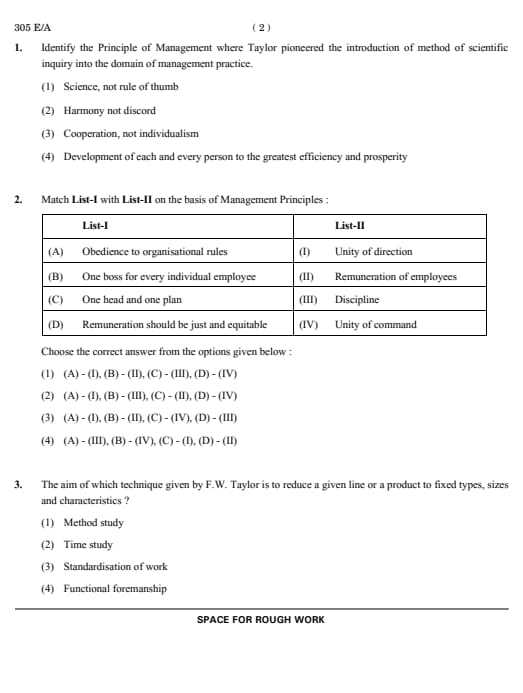


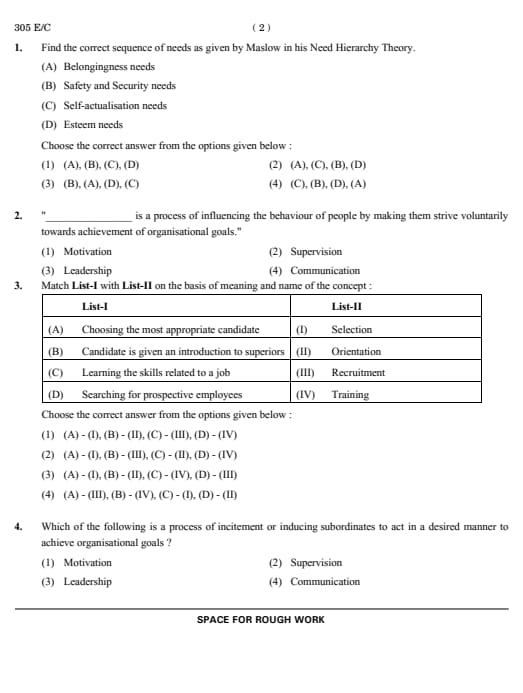
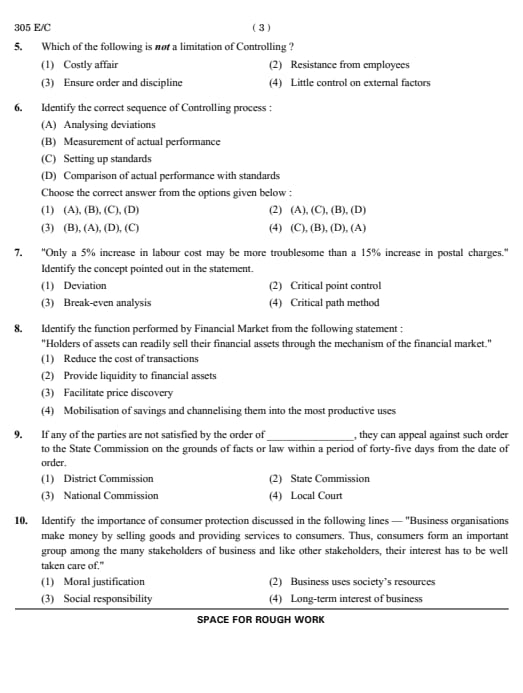
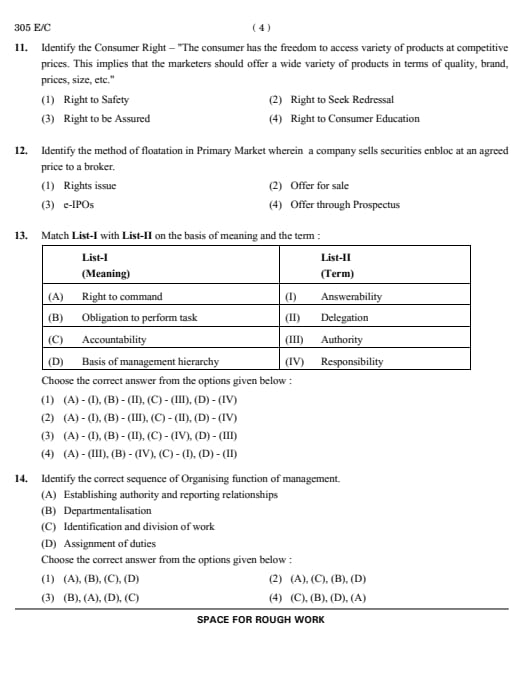
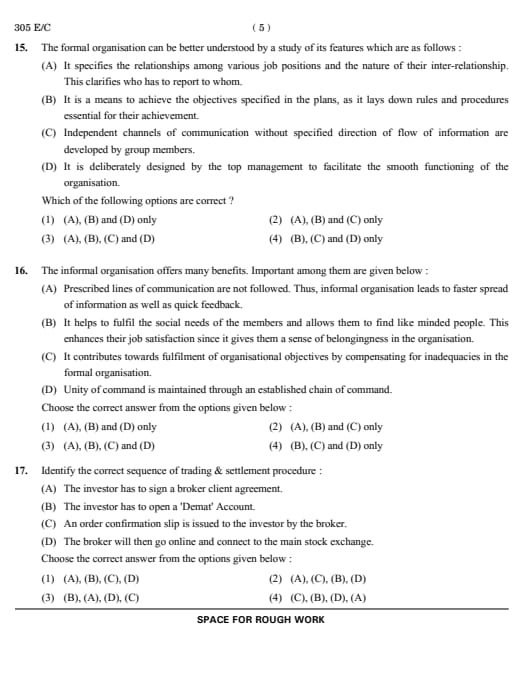
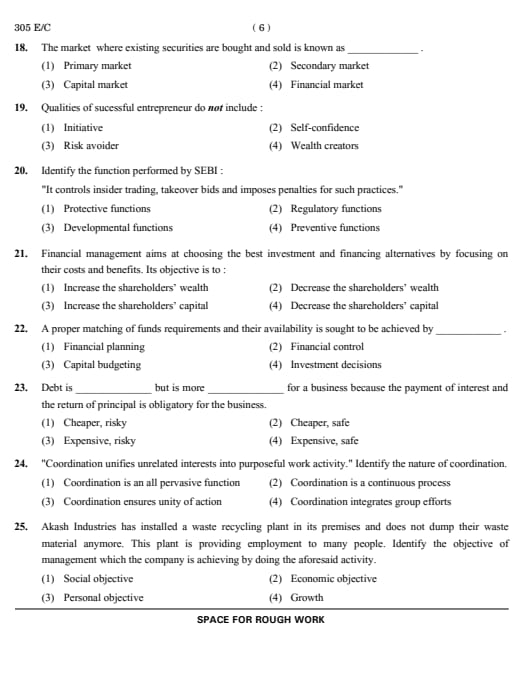
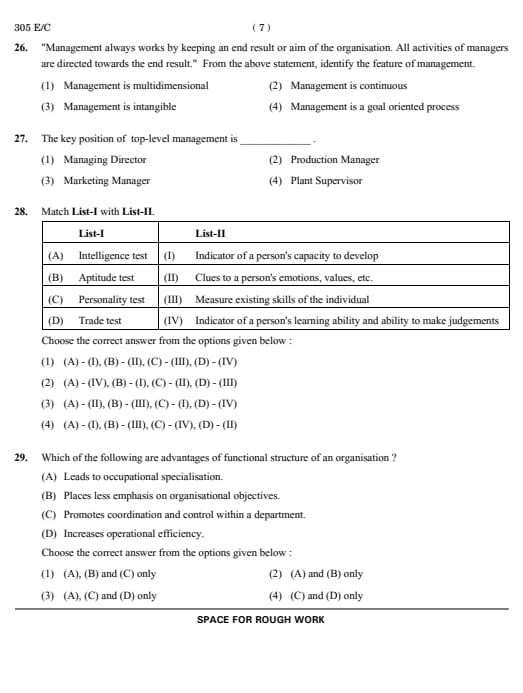
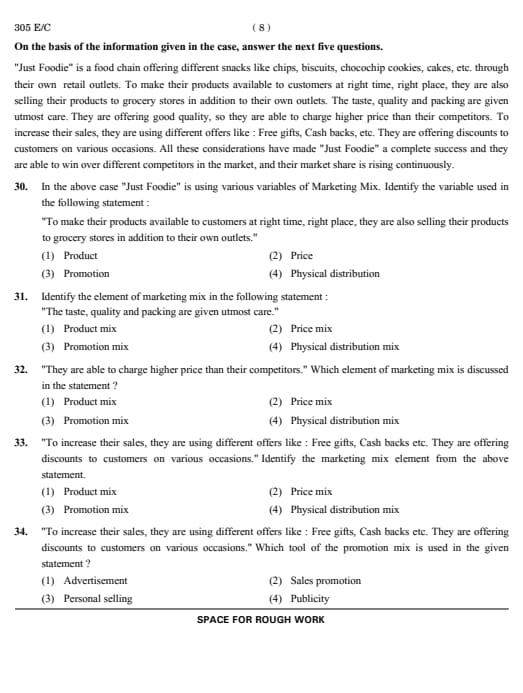
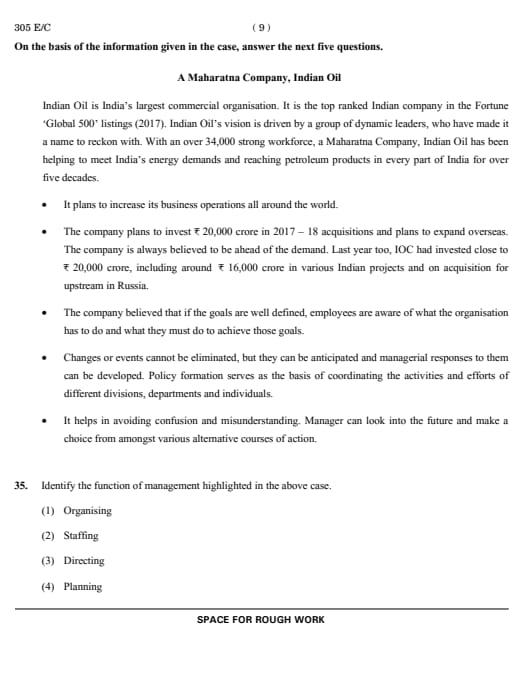
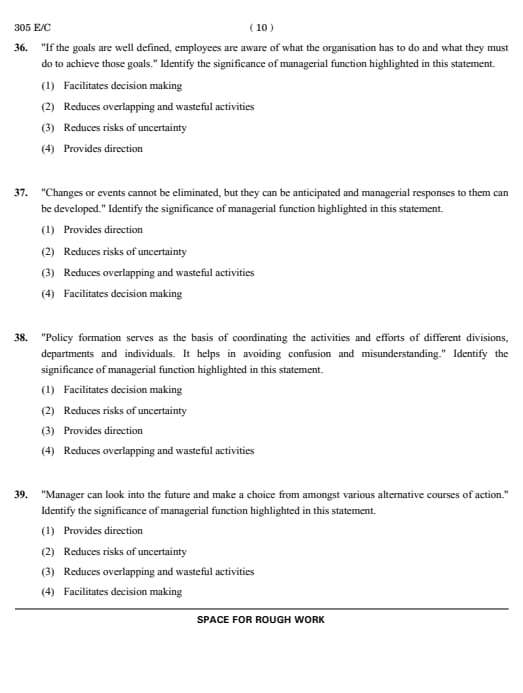
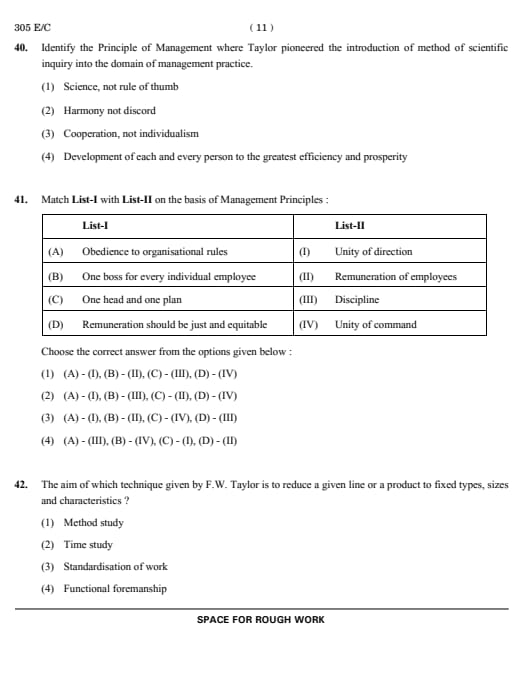
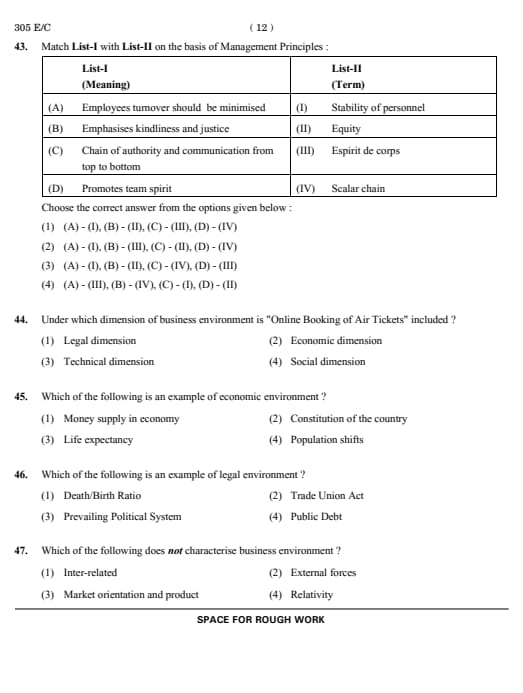
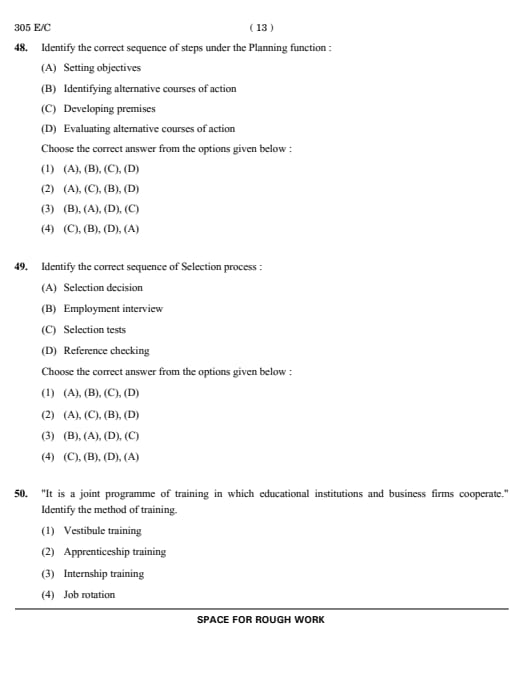


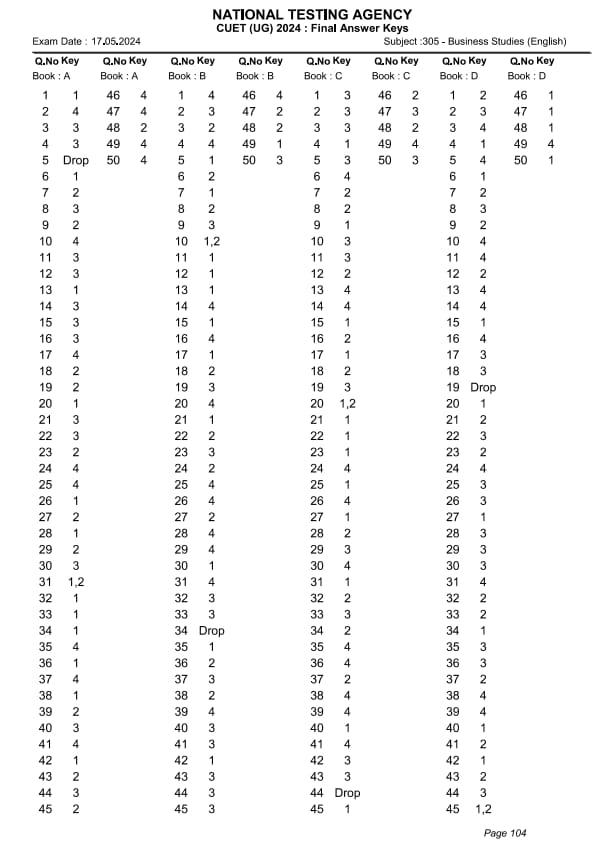
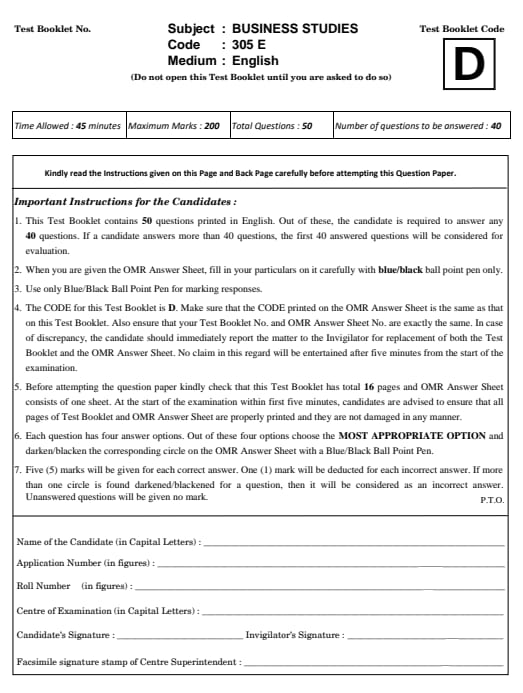
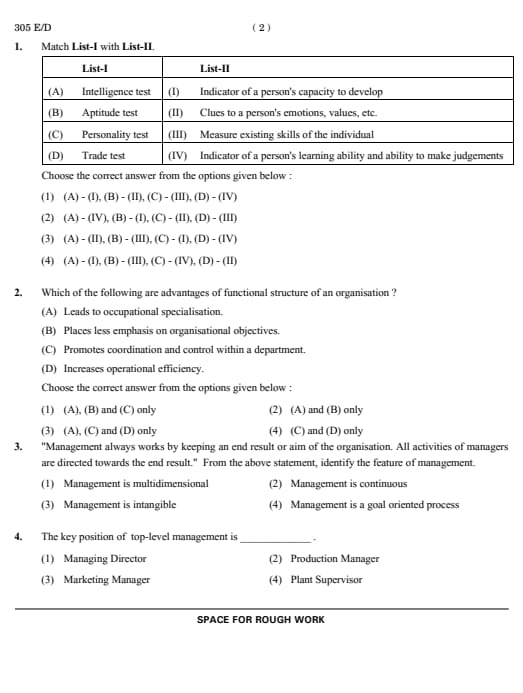
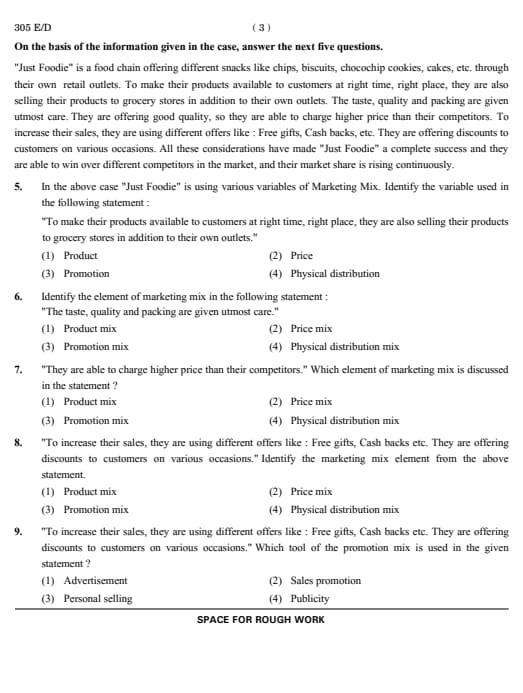
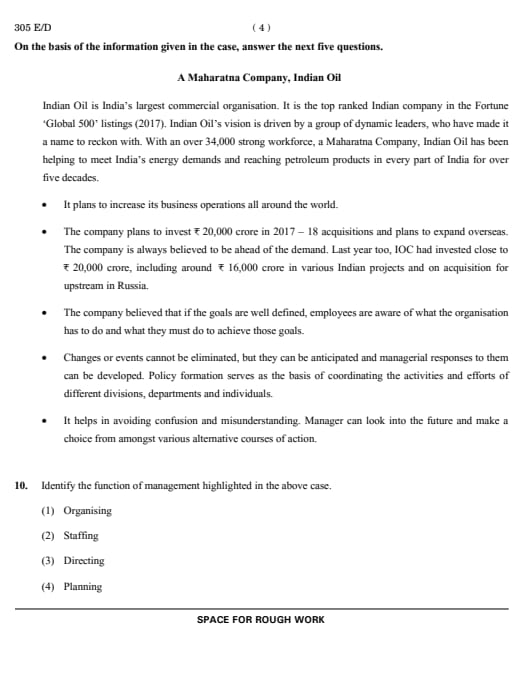
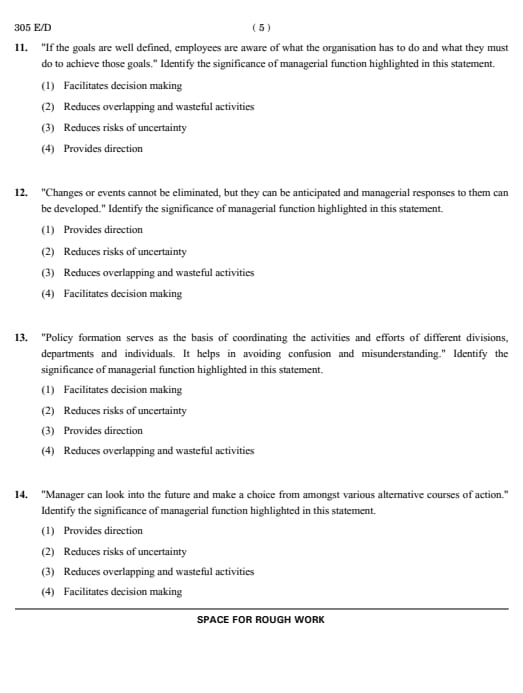
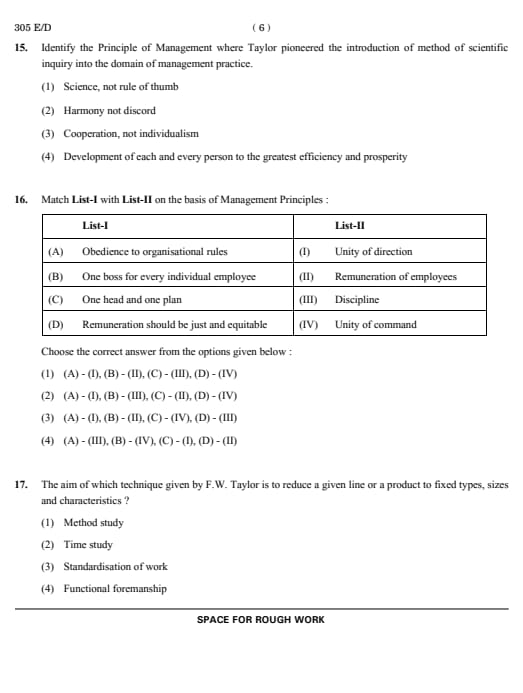
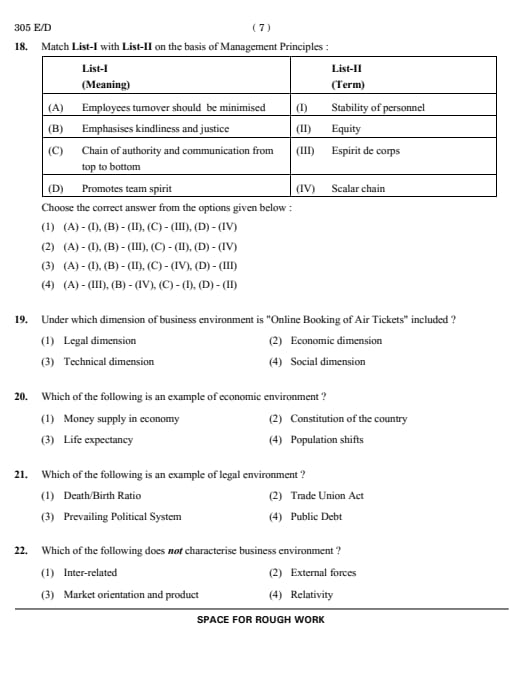
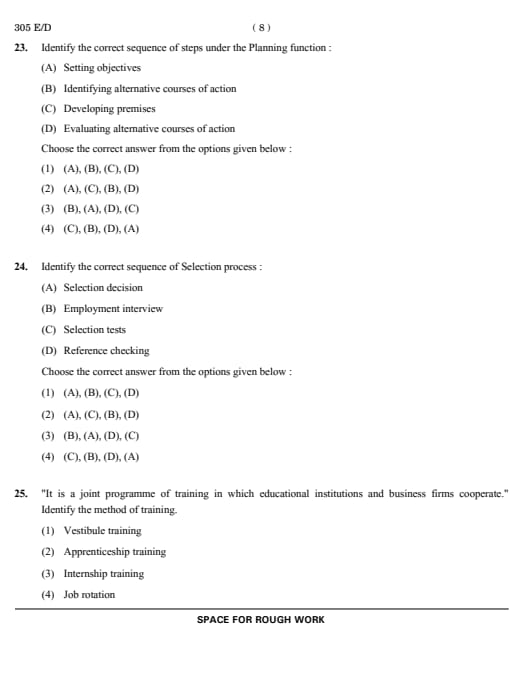
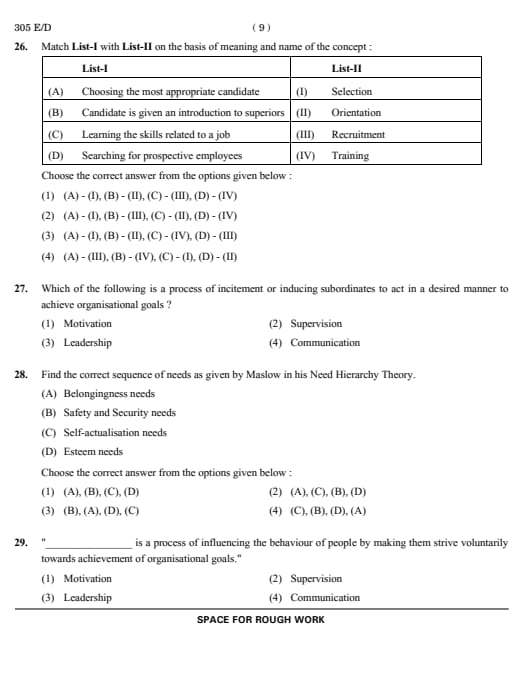
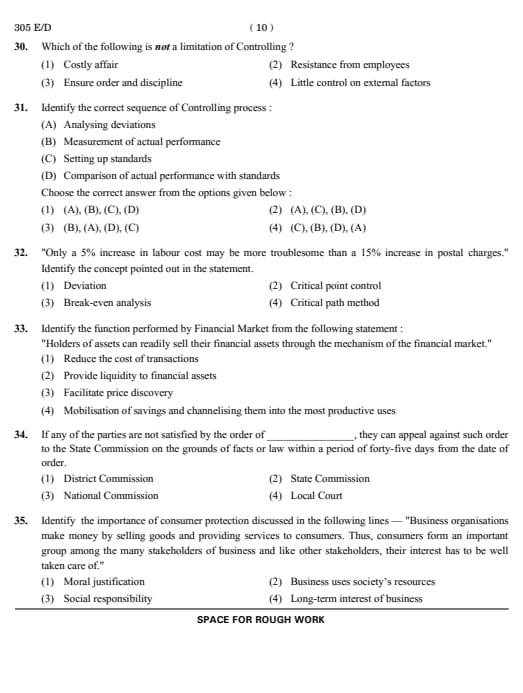
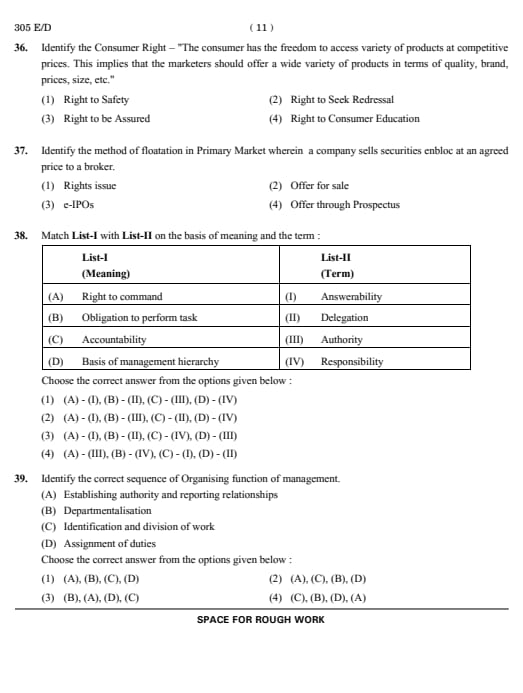
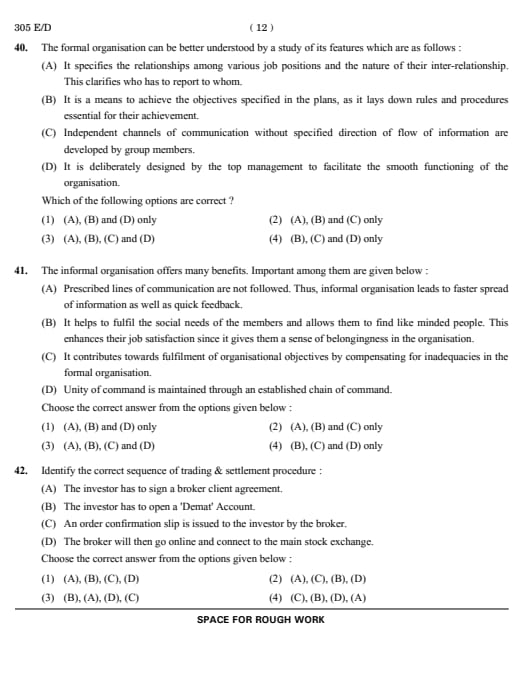
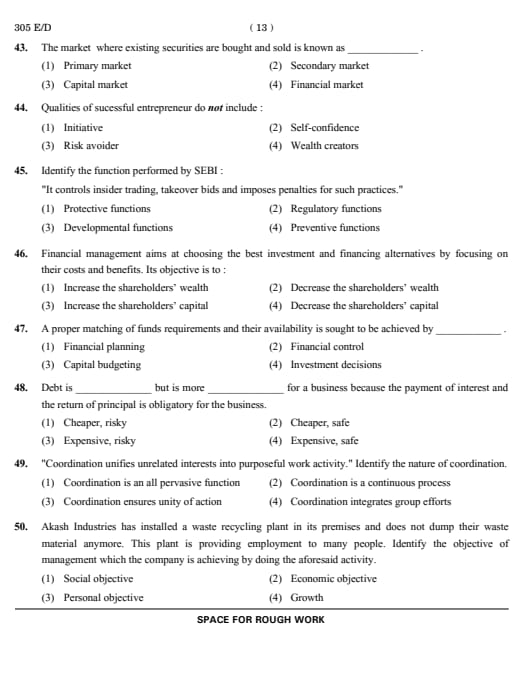


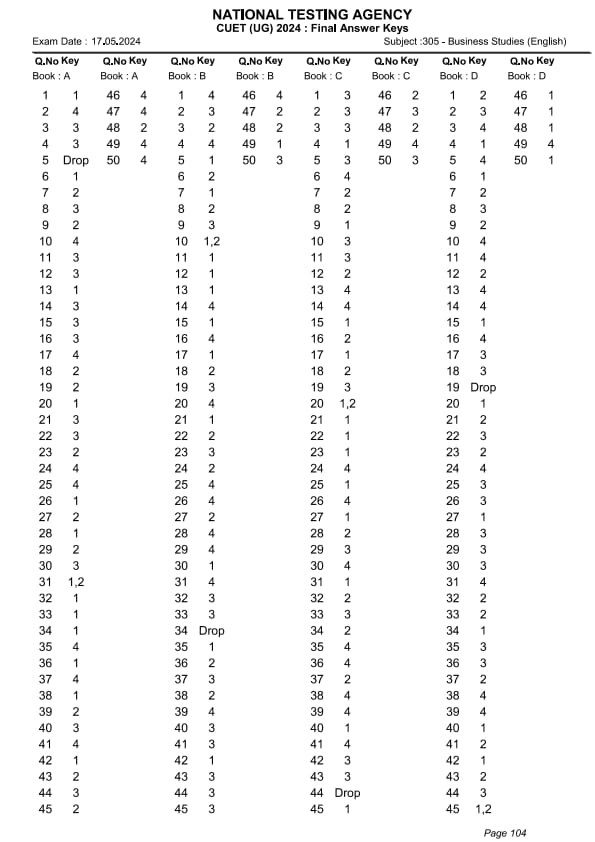
*The article might have information for the previous academic years, please refer the official website of the exam.