
CUET Fashion Studies Question Paper 2024 (Available)- Download Solutions and Answer Key pdf


Content Writer | Updated On - Dec 8, 2024
Download the CUET Fashion Studies Question Paper 2024 with Solutions PDF!. The NTA conducted the CUET 2024 Fashion Studies exam on May 21 during Shift 3. This question paper featured multiple-choice questions (MCQs) to evaluate candidates' knowledge. Participants had 45 minutes to attempt 40 out of 50 MCQs in the CUET 2024 Fashion Studies paper. Boost your preparation by reviewing this detailed question paper with solutions.
| CUET 2024 Fashion Studies Question Paper with Answer Key |  Download Download |
Check Solution |
CUET 2024 Fashion Studies Question Paper with Solution
| Question | Answer | Detailed Solution | ||||||||||
|---|---|---|---|---|---|---|---|---|---|---|---|---|
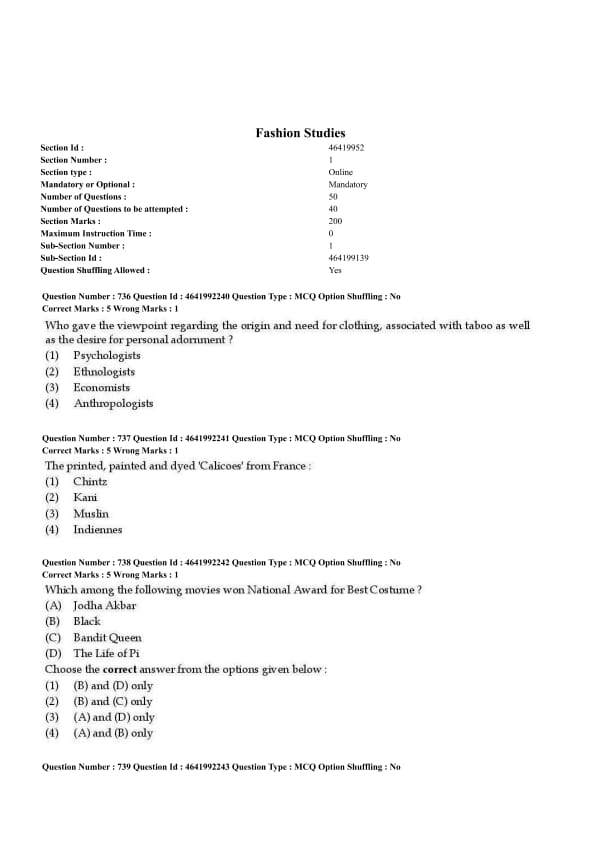
| 1. Who gave the viewpoint regarding the origin and need for clothing, associated with taboo as well as the desire for personal adornment? (1) Psychologists (2) Ethnologists (3) Economists (4) Anthropologists |
(4) Anthropologists | Anthropologists have studied the origin of clothing, linking it to both societal taboos and the human desire for personal adornment. | ||||||||||
| 2. The printed, painted, and dyed ’Calicoes’ from France are: (1) Chintz (2) Kani (3) Muslin (4) Indiennes |
(4) Indiennes | Indiennes are the printed, painted, and dyed cotton fabrics originally imported from France and later produced in India. | ||||||||||
| 3. Which among the following movies won the National Award for Best Costume? (1) Jodha Akbar (2) Black (3) Bandit Queen (4) The Life of Pi |
(2) Black and Bandit Queen | The National Award for Best Costume was awarded to the films 'Black' and 'Bandit Queen' for their exceptional costume design. | ||||||||||
| 4. Which of the following trims may need preshrinking? (1) Buttons (2) Laces (3) Studs (4) Hardware |
(2) Laces | Laces may need preshrinking to prevent shrinkage when they are later washed with the garment. | ||||||||||
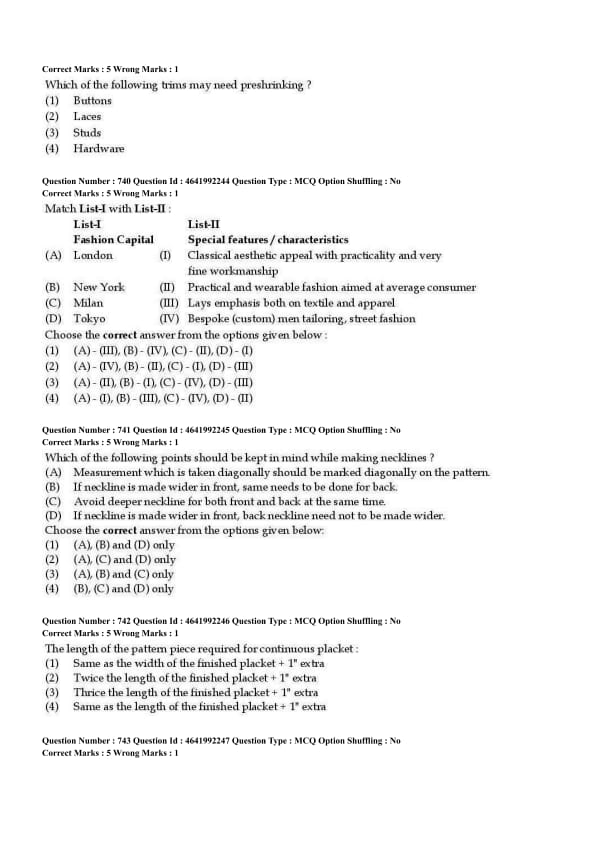
5. Match List-I with List-II:
1. (A)-(III), (B)-(IV), (C)-(II), (D)-(I) 2. (A)-(IV), (B)-(II), (C)-(I), (D)-(III) 3. (A)-(II), (B)-(I), (C)-(IV), (D)-(III) 4. (A)-(I), (B)-(III), (C)-(IV), (D)-(II) |
(2) (A)-(IV), (B)-(II), (C)-(I), (D)-(III) | London is known for bespoke tailoring and street fashion, New York for practical fashion, Milan for classic aesthetics and fine workmanship, and Tokyo for its focus on textiles and innovative apparel. | ||||||||||
|
Q6. Which of the following points should be kept in mind while making necklines? |
(2) A, C AND D only | The guidelines for neckline creation include avoiding overly deep necklines at both front and back, ensuring symmetry when adjusting front and back necklines, and maintaining proportions. | ||||||||||
| Q7. The length of the pattern piece required for a continuous placket: (1) Same as the width of the finished placket + 1 inch extra. (2) Twice the length of the finished placket + 1 inch extra. (3) Three times the length of the finished placket + 1 inch extra. (4) Same as the length of the finished placket + 1 inch extra. |
(2) Twice the length of the finished placket + 1 inch extra | For a continuous placket, the length is calculated as twice the finished placket length plus an additional inch for seams and hems. | ||||||||||
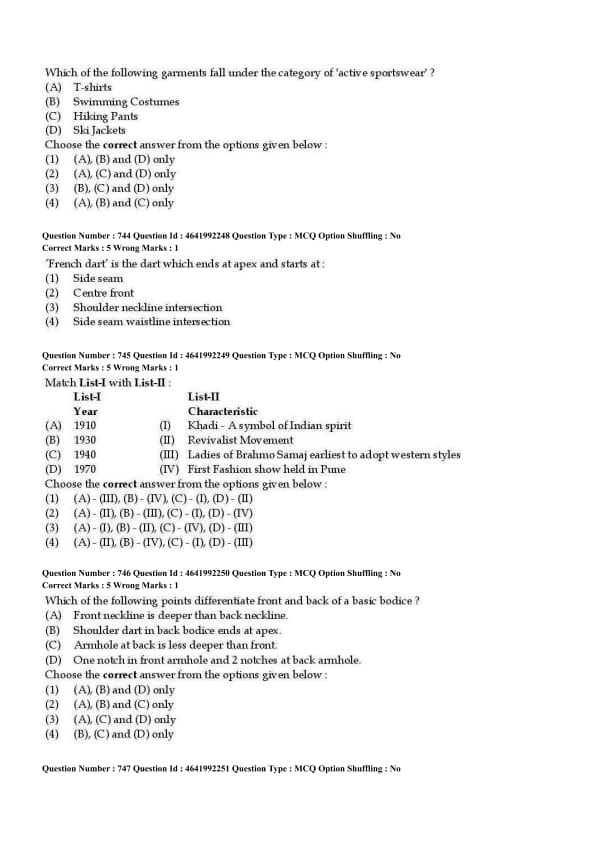
| Q8. Which of the following garments fall under the category of ‘active sportswear’? 1. T-shirts 2. Swimming Costumes 3. Hiking Pants 4. Ski Jackets (1) A, B AND D only (2) A, C AND D only (3) B, C AND D only (4) A, B, AND C only |
(3) B, C AND D only | Active sportswear includes garments such as swimming costumes, hiking pants, and ski jackets, designed for physical activities and comfort. | ||||||||||
| Q9. ‘French dart’ is the dart which ends at the apex and starts at: (1) Side seam (2) Centre front (3) Shoulder neckline intersection (4) Side seam waistline intersection |
(1) Side seam | A French dart is a diagonal dart starting from the side seam and ending at the apex of the bust. | ||||||||||
|
Q10. Match List-I with List-II: 1. (A)-(III), (B)-(IV), (C)-(I), (D)-(II) |
(2) (A)-(II), (B)-(III), (C)-(I), (D)-(IV) | The 1910 Revivalist Movement focused on Khadi as a symbol of Indian spirit, while Western styles were adopted by Brahmo Samaj ladies in 1940. The first fashion show in Pune took place in 1970. | ||||||||||
| Q11. Which of the following points differentiate the front and back of a basic bodice? 1. Front neckline is deeper than back neckline. 2. Shoulder dart in back bodice ends at apex. 3. Armhole at back is less deep than front. 4. One notch in front armhole and two notches at back armhole |
(3) (A), (C), and (D) only | The front neckline is deeper than the back neckline, the armhole at the back is less deep than the front, and one notch is found in the front armhole, while two notches are at the back armhole. | ||||||||||
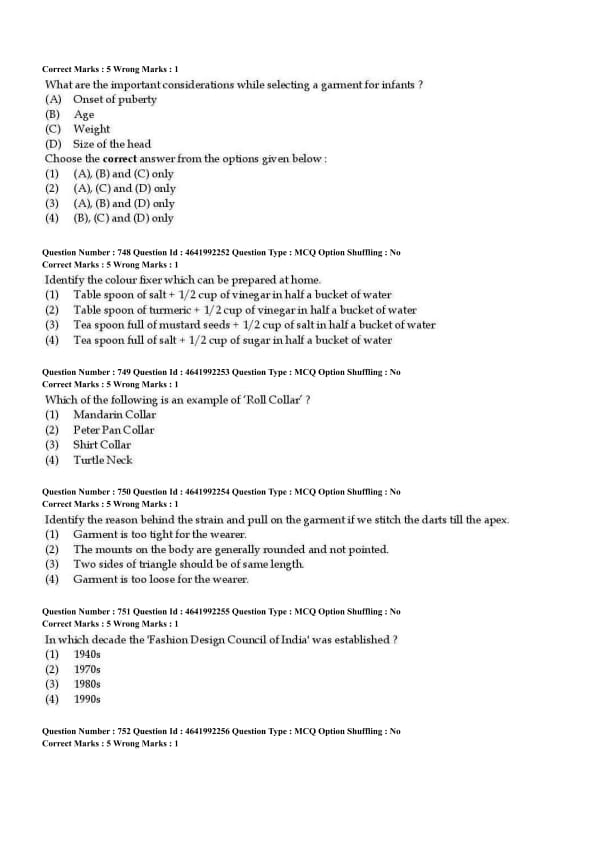
| Q12. What are the important considerations while selecting a garment for infants? 1. Onset of puberty 2. Age 3. Weight 4. Size of the head |
(4) (B), (C), and (D) only | Age, weight, and head size are crucial factors when selecting garments for infants, not the onset of puberty. | ||||||||||
| Q13. Identify the color fixer which can be prepared at home. 1. Tablespoon of salt + 1 /2 cup of vinegar in half a bucket of water. 2. Tablespoon of turmeric + 1 /2 cup of vinegar in half a bucket of water. 3. Teaspoon of mustard seeds + 1 /2 cup of salt in half a bucket of water. 4. Teaspoon of salt + 1 /2 cup of sugar in half a bucket of water. |
(1) Tablespoon of salt + 1 /2 cup of vinegar in half a bucket of water | A color fixer made of salt and vinegar can be prepared at home to set fabric colors. | ||||||||||
| Q14. Which of the following is an example of a 'Roll Collar'? 1. Mandarin Collar 2. Peter Pan Collar 3. Shirt Collar 4. Turtle Neck |
(3) Shirt Collar | A shirt collar is an example of a roll collar, which has a rounded shape and rolls over slightly. | ||||||||||
| Q15. Identify the reason behind the strain and pull on the garment if we stitch the darts till the apex. 1. Garment is too tight for the wearer. 2. The mounts on the body are generally rounded and not pointed. 3. Two sides of the triangle should be of the same length. 4. Garment is too loose for the wearer. |
(2) The mounts on the body are generally rounded and not pointed. | When darts are stitched too much towards the apex, it causes strain due to the body's rounded shape, not pointed features. | ||||||||||
| Q16. In which decade was the 'Fashion Design Council of India' established? 1. 1940s 2. 1970s 3. 1980s 4. 1990s |
(4) 1990s | The Fashion Design Council of India (FDCI) was established in the 1990s to promote and support Indian fashion designers. | ||||||||||
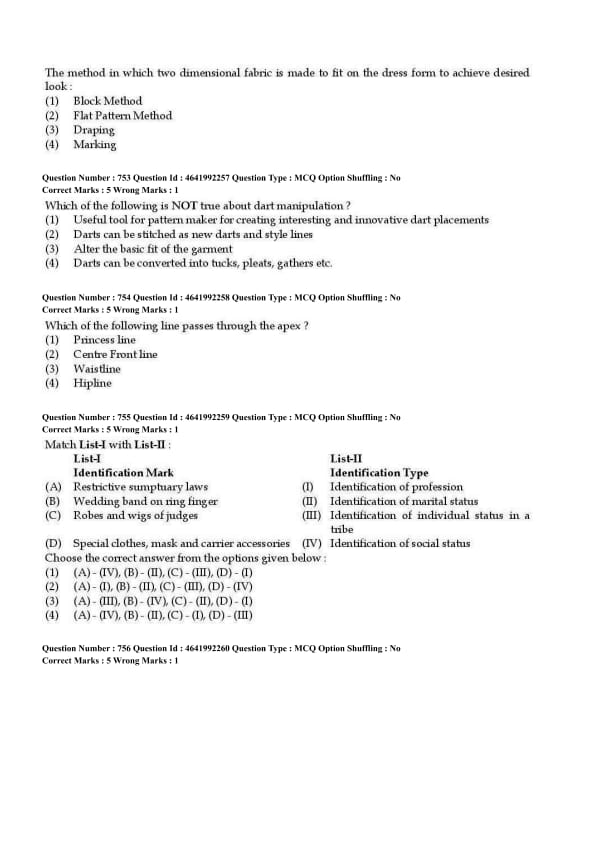
| Q17. The method in which two-dimensional fabric is made to fit on the dress form to achieve a desired look: 1. Block Method 2. Flat Pattern Method 3. Draping 4. Marking |
(3) Draping | Draping is a technique where fabric is arranged on a dress form to create the desired shape or design. | ||||||||||
| Q18. Which of the following is NOT true about dart manipulation? 1. Useful tool for pattern maker for creating interesting and innovative dart placements 2. Darts can be stitched as new darts and style lines 3. Alter the basic fit of the garment 4. Darts can be converted into tucks, pleats, gathers, etc. |
(3) Alter the basic fit of the garment | Dart manipulation is not primarily used to alter the basic fit but to create new styles and shapes in garments. | ||||||||||
| Q19. Which of the following lines passes through the apex? 1. Princess line 2. Centre Front line 3. Waistline 4. Hipline |
(1) Princess line | The princess line is a seam line that passes through the apex of the bust, shaping the garment. | ||||||||||
| Q20. Match List-I with List-II: List-I (Identification Mark) (A) Restrictive sumptuary laws (B) Wedding band on ring finger (C) Robes and wigs of judges (D) Special clothes, mask, and carrier accessories List-II (Identification Type) (I) Identification of profession (II) Identification of marital status (III) Identification of individual status in a tribe (IV) Identification of social status Options: 1. (A)-(IV), (B)-(II), (C)-(III), (D)-(I) 2. (A)-(I), (B)-(II), (C)-(III), (D)-(IV) 3. (A)-(III), (B)-(IV), (C)-(II), (D)-(I) 4. (A)-(IV), (B)-(II), (C)-(I), (D)-(III) |
(1) (A)-(IV), (B)-(II), (C)-(III), (D)-(I) | Matching the identification marks with their respective types based on traditional and social classifications. | ||||||||||
|
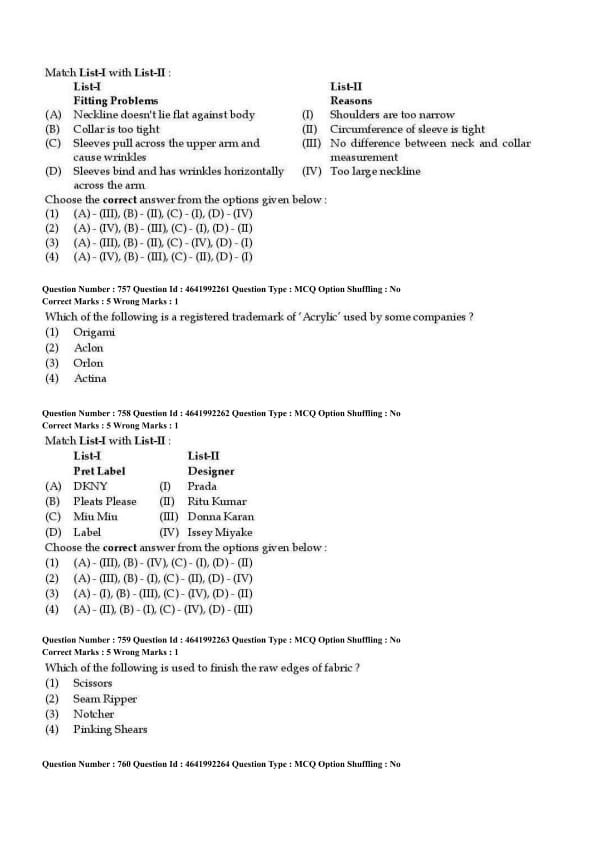
Q21. Match List-I with List-II
1. (A)-(III), (B)-(II), (C)-(I), (D)-(IV) |
(2) (A)-(IV), (B)-(III), (C)-(I), (D)-(II) | Fitting problems are caused by issues like neckline size, shoulder width, sleeve circumference, and general fit. | ||||||||||
| Q22. Which of the following is a registered trademark of ‘Acrylic’ used by some companies? 1. Origami 2. Aclon 3. Orlon 4. Actina |
(3) Orlon | Orlon is a registered trademark for a specific brand of acrylic fibers used in textiles. | ||||||||||
| Q23. Match List-I with List-II: List-I (Pret Label) (A) DKNY (B) Pleats Please (C) Miu Miu (D) Label List-II (Designer) (I) Prada (II) Ritu Kumar (III) Donna Karan (IV) Issey Miyake Options: 1. (A)-(III), (B)-(IV), (C)-(I), (D)-(II) 2. (A)-(III), (B)-(I), (C)-(II), (D)-(IV) 3. (A)-(I), (B)-(III), (C)-(IV), (D)-(II) 4. (A)-(II), (B)-(I), (C)-(IV), (D)-(III) |
(1) (A)-(III), (B)-(IV), (C)-(I), (D)-(II) | Matching the Pret labels with their corresponding designers based on the brand's history and association. | ||||||||||
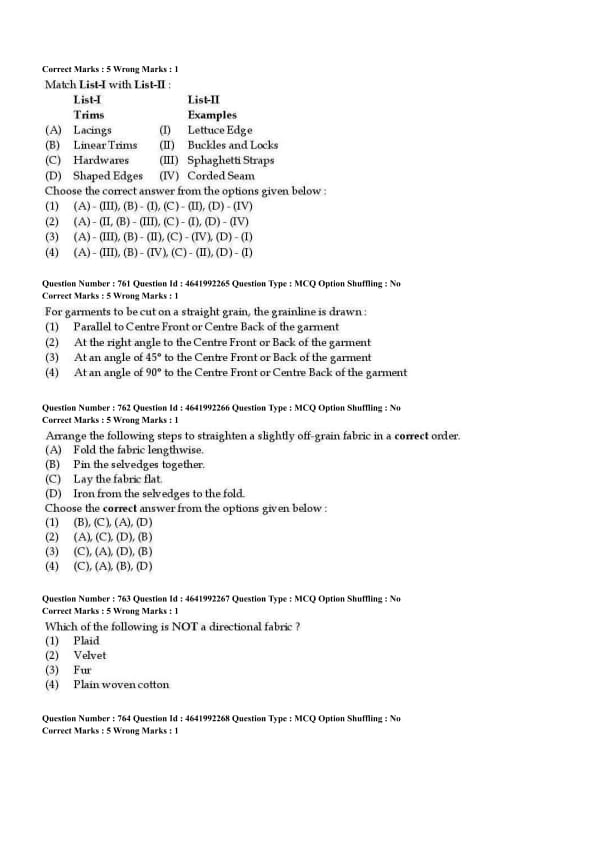
| Q24. Which of the following is used to finish the raw edges of fabric? 1. Scissors 2. Seam Ripper 3. Notcher 4. Pinking Shears |
(4) Pinking Shears | Pinking shears are special scissors used to trim raw fabric edges and prevent fraying. | ||||||||||
| Q25. Match List-I with List-II: List-I (Trims) (A) Lacings (B) Linear Trims (C) Hardwares (D) Shaped Edges List-II (Examples) (I) Lettuce Edge (II) Buckles and Locks (III) Spaghetti Straps (IV) Corded Seam Options: 1. (A)-(III), (B)-(I), (C)-(II), (D)-(IV) 2. (A)-(II), (B)-(III), (C)-(I), (D)-(IV) 3. (A)-(III), (B)-(II), (C)-(IV), (D)-(I) 4. (A)-(III), (B)-(IV), (C)-(II), (D)-(I) |
(4) (A)-(III), (B)-(IV), (C)-(II), (D)-(I) | Trims and their corresponding examples are matched based on their function in garment design. | ||||||||||
| Q26. For garments to be cut on a straight grain, the grainline is drawn: 1. Parallel to Centre Front or Centre Back of the garment 2. At the right angle to the Centre Front or Back of the garment 3. At an angle of 45° to the Centre Front or Back of the garment 4. At an angle of 90° to the Centre Front or Centre Back of the garment |
(1) Parallel to Centre Front or Centre Back of the garment | The grainline is drawn parallel to the centre front or back to ensure proper fabric orientation during cutting. | ||||||||||
| Q27. Arrange the following steps to straighten a slightly off-grain fabric in the correct order: 1. Fold the fabric lengthwise. 2. Pin the selvedges together. 3. Lay the fabric flat. 4. Iron from the selvedges to the fold. |
(4) (C), (A), (B), (D) | The correct order is to lay the fabric flat, fold it lengthwise, pin the selvedges, and then iron. | ||||||||||
| Q28. Which of the following is NOT a directional fabric? 1. Plaid 2. Velvet 3. Fur 4. Plain woven cotton |
(4) Plain woven cotton | Plain woven cotton is a non-directional fabric, meaning it can be cut in any direction. | ||||||||||
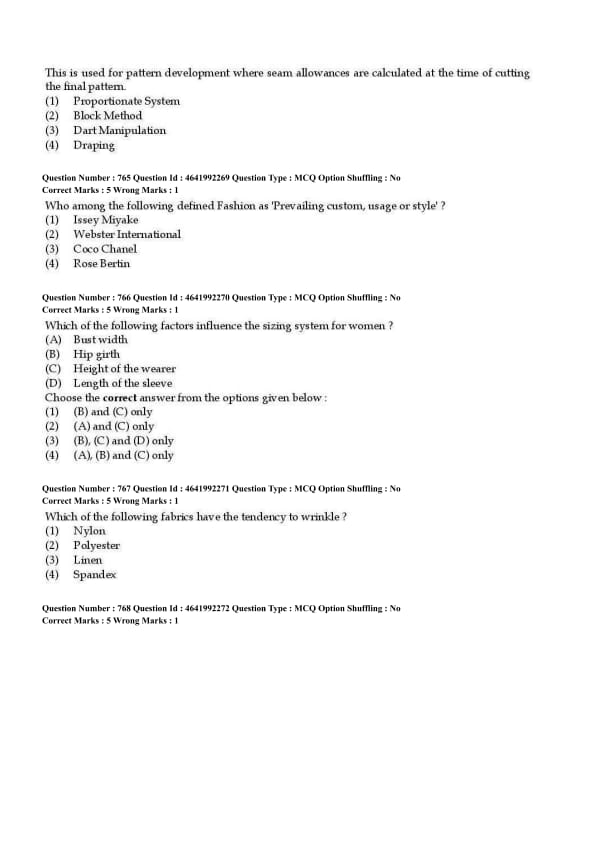
| Q29. This is used for pattern development where seam allowances are calculated at the time of cutting the final pattern: 1. Proportionate System 2. Block Method 3. Dart Manipulation 4. Draping |
(2) Block Method | The Block Method involves adding seam allowances during the cutting of the final pattern. | ||||||||||
| Q30. Who among the following defined Fashion as ‘Prevailing custom, usage or style’? 1. Issey Miyake 2. Webster International 3. Coco Chanel 4. Rose Bertin |
(2) Webster International | Webster International defines fashion as the prevailing custom or style that is widely accepted in society. | ||||||||||
| Q31. Which of the following factors influence the sizing system for women? 1. Bust width 2. Hip girth 3. Height of the wearer 4. Length of the sleeve options. 1. B and C only 2. A and C only 3. B, C and D only 4. A, B and C only |
(4) (A), (B), and (C) only | The sizing system for women is primarily influenced by measurements like bust width, hip girth, and height of the wearer. | ||||||||||
| Q32. Which of the following fabrics have the tendency to wrinkle? 1. Nylon 2. Polyester 3. Linen 4. Spandex |
(3) Linen | Linen is a fabric that tends to wrinkle easily due to its natural fibers. | ||||||||||
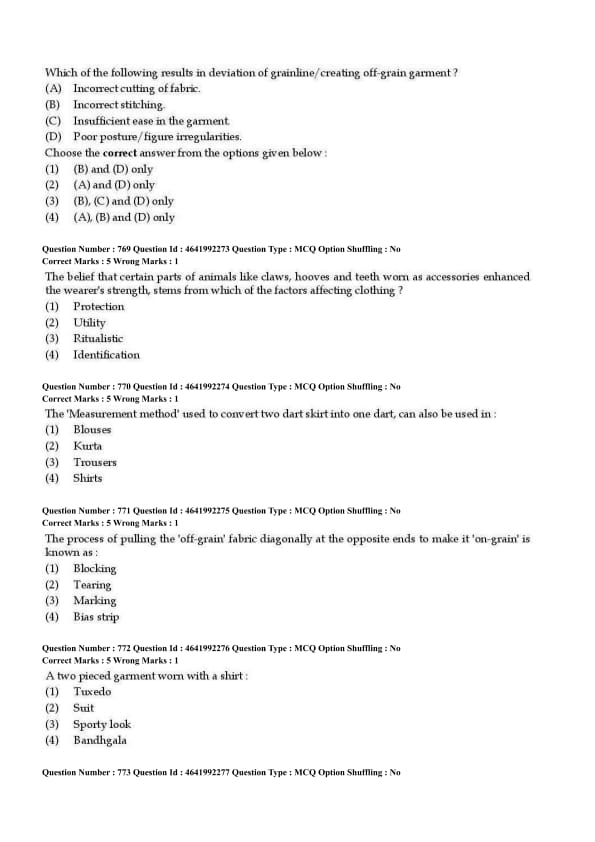
| Q33. Which of the following results in deviation of grainline/creating off-grain garment? 1. Incorrect cutting of fabric. 2. Incorrect stitching. 3. Insufficient ease in the garment. 4. Poor posture/figure irregularities. options (1) B and D only (2) A and D only (3) B, C and D only (4) (A), (B), and (D) only |
(4) (A), (B), and (D) only | Deviation of the grainline can result from incorrect cutting, stitching, and poor posture/figure irregularities. | ||||||||||
| Q34. The belief that certain parts of animals like claws, hooves, and teeth worn as accessories enhanced the wearer’s strength, stems from which of the factors affecting clothing? 1. Protection 2. Utility 3. Ritualistic 4. Identification |
(3) Ritualistic | The belief in wearing animal parts for strength is rooted in ritualistic practices that symbolize power or protection. | ||||||||||
| Q35. The ’Measurement method’ used to convert a two-dart skirt into one dart, can also be used in: 1. Blouses 2. Kurta 3. Trousers 4. Shirts |
(1) Blouses | The measurement method used for dart conversion is typically applied to blouses. | ||||||||||
| Q36. The process of pulling the ’off-grain’ fabric diagonally at the opposite ends to make it ’on-grain’ is known as: 1. Blocking 2. Tearing 3. Marking 4. Bias strip |
(1) Blocking | Blocking is the process of adjusting fabric to align with its grain to ensure proper fit and drape. | ||||||||||
| Q37. A two-piece garment worn with a shirt: 1. Tuxedo 2. Suit 3. Sporty look 4. Bandhgala |
(2) Suit | A suit typically consists of a jacket and trousers worn with a shirt. | ||||||||||
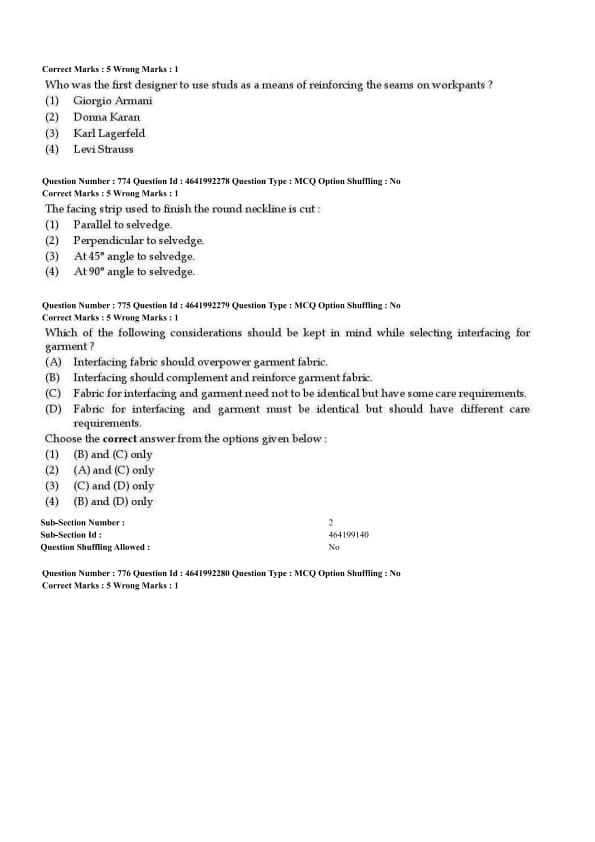
| Q38. Who was the first designer to use studs as a means of reinforcing the seams on work pants? 1. Giorgio Armani 2. Donna Karan 3. Karl Lagerfeld 4. Levi Strauss |
(4) Levi Strauss | Levi Strauss is credited with using studs to reinforce seams on work pants, an innovation that led to the creation of jeans. | ||||||||||
| Q39. The facing strip used to finish the round neckline is cut: 1. Parallel to selvedge 2. Perpendicular to selvedge 3. At 45° angle to selvedge 4. At 90° angle to selvedge |
(3) At 45° angle to selvedge | The facing strip for a round neckline is cut at a 45° angle to the selvedge to allow it to curve smoothly. | ||||||||||
| Q40. Which of the following considerations should be kept in mind while selecting interfacing for a garment? 1. Interfacing fabric should overpower garment fabric. 2. Interfacing should complement and reinforce garment fabric. 3. Fabric for interfacing and garment need not be identical but have similar care requirements. 4. Fabric for interfacing and garment must be identical but have different care requirements. Options 1. B and C only 2. A and C only 3. C and D only 4. B and D only |
(1) (B) and (C) only | Interfacing should complement and reinforce the garment fabric, and both fabrics should have similar care requirements. | ||||||||||
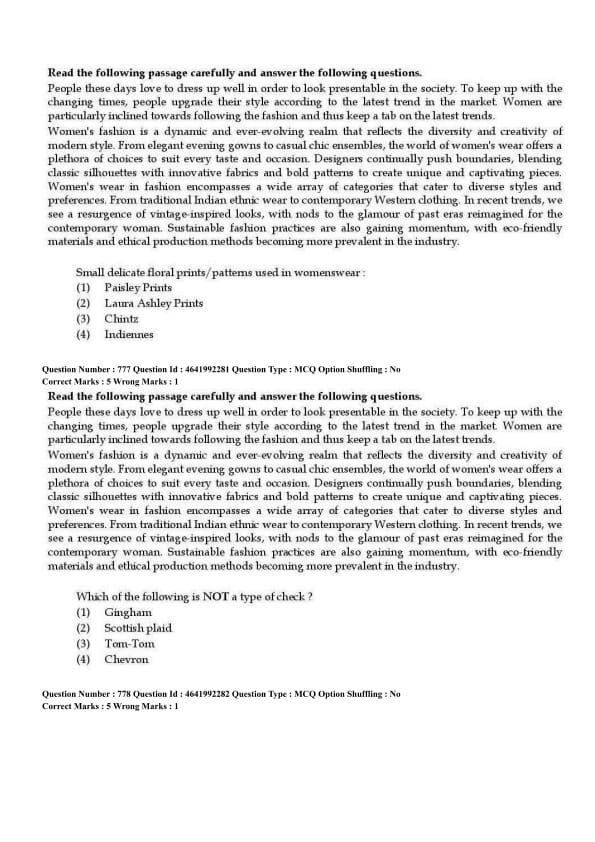
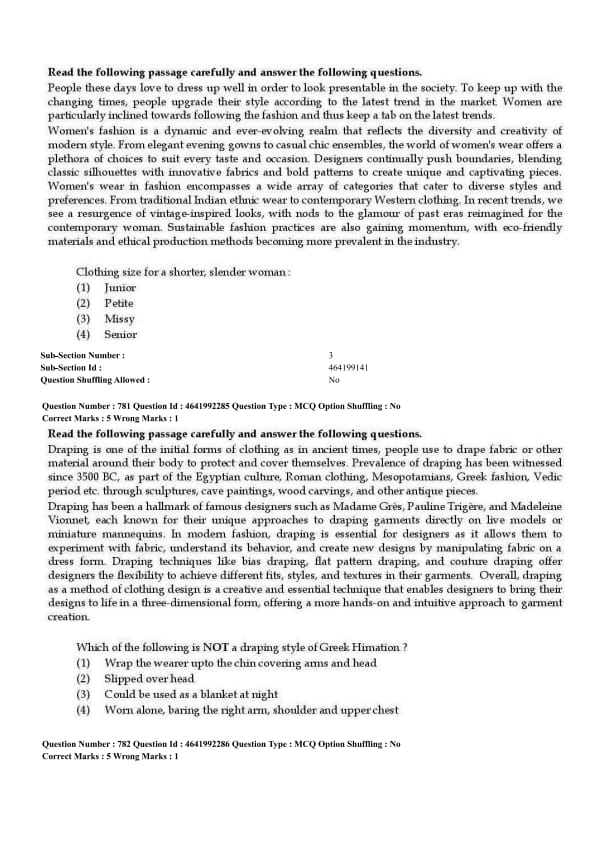
Read the following passage carefully and answer the following questions. People these days love to dress up well in order to look presentable in society. To keep up with the changing times, people upgrade their style according to the latest trends in the market. Women are particularly inclined towards following fashion and thus keep a tab on the latest trends. Women’s fashion is a dynamic and ever-evolving realm that reflects the diversity and creativity of modern style. From elegant evening gowns to casual chic ensembles, the world of women’s wear offers a plethora of choices to suit every taste and occasion. Designers continually push boundaries, blending classic silhouettes with innovative fabrics and bold 27 patterns to create unique and captivating pieces. Women’s wear in fashion encompasses a wide array of categories that cater to diverse styles and preferences, from traditional Indian ethnic wear to contemporary Western clothing. In recent trends, we see a resurgence of vintage-inspired looks, with nods to the glamour of past eras reimagined for the contemporary woman. Sustainable fashion practices are also gaining momentum, with eco-friendly materials and ethical production methods becoming more prevalent in the industry Q41. Small delicate floral prints/patterns used in womenswear: 1. Paisley Prints 2. Laura Ashley Prints 3. Chintz 4. Indiennes |
(2) Laura Ashley Prints | Laura Ashley prints are known for their small delicate floral patterns, which are a popular choice in womenswear. | ||||||||||
| Q42. Which of the following is NOT a type of check? 1. Gingham 2. Scottish plaid 3. Tom-Tom 4. Chevron |
(4) Chevron | Chevron is a pattern with a V-shaped design, while gingham, Scottish plaid, and Tom-Tom are different types of check patterns. | ||||||||||
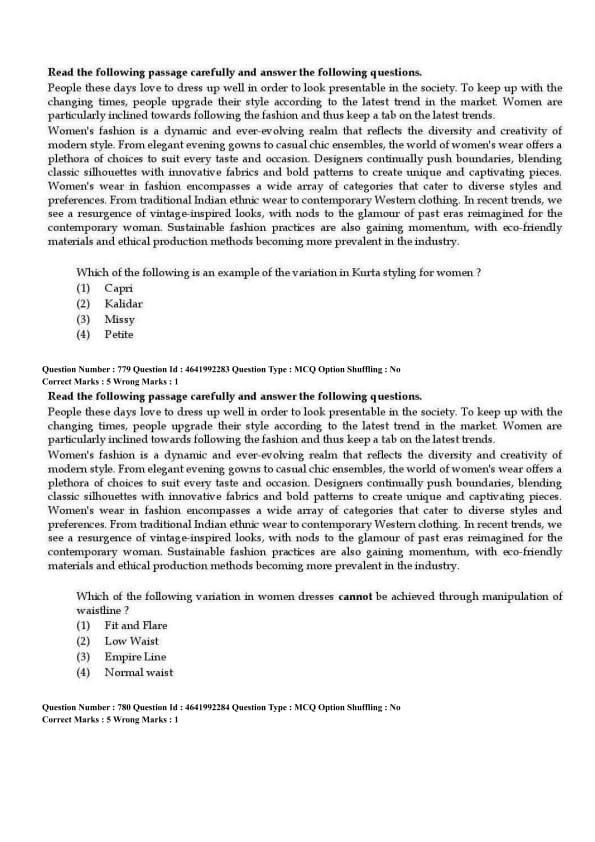
| Q43. Which of the following is an example of the variation in Kurta styling for women? 1. Capri 2. Kalidar 3. Missy 4. Petite |
(2) Kalidar | Kalidar is a variation in kurta styling where multiple panels are stitched together, creating a flared effect. | ||||||||||
| Q44. Which of the following variations in women’s dresses cannot be achieved through manipulation of the waistline? 1. Fit and Flare 2. Low Waist 3. Empire Line 4. Normal Waist |
(1) Fit and Flare | The "Fit and Flare" silhouette is achieved through the cut of the dress, not by manipulating the waistline. | ||||||||||
| Q45. Clothing size for a shorter, slender woman: 1. Junior 2. Petite 3. Missy 4. Senior |
(2) Petite | The "Petite" size is designed for shorter, slender women and is proportionally smaller than regular sizes. | ||||||||||
| Q46. Which of the following is NOT a draping style of Greek Himation? 1. Wrap the wearer up to the chin covering arms and head 2. Slipped over head 3. Could be used as a blanket at night 4. Worn alone, baring the right arm, shoulder, and upper chest |
(2) Slipped over head | The Greek Himation was typically draped around the body, covering the arms and shoulders, but not slipped over the head. | ||||||||||
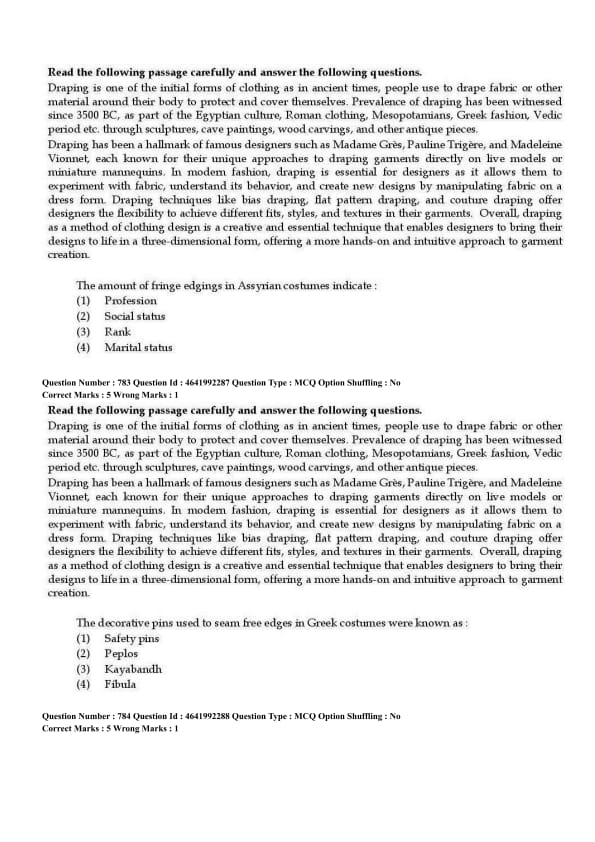
| Q47. The amount of fringe edgings in Assyrian costumes indicate: 1. Profession 2. Social status 3. Rank 4. Marital status |
(3) Rank | The fringe edgings in Assyrian costumes were used to signify the wearer's rank, with higher-ranking individuals having more elaborate decorations. | ||||||||||
| Q48. The decorative pins used to seam free edges in Greek costumes were known as: 1. Safety pins 2. Peplos 3. Kayabandh 4. Fibula |
(4) Fibula | Fibulae were decorative pins used in ancient Greek clothing to hold garments together at the seams. | ||||||||||
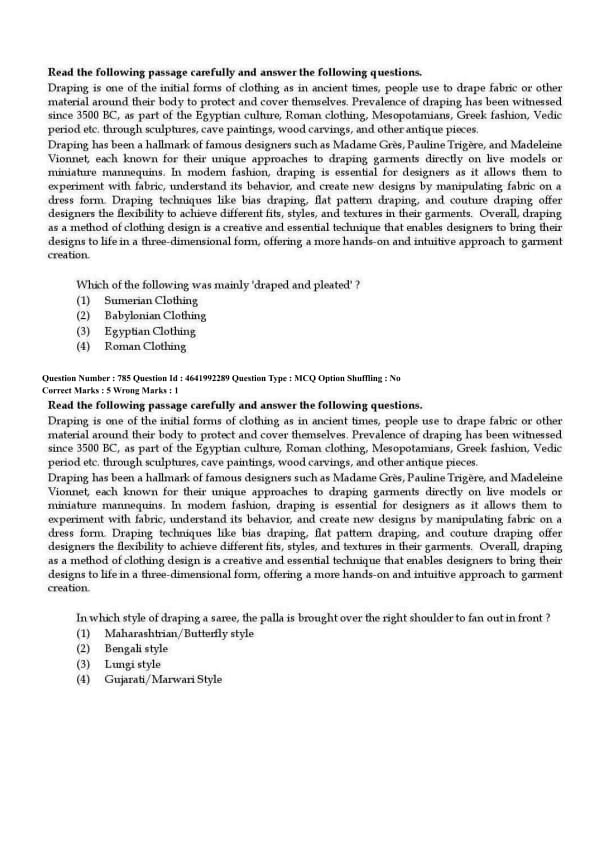
| Q49. Which of the following was mainly ‘draped and pleated’? 1. Sumerian Clothing 2. Babylonian Clothing 3. Egyptian Clothing 4. Roman Clothing |
(4) Roman Clothing | Roman clothing, especially the toga, was primarily draped and pleated, forming a distinct silhouette. | ||||||||||
| Q50. In which style of draping a saree, the palla is brought over the right shoulder to fan out in front? 1. Maharashtrian/Butterfly style 2. Bengali style 3. Lungi style 4. Gujarati/Marwari Style |
(4) Gujarati/Marwari Style | In the Gujarati/Marwari style of draping a saree, the palla is draped over the right shoulder and fanned out in front of the body. |
*The article might have information for the previous academic years, please refer the official website of the exam.