
CUET History Question Paper 2024 Download Solutions and Answer Key pdf (May 18 - Shift 1)


| Updated On - Dec 8, 2024
CUET Question Papers are the most important study material for effective exam preparation. We at Zollege have provided all CUET Previous Year Papers with Solution PDFs here. CUET 2024 History was conducted successfully on May 18 by NTA.
Students can freely download the CUET previous year's question paper PDFs along with their solutions here. We strongly encourage cuet aspirants to scan through all the CUET Question Paper to know the overall difficulty level, CUET Syllabus and understand the changes in CUET Exam Pattern over the years.
CUET 2024 History Question Paper with Answer Key PDF
| CUET 2024 History Question Paper Set A with Answer Key |  Download Download |
Check Solution |
| CUET 2024 History Question Paper Set B with Answer Key | Download |
Check Solution |
| CUET 2024 History Question Paper Set C with Answer Key | Download |
Check Solution |
| CUET 2024 History Question Paper Set D with Answer Key | Download |
Check Solution |
| CUET 2024 History Online Question Paper with Answer Key | Download |
Check Solution |
CUET 2024 History Question with Solution Set A
| Question | Answer | Detailed Solution |
|---|---|---|
| Question 1: Which Sufi teacher was also known as the ‘Gharib Nawaz’? (1) Shaikh Nizamuddin Auliya (2) Khwaja Muinuddin (3) Amir Khusrau (4) Shaikh Qutbuddin Bakhtiyar Kaki |
(2) Khwaja Muinuddin | Khwaja Muinuddin was a prominent Sufi saint of the Chishti order in India. He is known as 'Gharib Nawaz', which means benefactor of the poor. |
| Question 2: Lord Jagannatha is a form of which God? (1) Surya (2) Vishnu (3) Shiva (4) Brahma |
(2) Vishnu | Lord Jagannatha is a form of Vishnu, worshipped primarily in Puri, Odisha, at the famous Jagannath Temple. |
| Question 3: Which among the following travelers visited the city of Vijayanagara during the 15th century? (A) Domingo Paes (B) Abdur Razzaq (C) Afanasii Nikitin (D) Fernao Nuniz (E) Nicolo de Conti |
(A), (B), and (D) only | Domingo Paes, Abdur Razzaq, and Fernao Nuniz visited Vijayanagara during its peak and left valuable descriptions of its wealth and grandeur. |
| Question 4: Madras, Bombay, and Calcutta were the anglicized names of where the British first set up trading posts. (1) Cities (2) Villages (3) Towns (4) Capitals |
(1) Cities | The British East India Company established its trading posts in the cities of Madras, Bombay, and Calcutta, which later grew into major centers of British colonial administration. |
| Question 5: Which of the following statements are correct? (A) Guru Arjan compiled Guru Nanak's hymns in the Adi Granth Sahib. (B) Guru Tegh Bahadur laid the foundation of the Khalsa Panth. (C) Guru Nanak composed the Guru Granth Sahib. (D) Mirabai was a Maratha princess. (E) Mirabai was a Rajput princess. |
(A) and (E) only | Guru Arjan compiled Guru Nanak's hymns in the Adi Granth Sahib, and Mirabai was a Rajput princess known for her devotion to Lord Krishna. |
| Question 6: Match List-I with List-II: List-I: (A) Terracotta models of plough (B) Ploughed field (C) Traces of canals (D) Water reservoirs List-II: (I) Kalibangan (II) Shortughai (III) Dholavira (IV) Cholistan |
(A) - (I), (B) - (II), (C) - (III), (D) - (IV) | Terracotta models of plough were found at Kalibangan, a ploughed field at Shortughai, traces of canals at Dholavira, and water reservoirs in Cholistan. |
| Question 7: Who, amongst the following, founded the Vijayanagara Empire? (1) Krishnadeva Raya (2) Harihara and Bukka (3) Raja Raya (4) Rajendra II |
(2) Harihara and Bukka | The brothers Harihara and Bukka founded the Vijayanagara Empire in 1336, which grew into one of the most powerful empires in South India. |
| Question 8: Match List-I with List-II: List-I: (A) Shell (B) Lapis-Lazuli (C) Carnelian (D) Steatite List-II: (I) Shortughai (II) Nageshwar (III) South Rajasthan (IV) Lothal |
(A) - (II), (B) - (I), (C) - (IV), (D) - (III) | Shells were found at Nageshwar, Lapis-Lazuli at Shortughai, Carnelian at Lothal, and Steatite in South Rajasthan. |
| Question 9: Match List-I with List-II: List-I: (A) Mahals (B) Pahariyas and Santhals (C) 1793 (D) Taluq List-II: (I) Territorial unit (II) Permanent Settlement (III) Rajmahal hills (IV) Estates |
(A) - (IV), (B) - (III), (C) - (II), (D) - (I) | Mahals were estates, Pahariyas and Santhals lived in the Rajmahal hills, and the Permanent Settlement was introduced in 1793. Taluqs were territorial units. |
| Question 10: Which of the following statements are correct? (A) Moneylenders were called 'dikus'. (B) Zamindars hired the Santhals to reclaim land. (C) Santhals were merchants. (D) Land of the Santhals was demarcated as 'Damin-i-koh'. (E) Santhals charged heavy land revenue from dikus moneylenders. |
(A), (B), and (D) only | Moneylenders were referred to as ‘dikus', and the land of the Santhals was demarcated as 'Damin-i-koh'. Santhals were hired by zamindars to reclaim land. |
| Question 11: Which of the following statements are true about the zamindars? (A) Milkiyat lands were cultivated for the general use of the people. (B) Zamindars could sell, bequeath, or mortgage the milkiyat lands. (C) Zamindars collected revenue on behalf of themselves. (D) Most Zamindars had fortresses as well as armed contingents. (E) Control over military resources was another source of power for the Zamindars. |
(B), (D), and (E) only | Zamindars had significant control over their lands and could sell or mortgage milkiyat lands. They often maintained private armed forces and controlled military resources, giving them substantial power. |
| Question 12: Kauravas and Pandavas belonged to which ruling family? (1) Kuru (2) Panchal (3) Magadha (4) Vatsa |
(1) Kuru | The Kauravas and Pandavas, central figures in the Mahabharata, belonged to the Kuru dynasty, one of the most prominent royal families in ancient India. |
| Question 13: Which report reproduced zamindars' and ryots' petitions as appendices for consideration of the British Parliament? (1) The First Report (2) The Seventh Report (3) The Sixth Report (4) The Fifth Report |
(4) The Fifth Report | The Fifth Report, published by the British Parliament in 1813, reproduced petitions and reports from zamindars and ryots (peasants), providing a detailed account of the revenue system in Bengal. |
| Question 14: The rebel leaders issued Proclamations and ______ to propagate their ideas during the 1857 revolt. (1) Cartridges (2) Ishtahars (3) Sepoys (4) Taluqdars |
(2) Ishtahars | During the Revolt of 1857, rebel leaders issued proclamations known as "ishtahars” to spread their ideas and inspire support among the people. |
| Question 15: In 1857 “the life has gone out of the body” was said in reference to which state? (1) Jhansi (2) Awadh (3) Kanpur (4) Delhi |
(2) Awadh | This statement was made in reference to Awadh, which was annexed by the British in 1856, causing widespread discontent that led to the 1857 revolt. |
| Question 16: Which of the following statements are correct? (A) Bell of arms was a storeroom where weapons were kept. (B) The army of Awadh supported the British. (C) Firangi is a term of Persian origin used for the British by the rebels. (D) The 7th Awadh Irregular Cavalry accepted the new cartridges in early May. (E) Local leaders emerged, urging peasants, zamindars, and tribals to revolt. |
(A), (C), and (E) only | The Bell of Arms was a storeroom for weapons, and the term "firangi" was used by the rebels to refer to the British. Local leaders played a key role in organizing the revolt. |
| Question 17: Match List-I with List-II: List-I: (A) Nana Sahib (B) Rani Lakshmi Bai (C) Kunwar Singh (D) Birjis Qadr List-II: (I) Awadh (II) Arrah (III) Kanpur (IV) Jhansi |
(A) - (III), (B) - (IV), (C) - (II), (D) - (I) | Nana Sahib was associated with Kanpur, Rani Lakshmi Bai with Jhansi, Kunwar Singh with Arrah, and Birjis Qadr with Awadh during the Revolt of 1857. |
| Question 18: Who was the leader of the Santhal Revolt of 1855-56? (1) Birsa Munda (2) Gonoo (3) Sidhu Manjhi (4) Shah Mal |
(3) Sidhu Manjhi | Sidhu and Kanhu, two brothers from the Santhal tribe, led the Santhal Revolt of 1855-56 against British exploitation and oppression. |
| Question 19: Who fought in the famous Battle of Chinhat in which the British forces under Henry Lawrence were defeated? (1) Shah Mal (2) Maulvi Ahmadullah Shah (3) Birjis Qadr (4) Kunwar Singh |
(2) Maulvi Ahmadullah Shah | Maulvi Ahmadullah Shah, a prominent leader during the Revolt of 1857, led the Indian forces to victory against the British at the Battle of Chinhat. |
| Question 20: Who was the Commissioner of Lucknow when the rebels besieged it during the Revolt of 1857? (1) Colin Campbell (2) Henry Lawrence (3) James Outram (4) Henry Havelock |
(2) Henry Lawrence | Henry Lawrence was the British Commissioner of Lucknow during the 1857 revolt and played a crucial role in defending the city until his death during the siege. |
| Question 21: The Sunset Law was associated with (1) Zamindari System/Permanent Settlement (2) British Navy (3) Imperial Court (4) Freedom Movement |
(1) Zamindari System/Permanent Settlement | The Sunset Law required Zamindars to pay their land revenue before sunset on the due date, failing which they would lose their rights to the land. |
| Question 22: During his 'Salt March' Gandhiji began walking towards the ocean from his ashram, located at (1) Ahmedabad (2) Sabarmati (3) Wardha (4) Kochrab |
(2) Sabarmati | The Salt March began from Sabarmati Ashram on March 12, 1930, and ended at the coastal village of Dandi. |
| Question 23: Mahatma Gandhi's Salt March was notable as the first nationalist activity focused on (1) Women (2) Lord Irwin (3) Subhas Chandra Bose (4) 15 March, 1930 |
(1) Women | The Salt March saw significant participation from women, marking their active involvement in the nationalist movement. |
| Question 24: “Purna Swaraj" as the goal of nationalism in India was aimed to achieve (1) Partial freedom (2) Complete independence (3) Indian identity (4) Partition |
(2) Complete independence | Purna Swaraj, or complete independence, was declared as the goal of the Indian National Congress on January 26, 1930. |
| Question 25: Which of the following statements of Gandhiji made at the opening of Banaras Hindu University are true? (A) Gandhiji charged the Indian elite with a lack of concern for the labouring poor. (B) Gandhiji was not worried about the contrast between the "richly bedecked noblemen" and millions of poor Indians. (C) Gandhiji said, “Our salvation can only come through lawyers, doctors and rich landlords." (D) Gandhiji emphasised that farmers are going to secure the salvation of India. (E) Gandhiji told the privileged invitees, “Strip yourself of this jewellery and hold it in trust for your countrymen.” |
(A), (D), and (E) only | Gandhiji criticized the Indian elite, emphasized the role of farmers, and urged the wealthy to use their wealth for the country's benefit. |
| Question 26: Match List-I with List-II: List-I: (A) Khilafat Movement (B) Jallianwala Bagh Massacre (C) Kemal Ataturk (D) Louis Fisher List-II: (I) Mahatma Gandhi's biographer (II) Turkish ruler (III) 1919 (IV) 1919-1920 |
(A) - (IV), (B) - (III), (C) - (II), (D) - (I) | The Khilafat Movement (1919-1920), Jallianwala Bagh Massacre (1919), Kemal Ataturk (Turkish ruler), and Louis Fisher (Gandhi's biographer) are correctly matched. |
| Question 27: Who was the Judge who presided over Gandhiji's trial after the withdrawal of the Non-Cooperation Movement? (1) Justice C.N. Broomfield (2) Justice William Hodges (3) Justice Joseph Noel (4) Justice Thomas Barker |
(1) Justice C.N. Broomfield | Justice C.N. Broomfield sentenced Gandhiji to six years in prison in 1922 after the Non-Cooperation Movement was called off. |
| Question 28: When were separate electorates first created by the British Colonial Government? (1) 1919 (2) 1923 (3) 1909 (4) 1907 |
(3) 1909 | The Morley-Minto Reforms of 1909 introduced separate electorates for Muslims, allowing them to elect their own representatives. |
| Question 29: Mughal chronicles viewed the emperors as supreme sovereign because (1) Nobility wanted him to be one. (2) Vision of empire viewed the emperor as the sole ruler. (3) Chronicles were a rich source of history. (4) Imperial administration was weak. |
(2) Vision of empire viewed the emperor as the sole ruler. | Mughal chronicles like the Akbar Nama were designed to project the emperor as the ultimate authority and central figure of the empire. |
| Question 30: Which section of the Mughal Court was viewed as very significant? (1) Imperial vision (2) The Empire (3) Nobility (4) Mughal Chronicles |
(3) Nobility | The nobility played a crucial role in the administration and stability of the Mughal Empire, supporting the emperor's rule. |
| Question 31: Which chronicle says that the entire kingdom has to follow the king's orders? (1) Urdu Akhbar (2) Badshah Nama (3) Akbar Nama (4) Kitabkhana |
(3) Akbar Nama | The Akbar Nama, written by Abu'l Fazl, presents a vision of the empire where the emperor's orders were followed by the entire kingdom. |
| Question 32: The Mughal imperial administrative apparatus was effectively dependent on (1) Travellers (2) Nobles (3) Masses (4) Mir Bakshi |
(2) Nobles | The nobles were essential in maintaining the administrative structure and implementing the policies of the Mughal Empire. |
| Question 33: Who is the author of Akbar Nama? (1) Chandrabhan Barahman (2) Muhammad Kazim (3) Lahori (4) Abu'l Fazl |
(4) Abu'l Fazl | Abu'l Fazl, a close advisor and court historian of Akbar, authored the Akbar Nama, which details the reign of Emperor Akbar. |
| Question 34: When did the Constitution of India come into force? (1) 26th January, 1950 (2) 15th August, 1947 (3) 31st January, 1929 (4) 6th November, 1949 |
(1) 26th January, 1950 | The Constitution of India came into effect on 26th January 1950, marking the day India became a republic. |
| Question 35: Why is the Constitution of India described as the longest document in the world? (1) It is a painstakingly drafted document. (2) It is carefully worked out. (3) It imbibes culture of hierarchy. (4) The country size and diversity impacted the Constitution length. |
(4) The country size and diversity impacted the Constitution length. | India's vast size and diversity necessitated a comprehensive and detailed Constitution to address its various needs. |
| Question 36: How can we say that the Constitution of India seeks to unify India? (1) It deals with the country's problems. (2) The area of the subcontinent was under its control. (3) It was designed to keep the country's divided classes, communities and castes together. (4) It was to nurture democratic institutions. |
(3) It was designed to keep the country's divided classes, communities and castes together. | The Indian Constitution aimed to integrate diverse groups and promote unity and harmony in a newly independent nation. |
| Question 37: In which body was the Constitution of India deliberated upon? (1) Parliament of India (2) Through Newspaper coverage (3) Constituent Assembly (4) Princely States |
(3) Constituent Assembly | The Constituent Assembly was responsible for drafting and deliberating the Indian Constitution. |
| Question 38: The nature of the Constitution imbibed the right to (1) Cultural Rights (2) Educational Rights (3) Equality (4) Religion |
(3) Equality | The Indian Constitution enshrines the right to equality as a fundamental right, promoting fairness and justice. |
| Question 39: Which of the following statements are correct? (A) Harappan seal was a most distinctive artifact of the Harappan Civilization. (B) Harappan seal motifs conveyed a meaning to those unable to read it. (C) Harappan seals had Sanskrit script on them. (D) Harappan seals had Pali and Prakrit inscriptions on them. (E) Some Harappan seals show wider spacing of script from right and cramping on the left. |
(A), (B), and (E) only | Harappan seals, often depicting animals and script, were unique to the civilization and conveyed meanings through motifs. |
| Question 40: Match List-I with List-II: List-I: (A) Kushanas (B) Ashoka (C) Samudragupta (D) Harisena List-II: (I) Piyadassi (II) Devputra (III) Court-poet (IV) Prayaga Prashasti |
(A) - (II), (B) - (I), (C) - (IV), (D) - (III) | The titles and contributions are correctly matched: Kushanas were known as Devputra, Ashoka as Piyadassi, Samudragupta's achievements are in Prayaga Prashasti, and Harisena was a court-poet. |
| Question 41: Name the first site from where the Indus Valley Civilization was discovered. (1) Harappa (2) Rakhigarhi (3) Hulas (4) Sinauli |
(1) Harappa | Harappa, located in present-day Pakistan, was the first site where evidence of the Indus Valley Civilization was found. |
| Question 42: Match List-I with List-II: List-I: (A) Alexander Greenlaw (B) John Marshall (C) J.F. Fleet (D) Colin Mackenzie List-II: (I) Documenting the inscriptions on the temple walls (II) Visits Vijayanagara in 1800 (III) Conservation works of Vijayanagara began under him (IV) Detailed photography at Hampi |
(A) - (IV), (B) - (III), (C) - (I), (D) - (II) | Alexander Greenlaw took detailed photographs at Hampi, John Marshall began conservation works at Vijayanagara, J.F. Fleet documented inscriptions, and Colin Mackenzie visited Vijayanagara in 1800. |
| Question 43: Match List-I with List-II: List-I: (A) Duarte Barbosa (B) Marco Polo (C) Ibn Battuta (D) Antonio Monserrate List-II: (I) Morocco (II) Spain (III) Portugal (IV) Italy |
(A) - (III), (B) - (IV), (C) - (I), (D) - (II) | Duarte Barbosa was associated with Portugal, Marco Polo with Italy, Ibn Battuta with Morocco, and Antonio Monserrate with Spain. |
| Question 44: Match List-I with List-II: List-I: (A) Pataliputra (B) Rajgaha (C) Kalinga (D) Arthasastra List-II: (I) Prakrit name of Rajgir, Bihar (II) Present day Coastal Odisha (III) Present day Patna (IV) Kautilya |
(A) - (III), (B) - (I), (C) - (II), (D) - (IV) | Pataliputra is present-day Patna, Rajgaha is the Prakrit name for Rajgir, Kalinga is present-day Coastal Odisha, and the Arthasastra was written by Kautilya. |
| Question 45: Which of the following statements are correct? (A) Mahabharata has over 1,00,000 verses. (B) Mahabharata was written by Valmiki. (C) V.S. Sukthankar is associated with the critical edition of Mahabharata. (D) The critical edition of Mahabharata took 47 years to complete. (E) The critical edition of Mahabharata ran into over 13,000 pages. |
(A), (C), (D), and (E) only | The Mahabharata, attributed to Vyasa, is one of the longest epic poems in the world with significant scholarly work done on its critical edition. |
| Question 46: Match List-I with List-II: List-I: (A) Kula (B) Jati (C) Vamsha (D) Jana List-II: (I) Larger network of kinfolk (II) Families (III) People (IV) Lineage |
(A) - (II), (B) - (I), (C) - (IV), (D) - (III) | Different terms in ancient Indian texts refer to various social and familial structures: Kula (families), Jati (larger network of kinfolk), Vamsha (lineage), Jana (people). |
| Question 47: Match List-I with List-II: List-I: (A) Meghe Dhaka Tara (B) Garam Hawa (C) Tamas (D) Jis Lahore Nahin Vekhya O Jamya-e-nai List-II: (I) Govind Nihalani (II) Habib Tanvir (III) Ritvik Ghatak (IV) M.S. Sathyu |
(A) - (III), (B) - (IV), (C) - (I), (D) - (II) | Meghe Dhaka Tara was directed by Ritvik Ghatak, Garam Hawa by M.S. Sathyu, Tamas by Govind Nihalani, and Jis Lahore Nahin Vekhya O Jamya-e-nai was written by Habib Tanvir. |
| Question 48: Who was the first woman to be ordained as bhikkhuni? (1) Sigala (2) Karuni Pajapati (3) Mahapajapati Gotami (4) Punna |
(3) Mahapajapati Gotami | Mahapajapati Gotami, the Buddha's aunt and foster mother, was the first woman to be ordained as a bhikkhuni (Buddhist nun). |
| Question 49: Who amongst the following were the principal deities of the Vedic pantheon? (1) Brahma, Vishnu, Shiva (2) Vishnu, Shiva, Indra (3) Agni, Indra, Soma (4) Agni, Varuna, Indra |
(3) Agni, Indra, Soma | The Vedic pantheon primarily worshipped deities associated with natural elements and cosmic principles: Agni (fire), Indra (rain and thunder), and Soma (a ritual drink). |
| Question 50: Which of the following statements are not correct? (A) Vinay Pitaka does not describe the rules for monks. (B) Buddhism grew only after the death of Buddha. (C) Sutta Pitaka are the verses composed by bhikkunis. (D) Punna was a rich land-lady. (E) The word Chaitya may have been derived from the word chita. |
(A), (B), and (D) only | Vinay Pitaka describes the rules for monks, Buddhism grew significantly during Buddha's lifetime, and Punna was a disciple of Buddha, not a rich land-lady. The word Chaitya is indeed derived from "chita." |
CUET 2024 History Question with Solution Set B
| Question | Correct Answer | Solution |
|---|---|---|
| 1. Which statements are correct about Santhals? (A) Moneylenders were called ‘dikus’. (B) Zamindars hired Santhals to reclaim land. (C) Santhals were merchants. (D) Land of Santhals was ‘Damin-i-koh’. (E) Santhals charged heavy revenue from dikus. Choose: (1) (A), (B), and (C) only (2) (C) and (E) only (3) (A), (B) and (D) only (4) (C) and (D) only |
(3) (A), (B) and (D) only | Moneylenders were known as ‘dikus’; Santhals’ land was ‘Damin-i-koh’ and they were hired to reclaim land. |
| 2. Which statements are correct about the zamindars? (A) Milkiyat lands were for general use. (B) Zamindars could sell, bequeath, or mortgage milkiyat lands. (C) Zamindars collected revenue for themselves. (D) Zamindars had fortresses and armed contingents. (E) Military resources were a power source. Choose: (1) (A), (D) and (E) only (2) (C), (D) and (E) only (3) (A), (B) and (C) only (4) (B), (D) and (E) only |
(4) (B), (D) and (E) only | Zamindars had authority over milkiyat lands, maintained armed forces, and drew power from military resources. |
| 3. Match List-I with List-II: List-I: (A) Mahals, (B) Pahariyas and Santhals, (C) 1793, (D) Taluq List-II: (I) Territorial unit, (II) Permanent Settlement, (III) Rajmahal hills, (IV) Estates Choose: (1) (A) - (I), (B) - (II), (C) - (III), (D) - (IV) (2) (A) - (IV), (B) - (III), (C) - (II), (D) - (I) (3) (A) - (IV), (B) - (III), (C) - (I), (D) - (II) (4) (A) - (II), (B) - (I), (C) - (IV), (D) - (III) |
(2) (A) - (IV), (B) - (III), (C) - (II), (D) - (I) | The Permanent Settlement introduced in 1793 aimed to create a class of landlords in Bengal. |
| 4. Kauravas and Pandavas belonged to which ruling family? (1) Kuru (2) Panchal (3) Magadha (4) Vatsa |
(1) Kuru | The Kauravas and Pandavas were part of the Kuru dynasty, central to the Mahabharata. |
| 5. Which report reproduced zamindars’ and ryots’ petitions for British Parliament? (1) The First Report (2) The Seventh Report (3) The Sixth Report (4) The Fifth Report |
(4) The Fifth Report | The Fifth Report, published in 1813, detailed the revenue system in Bengal through petitions from zamindars and ryots. |
| 6. During the 1857 revolt, rebel leaders issued proclamations called . (1) Cartridges (2) Ishtahars (3) Sepoys (4) Taluqdars |
(2) Ishtahars | Rebel leaders issued ishtahars to spread revolutionary ideas and inspire local support against British rule. |
| 7. In 1857, “the life has gone out of the body” referred to which state? (1) Jhansi (2) Awadh (3) Kanpur (4) Delhi |
(2) Awadh | The annexation of Awadh by the British in 1856 led to widespread discontent and contributed to the 1857 revolt. |
| 8. Which statements are correct? (A) Bell of arms was a storeroom for weapons. (B) The army of Awadh supported the British. (C) Firangi, a Persian term, referred to the British. (D) 7th Awadh Cavalry accepted new cartridges. (E) Local leaders urged revolt. Choose: (1) (A), (B), and (C) only (2) (B) and (D) only (3) (A), (C), and (E) only (4) (D) and (E) only |
(3) (A), (C), and (E) only | The Bell of Arms was a weapon storeroom, "Firangi" was used for the British, and local leaders organized the revolt. |
| 9. Match List-I with List-II: List-I: (A) Nana Sahib, (B) Rani Lakshmi Bai, (C) Kunwar Singh, (D) Birjis Qadr List-II: (I) Awadh, (II) Arrah, (III) Kanpur, (IV) Jhansi Choose: (1) (A) - (I), (B) - (II), (C) - (III), (D) - (IV) (2) (A) - (I), (B) - (II), (C) - (IV), (D) - (III) (3) (A) - (III), (B) - (IV), (C) - (II), (D) - (I) (4) (A) - (II), (B) - (I), (C) - (III), (D) - (IV) |
(3) (A) - (III), (B) - (IV), (C) - (II), (D) - (I) | Nana Sahib was associated with Kanpur, Rani Lakshmi Bai with Jhansi, Kunwar Singh with Arrah, and Birjis Qadr with Awadh. |
| 10. Who led the Santhal Revolt of 1855-56? (1) Birsa Munda (2) Gonoo (3) Sidhu Manjhi (4) Shah Mal |
(3) Sidhu Manjhi | Sidhu and Kanhu led the Santhal Revolt against British exploitation, one of India’s earliest tribal uprisings. |
| 11. Who fought in the Battle of Chinhat, defeating British forces under Henry Lawrence? (1) Shah Mal (2) Maulvi Ahmadullah Shah (3) Birjis Qadr (4) Kunwar Singh |
(2) Maulvi Ahmadullah Shah | Maulvi Ahmadullah Shah led Indian forces to victory at Chinhat, bolstering morale during the Lucknow siege. |
| 12. Who was the Commissioner of Lucknow during the 1857 siege? (1) Colin Campbell (2) Henry Lawrence (3) James Outram (4) Henry Havelock |
(2) Henry Lawrence | Henry Lawrence, the British Commissioner of Lucknow, defended the city until his death in the 1857 revolt. |
| 13. The Sunset Law was associated with: (1) Zamindari System/Permanent Settlement (2) British Navy (3) Imperial Court (4) Freedom Movement |
(1) Zamindari System/Permanent Settlement | The Sunset Law required Zamindars to pay land revenue by sunset to retain land rights, part of the Permanent Settlement. |
| 14. Gandhi’s ‘Salt March’ began from his ashram located at: (1) Ahmedabad (2) Sabarmati (3) Wardha (4) Kochrab |
(2) Sabarmati | The Salt March, a significant event in India’s independence movement, began from Sabarmati Ashram on March 12, 1930. |
| 15. Gandhi’s Salt March marked the first nationalist activity focused on: (1) Women (2) Lord Irwin (3) Subhas Chandra Bose (4) 15 March, 1930 |
(1) Women | The Salt March saw notable participation from women, highlighting their role in India’s independence movement. |
| 16. “Purna Swaraj” aimed to achieve: (1) Partial freedom (2) Complete independence (3) Indian identity (4) Partition |
(2) Complete independence | Purna Swaraj, or complete independence, was declared by the Indian National Congress on January 26, 1930. |
| 17. Which statements of Gandhi at the Banaras Hindu University are correct? (A) Criticized elite for neglecting poor. (B) Unconcerned about “rich noblemen” and poor contrast. (C) Claimed salvation from lawyers, doctors, landlords. (D) Farmers would secure India’s salvation. (E) Urged invitees to use jewelry for country’s benefit. Choose: (1) (A), (B), and (C) only (2) (C), (D) and (E) only (3) (B), (C), and (D) only (4) (A), (D) and (E) only |
(4) (A), (D) and (E) only | Gandhi emphasized that farmers would be India’s salvation, criticized the elite, and urged them to help the poor. |
| 18. Match List-I with List-II: List-I: (A) Khilafat Movement, (B) Jallianwala Bagh Massacre, (C) Kemal Ataturk, (D) Louis Fisher List-II: (I) Mahatma Gandhi’s biographer, (II) Turkish ruler, (III) 1919, (IV) 1919-1920 Choose: (1) (A) - (I), (B) - (II), (C) - (III), (D) - (IV) (2) (A) - (I), (B) - (IV), (C) - (II), (D) - (III) (3) (A) - (III), (B) - (I), (C) - (IV), (D) - (II) (4) (A) - (IV), (B) - (III), (C) - (II), (D) - (I) |
(4) (A) - (IV), (B) - (III), (C) - (II), (D) - (I) | The Khilafat Movement (1919-1920), Jallianwala Bagh Massacre (1919), Kemal Ataturk (Turkish ruler), and Louis Fisher (Gandhi’s biographer) are correctly matched. |
| 19. Who was the judge who presided over Gandhi’s trial after the Non-Cooperation Movement? (1) Justice C.N. Broomfield (2) Justice William Hodges (3) Justice Joseph Noel (4) Justice Thomas Barker |
(1) Justice C.N. Broomfield | Justice C.N. Broomfield sentenced Gandhi to six years in prison in 1922 after the Non-Cooperation Movement was called off. |
| 20. When were separate electorates first created by the British Colonial Government? (1) 1919 (2) 1923 (3) 1909 (4) 1907 |
(3) 1909 | The Morley-Minto Reforms of 1909 introduced separate electorates for Muslims, allowing them to elect their own representatives. |
| 21. Mughal chronicles viewed emperors as supreme sovereign because: (1) Nobility wanted it so. (2) Empire’s vision saw emperor as the sole ruler. (3) Chronicles were a history source. (4) Imperial administration was weak. |
(2) Empire’s vision saw emperor as the sole ruler. | Mughal chronicles like the Akbar Nama were designed to portray the emperor as the central authority. |
| 22. Which section of the Mughal Court was seen as highly significant? (1) Imperial vision (2) The Empire (3) Nobility (4) Mughal Chronicles |
(3) Nobility | The nobility was crucial for the administration and stability of the Mughal Empire, supporting the emperor’s rule. |
| 23. Which chronicle states that the entire kingdom had to follow the king’s orders? (1) Urdu Akhbar (2) Badshah Nama (3) Akbar Nama (4) Kitabkhana |
(3) Akbar Nama | The Akbar Nama, written by Abu’l Fazl, presents a vision of the empire where the emperor’s orders were followed throughout the kingdom. |
| 24. The Mughal imperial administrative apparatus depended on: (1) Travellers (2) Nobles (3) Masses (4) Mir Bakshi |
(2) Nobles | Nobles played a critical role in maintaining the administrative structure and implementing policies within the Mughal Empire. |
| 25. Who is the author of Akbar Nama? (1) Chandrabhan Barahman (2) Muhammad Kazim (3) Lahori (4) Abu’l Fazl |
(4) Abu’l Fazl | Abu’l Fazl, a close advisor and court historian of Akbar, authored the Akbar Nama, which details Akbar’s reign. |
| 26. When did the Constitution of India come into force? (1) 26th January, 1950 (2) 15th August, 1947 (3) 31st January, 1929 (4) 6th November, 1949 |
(1) 26th January, 1950 | The Indian Constitution came into effect on 26th January 1950, marking the day India became a republic. |
| 27. Why is the Indian Constitution the longest document in the world? (1) It is painstakingly drafted. (2) It is carefully worked out. (3) It imbibes a culture of hierarchy. (4) The country’s size and diversity impacted its length. |
(4) The country’s size and diversity impacted its length. | India’s vast size and diversity necessitated a comprehensive and detailed Constitution to address its varied needs. |
| 28. How does the Constitution of India seek to unify India? (1) Deals with the country’s problems. (2) Controls the subcontinent. (3) Designed to unite divided classes, communities, and castes. (4) Nurtures democratic institutions. |
(3) Designed to unite divided classes, communities, and castes. | The Indian Constitution aimed to integrate diverse groups and promote unity and harmony in the newly independent nation. |
| 29. In which body was the Indian Constitution deliberated upon? (1) Parliament of India (2) Through newspaper coverage (3) Constituent Assembly (4) Princely States |
(3) Constituent Assembly | The Constituent Assembly was responsible for drafting and deliberating the Indian Constitution. |
| 30. The nature of the Constitution imbibed the right to: (1) Cultural Rights (2) Educational Rights (3) Equality (4) Religion |
(3) Equality | The Indian Constitution enshrines the right to equality as a fundamental right, promoting fairness and justice. |
| 31. Which statements about Harappan seals are correct? (A) Harappan seals were distinctive artifacts. (B) Seals conveyed meaning to non-readers. (C) Harappan seals had Sanskrit inscriptions. (D) Seals had Pali/Prakrit inscriptions. (E) Some seals show spacing to the right and cramping to the left. Choose: (1) (A) and (D) only (2) (C), (D), and (E) only (3) (A), (B), and (E) only (4) (A), (C), and (D) only |
(3) (A), (B), and (E) only | Harappan seals are unique artifacts, often conveying messages through motifs and script layout. |
| 32. Match List-I with List-II: List-I: (A) Kushanas, (B) Ashoka, (C) Samudragupta, (D) Harisena List-II: (I) Piyadassi, (II) Devputra, (III) Court-poet, (IV) Prayaga Prashasti Choose: (1) (A) - (II), (B) - (I), (C) - (IV), (D) - (III) (2) (A) - (I), (B) - (II), (C) - (III), (D) - (IV) (3) (A) - (IV), (B) - (III), (C) - (I), (D) - (II) (4) (A) - (III), (B) - (IV), (C) - (II), (D) - (I) |
(1) (A) - (II), (B) - (I), (C) - (IV), (D) - (III) | The titles and contributions of historical figures are correctly matched. |
| 33. Name the first site where the Indus Valley Civilization was discovered. (1) Harappa (2) Rakhigarhi (3) Hulas (4) Sinauli |
(1) Harappa | Harappa, in present-day Pakistan, was the first site where evidence of the Indus Valley Civilization was found. |
| 34. Match List-I with List-II: List-I: (A) Alexander Greenlaw, (B) John Marshall, (C) J.F. Fleet, (D) Colin Mackenzie List-II: (I) Documenting inscriptions on temple walls, (II) Detailed photography at Hampi, (III) Conservation of Vijayanagara, (IV) Visits Vijayanagara in 1800 Choose: (1) (A) - (III), (B) - (IV), (C) - (II), (D) - (I) (2) (A) - (IV), (B) - (III), (C) - (I), (D) - (II) (3) (A) - (I), (B) - (II), (C) - (IV), (D) - (III) (4) (A) - (II), (B) - (III), (C) - (I), (D) - (IV) |
(2) (A) - (IV), (B) - (III), (C) - (I), (D) - (II) | Key archaeological figures and their contributions are correctly matched. |
| 35. Match List-I with List-II: List-I: (A) Duarte Barbosa, (B) Marco Polo, (C) Ibn Battuta, (D) Antonio Monserrate List-II: (I) Morocco, (II) Spain, (III) Portugal, (IV) Italy Choose: (1) (A) - (I), (B) - (II), (C) - (IV), (D) - (III) (2) (A) - (III), (B) - (IV), (C) - (I), (D) - (II) (3) (A) - (III), (B) - (IV), (C) - (II), (D) - (I) (4) (A) - (IV), (B) - (I), (C) - (III), (D) - (II) |
(2) (A) - (III), (B) - (IV), (C) - (I), (D) - (II) | Duarte Barbosa was associated with Portugal, Marco Polo with Italy, Ibn Battuta with Morocco, and Antonio Monserrate with Spain. |
| 36. Match List-I with List-II: List-I: (A) Pataliputra, (B) Rajgaha, (C) Kalinga, (D) Arthasastra List-II: (I) Prakrit name of Rajgir, Bihar, (II) Present-day Coastal Odisha, (III) Present-day Patna, (IV) Kautilya Choose: (1) (A) - (III), (B) - (I), (C) - (II), (D) - (IV) (2) (A) - (I), (B) - (III), (C) - (II), (D) - (IV) (3) (A) - (I), (B) - (II), (C) - (IV), (D) - (III) (4) (A) - (III), (B) - (IV), (C) - (I), (D) - (II) |
(1) (A) - (III), (B) - (I), (C) - (II), (D) - (IV) | Pataliputra is modern Patna, Rajgaha is Rajgir, Kalinga is Coastal Odisha, and Arthasastra was written by Kautilya. |
| 37. Which statements are correct about Mahabharata? (A) Mahabharata has over 1,00,000 verses. (B) Mahabharata was written by Valmiki. (C) V.S. Sukthankar is associated with the critical edition. (D) The critical edition took 47 years. (E) The critical edition is over 13,000 pages. Choose: (1) (A) and (B) only (2) (B) and (E) only (3) (A), (C), (D), and (E) only (4) (B) and (C) only |
(3) (A), (C), (D), and (E) only | The Mahabharata, attributed to Vyasa, is among the longest epics, and its critical edition was a monumental scholarly work. |
| 38. Match List-I with List-II: List-I: (A) Kula, (B) Jati, (C) Vamsha, (D) Jana List-II: (I) Larger network of kinfolk, (II) Families, (III) People, (IV) Lineage Choose: (1) (A) - (I), (B) - (II), (C) - (III), (D) - (IV) (2) (A) - (IV), (B) - (III), (C) - (II), (D) - (I) (3) (A) - (II), (B) - (I), (C) - (IV), (D) - (III) (4) (A) - (III), (B) - (IV), (C) - (II), (D) - (I) |
(3) (A) - (II), (B) - (I), (C) - (IV), (D) - (III) | In ancient Indian texts, Kula refers to families, Jati to kin networks, Vamsha to lineage, and Jana to people. |
| 39. Match List-I with List-II: List-I: (A) Meghe Dhaka Tara, (B) Garam Hawa, (C) Tamas, (D) Jis Lahore Nahin Vekhya O Jamya-e-nai List-II: (I) Govind Nihalani, (II) Habib Tanvir, (III) Ritvik Ghatak, (IV) M.S. Sathyu Choose: (1) (A) - (IV), (B) - (III), (C) - (II), (D) - (I) (2) (A) - (III), (B) - (IV), (C) - (I), (D) - (II) (3) (A) - (I), (B) - (II), (C) - (III), (D) - (IV) (4) (A) - (II), (B) - (I), (C) - (IV), (D) - (III) |
(2) (A) - (III), (B) - (IV), (C) - (I), (D) - (II) | Significant Indian films and their directors include: - Meghe Dhaka Tara - Ritvik Ghatak, Garam Hawa - M.S. Sathyu, Tamas - Govind Nihalani, Jis Lahore Nahin Vekhya - Habib Tanvir. |
| 40. Who was the first woman ordained as bhikkhuni? (1) Sigala (2) Karuni Pajapati (3) Mahapajapati Gotami (4) Punna |
(3) Mahapajapati Gotami | Mahapajapati Gotami, the Buddha’s foster mother, was the first woman to be ordained as a bhikkhuni. |
| 41. Who were the principal deities of the Vedic pantheon? (1) Brahma, Vishnu, Shiva (2) Vishnu, Shiva, Indra (3) Agni, Indra, Soma (4) Agni, Varuna, Indra |
(3) Agni, Indra, Soma | Vedic deities Agni, Indra, and Soma were central, representing natural elements and cosmic principles. |
| 42. Which statements about Buddhism are incorrect? (A) Vinay Pitaka lacks monastic rules. (B) Buddhism grew only post-Buddha. (C) Sutta Pitaka holds bhikkuni verses. (D) Punna was a rich land-lady. (E) "Chaitya" may derive from "chita". Choose: (1) (D) and (E) only (2) (A), (B), and (D) only (3) (C) and (E) only (4) (B), (D), and (E) only |
(2) (A), (B), and (D) only | Vinay Pitaka includes monastic rules, Buddhism expanded during Buddha’s life, and Punna was a disciple, not a wealthy land-lady. |
| 43. Madras, Bombay, and Calcutta were the British’s first trading posts in: (1) Cities (2) Villages (3) Towns (4) Capitals |
(1) Cities | The British East India Company established trading posts in these cities, which became major colonial centers. |
| 44. Which statements are correct? (A) Guru Arjan compiled Guru Nanak’s hymns in Adi Granth Sahib. (B) Guru Tegh Bahadur founded Khalsa Panth. (C) Guru Nanak wrote Guru Granth Sahib. (D) Mirabai was a Maratha princess. (E) Mirabai was a Rajput princess. Choose: (1) (A) and (D) only (2) (C) and (D) only (3) (B) and (C) only (4) (A) and (E) only |
(4) (A) and (E) only | Guru Arjan compiled the Adi Granth, and Mirabai was a Rajput princess known for her devotion to Lord Krishna. |
| 45. Which Sufi teacher was also known as the ‘Gharib Nawaz’? (1) Shaikh Nizamuddin Auliya (2) Khwaja Muinuddin (3) Amir Khusrau (4) Shaikh Qutbuddin Bakhtiyar Kaki |
(2) Khwaja Muinuddin | Khwaja Muinuddin, a Sufi saint of the Chishti order in India, is known as ‘Gharib Nawaz’, meaning benefactor of the poor. |
| 46. Lord Jagannatha is a form of which God? (1) Surya (2) Vishnu (3) Shiva (4) Brahma |
(2) Vishnu | Lord Jagannatha is a form of Vishnu, primarily worshipped in Puri, Odisha, at the Jagannath Temple. |
| 47. Which travelers visited Vijayanagara during the 15th century? (A) Domingo Paes (B) Abdur Razzaq (C) Afanasii Nikitin (D) Fernao Nuniz (E) Nicolo de Conti Choose: (1) (B), (C) and (E) only (2) (C), (D) and (E) only (3) (A), (B) and (D) only (4) (B), (C) and (D) only |
(3) (A), (B) and (D) only | Domingo Paes, Abdur Razzaq, and Fernao Nuniz visited Vijayanagara and left detailed accounts of its prosperity. |
| 48. Match List-I with List-II: List-I: (A) Terracotta models of plough, (B) Ploughed field, (C) Traces of canals, (D) Water reservoirs List-II: (I) Kalibangan, (II) Shortughai, (III) Dholavira, (IV) Cholistan Choose: (1) (A) - (IV), (B) - (I), (C) - (II), (D) - (III) (2) (A) - (I), (B) - (II), (C) - (IV), (D) - (III) (3) (A) - (I), (B) - (II), (C) - (III), (D) - (IV) (4) (A) - (IV), (B) - (III), (C) - (II), (D) - (I) |
(3) (A) - (I), (B) - (II), (C) - (III), (D) - (IV) | Artifacts at these sites reveal the Harappan civilization's agricultural and water management practices. |
| 49. Who founded the Vijayanagara Empire? (1) Krishnadeva Raya (2) Harihara and Bukka (3) Raja Raya (4) Rajendra II |
(2) Harihara and Bukka | Harihara and Bukka established the Vijayanagara Empire in 1336, a powerful empire in South India. |
| 50. Match List-I with List-II: List-I: (A) Shell, (B) Lapis-Lazuli, (C) Carnelian, (D) Steatite List-II: (I) Shortughai, (II) Nageshwar, (III) South Rajasthan, (IV) Lothal Choose: (1) (A) - (III), (B) - (IV), (C) - (I), (D) - (II) (2) (A) - (II), (B) - (I), (C) - (IV), (D) - (III) (3) (A) - (I), (B) - (II), (C) - (III), (D) - (IV) (4) (A) - (IV), (B) - (III), (C) - (II), (D) - (I) |
(2) (A) - (II), (B) - (I), (C) - (IV), (D) - (III) | Artifacts from these regions show the trade connections of the Harappan civilization. |
CUET 2024 History Question with Solution Set C
| Question | Correct Answer | Solution |
|---|---|---|
| 1. Which statements about Harappan seals are correct? (A) Harappan seals were distinctive artifacts. (B) Seals conveyed meaning to non-readers. (C) Harappan seals had Sanskrit inscriptions. (D) Seals had Pali/Prakrit inscriptions. (E) Some seals show spacing to the right and cramping to the left. Choose: (1) (A) and (D) only (2) (C), (D), and (E) only (3) (A), (B), and (E) only (4) (A), (C), and (D) only |
(3) (A), (B), and (E) only | Harappan seals are unique artifacts, often conveying messages through motifs and script layout. |
| 2. Match List-I with List-II: List-I: (A) Kushanas, (B) Ashoka, (C) Samudragupta, (D) Harisena List-II: (I) Piyadassi, (II) Devputra, (III) Court-poet, (IV) Prayaga Prashasti Choose: (1) (A) - (II), (B) - (I), (C) - (IV), (D) - (III) (2) (A) - (I), (B) - (II), (C) - (III), (D) - (IV) (3) (A) - (IV), (B) - (III), (C) - (I), (D) - (II) (4) (A) - (III), (B) - (IV), (C) - (II), (D) - (I) |
(1) (A) - (II), (B) - (I), (C) - (IV), (D) - (III) | The titles and contributions of historical figures are correctly matched. |
| 3. Name the first site where the Indus Valley Civilization was discovered. (1) Harappa (2) Rakhigarhi (3) Hulas (4) Sinauli |
(1) Harappa | Harappa, in present-day Pakistan, was the first site where evidence of the Indus Valley Civilization was found. |
| 4. Match List-I with List-II: List-I: (A) Alexander Greenlaw, (B) John Marshall, (C) J.F. Fleet, (D) Colin Mackenzie List-II: (I) Documenting inscriptions on temple walls, (II) Detailed photography at Hampi, (III) Conservation of Vijayanagara, (IV) Visits Vijayanagara in 1800 Choose: (1) (A) - (III), (B) - (IV), (C) - (II), (D) - (I) (2) (A) - (IV), (B) - (III), (C) - (I), (D) - (II) (3) (A) - (I), (B) - (II), (C) - (IV), (D) - (III) (4) (A) - (II), (B) - (III), (C) - (I), (D) - (IV) |
(2) (A) - (IV), (B) - (III), (C) - (I), (D) - (II) | Key archaeological figures and their contributions are correctly matched. |
| 5. Match List-I with List-II: List-I: (A) Duarte Barbosa, (B) Marco Polo, (C) Ibn Battuta, (D) Antonio Monserrate List-II: (I) Morocco, (II) Spain, (III) Portugal, (IV) Italy Choose: (1) (A) - (I), (B) - (II), (C) - (IV), (D) - (III) (2) (A) - (III), (B) - (IV), (C) - (I), (D) - (II) (3) (A) - (III), (B) - (IV), (C) - (II), (D) - (I) (4) (A) - (IV), (B) - (I), (C) - (III), (D) - (II) |
(2) (A) - (III), (B) - (IV), (C) - (I), (D) - (II) | Duarte Barbosa was associated with Portugal, Marco Polo with Italy, Ibn Battuta with Morocco, and Antonio Monserrate with Spain. |
| 6. Match List-I with List-II: List-I: (A) Pataliputra, (B) Rajgaha, (C) Kalinga, (D) Arthasastra List-II: (I) Prakrit name of Rajgir, Bihar, (II) Present-day Coastal Odisha, (III) Present-day Patna, (IV) Kautilya Choose: (1) (A) - (III), (B) - (I), (C) - (II), (D) - (IV) (2) (A) - (I), (B) - (III), (C) - (II), (D) - (IV) (3) (A) - (I), (B) - (II), (C) - (IV), (D) - (III) (4) (A) - (III), (B) - (IV), (C) - (I), (D) - (II) |
(1) (A) - (III), (B) - (I), (C) - (II), (D) - (IV) | Pataliputra is modern Patna, Rajgaha is Rajgir, Kalinga is Coastal Odisha, and Arthasastra was written by Kautilya. |
| 7. Which statements are correct about Mahabharata? (A) Mahabharata has over 1,00,000 verses. (B) Mahabharata was written by Valmiki. (C) V.S. Sukthankar is associated with the critical edition. (D) The critical edition took 47 years. (E) The critical edition is over 13,000 pages. Choose: (1) (A) and (B) only (2) (B) and (E) only (3) (A), (C), (D), and (E) only (4) (B) and (C) only |
(3) (A), (C), (D), and (E) only | The Mahabharata, attributed to Vyasa, is among the longest epics, and its critical edition was a monumental scholarly work. |
| 8. Match List-I with List-II: List-I: (A) Kula, (B) Jati, (C) Vamsha, (D) Jana List-II: (I) Larger network of kinfolk, (II) Families, (III) People, (IV) Lineage Choose: (1) (A) - (I), (B) - (II), (C) - (III), (D) - (IV) (2) (A) - (IV), (B) - (III), (C) - (II), (D) - (I) (3) (A) - (II), (B) - (I), (C) - (IV), (D) - (III) (4) (A) - (III), (B) - (IV), (C) - (II), (D) - (I) |
(3) (A) - (II), (B) - (I), (C) - (IV), (D) - (III) | In ancient Indian texts, Kula refers to families, Jati to kin networks, Vamsha to lineage, and Jana to people. |
| 9. Match List-I with List-II: List-I: (A) Meghe Dhaka Tara, (B) Garam Hawa, (C) Tamas, (D) Jis Lahore Nahin Vekhya O Jamya-e-nai List-II: (I) Govind Nihalani, (II) Habib Tanvir, (III) Ritvik Ghatak, (IV) M.S. Sathyu Choose: (1) (A) - (IV), (B) - (III), (C) - (II), (D) - (I) (2) (A) - (III), (B) - (IV), (C) - (I), (D) - (II) (3) (A) - (I), (B) - (II), (C) - (III), (D) - (IV) (4) (A) - (II), (B) - (I), (C) - (IV), (D) - (III) |
(2) (A) - (III), (B) - (IV), (C) - (I), (D) - (II) | Significant Indian films and their directors include: - Meghe Dhaka Tara - Ritvik Ghatak, Garam Hawa - M.S. Sathyu, Tamas - Govind Nihalani, Jis Lahore Nahin Vekhya - Habib Tanvir. |
| 10. Who was the first woman ordained as bhikkhuni? (1) Sigala (2) Karuni Pajapati (3) Mahapajapati Gotami (4) Punna |
(3) Mahapajapati Gotami | Mahapajapati Gotami, the Buddha’s foster mother, was the first woman to be ordained as a bhikkhuni. |
| 11. Who were the principal deities of the Vedic pantheon? (1) Brahma, Vishnu, Shiva (2) Vishnu, Shiva, Indra (3) Agni, Indra, Soma (4) Agni, Varuna, Indra |
(3) Agni, Indra, Soma | Vedic deities Agni, Indra, and Soma were central, representing natural elements and cosmic principles. |
| 12. Which statements about Buddhism are incorrect? (A) Vinay Pitaka lacks monastic rules. (B) Buddhism grew only post-Buddha. (C) Sutta Pitaka holds bhikkuni verses. (D) Punna was a rich land-lady. (E) "Chaitya" may derive from "chita". Choose: (1) (D) and (E) only (2) (A), (B), and (D) only (3) (C) and (E) only (4) (B), (D), and (E) only |
(2) (A), (B), and (D) only | Vinay Pitaka includes monastic rules, Buddhism expanded during Buddha’s life, and Punna was a disciple, not a wealthy land-lady. |
| 13. Madras, Bombay, and Calcutta were the British’s first trading posts in: (1) Cities (2) Villages (3) Towns (4) Capitals |
(1) Cities | The British East India Company established trading posts in these cities, which became major colonial centers. |
| 14. Which statements are correct? (A) Guru Arjan compiled Guru Nanak’s hymns in Adi Granth Sahib. (B) Guru Tegh Bahadur founded Khalsa Panth. (C) Guru Nanak wrote Guru Granth Sahib. (D) Mirabai was a Maratha princess. (E) Mirabai was a Rajput princess. Choose: (1) (A) and (D) only (2) (C) and (D) only (3) (B) and (C) only (4) (A) and (E) only |
(4) (A) and (E) only | Guru Arjan compiled the Adi Granth, and Mirabai was a Rajput princess known for her devotion to Lord Krishna. |
| 15. Which Sufi teacher was also known as the ‘Gharib Nawaz’? (1) Shaikh Nizamuddin Auliya (2) Khwaja Muinuddin (3) Amir Khusrau (4) Shaikh Qutbuddin Bakhtiyar Kaki |
(2) Khwaja Muinuddin | Khwaja Muinuddin, a Sufi saint of the Chishti order in India, is known as ‘Gharib Nawaz’, meaning benefactor of the poor. |
| 16. Lord Jagannatha is a form of which God? (1) Surya (2) Vishnu (3) Shiva (4) Brahma |
(2) Vishnu | Lord Jagannatha is a form of Vishnu, primarily worshipped in Puri, Odisha, at the Jagannath Temple. |
| 17. Which travelers visited Vijayanagara during the 15th century? (A) Domingo Paes (B) Abdur Razzaq (C) Afanasii Nikitin (D) Fernao Nuniz (E) Nicolo de Conti Choose: (1) (B), (C) and (E) only (2) (C), (D) and (E) only (3) (A), (B) and (D) only (4) (B), (C) and (D) only |
(3) (A), (B) and (D) only | Domingo Paes, Abdur Razzaq, and Fernao Nuniz visited Vijayanagara and left detailed accounts of its prosperity. |
| 18. Match List-I with List-II: List-I: (A) Terracotta models of plough, (B) Ploughed field, (C) Traces of canals, (D) Water reservoirs List-II: (I) Kalibangan, (II) Shortughai, (III) Dholavira, (IV) Cholistan Choose: (1) (A) - (IV), (B) - (I), (C) - (II), (D) - (III) (2) (A) - (I), (B) - (II), (C) - (IV), (D) - (III) (3) (A) - (I), (B) - (II), (C) - (III), (D) - (IV) (4) (A) - (IV), (B) - (III), (C) - (II), (D) - (I) |
(3) (A) - (I), (B) - (II), (C) - (III), (D) - (IV) | Artifacts at these sites reveal the Harappan civilization's agricultural and water management practices. |
| 19. Who founded the Vijayanagara Empire? (1) Krishnadeva Raya (2) Harihara and Bukka (3) Raja Raya (4) Rajendra II |
(2) Harihara and Bukka | Harihara and Bukka established the Vijayanagara Empire in 1336, a powerful empire in South India. |
| 20. Match List-I with List-II: List-I: (A) Shell, (B) Lapis-Lazuli, (C) Carnelian, (D) Steatite List-II: (I) Shortughai, (II) Nageshwar, (III) South Rajasthan, (IV) Lothal Choose: (1) (A) - (III), (B) - (IV), (C) - (I), (D) - (II) (2) (A) - (II), (B) - (I), (C) - (IV), (D) - (III) (3) (A) - (I), (B) - (II), (C) - (III), (D) - (IV) (4) (A) - (IV), (B) - (III), (C) - (II), (D) - (I) |
(2) (A) - (II), (B) - (I), (C) - (IV), (D) - (III) | Artifacts from these regions show the trade connections of the Harappan civilization. |
| 21. Match List-I with List-II: List-I: (A) Mahals, (B) Pahariyas and Santhals, (C) 1793, (D) Taluq List-II: (I) Territorial unit, (II) Permanent Settlement, (III) Rajmahal hills, (IV) Estates Choose: (1) (A) - (I), (B) - (II), (C) - (III), (D) - (IV) (2) (A) - (IV), (B) - (III), (C) - (II), (D) - (I) (3) (A) - (IV), (B) - (III), (C) - (I), (D) - (II) (4) (A) - (II), (B) - (I), (C) - (IV), (D) - (III) |
(2) (A) - (IV), (B) - (III), (C) - (II), (D) - (I) | The Permanent Settlement introduced in 1793 aimed to create a class of landlords in Bengal. |
| 22. Which statements are correct about Santhals? (A) Moneylenders were called ‘dikus’. (B) Zamindars hired Santhals to reclaim land. (C) Santhals were merchants. (D) Land of Santhals was ‘Damin-i-koh’. (E) Santhals charged heavy revenue from dikus. Choose: (1) (A), (B), and (C) only (2) (C) and (E) only (3) (A), (B) and (D) only (4) (C) and (D) only |
(3) (A), (B) and (D) only | Moneylenders were known as ‘dikus’; Santhals’ land was ‘Damin-i-koh’ and they were hired to reclaim land. |
| 23. Which statements are correct about the zamindars? (A) Milkiyat lands were for general use. (B) Zamindars could sell, bequeath, or mortgage milkiyat lands. (C) Zamindars collected revenue for themselves. (D) Zamindars had fortresses and armed contingents. (E) Military resources were a power source. Choose: (1) (A), (D) and (E) only (2) (C), (D) and (E) only (3) (A), (B) and (C) only (4) (B), (D) and (E) only |
(4) (B), (D) and (E) only | Zamindars had authority over milkiyat lands, maintained armed forces, and drew power from military resources. |
| 24. Kauravas and Pandavas belonged to which ruling family? (1) Kuru (2) Panchal (3) Magadha (4) Vatsa |
(1) Kuru | The Kauravas and Pandavas were part of the Kuru dynasty, central to the Mahabharata. |
| 25. Which report reproduced zamindars’ and ryots’ petitions for British Parliament? (1) The First Report (2) The Seventh Report (3) The Sixth Report (4) The Fifth Report |
(4) The Fifth Report | The Fifth Report, published in 1813, detailed the revenue system in Bengal through petitions from zamindars and ryots. |
| 26. During the 1857 revolt, rebel leaders issued proclamations called . (1) Cartridges (2) Ishtahars (3) Sepoys (4) Taluqdars |
(2) Ishtahars | Rebel leaders issued ishtahars to spread revolutionary ideas and inspire local support against British rule. |
| 27. In 1857, “the life has gone out of the body” referred to which state? (1) Jhansi (2) Awadh (3) Kanpur (4) Delhi |
(2) Awadh | The annexation of Awadh by the British in 1856 led to widespread discontent and contributed to the 1857 revolt. |
| 28. Which statements are correct? (A) Bell of arms was a storeroom for weapons. (B) The army of Awadh supported the British. (C) Firangi, a Persian term, referred to the British. (D) 7th Awadh Cavalry accepted new cartridges. (E) Local leaders urged revolt. Choose: (1) (A), (B), and (C) only (2) (B) and (D) only (3) (A), (C), and (E) only (4) (D) and (E) only |
(3) (A), (C), and (E) only | The Bell of Arms was a weapon storeroom, "Firangi" was used for the British, and local leaders organized the revolt. |
| 29. Match List-I with List-II: List-I: (A) Nana Sahib, (B) Rani Lakshmi Bai, (C) Kunwar Singh, (D) Birjis Qadr List-II: (I) Awadh, (II) Arrah, (III) Kanpur, (IV) Jhansi Choose: (1) (A) - (I), (B) - (II), (C) - (III), (D) - (IV) (2) (A) - (I), (B) - (II), (C) - (IV), (D) - (III) (3) (A) - (III), (B) - (IV), (C) - (II), (D) - (I) (4) (A) - (II), (B) - (I), (C) - (III), (D) - (IV) |
(3) (A) - (III), (B) - (IV), (C) - (II), (D) - (I) | Nana Sahib was associated with Kanpur, Rani Lakshmi Bai with Jhansi, Kunwar Singh with Arrah, and Birjis Qadr with Awadh. |
| 30. Who led the Santhal Revolt of 1855-56? (1) Birsa Munda (2) Gonoo (3) Sidhu Manjhi (4) Shah Mal |
(3) Sidhu Manjhi | Sidhu and Kanhu led the Santhal Revolt against British exploitation, one of India’s earliest tribal uprisings. |
| 31. Who fought in the Battle of Chinhat, defeating British forces under Henry Lawrence? (1) Shah Mal (2) Maulvi Ahmadullah Shah (3) Birjis Qadr (4) Kunwar Singh |
(2) Maulvi Ahmadullah Shah | Maulvi Ahmadullah Shah led Indian forces to victory at Chinhat, bolstering morale during the Lucknow siege. |
| 32. Who was the Commissioner of Lucknow during the 1857 siege? (1) Colin Campbell (2) Henry Lawrence (3) James Outram (4) Henry Havelock |
(2) Henry Lawrence | Henry Lawrence, the British Commissioner of Lucknow, defended the city until his death in the 1857 revolt. |
| 33. The Sunset Law was associated with: (1) Zamindari System/Permanent Settlement (2) British Navy (3) Imperial Court (4) Freedom Movement |
(1) Zamindari System/Permanent Settlement | The Sunset Law required Zamindars to pay land revenue by sunset to retain land rights, part of the Permanent Settlement. |
| 34. Gandhi’s ‘Salt March’ began from his ashram located at: (1) Ahmedabad (2) Sabarmati (3) Wardha (4) Kochrab |
(2) Sabarmati | The Salt March, a significant event in India’s independence movement, began from Sabarmati Ashram on March 12, 1930. |
| 35. Gandhi’s Salt March marked the first nationalist activity focused on: (1) Women (2) Lord Irwin (3) Subhas Chandra Bose (4) 15 March, 1930 |
(1) Women | The Salt March saw notable participation from women, highlighting their role in India’s independence movement. |
| 36. “Purna Swaraj” aimed to achieve: (1) Partial freedom (2) Complete independence (3) Indian identity (4) Partition |
(2) Complete independence | Purna Swaraj, or complete independence, was declared by the Indian National Congress on January 26, 1930. |
| 37. Which statements of Gandhi at the Banaras Hindu University are correct? (A) Criticized elite for neglecting poor. (B) Unconcerned about “rich noblemen” and poor contrast. (C) Claimed salvation from lawyers, doctors, landlords. (D) Farmers would secure India’s salvation. (E) Urged invitees to use jewelry for country’s benefit. Choose: (1) (A), (B), and (C) only (2) (C), (D) and (E) only (3) (B), (C), and (D) only (4) (A), (D) and (E) only |
(4) (A), (D) and (E) only | Gandhi emphasized that farmers would be India’s salvation, criticized the elite, and urged them to help the poor. |
| 38. Match List-I with List-II: List-I: (A) Khilafat Movement, (B) Jallianwala Bagh Massacre, (C) Kemal Ataturk, (D) Louis Fisher List-II: (I) Mahatma Gandhi’s biographer, (II) Turkish ruler, (III) 1919, (IV) 1919-1920 Choose: (1) (A) - (I), (B) - (II), (C) - (III), (D) - (IV) (2) (A) - (I), (B) - (IV), (C) - (II), (D) - (III) (3) (A) - (III), (B) - (I), (C) - (IV), (D) - (II) (4) (A) - (IV), (B) - (III), (C) - (II), (D) - (I) |
(4) (A) - (IV), (B) - (III), (C) - (II), (D) - (I) | The Khilafat Movement (1919-1920), Jallianwala Bagh Massacre (1919), Kemal Ataturk (Turkish ruler), and Louis Fisher (Gandhi’s biographer) are correctly matched. |
| 39. Who was the judge who presided over Gandhi’s trial after the Non-Cooperation Movement? (1) Justice C.N. Broomfield (2) Justice William Hodges (3) Justice Joseph Noel (4) Justice Thomas Barker |
(1) Justice C.N. Broomfield | Justice C.N. Broomfield sentenced Gandhi to six years in prison in 1922 after the Non-Cooperation Movement was called off. |
| 40. When were separate electorates first created by the British Colonial Government? (1) 1919 (2) 1923 (3) 1909 (4) 1907 |
(3) 1909 | The Morley-Minto Reforms of 1909 introduced separate electorates for Muslims, allowing them to elect their own representatives. |
| 41. Mughal chronicles viewed emperors as supreme sovereign because: (1) Nobility wanted it so. (2) Empire’s vision saw emperor as the sole ruler. (3) Chronicles were a history source. (4) Imperial administration was weak. |
(2) Empire’s vision saw emperor as the sole ruler. | Mughal chronicles like the Akbar Nama were designed to portray the emperor as the central authority. |
| 42. Which section of the Mughal Court was seen as highly significant? (1) Imperial vision (2) The Empire (3) Nobility (4) Mughal Chronicles |
(3) Nobility | The nobility was crucial for the administration and stability of the Mughal Empire, supporting the emperor’s rule. |
| 43. Which chronicle states that the entire kingdom had to follow the king’s orders? (1) Urdu Akhbar (2) Badshah Nama (3) Akbar Nama (4) Kitabkhana |
(3) Akbar Nama | The Akbar Nama, written by Abu’l Fazl, presents a vision of the empire where the emperor’s orders were followed throughout the kingdom. |
| 44. The Mughal imperial administrative apparatus depended on: (1) Travellers (2) Nobles (3) Masses (4) Mir Bakshi |
(2) Nobles | Nobles played a critical role in maintaining the administrative structure and implementing policies within the Mughal Empire. |
| 45. Who is the author of Akbar Nama? (1) Chandrabhan Barahman (2) Muhammad Kazim (3) Lahori (4) Abu’l Fazl |
(4) Abu’l Fazl | Abu’l Fazl, a close advisor and court historian of Akbar, authored the Akbar Nama, which details Akbar’s reign. |
| 46. When did the Constitution of India come into force? (1) 26th January, 1950 (2) 15th August, 1947 (3) 31st January, 1929 (4) 6th November, 1949 |
(1) 26th January, 1950 | The Indian Constitution came into effect on 26th January 1950, marking the day India became a republic. |
| 47. Why is the Indian Constitution the longest document in the world? (1) It is painstakingly drafted. (2) It is carefully worked out. (3) It imbibes a culture of hierarchy. (4) The country’s size and diversity impacted its length. |
(4) The country’s size and diversity impacted its length. | India’s vast size and diversity necessitated a comprehensive and detailed Constitution to address its varied needs. |
| 48. How does the Constitution of India seek to unify India? (1) Deals with the country’s problems. (2) Controls the subcontinent. (3) Designed to unite divided classes, communities, and castes. (4) Nurtures democratic institutions. |
(3) Designed to unite divided classes, communities, and castes. | The Indian Constitution aimed to integrate diverse groups and promote unity and harmony in the newly independent nation. |
| 49. In which body was the Indian Constitution deliberated upon? (1) Parliament of India (2) Through newspaper coverage (3) Constituent Assembly (4) Princely States |
(3) Constituent Assembly | The Constituent Assembly was responsible for drafting and deliberating the Indian Constitution. |
| 50. The nature of the Constitution imbibed the right to: (1) Cultural Rights (2) Educational Rights (3) Equality (4) Religion |
(3) Equality | The Indian Constitution enshrines the right to equality as a fundamental right, promoting fairness and justice. |
CUET 2024 History Question with Solution Set D
| Question | Answer | Detailed Solution |
|---|---|---|
| Question 1: Which of the following statements of Gandhiji made at the opening of Banaras Hindu University are true? (A) Gandhiji charged the Indian elite with a lack of concern for the labouring poor. (B) Gandhiji was not worried about the contrast between the “richly bedecked noblemen" and millions of poor Indians. (C) Gandhiji said, “Our salvation can only come through lawyers, doctors and rich landlords.” (D) Gandhiji emphasised that farmers are going to secure the salvation of India. (E) Gandhiji told the privileged invitees, “Strip yourself of this jewellery and hold it in trust for your countrymen.” |
(A), (D), and (E) only | Gandhiji's address was a critique of the Indian elite's detachment from the struggles of common people. He highlighted the need for empathy and support for the laboring classes, emphasized the importance of farmers, and urged the wealthy to contribute responsibly. |
| Question 2: Match List-I with List-II: List-I: (A) Khilafat Movement, (B) Jallianwala Bagh Massacre, (C) Kemal Ataturk, (D) Louis Fisher List-II: (I) Mahatma Gandhi's biographer, (II) Turkish ruler, (III) 1919, (IV) 1919-1920 |
(A) - (IV), (B) - (III), (C) - (II), (D) - (I) | The Khilafat Movement occurred between 1919 and 1920; the Jallianwala Bagh Massacre happened in 1919; Kemal Ataturk was a Turkish ruler; and Louis Fisher was Mahatma Gandhi's biographer. |
| Question 3: Mahatma Gandhi's Salt March was notable as the first nationalist activity focused on ______. (1) Women (2) Lord Irwin (3) Subhas Chandra Bose (4) 15 March, 1930 |
Women | The Salt March is noted for its inclusive approach, encouraging widespread participation, including significant involvement of women. |
| Question 4: “Purna Swaraj” as the goal of nationalism in India was aimed to achieve ______. (1) Partial freedom (2) Complete independence (3) Indian identity (4) Partition |
Complete independence | The demand for "Purna Swaraj" or complete independence was officially adopted by the Indian National Congress on January 26, 1930. |
| Question 5: Who was the Judge who presided over Gandhiji's trial after the withdrawal of the Non-Cooperation Movement? (1) Justice C.N. Broomfield (2) Justice William Hodges (3) Justice Joseph Noel (4) Justice Thomas Barker |
Justice C.N. Broomfield | Justice C.N. Broomfield presided over Gandhiji's trial in 1922 after the Non-Cooperation Movement was suspended. |
| Question 6: When were separate electorates first created by the British Colonial Government? (1) 1919 (2) 1923 (3) 1909 (4) 1907 |
1909 | The Morley-Minto Reforms of 1909 introduced separate electorates for Muslims. |
| Question 7: Mughal chronicles viewed the emperors as supreme sovereign because ______. (1) Nobility wanted him to be one. (2) Vision of empire viewed the emperor as the sole ruler. (3) Chronicles were a rich source of history. (4) Imperial administration was weak. |
Vision of empire viewed the emperor as the sole ruler. | Mughal chronicles portrayed the emperor as the central and supreme figure in the empire's administration and governance. |
| Question 8: Which section of the Mughal Court was viewed as very significant? (1) Imperial vision (2) The Empire (3) Nobility (4) Mughal Chronicles |
Nobility | The nobility formed an essential part of the Mughal administration, serving as military commanders, governors, and key advisers. |
| Question 9: Which chronicle says that the entire kingdom has to follow the king's orders? (1) Urdu Akhbar (2) Badshah Nama (3) Akbar Nama (4) Kitabkhana |
Akbar Nama | The Akbar Nama portrays a vision of the Mughal Empire where the emperor's commands were treated as binding. |
| Question 10: The Mughal imperial administrative apparatus was effectively dependent on ______. (1) Travellers (2) Nobles (3) Masses (4) Mir Bakshi |
Nobles | The Mughal administration heavily relied on the nobles who were tasked with implementing the emperor's policies. |
| Question 11: Who is the author of Akbar Nama? (1) Chandrabhan Barahman (2) Muhammad Kazim (3) Lahori (4) Abu'l Fazl |
Abu'l Fazl | Abu'l Fazl, a prominent court historian, authored the Akbar Nama. |
| Question 12: When did the Constitution of India come into force? (1) 26th January, 1950 (2) 15th August, 1947 (3) 31st January, 1929 (4) 6th November, 1949 |
26th January, 1950 | The Constitution of India officially came into effect on 26th January 1950. |
| Question 13: Why is the Constitution of India described as the longest document in the world? (1) It is a painstakingly drafted document. (2) It is carefully worked out. (3) It imbibes culture of hierarchy. (4) The country size and diversity impacted the Constitution length. |
The country size and diversity impacted the Constitution length. | The complexity and diversity of India required a comprehensive and detailed Constitution. |
| Question 14: How can we say that the Constitution of India seeks to unify India? (1) It deals with the country's problems. (2) The area of the subcontinent was under its control. (3) It was designed to keep the country's divided classes, communities and castes together. (4) It was to nurture democratic institutions. |
It was designed to keep the country's divided classes, communities and castes together. | The Indian Constitution was carefully framed to promote unity and integration among India's diverse population. |
| Question 15: In which body was the Constitution of India deliberated upon? (1) Parliament of India (2) Through Newspaper coverage (3) Constituent Assembly (4) Princely States |
Constituent Assembly | The Constituent Assembly, established in 1946, was tasked with drafting and debating the Indian Constitution. |
| Question 16: The nature of the Constitution imbibed the right to ______. (1) Cultural Rights (2) Educational Rights (3) Equality (4) Religion |
Equality | The Indian Constitution enshrines equality as a fundamental right. |
| Question 17: Which of the following statements are correct? (A) Harappan seal was a most distinctive artifact of the Harappan Civilization. (B) Harappan seal motifs conveyed a meaning to those unable to read it. (C) Harappan seals had Sanskrit script on them. (D) Harappan seals had Pali and Prakrit inscriptions on them. (E) Some Harappan seals show wider spacing of script from right and cramping on the left. |
(A), (B), and (E) only | Harappan seals were unique to the civilization; motifs conveyed meanings to both literate and non-literate people; some seals displayed variations in script spacing. |
| Question 18: Match List-I with List-II: List-I: (A) Kushanas, (B) Ashoka, (C) Samudragupta, (D) Harisena List-II: (I) Piyadassi, (II) Devputra, (III) Court-poet, (IV) Prayaga Prashasti |
(A) - (II), (B) - (I), (C) - (IV), (D) - (III) | Kushanas were referred to as Devputra; Ashoka was known by the title Piyadassi; Samudragupta's achievements are documented in the Prayaga Prashasti; and Harisena was a renowned court-poet. |
| Question 19: Name the first site from where the Indus Valley Civilization was discovered. (1) Harappa (2) Rakhigarhi (3) Hulas (4) Sinauli |
Harappa | Harappa, located in present-day Pakistan, was the first site where evidence of the Indus Valley Civilization was found. |
| Question 20: Match List-I with List-II: List-I: (A) Alexander Greenlaw, (B) John Marshall, (C) J.F. Fleet, (D) Colin Mackenzie List-II: (I) Documenting the inscriptions on the temple walls, (II) Visits Vijayanagara in 1800, (III) Conservation works of Vijayanagara began under him, (IV) Detailed photography at Hampi |
(A) - (IV), (B) - (III), (C) - (I), (D) - (II) | Alexander Greenlaw took detailed photographs at Hampi; John Marshall initiated conservation work at Vijayanagara; J.F. Fleet was known for documenting inscriptions; and Colin Mackenzie visited Vijayanagara in 1800. |
| Question 21: Match List-I with List-II: List-I: (A) Duarte Barbosa, (B) Marco Polo, (C) Ibn Battuta, (D) Antonio Monserrate List-II: (I) Morocco, (II) Spain, (III) Portugal, (IV) Italy |
(A) - (III), (B) - (IV), (C) - (I), (D) - (II) | Duarte Barbosa was from Portugal; Marco Polo from Italy; Ibn Battuta from Morocco; and Antonio Monserrate from Spain. |
| Question 22: Match List-I with List-II: List-I: (A) Pataliputra, (B) Rajgaha, (C) Kalinga, (D) Arthasastra List-II: (I) Prakrit name of Rajgir, Bihar, (II) Present-day Coastal Odisha, (III) Present-day Patna, (IV) Kautilya |
(A) - (III), (B) - (I), (C) - (II), (D) - (IV) | Pataliputra is present-day Patna; Rajgaha is the Prakrit name for Rajgir; Kalinga is present-day Coastal Odisha; and Arthasastra was authored by Kautilya. |
| Question 23: Which of the following statements are correct? (A) Mahabharata has over 1,00,000 verses. (B) Mahabharata was written by Valmiki. (C) V.S. Sukthankar is associated with the critical edition of Mahabharata. (D) The critical edition of Mahabharata took 47 years to complete. (E) The critical edition of Mahabharata ran into over 13,000 pages. |
(A), (C), (D), and (E) only | The Mahabharata contains over 1,00,000 verses; its critical edition, led by V.S. Sukthankar, took 47 years to complete, running into over 13,000 pages. |
| Question 24: Match List-I with List-II: List-I: (A) Kula, (B) Jati, (C) Vamsha, (D) Jana List-II: (I) Larger network of kinfolk, (II) Families, (III) Lineage, (IV) People |
(A) - (II), (B) - (I), (C) - (III), (D) - (IV) | Kula (families), Jati (larger network of kinfolk), Vamsha (lineage), and Jana (people). |
| Question 25: Match List-I with List-II: List-I: (A) Meghe Dhaka Tara, (B) Garam Hawa, (C) Tamas, (D) Jis Lahore Nahin Vekhya O Jamya-e-nai List-II: (I) Govind Nihalani, (II) Habib Tanvir, (III) Ritvik Ghatak, (IV) M.S. Sathyu |
(A) - (III), (B) - (IV), (C) - (I), (D) - (II) | Meghe Dhaka Tara was directed by Ritvik Ghatak; Garam Hawa by M.S. Sathyu; Tamas by Govind Nihalani; and Jis Lahore Nahin Vekhya O Jamya-e-nai was written by Habib Tanvir. |
| Question 26: Who was the first woman to be ordained as bhikkhuni? (1) Sigala (2) Karuni Pajapati (3) Mahapajapati Gotami (4) Punna |
Mahapajapati Gotami | Mahapajapati Gotami was the first woman to be ordained as a bhikkhuni. |
| Question 27: Who amongst the following were the principal deities of the Vedic pantheon? (1) Brahma, Vishnu, Shiva (2) Vishnu, Shiva, Indra (3) Agni, Indra, Soma (4) Agni, Varuna, Indra |
Agni, Indra, Soma | The principal deities included Agni (fire), Indra (rain and thunder), and Soma (a ritual drink). |
| Question 28: Which of the following statements are not correct? (A) Vinay Pitaka does not describe the rules for monks. (B) Buddhism grew only after the death of Buddha. (C) Sutta Pitaka are the verses composed by bhikkhunis. (D) Punna was a rich land-lady. (E) The word Chaitya may have been derived from the word chita. |
(A), (B), and (D) only | Vinay Pitaka does describe the rules for monks; Buddhism expanded significantly during the Buddha's lifetime; and Punna was not a rich land-lady but a disciple of the Buddha. |
| Question 29: Madras, Bombay, and Calcutta were the anglicized names of where the British first set up trading posts. (1) Cities (2) Villages (3) Towns (4) Capitals |
Cities | The British East India Company established its trading posts in the cities of Madras, Bombay, and Calcutta. |
| Question 30: Which of the following statements are correct? (A) Guru Arjan compiled Guru Nanak's hymns in the Adi Granth Sahib. (B) Guru Tegh Bahadur laid the foundation of the Khalsa Panth. (C) Guru Nanak composed the Guru Granth Sahib. (D) Mirabai was a Maratha princess. (E) Mirabai was a Rajput princess. |
(A) and (E) only | Guru Arjan compiled Guru Nanak's hymns in the Adi Granth Sahib, and Mirabai was a Rajput princess. |
| Question 31: Which Sufi teacher was also known as the ‘Gharib Nawaz'? (1) Shaikh Nizamuddin Auliya (2) Khwaja Muinuddin (3) Amir Khusrau (4) Shaikh Qutbuddin Bakhtiyar Kaki |
Khwaja Muinuddin | Khwaja Muinuddin was a prominent Sufi saint known as 'Gharib Nawaz'. |
| Question 32: Lord Jagannatha is a form of which God? (1) Surya (2) Vishnu (3) Shiva (4) Brahma |
Vishnu | Lord Jagannatha is a form of Vishnu. |
| Question 33: Which among the following travelers visited the city of Vijayanagara during the 15th century? (A) Domingo Paes (B) Abdur Razzaq (C) Afanasii Nikitin (D) Fernao Nuniz (E) Nicolo de Conti |
(A), (B), and (D) only | Domingo Paes, Abdur Razzaq, and Fernao Nuniz visited Vijayanagara during its peak. |
| Question 34: Match List-I with List-II: List-I: (A) Terracotta models of ploughs, (B) Ploughed field, (C) Traces of canals, (D) Water reservoirs List-II: (I) Kalibangan, (II) Shortughai, (III) Dholavira, (IV) Cholistan |
(A) - (I), (B) - (II), (C) - (III), (D) - (IV) | Terracotta models of ploughs were found at Kalibangan; a ploughed field at Shortughai; traces of canals at Dholavira; and water reservoirs in Cholistan. |
| Question 35: Who, amongst the following, founded the Vijayanagara Empire? (1) Krishnadeva Raya (2) Harihara and Bukka (3) Raja Raya (4) Rajendra II |
Harihara and Bukka | The brothers Harihara and Bukka founded the Vijayanagara Empire in 1336. |
| Question 36: Match List-I with List-II: List-I: (A) Shell, (B) Lapis-Lazuli, (C) Carnelian, (D) Steatite List-II: (I) Shortughai, (II) Nageshwar, (III) South Rajasthan, (IV) Lothal |
(A) - (II), (B) - (I), (C) - (IV), (D) - (III) | Shells were found at Nageshwar; Lapis-Lazuli at Shortughai; Carnelian at Lothal; and Steatite in South Rajasthan. |
| Question 37: Match List-I with List-II: List-I: (A) Mahals, (B) Pahariyas and Santhals, (C) 1793, (D) Taluq List-II: (I) Territorial unit, (II) Permanent Settlement, (III) Rajmahal hills, (IV) Estates |
(A) - (IV), (B) - (III), (C) - (II), (D) - (I) | Mahals were estates, Pahariyas and Santhals lived in the Rajmahal hills, the Permanent Settlement was introduced in 1793, and Taluqs were territorial units. |
| Question 38: Which of the following statements are correct? (A) Moneylenders were called ‘dikus’. (B) Zamindars hired the Santhals to reclaim land. (C) Santhals were merchants. (D) Land of the Santhals was demarcated as ‘Damin-i-koh’. (E) Santhals charged heavy land revenue from dikus moneylenders. |
(A), (B), and (D) only | Moneylenders were referred to as 'dikus', and the land of the Santhals was demarcated as 'Damin-i-koh'. Santhals were hired by zamindars to reclaim land. |
| Question 39: Which of the following statements are true about the zamindars? (A) Milkiyat lands were cultivated for the general use of the people. (B) Zamindars could sell, bequeath, or mortgage the milkiyat lands. (C) Zamindars collected revenue on behalf of themselves. (D) Most Zamindars had fortresses as well as armed contingents. (E) Control over military resources was another source of power for the Zamindars. |
(B), (D), and (E) only | Zamindars had significant control over their lands and could sell or mortgage milkiyat lands. They often maintained private armed forces and controlled military resources. |
| Question 40: Kauravas and Pandavas belonged to which ruling family? (1) Kuru (2) Panchal (3) Magadha (4) Vatsa |
Kuru | The Kauravas and Pandavas belonged to the Kuru dynasty. |
| Question 41: Which report reproduced zamindars' and ryots' petitions as appendices for consideration of the British Parliament? (1) The First Report (2) The Seventh Report (3) The Sixth Report (4) The Fifth Report |
The Fifth Report | The Fifth Report, published by the British Parliament in 1813, reproduced petitions and reports from zamindars and ryots. |
| Question 42: The rebel leaders issued Proclamations and ______ to propagate their ideas during the 1857 revolt. (1) Cartridges (2) Ishtahars (3) Sepoys (4) Taluqdars |
Ishtahars | During the Revolt of 1857, rebel leaders issued proclamations known as "ishtahars”. |
| Question 43: In 1857 “the life has gone out of the body” was said in reference to which state? (1) Jhansi (2) Awadh (3) Kanpur (4) Delhi |
Awadh | This statement was made in reference to Awadh, which was annexed by the British in 1856. |
| Question 44: Which of the following statements are correct? (A) Bell of arms was a storeroom where weapons were kept. (B) The army of Awadh supported the British. (C) Firangi is a term of Persian origin used for the British by the rebels. (D) The 7th Awadh Irregular Cavalry accepted the new cartridges in early May. (E) Local leaders emerged, urging peasants, zamindars, and tribals to revolt. |
(A), (C), and (E) only | The Bell of Arms was a storeroom for weapons, and the term "firangi” was used by the rebels to refer to the British. Local leaders played a key role in organizing the revolt. |
| Question 45: Match List-I with List-II: List-I: (A) Nana Sahib, (B) Rani Lakshmi Bai, (C) Kunwar Singh, (D) Birjis Qadr List-II: (I) Awadh, (II) Arrah, (III) Kanpur, (IV) Jhansi |
(A) - (III), (B) - (IV), (C) - (II), (D) - (I) | Nana Sahib was associated with Kanpur, Rani Lakshmi Bai with Jhansi, Kunwar Singh with Arrah, and Birjis Qadr with Awadh during the Revolt of 1857. |
| Question 46: Who was the leader of the Santhal Revolt of 1855-56? (1) Birsa Munda (2) Gonoo (3) Sidhu Manjhi (4) Shah Mal |
Sidhu Manjhi | Sidhu and Kanhu led the Santhal Revolt of 1855-56. |
| Question 47: Who fought in the famous Battle of Chinhat in which the British forces under Henry Lawrence were defeated? (1) Shah Mal (2) Maulvi Ahmadullah Shah (3) Birjis Qadr (4) Kunwar Singh |
Maulvi Ahmadullah Shah | Maulvi Ahmadullah Shah led the Indian forces to victory against the British at the Battle of Chinhat. |
| Question 48: Who was the Commissioner of Lucknow when the rebels besieged it during the Revolt of 1857? (1) Colin Campbell (2) Henry Lawrence (3) James Outram (4) Henry Havelock |
Henry Lawrence | Henry Lawrence was the British Commissioner of Lucknow during the 1857 revolt. |
| Question 49: The Sunset Law was associated with (1) Zamindari System/Permanent Settlement (2) British Navy (3) Imperial Court (4) Freedom Movement |
Zamindari System/Permanent Settlement | The Sunset Law was associated with the Zamindari System under the Permanent Settlement. |
| Question 50: During his ‘Salt March' Gandhiji began walking towards the ocean from his ashram, located at (1) Ahmedabad (2) Sabarmati (3) Wardha (4) Kochrab |
Sabarmati | Gandhiji started the famous Salt March from Sabarmati Ashram on March 12, 1930. |
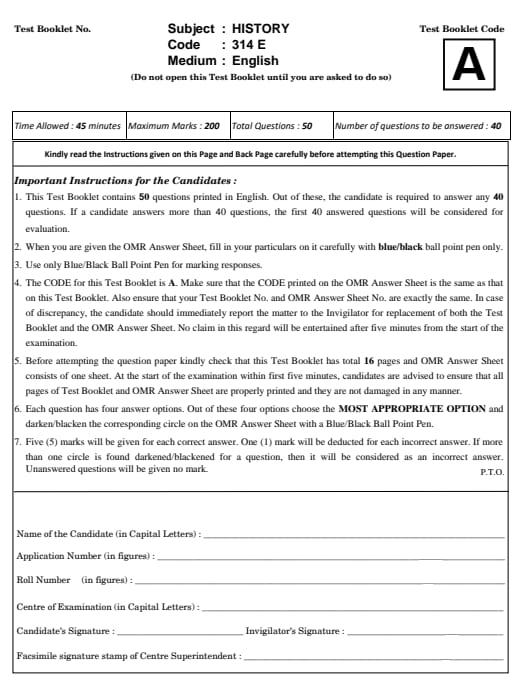
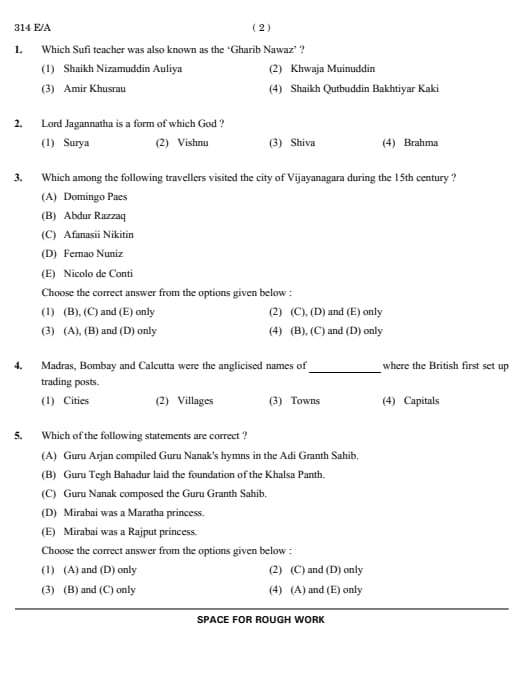
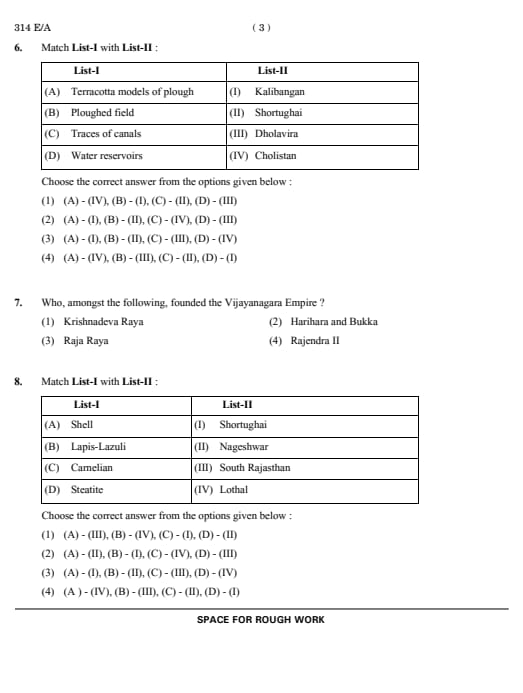
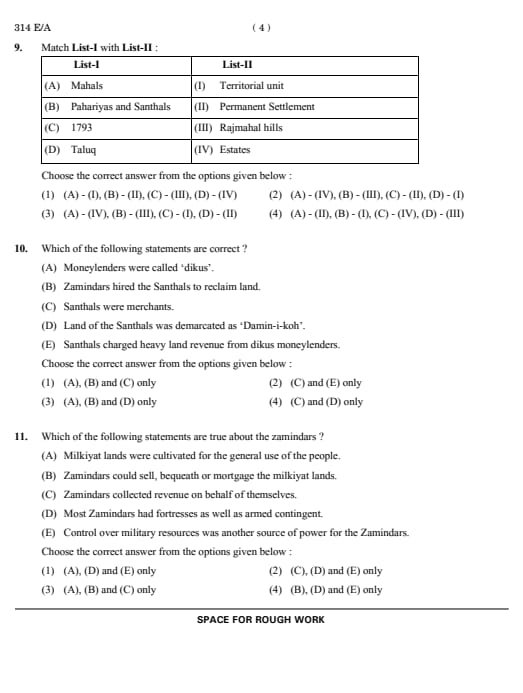
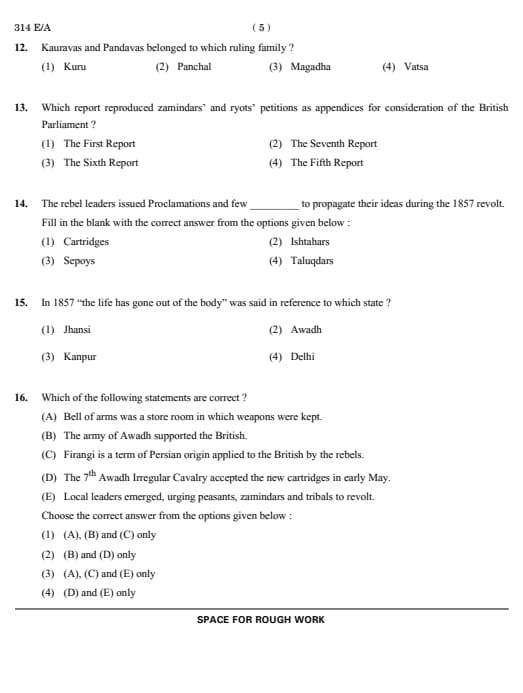
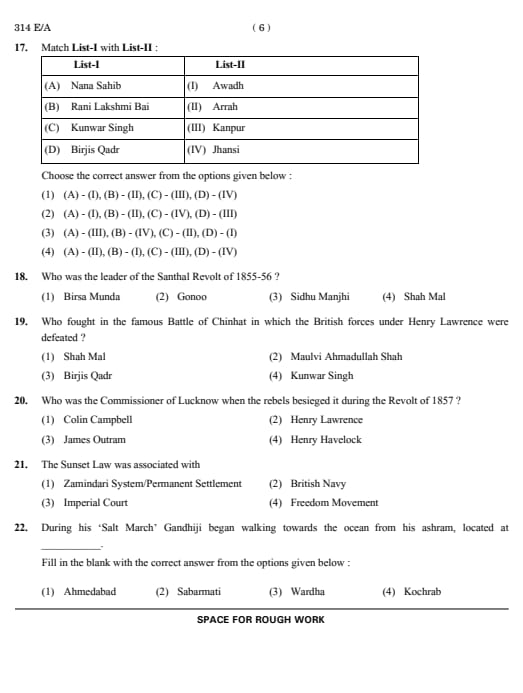
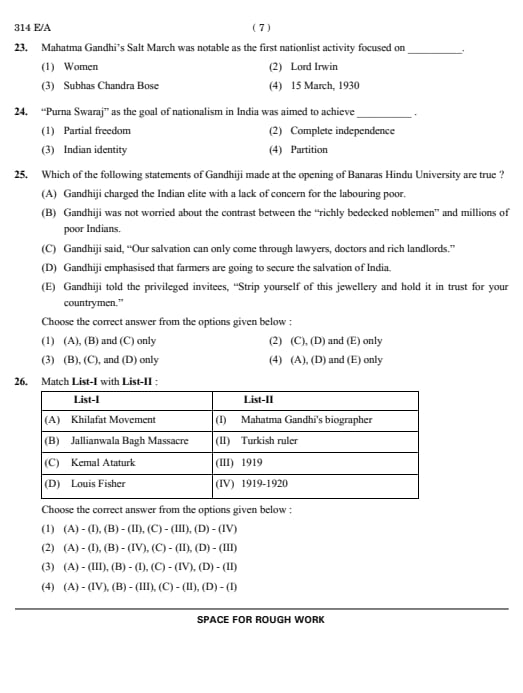
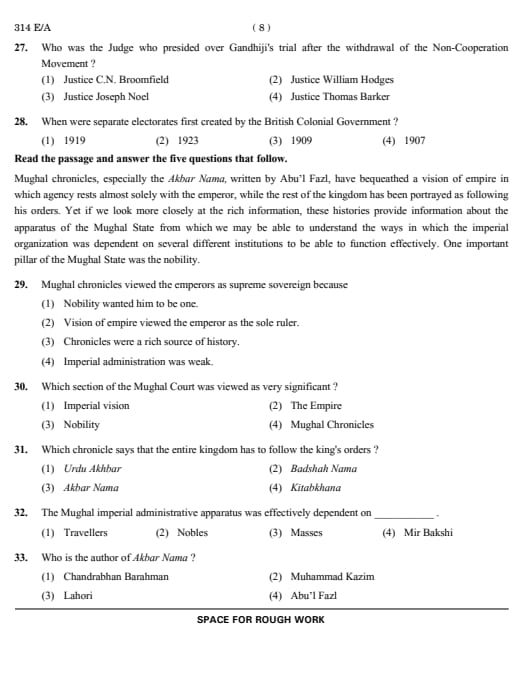
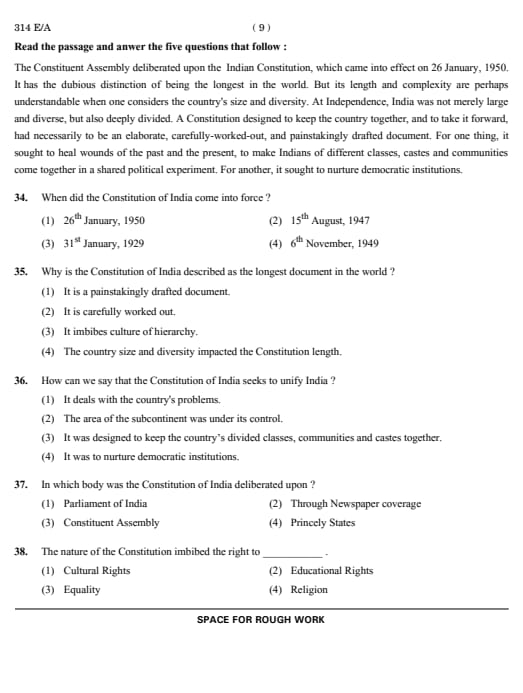
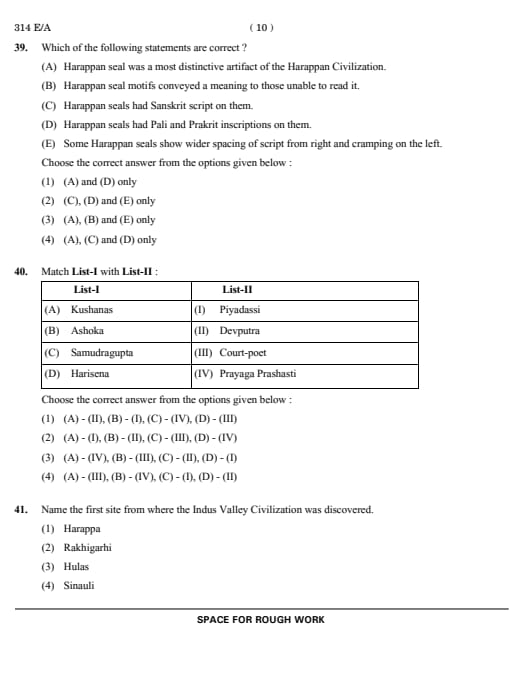
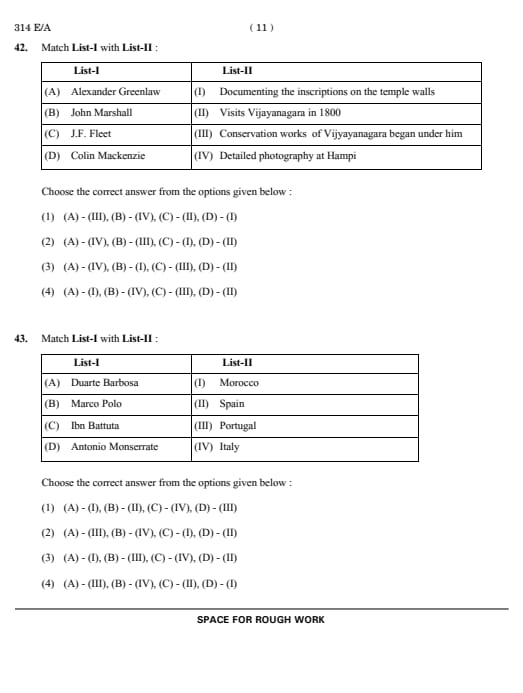
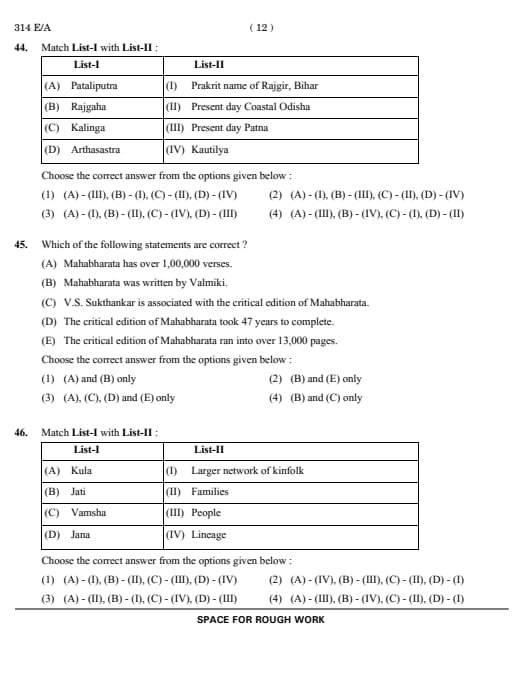
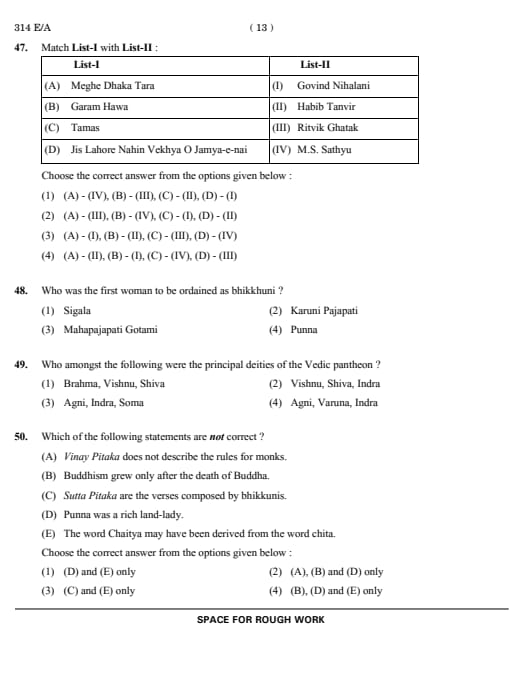




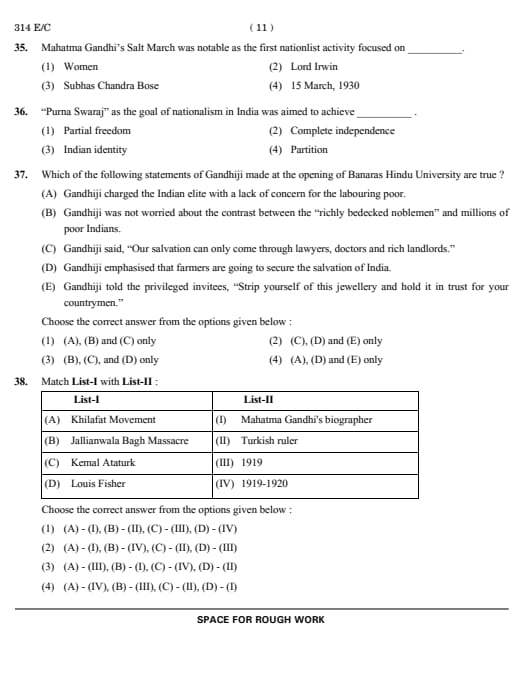





*The article might have information for the previous academic years, please refer the official website of the exam.