
CUET Home Science Question Paper 2024 (Available)- Download Solutions and Answer Key pdf


Content Writer | Updated On - Dec 8, 2024
Access the CUET Home Science Question Paper 2024. The NTA held the CUET 2024 Home Science exam on May 22 during Shift 2. This question paper comprises multiple-choice questions (MCQs) aimed at assessing candidates' knowledge. Test-takers had 45 minutes to answer 40 out of 50 MCQs in the CUET 2024 Home Science paper. Prepare effectively by practicing with this comprehensive question paper.
CUET 2024 Home Sciene Question Paper with Answer Key PDF
| CUET 2024 Home Science Question Paper with Answer Key |  Download Download |
Check Solution |
CUET 2024 Home Sciene Question Paper with Solution
| Question | Answer | Solution |
|---|---|---|
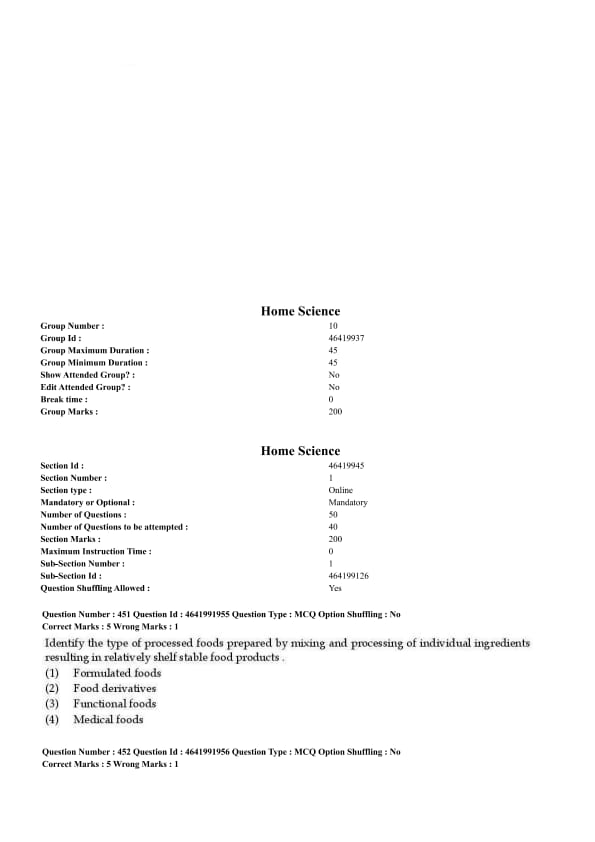
| Question 1: Identify the type of processed foods prepared by mixing and processing of individual ingredients resulting in relatively shelf-stable food products. (1) Formulated foods (2) Food derivatives (3) Functional foods (4) Medical foods |
Formulated foods | Formulated foods are created by combining various ingredients and processing them to produce shelf-stable products ready for consumption. |
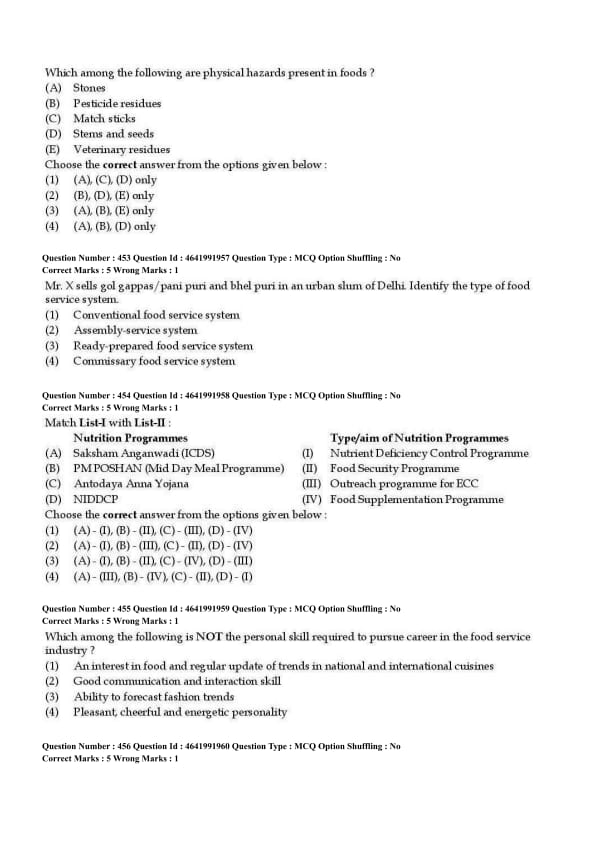
| Question 2: Which among the following are physical hazards present in foods? (A) Stones (B) Pesticide residues (C) Match sticks (D) Stems and seeds (E) Veterinary residues Choose the correct answer from the options given below: (1) (A), (C), (D) only (2) (B), (D), (E) only (3) (A), (B), (E) only (4) (A), (B), (D) only |
(A), (C), (D) only | Physical hazards in food are foreign objects like stones, matchsticks, and seeds that are unintentionally present. Pesticide and veterinary residues are chemical hazards. |
| Question 3: Mr. X sells gol gappas/pani puri and bhel puri in an urban slum of Delhi. Identify the type of food service system. (1) Conventional food service system (2) Assembly-service system (3) Ready-prepared food service system (4) Commissary food service system |
Conventional food service system | Conventional food service involves on-site preparation and immediate service. |
| Question 4: Match List-I with List-II: List-I (Nutrition Programmes) (A) Saksham Anganwadi (ICDS) (B) PMPOSHAN (Mid Day Meal Programme) (C) Antodaya Anna Yojana (D) NIDDCP List-II (Type/aim of Nutrition Programmes) (I) Nutrient Deficiency Control Programme (II) Food Security Programme (III) Outreach programme for ECC (IV) Food Supplementation Programme Choose the correct answer from the options given below: (1) (A)-(I), (B)-(II), (C)-(III), (D)-(IV) (2) (A)-(I), (B)-(III), (C)-(II), (D)-(IV) (3) (A)-(I), (B)-(II), (C)-(IV), (D)-(III) (4) (A)-(III), (B)-(IV), (C)-(II), (D)-(I) |
(A)-(III), (B)-(IV), (C)-(II), (D)-(I) | A: Saksham Anganwadi (ICDS) focuses on early childhood care (outreach). B: PMPOSHAN is a food supplementation program (Mid Day Meal). C: Antodaya Anna Yojana focuses on food security. D: NIDDCP addresses nutrient deficiency control. |
| Question 5: Which among the following is NOT a personal skill required to pursue a career in the food service industry? (1) An interest in food and regular updates of trends in national and international cuisines (2) Good communication and interaction skills (3) Ability to forecast fashion trends (4) Pleasant, cheerful, and energetic personality |
Ability to forecast fashion trends | Fashion forecasting is not directly relevant to the food service industry. Knowledge of food, communication skills, and a pleasant personality are essential. |
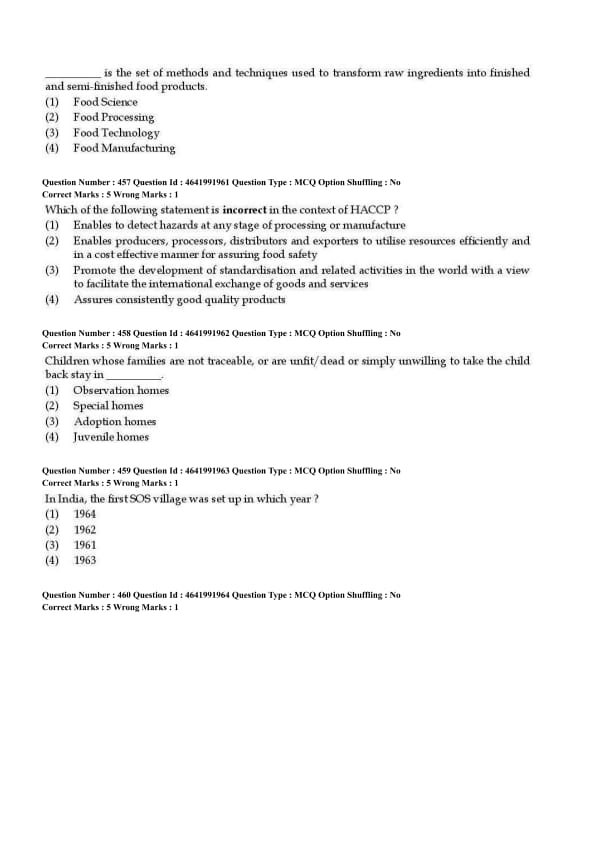
| Question 6: _______ is the set of methods and techniques used to transform raw ingredients into finished and semi-finished food products. (1) Food Science (2) Food Processing (3) Food Technology (4) Food Manufacturing |
Food Processing | Food processing specifically refers to the methods and techniques for converting raw ingredients into finished or semi-finished food products. Food science, technology, and manufacturing are broader fields. |
| Question 7: Which of the following statements is incorrect in the context of HACCP? (1) Enables to detect hazards at any stage of processing or manufacture (2) Enables producers, processors, distributors, and exporters to utilize resources efficiently and in a cost-effective manner for assuring food safety (3) Promotes the development of standardization and related activities in the world with a view to facilitate the international exchange of goods and services (4) Assures consistently good quality products |
Promotes the development of standardization and related activities in the world with a view to facilitate the international exchange of goods and services | HACCP focuses on food safety risk management, not international standardization or trade. |
| Question 8: Children whose families are not traceable, or are unfit/dead or simply unwilling to take the child back stay in: (1) Observation homes (2) Special homes (3) Adoption homes (4) Juvenile homes |
Special homes | Special homes provide long-term care for children with no traceable families or families unable or unwilling to care for them. |
| Question 9: In India, the first SOS village was set up in which year? (1) 1964 (2) 1962 (3) 1961 (4) 1963 |
1961 | The first SOS Children's Village in India was established in 1961. |
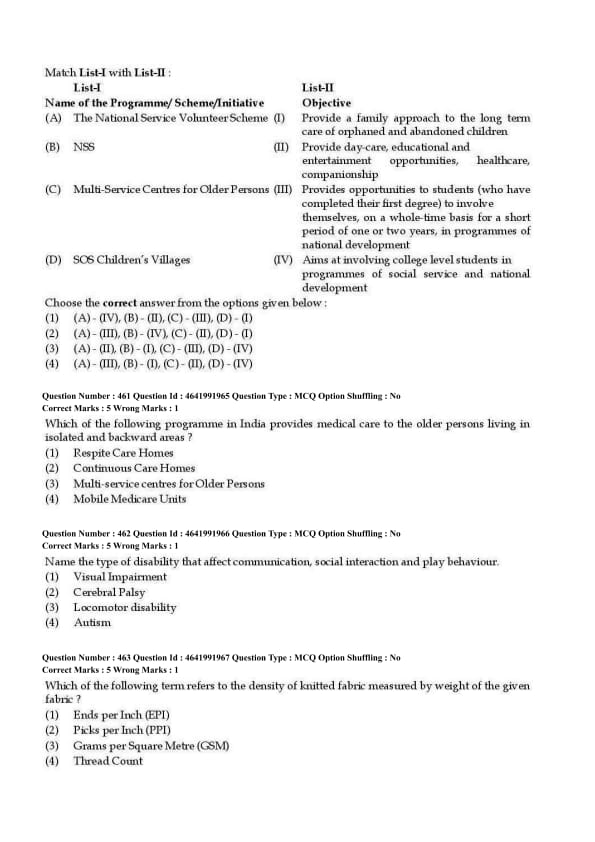
| Question 10: Match List-I with List-II: List-I (Name of the Programme/Scheme/Initiative) (A) The National Service Volunteer Scheme (B) NSS (C) Multi-Service Centres for Older Persons (D) SOS Children's Villages List-II (Objective) (I) Provide a family approach to the long-term care of orphaned and abandoned children (II) Provide day-care, educational and entertainment opportunities, healthcare, companionship (III) Provides opportunities to students (who have completed their first degree) to involve themselves, on a whole-time basis for a short period of one or two years, in programmes of national development (IV) Aims at involving college-level students in programmes of social service and national development Choose the correct answer from the options given below: (1) (A)-(IV), (B)-(II), (C)-(III), (D)-(I) (2) (A)-(III), (B)-(IV), (C)-(II), (D)-(I) (3) (A)-(II), (B)-(I), (C)-(III), (D)-(IV) (4) (A)-(III), (B)-(I), (C)-(II), (D)-(IV) |
(A)-(III), (B)-(IV), (C)-(II), (D)-(I) | A: National Service Volunteer Scheme provides opportunities for graduates in national development. B: NSS involves college students in social service and national development. C: Multi-Service Centres for Older Persons provide day-care, etc. D: SOS Children's Villages provide family-like care for orphans. |
| Question 11: Which of the following programme in India provides medical care to older persons living in isolated and backward areas? (1) Respite Care Homes (2) Continuous Care Homes (3) Multi-service centres for Older Persons (4) Mobile Medicare Units |
Mobile Medicare Units | Mobile Medicare Units are designed to provide healthcare outreach, particularly in remote or underserved areas. |
| Question 12: Name the type of disability that affects communication, social interaction, and play behavior. (1) Visual Impairment (2) Cerebral Palsy (3) Locomotor disability (4) Autism |
Autism | Autism is a developmental disorder primarily affecting communication, social interaction, and play behavior. |
| Question 13: Which of the following terms refers to the density of knitted fabric measured by the weight of the given fabric? (1) Ends per Inch (EPI) (2) Picks per Inch (PPI) (3) Grams per Square Metre (GSM) (4) Thread Count |
Grams per Square Metre (GSM) | GSM measures fabric density by weight per square meter. EPI, PPI, and thread count refer to thread density in woven fabrics. |
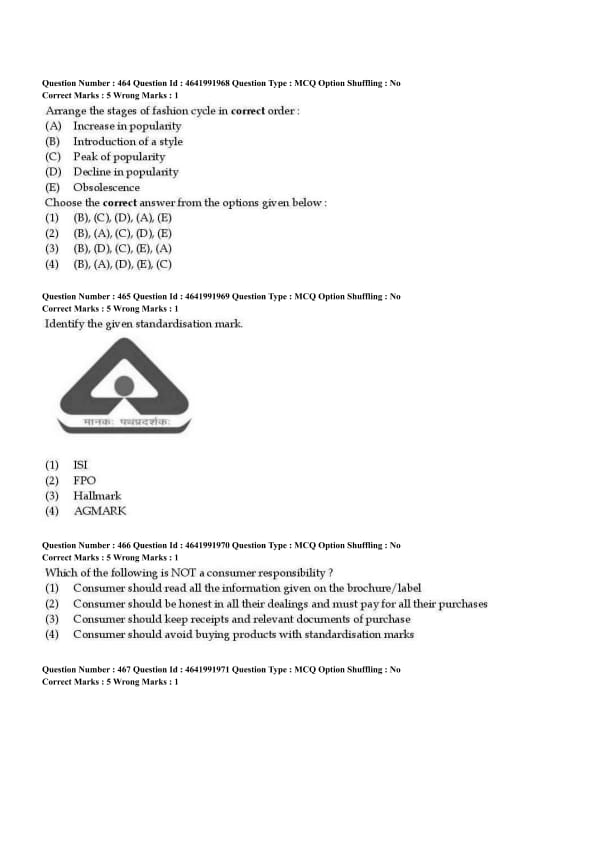
| Question 14: Arrange the stages of the fashion cycle in correct order: (A) Increase in popularity (B) Introduction of a style (C) Peak of popularity (D) Decline in popularity (E) Obsolescence (1) (B), (C), (D), (A), (E) (2) (B), (A), (C), (D), (E) (3) (B), (D), (C), (E), (A) (4) (B), (A), (D), (E), (C) |
(B), (A), (C), (D), (E) | The fashion cycle follows this order: introduction of a style, increase in popularity, peak popularity, decline in popularity, obsolescence. |
| Question 15: Identify the given standardization mark. (Refer to image in PDF) (1) ISI (2) FPO (3) Hallmark (4) AGMARK |
ISI | The ISI mark is used for industrial products in India, signifying quality and safety standards. |
| Question 16: Which of the following is NOT a consumer responsibility? (1) Consumer should read all the information given on the brochure/label (2) Consumer should be honest in all their dealings and must pay for all their purchases (3) Consumer should keep receipts and relevant documents of purchase (4) Consumer should avoid buying products with standardisation marks |
Consumer should avoid buying products with standardisation marks | Consumers should buy products with standardisation marks for quality assurance. |
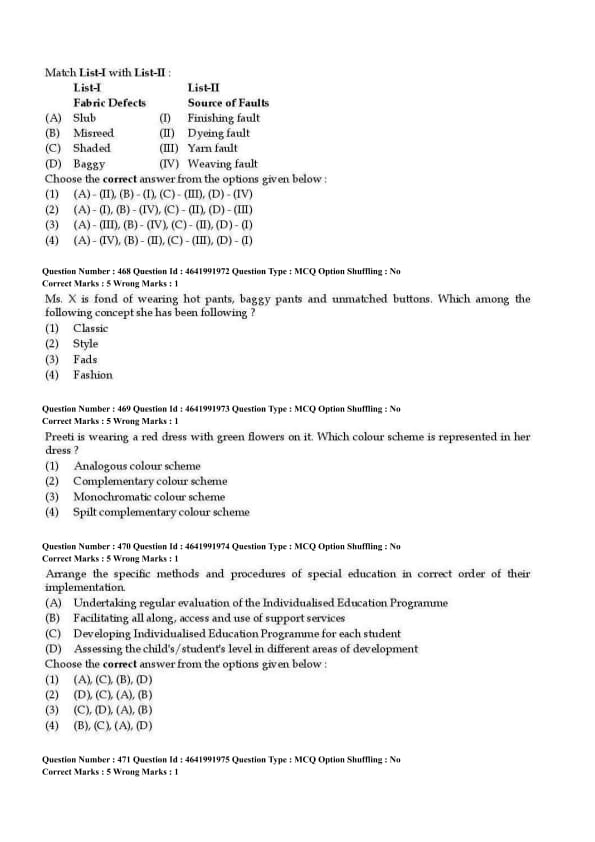
| Question 17: Match List-I with List-II: List-I (Fabric Defects) (A) Slub (B) Misreed (C) Shaded (D) Baggy List-II (Source of Faults) (I) Finishing fault (II) Dyeing fault (III) Yarn fault (IV) Weaving fault (1) (A)-(II), (B)-(I), (C)-(III), (D)-(IV) (2) (A)-(I), (B)-(IV), (C)-(II), (D)-(III) (3) (A)-(III), (B)-(IV), (C)-(II), (D)-(I) (4) (A)-(IV), (B)-(II), (C)-(III), (D)-(I) |
(A)-(III), (B)-(IV), (C)-(II), (D)-(I) | Slubs are yarn faults. Misreed is a weaving fault. Shaded is a dyeing fault. Baggy is a finishing fault. |
| Question 18: Ms. X is fond of wearing hot pants, baggy pants, and unmatched buttons. Which among the following concept is she following? (1) Classic (2) Style (3) Fads (4) Fashion |
Fads | Fads are short-lived fashion trends, unlike classic styles or established fashion. |
| Question 19: Preeti is wearing a red dress with green flowers on it. Which colour scheme is represented in her dress? (1) Analogous colour scheme (2) Complementary colour scheme (3) Monochromatic colour scheme (4) Split complementary colour scheme |
Complementary colour scheme | Red and green are complementary colors; they are opposite each other on the color wheel. |
| Question 20: Arrange the specific methods and procedures of special education in correct order of their implementation: (A) Undertaking regular evaluation of the Individualised Education Programme (B) Facilitating all along, access and use of support services (C) Developing Individualised Education Programme for each student (D) Assessing the child's/student's level in different areas of development (1) (A), (C), (B), (D) (2) (D), (C), (A), (B) (3) (C), (D), (A), (B) (4) (B), (C), (A), (D) |
(D), (C), (A), (B) | The correct order is: Assessment (D), then creating an Individualized Education Program (IEP) (C), then regular evaluation of the IEP (A), and finally facilitating support services (B). |
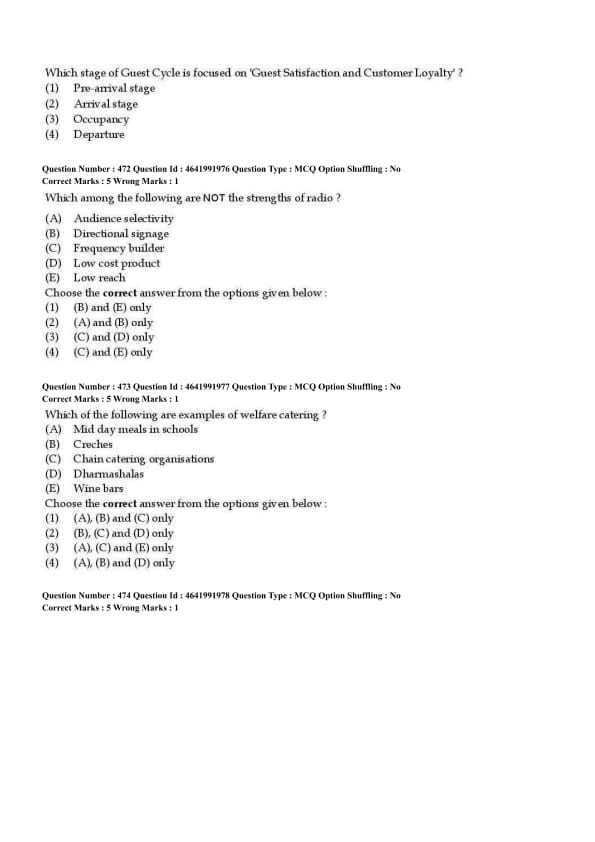
| Question 21: Which stage of the Guest Cycle is focused on ‘Guest Satisfaction and Customer Loyalty’? (1) Pre-arrival stage (2) Arrival stage (3) Occupancy (4) Departure |
Occupancy | Guest satisfaction and loyalty are primarily built during the occupancy stage through attentive service. |
| Question 22: Which among the following are NOT strengths of radio? (A) Audience selectivity (B) Directional signage (C) Frequency builder (D) Low cost product (E) Low reach (1) (B) and (E) only (2) (A) and (B) only (3) (C) and (D) only (4) (C) and (E) only |
(B) and (E) only | Radio excels in audience selectivity, frequency building, and low-cost production but lacks visual elements (directional signage) and may have limited reach. |
| Question 23: Which of the following are examples of welfare catering? (A) Mid day meals in schools (B) Creches (C) Chain catering organisations (D) Dharmashalas (E) Wine bars (1) (A), (B) and (C) only (2) (B), (C) and (D) only (3) (A), (C) and (E) only (4) (A), (B) and (D) only |
(A), (B) and (D) only | Welfare catering focuses on providing meals and care in non-commercial settings like schools, creches, and dharmashalas. |
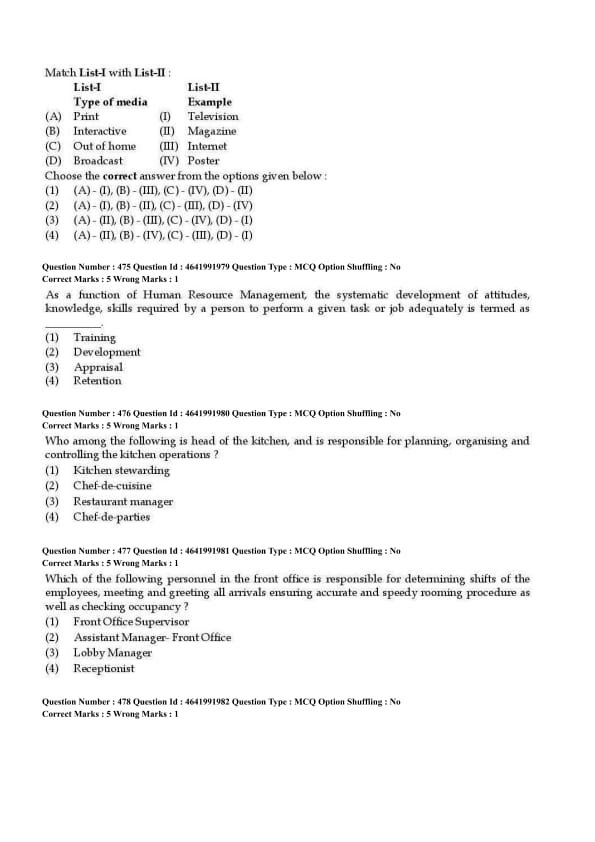
| Question 24: Match List-I with List-II: List-I (Type of media) (A) Print (B) Interactive (C) Out of home (D) Broadcast List-II (Example) (I) Television (II) Magazine (III) Internet (IV) Poster (1) (A)-(I), (B)-(III), (C)-(IV), (D)-(II) (2) (A)-(I), (B)-(II), (C)-(III), (D)-(IV) (3) (A)-(II), (B)-(III), (C)-(IV), (D)-(I) (4) (A)-(II), (B)-(IV), (C)-(III), (D)-(I) |
(A)-(II), (B)-(III), (C)-(IV), (D)-(I) | Print media includes magazines, interactive media is the internet, out-of-home media uses posters, and broadcast media is television. |
| Question 25: As a function of Human Resource Management, the systematic development of attitudes, knowledge, and skills required by a person to perform a given task or job adequately is termed as: (1) Training (2) Development (3) Appraisal (4) Retention |
Training | Training focuses on job-specific skills and knowledge. Development is broader and focuses on personal growth. Appraisal evaluates performance, and retention is about keeping employees. |
| Question 26: Who among the following is head of the kitchen, and is responsible for planning, organizing, and controlling the kitchen operations? (1) Kitchen stewarding (2) Chef-de-cuisine (3) Restaurant manager (4) Chef-de-parties |
Chef-de-cuisine | The chef-de-cuisine (executive chef) is the head of the kitchen and is responsible for its operations. |
| Question 27: Which of the following personnel in the front office is responsible for determining shifts of the employees, meeting and greeting all arrivals, ensuring accurate and speedy rooming procedure, as well as checking occupancy? (1) Front Office Supervisor (2) Assistant Manager- Front Office (3) Lobby Manager (4) Receptionist |
Lobby Manager | The Lobby Manager oversees the smooth functioning of the front office, including employee scheduling and guest arrival management. |
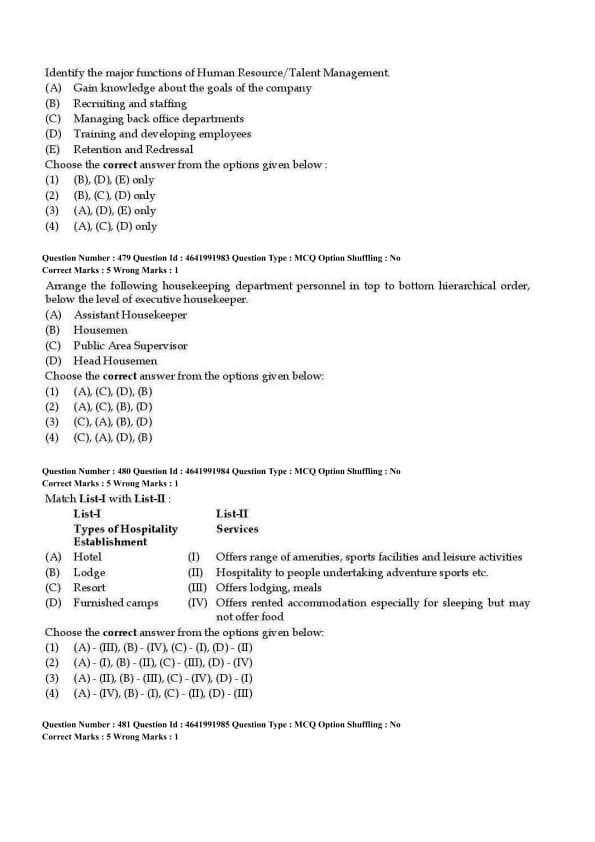
| Question 28: Identify the major functions of Human Resource/Talent Management: (A) Gain knowledge about the goals of the company (B) Recruiting and staffing (C) Managing back office departments (D) Training and developing employees (E) Retention and Redressal (1) (B), (D), (E) only (2) (B), (C), (D) only (3) (A), (D), (E) only (4) (A), (C), (D) only |
(B), (D), (E) only | Key HR functions include recruiting, training and development, and retention. Managing back office departments is not a core HR function. |
| Question 29: Arrange the following housekeeping department personnel in top-to-bottom hierarchical order, below the level of Executive Housekeeper: (A) Assistant Housekeeper (B) Housemen (C) Public Area Supervisor (D) Head Housemen (1) (A), (C), (D), (B) (2) (A), (C), (B), (D) (3) (C), (A), (B), (D) (4) (C), (A), (D), (B) |
(A), (C), (D), (B) | The typical hierarchy is: Assistant Housekeeper, Public Area Supervisor, Head Housemen, Housemen. |
| Question 30: Match List-I with List-II: List-I (Types of Hospitality Establishment) (A) Hotel (B) Lodge (C) Resort (D) Furnished camps List-II (Services) (I) Offers range of amenities, sports facilities and leisure activities (II) Hospitality to people undertaking adventure sports, etc. (III) Offers lodging, meals (IV) Offers rented accommodation especially for sleeping but may not offer food (1) (A)-(III), (B)-(IV), (C)-(I), (D)-(II) (2) (A)-(I), (B)-(II), (C)-(III), (D)-(IV) (3) (A)-(II), (B)-(III), (C)-(IV), (D)-(I) (4) (A)-(IV), (B)-(I), (C)-(II), (D)-(III) |
(A)-(III), (B)-(IV), (C)-(I), (D)-(II) | Hotels typically offer lodging and meals. Lodges offer basic accommodation. Resorts offer a wide range of amenities. Furnished camps mainly provide sleeping accommodations. |
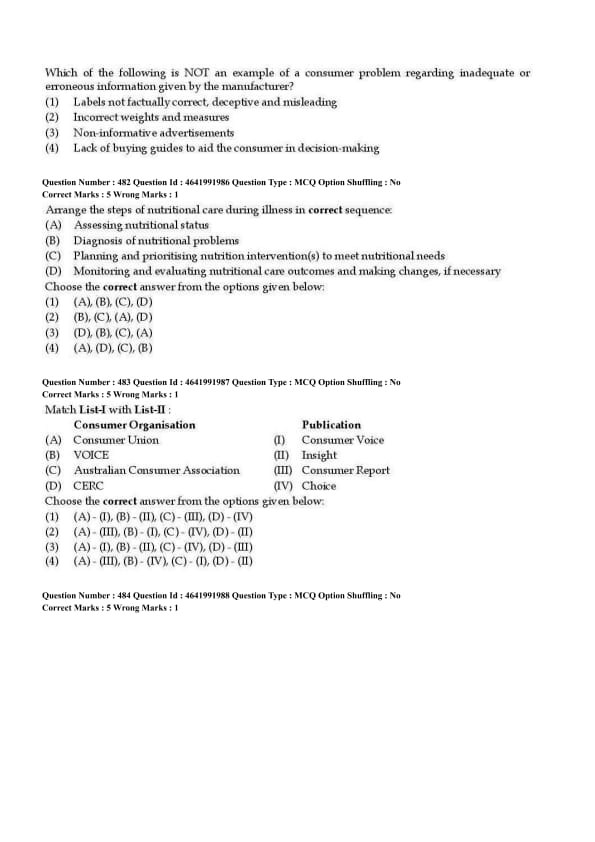
| Question 31: Which of the following is NOT an example of a consumer problem regarding inadequate or erroneous information given by the manufacturer? (1) Labels not factually correct, deceptive and misleading (2) Incorrect weights and measures (3) Non-informative advertisements (4) Lack of buying guides to aid the consumer in decision-making |
Lack of buying guides to aid the consumer in decision-making | Lack of buying guides is a consumer information problem, not directly related to manufacturer misinformation. |
| Question 32: Arrange the steps of nutritional care during illness in correct sequence: (A) Assessing nutritional status (B) Diagnosis of nutritional problems (C) Planning and prioritising nutrition intervention(s) to meet nutritional needs (D) Monitoring and evaluating nutritional care outcomes and making changes, if necessary (1) (A), (B), (C), (D) (2) (B), (C), (A), (D) (3) (D), (B), (C), (A) (4) (A), (D), (C), (B) |
(A), (B), (C), (D) | Nutritional care follows a logical sequence: assessment, diagnosis, planning, and monitoring/evaluation. |
| Question 33: Match List-I with List-II: List-I (Consumer Organisation) (A) Consumer Union (B) VOICE (C) Australian Consumer Association (D) CERC List-II (Publication) (I) Consumer Voice (II) Insight (III) Consumer Report (IV) Choice (1) (A)-(I), (B)-(II), (C)-(III), (D)-(IV) (2) (A)-(III), (B)-(I), (C)-(IV), (D)-(II) (3) (A)-(I), (B)-(II), (C)-(IV), (D)-(III) (4) (A)-(III), (B)-(IV), (C)-(I), (D)-(II) |
(A)-(III), (B)-(I), (C)-(IV), (D)-(II) | These are well-known consumer organizations and their associated publications. |
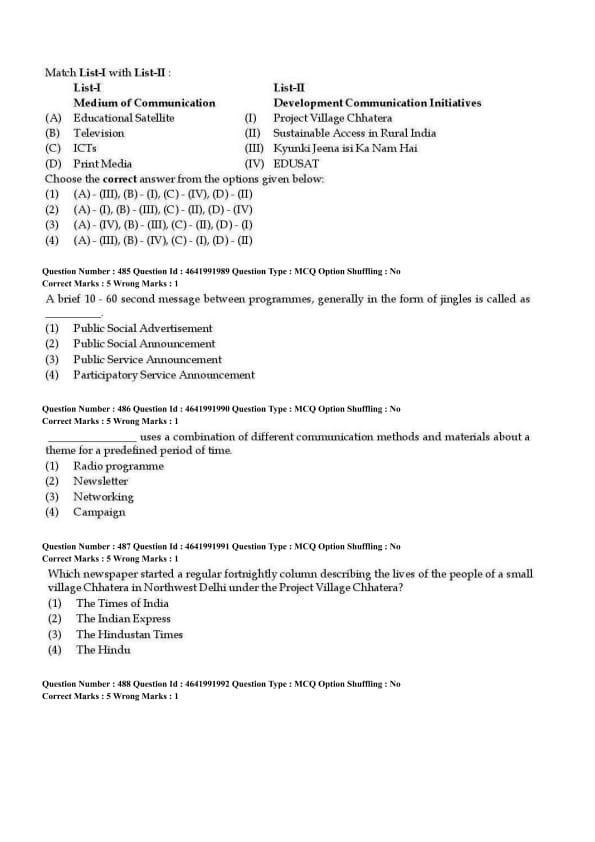
| Question 34: Match List-I with List-II: List-I (Medium of Communication) (A) Educational Satellite (B) Television (C) ICTs (D) Print Media List-II (Development Communication Initiatives) (I) Project Village Chhatera (II) Sustainable Access in Rural India (III) Kyunki Jeena Isi Ka Naam Hai (IV) EDUSAT (1) (A)-(III), (B)-(I), (C)-(IV), (D)-(II) (2) (A)-(I), (B)-(III), (C)-(II), (D)-(IV) (3) (A)-(IV), (B)-(III), (C)-(II), (D)-(I) (4) (A)-(III), (B)-(IV), (C)-(I), (D)-(II) |
(A)-(IV), (B)-(III), (C)-(II), (D)-(I) | EDUSAT is an educational satellite program. The TV serial "Kyunki Jeena Isi Ka Naam Hai" was used for awareness. ICTs were used to improve access in rural areas. The Project Village Chhatera used print media. |
| Question 35: A brief 10-60 second message between programmes, generally in the form of jingles, is called: (1) Public Social Advertisement (2) Public Social Announcement (3) Public Service Announcement (4) Participatory Service Announcement |
Public Service Announcement | A Public Service Announcement (PSA) is a short message used to raise awareness or educate the public on a specific issue. |
| Question 36: ________ uses a combination of different communication methods and materials about a theme for a predefined period of time. (1) Radio programme (2) Newsletter (3) Networking (4) Campaign |
Campaign | A campaign uses multiple communication methods to promote a theme over time. |
| Question 37: Which newspaper started a regular fortnightly column describing the lives of the people of a small village, Chhatera, in Northwest Delhi under the Project Village Chhatera? (1) The Times of India (2) The Indian Express (3) The Hindustan Times (4) The Hindu |
The Hindustan Times | The Hindustan Times is known for its community-focused reporting. |
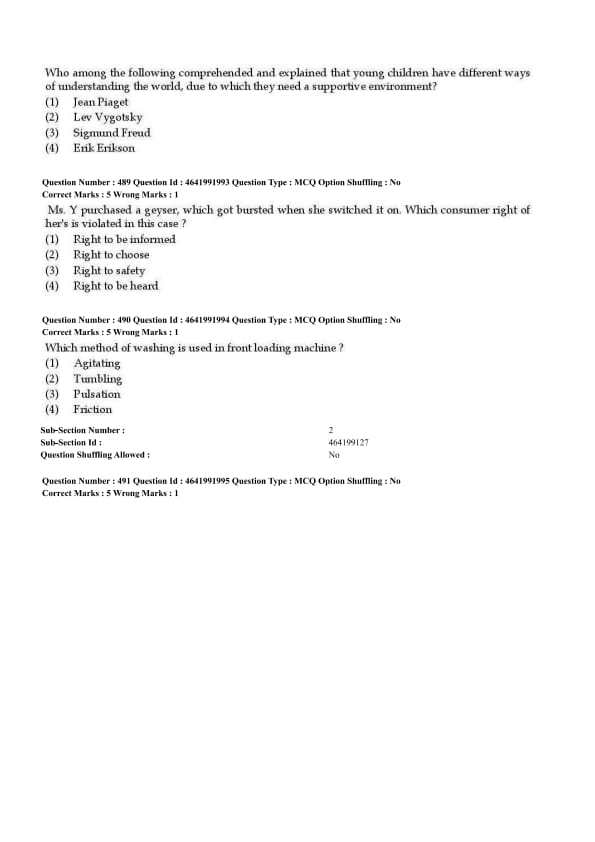
| Question 38: Who among the following comprehended and explained that young children have different ways of understanding the world, due to which they need a supportive environment? (1) Jean Piaget (2) Lev Vygotsky (3) Sigmund Freud (4) Erik Erikson |
Jean Piaget | Jean Piaget's theory of cognitive development emphasizes the importance of supportive environments for children's learning. |
| Question 39: Ms. Y purchased a geyser, which burst when she switched it on. Which consumer right of hers is violated in this case? (1) Right to be informed (2) Right to choose (3) Right to safety (4) Right to be heard |
Right to safety | A faulty product that poses a safety risk violates the consumer's right to safety. |
| Question 40: Which method of washing is used in a front-loading machine? (1) Agitating (2) Tumbling (3) Pulsation (4) Friction |
Tumbling | Front-loading washing machines use a tumbling action to clean clothes. |
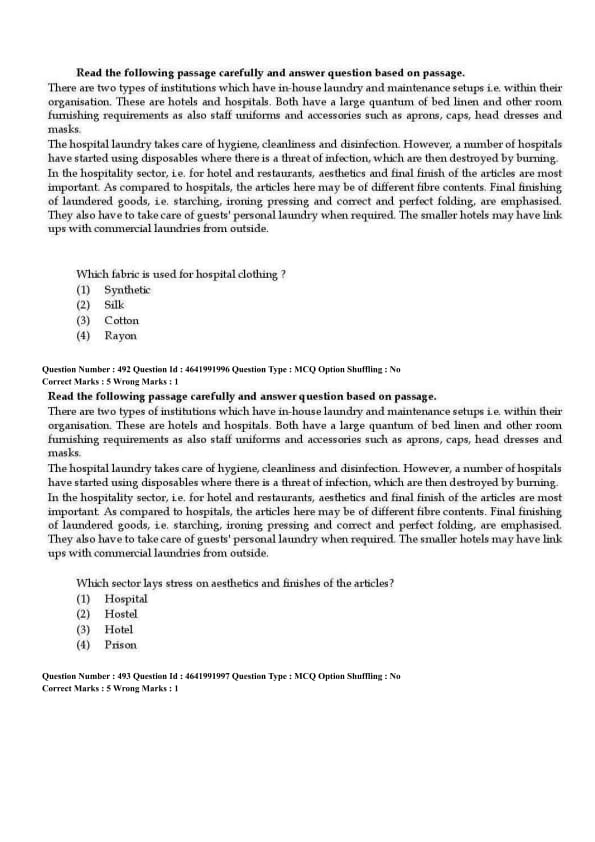
| Question 41: Which fabric is used for hospital clothing? (1) Synthetic (2) Silk (3) Cotton (4) Rayon |
Cotton | Cotton is preferred for hospital clothing due to its breathability, comfort, and ease of sterilization. |
| Question 42: Which sector lays stress on aesthetics and finishes of the articles? (1) Hospital (2) Hostel (3) Hotel (4) Prison |
Hotel | The hospitality sector, particularly hotels, emphasizes aesthetics and finishes to enhance guest experience. |
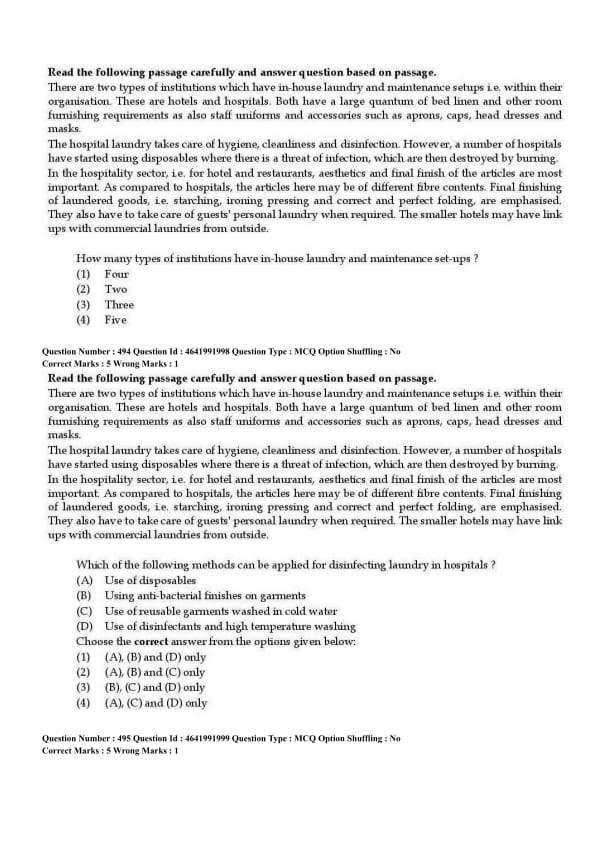
| Question 43: How many types of institutions have in-house laundry and maintenance set-ups? (1) Four (2) Two (3) Three (4) Five |
Two | The passage mentions hotels and hospitals as having in-house laundry and maintenance. |
| Question 44: Which of the following methods can be applied for disinfecting laundry in hospitals? (A) Use of disposables (B) Using anti-bacterial finishes on garments (C) Use of reusable garments washed in cold water (D) Use of disinfectants and high-temperature washing (1) (A), (B) and (D) only (2) (A), (B) and (C) only (3) (B), (C) and (D) only (4) (A), (C) and (D) only |
(A), (B) and (D) only | Disposables minimize infection risks. Anti-bacterial finishes reduce contamination. High-temperature washing with disinfectants kills pathogens. |
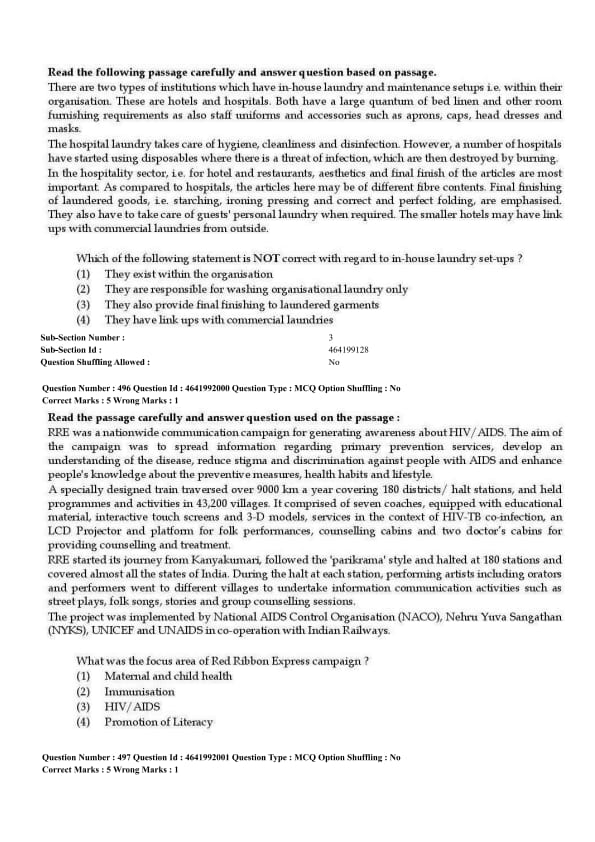
| Question 45: Which of the following statements is NOT correct with regard to in-house laundry set-ups? (1) They exist within the organisation (2) They are responsible for washing organisational laundry only (3) They also provide final finishing to laundered garments (4) They have link-ups with commercial laundries |
They have link-ups with commercial laundries | In-house laundries typically handle all laundry needs independently; they don't usually rely on external commercial laundries. |
| Question 46: What was the focus area of the Red Ribbon Express campaign? (1) Maternal and child health (2) Immunisation (3) HIV/AIDS (4) Promotion of Literacy |
HIV/AIDS | The Red Ribbon Express campaign focused on raising awareness and providing education about HIV/AIDS prevention. |
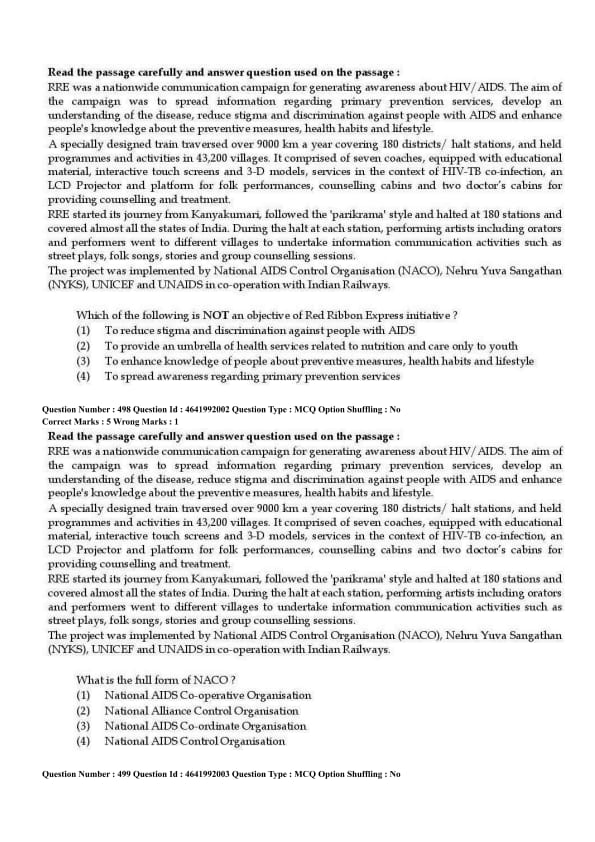
| Question 47: Which of the following is NOT an objective of the Red Ribbon Express initiative? (1) To reduce stigma and discrimination against people with AIDS (2) To provide an umbrella of health services related to nutrition and care only to youth (3) To enhance knowledge of people about preventive measures, health habits, and lifestyle (4) To spread awareness regarding primary prevention services |
To provide an umbrella of health services related to nutrition and care only to youth | The Red Ribbon Express campaign aimed to raise awareness across all demographics, not just youth. |
| Question 48: What is the full form of NACO? (1) National AIDS Co-operative Organisation (2) National Alliance Control Organisation (3) National AIDS Co-ordinate Organisation (4) National AIDS Control Organisation |
National AIDS Control Organisation | NACO stands for National AIDS Control Organisation. |
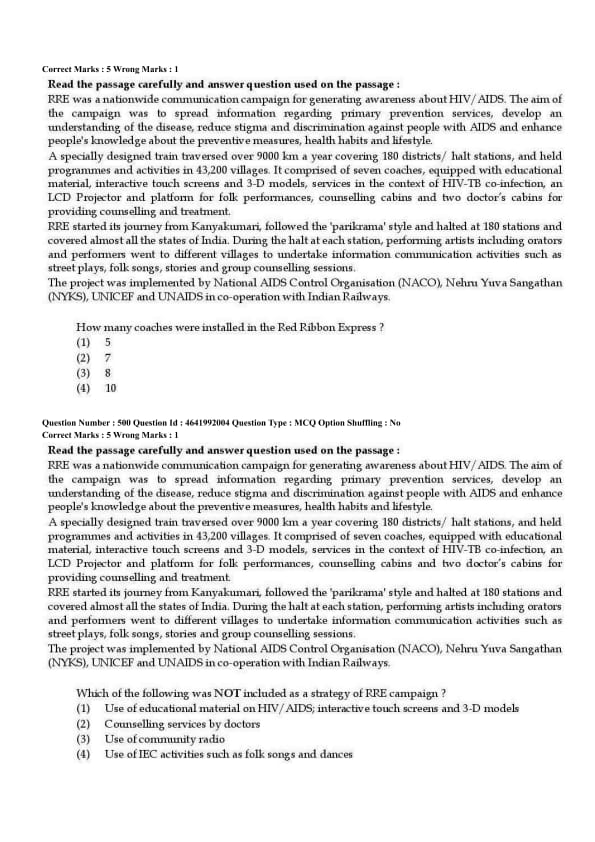
| Question 49: How many coaches were installed in the Red Ribbon Express? (1) 5 (2) 7 (3) 8 (4) 10 |
7 | The Red Ribbon Express train comprised seven coaches. |
| Question 50: Which of the following was NOT included as a strategy of the RRE campaign? (1) Use of educational material on HIV/AIDS; interactive touch screens and 3-D models (2) Counselling services by doctors (3) Use of community radio (4) Use of IEC activities such as folk songs and dances |
Use of community radio | The RRE campaign focused on direct interaction and educational tools, not community radio. |
*The article might have information for the previous academic years, please refer the official website of the exam.